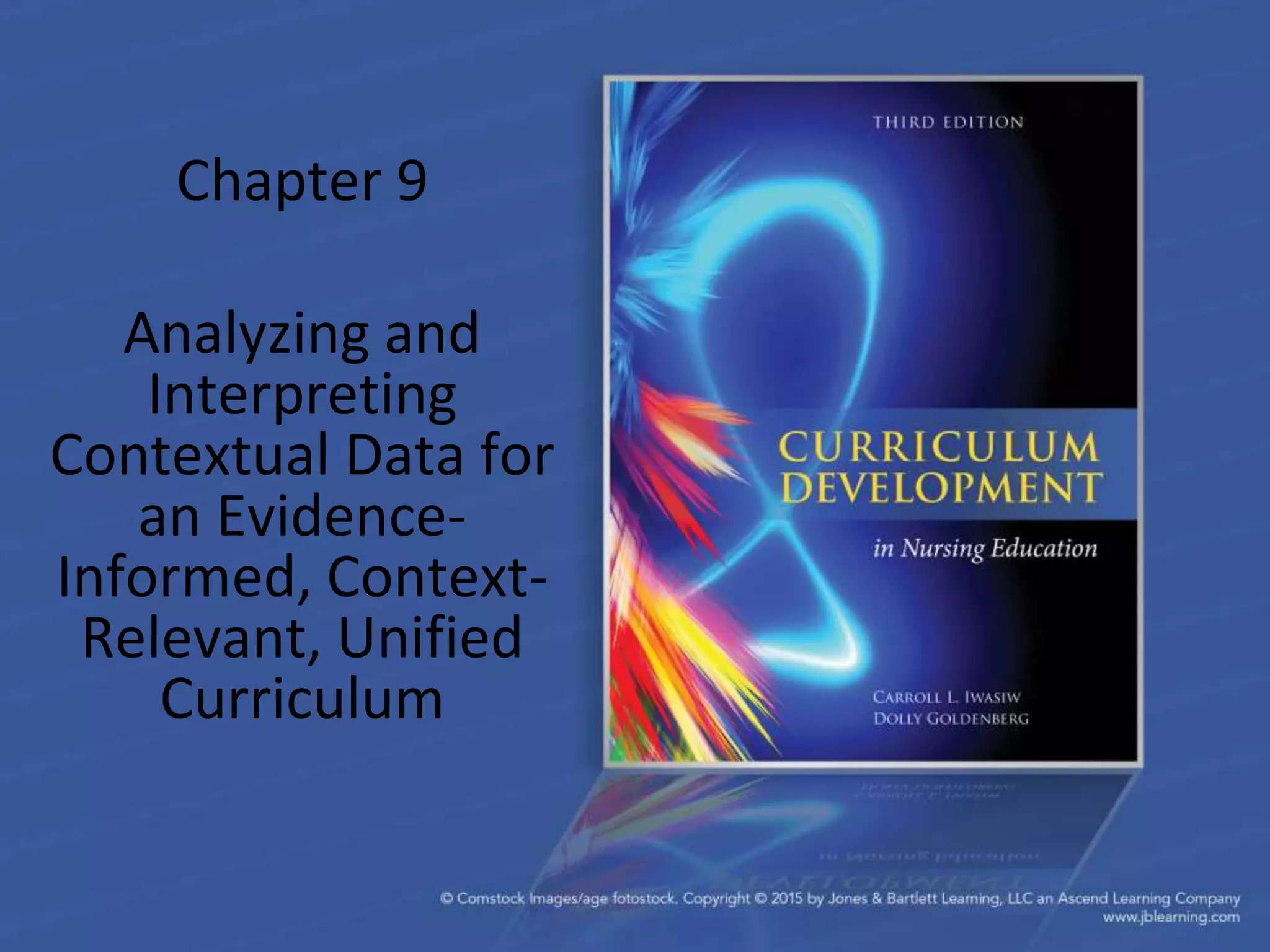
Chapter 9
Analyzing and
Interpreting
Contextual Data for
an Evidence-
Informed, Context-
Relevant, Unified
Curriculum
Overview
• Once data gathering related to internal and
external context is complete, results can
be integrated into clear understanding of
curriculum impact.
• Contextual data become the basis from
which curriculum concepts and
professional abilities are derived, and
curriculum possibilities become evident.
Analysis and Interpretation of
Contextual Data
• The following processes are part of the
analysis, interpretation, and synthesis of
contextual data:
– Examination and integration
– Identifying trends and patterns
– Proposing curriculum possibilities
– Deducing curriculum possibilities
– Identifying administrative issues
• These generally occur in tandem.
Analysis and Interpretation of
Contextual Data (cont.)
• Examining and integrating contextual data
– An activity for the total faculty group.
– Individual and small-group reviews form basis
for total faculty group discussion, where trends
and patterns are identified.
– Curriculum developers can ask:
• What data are available about this contextual
factor?
• What patterns and/or trends emerge from the data
about this one factor?
Analysis and Interpretation of
Contextual Data (cont.)
• Examining and integrating contextual data
(cont.)
– Examine available data about specific factors
and how it relates to other factors
– Ask the following questions:
• How do data about one factor influence other
factors?
• If trends continue, how might other contextual
factors be influenced?
• What are the dominant features of the context in
which graduates will practice nursing?
Analysis and Interpretation of
Contextual Data (cont.)
• Inferring curriculum concepts and
professional abilities
– Curriculum developers can ask:
• What inferences about important curriculum
concepts can be made from contextual data?
• What inferences about professional abilities can be
made from contextual data?
• What additional ideas about relevant curriculum
concepts arrive from the professional abilities?
• What additional ideas about professional abilities
arise from curriculum concepts?
Analysis and Interpretation of
Contextual Data (cont.)
• Proposing curriculum possibilities
– In an effort to determine the curriculum
possibilities of the contextual data, curriculum
concepts, and professional abilities, consider
the following:
• Curriculum design options?
• Courses?
• Potential fit with content areas?
• Educational processes and experiences?
Analysis and Interpretation of
Contextual Data (cont.)
• Identifying curriculum limitations
– Restrictions or constraints on teaching-learning
experiences and curriculum design based on
pragmatic, logical interpretation of data.
– Curriculum builders might ask:
• How do contextual data and trends constrain what
might be possible in the curriculum?
• What restrictions are evident based on required
curriculum concepts and professional abilities?
Analysis and Interpretation of
Contextual Data (cont.)
• Deducing administrative issues
– Administrative issues beyond the authority of
faculty members to resolve can significantly
affect the new curriculum.
– These typically include:
• Logistical
• Personnel
• Budgetary
– Administrative issues should be presented to
the school leader for possible resolution.
Determining Core Curriculum Concepts
and Key Professional Abilities
• Synthesizing core curriculum concepts
– Abstract ideas that form curriculum substance.
– Core curriculum concepts:
• Are overriding ideas nurses should know.
• Shape students’ views about clients and how nurses
think and behave.
• Permeate and are prominent throughout the
curriculum.
• Are part of curriculum content and of the structure
used to organize content.
• Reflect an integrated analysis of contextual data.
Determining Core Curriculum Concepts
and Key Professional Abilities (cont.)
• Synthesizing key professional abilities
– Capabilities necessary for nursing practice that
encompass:
• Cognitive
• Affective
• Technical
• Interpersonal skills
• Ethical decision making
• Professional judgment
Determining Core Curriculum Concepts
and Key Professional Abilities (cont.)
• Synthesizing key professional abilities (cont.)
– Key professional abilities:
• Are overriding professional abilities that nurses utilize
in all practice contexts.
• Shape students’ thinking about the nature of the
nursing practice.
• Permeate, emphasized throughout curriculum.
• Form part of the curriculum content.
• Are evident in professional practice experiences.
• Reflect an integrated analysis of contextual data.
Determining Core Curriculum Concepts
and Key Professional Abilities (cont.)
• Confirming core curriculum concepts and key
professional abilities
– Curriculum team must employ its professional
judgment about the derived core curriculum
concepts and key professional abilities.
– Considerable discussion may be needed for
consensus.
– Total faculty group resolution is essential.
Relationship of Analysis
• Contextual data provide evidence for
curriculum design.
• Core curriculum concepts and key
professional abilities taken from contextual
data ensure these aspects are evidence
informed and context relevant.
• Ensures core concepts, key abilities are
prominent throughout curriculum.
Core Processes of Curriculum Work
• Faculty development
– Expand understanding of deriving the core
curriculum concepts, and key professional
abilities, and how they apply to development.
• Ongoing appraisal
– Inherent in identification of core curriculum
concepts and key professional abilities.
• Scholarship
– Possibilities related to analyzing, interpreting
contextual data.

Iwasiw ppts ch09_3_e

  • 1.
    Chapter 9 Analyzing and Interpreting ContextualData for an Evidence- Informed, Context- Relevant, Unified Curriculum
  • 2.
    Overview • Once datagathering related to internal and external context is complete, results can be integrated into clear understanding of curriculum impact. • Contextual data become the basis from which curriculum concepts and professional abilities are derived, and curriculum possibilities become evident.
  • 3.
    Analysis and Interpretationof Contextual Data • The following processes are part of the analysis, interpretation, and synthesis of contextual data: – Examination and integration – Identifying trends and patterns – Proposing curriculum possibilities – Deducing curriculum possibilities – Identifying administrative issues • These generally occur in tandem.
  • 4.
    Analysis and Interpretationof Contextual Data (cont.) • Examining and integrating contextual data – An activity for the total faculty group. – Individual and small-group reviews form basis for total faculty group discussion, where trends and patterns are identified. – Curriculum developers can ask: • What data are available about this contextual factor? • What patterns and/or trends emerge from the data about this one factor?
  • 5.
    Analysis and Interpretationof Contextual Data (cont.) • Examining and integrating contextual data (cont.) – Examine available data about specific factors and how it relates to other factors – Ask the following questions: • How do data about one factor influence other factors? • If trends continue, how might other contextual factors be influenced? • What are the dominant features of the context in which graduates will practice nursing?
  • 6.
    Analysis and Interpretationof Contextual Data (cont.) • Inferring curriculum concepts and professional abilities – Curriculum developers can ask: • What inferences about important curriculum concepts can be made from contextual data? • What inferences about professional abilities can be made from contextual data? • What additional ideas about relevant curriculum concepts arrive from the professional abilities? • What additional ideas about professional abilities arise from curriculum concepts?
  • 7.
    Analysis and Interpretationof Contextual Data (cont.) • Proposing curriculum possibilities – In an effort to determine the curriculum possibilities of the contextual data, curriculum concepts, and professional abilities, consider the following: • Curriculum design options? • Courses? • Potential fit with content areas? • Educational processes and experiences?
  • 8.
    Analysis and Interpretationof Contextual Data (cont.) • Identifying curriculum limitations – Restrictions or constraints on teaching-learning experiences and curriculum design based on pragmatic, logical interpretation of data. – Curriculum builders might ask: • How do contextual data and trends constrain what might be possible in the curriculum? • What restrictions are evident based on required curriculum concepts and professional abilities?
  • 9.
    Analysis and Interpretationof Contextual Data (cont.) • Deducing administrative issues – Administrative issues beyond the authority of faculty members to resolve can significantly affect the new curriculum. – These typically include: • Logistical • Personnel • Budgetary – Administrative issues should be presented to the school leader for possible resolution.
  • 10.
    Determining Core CurriculumConcepts and Key Professional Abilities • Synthesizing core curriculum concepts – Abstract ideas that form curriculum substance. – Core curriculum concepts: • Are overriding ideas nurses should know. • Shape students’ views about clients and how nurses think and behave. • Permeate and are prominent throughout the curriculum. • Are part of curriculum content and of the structure used to organize content. • Reflect an integrated analysis of contextual data.
  • 11.
    Determining Core CurriculumConcepts and Key Professional Abilities (cont.) • Synthesizing key professional abilities – Capabilities necessary for nursing practice that encompass: • Cognitive • Affective • Technical • Interpersonal skills • Ethical decision making • Professional judgment
  • 12.
    Determining Core CurriculumConcepts and Key Professional Abilities (cont.) • Synthesizing key professional abilities (cont.) – Key professional abilities: • Are overriding professional abilities that nurses utilize in all practice contexts. • Shape students’ thinking about the nature of the nursing practice. • Permeate, emphasized throughout curriculum. • Form part of the curriculum content. • Are evident in professional practice experiences. • Reflect an integrated analysis of contextual data.
  • 13.
    Determining Core CurriculumConcepts and Key Professional Abilities (cont.) • Confirming core curriculum concepts and key professional abilities – Curriculum team must employ its professional judgment about the derived core curriculum concepts and key professional abilities. – Considerable discussion may be needed for consensus. – Total faculty group resolution is essential.
  • 14.
    Relationship of Analysis •Contextual data provide evidence for curriculum design. • Core curriculum concepts and key professional abilities taken from contextual data ensure these aspects are evidence informed and context relevant. • Ensures core concepts, key abilities are prominent throughout curriculum.
  • 15.
    Core Processes ofCurriculum Work • Faculty development – Expand understanding of deriving the core curriculum concepts, and key professional abilities, and how they apply to development. • Ongoing appraisal – Inherent in identification of core curriculum concepts and key professional abilities. • Scholarship – Possibilities related to analyzing, interpreting contextual data.