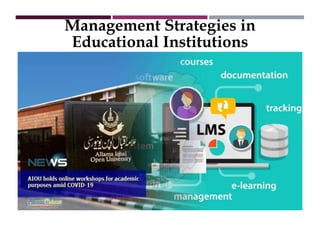
Management Strategies in
Educational Institutions
Course Code: 8615
Unit 5
By: Muhammad Inam Waris
PhD (Education) Scholar
Visiting Lecturer BZU Campus Vehari
0333-6263255
warisinaam@gmail.com
ORGANIZATIONAL
BEHAVIOR MANAGEMENT
WELCOME TO AIOU’S VIRTUAL
CLASSROOM SYSTEM
Instructions for students:
 Please mute your microphone while class.
 Don’t engage in chatting with other students
 Ask questions if any using public chat feature
 Please note that all activities are being
recorded
After studying this unit, you will be able to:
 1. Know the concept of organizational behavior (OB), behavior-based
system (BBS), behavior change communication (BCC), and Behavioral
systems analysis (BSA);
 2. Apply the above mentioned Management strategies in your
educational institutions to solve the issues;
 3. Apply different models of organizational behaviour to achieve the
desired organizational objectives;
 4. Apply behavior-based system of behavior change to real world
problems
 5. Develop communication strategies to promote positive behaviors
which are appropriate to your settings.
UNIT 5: ORGANIZATIONAL
BEHAVIOR MANAGEMENT
ORGANIZATIONAL BEHAVIOR
 Organizational behavior is the study of human
behavior in organizational setting, the interface
between the human behavior and the organization,
and the organization itself.
 Furthermore, it may be defined as “the study of
the way people interact within groups. Normally
OB is applied in an attempt to create more
efficient business organizations.
OB LEVELS
Micro-level (The study of the individuals working in the
organizations): The topics covered by Micro OB include cognition,
decision making, learning, motivation, negotiation, impressions,
group process, stereotyping, and power, and influence.
Meso-level (The study of working groups in the organization): it
covers the working force, administrative / management group.
Macro-level (The study of how organizations behave): Macro OB
covers organizations as social systems, dynamics of change,
relationships between organizations and their environments, as well
as identity in organizational process, how social movements
influence markets, and the power of social networks.
Goals of Organizational Behaviour
• Feedback
• Investigation
• Prompt Action
• Recognition
• People
ELEMENTS OF ORGANIZATIONAL BEHAVIOUR
• Structure
• Mechanistic
form of
Organization
• Organic form of
Organization
• Job Design
MODELS OF OB
 Autocratic: The basis of this model is power with
a managerial orientation of authority. The
employees in turn are oriented towards obedience
and dependence on the boss.
 Custodial: The basis of this model is economic
resources with a managerial orientation of money.
The employees in turn, are oriented towards
security, benefits, and dependence on the
organization.
MODELS OF OB
 Supportive: The basis of this model is leadership
with a managerial orientation of support. The
employees in turn are oriented towards job
performance and participation.
 Collegial: The basis of this model is partnership
with a managerial orientation of teamwork. The
employees in turn are oriented towards responsible
behavior and self-discipline.
BEHAVIORAL SYSTEMS ANALYSIS
(BSA)
 Focuses on performance improvement in organizations through
the methods and principles of behavior analysis and systems
analysis.
 It is a scientific discipline that studies the behavior of
individuals.
 It maintains the behavior which is the product of individual's
interaction with the environnent.
 All social organizations (e.g. educational institutions) are
comprised of individuals' behaviors and their products.
 Systems Analysis is a scientific discipline that studies the
operations of complex systems such as organizations, and
focuses on the interactions between parts of those systems.
BEHAVIORAL SYSTEMS ANALYSIS
(BSA)
 Behavioral Systems Analysis draws upon basic and applied
research.
 Behavioral Systems Analysis views organizational performance as
a scientific subject matter.
 Behavioral Systems Analysis is an approach to organizational
design and management.
 It is based on the premise that organizations are complex systems.
 A primary goal of BSA is to create a balanced application in
which areas of poor performance are improved, areas of high
performance are maintained, and employee performance
outcomes are directed towards organizational goals.
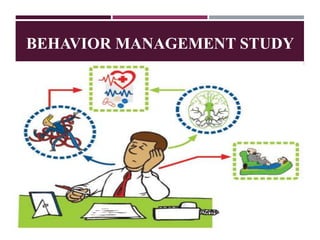
BEHAVIOR MANAGEMENT STUDY
 BBS is the application of science of behavior change to real
world problems.
 It is a process that creates a safety partnership between
management and employees
 It focuses on what people do, analyzes why they do it, and then
applies a research-supported intervention strategy to improve
what people do.
 BBS is not based on assumptions, personal feeling, or common
 knowledge but it must be based on scientific knowledge
(empirical evidences).
BEHAVIOR-BASED SAFETY (BBS)
 Behavior change communication is an interactive
process of any intervention with individuals,
communities and/or societies to develop communication
strategies to promote positive behaviors.
 Provides a supportive environment to enable people to
 initiate, sustain and maintain positive and desirable
behavior outcomes.
 It is the strategic use of communication to promote
positive health outcomes, based on proven theories and
models of behavior change.
BEHAVIOR CHANGE
COMMUNICATION (BCC)
ETHICAL LEADERSHIP
PRINCIPLES
 Social responsibility: Responsibility to others arises whenever
people have power in an organization.
 Open communication: The organization will operate as a
two-way open system, with open receipt of inputs from people
and open disclosure of its operations to them.
 Cost-benefit analysis: In addition to economic costs and
benefits, human and social costs and benefits of an activity
will be analyzed in determining whether to proceed with the
activity. As the general population learns more about
organizational behavior, it will be more difficult to manipulate
people, but the possibility is always there. That is why society
desperately needs ethical leaders.
QUESTIONS
ASSIGNMENT
Management by Objectives (MBO)
WhatsApp me
0333-6263255

ORGANIZATIONAL BEHAVIOR MANAGEMENT-8615

  • 1.
  • 2.
    Course Code: 8615 Unit5 By: Muhammad Inam Waris PhD (Education) Scholar Visiting Lecturer BZU Campus Vehari 0333-6263255 warisinaam@gmail.com ORGANIZATIONAL BEHAVIOR MANAGEMENT
  • 3.
    WELCOME TO AIOU’SVIRTUAL CLASSROOM SYSTEM Instructions for students:  Please mute your microphone while class.  Don’t engage in chatting with other students  Ask questions if any using public chat feature  Please note that all activities are being recorded
  • 4.
    After studying thisunit, you will be able to:  1. Know the concept of organizational behavior (OB), behavior-based system (BBS), behavior change communication (BCC), and Behavioral systems analysis (BSA);  2. Apply the above mentioned Management strategies in your educational institutions to solve the issues;  3. Apply different models of organizational behaviour to achieve the desired organizational objectives;  4. Apply behavior-based system of behavior change to real world problems  5. Develop communication strategies to promote positive behaviors which are appropriate to your settings. UNIT 5: ORGANIZATIONAL BEHAVIOR MANAGEMENT
  • 5.
    ORGANIZATIONAL BEHAVIOR  Organizationalbehavior is the study of human behavior in organizational setting, the interface between the human behavior and the organization, and the organization itself.  Furthermore, it may be defined as “the study of the way people interact within groups. Normally OB is applied in an attempt to create more efficient business organizations.
  • 6.
    OB LEVELS Micro-level (Thestudy of the individuals working in the organizations): The topics covered by Micro OB include cognition, decision making, learning, motivation, negotiation, impressions, group process, stereotyping, and power, and influence. Meso-level (The study of working groups in the organization): it covers the working force, administrative / management group. Macro-level (The study of how organizations behave): Macro OB covers organizations as social systems, dynamics of change, relationships between organizations and their environments, as well as identity in organizational process, how social movements influence markets, and the power of social networks.
  • 7.
  • 8.
    • Feedback • Investigation •Prompt Action • Recognition • People ELEMENTS OF ORGANIZATIONAL BEHAVIOUR • Structure • Mechanistic form of Organization • Organic form of Organization • Job Design
  • 9.
    MODELS OF OB Autocratic: The basis of this model is power with a managerial orientation of authority. The employees in turn are oriented towards obedience and dependence on the boss.  Custodial: The basis of this model is economic resources with a managerial orientation of money. The employees in turn, are oriented towards security, benefits, and dependence on the organization.
  • 10.
    MODELS OF OB Supportive: The basis of this model is leadership with a managerial orientation of support. The employees in turn are oriented towards job performance and participation.  Collegial: The basis of this model is partnership with a managerial orientation of teamwork. The employees in turn are oriented towards responsible behavior and self-discipline.
  • 12.
    BEHAVIORAL SYSTEMS ANALYSIS (BSA) Focuses on performance improvement in organizations through the methods and principles of behavior analysis and systems analysis.  It is a scientific discipline that studies the behavior of individuals.  It maintains the behavior which is the product of individual's interaction with the environnent.  All social organizations (e.g. educational institutions) are comprised of individuals' behaviors and their products.  Systems Analysis is a scientific discipline that studies the operations of complex systems such as organizations, and focuses on the interactions between parts of those systems.
  • 13.
    BEHAVIORAL SYSTEMS ANALYSIS (BSA) Behavioral Systems Analysis draws upon basic and applied research.  Behavioral Systems Analysis views organizational performance as a scientific subject matter.  Behavioral Systems Analysis is an approach to organizational design and management.  It is based on the premise that organizations are complex systems.  A primary goal of BSA is to create a balanced application in which areas of poor performance are improved, areas of high performance are maintained, and employee performance outcomes are directed towards organizational goals.
  • 14.
  • 15.
     BBS isthe application of science of behavior change to real world problems.  It is a process that creates a safety partnership between management and employees  It focuses on what people do, analyzes why they do it, and then applies a research-supported intervention strategy to improve what people do.  BBS is not based on assumptions, personal feeling, or common  knowledge but it must be based on scientific knowledge (empirical evidences). BEHAVIOR-BASED SAFETY (BBS)
  • 16.
     Behavior changecommunication is an interactive process of any intervention with individuals, communities and/or societies to develop communication strategies to promote positive behaviors.  Provides a supportive environment to enable people to  initiate, sustain and maintain positive and desirable behavior outcomes.  It is the strategic use of communication to promote positive health outcomes, based on proven theories and models of behavior change. BEHAVIOR CHANGE COMMUNICATION (BCC)
  • 18.
    ETHICAL LEADERSHIP PRINCIPLES  Socialresponsibility: Responsibility to others arises whenever people have power in an organization.  Open communication: The organization will operate as a two-way open system, with open receipt of inputs from people and open disclosure of its operations to them.  Cost-benefit analysis: In addition to economic costs and benefits, human and social costs and benefits of an activity will be analyzed in determining whether to proceed with the activity. As the general population learns more about organizational behavior, it will be more difficult to manipulate people, but the possibility is always there. That is why society desperately needs ethical leaders.
  • 19.
  • 21.
    ASSIGNMENT Management by Objectives(MBO) WhatsApp me 0333-6263255