MARC IMHOTEP CRAY, M.D./Last updated 06-08-12


                                                  IVMS LEARNING OUTCOMES –
                                            HORIZONTALLY INTEGRATED RAPID OVERVIEW

VIEWING INSTRUCTIONS FOR THIS COMPONENT:Once you download, and open in MS word: go to View> Navigation
Pane. You will see a hot-linked index of this resource. Hyperlinks to major curriculum topics are also embedded. This function, as
well as the embed hyperlinks in the map, is only limited in this demonstration. Nonetheless, this document will provide you will a
comprehensive sequenced vocabulary/ medical terminology of IVMS Courseware learning objective. It is an excellent tool to
cross reference with our Basic Medical Terminology-PROGRAMMED INSTRUCTION downloadable resource.

      N.B.-An extensively hyperlinked to IVMS online RLOs (Reusable Learn Objects/aka, SCOs/ Sharable Content Objects
        using SCORM Terminology) is available to enrolled learners and/or at cost for those learners/teachers non-enrolled
      IVMS is the ultimate medical student Web 2.0 companion. This SDL-Face to Face hybrid courseware is a digitally tagged and content enhanced
         replication of the United States Medical Licensing Examination's Cognitive Learning Objectives (Steps 1, 2 or 3). Including authoritative
         reusable learning object (RLO) integration and scholarly Web Interactive PowerPoint-driven multimedia shows/PDFs. Comprehensive
         hypermedia BMS learning outcomes and detailed, content enriched learning objectives.


                              IVMS LEARNING OUTCOMES -HORIZONTALLY INTEGRATED RAPID OVERVIEW                                                    1
MARC IMHOTEP CRAY, M.D./Last updated 06-08-12


     1. CELLULAR & MOLECULAR STRUCTURE & FUNCTION
Animations, Movies & Interactive Tutorials

   1.1    GENERAL PRINCIPLES OF BIOCHEMICAL STRUCTURES
   Macromolecular organization as the basis of biological
      structure and function
   Concept of stereoisomerism
   1.2    PROTEINS
            1.2.1      GENERAL PRINCIPLES
   Functional types: structural proteins, enzymes,
      transporters, regulatory proteins
   1.2.2 Protein Composition and Structure
   1.2.2.1         Amino Acids and the Peptide Bond
   Principles of structure of amino acids: details of               Protein sequencing: basic principles and application
      functional groups of individual amino acids not                 of
      required
   The functional types of amino acid side-groups: basic,           Difference between mammalian and bacterial use of
      acidic, hydrophilic, hydrophobic, ―structural‖ (proline)         stereoisomers. Antibiotics as mimics of D-amino
                                                                       acid structures
   The peptide bond: features, significance in secondary            Significance of stereoisomerism in drug development
     structure
   Importance of stereoisomerism in influencing shape of
     proteins and hence interaction between molecules

   1.2.2.2         Principles of protein structure
   Factors stabilizing protein structure: Van der Waal‘s            Reversible and irreversible denaturation of protein.
     forces, hydrogen bonds, hydrophobic forces, ionic
     interactions, disulphide bonds


                           IVMS LEARNING OUTCOMES -HORIZONTALLY INTEGRATED RAPID OVERVIEW                            1
MARC IMHOTEP CRAY, M.D./Last updated 06-08-12


Levels of organization (primary, secondary, tertiary and         Organization of secondary structural elements into
   quaternary)                                                     structural and functional domains: specific
Organization and properties of alpha-helix, Beta-sheet,            examples, e.g. ABC proteins, 2 units of 6  helices
   and loop/turn                                                   in membrane; nicotinic acetylcholine receptor
Structural and functional domains
Hetero- and homo-oligomeric multi-subunit proteins               Comparison of the structure and properties of
Functional significance: allosteric (intra-protein)                hemoglobin and myoglobin
   regulation;                                                   protein–protein regulation: e.g. cAMP-dependent
   hemoglobin as an example                                        protein kinase
                                                                 Post-translational modifications
                                                                   disulphide bonding, cross-linking, peptidolysis
                                                                   non-peptide attachments: glycosylation,
                                                                   phosphorylation,
                                                                      adenylation, farnesylation
                                                                   roles: regulation, targeting, turnover, structural
1.2.3 Structural Proteins: Structure and Function
1.2.3.1         Collagen
Structural protein of tendons and ligments:                      Repeating amino-acid unit favours left-handed helix
   fibrous protein, triple coils of extended helices,              formation
   assembled staggered and cross-linked for strength             Hydrogen bonding by glycines as the stabilizing force
                                                                   of the triple helix
                                                                 Ehlers-Danlos syndrome; osteogenesis imperfecta
1.2.3.2         Histones
Structural protein of chromatin: globular, associate in          Need for histones: packaging of DNA (saves space
   octamers to form nucleosomes around which DNA is                and protects it)
   wound                                                         Significance of the cationic nature of histones.
                                                                   Packaging role of H1
1.2.4 Enzymes And Enzymatic Catalysis


1.2.4.1         Concepts of Biochemical Reactions and Enzymes

                        IVMS LEARNING OUTCOMES -HORIZONTALLY INTEGRATED RAPID OVERVIEW                             2
MARC IMHOTEP CRAY, M.D./Last updated 06-08-12


     Definition of catalysis, definition of enzyme                    Energy of reaction and reaction intermediates.
                                                                        Transition-state complex
                                                                      Classes of biochemical reaction: hydrolysis, ligation,
                                                                        condensation, group-transfer, redox, isomerization
     1.2.4.2         Structure and Function of Enzymes
     Importance of active site for catalysis and specificity          Domain organization
     Multimeric enzymes:                                              Mechanisms of catalysis illustrated by serine
       ranges of isozymes e.g. LDH                                      proteases, carboxypeptidase A and lysozyme
       multienzyme complexes e.g. pyruvate dehydrogenase
       (see 2.3.3)
       regulation of activity by allostery, and by subunit
       dissociation (e.g. cAMP-dependent protein kinase)

     1.2.4.3         Co-Factors
     Importance of co-enzymes and trace elements in enzyme            Examples of co-factors e.g. from glycolysis, TCA
        action                                                          cycle, fatty acid oxidation and synthesis
     Vitamins as precursors of co-enzymes

1.2.4.4      Kinetic Parameters
     Dependence of rate of reaction on substrate
        concentration and amount of enzyme
     Simple steady state reaction kinetics:
        Michaelis constant Km, maximal velocity Vmax and
        turnover number
     Principles of competitive, non-competitive and
        irreversible inhibition


     1.2.4.5         Regulation of Enzyme Activity


                             IVMS LEARNING OUTCOMES -HORIZONTALLY INTEGRATED RAPID OVERVIEW                            3
MARC IMHOTEP CRAY, M.D./Last updated 06-08-12


      Allosteric control                                               pH and temperature sensitivity of enzymic catalysis
      Covalent modification e.g. phosphorylation
      1.2.5 Transporters: Structure And Function
      Types with examples (see 1.6.1):                                 Common features: e.g. transmembrane segments and
         channels                                                        energy-producing domains
         carriers - passive and active (i.e. pumps)                    Amphipathic nature of transmembrane segments
      Specificity due to interaction between solute and channel        Polar/ionic inner surface of pores
         or carrier
                                                                       Passive transport in channels: gated channels
                                                                          undergo conformational change to open or
                                                                          regulate the channel
      Saturation of carriers at high solute concentrations             Carriers: undergo cyclical conformational change to
                                                                          transport ligands across the membrane
                                                                       Flipases, P-glycoprotein
                                                                       Consequences of structural perturbation: e.g.
                                                                          misfolding and intracellular retention of CFTR, the
                                                                          cystic fibrosis transmembrane-conductance
                                                                          regulator
      1.2.6 Regulatory Proteins: Structure And Function
      Examples: proteins that regulate gene expression (see            Ligand-induced structural changes (illustrated by the
         3.1.4)                                                           steroid hormone receptor) affect binding to DNA
       regulatory subunits of enzymes (see 1.2.4.2)
1.3   LIPIDS
      1.3.1 Types Of Lipid In The Body
      1.3.1.1         Fatty Acids and Glycerides
      General structure of fats and fatty acids
      Sources of fatty acids (dietary and de novo synthesis)
      Concept of essential fatty acids


      13.1.2          Phospholipids
      Outline structure of phosphatidyl compounds                      Structure and classes of sphingolipid
                                                                          (sphingomyelin, gangliosides, cerebrosides)

                              IVMS LEARNING OUTCOMES -HORIZONTALLY INTEGRATED RAPID OVERVIEW                            4
MARC IMHOTEP CRAY, M.D./Last updated 06-08-12


1.3.1.3         Sterols
Outline structure of cholesterol
Cholesterol derivatives: bile acids and steroid hormones
1.3.2 Roles Of Lipids
Energy sources (see 2.2)
Structural: as diffusion barriers (in lipid bilayers - see 1.6),
   and to stabilize fat : water interfaces (bile salts in the
   gut, and phospholipid and cholesterol in plasma
   lipoproteins)
Signalling molecules                                               Extracellular signalling molecules derived from
   extracellular: e.g. steroid hormones                               arachidonic acid: eicosanoids
                                                                   Intracellular signalling molecules (second
                                                                      messengers) derived from the phopholipid PIP2:
                                                                      e.g. diacylglycerol and IP3
1.4   CARBOHYDRATES
1.4.1 Types Of Carbohydrates
Monosaccharides: e.g. glucose, fructose, galactose                 L- and D-glucose: ―dextrose‖ as a common clinical
Disaccharides: e.g. sucrose, lactose                                  term for D-glucose
Polysaccharides                                                    Structure and formation of 1,4 and 1,6 glycosidic
                                                                      bonds
                                                                   Glycogen, starch, cellulose
1.4.2 Roles of Carbohydrate in the Body
1.4.3.1         Structural
Proteoglycans in the extracellular matrix (see 5.2)                Examples and functions of hyaluronic acid,
                                                                     chondroitin, dermatan, keratan.
1.4.3.2         Energy Sources
Roles of glycogen, starch, cellulose                               Inability of mammals to digest cellulose.
(Details of metabolism as outlined in 2.3)
1.4.3.3         As Biosynthetic Precursors
Role of carbohydrates in synthesis of amino-acids, fatty
  acids and nucleotides
1.4.3.4         In Conjugates

                        IVMS LEARNING OUTCOMES -HORIZONTALLY INTEGRATED RAPID OVERVIEW                           5
MARC IMHOTEP CRAY, M.D./Last updated 06-08-12


Glycoproteins and glycolipids                                    Cell surface carbohydrates in blood groups
1.5   STRUCTURE AND FUNCTION OF MEMBRANES
1.5.1 Solutes, Membranes, and Membrane Transport
 Principles of solubility, osmosis, and diffusion                Fick‘s Law of diffusion
 Transmembrane passage of gases and water                        Passage of charged and uncharged solutes through
                                                                    artificial lipid membranes
 Membrane transport: channels, carriers and pumps for            Structure of membrane channels, carriers and pumps
    the passage of ions and substrates such as glucose              (see 1.2.5)
 Channels: voltage-gated e.g. for Na or for K
          ligand-gated e.g. by ACh
 Carriers:    primary active transport e.g. Na/K-ATPase
 secondary active transport e.g. Na/Ca exchange, the
    Na-glucose symporter facilitated diffusion e.g.
    Cl‘/HCO3‘ exchange
 Simple kinetic properties of channels and carriers
 Cellular ion homeostasis (see also 6.3.1)                       The pump-leak model
1.5.2 Composition of Membranes
 Roles of lipids (including cholesterol), proteins and           Comparison of micelles, bilayers and monolayers
   carbohydrates (including glycoproteins and                    Variation in membrane properties with different types
   glycolipids).                                                    of lipid constituents
                                                                 Biosynthesis of phospholipids and glycoproteins:
                                                                    involvement of CTP and dolichol
                                                                 Structural aspects of membrane proteins: alpha-
                                                                    helical content and amphipathic nature


1.5.3 The Fluid Mosaic Model of Membrane Structure


                        IVMS LEARNING OUTCOMES -HORIZONTALLY INTEGRATED RAPID OVERVIEW                           6
MARC IMHOTEP CRAY, M.D./Last updated 06-08-12


The fluidity of membranes                                        Implications of the model for membrane function and
Modes of association of proteins with the lipid phase:             behaviour: e.g. mobility of receptors, recirculation
  surface proteins, transmembrane proteins, anchored               of membrane constituents
  proteins                                                       Range of motions for membrane components:
                                                                   rotational and translational; lipid translocation and
                                                                   asymmetry
                                                                 Limitations of the fluid mosaic hypothesis: alternative
                                                                   hypotheses of membrane behaviour
1.5.4 Functions of Membrane Proteins
1.5.4.1         Transport through Lipid Membranes
See 1.2.5 and 1.6.1
1.5.4.2         Vesicular Transport
Membrane proteins:
  promote and regulate vesicle formation
  determine the destination of vesicles and their contents
  (see 1.9)
1.5.4.3         Signalling
See 4.2.1 and 4.2.3
1.6    SUB-CELLULAR ORGANELLES
Structure and function of the cell membrane and
   sub-cellular organelles: rough and smooth
   endoplasmic reticulum, ribosomes, Golgi apparatus,
   mitochondria, lysosomes; and the cytoskeleton:
   microtubules, intermediate filaments and
   microfilaments
Metabolic compartmentation: see 2.5
Vesicle and protein trafficking: see 1.9


1.7     THE NUCLEUS


                        IVMS LEARNING OUTCOMES -HORIZONTALLY INTEGRATED RAPID OVERVIEW                            7
MARC IMHOTEP CRAY, M.D./Last updated 06-08-12


Size and structure of nucleus                                   Chromatin structure: the packing of DNA (a long
Nuclear functions: (see also section 3)                           molecule) into a compact structure - histones -
   gene replication and repair, genetic transcription,            solenoids - loops
   ribosome production                                          Chromatin structure related to functions of DNA
The interphase nucleus: euchromatin and
   heterochromatin
Constitutive and facultative heterochromatin (Barr body)
Concept of condensed chromatin and gene inactivity
Nuclear envelope: defines eukaryote                             Structure and functions of the nuclear envelope
Two way communication between nucleus and cytoplasm                inner and outer membrane, perinuclear space,
The nucleolus: the site of ribosome production                     nuclear lamina
                                                                   nuclear pores
1.8     TRAFFICKING
Vesicle trafficking routes                                      Transport of vesicles: role of cytoskeleton
From endoplasmic reticulum to the Golgi apparatus,
    thence:
    to the plasmalemma or to lysosomes
Trafficking to the plasmalemma adds material to it or
    allows secretion into the extracellular space:
    constitutive and regulated secretion
Receptor mediated endocytosis                                   Ligand–receptor binding, clustering of receptors
Transcytosis                                                    Coated pits and vesicles: clathrin
                                                                Low pH in endosomes: significance
Principle of the targeting of newly synthesized proteins        Details of protein trafficing in endoplasmic
   by signal sequences                                             reticulum/Golgi and import of proteins into
                                                                   mitochondria or nucleus
                                                                Role of chaperonins
                                                                Genetic defects of trafficking pathways


1.9     THE CELL CYCLE: MITOSISAND CELL DIVISION


                        IVMS LEARNING OUTCOMES -HORIZONTALLY INTEGRATED RAPID OVERVIEW                              8
MARC IMHOTEP CRAY, M.D./Last updated 06-08-12


     Phases of the cycle:
        Interphase : G1, S (nuclear DNA replication), G2 — G0         Demonstration of cell-cycle phases by 3H-thymidine
        non-cycling cells                                             Centrosome, centrioles, aster, spindle
        Mitosis: M (i.e. nuclear division)                            Centromeres and interaction with spindle
           appearance of the chromosomes and separation of
        the chromatids
           prophase, metaphase, anaphase, telophase
        Cell division
1.10 CONTROL OF CELL GROWTH AND DIFFERENTIATION
     1.10.1 Cell Growth and Division
     Growth in development, morphogenesis (see 15)
     Growth after birth
        Renewing tissues: e.g. skin, gut epithelium -
        continually dividing stem cells
        Resting tissues: e.g. liver, cells multiply only to repair
        damage
        Non-dividing tissues: e.g. neurones do not multiply
        after birth
     Maintenance of normal tissue structure and function:             Characteristics of normal fibroblast growth in vitro
        cell growth and division, controlled by extracellular         Experimental demonstration of platelet-derived
        growth factors, and balanced by cell loss and cell death        fibroblast growth factor (PDGF)
     Apoptosis (programmed cell death)
     Physiological hypertrophy: e.g. of skeletal muscle               Cancer a disease of excessive cell multiplication
     Physiological hyperplasia: e.g. skin, erythropoiesis             (see 40.3)
     1.10.2 Differentiation
     Selective gene expression as the basis for producing
         cells with different functions                               Totipotent stem cells, pluripotent and unipotent cells
     Principles of the establishment of tissues: progressive          Mosaic vs regulative decisions in cell type specification
         restriction of developmental potential
     The stability of cell differentiation
     Abnormal differentiation in tumors (see 40.3.1.3)


                              IVMS LEARNING OUTCOMES -HORIZONTALLY INTEGRATED RAPID OVERVIEW                              9
MARC IMHOTEP CRAY, M.D./Last updated 06-08-12


Regulation of tissue structure and function by hormones         Role of retinoids in normal and abnormal differentiation
  and growth factors (affecting gene expression and cell           (e.g. of epithelia)
  multiplication and turnover)


1.11MEIOSIS
1.11.1 Principles
Creation of offspring with new combinations of genes by
   sexual reproduction
Haploid gametes are formed by two special cell divisions
   ‗meiosis‘
(Chromosome abnormalities through faults in meiosis:
   see 3.3)
Meiosis I (‗reduction division‘):
  Follows a normal S-phase in primary gametocytes
  Prophase I:                                                   The stages of prophase I: role of the synaptonemal
   pairing of homologous chromosomes                               complex
   chromatids ‗cross-over‘ (exchange of maternal and            Molecular mechanism of recombination:
   paternal genes)                                                 Concepts of strand invasion, Holliday junction,
  Anaphase I:                                                      branch migration
   maternal and paternal chromosomes separate at                Reciprocal vs non-reciprocal recombination
   random to form daughter nuclei
  Result: two secondary gametocytes, each with only one
   chromosome of each pair, and with new combinations
   of maternal and paternal genes on each chromosome
Meiosis II:
   Follows meiosis I with no intervening S-phase
   Resembles mitosis – chromatids separate to form new
   nuclei
One primary gametocyte can thus produce 4 gametes
   (e.g. spermatozoa)
1.11.2 Gametogenesis

                        IVMS LEARNING OUTCOMES -HORIZONTALLY INTEGRATED RAPID OVERVIEW                           10
MARC IMHOTEP CRAY, M.D./Last updated 06-08-12


Spermatogenesis: see 13.3.1
Oogenesis: see also 13.3.2
 Primary oocytes arrest in prophase I during fetal life,
  build up stores of RNA and protein and then rest until
  puberty
 At puberty, cohorts of oocytes mature by completing
  meiosis I (giving one secondary oocyte and a polar
  body): ovulation occurs
 Meiosis two (with the production of another polar body)
  is completed on fertilisation

1.12 LIGHT MICROSCOPY
Resolution: can show bacteria, and details within               Reveals structures commensurate with one wavelength
   nucleated cells such as mitochondria and storage               of light
   ‗granules‘ (gross appearance only)
Simple appreciation of the steps needed to prepare tissue       Artefacts of specimen preparation e.g. usually, lipid is
   for light microscopy: fixation, sectioning and staining         dissolved and lost from the specimen during
                                                                   fixation and embedding
General histological appearance of an ‗H & E‘ stained           ‗Basophilic‘ structures, such as nucleic acids, bind
   section                                                         basic dyes (e.g. purple Hematoxylin); ‗acidophilic‘
   nuclei (and structures rich in nucleic acids) stain             structures bind pink Eosin
   purple                                                       Specific stains e.g: Van Giesson‘s stain renders
   most proteins stain pink (in particular, the cytoplasm of       collagen fibres vivid pink
   muscle, and red blood cells, and many epithelial cells)         orcein stains elastin grey
Localization of specific molecules by                           Use of fluorescence microscopy on living cells
   immunocytochemistry
1.13 ELECTRON MICROSCOPY
Resolution: shows structure within
   organelles, lipid membranes, viruses
   and macromolecules (e.g. DNA and
   proteins)
Appearance of the main cell organelles         Scanning EM to study surfaces of
   as listed in 1.7 in transmission EM            cells and organelles

                        IVMS LEARNING OUTCOMES -HORIZONTALLY INTEGRATED RAPID OVERVIEW                            11
MARC IMHOTEP CRAY, M.D./Last updated 06-08-12


2. CELLULAR METABOLISM
2.1    GENERAL PRINCIPLES
The overall strategy and logic of human metabolism:              Free energy, entropy
   partial and complete oxidation; trapping of energy as
   ATP; coupling of ATP hydrolysis to energy-requiring           Structure of ATP and its energy content
   reactions; CO2 and water production
2.1.1 Principles of Metabolic Control
Short-term controls: allosteric effects (milliseconds),
   covalent modification (seconds to minutes)
Long-term controls: enzyme induction / suppression
   (hours to days)
Cycles between organs (e.g. Cori cycle): principle that
   control of metabolism includes (i) delivery (i.e.,
   anatomy, functioning circulation) and (ii)
   transmembrane movement (i.e. membrane
   transporters) of substrates, as well as enzyme
   regulation
2.1.2 Oxidation–Reduction Reactions
Oxidation and reduction by NAD+/NADH, FAD/FADH2,                 Key examples of linked oxidation and reduction:
                                                                   oxidation of glyceraldehyde-3-phosphate, and
   NADP+/NADPH                                                     implications for energy transfer by substrate-level
                                                                   phosphorylation.


2.1.3 Role and Control of the TCA Cycle


                        IVMS LEARNING OUTCOMES -HORIZONTALLY INTEGRATED RAPID OVERVIEW                          12
MARC IMHOTEP CRAY, M.D./Last updated 06-08-12


Substrates and products of the cycle. Significance of a          Entry to TCA cycle of carbon skeletons of amino
  cyclic (as opposed to a linear) pathway: catalytic               acids, odd chain length fatty acids
  effects. Connection with other metabolic pathways: as
  substrate (e.g. acetyl CoA) or as intermediate (e.g. -
  ketoglutarate)
Use of TCA cycle intermediates for biosynthesis, esp. of                  Succinyl CoA as precursor of
  glucose, fatty acids and some amino acids                               porphyrins and heme
Significance of ―anaplerotic‖ reactions to maintain
  concentrations of TCA cycle intermediates
Operation related to demand for ATP, not to substrate            Reguln.of TCA cycle by calcium: activation of
  availability                                                     pyruvate dehydrogenase, isocitrate dehydrogenase
                                                                   and  -ketoglutarate dehydrogenase in response to
                                                                   an increase in intra-mitochondrial calcium
                                                                   concentration
2.1.4 ATP Production and its Control
Near-constancy of intracellular ATP concentration;              Signals of ATP utilization:
   relative concentrations of ATP, ADP and AMP                      rising ADP as a signal to mitochondria
                                                                    rising AMP as a cytoplasmic signal to regulate
                                                                    glycolysis
2.1.5 Pathways Of Mitochondrial Oxidation
2.1.5.1         The electron transport chain
Main components and outline organization of the electron        Structure and function in the chain:-
  transport chain                                               Large protein complexes linked by smaller, more
                                                                    mobile intermediates. Multiple centres allowing
                                                                    sequential oxidation/reduction reactions with
                                                                    increasing redox potential
                                                                Function of specific examples of oxidation/reduction
                                                                    centres: haem, iron-sulphur centres, ubiquinone,
                                                                    copper (in cytochrome oxidase)
                                                                Stoichiometry of the electron transport chain
2.1.5.2         Reoxidation of reduced cofactors in the mitochondrion


                        IVMS LEARNING OUTCOMES -HORIZONTALLY INTEGRATED RAPID OVERVIEW                          13
MARC IMHOTEP CRAY, M.D./Last updated 06-08-12


Reoxidation of mitochondrial NADH (diffusible in the            Reoxidation of cytoplasmic NADH: shuttle systems
  matrix) and FADH2 (enzyme-bound) in the                           transfer reducing equivalents through
  mitochondrion                                                     mitochondrial membrane (impermeable to
                                                                    NAD/NADH)
                                                                Significance of different redox states of cytoplasmic
                                                                    and mitochondrial NAD
2.1.6 Mitochondrial ATP Synthesis
2.1.6.1         The Chemiosmotic Mechanism
Oxidative phosphorylation: an indirect coupling of energy        Mitochondrial matrix as a closed environment, with
   release by oxidation to the synthesis of ATP                      inner membrane impermeable to H+. Extrusion of
- Flow of electrons down the respiratory chain drives H+             H+ creates a pH and electric potential gradient.
   extrusion from the mitochondrion                              Experimental evidence for the chemiosmotic
- Flow of H+ back into the mitochondrion via a protein               hypothesis
   complex drives ATP synthesis                                      includes uncouplers that short circuit the proton
                                                                     gradient
                                                                     e.g. lipophilic weak acids such as
                                                                     2,4-dinitrophenol, salicylic acid
                                                                 Discharge of proton gradient as regulator of the
                                                                     electron transport chain and hence of substrate
                                                                     oxidation: ―respiratory control‖
                                                                 Analogy to bacterial power supply. Some antibiotics
                                                                     act as uncouplers e.g. topical antifungal
                                                                     ionophores such as Nystatin


2.1.6.2         Uses of the Proton Gradient


                        IVMS LEARNING OUTCOMES -HORIZONTALLY INTEGRATED RAPID OVERVIEW                           14
MARC IMHOTEP CRAY, M.D./Last updated 06-08-12


ATP synthesis                                                    F1 F0 components, role of transmembrane proton
                                                                     flow leading to ATP release
                                                                 Co-operativity and stoichiometry (about 3 H+ per ATP)
                                                                     of the enzyme.
                                                                 Reversibility of ATP synthase
Inner membrane transport                                         Examples: mitochondrial uptake of ADP and extrusion
                                                                     of ATP
                                                                     (most ATP is made in the mitochondrion yet used
                                                                     in the cytoplasm)
                                                                 Mitochondrial uptake of Ca2+, and of substrates such
                                                                     as pyruvate
Thermogenesis in brown adipose tissue                            Outline of mechanism. Importance especially in
                                                                     neonates (who can‘t shiver).
2.1.7 Body Energy Supplies
Stores: relative stores of fat, carbohydrate (as liver and
   muscle glycogen and as blood glucose), and protein
Intake (see 2.6): relative intake and energy values of fat,
   carbohydrate and protein
2.2    FAT AS A METABOLIC FUEL
2.2.1 Overview
Advantages and disadvantages of fat as a metabolic fuel.
   Contribution to total energy production (about 35%)
2.2.2 Assimilation of Dietary Fat
Assimilation, emulsification, absorption, packaging as            Direct transport of medium chain length fatty acids
   chylomicrons.                                                     via blood to liver and peripheral tissues
Transport in lymph to peripheral tissues. Lipoprotein
   lipase in release of fatty acids from chylomicrons
Uptake and resynthesis of intracellular triglyceride in
   adipose tissue
Utilization of triglyceride by skeletal muscle, heart and
   renal cortex


                        IVMS LEARNING OUTCOMES -HORIZONTALLY INTEGRATED RAPID OVERVIEW                            15
MARC IMHOTEP CRAY, M.D./Last updated 06-08-12


Release and transport of NEFAs. Hormonal regulation of
   lipolysis
Plasma NEFA levels under different metabolic conditions
2.2.3 Metabolic Fuels and Tissues
Heart‘s preference for NEFAs and endogenous triglyceride
Skeletal muscle and use of free NEFAs, glucose and
   glycogen during different forms of exercise
NEFA use in renal cortex
2.2.4 Oxidation of Fat
Production of fatty acyl CoA; carnitine ―shuttle‖ and its         Cytoplasmic fatty-acid-binding protein, transport to
   control                                                          mitochondrial membrane
 -oxidation of fatty acyl chain. Site of reaction                Enzymes of fatty acid oxidation: VLCAD, LCAD,
   (mitochondrial matrix)                                           MCAD, SCAD
                                                                  Oxidation of other fatty acids: unsaturated fatty
                                                                    acids, very long chain fatty acids, odd-chain-
                                                                    length fatty acids, branched-chain fatty acids
                                                                  Defects of fatty acid oxidation - relative frequency,
                                                                    biochemistry and clinical symptoms of MCAD
                                                                    deficiency, carnitine deficiency
2.2.5 Fatty acid metabolism in the liver
2.2.5.1         Oxidation
See 2.2.4
2.2.5.2         Biosynthesis
Production of triglyceride from excess sugars and amino           Outline of structure and function of fatty acid
  acids                                                             synthase complex.
                                                                  Key differences between fatty acid biosynthesis and
                                                                    beta-oxidation: enzymes, cofactors, subcellular
                                                                    compartments
                                                                  Balance between oxidation and synthesis, regulated
                                                                    by concentration of substrates (and of TCA cycle
                                                                    intermediates)
2.2.5.3         Ketogenesis

                        IVMS LEARNING OUTCOMES -HORIZONTALLY INTEGRATED RAPID OVERVIEW                           16
MARC IMHOTEP CRAY, M.D./Last updated 06-08-12


Role in fasting and starvation                                    Structures of common NEFA-derived ketones and
Use of ketone bodies in peripheral tissues.                          steps in their synthesis
Ketone bodies as signals for availability of energy
   substrates
2.2.6 Integration of Fatty Acid Metabolism
Effects of insulin, glucagon, adrenaline and thyroxine on         Regulation:
   synthesis, breakdown, uptake and release of fatty acids          of lipoprotein lipase (clearing-factor lipase)
                                                                    of mobilization of NEFAs from adipose tissue,
                                                                    and
                                                                    of acetyl CoA carboxylase
2.3    GLUCOSE AS A METABOLIC FUEL
2.3.1 Overview
Storage and availability of glucose. Relative use of              Glucose delivery to the fetus
   glucose by different tissues: brain, skeletal muscle, red
   blood cells, renal medulla
2.3.2 Glycolysis
2.3.2.1         Significance
Overall scheme and importance in generating ATP in                Measurement and concentrations of intermediates
  different tissues under anaerobic conditions.
  Production of lactate
2.3.2.2         Glucose uptake (transport and phosphorylation)
Glucose uptake requires transport and phosphorylation             Glucose transport:
Tissue differences:                                                 GluT1–5 transporters, kinetics and tissue
  Uptake dependent on plasma glucose concentration                  distribution of different glucose transporters,
   - in liver (appropriate for glycogen or fat synthesis)           insulin-induction of GluT4 expression
   - in endocrine pancreas (to control hormone release)           Phosphorylation:
   insulin-independent glucose transport by GluT2                   hexokinase in peripheral tissues
  Uptake elsewhere (in ‗peripheral‘ tissues) depends on             glucokinase in liver, pancreas (  -cells)
   energy needs of tissue and is regulated in tissues that          physiological significance of differences in their
   can also use non-carbohydrate energy substrates:                 properties (Km values and inhibition)
   importance of the insulin-dependent glucose
   transporter (GluT4)
2.3.2.3         Trapping energy: formation of ATP in glycolysis
                        IVMS LEARNING OUTCOMES -HORIZONTALLY INTEGRATED RAPID OVERVIEW                           17
MARC IMHOTEP CRAY, M.D./Last updated 06-08-12


Substrate-level phosphorylation: quantity of ATP per              Principal points of ATP formation
  molecule of glucose
2.3.2.4         Control of glycolysis
Glycolysis is regulated by the energy needs of the cell:          Points of regulation: hexokinase,
  this regulation is of specific importance in type IIb             phosphofructokinase, pyruvate kinase
  skeletal muscle fibres                                          Phosphofructokinase as principal control point of
                                                                    glycolysis: fructose-2,6-bisphosphate
Isozymes of glycolytic enzymes and their significance in          Variation of isozyme expression in different tissues;
   clinical diagnosis                                               correlation with different metabolic function of
                                                                    different tissues, e.g. lactate dehydrogenase,
                                                                    pyruvate kinase
2.3.2.5         Utilization of other monosaccharides
Galactose and fructose: importance as fuel                        Galactosaemia - typical pattern of presentation;
                                                                    metabolic problems
                                                                  Hereditary fructose intolerance - presentation;
                                                                    metabolic problems


2.3.3 Aerobic Oxidation of Glucose
Pyruvate dehydrogenase as key regulatory enzyme                   Control of activity in relation to metabolic state of
                                                                    mitochondrion
Importance of aerobic glucose oxidation in the brain
Pentose phosphate pathway:                                        Reaction sequence of the pentose phosphate
  significance as a generator of NADPH and for the                  pathway
  synthesis of various carbohydrates, including pentoses          Glucose-6-P dehydrogenase deficiency -
  for nucleic acids                                                 significance and metabolic consequences;
  Role in antioxidant pathways (see 2.5.5)                          prevalence (common); mechanism of damage to
                                                                    rbc; development of acute haemolytic anaemia
2.3.4 Storage of Glucose
Glycogen synthesis in liver and muscle
Cost of synthesis

                        IVMS LEARNING OUTCOMES -HORIZONTALLY INTEGRATED RAPID OVERVIEW                             18
MARC IMHOTEP CRAY, M.D./Last updated 06-08-12


Mobilization: phosphorylase and debranching enzyme                The ―glucose–fatty-acid cycle‖
Control of glycogen synthesis and breakdown in muscle             Hormone receptors on hepatocytes. Role of
  and in liver; roles of adrenaline, glucagon and insulin           autonomic nervous system in hepatic
                                                                    metabolism. Calmodulin as subunit of
                                                                    phosphorylase kinase.
2.3.5 Glucogenesis
Quantitative importance and sites of synthesis                    Why we can‘t make glucose from fatty acids
Common substrates: lactate, alanine, glutamine, glycerol          Comparison between glucogenesis and glycolysis
   and other sugars
                                                                  Control:
                                                                    acutely: by metabolites and hormonal signals e.g.
                                                                    glucagon
                                                                    chronic adaptation: in response to insulin,
                                                                    glucagon and corticosteroids
2.4   AMINO ACID METABOLISM
2.4.1 Protein digestion (see also 9.5.4 and 9.5.5)
Dietary intake; digestion by pepsin, trypsin, chymotrypsin.       Enterokinase
   Uptake of di- and tripeptides by intestinal cells;             Pancreatitis
   conversion to amino acids
2.4.1.1         Amino acids
Amino acids essential in diet, arginine as an essential
   amino acid produced by endogenous synthesis.
   Consequences of dietary lack
Incorporation into body proteins or derivatives (e.g.,
   hormones, neurotransmitters), oxidation, conversion to
   glucose or fatty acids
Categories of amino acid:
   glucogenic via pyruvate, glucogenic via TCA cycle
   intermediates; ketogenic;
   mixed
2.4.1.2         Amino Acid Metabolism
2.4.1.2.1  Oxidation
Transamination; role of -ketoglutarate and glutamate             Pyridoxal phosphate in transamination

                        IVMS LEARNING OUTCOMES -HORIZONTALLY INTEGRATED RAPID OVERVIEW                         19
MARC IMHOTEP CRAY, M.D./Last updated 06-08-12


Significance of glutamate dehydrogenase. Fate of
   ammonia generated
Transport of ammonia from peripheral tissues. Metabolism
   of glutamine in intestinal cells and renal cortex
Nitrogen excretion as urea or as ammonium ions;
   implications for pH regulation
2.4.1.2.2    Urea synthesis
Principal steps in formation of urea from ammonia                 Hepatic intracellular compartmentation of the urea
Site (periportal cells of liver lobule)                             cycle

Control of the urea cycle:                                        Fate of urea: n.b. renal concentrating mechanism
   acute: regulation of enzyme activity; carbamyl-
   phosphate synthetase as the controlling step
   chronic: induction of urea-cycle enzymes over 24–36h
2.4.1.2.3     Tissue-specific amino acid metabolism
                                                                  Amino acid metabolism in specific tissues: liver,
                                                                    intestine, skeletal muscle, renal cortex
                                                                  Distribution of urea-cycle enzymes between gut and
                                                                    kidney
                                                                  The glucose–alanine cycle
2.5    CELLULAR ORGANIZATION OF METABOLISM
2.5.1 Overview
The major pathways of metabolism in relation to sub-
   cellular architecture
2.5.2 Mitochondria
Role in energy generation; in generation of NADH and              Separate mitochondrial genome encodes some
   metabolic intermediates; final common pathway of                 components of the electron transport chain
   chemical energy production, electron transport chain             complexes
   and oxidative phosphorylation                                  Mitochondria as ―symbionts‖
                                                                  Mitochondrial biosynthesis. Density of mitochondria
                                                                    in cells (increases in hypoxia)


                        IVMS LEARNING OUTCOMES -HORIZONTALLY INTEGRATED RAPID OVERVIEW                          20
MARC IMHOTEP CRAY, M.D./Last updated 06-08-12


                                                                  Clinical manifestations of mitochondrial disease.
                                                                     Maternal inheritance of mitochondrial DNA.
                                                                     Mitochondrial DNA mutations and their
                                                                     expression (see 3.4)
2.5.2 Endoplasmic Reticulum/Golgi Apparatus
Outline of role in biosynthesis of lipids, complex
   carbohydrates and glycoproteins
Role in detoxification: significance of cytochrome P450
2.5.3 Lysosomes
Outline of role in recycling of building blocks of                Range and importance of lysosomal diseases
   macromolecules (especially extracellular matrix
   components). See also 1.9
2.5.4 Peroxisomes
Outline of role in substrate processing                           Role in biosynthesis: plasmalogens, bile acids
                                                                  Significance of peroxisomes as revealed by
                                                                    peroxisomal diseases
2.5.5 Protection Of Cells Against Reactive Oxygen Species
Mechanism of generation of O2– and H2O2                           Glutathione, vitamins C and E
                                                                  Superoxide dismutases, catalase, glutathione
Existence of specific ‗antioxidant‘ enzymes that remove
                                                                    peroxidase (need for selenium)
   these toxic species
                                                                  Glutathione reductase, need for NADPH
2.6    BIOCHEMICAL PRINCIPLES OF NUTRITION
Energy balance and body weight regulation: meaning of             Obesity and its treatment
   dietary ―energy‖; components of energy balance;
   physical activity vs. energy intake as determinants of
   body weight
Biochemical basis of nutritional guidelines: contribution of      Epidemiology of coronary heart disease in relation
   carbohydrate, protein, fat to dietary intake; the                to nutritional patterns
   nutritional role of different fatty acids; types of dietary
   carbohydrate and their effects on metabolism


                        IVMS LEARNING OUTCOMES -HORIZONTALLY INTEGRATED RAPID OVERVIEW                           21
MARC IMHOTEP CRAY, M.D./Last updated 06-08-12


                                                                  Principles of clinical nutrition: energy and nutrient
                                                                     requirements in illness vs. health; means of
                                                                     supplying energy and nutrients in the sick;
                                                                     metabolic effects of parenteral delivery of
                                                                     nutrients. Amino acid supply in the critically ill
2.7    CLINICAL BIOCHEMICAL MEASUREMENT
Measurement of gases, ions, pH, osmolarity, metabolic
   substrates, hormones and enzymes: principles and
   clinical importance
Uses of enzyme measurement in clinical practice
   Assessment of tissue damage: Cardiac enzymes and
   liver enzymes as examples in the assessment of tissue
   damage (see also 2.3.2.4)
   Recognition of enzyme deficiencies
Use of enzymes to measure biologically-important                  Glucose assays
   molecules
3.MOLECULAR AND MEDICAL GENETICS
3.1     PRINCIPLES OF MOLECULAR GENETICS
3.1.1 What Genes Do
Genes as inherited units of information, specifying               Identifying amino-acids changed by mutation
   phenotype at a gross level (e.g., morphological
   characteristics) or at a molecular level (e.g., genes
   representing polypeptides).
Mutation: types of mutation and their consequences;
   harmless variants vs disease-causing mutations (see
   3.7)
3.1.2 What Genes are Made Of
Genes as nucleic acid                                             Transfer of genetic information to cells in vitro
                                                                    shows that genes can be extracted from cells,
                                                                    making chemical identification possible
                                                                  Confirmation that genetic information is carried by
                                                                    DNA and RNA but not by proteins
3.1.3 Connection between Gene Structure and Function

                        IVMS LEARNING OUTCOMES -HORIZONTALLY INTEGRATED RAPID OVERVIEW                            22
MARC IMHOTEP CRAY, M.D./Last updated 06-08-12


Molecular structure of DNA                                        Physical evidence for DNA structure. Simple
Nucleic acid bases, nucleosides and nucleotides                     treatment of X-ray diffraction
5‘-3‘ polarity of DNA strands; base pairing rules
DNA replication as a semi-conservative process                    Evidence from electron microscopy and
                                                                     identification of enzymes needed for replication
                                                                  Synthesis of DNA; proof-reading functions of
                                                                     enzymes
How genes code for proteins: key features of the genetic          Evidence for the nature of genetic code
   code                                                           Identification of individual codons, stop and start
Role of tRNAs and aminoacyl-tRNA synthase                            signals
3.1.4 Regulation Of Gene Expression
Regulation of expression of genes by other genes:                 RNA polymerases and their roles in mammalian
   concept of structural and regulator genes                        cells
Roles of gene regulation in mammalian cells:                      Essential features of bacterial operons and key
   transient - e.g. for response to steroid hormones                genetic experiments which demonstrate them.
   stable, long-term - e.g. cell differentiation                    Biochemical confirmation by isolation of
Chromatin condensation and gene activity (see 1.8)                  postulated factors
          3.1.5      TRANSCRIPTION, RNA PROCESSING AND TRANSLATION
Products of gene expression: mRNA, ribosomal RNA,               Assembly of the initiation complex. Recruitment of
   tRNA, snRNA.                                                    RNA polymerase.
RNA bases; relationship between a DNA coding strand and         Termination and release of the transcript. Nature of
   its transcript                                                  cap, role of cap and poly-A.
Outline of production and processing of mammalian               Discovery of introns. Mechanism of splicing.
   mRNA:                                                           Alternative splicing. Ribozymes.
   transcription, capping and polyadenylation                   Details of translation at the ribosome; initiation,
   introns, exons and splicing                                     elongation and termination of protein synthesis
Outline of ribosome structure and of translation
Intracellular sites of protein synthesis and the signal
   hypothesis (see 1.9)
3.1.6 Organization Of The Genome


                        IVMS LEARNING OUTCOMES -HORIZONTALLY INTEGRATED RAPID OVERVIEW                           23
MARC IMHOTEP CRAY, M.D./Last updated 06-08-12


      The mammalian genome:                                             Information content of different genomes:
         single copy sequences                                             Comparison between simple, non-redundant
         multiple-copy genes (e.g for histones and the genes for           genomes of bacteria and viruses and the complex
         ribosomal RNA)                                                    genomes of eukaryotes.
         highly repeated non-coding sequences                           Coding/non-coding ratio in the mammalian genome
      3.1.7 Characterization of genes at a molecular level
      Meaning of ‗cloning a DNA sequence‘                               Elementary cloning of genes for known proteins
      Principles of DNA cloning                                         Northern blotting
         Use of restriction enzymes & simple cloning vectors;           Expressed sequence tag (EST) libraries
         polymerase chain reaction                                      Examples of uses for cloned genes and probes in
      Separation of DNA fragments according to size by                    fundamental research, and for diagnostic and
         electrophoresis                                                  therapeutic applications
      Southern blotting and the use of DNA probes to identify
         fragments


Principle of DNA sequencing
      3.2    GENERAL CONCEPTS OF MEDICAL GENETICS
      Impact of genetic disease on public health
      Relationship of genes and environment
      Mendelian fundamentals: character, gene, allele, genotype,
         phenotype, dominant and recessive traits
      3.3    CHROMOSOMES
      Chromosome structure and the normal chromosome
         complement
      Sex determination
      Chromosomal abnormalities, with examples of their
         occurrence and effects                                        Deletions, inversions
      Numerical: aneuploidy, monosomies, trisomies
      Structural: balanced and unbalanced translocations,
         duplications

                              IVMS LEARNING OUTCOMES -HORIZONTALLY INTEGRATED RAPID OVERVIEW                        24
MARC IMHOTEP CRAY, M.D./Last updated 06-08-12


3.4    GENETICS OF DISEASE
Single gene disorders
Autosomal dominant — segregation, expression in
   heterozygotes, penetrance, expressivity, risk to
   offspring
Autosomal recessive — transmission, expression in
   homozygotes, carrier status, risk to siblings                  Basis of rare occurrence of X-linked disease in
X-linked — transmission, hemizygous males, carrier                  females
   females                                                        Mitochondrial disorders: heteroplasmy
Mitochondrial inheritance
Polygenic disease: concordance in twin studies, relative
   risk, susceptibility genes
3.5    GENES IN POPULATIONS
Ethnic differences in disease frequencies
Hardy-Weinberg equilibrium
Assortative mating, genetic drift, selection and mutation
The concept of polymorphism
3.6    THE HUMAN GENOME, MAPPING & DIAGNOSIS
3.6.1 DNA Polymorphisms
Restriction fragment length polymorphisms (RFLP)
Minisatellites and microsatellites (VNTR)
Use of DNA polymorphisms as genetic markers
3.6.2 Genetic linkage
Concept of genetic linkage and the principle of its use in        Construction of genetic linkage maps
   genetic mapping                                                Mapping genetic diseases with and without
                                                                     biochemical or cytogenetic clues
                                                                  Localizing genes by somatic cell hybridization and
                                                                     by fluorescent in situ hybridization (FISH)
                                                                  Long range mapping with cosmids and YACs.
                                                                  Identification of genes: open reading frames (ORFs),
Moving from a linkage marker to a disease locus: use of              CpG islands, use of mRNA, cDNA libraries and
  the human genome sequence                                          zoo blots
                                                                  Pre-natal and pre-symptomatic diagnosis, including

                        IVMS LEARNING OUTCOMES -HORIZONTALLY INTEGRATED RAPID OVERVIEW                          25
MARC IMHOTEP CRAY, M.D./Last updated 06-08-12


                                                                    ethical considerations.
3.7    MUTATION AND HUMAN DISEASE
Effects of single-base changes, deletions and unstable            Molecular basis of mutant phenotypes with
   repeat units (anticipation); with examples some                  examples e.g. sickle-cell anaemia and
   resultant genetic diseases                                       thalassaemia as examples of recessive disease;
                                                                    collagen disorders as examples of dominant
                                                                    disease
                                                                  Notation for single amino-acid changes

4.PRINCIPLES OF DRUG ACTION
4.1    TYPES OF PHARMACOLOGICALLY ACTIVE AGENTS
Acting via receptors:
  Endogenous agents: e.g. hormones (see 14);
   neurotransmitters (see 6.4); growth factors; vaso-active
   factors (such as endothelin)
  Exogenous agents, ‗drugs‘, that modify the effect of
   endogenous agents:
   agonists or antagonists acting at the receptor for the
   endogenous agent;
   drugs that act indirectly (e.g. by physiological
   antagonism, by effects on release, metabolism, or
   reuptake of endogenous agent)
Enzymes and enzyme inhibitors
Drugs acting on membrane transporters or ion channels
   e.g. calcium channel blockers, potassium channel
   blockers
4.2    RESPONSE
4.2.1 Cell -Surface Receptors
Proteins as receptors
Three types of cell surface receptor: ion-channel-linked,         Types of enzyme-receptors (e.g. tyrosine kinases,
   G-protein-linked, enzymes                                        guanylate cyclases)
Kinetics of ligand-receptor interactions
4.2.2 Drug Action

                        IVMS LEARNING OUTCOMES -HORIZONTALLY INTEGRATED RAPID OVERVIEW                         26
MARC IMHOTEP CRAY, M.D./Last updated 06-08-12


The log-dose/response curve                                       Principle and uses of bioassay
Affinity, efficacy, potency: definitions and chemical basis
Types of antagonism: competitive, non-competitive,                Radioligand binding studies
   irreversible, physiological
Effects on log-dose/response curve
4.2.3 Receptor–Effector Coupling
Concept of second messengers: principle of amplification;
   G-proteins
Cyclic 3‘,5‘-AMP (cAMP)                                           Control of adenylate cyclase by G-proteins,
   Produced in response to e.g.     -adrenoceptor                  including inhibition of adenylate cyclase e.g. by
   stimulation                                                      muscarinic receptor activation
   Action: cAMP-dependent protein kinase (PK-A)                   Other cyclic nucleotides as second messengers:
   regulates specific enzymes                                       cGMP for atrial natriuretic peptide (ANP)
   Degradation: phosphodiesterases (inhibited by
   methylxanthines)
Intracellular calcium                                             Coupling of receptor stimulation to production of
   Raised by:- release of Ca2+ from intracellular stores (e.g.      inositol trisphosphate (IP3) and diacylglycerol
    -adrenoceptor
     1                                                              (DAG)
     stimulation); or by opening of Ca2+-channels in cell         IP3releases intracellular calcium, DAG activates
   membrane                                                         protein kinase-C
   Action: activates specific enzymes                             Role of calmodulin
   Lowered by reuptake to stores or extrusion
Gap junctions: passage of ions and small molecules
   (second messengers) between adjacent cells e.g.
   linking epithelial, cardiac and some smooth muscle
   cells
Desensitization (tachyphylaxis)
4.2.4 Modulation
Interactions at receptor site and intracellularly
4.2.5 Receptor Regulation
Up- and down-regulation in response to agonists and
   antagonists
4.2.6 Intracellular Receptors

                        IVMS LEARNING OUTCOMES -HORIZONTALLY INTEGRATED RAPID OVERVIEW                          27
MARC IMHOTEP CRAY, M.D./Last updated 06-08-12


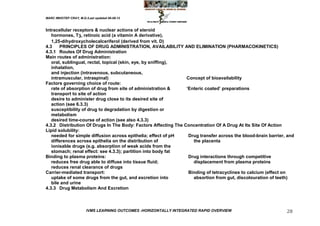
Intracellular receptors & nuclear actions of steroid
   hormones, T3, retinoic acid (a vitamin A derivative),
   1,25-dihydroxycholecalceriferol (derived from vit. D)
4.3    PRINCIPLES OF DRUG ADMINISTRATION, AVAILABILITY AND ELIMINATION (PHARMACOKINETICS)
4.3.1 Routes Of Drug Administration
Main routes of administration:
   oral, sublingual, rectal, topical (skin, eye, by sniffing),
   inhalation,
   and injection (intravenous, subcutaneous,
   intramuscular, intraspinal)                                  Concept of bioavailability
Factors governing choice of route:
   rate of absorption of drug from site of administration &     ‗Enteric coated‘ preparations
   transport to site of action
   desire to administer drug close to its desired site of
   action (see 6.3.3)
   susceptibility of drug to degradation by digestion or
   metabolism
   desired time-course of action (see also 4.3.3)
4.3.2 Distribution Of Drugs In The Body: Factors Affecting The Concentration Of A Drug At Its Site Of Action
Lipid solubility:
   needed for simple diffusion across epithelia; effect of pH    Drug transfer across the blood-brain barrier, and
   differences across epithelia on the distribution of             the placenta
   ionisable drugs (e.g. absorption of weak acids from the
   stomach; renal effect: see 4.3.3); partition into body fat
Binding to plasma proteins:                                      Drug interactions through competitive
   reduces free drug able to diffuse into tissue fluid;            displacement from plasma proteins
   reduces renal clearance of drugs
Carrier-mediated transport:                                      Binding of tetracyclines to calcium (effect on
   uptake of some drugs from the gut, and excretion into           absortion from gut, discolouration of teeth)
   bile and urine
4.3.3 Drug Metabolism And Excretion


                        IVMS LEARNING OUTCOMES -HORIZONTALLY INTEGRATED RAPID OVERVIEW                        28
MARC IMHOTEP CRAY, M.D./Last updated 06-08-12


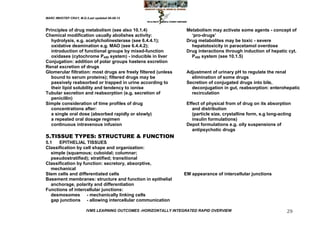
Principles of drug metabolism (see also 10.1.4)                   Metabolism may activate some agents - concept of
Chemical modification usually abolishes activity:                   ‗pro-drugs‘
   hydrolysis, e.g. acetylcholinesterase (see 6.4.4.1);           Drug metabolites may be toxic - severe
   oxidative deamination e.g. MAO (see 6.4.4.2);                    hepatotoxicity in paracetamol overdose
   introduction of functional groups by mixed-function            Drug interactions through induction of hepatic cyt.
   oxidases (cytochrome P450 system) - inducible in liver           P450 system (see 10.1.5)
Conjugation: addition of polar groups hastens excretion
Renal excretion of drugs
Glomerular filtration: most drugs are freely filtered (unless     Adjustment of urinary pH to regulate the renal
   bound to serum proteins); filtered drugs may be                  elimination of some drugs
   passively reabsorbed or trapped in urine according to          Secretion of conjugated drugs into bile,
   their lipid solubility and tendency to ionise                    deconjugation in gut, reabsorption: enterohepatic
Tubular secretion and reabsorption (e.g. secretion of               recirculation
   penicillin)
Simple consideration of time profiles of drug                     Effect of physical from of drug on its absorption
   concentrations after:                                             and distribution
   a single oral dose (absorbed rapidly or slowly)                   (particle size, crystalline form, e.g long-acting
   a repeated oral dosage regimen                                    insulin formulations)
   continuous intravenous infusion                                Depot formulations e.g. oily suspensions of
                                                                     antipsychotic drugs
5.TISSUE TYPES: STRUCTURE & FUNCTION
5.1   EPITHELIAL TISSUES
Classification by cell shape and organization:
   simple (squamous; cuboidal; columnar;
   pseudostratified); stratified; transitional
Classification by function: secretory, absorptive,
   mechanical
Stem cells and differentiated cells                              EM appearance of intercellular junctions
Basement membranes: structure and function in epithelial
   anchorage, polarity and differentiation
Functions of intercellular junctions:
   desmosomes - mechanically linking cells
   gap junctions - allowing intercellular communication

                        IVMS LEARNING OUTCOMES -HORIZONTALLY INTEGRATED RAPID OVERVIEW                             29
MARC IMHOTEP CRAY, M.D./Last updated 06-08-12


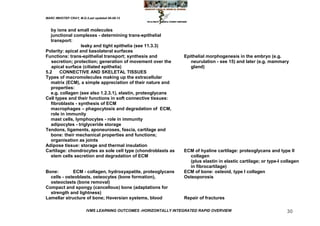
   by ions and small molecules
   junctional complexes - determining trans-epithelial
   transport:
                  leaky and tight epithelia (see 11.3.3)
Polarity: apical and basolateral surfaces
Functions: trans-epithelial transport; synthesis and             Epithelial morphogenesis in the embryo (e.g.
   secretion; protection; generation of movement over the           neurulation - see 15) and later (e.g. mammary
   apical surface (ciliated epithelia)                              gland)
5.2     CONNECTIVE AND SKELETAL TISSUES
Types of macromolecules making up the extracellular
   matrix (ECM), a simple appreciation of their nature and
   properties:
   e.g. collagen (see also 1.2.3.1), elastin, proteoglycans
Cell types and their functions in soft connective tissues:
   fibroblasts - synthesis of ECM
   macrophages – phagocytosis and degradation of ECM,
   role in immunity
   mast cells, lymphocytes - role in immunity
   adipocytes - triglyceride storage
Tendons, ligaments, aponeuroses, fascia, cartilage and
   bone: their mechanical properties and functions;
   organisation as joints
Adipose tissue: storage and thermal insulation
Cartilage: chondrocytes as sole cell type (chondroblasts as      ECM of hyaline cartilage: proteoglycans and type II
   stem cells secretion and degradation of ECM                     collagen
                                                                   (plus elastin in elastic cartilage; or type-I collagen
                                                                   in fibrocartilage)
Bone:        ECM - collagen, hydroxyapatite, proteoglycans       ECM of bone: osteoid, type I collagen
  cells - osteoblasts, osteocytes (bone formation),              Osteoporosis
  osteoclasts (bone removal)
Compact and spongy (cancellous) bone (adaptations for
  strength and lightness)
Lamellar structure of bone; Haversian systems, blood             Repair of fractures

                        IVMS LEARNING OUTCOMES -HORIZONTALLY INTEGRATED RAPID OVERVIEW                             30
MARC IMHOTEP CRAY, M.D./Last updated 06-08-12


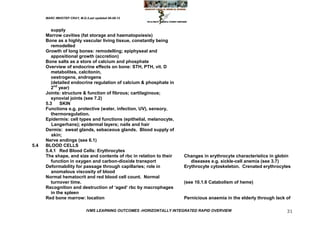
         supply
      Marrow cavities (fat storage and haematopoiesis)
      Bone as a highly vascular living tissue, constantly being
         remodelled
      Growth of long bones: remodelling; epiphyseal and
         appositional growth (accretion)
      Bone salts as a store of calcium and phosphate
      Overview of endocrine effects on bone: STH, PTH, vit. D
         metabolites, calcitonin,
         oestrogens, androgens
         (detailed endocrine regulation of calcium & phosphate in
         2nd year)
      Joints: structure & function of fibrous; cartilaginous;
         synovial joints (see 7.2)
      5.3     SKIN
      Functions e.g. protective (water, infection, UV), sensory,
         thermoregulation.
      Epidermis: cell types and functions (epithelial, melanocyte,
         Langerhans); epidermal layers; nails and hair
      Dermis: sweat glands, sebaceous glands. Blood supply of
         skin;
      Nerve endings (see 6.1)
5.4   BLOOD CELLS
      5.4.1 Red Blood Cells: Erythrocytes
      The shape, and size and contents of rbc in relation to their     Changes in erythrocyte characteristics in globin
         function in oxygen and carbon-dioxide transport                  diseases e.g. sickle-cell anemia (see 3.7)
      Deformability for passage through capillaries; role in           Erythrocyte cytoskeleton. Crenated erythrocytes
         anomalous viscosity of blood
      Normal hematocrit and red blood cell count. Normal
         turnover time.                                                (see 10.1.6 Catabolism of heme)
      Recognition and destruction of ‗aged‘ rbc by macrophages
         in the spleen
      Red bone marrow: location                                        Pernicious anaemia in the elderly through lack of

                              IVMS LEARNING OUTCOMES -HORIZONTALLY INTEGRATED RAPID OVERVIEW                          31
MARC IMHOTEP CRAY, M.D./Last updated 06-08-12


     Production of rbc: stem cells (erythroblasts), normoblasts,      intrinsic factor. Megaloblastic anaemia in folate
        reticulocytes                                                 deficiency
     Control of erythropoiesis: erythropoietin (14.8.1), bone      Use of exogenous EPO
        marrow hyperplasia e.g. in response to prolonged           (see also 10.1.3 Iron transport and storage)
        hypoxia, or hemolytic anaemia                              Role of folate and B12 in erythropoiesis
     Anemia through insufficiency of iron, or vitamins (folate, or
        vitamin B12)
     5.4.2 White Blood Cells: Leucocytes
You should know the roles and normal abundance and turnover times of neutrophils, eosinophils, basophils,
  monocytes, lymphocytes and platelets; and the appearance of these cells in blood films. You should be aware of the
  role of stem cells in their production.
     5.4.2.1         Granulocytes
     Neutrophils (PMNs; polymorphonuclear leucocytes,                  Reserve stores, growth factors specific for each type
       ‗polymorphs‘)                                                     of leucocyte
       Increased production in acute bacterial infection
       Adhere to vascular endothelium and migrate into tissues
       at sites of acute inflammation.
       Phagocytic: ingest, kill and digest micro-organisms,
       particularly bacteria.form pus (see also 10.4.1)
     Eosinophils
       Increased production in chronic allergic conditions or
       parasitic infection
       May protect against damaging effects of long-standing
       allergic reactions
     Basophils
       Granules contain vasoactive substances including
       histamine
       Related to tissue mast cells which release histamine
       (increases blood flow and vascular permeability) in one
       type of allergic response
     5.4.2.2         Monocytes
     Blood cells that give rise by migration to macrophages,


                             IVMS LEARNING OUTCOMES -HORIZONTALLY INTEGRATED RAPID OVERVIEW                           32
MARC IMHOTEP CRAY, M.D./Last updated 06-08-12


  both resident macrophages (e.g. Kupffer cells) and those
  freshly migrated from the blood at sites of inflammation
Macrophages phagocytose and kill organisms; remove
  tissue debris (they secrete enzymes e.g. collagenase)             Macrophages may cause tissue damage known as
  allowing effective repair; and are involved in tissue              ‗chronic inflammation‘
  homeostasis and remodeling – they phagocytose                      e.g. in TB
  apoptotic bodies
5.4.2.3         Lymphocytes
Stem cells in bone marrow, primary development along two
   lineages, ‗B‘ cells and ‗T‘ cells. ‗T cells‘ mature in thymus,
   self-sustaining in the periphery
Proliferate in secondary lymphoid organs - lymph nodes,
   Peyer‘s patches and spleen.
‗B cells‘ e.g. mature into antibody producing cells (plasma
   cells: see 10.4.1)
‗T cells‘ play a role in regulating the immune response, or
   else act to kill cells directly (e.g. virus infected cells)
Third type of lymphocyte: Natural Killer (anti-viral and anti-
   tumor roles)
Small lymphocytes: quiescent, non-dividing, awaiting
   activation by antigen
   Re-circulate continuously through tissues by migration
   through post-capillary venules and via tissue-fluid,
   lymphatics and lymph nodes back into the blood
   thus monitor tissues for presence of antigens
   Respond to specific antigens (presented by antigen-
   presenting cells) by mounting a specific immune response
Large lymphocytes (lymphoblasts): activated, dividing,
   developing to effector cells
Immunological memory resides in lymphocytes
5.4.2.4         Platelets          See 10.3
5.4.3 Hemopoietic Stem Cells

                        IVMS LEARNING OUTCOMES -HORIZONTALLY INTEGRATED RAPID OVERVIEW                       33
MARC IMHOTEP CRAY, M.D./Last updated 06-08-12


 As classic example of well-studied cellular differentiation        Markers of differentiation: proteins (e.g. cell surface
   lineage                                                            markers);
                                                                      mRNA (= cDNA) profiles.
                                                                    Specialized protein synthesis, e.g. globin,
                                                                      immunoglobulin
 Self-renewal of stem cells
 Location in adult red bone marrow                                  Experimental basis of determination of hemopoietic
 Sensitivity to ionizing radiation, and to cytotoxic drugs, e.g.      function
   those used in chemotherapy of cancer (see 40.3.4)
 6.EXCITABLE CELLS: NEURAL COMMUNICATION
 6.1    TISSUES OF THE PERIPHERAL NERVOUS SYSTEM
 Structure of a peripheral nerve: epineurium; fascicular            Perineurium, endoneurium
    arrangement of axons; myelin sheaths, nodes of Ranvier;
    unmyelinated axons
 Ganglia: dorsal root, sympathetic and enteric ganglia
 Structure and distribution of nerve endings: sensory
    terminals (e.g. Meissner, Ruffini, Merkel, Pacinian, free),
    motor end-plate, sympathetic varicosities


 6.2    DIVISIONS OF THE PERIPHERAL NERVOUS SYSTEM
Principles of the peripheral organisation of the somatic motor and sensory nervous systems, and of the autonomic
nervous system
 6.2.1 Somatic Nervous System
 Somatic motor fibres (efferent): cell bodies in spinal cord, terminate directly on
    muscle at motor end plates
 Somatic sensory fibres (afferent): sensory endings in tissues, cell bodies in dorsal
    root ganglia, synapse to other neurons inside central nervous system, convey
    information from receptors e.g. in skin (touch, pain, temperature), in joints (position
    sense, pain), in muscle and tendons (reflex control of movement)
 Motor and sensory fibres typically run in the same peripheral nerves – ―mixed nerves‖
 Fibres of the somatic nervous system are mostly myelinated with fast to medium
    velocity (see 6.3.2); slow ‗C-type‘ pain fibres unmyelinated

                         IVMS LEARNING OUTCOMES -HORIZONTALLY INTEGRATED RAPID OVERVIEW                             34
MARC IMHOTEP CRAY, M.D./Last updated 06-08-12


      6.2.2 Autonomic Nervous System
      Efferent system for involuntary control of body functions. Two major efferent
         divisions: sympathetic and parasympathetic
      Cell bodies in CNS send pre-ganglionic fibres (mostly myelinated, slow to medium
         velocity) to synapse on ganglion cells outside CNS. Pre-ganglionic transmitter:
         ACh
         Parasympathetic outflow: cranial, e.g. vagus nerve for thoracic and most abdominal
         viscera; and sacral for lower gut and urogenital system
         Sympathetic outflow: thoracic and lumbar (T1-L2)
      Ganglion cells send post-ganglionic fibres (non-myelinated slow) to cardiac and
         smooth muscle and glands
      Parasympathetic ganglion cells: typically within end-organ, release ACh
      Sympathetic ganglion cells: typically in discrete ganglia with long post-ganglionic
         fibres
         e.g. paravertebral chain, coeliac ganglion; most release noradrenaline
         adrenal medullary cells are modified symp. ganglion cells that secrete adrenaline
         into the blood.
      Visceral afferents (from stretch and chemoreceptors) often run with autonomic
         nerves:
         may elicit involuntary autonomic reflex (e.g. baroreceptor reflex), or may give
         sensation and mixed autonomic and voluntary somatic effects (e.g. micturition)
      Enteric nervous system: sensory, motor and secretomotor neurons in plexuses in the
         gut wall
         Coordinates activity of gut
         Modulated by pre-ganglionic parasympathetic fibres and post-ganglionic
         sympathetic fibres
      See also specific sections on e.g. autonomic transmission, and nervous control of
         thoracic and abdominal viscera

6.3   NERVE CONDUCTION
      6.3.1 Membrane Potential
      General ion distribution across membranes                     Double-Donnan distribution (osmotic-equilibrium)
      Role of Na/K pump in generating Na+ and K+ distribution       Nernst equation, constant field equation

                              IVMS LEARNING OUTCOMES -HORIZONTALLY INTEGRATED RAPID OVERVIEW                           35
MARC IMHOTEP CRAY, M.D./Last updated 06-08-12


Role of K+ and Na+ diffusion in generating the                Effects of varying external K+, Na+, or Cl– on membrane
   membrane potential                                            potential
6.3.2 Action Potential
Ionic mechanism of the action potential                       Experimental evidence for the Hodgkin-Huxley model.
Conduction of action potential                                   Explanation of voltage-clamp, patch-clamp and gating
Role of myelination in saltatory conduction                      currents. State-diagrams for Na+ and K+ channels
Range of nerve fibre sizes (non-myelinated and                Effects of ion-channel blockers e.g. tetrodotoxin (TTX)
   myelinated) and their conduction velocities:                  and tetraethylammonium ions (TEA)
   compound action potential in a peripheral nerve            Electrical circuit model of membrane potential
                                                              Passive electrical constants of membranes (length
                                                                 constant, time constant)
                                                              Wallerian degeneration
                                                              Degenerative disorders:
                                                                axonal death as a cause of disease -Motor Neurone
                                                                 Disease; vincristine neuropathy as an example of the
                                                                 effect of failure of the cytoskeleton
                                                                demyelinating diseases - multiple sclerosis
6.3.3 Local Anesthetics
Examples of local anaesthetics e.g. lignocaine                Cocaine
Mechanisms of action.                                         Local, regional, spinal, epidural anesthesia
Duration of action: dependence on lipid solubility, use       Risks of accidental systemic administration
   of vasoconstrictors
Sequence of blockade: pain first, then general sensory
   and then motor last.
6.3.4 General Anesthetics
Principles of action of general anaesthetics
Distribution of anesthetic drugs between alveolar air (for    Physical and chemical characteristics of the ―ideal‖
   inhalational agents), blood, tissues and CNS                 general anesthetic
Factors influencing duration and depth of anesthesia.
6.4    SYNAPTIC TRANSMISSION
6.4.1 Neuromuscular Transmission
Morphology and function of neuromuscular junction             Structure of ACh-activated cation channels; two ACh
   (nmj)                                                         receptor sites per channel. High signal-to-noise ratio

                        IVMS LEARNING OUTCOMES -HORIZONTALLY INTEGRATED RAPID OVERVIEW                           36
MARC IMHOTEP CRAY, M.D./Last updated 06-08-12


Synthesis, storage, release and action of ACh                   of synapse. Choline recycling. Drugs interfering with
Hydrolysis of ACh                                               vesicular release: botulinum toxin
Mechanisms of action of neuromuscular blocking                Modern analogues of tubocurarine.
   drugs:                                                     Advantages and disadvantages of tubocurarine vs.
   competitive non-depolarising (tubocurarine)                  suxamethonium. Pseudocholinesterase deficiency
   depolarising (suxamethonium)
Methods of reversing neuromuscular block
6.4.2 Interneuronal synapses
Variety of neurotransmitters (including ACh,
   catecholamines, glutamate, GABA and glycine) and
   receptors
Excitatory and inhibitory synapses
EPSPs and IPSPs                                               Pre-synaptic inhibition
Concept of synaptic integration                               Idealised model of a nerve cell (input and output regions;
                                                                 summing point)
                                                              Concept of spatial and temporal summation
                                                              Synaptic plasticity; facilitation and depression
                                                              Electrical synapses, gap junctions

6.4.3 Autonomic Synapses
Synapses on cardiac and smooth muscle (en passant
   junctions, varicosities): structure and function in
   comparison with neuromuscular junction.

6.4.4 Autonomic Transmission
6.4.4.1         Cholinergic
Nicotinic and muscarinic receptors: distribution and          Existence of receptor subtypes M, N1,, N2: ganglionic vs.
  function                                                       neuromuscular nicotinic receptors
Local and systemic actions of agonists (e.g. nicotine,        Hexamethonium vs. decamethonium as evidence for
  muscarine) and of antagonists (e.g. tubocurarine,              structural differences between N1 and N2 subtypes
  atropine)
Therapeutic use of antimuscarinics in e.g. asthma,
  urinary incontinence

                        IVMS LEARNING OUTCOMES -HORIZONTALLY INTEGRATED RAPID OVERVIEW                           37
MARC IMHOTEP CRAY, M.D./Last updated 06-08-12


Acetylcholinesterase
Examples and effects of anti-cholinesterases.(e.g.
  neostigmine)
Therapeutic use of anticholinesterases in myasthenia
  gravis
6.4.4.2         Catecholaminergic
Synthesis, storage and release of catecholamines              Actions of experimental toxins to interfere with synthesis
  (dopamine, noradrenaline, adrenaline)                       Effect of reserpine
                                                              DA as a transmitter in brain, gut and kidneys: use of L-
                                                                 DOPA
Adrenoceptors: 1, 2, 1, 2; distribution and function      Therapeutic applications of selective antagonists: in
  relative potency of NA, Adr, and isoprenaline on 1,           asthmatics
  1, 2
Local and systemic effects of agonists and antagonists
Therapeutic use of selective agonists and antagonists
  e.g:
    -agonists in asthma
  1 -blockers (e.g. atenolol) in cardiovascular disease
Reuptake of transmitter and subsequent degradation:
  MAO, COMT
  inhibitors of reuptake (amphetamines);
  inhibitors of degradation: MAO inhibitors

6.4.4.3         Other autonomic neurotransmitters
Other transmitters and neurotransmitters e.g. nitric
  oxide (NO), ATP and neuropeptides e.g. VIP

Concept of co-transmission                                    Putative functions of co-transmitters
6.5    MUSCLE AND INNERVATION
6.5.1 Structure and Function: Overview
Skeletal muscle.                                               Functional and metabolic characteristics of different
   Gross structure: fascicular arrangement; myofibres           fibre types in skeletal muscle. Distribution of different
   controlled in groups                                         fibre types between muscles

                        IVMS LEARNING OUTCOMES -HORIZONTALLY INTEGRATED RAPID OVERVIEW                            38
MARC IMHOTEP CRAY, M.D./Last updated 06-08-12


    (motor units) by somatic nerves ending at motor end
   plates (see 6.4.1)
   Ultrastructure: sarcolemma, sarcoplasm,
   sarcoplasmic reticulum,
    myofibrils, myofilaments (organisation of muscle
   proteins),
    mitochondria, T-tubules
Cardiac muscle:
   branching mesh of cells joined and electrically
   coupled by intercalated disks (desmosomes and gap
   junctions)
   autonomic innervation
Smooth muscle: distribution and functions                      Relationship between ultrastructure and function in all
   Gross and microscopic structure in relation to                three muscle types: comparisons between types
   function; cell-cell connections – mechanical and            Limitations on regeneration and repair following damage
   communicating
   autonomic innervation
6.5.2 Skeletal Muscle
Muscle action potential as the trigger for muscle fibre       Length–tension curve of muscle
   contraction                                                Electron microscopy of muscle. 3-D arrangement of
Grading of contraction depends on motor unit                     myofilaments. Relation of sliding-filament theory to
   recruitment and frequency of nerve (and, therefore,           length-tension relationship
   muscle) action potentials:-                                T-tubules and triads in e/c coupling:
   ‖one-to-one transmisssion‖; twitch summation;                 link between t-tubules and sarcoplasmic reticulum -
   tetany                                                        Ca2+-release
Cross-bridge cycling and sliding filament theory of           Troponin/tropomyosin inhibition of cross-bridge cycling:
   contraction                                                   disinhibition by a rise of intracellular Ca++
Role of sarcoplasmic reticulum and Ca++: e/c coupling
   and muscle relaxation (sr Ca2+-ATPase)
6.5.3 Cardiac Muscle
Heterogeneity, roles, and basic ionic mechanisms of the
   cardiac action potential
Role of Ca2+ entry (during the long AP) and sr Ca2+

                        IVMS LEARNING OUTCOMES -HORIZONTALLY INTEGRATED RAPID OVERVIEW                         39
MARC IMHOTEP CRAY, M.D./Last updated 06-08-12


   release in e/c coupling
Mechanism of relaxation.
Regulation of contraction:                                    Length–tension curve of cardiac muscle
   cellular basis of Starling‘s Law of the heart              Effects of methyl-xanthines
   role and mechanisms of autonomic input in
   controlling the amplitude and frequency of the heart
   beat
Inotropic effect of cardiac glycosides (see also 8.6.7)
6.5.4 Smooth Muscle
Neurogenic and myogenic activity                              Types of smooth muscle:
Role of the action potential (when present)                   (i) electrically excitable: driven entirely through nervous
Role of Ca2+ entry and sr Ca2+ release in activating               activity e.g. vas deferens, arterioles
   contraction                                                (ii) spontaneous electrical activity modulated by nervous
Role of cAMP in inhibiting contraction                             activity:
Regulation of contraction:                                         pacemaker depolarizations and spikes e.g. bladder,
   excitatory and inhibitory autonomic innervation                 some gut muscle
   stimulation or inhibition by a variety of hormones and          or basic slow wave activity e.g. most gut, uterus
   locally produced compounds                                 (iii) electrically inexcitable: regulated through receptors
                                                                   acting via second messengers (not via Em) e.g.
                                                                   respiratory tract, many blood vessels
                                                              Patterns of innervation of these types of smooth muscle
                                                              Control of contraction by the action of myosin light chain
                                                                   kinase (Ca2+ activates, cAMP/PK-C inhibits)
7.MUSCULOSKELETAL ANATOMY

        Basic principles of living, gross and radiographic anatomy, (including CT and MRI) of the principal features
        of the musculoskeletal system. You should be able to identify major named structures on the living body,
        a dissection, or a clinical image, and define their principal functions.
7.1   BONES OF THE LIMBS
Principles of skeletal organisation; bone as a tissue (see 5.2)
Long, flat, and short bones; adaptations to strength and force transmission
As examples, the bones of the upper limb, their functional adaptations; comparisons

                        IVMS LEARNING OUTCOMES -HORIZONTALLY INTEGRATED RAPID OVERVIEW                            40
MARC IMHOTEP CRAY, M.D./Last updated 06-08-12


  with bones of the lower limb
Shoulder girdle: clavicle; scapula (coracoid, acromion, spine, glenoid fossa);
  comparison with pelvic girdle (pubis, ischium, ilium )
Arm: humerus (head, neck, lesser and greater tuberosities, shaft, epicondyles);
  comparison with femur
Forearm: ulna and radius; comparison with tibia and fibula
Small bones of hand (carpal; metacarpals; phalanges); comparison with foot (tarsus,
  metatarsals, phalanges)

7.2    JOINTS OF THE LIMBS
Principles of the structure and function of fibrous, cartilaginous, synovial joints
Relationships between stability and mobility
For each joint you should know its structural and functional classification, the type
   and range of movements, and main muscle groups acting at the joint. Compare the
   movements and structural specializations of the shoulder girdle (sterno-clavicular
   and acromio-clavicular joints) and pelvic girdle, shoulder and hip, elbow and knee,
   forearm (radio-ulnar) and wrist compared with the leg (tibio-fibular) and ankle.
Role of the rotator-cuff muscles
Compare the structural specializations of the hand (dexterity and grip) with foot
   (stability and support)
7.3    MUSCLES AND MOVEMENTS OF THE LIMBS
Principles of the organisation, function and innervation of functional muscle groups
The attachments, functional grouping and movements of the muscles of the upper
   limb; comparisons with the lower limb; control of tendons at joints
Muscles groups acting on the shoulder girdle and shoulder compared with those
   acting at the hip
Muscles groups of the flexor and extensor compartment of the arm (acting on the
   elbow) compared with those acting at the knee
Muscles groups involved in pronation and supination of the forearm
Muscles groups acting to produce inversion and eversion of the foot
Muscles groups of the forearm involved primarily in flexion and extension of wrist and
   fingers compared with ankle and toes
Movements of the hand compared with the foot

                        IVMS LEARNING OUTCOMES -HORIZONTALLY INTEGRATED RAPID OVERVIEW   41
MARC IMHOTEP CRAY, M.D./Last updated 06-08-12


7.4     BLOOD SUPPLY TO THE LIMBS
Basic principles and general organisation of arterial supply and venous and lymphatic
   drainage (structural adaptation of blood vessels: see 8.5.2)
Upper limb arteries (subclavian, axillary, brachial, radial, ulnar, palmar arches)
   compared with lower limb (external iliac, femoral, popliteal, anterior and posterior
   tibial, dorsalis pedis, plantar arch)
Superficial and deep venous drainage of upper (axillary and subclavian veins) and
   lower limb (venae comitantes; popliteal and femoral veins)
Communicating veins: normal flow from superficial to deep. Effects of gravity on
   venous return from legs, roles of muscle pump, fascial compartments.
Lymphatic drainage follows venous drainage; superficial and deep nodes; principles
   of central drainage via successively more central nodes, axillary lymph nodes - role
   in drainage of breast.
Principle of anastomosis around joints
7.5     NERVE SUPPLY OF THE LIMBS
Principles of the origin and distribution of the motor (multiple spinal levels of origin
   for nerves involved in limb movements), sensory (dermatomes), and autonomic
   nervous systems (see 6.2.2)
Principles of organization of limb plexuses in relation to their development
Brachial plexus and lumbosacral plexus
The nerve supply to the flexor and extensor compartments of the limbs, and the
   muscle groups supplied:
   Upper limb: musculocutaneous, median, ulnar, radial
   Lower limb: femoral, obturator, gluteal, sciatic
Anatomical basis of common reflex arcs: significance in mapping injuries to spinal
   nerve roots
7.6     SPINE
Basic principles of development of the spine (sclerotome formation) and of its
   structure sufficient to understand its functions as the central, flexible, weight-
   bearing axis of the body
Components of a typical vertebra. Regional specializations for function at cervical,
   thoracic, lumbar and sacral levels; the atlas and axis; fused vertebrae in sacrum
   and coccyx

                        IVMS LEARNING OUTCOMES -HORIZONTALLY INTEGRATED RAPID OVERVIEW     42
MARC IMHOTEP CRAY, M.D./Last updated 06-08-12


      Intervertebral joints: movements possible at different regions of the spine;
         intervertebral discs
      Curvatures of the spine: lumbar and sacral lordoses. Transmission of weight through
         the spine
      Major features of the development of the segmental structure of the body
      7.7    LIVING ANATOMY
      Major bony landmarks (esp. around shoulder, elbow, wrist). Vertebral prominences
      Principal arterial pulse points. Measurement of systemic arterial pressure
Points of access to veins for venepuncture
      Nerve function: muscle action and power, tendon reflexes (e.g. biceps, knee jerk);          Electromyogram
         sites to test sensation to determine damage to nerve roots and main peripheral
         nerves
      7.8. IMAGING
      Plain radiographs: principal bony landmarks
      CT and MRI: principal structures and landmarks
      Contrast imaging: angiograms - principal arteries, veins, lymphatics                        Arthrograms
8.     BREATHING AND CIRCULATION
      8.1    THORACIC ANATOMY
       Principal features of the living, gross and radiographic anatomy, including CT and MRI appearance of the thorax.
          You should be able to identify major named structures on the living body, a dissection, or a clinical image, and
          to define their major functions.
      8.1.1 Thoracic Cage
      Structure of thoracic cage in relation to movements of respiration, protection of thoracic contents, and
         examination of heart, lungs and chest wall.
      8.1.1.1         Living anatomy of the thorax
      Surface markings on the chest of the apex beat and
        borders of the heart, the diaphragm
      Relative expansion of the upper and lower chest in
        anteroposterior and lateral dimensions; descent of
        diaphragm on inspiration
      Percussion of the chest wall to detect dullness due to
        heart and liver, or resonance of gas-filled cavities i.e.

                              IVMS LEARNING OUTCOMES -HORIZONTALLY INTEGRATED RAPID OVERVIEW                           43
MARC IMHOTEP CRAY, M.D./Last updated 06-08-12


         lung fields and gas in stomach

      8.1.1.2         Skeletal and soft-tissue framework of the thorax
      Sternum, manubrium, xiphisternum, sternal angle, ribs
         and costal cartilages
      Diaphragm, external and internal intercostal muscles,
         phrenic nerve (C3,4,5)
      Movements of the ribs: expansion of transverse diameter
         by movement of the lower ribs; movement of the upper
         ribs give lesser expansion of anterior-posterior and
         transverse diameters; role of intercostal muscles,
         diaphragm
      8.2    PULMONARY MORPHOLOGY
             Structure of the lungs, airways and pleural cavity in relation to respiration
      8.2.1 Pleura and Pleural Cavities
      Pleural sac. Parietal and visceral layers of pleura.
      8.2.2 Upper Airway
      Role of the nose: olfaction, and warming, cleaning, and          Sites of impaction of inhaled bodies
         humidifying inspired air
      Naso-, oro-, and laryngopharynx
      Movements of mouth, tongue, soft palate and pharynx
      during breathing
      Epiglottis, larynx and phonation
8.2.3 Airway And Lungs
      Airway: trachea left and right main bronchi; division into
         lobar bronchi
      Principles of lobar organization and bronchopulmonary
         segmentation
      Structural feature of the lungs in relation to gas exchange
      Principles of pulmonary and bronchial arterial supply and
         venous drainage of the lungs
      Afferent and efferent autonomic innervation of airways
         and lungs

                              IVMS LEARNING OUTCOMES -HORIZONTALLY INTEGRATED RAPID OVERVIEW                  44
MARC IMHOTEP CRAY, M.D./Last updated 06-08-12


Principles of lymphatic drainage of airway

8.2.4 Tissues of the Respiratory System
General structure of mucous and serous membranes; the            Accumulation of viscous secretion in cystic fibrosis
   mucous membranes of the respiratory tract
Epithelial cell types and their functions in the airways:        Brush cells, Clara cells, small granule-containing cells
   ciliated cells, goblet cells
Development and cellular structure of alveoli: surfactant        Respiratory distress of the new-born
   production                                                    Effects of smoking on respiratory epithelia
Type I and type II pneumocytes, alveolar macrophages,            Role of growth factors in differentiation and
   alveolar capillaries                                             morphogenesis
   elastic fibres

8.2.5 Imaging
Appearance on radiographs, angiograms, CT and MRI of
   normal lung parenchyma and pulmonary vasculature

8.3     RESPIRATORY PHYSIOLOGY

8.3.1 Overview Of Pulmonary Function
Total ventilation. Respiratory dead space and alveolar
   ventilation
Concept of partial pressure and its units of measurement
Resting oxygen uptake and carbon dioxide production              Respiratory quotient
Normal alveolar partial pressures of oxygen and carbon           The alveolar gas equation
   dioxide
8.3.2 Respiratory Mechanics - Statics
Tidal volume, vital capacity, functional residual capacity,      Other lung volumes and their measurement
   and their measurement
Negativity of intra-pleural pressure: pneumothorax               Measurement of intra-pleural pressure and lung
                                                                    compliance
Concepts of compliance, surface tension                          Regional ventilation
Surfactant                                                       Laplace‘s equation

                        IVMS LEARNING OUTCOMES -HORIZONTALLY INTEGRATED RAPID OVERVIEW                            45
MARC IMHOTEP CRAY, M.D./Last updated 06-08-12


                                                                 Atelectasis in Respiratory Distress Syndromes
8.3.3 Respiratory Mechanics - Dynamics
Concept of airways resistance                                    Distribution of airways resistance
Turbulence of airflow leading to wheeze                          Relation of airways resistance to lung volume
                                                                 Measurement of airways resistance
Peak expiratory flow and its measurement                         Forced expiratory volume in one second (FEV1)
                                                                 Work of breathing
                                                                 Distinction between obstructive (e.g. asthma) and
                                                                    restrictive (e.g. pulmonary fibrosis) lung disease

8.3.4 Diffusion Of Respiratory Gases
Concept of diffusion and of the diffusing capacity of the        Fick‘s law of diffusion
   lung
Factors influencing the speed of diffusion                       Perfusion and diffusion limitation of gas transfer
Pathologies affecting diffusion e.g. pulmonary fibrosis,         Measurement of diffusing capacity using carbon
   pulmonary edema, emphysema                                       monoxide
8.3.5 Oxygen Transport
Normal value for systemic arterial partial pressure of           Measurement of arterial partial pressure of oxygen
   oxygen
Role of hemoglobin in oxygen transport                           Contribution of dissolved oxygen to oxygen
Concept of saturation                                               transport
                                                                 Measurement of arterial pressure oxygen saturation
                                                                    by pulse oximetry
Shape of the oxy-hemoglobin dissociation curve                   The Hill equation and cooperative binding
                                                                 Myoglobin: role of myoglobin comparison with
Shift of the curve by CO2 and pH (Bohr effect)                      hemoglobin,
                                                                 Effect of temperature and 2,3-DPG concentration on
                                                                    oxy-haemoglobin dissociation
                                                                 Varieties of hemoglobin: e.g. foetal, sickle cell
Delivery of oxygen to the tissues and factors affecting it       Oxygen stores and the effect of apnoea
                                                                    hypoxic hypoxaemia, cyanosis
                                                                 Cyanide and carbon monoxide poisoning, oxygen
                                                                    therapy

                        IVMS LEARNING OUTCOMES -HORIZONTALLY INTEGRATED RAPID OVERVIEW                            46
MARC IMHOTEP CRAY, M.D./Last updated 06-08-12


8.3.6 Carbon Dioxide Transport
Normal value for systemic arterial partial pressure of
   carbon dioxide
Role of bicarbonate in carbon dioxide transport             Contribution of dissolved carbon dioxide to oxygen
Concept of buffering: its importance in carbon dioxide         transport
   transport                                                The Henderson-Hasselbalch equation
   role of hemoglobin in buffering H+ from dissociating     The CO2/blood dissociation curve: the Haldane effect
   H2CO3                                                    The Davenport diagram showing the
Additional role of haemoglobin in CO2 transport by             interdependence of plasma bicarbonate, pCO2,
   formation of carbamino compounds                            and pH in oxygenated and deoxygenated blood
Role of carbonic anhydrase in red cells; the chloride shift Body stores of CO2; the effects of apnoea
8.3.7 Pulmonary Perfusion And Ventilation/Perfusion (V/Q) Matching
The pulmonary circulation as a low pressure circulation     Regional distribution of flow and its measurement
Effect of mismatch of perfusion to ventilation on           Regional differences in ventilation/perfusion ratios
   pulmonary gas exchange (including consequences of           and alveolar gas composition
   the shape of the oxyhemoglobin dissociation curve)       The three-compartment model of the lung: shunt,
Concept of pulmonary shunt                                     ideal alveolus and dead-space
Hypoxic pulmonary vasoconstriction and acute pulmonary      Pathological examples of V/Q mismatch: pulmonary
   hypertension                                                embolism, pneumonia
8.3.8 Control Of Breathing
Generation of breathing rhythm within brainstem             Structure and function of the carotid body
Effect of ventilation on alveolar pressures of oxygen and
   CO2
Central chemoreceptors: their location, normal stimulants,
   and role
Peripheral chemoreceptors: their location and normal        Innervation of peripheral chemoreceptors
   stimulants
Pulmonary stretch receptors                                 Hering-Breuer reflex. Pulmonary irritant and J
Autonomic innervation of the bronchi                           receptors
                                                            Innervation of pulmonary receptors via vagus nerve
8.3.9 Acute Airways Obstruction
8.3.9.1         By Foreign Bodies
Consequences of acute airway obstruction by foreign              Anatomy of bronchial bifurcation: favoured path

                        IVMS LEARNING OUTCOMES -HORIZONTALLY INTEGRATED RAPID OVERVIEW                         47
MARC IMHOTEP CRAY, M.D./Last updated 06-08-12


    bodies: upper and lower airways                                   followed by inhaled foreign bodies
 8.3.9.2         In Unconsciousness and Sleep
 Consequences and relief during basic
    resuscitation of upper airways obstruction
 8.3.10 Pharmacology Of Breathing
 8.3.10.1 Effects of drugs on respiratory control
Effects of opiates on cough reflex and respiratory          Effect of salicylate overdose on respiratory control
  drive                                                     Use of respiratory stimulants (doxapram) after
                                                               general anesthesia
 8.3.10.2        Asthma and its pharmacology
Asthma: role of inflammatory response                       Mucus formation. Intrinsic plexus
Drugs used to treat asthma:                                 Potential disadvantages of pharmacological
bronchodilators;   -adrenoceptor agonists e.g.               intervention: receptor down-regulation, adverse
  salbutamol, adrenaline (for its                             effects on mucus viscidity (beta-agonists)
   -agonism), cholinoceptor antagonists (e.g.              Antileukotrienes in asthma therapy
  ipratropium), xanthines                                   Sodium cromoglycate; inhibition of mast cell
  (e.g. aminophylline)                                        degranulation
Steroids: actions and adverse effects (see also 34.1.1;     Other transmitters of bronchial plexus as possible
  27.5.2)                                                     therapeutic targets
Cromoglycate                                                Use of humidification and mucolytics

 8.4    CARDIOVASCULAR SYSTEM: MORPHOLOGY
 8.4.1 The Heart
     Structure of the heart in relation to its action as two pumps, left and right. You should be able to identify
        major named structures on the living body, a dissection, or a clinical image, and to define their major
        functions.
 8.4.1.1         Exterior of heart
 Fibrous pericardium; serous pericardium
 Principal venous structures draining to the heart (superior
   and inferior venae cavae and pulmonary veins)
 Principal arterial structures leaving the heart: aorta and
   pulmonary trunk

                         IVMS LEARNING OUTCOMES -HORIZONTALLY INTEGRATED RAPID OVERVIEW                              48
MARC IMHOTEP CRAY, M.D./Last updated 06-08-12


8.4.1.2         Interior of heart
Atria and ventricles: structural adaptation to function
Right (tricuspid) and left (mitral) atrioventricular valves,
  pulmonary valve, aortic valve
8.4.1.3         Blood supply of heart: distribution of supply
Principles of coronary vascular supply; angiographic            Angina. Myocardial ischemia; consequences of
  appearance                                                    occlusion of the major coronary arteries
Principles of blood supply to myocardium: coronary
  arteries as functional end arteries, coronary perfusion
  during diastole, coronary sinus
8.4.1.4         The Conducting System (see also 8.6.1)
Principles of conducting system of the heart
Sinu-atrial and atrioventricular nodes. Atrioventricular        Referred pain from the heart to central chest, neck
   bundle: right and left branches                              and left arm; from diaphragm to shoulder (C4)
Autonomic innervation.
8.4.2 Histology of Blood Vessels
Structure and functions arteries, arterioles, capillaries,      Arterio-venous anastomoses
   venules and veins:                                           Atherosclerosis - degenerative process narrowing
   endothelium; tunica intima, media, vasa vasorum,                arterial lumen and weakening walls (details to be
   adventitia; elastic and non-elastic vessels                     covered in 2nd year)
Portal systems (in liver, kidney, and pituitary gland)
Structure and function of different types of capillaries:
   non-fenestrated and fenestrated capillaries, sinusoids,
   ‗tight‘ capillaries
8.4.3 The Great Vessels
       Major arteries and veins carrying blood from, and returning it to, the heart.
Aorta: ascending, arch, descending
  Aortic arch baroreceptors, aortic body chemoreceptors          Sensory fibres in vagus nerve: Cr. X
Brachiocephalic artery, subclavian and common carotid
  arteries; carotid bifurcation                                  Sensory fibres in glossopharyngeal nerve: Cr. IX
  Carotid sinus baraoreceptors, carotid body
  chemoreceptors

                        IVMS LEARNING OUTCOMES -HORIZONTALLY INTEGRATED RAPID OVERVIEW                          49
MARC IMHOTEP CRAY, M.D./Last updated 06-08-12


      Pulmonary artery. Ligamentum arteriosum
      Brachiocephalic veins, superior and inferior vena cava
      8.4.4 Mediastinum
Position and function of the major structures within the chest, and their relationship to the heart and lungs.
      Major aspects of organisation of the mediastinum. Sites
         of major structures: heart, great vessels, trachea,
         oesophagus, phrenic, and autonomic nerves
      Thoracic duct draining lymph to left subclavian vein
      8.5.5 Autonomic Innervation of Thoracic Viscera (see also 6.2.2)
      Sympathetic nervous system: origin of preganglionic
         fibres from T1 - L2 of cord; Sympathetic chain of
         ganglia; effects on heart and airways
      Parasympathetic system; preganglionic fibres in vagus         Horner‘s syndrome (damage to sympathetic trunk at
         nerves; effects on heart and airways                          head of first rib)
      Visceral afferent (sensory) fibres with vagus and
         sympathetic nerves
      8.4.6 Imaging
      Appearance on radiographs, angiograms, CT and MRI of
         normal heart and mediastinum

      8.5    CARDIOVASCULAR PHYSIOLOGY
      8.5.1 Electrical Activity In The Heart: The Electrocardiogram
      Pacemaker and conducting system
         relative conduction velocities in parts of the conducting
         system
      Key components and origin of the 3-lead ECG                      The heart as a dipole in a volume conductor
         P, QRS, T waves                                               Historical appreciation of the contributions of
                                                                          Einthoven and others to understanding the ECG.
                                                                          12-lead ECG
                                                                       Elementary examples of clinical abnormalities
                                                                          diagnosed on ECG

      8.5.2 The Heart as a Pump

                              IVMS LEARNING OUTCOMES -HORIZONTALLY INTEGRATED RAPID OVERVIEW                        50
MARC IMHOTEP CRAY, M.D./Last updated 06-08-12


Role of papillary muscles in valve function
1st and 2nd heart sounds                                         3rd and 4th heart sounds
Cardiac cycle: pressure and volume changes in relation to
   the ECG
Jugular venous pulse in relation to the cardiac cycle
Physiological significance of the Frank-Starling Law of the      Historical appreciation to the Frank–Starling Law
   Heart                                                         Concept of cardiac work
Determinants of cardiac output                                   Measurement of cardiac output: the Fick principle,
Neural and chemical factors affecting the inotropic and             and dilution technique; echocardiography
   chronotropic state of the heart

8.5.3 Properties of the Vascular System
Functions of the circulation: systemic and pulmonary
   divisions
Distribution of cardiac output to main organs of the body
Structure and roles of arteries, arterioles, capillaries, &      Arterio-venous anastomoses
   veins (see 8.5.5)
Relation between flow velocity and total cross-sectional         Poiseuille‘s equation; distinction between laminar
   area of vessel bed                                               and turbulent flow
Blood volume and its distribution with respect to vessel         Laplace‘s law: the importance of elastic tissue in
   type                                                             maintaining the stability of resistance vessels
Effect of vessel radius on its resistance to flow
Anomalous viscosity of blood
Fluid balance across capillaries (Starling forces)
Production of vasoactive substances by endothelium
8.5.4 Hemodynamics
Measurement of arterial blood pressure; Korotkoff sounds         Appreciation of the history of the circulation (Galen,
                                                                     Harvey)
Pulse pressure, mean arterial blood pressure, diastolic          Pulse wave transmission speeds
  and systolic blood pressure                                    Differences between peripheral and central pressure
                                                                     waveforms
Determinants of arterial blood pressure (cardiac output
  and total peripheral resistance)

                        IVMS LEARNING OUTCOMES -HORIZONTALLY INTEGRATED RAPID OVERVIEW                            51
MARC IMHOTEP CRAY, M.D./Last updated 06-08-12


Use of the jugular vein for assessment of central venous
   pressure.
Effects of posture and gravity on pressure and volumes in
   the circulation
8.5.5 The Control Of Regional Blood Flow
Autoregulation
Factors affecting local vascular control:                      Stretch-activated ion channels
   temperature, metabolic, myogenic, autacoids, nitric         Evidence for role of nitric oxide
   oxide
Reactive hyperaemia
Neural and hormonal control
Distinguishing features and the control of circulation in
   the major organs:
   skeletal muscle, coronary, pulmonary, cutaneous,
   cerebral, renal
8.5.6 Sensory Receptors And Reflexes
       The integrative processes involved in blood pressure regulation will not be examined until the second year
Arterial baroreceptors: location and function                    Classes of baroreceptor fibre and their thresholds for
                                                                    firing
Afferent and efferent pathways                                   Effect of arterial chemoreceptor stimulation on the
                                                                    circulation
Low pressure cardiopulmonary receptors                           Significance of blood pressure regulation
8.5.7 Pharmacology of Cardiac Contractility
Principles of influence of drugs on cardiac contractility:        Effects on cardiac contractility of coronary and
   direct effects on heart, indirect effects through                 peripheral vasodilators (e.g. ACE inhibitors,
   changing vascular tone                                            hydralazine, nitrates)
Cardiac glycosides: possible mechanism of action                  Risk that drugs increasing cardiac contractility may
Positive effect of adrenoceptor agonists e.g. dobutamine             precipitate ischaemia and dysrhythmia
   ( agonist)
      -                                                           Calcium sensitizers as possible new positive
Negative effect of adrenoceptor antagonists e.g.                     inotropes
   propranolol
8.5.8 Cardiac Dysrhythmias And Heart Block
Examples of common dysrhythmias                  Possible causative mechanisms:

                        IVMS LEARNING OUTCOMES -HORIZONTALLY INTEGRATED RAPID OVERVIEW                            52
MARC IMHOTEP CRAY, M.D./Last updated 06-08-12


                                                  Effects of ischemia, electrolyte
                                                    imbalance
                                                  Structural causes, e.g. hypertrophic
                                                    obstructive cardiomyopathy
                                                    aberrant conducting pathways as in
                                                    Wolff-Parksinon-White syndrome
 Examples of antidysrhythmics, e.g:              Dysrhythmogenic effects of
    lignocaine, propranolol, amiodarone,            antidysrhythmic drugs.
    verapamil, adenosine; brief outline of
    possible principles of action
 Types of heart-block                        Possible iatrogenic origins of heart-
 Secondary pacemakers                           block:
 Therapeutic use of antimuscarinic drugs        use of cardiac glycosides or Ca++
    (atropine)                                  channel antagonists
 8.5.9 Integration of Regional and Systemic Regulation of the Circulation
 Examples of coordinated regulation see: Exercise Physiology (section 8.7)

Local metabolic and myogenic effects on regional            Cellular mechanisms of metabolic vasodilation:
  circulation                                                  ATP, adenosine, pH, K+, osmolarity, temperature,
Distinction of functions of metabolic and myogenic             ATP-sensitive K+ channels, L-type Ca2+ channels
  responses                                                 Cellular mechanisms of myogenic response: stretch-
Action of regional regulatory changes on cardiac               sensitive cation channels
  output through Starling's Law                             Role of endothelial nitric oxide in ascending
                                                               vasodilation
                                                            (n.b. other locally acting mediators: see Anti-
                                                               Inflammatory Drugs 27.5)
                                                            Experimental demonstrations of autoregulation of
                                                               local blood flow
                                                            Venous occlusion plethysmography
                                                            in situ studies of vessels, countercurrent
                                                               communication from venules to arterioles
                                                            Effects of posture on capillary pressure of the human
                                                               foot

                         IVMS LEARNING OUTCOMES -HORIZONTALLY INTEGRATED RAPID OVERVIEW                             53
MARC IMHOTEP CRAY, M.D./Last updated 06-08-12


      Short-term reflex control of arterial blood pressure       Rate sensitivity of carotid sinus baroreceptors
                                                                 Pathways of the reflexes: role of the brainstem
         stability of ABP independent of local flow

         mechanisms

    High pressure (arterial) and low pressure (atrial)
      reflexes
     8.5.10 Cardiovascular Regulation in Critical Illness
    Symptoms and signs of cardiac failure                        Classification of disorders of the circulation
    Examples of causes of left and right ventricular             Effects of haemorrhage and vasoconstriction or
      failure, failure of the arterial and venous                   dilation on cardiac and vascular function curves:
      circulations, and losses of circulating volume                Guyton‘s analysis
                                                                 Arterial and venous compliances. Mean circulatory
                                                                    pressure
    Definition of shock: symptoms and signs of shock.            Principles of treatment of shock
    Features of hypovolemic, cardiogenic and septic              Anaphylactic and spinal shock
      shock
    Neural and endocrine responses to shock
     8.5.11 Pharmacology of Cardiac Failure
    Symptomatic treatments: diuretics; actions on                Advantages and disadvantages of different
      vasculature and on circulating volume                        approaches to therapy
    Vasodilators: nitrates, converting-enzyme inhibitors         Therapeutic and possible adverse effects of diuretics
                                                                   through reduction in venous return
     Positive inotropes: glycosides
      8.5.12 Pharmacology of Blood Pressure
      8.6.12.1        Central Effectors
     Sympathetic influences in CNS. Other possible sites
       of control
     Clonidine,  -methylDOPA
      8.5.12.2        Peripheral Vascular Effectors
8.5.12.2.1    Sympathetic

                              IVMS LEARNING OUTCOMES -HORIZONTALLY INTEGRATED RAPID OVERVIEW                             54
MARC IMHOTEP CRAY, M.D./Last updated 06-08-12


    Alpha and beta antagonists in the treatment of               Possibility of sub-groups of hypertensives responsive
      hypertension                                                 to beta-blockade
    Adverse effects of alpha blockade: postural
      hypotension                                                Possible mechanisms of action of beta-blockade
    Adverse effects of beta blockade:
      lethargy/depression, exacerbation of asthma,
      digital vasoconstriction
     8.5.12.2.2   Nitrates
    Existence of EDRF (nitric oxide) and its receptors.          Failure of endogenous nitrate vasodilator (EDRF)
      Nitrate vasodilators: glyceryl trinitrate, isosorbide.       mechanism as a postulated cause of hypertension
      Frusemide and thiazides as vasodilators                    Use of inhaled nitric oxide in treatment of pulmonary
                                                                   hypertension
     8.5.12.2.3    Calcium channel blockers
    Dihydropyridine derivatives block Ca2+-channels              Adverse effects: flushing, headaches
      preferentially in smooth muscle (as compared with
      cardiac): causes vasodilatation
      8.5.12.3        Peripheral Endocrine Effectors
8.6.12.3.1    Adrenals (cortex and medulla)
       Influences of aldosterone, cortisol, adrenaline on        Use of aldosterone antagonists (e.g. spironolactone)
          vascular tone and circulating volume                   Cortisol excess (e.g. Cushing‘s syndrome) and
                                                                   aldosterone excess (Conn‘s syndrome - rare) as
                                                                   causes of hypertension
      8.5.12.3.2  Renin–angiotensin-aldosterone system
      Angiotensin-converting-enzyme inhibitors: enalapril        Contribution of renin-angiotensin system to normal
      Angiotensin receptors; effects on vascular tone              blood pressure regulation: overactivity of this
                                                                   system as a possible cause of hypertension. Renin
                                                                   antagonists; angiotensin receptor antagonism
      8.5.12.3.3  ADH
      Existence of receptors for
         ADH/vasopressin, effects on vascular
         tone
      8.6    EXERCISE PHYSIOLOGY
      8.6.1 Energy Metabolism And Oxygen Consumption During Exercise

                              IVMS LEARNING OUTCOMES -HORIZONTALLY INTEGRATED RAPID OVERVIEW                             55
MARC IMHOTEP CRAY, M.D./Last updated 06-08-12


 Changes in metabolic rate and oxygen consumption           Measurement of the severity of exercise. Efficiency of
   during exercise                                            exercise.
 Measurement of oxygen consumption                          Distinction between sprinting and endurance
 Power supply: the energy value of basic body fuels;          exercise. Energy & fuel requirements. Muscle fibre
   respiratory quotient                                       types involved. Substrate cycling and glycolysis.
                                                              Use of carbohydrate, fatty acid and phosphagen
                                                              stores.
                                                            Balance between fuels for maximum aerobic power
                                                              output in marathon compared to
                                                              ultra-short-distance runners
 8.6.2 Physiological Changes During Exercise
 Changes in cardiac output and heart rate with              Changes in stroke volume and systolic & diastolic
    increasing exercise                                       pressures with increasing exercise
 Factors which contribute to venous return,                 Relation between oxygen consumption, blood flow
    including the muscle pump                                 and venous oxygen saturation for exercising
                                                              muscle and the whole body during exercise
 Matching of ventilation to severity of exercise            Changes in tidal volume and respiratory rate with
 Stability of blood gases                                     increasing exercise
                                                            Possibility of diffusion limitation to pulmonary gas
                                                              transfer in extreme exertion
 Changes in plasma lactate concentrations during            Changes in plasma catecholamine and potassium
   exercise                                                   concentrations

 8.6.3 Control Of Physiological Changes During Exercise
Exercise limitation in normal subjects and in patients  The effects of training. The three phases of change in
  with cardiopulmonary disease                            ventilation on starting steady exercise
Sources of feedforward and feedback control in the
  regulation of breathing during exercise
Role of the autonomic nervous system in the             Relative importance of sympathetic neural and
  cardiovascular response to exercise. Skeletal           humoral cardiac drive
  muscle work (chemo) receptors


                         IVMS LEARNING OUTCOMES -HORIZONTALLY INTEGRATED RAPID OVERVIEW                            56
MARC IMHOTEP CRAY, M.D./Last updated 06-08-12


                                                               Symptoms and signs related to exercise limitation in
                                                                 disease: angina, claudication, dyspnoea.
                                                               Exercise ECG testing. Limitations on exercise at
                                                                 altitude.
9. DIGESTIVE SYSTEM
    9.1     ABDOMINAL ANATOMY
   Principles of the living, radiological and gross anatomy, including CT and MRI appearance of the principal features
   of the abdomen and pelvis. You should be able to identify major structures as appropriate on the living body, a
   dissection, or a clinical image, and to define their functions.
    9.1.1 Anterior Abdominal Wall
    Basic structure of the anterior abdominal wall in relation to
       its function
    Surface projections of the major organs                          Inguinal hernias; congenital umbilical hernias
    Consequences of deficiencies in the abdominal wall e.g.
       the inguinal canal
    9.1.2 Posterior Abdominal Wall
    Basic structure of the posterior abdominal and pelvic
       walls
    Distribution of vessels and nerves to organs and the lower
       limbs
    9.1.3 Peritoneal Cavity and Peritoneum
    Major compartments of the peritoneal cavity in relation to       Spread of infection and fluid within the abdomen
       abdominal organs. Visceral and parietal peritoneal
       layers. Peritoneal cavity: greater sac, lesser sac. Pelvic
       cavity
    9.1.4 Spleen
    Position of the spleen in the peritoneal cavity. Arterial
       supply and venous drainage of the spleen
    Roles of spleen: turnover of red blood cells

    9.2. MOUTH, PHARYNX AND ESOPHAGUS
    Mouth and mastication, teeth and tongue
    Salivary glands: parotid, submandibular, and sublingual

                            IVMS LEARNING OUTCOMES -HORIZONTALLY INTEGRATED RAPID OVERVIEW                            57
MARC IMHOTEP CRAY, M.D./Last updated 06-08-12


      Naso-, oro-, and laryngopharynx. Functions of soft palate,
         oesophagus
      Movements of mouth, tongue, soft palate and pharynx
         during swallowing
      9.3    THE GASTRO-INTESTINAL TRACT
          Principles of the structure, vascular supply, innervation of the abdominal alimentary tract in relation to its
             movements, secretions and absorptive functions.
      9.3.1 Morphology Of Gastro-Intestinal Tract
      Abdominal oesophagus; gastroesophageal junction and             Hiatus hernia
         ‗sphincter‘ mechanism
Stomach: fundus, body; pyloric region (sphincter); greater and        Pyloric stenosis; Gastric ulceration
lesser omentum
      Duodenum; entry of biliary and pancreatic ducts                 Duodenal ulcers
      Jejunum, ileum, attachment to small bowel mesentery
      Cecum; appendix; ascending, transverse, descending and          Appendicitis
         sigmoid colon; rectum, anal canal
      9.3.2 Vasculature Of Alimentary Tract
             Distribution of major arteries to the gut and associated organs, venous drainage to hepatic portal vein, and
                portal/systemic anastomoses.
               Major features of organisation related to development.
      Coeliac artery – foregut derivatives
      Superior mesenteric artery to midgut derivatives
      Inferior mesenteric artery to hindgut derivatives
      Arrangement of arterial supply to gut                             Volvulus, intussusception, and consequences of
                                                                           ischemia
      Control of gut arterial supply by sympathetic nerves
      Drainage of veins to hepatic portal vein                     Consequences of portal hypertension
      Venous drainage of the rectum                                Hemorrhoids
      Principles of lymphatic drainage
      9.3.3 Autonomic Innervation of Abdominal Viscera (see also 6.2.2)
      Sympathetic, and parasympathetic (vagal and sacral),
         supplies to abdominal organs

                              IVMS LEARNING OUTCOMES -HORIZONTALLY INTEGRATED RAPID OVERVIEW                               58
MARC IMHOTEP CRAY, M.D./Last updated 06-08-12


 Effects on motility, sphincters and secretion
 Visceral afferent (sensory) fibres with vagus and
   sympathetic nerves

 9.3.4 Histology of the Digestive Tract
 Basic structure of gut wall and its regional modifications:
    mucosa (i.e. epithelium, lamina propria, muscularis
    mucosae);                                                      Mucosal immune system: M cells, dendritic cells, gut-
    submucosa; submucosal nerve and vascular plexus;                 associated lymphoid tissue
    muscle layers; myenteric plexus; gut-associated                Paneth cells
    lymphoid tissue; serosa.
 Types, functions and turnover of the various epithelial
    cells (enterocytes, goblet cells, enteroendocrine cells -
    see 14.6)
 Stomach: structural, functional and cellular specializations
    of the fundus, cardiac and pyloric regions. Gastric pits
    and glands
 Small intestine: structure of villi, lacteals, brush border of
    absorptive epithelium,
    crypts - replacement of epithelial cells by division,
    migration and differentiation of stem cells
 Large intestine: crypts, no villi, predominance of goblet
    cells, taeniae coli
 Innervation of the gut: enteric nervous system (see 6.2.2)

 9.4     LIVER AND PANCREAS
Principles of organisation of the liver in relation to its processing of venous drainage of the bowel, secretion of
   plasma proteins etc., production of bile and its storage and transport to the intestine
Principles of organization of the pancreas and drainage of its secretions (exocrine and endocrine)
 9.4.1 Liver and Biliary Tract
 Porta hepatis, hepatic portal vein, hepatic artery, hepatic
     veins, portal-systemic venous anastomoses
 Biliary system: hepatic ducts, gall bladder and cystic duct,

                         IVMS LEARNING OUTCOMES -HORIZONTALLY INTEGRATED RAPID OVERVIEW                               59
MARC IMHOTEP CRAY, M.D./Last updated 06-08-12


   common bile duct, sphincter of Oddi.
Liver as common site for metastatic tumors
9.4.2 Histology of Liver and Biliary System
Liver: major functions; histological structure - sinusoids,
   space of Disse, bile canaliculi, portal triads, functional
   subunits (lobules)
Kupffer cells as an example of the mononuclear phagocyte
   system
Biliary system: bile-resistant epithelium, the gall bladder.
   Gallstones
9.4.3 Pancreas
Head, neck, body, tail and uncinate process of pancreas
Exocrine role: main pancreatic duct, sphincter of Oddi
Endocrine role: see 14.5
Principles of vascular supply
9.4.4 Histology of Salivary Glands and Pancreas
Microscopical anatomy of the salivary glands and
   pancreas in relation the secretion of saliva and
   pancreatic juice; zymogen granules
Salivary glands: myo-epithelial cells, serous cells, mucous
   cells; control of secretion
Exocrine and endocrine components of pancreas:
   exocrine acini and ducts, endocrine islets (14.5)

9.5     GASTROINTESTINAL PHYSIOLOGY

        The physiological functions of the various parts of the gastrointestinal tract in relation to its functions in
        digestion, absorption, and excretion of components of a meal; function in maintenance of salt and water
        balance; and function as a protective/immune system.
9.5.1 Activity of the alimentary tract following a Meal
Cephalic, gastric, intestinal phases of activity
Integration of intrinsic and extrinsic neural control and local
   hormones in regulation

                        IVMS LEARNING OUTCOMES -HORIZONTALLY INTEGRATED RAPID OVERVIEW                                   60
MARC IMHOTEP CRAY, M.D./Last updated 06-08-12


9.5.2 Alimentary Tract Motility
      Movements of different parts of the alimentary tract and their co-ordination. Relationship to abnormal
      bowel movements. Effects of drugs
Swallowing
Esophageal sphincters
Gastric motility and emptying — its control                         Gut motility controlled according to contents by:
Importance of stomach as a storage organ; formation of chyme          (i) hormones released by specialised epithelial
                                                                      cells
                                                                      (ii) stretch receptors acting via the enteric
                                                                      nervous system
Gall bladder motility
Small intestinal motility: segmentation and pendular activity
Large intestinal motility: peristalsis (stimulated by distension    Electrical slow waves, migrating motor complex
   via enteric nervous system)                                         (MMC)
Role of enteric nervous system                                      NANC (non-adrenergic, non-cholinergic nerves)
Influence of drugs on motility: anti-emetics, laxatives,
   antidiarrheal drugs
   parasympathomimetics, opiates
Influence of diet on motility                                       Importance of dietary fibre
Defaecation: voluntary and autonomic control                        Common motility disorders: e.g. constipation,
                                                                       irritable bowel syndrome
9.5.3 Gastrointestinal Secretion
Salivary secretion: mechanisms and regulation. Components
   of saliva
Gastric secretions:                                                 Experimental pouches, innervated and vagally
   acid (see 9.5.3.1); enzyme (pepsinogen); mucus;                     denervated.
   intrinsic factor - role in vitamin B12 absorption                Sham feeding experiments.
                                                                    Pernicious anaemia
Pancreatic secretion: enzyme, chloride and bicarbonate              Abnormalities of chloride secretion in cystic
  components                                                           fibrosis
Biliary secretion; entero-hepatic recirculation of bile salts       Entero-hepatic recirculation of drugs
9.5.3.1         Gastric Acid Secretion and Peptic Ulceration
Mechanism of gastric acid secretion:

                        IVMS LEARNING OUTCOMES -HORIZONTALLY INTEGRATED RAPID OVERVIEW                         61
MARC IMHOTEP CRAY, M.D./Last updated 06-08-12


   parietal cells, role of the H+-K+ ATPase in maintaining a large
   pH gradient
Interactions of vagal stimulation, histamine and gastrin in
   control of gastric acid secretion
Peptic ulcer: possible causes and therapy with antacids              Adverse effects of antacid therapy
   direct antacid agents e.g. aluminium hydroxide                    Evidence for association of Helicobacter pylori
   histamine antagonists e.g. ranitidine                                with peptic ulceration: chemotherapy for
   blockers of H+-K+ ATPase e.g. omeprazole                             Helicobacter
                                                                     Also used, but rarely for peptic ulcer:
                                                                        antimuscarinic agents e.g. pirenzepine
9.5.4 Digestion in the Alimentary Tract
Contributions of saliva, gastric secretion, pancreatic secretion  Diversity of proteases, amylases and lipases
   and bile to the digestion of protein, carbohydrate and lipid.  Use of pancreatic enzymes in substitution
Enterokinase as an activator of intestinal peptidases                therapy in pancreatic malabsorption
Role of brush border peptidases
Role of brush border disaccharidases                              Inability of humans to digest cellulose
Composition, concentration and secretion of bile
Emulsion and micelle formation and the role of bile salts
9.5.5 Absorption by the Alimentary Tract
      Absorption of the major digested products of proteins, carbohydrates and fats; absorption of water- and
      fat-soluble vitamins; absorption of water and electrolytes
Integration of nutrient digestion and absorption                     The unstirred layer
Role of active and passive epithelial transfer
Absorption of amino acids and peptides in the small bowel
Intracellular peptidases
Active absorption of D-glucose and D-galactose by Na-                Minor passive components:
   dependent secondary active transport; hexose exit from the           uptake of fructose by facilitated diffusion
   epithelium                                                        Role of glutamine as an intestinal fuel
Oral rehydration solutions: notably isosmotic salt/glucose
   solution
Fate of unabsorbed carbohydrate                                      Osmotic diarrhoea due to carbohydrate
                                                                       malabsorption; Lactase deficiency
Intracellular triglyceride resynthesis. Chylomicron formation

                        IVMS LEARNING OUTCOMES -HORIZONTALLY INTEGRATED RAPID OVERVIEW                            62
MARC IMHOTEP CRAY, M.D./Last updated 06-08-12


   and passage via lymph
Absorption of water-soluble and fat-soluble vitamins
Absorption of water and minerals, especially calcium and iron        Toxin-induced diarrhoeas
   (see also 10.1.1.3)
Intestinal electrolyte transport:                                    Cystic fibrosis
   tight and leaky epithelia and segmental variation
   apical and basolateral transporters for Na+, Cl‘, K+, HCO3‘,
   and short-chain fatty acids
   regulation of ion transport
9.5.6 Gastrointestinal Hormones (see section 14.6)
       The role of hormones (e.g. gastrin, secretin, cholecystokinin) in integrating the secretory, digestive and
       motile functions of the alimentary tract
9.5.7 Protective/Immune Functions of the Alimentary Tract
The role of the different components of the alimentary tract in protecting the body
Taste as a protective mechanism
Gastric acid as a protective mechanism; sterility of small           Achlorhydria: bacterial overgrowth as a cause of
   bowel contents                                                       fat malabsorption
Epithelial barrier functions; protective role of mucus
Concepts of mucosal immune system
10. BIOCHEMISTRY: INTEGRATIVE ASPECTS, DEFENSE & DISEASE
10.1 ROLES OF THE LIVER
10.1.1 Overview
Roles of the liver in glucose homeostasis, fat metabolism,            Effects of acute and chronic liver disease
  amino acid metabolism and urea synthesis (see preceding
  sections)
Functions in plasma-protein synthesis, trace-element
  homeostasis, detoxification, alcohol metabolism,
  vitamin/cofactor metabolism, and storage (see examples in
  following sections)
10.1.2 Hepatic Protein Synthesis: Examples
10.1.2.1        Albumin


                        IVMS LEARNING OUTCOMES -HORIZONTALLY INTEGRATED RAPID OVERVIEW                              63
MARC IMHOTEP CRAY, M.D./Last updated 06-08-12


Significance in osmotic balance between vascular and                  edema of malnutrition
  interstitial compartments; origins of oedema and ascites as
  signs of severe (usually chronic) liver disease
Role in transport of hormones, fatty acids and drugs.
Example of another transport protein: transferrin (see 10.1.3)
10.1.2.2        Vitamin-K-dependent clotting factors
Proteases that, when activated, act on one another                    Identity: prothrombin (Factor V), and Factors VII,
  sequentially: ultimate product is insoluble fibrin                     IX, X
                                                                      Significance of clotting defects in liver disease
Action of these and other plasma proteases is inhibited by             -carboxyglutamate residues:
  other proteins produced in the liver e.g. the protease                 role in metal-ion binding
  inhibitor a-1-antitrypsin                                              made by a vit K-dependent post-translational
See also ‗Hemostasis‘ (10.3)                                             modification
                                                                         of clotting factors
                                                                         inhibition of that process by coumarin
                                                                         anticoagulants
10.1.3 Iron Transport And Storage
Iron absorption, transport and distribution: roles of transferrin      Causes and manifestations of iron deficiency
   and transferrin receptors                                             and iron excess
Homeostasis: storage forms, dietary intake (including dietary
   sources, ease of absorption of haem vs non-heme iron),
   forms of loss
Iron storage in cells: role of ferritin                                Coordination with transferrin receptor synthesis
10.1.4 Detoxification
Conversion of toxic, lipophilic compounds to polar, more
   water-soluble derivatives for excretion, by oxidation,
   reduction and conjugation
Oxidation/reduction reactions: significance of                    Dehydrogenases (e.g. alcohol dehydrogenase),
   oxidation/reduction reactions in detoxification,                  reductases, oxidases. Mono-oxygenases –
   activation of xenobiotics (to carcinogens), activation of         cytochrome P450; function as electron donor
   prodrugs                                                       Flavin-containing mono-oxygenases


                        IVMS LEARNING OUTCOMES -HORIZONTALLY INTEGRATED RAPID OVERVIEW                           64
MARC IMHOTEP CRAY, M.D./Last updated 06-08-12


Conjugation: functional groups introduced by                     Conjugation with sulphate, acetyl groups, amino
  oxidation/reduction subsequently used to increase                acids
  water-solubility by conjugation, esp. with glucuronic
  acid
10.1.5 Alcohol Metabolism
Role of the liver in alcohol metabolism                          Major pathways of hepatic ethanol metabolism.
Resultant susceptibility of liver to alcohol-induced               Roles of alcohol dehydrogenase, cytochrome
  damage                                                           P450 mono-oxygenase, peroxisomal catalase.
Metabolic effects of alcohol: hypoglycaemia, lactic                Effects of ethanol metabolism on NADH levels.
  acidosis, hyperuricaemia                                         Significance of differing rates of alcohol
                                                                   metabolism in different individuals, and their
                                                                   possible relation to alcohol tolerance
                                                                 Significance and subtypes (I–IV) of acetaldehyde
                                                                   dehydrogenase; recognition of variations of
                                                                   acetaldehyde dehydrogenase between races;
                                                                   significance for alcohol tolerance.
                                                                 Cellular effects of acetaldehyde; acetate; metabolic
                                                                   consequences of increased NADH on fatty acid
                                                                   metabolism and gluconeogenesis. Effect on
                                                                   collagen synthesis (hepatic fibrosis in alcoholism)
Concept of modification of drug metabolism by alcohol            A consequence of induction of the cytochrome P450
                                                                   system; increased metabolism and decreased
                                                                   activity (e.g. phenobarbitone, warfarin) and
                                                                   increased activation with risks of hepatotoxicity
                                                                   (e.g. paracetamol)
10.1.6 Catabolism Of HemE
Origin from red cells; conversion to bilirubin; transport to     Competition with drugs for binding sites on albumin
  liver bound to albumin; conjugation in liver to render it
  water-soluble.
                                                                 Bacterial metabolism of gut bilirubin to urobilinogen;
                                                                   some oxidized to urobilins. (Significance of colour
                                                                   of faeces and urine in bile-duct obstruction: see
                                                                   9.4.1)

                        IVMS LEARNING OUTCOMES -HORIZONTALLY INTEGRATED RAPID OVERVIEW                           65
MARC IMHOTEP CRAY, M.D./Last updated 06-08-12


 Jaundice as a sign of hyperbilirubinaemia. Significance of          Toxicity of bilirubin
   conjugated and unconjugated bilirubin in liver function
   tests in investigation of causes of jaundice. Common
   causes of elevated levels of conjugated and
   unconjugated bilirubin
                                                                     Kernicterus. Effects of light on bilirubin:
                                                                       significance for phototherapy of neonatal jaundice
 10.2 LIPOPROTEINS
 Lipoproteins as transport vehicles for lipids: major                    Examples of single-gene inherited dyslipidemias:
    lipoprotein fractions                                                  familial hypercholesterolemia, type I
                                                                           hyperlipoproteinemia
 Outlines of the metabolism (origin and fate) of chylomicrons,           Possible significance of HMG CoA reductase in
   VLDL, LDL and HDL                                                       atherosclerosis; inhibition of cholesterol
                                                                           synthesis in the management of
                                                                           atherosclerosis
 The LDL receptor and its regulation                                     Treatment of inherited dyslipidemias
 10.3 HEMOSTASIS
Hemostasis:
  vasospasm; formation of haemostatic plug by platelets
  coagulation of the blood; subsequent clot resolution and
  repair
Blood vessel endothelium: properties and interactions with               Leukotrienes, chemokines, EDRF (NO)
  blood components
Tunica media: smooth muscle, properties (structure of vessel
  walls: see 8.5.2)
Platelets                                                                Phosphoinositides, von Willebrand‘s factor
  granule constituents (ADP and 5-HT). Aggregation and
  degranulation
  functions in hemostasis: vasoconstriction, platelet plug,
  activation of fibrin deposition (stabilises plug), initiation of
  vascular and other repair processes (PDGF)
Blood coagulation: clotting cascade and its control:
  extrinsic and intrinsic pathways, major coagulation factors            Hemophilias and other bleeding disorders

                         IVMS LEARNING OUTCOMES -HORIZONTALLY INTEGRATED RAPID OVERVIEW                               66
MARC IMHOTEP CRAY, M.D./Last updated 06-08-12


  (tissue factor, factor VIII, prothrombin, fibrinogen). Vit. K-      Thrombosis: intravascular coagulation (details
  dependent clotting factors: see 10.1.2.2                              2nd year)
Fibrinolysis and role of plasmin                                      Endogenous anticoagulants

 10.4 ANTIBODIES AND COMPLEMENT
 10.4.1 Antibodies: Immunoglobulins
 Produced by plasma cells (which differentiate from B
   lymphocytes: see 5.4.2.3)
 Plasma cells derive clonally from a lymphocyte and produce
   an antibody recognising a specific antigen characteristic
   for that lymphocyte. Plasma cells as sites of
   immunoglobulin synthesis in gut, mammary gland,
   lymphoid organs and bone marrow
 Role of antibodies:
   bind to microorganisms and prevent their entry into
   body/cells
   bind to organisms and bind also to phagocytes
   assists phagocytosis (‗opsonization‘) and activates
   phagocytes
   neutralise bacterial toxins
   on binding to antigen activates complement and induces
   inflammation (see 10.4.2)
   membrane-bound form as receptor for antigen on B
   lymphocytes
 Antibody (i.e. immunoglobulin) structure: glycoproteins;
   molecular size in relation to distribution in body fluids;
   heavy and light chains
 Variable and constant regions: the Fab region; the Fc region        Structural basis of classes and sub-classes
 Classes of immunoglobulins, the number of binding sites               (isotypes)
   they have for antigen                                             Secreted vs cell surface determined by alternative
 Secreted and cell surface forms of antibody                           mRNA splicing
 Antibody function:                                                  Affinity, avidity. Structural basis of specificity:
 Antigen binding region (Fab) for specificity                          complementarity determining residues (CDRs)

                         IVMS LEARNING OUTCOMES -HORIZONTALLY INTEGRATED RAPID OVERVIEW                          67
MARC IMHOTEP CRAY, M.D./Last updated 06-08-12


Fc region:
  complement activation
  binding to receptors on various cell types, e.g:
  to macrophages and neutrophils, triggers phagocytosis
  (opsonization) and activn.
      to mast cells (IgE), triggers degranulation
      to epithelial cells for transepithelial secretion:
      IgA into tears, saliva, colostrum, the gut, etc.
      IgG across the placenta
Turnover time of immunoglobulins as plasma proteins.
  Relationship to neonatal protection by maternal antibody
10.4.2 Complement
System of neutral proteinases secreted into plasma by the
  liver (also by macrophages)                                       Alternative pathway for activation: IgA or certain
Cascade activated by immunoglobulin (IgG or IgM)                      bacterial cell walls (‗endotoxin‘)
  associated with its antigen (classical pathway): feed-
  forward amplification, control by inhibitors
Roles:
  activated complement fragment C3 bound to antibody acts
  as an opsonin
  released fragments mediate inflammation (e.g. stimulate
  migration of phagocytes,
  increase venule permeability)
  on antibodies bound to cell membranes, activated
  complement assembles a pore that
  causes cell lysis (e.g. can kill a microrganism, or a cell
  producing virus)

10.5 DIABETES MELLITUS
Types of diabetes: insipidus; mellitus Types
  1 and 2


                        IVMS LEARNING OUTCOMES -HORIZONTALLY INTEGRATED RAPID OVERVIEW                            68
MARC IMHOTEP CRAY, M.D./Last updated 06-08-12


     Mechanisms of Type 1 and Type 2 diabetes
       mellitus: insulin deficiency (from b-cell
       destruction) vs. insulin resistance
     Major metabolic disturbances in diabetes            Biochemical principles underlying
       mellitus (Types 1 and 2): polyuria,                 the treatment of type-I diabetes
       polydipsia, dehydration, fatty acid               Complications of diabetes mellitus
       mobilisation, ketoacidosis, hypoglycemia
     Glucose tolerance test
     10.5.1 Endocrinological Aspects Of Growth
     Hormones and prenatal growth, postnatal growth and the
       pubertal growth spurt. Role of growth hormone, insulin-like
       growth factors, human chorionic somatomammotrophin, T3,
       sex steroids
     10.5.2 Metabolic Homeostasis
     Uptake and storage of nutrients: control by insulin, growth
       hormone and IGF-1;
       multifactorial control of insulin release
     Mobilization and utilization of energy substrates; roles of
       glucagon, catecholamines, T3, growth hormone/IGF-1 and
       corticosteroids
     Gluconeogenesis; regulation by glucagon, corticosteroids and
       T3
     10.5.2 Malnutrition And Obesity
     Hormonal responses to malnutrition
     Control of body weight, leptin. Hormonal aspects of obesity
10.6 INBORN ERRORS OF METABOLISM
     Importance of these individually relatively rare diseases in the     Examples: glucose-6-phosphatase deficiency,
       population. A logical scheme for understanding any                     phenylketonuria (including maternal PKU),
       individual disease: site of the enzyme defect and an                   urea cycle defects
       understanding of the relevant biochemistry. Rational               Form of notation used to indicate single amino
       approach to treatment                                                  acid substitutions
      11. URINARY SYSTEM
      11.1    URINARY TRACT MORPHOLOGY

                              IVMS LEARNING OUTCOMES -HORIZONTALLY INTEGRATED RAPID OVERVIEW                        69
MARC IMHOTEP CRAY, M.D./Last updated 06-08-12


   Principles of the living, radiological and gross anatomy, including CT and MRI appearance of the urinary tract. You
      should be able to identify the major structures on the living body, a dissection, or a clinical image (radiograph,
      endoscopic image etc.), and to define their functions.
       11.1.1 Kidney and Ureter
       Asymmetry of left and right kidney, relationship with adrenal
          glands
       Hilus of kidney, renal veins and arteries; renal pelvis, major
          and minor calyces; cortex and medulla; kidney capsule
       Ureter
       11.1.2 Urinary Bladder
       Position of bladder in abdomen, structural features relating to
          bladder function e.g. sphincters
       Principles of autonomic and somatic innervation (11.4)
       11.2 HISTOLOGY OF THE URINARY TRACT
       Structure of glomerulus and filtration barrier: podocytes,
          basement membranes, capillary fenestrations, Bowman‘s
          capsule, afferent and efferent arterioles
       Structure and relationship to function of proximal and distal       Cortical and juxtamedullary nephrons
          convoluted tubules,
          component parts of the loop of Henle, collecting ducts
       Blood supply to the medulla: vasa recta
       Juxtaglomerular apparatus, macula densa (see also 11.3.3)
       Urothelium (‗transitional epithelium‘) of lower urinary tract       Specializations of bladder epithelium for
                                                                             distension
       Structure and function of wall of bladder and ureter
11.3   RENAL PHYSIOLOGY
       11.3.1 Role Of The Kidney
       Overall functions of the kidney: regulatory; excretory;               Consequences of renal failure:
          endocrine (erythropoietin secretion, vitamin D activation)           loss of ability to deal with volume and salt
       General mechanism of urine formation:                                   loading disturbances of electrolyte balance
          glomerular filtration, tubular re-absorption and secretion           (e.g. hyperkalemia) and mineral metabolism,
       Magnitude of: renal blood and plasma flows, glomerular                  metabolic acidosis,
          filtration rate (GFR), range of urine flow rate                      uremia, loss of endocrine functions

                               IVMS LEARNING OUTCOMES -HORIZONTALLY INTEGRATED RAPID OVERVIEW                          70
MARC IMHOTEP CRAY, M.D./Last updated 06-08-12


Role of the kidney in salt and water homeostasis
11.3.2 Glomerular Filtration
Concept of ultrafiltration and components of filtration barrier;      Experimental evidence for ultrafiltration
  driving forces for filtration and determinants of GFR;              Concept of filtration pressure equilibrium
  concept of filtration fraction
Definition of renal clearance and use of inulin and creatinine        Para-amino hippurate (PAH) clearance to
  clearance to measure GFR                                               measure Effective Renal Plasma Flow (ERPF):
Autoregulation of GFR: myogenic response, tubulo-glomerular              the Fick Principle
  feedback                                                            Differential regulation of the afferent and
                                                                         efferent arterioles (e.g. by angiotensin II and
                                                                         by atrial natriuretic peptide ‗ANP‘)
11.3.3 Tubular Transport
Principles of epithelial transport: active versus passive
   transport processes; leaky and tight epithelia; transcellular
   versus paracellular route
Importance of basolateral Na/K-ATPase in driving solute and
   water reabsorption
Mechanisms of apical sodium entry (coupled transporters and
   channels)

Main functions and transport mechanisms of the different              Composition of the tubular fluid along the
  parts of the nephron                                                  nephron
Proximal tubule:                                                      Glomerulo-tubular balance in the proximal
  Isotonic reabsorption of the bulk of filtrate. Concept of Tm          tubule
  and glucose ―overspill‖
  Secretion of endogenous and exogenous organic cations
  and anions
      (e.g. uric acid, penicillin)
Loop of Henle: urine dilution (see 11.3.4)
Distal tubule and collecting duct:
  Fine-regulation of renal electrolyte and water output

Juxtaglomerular apparatus                                             Consequences of hyper- and

                        IVMS LEARNING OUTCOMES -HORIZONTALLY INTEGRATED RAPID OVERVIEW                             71
MARC IMHOTEP CRAY, M.D./Last updated 06-08-12


  Renin-angiotensin-aldosterone system                                   hypoaldosteronism on renal tubular
  Action of aldosterone on Na+ re-absorption and K+ and H+               transport and body electrolyte balance
  secretion
11.3.4 Formation Of Dilute And Concentrated Urine
Range of urine osmolarity
Establishment of corticopapillary interstitial osmotic gradient
  by countercurrent multiplication in loops of Henle (role of
  NaK2Cl co-transport and role of urea)
Regulation of tubular water permeability by ADH (i.e.                 V2 receptor; aquaporins
  antidiuretic hormone, vasopressin) to concentrate urine (site       Diabetes insipidus: central and nephrogenic
  and mechanism of action)                                            Effect of ADH on urea permeability in the inner-
Role of the vasa recta in countercurrent exchange                        medullary collecting duct
11.3.5 Diuretics
11.3.5.1        Loop diuretics (e.g. furosemide)
Mechanism of action:                                                  Secreted by the proximal convoluted tubule,
  inhibition of the NaK2Cl transporter in the thick ascending           and acts on the loop of Henle from within the
  limb disrupts the osmotic gradient needed for urine                   lumen
  concentration                                                       Treatment of oedema e.g. in congestive heart
                                                                        failure
Adverse effects: e.g. K+ loss, volume depletion                       Peripheral vasodilator effects
11.3.5.2        Thiazides (e.g. hydrochlorothiazide)
Mechanism of action:                                                  Treatment of hypertension and edematous
  inhibition of NaCl transporter in the distal tubule                   conditions
Comparison with loop diuretics: less potent, smaller loss of K+       Can precipitate gout through competitive
                                                                        inhibition of uric acid excretion
11.3.5.3        Osmotic diuretics (e.g. mannitol)
Mechanism of action:                                                   Treatment of cerebral edema and prophylaxis
  osmotic activity in tubule diminishes fluid reabsorption               of acute renal failure: adverse effects: e.g.
                                                                         volume-overload
11.3.5.4        Potassium- sparing diuretics
Aldosterone antagonists e.g. spironolactone                            Adverse effects: e.g. hyperkalemia
Inhibitors of the epithelial Na+ channel in the collecting duct


                        IVMS LEARNING OUTCOMES -HORIZONTALLY INTEGRATED RAPID OVERVIEW                            72
MARC IMHOTEP CRAY, M.D./Last updated 06-08-12


   e.g. amiloride
11.3.5.5        Carbonic anhydrase inhibition (e.g. acetazolamide)
Mechanism of action: inhibition of bicarbonate reabsorption in         Not considered useful as a diuretic, but used to
  the proximal tubule                                                    treat glaucoma and as prophylaxis against
                                                                         mountain sickness
                                                                       Adverse effect: e.g. hypokalemia and acidosis
11.4 BLADDER CONTROL AND URINARY CONTINENCE
Nervous control of bladder (parasympathetic), and of internal
   and external urethral sphincters (sympathetic and voluntary
   control: see also 6.2.2)
Muscarinic antagonists for incontinence due to overactive
   bladder
 -antagonists for outflow obstruction
 1


           BODY FLUIDS(14)
12.1    VOLUME, ELECTROLYTE COMPOSITION, OSMOLARITY

Body fluid compartments and their volume:             Measurement of the volumes of
  Total body water                                      body fluid compartments
  Extracellular fluid ‗ECF‘ (plasma and
  interstitial fluid)
  Intracellular fluid ‗ICF‘
  Transcellular fluid e.g. exocrine secretions
  into gut (cerebrospinal fluid, intra-ocular
  fluids)
Electrolytes:                                         Concept of salt and water balance
  reference values in ECF for the                     Causes and consequences of
  concentrations of sodium, chloride,                   water and electrolyte depletion
  bicarbonate, potassium, calcium, and for              (e.g. diarrhoea)
  pH                                                  Causes of salt and water overload
  approximate intracellular values for                  (e.g. iatrogenic fluid overload,
  sodium, potassium, calcium and pH                     drugs)

                        IVMS LEARNING OUTCOMES -HORIZONTALLY INTEGRATED RAPID OVERVIEW                           73
MARC IMHOTEP CRAY, M.D./Last updated 06-08-12


       Serum osmolarity and its determinants
12.2.1 Regulation Of Body Fluid Volume and Osmolarity
       Normal water intake and losses                                       Abnormalities of water balance and
       Feedback control of the release of antidiuretic hormone (ADH)          regulation
         in regulating blood volume and serum osmolarity:
         hypothalamic osmoreceptors and vascular volume receptor
         mechanisms - their relative importance in control of ADH
         release. The major contribution of sodium to osmolarity;
         regulation of plasma sodium: the renin-angiotensin-
         aldosterone system. Long-term regulation of blood
         pressure.
       12.2.2 Regulation of Plasma Potassium
       Distribution and total body content of K+. Normal plasma           Functional consequences of exercise-
        concentration at rest and during exercise                           induced hyperkalemia e.g. skeletal
      Consequences of hypo/hyperkalemia. Normal dietary balance             muscle hyperemia
      Non-renal handling of potassium. Hormonal effects on Na-K             fatigue
        ATPase (insulin, catecholamines)                                    myocardial stability (e.g. interaction of
                                                                            effects of adrenaline and hyperkalemia)
      Abnormalities of K+ balance, including diarrhoea and renal
        failure and the consequences on systemic function (e.g. on
        the heart)
      12.2.3 Regulation of Plasma Calcium
      Assumes a knowledge of the effects of PTH, calcitonin and calcitriol on bone, gut and kidney


                              IVMS LEARNING OUTCOMES -HORIZONTALLY INTEGRATED RAPID OVERVIEW                            74
MARC IMHOTEP CRAY, M.D./Last updated 06-08-12


      Distribution and total body content of Ca2+: plasma Ca2+                Mechanisms of absorption in gut
                                                                              Mechanisms of excretion/reabsorption in
        level; cell Ca2+                                                        kidney
      Functions of Ca2+: consequences of hypo/hypercalcemia                   Formation and reabsorption of bone,
                                                                                osteoblasts, osteocytes and osteoclasts
      Whole body Ca2+-fluxes, intestine, kidney, bone: dietary
        intake vs requirements
                                                                              Bone resorption in malignancy — PTH-RP
      Special considerations: development, pregnancy, lactation
      Abnormalities of Ca2+-regulation e.g. rickets, osteoporosis,
          hypo/hyperparathyroidism, pseudohypoparathyroidism,
          cancer, diuretics, renal failure
       Glucocorticoids — as cause of osteoporosis                                Effects of thyroid hormone, growth hormone
       Sex steroids — post-menopausal osteoporosis                                  & IGFs, local growth factor
12.3 ACID–BASE BALANCE
12.3.1 Maintenance Of Intracellular And Extracellular PH
       Importance of the maintenance of constant intracellular and                  Role of Na+-H+ exchange, HCO3‘ transporters,
          extracellular pH                                                             and other membrane transporters (e.g.
       Three lines of defence against acidosis/alkalosis:                              H+-ATPase) in controlling intracellular pH
          (i) buffers; (ii) ventilatory mechanisms; (iii) renal                        with respect to extracellular pH
          mechanisms
       Concept of a buffer
       Main intracellular and extracellular buffers
       12.3.2 Renal Contribution to Acid-Base Balance
       Renal regulation of plasma HCO3‘                         Metabolic acidosis in chronic
          concentration by:                                        renal failure
          (a) reabsorption of filtered HCO3‘                    Clinical usefulness of adjusting
          (b) generation of new HCO3‘                              urinary pH to hasten drug
          (c) distal tubular secretion of HCO3‘                    excretion e.g. alkalinize the
       Sites, mechanism and regulation of H+                       urine to remove salicylate from
          secretion and HCO3‘                                      the body
          re-absorption/secretion
       Urinary buffers (e.g. phosphate)
       Adaptive changes (e.g. in NH4 synthesis) to

                              IVMS LEARNING OUTCOMES -HORIZONTALLY INTEGRATED RAPID OVERVIEW                                 75
MARC IMHOTEP CRAY, M.D./Last updated 06-08-12


         maintain acid-base balance
      12.3.3 Integration of renal and respiratory mechanisms of control
     Examples of common causes of acid-base disturbance (see also
       8.7; 15.4)
     Adverse effects of acidosis
     Changes in ventilation and in renal bicarbonate and glutamine
       handling in acid-base disturbance. The Davenport plot
     Respiratory compensation and renal correction of metabolic
       acidosis
     Renal compensation in respiratory acidosis
13. REPRODUCTIVE SYSTEM
      13.1 ANATOMY OF THE GENITAL SYSTEMS

      13.1.1 Anatomy Of The Pelvis And Perineum
      Bony and soft-tissue of structure of the pelvis, pelvic floor       Prolapse of pelvic organs after damage to
      Principles of distribution of nerves and vasculature to pelvis,        pelvic/perineal floor; incontinence
         perineum and lower limb
      Urogenital triangle in the male and female
      13.1.2 Reproductive Tract Differentiation And Development
      Source and migration of germ cells
      Role of the Y-chromosome in sex determination                       SRY gene
      Formation of female and male gonads; their migration
      Formation of female and male internal reproductive tracts and       Bicornuate uterus, imperforate hymen,
         external genitalia                                                  recto-vaginal fistula
      Effects of androgens and of Müllerian inhibiting factor on          Genetic disorders affecting sexual differentiation:
         sexual differentiation                                              testicular femininisation syndrome, 5- -
                                                                             reductase deficiency
                                                                             absence of Müllerian inhibiting factor
      Maldescent of testis                                                Appendices of testis and epididymis
                                                                          Cysts derived from mesonephric duct in female;
                                                                             torsion of ovary; ovarian cysts

      13.1.3 Male Genital System

                              IVMS LEARNING OUTCOMES -HORIZONTALLY INTEGRATED RAPID OVERVIEW                           76
MARC IMHOTEP CRAY, M.D./Last updated 06-08-12


Testis, seminiferous tubules, vasa efferentia
Epididymis, vas deferens. seminal vesicles, common
  ejaculatory duct; relations to pelvic peritoneum, inguinal
  canal. Penis - erectile tissue
Arterial supply and drainage of testis and external genitals;
  pampiniform plexus
13.1.4 Female Genital System
Ovary: position. Fallopian tubes. Uterus: body, fundus,
  cervix, vagina
Arterial supply and venous drainage of ovary and uterus;
  anastomotic supply to uterus

13.2 HISTOLOGY OF THE REPRODUCTIVE TRACT
Testis: germinal epithelium = Sertoli cells + the various stages
  of development of the male germ cells; interstitial (Leydig)
  cells
Epididymis, seminal vesicles, prostate
Ovary. Ovarian follicles in various developmental stages:           Corona radiata
  primordial, antral, pre-ovulatory, atretic. Theca interna and
  externa, granulosa cells, oocyte and zona pellucida. Corpus       Corpus albicans
  luteum.
Fallopian tube: epithelium and muscle coat
Uterus: myometrium, endometrium in different stages of the
  menstrual cycle - endometrial glands, spiral arteries,
  endometrial stroma
Cervix and vagina
Correlation of the structure of the female tract with the
  endocrinological status

13.3    REPRODUCTIVE FUNCTION

         Relevant pituitary hormones are described further in 14.2.2.3; 14.2.2.4; 14.2.3.2
13.3.1 Production of Male Gametes

                        IVMS LEARNING OUTCOMES -HORIZONTALLY INTEGRATED RAPID OVERVIEW       77
MARC IMHOTEP CRAY, M.D./Last updated 06-08-12


Dual function of the testis: production of gametes and sex
   hormones
Spermatogenesis: spermatogonium to spermatid; the
   significance of meiosis; maturation of spermatids to
   produce spermatozoa
Functions of Leydig and Sertoli cells
Control of testis function by gonadotrophins (LH, FSH) and
   testosterone
Gonadal hormone feedback to pituitary, hypothalamus
Effects of testosterone on genital tract, secondary sexual
   characteristics
Functions of the epididymis, seminal vesicles, prostate
Erection, emission, ejaculation; neural control – erection          Male infertility; impotence, Viagra; priapism
   parasympathetic; emission sympathetic; ejaculation               Contraception in the male
   somatic.
13.3.2 Production of Female Gametes
Dual function of the ovary: production of gametes and sex
   hormones
Maturation of primordial follicles to pre-ovulatory follicles;
   follicle ‗rescue‘, selection, atresia
Functions of granulosa and theca interna cells
Control of ovarian function by gonadotrophins (LH, FSH) and
   estrogen
The hypothalamo-pituitary axis; endocrine control of
   menstrual cycle; gonadal hormone feedback
The ovum and its covering layers at ovulation; process of
ovulation
Formation of corpus luteum; secretion of progesterone,
   oestrogen; luteolysis
Female infertility                                                  Suppression of ovulation in starvation, severe
Contraception and strategies for the treatment of infertility; in     exercise, emotional stress
   vitro fertilisation
13.3.3 Coitus, Fertiliation, Implantation and Pregnancy

                        IVMS LEARNING OUTCOMES -HORIZONTALLY INTEGRATED RAPID OVERVIEW                              78
MARC IMHOTEP CRAY, M.D./Last updated 06-08-12


Coitus and orgasm
Fertilisation and preparation of the uterus for pregnancy
The process of implantation; status of the foetus as an
   allograft
Structure and function of the placenta; placental villi
Production of estrogen, progesterone, gonadotrophin during          Human placental lactogen. Possible role of foetal
   pregnancy; roles of these hormones in the maintenance of           steroids: concept of the feto-placental unit
   pregnancy
Mechanism of parturition; hormonal control - role of oxytocin
   and prostaglandins
Premature and delayed parturition
13.3.4 Mammary Gland and Lactation
Structure of the mammary gland at different ages.
Breast development in pregnancy and lactation, and its
   hormonal control
Lactogenesis: roles of prolactin and other hormones
Milk-ejection reflex: role of oxytocin
Consequences of lactation and raised prolactin levels on
   fertility
Pituitary tumors and galactorrhea
13.3.5 Age Changes in Reproductive Status
Growth during childhood
Puberty: role of pituitary hormones                                 Adrenarche, gonadarche, menarche
Ageing of the female reproductive tract; the menopause
Precocious puberty; delayed puberty

13.4    PHARMACOLOGICAL ASPECTS OF THE FEMALE SEX HORMONES


                        IVMS LEARNING OUTCOMES -HORIZONTALLY INTEGRATED RAPID OVERVIEW                         79
MARC IMHOTEP CRAY, M.D./Last updated 06-08-12


Replacement therapies: use of estrogens and                     Anti-progesterones - 'abortion pill' (RU-486)
  progesterones                                                 Adverse effects of combined pill: preferred use of
Anti-estrogens: tamoxifen and estrogen-dependent                  progesterone only in older women
  breast cancer                                                 Post-coital contraceptive pills. Fertility
Oral contraceptives: progesterone only and combined               treatments.
  pill                                                          Endometriosis: therapy with danazol as an
                                                                  inhibitor of gonadotrophin output


           ENDOCRINOLOGY
14.1 PRINCIPLES OF ENDOCRINOLOGY
14.1.1 Principles Of Hormone Action
For any particular hormone, you will be expected to know:
   its chemical class & broad structure; site and mechanism of
   production & release
   stimuli that cause or inhibit its release; pattern of secretion
   into the blood/ecf
   mechanism of transport in the blood/ecf (general principles
   of half-life and clearance:
   see section 4)
   distant action: endocrine (or local action: paracrine and
   autocrine)
   principal target tissue(s) & receptors; mechanism of action
   in target tissue(s)
   principal effects
   major effects of excess, deficiency, hormone resistance in
   target
The mechanisms of action of hormones, their distribution in
   the body
14.1.2 Main Regulatory Roles Of Hormones
in homeostasis, including anticipatory responses; stress
   responses
in control of reproduction

                        IVMS LEARNING OUTCOMES -HORIZONTALLY INTEGRATED RAPID OVERVIEW                               80
MARC IMHOTEP CRAY, M.D./Last updated 06-08-12


in development, growth and differentiation
14.1.3 Characteristics of Main Classes Of Hormone
Hormones synthesized and stored in endocrine glands:
   protein, peptide, bioactive amine, steroid, thyroid
Structure of cells that synthesize and store these hormones
Order of normal concentration in plasma: protein and                 Methods of assay: distinction between free and
   polypeptide hormones, typically nanomolar; steroids,                total (including protein bound) hormone
   typically sub-micromolar
Secretion may be in pulses, rhythms (diurnal, reproductive)
Hormones produced enzymatically as they are needed:
   prostaglandins (see 13.3.3);
   nitric oxide (see 8.6.5); angiotensin II (see 11.3.3)
14.2 PITUITARY
14.2.1 Components of Pituitary
Development of pituitary gland
Gross and microscopic structure of pituitary and component
   parts: adenohypophysis, neurohypophysis
Adenohypophysis: anterior part                                      Tuberal and intermediate (vestigial) parts.
   endocrine cells: thyrotrophs, corticotrophs, gonadotrophs,         Folliculo-stellate cells
   lactotrophs, and somatotrophs
   control of adenohypophysis:                                      Concept of feedback regulation at hypothalamic
   (a) by CNS: neurosecretion of specific releasing factors           and pituitary levels
   from hypothalamus via hypothalamo-hypophysial portal
   vessels;
   (b) by negative feedback of target hormones and effects
   local and systemic effects of tumors of the
   adenohypophysis
Neurohypophysis: nerve endings of hypothalamic                      Concept of neurosecretion
   neurosecretory neurons

14.2.2 Hormones Of The Adenohypophysis
Symptoms of excess or insufficiency mostly resemble those of over- or under-activity of the target endocrine
  organs

                        IVMS LEARNING OUTCOMES -HORIZONTALLY INTEGRATED RAPID OVERVIEW                            81
MARC IMHOTEP CRAY, M.D./Last updated 06-08-12


14.2.2.1        TSH = thyrotrophin (from thyrotroph cells)
Glycoprotein                                                        Two subunits:  common to TSH, LH, FSH; 
Promotes thyroid gland growth and synthesis and secretion of           specific
  thyroid hormones                                                  Acts by raising cAMP in thyroid; effects on
Negative feedback by T3 and T4; hypothalamic control                   various aspects of thyroid gland metabolism
Released in pulses: diurnal rhythm                                  Danger of withdrawal of thyroid hormone therapy
14.2.2.2        ACTH = corticotrophin (from corticotroph cells)
Polypeptide                                                         Produced by cleavage from a protein precursor
Promotes adrenal cortical steroid secretion and growth                 (pro-opiomelanocortin ‗POMC‘)
  increases mostly glucocorticoid production (some increase         Acts by raising cAMP in adrenal cortex
  in adrenal sex steroids)
Negative feedback by glucocorticoids; hypothalamic control          Danger of sudden withdrawal of glucocorticoid
  (hypoclycaemia, stress); released in pulses: diurnal rhythm          therapy
                                                                    Nelson‘s syndrome increased pigmentation
                                                                       (melanocyte stimulation by high ACTH)
14.2.2.3   LH = luteinizing hormone; FSH = follicle-stimulating hormone (from gonadotroph cells)
  see also 13.3
Both are glycoproteins                                              Subunit structure (see 14.2.2.1)
Actions on ovary in female:                                         Both act by raising cAMP
  FSH stimulates follicle development and ovulation
  LH stimulates progesterone secretion by corpus luteum
Actions on testis in male:
  FSH acts on Sertoli cells to initiate and maintain
  spermatogenesis
  LH stimulates interstitial cells (of Leydig) to secrete
  testosterone
Released in pulses: hypothalamic control and feedback from
  gonadal hormones
Cyclical variation in LH and FSH in menstrual cycle (see 13.3.2)
Dysfunctions: infertility, precocious puberty
14.2.2.4        Prolactin = mammotrophin (from lactotroph cells)
Protein                                                             Receptor - tyrosine kinase

                        IVMS LEARNING OUTCOMES -HORIZONTALLY INTEGRATED RAPID OVERVIEW                        82
MARC IMHOTEP CRAY, M.D./Last updated 06-08-12


       Promotes growth and development of breast and milk                  Inhibitory to gonads; lactational amenorrhoea
         production
       Control: only pituitary hormone whose principal control is          Inhibition of release is by DA
         inhibition by the hypothalamus
       dysfunction: prolactinomas                                          Dopamine agonists (e.g. bromocryptine)
                                                                             suppress lactation
       14.2.2.5        Growth hormone = somatotrophin (STH: from somatotroph cells)
       Protein                                                             Receptor - tyrosine kinase
       Actions on growth: direct and indirect via IGFs; metabolic          Wide-ranging metabolic effects - promotes
         actions                                                             protein synthesis, but raises blood glucose
       Release (pulsatile) controlled via hypothalamus by
         metabolites; stress, sleep, exercise
       Dysfunction: short or excess stature, acromegaly; diabetes
         mellitus


       14.2.3 Hormones Of The Neurohypophysis
       14.2.3.1        Antidiuretic hormone (ADH) = vasopressin
       Affects body fluid volume and osmolarity by regulating water
         reabsortion in the kidney (see 11.3.4). Diabetes insipidus
       14.2.3.2        Oxytocin
       Role in parturition, milk-ejection (see 13.3.3; 13.3.4)
14.3   THYROID GLAND and IODOTHYRONINES
       Development, gross and microscopic structure of thyroid;            Structure of thyroid hormones
         vasculature; colloid
       Synthesis and storage of thyroglobulin, secretion of thyroid        Plasma transport, long half lives of T4, T3
         hormones; iodine economy of the thyroid; action of TSH
       Peripheral metabolism of T4 to T3 and rT3 by liver, kidney;         Different deiodinases; interactions with
         clearance of iodothyronines                                           autonomic nervous system; euthyroid sick
                                                                               syndrome
       T3 as the metabolically active hormone; T3 receptors                Action on gene transcription by intracellular
                                                                               receptor
       Actions of T3 on basal metabolic rate (protein, carbohydrate &

                               IVMS LEARNING OUTCOMES -HORIZONTALLY INTEGRATED RAPID OVERVIEW                            83
MARC IMHOTEP CRAY, M.D./Last updated 06-08-12


  lipid metabolism), development and growth
Catabolic versus anabolic effects; negative feedback of T3, T4
  on pituitary and hypothalamus
Control: via TSH, iodine
Dysfunction: excess – thyrotoxicosis; deficiency - cretinism,
  myxoedema
Goitre in iodine deficiency. Thyroid resistance
14.4 ADRENAL GLAND
Development of cortex and medulla; foetal zone of cortex
Gross and microscopic structure of adrenal cortex and
  medulla; vasculature, innervation
14.4.1 Adrenal Medulla
Synthesis of adrenaline and noradrenaline; storage in
  chromaffin granules
Catecholamine receptors and their distribution in tissues (see
  6.4.4.2)
Actions on cardiovascular system, respiratory system,
  gastrointestinal tract, metabolism (see appropriate
  sections). Mediation of effects: cAMP, or IP3/calcium (see
  4.2.3)
Control by autonomic nervous system
dysfunction: effects of pheochromocytoma
14.4.2 Adrenal Cortex
14.4.2.1        General principles
Synthesis of glucocorticoids and mineralocorticoids from            Inherited disorders of steroid synthesis (general
  cholesterol                                                          principles)
Steroid action: intracellular receptor controls gene
  transcription
Congenital adrenal hyperplasia
Plasma transport of corticosteroids; clearance by liver
14.4.2.2        Cortisol
Widespread action on many tissues: induces enzymes, favours          Other effects:
  fat mobilisation, protein catabolism, gluconeogenesis (i.e.         immunosuppressant (at therapeutic doses)

                        IVMS LEARNING OUTCOMES -HORIZONTALLY INTEGRATED RAPID OVERVIEW                          84
MARC IMHOTEP CRAY, M.D./Last updated 06-08-12


  opposes insulin)                                                     some mineralocorticoid effect (adverse effects
Dysfunction: adrenal insufficiency (Addison‘s) and excess              of therapy)
  (Cushing‘s)
14.4.2.3        Aldosterone
See 11.3.3
14.4.2.4        Adrenal androgens
At most times a very minor component of secretion                    Route for synthesis of sex steroids: action of
                                                                      adrenal androgens in fetus and at puberty
                                                                     Adrenal sex steroid production in inherited
                                                                      disorders
14.5 ENDOCRINE PANCREAS
Development and microscopic structure of islets of                   Blood and nerve supply of islets
  Langerhans
14.5.1 Insulin

A protein synthesized in -cells                                     Synthesis as proinsulin with C-peptide
                                                                     Receptor: tyrosine-kinase
Secretion stimulated by: raised blood glucose, amino acids,          Mechanism of stimulus-secretion coupling:
  hormones e.g. GLP (glucagon-like peptide - sensitises  -           role of ATP-inhibited K+ channels; action of
  cells to glucose), nervous inputs                                   sulphonylureas
                                                                     GIP: Glucose-dependent insulinotrophic peptide
                                                                      hormone secreted by cells in small intestine in
                                                                      response to glucose - sensitises  -cells to
                                                                      glucose
Widespread actions to promote anabolism; lowers raised
  plasma glucose
Diabetes mellitus: type I and type II
14.5.2 Glucagon
       Metabolic effects of glucagon to be examined in more detail in Biochemistry: see e.g. 2.2.6; 2.3.4; 2.3.5
Polypeptide hormone synthesized in   -cells
Released in response to hypoglycemia                                 Somatostatin, pancreatic polypeptide
Acts on liver via cAMP to promote glycogenolysis and


                        IVMS LEARNING OUTCOMES -HORIZONTALLY INTEGRATED RAPID OVERVIEW                             85
MARC IMHOTEP CRAY, M.D./Last updated 06-08-12


  gluconeogenesis; promotes lipolysis in adipose tissue
Synergism of actions with catecholamines, glucocorticoids,
  growth hormone
14.5.3 Somatostatin
Paracrine peptide produced in -cells; inhibits insulin release     Also a negative paracrine modulator in the gut,
                                                                       salivary glands and pituitary
14.5.4 Endocrine Tumors of Pancreas
Insulinoma (rare)                                                   multiple endocrine neoplasia
                                                                    gastrinoma (see 14.6.1: ectopic gastrin
                                                                     production - no feedback from stomach acid to
                                                                     limit gastrin secretion: Zollinger-Ellison
                                                                     syndrome)
14.6 GASTROINTESTINAL HORMONES
Endocrine cells scattered in gut epithelium sense contents of       Origin of gut endocrine cells from endoderm
   lumen
Peptide hormones released by exocytosis
Integrated role of gut endocrine and nervous systems to
   control motor, digestive, vascular activity of gut
Concept of two families of gut hormones:
   gastrin-like (includes CCK)                                      gastrin-like hormones act via intracellular calcium
   secretin-like (includes glucagon)                                secretin-like hormones act via cAMP
14.6.1 Gastrin
Produced in gastric antrum                                          Gastrinomas (pancreatic gastrinoma free from H+
Stimuli for gastrin secretion; H+ negative feedback                   feedback much more common than gastric
Actions: pepsin secretion; gastric acid secretion (see also           gastrinoma see 14.5.4)
   9.5.3.1)
14.6.2 Histamine
Secreted by ECL cells of stomach in response to stretch or
   vagal stimulation
Paracrine action to stimulate gastric acid via H2 receptors on
   oxyntic cells (see 9.5.3.1 for more detail)
14.6.3 CCK (Cholecystokinin )
Produced in duodenum and jejunum

                        IVMS LEARNING OUTCOMES -HORIZONTALLY INTEGRATED RAPID OVERVIEW                          86
MARC IMHOTEP CRAY, M.D./Last updated 06-08-12


       Stimuli for secretion: protein and fat products in duodenum
       Actions: stimulation pancreatic enzyme secretion and gall
          bladder contraction
       14.6.4 Secretin
       Produced from duodenum to ileum
       Stimuli for secretion: acid in duodenum
       Actions: stimulation of HCO3‘ secretion from pancreas and           Action of secretin via cAMP and CFTR on Cl‘
          liver                                                               conductance stimulates Cl‘/HCO3‘ exchange
14.7   HORMONES INFLUENCING CALCIUM, PHOSPHATE, BONE

       14.8 OTHER HORMONES
       14.8.1 Kidney
       Erythropoietin: stimulates erythropoiesis in response to            Erythropoietin replacement therapy (and dialysis)
         hypoxia or anaemia                                                   needed after severe renal damage (see also
       Renin-angiotensin-aldosterone system                                   5.4.1)
       14.8.2 Heart: ANP
                                                                           ANP = atrial natriuretic peptide
                                                                           Produced in atrial myocytes, released by atrial
                                                                              distension
                                                                           Reduces salt and water content of body (see
                                                                              11.3.2)
       14.8.3 Adipose Tissue

       14.8.4 Prostaglandins
       Widespread production and roles: esp. actions on uterus (see
         13.3.3)
       15.    EMBRYONIC DEVELOPMENT
              Subjects for study are chosen to provide (i) an essential understanding of the principles of developmental
              biology, (ii) a background with which to understand some congenital abnormalities (including genetic and
              non-genetic conditions), and (iii) a knowledge of the embryonic origins of adult gross anatomy. Key
              developmental principles to be covered include: multipotentiality and restriction of potential; inductive
              tissue interactions; the concept of organizers, signalling centres, and pattern formation.
       15.1    FERTILIZATION TO IMPLANTATION

                               IVMS LEARNING OUTCOMES -HORIZONTALLY INTEGRATED RAPID OVERVIEW                          87
MARC IMHOTEP CRAY, M.D./Last updated 06-08-12


See also: 1.10; 1.11; 1.12; and 13.3.1 - 13.3.3
Fertilization, the zygote, cleavage of blastomeres, totipotency,  IVF
   formation of blastocyst (inner cell mass and trophoblast),     Specific maternal and paternal contributions to
   implantation, bilaminar germ disc (epiblast and hypoblast).       development
   Amniotic cavity & amnion. Formation of umbilical cord,         Ectopic implantation
   placenta.
15.2 FORMATION OF THE BASIC BODY PLAN
Axis/primitive streak formation, gastrulation, tissue             Hemivertebrae
   interactions leading to formation of definitive germ layers    Kyphoscoliosis
   (ectoderm, mesoderm, endoderm) from the epiblast;
   formation of and derivatives of notochord, somites,
   intermediate and lateral plate mesoderm, segmentation
Teratogenesis, sensitive periods
15.3 MORPHOGENESIS AND INITIATION OF THE ORGANS
Neurulation, neural patterning, neural crest; embryonic
   folding, formation of the gut (foregut, midgut, hindgut) and
   coelomic cavities (pericardial, pleural, peritoneal cavities);
   septum transversum, formation of the diaphragm; initiation
   of lung development (see also 8.2.4)
Diaphragmatic hernia, esophageal atresia/tracheo-esophageal       Hirschsprung‘s disease
   fistula, spina bifida
15.4 LIMB DEVELOPMENT: AN ILLUSTRATION OF KEY PRINCIPLES AND CONCEPTS
Induction of limb buds at specific axial levels; outgrowth and    Polydactyly, syndactyly
   patterning in proximodistal, anteroposterior and               Thalidomide
   dorsoventral axes; migration of myotome into the limb;
   segmental innervation of skin and muscles
15.5 DEVELOPMENT OF THE CARDIOVASCULAR SYSTEM
15.5.1 The Early Heart Tube
Formation and fusion of the left and right heart tubes;
   structure of the early heart tube (myoepicardium, cardiac
   jelly, endocardium); the mesocardium and transverse sinus;
   asymmetric morphogenesis to form atria, ventricles, conus
   cordis, truncus arteriosus; the onset of contractile activity;

                        IVMS LEARNING OUTCOMES -HORIZONTALLY INTEGRATED RAPID OVERVIEW                      88
MARC IMHOTEP CRAY, M.D./Last updated 06-08-12


  changing pattern of the aortic arches
15.5.2 Development Of The Fetal And Postnatal Heart And Circulation
Septation of the atria, ventricles and outflow tract; the role of
  haemodynamic forces, deformability of the heart wall, and
  cell proliferation
Development of the venous system: bias of venous inflow into
  the right atrium prior to septation
The definitive fetal circulation; changes at birth
Congenital abnormalities of the heart, especially septation        Tetralogy of Fallot
  defects
15.6 DEVELOPMENT OF THE GUT AND ASSOCIATED STRUCTURES
The endodermal epithelial lining of the gut and its derivatives;
  buccopharyngeal and anal membranes; septum
  transversum.
Foregut/midgut/hindgut formation and their blood supply            Meckel‘s diverticulum
Epithelial-mesenchymal interactions leading to region-specific     Recanalization of the gut
  differentiation and morphogenesis of the gut wall; gut
  diverticula undergo branching morphogenesis to form liver,
  pancreas (and lungs - see 5.3; 8.2.4)
Spleen from mesenchyme only
Neural crest origin of enteric neurons
Rotation and fixation of the gut
15.7 DEVELOPMENT OF THE URINARY SYSTEM
Pronephros, mesonephros, metanephros form from                     Evolution of metanephric kidney for life on land
  intermediate mesoderm in craniocaudal sequence and show
  increasing complexity
Formation of metanephros (definitive mammalian kidney) from
  ureteric bud and surrounding mesenchyme
Branching of ureteric bud to form ureter, pelvis, major and
  minor calyces, collecting tubules; ampullae at apex of
  branches induce formation of excretory tubules and
  glomeruli from mesenchyme
Ascent of kidneys

                        IVMS LEARNING OUTCOMES -HORIZONTALLY INTEGRATED RAPID OVERVIEW                       89
MARC IMHOTEP CRAY, M.D./Last updated 06-08-12


Formation of bladder (from lower allantois), urethra, prostate,
  urachus
Congenital abnormalities, including polycystic kidney,
  oligohydramnios, hydronephrosis, kidney agenesis, horse-
  shoe kidney
15.8 DEVELOPMENT OF THE GENITAL SYSTEM
See 13.1.3 Reproductive tract differentiation and development
15.9 DEVELOPMENT OF HEAD AND NECK
Cranial neurulation and neural crest migration
The embryonic pharynx: pharyngeal (branchial arches),
  pouches and clefts, and their derivatives; nerves, muscles,
  arteries and skeletal elements
Development of the facial processes and secondary palate;
  cleft lip and palate
16.   HEAD & NECK

16.2 OSTEOLOGY
16.2.1 Skull
16.2.1.1        Sutures: Development
Functions (deformation in birth)
Identification on a skull or plain radiograph of the following       Fontanelles: relative times of fusion
   sutures: coronal, sagittal parieto-occipital; bregma, lambda,     Results of premature fusion
   pterion
16.2.1.2        Bones of the vault
Identification on a skull or plain radiograph, and as surface        Tympanic plate
   landmarks (where appropriate) of the following bones:             Eroded posterior clinoids as a sign of
   frontal, occipital, parietal,; squamous and petrous temporal,       pituitary enlargement or as a sign of
   external acoustic meatus, zygomatic, greater and lesser             raised intracranial pressure
   wings of sphenoid, cribriform plate, clinoid processes; and       Localizing signs of skull fractures. CSF
   the pituitary fossa, and anterior, middle and posterior cranial     leakage: otorrhoea, rhinorrhea
   fossa                                                             Common sites and consequences of skull
                                                                       fractures
16.2.1.3        Cranial nerve foramina
                        IVMS LEARNING OUTCOMES -HORIZONTALLY INTEGRATED RAPID OVERVIEW                          90
MARC IMHOTEP CRAY, M.D./Last updated 06-08-12


Identification on a skull or plain radiograph or CT scan of the following foramina,
   and a knowledge of their principal contents: rotundum (maxillary V), ovale
   (mandibular V), spinosum (middle meningeal art.); jugular foramen (IX,X,XI + int.
   jugular); foramen magnum (spinal cord+ vertebral arts.); carotid canal (Int.
   Carotid), stylomastoid foramen (VII), hypoglossal canal (XII); optic foramen (II+
   ophthalamic art.), superior and inferior orbital fissures ( III,IV,VI, ophthalmic V);
   internal acoustic meatus ( VII, VIII + labyrinthine art.)
 16.4 BLOOD SUPPLY
 16.4.1 Arterial Supply
 16.4.1.2        Arterial supply to central nervous system, related meninges and soft tissues
 To be able to identify the following major vessels on angiograms and on wet specimens, to describe their course
 and to relate this to the functional areas and fibre tracts they supply and the deficits caused by occlusion of
 main vessels

Common carotid, external carotid, middle meningeal, internal             Arterial anastomoses
  carotid; anterior, middle and posterior cerebral; vertebral
  (and its subclavian origin), basilar; striate; pontine; posterior
  inferior cerebellar; anterior and posterior spinal;                    Anterior inferior cerebellar artery
  reinforcement of spinal supply (artery of Adamkiewitz). Circle         Choroidal arteries
  of Willis
Important relations of arteries:
  Circle of Willis - subarachnoid haemorrhage
  Middle meningeal to pterion - extradural haemorrhage
  Internal carotid to middle ear, cavernous sinus
 16.4.1.3        Pulse points - surface markings
Carotid; facial; superficial temporal
 16.4.2 Venous drainage
 16.4.2.5        Venous drainage of the brain
 Superior sagittal sinus, great cerebral vein, transverse and            Inferior sagittal sinus; inferior petrosal
   cavernous sinuses; sigmoid sinus; internal jugular vein                  sinus
                                                                         Venous haemorrhages; sub-dural space

 16.5    SPECIAL AREAS

                         IVMS LEARNING OUTCOMES -HORIZONTALLY INTEGRATED RAPID OVERVIEW                               91
MARC IMHOTEP CRAY, M.D./Last updated 06-08-12


 16.5.2 Orbit And Eye
 16.5.2.1        Orbit and associated structures
Bones of orbit: frontal, sphenoid, zygoma, maxilla, lacrimal
Optic canal, superior and inferior orbital fissures, lacrimal
  fossa and nasolacrimal canal
Eyelids, tarsal plates, tarsal glands, levator palpebrae,
  orbicularis oculi
Attachments and function of external ocular muscles,                  Orbital fat; medial and lateral check
  suspensory ligament of the eyeball                                    ligaments
Lacrimal gland, puncta and nasolacrimal duct, conjunctival sac.       Puncta, conjunctival sac
                                                                      Tarsal plates
Lacrimation reflex: afferent - ophthalmic V (emotional stimuli)
   efferent - parasympathetic facial, pterygopalatine ganglion,
   lacrimal gland
Levator palpebrae: innervation by III and by sympathetic fibres
Ptosis: failure of autonomic or oculomotor nerve (III)
Lesions of sympathetic supply (Horner‘s syndrome).                    Carcinoma of apex of lung (Pancoast‘s
   Intracranial lesions                                                 tumour)
Blink reflex: afferent - ophthalmic V; efferent - facial to
   orbicularis oculi
 16.5.2.2        Development of the Eye
Development of the eye as an outgrowth of the forebrain         Development and envelopment of lens vesicle
                                                                Hyaloid artery
 16.5.2.3        Gross Morphology of the Eyeball
Cornea, sclera, conjunctiva; iris, pupil, retina, optic disc,
  fovea, central artery of the retina; lens, ciliary body,      Disorders of the lens: cataract
  suspensory ligaments, ciliary muscles; anterior and           ciliary nerves and arteries
  posterior chambers, ciliary processes; optic nerve
Optic nerve and its surrounding extension of
  subarachnoid space; ocular signs of raised
  intracranial pressure
Aqueous humour: drainage; raised intraocular pressure
  (glaucoma)

                         IVMS LEARNING OUTCOMES -HORIZONTALLY INTEGRATED RAPID OVERVIEW                       92
MARC IMHOTEP CRAY, M.D./Last updated 06-08-12


    Ophthalmoscopy: appearance of the normal retina                 Common abnormalities - papilloedema, cataract,
                                                                      abnormal blood vessels
     16.5.2.4        Internal muscles of the eye
    Functions and innervation of ciliary muscles, and of
      dilator and sphincter pupillae Pupillary reflexes: see
      21.7
16.5.2.5     Oculomotor, Trochlear and Abducent Nerves; Movements of the Eye: see 21.6
     16.5.4 The Ear
     16.5.4.1        Development of the ear
                                                                    Origin of inner ear from the otic placode/vesicle
                                                                      with neural crest contributions
                                                                    Sensitivity of the organ of Corti to viral infections
                                                                      (e.g. rubella) in early pregnancy
                                                                    Eustachian tube and tympanic cavity from 1st
                                                                      pharyngeal pouch
                                                                    Ext. acoustic meatus and pinna from 1st
                                                                      ectodermal cleft
                                                                    Malleus and incus (Vth nerve to tensor tympani)
                                                                      from 1st branchial arch
                                                                    Stapes (VII th nerve to stapedius) from 2nd arch
     16.5.4.2        Functional Anatomy of the ear
    External ear: pinna, tragus, external auditory meatus,          Features of tympanic membrane visible on
       tympanic membrane                                              examination
    Innervation of external auditory meatus by V and X, with        Wax production and removal. Otitis media.
       VII contributing at the tympanic membrane                      Perforated eardrum.
                                                                    Sound conditioning: role in monaural sound
                                                                      localization
                                                                    Referred pain in ear from e.g. sore throat
                                                                    Vomiting and cardiac depression with syringing
                                                                      of external meatus (X nerve stimulation)
                                                                    Ramsay-Hunt syndrome (Herpes zoster of
                                                                      geniculate ganglion)


                             IVMS LEARNING OUTCOMES -HORIZONTALLY INTEGRATED RAPID OVERVIEW                                 93
MARC IMHOTEP CRAY, M.D./Last updated 06-08-12


Middle ear: malleus, incus, stapes; stapedius, tensor           Mastoid antrum
  tympani; pharyngotympanic tube; round and oval                Infection spread through middle ear to middle and
  windows                                                          posterior cranial fossae, causing meningitis
Function of auditory ossicles: impedance matching                  and brain abscesses
                                                                Hyperacusis from VIIth nerve damage
Connection with mastoid air cells; importance as a route        Innervation: middle ear and pharyngotympanic
   of infection                                                    tube: IX (tympanic branch); tympanic plexus
Inner ear: temporal bone, internal acoustic meatus;             Tinnitus, vertigo. Sensory/conduction deafness
   cochlea, cochlear nerve, spiral ganglion (see also           Connections between perilymph and CSF
   20.4.2; 20.4.4); semicircular canals, utricle and saccule
 17.    EMBRYONIC DEVELOPMENT NERVOUS SYSTEM
 17.10 DEVELOPMENT OF THE CNS
 Neuroectodermal origins of neural and glial cells, basal       Neural cell determination; cell migration
    (motor) and alar (sensory) plates; neural crest and its     A general understanding of the process of axon
    derivatives; mechanisms of axon growth; no mitosis            outgrowth and formation of connections:
    of mature neurons                                             critical periods, synaptic plasticity, neural cell
                                                                  death and growth factors
 Neural tube formation, the flexures of the brain,
    expansion of the telencephalon
 Abnormalities: spina bifida, anencephaly                       Cell migration defects; heterotopias, dysplasias
 18.    CNS MORPHOLOGY
 18.1 CNS COMPARTMENTS
 18.1.1 Blood-Brain Barrier
Histological appearance of astrocyte: endothelial surface;       Chemical and physical interruption of
  selective transport through barrier; significance for            receptor-mediated transport across blood-
  drugs, infection, immune system                                  brain barrier
 18.1.2 Cerebro-Spinal Fluid


                         IVMS LEARNING OUTCOMES -HORIZONTALLY INTEGRATED RAPID OVERVIEW                                94
MARC IMHOTEP CRAY, M.D./Last updated 06-08-12


Production (choroid plexus), composition relative to                    CSF cisterns: magna, interpeduncular, ambiens,
   plasma, and absorption via arachnoid granulations                      pontine, lateral fissure, and superior.
Circulation:                                                            CSF-vascular shunts
   the cerebral ventricles (lateral ventricles, third
   ventricle, aqueduct and fourth ventricle) and their
   relationships to structures in 18.2.1 and 18.2.2.
   Hydrocephalus
   CSF cisterns. Lumbar puncture
18.2 NEUROANATOMY

        You should be able to identify major structures (set out below) on CT and MRI scans, and major tracts on
        histological sections, i.e., online atlases. You should know their major afferent and efferent connections,
        their function and the likely effects of a lesion.
18.2.1 Forebrain
18.2.1.1        Cerebral Hemispheres
Lobes - frontal, parietal, occipital, temporal                               Pre-central, post-central, collateral sulci
Gyri - calcarine, superior temporal, pre-central, post-central,
  insula, uncus, parahippocampal, hippocampal
Wernicke‘s and Broca‘s areas
Sulci - longitudinal (sagittal), lateral, central, parieto-occipital,
  calcarine and cingulate
Origin, course and major terminations of fibres in the: corpus               Origin, course and major terminations of
  callosum, internal capsule, fornix                                           fibres in the anterior commissure,
Classification of commissural, association, projection fibres                  stria terminalis, and cingulum
18.2.1.2        Basal Ganglia and Diencephalon
Caudate, putamen, globus pallidus, amygdala, thalamus,
  hypothalamus, mamillary bodies, pineal, pituitary. See also
  21.4.1
18.2.2 Brainstem and Cerebellum
Medulla, pyramids, olive, pons, cerebellum, cerebellar
  peduncles, midbrain, cerebral peduncles, tectum (superior
  and inferior colliculi)


                        IVMS LEARNING OUTCOMES -HORIZONTALLY INTEGRATED RAPID OVERVIEW                                     95
MARC IMHOTEP CRAY, M.D./Last updated 06-08-12


 Brainstem nuclei: dorsal column nuclei, pontine nuclei,                Raphé nuclei
   olivary nuclei
 Periaqueductal grey
 Cranial nerve nuclei: Edinger-Westphal, III, IV, VI, trigeminal      Mesencephalic nucleus of V
   (main motor and spinal nuclei), facial, cochlear, vestibular,      Subdivisions of vestibular nuclei
   nucleus ambiguus, nucleus of the solitary tract, vagal,
   hypoglossal
 Tracts: corticospinal, corticobulbar, corticopontine, dorsal
   column, internal arcuate, medial lemniscus, lateral
   lemniscus, anterolateral column (spinoreticular,
   spinomesencephalic, spinothalamic), medial longitudinal
   fasciculus, spino-cerebellar, ponto-cerebellar, superior
   cerebellar peduncle, spinal tract of the trigeminal
 Cerebellar hemispheres, vermis, flocculo-nodular lobe, supr.,        Tonsil, uvula, pyramids, nodule; other deep
   mid., inf. peduncles; spinal/vestibular/cortical divisions;          nuclei
   deep nuclei (esp. dentate)
 18.2.3 Spinal Cord
 18.2.3.1        Gross Structure
 Dura, arachnoid, sub-arachnoid space, pia. Dorsal and ventral        Subarachnoid septum
   roots, dorsal root ganglia, cauda equina, filum terminale,         Denticulate ligaments
   lumbar and cervical enlargements; connections to                   Radicular arteries and veins
   sympathetic chain. Vessels: anterior and postero-lateral
   spinal arteries
 18.2.3.2        Internal Organization
 Dorsal horn, posteromarginal zone, substantia gelatinosa,
    main sensory nucleus, thoracic nucleus; motor pools
    (medial and lateral); lateral horn
 Fibre tracts and the consequences of lesions: corticospinal,         Rubrospinal and tectospinal tracts
    dorsal columns, anterolateral columns, spino-cerebellar,
    Lissauer‘s, vestibulospinal, reticulospinal
 18.2.4 Spinal Nerve Exit Foramina and Intervertebral Discs
Anatomy and MRI appearance of exit space
Consequences of compression of the spinal nerves

                         IVMS LEARNING OUTCOMES -HORIZONTALLY INTEGRATED RAPID OVERVIEW                         96
MARC IMHOTEP CRAY, M.D./Last updated 06-08-12


 19.    PRINCIPLES OF NEURONAL FUNCTION
 19.1 METHODS OF STUDY OF THE NERVOUS SYSTEM
Basic histological techniques (Nissl, Golgi, Weigert)
CT, PET, MRI scans; and EEG: the information each can
  provide
 19.2 STRUCTURE AND FUNCTION OF NEURONES AND GLIA
Characteristic appearance and functions of projection and
  inter-projection neurones
Excitatory and inhibitory neurones
Neuroglia: appearance and function of astrocytes,
  oligodendroglia, microglia
 19.3 NEURONAL DEGENERATION
Wallerian degeneration, demyelination                                 Multiple sclerosis. Motor Neurone Disease
CNS degenerative disorders e.g. Alzheimer‘s, Parkinson‘s (see         Vincristine peripheral neuropathy as an
  24.6.2; 21.4.3)                                                       example of a failure of the neuronal
                                                                        cytoskeleton
 19.4 NEURONAL REPAIR AND REGENERATION
Comparison of PNS and CNS regeneration                                Factors affecting CNS regeneration: glia,
                                                                        growth factors, cell survival,
                                                                        renavigation, microglia
                                                                      Possible application in Parkinson‘s
                                                                        Disease. Neural transplantation
 19.4.1 Neuronal Plasticity
Concept of neuronal plasticity. Possible role in learning             Neuronal plasticity in recovery from stroke
 19.5 SYNAPTIC TRANSMISSION
 19.5.1 Excitatory Transmission in the CNS
Glutamate: some sites of action and putative functions;               NMDA receptors and synaptic plasticity
  glutamate receptors
Differences between AMPA, NMDA, and metabotropic receptors            Molecular genetics of receptors and
                                                                        channels.
                                                                      Excitotoxicity in stroke and ischaemia
 19.5.2 Inhibitory Transmission in the CNS


                         IVMS LEARNING OUTCOMES -HORIZONTALLY INTEGRATED RAPID OVERVIEW                             97
MARC IMHOTEP CRAY, M.D./Last updated 06-08-12


 GABA: synthesis and degradation. Drugs that inhibit GABA             Glycine
   breakdown and drugs that mimic GABA actions
 Mechanisms of action: GABA receptors, chloride channels,
   hyperpolarization. Action of benzodiazepines at
   GABA-receptor complex
 19.5.3 Neuromodulation
 Concept of neuromodulation                                           Pre-synaptic modulation at autonomic
                                                                        synapses. Wider role of
                                                                        neuromodulation in CNS
 19.5.4 Regulation of Receptor Action
 Up- and down-regulation of receptor numbers, and receptor            Tachyphylaxis. Possible mechanisms:
   desensitisation, after chronic stimulation or blockade.              changes in receptor structure or affinity;
   Long-term potentiation, long-term depression                         second messengers
 19.6 EPILEPTIC DISCHARGES
Concept of epilepsy as uncontrolled CNS discharge
 19.6.1 Anti-Epileptic Drugs
Pharmacological mechanisms for suppression of epileptic
  activity:
Acute (status epilepticus): diazepam;
Chronic/prophylactic: phenytoin, carbamazepine as local               Use of carbamazepine in treatment of
  anaesthetics / antidysrhythmics; valproate as GABA agonist.           trigeminal neuralgia
  Newer anti-epileptics: lamotrigine; vigabatrin
 20.    SENSORY SYSTEMS
 20.1 SOMATOSENSORY PATHWAYS
 20.1.1 Receptors
 Classification and morphology of receptors (mechano,                 Impulse generation and coding
   thermo, noci)                                                      Sensory transmitters
 Classification and characteristics of nerve fibres (myelinated
   vs. unmyelinated)
 Mechanisms of sensory transduction and adaptation                    2-point discrimination
 20.1.2 Spinal Pathways
 20.1.2.1        Dorsal Column Systems


                         IVMS LEARNING OUTCOMES -HORIZONTALLY INTEGRATED RAPID OVERVIEW                              98
MARC IMHOTEP CRAY, M.D./Last updated 06-08-12


 Modality and somatotopy (dorsal columns, dorsal column
   nuclei and VPL thalamus)
 Sensory coding: receptive fields, lateral inhibition                 Corticofugal control
 20.1.2.2        Anterolateral System
Dorsal horn laminae: termination of primary sensory neurones
Spinoreticular, spinomesencephalic and spinothalamic
  projections
 20.1.2.3        Consequences of spinal cord lesions
 To be able to work out the level of a spinal cord lesion from
   the signs: complete
   transection; Brown-Sequard; partial lesions at different
   levels; syringomyelia
 20.1.3 Somatosensory Cortex
S1 maps; columnar organization; S1 lesions in humans                  Cortical processing. Stereognosis. S2
                                                                      Development and adult plasticity of S1.
                                                                        Phantom limb
 20.2 PAIN
 20.2.1 Role and Neurophysiology
Protective function                                                   Features of absence of pain perception
Receptors and peripheral pathways                                     Types of pain, possible correlation with
                                                                        fibre type
Central pathways:                                                     Central representation of pain
  Dorsal horn gate, enkephalin interneurones, descending
  control (periaqueductal grey)
Variability of pain perception: hyperalgesia, psychological
  modulation of pain, anatomical basis of ‗referred‘ pain
 20.2.2 Pain Relief


                         IVMS LEARNING OUTCOMES -HORIZONTALLY INTEGRATED RAPID OVERVIEW                          99
MARC IMHOTEP CRAY, M.D./Last updated 06-08-12


Analgesic drugs and techniques:
  Peripherally-acting analgesics: aspirin and other NSAIDS            Transmitters in the pain pathway
  (see 27.5.1), local anesthetics (mechanisms of action: first        Sub-classes of opiate receptor
  year)                                                               Acupuncture. Placebo effect
Centrally-acting analgesics: opioids. Anxiolytics in the
  management of pain
(See also General Anaesthesia 24.1.2)

 20.3    VISION
 20.3.1 Structure of the Eye          (See 16.5.2.3)
 20.3.2 Histology of the Retina
 Functional histology of retina: distribution of rods and cones
 20.3.3 Visual Transduction
 Visual pigments: defects of colour vision
 Visual transduction: dark current, transducin cascade, light         Bipolar and ganglion cell receptive fields
    adaptation
 20.3.4 Visual Pathways
 Bipolar and ganglion cells, optic nerve, chiasm, and tracts;         Magnocellular and parvocellular pathways
    lateral geniculate nucleus; optic radiation; other sub-             in terms of function rather than details of
    cortical projections - superior colliculus, suprachiasmatic,        anatomy
    pretectal nuclei                                                  Meyer‘s loop
 20.3.5 Visual Cortex
 Striate cortex. V1. Columnar organization. Orientation. Ocular       Development and plasticity of the visual
    dominance                                                            system.
                                                                      Effects of amblyopia, strabismus
                                                                      Two visual outflows: V4 to inferotemporal
                                                                         cortex for colour and pattern, visual
                                                                         agnosia; V5 to posterior parietal cortex
                                                                         for location and motion, space sense
 20.3.6 Visual Fields


                         IVMS LEARNING OUTCOMES -HORIZONTALLY INTEGRATED RAPID OVERVIEW                             100
MARC IMHOTEP CRAY, M.D./Last updated 06-08-12


 Visual field representation from eye to cortex; consequences
    of lesions of optic nerve, optic chiasm, optic tract and          Field defects due to optic neuritis, retinal
    visual cortex; visual field examination                              arterial emboli
 Binocular vision: distance perception, disparity and
    stereopsis
 20.3.7 Visual Function : Optical and Neural Determinants
Acuity, intensity, wavelength discrimination                          Cortical determinants
Optics; refractive errors; myopia, and hypermetropia, and their       Diffraction. Emmetropization during
  effects on visual performance; visual testing                          development
                                                                      Optical and neural determinants of contrast
                                                                         sensitivity
                                                                      Effects on visual performance of glaucoma,
                                                                         cataract, macular degeneration
 20.4 AUDITION
 20.4.1 Peripheral Structures
        See 16.5.4.2                                                  Physics of sound
 20.4.2 Inner Ear
Cochlea: gross structure and histology. Formation and
  composition of endolymph and perilymph
Hair cells and transduction                                           Inner hair cells as resonators; outer hair
                                                                         cells as motors
                                                                      Olivocochlear bundle and centrifugal
                                                                         control
 20.4.3 Auditory Function
 Audiometry. Frequency resolution, sound localization (by             Sound pressure level thresholds
   binaural timing and intensity differences)                         Speech sounds and speech perception
                                                                      Monaural cues to sound localisation
 Causes of deafness                                                   Deafness in ageing. Tinnitus
 Conduction vs. neural deafness: tuning fork tests (Weber &           Drug-induced ototoxicity: e.g., gentamicin,
   Rinne)                                                               frusemide, aspirin
 20.4.4 Auditory Pathways


                         IVMS LEARNING OUTCOMES -HORIZONTALLY INTEGRATED RAPID OVERVIEW                              101
MARC IMHOTEP CRAY, M.D./Last updated 06-08-12


 Spiral ganglion, auditory nerve, dorsal and ventral cochlear         Tonotopicity, phase locking, VIIIth nerve
   nuclei, trapezoid body, superior olive, inferior colliculus,         tuning curves
   medial geniculate nucleus. Projections to cortex: superior         Binaural interaction in superior olives for
   temporal gyrus A1                                                    sound source localization
 20.4.5 Speech and Language
 Aphasias: Wernicke‘s area and sensory aphasia; Broca‘s area          Arcuate bundle. The dyslexias
   and motor aphasia. Hemispheric specialization                      Aphasia c.f. dysarthria
 20.5 VESTIBULAR SYSTEM
 Otoliths (linear acceleration, head position); semicircular          Mechanisms of vestibular transduction
   canals (angular acceleration)
 Vestibular pathways: vestibular nuclei, vestibulo-spinal, and
   vestibulo-ocular tracts
 Vestibulo-ocular reflexes: reflex stabilizes gaze                    Relations with cerebellum; cerebellar
 Vestibulospinal reflexes                                               calibration
                                                                      Placing and neck reflexes
 20.5.1 Disorders of Equilibrium
Vertigo, motion sickness, nystagmus                                   Drugs for motion sickness: hyoscine,
                                                                        antihistamines
 20.6 SMELL AND TASTE
 Olfactory system: chemoreceptors in nasal mucosa,            Importance of smell to limbic system
   afferents (I) via cribriform plate; olfactory bulb,        Genetics of olfactory and taste receptors; their
   olfactory tract, primary olfactory cortex of temporal        turnover
   lobe (see 22.1.1)
 Taste system: taste receptors, projections via VII and
   IX to nucleus of the solitary tract, to the
   hypothalamus and orbitofrontal cortex
 20.7 SENSORY INTEGRATION
 20.7.1 Auditory-Visual Integration
                                                               Superior colliculus organisation: inputs,
                                                                 topography, multimodality
                                                               Function: orientating eye (saccadic), head and
                                                                 body movements
 20.7.2 Association

                         IVMS LEARNING OUTCOMES -HORIZONTALLY INTEGRATED RAPID OVERVIEW                             102
MARC IMHOTEP CRAY, M.D./Last updated 06-08-12


 20.7.2.1        Posterior parietal cortex
Inputs: visual, somaesthetic, auditory, motor, limbic           Superior parietal lobule; integration of sensory
Outputs: frontal cortex, basal ganglia, cerebellum                 motor and motivational signals for
Multimodal sensorimotor association area for direction             representation of body image and ―active
   of attention, movement, speech and reading                      touch‖
                                                               Inferior parietal lobule; visual ―where‖ and eye
                                                                  movement signals integrated for ―active sight‖
                                                                  and representation of visual space
Lesions give neglect syndromes and acquired                    Hemispheric localization and lesions:-
  dyslexias.                                                   Right hemisphere - visuo-spatial (lesion gives left
                                                                  neglect)
                                                               Left hemisphere - language and reading (lesion
                                                                  gives acquired dyslexia or apraxia)
                                                               Concerned with egocentric space (as opposed to
                                                                  the hippocampus which is concerned with
                                                                  allocentric space
 20.7.2.2        Prefrontal cortex
 Reciprocal connections with limbic, visual systems            Medial (orbitofrontal): receives limbic and visual
   and basal ganglia                                             ―what‖ signals, assessment of significance
 Functions: working memory, intention, decision                Lateral: receives visual ―where‖ signals, also input
                                                                 from basal ganglia, choice of behaviour
                                                               Lesions: perseveration, indecisiveness,
                                                                 impulsiveness c.f. schizophrenia
 21.   MOTOR SYSTEMS
 21.1 LOWER MOTOR NEURONE POOLS
 Motor units: the size principle, temporal and spatial
   facilitation, reciprocal inhibition, pattern generation
 Lesions: flaccid paralysis in lower motor neurone lesion

 21.2    MUSCLE STRETCH REFLEX


                         IVMS LEARNING OUTCOMES -HORIZONTALLY INTEGRATED RAPID OVERVIEW                          103
MARC IMHOTEP CRAY, M.D./Last updated 06-08-12


Muscle spindle, primary and secondary spindle afferents;       Contribution of spindle and joint receptors to
   -efferent control                                            position sense
Reflexes: tendon jerk; monosynaptic component; tonic           Transcortical stretch reflex
  stretch reflex for posture; spinal interneurones (Ia
  inhib. and Renshaw). Flexion reflex
 21.3 UPPER MOTOR NEURONES
 21.3.1 Descending Pathways To Spinal Cord
Functional anatomy of pathways to spinal cord:                 Rubrospinal and tectospinal tracts
  corticospinal, vestibulospinal, reticulospinal               Lamination of motor cortex and tracts
Lateral and medial descending systems
Effects of damage to descending tracts at different levels
  on voluntary movement, muscle tone, spinal reflexes
Decerebrate preparation. Hemiplegia. Hemiparesis,
  paraplegia, spasticity, rigidity
Babinski response
 21.3.2 Cortical Control Of Motor Activity
 Motor cortex (Area 4) – functional anatomy
 Inputs: supplementary motor area, premotor and
    somatosensory cortex, VL and VA thalamus (from
    cerebellum and basal ganglia respectively)
 Outputs: corticospinal tract, corticostriate,
    corticobulbar (to cerebellum, red nucleus, reticular
    formation, cranial nerves)
 Premotor cortical areas:
     Premotor cortex (lateral area 6) for sensory guidance
    of movements and postural adjustments
     Supplementary Motor Cortex (area 6) for planning
    spontaneous movements
 21.4 BASAL GANGLIA
 21.4.1 Components, Connections And Functions


                         IVMS LEARNING OUTCOMES -HORIZONTALLY INTEGRATED RAPID OVERVIEW                         104
MARC IMHOTEP CRAY, M.D./Last updated 06-08-12


 Nuclei: Neostriatum - caudate & putamen; Globus pallidus            Limbic components: nucleus accumbens,
    (internal & external);                                             ventral striatum and pallidum
    Subthalamic nucleus; Substantia nigra (compact and
    reticular)
 Subcortical loops back to cortex and to brainstem via BG;
    nigrostriatal loop
 Direct and indirect pathways. Effect on thalamic, VA and VL
    nuclei
 Functions: selection and control of expression and execution        Function with limbic system: selection and
    of internally generated motor programmes                           control of expression of emotions
 21.4.2 Neurotransmitters And Pharmacology
Principle neurotransmitters:                                         Limitations of L-DOPA therapy (systemic
  Excitatory (glutamate) inputs from cerebral cortex to striatum       side-effects, involuntary movements,
  Inhibitory (GABA) from striatum and globus pallidus                  receptor desensitization, continuing
  Dopaminergic from compact substantia nigra to striatum               neuronal degeneration). Use of other
  activates direct and inhibits indirect pathways                      dopaminergic agonists as adjuncts
Dopaminergic neurones degenerate in Parkinson‘s Disease: use           (bromocriptine)
  of L-DOPA
                                                                     Other possible therapies: muscarinic
                                                                       antagonists (benztropine). MPTP as
                                                                       model
                                                                     Example of possible application of neural
                                                                       transplantation
 21.4.3 Consequences of Lesions
 Involuntary movements and inability to make voluntary
    movements: akinesia, bradykinesia
 Tremor and rigidity of Parkinson‘s Disease; chorea in striatal
    lesions (Huntington‘s chorea); ballism in subthalamic
    lesions
 21.5 CEREBELLUM
Cytoarchitecture:
  three layers: molecular layer (parallel fibres), Purkinje cell
  layer, and granule cell layer

                         IVMS LEARNING OUTCOMES -HORIZONTALLY INTEGRATED RAPID OVERVIEW                           105
MARC IMHOTEP CRAY, M.D./Last updated 06-08-12


Inputs:                                                                Long-term depression of Purkinje cell
   Mossy Fibres: pontocerebellar, spinocerebellar,                       synapses by climbing fibres.
   vestibulocerebellar (simple spikes)
   Climbing Fibres from the inferior olive (complex spikes)
Deep nuclei and outputs:
   medial (fastigial nucleus) to vestibular system; intermediate
   (globose and emboliform nuclei) to red nucleus and
   descending spinal systems; lateral (dentate nucleus) to VL
   thalamus, thence to motor cortex
Function: motor coordination: calibrating, learning and
   automating motor skills
Lesions: incoordination, postural ataxia, intention tremor,
   nystagmus
  21.6 LOCOMOTION
  Walking: brainstem and spinal pattern generators,                    Swing and stance phases
     proprioceptive feedback
  Abnormal gaits: freezing and festination (i.e. small steps) in
     Parkinson‘s disease; limping in hemiplegia; abnormal gaits
     due to absent proprioception in syphylis (tabes dorsalis)
     and peripheral neuropathy
  21.7 EYE MOVEMENT CONTROL AND PUPILLARY REFLEXES
  Cranial nerves: III, IV, VI: origins and course; consequences of
     lesions (see also 22.1.3)
  Eye movements: vestibular, pursuit, saccadic, vergence.
  Central control: nuclei of III, IV, and VI; medial longitudinal       Clinical disorders of oculomotor control
     fasciculus;                                                        Effects of myasthenia: ptosis, diplopia
     role of posterior parietal cortex, frontal eye fields, superior
     colliculus, vestibular nuclei
  Pupillary reflexes: light response and accommodation reflex;          Argyll-Robertson pupil
     parasympathetic and sympathetic control.
  Lesions of the sympathetic supply; ptosis and Horner‘s
     syndrome
  22.    CRANIAL NERVES

                         IVMS LEARNING OUTCOMES -HORIZONTALLY INTEGRATED RAPID OVERVIEW                            106
MARC IMHOTEP CRAY, M.D./Last updated 06-08-12


        The following should be known for each cranial nerve: function(s); origin; emergence from CNS; intra- and
        extra-cranial course; peripheral distribution; testing of function; consequences of lesions at different
        levels; control and interrelations of cranial nerve nuclei. Classification of fibres into: sensory fibres
        supplying somatic tissues, viscera; motor fibres to striated muscle; autonomic fibres to glands and smooth
        muscle. Particular points for each nerve are listed below.
        You should also know the related sympathetic cervical ganglia; parasympathetic ganglia (ciliary,
        pterygopalatine, submandibular, otic), the control of sweating, lacrimation, salivation, and eyelid and
        pupillary reflexes (see 21.7)
22.1 SPECIFIC CRANIAL NERVES
22.1.1 Olfactory (I)
See 20.6                                                                Anosmia after skull fracture. Kallman‘s
Test: examine sense of smell                                              syndrome
                                                                        Medial and lateral olfactory striae; septal
                                                                          olfactory area; inputs to limbic system
22.1.2 Optic (II)
See 20.3.4 Tests: visual field tests
22.1.3 Oculomotor, Trochlear, Abducent (III, IV, VI)
See control of eye movement: 21.7                                       Position of nerves in cavernous sinus
Tests: examine pupillary reflexes and eye movements                     Relation of nerves to internal carotid
                                                                          artery
Damage to III: loss of upward, downward and medial rotation
    of eye; prosis; pupillary dilatation
Damage to IV: diplopia on looking down and medial
Damage to VI: loss of lateral rotation of eye, diplopia on
    looking to side
22.1.4 Trigeminal Nerve (V)
Motor to muscles of mastication                                         Motor to tensor tympani, tensor palati
Sensory to face, floor of mouth, teeth and tongue
   ophthalmic and maxillary V afferents in coughing and
   sneezing
Trigeminal ganglion; principal sensory and spinal sensory               Mesencephalic nucleus of V
   nuclei; motor nucleus

                        IVMS LEARNING OUTCOMES -HORIZONTALLY INTEGRATED RAPID OVERVIEW                            107
MARC IMHOTEP CRAY, M.D./Last updated 06-08-12


  Lalateral medullary syndrome: loss of pain and temperature
                             sensation
Tests: examine sense of touch in cornea and face; check that          On opening, jaw deviates towards side of
  jaw closes symmetrically                                              any paralysis
22.1.5 Facial Nerve (VII)
Motor supply to muscles of facial expression, stapedius; motor        Facial colliculus (fibres of VII around Vi
   nucleus                                                              nucleus)
Sensory supply via chorda tympani (taste to anterior 2/3 of           Hyperacusis
   tongue);
   geniculate ganglion, nucleus solitarius
Autonomic parasympathetic supply to lacrimal glands, nose
   via pterygopalatine ganglia; and to floor of mouth via
   submandibular ganglion
Tests: examine control of facial muscles, check symmetry of           Unilateral and bilateral cortical control
   expression
   Bell‘s (facial) palsy
22.1.6 Auditory Nerve (VIII)
See 20.4.4                                                            Acoustic neuroma
Tests: audiometry, use of tuning fork to distinguish
   sensorineural and conductive
    hearing loss
    examine vestibular function with caloric or rotational tests
   and
    observation of nystagmus
22.1.7 IX, X, XI
Sensory supply to oropharynx, carotid sinus, carotid body (IX);
   and to foregut and midgut derivatives (X), projection to
   nucleus of solitary tract
Motor fibre supply from nucleus ambiguus (IX, X, XI) to
   muscles of palate, larynx, pharynx
Role of the afferents and efferents in coordinating swallowing        Disorders of swallowing with fractures
   (also XII)                                                           through the jugular foramen
Actions of sternomastoid and trapezius muscles (XI)

                        IVMS LEARNING OUTCOMES -HORIZONTALLY INTEGRATED RAPID OVERVIEW                             108
MARC IMHOTEP CRAY, M.D./Last updated 06-08-12


     Autonomic: preganglionic parasympathetic fibres from inferior
        salivatory nucleus of IX to parotid gland, and dorsal motor
        nucleus of X to pharynx, larynx and all of the
        gastrointestinal tract derived from fore- and mid-gut
     Tests: gag reflex (IX and X)
        palatal movements (X)
        actions of sternomastoid and trapezius muscles (XI)
     22.1.8 Hypoglossal Nerve (XII)
     Motor supply to muscles of the tongue; hypoglossal nucleus
     Tests: observe tongue for paralysis and wasting - tongue
        deviates on protrusion towards paralysed side
     23.    THALAMUS AND HYPOTHALAMUS
     23.1 THALAMUS
     Functions.                                                            Reticular, perireticular, pulvinar and
     Afferent and efferent connections of the following thalamic             dorsomedial nuclei.
        nuclei: anterior (limbic); ventral anterior and ventral lateral
        (motor), ventral posterior medial and lateral
        (somatosensory), lateral geniculate (visual), medial
        geniculate (auditory). Afferent relay to cortex, topographical
        organization, reciprocal connections with cortex
     23.2 HYPOTHALAMUS
Note also Body Temperature Regulation: section 15.3
     Structure and connections of the hypothalamus as a basis for          Role in sleep-wake cycle
        the physiological control of internal systems via the
        autonomic and endocrine systems; the biological clock;
        reproductive functions
     23.2.1 Components and Connections Of The Hypothalamus


                             IVMS LEARNING OUTCOMES -HORIZONTALLY INTEGRATED RAPID OVERVIEW                         109
MARC IMHOTEP CRAY, M.D./Last updated 06-08-12


Principal nuclei and functions of:                                    Subdivisions: (anteroposterior)
   suprachiasmatic nucleus (biological clock);                            chiasmatic; tuberal; posterior;
   supraoptic / paraventricular nucleus (posterior pituitary              (mediolateral) periventricular, medial,
   neurosecretion,                                                        lateral
   oxytocin/vasopressin);                                             Preoptic / anterior hypothalamic area
   mediane eminence/arcuate nucleus (control anterior                 Lateral hypothalamic area. Posterior
   pituitary)                                                             hypothalamic area
   ventromedial nucleus (feeding, satiety)                            Dorsomedial nucleus, lateral tuberal
   mamillary body (memory)                                                nucleus (very wide GABA projections,
                                                                          cf. raphe, locus coeruleus), medial
                                                                          mamillary nucleus, lateral mamillary
                                                                          nucleus
Sensitivity of neurones to osmotic pressure, temperature,             Periventricular organs:
  glucose, hormones                                                     Organum vasculosum of lamina
                                                                         terminalis (OVLT)
                                                                        Subfornical organ (SFO) - thirst,
                                                                         osmoreception
                                                                      Sexual dimorphism of some hypothalamic
                                                                         nuclei
                                                                      Role of hypothalamus in sexual behaviour
                                                                         and orientation
Neural connections: large fibre bundles - fornix,                     Stria terminalis
   mamillothalamic tract, and medial forebrain bundle. Largely
   reciprocal
largely reciprocal
Afferents: from sensory receptors, visceral (via reticular
   formation and solitary tract); from brain stem (locus
   coeruleus, raphe, periaqueductal grey); higher centres
   (hippocampal formation, amygdala, orbitofrontal cortex via
   mediodorsal thalamus)
Sensitivity of neurones to osmotic pressure, temperature,
   glucose, hormones.


                        IVMS LEARNING OUTCOMES -HORIZONTALLY INTEGRATED RAPID OVERVIEW                         110
MARC IMHOTEP CRAY, M.D./Last updated 06-08-12


Efferents: endocrine control via posterior pituitary, and
   anterior pituitary via portal system; descending control of
   autonomic centres in brain stem and spinal cord;
   mamillothalamic tract
Vasculature of hypothalamus and pituitary from internal               Superior and inferior hypophyseal arteries
   carotid, capillary plexus in median eminence; portal vessels       Long and short portal vessels
   to anterior pituitary; direct supply to posterior pituitary
23.2.2 Functions
Roles in homeostasis, rhythms, development (e.g. puberty),
   metabolism, control of autonomic nervous system and
   endocrine control
Monitoring of plasma levels of hormones, metabolites,
   osmolality
Coordination of regulation of blood pressure and volume
Control of the anterior pituitary by secretion of:                    Effects of adrenalectomy on production of
   releasing hormones: GnRH, GHRH, TRH, CRH                              melanocyte stimulating hormone, and
   release-inhibiting factors DA, somatostatin                           effect on pigmentation
Secretion of oxytocin and vasopressin from posterior pituitary
Negative and positive feedback by peripheral hormones and by
   metabolic signals

Control of autonomic nervous system:
  neural outputs to brain stem and spinal cord centres
  effects of hypothalamus and of hypothalamic lesions on
  autonomic functions in eye
    (pupil, lacrimation); osmotic regulation and cardiovascular
  system; thermoregulation;
  alimentary system (salivation, peristalsis); genital system
  (erection and emission);
    urinary system; sleep-wake; aggressive behaviour (sham
  rage)
Autonomic and endocrine components of the stress response


                        IVMS LEARNING OUTCOMES -HORIZONTALLY INTEGRATED RAPID OVERVIEW                        111
MARC IMHOTEP CRAY, M.D./Last updated 06-08-12


      Hypothalamo-pituitary-gonadal system (principles of endocrine
         contraception: see 13.4)
      Effects of pituitary tumors
      23.3 EPITHALAMUS
                                                                            Pineal: control by postganglionic
                                                                              sympathetic fibres;
                                                                              melatonin production, day-night rhythm;
                                                                              habenular nuclei
     23.4 HUNGER, THIRST AND REWARD
     Peripheral receptors vs. central control signals; interaction
        with mesolimbic reward system
24.  HIGHER CEREBRAL FUNCTIONS
     24.1 CONSCIOUSNESS
     24.1.1 Coma
     Coma. Persistent Vegetative State                           The ―binding problem‖. Neuronal oscillation and
                                                                   synchronization
     24.1.2 General Anesthesia
    Postulated mechanisms of action
     Adjuvant drugs in general anaesthesia: inhibitors of
        secretion (e.g. atropine), anxiolytics (e.g. diazepam,
        opiates); analgesics, muscle relaxants
        (tubocurarine, suxamethonium)
     24.2 SLEEP
     EEG stages of sleep, reticular activating system,
        non-specific inputs to cortex; role of 5-HT, NA, ACh,
        peptides, endogenous rhythms, paradoxical, REM;
        sleep and dreaming
     24.3 COMPONENTS AND CONNECTIONS OF THE LIMBIC SYSTEM
     Circuit of Papez: cingulate gyrus, parahippocampus
        (reciprocal connections with most association
        cortex), hippocampus, dentate gyrus, fornix/fibria,
        mammillary bodies, mamillothalamic tract, anterior
        thalamus

                              IVMS LEARNING OUTCOMES -HORIZONTALLY INTEGRATED RAPID OVERVIEW                       112
MARC IMHOTEP CRAY, M.D./Last updated 06-08-12


     Amygdala: links with olfactory system, association
        cortex, and hypothalamus
     Orbitofrontal cortex
     24.4 FUNCTIONS OF THE LIMBIC SYSTEM
     Functions of frontal lobe                                     Self-stimulation studies of Old
     Amygdala and fear                                             ‗Face‘, ‗food‘, ‗error detection‘ neurones
     Effect of lesions of hippocampus and amygdala in man          Learning: one-trial, multi-trial
     24.5 MEMORY
     Classical conditioning
     Types of memory: associative, declarative and
        procedural memory
     Short- and long-term memory
     Hippocampal LTP responsible for spatial or episodic           Synaptic plasticity in hippocampus
        memory, cf cerebellar LTD for automaticising skills        Human amnesia, bilateral hippocampectomy,
                                                                     Korsakov‘s disease
     Alzheimer‘s Disease, basal forebrain cholinergic              Anticholinesterase treatment for Alzheimer‘s
       systems                                                       disease
     24.6 DEVELOPMENT AND AGEING
     24.6.1 Aging and Dementia
     Normal ageing and Alzheimer‘s Disease                         Neuropathology of Alzheimer‘s Disease. Varieties
                                                                     of dementia
     24.6.2 Individuality
     Individual differences. IQ                    Basic dimensions of personality.
                                                   Difference between personality and temperament
                                                   Connections to abnormal psychiatric states
                                                   Genetic and developmental evidence for theories
                                                      of personality.
                                                   Personality and personality disorders.
25. PSYCHOLOGICAL DISORDERS AND PSYCHOPHARMACOLOGY
      25.1 EMOTION, STRESS AND ANXIETY
      Human emotion: cognitive factors; clues from Emotion in animals
        functional imaging


                             IVMS LEARNING OUTCOMES -HORIZONTALLY INTEGRATED RAPID OVERVIEW                       113
MARC IMHOTEP CRAY, M.D./Last updated 06-08-12


     Stress - its consequences for human anxiety and                Stress in animal models
        depression; panic disorder; post-traumatic stress
        disorder
     Eating disorders
     25.2 DEPRESSION
     25.2.1 General
    Definition and types of depression                              Hypotheses of cause
                                                                    Drug-induced depression
     25.2.2 Anti-Depressant Drugs
     Classes of anti-depressants:                                   Possible mechanisms of action of anti-
       tricyclics, 5-HT antagonists, selective 5-HT                    depressants
       (serotonin) re-uptake inhibitors (‗SSRIs‘), MAO              ―Atypical antidepressants‖, e.g. mianserin
       inhibitors, lithium and their adverse effects                Indications from drug therapy for ideas of cause of
       (including psychological and physical dependence)               depression: validity of evidence
     25.2.3 Anxiolytic Drugs
    Benzodiazepines: see 19.5.4
     25.2.4 Other Treatments
                                                                    Electroconvulsive therapy as a treatment for
                                                                      depression
     25.3 SCHIZOPHRENIA
    Definition and major symptoms; DMS criteria                     Neurobiology of psychoses: ideas and clues from
                                                                      neuropharmacology, brain imaging and
                                                                      genetics
      25.3.1 Pharmacology of Anti-Psychotic Drugs
      Dopamine antagonists, e.g. chlorpromazine: possible        Possible role of newly-identified transmitters in
         mechanisms of action in schizophrenia; adverse            schizophrenia; therapeutic possibilities.
         effects, incl. effects on motor control.
      25.4 SOCIAL DRUGS AND ADDICTION
     Dependence                                                  Neurobiology of addiction
26. OVERVIEW OF INFECTION AND IMMUNITY
This section summarizes key concepts in infection and immunity that are elaborated in following sections.
      26.1 IMPORTANCE OF INFECTIOUS DISEASE
      26.1.1 Relative Importance Of Infection As A Cause Of Morbidity And Mortality

                              IVMS LEARNING OUTCOMES -HORIZONTALLY INTEGRATED RAPID OVERVIEW                         114
MARC IMHOTEP CRAY, M.D./Last updated 06-08-12


Differences between the West and developing countries. Comparison with
    cancer and cardiovascular disease
Age distribution of infectious disease
Illustrative examples: tuberculosis, malaria, HIV and AIDS, tetanus,
    poliomyelitis
   26.2 PATHOGENS AND THEIR DISEASE-CAUSING PROPERTIES

Concept that pathogens have evolved to evade and avoid host defense
   mechanisms
  26.2.1 Bacteria
Pathogenic bacteria fall into the following major groups
   Pyogenic (pus-forming) e.g. Staphylococcus and Streptococcus
   Enteric bacteria e.g. Salmonella and Vibrio
   Exotoxin producers e.g. Clostridium and Vibrio
   Facultative intracellular parasites (e.g. Mycobacterium) that provoke a
   disease-causing immune response
  26.2.2 Viruses
Viruses are obligate intracellular parasites which can cause disease by:
   inducing inflammation, causing cell death, increasing the likelihood that a
   tumour will develop
  26.2.3 Eukaryotic Parasites
Malaria, schistosomiasis
  26.2.4 Fungi
Importance in immunosuppressed individuals
  26.2.5 Non-Pathogenic Micro-Organisms
Normal body flora; usually-harmless organisms; role in protection from
   pathogens
Cause disease in immunosuppressed individuals: e.g. people with AIDS
   patients immunosuppressed with drugs after transplantation
   people with inherited defects of the immune system
  26.3 DEFENSE AGAINST INFECTIOUS DISEASE
Natural defence is often inadequate e.g. poliomyelitis, tuberculosis, tetanus,
   rabies, AIDS.

                         IVMS LEARNING OUTCOMES -HORIZONTALLY INTEGRATED RAPID OVERVIEW   115
MARC IMHOTEP CRAY, M.D./Last updated 06-08-12


      26.3.1 Innate Mechanisms
    Can act without help from the specific immune response
    Barriers to infection: skin, mucus, gastric acid, bile salts, normal flora
    Internal mechanisms:
       Cells - opsonin-dependent: neutrophils, macrophages
               opsonin-independent: natural killer ‗NK‘ cells
       Molecules - complement, interferons and other secreted molecules
      26.3.2 Specific Immune Response
      26.3.2.1        Induction
    Depends on lymphocytes. Involves recognition of an antigen. Response is
      specific for an individual antigen. Different lymphocytes recognise
      different antigens
    The specific response arises by the selection, clonal expansion, and
      differentiation of lymphocytes that recognise the antigen
    Immunological memory for a specific antigen
      the primary response to an antigen
      the secondary response (faster and more effective) to the same antigen
      26.3.2.2        Effector mechanisms
    B-cells differentiate to antibody-secreting cells (plasma cells)
       Antibodies: prevent entry of pathogens (e.g.viruses and mucosal
       bacteria),
       neutralize bacterial toxins, opsonize bacteria, initiate acute inflammation
    T-cells: help B-cells grow and differentiate to plasma cells
       kill cells directly (e.g. virus-infected cells)
       secrete cytokines which e.g. activate macrophages and NK cells
            (so improving the effectiveness of innate immunity)
      26.4 PREVENTION AND TREATMENT OF INFECTIOUS DISEASE
    Importance of public health measures - developing world
    Immunization: examples of success and limitations
        - smallpox, polio, tetanus, measles; as compared with HIV, malaria,
       tuberculosis
    Antibiotics: principles of action; development of resistance
27.   INFLAMMATION, CELL DEATH AND REPAIR

                              IVMS LEARNING OUTCOMES -HORIZONTALLY INTEGRATED RAPID OVERVIEW   116
MARC IMHOTEP CRAY, M.D./Last updated 06-08-12


Host response to infection and tissue damage
 27.1 NECROSIS AND APOPTOSIS
 Necrosis: damage to the cell raises intracellular calcium and
   activates hydrolytic enzymes. Result: cell death and the
   release of inflammatory mediators
 Apoptosis: ―programmed cell death‖ directed by the                    Mechanism and regulation of apoptosis
   expression of specific genes; produces no inflammation.             Role of Fas, caspases, and bcl-2
   Roles: normal tissue homeostasis, embryonic
   morphogenesis and deletion of self-reactive lymphocytes
 27.2 ACUTE INFLAMMATION
 27.2.1 Function in Defense
 Lasts minutes to days (but see 27.2.9)
 Combats pyogenic infection by recruiting neutrophil
   polymorphonuclear leucocytes (PMN) and by
   facilitating phagocytosis by PMN

 27.2.2 Cardinal Features
Heat (vasodilation) Redness (vasodilation)
Swelling (oedema) Pain (chemical mediators)          Leads to loss
  of function

 27.2.3 Histology
Vasodilation, oedema, adhesion of PMN to venule walls
Cellular infiltration by PM N (major) and macrophages (minor)
Formation of pus. Abscesses: structure, formation and fate

 27.2.4 Leucocytes
        You should know the appearance and normal abundance of neutrophils, eosinophils, basophils,
        monocytes, and lymphocytes, and you should know the significance of increased blood counts of
        neutrophils and eosinophils.
 27.2.4.1        Neutrophils (PMNs; polymorphonuclear leucocytes, ‘polymorphs’)
 Site of production, lifespan and morphology                           Reserve stores, stimulated production
                                                                       Colony stimulating factors

                         IVMS LEARNING OUTCOMES -HORIZONTALLY INTEGRATED RAPID OVERVIEW                        117
MARC IMHOTEP CRAY, M.D./Last updated 06-08-12


     Adhesion to vascular endothelium                                       Rolling (selectins), firm adhesion
                                                                              (integrins)
     Diapedesis                                                     Chemokines and their receptors
                                                                    G-protein coupled receptors
     Migration and chemotaxis along gradients of                    CD31
       inflammatory mediators
                                                                    C5a, leukotrienes, bacterial peptides, chemokines
                                                                    Cell biology of chemotaxis
     Phagocytosis                                                   Zipper mechanism
       opsonization by Ab and complement                            Other opsonins and receptors for phagocytosis
       lysosomal fusion                                               (lectins)
       killing and digestion of micro-organisms                     Respiratory burst (NADPH oxidase)
                                                                    Non-oxygen-dependent killing mechanisms
                                                                    Defects: chronic granulomatous disease; Ig and
                                                                      complement deficiencies
     Tissue damage                                                  Degranulation
                                                                    Frustrated phagocytosis, cell death
                                                                    Secreted and released enzymes
27.2.5 Macrophages
     27.2.5.1        Life history and distribution
    Derived by differentiation of blood monocytes (which are        M-CSF, GM-CSF
      ultimately bone marrow-derived)
    Two major classes: resident (e.g. Kupffer cells);               Other tissue-macrophages: e.g. splenic, alveolar,
      inflammatory                                                    Langerhans cells
    Adhesion of monocytes to vascular endothelium,                  T-cell factors, MCP, Rantes
      migration and chemotaxis                                      Chemokine receptors (see HIV)
       - as for PMN
    Long lived. Giant cell formation
     27.2.5.2        Functions
    Defence                                                         Leishmania, leprosy
      killing facultative intracellular pathogens, e.g. TB,         Cytotoxic mechanisms: oxygen metabolites, nitric
      (dependent on activation by interferon-)                       oxide
                                                                    Activation alternatively by TNF and IL-4

                             IVMS LEARNING OUTCOMES -HORIZONTALLY INTEGRATED RAPID OVERVIEW                         118
MARC IMHOTEP CRAY, M.D./Last updated 06-08-12


  activation by endotoxin                                       Cytokines (TNF-, IL-1, IL-6, L-10, IL-12)
  clearing of virus from blood                                  Other secretory products: hydrolytic enzymes,
  secretion of cytokines                                          complement components
                                                                Role in Th-1 development
Tissue homeostatis: remodelling and repair                      Removal of apoptotic and necrotic cells
Pathology:            chronic inflammation (section 27.3)
  27.2.6 Mast Cells (see also Section 34.1.1)
Morphology and distribution                                     Types of mast cell, biochemistry of mediator
                                                                  synthesis
Release of inflammatory mediators e.g. histamine (from          Role of FcR on mast cell membrane
  vesicular stores)                                             Other triggers: C5a and C3a, trauma
Triggering of release, role of IgE                              Preformed mediators (histamine) and mediators
                                                                  synthesized by triggered mast cells
                                                                  (leukotrienes, prostaglandins): biochemistry of
                                                                  mediator synthesis
 27.2.7 Mediators Of Inflammation
 27.2.7.1        Complement
 Sequential activation of neutral proteinases with feed-        Role of C3, C3a, C5a
    forward regulation                                          Individual components, regulation of activation,
 Principle of amplification: need for control by inhibitors       deficiencies
 Initiation of classical and alternative pathways               Interaction with coagulation, kinin and fibrinolytic
                                                                  cascades
 27.2.7.2        Other mediators
Products of coagulation cascade;                                Roles of Hageman factor and thrombin
Products of fibrinolytic cascade;                               Activation of plasminogen
Kinins, prostaglandins and leukotrienes                           role of plasmin in producing other mediators
 27.2.7.3        Effects of mediators on cells
                                                                Effects on vascular endothelium, PMNs,
                                                                  macrophages, mast cells, fibroblasts
 27.2.7.4        Regulation of acute inflammation
Concept of inactivators for active mediators                    1-anti-trypsin and emphysema
                                                                C1 esterase inhibitor and angio-oedema

                         IVMS LEARNING OUTCOMES -HORIZONTALLY INTEGRATED RAPID OVERVIEW                            119
MARC IMHOTEP CRAY, M.D./Last updated 06-08-12


        27.2.8 Systemic Effects of Acute Inflammation
       Acute phase response; fever.                                    Roles of IL-1, TNF- and NO
       Septic shock, role of endotoxin (see 8.6.10.2)                  Acute phase proteins (C-reactive protein)
                                                                       Role of lipoteichoic acid (cell wall component of
                                                                         Gram-positive bacteria with effect like
                                                                         endotoxin)
        27.2.9 Persistent Or Repeated Acute Inflammation
       Results from an inability to clear pathogenic bacteria
         (normal mechanisms may be impeded by dead tissue
         or by a foreign body) or from repeated episodes of
         pyogenic infection
       Frequently classified in textbooks as ―chronic
         inflammation‖, but the mechanism is as for acute
         inflammation

27.3    CHRONIC INFLAMMATION
        27.3.1 General
        Lasts weeks to years
        Mononuclear cell infiltrate i.e. macrophages (may
           include giant cells and epithelioid cells) and
           lymphocytes
        Absence of PMNs and pus
        Vascularization and collagen deposition (may become
           excessive), but little oedema
        27.3.2 Pathogenesis: Non-Immune
        Toxic, non-antigenic, particles activate and kill
           macrophages
        Stimulates further recruitment and death of
           macrophages
        Mediators released by macrophages cause persistent
           repair reaction leading to fibrosis and loss of
           function.
        27.3.3 Pathogenesis: Immune-based

                                IVMS LEARNING OUTCOMES -HORIZONTALLY INTEGRATED RAPID OVERVIEW                             120
MARC IMHOTEP CRAY, M.D./Last updated 06-08-12


 T-cell-mediated immune response to persistent                  Animal models
    antigens                                                    Role of CD4+ T-cells and macrophage activation
 Structure of a granuloma and its evolution                     Role of IFN- and TNF-
 Macrophage as a secretory cell causing tissue damage           Reasons for antigen persistence
                                                                Genetic basis for susceptibility (and evidence
 Examples:                                                        from mice)
    tuberculosis (see section 29.5.4), rheumatoid               Sarcoidosis, systemic lupus erythmatosis (SLE)
    arthritis,                                                    and other auto-immune diseases, contact
    schistosomiasis (see section 32)                              sensitivity
 27.4 REPAIR
Histology of repair of a clean incision
 27.4.1 Cellular basis of repair
 Granulation tissue (do not confuse with ‗granuloma‘)
 Roles of blood and lymphatic vessels, blood platelets,
    endothelium, macrophages and fibroblasts.
 27.4.2 Regulation of repair
Roles of cytokines (PDGF), proteases, fibrinolysis
Resolution, organization and fibrosis. Scar formation
Repair in epithelia
Factors inhibiting repair — infection, vascular
  insufficiency (e.g. varicose ulcers, diabetes)
  malnutrition

 27.5 ANTI-INFLAMMATORY DRUGS
 27.5.1 Aspirin and Other NSAIDs
 Mechanism of action:
   cyclo-oxygenase (COX) inhibition blocks prostanoid          Aspirin as a non-specific COX-inhibitor
   synthesis                                                   Development of new, COX-2 specific, anti-
 Systemic effects.                                               inflammatories
 Adverse effects: gastrointestinal haemorrhage (COX-1
   inhibition: see 36.8.2)                                     Other potential targets for anti-inflammatory
 Use in rheumatoid arthritis                                     action:
 Awareness of other drugs used in rheumatoid arthritis           complement and complement fragments

                         IVMS LEARNING OUTCOMES -HORIZONTALLY INTEGRATED RAPID OVERVIEW                          121
MARC IMHOTEP CRAY, M.D./Last updated 06-08-12


    (DMARDS - disease modifying anti-inflammatory                kinins, reactive oxygen species
    drugs)
 Note: Paracetamol has no anti-inflammatory action (it inhibits a specific COX and has analgesic and antipyretic
    effects only)
 27.5.2 Steroids
 Mechanism of action: modulates protein synthesis and         Lipocortins
    results in a reduced activity of phospholipase A2 -
    effect to reduce production of prostaglandins,
    leukotrienes and platelet activating factor. Systemic
    effects on inflammatory processes
 Use in allergic conditions including asthma: see e.g.
    8.3.10.2
 Adverse effects:
    immune depression increasing susceptibility to viral
    infection
    hypertension via effects on fluid and electrolyte
    balance
    bone resorption; diabetes; peptic ulcers; effects on
    the skin
 27.5.3 Anti-inflammatory Histamine Antagonists (H1 blockers)
Role of histamine in inflammation: uses and limitations
  of anti-histamines in therapy
Anaphylaxis: principles of cause and treatment,
  including use of anti-histamines (see 34.1.1)
 28 SPECIFIC IMMUNE RESPONSE
 28.1 STRUCTURE AND PHYSIOLOGY OF THE IMMUNE SYSTEM
 28.1.2 Primary lymphoid organs
Sites of lymphocyte production, not activation  Overproduction of lymphocytes and apoptosis in
   Thymus - T cells                                primary organs
   Bone marrow- B cells                         Histology and embryology of thymus and bone
                                                   marrow
                                                Differentiation sequences of lymphocytes. Allelic
                                                   exclusion
                         IVMS LEARNING OUTCOMES -HORIZONTALLY INTEGRATED RAPID OVERVIEW                       122
MARC IMHOTEP CRAY, M.D./Last updated 06-08-12


        28.1.2 Lymphocytes
       Major surface molecules of T-cells                               Schematic structure of these molecules
         T cell Ag receptor, CD3, CD4, CD8, adhesion molecules,         Individual adhesion molecules, selectins,
         cytokine and chemokine receptors (e.g. IL-2R)                    integrins, CD40, CD28, Fas-ligand and Fas
       Major surface molecules of B-cells                               Individual adhesion molecules, selectins,
         surface Ig, MHC class II, adhesion molecules, chemokine          integrins,
         and cytokine receptors                                           and Ig co-receptors
        28.1.3 Secondary lymphoid organs
       Where immune responses start - sited to monitor pathogen         Common mucosal system - importance for neo-
         entry                                                            natal immunity
         Lymph nodes - monitor solid tissues                            High endothelial venules as site of lymphocyte
         Spleen - monitors blood                                          exit from blood
         Peyer‘s patches and equivalents - monitor mucosa               Recirculation allows accumulation of Ag-specific
       Basic structure of secondary lymphoid organs                       lymphocytes at sites exposed to Ag - amplifies
         T and B cell areas                                               response
         Routes of Ag entry                                             Differential expression of molecules on
       Lymphocyte recirculation                                           lymphocyte and endothelium determines sites
                                                                          of exit - selectin, chemokines, integrins
                                                                        Resting and activated lymphocytes have
                                                                          different migratory properties
28.2    INDUCTION OF IMMUNE RESPONSES
        28.2.1 The Nature Of Antigens
       Factors affecting antigenicity: size, shape, degree of           Antigenicity and immunogenicity
         foreignness
       Concept of antigenic epitopes
               Antigen processing, antigenic peptide fragments:
               exogenous proteins (taken into cells by
               endocytosis) are degraded into peptides
                  and the fragments presented on MHC class II
               endogenously synthesized proteins (including host
               proteins but also viral                                  TI-1 and TI-2 antigens: role of spleen
                  proteins) yield fragments displayed on MHC            Cellular and molecular pathways of antigen
               class I                                                     processing

                                IVMS LEARNING OUTCOMES -HORIZONTALLY INTEGRATED RAPID OVERVIEW                        123
MARC IMHOTEP CRAY, M.D./Last updated 06-08-12


Haptens and carriers
Concept of thymus-dependent (T-dependent) and T-
   independent antigens
  28.2.2 Antibody Structure
Immunoglobulins: heavy and light chains; variable and
   constant regions                                                 Complementarity determining residues (CDRs)
‗Y-shaped‘ structure: 2 antigen-binding sites (e.g. on IgG),
   and the Fc region                                                Structural basis of sub-classes (isotypes)
Classes and valency of immunoglobulins
Secreted and cell surface forms of antibody
  28.2.3 Antibody Function
Antigen binding region (Fab)                                        Affinity, avidity
    specificity, diversity
Fc region
   complement activation                                            Molecular mechanisms of complement
   binding to receptors on various cell types:                       activation
   to macrophages and neutrophils, triggers phagocytosis             by the classical pathway, IgM & IgG
   (opsonization) and activn.                                        by the alternative pathway: IgA or endotoxin
     to mast cells (IgE), triggers degranulation
     to epithelial cells for transepithelial secretion - IgA into
   tears, saliva, colostrum, the gut, etc.; transplacental
   migration of IgG
  28.2.4 Clonal Selection
Each lymphocyte expresses many copies of one Ag-                    Only about 1 in 105 lymphocytes react to any
   receptor (Ig or TCR)                                               one Ag Evidence for clonal selection
Wide diversity of Ag-receptors
Ag selects those lymphocytes that can bind Ag sufficiently
   strongly
These are stimulated to divide and produce clones of
   effector/memory cells
  28.2.5 Physiology Of The Immune Response
Ag is transported to secondary lymphoid organs by
   dendritic cells or free in lymph

                         IVMS LEARNING OUTCOMES -HORIZONTALLY INTEGRATED RAPID OVERVIEW                             124
MARC IMHOTEP CRAY, M.D./Last updated 06-08-12


Antigen-specific T cells adhere to dendritic cells and receive
   activation signals
Activated lymphocytes leave secondary lymphoid organs
   and become effector/memory cells
  28.2.6 Activation Of T Cells
T cell activation is essential for most immune responses          Evidence from immunodeficient humans and
T cells recognize peptides bound to MHC molecules                   animals
   nature of T-cell receptor                                      Basic structure of MHC molecules
   CD4+ T cells recognize MHC class II                            Structural basis of peptide binding
   CD8+ T cells recognize MHC class I                             Signals are transduced via CD3. Ca2+ and DAG
Naive T cells require co-stimulatory signals                        pathways
                                                                  Activation of NF-B
                                                                  Nature of co-stimulation, B7 (CD80, CD86),
                                                                    CD28, CTLA-4, differential signaling
                                                                    pathways, anergy induction in absence of co-
                                                                    stimulation.
                                                                  Activated T cell can be stimulated by other
                                                                    APCs (B cells, macrophages etc.)
                                                                  Activated CD4+ T cells express IL-2R and
                                                                    secrete
                                                                    IL-2: IL-2 is a growth factor for T-cells
                                                                  Danger theory
 28.2.7 Regulation Of Immune Responses
Activated CD4+ T cells (―Helper Cells‖) secrete cytokines         IL-10, IL-12, functions of cytokines
  that promote
  the growth and differentiation of other lymphocytes and
  that activate                                                   Evidence for Th1/2 polarization. Factors
  macrophages: e.g. IL-2, IL-4, IFN-                               influencing polarization. Il-12, IL-10. Some
Cytokine secretion by CD4+ T cells can be polarized into            antibody is secreted in Th1 responses. Th2
  Th1 and Th2 types:                                                responses stimulate IgE secretion.
  Th1 secrete IL-2 and IFN- and stimulate cell-mediated          T cell memory may or may not be Ag-dependent
  immunity
  Th2 secrete IL-4 and stimulate antibody synthesis

                         IVMS LEARNING OUTCOMES -HORIZONTALLY INTEGRATED RAPID OVERVIEW                       125
MARC IMHOTEP CRAY, M.D./Last updated 06-08-12


Clinical relevance : e.g. Th2 response ineffective in leprosy
T cell memory is usually long-lasting
  28.2.8 Activation Of B Lymphocytes
Response to polysaccharides (e.g. to bacterial capsules)           Types of T-independent Ags, mechanisms of
   doesn‘t involve T-cells and is consequently weak and              activation, characteristics of response
   short-lived: relevance to vaccination                             (typically IgM)
Antibody synthesis to protein Ags needs CD4+ T cell help           B cells can act as APC for primed T cells - these
   and produces stronger responses                                   then activate the B cell
Multiplying B-cells may switch from producing IgM to the           Mechanisms of B cell APC activity, nature of
   other Ig isotypes, and they may change to produce                 signals involved in B-T collaboration
   antibodies with increased affinity (―affinity maturation‖)      Mechanisms of affinity maturation; somatic
Antibody-secreting cells (plasma cells) are present in               hypermutation, germinal centres
   secondary lymphoid organs, mucose (IgA) and bone                Considerations of effect of binding and
   marrow                                                            dissociation rate changes on affinity during
                                                                     maturation
                                                                   Mechanisms of B cell memory, follicular
B-cell memory can last for many years                                dendritic cells, retention of Ag/Ab complexes.
  tetanus immunization is repeated every 10 years                    Evidence for Ag-dependence of memory
 28.2.9 Immunological Tolerance
Ag specificity of newly-formed lymphocytes is randomly             Positive and negative selection in thymus,
  generated                                                          mechanisms of central and peripheral
Some will have receptors for self antigens                           tolerance, incomplete nature of tolerance in T
These are inactivated in thymus - central tolerance, or              and B cells
  periphery - peripheral tolerance                                 Evidence for different theories of tolerance:
                                                                     deletion, anergy, active suppression
 28.2.10       Monoclonal Antibodies
Principles of production and use of monoclonal antibodies          Details of monoclonal antibody technology:
                                                                     fusion partners; cell cloning techniques
                                                                     methods for labeling, detecting and
                                                                     engineering monoclonal antibodies
  28.3 IMMUNOGENETICS
  28.3.1 Antibody And TCR Genes
Basic principles of generation of diversity of antigen-         Basic structure of Ig and TCR genes

                          IVMS LEARNING OUTCOMES -HORIZONTALLY INTEGRATED RAPID OVERVIEW                          126
MARC IMHOTEP CRAY, M.D./Last updated 06-08-12


 binding sites                                                 Numbers of gene segments (V, J or V, D, J)

                                                               Production of receptors in lymphocytes by
                                                                 combinatorial association of different genes –
                                                                 heavy and light (B cells) or  and  chains (T
                                                                 cells) – and constituent gene segments
                                                               Junctional diversification
                                                               Secondary diversification of Ig but not TCR genes
                                                                 (affinity maturation)
                                                               Basic molecular genetics of diversification
                                                                 including somatic hypermutation after B cell
                                                                 activation
                                                               Oligoclonality of germinal centres
 28.3.2 Major Histocompatibility Complex
Allelic polymorphism of MHC genes leads to preferential Reasons for MHC polymorphism, immune
   presentation of certain antigens and may lead to       response genes
   disease association e.g. insulin-dependent diabetes,
   rheumatoid arthritis
 28.4 EFFECTOR MECHANISMS IN IMMUNITY TO INFECTION
 28.4.1 Antibody
 28.4.1.1        Defense Against Infection
Elimination of infection; opsonization, initiation of acute
   inflammation
Resistance to reinfection:
   prevention of pathogen binding to host cells
   neutralization of bacterial products, including
   exotoxins
 28.4.1.2        Mucosal Immunity
Mucosae as the major site of pathogen entry                    Need to protect against infection but not make
Concept of common mucosal immune system                          harmful responses to food. Oral tolerance
Secondary lymphoid tissues - Peyer‘s patches                   Mechanisms of IgA synthesis and transport
Functions of IgA                                               Regulation of IgA synthesis
 28.4.2 CD8+ T-Cells

                         IVMS LEARNING OUTCOMES -HORIZONTALLY INTEGRATED RAPID OVERVIEW                         127
MARC IMHOTEP CRAY, M.D./Last updated 06-08-12


Recognize MHC class I + peptide                                 Secrete perforin, homology with complement
Cytotoxic: induce apoptosis in target cell; can kill virally-     factor 9, polymerizes to form non-specific pore
  infected cell and abort infection                               in plasma membrane, entry of granzymes,
Secrete IFN-: activates macrophages                              activate caspases - leads to apoptosis
 28.4.3 Natural Killer Cells
Part of innate immune system but activity increased by          Receptors on NK cells; killer inhibitory receptors
  the specific immune response                                    (―KIRs‖), recognition of lack of MHC class I
Do not express TCR or Ig. May kill virally-infected cells       Molecules activating NK cells; IL-12, IL-2, IFN-
Secrete IFN-. Activate macrophages early in response           Human NK cell deficiencies
 28.4.4 Macrophages
Part of innate immune system but properties changed by
  the specific immune response
Recruited to sites of infection                                 Molecules involved in recruitment; adhesion
Activated by IFN-                                               molecules, chemokines
When activated:-
  kill facultative intracellular parasites in O2-dependent      When activated: express MHC class II; can act as
  way                                                             APC for CD4+ T cells
   - e.g. Mycobacteria, Leishmania                              Molecules secreted by activated macrophages;
  secrete toxic molecules: can cause tissue damage                H2O2, enzymes - collagenase, elastase, other
   - chronic inflammation                                         proteases
                                                                Genetic basis of resistance to infection; twin
                                                                  studies, inbred strains of mice
 29 BACTERIOLOGY
 29.1 BACTERIAL STRUCTURE
Size: typically 1m - i.e., much smaller than eukaryotic        Properties and functions of essential cellular
  cells                                                           structures: - nucleoid, ribosomes, cytoplasmic
Bacteria are prokaryotes: differences between bacterial           membrane
  and eukaryotic cells
The schematic structure of the bacterial cell wall:             Chemical description of peptidoglycan structure
  peptidoglycan, teichoic acids, lipopolysaccharides,           Differences between cross-linking in different
  mycolic acids                                                   species
The differences between Gram-positive, Gram-negative
  and acid-fast cell walls

                         IVMS LEARNING OUTCOMES -HORIZONTALLY INTEGRATED RAPID OVERVIEW                              128
MARC IMHOTEP CRAY, M.D./Last updated 06-08-12


Plasmids, pili, flagella, capsule, endospores: their
  functions in antimicrobial resistance and virulence (see
  29.3.3; 29.5)
 29.2 BACTERIAL GROWTH AND DISINFECTION
Measurement and simple description of growth phases in         Likely differences between growth phases in vivo
  batch culture                                                  and in vitro
Environmental factors affecting bacterial growth (e.g.         Different modes of bacterial nutrition: autotrophy
  availability of nutrients, pO2, temperature, iron) and the     vs. heterotrophy; free-living, facultative and
  relevance of these factors to bacterial growth within a        obligate parasitism
  host organsim                                                Bacterial need for iron: host sequestration of iron
Principles of disinfection and sterilization                   Methods of sterilization. Ultrafiltration, dry heat
Aseptic techniques                                               and steam. Common disinfectants and their
                                                                 mode of action
 29.3 ANTIBIOTICS
 29.3.1 Prinicples Of Selective Action
Examples of the mechanism of action of specific classes        Comparison of bacteria and eukaryotic parasites
  of antibiotic:                                                 (e.g. fungi) as targets
  inhibitors of cell-wall synthesis (e.g. penicillin)          Beta-lactam structure. Penicillin-binding proteins
  inhibitors of protein synthesis (e.g. aminoglycosides)       Target for aminoglycosides is A-site on 16S rRNA
  inhibitors of transcription (e.g. rifampicin)                Further examples of antibiotics and their action:
  inhibitors of DNA synthesis (e.g. sulphonamides)               cephalosporins, tetracyclines, chloramphenicol,
                                                                 Trimethoprim, quinolones
 29.3.2 Practical Considerations
Use of antibiotic with appropriate spectrum of activity,       Appropriate prophylactic use of antibiotics e.g. in
  before and after microbial diagnosis                           surgery and for prevention of meningitis
Ability of antibiotic to reach target tissue
Dangers of indiscriminate use: drug resistance and
  elimination of natural flora
Synergism and antagonism between antibiotics
Hypersensitivity to antibiotics
 29.3.3 Principles Of Antibiotic-Resistance
Genetic mutation                                               Mechanisms of antibiotic resistance:
Effect of selection pressure                                    target site insensitivity: e.g. mutations in gyrase

                         IVMS LEARNING OUTCOMES -HORIZONTALLY INTEGRATED RAPID OVERVIEW                           129
MARC IMHOTEP CRAY, M.D./Last updated 06-08-12


Vertical and horizontal transmission                              leading to quinolone resistance
                                                                 enzymatic modification of antibiotic: e.g.
                                                                  beta-lactamases and aminoglycoside
                                                                  phosphotransferases
                                                                 cell wall impermeability to antibiotics: e.g.
                                                                  mutations in Gram-negative porins
                                                                Pharmaceutical responses to resistance: newer
                                                                  synthetic beta-lactams, beta-lactamase
                                                                  inhibitors (e.g., clavulanate, tazobactam)
  29.4 BACTERIAL DIAGNOSIS
  29.4.1 Isolation Of Presumptive Pathogen
Safe handling of potentially pathogenic micro-organisms         Koch‘s postulates
Isolation, culture and purification of bacteria from clinical
   specimens
The use of selective media
  29.4.2 Principles Of Identification
Gram staining, and colony and cellular morphology in            Phage typing, PCR-based methods, serology
   preliminary identification (exemplified by reference to
   pathogens in 29.7)
Tests for antibiotic sensitivity
Knowledge of the appropriate use of catalase, coagulase,        The principles of diagnosis by multiple
   oxidase tests, Streptococcal carbohydrate antigen              fermentation tests, where appropriate
   grouping and MacConkey agar, to discriminate core
   pathogens listed in 29.7
  29.5 BACTERIAL PATHOGENESIS
  29.5.1 Normal Flora
Blood, lymph and CSF are normally sterile; skin and
   colon are not
Species of bacteria normally found on skin and in the           Adaptations for growth on the skin and in the gut
   colon: -
   commensals or symbiotic; usually harmless
   opportunistic pathogenesis (‗opportunism‘)
Other sites for commensals: mouth, vagina

                         IVMS LEARNING OUTCOMES -HORIZONTALLY INTEGRATED RAPID OVERVIEW                          130
MARC IMHOTEP CRAY, M.D./Last updated 06-08-12


 29.5.2 Bacterial Adhesion
Adhesion of bacteria to body surfaces as a prelude to          Mannose-resistant adhesins of Enterobacteria
  colonization                                                   (adhesins not blocked by mannose)
  example: role of the Type 1 Enterobacterial pilus            Use of cystic fibrosis transmembrane regulator
                                                                 (CFTR) as a cellular receptor by Vibrio cholerae
                                                                 and by Salmonella typhi
  29.5.3 Intracellular Uptake And Survival
Invasion of cells by Mycobacteria and Salmonella               Induction of cellular uptake by bacterial adhesion
                                                               Structure and function of siderophores, and the
                                                                 cycle of iron-uptake
 29.5.4 Tissue Damage
Locally-acting exoenzymes and toxins of Staphylococcus         Mechanism of action, schematic structure and
  and Streptococcus                                              physiological consequences of exoenzymes
                                                                 and toxins
Distantly-acting exotoxins of Vibrio cholerae and              Shiga toxin, botulinum toxin, pertussis toxin,
  Clostridium tetani                                             E. coli LT (labile toxin) and ST stable toxin,
                                                                 staphylococcal TSST-1 (toxic shock syndrome
                                                                 toxin-1), streptococcal erythrogenic toxin,
                                                                 Clostriudium perfringens     -toxin
Systemic action of endotoxins, esp of Salmonella               Lipoteichoic acids as endotoxins
  (see also 27.1.5; 27.1.7; 27.1.8)

Induction of hypersensitivity and autoimmune reactions      Bacterial endocarditis
   by Streptococcus                                         Acute glomerulonephritis, rheumatic fever
Induction hypersensitivity and chronic inflammation by
   Mycobacterium (see 27.3)
  29.5.5 Bacterial counter-measures against the immune system
Avoidance of phagocytosis by capsules (esp.                 Composition of capsules in group A
   Streptococcus)                                             Streptococcus, pneumococcus, Bacillus
                                                              anthracis
                                                            Action of leukocidins, Ig proteases
Survival within neutrophils by Staphylococcus, and in
   macrophages by Salmonella typhi and Mycobacterium

                         IVMS LEARNING OUTCOMES -HORIZONTALLY INTEGRATED RAPID OVERVIEW                           131
MARC IMHOTEP CRAY, M.D./Last updated 06-08-12


 29.6 GENETICS OF VIRULENCE AND ANTIBIOTIC-RESISTANCE
Plasmids as repositories of additional genetic information       Prophages and transposons
                                                                 Mechanisms of genetic transfer in bacteria:
                                                                   transformation, transduction, conjugation
Antibiotic-resistance is most often determined by genes          Examples of adhesins, aggressins (e.g. toxins)
  on plasmids                                                      and antibiotic resistance genes carried by
Resistance is transferable between bacteria. Multiple              mobile genetic elements
  drug resistance
                                                                 Genetic responses to environmental variables:
                                                                   selection of favorable mutants, induction of
                                                                   gene expression
                                                                 Expression of virulence determinants may be
                                                                   regulated by environment: e.g. in group A
                                                                   Streptococci by CO2
 29.7 SPECIFIC PATHOGENIC BACTERIA
        Differential identification, pathogenesis, basis of treatment, and prophylaxis in the following examples:-
Streptococcus pyogenes: (Group A Strep.) pharyngitis,          Streptococcus pneumoniae: primary lobar
  cellulitis, rheumatic fever                                    pneumonia
Staphylococcus aureus: abscesses, surgical wound and           Corynebacterium diphtheriae
  burn infections, food poisoning                              Listeria monocytogenes
                                                               Bacillus cereus, Bacillus anthracis
Salmonella spp.: enteric fevers, food poisoning                Enteropathogenic, enteroinvasive and 0157 strains
                                                                 of Escherichia coli
Vibrio cholerae: cholera                                       Klebsiella spp.
Mycobacterium tuberculosis: tuberculosis                       Shigella spp.
Clostridium tetani: tetanus                                    Haemophilus influenzae
                                                               Bordetella pertussis
                                                               Neisseria gonorrhoeae
                                                               Pseudomonas spp.
                                                               Campylobacter jejuni
                                                               Legionella pneumophila
                                                               Treponema pallidum
                                                               Chlamydia

                         IVMS LEARNING OUTCOMES -HORIZONTALLY INTEGRATED RAPID OVERVIEW                          132
MARC IMHOTEP CRAY, M.D./Last updated 06-08-12


                                                                Rickettsia
  30 MYCOLOGY
  30.1 FUNGI OF MEDICAL IMPORTANCE
                                                                Yeasts e.g. Candida (a commensal in the mouth,
                                                                   gut, vagina – cause of thrush); Pneumocystis
                                                                   and Cryptococcus
                                                                Filamentous fungi such as Aspergillus and Mucor
                                                                Dermatophytes
                                                                Importance of health of host in resistance to
                                                                   fungal infection.
                                                                   Aspergillus as an example of the effect of the
                                                                   host upon disease: no disease, allergic
                                                                   bronchopulmonary aspergillosis, aspergilloma
                                                                   in lung cavities, invasive aspergillosis in
                                                                   neutropaenics and severely
                                                                   immunocompromised
                                                                Chemotherapy of fungal disease
  31 VIROLOGY
  31.1 EXAMPLES OF VIRAL DISEASES
Symptoms, pathogenesis, basis of treatment, and prophylaxis in the following examples and the replication and
  structure of the causative viruses:-
  Influenza (influenza virus)                                      Paramyxoviridae: measles virus, mumps virus,
                                                                     respiratory syncytial virus
  Poliomyelitis (polio virus)                                      Picornaviridae: Rhinovirus – common cold
                                                                   Rhabdoviridae: rabies virus
  AIDS (HIV-1)                                                     Rous sarcoma virus

  Viral Hepatitis and hepatocellular carcinoma (HBV)               Reoviridae: rotavirus- childhood diarrhoea
                                                                   Herpesviridae: Human cytomegalovirus, HSV-1
                                                                     (labial and genital herpes), Varicella-Zoster
                                                                     virus (chicken pox and shingles)
  Infectious mononucleosis, Burkitt‘s lymphoma,                    Papilloma virus associated with warts, cervical
     nasopharyngeal carcinoma (EBV)                                  carcinoma

                          IVMS LEARNING OUTCOMES -HORIZONTALLY INTEGRATED RAPID OVERVIEW                         133
MARC IMHOTEP CRAY, M.D./Last updated 06-08-12


                                                                        Flaviviridae: Dengue virus, yellow fever virus,
                                                                          hepatitis C virus, West Nile virus
                                                                        Togaviridae: rubella virus
31.2 LABORATORY DIAGNOSTIC METHODS
    Viremia. Detection of virus in blood (or c.s.f.) indicates          Visualization by electron microscopy
      current infection. Methods for detecting virus (or virus
      fragments) include: ELISA, PCR (or RT-PCR), plaque (or
      other infectious centre) assays, hemaglutination.
    Serology. Existence of serum antibody to virus indicates
      prior infection. Depends on specificity of immune
      response. Methods for detecting specific antibody
      include: ELISA, hemagglutination Inhibition
31.3 VIRION STRUCTURE AND CLASSIFICATION
     Small size (20–300nm)
        pass through bacterial filters; not visible by light
        microscope
    Simplicity — protein and nucleic acid (RNA or DNA) (lipid
       and carbohydrate). Numerous, infect all types of host.
       Diversity of structure. Cause diverse diseases
     The enigma of prions

       Nucleocapsid: protein that packages virion nucleic acid          Capsomers. Helical symmetry: e.g. rabies
                                                                          virus, influenza virus
                                                                        Icosahedral symmetry: e.g. polio virus
       Envelope (in some viruses): lipid bilayer derived from host
         cell;
         contains viral attachment proteins; destroyed by
         detergents e.g. bile
       Nucleic acid:                                                    Single-stranded (ss) or double stranded (ds)
         RNA or DNA; may be segmented; positive or negative             Linear or circular; size range: 3-300 kb
         polarity                                                       Finer viral classification is based on structure,
       Nucleic acid type (and replication strategy) determine             serology and sequence homology
         ―Baltimore Classification‖                                     Families, subfamilies, genera, species, strains.

                               IVMS LEARNING OUTCOMES -HORIZONTALLY INTEGRATED RAPID OVERVIEW                             134
MARC IMHOTEP CRAY, M.D./Last updated 06-08-12


                                                                    ssDNA viruses

 31.4 VIRUS REPLICATION
Obligate intracellular parasites. Unique mode of replication.
  Eclipse phase

 Entry into cells
   the concept of virus attachment proteins and their             Particle/pfu ratios
   cellular receptors:                                            EBV gp340 and CD21. Polio virus receptor
   HIV-1 gp120 and CD4; influenza haemagglutinin and                (PVR)
   sialic acid                                                    HIV-1 co-receptors (chemokine receptors
Specificity and tropism                                             CXCR4, CCR5)

Penetration:
  envelope fusion at plasma membrane (HIV)                        Capsid transformations at cell surface and
  envelope fusion in endosomes at low pH (influenza)                endosomes (polio virus)
                                                                  Nuclear localization (flu, HIV-1, EBV) and
                                                                    integration (HIV-1)

Viral gene expression
  Principle of subversion of cell metabolism to manufacture       Temporal and quantitative control of gene
  of virus components                                               expression
     (poliovirus effects on the ribosome)                         Latency-associated transcription (EBV)
                                                                  Tat and Rev in regulation of HIV-1 expression

Nucleic acid replication
  Involves viral polymerases and other viral enzymes (drug        Strategy for production of genomic and
  targets: see 31.8)                                                messenger nucleic acids
  RNA viruses need viral RNA polymerises. Retroviruses            Viral enzymes:
  need reverse                                                      Essential, e.g. DNA and RNA polymerases,
  transcriptases                                                    reverse transcriptase
  Genetic resortment and recombination (e.g. antigenic              Non-essential, e.g. thymidine kinase,
  shift in influenza virus)                                         ribonucleotide reductase, virulence factors

                         IVMS LEARNING OUTCOMES -HORIZONTALLY INTEGRATED RAPID OVERVIEW                           135
MARC IMHOTEP CRAY, M.D./Last updated 06-08-12


Assembly and release
  budding of enveloped viruses (HIV-1, EBV)                       Self-assembly of capsids and virus-like particles
  cell lysis to release naked viruses (poliovirus)                Prolonged shedding during persistent
                                                                    infections
                                                                  Specific lysis proteins
Role of viral proteases in virus maturation (poliovirus, HIV-
  1) and as drug targets (see 31.8)
 31.5 CELLULAR AND SYSTEMIC CONSEQUENCES OF INFECTION
 Not all viruses are pathogenic
 Mechanisms by which viruses produce disease in whole         Effect of dose of infectious agent on outcome
    organism                                                  Effect of host factors on probability of infection:
 Outcome of infection influenced by viral and host factors      age, health, immunosuppressive drugs
    (see immediately following sections)                        (including steroids)

 31.5.1 Cell Death
Cytopathic effects of polio virus (anterior horn cells) and       Cytoskeletal changes: changes in cell shape,
  HIV-1 (CD4+ cells).                                               loss of cell adhesion (notable in vitro)
Role of apoptosis (see 27.1).                                     Chromosome destruction
Role of cell-mediated immunity in viral hepatitis (see 34.3)
 31.5.2 Cellular Transformation
 31.5.2.1        Transformation By DNA Viruses
 EBV normally causes only infectious mononucleosis, but           Papilloma virus: gives common warts (benign
   predisposes to Burkitt‘s lymphoma (BL) and                       tumors) and certain strains predispose to
   nasopharyngeal carcinoma (NPC). Other cofactors                  cancer of the uterine cervix
   required.                                                      Geographical incidence of BL and NPC: its
                                                                    implications
                                                                  Chromosomal translocations in BL: c-myc with
                                                                    Ig light or heavy chain loci. Interactions of
                                                                    virus proteins with products of tumour-
                                                                    suppressor genes
                                                                  Kaposi‘s sarcoma and HIV 8
 HBV can give rise to hepatocellular carcinoma following          Viral transforming proteins:

                         IVMS LEARNING OUTCOMES -HORIZONTALLY INTEGRATED RAPID OVERVIEW                          136
MARC IMHOTEP CRAY, M.D./Last updated 06-08-12


         chronic infection                                               Adenoviridae, E1A and E1B
                                                                         Papovavirdae (SV40 and polyoma) large T
                                                                         antigen
      31.5.2.2        Transformation by RNA viruses
                                                                       Cellular transformation by retroviruses:
                                                                         Adult T-cell leukaemia/lymphoma (ATLL: rare)
                                                                         occurs only in carriers of HTLV-1 (and only in
                                                                         1/1000 of them). A virally encoded
                                                                         transcription factor can activate cellular
                                                                         growth-promoting genes
                                                                       Retroviruses oncogenic in animals:
                                                                         e.g. RSV, AMV, MLV (see 38.3.3.3)
     31.5.3 Cellular and Clinical Latency
    Cellular latency is the persistence of viral genomes in cells      Latent infections by herpes viruses
      without overt expression of new viruses. Observed in               HSV (cold sores, genital herpes); reactivation
      Herpes viruses and retroviruses.                                   during immunosuppression,
    Clinical latency is the temporary absence of symptoms in             e.g.transplantation surgery
      spite of infection. This may be the result of cellular             Human cytomegalovirus
      latency, active immunity, etc.
                                                                       Varicella-Zoster virus: chickenpox and zoster
                                                                         (‗shingles‘)
                                                                       Retroviruses The integrated provirus, can
                                                                         become transcriptionally silent, in response
                                                                         to host cell quiescence: possibility of germ-
                                                                         line transmission
31.5.4 Dissemination In The Host
     Local spread
        Symptoms due to cytopathic viruses appear after a short        Restriction of virus replication to local site by
        incubation period e.g. influenza, rotavirus                      polarized shedding to apical surface of
        Spread to local lymph nodes                                      epithelium (e.g. flu)
                                                                       Spread to lymph nodes as free virus or within
                                                                         phagocytes
    Systemic infection                                                 Virus in blood may be free in plasma or within

                              IVMS LEARNING OUTCOMES -HORIZONTALLY INTEGRATED RAPID OVERVIEW                               137
MARC IMHOTEP CRAY, M.D./Last updated 06-08-12


  Viremia enables infection of distant sites                        leukocytes
  Effect of virus on distant tissues becomes evident after a      Secondary viremia results from the release of
  longer incubation period, e.g. poliomyelitis                      virus from secondary sites into the blood
                                                                  Penetration of vascular barrier by viruses (to
                                                                    reach secondary sites esp. CNS) may be
                                                                    within recirculating leukocytes or by
                                                                    replication in endothelial cells
 31.5.5 Fever, Malaise etc
Overlapping spectrum of symptoms found in many virus              Arthopathy, myalgia, headaches, vomiting,
  infections. Most symptoms result from release of                  dizziness, depression.
  mediators of inflammation (27.2.7). Fever: elevated             Post-viral syndromes (ME)
  temperature due to change in hypothalamic set point
  (15.3) as a result of chemical mediators (prostaglandins,
  1lL-1, TNF) released by neighbouring macrophages.
 31.5.6 Resolution
 Acute infections
    Virus replication sometimes restricted by local               Action and induction of interferons
    production of / interferons
    Virus-infected cells cleared by immune system, chiefly
    CD8+ lymphocytes
      (see 28.4.2)
    Free virus cleared by antibody + complement
    Re-infection prevented by plasma IgG and secretory IgA

Persistent and chronic infections
  HIV, leading to AIDS: attack on CD4+ lymphocytes,               Measles, subacute sclerosing panencephalitis
  antigenic variation                                               (SSPE)
  Epstein-Barr virus: asymptomatic, or glandular fever,           Immunomodulatory viral proteins of EBV, other
  both followed by persistent infection: role of CMI in             herpes and pox viruses: blockage of
  control and symptoms (see also 31.6.2)                            complement, interferon, inflammation, fever,
  HBV - leading possibly to liver cancer                            MHC I-Ag presentation
 31.6 POPULATION VIROLOGY
 31.6.1 Routes of Transmission

                         IVMS LEARNING OUTCOMES -HORIZONTALLY INTEGRATED RAPID OVERVIEW                            138
MARC IMHOTEP CRAY, M.D./Last updated 06-08-12


 Feco-oral route (polio)                                          Mammal bites: rabies virus in saliva
 Respiratory droplets (influenza)                                 Skin: by scratches (e.g. papilloma)
 Saliva (EBV)                                                     Arthropod bites: yellow fever; Dengue, West
 Genito-urinary transmission (HIV)                                  Nile viruses
 Transfusion, blood products, i.v., drug abuse (HIV, HBV)         Concept of animal reservoirs, zoonoses
                                                                  Veterinary eradication / slaughter policies
                                                                  Transfusion hepatitis (usually HCV)
 31.6.2 Vaccination (See section 33)
 31.6.3 Antigenic Variation
 Mutability of virus (esp RNA virus) genomes                      Error rates of RNA-dependent nucleic acid
                                                                    polymerises
                                                                  Structural constraints on virus evolution
 Neutralizing antibody as a selection pressure                    CTL as selective agents
 Antigenic drift (e.g. influenza and HIV)                         Concept of virus quasispecies
 Antigenic shift (e.g. influenza)                                 Role of avian and porcine hosts in pandemic
 Antigenic conservatism (e.g. polio)                                shifts
                                                                  Implications for vaccination regimes
 31.6.4 Therapy of Viral Diseases
 31.6.4.1        Antiviral therapy
 Limited choice of targets compared to bacteria (intimacy
    of parasitism)
 Viral target enzymes:                                            Herpes virus thymidine kinases: acyclovir and
    HIV reverse transcriptase - zidovudine (azidothymidine,         gancyclovir
    AZT) chain terminator                                         Use of RT inhibitors in HBV
    HIV protease - Saquinavir , substrate peptide analogue        Possibility of interfering with virus/cell receptor
    Influenza virus M2 ion channel - amantadine                     recognition
 31.6.4.2        Palliative therapy
 Problem of lack of effective drugs                               Interferons
 Problem of lack of specific diagnosis: similarity of             Cytokine therapy
    symptoms
 Anti-inflammatory drugs (see 27.5)
 32 PARASITOLOGY
Worldwide significance of protozoal and helminth infections

                         IVMS LEARNING OUTCOMES -HORIZONTALLY INTEGRATED RAPID OVERVIEW                             139
MARC IMHOTEP CRAY, M.D./Last updated 06-08-12


Protozoa: Plasmodium sp. Basic life-cycle and                     Leishmania spp., amoebae, Trypanosoma spp.,
   pathogenesis                                                     Toxoplasma, Cryptosporidium, Giardia
Helminths: Schistosoma sp. Basic life-cycle and                   Ascaris spp., hookworms, Taenia spp.,
   pathogenesis                                                     Echinococcus spp.
  33 IMMUNIZATION AGAINST INFECTIOUS DISEASE
  33.1 PASSIVE IMMUNIZATION
Immunoglobulin, e.g. for Hepatitis B                          Advantage: instant effectiveness
                                                              Disadvantage: short-lasting, serum sickness
                                                                (response to foreign protein)
  33.2 LIVE VACCINES
Attenuated form of virulent organism (e.g. measles,           Other examples of attentuated organisms: rubella,
   Sabin polio vaccine)                                         yellow fever 17D vaccine
Immunologically related organism (e.g. vaccinia)              Advantages: long-lasting
                                                                         inexpensive manufacture
                                                                         easy administration
                                                                         induce both cell-mediated and antibody
                                                                response
                                                              Disadvantages:          may revert to virulence (rare)
                                                                         more severe reactions than with dead
                                                                vaccines
                                                                           - (life-threatening infections in immune-
                                                                incompetent)
                                                                         vaccine may be shed into environment
                                                                         storage difficulty (e.g. heat lability)
                                                              Immunization with virulent organism (variolation)
 33.3 DEAD VACCINES
Antigen preparation chemically treated to inactivate          Advantage:    safety
  infectivity and toxicity:                                   Disadvantages:       multiple administration
   Whole organisms e.g. cholera, pertussis                      needed (may need adjuvant)
   Subunit vaccines e.g. influenza vaccine, genetically                 shorter-lasting immunity than with live
  engineered protein sub-unit from HBV                          vaccines
   Inactivated exotoxin e.g. tetanus toxoid                                 (boosters needed)
                                                                        less cell-mediated immunity

                         IVMS LEARNING OUTCOMES -HORIZONTALLY INTEGRATED RAPID OVERVIEW                           140
MARC IMHOTEP CRAY, M.D./Last updated 06-08-12


                                                                        expensive
 33.4 EPIDEMIOLOGY AND PUBLIC HEALTH
Principles of prevention and control of infections
   diseases:                                                  The need to develop new vaccines
   prevention of exposure; quarantine (e.g. rabies)           New strategies for vaccine development
   immunization                                                 DNA vaccines
   control of reservoirs (e.g. rabies); control of vectors      recombinant viral vaccines
   (e.g. yellow fever)
Concept of herd immunity
 34 IMMUNOPATHOLOGY
Concept that immune responses can cause harm to the
   host and are central to many clinically important
   diseases
 34.1 HYPERSENSITIVITY
 34.1.1 Anaphylactic (Type 1)
Allergic responses (hay fever, asthma, food allergies            Distribution of mast cells, ways of triggering
   (peanuts)                                                        mast cell degranulation, other mediators
Central role of IgE in triggering mast cell degranulation           released from mast cells
Histamine, leukotrienes - effects on smooth muscle of            Physiology of anaphylaxis
   blood vessels and bronchi and on mucosae                      Genetic basis of allergies and asthma
Treatment: immediate: anti-histamines, adrenaline                Relationship to Th2 responses
   long-term: cromoglycate, glucocorticoids, anti-
   histamines
 34.1.2 Cytotoxic (Type 2)
Mediated by antibody  complement - cell lysis or
   opsonisation
Transfusion reactions - the ABO and Rhesus blood
   groups
Haemolytic disease of the new-born; pathogenesis and
   prevention
Hyperacute allograft rejection
 34.1.3 Immune Complexes (Type 3)
Antigen/antibody complexes activate complement,

                         IVMS LEARNING OUTCOMES -HORIZONTALLY INTEGRATED RAPID OVERVIEW                           141
MARC IMHOTEP CRAY, M.D./Last updated 06-08-12


   initiating acute inflammation
Local - complexes in specific sites - e.g. inhaled Ag -
   Farmer‘s lung
Diffuse - circulating complexes - deposition in
   microvasculature of joints, kidneys e.g. systemic lupus
   erythematosus (SLE) which involves autoantibodies
  34.1.4 Delayed Type Hypersensitivity ‗DTH‘ (Type 4)
T cell-mediated - Ab has no role                                 Genetic basis of DTH
Develops slowly as cells accumulate                              Animal models of DTH
Roles of T cells and activated macrophages
Role of persistent Ag: e.g. mycobacteria, self Ag in
   autoimmunity                                                  Details of pathogenesis of contact sensitivity
Examples: Mantoux test, contact sensitivity
  34.1.5 Stimulatory Hypersensitivity (Type 5)
Mediated by autoantibody acting as agonists on cell
   curface receptors
   e.g. Graves‘s Disease (hyperthyroidism)
  34.2 BACTERIAL IMMUNOPATHOLOGY
Role of DTH in tuberculosis                                      Ulceration by Salmonella typhi
Role of antibody-mediated reactions in pathogenesis of
   rheumatic fever and glomerulonephritis
   (Streptococcus)
  34.3 VIRAL IMMUNOPATHOLGY
 Hepatitis B virus: cell killing largely due to cytotoxic T-     Lymphocytic chorio-meningitis virus
    cells                                                        Antibody-enhanced infectivity: Rabies early
                                                                    death syndome;
                                                                 Subacute sclerosing panencephalitis
  34.4 PARASITE IMMUNOPATHOLOGY
Schistosomiasis
  34.5 AUTOIMMUNITY
 Concept that immune responses may be initiated by self-         Hypotheses to explain existence of self-reactive
   Ag                                                              lymphocytes
 Implication that self-reactive lymphocytes exist in the         Hypotheses to explain activation of these

                         IVMS LEARNING OUTCOMES -HORIZONTALLY INTEGRATED RAPID OVERVIEW                           142
MARC IMHOTEP CRAY, M.D./Last updated 06-08-12


    periphery                                                      lymphocytes in autoimmunity
 Concept and examples of privileged sites                        Genetic basis of autoimmunity
 Examples of autoimmune disease, brief details of                Experimental models of autoimmune disease
    pathogenic mechanisms:                                         non-obese diabetic (NOD) mice
    Cell-mediated - insulin-dependent diabetes,                    experimental autoimmune encephalomyelitis
    rheumatoid arthritis                                           (EAE)
    Antibody-mediated - myasthenia gravis, Graves‘s
    disease (hyperthyroidism),
      and rheumatic fever
  34.6 TRANSPLANTATION IMMUNOLOGY
The need for tissue and organ transplantation
Autografts: no immune response
Allografts: characteristics of allograft rejection;              Xenografts
   hyperacute, acute and chronic rejection (their                Rejection mechanisms
   histology)                                                    Behaviour of different types of graft - kidney and
   first and second set rejection                                    bone-marrow
Immune basis of allograft rejection, memory and                  Experimental studies of mechanisms of graft
   specificity                                                       rejection
Antigens responsible for allograft rejection                     Experimental induction of tolerance to allografts
   blood group Ags                                               Blood transfusion effect
   major and minor histocompatibility Ags                        Initiation of response - passenger cells
Prevention of rejection                                              (dendritic cells)
   MHC matching
   Immunosuppressive drugs e.g. cyclosporin A,
   corticosteroids                                               Tacrolimus
  35 IMMUNODEFICIENCY AND IMMUNOSUPPRESSION
  35.1 IMMUNODEFICIENCY
  35.1.1 T-Cell Deficiencies
Cause susceptibility to infections by viruses and
   facultative intracellular pathogens                           Adenosine deaminase (ADA) deficiency
Inherited: e.g. thymic aplasia (lack of T-cells)                 Loss of cell-mediated immunity due to measles
Acquired: e.g. loss of CD4+ T-cells due to HIV: results in
   AIDS

                         IVMS LEARNING OUTCOMES -HORIZONTALLY INTEGRATED RAPID OVERVIEW                          143
MARC IMHOTEP CRAY, M.D./Last updated 06-08-12


       35.1.2 B-Cell Deficiencies
     Cause susceptibility to pyogenic infections
     Inherited: e.g. agammaglobulinemia
35.1.3 Deficiencies Of The Non-Specific Immune System
     Causes susceptibility to pyogenic infections
     Cellular defects e.g. involving PMN                               Chronic granulomatous disease; Chédiak-
     Deficiencies of secreted molecules e.g. of a complement             Higashi syndrome
        component
       35.1.4 Treatment
     Replacement therapy e.g. give immunoglobins                       Gene therapy (e.g. attempted correction of ADA
                                                                         deficiency)
    Bone-marrow transplantation
    Antiviral chemotherapy e.g. in AIDS
     35.2 IATROGENIC IMMUNOSUPPRESSION
    As a complication of the use of cytotoxic drugs or
      irradiation in tumour therapy
    Therapeutic immunosuppression (i.e. intentional) after
      transplantation surgery or to control auto-immune
      disease
     36.    CARDIOVASCULAR PATHOLOGY
     36.1 HEMOSTASIS
    Vasospasm. Formation of hemostatic plug by platelets (section
      36.3)
    Coagulation of the blood: subsequent fibrinolysis (section 36.4)

     36.2 STRUCTURE AND FUNCTIONS OF ARTERIAL WALL
    Endothelium, intima, media, adventitia; vasa vasorum
    Endothelium: properties and interactions with blood                        leukotrienes, chemokines, EDRF (NO)
      components
    Media: smooth muscle cells, properties, control of migration and
      proliferation

      36.3    BLOOD PLATELETS

                              IVMS LEARNING OUTCOMES -HORIZONTALLY INTEGRATED RAPID OVERVIEW                         144
MARC IMHOTEP CRAY, M.D./Last updated 06-08-12


Origin and lifespan. Granule constituents (ADP and 5-HT).             Phosphoinositides, von Willebrand‘s
   Aggregation and degranulation                                        factor
Functions in haemostasis — vasoconstriction, platelet plug,
   activation of fibrin deposition (stabilises plug), initiation of
   vascular and other repair processes (PDGF)
36.4 BLOOD COAGULATION
Extrinsic and intrinsic pathways, major coagulation factors           Hemophilias
   (tissue factor, factor VIII, prothrombin, fibrinogen)
Fibrinolysis — role of plasmin, inhibitors of fibrinolysis.
   Endogenous anticoagulants
36.5 THROMBOSIS
―Hemostasis in wrong place‖. Differences between arterial
   and venous thrombosis. Risk factors in venous thrombosis:
   venous stasis, surgery, childbirth. Evolution of a thrombus.
   Effects of thrombosis — stenosis, ischaemia, infarction,
   embolism.
36.6 EMBOLISM
Types of embolism — most are thrombi (others: fat, air, pus,
   material from atheromatous plaque)
Pulmonary embolism: its main consequences
Systemic embolism: infarction
Possible healing reactions in an embolised thrombus
Possible enhancement of collateral circulation
36.7 ATHEROSCLEROSIS
Epidemiology — age, sex, geographical distribution
Structure and distribution of lesions — fatty streaks, fibro-fatty    Cellular and molecular mechanisms of
   plaques, complicated lesions.                                        pathogenesis
                                                                      Animal models: apoE and LDLR knock-out
                                                                        mice
Pathogenesis: reponse to endothelial injury                             vascular gene transfer
Risk factors — Smoking, diabetes, genetic (LDL receptors),            Apolipoprotein E.
  endocrine (sex), hypertension, hyperlipidaemia (raised LDL
  as opposed to HDL), oxidised LDL, Lp(a)

                        IVMS LEARNING OUTCOMES -HORIZONTALLY INTEGRATED RAPID OVERVIEW                      145
MARC IMHOTEP CRAY, M.D./Last updated 06-08-12


  Clinical manifestations: angina, myocardial infarction,
     claudication, embolism, aneurysm
  36.8 PREVENTION AND TREATMENT OF CV DISEASE
  Lifestyle choices:
     smoking, obestity, physical activity, blood pressure, diet
  Anti-thrombotic drugs
     aspirin and its action; thrombolytic agents eg streptokinase,
     tPA
  Anti-coagulant drugs
     heparin and warfarin: their action and its reversal
  Lipid-lowering drugs:
     action of the statins
  Surgical intervention:
     ballon angioplasty, stenting, coronary bypass
  37.    DEGENERATIVE DISEASE DUE TO ABNORMAL PROTEIN DEPOSITION
  37.1 NON-TRANSMISSIBLE
Amyloidoses
Alzheimer‘s disease
  37.2 TRANSMISSIBLE
 Neuropathies associated with prions - transmissible
   spongiform encephalopathies (TSE):
   Creuztfeld-Jacob disease (CJD), and Variant CJD,
   Bovine spongiform encephalopathy (BSE)
  38.    GROWTH AND FUNCTION OF TISSUES AND ORGANS
  38.1 DECREASED GROWTH
 Elementary classification with physiological and
   pathological examples:-
  38.1.1 Developmental
 Agenesis
   complete failure to develop — e.g. ovaries in Turner‘s
   syndrome
 Hypoplasia
   partial failure to develop — e.g. testes in Klinefelter‘s

                         IVMS LEARNING OUTCOMES -HORIZONTALLY INTEGRATED RAPID OVERVIEW   146
MARC IMHOTEP CRAY, M.D./Last updated 06-08-12


        syndrome
       38.1.2 Progressive
       38.1.2.1        Physiological Atrophy (involution)
       e.g. branchial clefts in embryogenesis, ductus arteriosus
          after birth, thymus at puberty.
       38.1.2.2        Pathological Atrophy
       General: affecting many different tissues or organs - e.g.
          wasting in starvation, old age and in malignant disease
          (―cachexia‖)
       Tissue-specific: affecting a particular tissue of the body        brown atrophy (in neurones and cardiac
          e.g. osteoporosis (due to post-menopausal hormonal               muscle)
          changes, prolonged
               recumbency, or vit. C deficiency).

       Local: through various causes —
          disuse — e.g. bone and muscle of an immobilized limb
          ischaemic — e.g. due to pressure exerted by a cyst,
          tumour or aneurism; or
          due to vascular disease (a cause of cerebral atrophy)
          neuropathic — e.g. muscle wasting after nerve injury or
          polio
          idiopathic — e.g. the neuropathies in Parkinson‘s and in
          Alzheimer‘s diseases
38.2   INCREASED GROWTH
       Definitions, with examples and their causes
       38.2.1 Hypertrophy
       Increase in a tissue or organ by an increase in cell size
          typical of ‗permanent‘ tissues (e.g. skeletal, smooth and
          cardiac muscle)
       Characteristics of hypertrophy
       38.2.2 Hyperplasia
       Increase in a tissue or organ by cell multiplication
          typical of ‗renewing‘ tissues e.g. bone marrow; or

                               IVMS LEARNING OUTCOMES -HORIZONTALLY INTEGRATED RAPID OVERVIEW                     147
MARC IMHOTEP CRAY, M.D./Last updated 06-08-12


   ‗resting‘ tissues
   e.g. the thyroid and other endocrine glands, and
   regeneration of the liver
 Characteristics of hyperplasia: distinction from neoplasia
 38.3 NEOPLASIA (TUMOUR GROWTH)
 38.3.1 Pathology
 38.3.1.1        General
 Characteristics of neoplastic growth (and distinction from
   hyperplasia)
 A simple overview of the range and nomenclature of
   benign and malignant tumors
 38.3.1.2        Benign Tumors
 Characteristics of benign tumors
 Examples of benign tumors: warts; gliomata; adenomata             teratoma, hydatidiform mole
   (e.g. colonic polyps); fibroids (uterine leiomyomata);
   lipoma
 Possible damaging effects eg bleeding, pressure,
   endocrine toxicity, and possible progression to
   malignancy
 38.3.1.3        Malignant tumors (i.e. ‘Cancer’)
Characteristics of malignant tumors (including invasion,
  metastasis and progression): distinction from benign
  tumors
 38.3.1.4        Spread of Malignant Tumors
 Local invasion: routes for invasion (including infiltration       Factors involved in invasiveness
   and permeation)
 Metastasis — a common and serious problem (but
   variable)                                                       Experimental study of metastasis
   Routes for metastasis                                           The inefficiency of metastasis, the steps
   Preferred sites of secondaries — the anatomical view,             involved and specific interactions that may
   and the notion                                                    influence it
     of ‗seed and soil‘


                         IVMS LEARNING OUTCOMES -HORIZONTALLY INTEGRATED RAPID OVERVIEW                        148
MARC IMHOTEP CRAY, M.D./Last updated 06-08-12


 38.3.1.5        Consequences of Malignant Tumors
 Local effects — pressure, occupation of space (e.g. intra-
   thoracic or intra-cranial), obstruction of vessels or
   ducts, intussusception of the gut, haemorrhage,
   infection
 Systemic effects: cachexia (weight loss, nausea, anorexia,        Role of TNFin cachexia
   lethargy); hormonal effects (over-secretion, ectopic
   secretion, or destruction of endocrine tissue); marrow
   destruction in leukaemias leading to infection
   (neutropenia), bleeding (thrombocytopenia), or anaemia
 38.3.1.6        Tumors and the Immune System
The immune system does little to prevent tumour growth.            Tumour associated antigens seen as self and
The very limited effect of immunodeficiency or                       so provoke no immune response
  immunosuppression on tumour incidence (other than that           Oncofetal antigens, differentiation antigens,
  of lymphoid tumors)                                                and their use in diagnosis
                                                                   Experimental demonstration of tumour-
                                                                     specific transplantation antigens —
                                                                     rejection of experimental tumors by T-cell-
                                                                     mediated immunity (induction of apoptosis)
                                                                   Comparison of metastasis in nude mice and
                                                                     beige mice: role of NK cells
                                                                   Experimental demonstration of anti-tumour
                                                                     role of activated macrophages:
                                                                     experimental production of microvascular
                                                                     damage in tumors by TNF
 38.3.2 Regulation of Cell Growth
 38.3.2.1        Normal and Abnormal Cell Growth
 The phases of the cell cycle - mitosis (M, nuclear division),     Measurement of phases of the cell cycle
   cell division and interphase (G1, S, G2)
 Arrest of normal cells in G0, or induction of apoptosis, by       Experimental demonstration of the ―restriction
   absence of growth factors                                         point‖ in G1
                                                                   Characteristics of normal fibroblast growth in
                                                                     vitro

                         IVMS LEARNING OUTCOMES -HORIZONTALLY INTEGRATED RAPID OVERVIEW                        149
MARC IMHOTEP CRAY, M.D./Last updated 06-08-12


                                                                   Experimental demonstration of platelet-
                                                                     derived fibroblast growth factor (PDGF)
 The concept of cellular transformation, in particular:            Other characteristics of transformed fibroblast
   independence from growth factors                                  growth
   the potential for unlimited cell division (‗immortality‘)       Transformed growth as typical of explanted
                                                                     tumour cells
                                                                   Experimental in vitro transformation
 Transformation as contributor to (yet alone insufficient          Experimental assay for tumorigenic cells
   for) malignancy
 Factors that limit tumour growth: most cells in a tumour          Cell cycle analysis in tumors in vivo
   are in G0, cellular differentiation, death (ischaemic lysis
   or apoptosis), cell loss (e.g. from skin and gut, or
   shedding into the circulation)
 38.3.3 Genetic Basis of Malignancy
 38.3.3.1        Somatic mutation and malignancy
Rarity of tumors expressed on a per cell basis
Monoclonality of tumors                                            Experimental evidence for monoclonality
Age-incidence data suggest a need for the accumulation of
  several independent events
Epidemiology of tumors in man — examples indicating the            The ‗Ames test‘: role of microsomal
  importance of chemical and physical mutagens                       metabolism; the conversion of ‗pro-
                                                                     carcinogens‘ to mutagenic ‗ultimate
                                                                     carcinogens‘.
Implication that malignancy develops through cells in the          Examples of accumulated genetic changes in
  body accumulating changes to their genes e.g. activation           carcinogenesis e.g. the development of
  of oncogenes, and loss of tumour suppressor genes                  carcinoma of the colon
 38.3.3.2        Chemical carcinogenesis in experimental animals
                                                                   Experimental evidence for the distinction
                                                                      between initiation and promotion.
                                                                   Initiation involves mutagens, promoters need
                                                                      not be mutagens: possible genetic
                                                                      significance
 38.3.3.3        Oncogenes
                         IVMS LEARNING OUTCOMES -HORIZONTALLY INTEGRATED RAPID OVERVIEW                         150
MARC IMHOTEP CRAY, M.D./Last updated 06-08-12


The concept of viral oncogenes as cancer-inducing genes           Ability of RSV and SV40 to cause
  within oncogenic viruses.                                         transformation in vitro and tumors in vivo.
                                                                    Integration of viral oncogenes into cellular
                                                                    DNA, and their role in the maintenance of
                                                                    transformation and tumorigenicity.
                                                                    Evidence from studies with temperature-
                                                                    sensitive mutant oncogenes

Cellular oncogenes — cellular genes whose normal role is          Relationship between cellular and viral
  most likely to regulate normal cell growth, death or              oncogenes
  differentiation, but which contribute to malignancy             Examples of oncogenes and the functions of
  when mutated, or inappropriately or over-expressed                their products in the intracellular
                                                                    transduction pathways for hormones and
                                                                    growth factors
                                                                  The detection of ‗morphologically
                                                                    transforming‘ oncogenes in tumour cell
                                                                    DNA by the 3T3 transfection assay, and the
                                                                    demonstration of other, ‗immortalising
                                                                    oncogenes‘, as an additional requirement
                                                                    for transforming normal fibroblasts
38.3.3.4        Tumour suppressor genes
Tumour suppressor genes normally prevent tumour                   Evidence for tumour suppressor genes: -
  growth and are mutated or lost in malignant tumors              recessivity of tumorigenicity in hybrid cells
                                                                     made by fusing normal and malignant cells
                                                                  ‗inherited‘ tumors resulting from somatically
                                                                     acquired homozygosity for a mutant or
                                                                     deleted tumour suppressor gene (e.g.
                                                                     inherited bilateral retinoblastoma)
Inherited susceptibility for many types of human tumour           Mechanisms for the acquisition of
Role of somatically acquired homozygosity in the                     homozygosity, and evidence for its
   occurrence and progression of non-inherited tumors                importance
                                                                  Examples of tumour suppressor genes and
                                                                     suggested roles of their products: evidence

                        IVMS LEARNING OUTCOMES -HORIZONTALLY INTEGRATED RAPID OVERVIEW                             151
MARC IMHOTEP CRAY, M.D./Last updated 06-08-12


                                                                          from transgenic mice
                                                                        Testing for predisposition to tumour
                                                                          development
      38.3.4 Cancer Chemotherapy
      Principles of action of drugs used against neoplasms.             Mechanisms of resistance to chemotherapy
         Difficulty of selectivity: adverse effects on host.              (e.g. methotrexate resistance and multi-drug
         Alkylating agents, e.g. cyclophosphamide; cytotoxic              resistance). Strategies for avoiding or
         antibiotics, e.g. doxorubicin; antimetabolites, e.g.             reducing resistance.
         methotrexate.
      Drug resistance and its development
      39.     RADIOBIOLOGY
      39.1 GENERAL
      Distinction between ionizing and non-ionizing radiation.          Radon as hazard
         Concept of isotope
      - and X-rays in relation to diagnosis                            Medical X-rays as hazard
      -particles,  particles and neutrons in relation to
         radiotherapy
      Relative contributions of different ―background‖
         exposures: natural versus man-made
      Concept of physical half-life of decay: distinction from
         biological half-life; and the combined concept of
         effective half-life
39.2 EFFECTS OF IONIZING RADIATION ON TISSUE


    Absorption of ionizing radiation by tissue
    Linear energy transfer (LET) and the nature of damage               Double-strand versus single-strand DNA
    Chromosomal damage                                                    breaks
                                                                        Constraints on repair
    Relationship between dose level and damage (qualitative)


      39.3    CLINICAL ASPECTS

                              IVMS LEARNING OUTCOMES -HORIZONTALLY INTEGRATED RAPID OVERVIEW                        152
MARC IMHOTEP CRAY, M.D./Last updated 06-08-12


    Fractionated versus single-dose in radiotherapy
    Relative radiosensitivities of different tissues and cell types
      e.g. neural tissue insensitive, lymphocytes sensitive
    Radiosensitization
      oxygen effect and use of hyperthermia
      radiosensitisation by drugs
    Symptoms of radiation overexposure
    Radiation as carcinogen

40. ABNORMALITIES OF GROWTH
      40.1 DECREASED GROWTH
       Elementary classification with physiological and pathological examples and their causes
      40.1.1 Developmental
     Agenesis
       complete failure to develop — e.g. ovaries in Turner‘s
       syndrome
     Hypoplasia
       partial failure to develop — e.g. testes in Klinefelter‘s
       syndrome
      40.1.2 Progressive
      Physiological atrophy (involution) e.g. thymus at puberty
      Pathological:
        General: affecting many different tissues or organs - e.g.
        wasting in starvation,
        and in malignant disease (―cachexia‖)                                 Brown atrophy (in neurones and cardiac
        Tissue-specific: e.g. osteoporosis                                      muscle)
        Local atrophy - through various causes: disuse — e.g. bone
        and muscle of an immobilised limb
        ischemic — e.g. cerebral atrophy
        neuropathic — e.g. muscle wasting after nerve injury or
        poliomyelitis
        idiopathic — e.g. the neuropathies such as Parkinson‘s


                              IVMS LEARNING OUTCOMES -HORIZONTALLY INTEGRATED RAPID OVERVIEW                      153
MARC IMHOTEP CRAY, M.D./Last updated 06-08-12


40.2 INCREASED GROWTH
 Definitions, with examples and their causes:
40.2.1          Hypertrophy
Increase in a tissue or organ by an increase in cell size
Characteristics of hypertrophy
Typical of ‗permanent‘ tissues
May be physiological e.g. skeletal muscle in exercise;
   or be caused by a pathology e.g. bladder smooth muscle in
   prostatic enlargement;
   and may predispose to disease e.g. cardiac hypertrophy
40.2.2 Hyperplasia
Increase in a tissue or organ by cell multiplication
Typical of ‗renewing‘ tissues e.g. bone marrow; or ‗resting‘
   tissues
   e.g. the thyroid and other endocrine glands, and
   regeneration of the liver
Ranges from physiological to seriously pathological
Characteristics of hyperplasia: distinction from neoplasia
40.3 NEOPLASIA (TUMOUR GROWTH)
40.3.1 Pathology
40.3.1.1        General
Characteristics of neoplastic growth (and distinction from
  hyperplasia)
A simple overview of the range and nomenclature of benign
  and malignant tumors
40.3.1.2        Benign Tumors
Characteristics of benign tumors
Examples of benign tumors: warts; gliomata; adenomata (e.g.           teratoma, hydatidiform mole
  colonic polyps); fibroids (uterine leiomyomata); lipoma
Possible damaging effects e.g. bleeding, pressure, endocrine
  toxicity, and possible progression to malignancy
40.3.1.3        Malignant tumors (i.e. ‘Cancer’)

                        IVMS LEARNING OUTCOMES -HORIZONTALLY INTEGRATED RAPID OVERVIEW              154
MARC IMHOTEP CRAY, M.D./Last updated 06-08-12


Characteristics of malignant tumors (including invasion,
  metastasis and progression; pleomorphism, anaplasia):
  distinction from benign tumors
 40.3.1.4        Spread of Malignant Tumors
 Local invasion: routes for invasion (including infiltration and       Factors involved in invasiveness
   permeation)
 Metastasis — a common and serious problem (but variable)
   Routes for metastasis                                               Experimental study of metastasis
   Preferred sites of secondaries — the anatomical view, and           The inefficiency of metastasis, the steps
   the concept of ‗seed and soil‘                                        involved and specific interactions that may
                                                                         influence it
 40.3.1.5        Consequences of Malignant Tumors
 Local effects — pressure, occupation of space (e.g. intra-
   thoracic or intra-cranial), obstruction of vessels or ducts,
   intussusception of the gut, hemorrhage, infection
 Systemic effects: cachexia (weight loss, nausea, anorexia,            Role of TNFin cachexia
   lethargy); hormonal effects (over-secretion, ectopic
   secretion, or destruction of endocrine tissue); marrow
   destruction in leukaemias leading to infection (neutropenia),
   bleeding (thrombocytopenia), or anaemia
 40.3.1.6        Tumors and the Immune System
Slight effect of immunodeficiency or immunosuppression on
   general incidence of tumors (with some notable exceptions:
   lymphoid tumors, certain skin tumors; some virally
   associated tumors)
 40.3.2 Regulation of Cell Growth
 40.3.2.1        Abnormal Cell Growth
  This section assumes a knowledge of normal cell growth and its control (see 1.10 1.11)
 The concept of cellular transformation, comparison with               Other characteristics of transformed fibroblast
    normal cell growth                                                   growth
 In particular:                                                        Transformed growth as typical of explanted
    independence from growth factors                                     tumour cells

                         IVMS LEARNING OUTCOMES -HORIZONTALLY INTEGRATED RAPID OVERVIEW                         155
MARC IMHOTEP CRAY, M.D./Last updated 06-08-12


   the potential for unlimited cell division (‗immortality‘)           Experimental in vitro transformation
 Transformation as contributor to (yet alone insufficient for)         Experimental assay for tumorigenic cells
   malignancy
 Factors that limit tumour growth: most cells in a tumour are in       Cell cycle analysis in tumors in vivo
   G0, cellular differentiation, death (ischemic lysis or
   apoptosis), cell loss (e.g. from skin and gut, or shedding
   into the circulation)
 40.3.3 Genetic Basis of Malignancy
 40.3.3.1        Somatic mutation and malignancy
Rarity of tumors expressed on a per cell basis
Monoclonality of tumors                                                Experimental evidence for monoclonality
Age-incidence data suggest a need for the accumulation of
  several independent events
Epidemiology of tumors in man — examples indicating the                The ‗Ames test‘: role of microsomal
  importance of chemical and physical mutagens                           metabolism; the conversion of ‗pro-
                                                                         carcinogens‘ to mutagenic ‗ultimate
                                                                         carcinogens‘
Implication that malignancy develops through cells in the body         Examples of accumulated genetic changes in
  accumulating changes to their genes e.g. activation of                 carcinogenesis e.g. the development of
  oncogenes, and loss of tumour suppressor genes                         carcinoma of the colon
 40.3.3.2        Chemical carcinogenesis in experimental animals
                                                                       Experimental evidence for the distinction
                                                                          between initiation and promotion
                                                                       Initiation involves mutagens, promoters need
                                                                          not be mutagens: possible genetic
                                                                          significance
 40.3.3.3        Oncogenes
 The concept of viral oncogenes as cancer-inducing genes               Ability of RSV and SV40 to cause
   within oncogenic viruses.                                             transformation in vitro and tumors in vivo.
                                                                         Integration of viral oncogenes into cellular
                                                                         DNA, and their role in the maintenance of
                                                                         transformation and tumorigenicity.
                                                                         Evidence from studies with temperature-

                         IVMS LEARNING OUTCOMES -HORIZONTALLY INTEGRATED RAPID OVERVIEW                           156
MARC IMHOTEP CRAY, M.D./Last updated 06-08-12


                                                                        sensitive mutant oncogenes
Cellular oncogenes — cellular genes whose normal role is              Relationship between cellular and viral
  most likely to regulate normal cell growth, death or                  oncogenes
  differentiation, but which contribute to malignancy when            Examples of oncogenes and the functions of
  mutated, or inappropriately or over-expressed                         their products in the intracellular
                                                                        transduction pathways for hormones and
                                                                        growth factors
                                                                      The detection of ‗morphologically
                                                                        transforming‘ oncogenes in tumour cell
                                                                        DNA by the 3T3 transfection assay, and the
                                                                        demonstration of other, ‗immortalizing
                                                                        oncogenes‘, as an additional requirement
                                                                        for transforming normal fibroblasts
40.3.3.4        Tumour suppressor genes
Tumour suppressor genes normally prevent tumour growth                Evidence for tumour suppressor genes: -
  and are mutated or lost in malignant tumors                         recessivity of tumorigenicity in hybrid cells
                                                                         made by fusing normal and malignant cells
                                                                      ‗inherited‘ tumors resulting from somatically
                                                                         acquired homozygosity for a mutant or
                                                                         deleted tumour suppressor gene (e.g.
                                                                         inherited bilateral retinoblastoma)
Inherited susceptibility for many types of human tumour               Mechanisms for the acquisition of
Role of somatically acquired homozygosity in the occurrence              homozygosity, and evidence for its
   and progression of non-inherited tumors                               importance
                                                                      Examples of tumour suppressor genes and
                                                                         suggested roles of their products: evidence
                                                                         from transgenic mice
                                                                      Testing for predisposition to tumour
                                                                         development
40.3.4 Cancer Chemotherapy
Principles of action of drugs used against neoplasms.                 Mechanisms of resistance to chemotherapy
   Difficulty of selectivity: adverse effects on host. Alkylating       (e.g. methotrexate resistance and multi-drug
   agents, e.g. cyclophosphamide; cytotoxic antibiotics, e.g.           resistance). Strategies for avoiding or

                        IVMS LEARNING OUTCOMES -HORIZONTALLY INTEGRATED RAPID OVERVIEW                         157
MARC IMHOTEP CRAY, M.D./Last updated 06-08-12


        doxorubicin; antimetabolites, e.g. methotrexate                       reducing resistance.
     Drug resistance and its development
41   MEDICAL SOCIOLOGY FOR MEDICAL STUDENTS
     Long-term trends in health
     Social status and health
     Life events, social support and health
     The influence of class, gender, ethnicity, and age on health
     Impact of illness on patients; illness behaviour; assessment of health status and health-
        related quality of life
     The consultation; strategies of doctor and patient; patient satisfaction and compliance
     Comparative health-care systems: evaluation, structure and finance
42. MEDICAL STATISTICS
     42.1 DESCRIPTIVE STATISTICS
     Types of data: binary, categorical, continuous
     Summary statistics: means, medians, proportions and
        standard deviations
     Frequency distributions
     42.2 THE NORMAL DISTRIBUTION
     The Normal curve from continuous data
     42.3 STATISTICAL INFERENCE
     Sample statistics and population parameters.
     Distribution of the means of repeated random samples from the
        same population
        (i.e. sampling distribution of a mean)
     Sampling distribution of the difference between two means:
        standard errors of means
     42.3.1 Estimation
     Confidence intervals for a single mean and the difference
        between two means
     42.3.2 Hypothesis Tests
     The null hypothesis. The test statistic. The p-value
     Test of statistical significance for comparing two means
     Assumptions of methods

                              IVMS LEARNING OUTCOMES -HORIZONTALLY INTEGRATED RAPID OVERVIEW         158
MARC IMHOTEP CRAY, M.D./Last updated 06-08-12


                        IVMS LEARNING OUTCOMES -HORIZONTALLY INTEGRATED RAPID OVERVIEW   159
MARC IMHOTEP CRAY, M.D./Last updated 06-08-12


                        IVMS LEARNING OUTCOMES -HORIZONTALLY INTEGRATED RAPID OVERVIEW   2
MARC IMHOTEP CRAY, M.D./Last updated 06-08-12


                        IVMS LEARNING OUTCOMES -HORIZONTALLY INTEGRATED RAPID OVERVIEW   1
IVMS LEARNING OUTCOMES -HORIZONTALLY INTEGRATED RAPID OVERVIEW   2
IVMS LEARNING OUTCOMES -HORIZONTALLY INTEGRATED RAPID OVERVIEW

IVMS LEARNING OUTCOMES -HORIZONTALLY INTEGRATED RAPID OVERVIEW

  • 1.
    MARC IMHOTEP CRAY,M.D./Last updated 06-08-12 IVMS LEARNING OUTCOMES – HORIZONTALLY INTEGRATED RAPID OVERVIEW VIEWING INSTRUCTIONS FOR THIS COMPONENT:Once you download, and open in MS word: go to View> Navigation Pane. You will see a hot-linked index of this resource. Hyperlinks to major curriculum topics are also embedded. This function, as well as the embed hyperlinks in the map, is only limited in this demonstration. Nonetheless, this document will provide you will a comprehensive sequenced vocabulary/ medical terminology of IVMS Courseware learning objective. It is an excellent tool to cross reference with our Basic Medical Terminology-PROGRAMMED INSTRUCTION downloadable resource. N.B.-An extensively hyperlinked to IVMS online RLOs (Reusable Learn Objects/aka, SCOs/ Sharable Content Objects using SCORM Terminology) is available to enrolled learners and/or at cost for those learners/teachers non-enrolled IVMS is the ultimate medical student Web 2.0 companion. This SDL-Face to Face hybrid courseware is a digitally tagged and content enhanced replication of the United States Medical Licensing Examination's Cognitive Learning Objectives (Steps 1, 2 or 3). Including authoritative reusable learning object (RLO) integration and scholarly Web Interactive PowerPoint-driven multimedia shows/PDFs. Comprehensive hypermedia BMS learning outcomes and detailed, content enriched learning objectives. IVMS LEARNING OUTCOMES -HORIZONTALLY INTEGRATED RAPID OVERVIEW 1
  • 2.
    MARC IMHOTEP CRAY,M.D./Last updated 06-08-12 1. CELLULAR & MOLECULAR STRUCTURE & FUNCTION Animations, Movies & Interactive Tutorials 1.1 GENERAL PRINCIPLES OF BIOCHEMICAL STRUCTURES Macromolecular organization as the basis of biological structure and function Concept of stereoisomerism 1.2 PROTEINS 1.2.1 GENERAL PRINCIPLES Functional types: structural proteins, enzymes, transporters, regulatory proteins 1.2.2 Protein Composition and Structure 1.2.2.1 Amino Acids and the Peptide Bond Principles of structure of amino acids: details of Protein sequencing: basic principles and application functional groups of individual amino acids not of required The functional types of amino acid side-groups: basic, Difference between mammalian and bacterial use of acidic, hydrophilic, hydrophobic, ―structural‖ (proline) stereoisomers. Antibiotics as mimics of D-amino acid structures The peptide bond: features, significance in secondary Significance of stereoisomerism in drug development structure Importance of stereoisomerism in influencing shape of proteins and hence interaction between molecules 1.2.2.2 Principles of protein structure Factors stabilizing protein structure: Van der Waal‘s Reversible and irreversible denaturation of protein. forces, hydrogen bonds, hydrophobic forces, ionic interactions, disulphide bonds IVMS LEARNING OUTCOMES -HORIZONTALLY INTEGRATED RAPID OVERVIEW 1
  • 3.
    MARC IMHOTEP CRAY,M.D./Last updated 06-08-12 Levels of organization (primary, secondary, tertiary and Organization of secondary structural elements into quaternary) structural and functional domains: specific Organization and properties of alpha-helix, Beta-sheet, examples, e.g. ABC proteins, 2 units of 6  helices and loop/turn in membrane; nicotinic acetylcholine receptor Structural and functional domains Hetero- and homo-oligomeric multi-subunit proteins Comparison of the structure and properties of Functional significance: allosteric (intra-protein) hemoglobin and myoglobin regulation; protein–protein regulation: e.g. cAMP-dependent hemoglobin as an example protein kinase Post-translational modifications disulphide bonding, cross-linking, peptidolysis non-peptide attachments: glycosylation, phosphorylation, adenylation, farnesylation roles: regulation, targeting, turnover, structural 1.2.3 Structural Proteins: Structure and Function 1.2.3.1 Collagen Structural protein of tendons and ligments: Repeating amino-acid unit favours left-handed helix fibrous protein, triple coils of extended helices, formation assembled staggered and cross-linked for strength Hydrogen bonding by glycines as the stabilizing force of the triple helix Ehlers-Danlos syndrome; osteogenesis imperfecta 1.2.3.2 Histones Structural protein of chromatin: globular, associate in Need for histones: packaging of DNA (saves space octamers to form nucleosomes around which DNA is and protects it) wound Significance of the cationic nature of histones. Packaging role of H1 1.2.4 Enzymes And Enzymatic Catalysis 1.2.4.1 Concepts of Biochemical Reactions and Enzymes IVMS LEARNING OUTCOMES -HORIZONTALLY INTEGRATED RAPID OVERVIEW 2
  • 4.
    MARC IMHOTEP CRAY,M.D./Last updated 06-08-12 Definition of catalysis, definition of enzyme Energy of reaction and reaction intermediates. Transition-state complex Classes of biochemical reaction: hydrolysis, ligation, condensation, group-transfer, redox, isomerization 1.2.4.2 Structure and Function of Enzymes Importance of active site for catalysis and specificity Domain organization Multimeric enzymes: Mechanisms of catalysis illustrated by serine ranges of isozymes e.g. LDH proteases, carboxypeptidase A and lysozyme multienzyme complexes e.g. pyruvate dehydrogenase (see 2.3.3) regulation of activity by allostery, and by subunit dissociation (e.g. cAMP-dependent protein kinase) 1.2.4.3 Co-Factors Importance of co-enzymes and trace elements in enzyme Examples of co-factors e.g. from glycolysis, TCA action cycle, fatty acid oxidation and synthesis Vitamins as precursors of co-enzymes 1.2.4.4 Kinetic Parameters Dependence of rate of reaction on substrate concentration and amount of enzyme Simple steady state reaction kinetics: Michaelis constant Km, maximal velocity Vmax and turnover number Principles of competitive, non-competitive and irreversible inhibition 1.2.4.5 Regulation of Enzyme Activity IVMS LEARNING OUTCOMES -HORIZONTALLY INTEGRATED RAPID OVERVIEW 3
  • 5.
    MARC IMHOTEP CRAY,M.D./Last updated 06-08-12 Allosteric control pH and temperature sensitivity of enzymic catalysis Covalent modification e.g. phosphorylation 1.2.5 Transporters: Structure And Function Types with examples (see 1.6.1): Common features: e.g. transmembrane segments and channels energy-producing domains carriers - passive and active (i.e. pumps) Amphipathic nature of transmembrane segments Specificity due to interaction between solute and channel Polar/ionic inner surface of pores or carrier Passive transport in channels: gated channels undergo conformational change to open or regulate the channel Saturation of carriers at high solute concentrations Carriers: undergo cyclical conformational change to transport ligands across the membrane Flipases, P-glycoprotein Consequences of structural perturbation: e.g. misfolding and intracellular retention of CFTR, the cystic fibrosis transmembrane-conductance regulator 1.2.6 Regulatory Proteins: Structure And Function Examples: proteins that regulate gene expression (see Ligand-induced structural changes (illustrated by the 3.1.4) steroid hormone receptor) affect binding to DNA regulatory subunits of enzymes (see 1.2.4.2) 1.3 LIPIDS 1.3.1 Types Of Lipid In The Body 1.3.1.1 Fatty Acids and Glycerides General structure of fats and fatty acids Sources of fatty acids (dietary and de novo synthesis) Concept of essential fatty acids 13.1.2 Phospholipids Outline structure of phosphatidyl compounds Structure and classes of sphingolipid (sphingomyelin, gangliosides, cerebrosides) IVMS LEARNING OUTCOMES -HORIZONTALLY INTEGRATED RAPID OVERVIEW 4
  • 6.
    MARC IMHOTEP CRAY,M.D./Last updated 06-08-12 1.3.1.3 Sterols Outline structure of cholesterol Cholesterol derivatives: bile acids and steroid hormones 1.3.2 Roles Of Lipids Energy sources (see 2.2) Structural: as diffusion barriers (in lipid bilayers - see 1.6), and to stabilize fat : water interfaces (bile salts in the gut, and phospholipid and cholesterol in plasma lipoproteins) Signalling molecules Extracellular signalling molecules derived from extracellular: e.g. steroid hormones arachidonic acid: eicosanoids Intracellular signalling molecules (second messengers) derived from the phopholipid PIP2: e.g. diacylglycerol and IP3 1.4 CARBOHYDRATES 1.4.1 Types Of Carbohydrates Monosaccharides: e.g. glucose, fructose, galactose L- and D-glucose: ―dextrose‖ as a common clinical Disaccharides: e.g. sucrose, lactose term for D-glucose Polysaccharides Structure and formation of 1,4 and 1,6 glycosidic bonds Glycogen, starch, cellulose 1.4.2 Roles of Carbohydrate in the Body 1.4.3.1 Structural Proteoglycans in the extracellular matrix (see 5.2) Examples and functions of hyaluronic acid, chondroitin, dermatan, keratan. 1.4.3.2 Energy Sources Roles of glycogen, starch, cellulose Inability of mammals to digest cellulose. (Details of metabolism as outlined in 2.3) 1.4.3.3 As Biosynthetic Precursors Role of carbohydrates in synthesis of amino-acids, fatty acids and nucleotides 1.4.3.4 In Conjugates IVMS LEARNING OUTCOMES -HORIZONTALLY INTEGRATED RAPID OVERVIEW 5
  • 7.
    MARC IMHOTEP CRAY,M.D./Last updated 06-08-12 Glycoproteins and glycolipids Cell surface carbohydrates in blood groups 1.5 STRUCTURE AND FUNCTION OF MEMBRANES 1.5.1 Solutes, Membranes, and Membrane Transport Principles of solubility, osmosis, and diffusion Fick‘s Law of diffusion Transmembrane passage of gases and water Passage of charged and uncharged solutes through artificial lipid membranes Membrane transport: channels, carriers and pumps for Structure of membrane channels, carriers and pumps the passage of ions and substrates such as glucose (see 1.2.5) Channels: voltage-gated e.g. for Na or for K ligand-gated e.g. by ACh Carriers: primary active transport e.g. Na/K-ATPase secondary active transport e.g. Na/Ca exchange, the Na-glucose symporter facilitated diffusion e.g. Cl‘/HCO3‘ exchange Simple kinetic properties of channels and carriers Cellular ion homeostasis (see also 6.3.1) The pump-leak model 1.5.2 Composition of Membranes Roles of lipids (including cholesterol), proteins and Comparison of micelles, bilayers and monolayers carbohydrates (including glycoproteins and Variation in membrane properties with different types glycolipids). of lipid constituents Biosynthesis of phospholipids and glycoproteins: involvement of CTP and dolichol Structural aspects of membrane proteins: alpha- helical content and amphipathic nature 1.5.3 The Fluid Mosaic Model of Membrane Structure IVMS LEARNING OUTCOMES -HORIZONTALLY INTEGRATED RAPID OVERVIEW 6
  • 8.
    MARC IMHOTEP CRAY,M.D./Last updated 06-08-12 The fluidity of membranes Implications of the model for membrane function and Modes of association of proteins with the lipid phase: behaviour: e.g. mobility of receptors, recirculation surface proteins, transmembrane proteins, anchored of membrane constituents proteins Range of motions for membrane components: rotational and translational; lipid translocation and asymmetry Limitations of the fluid mosaic hypothesis: alternative hypotheses of membrane behaviour 1.5.4 Functions of Membrane Proteins 1.5.4.1 Transport through Lipid Membranes See 1.2.5 and 1.6.1 1.5.4.2 Vesicular Transport Membrane proteins: promote and regulate vesicle formation determine the destination of vesicles and their contents (see 1.9) 1.5.4.3 Signalling See 4.2.1 and 4.2.3 1.6 SUB-CELLULAR ORGANELLES Structure and function of the cell membrane and sub-cellular organelles: rough and smooth endoplasmic reticulum, ribosomes, Golgi apparatus, mitochondria, lysosomes; and the cytoskeleton: microtubules, intermediate filaments and microfilaments Metabolic compartmentation: see 2.5 Vesicle and protein trafficking: see 1.9 1.7 THE NUCLEUS IVMS LEARNING OUTCOMES -HORIZONTALLY INTEGRATED RAPID OVERVIEW 7
  • 9.
    MARC IMHOTEP CRAY,M.D./Last updated 06-08-12 Size and structure of nucleus Chromatin structure: the packing of DNA (a long Nuclear functions: (see also section 3) molecule) into a compact structure - histones - gene replication and repair, genetic transcription, solenoids - loops ribosome production Chromatin structure related to functions of DNA The interphase nucleus: euchromatin and heterochromatin Constitutive and facultative heterochromatin (Barr body) Concept of condensed chromatin and gene inactivity Nuclear envelope: defines eukaryote Structure and functions of the nuclear envelope Two way communication between nucleus and cytoplasm inner and outer membrane, perinuclear space, The nucleolus: the site of ribosome production nuclear lamina nuclear pores 1.8 TRAFFICKING Vesicle trafficking routes Transport of vesicles: role of cytoskeleton From endoplasmic reticulum to the Golgi apparatus, thence: to the plasmalemma or to lysosomes Trafficking to the plasmalemma adds material to it or allows secretion into the extracellular space: constitutive and regulated secretion Receptor mediated endocytosis Ligand–receptor binding, clustering of receptors Transcytosis Coated pits and vesicles: clathrin Low pH in endosomes: significance Principle of the targeting of newly synthesized proteins Details of protein trafficing in endoplasmic by signal sequences reticulum/Golgi and import of proteins into mitochondria or nucleus Role of chaperonins Genetic defects of trafficking pathways 1.9 THE CELL CYCLE: MITOSISAND CELL DIVISION IVMS LEARNING OUTCOMES -HORIZONTALLY INTEGRATED RAPID OVERVIEW 8
  • 10.
    MARC IMHOTEP CRAY,M.D./Last updated 06-08-12 Phases of the cycle: Interphase : G1, S (nuclear DNA replication), G2 — G0 Demonstration of cell-cycle phases by 3H-thymidine non-cycling cells Centrosome, centrioles, aster, spindle Mitosis: M (i.e. nuclear division) Centromeres and interaction with spindle appearance of the chromosomes and separation of the chromatids prophase, metaphase, anaphase, telophase Cell division 1.10 CONTROL OF CELL GROWTH AND DIFFERENTIATION 1.10.1 Cell Growth and Division Growth in development, morphogenesis (see 15) Growth after birth Renewing tissues: e.g. skin, gut epithelium - continually dividing stem cells Resting tissues: e.g. liver, cells multiply only to repair damage Non-dividing tissues: e.g. neurones do not multiply after birth Maintenance of normal tissue structure and function: Characteristics of normal fibroblast growth in vitro cell growth and division, controlled by extracellular Experimental demonstration of platelet-derived growth factors, and balanced by cell loss and cell death fibroblast growth factor (PDGF) Apoptosis (programmed cell death) Physiological hypertrophy: e.g. of skeletal muscle Cancer a disease of excessive cell multiplication Physiological hyperplasia: e.g. skin, erythropoiesis (see 40.3) 1.10.2 Differentiation Selective gene expression as the basis for producing cells with different functions Totipotent stem cells, pluripotent and unipotent cells Principles of the establishment of tissues: progressive Mosaic vs regulative decisions in cell type specification restriction of developmental potential The stability of cell differentiation Abnormal differentiation in tumors (see 40.3.1.3) IVMS LEARNING OUTCOMES -HORIZONTALLY INTEGRATED RAPID OVERVIEW 9
  • 11.
    MARC IMHOTEP CRAY,M.D./Last updated 06-08-12 Regulation of tissue structure and function by hormones Role of retinoids in normal and abnormal differentiation and growth factors (affecting gene expression and cell (e.g. of epithelia) multiplication and turnover) 1.11MEIOSIS 1.11.1 Principles Creation of offspring with new combinations of genes by sexual reproduction Haploid gametes are formed by two special cell divisions ‗meiosis‘ (Chromosome abnormalities through faults in meiosis: see 3.3) Meiosis I (‗reduction division‘): Follows a normal S-phase in primary gametocytes Prophase I: The stages of prophase I: role of the synaptonemal pairing of homologous chromosomes complex chromatids ‗cross-over‘ (exchange of maternal and Molecular mechanism of recombination: paternal genes) Concepts of strand invasion, Holliday junction, Anaphase I: branch migration maternal and paternal chromosomes separate at Reciprocal vs non-reciprocal recombination random to form daughter nuclei Result: two secondary gametocytes, each with only one chromosome of each pair, and with new combinations of maternal and paternal genes on each chromosome Meiosis II: Follows meiosis I with no intervening S-phase Resembles mitosis – chromatids separate to form new nuclei One primary gametocyte can thus produce 4 gametes (e.g. spermatozoa) 1.11.2 Gametogenesis IVMS LEARNING OUTCOMES -HORIZONTALLY INTEGRATED RAPID OVERVIEW 10
  • 12.
    MARC IMHOTEP CRAY,M.D./Last updated 06-08-12 Spermatogenesis: see 13.3.1 Oogenesis: see also 13.3.2 Primary oocytes arrest in prophase I during fetal life, build up stores of RNA and protein and then rest until puberty At puberty, cohorts of oocytes mature by completing meiosis I (giving one secondary oocyte and a polar body): ovulation occurs Meiosis two (with the production of another polar body) is completed on fertilisation 1.12 LIGHT MICROSCOPY Resolution: can show bacteria, and details within Reveals structures commensurate with one wavelength nucleated cells such as mitochondria and storage of light ‗granules‘ (gross appearance only) Simple appreciation of the steps needed to prepare tissue Artefacts of specimen preparation e.g. usually, lipid is for light microscopy: fixation, sectioning and staining dissolved and lost from the specimen during fixation and embedding General histological appearance of an ‗H & E‘ stained ‗Basophilic‘ structures, such as nucleic acids, bind section basic dyes (e.g. purple Hematoxylin); ‗acidophilic‘ nuclei (and structures rich in nucleic acids) stain structures bind pink Eosin purple Specific stains e.g: Van Giesson‘s stain renders most proteins stain pink (in particular, the cytoplasm of collagen fibres vivid pink muscle, and red blood cells, and many epithelial cells) orcein stains elastin grey Localization of specific molecules by Use of fluorescence microscopy on living cells immunocytochemistry 1.13 ELECTRON MICROSCOPY Resolution: shows structure within organelles, lipid membranes, viruses and macromolecules (e.g. DNA and proteins) Appearance of the main cell organelles Scanning EM to study surfaces of as listed in 1.7 in transmission EM cells and organelles IVMS LEARNING OUTCOMES -HORIZONTALLY INTEGRATED RAPID OVERVIEW 11
  • 13.
    MARC IMHOTEP CRAY,M.D./Last updated 06-08-12 2. CELLULAR METABOLISM 2.1 GENERAL PRINCIPLES The overall strategy and logic of human metabolism: Free energy, entropy partial and complete oxidation; trapping of energy as ATP; coupling of ATP hydrolysis to energy-requiring Structure of ATP and its energy content reactions; CO2 and water production 2.1.1 Principles of Metabolic Control Short-term controls: allosteric effects (milliseconds), covalent modification (seconds to minutes) Long-term controls: enzyme induction / suppression (hours to days) Cycles between organs (e.g. Cori cycle): principle that control of metabolism includes (i) delivery (i.e., anatomy, functioning circulation) and (ii) transmembrane movement (i.e. membrane transporters) of substrates, as well as enzyme regulation 2.1.2 Oxidation–Reduction Reactions Oxidation and reduction by NAD+/NADH, FAD/FADH2, Key examples of linked oxidation and reduction: oxidation of glyceraldehyde-3-phosphate, and NADP+/NADPH implications for energy transfer by substrate-level phosphorylation. 2.1.3 Role and Control of the TCA Cycle IVMS LEARNING OUTCOMES -HORIZONTALLY INTEGRATED RAPID OVERVIEW 12
  • 14.
    MARC IMHOTEP CRAY,M.D./Last updated 06-08-12 Substrates and products of the cycle. Significance of a Entry to TCA cycle of carbon skeletons of amino cyclic (as opposed to a linear) pathway: catalytic acids, odd chain length fatty acids effects. Connection with other metabolic pathways: as substrate (e.g. acetyl CoA) or as intermediate (e.g. - ketoglutarate) Use of TCA cycle intermediates for biosynthesis, esp. of Succinyl CoA as precursor of glucose, fatty acids and some amino acids porphyrins and heme Significance of ―anaplerotic‖ reactions to maintain concentrations of TCA cycle intermediates Operation related to demand for ATP, not to substrate Reguln.of TCA cycle by calcium: activation of availability pyruvate dehydrogenase, isocitrate dehydrogenase and  -ketoglutarate dehydrogenase in response to an increase in intra-mitochondrial calcium concentration 2.1.4 ATP Production and its Control Near-constancy of intracellular ATP concentration; Signals of ATP utilization: relative concentrations of ATP, ADP and AMP rising ADP as a signal to mitochondria rising AMP as a cytoplasmic signal to regulate glycolysis 2.1.5 Pathways Of Mitochondrial Oxidation 2.1.5.1 The electron transport chain Main components and outline organization of the electron Structure and function in the chain:- transport chain Large protein complexes linked by smaller, more mobile intermediates. Multiple centres allowing sequential oxidation/reduction reactions with increasing redox potential Function of specific examples of oxidation/reduction centres: haem, iron-sulphur centres, ubiquinone, copper (in cytochrome oxidase) Stoichiometry of the electron transport chain 2.1.5.2 Reoxidation of reduced cofactors in the mitochondrion IVMS LEARNING OUTCOMES -HORIZONTALLY INTEGRATED RAPID OVERVIEW 13
  • 15.
    MARC IMHOTEP CRAY,M.D./Last updated 06-08-12 Reoxidation of mitochondrial NADH (diffusible in the Reoxidation of cytoplasmic NADH: shuttle systems matrix) and FADH2 (enzyme-bound) in the transfer reducing equivalents through mitochondrion mitochondrial membrane (impermeable to NAD/NADH) Significance of different redox states of cytoplasmic and mitochondrial NAD 2.1.6 Mitochondrial ATP Synthesis 2.1.6.1 The Chemiosmotic Mechanism Oxidative phosphorylation: an indirect coupling of energy Mitochondrial matrix as a closed environment, with release by oxidation to the synthesis of ATP inner membrane impermeable to H+. Extrusion of - Flow of electrons down the respiratory chain drives H+ H+ creates a pH and electric potential gradient. extrusion from the mitochondrion Experimental evidence for the chemiosmotic - Flow of H+ back into the mitochondrion via a protein hypothesis complex drives ATP synthesis includes uncouplers that short circuit the proton gradient e.g. lipophilic weak acids such as 2,4-dinitrophenol, salicylic acid Discharge of proton gradient as regulator of the electron transport chain and hence of substrate oxidation: ―respiratory control‖ Analogy to bacterial power supply. Some antibiotics act as uncouplers e.g. topical antifungal ionophores such as Nystatin 2.1.6.2 Uses of the Proton Gradient IVMS LEARNING OUTCOMES -HORIZONTALLY INTEGRATED RAPID OVERVIEW 14
  • 16.
    MARC IMHOTEP CRAY,M.D./Last updated 06-08-12 ATP synthesis F1 F0 components, role of transmembrane proton flow leading to ATP release Co-operativity and stoichiometry (about 3 H+ per ATP) of the enzyme. Reversibility of ATP synthase Inner membrane transport Examples: mitochondrial uptake of ADP and extrusion of ATP (most ATP is made in the mitochondrion yet used in the cytoplasm) Mitochondrial uptake of Ca2+, and of substrates such as pyruvate Thermogenesis in brown adipose tissue Outline of mechanism. Importance especially in neonates (who can‘t shiver). 2.1.7 Body Energy Supplies Stores: relative stores of fat, carbohydrate (as liver and muscle glycogen and as blood glucose), and protein Intake (see 2.6): relative intake and energy values of fat, carbohydrate and protein 2.2 FAT AS A METABOLIC FUEL 2.2.1 Overview Advantages and disadvantages of fat as a metabolic fuel. Contribution to total energy production (about 35%) 2.2.2 Assimilation of Dietary Fat Assimilation, emulsification, absorption, packaging as Direct transport of medium chain length fatty acids chylomicrons. via blood to liver and peripheral tissues Transport in lymph to peripheral tissues. Lipoprotein lipase in release of fatty acids from chylomicrons Uptake and resynthesis of intracellular triglyceride in adipose tissue Utilization of triglyceride by skeletal muscle, heart and renal cortex IVMS LEARNING OUTCOMES -HORIZONTALLY INTEGRATED RAPID OVERVIEW 15
  • 17.
    MARC IMHOTEP CRAY,M.D./Last updated 06-08-12 Release and transport of NEFAs. Hormonal regulation of lipolysis Plasma NEFA levels under different metabolic conditions 2.2.3 Metabolic Fuels and Tissues Heart‘s preference for NEFAs and endogenous triglyceride Skeletal muscle and use of free NEFAs, glucose and glycogen during different forms of exercise NEFA use in renal cortex 2.2.4 Oxidation of Fat Production of fatty acyl CoA; carnitine ―shuttle‖ and its Cytoplasmic fatty-acid-binding protein, transport to control mitochondrial membrane  -oxidation of fatty acyl chain. Site of reaction Enzymes of fatty acid oxidation: VLCAD, LCAD, (mitochondrial matrix) MCAD, SCAD Oxidation of other fatty acids: unsaturated fatty acids, very long chain fatty acids, odd-chain- length fatty acids, branched-chain fatty acids Defects of fatty acid oxidation - relative frequency, biochemistry and clinical symptoms of MCAD deficiency, carnitine deficiency 2.2.5 Fatty acid metabolism in the liver 2.2.5.1 Oxidation See 2.2.4 2.2.5.2 Biosynthesis Production of triglyceride from excess sugars and amino Outline of structure and function of fatty acid acids synthase complex. Key differences between fatty acid biosynthesis and beta-oxidation: enzymes, cofactors, subcellular compartments Balance between oxidation and synthesis, regulated by concentration of substrates (and of TCA cycle intermediates) 2.2.5.3 Ketogenesis IVMS LEARNING OUTCOMES -HORIZONTALLY INTEGRATED RAPID OVERVIEW 16
  • 18.
    MARC IMHOTEP CRAY,M.D./Last updated 06-08-12 Role in fasting and starvation Structures of common NEFA-derived ketones and Use of ketone bodies in peripheral tissues. steps in their synthesis Ketone bodies as signals for availability of energy substrates 2.2.6 Integration of Fatty Acid Metabolism Effects of insulin, glucagon, adrenaline and thyroxine on Regulation: synthesis, breakdown, uptake and release of fatty acids of lipoprotein lipase (clearing-factor lipase) of mobilization of NEFAs from adipose tissue, and of acetyl CoA carboxylase 2.3 GLUCOSE AS A METABOLIC FUEL 2.3.1 Overview Storage and availability of glucose. Relative use of Glucose delivery to the fetus glucose by different tissues: brain, skeletal muscle, red blood cells, renal medulla 2.3.2 Glycolysis 2.3.2.1 Significance Overall scheme and importance in generating ATP in Measurement and concentrations of intermediates different tissues under anaerobic conditions. Production of lactate 2.3.2.2 Glucose uptake (transport and phosphorylation) Glucose uptake requires transport and phosphorylation Glucose transport: Tissue differences: GluT1–5 transporters, kinetics and tissue Uptake dependent on plasma glucose concentration distribution of different glucose transporters, - in liver (appropriate for glycogen or fat synthesis) insulin-induction of GluT4 expression - in endocrine pancreas (to control hormone release) Phosphorylation: insulin-independent glucose transport by GluT2 hexokinase in peripheral tissues Uptake elsewhere (in ‗peripheral‘ tissues) depends on glucokinase in liver, pancreas ( -cells) energy needs of tissue and is regulated in tissues that physiological significance of differences in their can also use non-carbohydrate energy substrates: properties (Km values and inhibition) importance of the insulin-dependent glucose transporter (GluT4) 2.3.2.3 Trapping energy: formation of ATP in glycolysis IVMS LEARNING OUTCOMES -HORIZONTALLY INTEGRATED RAPID OVERVIEW 17
  • 19.
    MARC IMHOTEP CRAY,M.D./Last updated 06-08-12 Substrate-level phosphorylation: quantity of ATP per Principal points of ATP formation molecule of glucose 2.3.2.4 Control of glycolysis Glycolysis is regulated by the energy needs of the cell: Points of regulation: hexokinase, this regulation is of specific importance in type IIb phosphofructokinase, pyruvate kinase skeletal muscle fibres Phosphofructokinase as principal control point of glycolysis: fructose-2,6-bisphosphate Isozymes of glycolytic enzymes and their significance in Variation of isozyme expression in different tissues; clinical diagnosis correlation with different metabolic function of different tissues, e.g. lactate dehydrogenase, pyruvate kinase 2.3.2.5 Utilization of other monosaccharides Galactose and fructose: importance as fuel Galactosaemia - typical pattern of presentation; metabolic problems Hereditary fructose intolerance - presentation; metabolic problems 2.3.3 Aerobic Oxidation of Glucose Pyruvate dehydrogenase as key regulatory enzyme Control of activity in relation to metabolic state of mitochondrion Importance of aerobic glucose oxidation in the brain Pentose phosphate pathway: Reaction sequence of the pentose phosphate significance as a generator of NADPH and for the pathway synthesis of various carbohydrates, including pentoses Glucose-6-P dehydrogenase deficiency - for nucleic acids significance and metabolic consequences; Role in antioxidant pathways (see 2.5.5) prevalence (common); mechanism of damage to rbc; development of acute haemolytic anaemia 2.3.4 Storage of Glucose Glycogen synthesis in liver and muscle Cost of synthesis IVMS LEARNING OUTCOMES -HORIZONTALLY INTEGRATED RAPID OVERVIEW 18
  • 20.
    MARC IMHOTEP CRAY,M.D./Last updated 06-08-12 Mobilization: phosphorylase and debranching enzyme The ―glucose–fatty-acid cycle‖ Control of glycogen synthesis and breakdown in muscle Hormone receptors on hepatocytes. Role of and in liver; roles of adrenaline, glucagon and insulin autonomic nervous system in hepatic metabolism. Calmodulin as subunit of phosphorylase kinase. 2.3.5 Glucogenesis Quantitative importance and sites of synthesis Why we can‘t make glucose from fatty acids Common substrates: lactate, alanine, glutamine, glycerol Comparison between glucogenesis and glycolysis and other sugars Control: acutely: by metabolites and hormonal signals e.g. glucagon chronic adaptation: in response to insulin, glucagon and corticosteroids 2.4 AMINO ACID METABOLISM 2.4.1 Protein digestion (see also 9.5.4 and 9.5.5) Dietary intake; digestion by pepsin, trypsin, chymotrypsin. Enterokinase Uptake of di- and tripeptides by intestinal cells; Pancreatitis conversion to amino acids 2.4.1.1 Amino acids Amino acids essential in diet, arginine as an essential amino acid produced by endogenous synthesis. Consequences of dietary lack Incorporation into body proteins or derivatives (e.g., hormones, neurotransmitters), oxidation, conversion to glucose or fatty acids Categories of amino acid: glucogenic via pyruvate, glucogenic via TCA cycle intermediates; ketogenic; mixed 2.4.1.2 Amino Acid Metabolism 2.4.1.2.1 Oxidation Transamination; role of -ketoglutarate and glutamate Pyridoxal phosphate in transamination IVMS LEARNING OUTCOMES -HORIZONTALLY INTEGRATED RAPID OVERVIEW 19
  • 21.
    MARC IMHOTEP CRAY,M.D./Last updated 06-08-12 Significance of glutamate dehydrogenase. Fate of ammonia generated Transport of ammonia from peripheral tissues. Metabolism of glutamine in intestinal cells and renal cortex Nitrogen excretion as urea or as ammonium ions; implications for pH regulation 2.4.1.2.2 Urea synthesis Principal steps in formation of urea from ammonia Hepatic intracellular compartmentation of the urea Site (periportal cells of liver lobule) cycle Control of the urea cycle: Fate of urea: n.b. renal concentrating mechanism acute: regulation of enzyme activity; carbamyl- phosphate synthetase as the controlling step chronic: induction of urea-cycle enzymes over 24–36h 2.4.1.2.3 Tissue-specific amino acid metabolism Amino acid metabolism in specific tissues: liver, intestine, skeletal muscle, renal cortex Distribution of urea-cycle enzymes between gut and kidney The glucose–alanine cycle 2.5 CELLULAR ORGANIZATION OF METABOLISM 2.5.1 Overview The major pathways of metabolism in relation to sub- cellular architecture 2.5.2 Mitochondria Role in energy generation; in generation of NADH and Separate mitochondrial genome encodes some metabolic intermediates; final common pathway of components of the electron transport chain chemical energy production, electron transport chain complexes and oxidative phosphorylation Mitochondria as ―symbionts‖ Mitochondrial biosynthesis. Density of mitochondria in cells (increases in hypoxia) IVMS LEARNING OUTCOMES -HORIZONTALLY INTEGRATED RAPID OVERVIEW 20
  • 22.
    MARC IMHOTEP CRAY,M.D./Last updated 06-08-12 Clinical manifestations of mitochondrial disease. Maternal inheritance of mitochondrial DNA. Mitochondrial DNA mutations and their expression (see 3.4) 2.5.2 Endoplasmic Reticulum/Golgi Apparatus Outline of role in biosynthesis of lipids, complex carbohydrates and glycoproteins Role in detoxification: significance of cytochrome P450 2.5.3 Lysosomes Outline of role in recycling of building blocks of Range and importance of lysosomal diseases macromolecules (especially extracellular matrix components). See also 1.9 2.5.4 Peroxisomes Outline of role in substrate processing Role in biosynthesis: plasmalogens, bile acids Significance of peroxisomes as revealed by peroxisomal diseases 2.5.5 Protection Of Cells Against Reactive Oxygen Species Mechanism of generation of O2– and H2O2 Glutathione, vitamins C and E Superoxide dismutases, catalase, glutathione Existence of specific ‗antioxidant‘ enzymes that remove peroxidase (need for selenium) these toxic species Glutathione reductase, need for NADPH 2.6 BIOCHEMICAL PRINCIPLES OF NUTRITION Energy balance and body weight regulation: meaning of Obesity and its treatment dietary ―energy‖; components of energy balance; physical activity vs. energy intake as determinants of body weight Biochemical basis of nutritional guidelines: contribution of Epidemiology of coronary heart disease in relation carbohydrate, protein, fat to dietary intake; the to nutritional patterns nutritional role of different fatty acids; types of dietary carbohydrate and their effects on metabolism IVMS LEARNING OUTCOMES -HORIZONTALLY INTEGRATED RAPID OVERVIEW 21
  • 23.
    MARC IMHOTEP CRAY,M.D./Last updated 06-08-12 Principles of clinical nutrition: energy and nutrient requirements in illness vs. health; means of supplying energy and nutrients in the sick; metabolic effects of parenteral delivery of nutrients. Amino acid supply in the critically ill 2.7 CLINICAL BIOCHEMICAL MEASUREMENT Measurement of gases, ions, pH, osmolarity, metabolic substrates, hormones and enzymes: principles and clinical importance Uses of enzyme measurement in clinical practice Assessment of tissue damage: Cardiac enzymes and liver enzymes as examples in the assessment of tissue damage (see also 2.3.2.4) Recognition of enzyme deficiencies Use of enzymes to measure biologically-important Glucose assays molecules 3.MOLECULAR AND MEDICAL GENETICS 3.1 PRINCIPLES OF MOLECULAR GENETICS 3.1.1 What Genes Do Genes as inherited units of information, specifying Identifying amino-acids changed by mutation phenotype at a gross level (e.g., morphological characteristics) or at a molecular level (e.g., genes representing polypeptides). Mutation: types of mutation and their consequences; harmless variants vs disease-causing mutations (see 3.7) 3.1.2 What Genes are Made Of Genes as nucleic acid Transfer of genetic information to cells in vitro shows that genes can be extracted from cells, making chemical identification possible Confirmation that genetic information is carried by DNA and RNA but not by proteins 3.1.3 Connection between Gene Structure and Function IVMS LEARNING OUTCOMES -HORIZONTALLY INTEGRATED RAPID OVERVIEW 22
  • 24.
    MARC IMHOTEP CRAY,M.D./Last updated 06-08-12 Molecular structure of DNA Physical evidence for DNA structure. Simple Nucleic acid bases, nucleosides and nucleotides treatment of X-ray diffraction 5‘-3‘ polarity of DNA strands; base pairing rules DNA replication as a semi-conservative process Evidence from electron microscopy and identification of enzymes needed for replication Synthesis of DNA; proof-reading functions of enzymes How genes code for proteins: key features of the genetic Evidence for the nature of genetic code code Identification of individual codons, stop and start Role of tRNAs and aminoacyl-tRNA synthase signals 3.1.4 Regulation Of Gene Expression Regulation of expression of genes by other genes: RNA polymerases and their roles in mammalian concept of structural and regulator genes cells Roles of gene regulation in mammalian cells: Essential features of bacterial operons and key transient - e.g. for response to steroid hormones genetic experiments which demonstrate them. stable, long-term - e.g. cell differentiation Biochemical confirmation by isolation of Chromatin condensation and gene activity (see 1.8) postulated factors 3.1.5 TRANSCRIPTION, RNA PROCESSING AND TRANSLATION Products of gene expression: mRNA, ribosomal RNA, Assembly of the initiation complex. Recruitment of tRNA, snRNA. RNA polymerase. RNA bases; relationship between a DNA coding strand and Termination and release of the transcript. Nature of its transcript cap, role of cap and poly-A. Outline of production and processing of mammalian Discovery of introns. Mechanism of splicing. mRNA: Alternative splicing. Ribozymes. transcription, capping and polyadenylation Details of translation at the ribosome; initiation, introns, exons and splicing elongation and termination of protein synthesis Outline of ribosome structure and of translation Intracellular sites of protein synthesis and the signal hypothesis (see 1.9) 3.1.6 Organization Of The Genome IVMS LEARNING OUTCOMES -HORIZONTALLY INTEGRATED RAPID OVERVIEW 23
  • 25.
    MARC IMHOTEP CRAY,M.D./Last updated 06-08-12 The mammalian genome: Information content of different genomes: single copy sequences Comparison between simple, non-redundant multiple-copy genes (e.g for histones and the genes for genomes of bacteria and viruses and the complex ribosomal RNA) genomes of eukaryotes. highly repeated non-coding sequences Coding/non-coding ratio in the mammalian genome 3.1.7 Characterization of genes at a molecular level Meaning of ‗cloning a DNA sequence‘ Elementary cloning of genes for known proteins Principles of DNA cloning Northern blotting Use of restriction enzymes & simple cloning vectors; Expressed sequence tag (EST) libraries polymerase chain reaction Examples of uses for cloned genes and probes in Separation of DNA fragments according to size by fundamental research, and for diagnostic and electrophoresis therapeutic applications Southern blotting and the use of DNA probes to identify fragments Principle of DNA sequencing 3.2 GENERAL CONCEPTS OF MEDICAL GENETICS Impact of genetic disease on public health Relationship of genes and environment Mendelian fundamentals: character, gene, allele, genotype, phenotype, dominant and recessive traits 3.3 CHROMOSOMES Chromosome structure and the normal chromosome complement Sex determination Chromosomal abnormalities, with examples of their occurrence and effects Deletions, inversions Numerical: aneuploidy, monosomies, trisomies Structural: balanced and unbalanced translocations, duplications IVMS LEARNING OUTCOMES -HORIZONTALLY INTEGRATED RAPID OVERVIEW 24
  • 26.
    MARC IMHOTEP CRAY,M.D./Last updated 06-08-12 3.4 GENETICS OF DISEASE Single gene disorders Autosomal dominant — segregation, expression in heterozygotes, penetrance, expressivity, risk to offspring Autosomal recessive — transmission, expression in homozygotes, carrier status, risk to siblings Basis of rare occurrence of X-linked disease in X-linked — transmission, hemizygous males, carrier females females Mitochondrial disorders: heteroplasmy Mitochondrial inheritance Polygenic disease: concordance in twin studies, relative risk, susceptibility genes 3.5 GENES IN POPULATIONS Ethnic differences in disease frequencies Hardy-Weinberg equilibrium Assortative mating, genetic drift, selection and mutation The concept of polymorphism 3.6 THE HUMAN GENOME, MAPPING & DIAGNOSIS 3.6.1 DNA Polymorphisms Restriction fragment length polymorphisms (RFLP) Minisatellites and microsatellites (VNTR) Use of DNA polymorphisms as genetic markers 3.6.2 Genetic linkage Concept of genetic linkage and the principle of its use in Construction of genetic linkage maps genetic mapping Mapping genetic diseases with and without biochemical or cytogenetic clues Localizing genes by somatic cell hybridization and by fluorescent in situ hybridization (FISH) Long range mapping with cosmids and YACs. Identification of genes: open reading frames (ORFs), Moving from a linkage marker to a disease locus: use of CpG islands, use of mRNA, cDNA libraries and the human genome sequence zoo blots Pre-natal and pre-symptomatic diagnosis, including IVMS LEARNING OUTCOMES -HORIZONTALLY INTEGRATED RAPID OVERVIEW 25
  • 27.
    MARC IMHOTEP CRAY,M.D./Last updated 06-08-12 ethical considerations. 3.7 MUTATION AND HUMAN DISEASE Effects of single-base changes, deletions and unstable Molecular basis of mutant phenotypes with repeat units (anticipation); with examples some examples e.g. sickle-cell anaemia and resultant genetic diseases thalassaemia as examples of recessive disease; collagen disorders as examples of dominant disease Notation for single amino-acid changes 4.PRINCIPLES OF DRUG ACTION 4.1 TYPES OF PHARMACOLOGICALLY ACTIVE AGENTS Acting via receptors: Endogenous agents: e.g. hormones (see 14); neurotransmitters (see 6.4); growth factors; vaso-active factors (such as endothelin) Exogenous agents, ‗drugs‘, that modify the effect of endogenous agents: agonists or antagonists acting at the receptor for the endogenous agent; drugs that act indirectly (e.g. by physiological antagonism, by effects on release, metabolism, or reuptake of endogenous agent) Enzymes and enzyme inhibitors Drugs acting on membrane transporters or ion channels e.g. calcium channel blockers, potassium channel blockers 4.2 RESPONSE 4.2.1 Cell -Surface Receptors Proteins as receptors Three types of cell surface receptor: ion-channel-linked, Types of enzyme-receptors (e.g. tyrosine kinases, G-protein-linked, enzymes guanylate cyclases) Kinetics of ligand-receptor interactions 4.2.2 Drug Action IVMS LEARNING OUTCOMES -HORIZONTALLY INTEGRATED RAPID OVERVIEW 26
  • 28.
    MARC IMHOTEP CRAY,M.D./Last updated 06-08-12 The log-dose/response curve Principle and uses of bioassay Affinity, efficacy, potency: definitions and chemical basis Types of antagonism: competitive, non-competitive, Radioligand binding studies irreversible, physiological Effects on log-dose/response curve 4.2.3 Receptor–Effector Coupling Concept of second messengers: principle of amplification; G-proteins Cyclic 3‘,5‘-AMP (cAMP) Control of adenylate cyclase by G-proteins, Produced in response to e.g.  -adrenoceptor including inhibition of adenylate cyclase e.g. by stimulation muscarinic receptor activation Action: cAMP-dependent protein kinase (PK-A) Other cyclic nucleotides as second messengers: regulates specific enzymes cGMP for atrial natriuretic peptide (ANP) Degradation: phosphodiesterases (inhibited by methylxanthines) Intracellular calcium Coupling of receptor stimulation to production of Raised by:- release of Ca2+ from intracellular stores (e.g. inositol trisphosphate (IP3) and diacylglycerol  -adrenoceptor 1 (DAG) stimulation); or by opening of Ca2+-channels in cell IP3releases intracellular calcium, DAG activates membrane protein kinase-C Action: activates specific enzymes Role of calmodulin Lowered by reuptake to stores or extrusion Gap junctions: passage of ions and small molecules (second messengers) between adjacent cells e.g. linking epithelial, cardiac and some smooth muscle cells Desensitization (tachyphylaxis) 4.2.4 Modulation Interactions at receptor site and intracellularly 4.2.5 Receptor Regulation Up- and down-regulation in response to agonists and antagonists 4.2.6 Intracellular Receptors IVMS LEARNING OUTCOMES -HORIZONTALLY INTEGRATED RAPID OVERVIEW 27
  • 29.
    MARC IMHOTEP CRAY,M.D./Last updated 06-08-12 Intracellular receptors & nuclear actions of steroid hormones, T3, retinoic acid (a vitamin A derivative), 1,25-dihydroxycholecalceriferol (derived from vit. D) 4.3 PRINCIPLES OF DRUG ADMINISTRATION, AVAILABILITY AND ELIMINATION (PHARMACOKINETICS) 4.3.1 Routes Of Drug Administration Main routes of administration: oral, sublingual, rectal, topical (skin, eye, by sniffing), inhalation, and injection (intravenous, subcutaneous, intramuscular, intraspinal) Concept of bioavailability Factors governing choice of route: rate of absorption of drug from site of administration & ‗Enteric coated‘ preparations transport to site of action desire to administer drug close to its desired site of action (see 6.3.3) susceptibility of drug to degradation by digestion or metabolism desired time-course of action (see also 4.3.3) 4.3.2 Distribution Of Drugs In The Body: Factors Affecting The Concentration Of A Drug At Its Site Of Action Lipid solubility: needed for simple diffusion across epithelia; effect of pH Drug transfer across the blood-brain barrier, and differences across epithelia on the distribution of the placenta ionisable drugs (e.g. absorption of weak acids from the stomach; renal effect: see 4.3.3); partition into body fat Binding to plasma proteins: Drug interactions through competitive reduces free drug able to diffuse into tissue fluid; displacement from plasma proteins reduces renal clearance of drugs Carrier-mediated transport: Binding of tetracyclines to calcium (effect on uptake of some drugs from the gut, and excretion into absortion from gut, discolouration of teeth) bile and urine 4.3.3 Drug Metabolism And Excretion IVMS LEARNING OUTCOMES -HORIZONTALLY INTEGRATED RAPID OVERVIEW 28
  • 30.
    MARC IMHOTEP CRAY,M.D./Last updated 06-08-12 Principles of drug metabolism (see also 10.1.4) Metabolism may activate some agents - concept of Chemical modification usually abolishes activity: ‗pro-drugs‘ hydrolysis, e.g. acetylcholinesterase (see 6.4.4.1); Drug metabolites may be toxic - severe oxidative deamination e.g. MAO (see 6.4.4.2); hepatotoxicity in paracetamol overdose introduction of functional groups by mixed-function Drug interactions through induction of hepatic cyt. oxidases (cytochrome P450 system) - inducible in liver P450 system (see 10.1.5) Conjugation: addition of polar groups hastens excretion Renal excretion of drugs Glomerular filtration: most drugs are freely filtered (unless Adjustment of urinary pH to regulate the renal bound to serum proteins); filtered drugs may be elimination of some drugs passively reabsorbed or trapped in urine according to Secretion of conjugated drugs into bile, their lipid solubility and tendency to ionise deconjugation in gut, reabsorption: enterohepatic Tubular secretion and reabsorption (e.g. secretion of recirculation penicillin) Simple consideration of time profiles of drug Effect of physical from of drug on its absorption concentrations after: and distribution a single oral dose (absorbed rapidly or slowly) (particle size, crystalline form, e.g long-acting a repeated oral dosage regimen insulin formulations) continuous intravenous infusion Depot formulations e.g. oily suspensions of antipsychotic drugs 5.TISSUE TYPES: STRUCTURE & FUNCTION 5.1 EPITHELIAL TISSUES Classification by cell shape and organization: simple (squamous; cuboidal; columnar; pseudostratified); stratified; transitional Classification by function: secretory, absorptive, mechanical Stem cells and differentiated cells EM appearance of intercellular junctions Basement membranes: structure and function in epithelial anchorage, polarity and differentiation Functions of intercellular junctions: desmosomes - mechanically linking cells gap junctions - allowing intercellular communication IVMS LEARNING OUTCOMES -HORIZONTALLY INTEGRATED RAPID OVERVIEW 29
  • 31.
    MARC IMHOTEP CRAY,M.D./Last updated 06-08-12 by ions and small molecules junctional complexes - determining trans-epithelial transport: leaky and tight epithelia (see 11.3.3) Polarity: apical and basolateral surfaces Functions: trans-epithelial transport; synthesis and Epithelial morphogenesis in the embryo (e.g. secretion; protection; generation of movement over the neurulation - see 15) and later (e.g. mammary apical surface (ciliated epithelia) gland) 5.2 CONNECTIVE AND SKELETAL TISSUES Types of macromolecules making up the extracellular matrix (ECM), a simple appreciation of their nature and properties: e.g. collagen (see also 1.2.3.1), elastin, proteoglycans Cell types and their functions in soft connective tissues: fibroblasts - synthesis of ECM macrophages – phagocytosis and degradation of ECM, role in immunity mast cells, lymphocytes - role in immunity adipocytes - triglyceride storage Tendons, ligaments, aponeuroses, fascia, cartilage and bone: their mechanical properties and functions; organisation as joints Adipose tissue: storage and thermal insulation Cartilage: chondrocytes as sole cell type (chondroblasts as ECM of hyaline cartilage: proteoglycans and type II stem cells secretion and degradation of ECM collagen (plus elastin in elastic cartilage; or type-I collagen in fibrocartilage) Bone: ECM - collagen, hydroxyapatite, proteoglycans ECM of bone: osteoid, type I collagen cells - osteoblasts, osteocytes (bone formation), Osteoporosis osteoclasts (bone removal) Compact and spongy (cancellous) bone (adaptations for strength and lightness) Lamellar structure of bone; Haversian systems, blood Repair of fractures IVMS LEARNING OUTCOMES -HORIZONTALLY INTEGRATED RAPID OVERVIEW 30
  • 32.
    MARC IMHOTEP CRAY,M.D./Last updated 06-08-12 supply Marrow cavities (fat storage and haematopoiesis) Bone as a highly vascular living tissue, constantly being remodelled Growth of long bones: remodelling; epiphyseal and appositional growth (accretion) Bone salts as a store of calcium and phosphate Overview of endocrine effects on bone: STH, PTH, vit. D metabolites, calcitonin, oestrogens, androgens (detailed endocrine regulation of calcium & phosphate in 2nd year) Joints: structure & function of fibrous; cartilaginous; synovial joints (see 7.2) 5.3 SKIN Functions e.g. protective (water, infection, UV), sensory, thermoregulation. Epidermis: cell types and functions (epithelial, melanocyte, Langerhans); epidermal layers; nails and hair Dermis: sweat glands, sebaceous glands. Blood supply of skin; Nerve endings (see 6.1) 5.4 BLOOD CELLS 5.4.1 Red Blood Cells: Erythrocytes The shape, and size and contents of rbc in relation to their Changes in erythrocyte characteristics in globin function in oxygen and carbon-dioxide transport diseases e.g. sickle-cell anemia (see 3.7) Deformability for passage through capillaries; role in Erythrocyte cytoskeleton. Crenated erythrocytes anomalous viscosity of blood Normal hematocrit and red blood cell count. Normal turnover time. (see 10.1.6 Catabolism of heme) Recognition and destruction of ‗aged‘ rbc by macrophages in the spleen Red bone marrow: location Pernicious anaemia in the elderly through lack of IVMS LEARNING OUTCOMES -HORIZONTALLY INTEGRATED RAPID OVERVIEW 31
  • 33.
    MARC IMHOTEP CRAY,M.D./Last updated 06-08-12 Production of rbc: stem cells (erythroblasts), normoblasts, intrinsic factor. Megaloblastic anaemia in folate reticulocytes deficiency Control of erythropoiesis: erythropoietin (14.8.1), bone Use of exogenous EPO marrow hyperplasia e.g. in response to prolonged (see also 10.1.3 Iron transport and storage) hypoxia, or hemolytic anaemia Role of folate and B12 in erythropoiesis Anemia through insufficiency of iron, or vitamins (folate, or vitamin B12) 5.4.2 White Blood Cells: Leucocytes You should know the roles and normal abundance and turnover times of neutrophils, eosinophils, basophils, monocytes, lymphocytes and platelets; and the appearance of these cells in blood films. You should be aware of the role of stem cells in their production. 5.4.2.1 Granulocytes Neutrophils (PMNs; polymorphonuclear leucocytes, Reserve stores, growth factors specific for each type ‗polymorphs‘) of leucocyte Increased production in acute bacterial infection Adhere to vascular endothelium and migrate into tissues at sites of acute inflammation. Phagocytic: ingest, kill and digest micro-organisms, particularly bacteria.form pus (see also 10.4.1) Eosinophils Increased production in chronic allergic conditions or parasitic infection May protect against damaging effects of long-standing allergic reactions Basophils Granules contain vasoactive substances including histamine Related to tissue mast cells which release histamine (increases blood flow and vascular permeability) in one type of allergic response 5.4.2.2 Monocytes Blood cells that give rise by migration to macrophages, IVMS LEARNING OUTCOMES -HORIZONTALLY INTEGRATED RAPID OVERVIEW 32
  • 34.
    MARC IMHOTEP CRAY,M.D./Last updated 06-08-12 both resident macrophages (e.g. Kupffer cells) and those freshly migrated from the blood at sites of inflammation Macrophages phagocytose and kill organisms; remove tissue debris (they secrete enzymes e.g. collagenase) Macrophages may cause tissue damage known as allowing effective repair; and are involved in tissue ‗chronic inflammation‘ homeostasis and remodeling – they phagocytose e.g. in TB apoptotic bodies 5.4.2.3 Lymphocytes Stem cells in bone marrow, primary development along two lineages, ‗B‘ cells and ‗T‘ cells. ‗T cells‘ mature in thymus, self-sustaining in the periphery Proliferate in secondary lymphoid organs - lymph nodes, Peyer‘s patches and spleen. ‗B cells‘ e.g. mature into antibody producing cells (plasma cells: see 10.4.1) ‗T cells‘ play a role in regulating the immune response, or else act to kill cells directly (e.g. virus infected cells) Third type of lymphocyte: Natural Killer (anti-viral and anti- tumor roles) Small lymphocytes: quiescent, non-dividing, awaiting activation by antigen Re-circulate continuously through tissues by migration through post-capillary venules and via tissue-fluid, lymphatics and lymph nodes back into the blood thus monitor tissues for presence of antigens Respond to specific antigens (presented by antigen- presenting cells) by mounting a specific immune response Large lymphocytes (lymphoblasts): activated, dividing, developing to effector cells Immunological memory resides in lymphocytes 5.4.2.4 Platelets See 10.3 5.4.3 Hemopoietic Stem Cells IVMS LEARNING OUTCOMES -HORIZONTALLY INTEGRATED RAPID OVERVIEW 33
  • 35.
    MARC IMHOTEP CRAY,M.D./Last updated 06-08-12 As classic example of well-studied cellular differentiation Markers of differentiation: proteins (e.g. cell surface lineage markers); mRNA (= cDNA) profiles. Specialized protein synthesis, e.g. globin, immunoglobulin Self-renewal of stem cells Location in adult red bone marrow Experimental basis of determination of hemopoietic Sensitivity to ionizing radiation, and to cytotoxic drugs, e.g. function those used in chemotherapy of cancer (see 40.3.4) 6.EXCITABLE CELLS: NEURAL COMMUNICATION 6.1 TISSUES OF THE PERIPHERAL NERVOUS SYSTEM Structure of a peripheral nerve: epineurium; fascicular Perineurium, endoneurium arrangement of axons; myelin sheaths, nodes of Ranvier; unmyelinated axons Ganglia: dorsal root, sympathetic and enteric ganglia Structure and distribution of nerve endings: sensory terminals (e.g. Meissner, Ruffini, Merkel, Pacinian, free), motor end-plate, sympathetic varicosities 6.2 DIVISIONS OF THE PERIPHERAL NERVOUS SYSTEM Principles of the peripheral organisation of the somatic motor and sensory nervous systems, and of the autonomic nervous system 6.2.1 Somatic Nervous System Somatic motor fibres (efferent): cell bodies in spinal cord, terminate directly on muscle at motor end plates Somatic sensory fibres (afferent): sensory endings in tissues, cell bodies in dorsal root ganglia, synapse to other neurons inside central nervous system, convey information from receptors e.g. in skin (touch, pain, temperature), in joints (position sense, pain), in muscle and tendons (reflex control of movement) Motor and sensory fibres typically run in the same peripheral nerves – ―mixed nerves‖ Fibres of the somatic nervous system are mostly myelinated with fast to medium velocity (see 6.3.2); slow ‗C-type‘ pain fibres unmyelinated IVMS LEARNING OUTCOMES -HORIZONTALLY INTEGRATED RAPID OVERVIEW 34
  • 36.
    MARC IMHOTEP CRAY,M.D./Last updated 06-08-12 6.2.2 Autonomic Nervous System Efferent system for involuntary control of body functions. Two major efferent divisions: sympathetic and parasympathetic Cell bodies in CNS send pre-ganglionic fibres (mostly myelinated, slow to medium velocity) to synapse on ganglion cells outside CNS. Pre-ganglionic transmitter: ACh Parasympathetic outflow: cranial, e.g. vagus nerve for thoracic and most abdominal viscera; and sacral for lower gut and urogenital system Sympathetic outflow: thoracic and lumbar (T1-L2) Ganglion cells send post-ganglionic fibres (non-myelinated slow) to cardiac and smooth muscle and glands Parasympathetic ganglion cells: typically within end-organ, release ACh Sympathetic ganglion cells: typically in discrete ganglia with long post-ganglionic fibres e.g. paravertebral chain, coeliac ganglion; most release noradrenaline adrenal medullary cells are modified symp. ganglion cells that secrete adrenaline into the blood. Visceral afferents (from stretch and chemoreceptors) often run with autonomic nerves: may elicit involuntary autonomic reflex (e.g. baroreceptor reflex), or may give sensation and mixed autonomic and voluntary somatic effects (e.g. micturition) Enteric nervous system: sensory, motor and secretomotor neurons in plexuses in the gut wall Coordinates activity of gut Modulated by pre-ganglionic parasympathetic fibres and post-ganglionic sympathetic fibres See also specific sections on e.g. autonomic transmission, and nervous control of thoracic and abdominal viscera 6.3 NERVE CONDUCTION 6.3.1 Membrane Potential General ion distribution across membranes Double-Donnan distribution (osmotic-equilibrium) Role of Na/K pump in generating Na+ and K+ distribution Nernst equation, constant field equation IVMS LEARNING OUTCOMES -HORIZONTALLY INTEGRATED RAPID OVERVIEW 35
  • 37.
    MARC IMHOTEP CRAY,M.D./Last updated 06-08-12 Role of K+ and Na+ diffusion in generating the Effects of varying external K+, Na+, or Cl– on membrane membrane potential potential 6.3.2 Action Potential Ionic mechanism of the action potential Experimental evidence for the Hodgkin-Huxley model. Conduction of action potential Explanation of voltage-clamp, patch-clamp and gating Role of myelination in saltatory conduction currents. State-diagrams for Na+ and K+ channels Range of nerve fibre sizes (non-myelinated and Effects of ion-channel blockers e.g. tetrodotoxin (TTX) myelinated) and their conduction velocities: and tetraethylammonium ions (TEA) compound action potential in a peripheral nerve Electrical circuit model of membrane potential Passive electrical constants of membranes (length constant, time constant) Wallerian degeneration Degenerative disorders: axonal death as a cause of disease -Motor Neurone Disease; vincristine neuropathy as an example of the effect of failure of the cytoskeleton demyelinating diseases - multiple sclerosis 6.3.3 Local Anesthetics Examples of local anaesthetics e.g. lignocaine Cocaine Mechanisms of action. Local, regional, spinal, epidural anesthesia Duration of action: dependence on lipid solubility, use Risks of accidental systemic administration of vasoconstrictors Sequence of blockade: pain first, then general sensory and then motor last. 6.3.4 General Anesthetics Principles of action of general anaesthetics Distribution of anesthetic drugs between alveolar air (for Physical and chemical characteristics of the ―ideal‖ inhalational agents), blood, tissues and CNS general anesthetic Factors influencing duration and depth of anesthesia. 6.4 SYNAPTIC TRANSMISSION 6.4.1 Neuromuscular Transmission Morphology and function of neuromuscular junction Structure of ACh-activated cation channels; two ACh (nmj) receptor sites per channel. High signal-to-noise ratio IVMS LEARNING OUTCOMES -HORIZONTALLY INTEGRATED RAPID OVERVIEW 36
  • 38.
    MARC IMHOTEP CRAY,M.D./Last updated 06-08-12 Synthesis, storage, release and action of ACh of synapse. Choline recycling. Drugs interfering with Hydrolysis of ACh vesicular release: botulinum toxin Mechanisms of action of neuromuscular blocking Modern analogues of tubocurarine. drugs: Advantages and disadvantages of tubocurarine vs. competitive non-depolarising (tubocurarine) suxamethonium. Pseudocholinesterase deficiency depolarising (suxamethonium) Methods of reversing neuromuscular block 6.4.2 Interneuronal synapses Variety of neurotransmitters (including ACh, catecholamines, glutamate, GABA and glycine) and receptors Excitatory and inhibitory synapses EPSPs and IPSPs Pre-synaptic inhibition Concept of synaptic integration Idealised model of a nerve cell (input and output regions; summing point) Concept of spatial and temporal summation Synaptic plasticity; facilitation and depression Electrical synapses, gap junctions 6.4.3 Autonomic Synapses Synapses on cardiac and smooth muscle (en passant junctions, varicosities): structure and function in comparison with neuromuscular junction. 6.4.4 Autonomic Transmission 6.4.4.1 Cholinergic Nicotinic and muscarinic receptors: distribution and Existence of receptor subtypes M, N1,, N2: ganglionic vs. function neuromuscular nicotinic receptors Local and systemic actions of agonists (e.g. nicotine, Hexamethonium vs. decamethonium as evidence for muscarine) and of antagonists (e.g. tubocurarine, structural differences between N1 and N2 subtypes atropine) Therapeutic use of antimuscarinics in e.g. asthma, urinary incontinence IVMS LEARNING OUTCOMES -HORIZONTALLY INTEGRATED RAPID OVERVIEW 37
  • 39.
    MARC IMHOTEP CRAY,M.D./Last updated 06-08-12 Acetylcholinesterase Examples and effects of anti-cholinesterases.(e.g. neostigmine) Therapeutic use of anticholinesterases in myasthenia gravis 6.4.4.2 Catecholaminergic Synthesis, storage and release of catecholamines Actions of experimental toxins to interfere with synthesis (dopamine, noradrenaline, adrenaline) Effect of reserpine DA as a transmitter in brain, gut and kidneys: use of L- DOPA Adrenoceptors: 1, 2, 1, 2; distribution and function Therapeutic applications of selective antagonists: in relative potency of NA, Adr, and isoprenaline on 1, asthmatics 1, 2 Local and systemic effects of agonists and antagonists Therapeutic use of selective agonists and antagonists e.g:  -agonists in asthma 1 -blockers (e.g. atenolol) in cardiovascular disease Reuptake of transmitter and subsequent degradation: MAO, COMT inhibitors of reuptake (amphetamines); inhibitors of degradation: MAO inhibitors 6.4.4.3 Other autonomic neurotransmitters Other transmitters and neurotransmitters e.g. nitric oxide (NO), ATP and neuropeptides e.g. VIP Concept of co-transmission Putative functions of co-transmitters 6.5 MUSCLE AND INNERVATION 6.5.1 Structure and Function: Overview Skeletal muscle. Functional and metabolic characteristics of different Gross structure: fascicular arrangement; myofibres fibre types in skeletal muscle. Distribution of different controlled in groups fibre types between muscles IVMS LEARNING OUTCOMES -HORIZONTALLY INTEGRATED RAPID OVERVIEW 38
  • 40.
    MARC IMHOTEP CRAY,M.D./Last updated 06-08-12 (motor units) by somatic nerves ending at motor end plates (see 6.4.1) Ultrastructure: sarcolemma, sarcoplasm, sarcoplasmic reticulum, myofibrils, myofilaments (organisation of muscle proteins), mitochondria, T-tubules Cardiac muscle: branching mesh of cells joined and electrically coupled by intercalated disks (desmosomes and gap junctions) autonomic innervation Smooth muscle: distribution and functions Relationship between ultrastructure and function in all Gross and microscopic structure in relation to three muscle types: comparisons between types function; cell-cell connections – mechanical and Limitations on regeneration and repair following damage communicating autonomic innervation 6.5.2 Skeletal Muscle Muscle action potential as the trigger for muscle fibre Length–tension curve of muscle contraction Electron microscopy of muscle. 3-D arrangement of Grading of contraction depends on motor unit myofilaments. Relation of sliding-filament theory to recruitment and frequency of nerve (and, therefore, length-tension relationship muscle) action potentials:- T-tubules and triads in e/c coupling: ‖one-to-one transmisssion‖; twitch summation; link between t-tubules and sarcoplasmic reticulum - tetany Ca2+-release Cross-bridge cycling and sliding filament theory of Troponin/tropomyosin inhibition of cross-bridge cycling: contraction disinhibition by a rise of intracellular Ca++ Role of sarcoplasmic reticulum and Ca++: e/c coupling and muscle relaxation (sr Ca2+-ATPase) 6.5.3 Cardiac Muscle Heterogeneity, roles, and basic ionic mechanisms of the cardiac action potential Role of Ca2+ entry (during the long AP) and sr Ca2+ IVMS LEARNING OUTCOMES -HORIZONTALLY INTEGRATED RAPID OVERVIEW 39
  • 41.
    MARC IMHOTEP CRAY,M.D./Last updated 06-08-12 release in e/c coupling Mechanism of relaxation. Regulation of contraction: Length–tension curve of cardiac muscle cellular basis of Starling‘s Law of the heart Effects of methyl-xanthines role and mechanisms of autonomic input in controlling the amplitude and frequency of the heart beat Inotropic effect of cardiac glycosides (see also 8.6.7) 6.5.4 Smooth Muscle Neurogenic and myogenic activity Types of smooth muscle: Role of the action potential (when present) (i) electrically excitable: driven entirely through nervous Role of Ca2+ entry and sr Ca2+ release in activating activity e.g. vas deferens, arterioles contraction (ii) spontaneous electrical activity modulated by nervous Role of cAMP in inhibiting contraction activity: Regulation of contraction: pacemaker depolarizations and spikes e.g. bladder, excitatory and inhibitory autonomic innervation some gut muscle stimulation or inhibition by a variety of hormones and or basic slow wave activity e.g. most gut, uterus locally produced compounds (iii) electrically inexcitable: regulated through receptors acting via second messengers (not via Em) e.g. respiratory tract, many blood vessels Patterns of innervation of these types of smooth muscle Control of contraction by the action of myosin light chain kinase (Ca2+ activates, cAMP/PK-C inhibits) 7.MUSCULOSKELETAL ANATOMY Basic principles of living, gross and radiographic anatomy, (including CT and MRI) of the principal features of the musculoskeletal system. You should be able to identify major named structures on the living body, a dissection, or a clinical image, and define their principal functions. 7.1 BONES OF THE LIMBS Principles of skeletal organisation; bone as a tissue (see 5.2) Long, flat, and short bones; adaptations to strength and force transmission As examples, the bones of the upper limb, their functional adaptations; comparisons IVMS LEARNING OUTCOMES -HORIZONTALLY INTEGRATED RAPID OVERVIEW 40
  • 42.
    MARC IMHOTEP CRAY,M.D./Last updated 06-08-12 with bones of the lower limb Shoulder girdle: clavicle; scapula (coracoid, acromion, spine, glenoid fossa); comparison with pelvic girdle (pubis, ischium, ilium ) Arm: humerus (head, neck, lesser and greater tuberosities, shaft, epicondyles); comparison with femur Forearm: ulna and radius; comparison with tibia and fibula Small bones of hand (carpal; metacarpals; phalanges); comparison with foot (tarsus, metatarsals, phalanges) 7.2 JOINTS OF THE LIMBS Principles of the structure and function of fibrous, cartilaginous, synovial joints Relationships between stability and mobility For each joint you should know its structural and functional classification, the type and range of movements, and main muscle groups acting at the joint. Compare the movements and structural specializations of the shoulder girdle (sterno-clavicular and acromio-clavicular joints) and pelvic girdle, shoulder and hip, elbow and knee, forearm (radio-ulnar) and wrist compared with the leg (tibio-fibular) and ankle. Role of the rotator-cuff muscles Compare the structural specializations of the hand (dexterity and grip) with foot (stability and support) 7.3 MUSCLES AND MOVEMENTS OF THE LIMBS Principles of the organisation, function and innervation of functional muscle groups The attachments, functional grouping and movements of the muscles of the upper limb; comparisons with the lower limb; control of tendons at joints Muscles groups acting on the shoulder girdle and shoulder compared with those acting at the hip Muscles groups of the flexor and extensor compartment of the arm (acting on the elbow) compared with those acting at the knee Muscles groups involved in pronation and supination of the forearm Muscles groups acting to produce inversion and eversion of the foot Muscles groups of the forearm involved primarily in flexion and extension of wrist and fingers compared with ankle and toes Movements of the hand compared with the foot IVMS LEARNING OUTCOMES -HORIZONTALLY INTEGRATED RAPID OVERVIEW 41
  • 43.
    MARC IMHOTEP CRAY,M.D./Last updated 06-08-12 7.4 BLOOD SUPPLY TO THE LIMBS Basic principles and general organisation of arterial supply and venous and lymphatic drainage (structural adaptation of blood vessels: see 8.5.2) Upper limb arteries (subclavian, axillary, brachial, radial, ulnar, palmar arches) compared with lower limb (external iliac, femoral, popliteal, anterior and posterior tibial, dorsalis pedis, plantar arch) Superficial and deep venous drainage of upper (axillary and subclavian veins) and lower limb (venae comitantes; popliteal and femoral veins) Communicating veins: normal flow from superficial to deep. Effects of gravity on venous return from legs, roles of muscle pump, fascial compartments. Lymphatic drainage follows venous drainage; superficial and deep nodes; principles of central drainage via successively more central nodes, axillary lymph nodes - role in drainage of breast. Principle of anastomosis around joints 7.5 NERVE SUPPLY OF THE LIMBS Principles of the origin and distribution of the motor (multiple spinal levels of origin for nerves involved in limb movements), sensory (dermatomes), and autonomic nervous systems (see 6.2.2) Principles of organization of limb plexuses in relation to their development Brachial plexus and lumbosacral plexus The nerve supply to the flexor and extensor compartments of the limbs, and the muscle groups supplied: Upper limb: musculocutaneous, median, ulnar, radial Lower limb: femoral, obturator, gluteal, sciatic Anatomical basis of common reflex arcs: significance in mapping injuries to spinal nerve roots 7.6 SPINE Basic principles of development of the spine (sclerotome formation) and of its structure sufficient to understand its functions as the central, flexible, weight- bearing axis of the body Components of a typical vertebra. Regional specializations for function at cervical, thoracic, lumbar and sacral levels; the atlas and axis; fused vertebrae in sacrum and coccyx IVMS LEARNING OUTCOMES -HORIZONTALLY INTEGRATED RAPID OVERVIEW 42
  • 44.
    MARC IMHOTEP CRAY,M.D./Last updated 06-08-12 Intervertebral joints: movements possible at different regions of the spine; intervertebral discs Curvatures of the spine: lumbar and sacral lordoses. Transmission of weight through the spine Major features of the development of the segmental structure of the body 7.7 LIVING ANATOMY Major bony landmarks (esp. around shoulder, elbow, wrist). Vertebral prominences Principal arterial pulse points. Measurement of systemic arterial pressure Points of access to veins for venepuncture Nerve function: muscle action and power, tendon reflexes (e.g. biceps, knee jerk); Electromyogram sites to test sensation to determine damage to nerve roots and main peripheral nerves 7.8. IMAGING Plain radiographs: principal bony landmarks CT and MRI: principal structures and landmarks Contrast imaging: angiograms - principal arteries, veins, lymphatics Arthrograms 8. BREATHING AND CIRCULATION 8.1 THORACIC ANATOMY Principal features of the living, gross and radiographic anatomy, including CT and MRI appearance of the thorax. You should be able to identify major named structures on the living body, a dissection, or a clinical image, and to define their major functions. 8.1.1 Thoracic Cage Structure of thoracic cage in relation to movements of respiration, protection of thoracic contents, and examination of heart, lungs and chest wall. 8.1.1.1 Living anatomy of the thorax Surface markings on the chest of the apex beat and borders of the heart, the diaphragm Relative expansion of the upper and lower chest in anteroposterior and lateral dimensions; descent of diaphragm on inspiration Percussion of the chest wall to detect dullness due to heart and liver, or resonance of gas-filled cavities i.e. IVMS LEARNING OUTCOMES -HORIZONTALLY INTEGRATED RAPID OVERVIEW 43
  • 45.
    MARC IMHOTEP CRAY,M.D./Last updated 06-08-12 lung fields and gas in stomach 8.1.1.2 Skeletal and soft-tissue framework of the thorax Sternum, manubrium, xiphisternum, sternal angle, ribs and costal cartilages Diaphragm, external and internal intercostal muscles, phrenic nerve (C3,4,5) Movements of the ribs: expansion of transverse diameter by movement of the lower ribs; movement of the upper ribs give lesser expansion of anterior-posterior and transverse diameters; role of intercostal muscles, diaphragm 8.2 PULMONARY MORPHOLOGY Structure of the lungs, airways and pleural cavity in relation to respiration 8.2.1 Pleura and Pleural Cavities Pleural sac. Parietal and visceral layers of pleura. 8.2.2 Upper Airway Role of the nose: olfaction, and warming, cleaning, and Sites of impaction of inhaled bodies humidifying inspired air Naso-, oro-, and laryngopharynx Movements of mouth, tongue, soft palate and pharynx during breathing Epiglottis, larynx and phonation 8.2.3 Airway And Lungs Airway: trachea left and right main bronchi; division into lobar bronchi Principles of lobar organization and bronchopulmonary segmentation Structural feature of the lungs in relation to gas exchange Principles of pulmonary and bronchial arterial supply and venous drainage of the lungs Afferent and efferent autonomic innervation of airways and lungs IVMS LEARNING OUTCOMES -HORIZONTALLY INTEGRATED RAPID OVERVIEW 44
  • 46.
    MARC IMHOTEP CRAY,M.D./Last updated 06-08-12 Principles of lymphatic drainage of airway 8.2.4 Tissues of the Respiratory System General structure of mucous and serous membranes; the Accumulation of viscous secretion in cystic fibrosis mucous membranes of the respiratory tract Epithelial cell types and their functions in the airways: Brush cells, Clara cells, small granule-containing cells ciliated cells, goblet cells Development and cellular structure of alveoli: surfactant Respiratory distress of the new-born production Effects of smoking on respiratory epithelia Type I and type II pneumocytes, alveolar macrophages, Role of growth factors in differentiation and alveolar capillaries morphogenesis elastic fibres 8.2.5 Imaging Appearance on radiographs, angiograms, CT and MRI of normal lung parenchyma and pulmonary vasculature 8.3 RESPIRATORY PHYSIOLOGY 8.3.1 Overview Of Pulmonary Function Total ventilation. Respiratory dead space and alveolar ventilation Concept of partial pressure and its units of measurement Resting oxygen uptake and carbon dioxide production Respiratory quotient Normal alveolar partial pressures of oxygen and carbon The alveolar gas equation dioxide 8.3.2 Respiratory Mechanics - Statics Tidal volume, vital capacity, functional residual capacity, Other lung volumes and their measurement and their measurement Negativity of intra-pleural pressure: pneumothorax Measurement of intra-pleural pressure and lung compliance Concepts of compliance, surface tension Regional ventilation Surfactant Laplace‘s equation IVMS LEARNING OUTCOMES -HORIZONTALLY INTEGRATED RAPID OVERVIEW 45
  • 47.
    MARC IMHOTEP CRAY,M.D./Last updated 06-08-12 Atelectasis in Respiratory Distress Syndromes 8.3.3 Respiratory Mechanics - Dynamics Concept of airways resistance Distribution of airways resistance Turbulence of airflow leading to wheeze Relation of airways resistance to lung volume Measurement of airways resistance Peak expiratory flow and its measurement Forced expiratory volume in one second (FEV1) Work of breathing Distinction between obstructive (e.g. asthma) and restrictive (e.g. pulmonary fibrosis) lung disease 8.3.4 Diffusion Of Respiratory Gases Concept of diffusion and of the diffusing capacity of the Fick‘s law of diffusion lung Factors influencing the speed of diffusion Perfusion and diffusion limitation of gas transfer Pathologies affecting diffusion e.g. pulmonary fibrosis, Measurement of diffusing capacity using carbon pulmonary edema, emphysema monoxide 8.3.5 Oxygen Transport Normal value for systemic arterial partial pressure of Measurement of arterial partial pressure of oxygen oxygen Role of hemoglobin in oxygen transport Contribution of dissolved oxygen to oxygen Concept of saturation transport Measurement of arterial pressure oxygen saturation by pulse oximetry Shape of the oxy-hemoglobin dissociation curve The Hill equation and cooperative binding Myoglobin: role of myoglobin comparison with Shift of the curve by CO2 and pH (Bohr effect) hemoglobin, Effect of temperature and 2,3-DPG concentration on oxy-haemoglobin dissociation Varieties of hemoglobin: e.g. foetal, sickle cell Delivery of oxygen to the tissues and factors affecting it Oxygen stores and the effect of apnoea hypoxic hypoxaemia, cyanosis Cyanide and carbon monoxide poisoning, oxygen therapy IVMS LEARNING OUTCOMES -HORIZONTALLY INTEGRATED RAPID OVERVIEW 46
  • 48.
    MARC IMHOTEP CRAY,M.D./Last updated 06-08-12 8.3.6 Carbon Dioxide Transport Normal value for systemic arterial partial pressure of carbon dioxide Role of bicarbonate in carbon dioxide transport Contribution of dissolved carbon dioxide to oxygen Concept of buffering: its importance in carbon dioxide transport transport The Henderson-Hasselbalch equation role of hemoglobin in buffering H+ from dissociating The CO2/blood dissociation curve: the Haldane effect H2CO3 The Davenport diagram showing the Additional role of haemoglobin in CO2 transport by interdependence of plasma bicarbonate, pCO2, formation of carbamino compounds and pH in oxygenated and deoxygenated blood Role of carbonic anhydrase in red cells; the chloride shift Body stores of CO2; the effects of apnoea 8.3.7 Pulmonary Perfusion And Ventilation/Perfusion (V/Q) Matching The pulmonary circulation as a low pressure circulation Regional distribution of flow and its measurement Effect of mismatch of perfusion to ventilation on Regional differences in ventilation/perfusion ratios pulmonary gas exchange (including consequences of and alveolar gas composition the shape of the oxyhemoglobin dissociation curve) The three-compartment model of the lung: shunt, Concept of pulmonary shunt ideal alveolus and dead-space Hypoxic pulmonary vasoconstriction and acute pulmonary Pathological examples of V/Q mismatch: pulmonary hypertension embolism, pneumonia 8.3.8 Control Of Breathing Generation of breathing rhythm within brainstem Structure and function of the carotid body Effect of ventilation on alveolar pressures of oxygen and CO2 Central chemoreceptors: their location, normal stimulants, and role Peripheral chemoreceptors: their location and normal Innervation of peripheral chemoreceptors stimulants Pulmonary stretch receptors Hering-Breuer reflex. Pulmonary irritant and J Autonomic innervation of the bronchi receptors Innervation of pulmonary receptors via vagus nerve 8.3.9 Acute Airways Obstruction 8.3.9.1 By Foreign Bodies Consequences of acute airway obstruction by foreign Anatomy of bronchial bifurcation: favoured path IVMS LEARNING OUTCOMES -HORIZONTALLY INTEGRATED RAPID OVERVIEW 47
  • 49.
    MARC IMHOTEP CRAY,M.D./Last updated 06-08-12 bodies: upper and lower airways followed by inhaled foreign bodies 8.3.9.2 In Unconsciousness and Sleep Consequences and relief during basic resuscitation of upper airways obstruction 8.3.10 Pharmacology Of Breathing 8.3.10.1 Effects of drugs on respiratory control Effects of opiates on cough reflex and respiratory Effect of salicylate overdose on respiratory control drive Use of respiratory stimulants (doxapram) after general anesthesia 8.3.10.2 Asthma and its pharmacology Asthma: role of inflammatory response Mucus formation. Intrinsic plexus Drugs used to treat asthma: Potential disadvantages of pharmacological bronchodilators;  -adrenoceptor agonists e.g. intervention: receptor down-regulation, adverse salbutamol, adrenaline (for its effects on mucus viscidity (beta-agonists)  -agonism), cholinoceptor antagonists (e.g. Antileukotrienes in asthma therapy ipratropium), xanthines Sodium cromoglycate; inhibition of mast cell (e.g. aminophylline) degranulation Steroids: actions and adverse effects (see also 34.1.1; Other transmitters of bronchial plexus as possible 27.5.2) therapeutic targets Cromoglycate Use of humidification and mucolytics 8.4 CARDIOVASCULAR SYSTEM: MORPHOLOGY 8.4.1 The Heart Structure of the heart in relation to its action as two pumps, left and right. You should be able to identify major named structures on the living body, a dissection, or a clinical image, and to define their major functions. 8.4.1.1 Exterior of heart Fibrous pericardium; serous pericardium Principal venous structures draining to the heart (superior and inferior venae cavae and pulmonary veins) Principal arterial structures leaving the heart: aorta and pulmonary trunk IVMS LEARNING OUTCOMES -HORIZONTALLY INTEGRATED RAPID OVERVIEW 48
  • 50.
    MARC IMHOTEP CRAY,M.D./Last updated 06-08-12 8.4.1.2 Interior of heart Atria and ventricles: structural adaptation to function Right (tricuspid) and left (mitral) atrioventricular valves, pulmonary valve, aortic valve 8.4.1.3 Blood supply of heart: distribution of supply Principles of coronary vascular supply; angiographic Angina. Myocardial ischemia; consequences of appearance occlusion of the major coronary arteries Principles of blood supply to myocardium: coronary arteries as functional end arteries, coronary perfusion during diastole, coronary sinus 8.4.1.4 The Conducting System (see also 8.6.1) Principles of conducting system of the heart Sinu-atrial and atrioventricular nodes. Atrioventricular Referred pain from the heart to central chest, neck bundle: right and left branches and left arm; from diaphragm to shoulder (C4) Autonomic innervation. 8.4.2 Histology of Blood Vessels Structure and functions arteries, arterioles, capillaries, Arterio-venous anastomoses venules and veins: Atherosclerosis - degenerative process narrowing endothelium; tunica intima, media, vasa vasorum, arterial lumen and weakening walls (details to be adventitia; elastic and non-elastic vessels covered in 2nd year) Portal systems (in liver, kidney, and pituitary gland) Structure and function of different types of capillaries: non-fenestrated and fenestrated capillaries, sinusoids, ‗tight‘ capillaries 8.4.3 The Great Vessels Major arteries and veins carrying blood from, and returning it to, the heart. Aorta: ascending, arch, descending Aortic arch baroreceptors, aortic body chemoreceptors Sensory fibres in vagus nerve: Cr. X Brachiocephalic artery, subclavian and common carotid arteries; carotid bifurcation Sensory fibres in glossopharyngeal nerve: Cr. IX Carotid sinus baraoreceptors, carotid body chemoreceptors IVMS LEARNING OUTCOMES -HORIZONTALLY INTEGRATED RAPID OVERVIEW 49
  • 51.
    MARC IMHOTEP CRAY,M.D./Last updated 06-08-12 Pulmonary artery. Ligamentum arteriosum Brachiocephalic veins, superior and inferior vena cava 8.4.4 Mediastinum Position and function of the major structures within the chest, and their relationship to the heart and lungs. Major aspects of organisation of the mediastinum. Sites of major structures: heart, great vessels, trachea, oesophagus, phrenic, and autonomic nerves Thoracic duct draining lymph to left subclavian vein 8.5.5 Autonomic Innervation of Thoracic Viscera (see also 6.2.2) Sympathetic nervous system: origin of preganglionic fibres from T1 - L2 of cord; Sympathetic chain of ganglia; effects on heart and airways Parasympathetic system; preganglionic fibres in vagus Horner‘s syndrome (damage to sympathetic trunk at nerves; effects on heart and airways head of first rib) Visceral afferent (sensory) fibres with vagus and sympathetic nerves 8.4.6 Imaging Appearance on radiographs, angiograms, CT and MRI of normal heart and mediastinum 8.5 CARDIOVASCULAR PHYSIOLOGY 8.5.1 Electrical Activity In The Heart: The Electrocardiogram Pacemaker and conducting system relative conduction velocities in parts of the conducting system Key components and origin of the 3-lead ECG The heart as a dipole in a volume conductor P, QRS, T waves Historical appreciation of the contributions of Einthoven and others to understanding the ECG. 12-lead ECG Elementary examples of clinical abnormalities diagnosed on ECG 8.5.2 The Heart as a Pump IVMS LEARNING OUTCOMES -HORIZONTALLY INTEGRATED RAPID OVERVIEW 50
  • 52.
    MARC IMHOTEP CRAY,M.D./Last updated 06-08-12 Role of papillary muscles in valve function 1st and 2nd heart sounds 3rd and 4th heart sounds Cardiac cycle: pressure and volume changes in relation to the ECG Jugular venous pulse in relation to the cardiac cycle Physiological significance of the Frank-Starling Law of the Historical appreciation to the Frank–Starling Law Heart Concept of cardiac work Determinants of cardiac output Measurement of cardiac output: the Fick principle, Neural and chemical factors affecting the inotropic and and dilution technique; echocardiography chronotropic state of the heart 8.5.3 Properties of the Vascular System Functions of the circulation: systemic and pulmonary divisions Distribution of cardiac output to main organs of the body Structure and roles of arteries, arterioles, capillaries, & Arterio-venous anastomoses veins (see 8.5.5) Relation between flow velocity and total cross-sectional Poiseuille‘s equation; distinction between laminar area of vessel bed and turbulent flow Blood volume and its distribution with respect to vessel Laplace‘s law: the importance of elastic tissue in type maintaining the stability of resistance vessels Effect of vessel radius on its resistance to flow Anomalous viscosity of blood Fluid balance across capillaries (Starling forces) Production of vasoactive substances by endothelium 8.5.4 Hemodynamics Measurement of arterial blood pressure; Korotkoff sounds Appreciation of the history of the circulation (Galen, Harvey) Pulse pressure, mean arterial blood pressure, diastolic Pulse wave transmission speeds and systolic blood pressure Differences between peripheral and central pressure waveforms Determinants of arterial blood pressure (cardiac output and total peripheral resistance) IVMS LEARNING OUTCOMES -HORIZONTALLY INTEGRATED RAPID OVERVIEW 51
  • 53.
    MARC IMHOTEP CRAY,M.D./Last updated 06-08-12 Use of the jugular vein for assessment of central venous pressure. Effects of posture and gravity on pressure and volumes in the circulation 8.5.5 The Control Of Regional Blood Flow Autoregulation Factors affecting local vascular control: Stretch-activated ion channels temperature, metabolic, myogenic, autacoids, nitric Evidence for role of nitric oxide oxide Reactive hyperaemia Neural and hormonal control Distinguishing features and the control of circulation in the major organs: skeletal muscle, coronary, pulmonary, cutaneous, cerebral, renal 8.5.6 Sensory Receptors And Reflexes The integrative processes involved in blood pressure regulation will not be examined until the second year Arterial baroreceptors: location and function Classes of baroreceptor fibre and their thresholds for firing Afferent and efferent pathways Effect of arterial chemoreceptor stimulation on the circulation Low pressure cardiopulmonary receptors Significance of blood pressure regulation 8.5.7 Pharmacology of Cardiac Contractility Principles of influence of drugs on cardiac contractility: Effects on cardiac contractility of coronary and direct effects on heart, indirect effects through peripheral vasodilators (e.g. ACE inhibitors, changing vascular tone hydralazine, nitrates) Cardiac glycosides: possible mechanism of action Risk that drugs increasing cardiac contractility may Positive effect of adrenoceptor agonists e.g. dobutamine precipitate ischaemia and dysrhythmia ( agonist) - Calcium sensitizers as possible new positive Negative effect of adrenoceptor antagonists e.g. inotropes propranolol 8.5.8 Cardiac Dysrhythmias And Heart Block Examples of common dysrhythmias Possible causative mechanisms: IVMS LEARNING OUTCOMES -HORIZONTALLY INTEGRATED RAPID OVERVIEW 52
  • 54.
    MARC IMHOTEP CRAY,M.D./Last updated 06-08-12 Effects of ischemia, electrolyte imbalance Structural causes, e.g. hypertrophic obstructive cardiomyopathy aberrant conducting pathways as in Wolff-Parksinon-White syndrome Examples of antidysrhythmics, e.g: Dysrhythmogenic effects of lignocaine, propranolol, amiodarone, antidysrhythmic drugs. verapamil, adenosine; brief outline of possible principles of action Types of heart-block Possible iatrogenic origins of heart- Secondary pacemakers block: Therapeutic use of antimuscarinic drugs use of cardiac glycosides or Ca++ (atropine) channel antagonists 8.5.9 Integration of Regional and Systemic Regulation of the Circulation Examples of coordinated regulation see: Exercise Physiology (section 8.7) Local metabolic and myogenic effects on regional Cellular mechanisms of metabolic vasodilation: circulation ATP, adenosine, pH, K+, osmolarity, temperature, Distinction of functions of metabolic and myogenic ATP-sensitive K+ channels, L-type Ca2+ channels responses Cellular mechanisms of myogenic response: stretch- Action of regional regulatory changes on cardiac sensitive cation channels output through Starling's Law Role of endothelial nitric oxide in ascending vasodilation (n.b. other locally acting mediators: see Anti- Inflammatory Drugs 27.5) Experimental demonstrations of autoregulation of local blood flow Venous occlusion plethysmography in situ studies of vessels, countercurrent communication from venules to arterioles Effects of posture on capillary pressure of the human foot IVMS LEARNING OUTCOMES -HORIZONTALLY INTEGRATED RAPID OVERVIEW 53
  • 55.
    MARC IMHOTEP CRAY,M.D./Last updated 06-08-12 Short-term reflex control of arterial blood pressure Rate sensitivity of carotid sinus baroreceptors Pathways of the reflexes: role of the brainstem stability of ABP independent of local flow mechanisms High pressure (arterial) and low pressure (atrial) reflexes 8.5.10 Cardiovascular Regulation in Critical Illness Symptoms and signs of cardiac failure Classification of disorders of the circulation Examples of causes of left and right ventricular Effects of haemorrhage and vasoconstriction or failure, failure of the arterial and venous dilation on cardiac and vascular function curves: circulations, and losses of circulating volume Guyton‘s analysis Arterial and venous compliances. Mean circulatory pressure Definition of shock: symptoms and signs of shock. Principles of treatment of shock Features of hypovolemic, cardiogenic and septic Anaphylactic and spinal shock shock Neural and endocrine responses to shock 8.5.11 Pharmacology of Cardiac Failure Symptomatic treatments: diuretics; actions on Advantages and disadvantages of different vasculature and on circulating volume approaches to therapy Vasodilators: nitrates, converting-enzyme inhibitors Therapeutic and possible adverse effects of diuretics through reduction in venous return Positive inotropes: glycosides 8.5.12 Pharmacology of Blood Pressure 8.6.12.1 Central Effectors Sympathetic influences in CNS. Other possible sites of control Clonidine,  -methylDOPA 8.5.12.2 Peripheral Vascular Effectors 8.5.12.2.1 Sympathetic IVMS LEARNING OUTCOMES -HORIZONTALLY INTEGRATED RAPID OVERVIEW 54
  • 56.
    MARC IMHOTEP CRAY,M.D./Last updated 06-08-12 Alpha and beta antagonists in the treatment of Possibility of sub-groups of hypertensives responsive hypertension to beta-blockade Adverse effects of alpha blockade: postural hypotension Possible mechanisms of action of beta-blockade Adverse effects of beta blockade: lethargy/depression, exacerbation of asthma, digital vasoconstriction 8.5.12.2.2 Nitrates Existence of EDRF (nitric oxide) and its receptors. Failure of endogenous nitrate vasodilator (EDRF) Nitrate vasodilators: glyceryl trinitrate, isosorbide. mechanism as a postulated cause of hypertension Frusemide and thiazides as vasodilators Use of inhaled nitric oxide in treatment of pulmonary hypertension 8.5.12.2.3 Calcium channel blockers Dihydropyridine derivatives block Ca2+-channels Adverse effects: flushing, headaches preferentially in smooth muscle (as compared with cardiac): causes vasodilatation 8.5.12.3 Peripheral Endocrine Effectors 8.6.12.3.1 Adrenals (cortex and medulla) Influences of aldosterone, cortisol, adrenaline on Use of aldosterone antagonists (e.g. spironolactone) vascular tone and circulating volume Cortisol excess (e.g. Cushing‘s syndrome) and aldosterone excess (Conn‘s syndrome - rare) as causes of hypertension 8.5.12.3.2 Renin–angiotensin-aldosterone system Angiotensin-converting-enzyme inhibitors: enalapril Contribution of renin-angiotensin system to normal Angiotensin receptors; effects on vascular tone blood pressure regulation: overactivity of this system as a possible cause of hypertension. Renin antagonists; angiotensin receptor antagonism 8.5.12.3.3 ADH Existence of receptors for ADH/vasopressin, effects on vascular tone 8.6 EXERCISE PHYSIOLOGY 8.6.1 Energy Metabolism And Oxygen Consumption During Exercise IVMS LEARNING OUTCOMES -HORIZONTALLY INTEGRATED RAPID OVERVIEW 55
  • 57.
    MARC IMHOTEP CRAY,M.D./Last updated 06-08-12 Changes in metabolic rate and oxygen consumption Measurement of the severity of exercise. Efficiency of during exercise exercise. Measurement of oxygen consumption Distinction between sprinting and endurance Power supply: the energy value of basic body fuels; exercise. Energy & fuel requirements. Muscle fibre respiratory quotient types involved. Substrate cycling and glycolysis. Use of carbohydrate, fatty acid and phosphagen stores. Balance between fuels for maximum aerobic power output in marathon compared to ultra-short-distance runners 8.6.2 Physiological Changes During Exercise Changes in cardiac output and heart rate with Changes in stroke volume and systolic & diastolic increasing exercise pressures with increasing exercise Factors which contribute to venous return, Relation between oxygen consumption, blood flow including the muscle pump and venous oxygen saturation for exercising muscle and the whole body during exercise Matching of ventilation to severity of exercise Changes in tidal volume and respiratory rate with Stability of blood gases increasing exercise Possibility of diffusion limitation to pulmonary gas transfer in extreme exertion Changes in plasma lactate concentrations during Changes in plasma catecholamine and potassium exercise concentrations 8.6.3 Control Of Physiological Changes During Exercise Exercise limitation in normal subjects and in patients The effects of training. The three phases of change in with cardiopulmonary disease ventilation on starting steady exercise Sources of feedforward and feedback control in the regulation of breathing during exercise Role of the autonomic nervous system in the Relative importance of sympathetic neural and cardiovascular response to exercise. Skeletal humoral cardiac drive muscle work (chemo) receptors IVMS LEARNING OUTCOMES -HORIZONTALLY INTEGRATED RAPID OVERVIEW 56
  • 58.
    MARC IMHOTEP CRAY,M.D./Last updated 06-08-12 Symptoms and signs related to exercise limitation in disease: angina, claudication, dyspnoea. Exercise ECG testing. Limitations on exercise at altitude. 9. DIGESTIVE SYSTEM 9.1 ABDOMINAL ANATOMY Principles of the living, radiological and gross anatomy, including CT and MRI appearance of the principal features of the abdomen and pelvis. You should be able to identify major structures as appropriate on the living body, a dissection, or a clinical image, and to define their functions. 9.1.1 Anterior Abdominal Wall Basic structure of the anterior abdominal wall in relation to its function Surface projections of the major organs Inguinal hernias; congenital umbilical hernias Consequences of deficiencies in the abdominal wall e.g. the inguinal canal 9.1.2 Posterior Abdominal Wall Basic structure of the posterior abdominal and pelvic walls Distribution of vessels and nerves to organs and the lower limbs 9.1.3 Peritoneal Cavity and Peritoneum Major compartments of the peritoneal cavity in relation to Spread of infection and fluid within the abdomen abdominal organs. Visceral and parietal peritoneal layers. Peritoneal cavity: greater sac, lesser sac. Pelvic cavity 9.1.4 Spleen Position of the spleen in the peritoneal cavity. Arterial supply and venous drainage of the spleen Roles of spleen: turnover of red blood cells 9.2. MOUTH, PHARYNX AND ESOPHAGUS Mouth and mastication, teeth and tongue Salivary glands: parotid, submandibular, and sublingual IVMS LEARNING OUTCOMES -HORIZONTALLY INTEGRATED RAPID OVERVIEW 57
  • 59.
    MARC IMHOTEP CRAY,M.D./Last updated 06-08-12 Naso-, oro-, and laryngopharynx. Functions of soft palate, oesophagus Movements of mouth, tongue, soft palate and pharynx during swallowing 9.3 THE GASTRO-INTESTINAL TRACT Principles of the structure, vascular supply, innervation of the abdominal alimentary tract in relation to its movements, secretions and absorptive functions. 9.3.1 Morphology Of Gastro-Intestinal Tract Abdominal oesophagus; gastroesophageal junction and Hiatus hernia ‗sphincter‘ mechanism Stomach: fundus, body; pyloric region (sphincter); greater and Pyloric stenosis; Gastric ulceration lesser omentum Duodenum; entry of biliary and pancreatic ducts Duodenal ulcers Jejunum, ileum, attachment to small bowel mesentery Cecum; appendix; ascending, transverse, descending and Appendicitis sigmoid colon; rectum, anal canal 9.3.2 Vasculature Of Alimentary Tract Distribution of major arteries to the gut and associated organs, venous drainage to hepatic portal vein, and portal/systemic anastomoses. Major features of organisation related to development. Coeliac artery – foregut derivatives Superior mesenteric artery to midgut derivatives Inferior mesenteric artery to hindgut derivatives Arrangement of arterial supply to gut Volvulus, intussusception, and consequences of ischemia Control of gut arterial supply by sympathetic nerves Drainage of veins to hepatic portal vein Consequences of portal hypertension Venous drainage of the rectum Hemorrhoids Principles of lymphatic drainage 9.3.3 Autonomic Innervation of Abdominal Viscera (see also 6.2.2) Sympathetic, and parasympathetic (vagal and sacral), supplies to abdominal organs IVMS LEARNING OUTCOMES -HORIZONTALLY INTEGRATED RAPID OVERVIEW 58
  • 60.
    MARC IMHOTEP CRAY,M.D./Last updated 06-08-12 Effects on motility, sphincters and secretion Visceral afferent (sensory) fibres with vagus and sympathetic nerves 9.3.4 Histology of the Digestive Tract Basic structure of gut wall and its regional modifications: mucosa (i.e. epithelium, lamina propria, muscularis mucosae); Mucosal immune system: M cells, dendritic cells, gut- submucosa; submucosal nerve and vascular plexus; associated lymphoid tissue muscle layers; myenteric plexus; gut-associated Paneth cells lymphoid tissue; serosa. Types, functions and turnover of the various epithelial cells (enterocytes, goblet cells, enteroendocrine cells - see 14.6) Stomach: structural, functional and cellular specializations of the fundus, cardiac and pyloric regions. Gastric pits and glands Small intestine: structure of villi, lacteals, brush border of absorptive epithelium, crypts - replacement of epithelial cells by division, migration and differentiation of stem cells Large intestine: crypts, no villi, predominance of goblet cells, taeniae coli Innervation of the gut: enteric nervous system (see 6.2.2) 9.4 LIVER AND PANCREAS Principles of organisation of the liver in relation to its processing of venous drainage of the bowel, secretion of plasma proteins etc., production of bile and its storage and transport to the intestine Principles of organization of the pancreas and drainage of its secretions (exocrine and endocrine) 9.4.1 Liver and Biliary Tract Porta hepatis, hepatic portal vein, hepatic artery, hepatic veins, portal-systemic venous anastomoses Biliary system: hepatic ducts, gall bladder and cystic duct, IVMS LEARNING OUTCOMES -HORIZONTALLY INTEGRATED RAPID OVERVIEW 59
  • 61.
    MARC IMHOTEP CRAY,M.D./Last updated 06-08-12 common bile duct, sphincter of Oddi. Liver as common site for metastatic tumors 9.4.2 Histology of Liver and Biliary System Liver: major functions; histological structure - sinusoids, space of Disse, bile canaliculi, portal triads, functional subunits (lobules) Kupffer cells as an example of the mononuclear phagocyte system Biliary system: bile-resistant epithelium, the gall bladder. Gallstones 9.4.3 Pancreas Head, neck, body, tail and uncinate process of pancreas Exocrine role: main pancreatic duct, sphincter of Oddi Endocrine role: see 14.5 Principles of vascular supply 9.4.4 Histology of Salivary Glands and Pancreas Microscopical anatomy of the salivary glands and pancreas in relation the secretion of saliva and pancreatic juice; zymogen granules Salivary glands: myo-epithelial cells, serous cells, mucous cells; control of secretion Exocrine and endocrine components of pancreas: exocrine acini and ducts, endocrine islets (14.5) 9.5 GASTROINTESTINAL PHYSIOLOGY The physiological functions of the various parts of the gastrointestinal tract in relation to its functions in digestion, absorption, and excretion of components of a meal; function in maintenance of salt and water balance; and function as a protective/immune system. 9.5.1 Activity of the alimentary tract following a Meal Cephalic, gastric, intestinal phases of activity Integration of intrinsic and extrinsic neural control and local hormones in regulation IVMS LEARNING OUTCOMES -HORIZONTALLY INTEGRATED RAPID OVERVIEW 60
  • 62.
    MARC IMHOTEP CRAY,M.D./Last updated 06-08-12 9.5.2 Alimentary Tract Motility Movements of different parts of the alimentary tract and their co-ordination. Relationship to abnormal bowel movements. Effects of drugs Swallowing Esophageal sphincters Gastric motility and emptying — its control Gut motility controlled according to contents by: Importance of stomach as a storage organ; formation of chyme (i) hormones released by specialised epithelial cells (ii) stretch receptors acting via the enteric nervous system Gall bladder motility Small intestinal motility: segmentation and pendular activity Large intestinal motility: peristalsis (stimulated by distension Electrical slow waves, migrating motor complex via enteric nervous system) (MMC) Role of enteric nervous system NANC (non-adrenergic, non-cholinergic nerves) Influence of drugs on motility: anti-emetics, laxatives, antidiarrheal drugs parasympathomimetics, opiates Influence of diet on motility Importance of dietary fibre Defaecation: voluntary and autonomic control Common motility disorders: e.g. constipation, irritable bowel syndrome 9.5.3 Gastrointestinal Secretion Salivary secretion: mechanisms and regulation. Components of saliva Gastric secretions: Experimental pouches, innervated and vagally acid (see 9.5.3.1); enzyme (pepsinogen); mucus; denervated. intrinsic factor - role in vitamin B12 absorption Sham feeding experiments. Pernicious anaemia Pancreatic secretion: enzyme, chloride and bicarbonate Abnormalities of chloride secretion in cystic components fibrosis Biliary secretion; entero-hepatic recirculation of bile salts Entero-hepatic recirculation of drugs 9.5.3.1 Gastric Acid Secretion and Peptic Ulceration Mechanism of gastric acid secretion: IVMS LEARNING OUTCOMES -HORIZONTALLY INTEGRATED RAPID OVERVIEW 61
  • 63.
    MARC IMHOTEP CRAY,M.D./Last updated 06-08-12 parietal cells, role of the H+-K+ ATPase in maintaining a large pH gradient Interactions of vagal stimulation, histamine and gastrin in control of gastric acid secretion Peptic ulcer: possible causes and therapy with antacids Adverse effects of antacid therapy direct antacid agents e.g. aluminium hydroxide Evidence for association of Helicobacter pylori histamine antagonists e.g. ranitidine with peptic ulceration: chemotherapy for blockers of H+-K+ ATPase e.g. omeprazole Helicobacter Also used, but rarely for peptic ulcer: antimuscarinic agents e.g. pirenzepine 9.5.4 Digestion in the Alimentary Tract Contributions of saliva, gastric secretion, pancreatic secretion Diversity of proteases, amylases and lipases and bile to the digestion of protein, carbohydrate and lipid. Use of pancreatic enzymes in substitution Enterokinase as an activator of intestinal peptidases therapy in pancreatic malabsorption Role of brush border peptidases Role of brush border disaccharidases Inability of humans to digest cellulose Composition, concentration and secretion of bile Emulsion and micelle formation and the role of bile salts 9.5.5 Absorption by the Alimentary Tract Absorption of the major digested products of proteins, carbohydrates and fats; absorption of water- and fat-soluble vitamins; absorption of water and electrolytes Integration of nutrient digestion and absorption The unstirred layer Role of active and passive epithelial transfer Absorption of amino acids and peptides in the small bowel Intracellular peptidases Active absorption of D-glucose and D-galactose by Na- Minor passive components: dependent secondary active transport; hexose exit from the uptake of fructose by facilitated diffusion epithelium Role of glutamine as an intestinal fuel Oral rehydration solutions: notably isosmotic salt/glucose solution Fate of unabsorbed carbohydrate Osmotic diarrhoea due to carbohydrate malabsorption; Lactase deficiency Intracellular triglyceride resynthesis. Chylomicron formation IVMS LEARNING OUTCOMES -HORIZONTALLY INTEGRATED RAPID OVERVIEW 62
  • 64.
    MARC IMHOTEP CRAY,M.D./Last updated 06-08-12 and passage via lymph Absorption of water-soluble and fat-soluble vitamins Absorption of water and minerals, especially calcium and iron Toxin-induced diarrhoeas (see also 10.1.1.3) Intestinal electrolyte transport: Cystic fibrosis tight and leaky epithelia and segmental variation apical and basolateral transporters for Na+, Cl‘, K+, HCO3‘, and short-chain fatty acids regulation of ion transport 9.5.6 Gastrointestinal Hormones (see section 14.6) The role of hormones (e.g. gastrin, secretin, cholecystokinin) in integrating the secretory, digestive and motile functions of the alimentary tract 9.5.7 Protective/Immune Functions of the Alimentary Tract The role of the different components of the alimentary tract in protecting the body Taste as a protective mechanism Gastric acid as a protective mechanism; sterility of small Achlorhydria: bacterial overgrowth as a cause of bowel contents fat malabsorption Epithelial barrier functions; protective role of mucus Concepts of mucosal immune system 10. BIOCHEMISTRY: INTEGRATIVE ASPECTS, DEFENSE & DISEASE 10.1 ROLES OF THE LIVER 10.1.1 Overview Roles of the liver in glucose homeostasis, fat metabolism, Effects of acute and chronic liver disease amino acid metabolism and urea synthesis (see preceding sections) Functions in plasma-protein synthesis, trace-element homeostasis, detoxification, alcohol metabolism, vitamin/cofactor metabolism, and storage (see examples in following sections) 10.1.2 Hepatic Protein Synthesis: Examples 10.1.2.1 Albumin IVMS LEARNING OUTCOMES -HORIZONTALLY INTEGRATED RAPID OVERVIEW 63
  • 65.
    MARC IMHOTEP CRAY,M.D./Last updated 06-08-12 Significance in osmotic balance between vascular and edema of malnutrition interstitial compartments; origins of oedema and ascites as signs of severe (usually chronic) liver disease Role in transport of hormones, fatty acids and drugs. Example of another transport protein: transferrin (see 10.1.3) 10.1.2.2 Vitamin-K-dependent clotting factors Proteases that, when activated, act on one another Identity: prothrombin (Factor V), and Factors VII, sequentially: ultimate product is insoluble fibrin IX, X Significance of clotting defects in liver disease Action of these and other plasma proteases is inhibited by  -carboxyglutamate residues: other proteins produced in the liver e.g. the protease role in metal-ion binding inhibitor a-1-antitrypsin made by a vit K-dependent post-translational See also ‗Hemostasis‘ (10.3) modification of clotting factors inhibition of that process by coumarin anticoagulants 10.1.3 Iron Transport And Storage Iron absorption, transport and distribution: roles of transferrin Causes and manifestations of iron deficiency and transferrin receptors and iron excess Homeostasis: storage forms, dietary intake (including dietary sources, ease of absorption of haem vs non-heme iron), forms of loss Iron storage in cells: role of ferritin Coordination with transferrin receptor synthesis 10.1.4 Detoxification Conversion of toxic, lipophilic compounds to polar, more water-soluble derivatives for excretion, by oxidation, reduction and conjugation Oxidation/reduction reactions: significance of Dehydrogenases (e.g. alcohol dehydrogenase), oxidation/reduction reactions in detoxification, reductases, oxidases. Mono-oxygenases – activation of xenobiotics (to carcinogens), activation of cytochrome P450; function as electron donor prodrugs Flavin-containing mono-oxygenases IVMS LEARNING OUTCOMES -HORIZONTALLY INTEGRATED RAPID OVERVIEW 64
  • 66.
    MARC IMHOTEP CRAY,M.D./Last updated 06-08-12 Conjugation: functional groups introduced by Conjugation with sulphate, acetyl groups, amino oxidation/reduction subsequently used to increase acids water-solubility by conjugation, esp. with glucuronic acid 10.1.5 Alcohol Metabolism Role of the liver in alcohol metabolism Major pathways of hepatic ethanol metabolism. Resultant susceptibility of liver to alcohol-induced Roles of alcohol dehydrogenase, cytochrome damage P450 mono-oxygenase, peroxisomal catalase. Metabolic effects of alcohol: hypoglycaemia, lactic Effects of ethanol metabolism on NADH levels. acidosis, hyperuricaemia Significance of differing rates of alcohol metabolism in different individuals, and their possible relation to alcohol tolerance Significance and subtypes (I–IV) of acetaldehyde dehydrogenase; recognition of variations of acetaldehyde dehydrogenase between races; significance for alcohol tolerance. Cellular effects of acetaldehyde; acetate; metabolic consequences of increased NADH on fatty acid metabolism and gluconeogenesis. Effect on collagen synthesis (hepatic fibrosis in alcoholism) Concept of modification of drug metabolism by alcohol A consequence of induction of the cytochrome P450 system; increased metabolism and decreased activity (e.g. phenobarbitone, warfarin) and increased activation with risks of hepatotoxicity (e.g. paracetamol) 10.1.6 Catabolism Of HemE Origin from red cells; conversion to bilirubin; transport to Competition with drugs for binding sites on albumin liver bound to albumin; conjugation in liver to render it water-soluble. Bacterial metabolism of gut bilirubin to urobilinogen; some oxidized to urobilins. (Significance of colour of faeces and urine in bile-duct obstruction: see 9.4.1) IVMS LEARNING OUTCOMES -HORIZONTALLY INTEGRATED RAPID OVERVIEW 65
  • 67.
    MARC IMHOTEP CRAY,M.D./Last updated 06-08-12 Jaundice as a sign of hyperbilirubinaemia. Significance of Toxicity of bilirubin conjugated and unconjugated bilirubin in liver function tests in investigation of causes of jaundice. Common causes of elevated levels of conjugated and unconjugated bilirubin Kernicterus. Effects of light on bilirubin: significance for phototherapy of neonatal jaundice 10.2 LIPOPROTEINS Lipoproteins as transport vehicles for lipids: major Examples of single-gene inherited dyslipidemias: lipoprotein fractions familial hypercholesterolemia, type I hyperlipoproteinemia Outlines of the metabolism (origin and fate) of chylomicrons, Possible significance of HMG CoA reductase in VLDL, LDL and HDL atherosclerosis; inhibition of cholesterol synthesis in the management of atherosclerosis The LDL receptor and its regulation Treatment of inherited dyslipidemias 10.3 HEMOSTASIS Hemostasis: vasospasm; formation of haemostatic plug by platelets coagulation of the blood; subsequent clot resolution and repair Blood vessel endothelium: properties and interactions with Leukotrienes, chemokines, EDRF (NO) blood components Tunica media: smooth muscle, properties (structure of vessel walls: see 8.5.2) Platelets Phosphoinositides, von Willebrand‘s factor granule constituents (ADP and 5-HT). Aggregation and degranulation functions in hemostasis: vasoconstriction, platelet plug, activation of fibrin deposition (stabilises plug), initiation of vascular and other repair processes (PDGF) Blood coagulation: clotting cascade and its control: extrinsic and intrinsic pathways, major coagulation factors Hemophilias and other bleeding disorders IVMS LEARNING OUTCOMES -HORIZONTALLY INTEGRATED RAPID OVERVIEW 66
  • 68.
    MARC IMHOTEP CRAY,M.D./Last updated 06-08-12 (tissue factor, factor VIII, prothrombin, fibrinogen). Vit. K- Thrombosis: intravascular coagulation (details dependent clotting factors: see 10.1.2.2 2nd year) Fibrinolysis and role of plasmin Endogenous anticoagulants 10.4 ANTIBODIES AND COMPLEMENT 10.4.1 Antibodies: Immunoglobulins Produced by plasma cells (which differentiate from B lymphocytes: see 5.4.2.3) Plasma cells derive clonally from a lymphocyte and produce an antibody recognising a specific antigen characteristic for that lymphocyte. Plasma cells as sites of immunoglobulin synthesis in gut, mammary gland, lymphoid organs and bone marrow Role of antibodies: bind to microorganisms and prevent their entry into body/cells bind to organisms and bind also to phagocytes assists phagocytosis (‗opsonization‘) and activates phagocytes neutralise bacterial toxins on binding to antigen activates complement and induces inflammation (see 10.4.2) membrane-bound form as receptor for antigen on B lymphocytes Antibody (i.e. immunoglobulin) structure: glycoproteins; molecular size in relation to distribution in body fluids; heavy and light chains Variable and constant regions: the Fab region; the Fc region Structural basis of classes and sub-classes Classes of immunoglobulins, the number of binding sites (isotypes) they have for antigen Secreted vs cell surface determined by alternative Secreted and cell surface forms of antibody mRNA splicing Antibody function: Affinity, avidity. Structural basis of specificity: Antigen binding region (Fab) for specificity complementarity determining residues (CDRs) IVMS LEARNING OUTCOMES -HORIZONTALLY INTEGRATED RAPID OVERVIEW 67
  • 69.
    MARC IMHOTEP CRAY,M.D./Last updated 06-08-12 Fc region: complement activation binding to receptors on various cell types, e.g: to macrophages and neutrophils, triggers phagocytosis (opsonization) and activn. to mast cells (IgE), triggers degranulation to epithelial cells for transepithelial secretion: IgA into tears, saliva, colostrum, the gut, etc. IgG across the placenta Turnover time of immunoglobulins as plasma proteins. Relationship to neonatal protection by maternal antibody 10.4.2 Complement System of neutral proteinases secreted into plasma by the liver (also by macrophages) Alternative pathway for activation: IgA or certain Cascade activated by immunoglobulin (IgG or IgM) bacterial cell walls (‗endotoxin‘) associated with its antigen (classical pathway): feed- forward amplification, control by inhibitors Roles: activated complement fragment C3 bound to antibody acts as an opsonin released fragments mediate inflammation (e.g. stimulate migration of phagocytes, increase venule permeability) on antibodies bound to cell membranes, activated complement assembles a pore that causes cell lysis (e.g. can kill a microrganism, or a cell producing virus) 10.5 DIABETES MELLITUS Types of diabetes: insipidus; mellitus Types 1 and 2 IVMS LEARNING OUTCOMES -HORIZONTALLY INTEGRATED RAPID OVERVIEW 68
  • 70.
    MARC IMHOTEP CRAY,M.D./Last updated 06-08-12 Mechanisms of Type 1 and Type 2 diabetes mellitus: insulin deficiency (from b-cell destruction) vs. insulin resistance Major metabolic disturbances in diabetes Biochemical principles underlying mellitus (Types 1 and 2): polyuria, the treatment of type-I diabetes polydipsia, dehydration, fatty acid Complications of diabetes mellitus mobilisation, ketoacidosis, hypoglycemia Glucose tolerance test 10.5.1 Endocrinological Aspects Of Growth Hormones and prenatal growth, postnatal growth and the pubertal growth spurt. Role of growth hormone, insulin-like growth factors, human chorionic somatomammotrophin, T3, sex steroids 10.5.2 Metabolic Homeostasis Uptake and storage of nutrients: control by insulin, growth hormone and IGF-1; multifactorial control of insulin release Mobilization and utilization of energy substrates; roles of glucagon, catecholamines, T3, growth hormone/IGF-1 and corticosteroids Gluconeogenesis; regulation by glucagon, corticosteroids and T3 10.5.2 Malnutrition And Obesity Hormonal responses to malnutrition Control of body weight, leptin. Hormonal aspects of obesity 10.6 INBORN ERRORS OF METABOLISM Importance of these individually relatively rare diseases in the Examples: glucose-6-phosphatase deficiency, population. A logical scheme for understanding any phenylketonuria (including maternal PKU), individual disease: site of the enzyme defect and an urea cycle defects understanding of the relevant biochemistry. Rational Form of notation used to indicate single amino approach to treatment acid substitutions 11. URINARY SYSTEM 11.1 URINARY TRACT MORPHOLOGY IVMS LEARNING OUTCOMES -HORIZONTALLY INTEGRATED RAPID OVERVIEW 69
  • 71.
    MARC IMHOTEP CRAY,M.D./Last updated 06-08-12 Principles of the living, radiological and gross anatomy, including CT and MRI appearance of the urinary tract. You should be able to identify the major structures on the living body, a dissection, or a clinical image (radiograph, endoscopic image etc.), and to define their functions. 11.1.1 Kidney and Ureter Asymmetry of left and right kidney, relationship with adrenal glands Hilus of kidney, renal veins and arteries; renal pelvis, major and minor calyces; cortex and medulla; kidney capsule Ureter 11.1.2 Urinary Bladder Position of bladder in abdomen, structural features relating to bladder function e.g. sphincters Principles of autonomic and somatic innervation (11.4) 11.2 HISTOLOGY OF THE URINARY TRACT Structure of glomerulus and filtration barrier: podocytes, basement membranes, capillary fenestrations, Bowman‘s capsule, afferent and efferent arterioles Structure and relationship to function of proximal and distal Cortical and juxtamedullary nephrons convoluted tubules, component parts of the loop of Henle, collecting ducts Blood supply to the medulla: vasa recta Juxtaglomerular apparatus, macula densa (see also 11.3.3) Urothelium (‗transitional epithelium‘) of lower urinary tract Specializations of bladder epithelium for distension Structure and function of wall of bladder and ureter 11.3 RENAL PHYSIOLOGY 11.3.1 Role Of The Kidney Overall functions of the kidney: regulatory; excretory; Consequences of renal failure: endocrine (erythropoietin secretion, vitamin D activation) loss of ability to deal with volume and salt General mechanism of urine formation: loading disturbances of electrolyte balance glomerular filtration, tubular re-absorption and secretion (e.g. hyperkalemia) and mineral metabolism, Magnitude of: renal blood and plasma flows, glomerular metabolic acidosis, filtration rate (GFR), range of urine flow rate uremia, loss of endocrine functions IVMS LEARNING OUTCOMES -HORIZONTALLY INTEGRATED RAPID OVERVIEW 70
  • 72.
    MARC IMHOTEP CRAY,M.D./Last updated 06-08-12 Role of the kidney in salt and water homeostasis 11.3.2 Glomerular Filtration Concept of ultrafiltration and components of filtration barrier; Experimental evidence for ultrafiltration driving forces for filtration and determinants of GFR; Concept of filtration pressure equilibrium concept of filtration fraction Definition of renal clearance and use of inulin and creatinine Para-amino hippurate (PAH) clearance to clearance to measure GFR measure Effective Renal Plasma Flow (ERPF): Autoregulation of GFR: myogenic response, tubulo-glomerular the Fick Principle feedback Differential regulation of the afferent and efferent arterioles (e.g. by angiotensin II and by atrial natriuretic peptide ‗ANP‘) 11.3.3 Tubular Transport Principles of epithelial transport: active versus passive transport processes; leaky and tight epithelia; transcellular versus paracellular route Importance of basolateral Na/K-ATPase in driving solute and water reabsorption Mechanisms of apical sodium entry (coupled transporters and channels) Main functions and transport mechanisms of the different Composition of the tubular fluid along the parts of the nephron nephron Proximal tubule: Glomerulo-tubular balance in the proximal Isotonic reabsorption of the bulk of filtrate. Concept of Tm tubule and glucose ―overspill‖ Secretion of endogenous and exogenous organic cations and anions (e.g. uric acid, penicillin) Loop of Henle: urine dilution (see 11.3.4) Distal tubule and collecting duct: Fine-regulation of renal electrolyte and water output Juxtaglomerular apparatus Consequences of hyper- and IVMS LEARNING OUTCOMES -HORIZONTALLY INTEGRATED RAPID OVERVIEW 71
  • 73.
    MARC IMHOTEP CRAY,M.D./Last updated 06-08-12 Renin-angiotensin-aldosterone system hypoaldosteronism on renal tubular Action of aldosterone on Na+ re-absorption and K+ and H+ transport and body electrolyte balance secretion 11.3.4 Formation Of Dilute And Concentrated Urine Range of urine osmolarity Establishment of corticopapillary interstitial osmotic gradient by countercurrent multiplication in loops of Henle (role of NaK2Cl co-transport and role of urea) Regulation of tubular water permeability by ADH (i.e. V2 receptor; aquaporins antidiuretic hormone, vasopressin) to concentrate urine (site Diabetes insipidus: central and nephrogenic and mechanism of action) Effect of ADH on urea permeability in the inner- Role of the vasa recta in countercurrent exchange medullary collecting duct 11.3.5 Diuretics 11.3.5.1 Loop diuretics (e.g. furosemide) Mechanism of action: Secreted by the proximal convoluted tubule, inhibition of the NaK2Cl transporter in the thick ascending and acts on the loop of Henle from within the limb disrupts the osmotic gradient needed for urine lumen concentration Treatment of oedema e.g. in congestive heart failure Adverse effects: e.g. K+ loss, volume depletion Peripheral vasodilator effects 11.3.5.2 Thiazides (e.g. hydrochlorothiazide) Mechanism of action: Treatment of hypertension and edematous inhibition of NaCl transporter in the distal tubule conditions Comparison with loop diuretics: less potent, smaller loss of K+ Can precipitate gout through competitive inhibition of uric acid excretion 11.3.5.3 Osmotic diuretics (e.g. mannitol) Mechanism of action: Treatment of cerebral edema and prophylaxis osmotic activity in tubule diminishes fluid reabsorption of acute renal failure: adverse effects: e.g. volume-overload 11.3.5.4 Potassium- sparing diuretics Aldosterone antagonists e.g. spironolactone Adverse effects: e.g. hyperkalemia Inhibitors of the epithelial Na+ channel in the collecting duct IVMS LEARNING OUTCOMES -HORIZONTALLY INTEGRATED RAPID OVERVIEW 72
  • 74.
    MARC IMHOTEP CRAY,M.D./Last updated 06-08-12 e.g. amiloride 11.3.5.5 Carbonic anhydrase inhibition (e.g. acetazolamide) Mechanism of action: inhibition of bicarbonate reabsorption in Not considered useful as a diuretic, but used to the proximal tubule treat glaucoma and as prophylaxis against mountain sickness Adverse effect: e.g. hypokalemia and acidosis 11.4 BLADDER CONTROL AND URINARY CONTINENCE Nervous control of bladder (parasympathetic), and of internal and external urethral sphincters (sympathetic and voluntary control: see also 6.2.2) Muscarinic antagonists for incontinence due to overactive bladder  -antagonists for outflow obstruction 1 BODY FLUIDS(14) 12.1 VOLUME, ELECTROLYTE COMPOSITION, OSMOLARITY Body fluid compartments and their volume: Measurement of the volumes of Total body water body fluid compartments Extracellular fluid ‗ECF‘ (plasma and interstitial fluid) Intracellular fluid ‗ICF‘ Transcellular fluid e.g. exocrine secretions into gut (cerebrospinal fluid, intra-ocular fluids) Electrolytes: Concept of salt and water balance reference values in ECF for the Causes and consequences of concentrations of sodium, chloride, water and electrolyte depletion bicarbonate, potassium, calcium, and for (e.g. diarrhoea) pH Causes of salt and water overload approximate intracellular values for (e.g. iatrogenic fluid overload, sodium, potassium, calcium and pH drugs) IVMS LEARNING OUTCOMES -HORIZONTALLY INTEGRATED RAPID OVERVIEW 73
  • 75.
    MARC IMHOTEP CRAY,M.D./Last updated 06-08-12 Serum osmolarity and its determinants 12.2.1 Regulation Of Body Fluid Volume and Osmolarity Normal water intake and losses Abnormalities of water balance and Feedback control of the release of antidiuretic hormone (ADH) regulation in regulating blood volume and serum osmolarity: hypothalamic osmoreceptors and vascular volume receptor mechanisms - their relative importance in control of ADH release. The major contribution of sodium to osmolarity; regulation of plasma sodium: the renin-angiotensin- aldosterone system. Long-term regulation of blood pressure. 12.2.2 Regulation of Plasma Potassium Distribution and total body content of K+. Normal plasma Functional consequences of exercise- concentration at rest and during exercise induced hyperkalemia e.g. skeletal Consequences of hypo/hyperkalemia. Normal dietary balance muscle hyperemia Non-renal handling of potassium. Hormonal effects on Na-K fatigue ATPase (insulin, catecholamines) myocardial stability (e.g. interaction of effects of adrenaline and hyperkalemia) Abnormalities of K+ balance, including diarrhoea and renal failure and the consequences on systemic function (e.g. on the heart) 12.2.3 Regulation of Plasma Calcium Assumes a knowledge of the effects of PTH, calcitonin and calcitriol on bone, gut and kidney IVMS LEARNING OUTCOMES -HORIZONTALLY INTEGRATED RAPID OVERVIEW 74
  • 76.
    MARC IMHOTEP CRAY,M.D./Last updated 06-08-12 Distribution and total body content of Ca2+: plasma Ca2+ Mechanisms of absorption in gut Mechanisms of excretion/reabsorption in level; cell Ca2+ kidney Functions of Ca2+: consequences of hypo/hypercalcemia Formation and reabsorption of bone, osteoblasts, osteocytes and osteoclasts Whole body Ca2+-fluxes, intestine, kidney, bone: dietary intake vs requirements Bone resorption in malignancy — PTH-RP Special considerations: development, pregnancy, lactation Abnormalities of Ca2+-regulation e.g. rickets, osteoporosis, hypo/hyperparathyroidism, pseudohypoparathyroidism, cancer, diuretics, renal failure Glucocorticoids — as cause of osteoporosis Effects of thyroid hormone, growth hormone Sex steroids — post-menopausal osteoporosis & IGFs, local growth factor 12.3 ACID–BASE BALANCE 12.3.1 Maintenance Of Intracellular And Extracellular PH Importance of the maintenance of constant intracellular and Role of Na+-H+ exchange, HCO3‘ transporters, extracellular pH and other membrane transporters (e.g. Three lines of defence against acidosis/alkalosis: H+-ATPase) in controlling intracellular pH (i) buffers; (ii) ventilatory mechanisms; (iii) renal with respect to extracellular pH mechanisms Concept of a buffer Main intracellular and extracellular buffers 12.3.2 Renal Contribution to Acid-Base Balance Renal regulation of plasma HCO3‘ Metabolic acidosis in chronic concentration by: renal failure (a) reabsorption of filtered HCO3‘ Clinical usefulness of adjusting (b) generation of new HCO3‘ urinary pH to hasten drug (c) distal tubular secretion of HCO3‘ excretion e.g. alkalinize the Sites, mechanism and regulation of H+ urine to remove salicylate from secretion and HCO3‘ the body re-absorption/secretion Urinary buffers (e.g. phosphate) Adaptive changes (e.g. in NH4 synthesis) to IVMS LEARNING OUTCOMES -HORIZONTALLY INTEGRATED RAPID OVERVIEW 75
  • 77.
    MARC IMHOTEP CRAY,M.D./Last updated 06-08-12 maintain acid-base balance 12.3.3 Integration of renal and respiratory mechanisms of control Examples of common causes of acid-base disturbance (see also 8.7; 15.4) Adverse effects of acidosis Changes in ventilation and in renal bicarbonate and glutamine handling in acid-base disturbance. The Davenport plot Respiratory compensation and renal correction of metabolic acidosis Renal compensation in respiratory acidosis 13. REPRODUCTIVE SYSTEM 13.1 ANATOMY OF THE GENITAL SYSTEMS 13.1.1 Anatomy Of The Pelvis And Perineum Bony and soft-tissue of structure of the pelvis, pelvic floor Prolapse of pelvic organs after damage to Principles of distribution of nerves and vasculature to pelvis, pelvic/perineal floor; incontinence perineum and lower limb Urogenital triangle in the male and female 13.1.2 Reproductive Tract Differentiation And Development Source and migration of germ cells Role of the Y-chromosome in sex determination SRY gene Formation of female and male gonads; their migration Formation of female and male internal reproductive tracts and Bicornuate uterus, imperforate hymen, external genitalia recto-vaginal fistula Effects of androgens and of Müllerian inhibiting factor on Genetic disorders affecting sexual differentiation: sexual differentiation testicular femininisation syndrome, 5- - reductase deficiency absence of Müllerian inhibiting factor Maldescent of testis Appendices of testis and epididymis Cysts derived from mesonephric duct in female; torsion of ovary; ovarian cysts 13.1.3 Male Genital System IVMS LEARNING OUTCOMES -HORIZONTALLY INTEGRATED RAPID OVERVIEW 76
  • 78.
    MARC IMHOTEP CRAY,M.D./Last updated 06-08-12 Testis, seminiferous tubules, vasa efferentia Epididymis, vas deferens. seminal vesicles, common ejaculatory duct; relations to pelvic peritoneum, inguinal canal. Penis - erectile tissue Arterial supply and drainage of testis and external genitals; pampiniform plexus 13.1.4 Female Genital System Ovary: position. Fallopian tubes. Uterus: body, fundus, cervix, vagina Arterial supply and venous drainage of ovary and uterus; anastomotic supply to uterus 13.2 HISTOLOGY OF THE REPRODUCTIVE TRACT Testis: germinal epithelium = Sertoli cells + the various stages of development of the male germ cells; interstitial (Leydig) cells Epididymis, seminal vesicles, prostate Ovary. Ovarian follicles in various developmental stages: Corona radiata primordial, antral, pre-ovulatory, atretic. Theca interna and externa, granulosa cells, oocyte and zona pellucida. Corpus Corpus albicans luteum. Fallopian tube: epithelium and muscle coat Uterus: myometrium, endometrium in different stages of the menstrual cycle - endometrial glands, spiral arteries, endometrial stroma Cervix and vagina Correlation of the structure of the female tract with the endocrinological status 13.3 REPRODUCTIVE FUNCTION Relevant pituitary hormones are described further in 14.2.2.3; 14.2.2.4; 14.2.3.2 13.3.1 Production of Male Gametes IVMS LEARNING OUTCOMES -HORIZONTALLY INTEGRATED RAPID OVERVIEW 77
  • 79.
    MARC IMHOTEP CRAY,M.D./Last updated 06-08-12 Dual function of the testis: production of gametes and sex hormones Spermatogenesis: spermatogonium to spermatid; the significance of meiosis; maturation of spermatids to produce spermatozoa Functions of Leydig and Sertoli cells Control of testis function by gonadotrophins (LH, FSH) and testosterone Gonadal hormone feedback to pituitary, hypothalamus Effects of testosterone on genital tract, secondary sexual characteristics Functions of the epididymis, seminal vesicles, prostate Erection, emission, ejaculation; neural control – erection Male infertility; impotence, Viagra; priapism parasympathetic; emission sympathetic; ejaculation Contraception in the male somatic. 13.3.2 Production of Female Gametes Dual function of the ovary: production of gametes and sex hormones Maturation of primordial follicles to pre-ovulatory follicles; follicle ‗rescue‘, selection, atresia Functions of granulosa and theca interna cells Control of ovarian function by gonadotrophins (LH, FSH) and estrogen The hypothalamo-pituitary axis; endocrine control of menstrual cycle; gonadal hormone feedback The ovum and its covering layers at ovulation; process of ovulation Formation of corpus luteum; secretion of progesterone, oestrogen; luteolysis Female infertility Suppression of ovulation in starvation, severe Contraception and strategies for the treatment of infertility; in exercise, emotional stress vitro fertilisation 13.3.3 Coitus, Fertiliation, Implantation and Pregnancy IVMS LEARNING OUTCOMES -HORIZONTALLY INTEGRATED RAPID OVERVIEW 78
  • 80.
    MARC IMHOTEP CRAY,M.D./Last updated 06-08-12 Coitus and orgasm Fertilisation and preparation of the uterus for pregnancy The process of implantation; status of the foetus as an allograft Structure and function of the placenta; placental villi Production of estrogen, progesterone, gonadotrophin during Human placental lactogen. Possible role of foetal pregnancy; roles of these hormones in the maintenance of steroids: concept of the feto-placental unit pregnancy Mechanism of parturition; hormonal control - role of oxytocin and prostaglandins Premature and delayed parturition 13.3.4 Mammary Gland and Lactation Structure of the mammary gland at different ages. Breast development in pregnancy and lactation, and its hormonal control Lactogenesis: roles of prolactin and other hormones Milk-ejection reflex: role of oxytocin Consequences of lactation and raised prolactin levels on fertility Pituitary tumors and galactorrhea 13.3.5 Age Changes in Reproductive Status Growth during childhood Puberty: role of pituitary hormones Adrenarche, gonadarche, menarche Ageing of the female reproductive tract; the menopause Precocious puberty; delayed puberty 13.4 PHARMACOLOGICAL ASPECTS OF THE FEMALE SEX HORMONES IVMS LEARNING OUTCOMES -HORIZONTALLY INTEGRATED RAPID OVERVIEW 79
  • 81.
    MARC IMHOTEP CRAY,M.D./Last updated 06-08-12 Replacement therapies: use of estrogens and Anti-progesterones - 'abortion pill' (RU-486) progesterones Adverse effects of combined pill: preferred use of Anti-estrogens: tamoxifen and estrogen-dependent progesterone only in older women breast cancer Post-coital contraceptive pills. Fertility Oral contraceptives: progesterone only and combined treatments. pill Endometriosis: therapy with danazol as an inhibitor of gonadotrophin output ENDOCRINOLOGY 14.1 PRINCIPLES OF ENDOCRINOLOGY 14.1.1 Principles Of Hormone Action For any particular hormone, you will be expected to know: its chemical class & broad structure; site and mechanism of production & release stimuli that cause or inhibit its release; pattern of secretion into the blood/ecf mechanism of transport in the blood/ecf (general principles of half-life and clearance: see section 4) distant action: endocrine (or local action: paracrine and autocrine) principal target tissue(s) & receptors; mechanism of action in target tissue(s) principal effects major effects of excess, deficiency, hormone resistance in target The mechanisms of action of hormones, their distribution in the body 14.1.2 Main Regulatory Roles Of Hormones in homeostasis, including anticipatory responses; stress responses in control of reproduction IVMS LEARNING OUTCOMES -HORIZONTALLY INTEGRATED RAPID OVERVIEW 80
  • 82.
    MARC IMHOTEP CRAY,M.D./Last updated 06-08-12 in development, growth and differentiation 14.1.3 Characteristics of Main Classes Of Hormone Hormones synthesized and stored in endocrine glands: protein, peptide, bioactive amine, steroid, thyroid Structure of cells that synthesize and store these hormones Order of normal concentration in plasma: protein and Methods of assay: distinction between free and polypeptide hormones, typically nanomolar; steroids, total (including protein bound) hormone typically sub-micromolar Secretion may be in pulses, rhythms (diurnal, reproductive) Hormones produced enzymatically as they are needed: prostaglandins (see 13.3.3); nitric oxide (see 8.6.5); angiotensin II (see 11.3.3) 14.2 PITUITARY 14.2.1 Components of Pituitary Development of pituitary gland Gross and microscopic structure of pituitary and component parts: adenohypophysis, neurohypophysis Adenohypophysis: anterior part Tuberal and intermediate (vestigial) parts. endocrine cells: thyrotrophs, corticotrophs, gonadotrophs, Folliculo-stellate cells lactotrophs, and somatotrophs control of adenohypophysis: Concept of feedback regulation at hypothalamic (a) by CNS: neurosecretion of specific releasing factors and pituitary levels from hypothalamus via hypothalamo-hypophysial portal vessels; (b) by negative feedback of target hormones and effects local and systemic effects of tumors of the adenohypophysis Neurohypophysis: nerve endings of hypothalamic Concept of neurosecretion neurosecretory neurons 14.2.2 Hormones Of The Adenohypophysis Symptoms of excess or insufficiency mostly resemble those of over- or under-activity of the target endocrine organs IVMS LEARNING OUTCOMES -HORIZONTALLY INTEGRATED RAPID OVERVIEW 81
  • 83.
    MARC IMHOTEP CRAY,M.D./Last updated 06-08-12 14.2.2.1 TSH = thyrotrophin (from thyrotroph cells) Glycoprotein Two subunits:  common to TSH, LH, FSH;  Promotes thyroid gland growth and synthesis and secretion of specific thyroid hormones Acts by raising cAMP in thyroid; effects on Negative feedback by T3 and T4; hypothalamic control various aspects of thyroid gland metabolism Released in pulses: diurnal rhythm Danger of withdrawal of thyroid hormone therapy 14.2.2.2 ACTH = corticotrophin (from corticotroph cells) Polypeptide Produced by cleavage from a protein precursor Promotes adrenal cortical steroid secretion and growth (pro-opiomelanocortin ‗POMC‘) increases mostly glucocorticoid production (some increase Acts by raising cAMP in adrenal cortex in adrenal sex steroids) Negative feedback by glucocorticoids; hypothalamic control Danger of sudden withdrawal of glucocorticoid (hypoclycaemia, stress); released in pulses: diurnal rhythm therapy Nelson‘s syndrome increased pigmentation (melanocyte stimulation by high ACTH) 14.2.2.3 LH = luteinizing hormone; FSH = follicle-stimulating hormone (from gonadotroph cells) see also 13.3 Both are glycoproteins Subunit structure (see 14.2.2.1) Actions on ovary in female: Both act by raising cAMP FSH stimulates follicle development and ovulation LH stimulates progesterone secretion by corpus luteum Actions on testis in male: FSH acts on Sertoli cells to initiate and maintain spermatogenesis LH stimulates interstitial cells (of Leydig) to secrete testosterone Released in pulses: hypothalamic control and feedback from gonadal hormones Cyclical variation in LH and FSH in menstrual cycle (see 13.3.2) Dysfunctions: infertility, precocious puberty 14.2.2.4 Prolactin = mammotrophin (from lactotroph cells) Protein Receptor - tyrosine kinase IVMS LEARNING OUTCOMES -HORIZONTALLY INTEGRATED RAPID OVERVIEW 82
  • 84.
    MARC IMHOTEP CRAY,M.D./Last updated 06-08-12 Promotes growth and development of breast and milk Inhibitory to gonads; lactational amenorrhoea production Control: only pituitary hormone whose principal control is Inhibition of release is by DA inhibition by the hypothalamus dysfunction: prolactinomas Dopamine agonists (e.g. bromocryptine) suppress lactation 14.2.2.5 Growth hormone = somatotrophin (STH: from somatotroph cells) Protein Receptor - tyrosine kinase Actions on growth: direct and indirect via IGFs; metabolic Wide-ranging metabolic effects - promotes actions protein synthesis, but raises blood glucose Release (pulsatile) controlled via hypothalamus by metabolites; stress, sleep, exercise Dysfunction: short or excess stature, acromegaly; diabetes mellitus 14.2.3 Hormones Of The Neurohypophysis 14.2.3.1 Antidiuretic hormone (ADH) = vasopressin Affects body fluid volume and osmolarity by regulating water reabsortion in the kidney (see 11.3.4). Diabetes insipidus 14.2.3.2 Oxytocin Role in parturition, milk-ejection (see 13.3.3; 13.3.4) 14.3 THYROID GLAND and IODOTHYRONINES Development, gross and microscopic structure of thyroid; Structure of thyroid hormones vasculature; colloid Synthesis and storage of thyroglobulin, secretion of thyroid Plasma transport, long half lives of T4, T3 hormones; iodine economy of the thyroid; action of TSH Peripheral metabolism of T4 to T3 and rT3 by liver, kidney; Different deiodinases; interactions with clearance of iodothyronines autonomic nervous system; euthyroid sick syndrome T3 as the metabolically active hormone; T3 receptors Action on gene transcription by intracellular receptor Actions of T3 on basal metabolic rate (protein, carbohydrate & IVMS LEARNING OUTCOMES -HORIZONTALLY INTEGRATED RAPID OVERVIEW 83
  • 85.
    MARC IMHOTEP CRAY,M.D./Last updated 06-08-12 lipid metabolism), development and growth Catabolic versus anabolic effects; negative feedback of T3, T4 on pituitary and hypothalamus Control: via TSH, iodine Dysfunction: excess – thyrotoxicosis; deficiency - cretinism, myxoedema Goitre in iodine deficiency. Thyroid resistance 14.4 ADRENAL GLAND Development of cortex and medulla; foetal zone of cortex Gross and microscopic structure of adrenal cortex and medulla; vasculature, innervation 14.4.1 Adrenal Medulla Synthesis of adrenaline and noradrenaline; storage in chromaffin granules Catecholamine receptors and their distribution in tissues (see 6.4.4.2) Actions on cardiovascular system, respiratory system, gastrointestinal tract, metabolism (see appropriate sections). Mediation of effects: cAMP, or IP3/calcium (see 4.2.3) Control by autonomic nervous system dysfunction: effects of pheochromocytoma 14.4.2 Adrenal Cortex 14.4.2.1 General principles Synthesis of glucocorticoids and mineralocorticoids from Inherited disorders of steroid synthesis (general cholesterol principles) Steroid action: intracellular receptor controls gene transcription Congenital adrenal hyperplasia Plasma transport of corticosteroids; clearance by liver 14.4.2.2 Cortisol Widespread action on many tissues: induces enzymes, favours Other effects: fat mobilisation, protein catabolism, gluconeogenesis (i.e. immunosuppressant (at therapeutic doses) IVMS LEARNING OUTCOMES -HORIZONTALLY INTEGRATED RAPID OVERVIEW 84
  • 86.
    MARC IMHOTEP CRAY,M.D./Last updated 06-08-12 opposes insulin) some mineralocorticoid effect (adverse effects Dysfunction: adrenal insufficiency (Addison‘s) and excess of therapy) (Cushing‘s) 14.4.2.3 Aldosterone See 11.3.3 14.4.2.4 Adrenal androgens At most times a very minor component of secretion Route for synthesis of sex steroids: action of adrenal androgens in fetus and at puberty Adrenal sex steroid production in inherited disorders 14.5 ENDOCRINE PANCREAS Development and microscopic structure of islets of Blood and nerve supply of islets Langerhans 14.5.1 Insulin A protein synthesized in -cells Synthesis as proinsulin with C-peptide Receptor: tyrosine-kinase Secretion stimulated by: raised blood glucose, amino acids, Mechanism of stimulus-secretion coupling: hormones e.g. GLP (glucagon-like peptide - sensitises  - role of ATP-inhibited K+ channels; action of cells to glucose), nervous inputs sulphonylureas GIP: Glucose-dependent insulinotrophic peptide hormone secreted by cells in small intestine in response to glucose - sensitises  -cells to glucose Widespread actions to promote anabolism; lowers raised plasma glucose Diabetes mellitus: type I and type II 14.5.2 Glucagon Metabolic effects of glucagon to be examined in more detail in Biochemistry: see e.g. 2.2.6; 2.3.4; 2.3.5 Polypeptide hormone synthesized in  -cells Released in response to hypoglycemia Somatostatin, pancreatic polypeptide Acts on liver via cAMP to promote glycogenolysis and IVMS LEARNING OUTCOMES -HORIZONTALLY INTEGRATED RAPID OVERVIEW 85
  • 87.
    MARC IMHOTEP CRAY,M.D./Last updated 06-08-12 gluconeogenesis; promotes lipolysis in adipose tissue Synergism of actions with catecholamines, glucocorticoids, growth hormone 14.5.3 Somatostatin Paracrine peptide produced in -cells; inhibits insulin release Also a negative paracrine modulator in the gut, salivary glands and pituitary 14.5.4 Endocrine Tumors of Pancreas Insulinoma (rare) multiple endocrine neoplasia gastrinoma (see 14.6.1: ectopic gastrin production - no feedback from stomach acid to limit gastrin secretion: Zollinger-Ellison syndrome) 14.6 GASTROINTESTINAL HORMONES Endocrine cells scattered in gut epithelium sense contents of Origin of gut endocrine cells from endoderm lumen Peptide hormones released by exocytosis Integrated role of gut endocrine and nervous systems to control motor, digestive, vascular activity of gut Concept of two families of gut hormones: gastrin-like (includes CCK) gastrin-like hormones act via intracellular calcium secretin-like (includes glucagon) secretin-like hormones act via cAMP 14.6.1 Gastrin Produced in gastric antrum Gastrinomas (pancreatic gastrinoma free from H+ Stimuli for gastrin secretion; H+ negative feedback feedback much more common than gastric Actions: pepsin secretion; gastric acid secretion (see also gastrinoma see 14.5.4) 9.5.3.1) 14.6.2 Histamine Secreted by ECL cells of stomach in response to stretch or vagal stimulation Paracrine action to stimulate gastric acid via H2 receptors on oxyntic cells (see 9.5.3.1 for more detail) 14.6.3 CCK (Cholecystokinin ) Produced in duodenum and jejunum IVMS LEARNING OUTCOMES -HORIZONTALLY INTEGRATED RAPID OVERVIEW 86
  • 88.
    MARC IMHOTEP CRAY,M.D./Last updated 06-08-12 Stimuli for secretion: protein and fat products in duodenum Actions: stimulation pancreatic enzyme secretion and gall bladder contraction 14.6.4 Secretin Produced from duodenum to ileum Stimuli for secretion: acid in duodenum Actions: stimulation of HCO3‘ secretion from pancreas and Action of secretin via cAMP and CFTR on Cl‘ liver conductance stimulates Cl‘/HCO3‘ exchange 14.7 HORMONES INFLUENCING CALCIUM, PHOSPHATE, BONE 14.8 OTHER HORMONES 14.8.1 Kidney Erythropoietin: stimulates erythropoiesis in response to Erythropoietin replacement therapy (and dialysis) hypoxia or anaemia needed after severe renal damage (see also Renin-angiotensin-aldosterone system 5.4.1) 14.8.2 Heart: ANP ANP = atrial natriuretic peptide Produced in atrial myocytes, released by atrial distension Reduces salt and water content of body (see 11.3.2) 14.8.3 Adipose Tissue 14.8.4 Prostaglandins Widespread production and roles: esp. actions on uterus (see 13.3.3) 15. EMBRYONIC DEVELOPMENT Subjects for study are chosen to provide (i) an essential understanding of the principles of developmental biology, (ii) a background with which to understand some congenital abnormalities (including genetic and non-genetic conditions), and (iii) a knowledge of the embryonic origins of adult gross anatomy. Key developmental principles to be covered include: multipotentiality and restriction of potential; inductive tissue interactions; the concept of organizers, signalling centres, and pattern formation. 15.1 FERTILIZATION TO IMPLANTATION IVMS LEARNING OUTCOMES -HORIZONTALLY INTEGRATED RAPID OVERVIEW 87
  • 89.
    MARC IMHOTEP CRAY,M.D./Last updated 06-08-12 See also: 1.10; 1.11; 1.12; and 13.3.1 - 13.3.3 Fertilization, the zygote, cleavage of blastomeres, totipotency, IVF formation of blastocyst (inner cell mass and trophoblast), Specific maternal and paternal contributions to implantation, bilaminar germ disc (epiblast and hypoblast). development Amniotic cavity & amnion. Formation of umbilical cord, Ectopic implantation placenta. 15.2 FORMATION OF THE BASIC BODY PLAN Axis/primitive streak formation, gastrulation, tissue Hemivertebrae interactions leading to formation of definitive germ layers Kyphoscoliosis (ectoderm, mesoderm, endoderm) from the epiblast; formation of and derivatives of notochord, somites, intermediate and lateral plate mesoderm, segmentation Teratogenesis, sensitive periods 15.3 MORPHOGENESIS AND INITIATION OF THE ORGANS Neurulation, neural patterning, neural crest; embryonic folding, formation of the gut (foregut, midgut, hindgut) and coelomic cavities (pericardial, pleural, peritoneal cavities); septum transversum, formation of the diaphragm; initiation of lung development (see also 8.2.4) Diaphragmatic hernia, esophageal atresia/tracheo-esophageal Hirschsprung‘s disease fistula, spina bifida 15.4 LIMB DEVELOPMENT: AN ILLUSTRATION OF KEY PRINCIPLES AND CONCEPTS Induction of limb buds at specific axial levels; outgrowth and Polydactyly, syndactyly patterning in proximodistal, anteroposterior and Thalidomide dorsoventral axes; migration of myotome into the limb; segmental innervation of skin and muscles 15.5 DEVELOPMENT OF THE CARDIOVASCULAR SYSTEM 15.5.1 The Early Heart Tube Formation and fusion of the left and right heart tubes; structure of the early heart tube (myoepicardium, cardiac jelly, endocardium); the mesocardium and transverse sinus; asymmetric morphogenesis to form atria, ventricles, conus cordis, truncus arteriosus; the onset of contractile activity; IVMS LEARNING OUTCOMES -HORIZONTALLY INTEGRATED RAPID OVERVIEW 88
  • 90.
    MARC IMHOTEP CRAY,M.D./Last updated 06-08-12 changing pattern of the aortic arches 15.5.2 Development Of The Fetal And Postnatal Heart And Circulation Septation of the atria, ventricles and outflow tract; the role of haemodynamic forces, deformability of the heart wall, and cell proliferation Development of the venous system: bias of venous inflow into the right atrium prior to septation The definitive fetal circulation; changes at birth Congenital abnormalities of the heart, especially septation Tetralogy of Fallot defects 15.6 DEVELOPMENT OF THE GUT AND ASSOCIATED STRUCTURES The endodermal epithelial lining of the gut and its derivatives; buccopharyngeal and anal membranes; septum transversum. Foregut/midgut/hindgut formation and their blood supply Meckel‘s diverticulum Epithelial-mesenchymal interactions leading to region-specific Recanalization of the gut differentiation and morphogenesis of the gut wall; gut diverticula undergo branching morphogenesis to form liver, pancreas (and lungs - see 5.3; 8.2.4) Spleen from mesenchyme only Neural crest origin of enteric neurons Rotation and fixation of the gut 15.7 DEVELOPMENT OF THE URINARY SYSTEM Pronephros, mesonephros, metanephros form from Evolution of metanephric kidney for life on land intermediate mesoderm in craniocaudal sequence and show increasing complexity Formation of metanephros (definitive mammalian kidney) from ureteric bud and surrounding mesenchyme Branching of ureteric bud to form ureter, pelvis, major and minor calyces, collecting tubules; ampullae at apex of branches induce formation of excretory tubules and glomeruli from mesenchyme Ascent of kidneys IVMS LEARNING OUTCOMES -HORIZONTALLY INTEGRATED RAPID OVERVIEW 89
  • 91.
    MARC IMHOTEP CRAY,M.D./Last updated 06-08-12 Formation of bladder (from lower allantois), urethra, prostate, urachus Congenital abnormalities, including polycystic kidney, oligohydramnios, hydronephrosis, kidney agenesis, horse- shoe kidney 15.8 DEVELOPMENT OF THE GENITAL SYSTEM See 13.1.3 Reproductive tract differentiation and development 15.9 DEVELOPMENT OF HEAD AND NECK Cranial neurulation and neural crest migration The embryonic pharynx: pharyngeal (branchial arches), pouches and clefts, and their derivatives; nerves, muscles, arteries and skeletal elements Development of the facial processes and secondary palate; cleft lip and palate 16. HEAD & NECK 16.2 OSTEOLOGY 16.2.1 Skull 16.2.1.1 Sutures: Development Functions (deformation in birth) Identification on a skull or plain radiograph of the following Fontanelles: relative times of fusion sutures: coronal, sagittal parieto-occipital; bregma, lambda, Results of premature fusion pterion 16.2.1.2 Bones of the vault Identification on a skull or plain radiograph, and as surface Tympanic plate landmarks (where appropriate) of the following bones: Eroded posterior clinoids as a sign of frontal, occipital, parietal,; squamous and petrous temporal, pituitary enlargement or as a sign of external acoustic meatus, zygomatic, greater and lesser raised intracranial pressure wings of sphenoid, cribriform plate, clinoid processes; and Localizing signs of skull fractures. CSF the pituitary fossa, and anterior, middle and posterior cranial leakage: otorrhoea, rhinorrhea fossa Common sites and consequences of skull fractures 16.2.1.3 Cranial nerve foramina IVMS LEARNING OUTCOMES -HORIZONTALLY INTEGRATED RAPID OVERVIEW 90
  • 92.
    MARC IMHOTEP CRAY,M.D./Last updated 06-08-12 Identification on a skull or plain radiograph or CT scan of the following foramina, and a knowledge of their principal contents: rotundum (maxillary V), ovale (mandibular V), spinosum (middle meningeal art.); jugular foramen (IX,X,XI + int. jugular); foramen magnum (spinal cord+ vertebral arts.); carotid canal (Int. Carotid), stylomastoid foramen (VII), hypoglossal canal (XII); optic foramen (II+ ophthalamic art.), superior and inferior orbital fissures ( III,IV,VI, ophthalmic V); internal acoustic meatus ( VII, VIII + labyrinthine art.) 16.4 BLOOD SUPPLY 16.4.1 Arterial Supply 16.4.1.2 Arterial supply to central nervous system, related meninges and soft tissues To be able to identify the following major vessels on angiograms and on wet specimens, to describe their course and to relate this to the functional areas and fibre tracts they supply and the deficits caused by occlusion of main vessels Common carotid, external carotid, middle meningeal, internal Arterial anastomoses carotid; anterior, middle and posterior cerebral; vertebral (and its subclavian origin), basilar; striate; pontine; posterior inferior cerebellar; anterior and posterior spinal; Anterior inferior cerebellar artery reinforcement of spinal supply (artery of Adamkiewitz). Circle Choroidal arteries of Willis Important relations of arteries: Circle of Willis - subarachnoid haemorrhage Middle meningeal to pterion - extradural haemorrhage Internal carotid to middle ear, cavernous sinus 16.4.1.3 Pulse points - surface markings Carotid; facial; superficial temporal 16.4.2 Venous drainage 16.4.2.5 Venous drainage of the brain Superior sagittal sinus, great cerebral vein, transverse and Inferior sagittal sinus; inferior petrosal cavernous sinuses; sigmoid sinus; internal jugular vein sinus Venous haemorrhages; sub-dural space 16.5 SPECIAL AREAS IVMS LEARNING OUTCOMES -HORIZONTALLY INTEGRATED RAPID OVERVIEW 91
  • 93.
    MARC IMHOTEP CRAY,M.D./Last updated 06-08-12 16.5.2 Orbit And Eye 16.5.2.1 Orbit and associated structures Bones of orbit: frontal, sphenoid, zygoma, maxilla, lacrimal Optic canal, superior and inferior orbital fissures, lacrimal fossa and nasolacrimal canal Eyelids, tarsal plates, tarsal glands, levator palpebrae, orbicularis oculi Attachments and function of external ocular muscles, Orbital fat; medial and lateral check suspensory ligament of the eyeball ligaments Lacrimal gland, puncta and nasolacrimal duct, conjunctival sac. Puncta, conjunctival sac Tarsal plates Lacrimation reflex: afferent - ophthalmic V (emotional stimuli) efferent - parasympathetic facial, pterygopalatine ganglion, lacrimal gland Levator palpebrae: innervation by III and by sympathetic fibres Ptosis: failure of autonomic or oculomotor nerve (III) Lesions of sympathetic supply (Horner‘s syndrome). Carcinoma of apex of lung (Pancoast‘s Intracranial lesions tumour) Blink reflex: afferent - ophthalmic V; efferent - facial to orbicularis oculi 16.5.2.2 Development of the Eye Development of the eye as an outgrowth of the forebrain Development and envelopment of lens vesicle Hyaloid artery 16.5.2.3 Gross Morphology of the Eyeball Cornea, sclera, conjunctiva; iris, pupil, retina, optic disc, fovea, central artery of the retina; lens, ciliary body, Disorders of the lens: cataract suspensory ligaments, ciliary muscles; anterior and ciliary nerves and arteries posterior chambers, ciliary processes; optic nerve Optic nerve and its surrounding extension of subarachnoid space; ocular signs of raised intracranial pressure Aqueous humour: drainage; raised intraocular pressure (glaucoma) IVMS LEARNING OUTCOMES -HORIZONTALLY INTEGRATED RAPID OVERVIEW 92
  • 94.
    MARC IMHOTEP CRAY,M.D./Last updated 06-08-12 Ophthalmoscopy: appearance of the normal retina Common abnormalities - papilloedema, cataract, abnormal blood vessels 16.5.2.4 Internal muscles of the eye Functions and innervation of ciliary muscles, and of dilator and sphincter pupillae Pupillary reflexes: see 21.7 16.5.2.5 Oculomotor, Trochlear and Abducent Nerves; Movements of the Eye: see 21.6 16.5.4 The Ear 16.5.4.1 Development of the ear Origin of inner ear from the otic placode/vesicle with neural crest contributions Sensitivity of the organ of Corti to viral infections (e.g. rubella) in early pregnancy Eustachian tube and tympanic cavity from 1st pharyngeal pouch Ext. acoustic meatus and pinna from 1st ectodermal cleft Malleus and incus (Vth nerve to tensor tympani) from 1st branchial arch Stapes (VII th nerve to stapedius) from 2nd arch 16.5.4.2 Functional Anatomy of the ear External ear: pinna, tragus, external auditory meatus, Features of tympanic membrane visible on tympanic membrane examination Innervation of external auditory meatus by V and X, with Wax production and removal. Otitis media. VII contributing at the tympanic membrane Perforated eardrum. Sound conditioning: role in monaural sound localization Referred pain in ear from e.g. sore throat Vomiting and cardiac depression with syringing of external meatus (X nerve stimulation) Ramsay-Hunt syndrome (Herpes zoster of geniculate ganglion) IVMS LEARNING OUTCOMES -HORIZONTALLY INTEGRATED RAPID OVERVIEW 93
  • 95.
    MARC IMHOTEP CRAY,M.D./Last updated 06-08-12 Middle ear: malleus, incus, stapes; stapedius, tensor Mastoid antrum tympani; pharyngotympanic tube; round and oval Infection spread through middle ear to middle and windows posterior cranial fossae, causing meningitis Function of auditory ossicles: impedance matching and brain abscesses Hyperacusis from VIIth nerve damage Connection with mastoid air cells; importance as a route Innervation: middle ear and pharyngotympanic of infection tube: IX (tympanic branch); tympanic plexus Inner ear: temporal bone, internal acoustic meatus; Tinnitus, vertigo. Sensory/conduction deafness cochlea, cochlear nerve, spiral ganglion (see also Connections between perilymph and CSF 20.4.2; 20.4.4); semicircular canals, utricle and saccule 17. EMBRYONIC DEVELOPMENT NERVOUS SYSTEM 17.10 DEVELOPMENT OF THE CNS Neuroectodermal origins of neural and glial cells, basal Neural cell determination; cell migration (motor) and alar (sensory) plates; neural crest and its A general understanding of the process of axon derivatives; mechanisms of axon growth; no mitosis outgrowth and formation of connections: of mature neurons critical periods, synaptic plasticity, neural cell death and growth factors Neural tube formation, the flexures of the brain, expansion of the telencephalon Abnormalities: spina bifida, anencephaly Cell migration defects; heterotopias, dysplasias 18. CNS MORPHOLOGY 18.1 CNS COMPARTMENTS 18.1.1 Blood-Brain Barrier Histological appearance of astrocyte: endothelial surface; Chemical and physical interruption of selective transport through barrier; significance for receptor-mediated transport across blood- drugs, infection, immune system brain barrier 18.1.2 Cerebro-Spinal Fluid IVMS LEARNING OUTCOMES -HORIZONTALLY INTEGRATED RAPID OVERVIEW 94
  • 96.
    MARC IMHOTEP CRAY,M.D./Last updated 06-08-12 Production (choroid plexus), composition relative to CSF cisterns: magna, interpeduncular, ambiens, plasma, and absorption via arachnoid granulations pontine, lateral fissure, and superior. Circulation: CSF-vascular shunts the cerebral ventricles (lateral ventricles, third ventricle, aqueduct and fourth ventricle) and their relationships to structures in 18.2.1 and 18.2.2. Hydrocephalus CSF cisterns. Lumbar puncture 18.2 NEUROANATOMY You should be able to identify major structures (set out below) on CT and MRI scans, and major tracts on histological sections, i.e., online atlases. You should know their major afferent and efferent connections, their function and the likely effects of a lesion. 18.2.1 Forebrain 18.2.1.1 Cerebral Hemispheres Lobes - frontal, parietal, occipital, temporal Pre-central, post-central, collateral sulci Gyri - calcarine, superior temporal, pre-central, post-central, insula, uncus, parahippocampal, hippocampal Wernicke‘s and Broca‘s areas Sulci - longitudinal (sagittal), lateral, central, parieto-occipital, calcarine and cingulate Origin, course and major terminations of fibres in the: corpus Origin, course and major terminations of callosum, internal capsule, fornix fibres in the anterior commissure, Classification of commissural, association, projection fibres stria terminalis, and cingulum 18.2.1.2 Basal Ganglia and Diencephalon Caudate, putamen, globus pallidus, amygdala, thalamus, hypothalamus, mamillary bodies, pineal, pituitary. See also 21.4.1 18.2.2 Brainstem and Cerebellum Medulla, pyramids, olive, pons, cerebellum, cerebellar peduncles, midbrain, cerebral peduncles, tectum (superior and inferior colliculi) IVMS LEARNING OUTCOMES -HORIZONTALLY INTEGRATED RAPID OVERVIEW 95
  • 97.
    MARC IMHOTEP CRAY,M.D./Last updated 06-08-12 Brainstem nuclei: dorsal column nuclei, pontine nuclei, Raphé nuclei olivary nuclei Periaqueductal grey Cranial nerve nuclei: Edinger-Westphal, III, IV, VI, trigeminal Mesencephalic nucleus of V (main motor and spinal nuclei), facial, cochlear, vestibular, Subdivisions of vestibular nuclei nucleus ambiguus, nucleus of the solitary tract, vagal, hypoglossal Tracts: corticospinal, corticobulbar, corticopontine, dorsal column, internal arcuate, medial lemniscus, lateral lemniscus, anterolateral column (spinoreticular, spinomesencephalic, spinothalamic), medial longitudinal fasciculus, spino-cerebellar, ponto-cerebellar, superior cerebellar peduncle, spinal tract of the trigeminal Cerebellar hemispheres, vermis, flocculo-nodular lobe, supr., Tonsil, uvula, pyramids, nodule; other deep mid., inf. peduncles; spinal/vestibular/cortical divisions; nuclei deep nuclei (esp. dentate) 18.2.3 Spinal Cord 18.2.3.1 Gross Structure Dura, arachnoid, sub-arachnoid space, pia. Dorsal and ventral Subarachnoid septum roots, dorsal root ganglia, cauda equina, filum terminale, Denticulate ligaments lumbar and cervical enlargements; connections to Radicular arteries and veins sympathetic chain. Vessels: anterior and postero-lateral spinal arteries 18.2.3.2 Internal Organization Dorsal horn, posteromarginal zone, substantia gelatinosa, main sensory nucleus, thoracic nucleus; motor pools (medial and lateral); lateral horn Fibre tracts and the consequences of lesions: corticospinal, Rubrospinal and tectospinal tracts dorsal columns, anterolateral columns, spino-cerebellar, Lissauer‘s, vestibulospinal, reticulospinal 18.2.4 Spinal Nerve Exit Foramina and Intervertebral Discs Anatomy and MRI appearance of exit space Consequences of compression of the spinal nerves IVMS LEARNING OUTCOMES -HORIZONTALLY INTEGRATED RAPID OVERVIEW 96
  • 98.
    MARC IMHOTEP CRAY,M.D./Last updated 06-08-12 19. PRINCIPLES OF NEURONAL FUNCTION 19.1 METHODS OF STUDY OF THE NERVOUS SYSTEM Basic histological techniques (Nissl, Golgi, Weigert) CT, PET, MRI scans; and EEG: the information each can provide 19.2 STRUCTURE AND FUNCTION OF NEURONES AND GLIA Characteristic appearance and functions of projection and inter-projection neurones Excitatory and inhibitory neurones Neuroglia: appearance and function of astrocytes, oligodendroglia, microglia 19.3 NEURONAL DEGENERATION Wallerian degeneration, demyelination Multiple sclerosis. Motor Neurone Disease CNS degenerative disorders e.g. Alzheimer‘s, Parkinson‘s (see Vincristine peripheral neuropathy as an 24.6.2; 21.4.3) example of a failure of the neuronal cytoskeleton 19.4 NEURONAL REPAIR AND REGENERATION Comparison of PNS and CNS regeneration Factors affecting CNS regeneration: glia, growth factors, cell survival, renavigation, microglia Possible application in Parkinson‘s Disease. Neural transplantation 19.4.1 Neuronal Plasticity Concept of neuronal plasticity. Possible role in learning Neuronal plasticity in recovery from stroke 19.5 SYNAPTIC TRANSMISSION 19.5.1 Excitatory Transmission in the CNS Glutamate: some sites of action and putative functions; NMDA receptors and synaptic plasticity glutamate receptors Differences between AMPA, NMDA, and metabotropic receptors Molecular genetics of receptors and channels. Excitotoxicity in stroke and ischaemia 19.5.2 Inhibitory Transmission in the CNS IVMS LEARNING OUTCOMES -HORIZONTALLY INTEGRATED RAPID OVERVIEW 97
  • 99.
    MARC IMHOTEP CRAY,M.D./Last updated 06-08-12 GABA: synthesis and degradation. Drugs that inhibit GABA Glycine breakdown and drugs that mimic GABA actions Mechanisms of action: GABA receptors, chloride channels, hyperpolarization. Action of benzodiazepines at GABA-receptor complex 19.5.3 Neuromodulation Concept of neuromodulation Pre-synaptic modulation at autonomic synapses. Wider role of neuromodulation in CNS 19.5.4 Regulation of Receptor Action Up- and down-regulation of receptor numbers, and receptor Tachyphylaxis. Possible mechanisms: desensitisation, after chronic stimulation or blockade. changes in receptor structure or affinity; Long-term potentiation, long-term depression second messengers 19.6 EPILEPTIC DISCHARGES Concept of epilepsy as uncontrolled CNS discharge 19.6.1 Anti-Epileptic Drugs Pharmacological mechanisms for suppression of epileptic activity: Acute (status epilepticus): diazepam; Chronic/prophylactic: phenytoin, carbamazepine as local Use of carbamazepine in treatment of anaesthetics / antidysrhythmics; valproate as GABA agonist. trigeminal neuralgia Newer anti-epileptics: lamotrigine; vigabatrin 20. SENSORY SYSTEMS 20.1 SOMATOSENSORY PATHWAYS 20.1.1 Receptors Classification and morphology of receptors (mechano, Impulse generation and coding thermo, noci) Sensory transmitters Classification and characteristics of nerve fibres (myelinated vs. unmyelinated) Mechanisms of sensory transduction and adaptation 2-point discrimination 20.1.2 Spinal Pathways 20.1.2.1 Dorsal Column Systems IVMS LEARNING OUTCOMES -HORIZONTALLY INTEGRATED RAPID OVERVIEW 98
  • 100.
    MARC IMHOTEP CRAY,M.D./Last updated 06-08-12 Modality and somatotopy (dorsal columns, dorsal column nuclei and VPL thalamus) Sensory coding: receptive fields, lateral inhibition Corticofugal control 20.1.2.2 Anterolateral System Dorsal horn laminae: termination of primary sensory neurones Spinoreticular, spinomesencephalic and spinothalamic projections 20.1.2.3 Consequences of spinal cord lesions To be able to work out the level of a spinal cord lesion from the signs: complete transection; Brown-Sequard; partial lesions at different levels; syringomyelia 20.1.3 Somatosensory Cortex S1 maps; columnar organization; S1 lesions in humans Cortical processing. Stereognosis. S2 Development and adult plasticity of S1. Phantom limb 20.2 PAIN 20.2.1 Role and Neurophysiology Protective function Features of absence of pain perception Receptors and peripheral pathways Types of pain, possible correlation with fibre type Central pathways: Central representation of pain Dorsal horn gate, enkephalin interneurones, descending control (periaqueductal grey) Variability of pain perception: hyperalgesia, psychological modulation of pain, anatomical basis of ‗referred‘ pain 20.2.2 Pain Relief IVMS LEARNING OUTCOMES -HORIZONTALLY INTEGRATED RAPID OVERVIEW 99
  • 101.
    MARC IMHOTEP CRAY,M.D./Last updated 06-08-12 Analgesic drugs and techniques: Peripherally-acting analgesics: aspirin and other NSAIDS Transmitters in the pain pathway (see 27.5.1), local anesthetics (mechanisms of action: first Sub-classes of opiate receptor year) Acupuncture. Placebo effect Centrally-acting analgesics: opioids. Anxiolytics in the management of pain (See also General Anaesthesia 24.1.2) 20.3 VISION 20.3.1 Structure of the Eye (See 16.5.2.3) 20.3.2 Histology of the Retina Functional histology of retina: distribution of rods and cones 20.3.3 Visual Transduction Visual pigments: defects of colour vision Visual transduction: dark current, transducin cascade, light Bipolar and ganglion cell receptive fields adaptation 20.3.4 Visual Pathways Bipolar and ganglion cells, optic nerve, chiasm, and tracts; Magnocellular and parvocellular pathways lateral geniculate nucleus; optic radiation; other sub- in terms of function rather than details of cortical projections - superior colliculus, suprachiasmatic, anatomy pretectal nuclei Meyer‘s loop 20.3.5 Visual Cortex Striate cortex. V1. Columnar organization. Orientation. Ocular Development and plasticity of the visual dominance system. Effects of amblyopia, strabismus Two visual outflows: V4 to inferotemporal cortex for colour and pattern, visual agnosia; V5 to posterior parietal cortex for location and motion, space sense 20.3.6 Visual Fields IVMS LEARNING OUTCOMES -HORIZONTALLY INTEGRATED RAPID OVERVIEW 100
  • 102.
    MARC IMHOTEP CRAY,M.D./Last updated 06-08-12 Visual field representation from eye to cortex; consequences of lesions of optic nerve, optic chiasm, optic tract and Field defects due to optic neuritis, retinal visual cortex; visual field examination arterial emboli Binocular vision: distance perception, disparity and stereopsis 20.3.7 Visual Function : Optical and Neural Determinants Acuity, intensity, wavelength discrimination Cortical determinants Optics; refractive errors; myopia, and hypermetropia, and their Diffraction. Emmetropization during effects on visual performance; visual testing development Optical and neural determinants of contrast sensitivity Effects on visual performance of glaucoma, cataract, macular degeneration 20.4 AUDITION 20.4.1 Peripheral Structures See 16.5.4.2 Physics of sound 20.4.2 Inner Ear Cochlea: gross structure and histology. Formation and composition of endolymph and perilymph Hair cells and transduction Inner hair cells as resonators; outer hair cells as motors Olivocochlear bundle and centrifugal control 20.4.3 Auditory Function Audiometry. Frequency resolution, sound localization (by Sound pressure level thresholds binaural timing and intensity differences) Speech sounds and speech perception Monaural cues to sound localisation Causes of deafness Deafness in ageing. Tinnitus Conduction vs. neural deafness: tuning fork tests (Weber & Drug-induced ototoxicity: e.g., gentamicin, Rinne) frusemide, aspirin 20.4.4 Auditory Pathways IVMS LEARNING OUTCOMES -HORIZONTALLY INTEGRATED RAPID OVERVIEW 101
  • 103.
    MARC IMHOTEP CRAY,M.D./Last updated 06-08-12 Spiral ganglion, auditory nerve, dorsal and ventral cochlear Tonotopicity, phase locking, VIIIth nerve nuclei, trapezoid body, superior olive, inferior colliculus, tuning curves medial geniculate nucleus. Projections to cortex: superior Binaural interaction in superior olives for temporal gyrus A1 sound source localization 20.4.5 Speech and Language Aphasias: Wernicke‘s area and sensory aphasia; Broca‘s area Arcuate bundle. The dyslexias and motor aphasia. Hemispheric specialization Aphasia c.f. dysarthria 20.5 VESTIBULAR SYSTEM Otoliths (linear acceleration, head position); semicircular Mechanisms of vestibular transduction canals (angular acceleration) Vestibular pathways: vestibular nuclei, vestibulo-spinal, and vestibulo-ocular tracts Vestibulo-ocular reflexes: reflex stabilizes gaze Relations with cerebellum; cerebellar Vestibulospinal reflexes calibration Placing and neck reflexes 20.5.1 Disorders of Equilibrium Vertigo, motion sickness, nystagmus Drugs for motion sickness: hyoscine, antihistamines 20.6 SMELL AND TASTE Olfactory system: chemoreceptors in nasal mucosa, Importance of smell to limbic system afferents (I) via cribriform plate; olfactory bulb, Genetics of olfactory and taste receptors; their olfactory tract, primary olfactory cortex of temporal turnover lobe (see 22.1.1) Taste system: taste receptors, projections via VII and IX to nucleus of the solitary tract, to the hypothalamus and orbitofrontal cortex 20.7 SENSORY INTEGRATION 20.7.1 Auditory-Visual Integration Superior colliculus organisation: inputs, topography, multimodality Function: orientating eye (saccadic), head and body movements 20.7.2 Association IVMS LEARNING OUTCOMES -HORIZONTALLY INTEGRATED RAPID OVERVIEW 102
  • 104.
    MARC IMHOTEP CRAY,M.D./Last updated 06-08-12 20.7.2.1 Posterior parietal cortex Inputs: visual, somaesthetic, auditory, motor, limbic Superior parietal lobule; integration of sensory Outputs: frontal cortex, basal ganglia, cerebellum motor and motivational signals for Multimodal sensorimotor association area for direction representation of body image and ―active of attention, movement, speech and reading touch‖ Inferior parietal lobule; visual ―where‖ and eye movement signals integrated for ―active sight‖ and representation of visual space Lesions give neglect syndromes and acquired Hemispheric localization and lesions:- dyslexias. Right hemisphere - visuo-spatial (lesion gives left neglect) Left hemisphere - language and reading (lesion gives acquired dyslexia or apraxia) Concerned with egocentric space (as opposed to the hippocampus which is concerned with allocentric space 20.7.2.2 Prefrontal cortex Reciprocal connections with limbic, visual systems Medial (orbitofrontal): receives limbic and visual and basal ganglia ―what‖ signals, assessment of significance Functions: working memory, intention, decision Lateral: receives visual ―where‖ signals, also input from basal ganglia, choice of behaviour Lesions: perseveration, indecisiveness, impulsiveness c.f. schizophrenia 21. MOTOR SYSTEMS 21.1 LOWER MOTOR NEURONE POOLS Motor units: the size principle, temporal and spatial facilitation, reciprocal inhibition, pattern generation Lesions: flaccid paralysis in lower motor neurone lesion 21.2 MUSCLE STRETCH REFLEX IVMS LEARNING OUTCOMES -HORIZONTALLY INTEGRATED RAPID OVERVIEW 103
  • 105.
    MARC IMHOTEP CRAY,M.D./Last updated 06-08-12 Muscle spindle, primary and secondary spindle afferents; Contribution of spindle and joint receptors to  -efferent control position sense Reflexes: tendon jerk; monosynaptic component; tonic Transcortical stretch reflex stretch reflex for posture; spinal interneurones (Ia inhib. and Renshaw). Flexion reflex 21.3 UPPER MOTOR NEURONES 21.3.1 Descending Pathways To Spinal Cord Functional anatomy of pathways to spinal cord: Rubrospinal and tectospinal tracts corticospinal, vestibulospinal, reticulospinal Lamination of motor cortex and tracts Lateral and medial descending systems Effects of damage to descending tracts at different levels on voluntary movement, muscle tone, spinal reflexes Decerebrate preparation. Hemiplegia. Hemiparesis, paraplegia, spasticity, rigidity Babinski response 21.3.2 Cortical Control Of Motor Activity Motor cortex (Area 4) – functional anatomy Inputs: supplementary motor area, premotor and somatosensory cortex, VL and VA thalamus (from cerebellum and basal ganglia respectively) Outputs: corticospinal tract, corticostriate, corticobulbar (to cerebellum, red nucleus, reticular formation, cranial nerves) Premotor cortical areas: Premotor cortex (lateral area 6) for sensory guidance of movements and postural adjustments Supplementary Motor Cortex (area 6) for planning spontaneous movements 21.4 BASAL GANGLIA 21.4.1 Components, Connections And Functions IVMS LEARNING OUTCOMES -HORIZONTALLY INTEGRATED RAPID OVERVIEW 104
  • 106.
    MARC IMHOTEP CRAY,M.D./Last updated 06-08-12 Nuclei: Neostriatum - caudate & putamen; Globus pallidus Limbic components: nucleus accumbens, (internal & external); ventral striatum and pallidum Subthalamic nucleus; Substantia nigra (compact and reticular) Subcortical loops back to cortex and to brainstem via BG; nigrostriatal loop Direct and indirect pathways. Effect on thalamic, VA and VL nuclei Functions: selection and control of expression and execution Function with limbic system: selection and of internally generated motor programmes control of expression of emotions 21.4.2 Neurotransmitters And Pharmacology Principle neurotransmitters: Limitations of L-DOPA therapy (systemic Excitatory (glutamate) inputs from cerebral cortex to striatum side-effects, involuntary movements, Inhibitory (GABA) from striatum and globus pallidus receptor desensitization, continuing Dopaminergic from compact substantia nigra to striatum neuronal degeneration). Use of other activates direct and inhibits indirect pathways dopaminergic agonists as adjuncts Dopaminergic neurones degenerate in Parkinson‘s Disease: use (bromocriptine) of L-DOPA Other possible therapies: muscarinic antagonists (benztropine). MPTP as model Example of possible application of neural transplantation 21.4.3 Consequences of Lesions Involuntary movements and inability to make voluntary movements: akinesia, bradykinesia Tremor and rigidity of Parkinson‘s Disease; chorea in striatal lesions (Huntington‘s chorea); ballism in subthalamic lesions 21.5 CEREBELLUM Cytoarchitecture: three layers: molecular layer (parallel fibres), Purkinje cell layer, and granule cell layer IVMS LEARNING OUTCOMES -HORIZONTALLY INTEGRATED RAPID OVERVIEW 105
  • 107.
    MARC IMHOTEP CRAY,M.D./Last updated 06-08-12 Inputs: Long-term depression of Purkinje cell Mossy Fibres: pontocerebellar, spinocerebellar, synapses by climbing fibres. vestibulocerebellar (simple spikes) Climbing Fibres from the inferior olive (complex spikes) Deep nuclei and outputs: medial (fastigial nucleus) to vestibular system; intermediate (globose and emboliform nuclei) to red nucleus and descending spinal systems; lateral (dentate nucleus) to VL thalamus, thence to motor cortex Function: motor coordination: calibrating, learning and automating motor skills Lesions: incoordination, postural ataxia, intention tremor, nystagmus 21.6 LOCOMOTION Walking: brainstem and spinal pattern generators, Swing and stance phases proprioceptive feedback Abnormal gaits: freezing and festination (i.e. small steps) in Parkinson‘s disease; limping in hemiplegia; abnormal gaits due to absent proprioception in syphylis (tabes dorsalis) and peripheral neuropathy 21.7 EYE MOVEMENT CONTROL AND PUPILLARY REFLEXES Cranial nerves: III, IV, VI: origins and course; consequences of lesions (see also 22.1.3) Eye movements: vestibular, pursuit, saccadic, vergence. Central control: nuclei of III, IV, and VI; medial longitudinal Clinical disorders of oculomotor control fasciculus; Effects of myasthenia: ptosis, diplopia role of posterior parietal cortex, frontal eye fields, superior colliculus, vestibular nuclei Pupillary reflexes: light response and accommodation reflex; Argyll-Robertson pupil parasympathetic and sympathetic control. Lesions of the sympathetic supply; ptosis and Horner‘s syndrome 22. CRANIAL NERVES IVMS LEARNING OUTCOMES -HORIZONTALLY INTEGRATED RAPID OVERVIEW 106
  • 108.
    MARC IMHOTEP CRAY,M.D./Last updated 06-08-12 The following should be known for each cranial nerve: function(s); origin; emergence from CNS; intra- and extra-cranial course; peripheral distribution; testing of function; consequences of lesions at different levels; control and interrelations of cranial nerve nuclei. Classification of fibres into: sensory fibres supplying somatic tissues, viscera; motor fibres to striated muscle; autonomic fibres to glands and smooth muscle. Particular points for each nerve are listed below. You should also know the related sympathetic cervical ganglia; parasympathetic ganglia (ciliary, pterygopalatine, submandibular, otic), the control of sweating, lacrimation, salivation, and eyelid and pupillary reflexes (see 21.7) 22.1 SPECIFIC CRANIAL NERVES 22.1.1 Olfactory (I) See 20.6 Anosmia after skull fracture. Kallman‘s Test: examine sense of smell syndrome Medial and lateral olfactory striae; septal olfactory area; inputs to limbic system 22.1.2 Optic (II) See 20.3.4 Tests: visual field tests 22.1.3 Oculomotor, Trochlear, Abducent (III, IV, VI) See control of eye movement: 21.7 Position of nerves in cavernous sinus Tests: examine pupillary reflexes and eye movements Relation of nerves to internal carotid artery Damage to III: loss of upward, downward and medial rotation of eye; prosis; pupillary dilatation Damage to IV: diplopia on looking down and medial Damage to VI: loss of lateral rotation of eye, diplopia on looking to side 22.1.4 Trigeminal Nerve (V) Motor to muscles of mastication Motor to tensor tympani, tensor palati Sensory to face, floor of mouth, teeth and tongue ophthalmic and maxillary V afferents in coughing and sneezing Trigeminal ganglion; principal sensory and spinal sensory Mesencephalic nucleus of V nuclei; motor nucleus IVMS LEARNING OUTCOMES -HORIZONTALLY INTEGRATED RAPID OVERVIEW 107
  • 109.
    MARC IMHOTEP CRAY,M.D./Last updated 06-08-12 Lalateral medullary syndrome: loss of pain and temperature sensation Tests: examine sense of touch in cornea and face; check that On opening, jaw deviates towards side of jaw closes symmetrically any paralysis 22.1.5 Facial Nerve (VII) Motor supply to muscles of facial expression, stapedius; motor Facial colliculus (fibres of VII around Vi nucleus nucleus) Sensory supply via chorda tympani (taste to anterior 2/3 of Hyperacusis tongue); geniculate ganglion, nucleus solitarius Autonomic parasympathetic supply to lacrimal glands, nose via pterygopalatine ganglia; and to floor of mouth via submandibular ganglion Tests: examine control of facial muscles, check symmetry of Unilateral and bilateral cortical control expression Bell‘s (facial) palsy 22.1.6 Auditory Nerve (VIII) See 20.4.4 Acoustic neuroma Tests: audiometry, use of tuning fork to distinguish sensorineural and conductive hearing loss examine vestibular function with caloric or rotational tests and observation of nystagmus 22.1.7 IX, X, XI Sensory supply to oropharynx, carotid sinus, carotid body (IX); and to foregut and midgut derivatives (X), projection to nucleus of solitary tract Motor fibre supply from nucleus ambiguus (IX, X, XI) to muscles of palate, larynx, pharynx Role of the afferents and efferents in coordinating swallowing Disorders of swallowing with fractures (also XII) through the jugular foramen Actions of sternomastoid and trapezius muscles (XI) IVMS LEARNING OUTCOMES -HORIZONTALLY INTEGRATED RAPID OVERVIEW 108
  • 110.
    MARC IMHOTEP CRAY,M.D./Last updated 06-08-12 Autonomic: preganglionic parasympathetic fibres from inferior salivatory nucleus of IX to parotid gland, and dorsal motor nucleus of X to pharynx, larynx and all of the gastrointestinal tract derived from fore- and mid-gut Tests: gag reflex (IX and X) palatal movements (X) actions of sternomastoid and trapezius muscles (XI) 22.1.8 Hypoglossal Nerve (XII) Motor supply to muscles of the tongue; hypoglossal nucleus Tests: observe tongue for paralysis and wasting - tongue deviates on protrusion towards paralysed side 23. THALAMUS AND HYPOTHALAMUS 23.1 THALAMUS Functions. Reticular, perireticular, pulvinar and Afferent and efferent connections of the following thalamic dorsomedial nuclei. nuclei: anterior (limbic); ventral anterior and ventral lateral (motor), ventral posterior medial and lateral (somatosensory), lateral geniculate (visual), medial geniculate (auditory). Afferent relay to cortex, topographical organization, reciprocal connections with cortex 23.2 HYPOTHALAMUS Note also Body Temperature Regulation: section 15.3 Structure and connections of the hypothalamus as a basis for Role in sleep-wake cycle the physiological control of internal systems via the autonomic and endocrine systems; the biological clock; reproductive functions 23.2.1 Components and Connections Of The Hypothalamus IVMS LEARNING OUTCOMES -HORIZONTALLY INTEGRATED RAPID OVERVIEW 109
  • 111.
    MARC IMHOTEP CRAY,M.D./Last updated 06-08-12 Principal nuclei and functions of: Subdivisions: (anteroposterior) suprachiasmatic nucleus (biological clock); chiasmatic; tuberal; posterior; supraoptic / paraventricular nucleus (posterior pituitary (mediolateral) periventricular, medial, neurosecretion, lateral oxytocin/vasopressin); Preoptic / anterior hypothalamic area mediane eminence/arcuate nucleus (control anterior Lateral hypothalamic area. Posterior pituitary) hypothalamic area ventromedial nucleus (feeding, satiety) Dorsomedial nucleus, lateral tuberal mamillary body (memory) nucleus (very wide GABA projections, cf. raphe, locus coeruleus), medial mamillary nucleus, lateral mamillary nucleus Sensitivity of neurones to osmotic pressure, temperature, Periventricular organs: glucose, hormones Organum vasculosum of lamina terminalis (OVLT) Subfornical organ (SFO) - thirst, osmoreception Sexual dimorphism of some hypothalamic nuclei Role of hypothalamus in sexual behaviour and orientation Neural connections: large fibre bundles - fornix, Stria terminalis mamillothalamic tract, and medial forebrain bundle. Largely reciprocal largely reciprocal Afferents: from sensory receptors, visceral (via reticular formation and solitary tract); from brain stem (locus coeruleus, raphe, periaqueductal grey); higher centres (hippocampal formation, amygdala, orbitofrontal cortex via mediodorsal thalamus) Sensitivity of neurones to osmotic pressure, temperature, glucose, hormones. IVMS LEARNING OUTCOMES -HORIZONTALLY INTEGRATED RAPID OVERVIEW 110
  • 112.
    MARC IMHOTEP CRAY,M.D./Last updated 06-08-12 Efferents: endocrine control via posterior pituitary, and anterior pituitary via portal system; descending control of autonomic centres in brain stem and spinal cord; mamillothalamic tract Vasculature of hypothalamus and pituitary from internal Superior and inferior hypophyseal arteries carotid, capillary plexus in median eminence; portal vessels Long and short portal vessels to anterior pituitary; direct supply to posterior pituitary 23.2.2 Functions Roles in homeostasis, rhythms, development (e.g. puberty), metabolism, control of autonomic nervous system and endocrine control Monitoring of plasma levels of hormones, metabolites, osmolality Coordination of regulation of blood pressure and volume Control of the anterior pituitary by secretion of: Effects of adrenalectomy on production of releasing hormones: GnRH, GHRH, TRH, CRH melanocyte stimulating hormone, and release-inhibiting factors DA, somatostatin effect on pigmentation Secretion of oxytocin and vasopressin from posterior pituitary Negative and positive feedback by peripheral hormones and by metabolic signals Control of autonomic nervous system: neural outputs to brain stem and spinal cord centres effects of hypothalamus and of hypothalamic lesions on autonomic functions in eye (pupil, lacrimation); osmotic regulation and cardiovascular system; thermoregulation; alimentary system (salivation, peristalsis); genital system (erection and emission); urinary system; sleep-wake; aggressive behaviour (sham rage) Autonomic and endocrine components of the stress response IVMS LEARNING OUTCOMES -HORIZONTALLY INTEGRATED RAPID OVERVIEW 111
  • 113.
    MARC IMHOTEP CRAY,M.D./Last updated 06-08-12 Hypothalamo-pituitary-gonadal system (principles of endocrine contraception: see 13.4) Effects of pituitary tumors 23.3 EPITHALAMUS Pineal: control by postganglionic sympathetic fibres; melatonin production, day-night rhythm; habenular nuclei 23.4 HUNGER, THIRST AND REWARD Peripheral receptors vs. central control signals; interaction with mesolimbic reward system 24. HIGHER CEREBRAL FUNCTIONS 24.1 CONSCIOUSNESS 24.1.1 Coma Coma. Persistent Vegetative State The ―binding problem‖. Neuronal oscillation and synchronization 24.1.2 General Anesthesia Postulated mechanisms of action Adjuvant drugs in general anaesthesia: inhibitors of secretion (e.g. atropine), anxiolytics (e.g. diazepam, opiates); analgesics, muscle relaxants (tubocurarine, suxamethonium) 24.2 SLEEP EEG stages of sleep, reticular activating system, non-specific inputs to cortex; role of 5-HT, NA, ACh, peptides, endogenous rhythms, paradoxical, REM; sleep and dreaming 24.3 COMPONENTS AND CONNECTIONS OF THE LIMBIC SYSTEM Circuit of Papez: cingulate gyrus, parahippocampus (reciprocal connections with most association cortex), hippocampus, dentate gyrus, fornix/fibria, mammillary bodies, mamillothalamic tract, anterior thalamus IVMS LEARNING OUTCOMES -HORIZONTALLY INTEGRATED RAPID OVERVIEW 112
  • 114.
    MARC IMHOTEP CRAY,M.D./Last updated 06-08-12 Amygdala: links with olfactory system, association cortex, and hypothalamus Orbitofrontal cortex 24.4 FUNCTIONS OF THE LIMBIC SYSTEM Functions of frontal lobe Self-stimulation studies of Old Amygdala and fear ‗Face‘, ‗food‘, ‗error detection‘ neurones Effect of lesions of hippocampus and amygdala in man Learning: one-trial, multi-trial 24.5 MEMORY Classical conditioning Types of memory: associative, declarative and procedural memory Short- and long-term memory Hippocampal LTP responsible for spatial or episodic Synaptic plasticity in hippocampus memory, cf cerebellar LTD for automaticising skills Human amnesia, bilateral hippocampectomy, Korsakov‘s disease Alzheimer‘s Disease, basal forebrain cholinergic Anticholinesterase treatment for Alzheimer‘s systems disease 24.6 DEVELOPMENT AND AGEING 24.6.1 Aging and Dementia Normal ageing and Alzheimer‘s Disease Neuropathology of Alzheimer‘s Disease. Varieties of dementia 24.6.2 Individuality Individual differences. IQ Basic dimensions of personality. Difference between personality and temperament Connections to abnormal psychiatric states Genetic and developmental evidence for theories of personality. Personality and personality disorders. 25. PSYCHOLOGICAL DISORDERS AND PSYCHOPHARMACOLOGY 25.1 EMOTION, STRESS AND ANXIETY Human emotion: cognitive factors; clues from Emotion in animals functional imaging IVMS LEARNING OUTCOMES -HORIZONTALLY INTEGRATED RAPID OVERVIEW 113
  • 115.
    MARC IMHOTEP CRAY,M.D./Last updated 06-08-12 Stress - its consequences for human anxiety and Stress in animal models depression; panic disorder; post-traumatic stress disorder Eating disorders 25.2 DEPRESSION 25.2.1 General Definition and types of depression Hypotheses of cause Drug-induced depression 25.2.2 Anti-Depressant Drugs Classes of anti-depressants: Possible mechanisms of action of anti- tricyclics, 5-HT antagonists, selective 5-HT depressants (serotonin) re-uptake inhibitors (‗SSRIs‘), MAO ―Atypical antidepressants‖, e.g. mianserin inhibitors, lithium and their adverse effects Indications from drug therapy for ideas of cause of (including psychological and physical dependence) depression: validity of evidence 25.2.3 Anxiolytic Drugs Benzodiazepines: see 19.5.4 25.2.4 Other Treatments Electroconvulsive therapy as a treatment for depression 25.3 SCHIZOPHRENIA Definition and major symptoms; DMS criteria Neurobiology of psychoses: ideas and clues from neuropharmacology, brain imaging and genetics 25.3.1 Pharmacology of Anti-Psychotic Drugs Dopamine antagonists, e.g. chlorpromazine: possible Possible role of newly-identified transmitters in mechanisms of action in schizophrenia; adverse schizophrenia; therapeutic possibilities. effects, incl. effects on motor control. 25.4 SOCIAL DRUGS AND ADDICTION Dependence Neurobiology of addiction 26. OVERVIEW OF INFECTION AND IMMUNITY This section summarizes key concepts in infection and immunity that are elaborated in following sections. 26.1 IMPORTANCE OF INFECTIOUS DISEASE 26.1.1 Relative Importance Of Infection As A Cause Of Morbidity And Mortality IVMS LEARNING OUTCOMES -HORIZONTALLY INTEGRATED RAPID OVERVIEW 114
  • 116.
    MARC IMHOTEP CRAY,M.D./Last updated 06-08-12 Differences between the West and developing countries. Comparison with cancer and cardiovascular disease Age distribution of infectious disease Illustrative examples: tuberculosis, malaria, HIV and AIDS, tetanus, poliomyelitis 26.2 PATHOGENS AND THEIR DISEASE-CAUSING PROPERTIES Concept that pathogens have evolved to evade and avoid host defense mechanisms 26.2.1 Bacteria Pathogenic bacteria fall into the following major groups Pyogenic (pus-forming) e.g. Staphylococcus and Streptococcus Enteric bacteria e.g. Salmonella and Vibrio Exotoxin producers e.g. Clostridium and Vibrio Facultative intracellular parasites (e.g. Mycobacterium) that provoke a disease-causing immune response 26.2.2 Viruses Viruses are obligate intracellular parasites which can cause disease by: inducing inflammation, causing cell death, increasing the likelihood that a tumour will develop 26.2.3 Eukaryotic Parasites Malaria, schistosomiasis 26.2.4 Fungi Importance in immunosuppressed individuals 26.2.5 Non-Pathogenic Micro-Organisms Normal body flora; usually-harmless organisms; role in protection from pathogens Cause disease in immunosuppressed individuals: e.g. people with AIDS patients immunosuppressed with drugs after transplantation people with inherited defects of the immune system 26.3 DEFENSE AGAINST INFECTIOUS DISEASE Natural defence is often inadequate e.g. poliomyelitis, tuberculosis, tetanus, rabies, AIDS. IVMS LEARNING OUTCOMES -HORIZONTALLY INTEGRATED RAPID OVERVIEW 115
  • 117.
    MARC IMHOTEP CRAY,M.D./Last updated 06-08-12 26.3.1 Innate Mechanisms Can act without help from the specific immune response Barriers to infection: skin, mucus, gastric acid, bile salts, normal flora Internal mechanisms: Cells - opsonin-dependent: neutrophils, macrophages opsonin-independent: natural killer ‗NK‘ cells Molecules - complement, interferons and other secreted molecules 26.3.2 Specific Immune Response 26.3.2.1 Induction Depends on lymphocytes. Involves recognition of an antigen. Response is specific for an individual antigen. Different lymphocytes recognise different antigens The specific response arises by the selection, clonal expansion, and differentiation of lymphocytes that recognise the antigen Immunological memory for a specific antigen the primary response to an antigen the secondary response (faster and more effective) to the same antigen 26.3.2.2 Effector mechanisms B-cells differentiate to antibody-secreting cells (plasma cells) Antibodies: prevent entry of pathogens (e.g.viruses and mucosal bacteria), neutralize bacterial toxins, opsonize bacteria, initiate acute inflammation T-cells: help B-cells grow and differentiate to plasma cells kill cells directly (e.g. virus-infected cells) secrete cytokines which e.g. activate macrophages and NK cells (so improving the effectiveness of innate immunity) 26.4 PREVENTION AND TREATMENT OF INFECTIOUS DISEASE Importance of public health measures - developing world Immunization: examples of success and limitations - smallpox, polio, tetanus, measles; as compared with HIV, malaria, tuberculosis Antibiotics: principles of action; development of resistance 27. INFLAMMATION, CELL DEATH AND REPAIR IVMS LEARNING OUTCOMES -HORIZONTALLY INTEGRATED RAPID OVERVIEW 116
  • 118.
    MARC IMHOTEP CRAY,M.D./Last updated 06-08-12 Host response to infection and tissue damage 27.1 NECROSIS AND APOPTOSIS Necrosis: damage to the cell raises intracellular calcium and activates hydrolytic enzymes. Result: cell death and the release of inflammatory mediators Apoptosis: ―programmed cell death‖ directed by the Mechanism and regulation of apoptosis expression of specific genes; produces no inflammation. Role of Fas, caspases, and bcl-2 Roles: normal tissue homeostasis, embryonic morphogenesis and deletion of self-reactive lymphocytes 27.2 ACUTE INFLAMMATION 27.2.1 Function in Defense Lasts minutes to days (but see 27.2.9) Combats pyogenic infection by recruiting neutrophil polymorphonuclear leucocytes (PMN) and by facilitating phagocytosis by PMN 27.2.2 Cardinal Features Heat (vasodilation) Redness (vasodilation) Swelling (oedema) Pain (chemical mediators) Leads to loss of function 27.2.3 Histology Vasodilation, oedema, adhesion of PMN to venule walls Cellular infiltration by PM N (major) and macrophages (minor) Formation of pus. Abscesses: structure, formation and fate 27.2.4 Leucocytes You should know the appearance and normal abundance of neutrophils, eosinophils, basophils, monocytes, and lymphocytes, and you should know the significance of increased blood counts of neutrophils and eosinophils. 27.2.4.1 Neutrophils (PMNs; polymorphonuclear leucocytes, ‘polymorphs’) Site of production, lifespan and morphology Reserve stores, stimulated production Colony stimulating factors IVMS LEARNING OUTCOMES -HORIZONTALLY INTEGRATED RAPID OVERVIEW 117
  • 119.
    MARC IMHOTEP CRAY,M.D./Last updated 06-08-12 Adhesion to vascular endothelium Rolling (selectins), firm adhesion (integrins) Diapedesis Chemokines and their receptors G-protein coupled receptors Migration and chemotaxis along gradients of CD31 inflammatory mediators C5a, leukotrienes, bacterial peptides, chemokines Cell biology of chemotaxis Phagocytosis Zipper mechanism opsonization by Ab and complement Other opsonins and receptors for phagocytosis lysosomal fusion (lectins) killing and digestion of micro-organisms Respiratory burst (NADPH oxidase) Non-oxygen-dependent killing mechanisms Defects: chronic granulomatous disease; Ig and complement deficiencies Tissue damage Degranulation Frustrated phagocytosis, cell death Secreted and released enzymes 27.2.5 Macrophages 27.2.5.1 Life history and distribution Derived by differentiation of blood monocytes (which are M-CSF, GM-CSF ultimately bone marrow-derived) Two major classes: resident (e.g. Kupffer cells); Other tissue-macrophages: e.g. splenic, alveolar, inflammatory Langerhans cells Adhesion of monocytes to vascular endothelium, T-cell factors, MCP, Rantes migration and chemotaxis Chemokine receptors (see HIV) - as for PMN Long lived. Giant cell formation 27.2.5.2 Functions Defence Leishmania, leprosy killing facultative intracellular pathogens, e.g. TB, Cytotoxic mechanisms: oxygen metabolites, nitric (dependent on activation by interferon-) oxide Activation alternatively by TNF and IL-4 IVMS LEARNING OUTCOMES -HORIZONTALLY INTEGRATED RAPID OVERVIEW 118
  • 120.
    MARC IMHOTEP CRAY,M.D./Last updated 06-08-12 activation by endotoxin Cytokines (TNF-, IL-1, IL-6, L-10, IL-12) clearing of virus from blood Other secretory products: hydrolytic enzymes, secretion of cytokines complement components Role in Th-1 development Tissue homeostatis: remodelling and repair Removal of apoptotic and necrotic cells Pathology: chronic inflammation (section 27.3) 27.2.6 Mast Cells (see also Section 34.1.1) Morphology and distribution Types of mast cell, biochemistry of mediator synthesis Release of inflammatory mediators e.g. histamine (from Role of FcR on mast cell membrane vesicular stores) Other triggers: C5a and C3a, trauma Triggering of release, role of IgE Preformed mediators (histamine) and mediators synthesized by triggered mast cells (leukotrienes, prostaglandins): biochemistry of mediator synthesis 27.2.7 Mediators Of Inflammation 27.2.7.1 Complement Sequential activation of neutral proteinases with feed- Role of C3, C3a, C5a forward regulation Individual components, regulation of activation, Principle of amplification: need for control by inhibitors deficiencies Initiation of classical and alternative pathways Interaction with coagulation, kinin and fibrinolytic cascades 27.2.7.2 Other mediators Products of coagulation cascade; Roles of Hageman factor and thrombin Products of fibrinolytic cascade; Activation of plasminogen Kinins, prostaglandins and leukotrienes role of plasmin in producing other mediators 27.2.7.3 Effects of mediators on cells Effects on vascular endothelium, PMNs, macrophages, mast cells, fibroblasts 27.2.7.4 Regulation of acute inflammation Concept of inactivators for active mediators 1-anti-trypsin and emphysema C1 esterase inhibitor and angio-oedema IVMS LEARNING OUTCOMES -HORIZONTALLY INTEGRATED RAPID OVERVIEW 119
  • 121.
    MARC IMHOTEP CRAY,M.D./Last updated 06-08-12 27.2.8 Systemic Effects of Acute Inflammation Acute phase response; fever. Roles of IL-1, TNF- and NO Septic shock, role of endotoxin (see 8.6.10.2) Acute phase proteins (C-reactive protein) Role of lipoteichoic acid (cell wall component of Gram-positive bacteria with effect like endotoxin) 27.2.9 Persistent Or Repeated Acute Inflammation Results from an inability to clear pathogenic bacteria (normal mechanisms may be impeded by dead tissue or by a foreign body) or from repeated episodes of pyogenic infection Frequently classified in textbooks as ―chronic inflammation‖, but the mechanism is as for acute inflammation 27.3 CHRONIC INFLAMMATION 27.3.1 General Lasts weeks to years Mononuclear cell infiltrate i.e. macrophages (may include giant cells and epithelioid cells) and lymphocytes Absence of PMNs and pus Vascularization and collagen deposition (may become excessive), but little oedema 27.3.2 Pathogenesis: Non-Immune Toxic, non-antigenic, particles activate and kill macrophages Stimulates further recruitment and death of macrophages Mediators released by macrophages cause persistent repair reaction leading to fibrosis and loss of function. 27.3.3 Pathogenesis: Immune-based IVMS LEARNING OUTCOMES -HORIZONTALLY INTEGRATED RAPID OVERVIEW 120
  • 122.
    MARC IMHOTEP CRAY,M.D./Last updated 06-08-12 T-cell-mediated immune response to persistent Animal models antigens Role of CD4+ T-cells and macrophage activation Structure of a granuloma and its evolution Role of IFN- and TNF- Macrophage as a secretory cell causing tissue damage Reasons for antigen persistence Genetic basis for susceptibility (and evidence Examples: from mice) tuberculosis (see section 29.5.4), rheumatoid Sarcoidosis, systemic lupus erythmatosis (SLE) arthritis, and other auto-immune diseases, contact schistosomiasis (see section 32) sensitivity 27.4 REPAIR Histology of repair of a clean incision 27.4.1 Cellular basis of repair Granulation tissue (do not confuse with ‗granuloma‘) Roles of blood and lymphatic vessels, blood platelets, endothelium, macrophages and fibroblasts. 27.4.2 Regulation of repair Roles of cytokines (PDGF), proteases, fibrinolysis Resolution, organization and fibrosis. Scar formation Repair in epithelia Factors inhibiting repair — infection, vascular insufficiency (e.g. varicose ulcers, diabetes) malnutrition 27.5 ANTI-INFLAMMATORY DRUGS 27.5.1 Aspirin and Other NSAIDs Mechanism of action: cyclo-oxygenase (COX) inhibition blocks prostanoid Aspirin as a non-specific COX-inhibitor synthesis Development of new, COX-2 specific, anti- Systemic effects. inflammatories Adverse effects: gastrointestinal haemorrhage (COX-1 inhibition: see 36.8.2) Other potential targets for anti-inflammatory Use in rheumatoid arthritis action: Awareness of other drugs used in rheumatoid arthritis complement and complement fragments IVMS LEARNING OUTCOMES -HORIZONTALLY INTEGRATED RAPID OVERVIEW 121
  • 123.
    MARC IMHOTEP CRAY,M.D./Last updated 06-08-12 (DMARDS - disease modifying anti-inflammatory kinins, reactive oxygen species drugs) Note: Paracetamol has no anti-inflammatory action (it inhibits a specific COX and has analgesic and antipyretic effects only) 27.5.2 Steroids Mechanism of action: modulates protein synthesis and Lipocortins results in a reduced activity of phospholipase A2 - effect to reduce production of prostaglandins, leukotrienes and platelet activating factor. Systemic effects on inflammatory processes Use in allergic conditions including asthma: see e.g. 8.3.10.2 Adverse effects: immune depression increasing susceptibility to viral infection hypertension via effects on fluid and electrolyte balance bone resorption; diabetes; peptic ulcers; effects on the skin 27.5.3 Anti-inflammatory Histamine Antagonists (H1 blockers) Role of histamine in inflammation: uses and limitations of anti-histamines in therapy Anaphylaxis: principles of cause and treatment, including use of anti-histamines (see 34.1.1) 28 SPECIFIC IMMUNE RESPONSE 28.1 STRUCTURE AND PHYSIOLOGY OF THE IMMUNE SYSTEM 28.1.2 Primary lymphoid organs Sites of lymphocyte production, not activation Overproduction of lymphocytes and apoptosis in Thymus - T cells primary organs Bone marrow- B cells Histology and embryology of thymus and bone marrow Differentiation sequences of lymphocytes. Allelic exclusion IVMS LEARNING OUTCOMES -HORIZONTALLY INTEGRATED RAPID OVERVIEW 122
  • 124.
    MARC IMHOTEP CRAY,M.D./Last updated 06-08-12 28.1.2 Lymphocytes Major surface molecules of T-cells Schematic structure of these molecules T cell Ag receptor, CD3, CD4, CD8, adhesion molecules, Individual adhesion molecules, selectins, cytokine and chemokine receptors (e.g. IL-2R) integrins, CD40, CD28, Fas-ligand and Fas Major surface molecules of B-cells Individual adhesion molecules, selectins, surface Ig, MHC class II, adhesion molecules, chemokine integrins, and cytokine receptors and Ig co-receptors 28.1.3 Secondary lymphoid organs Where immune responses start - sited to monitor pathogen Common mucosal system - importance for neo- entry natal immunity Lymph nodes - monitor solid tissues High endothelial venules as site of lymphocyte Spleen - monitors blood exit from blood Peyer‘s patches and equivalents - monitor mucosa Recirculation allows accumulation of Ag-specific Basic structure of secondary lymphoid organs lymphocytes at sites exposed to Ag - amplifies T and B cell areas response Routes of Ag entry Differential expression of molecules on Lymphocyte recirculation lymphocyte and endothelium determines sites of exit - selectin, chemokines, integrins Resting and activated lymphocytes have different migratory properties 28.2 INDUCTION OF IMMUNE RESPONSES 28.2.1 The Nature Of Antigens Factors affecting antigenicity: size, shape, degree of Antigenicity and immunogenicity foreignness Concept of antigenic epitopes Antigen processing, antigenic peptide fragments: exogenous proteins (taken into cells by endocytosis) are degraded into peptides and the fragments presented on MHC class II endogenously synthesized proteins (including host proteins but also viral TI-1 and TI-2 antigens: role of spleen proteins) yield fragments displayed on MHC Cellular and molecular pathways of antigen class I processing IVMS LEARNING OUTCOMES -HORIZONTALLY INTEGRATED RAPID OVERVIEW 123
  • 125.
    MARC IMHOTEP CRAY,M.D./Last updated 06-08-12 Haptens and carriers Concept of thymus-dependent (T-dependent) and T- independent antigens 28.2.2 Antibody Structure Immunoglobulins: heavy and light chains; variable and constant regions Complementarity determining residues (CDRs) ‗Y-shaped‘ structure: 2 antigen-binding sites (e.g. on IgG), and the Fc region Structural basis of sub-classes (isotypes) Classes and valency of immunoglobulins Secreted and cell surface forms of antibody 28.2.3 Antibody Function Antigen binding region (Fab) Affinity, avidity specificity, diversity Fc region complement activation Molecular mechanisms of complement binding to receptors on various cell types: activation to macrophages and neutrophils, triggers phagocytosis by the classical pathway, IgM & IgG (opsonization) and activn. by the alternative pathway: IgA or endotoxin to mast cells (IgE), triggers degranulation to epithelial cells for transepithelial secretion - IgA into tears, saliva, colostrum, the gut, etc.; transplacental migration of IgG 28.2.4 Clonal Selection Each lymphocyte expresses many copies of one Ag- Only about 1 in 105 lymphocytes react to any receptor (Ig or TCR) one Ag Evidence for clonal selection Wide diversity of Ag-receptors Ag selects those lymphocytes that can bind Ag sufficiently strongly These are stimulated to divide and produce clones of effector/memory cells 28.2.5 Physiology Of The Immune Response Ag is transported to secondary lymphoid organs by dendritic cells or free in lymph IVMS LEARNING OUTCOMES -HORIZONTALLY INTEGRATED RAPID OVERVIEW 124
  • 126.
    MARC IMHOTEP CRAY,M.D./Last updated 06-08-12 Antigen-specific T cells adhere to dendritic cells and receive activation signals Activated lymphocytes leave secondary lymphoid organs and become effector/memory cells 28.2.6 Activation Of T Cells T cell activation is essential for most immune responses Evidence from immunodeficient humans and T cells recognize peptides bound to MHC molecules animals nature of T-cell receptor Basic structure of MHC molecules CD4+ T cells recognize MHC class II Structural basis of peptide binding CD8+ T cells recognize MHC class I Signals are transduced via CD3. Ca2+ and DAG Naive T cells require co-stimulatory signals pathways Activation of NF-B Nature of co-stimulation, B7 (CD80, CD86), CD28, CTLA-4, differential signaling pathways, anergy induction in absence of co- stimulation. Activated T cell can be stimulated by other APCs (B cells, macrophages etc.) Activated CD4+ T cells express IL-2R and secrete IL-2: IL-2 is a growth factor for T-cells Danger theory 28.2.7 Regulation Of Immune Responses Activated CD4+ T cells (―Helper Cells‖) secrete cytokines IL-10, IL-12, functions of cytokines that promote the growth and differentiation of other lymphocytes and that activate Evidence for Th1/2 polarization. Factors macrophages: e.g. IL-2, IL-4, IFN- influencing polarization. Il-12, IL-10. Some Cytokine secretion by CD4+ T cells can be polarized into antibody is secreted in Th1 responses. Th2 Th1 and Th2 types: responses stimulate IgE secretion. Th1 secrete IL-2 and IFN- and stimulate cell-mediated T cell memory may or may not be Ag-dependent immunity Th2 secrete IL-4 and stimulate antibody synthesis IVMS LEARNING OUTCOMES -HORIZONTALLY INTEGRATED RAPID OVERVIEW 125
  • 127.
    MARC IMHOTEP CRAY,M.D./Last updated 06-08-12 Clinical relevance : e.g. Th2 response ineffective in leprosy T cell memory is usually long-lasting 28.2.8 Activation Of B Lymphocytes Response to polysaccharides (e.g. to bacterial capsules) Types of T-independent Ags, mechanisms of doesn‘t involve T-cells and is consequently weak and activation, characteristics of response short-lived: relevance to vaccination (typically IgM) Antibody synthesis to protein Ags needs CD4+ T cell help B cells can act as APC for primed T cells - these and produces stronger responses then activate the B cell Multiplying B-cells may switch from producing IgM to the Mechanisms of B cell APC activity, nature of other Ig isotypes, and they may change to produce signals involved in B-T collaboration antibodies with increased affinity (―affinity maturation‖) Mechanisms of affinity maturation; somatic Antibody-secreting cells (plasma cells) are present in hypermutation, germinal centres secondary lymphoid organs, mucose (IgA) and bone Considerations of effect of binding and marrow dissociation rate changes on affinity during maturation Mechanisms of B cell memory, follicular B-cell memory can last for many years dendritic cells, retention of Ag/Ab complexes. tetanus immunization is repeated every 10 years Evidence for Ag-dependence of memory 28.2.9 Immunological Tolerance Ag specificity of newly-formed lymphocytes is randomly Positive and negative selection in thymus, generated mechanisms of central and peripheral Some will have receptors for self antigens tolerance, incomplete nature of tolerance in T These are inactivated in thymus - central tolerance, or and B cells periphery - peripheral tolerance Evidence for different theories of tolerance: deletion, anergy, active suppression 28.2.10 Monoclonal Antibodies Principles of production and use of monoclonal antibodies Details of monoclonal antibody technology: fusion partners; cell cloning techniques methods for labeling, detecting and engineering monoclonal antibodies 28.3 IMMUNOGENETICS 28.3.1 Antibody And TCR Genes Basic principles of generation of diversity of antigen- Basic structure of Ig and TCR genes IVMS LEARNING OUTCOMES -HORIZONTALLY INTEGRATED RAPID OVERVIEW 126
  • 128.
    MARC IMHOTEP CRAY,M.D./Last updated 06-08-12 binding sites Numbers of gene segments (V, J or V, D, J) Production of receptors in lymphocytes by combinatorial association of different genes – heavy and light (B cells) or  and  chains (T cells) – and constituent gene segments Junctional diversification Secondary diversification of Ig but not TCR genes (affinity maturation) Basic molecular genetics of diversification including somatic hypermutation after B cell activation Oligoclonality of germinal centres 28.3.2 Major Histocompatibility Complex Allelic polymorphism of MHC genes leads to preferential Reasons for MHC polymorphism, immune presentation of certain antigens and may lead to response genes disease association e.g. insulin-dependent diabetes, rheumatoid arthritis 28.4 EFFECTOR MECHANISMS IN IMMUNITY TO INFECTION 28.4.1 Antibody 28.4.1.1 Defense Against Infection Elimination of infection; opsonization, initiation of acute inflammation Resistance to reinfection: prevention of pathogen binding to host cells neutralization of bacterial products, including exotoxins 28.4.1.2 Mucosal Immunity Mucosae as the major site of pathogen entry Need to protect against infection but not make Concept of common mucosal immune system harmful responses to food. Oral tolerance Secondary lymphoid tissues - Peyer‘s patches Mechanisms of IgA synthesis and transport Functions of IgA Regulation of IgA synthesis 28.4.2 CD8+ T-Cells IVMS LEARNING OUTCOMES -HORIZONTALLY INTEGRATED RAPID OVERVIEW 127
  • 129.
    MARC IMHOTEP CRAY,M.D./Last updated 06-08-12 Recognize MHC class I + peptide Secrete perforin, homology with complement Cytotoxic: induce apoptosis in target cell; can kill virally- factor 9, polymerizes to form non-specific pore infected cell and abort infection in plasma membrane, entry of granzymes, Secrete IFN-: activates macrophages activate caspases - leads to apoptosis 28.4.3 Natural Killer Cells Part of innate immune system but activity increased by Receptors on NK cells; killer inhibitory receptors the specific immune response (―KIRs‖), recognition of lack of MHC class I Do not express TCR or Ig. May kill virally-infected cells Molecules activating NK cells; IL-12, IL-2, IFN- Secrete IFN-. Activate macrophages early in response Human NK cell deficiencies 28.4.4 Macrophages Part of innate immune system but properties changed by the specific immune response Recruited to sites of infection Molecules involved in recruitment; adhesion Activated by IFN- molecules, chemokines When activated:- kill facultative intracellular parasites in O2-dependent When activated: express MHC class II; can act as way APC for CD4+ T cells - e.g. Mycobacteria, Leishmania Molecules secreted by activated macrophages; secrete toxic molecules: can cause tissue damage H2O2, enzymes - collagenase, elastase, other - chronic inflammation proteases Genetic basis of resistance to infection; twin studies, inbred strains of mice 29 BACTERIOLOGY 29.1 BACTERIAL STRUCTURE Size: typically 1m - i.e., much smaller than eukaryotic Properties and functions of essential cellular cells structures: - nucleoid, ribosomes, cytoplasmic Bacteria are prokaryotes: differences between bacterial membrane and eukaryotic cells The schematic structure of the bacterial cell wall: Chemical description of peptidoglycan structure peptidoglycan, teichoic acids, lipopolysaccharides, Differences between cross-linking in different mycolic acids species The differences between Gram-positive, Gram-negative and acid-fast cell walls IVMS LEARNING OUTCOMES -HORIZONTALLY INTEGRATED RAPID OVERVIEW 128
  • 130.
    MARC IMHOTEP CRAY,M.D./Last updated 06-08-12 Plasmids, pili, flagella, capsule, endospores: their functions in antimicrobial resistance and virulence (see 29.3.3; 29.5) 29.2 BACTERIAL GROWTH AND DISINFECTION Measurement and simple description of growth phases in Likely differences between growth phases in vivo batch culture and in vitro Environmental factors affecting bacterial growth (e.g. Different modes of bacterial nutrition: autotrophy availability of nutrients, pO2, temperature, iron) and the vs. heterotrophy; free-living, facultative and relevance of these factors to bacterial growth within a obligate parasitism host organsim Bacterial need for iron: host sequestration of iron Principles of disinfection and sterilization Methods of sterilization. Ultrafiltration, dry heat Aseptic techniques and steam. Common disinfectants and their mode of action 29.3 ANTIBIOTICS 29.3.1 Prinicples Of Selective Action Examples of the mechanism of action of specific classes Comparison of bacteria and eukaryotic parasites of antibiotic: (e.g. fungi) as targets inhibitors of cell-wall synthesis (e.g. penicillin) Beta-lactam structure. Penicillin-binding proteins inhibitors of protein synthesis (e.g. aminoglycosides) Target for aminoglycosides is A-site on 16S rRNA inhibitors of transcription (e.g. rifampicin) Further examples of antibiotics and their action: inhibitors of DNA synthesis (e.g. sulphonamides) cephalosporins, tetracyclines, chloramphenicol, Trimethoprim, quinolones 29.3.2 Practical Considerations Use of antibiotic with appropriate spectrum of activity, Appropriate prophylactic use of antibiotics e.g. in before and after microbial diagnosis surgery and for prevention of meningitis Ability of antibiotic to reach target tissue Dangers of indiscriminate use: drug resistance and elimination of natural flora Synergism and antagonism between antibiotics Hypersensitivity to antibiotics 29.3.3 Principles Of Antibiotic-Resistance Genetic mutation Mechanisms of antibiotic resistance: Effect of selection pressure target site insensitivity: e.g. mutations in gyrase IVMS LEARNING OUTCOMES -HORIZONTALLY INTEGRATED RAPID OVERVIEW 129
  • 131.
    MARC IMHOTEP CRAY,M.D./Last updated 06-08-12 Vertical and horizontal transmission leading to quinolone resistance enzymatic modification of antibiotic: e.g. beta-lactamases and aminoglycoside phosphotransferases cell wall impermeability to antibiotics: e.g. mutations in Gram-negative porins Pharmaceutical responses to resistance: newer synthetic beta-lactams, beta-lactamase inhibitors (e.g., clavulanate, tazobactam) 29.4 BACTERIAL DIAGNOSIS 29.4.1 Isolation Of Presumptive Pathogen Safe handling of potentially pathogenic micro-organisms Koch‘s postulates Isolation, culture and purification of bacteria from clinical specimens The use of selective media 29.4.2 Principles Of Identification Gram staining, and colony and cellular morphology in Phage typing, PCR-based methods, serology preliminary identification (exemplified by reference to pathogens in 29.7) Tests for antibiotic sensitivity Knowledge of the appropriate use of catalase, coagulase, The principles of diagnosis by multiple oxidase tests, Streptococcal carbohydrate antigen fermentation tests, where appropriate grouping and MacConkey agar, to discriminate core pathogens listed in 29.7 29.5 BACTERIAL PATHOGENESIS 29.5.1 Normal Flora Blood, lymph and CSF are normally sterile; skin and colon are not Species of bacteria normally found on skin and in the Adaptations for growth on the skin and in the gut colon: - commensals or symbiotic; usually harmless opportunistic pathogenesis (‗opportunism‘) Other sites for commensals: mouth, vagina IVMS LEARNING OUTCOMES -HORIZONTALLY INTEGRATED RAPID OVERVIEW 130
  • 132.
    MARC IMHOTEP CRAY,M.D./Last updated 06-08-12 29.5.2 Bacterial Adhesion Adhesion of bacteria to body surfaces as a prelude to Mannose-resistant adhesins of Enterobacteria colonization (adhesins not blocked by mannose) example: role of the Type 1 Enterobacterial pilus Use of cystic fibrosis transmembrane regulator (CFTR) as a cellular receptor by Vibrio cholerae and by Salmonella typhi 29.5.3 Intracellular Uptake And Survival Invasion of cells by Mycobacteria and Salmonella Induction of cellular uptake by bacterial adhesion Structure and function of siderophores, and the cycle of iron-uptake 29.5.4 Tissue Damage Locally-acting exoenzymes and toxins of Staphylococcus Mechanism of action, schematic structure and and Streptococcus physiological consequences of exoenzymes and toxins Distantly-acting exotoxins of Vibrio cholerae and Shiga toxin, botulinum toxin, pertussis toxin, Clostridium tetani E. coli LT (labile toxin) and ST stable toxin, staphylococcal TSST-1 (toxic shock syndrome toxin-1), streptococcal erythrogenic toxin, Clostriudium perfringens  -toxin Systemic action of endotoxins, esp of Salmonella Lipoteichoic acids as endotoxins (see also 27.1.5; 27.1.7; 27.1.8) Induction of hypersensitivity and autoimmune reactions Bacterial endocarditis by Streptococcus Acute glomerulonephritis, rheumatic fever Induction hypersensitivity and chronic inflammation by Mycobacterium (see 27.3) 29.5.5 Bacterial counter-measures against the immune system Avoidance of phagocytosis by capsules (esp. Composition of capsules in group A Streptococcus) Streptococcus, pneumococcus, Bacillus anthracis Action of leukocidins, Ig proteases Survival within neutrophils by Staphylococcus, and in macrophages by Salmonella typhi and Mycobacterium IVMS LEARNING OUTCOMES -HORIZONTALLY INTEGRATED RAPID OVERVIEW 131
  • 133.
    MARC IMHOTEP CRAY,M.D./Last updated 06-08-12 29.6 GENETICS OF VIRULENCE AND ANTIBIOTIC-RESISTANCE Plasmids as repositories of additional genetic information Prophages and transposons Mechanisms of genetic transfer in bacteria: transformation, transduction, conjugation Antibiotic-resistance is most often determined by genes Examples of adhesins, aggressins (e.g. toxins) on plasmids and antibiotic resistance genes carried by Resistance is transferable between bacteria. Multiple mobile genetic elements drug resistance Genetic responses to environmental variables: selection of favorable mutants, induction of gene expression Expression of virulence determinants may be regulated by environment: e.g. in group A Streptococci by CO2 29.7 SPECIFIC PATHOGENIC BACTERIA Differential identification, pathogenesis, basis of treatment, and prophylaxis in the following examples:- Streptococcus pyogenes: (Group A Strep.) pharyngitis, Streptococcus pneumoniae: primary lobar cellulitis, rheumatic fever pneumonia Staphylococcus aureus: abscesses, surgical wound and Corynebacterium diphtheriae burn infections, food poisoning Listeria monocytogenes Bacillus cereus, Bacillus anthracis Salmonella spp.: enteric fevers, food poisoning Enteropathogenic, enteroinvasive and 0157 strains of Escherichia coli Vibrio cholerae: cholera Klebsiella spp. Mycobacterium tuberculosis: tuberculosis Shigella spp. Clostridium tetani: tetanus Haemophilus influenzae Bordetella pertussis Neisseria gonorrhoeae Pseudomonas spp. Campylobacter jejuni Legionella pneumophila Treponema pallidum Chlamydia IVMS LEARNING OUTCOMES -HORIZONTALLY INTEGRATED RAPID OVERVIEW 132
  • 134.
    MARC IMHOTEP CRAY,M.D./Last updated 06-08-12 Rickettsia 30 MYCOLOGY 30.1 FUNGI OF MEDICAL IMPORTANCE Yeasts e.g. Candida (a commensal in the mouth, gut, vagina – cause of thrush); Pneumocystis and Cryptococcus Filamentous fungi such as Aspergillus and Mucor Dermatophytes Importance of health of host in resistance to fungal infection. Aspergillus as an example of the effect of the host upon disease: no disease, allergic bronchopulmonary aspergillosis, aspergilloma in lung cavities, invasive aspergillosis in neutropaenics and severely immunocompromised Chemotherapy of fungal disease 31 VIROLOGY 31.1 EXAMPLES OF VIRAL DISEASES Symptoms, pathogenesis, basis of treatment, and prophylaxis in the following examples and the replication and structure of the causative viruses:- Influenza (influenza virus) Paramyxoviridae: measles virus, mumps virus, respiratory syncytial virus Poliomyelitis (polio virus) Picornaviridae: Rhinovirus – common cold Rhabdoviridae: rabies virus AIDS (HIV-1) Rous sarcoma virus Viral Hepatitis and hepatocellular carcinoma (HBV) Reoviridae: rotavirus- childhood diarrhoea Herpesviridae: Human cytomegalovirus, HSV-1 (labial and genital herpes), Varicella-Zoster virus (chicken pox and shingles) Infectious mononucleosis, Burkitt‘s lymphoma, Papilloma virus associated with warts, cervical nasopharyngeal carcinoma (EBV) carcinoma IVMS LEARNING OUTCOMES -HORIZONTALLY INTEGRATED RAPID OVERVIEW 133
  • 135.
    MARC IMHOTEP CRAY,M.D./Last updated 06-08-12 Flaviviridae: Dengue virus, yellow fever virus, hepatitis C virus, West Nile virus Togaviridae: rubella virus 31.2 LABORATORY DIAGNOSTIC METHODS Viremia. Detection of virus in blood (or c.s.f.) indicates Visualization by electron microscopy current infection. Methods for detecting virus (or virus fragments) include: ELISA, PCR (or RT-PCR), plaque (or other infectious centre) assays, hemaglutination. Serology. Existence of serum antibody to virus indicates prior infection. Depends on specificity of immune response. Methods for detecting specific antibody include: ELISA, hemagglutination Inhibition 31.3 VIRION STRUCTURE AND CLASSIFICATION Small size (20–300nm) pass through bacterial filters; not visible by light microscope Simplicity — protein and nucleic acid (RNA or DNA) (lipid and carbohydrate). Numerous, infect all types of host. Diversity of structure. Cause diverse diseases The enigma of prions Nucleocapsid: protein that packages virion nucleic acid Capsomers. Helical symmetry: e.g. rabies virus, influenza virus Icosahedral symmetry: e.g. polio virus Envelope (in some viruses): lipid bilayer derived from host cell; contains viral attachment proteins; destroyed by detergents e.g. bile Nucleic acid: Single-stranded (ss) or double stranded (ds) RNA or DNA; may be segmented; positive or negative Linear or circular; size range: 3-300 kb polarity Finer viral classification is based on structure, Nucleic acid type (and replication strategy) determine serology and sequence homology ―Baltimore Classification‖ Families, subfamilies, genera, species, strains. IVMS LEARNING OUTCOMES -HORIZONTALLY INTEGRATED RAPID OVERVIEW 134
  • 136.
    MARC IMHOTEP CRAY,M.D./Last updated 06-08-12 ssDNA viruses 31.4 VIRUS REPLICATION Obligate intracellular parasites. Unique mode of replication. Eclipse phase Entry into cells the concept of virus attachment proteins and their Particle/pfu ratios cellular receptors: EBV gp340 and CD21. Polio virus receptor HIV-1 gp120 and CD4; influenza haemagglutinin and (PVR) sialic acid HIV-1 co-receptors (chemokine receptors Specificity and tropism CXCR4, CCR5) Penetration: envelope fusion at plasma membrane (HIV) Capsid transformations at cell surface and envelope fusion in endosomes at low pH (influenza) endosomes (polio virus) Nuclear localization (flu, HIV-1, EBV) and integration (HIV-1) Viral gene expression Principle of subversion of cell metabolism to manufacture Temporal and quantitative control of gene of virus components expression (poliovirus effects on the ribosome) Latency-associated transcription (EBV) Tat and Rev in regulation of HIV-1 expression Nucleic acid replication Involves viral polymerases and other viral enzymes (drug Strategy for production of genomic and targets: see 31.8) messenger nucleic acids RNA viruses need viral RNA polymerises. Retroviruses Viral enzymes: need reverse Essential, e.g. DNA and RNA polymerases, transcriptases reverse transcriptase Genetic resortment and recombination (e.g. antigenic Non-essential, e.g. thymidine kinase, shift in influenza virus) ribonucleotide reductase, virulence factors IVMS LEARNING OUTCOMES -HORIZONTALLY INTEGRATED RAPID OVERVIEW 135
  • 137.
    MARC IMHOTEP CRAY,M.D./Last updated 06-08-12 Assembly and release budding of enveloped viruses (HIV-1, EBV) Self-assembly of capsids and virus-like particles cell lysis to release naked viruses (poliovirus) Prolonged shedding during persistent infections Specific lysis proteins Role of viral proteases in virus maturation (poliovirus, HIV- 1) and as drug targets (see 31.8) 31.5 CELLULAR AND SYSTEMIC CONSEQUENCES OF INFECTION Not all viruses are pathogenic Mechanisms by which viruses produce disease in whole Effect of dose of infectious agent on outcome organism Effect of host factors on probability of infection: Outcome of infection influenced by viral and host factors age, health, immunosuppressive drugs (see immediately following sections) (including steroids) 31.5.1 Cell Death Cytopathic effects of polio virus (anterior horn cells) and Cytoskeletal changes: changes in cell shape, HIV-1 (CD4+ cells). loss of cell adhesion (notable in vitro) Role of apoptosis (see 27.1). Chromosome destruction Role of cell-mediated immunity in viral hepatitis (see 34.3) 31.5.2 Cellular Transformation 31.5.2.1 Transformation By DNA Viruses EBV normally causes only infectious mononucleosis, but Papilloma virus: gives common warts (benign predisposes to Burkitt‘s lymphoma (BL) and tumors) and certain strains predispose to nasopharyngeal carcinoma (NPC). Other cofactors cancer of the uterine cervix required. Geographical incidence of BL and NPC: its implications Chromosomal translocations in BL: c-myc with Ig light or heavy chain loci. Interactions of virus proteins with products of tumour- suppressor genes Kaposi‘s sarcoma and HIV 8 HBV can give rise to hepatocellular carcinoma following Viral transforming proteins: IVMS LEARNING OUTCOMES -HORIZONTALLY INTEGRATED RAPID OVERVIEW 136
  • 138.
    MARC IMHOTEP CRAY,M.D./Last updated 06-08-12 chronic infection Adenoviridae, E1A and E1B Papovavirdae (SV40 and polyoma) large T antigen 31.5.2.2 Transformation by RNA viruses Cellular transformation by retroviruses: Adult T-cell leukaemia/lymphoma (ATLL: rare) occurs only in carriers of HTLV-1 (and only in 1/1000 of them). A virally encoded transcription factor can activate cellular growth-promoting genes Retroviruses oncogenic in animals: e.g. RSV, AMV, MLV (see 38.3.3.3) 31.5.3 Cellular and Clinical Latency Cellular latency is the persistence of viral genomes in cells Latent infections by herpes viruses without overt expression of new viruses. Observed in HSV (cold sores, genital herpes); reactivation Herpes viruses and retroviruses. during immunosuppression, Clinical latency is the temporary absence of symptoms in e.g.transplantation surgery spite of infection. This may be the result of cellular Human cytomegalovirus latency, active immunity, etc. Varicella-Zoster virus: chickenpox and zoster (‗shingles‘) Retroviruses The integrated provirus, can become transcriptionally silent, in response to host cell quiescence: possibility of germ- line transmission 31.5.4 Dissemination In The Host Local spread Symptoms due to cytopathic viruses appear after a short Restriction of virus replication to local site by incubation period e.g. influenza, rotavirus polarized shedding to apical surface of Spread to local lymph nodes epithelium (e.g. flu) Spread to lymph nodes as free virus or within phagocytes Systemic infection Virus in blood may be free in plasma or within IVMS LEARNING OUTCOMES -HORIZONTALLY INTEGRATED RAPID OVERVIEW 137
  • 139.
    MARC IMHOTEP CRAY,M.D./Last updated 06-08-12 Viremia enables infection of distant sites leukocytes Effect of virus on distant tissues becomes evident after a Secondary viremia results from the release of longer incubation period, e.g. poliomyelitis virus from secondary sites into the blood Penetration of vascular barrier by viruses (to reach secondary sites esp. CNS) may be within recirculating leukocytes or by replication in endothelial cells 31.5.5 Fever, Malaise etc Overlapping spectrum of symptoms found in many virus Arthopathy, myalgia, headaches, vomiting, infections. Most symptoms result from release of dizziness, depression. mediators of inflammation (27.2.7). Fever: elevated Post-viral syndromes (ME) temperature due to change in hypothalamic set point (15.3) as a result of chemical mediators (prostaglandins, 1lL-1, TNF) released by neighbouring macrophages. 31.5.6 Resolution Acute infections Virus replication sometimes restricted by local Action and induction of interferons production of / interferons Virus-infected cells cleared by immune system, chiefly CD8+ lymphocytes (see 28.4.2) Free virus cleared by antibody + complement Re-infection prevented by plasma IgG and secretory IgA Persistent and chronic infections HIV, leading to AIDS: attack on CD4+ lymphocytes, Measles, subacute sclerosing panencephalitis antigenic variation (SSPE) Epstein-Barr virus: asymptomatic, or glandular fever, Immunomodulatory viral proteins of EBV, other both followed by persistent infection: role of CMI in herpes and pox viruses: blockage of control and symptoms (see also 31.6.2) complement, interferon, inflammation, fever, HBV - leading possibly to liver cancer MHC I-Ag presentation 31.6 POPULATION VIROLOGY 31.6.1 Routes of Transmission IVMS LEARNING OUTCOMES -HORIZONTALLY INTEGRATED RAPID OVERVIEW 138
  • 140.
    MARC IMHOTEP CRAY,M.D./Last updated 06-08-12 Feco-oral route (polio) Mammal bites: rabies virus in saliva Respiratory droplets (influenza) Skin: by scratches (e.g. papilloma) Saliva (EBV) Arthropod bites: yellow fever; Dengue, West Genito-urinary transmission (HIV) Nile viruses Transfusion, blood products, i.v., drug abuse (HIV, HBV) Concept of animal reservoirs, zoonoses Veterinary eradication / slaughter policies Transfusion hepatitis (usually HCV) 31.6.2 Vaccination (See section 33) 31.6.3 Antigenic Variation Mutability of virus (esp RNA virus) genomes Error rates of RNA-dependent nucleic acid polymerises Structural constraints on virus evolution Neutralizing antibody as a selection pressure CTL as selective agents Antigenic drift (e.g. influenza and HIV) Concept of virus quasispecies Antigenic shift (e.g. influenza) Role of avian and porcine hosts in pandemic Antigenic conservatism (e.g. polio) shifts Implications for vaccination regimes 31.6.4 Therapy of Viral Diseases 31.6.4.1 Antiviral therapy Limited choice of targets compared to bacteria (intimacy of parasitism) Viral target enzymes: Herpes virus thymidine kinases: acyclovir and HIV reverse transcriptase - zidovudine (azidothymidine, gancyclovir AZT) chain terminator Use of RT inhibitors in HBV HIV protease - Saquinavir , substrate peptide analogue Possibility of interfering with virus/cell receptor Influenza virus M2 ion channel - amantadine recognition 31.6.4.2 Palliative therapy Problem of lack of effective drugs Interferons Problem of lack of specific diagnosis: similarity of Cytokine therapy symptoms Anti-inflammatory drugs (see 27.5) 32 PARASITOLOGY Worldwide significance of protozoal and helminth infections IVMS LEARNING OUTCOMES -HORIZONTALLY INTEGRATED RAPID OVERVIEW 139
  • 141.
    MARC IMHOTEP CRAY,M.D./Last updated 06-08-12 Protozoa: Plasmodium sp. Basic life-cycle and Leishmania spp., amoebae, Trypanosoma spp., pathogenesis Toxoplasma, Cryptosporidium, Giardia Helminths: Schistosoma sp. Basic life-cycle and Ascaris spp., hookworms, Taenia spp., pathogenesis Echinococcus spp. 33 IMMUNIZATION AGAINST INFECTIOUS DISEASE 33.1 PASSIVE IMMUNIZATION Immunoglobulin, e.g. for Hepatitis B Advantage: instant effectiveness Disadvantage: short-lasting, serum sickness (response to foreign protein) 33.2 LIVE VACCINES Attenuated form of virulent organism (e.g. measles, Other examples of attentuated organisms: rubella, Sabin polio vaccine) yellow fever 17D vaccine Immunologically related organism (e.g. vaccinia) Advantages: long-lasting inexpensive manufacture easy administration induce both cell-mediated and antibody response Disadvantages: may revert to virulence (rare) more severe reactions than with dead vaccines - (life-threatening infections in immune- incompetent) vaccine may be shed into environment storage difficulty (e.g. heat lability) Immunization with virulent organism (variolation) 33.3 DEAD VACCINES Antigen preparation chemically treated to inactivate Advantage: safety infectivity and toxicity: Disadvantages: multiple administration Whole organisms e.g. cholera, pertussis needed (may need adjuvant) Subunit vaccines e.g. influenza vaccine, genetically shorter-lasting immunity than with live engineered protein sub-unit from HBV vaccines Inactivated exotoxin e.g. tetanus toxoid (boosters needed) less cell-mediated immunity IVMS LEARNING OUTCOMES -HORIZONTALLY INTEGRATED RAPID OVERVIEW 140
  • 142.
    MARC IMHOTEP CRAY,M.D./Last updated 06-08-12 expensive 33.4 EPIDEMIOLOGY AND PUBLIC HEALTH Principles of prevention and control of infections diseases: The need to develop new vaccines prevention of exposure; quarantine (e.g. rabies) New strategies for vaccine development immunization DNA vaccines control of reservoirs (e.g. rabies); control of vectors recombinant viral vaccines (e.g. yellow fever) Concept of herd immunity 34 IMMUNOPATHOLOGY Concept that immune responses can cause harm to the host and are central to many clinically important diseases 34.1 HYPERSENSITIVITY 34.1.1 Anaphylactic (Type 1) Allergic responses (hay fever, asthma, food allergies Distribution of mast cells, ways of triggering (peanuts) mast cell degranulation, other mediators Central role of IgE in triggering mast cell degranulation released from mast cells Histamine, leukotrienes - effects on smooth muscle of Physiology of anaphylaxis blood vessels and bronchi and on mucosae Genetic basis of allergies and asthma Treatment: immediate: anti-histamines, adrenaline Relationship to Th2 responses long-term: cromoglycate, glucocorticoids, anti- histamines 34.1.2 Cytotoxic (Type 2) Mediated by antibody  complement - cell lysis or opsonisation Transfusion reactions - the ABO and Rhesus blood groups Haemolytic disease of the new-born; pathogenesis and prevention Hyperacute allograft rejection 34.1.3 Immune Complexes (Type 3) Antigen/antibody complexes activate complement, IVMS LEARNING OUTCOMES -HORIZONTALLY INTEGRATED RAPID OVERVIEW 141
  • 143.
    MARC IMHOTEP CRAY,M.D./Last updated 06-08-12 initiating acute inflammation Local - complexes in specific sites - e.g. inhaled Ag - Farmer‘s lung Diffuse - circulating complexes - deposition in microvasculature of joints, kidneys e.g. systemic lupus erythematosus (SLE) which involves autoantibodies 34.1.4 Delayed Type Hypersensitivity ‗DTH‘ (Type 4) T cell-mediated - Ab has no role Genetic basis of DTH Develops slowly as cells accumulate Animal models of DTH Roles of T cells and activated macrophages Role of persistent Ag: e.g. mycobacteria, self Ag in autoimmunity Details of pathogenesis of contact sensitivity Examples: Mantoux test, contact sensitivity 34.1.5 Stimulatory Hypersensitivity (Type 5) Mediated by autoantibody acting as agonists on cell curface receptors e.g. Graves‘s Disease (hyperthyroidism) 34.2 BACTERIAL IMMUNOPATHOLOGY Role of DTH in tuberculosis Ulceration by Salmonella typhi Role of antibody-mediated reactions in pathogenesis of rheumatic fever and glomerulonephritis (Streptococcus) 34.3 VIRAL IMMUNOPATHOLGY Hepatitis B virus: cell killing largely due to cytotoxic T- Lymphocytic chorio-meningitis virus cells Antibody-enhanced infectivity: Rabies early death syndome; Subacute sclerosing panencephalitis 34.4 PARASITE IMMUNOPATHOLOGY Schistosomiasis 34.5 AUTOIMMUNITY Concept that immune responses may be initiated by self- Hypotheses to explain existence of self-reactive Ag lymphocytes Implication that self-reactive lymphocytes exist in the Hypotheses to explain activation of these IVMS LEARNING OUTCOMES -HORIZONTALLY INTEGRATED RAPID OVERVIEW 142
  • 144.
    MARC IMHOTEP CRAY,M.D./Last updated 06-08-12 periphery lymphocytes in autoimmunity Concept and examples of privileged sites Genetic basis of autoimmunity Examples of autoimmune disease, brief details of Experimental models of autoimmune disease pathogenic mechanisms: non-obese diabetic (NOD) mice Cell-mediated - insulin-dependent diabetes, experimental autoimmune encephalomyelitis rheumatoid arthritis (EAE) Antibody-mediated - myasthenia gravis, Graves‘s disease (hyperthyroidism), and rheumatic fever 34.6 TRANSPLANTATION IMMUNOLOGY The need for tissue and organ transplantation Autografts: no immune response Allografts: characteristics of allograft rejection; Xenografts hyperacute, acute and chronic rejection (their Rejection mechanisms histology) Behaviour of different types of graft - kidney and first and second set rejection bone-marrow Immune basis of allograft rejection, memory and Experimental studies of mechanisms of graft specificity rejection Antigens responsible for allograft rejection Experimental induction of tolerance to allografts blood group Ags Blood transfusion effect major and minor histocompatibility Ags Initiation of response - passenger cells Prevention of rejection (dendritic cells) MHC matching Immunosuppressive drugs e.g. cyclosporin A, corticosteroids Tacrolimus 35 IMMUNODEFICIENCY AND IMMUNOSUPPRESSION 35.1 IMMUNODEFICIENCY 35.1.1 T-Cell Deficiencies Cause susceptibility to infections by viruses and facultative intracellular pathogens Adenosine deaminase (ADA) deficiency Inherited: e.g. thymic aplasia (lack of T-cells) Loss of cell-mediated immunity due to measles Acquired: e.g. loss of CD4+ T-cells due to HIV: results in AIDS IVMS LEARNING OUTCOMES -HORIZONTALLY INTEGRATED RAPID OVERVIEW 143
  • 145.
    MARC IMHOTEP CRAY,M.D./Last updated 06-08-12 35.1.2 B-Cell Deficiencies Cause susceptibility to pyogenic infections Inherited: e.g. agammaglobulinemia 35.1.3 Deficiencies Of The Non-Specific Immune System Causes susceptibility to pyogenic infections Cellular defects e.g. involving PMN Chronic granulomatous disease; Chédiak- Deficiencies of secreted molecules e.g. of a complement Higashi syndrome component 35.1.4 Treatment Replacement therapy e.g. give immunoglobins Gene therapy (e.g. attempted correction of ADA deficiency) Bone-marrow transplantation Antiviral chemotherapy e.g. in AIDS 35.2 IATROGENIC IMMUNOSUPPRESSION As a complication of the use of cytotoxic drugs or irradiation in tumour therapy Therapeutic immunosuppression (i.e. intentional) after transplantation surgery or to control auto-immune disease 36. CARDIOVASCULAR PATHOLOGY 36.1 HEMOSTASIS Vasospasm. Formation of hemostatic plug by platelets (section 36.3) Coagulation of the blood: subsequent fibrinolysis (section 36.4) 36.2 STRUCTURE AND FUNCTIONS OF ARTERIAL WALL Endothelium, intima, media, adventitia; vasa vasorum Endothelium: properties and interactions with blood leukotrienes, chemokines, EDRF (NO) components Media: smooth muscle cells, properties, control of migration and proliferation 36.3 BLOOD PLATELETS IVMS LEARNING OUTCOMES -HORIZONTALLY INTEGRATED RAPID OVERVIEW 144
  • 146.
    MARC IMHOTEP CRAY,M.D./Last updated 06-08-12 Origin and lifespan. Granule constituents (ADP and 5-HT). Phosphoinositides, von Willebrand‘s Aggregation and degranulation factor Functions in haemostasis — vasoconstriction, platelet plug, activation of fibrin deposition (stabilises plug), initiation of vascular and other repair processes (PDGF) 36.4 BLOOD COAGULATION Extrinsic and intrinsic pathways, major coagulation factors Hemophilias (tissue factor, factor VIII, prothrombin, fibrinogen) Fibrinolysis — role of plasmin, inhibitors of fibrinolysis. Endogenous anticoagulants 36.5 THROMBOSIS ―Hemostasis in wrong place‖. Differences between arterial and venous thrombosis. Risk factors in venous thrombosis: venous stasis, surgery, childbirth. Evolution of a thrombus. Effects of thrombosis — stenosis, ischaemia, infarction, embolism. 36.6 EMBOLISM Types of embolism — most are thrombi (others: fat, air, pus, material from atheromatous plaque) Pulmonary embolism: its main consequences Systemic embolism: infarction Possible healing reactions in an embolised thrombus Possible enhancement of collateral circulation 36.7 ATHEROSCLEROSIS Epidemiology — age, sex, geographical distribution Structure and distribution of lesions — fatty streaks, fibro-fatty Cellular and molecular mechanisms of plaques, complicated lesions. pathogenesis Animal models: apoE and LDLR knock-out mice Pathogenesis: reponse to endothelial injury vascular gene transfer Risk factors — Smoking, diabetes, genetic (LDL receptors), Apolipoprotein E. endocrine (sex), hypertension, hyperlipidaemia (raised LDL as opposed to HDL), oxidised LDL, Lp(a) IVMS LEARNING OUTCOMES -HORIZONTALLY INTEGRATED RAPID OVERVIEW 145
  • 147.
    MARC IMHOTEP CRAY,M.D./Last updated 06-08-12 Clinical manifestations: angina, myocardial infarction, claudication, embolism, aneurysm 36.8 PREVENTION AND TREATMENT OF CV DISEASE Lifestyle choices: smoking, obestity, physical activity, blood pressure, diet Anti-thrombotic drugs aspirin and its action; thrombolytic agents eg streptokinase, tPA Anti-coagulant drugs heparin and warfarin: their action and its reversal Lipid-lowering drugs: action of the statins Surgical intervention: ballon angioplasty, stenting, coronary bypass 37. DEGENERATIVE DISEASE DUE TO ABNORMAL PROTEIN DEPOSITION 37.1 NON-TRANSMISSIBLE Amyloidoses Alzheimer‘s disease 37.2 TRANSMISSIBLE Neuropathies associated with prions - transmissible spongiform encephalopathies (TSE): Creuztfeld-Jacob disease (CJD), and Variant CJD, Bovine spongiform encephalopathy (BSE) 38. GROWTH AND FUNCTION OF TISSUES AND ORGANS 38.1 DECREASED GROWTH Elementary classification with physiological and pathological examples:- 38.1.1 Developmental Agenesis complete failure to develop — e.g. ovaries in Turner‘s syndrome Hypoplasia partial failure to develop — e.g. testes in Klinefelter‘s IVMS LEARNING OUTCOMES -HORIZONTALLY INTEGRATED RAPID OVERVIEW 146
  • 148.
    MARC IMHOTEP CRAY,M.D./Last updated 06-08-12 syndrome 38.1.2 Progressive 38.1.2.1 Physiological Atrophy (involution) e.g. branchial clefts in embryogenesis, ductus arteriosus after birth, thymus at puberty. 38.1.2.2 Pathological Atrophy General: affecting many different tissues or organs - e.g. wasting in starvation, old age and in malignant disease (―cachexia‖) Tissue-specific: affecting a particular tissue of the body brown atrophy (in neurones and cardiac e.g. osteoporosis (due to post-menopausal hormonal muscle) changes, prolonged recumbency, or vit. C deficiency). Local: through various causes — disuse — e.g. bone and muscle of an immobilized limb ischaemic — e.g. due to pressure exerted by a cyst, tumour or aneurism; or due to vascular disease (a cause of cerebral atrophy) neuropathic — e.g. muscle wasting after nerve injury or polio idiopathic — e.g. the neuropathies in Parkinson‘s and in Alzheimer‘s diseases 38.2 INCREASED GROWTH Definitions, with examples and their causes 38.2.1 Hypertrophy Increase in a tissue or organ by an increase in cell size typical of ‗permanent‘ tissues (e.g. skeletal, smooth and cardiac muscle) Characteristics of hypertrophy 38.2.2 Hyperplasia Increase in a tissue or organ by cell multiplication typical of ‗renewing‘ tissues e.g. bone marrow; or IVMS LEARNING OUTCOMES -HORIZONTALLY INTEGRATED RAPID OVERVIEW 147
  • 149.
    MARC IMHOTEP CRAY,M.D./Last updated 06-08-12 ‗resting‘ tissues e.g. the thyroid and other endocrine glands, and regeneration of the liver Characteristics of hyperplasia: distinction from neoplasia 38.3 NEOPLASIA (TUMOUR GROWTH) 38.3.1 Pathology 38.3.1.1 General Characteristics of neoplastic growth (and distinction from hyperplasia) A simple overview of the range and nomenclature of benign and malignant tumors 38.3.1.2 Benign Tumors Characteristics of benign tumors Examples of benign tumors: warts; gliomata; adenomata teratoma, hydatidiform mole (e.g. colonic polyps); fibroids (uterine leiomyomata); lipoma Possible damaging effects eg bleeding, pressure, endocrine toxicity, and possible progression to malignancy 38.3.1.3 Malignant tumors (i.e. ‘Cancer’) Characteristics of malignant tumors (including invasion, metastasis and progression): distinction from benign tumors 38.3.1.4 Spread of Malignant Tumors Local invasion: routes for invasion (including infiltration Factors involved in invasiveness and permeation) Metastasis — a common and serious problem (but variable) Experimental study of metastasis Routes for metastasis The inefficiency of metastasis, the steps Preferred sites of secondaries — the anatomical view, involved and specific interactions that may and the notion influence it of ‗seed and soil‘ IVMS LEARNING OUTCOMES -HORIZONTALLY INTEGRATED RAPID OVERVIEW 148
  • 150.
    MARC IMHOTEP CRAY,M.D./Last updated 06-08-12 38.3.1.5 Consequences of Malignant Tumors Local effects — pressure, occupation of space (e.g. intra- thoracic or intra-cranial), obstruction of vessels or ducts, intussusception of the gut, haemorrhage, infection Systemic effects: cachexia (weight loss, nausea, anorexia, Role of TNFin cachexia lethargy); hormonal effects (over-secretion, ectopic secretion, or destruction of endocrine tissue); marrow destruction in leukaemias leading to infection (neutropenia), bleeding (thrombocytopenia), or anaemia 38.3.1.6 Tumors and the Immune System The immune system does little to prevent tumour growth. Tumour associated antigens seen as self and The very limited effect of immunodeficiency or so provoke no immune response immunosuppression on tumour incidence (other than that Oncofetal antigens, differentiation antigens, of lymphoid tumors) and their use in diagnosis Experimental demonstration of tumour- specific transplantation antigens — rejection of experimental tumors by T-cell- mediated immunity (induction of apoptosis) Comparison of metastasis in nude mice and beige mice: role of NK cells Experimental demonstration of anti-tumour role of activated macrophages: experimental production of microvascular damage in tumors by TNF 38.3.2 Regulation of Cell Growth 38.3.2.1 Normal and Abnormal Cell Growth The phases of the cell cycle - mitosis (M, nuclear division), Measurement of phases of the cell cycle cell division and interphase (G1, S, G2) Arrest of normal cells in G0, or induction of apoptosis, by Experimental demonstration of the ―restriction absence of growth factors point‖ in G1 Characteristics of normal fibroblast growth in vitro IVMS LEARNING OUTCOMES -HORIZONTALLY INTEGRATED RAPID OVERVIEW 149
  • 151.
    MARC IMHOTEP CRAY,M.D./Last updated 06-08-12 Experimental demonstration of platelet- derived fibroblast growth factor (PDGF) The concept of cellular transformation, in particular: Other characteristics of transformed fibroblast independence from growth factors growth the potential for unlimited cell division (‗immortality‘) Transformed growth as typical of explanted tumour cells Experimental in vitro transformation Transformation as contributor to (yet alone insufficient Experimental assay for tumorigenic cells for) malignancy Factors that limit tumour growth: most cells in a tumour Cell cycle analysis in tumors in vivo are in G0, cellular differentiation, death (ischaemic lysis or apoptosis), cell loss (e.g. from skin and gut, or shedding into the circulation) 38.3.3 Genetic Basis of Malignancy 38.3.3.1 Somatic mutation and malignancy Rarity of tumors expressed on a per cell basis Monoclonality of tumors Experimental evidence for monoclonality Age-incidence data suggest a need for the accumulation of several independent events Epidemiology of tumors in man — examples indicating the The ‗Ames test‘: role of microsomal importance of chemical and physical mutagens metabolism; the conversion of ‗pro- carcinogens‘ to mutagenic ‗ultimate carcinogens‘. Implication that malignancy develops through cells in the Examples of accumulated genetic changes in body accumulating changes to their genes e.g. activation carcinogenesis e.g. the development of of oncogenes, and loss of tumour suppressor genes carcinoma of the colon 38.3.3.2 Chemical carcinogenesis in experimental animals Experimental evidence for the distinction between initiation and promotion. Initiation involves mutagens, promoters need not be mutagens: possible genetic significance 38.3.3.3 Oncogenes IVMS LEARNING OUTCOMES -HORIZONTALLY INTEGRATED RAPID OVERVIEW 150
  • 152.
    MARC IMHOTEP CRAY,M.D./Last updated 06-08-12 The concept of viral oncogenes as cancer-inducing genes Ability of RSV and SV40 to cause within oncogenic viruses. transformation in vitro and tumors in vivo. Integration of viral oncogenes into cellular DNA, and their role in the maintenance of transformation and tumorigenicity. Evidence from studies with temperature- sensitive mutant oncogenes Cellular oncogenes — cellular genes whose normal role is Relationship between cellular and viral most likely to regulate normal cell growth, death or oncogenes differentiation, but which contribute to malignancy Examples of oncogenes and the functions of when mutated, or inappropriately or over-expressed their products in the intracellular transduction pathways for hormones and growth factors The detection of ‗morphologically transforming‘ oncogenes in tumour cell DNA by the 3T3 transfection assay, and the demonstration of other, ‗immortalising oncogenes‘, as an additional requirement for transforming normal fibroblasts 38.3.3.4 Tumour suppressor genes Tumour suppressor genes normally prevent tumour Evidence for tumour suppressor genes: - growth and are mutated or lost in malignant tumors recessivity of tumorigenicity in hybrid cells made by fusing normal and malignant cells ‗inherited‘ tumors resulting from somatically acquired homozygosity for a mutant or deleted tumour suppressor gene (e.g. inherited bilateral retinoblastoma) Inherited susceptibility for many types of human tumour Mechanisms for the acquisition of Role of somatically acquired homozygosity in the homozygosity, and evidence for its occurrence and progression of non-inherited tumors importance Examples of tumour suppressor genes and suggested roles of their products: evidence IVMS LEARNING OUTCOMES -HORIZONTALLY INTEGRATED RAPID OVERVIEW 151
  • 153.
    MARC IMHOTEP CRAY,M.D./Last updated 06-08-12 from transgenic mice Testing for predisposition to tumour development 38.3.4 Cancer Chemotherapy Principles of action of drugs used against neoplasms. Mechanisms of resistance to chemotherapy Difficulty of selectivity: adverse effects on host. (e.g. methotrexate resistance and multi-drug Alkylating agents, e.g. cyclophosphamide; cytotoxic resistance). Strategies for avoiding or antibiotics, e.g. doxorubicin; antimetabolites, e.g. reducing resistance. methotrexate. Drug resistance and its development 39. RADIOBIOLOGY 39.1 GENERAL Distinction between ionizing and non-ionizing radiation. Radon as hazard Concept of isotope - and X-rays in relation to diagnosis Medical X-rays as hazard -particles,  particles and neutrons in relation to radiotherapy Relative contributions of different ―background‖ exposures: natural versus man-made Concept of physical half-life of decay: distinction from biological half-life; and the combined concept of effective half-life 39.2 EFFECTS OF IONIZING RADIATION ON TISSUE Absorption of ionizing radiation by tissue Linear energy transfer (LET) and the nature of damage Double-strand versus single-strand DNA Chromosomal damage breaks Constraints on repair Relationship between dose level and damage (qualitative) 39.3 CLINICAL ASPECTS IVMS LEARNING OUTCOMES -HORIZONTALLY INTEGRATED RAPID OVERVIEW 152
  • 154.
    MARC IMHOTEP CRAY,M.D./Last updated 06-08-12 Fractionated versus single-dose in radiotherapy Relative radiosensitivities of different tissues and cell types e.g. neural tissue insensitive, lymphocytes sensitive Radiosensitization oxygen effect and use of hyperthermia radiosensitisation by drugs Symptoms of radiation overexposure Radiation as carcinogen 40. ABNORMALITIES OF GROWTH 40.1 DECREASED GROWTH Elementary classification with physiological and pathological examples and their causes 40.1.1 Developmental Agenesis complete failure to develop — e.g. ovaries in Turner‘s syndrome Hypoplasia partial failure to develop — e.g. testes in Klinefelter‘s syndrome 40.1.2 Progressive Physiological atrophy (involution) e.g. thymus at puberty Pathological: General: affecting many different tissues or organs - e.g. wasting in starvation, and in malignant disease (―cachexia‖) Brown atrophy (in neurones and cardiac Tissue-specific: e.g. osteoporosis muscle) Local atrophy - through various causes: disuse — e.g. bone and muscle of an immobilised limb ischemic — e.g. cerebral atrophy neuropathic — e.g. muscle wasting after nerve injury or poliomyelitis idiopathic — e.g. the neuropathies such as Parkinson‘s IVMS LEARNING OUTCOMES -HORIZONTALLY INTEGRATED RAPID OVERVIEW 153
  • 155.
    MARC IMHOTEP CRAY,M.D./Last updated 06-08-12 40.2 INCREASED GROWTH Definitions, with examples and their causes: 40.2.1 Hypertrophy Increase in a tissue or organ by an increase in cell size Characteristics of hypertrophy Typical of ‗permanent‘ tissues May be physiological e.g. skeletal muscle in exercise; or be caused by a pathology e.g. bladder smooth muscle in prostatic enlargement; and may predispose to disease e.g. cardiac hypertrophy 40.2.2 Hyperplasia Increase in a tissue or organ by cell multiplication Typical of ‗renewing‘ tissues e.g. bone marrow; or ‗resting‘ tissues e.g. the thyroid and other endocrine glands, and regeneration of the liver Ranges from physiological to seriously pathological Characteristics of hyperplasia: distinction from neoplasia 40.3 NEOPLASIA (TUMOUR GROWTH) 40.3.1 Pathology 40.3.1.1 General Characteristics of neoplastic growth (and distinction from hyperplasia) A simple overview of the range and nomenclature of benign and malignant tumors 40.3.1.2 Benign Tumors Characteristics of benign tumors Examples of benign tumors: warts; gliomata; adenomata (e.g. teratoma, hydatidiform mole colonic polyps); fibroids (uterine leiomyomata); lipoma Possible damaging effects e.g. bleeding, pressure, endocrine toxicity, and possible progression to malignancy 40.3.1.3 Malignant tumors (i.e. ‘Cancer’) IVMS LEARNING OUTCOMES -HORIZONTALLY INTEGRATED RAPID OVERVIEW 154
  • 156.
    MARC IMHOTEP CRAY,M.D./Last updated 06-08-12 Characteristics of malignant tumors (including invasion, metastasis and progression; pleomorphism, anaplasia): distinction from benign tumors 40.3.1.4 Spread of Malignant Tumors Local invasion: routes for invasion (including infiltration and Factors involved in invasiveness permeation) Metastasis — a common and serious problem (but variable) Routes for metastasis Experimental study of metastasis Preferred sites of secondaries — the anatomical view, and The inefficiency of metastasis, the steps the concept of ‗seed and soil‘ involved and specific interactions that may influence it 40.3.1.5 Consequences of Malignant Tumors Local effects — pressure, occupation of space (e.g. intra- thoracic or intra-cranial), obstruction of vessels or ducts, intussusception of the gut, hemorrhage, infection Systemic effects: cachexia (weight loss, nausea, anorexia, Role of TNFin cachexia lethargy); hormonal effects (over-secretion, ectopic secretion, or destruction of endocrine tissue); marrow destruction in leukaemias leading to infection (neutropenia), bleeding (thrombocytopenia), or anaemia 40.3.1.6 Tumors and the Immune System Slight effect of immunodeficiency or immunosuppression on general incidence of tumors (with some notable exceptions: lymphoid tumors, certain skin tumors; some virally associated tumors) 40.3.2 Regulation of Cell Growth 40.3.2.1 Abnormal Cell Growth This section assumes a knowledge of normal cell growth and its control (see 1.10 1.11) The concept of cellular transformation, comparison with Other characteristics of transformed fibroblast normal cell growth growth In particular: Transformed growth as typical of explanted independence from growth factors tumour cells IVMS LEARNING OUTCOMES -HORIZONTALLY INTEGRATED RAPID OVERVIEW 155
  • 157.
    MARC IMHOTEP CRAY,M.D./Last updated 06-08-12 the potential for unlimited cell division (‗immortality‘) Experimental in vitro transformation Transformation as contributor to (yet alone insufficient for) Experimental assay for tumorigenic cells malignancy Factors that limit tumour growth: most cells in a tumour are in Cell cycle analysis in tumors in vivo G0, cellular differentiation, death (ischemic lysis or apoptosis), cell loss (e.g. from skin and gut, or shedding into the circulation) 40.3.3 Genetic Basis of Malignancy 40.3.3.1 Somatic mutation and malignancy Rarity of tumors expressed on a per cell basis Monoclonality of tumors Experimental evidence for monoclonality Age-incidence data suggest a need for the accumulation of several independent events Epidemiology of tumors in man — examples indicating the The ‗Ames test‘: role of microsomal importance of chemical and physical mutagens metabolism; the conversion of ‗pro- carcinogens‘ to mutagenic ‗ultimate carcinogens‘ Implication that malignancy develops through cells in the body Examples of accumulated genetic changes in accumulating changes to their genes e.g. activation of carcinogenesis e.g. the development of oncogenes, and loss of tumour suppressor genes carcinoma of the colon 40.3.3.2 Chemical carcinogenesis in experimental animals Experimental evidence for the distinction between initiation and promotion Initiation involves mutagens, promoters need not be mutagens: possible genetic significance 40.3.3.3 Oncogenes The concept of viral oncogenes as cancer-inducing genes Ability of RSV and SV40 to cause within oncogenic viruses. transformation in vitro and tumors in vivo. Integration of viral oncogenes into cellular DNA, and their role in the maintenance of transformation and tumorigenicity. Evidence from studies with temperature- IVMS LEARNING OUTCOMES -HORIZONTALLY INTEGRATED RAPID OVERVIEW 156
  • 158.
    MARC IMHOTEP CRAY,M.D./Last updated 06-08-12 sensitive mutant oncogenes Cellular oncogenes — cellular genes whose normal role is Relationship between cellular and viral most likely to regulate normal cell growth, death or oncogenes differentiation, but which contribute to malignancy when Examples of oncogenes and the functions of mutated, or inappropriately or over-expressed their products in the intracellular transduction pathways for hormones and growth factors The detection of ‗morphologically transforming‘ oncogenes in tumour cell DNA by the 3T3 transfection assay, and the demonstration of other, ‗immortalizing oncogenes‘, as an additional requirement for transforming normal fibroblasts 40.3.3.4 Tumour suppressor genes Tumour suppressor genes normally prevent tumour growth Evidence for tumour suppressor genes: - and are mutated or lost in malignant tumors recessivity of tumorigenicity in hybrid cells made by fusing normal and malignant cells ‗inherited‘ tumors resulting from somatically acquired homozygosity for a mutant or deleted tumour suppressor gene (e.g. inherited bilateral retinoblastoma) Inherited susceptibility for many types of human tumour Mechanisms for the acquisition of Role of somatically acquired homozygosity in the occurrence homozygosity, and evidence for its and progression of non-inherited tumors importance Examples of tumour suppressor genes and suggested roles of their products: evidence from transgenic mice Testing for predisposition to tumour development 40.3.4 Cancer Chemotherapy Principles of action of drugs used against neoplasms. Mechanisms of resistance to chemotherapy Difficulty of selectivity: adverse effects on host. Alkylating (e.g. methotrexate resistance and multi-drug agents, e.g. cyclophosphamide; cytotoxic antibiotics, e.g. resistance). Strategies for avoiding or IVMS LEARNING OUTCOMES -HORIZONTALLY INTEGRATED RAPID OVERVIEW 157
  • 159.
    MARC IMHOTEP CRAY,M.D./Last updated 06-08-12 doxorubicin; antimetabolites, e.g. methotrexate reducing resistance. Drug resistance and its development 41 MEDICAL SOCIOLOGY FOR MEDICAL STUDENTS Long-term trends in health Social status and health Life events, social support and health The influence of class, gender, ethnicity, and age on health Impact of illness on patients; illness behaviour; assessment of health status and health- related quality of life The consultation; strategies of doctor and patient; patient satisfaction and compliance Comparative health-care systems: evaluation, structure and finance 42. MEDICAL STATISTICS 42.1 DESCRIPTIVE STATISTICS Types of data: binary, categorical, continuous Summary statistics: means, medians, proportions and standard deviations Frequency distributions 42.2 THE NORMAL DISTRIBUTION The Normal curve from continuous data 42.3 STATISTICAL INFERENCE Sample statistics and population parameters. Distribution of the means of repeated random samples from the same population (i.e. sampling distribution of a mean) Sampling distribution of the difference between two means: standard errors of means 42.3.1 Estimation Confidence intervals for a single mean and the difference between two means 42.3.2 Hypothesis Tests The null hypothesis. The test statistic. The p-value Test of statistical significance for comparing two means Assumptions of methods IVMS LEARNING OUTCOMES -HORIZONTALLY INTEGRATED RAPID OVERVIEW 158
  • 160.
    MARC IMHOTEP CRAY,M.D./Last updated 06-08-12 IVMS LEARNING OUTCOMES -HORIZONTALLY INTEGRATED RAPID OVERVIEW 159
  • 161.
    MARC IMHOTEP CRAY,M.D./Last updated 06-08-12 IVMS LEARNING OUTCOMES -HORIZONTALLY INTEGRATED RAPID OVERVIEW 2
  • 162.
    MARC IMHOTEP CRAY,M.D./Last updated 06-08-12 IVMS LEARNING OUTCOMES -HORIZONTALLY INTEGRATED RAPID OVERVIEW 1
  • 163.
    IVMS LEARNING OUTCOMES-HORIZONTALLY INTEGRATED RAPID OVERVIEW 2