Биологические макромолекулы Белки Углеводы Липиды Нуклеиновые кислоты
Organic Compounds Molecules unique to living systems contain carbon and hence are organic compounds They include: Carbohydrates Lipids Proteins Nucleic Acids
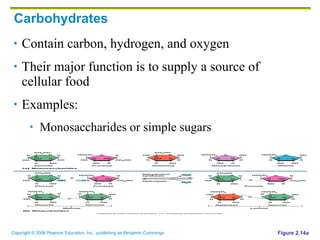
Carbohydrates Contain carbon, hydrogen, and oxygen Their major function is to supply a source of cellular food Examples: Monosaccharides or simple sugars Figure 2.14a
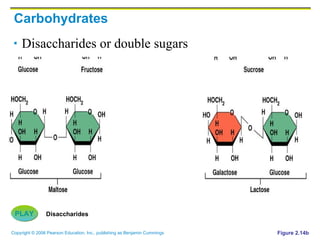
Carbohydrates Disaccharides or double sugars Figure 2.14b PLAY Disaccharides
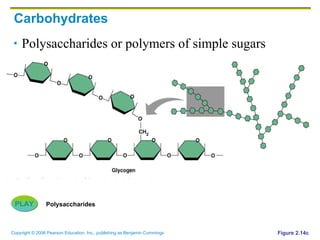
Carbohydrates Polysaccharides or polymers of simple sugars Figure 2.14c PLAY Polysaccharides
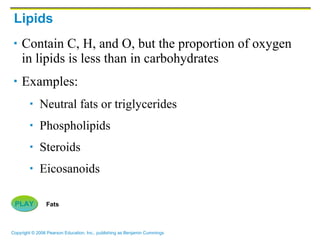
Lipids Contain C, H, and O, but the proportion of oxygen in lipids is less than in carbohydrates Examples: Neutral fats or triglycerides Phospholipids Steroids Eicosanoids PLAY Fats
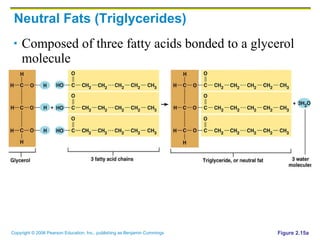
Neutral Fats (Triglycerides) Composed of three fatty acids bonded to a glycerol molecule Figure 2.15a
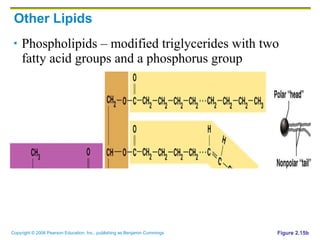
Other Lipids Phospholipids – modified triglycerides with two fatty acid groups and a phosphorus group Figure 2.15b
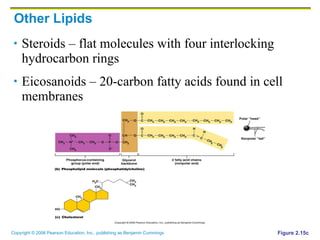
Other Lipids Steroids – flat molecules with four interlocking hydrocarbon rings Eicosanoids – 20-carbon fatty acids found in cell membranes Figure 2.15c
Representative Lipids Found in the Body Neutral fats – found in subcutaneous tissue and around organs Phospholipids – chief component of cell membranes Steroids – cholesterol, bile salts, vitamin D, sex hormones, and adrenal cortical hormones
Representative Lipids Found in the Body Fat-soluble vitamins – vitamins A, E, and K Eicosanoids – prostaglandins, leukotrienes, and thromboxanes Lipoproteins – transport fatty acids and cholesterol in the bloodstream
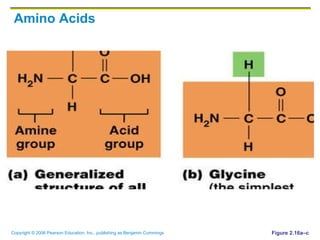
Amino Acids Building blocks of protein, containing an amino group and a carboxyl group Amino group NH 2 Carboxyl groups COOH
Amino Acids Figure 2.16a–c
Amino Acids Figure 2.16d, e
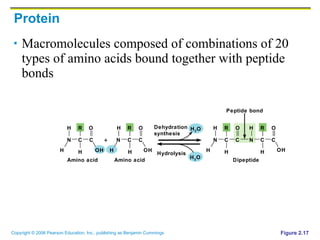
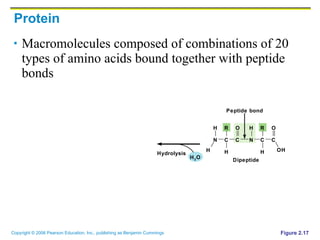
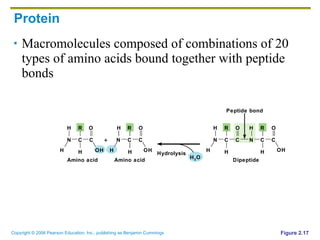
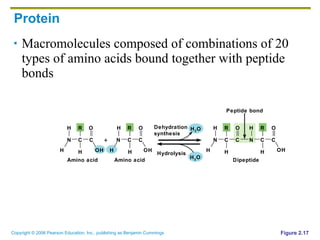
Protein Macromolecules composed of combinations of 20 types of amino acids bound together with peptide bonds Figure 2.17
Protein Macromolecules composed of combinations of 20 types of amino acids bound together with peptide bonds Figure 2.17 Amino acid Amino acid Dehydration synthesis Hydrolysis Dipeptide Peptide bond + N H H C R H O N H H C R C C H O H 2 O H 2 O N H H C R C H O N H C R C H O OH OH OH
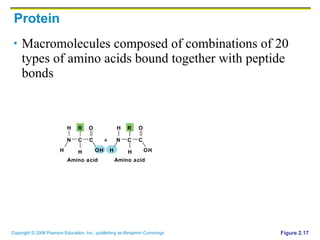
Protein Macromolecules composed of combinations of 20 types of amino acids bound together with peptide bonds Figure 2.17 Amino acid Amino acid + N H H C R H O N H H C R C C H O OH OH
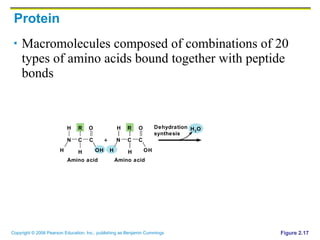
Protein Macromolecules composed of combinations of 20 types of amino acids bound together with peptide bonds Figure 2.17 Amino acid Amino acid Dehydration synthesis + N H H C R H O N H H C R C C H O H 2 O OH OH
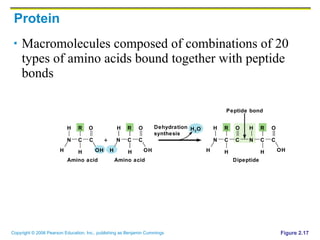
Protein Macromolecules composed of combinations of 20 types of amino acids bound together with peptide bonds Figure 2.17 Amino acid Amino acid Dehydration synthesis Dipeptide Peptide bond + N H H C R H O N H H C R C C H O H 2 O N H H C R C H O N H C R C H O OH OH OH
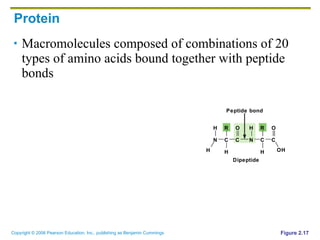
Protein Macromolecules composed of combinations of 20 types of amino acids bound together with peptide bonds Figure 2.17 Dipeptide Peptide bond N H H C R C H O N H C R C H O OH
Protein Macromolecules composed of combinations of 20 types of amino acids bound together with peptide bonds Figure 2.17 Hydrolysis Dipeptide Peptide bond H 2 O N H H C R C H O N H C R C H O OH
Protein Macromolecules composed of combinations of 20 types of amino acids bound together with peptide bonds Figure 2.17 Amino acid Amino acid Hydrolysis Dipeptide Peptide bond + N H H C R H O N H H C R C C H O H 2 O N H H C R C H O N H C R C H O OH OH OH
Protein Macromolecules composed of combinations of 20 types of amino acids bound together with peptide bonds Figure 2.17 Amino acid Amino acid Dehydration synthesis Hydrolysis Dipeptide Peptide bond + N H H C R H O N H H C R C C H O H 2 O H 2 O N H H C R C H O N H C R C H O OH OH OH
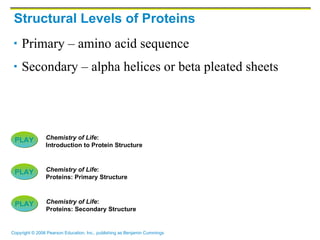
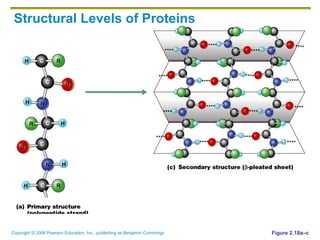
Structural Levels of Proteins Primary – amino acid sequence Secondary – alpha helices or beta pleated sheets PLAY Chemistry of Life :  Proteins: Secondary Structure PLAY Chemistry of Life :  Proteins: Primary Structure PLAY Chemistry of Life :  Introduction to Protein Structure
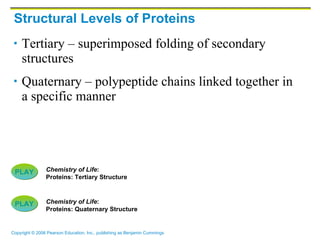
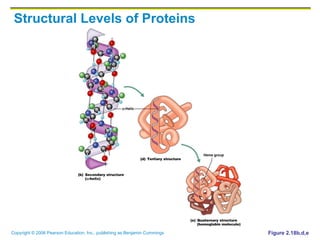
Structural Levels of Proteins Tertiary – superimposed folding of secondary structures Quaternary – polypeptide chains linked together in a specific manner PLAY Chemistry of Life :  Proteins: Quaternary Structure PLAY Chemistry of Life :  Proteins: Tertiary Structure
Structural Levels of Proteins Figure 2.18a–c
Structural Levels of Proteins Figure 2.18b,d,e
Fibrous and Globular Proteins Fibrous proteins Extended and strand-like proteins  Examples: keratin, elastin, collagen, and certain contractile fibers
Fibrous and Globular Proteins Globular proteins  Compact, spherical proteins with tertiary and quaternary structures Examples: antibodies, hormones, and enzymes
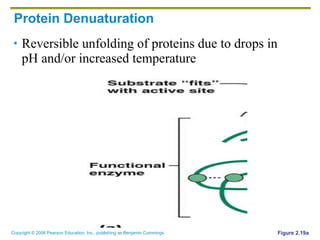
Protein Denuaturation Reversible unfolding of proteins due to drops in pH and/or increased temperature Figure 2.19a
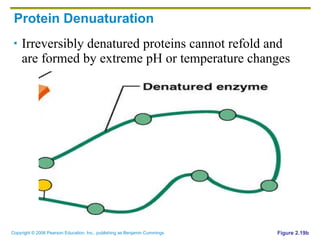
Protein Denuaturation Irreversibly denatured proteins cannot refold and are formed by extreme pH or temperature changes Figure 2.19b
Molecular Chaperones (Chaperonins) Help other proteins to achieve their functional three-dimensional shape Maintain folding integrity Assist in translocation of proteins across membranes Promote the breakdown of damaged or denatured proteins
Characteristics of Enzymes Most are globular proteins that act as biological catalysts Holoenzymes consist of an apoenzyme (protein) and a cofactor (usually an ion) Enzymes are chemically specific
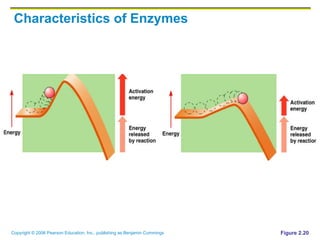
Characteristics of Enzymes Frequently named for the type of reaction they catalyze Enzyme names usually end in -ase Lower activation energy
Characteristics of Enzymes Figure 2.20
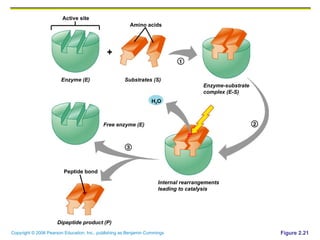
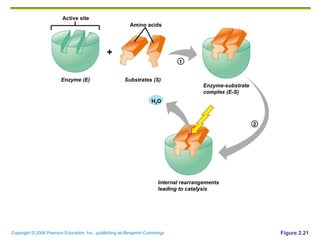
Mechanism of Enzyme Action Enzyme binds with substrate Product is formed at a lower activation energy Product is released PLAY How Enzymes Work
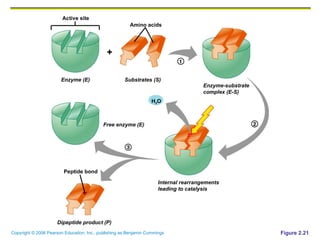
Figure 2.21 Active site Amino acids Enzyme (E) Enzyme-substrate complex (E-S) Internal rearrangements leading to catalysis Dipeptide product (P) Free enzyme (E) Substrates (S) Peptide bond H 2 O +
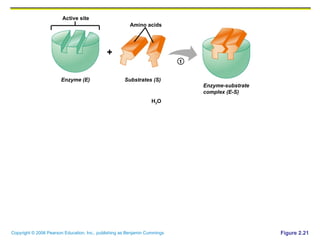
Figure 2.21 Active site Amino acids Enzyme (E) Enzyme-substrate complex (E-S) Substrates (S) H 2 O +
Figure 2.21 Active site Amino acids Enzyme (E) Enzyme-substrate complex (E-S) Internal rearrangements leading to catalysis Substrates (S) H 2 O +
Figure 2.21 Active site Amino acids Enzyme (E) Enzyme-substrate complex (E-S) Internal rearrangements leading to catalysis Dipeptide product (P) Free enzyme (E) Substrates (S) Peptide bond H 2 O +
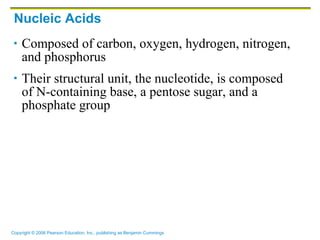
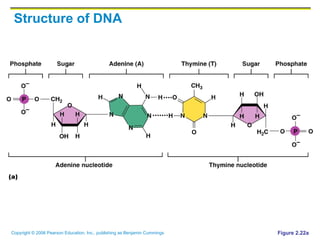
Nucleic Acids Composed of carbon, oxygen, hydrogen, nitrogen, and phosphorus Their structural unit, the nucleotide, is composed of N-containing base, a pentose sugar, and a phosphate group
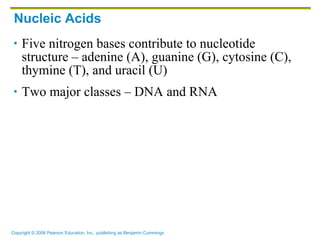
Nucleic Acids Five nitrogen bases contribute to nucleotide structure – adenine (A), guanine (G), cytosine (C), thymine (T), and uracil (U) Two major classes – DNA and RNA
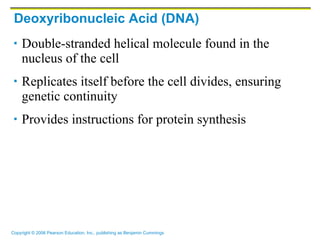
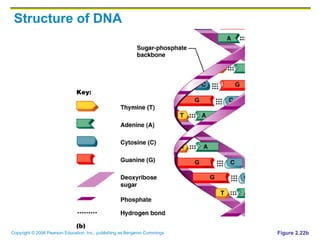
Deoxyribonucleic Acid (DNA) Double-stranded helical molecule found in the nucleus of the cell Replicates itself before the cell divides, ensuring genetic continuity Provides instructions for protein synthesis
Structure of DNA Figure 2.22a
Structure of DNA Figure 2.22b
Ribonucleic Acid (RNA) Single-stranded molecule found in both the nucleus and the cytoplasm of a cell Uses the nitrogenous base uracil instead of thymine Three varieties of RNA: messenger RNA, transfer RNA, and ribosomal RNA
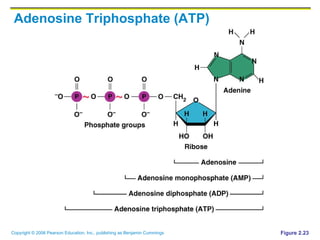
Adenosine Triphosphate (ATP) Source of immediately usable energy for the cell Adenine-containing RNA nucleotide with three phosphate groups
Adenosine Triphosphate (ATP) Figure 2.23
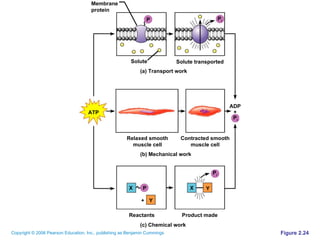
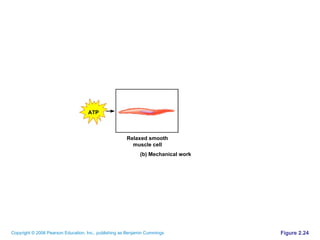
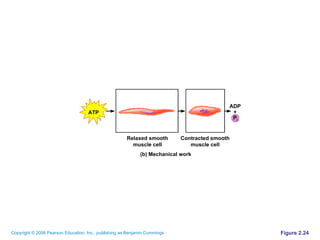
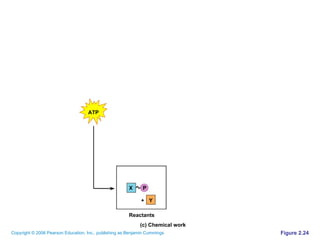
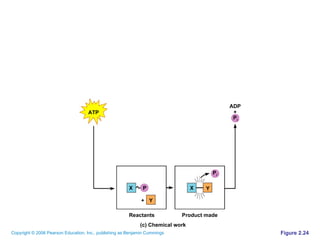
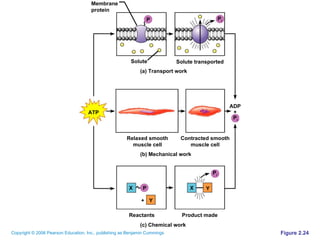
Figure 2.24 Solute Solute transported Contracted smooth muscle cell Product made Relaxed smooth muscle cell Reactants Membrane protein P P i ATP P X X Y Y + (a) Transport work (b) Mechanical work (c) Chemical work P i P i + ADP
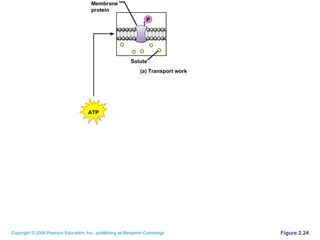
Figure 2.24 Solute Membrane protein P ATP (a) Transport work
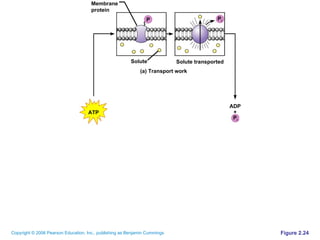
Figure 2.24 Solute Solute transported Membrane protein P P i ATP (a) Transport work P i + ADP
Figure 2.24 Relaxed smooth muscle cell ATP (b) Mechanical work
Figure 2.24 Contracted smooth muscle cell Relaxed smooth muscle cell ATP (b) Mechanical work P i + ADP
Figure 2.24 Reactants ATP P X Y + (c) Chemical work
Figure 2.24 Product made Reactants ATP P X X Y Y + (c) Chemical work P i P i + ADP
Figure 2.24 Solute Solute transported Contracted smooth muscle cell Product made Relaxed smooth muscle cell Reactants Membrane protein P P i ATP P X X Y Y + (a) Transport work (b) Mechanical work (c) Chemical work P i P i + ADP
МЕТАБОЛИЗМ
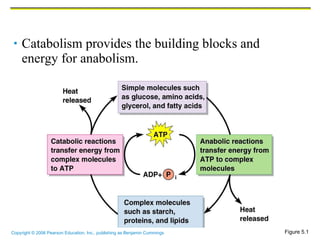
Catabolism provides the building blocks and energy for anabolism. Figure 5.1
A metabolic pathway is a sequence of enzymatically catalyzed chemical reactions in a cell. Metabolic pathways are determined by enzymes. Enzymes are encoded by genes. PLAY Animation: Metabolic Pathways (Overview)
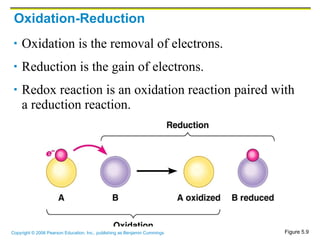
Oxidation-Reduction Oxidation is the removal of electrons. Reduction is the gain of electrons. Redox reaction is an oxidation reaction paired with a reduction reaction. Figure 5.9
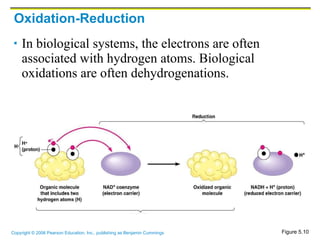
Oxidation-Reduction In biological systems, the electrons are often associated with hydrogen atoms. Biological oxidations are often dehydrogenations. Figure 5.10
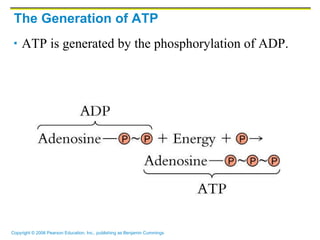
The Generation of ATP ATP is generated by the phosphorylation of ADP.
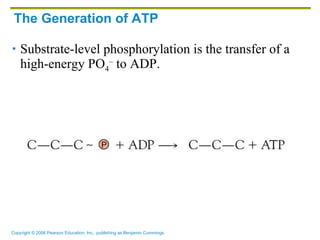
The Generation of ATP Substrate-level phosphorylation is the transfer of a high-energy PO 4 –  to ADP.
The Generation of ATP Energy released from the transfer of electrons (oxidation) of one compound to another (reduction) is used to generate ATP by chemiosmosis.
The Generation of ATP Light causes chlorophyll to give up electrons. Energy released from the transfer of electrons (oxidation) of chlorophyll through a system of carrier molecules is used to generate ATP.

Molbiol 2011-03-biochem

  • 1.
    Биологические макромолекулы БелкиУглеводы Липиды Нуклеиновые кислоты
  • 2.
    Organic Compounds Moleculesunique to living systems contain carbon and hence are organic compounds They include: Carbohydrates Lipids Proteins Nucleic Acids
  • 3.
    Carbohydrates Contain carbon,hydrogen, and oxygen Their major function is to supply a source of cellular food Examples: Monosaccharides or simple sugars Figure 2.14a
  • 4.
    Carbohydrates Disaccharides ordouble sugars Figure 2.14b PLAY Disaccharides
  • 5.
    Carbohydrates Polysaccharides orpolymers of simple sugars Figure 2.14c PLAY Polysaccharides
  • 6.
    Lipids Contain C,H, and O, but the proportion of oxygen in lipids is less than in carbohydrates Examples: Neutral fats or triglycerides Phospholipids Steroids Eicosanoids PLAY Fats
  • 7.
    Neutral Fats (Triglycerides)Composed of three fatty acids bonded to a glycerol molecule Figure 2.15a
  • 8.
    Other Lipids Phospholipids– modified triglycerides with two fatty acid groups and a phosphorus group Figure 2.15b
  • 9.
    Other Lipids Steroids– flat molecules with four interlocking hydrocarbon rings Eicosanoids – 20-carbon fatty acids found in cell membranes Figure 2.15c
  • 10.
    Representative Lipids Foundin the Body Neutral fats – found in subcutaneous tissue and around organs Phospholipids – chief component of cell membranes Steroids – cholesterol, bile salts, vitamin D, sex hormones, and adrenal cortical hormones
  • 11.
    Representative Lipids Foundin the Body Fat-soluble vitamins – vitamins A, E, and K Eicosanoids – prostaglandins, leukotrienes, and thromboxanes Lipoproteins – transport fatty acids and cholesterol in the bloodstream
  • 12.
    Amino Acids Buildingblocks of protein, containing an amino group and a carboxyl group Amino group NH 2 Carboxyl groups COOH
  • 13.
  • 14.
  • 15.
    Protein Macromolecules composedof combinations of 20 types of amino acids bound together with peptide bonds Figure 2.17
  • 16.
    Protein Macromolecules composedof combinations of 20 types of amino acids bound together with peptide bonds Figure 2.17 Amino acid Amino acid Dehydration synthesis Hydrolysis Dipeptide Peptide bond + N H H C R H O N H H C R C C H O H 2 O H 2 O N H H C R C H O N H C R C H O OH OH OH
  • 17.
    Protein Macromolecules composedof combinations of 20 types of amino acids bound together with peptide bonds Figure 2.17 Amino acid Amino acid + N H H C R H O N H H C R C C H O OH OH
  • 18.
    Protein Macromolecules composedof combinations of 20 types of amino acids bound together with peptide bonds Figure 2.17 Amino acid Amino acid Dehydration synthesis + N H H C R H O N H H C R C C H O H 2 O OH OH
  • 19.
    Protein Macromolecules composedof combinations of 20 types of amino acids bound together with peptide bonds Figure 2.17 Amino acid Amino acid Dehydration synthesis Dipeptide Peptide bond + N H H C R H O N H H C R C C H O H 2 O N H H C R C H O N H C R C H O OH OH OH
  • 20.
    Protein Macromolecules composedof combinations of 20 types of amino acids bound together with peptide bonds Figure 2.17 Dipeptide Peptide bond N H H C R C H O N H C R C H O OH
  • 21.
    Protein Macromolecules composedof combinations of 20 types of amino acids bound together with peptide bonds Figure 2.17 Hydrolysis Dipeptide Peptide bond H 2 O N H H C R C H O N H C R C H O OH
  • 22.
    Protein Macromolecules composedof combinations of 20 types of amino acids bound together with peptide bonds Figure 2.17 Amino acid Amino acid Hydrolysis Dipeptide Peptide bond + N H H C R H O N H H C R C C H O H 2 O N H H C R C H O N H C R C H O OH OH OH
  • 23.
    Protein Macromolecules composedof combinations of 20 types of amino acids bound together with peptide bonds Figure 2.17 Amino acid Amino acid Dehydration synthesis Hydrolysis Dipeptide Peptide bond + N H H C R H O N H H C R C C H O H 2 O H 2 O N H H C R C H O N H C R C H O OH OH OH
  • 24.
    Structural Levels ofProteins Primary – amino acid sequence Secondary – alpha helices or beta pleated sheets PLAY Chemistry of Life : Proteins: Secondary Structure PLAY Chemistry of Life : Proteins: Primary Structure PLAY Chemistry of Life : Introduction to Protein Structure
  • 25.
    Structural Levels ofProteins Tertiary – superimposed folding of secondary structures Quaternary – polypeptide chains linked together in a specific manner PLAY Chemistry of Life : Proteins: Quaternary Structure PLAY Chemistry of Life : Proteins: Tertiary Structure
  • 26.
    Structural Levels ofProteins Figure 2.18a–c
  • 27.
    Structural Levels ofProteins Figure 2.18b,d,e
  • 28.
    Fibrous and GlobularProteins Fibrous proteins Extended and strand-like proteins Examples: keratin, elastin, collagen, and certain contractile fibers
  • 29.
    Fibrous and GlobularProteins Globular proteins Compact, spherical proteins with tertiary and quaternary structures Examples: antibodies, hormones, and enzymes
  • 30.
    Protein Denuaturation Reversibleunfolding of proteins due to drops in pH and/or increased temperature Figure 2.19a
  • 31.
    Protein Denuaturation Irreversiblydenatured proteins cannot refold and are formed by extreme pH or temperature changes Figure 2.19b
  • 32.
    Molecular Chaperones (Chaperonins)Help other proteins to achieve their functional three-dimensional shape Maintain folding integrity Assist in translocation of proteins across membranes Promote the breakdown of damaged or denatured proteins
  • 33.
    Characteristics of EnzymesMost are globular proteins that act as biological catalysts Holoenzymes consist of an apoenzyme (protein) and a cofactor (usually an ion) Enzymes are chemically specific
  • 34.
    Characteristics of EnzymesFrequently named for the type of reaction they catalyze Enzyme names usually end in -ase Lower activation energy
  • 35.
  • 36.
    Mechanism of EnzymeAction Enzyme binds with substrate Product is formed at a lower activation energy Product is released PLAY How Enzymes Work
  • 37.
    Figure 2.21 Activesite Amino acids Enzyme (E) Enzyme-substrate complex (E-S) Internal rearrangements leading to catalysis Dipeptide product (P) Free enzyme (E) Substrates (S) Peptide bond H 2 O +
  • 38.
    Figure 2.21 Activesite Amino acids Enzyme (E) Enzyme-substrate complex (E-S) Substrates (S) H 2 O +
  • 39.
    Figure 2.21 Activesite Amino acids Enzyme (E) Enzyme-substrate complex (E-S) Internal rearrangements leading to catalysis Substrates (S) H 2 O +
  • 40.
    Figure 2.21 Activesite Amino acids Enzyme (E) Enzyme-substrate complex (E-S) Internal rearrangements leading to catalysis Dipeptide product (P) Free enzyme (E) Substrates (S) Peptide bond H 2 O +
  • 41.
    Nucleic Acids Composedof carbon, oxygen, hydrogen, nitrogen, and phosphorus Their structural unit, the nucleotide, is composed of N-containing base, a pentose sugar, and a phosphate group
  • 42.
    Nucleic Acids Fivenitrogen bases contribute to nucleotide structure – adenine (A), guanine (G), cytosine (C), thymine (T), and uracil (U) Two major classes – DNA and RNA
  • 43.
    Deoxyribonucleic Acid (DNA)Double-stranded helical molecule found in the nucleus of the cell Replicates itself before the cell divides, ensuring genetic continuity Provides instructions for protein synthesis
  • 44.
    Structure of DNAFigure 2.22a
  • 45.
    Structure of DNAFigure 2.22b
  • 46.
    Ribonucleic Acid (RNA)Single-stranded molecule found in both the nucleus and the cytoplasm of a cell Uses the nitrogenous base uracil instead of thymine Three varieties of RNA: messenger RNA, transfer RNA, and ribosomal RNA
  • 47.
    Adenosine Triphosphate (ATP)Source of immediately usable energy for the cell Adenine-containing RNA nucleotide with three phosphate groups
  • 48.
  • 49.
    Figure 2.24 SoluteSolute transported Contracted smooth muscle cell Product made Relaxed smooth muscle cell Reactants Membrane protein P P i ATP P X X Y Y + (a) Transport work (b) Mechanical work (c) Chemical work P i P i + ADP
  • 50.
    Figure 2.24 SoluteMembrane protein P ATP (a) Transport work
  • 51.
    Figure 2.24 SoluteSolute transported Membrane protein P P i ATP (a) Transport work P i + ADP
  • 52.
    Figure 2.24 Relaxedsmooth muscle cell ATP (b) Mechanical work
  • 53.
    Figure 2.24 Contractedsmooth muscle cell Relaxed smooth muscle cell ATP (b) Mechanical work P i + ADP
  • 54.
    Figure 2.24 ReactantsATP P X Y + (c) Chemical work
  • 55.
    Figure 2.24 Productmade Reactants ATP P X X Y Y + (c) Chemical work P i P i + ADP
  • 56.
    Figure 2.24 SoluteSolute transported Contracted smooth muscle cell Product made Relaxed smooth muscle cell Reactants Membrane protein P P i ATP P X X Y Y + (a) Transport work (b) Mechanical work (c) Chemical work P i P i + ADP
  • 57.
  • 58.
    Catabolism provides thebuilding blocks and energy for anabolism. Figure 5.1
  • 59.
    A metabolic pathwayis a sequence of enzymatically catalyzed chemical reactions in a cell. Metabolic pathways are determined by enzymes. Enzymes are encoded by genes. PLAY Animation: Metabolic Pathways (Overview)
  • 60.
    Oxidation-Reduction Oxidation isthe removal of electrons. Reduction is the gain of electrons. Redox reaction is an oxidation reaction paired with a reduction reaction. Figure 5.9
  • 61.
    Oxidation-Reduction In biologicalsystems, the electrons are often associated with hydrogen atoms. Biological oxidations are often dehydrogenations. Figure 5.10
  • 62.
    The Generation ofATP ATP is generated by the phosphorylation of ADP.
  • 63.
    The Generation ofATP Substrate-level phosphorylation is the transfer of a high-energy PO 4 – to ADP.
  • 64.
    The Generation ofATP Energy released from the transfer of electrons (oxidation) of one compound to another (reduction) is used to generate ATP by chemiosmosis.
  • 65.
    The Generation ofATP Light causes chlorophyll to give up electrons. Energy released from the transfer of electrons (oxidation) of chlorophyll through a system of carrier molecules is used to generate ATP.