“SOURCES,DENATURATIO
N AND FUNCTIONAL
PROPERTIES OF
PROTEINS”
SUBMITTED BY,
SHAHNAZ MOL.A
PROTEIN ?
“ Proteins are large
Biological Molecules or
Macromolecules consisting of
one or more long chains of
amino acid residues. ”
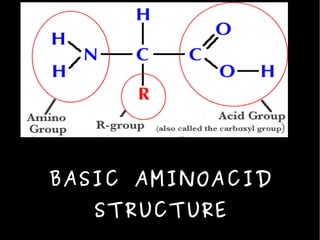
BASIC AMINOACID
STRUCTURE
SOURCES OF
PROTEIN
PLANT PROTEIN
.Derived from plant sources.
➔Eg: Pulses
Cereals
Nuts
Beans
Vegetables
Soy products
.Plant Proteins are less digestible.
● Plant proteins are Biologically Incomplete,
Because..................
“FOOD LACKS ONE OR MORE
ESSENTIAL AMINOACIDS
NEEDED BY THE BODY.”
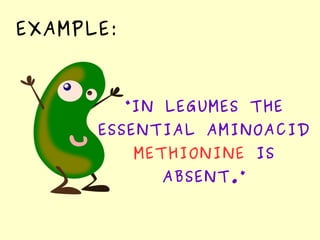
EXAMPLE:
“IN LEGUMES THE
ESSENTIAL AMINOACID
METHIONINE IS
ABSENT.”
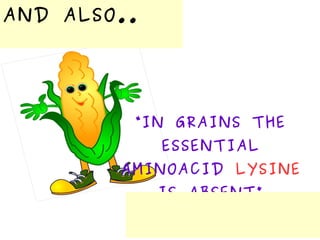
AND ALSO..
“IN GRAINS THE
ESSENTIAL
AMINOACID LYSINE
IS ABSENT”
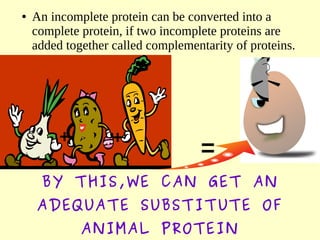
● An incomplete protein can be converted into a
complete protein, if two incomplete proteins are
added together called complementarity of proteins.
+ +
=
BY THIS,WE CAN GET AN
ADEQUATE SUBSTITUTE OF
ANIMAL PROTEIN
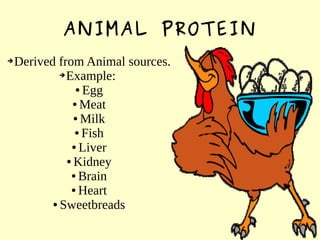
ANIMAL PROTEIN
➔Derived from Animal sources.
➔Example:
● Egg
● Meat
● Milk
● Fish
● Liver
● Kidney
● Brain
● Heart
● Sweetbreads
● Animal proteins are Biologically Complete,
Because.....
“FOOD CONTAINS ALL THE
9 ESSENTIAL AMINOACID
NEEDED BY THE BODY.”
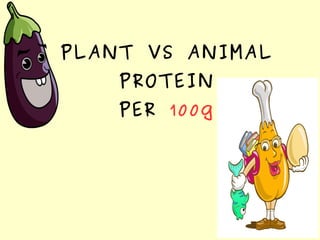
PLANT VS ANIMAL
PROTEIN
PER 100g
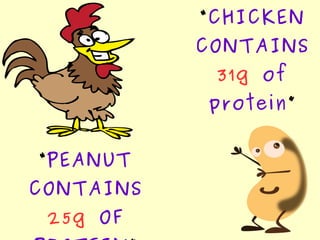
“CHICKEN
CONTAINS
31g of
protein”
“PEANUT
CONTAINS
25g OF
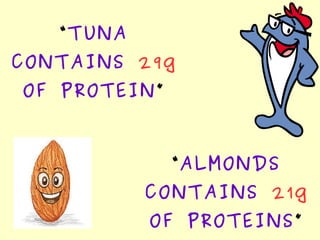
“TUNA
CONTAINS 29g
OF PROTEIN”
“ALMONDS
CONTAINS 21g
OF PROTEINS”
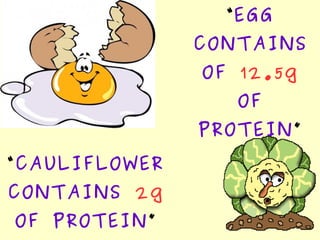
“EGG
CONTAINS
OF 12.5g
OF
PROTEIN”
“CAULIFLOWER
CONTAINS 2g
OF PROTEIN”
MEASURE OF PROTEIN
QUALITY
Biological Value (BV) of Protein
●
– based on NITROGEN RETENTION
●
– higher the protein quality= more Nitrogen
retained= more protein synthesis than catabolism
●
BV of EGG protein = 100%, all absorbed protein
retained.
DENATURATION
● IUPAC definition
“Process of partial or total
alteration of the native
secondary, and/or tertiary,
and/or quaternary structures
of proteins resulting in the
loss of bioactivity.”
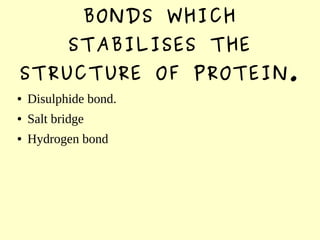
BONDS WHICH
STABILISES THE
STRUCTURE OF PROTEIN.
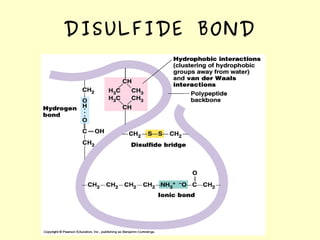
● Disulphide bond.
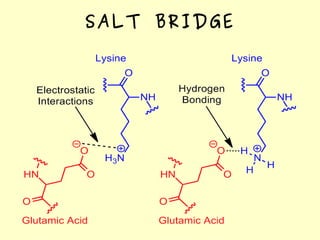
● Salt bridge
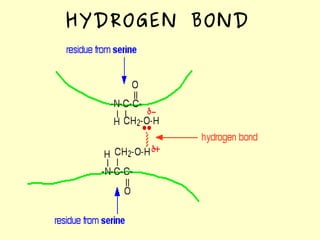
● Hydrogen bond
DISULFIDE BOND
SALT BRIDGE
HYDROGEN BOND
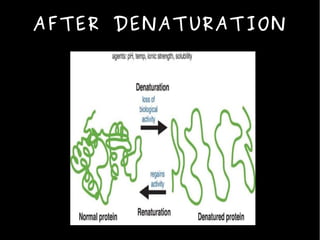
AFTER DENATURATION
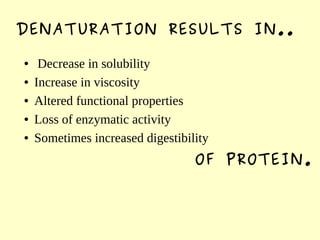
DENATURATION RESULTS IN..
● Decrease in solubility
● Increase in viscosity
● Altered functional properties
● Loss of enzymatic activity
● Sometimes increased digestibility
OF PROTEIN.
FACTORS CAUSING
PROTEIN DENATURATION.
● pH.
● Temperature.
● By Heavy Metal Ions.
● By Small Polar Molecules.
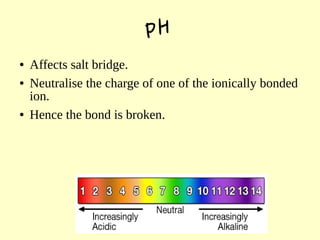
pH
● Affects salt bridge.
● Neutralise the charge of one of the ionically bonded
ion.
● Hence the bond is broken.
TEMPERATURE
● High temperature destabilizes
the non-covalent interactions
holding the protein together
causing it to eventually unfold
(to denature).
● As the temperature increases, Bonds are broken in
the following order :
➔ Hydrogen Bond
➔ Ionic Bond
METAL IONS
● Since metal salts are ionic they disrupt salt bridges
in proteins. The reaction of a heavy metal salt with a
protein usually leads to an insoluble metal protein
salt.
● Heavy metals may also disrupt disulfide bonds
because of their high affinity and attraction for
sulfur and will also lead to the denaturation of
proteins.
SMALL POLAR MOLECULE
● Urea in concentrated solution will denaturate
protein.
● It disrupts the hydrogen bonds and cause complete
Denaturation.
FUNCTIONAL PROPERTIES
OF PROTEIN IN FOOD
“Those physical and chemical properties,
which affect the behavior of proteins in
food systems during storage, processing,
preparation and consumption. It is these
characteristics, which influence the ‘quality’
and organoleptic attributes in food.”
IT IS DEFINED AS..
1)SOLUBILITY
● Functional properties of proteins depend on their
solubility
● Affected by the balance of hydrophobic and hydrophilic
amino acids on its surface
● Charged amino acids play the most important role in
keeping the protein soluble
● The proteins are least soluble at their Isoelectronic
point(no net charge)
● The protein become increasingly soluble as pH is
increased or decreased away from the Isoelectric point
Contd..
● Salt concentration (ionic strength) is also very important
for protein solubility
● At low salt concentrations protein solubility increases
(salting-in)
● At high salt concentrations protein solubility decreases
(salting-out)
● Denaturation of the protein can both increase or
decrease solubility of proteins
● Eg in very high and low pH denature, the protein is
soluble since there is much repulsion.
● Very high or very low temperature on the other hand
will lead to loss in solubility since exposed
hydrophobic groups of the denatured protein lead to
aggregation (may be desirable or undesirable in food
products).
2)GELATION
● A Gel is a mixture of mostly fluids locked in a tangled
mass of denatured and coagulated proteins. The liquid
keeps the proteins from collapsing and the protein keep the
liquid from flowing away.
● Texture, quality and sensory attributes of many foods
depend on protein Gelation on processing.
Eg: Sausages, cheese, yogurt, custard
● Gel; a continuous 3D network of proteins that entraps
water.
● A gel can form when proteins are denatured by Heat, pH,
Pressure and Shearing by aggregation and interaction with
other proteins.
3)EMULSIFICATION
● Emulsions consist of two liquids that are
immiscible, where one of the liquids is dispersed in
the other in form of small droplets.
● Proteins can be excellent emulsifiers because they
contain both Hydrophobic and Hydrophilic groups.
● Factor that affect protein-based emulsions is the type
of protein.
● Increased surface hydrophobicity will increase
emulsifying properties.
● Increased solubility increases emulsification ability.
4)FOAMING
● Foams are very similar to emulsion where air is the
hydrophobic phase instead of oil
● Principle of foam formation is similar to that of
emulsion formation (most of the same factors are
important)
● Foams are typically formed by Injecting gas/air into a
solution through small orifices or
● Mechanically agitate a protein solution (whipping) or
● Gas release in food, eg: leavened breads (a special
case)
● Increasing salt usually improves foaming since
charges are neutralized (they lose solubility)-
salting-out) in Egg albumins.
● Increased salt negatively affect foaming (they get
more soluble-salting in).
● The farther from pH the more repulsion and the
foam breaks down.
REFERENCE
● chapter 5 protein. pdf
● S. Johanna, “Functional properties of legume
protein compared to egg protein and their
potential as egg replacers in veg food” pp 3-6.

Protien- Sources, Denaturation & Functional Properties

  • 1.
    “SOURCES,DENATURATIO N AND FUNCTIONAL PROPERTIESOF PROTEINS” SUBMITTED BY, SHAHNAZ MOL.A
  • 2.
    PROTEIN ? “ Proteinsare large Biological Molecules or Macromolecules consisting of one or more long chains of amino acid residues. ”
  • 3.
  • 4.
  • 5.
    PLANT PROTEIN .Derived fromplant sources. ➔Eg: Pulses Cereals Nuts Beans Vegetables Soy products .Plant Proteins are less digestible.
  • 6.
    ● Plant proteinsare Biologically Incomplete, Because.................. “FOOD LACKS ONE OR MORE ESSENTIAL AMINOACIDS NEEDED BY THE BODY.”
  • 7.
    EXAMPLE: “IN LEGUMES THE ESSENTIALAMINOACID METHIONINE IS ABSENT.”
  • 8.
    AND ALSO.. “IN GRAINSTHE ESSENTIAL AMINOACID LYSINE IS ABSENT”
  • 9.
    ● An incompleteprotein can be converted into a complete protein, if two incomplete proteins are added together called complementarity of proteins. + + = BY THIS,WE CAN GET AN ADEQUATE SUBSTITUTE OF ANIMAL PROTEIN
  • 10.
    ANIMAL PROTEIN ➔Derived fromAnimal sources. ➔Example: ● Egg ● Meat ● Milk ● Fish ● Liver ● Kidney ● Brain ● Heart ● Sweetbreads
  • 11.
    ● Animal proteinsare Biologically Complete, Because..... “FOOD CONTAINS ALL THE 9 ESSENTIAL AMINOACID NEEDED BY THE BODY.”
  • 12.
  • 13.
  • 14.
  • 15.
  • 16.
    MEASURE OF PROTEIN QUALITY BiologicalValue (BV) of Protein ● – based on NITROGEN RETENTION ● – higher the protein quality= more Nitrogen retained= more protein synthesis than catabolism ● BV of EGG protein = 100%, all absorbed protein retained.
  • 17.
    DENATURATION ● IUPAC definition “Processof partial or total alteration of the native secondary, and/or tertiary, and/or quaternary structures of proteins resulting in the loss of bioactivity.”
  • 18.
    BONDS WHICH STABILISES THE STRUCTUREOF PROTEIN. ● Disulphide bond. ● Salt bridge ● Hydrogen bond
  • 19.
  • 20.
  • 21.
  • 22.
  • 23.
    DENATURATION RESULTS IN.. ●Decrease in solubility ● Increase in viscosity ● Altered functional properties ● Loss of enzymatic activity ● Sometimes increased digestibility OF PROTEIN.
  • 24.
    FACTORS CAUSING PROTEIN DENATURATION. ●pH. ● Temperature. ● By Heavy Metal Ions. ● By Small Polar Molecules.
  • 25.
    pH ● Affects saltbridge. ● Neutralise the charge of one of the ionically bonded ion. ● Hence the bond is broken.
  • 26.
    TEMPERATURE ● High temperaturedestabilizes the non-covalent interactions holding the protein together causing it to eventually unfold (to denature).
  • 27.
    ● As thetemperature increases, Bonds are broken in the following order : ➔ Hydrogen Bond ➔ Ionic Bond
  • 28.
    METAL IONS ● Sincemetal salts are ionic they disrupt salt bridges in proteins. The reaction of a heavy metal salt with a protein usually leads to an insoluble metal protein salt. ● Heavy metals may also disrupt disulfide bonds because of their high affinity and attraction for sulfur and will also lead to the denaturation of proteins.
  • 29.
    SMALL POLAR MOLECULE ●Urea in concentrated solution will denaturate protein. ● It disrupts the hydrogen bonds and cause complete Denaturation.
  • 30.
  • 31.
    “Those physical andchemical properties, which affect the behavior of proteins in food systems during storage, processing, preparation and consumption. It is these characteristics, which influence the ‘quality’ and organoleptic attributes in food.” IT IS DEFINED AS..
  • 32.
    1)SOLUBILITY ● Functional propertiesof proteins depend on their solubility ● Affected by the balance of hydrophobic and hydrophilic amino acids on its surface ● Charged amino acids play the most important role in keeping the protein soluble ● The proteins are least soluble at their Isoelectronic point(no net charge) ● The protein become increasingly soluble as pH is increased or decreased away from the Isoelectric point
  • 33.
    Contd.. ● Salt concentration(ionic strength) is also very important for protein solubility ● At low salt concentrations protein solubility increases (salting-in) ● At high salt concentrations protein solubility decreases (salting-out) ● Denaturation of the protein can both increase or decrease solubility of proteins ● Eg in very high and low pH denature, the protein is soluble since there is much repulsion.
  • 34.
    ● Very highor very low temperature on the other hand will lead to loss in solubility since exposed hydrophobic groups of the denatured protein lead to aggregation (may be desirable or undesirable in food products).
  • 35.
    2)GELATION ● A Gelis a mixture of mostly fluids locked in a tangled mass of denatured and coagulated proteins. The liquid keeps the proteins from collapsing and the protein keep the liquid from flowing away. ● Texture, quality and sensory attributes of many foods depend on protein Gelation on processing. Eg: Sausages, cheese, yogurt, custard ● Gel; a continuous 3D network of proteins that entraps water. ● A gel can form when proteins are denatured by Heat, pH, Pressure and Shearing by aggregation and interaction with other proteins.
  • 36.
    3)EMULSIFICATION ● Emulsions consistof two liquids that are immiscible, where one of the liquids is dispersed in the other in form of small droplets. ● Proteins can be excellent emulsifiers because they contain both Hydrophobic and Hydrophilic groups. ● Factor that affect protein-based emulsions is the type of protein. ● Increased surface hydrophobicity will increase emulsifying properties. ● Increased solubility increases emulsification ability.
  • 37.
    4)FOAMING ● Foams arevery similar to emulsion where air is the hydrophobic phase instead of oil ● Principle of foam formation is similar to that of emulsion formation (most of the same factors are important) ● Foams are typically formed by Injecting gas/air into a solution through small orifices or ● Mechanically agitate a protein solution (whipping) or ● Gas release in food, eg: leavened breads (a special case)
  • 38.
    ● Increasing saltusually improves foaming since charges are neutralized (they lose solubility)- salting-out) in Egg albumins. ● Increased salt negatively affect foaming (they get more soluble-salting in). ● The farther from pH the more repulsion and the foam breaks down.
  • 39.
    REFERENCE ● chapter 5protein. pdf ● S. Johanna, “Functional properties of legume protein compared to egg protein and their potential as egg replacers in veg food” pp 3-6.