Option B Biochemistry
Higher level
IB CHEMISTRY
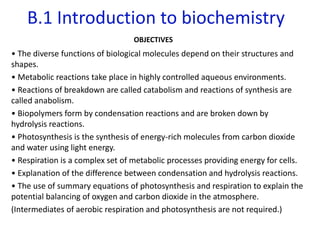
B.1 Introduction to biochemistry
OBJECTIVES
• The diverse functions of biological molecules depend on their structures and
shapes.
• Metabolic reactions take place in highly controlled aqueous environments.
• Reactions of breakdown are called catabolism and reactions of synthesis are
called anabolism.
• Biopolymers form by condensation reactions and are broken down by
hydrolysis reactions.
• Photosynthesis is the synthesis of energy-rich molecules from carbon dioxide
and water using light energy.
• Respiration is a complex set of metabolic processes providing energy for cells.
• Explanation of the difference between condensation and hydrolysis reactions.
• The use of summary equations of photosynthesis and respiration to explain the
potential balancing of oxygen and carbon dioxide in the atmosphere.
(Intermediates of aerobic respiration and photosynthesis are not required.)
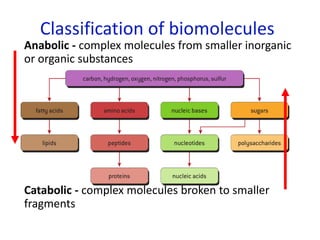
Classification of biomolecules
Anabolic - complex molecules from smaller inorganic
or organic substances
Catabolic - complex molecules broken to smaller
fragments
Metabolic pathways
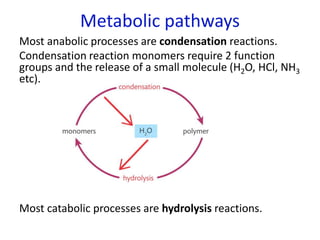
Most anabolic processes are condensation reactions.
Condensation reaction monomers require 2 function
groups and the release of a small molecule (H2O, HCl, NH3
etc).
Most catabolic processes are hydrolysis reactions.
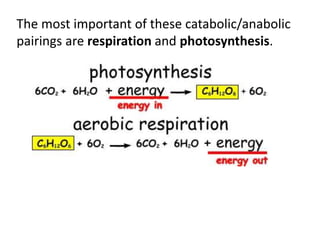
The most important of these catabolic/anabolic
pairings are respiration and photosynthesis.
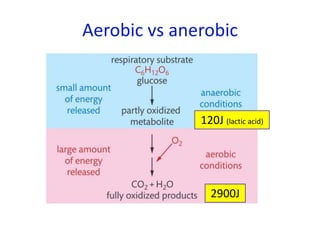
Aerobic vs anerobic
2900J
120J (lactic acid)
B.2 Proteins and enzymes
OBJECTIVES
• Proteins are polymers of 2-amino acids, joined by amide links (also known as peptide bonds).
• Amino acids are amphoteric and can exist as zwitterions, cations and anions.
• Protein structures are diverse and are described at the primary, secondary, tertiary and quaternary levels.
• A protein’s three-dimensional shape determines its role in structural components or in metabolic processes.
• Most enzymes are proteins that act as catalysts by binding specifically to a substrate at the active site.
• As enzyme activity depends on the conformation, it is sensitive to changes in temperature and pH and the
presence of heavy metal ions.
• Chromatography separation is based on different physical and chemical principles.
• Deduction of the structural formulas of reactants and products in condensation reactions of amino acids, and
hydrolysis reactions of peptides.
• Explanation of the solubilities and melting points of amino acids in terms of zwitterions.
• Application of the relationships between charge, pH and isoelectric point for amino acids and proteins.
• Description of the four levels of protein structure, including the origin and types of bonds and interactions
involved.
• Deduction and interpretation of graphs of enzyme activity involving changes in substrate concentration, pH and
temperature.
• Explanation of the processes of paper chromatography and gel electrophoresis in amino acid and protein
separation and identification.
(The names and structural formulas of the amino acids are given in the data booklet in section 33. Reference should
be made to alpha helix and beta pleated sheet, and to fibrous and globular proteins with examples of each. In paper
chromatography the use of Rf values and locating agents should be covered. In enzyme kinetics Km and Vmax are
not required.)
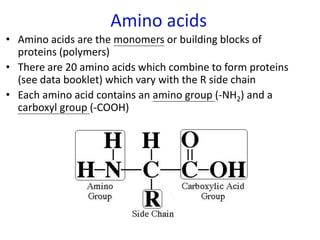
• Amino acids are the monomers or building blocks of
proteins (polymers)
• There are 20 amino acids which combine to form proteins
(see data booklet) which vary with the R side chain
• Each amino acid contains an amino group (-NH2) and a
carboxyl group (-COOH)
Amino acids
Amino acid properties
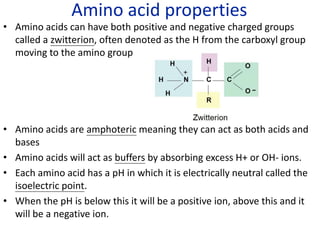
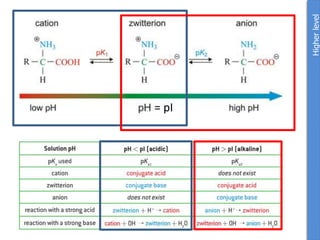
• Amino acids can have both positive and negative charged groups
called a zwitterion, often denoted as the H from the carboxyl group
moving to the amino group
• Amino acids are amphoteric meaning they can act as both acids and
bases
• Amino acids will act as buffers by absorbing excess H+ or OH- ions.
• Each amino acid has a pH in which it is electrically neutral called the
isoelectric point.
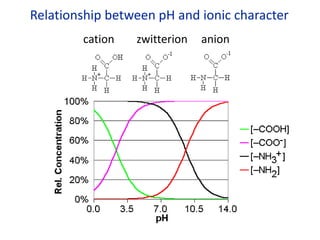
• When the pH is below this it will be a positive ion, above this and it
will be a negative ion.
Relationship between pH and ionic character
zwitterion anion
cation
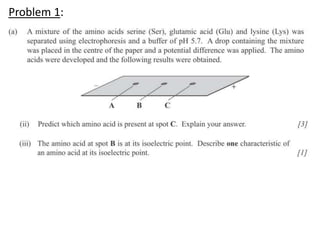
Problem 1:
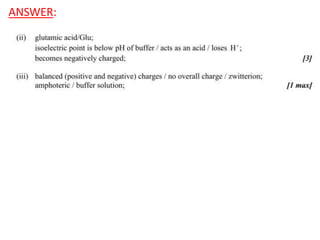
ANSWER:
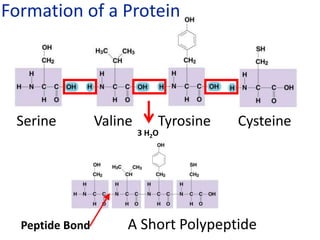
Serine Valine Tyrosine Cysteine
3 H2O
A Short Polypeptide
Peptide Bond
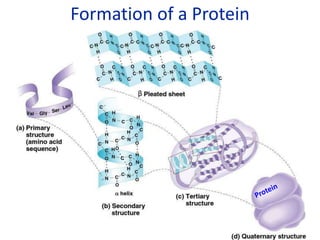
Formation of a Protein
β
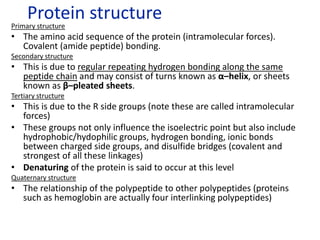
Primary structure
• The amino acid sequence of the protein (intramolecular forces).
Covalent (amide peptide) bonding.
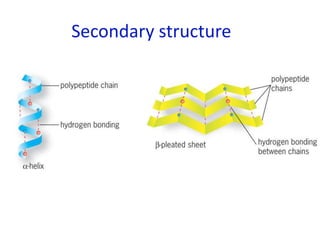
Secondary structure
• This is due to regular repeating hydrogen bonding along the same
peptide chain and may consist of turns known as α–helix, or sheets
known as β–pleated sheets.
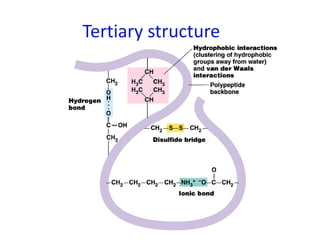
Tertiary structure
• This is due to the R side groups (note these are called intramolecular
forces)
• These groups not only influence the isoelectric point but also include
hydrophobic/hydophilic groups, hydrogen bonding, ionic bonds
between charged side groups, and disulfide bridges (covalent and
strongest of all these linkages)
• Denaturing of the protein is said to occur at this level
Quaternary structure
• The relationship of the polypeptide to other polypeptides (proteins
such as hemoglobin are actually four interlinking polypeptides)
Protein structure
Secondary structure
Tertiary structure
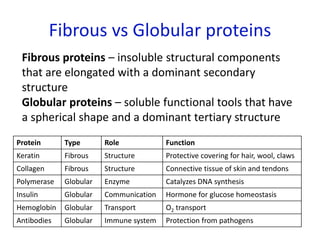
Fibrous vs Globular proteins
Protein Type Role Function
Keratin Fibrous Structure Protective covering for hair, wool, claws
Collagen Fibrous Structure Connective tissue of skin and tendons
Polymerase Globular Enzyme Catalyzes DNA synthesis
Insulin Globular Communication Hormone for glucose homeostasis
Hemoglobin Globular Transport O2 transport
Antibodies Globular Immune system Protection from pathogens
Fibrous proteins – insoluble structural components
that are elongated with a dominant secondary
structure
Globular proteins – soluble functional tools that have
a spherical shape and a dominant tertiary structure
• By using hydrolysis, proteins can be broken up into their
constituent amino acids
• Hydrolysis uses enzymes, or heat/acid
• Amino acids can then be detected by either chromatography
or electrophoresis
Protein analysis
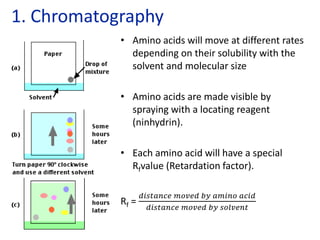
• Amino acids will move at different rates
depending on their solubility with the
solvent and molecular size
• Amino acids are made visible by
spraying with a locating reagent
(ninhydrin).
• Each amino acid will have a special
Rfvalue (Retardation factor).
Rf =
𝑑𝑖𝑠𝑡𝑎𝑛𝑐𝑒 𝑚𝑜𝑣𝑒𝑑 𝑏𝑦 𝑎𝑚𝑖𝑛𝑜 𝑎𝑐𝑖𝑑
𝑑𝑖𝑠𝑡𝑎𝑛𝑐𝑒 𝑚𝑜𝑣𝑒𝑑 𝑏𝑦 𝑠𝑜𝑙𝑣𝑒𝑛𝑡
1. Chromatography
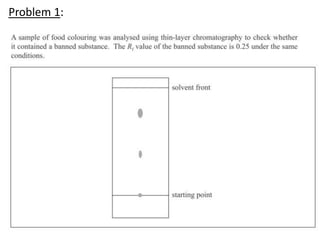
Problem 1:
ANSWER:
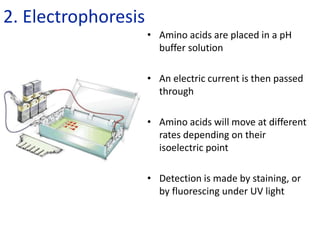
2. Electrophoresis
• Amino acids are placed in a pH
buffer solution
• An electric current is then passed
through
• Amino acids will move at different
rates depending on their
isoelectric point
• Detection is made by staining, or
by fluorescing under UV light
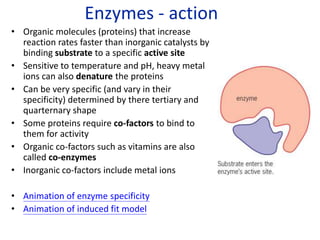
Enzymes - action
• Organic molecules (proteins) that increase
reaction rates faster than inorganic catalysts by
binding substrate to a specific active site
• Sensitive to temperature and pH, heavy metal
ions can also denature the proteins
• Can be very specific (and vary in their
specificity) determined by there tertiary and
quarternary shape
• Some proteins require co-factors to bind to
them for activity
• Organic co-factors such as vitamins are also
called co-enzymes
• Inorganic co-factors include metal ions
• Animation of enzyme specificity
• Animation of induced fit model
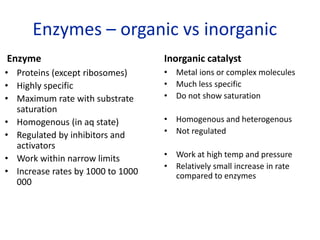
Enzymes – organic vs inorganic
Enzyme
• Proteins (except ribosomes)
• Highly specific
• Maximum rate with substrate
saturation
• Homogenous (in aq state)
• Regulated by inhibitors and
activators
• Work within narrow limits
• Increase rates by 1000 to 1000
000
Inorganic catalyst
• Metal ions or complex molecules
• Much less specific
• Do not show saturation
• Homogenous and heterogenous
• Not regulated
• Work at high temp and pressure
• Relatively small increase in rate
compared to enzymes
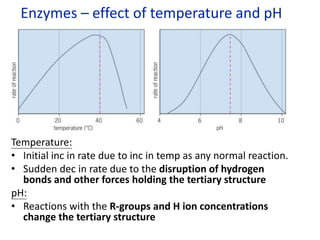
Enzymes – effect of temperature and pH
Temperature:
• Initial inc in rate due to inc in temp as any normal reaction.
• Sudden dec in rate due to the disruption of hydrogen
bonds and other forces holding the tertiary structure
pH:
• Reactions with the R-groups and H ion concentrations
change the tertiary structure
Enzymes – effect of heavy metal ions
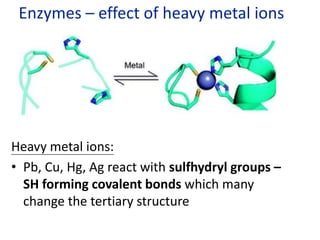
Heavy metal ions:
• Pb, Cu, Hg, Ag react with sulfhydryl groups –
SH forming covalent bonds which many
change the tertiary structure
B.3 Lipids
OBJECTIVES
• Fats are more reduced than carbohydrates and so yield more energy when oxidized.
• Triglycerides are produced by condensation of glycerol with three fatty acids and contain ester links.
Fatty acids can be saturated, monounsaturated or polyunsaturated.
• Phospholipids are derivatives of triglycerides.
• Hydrolysis of triglycerides and phospholipids can occur using enzymes or in alkaline or acidic
conditions.
• Steroids have a characteristic fused ring structure, known as a steroidal backbone.
• Lipids act as structural components of cell membranes, in energy storage, thermal and electrical
insulation, as transporters of lipid soluble vitamins and as hormones.
• Deduction of the structural formulas of reactants and products in condensation and hydrolysis
reactions between glycerol and fatty acids and/or phosphate.
• Prediction of the relative melting points of fats and oils from their structures.
• Comparison of the processes of hydrolytic and oxidative rancidity in fats with respect to the site of
reactivity in the molecules and the conditions that favour the reaction.
• Application of the concept of iodine number to determine the unsaturation of a fat.
• Comparison of carbohydrates and lipids as energy storage molecules with respect to their solubility
and energy density.
• Discussion of the impact of lipids on health, including the roles of dietary high-density lipoprotein
(HDL) and low-density lipoprotein (LDL) cholesterol, saturated, unsaturated and trans-fat and the use
and abuse of steroids.
(The structures of some fatty acids are given in the data booklet in section 34. Specific named
examples of fats and oils do not have to be learned. The structural differences between cis- and trans-
fats are not required.)
Lipids
Lipids are characterized as biological molecules that are
mostly non-polar and so insoluble in water. Molecules
interact with each other with weak Van der Waal’s forces.
There are three major lipid groups:
1. Triglycerides (fats and oils)
2. Phospholipid
3. Steroids
Glycerol Fatty Acid Tails
3 H2O
1. Triglycerides - formation
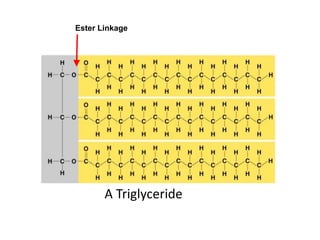
• Formation is a condensation reaction to create an ester link
• The reverse – hydrolysis occurs during digestion by lipases
A Triglyceride
Ester Linkage
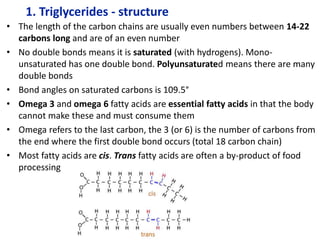
1. Triglycerides - structure
• The length of the carbon chains are usually even numbers between 14-22
carbons long and are of an even number
• No double bonds means it is saturated (with hydrogens). Mono-
unsaturated has one double bond. Polyunsaturated means there are many
double bonds
• Bond angles on saturated carbons is 109.5°
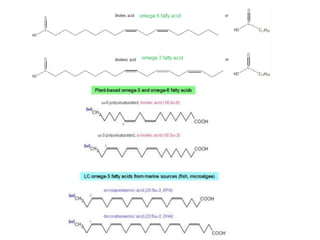
• Omega 3 and omega 6 fatty acids are essential fatty acids in that the body
cannot make these and must consume them
• Omega refers to the last carbon, the 3 (or 6) is the number of carbons from
the end where the first double bond occurs (total 18 carbon chain)
• Most fatty acids are cis. Trans fatty acids are often a by-product of food
processing
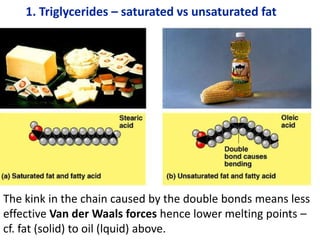
1. Triglycerides – saturated vs unsaturated fat
The kink in the chain caused by the double bonds means less
effective Van der Waals forces hence lower melting points –
cf. fat (solid) to oil (lquid) above.
1. Triglycerides – iodine number
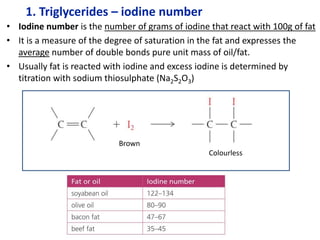
• Iodine number is the number of grams of iodine that react with 100g of fat
• It is a measure of the degree of saturation in the fat and expresses the
average number of double bonds pure unit mass of oil/fat.
• Usually fat is reacted with iodine and excess iodine is determined by
titration with sodium thiosulphate (Na2S2O3)
Brown
Colourless
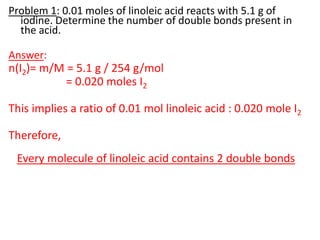
Problem 1: 0.01 moles of linoleic acid reacts with 5.1 g of
iodine. Determine the number of double bonds present in
the acid.
Answer:
n(I2)= m/M = 5.1 g / 254 g/mol
= 0.020 moles I2
This implies a ratio of 0.01 mol linoleic acid : 0.020 mole I2
Therefore,
Every molecule of linoleic acid contains 2 double bonds
Problem 2: Calculate the iodine number of linoloeic acid,
C17H31COOH.
Answer:
Molecular Weight of Acid = 18(12) + 32(1) +2(16) = 280 g/mol
Molecular Weight of Iodine = 2(127) = 254 g/mol
Linoleic Acid has 2 double bonds per molecule (from last problem).
280 grams of fat reacts with 2 x 254 g of iodine = 508 g iodine
100 grams of fat reacts with 508/280 = 181
The iodine number of linoleic acid is 181
RANCIDITY
• Rancidity is the chemical or biological decomposition of fats and oils
that produces unpleasant odours.
Hydrolytic rancidity
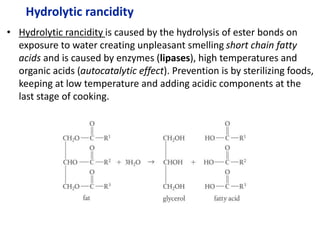
• Hydrolytic rancidity is caused by the hydrolysis of ester bonds on
exposure to water creating unpleasant smelling short chain fatty
acids and is caused by enzymes (lipases), high temperatures and
organic acids (autocatalytic effect). Prevention is by sterilizing foods,
keeping at low temperature and adding acidic components at the
last stage of cooking.
Oxidative rancidity
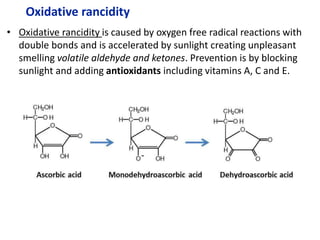
• Oxidative rancidity is caused by oxygen free radical reactions with
double bonds and is accelerated by sunlight creating unpleasant
smelling volatile aldehyde and ketones. Prevention is by blocking
sunlight and adding antioxidants including vitamins A, C and E.
ENERGY
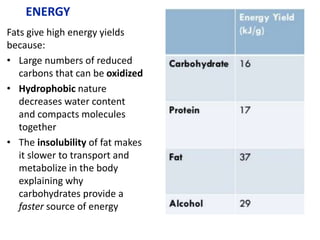
Fats give high energy yields
because:
• Large numbers of reduced
carbons that can be oxidized
• Hydrophobic nature
decreases water content
and compacts molecules
together
• The insolubility of fat makes
it slower to transport and
metabolize in the body
explaining why
carbohydrates provide a
faster source of energy
2. Phospholipids - structure
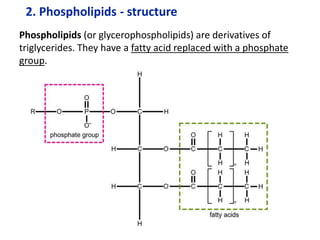
Phospholipids (or glycerophospholipids) are derivatives of
triglycerides. They have a fatty acid replaced with a phosphate
group.
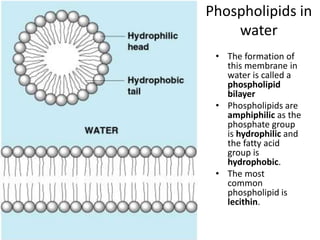
• The formation of
this membrane in
water is called a
phospholipid
bilayer
• Phospholipids are
amphiphilic as the
phosphate group
is hydrophilic and
the fatty acid
group is
hydrophobic.
• The most
common
phospholipid is
lecithin.
Phospholipids in
water
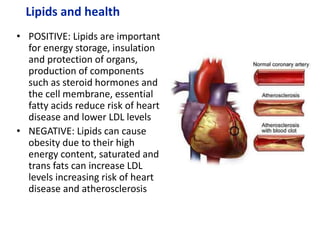
• POSITIVE: Lipids are important
for energy storage, insulation
and protection of organs,
production of components
such as steroid hormones and
the cell membrane, essential
fatty acids reduce risk of heart
disease and lower LDL levels
• NEGATIVE: Lipids can cause
obesity due to their high
energy content, saturated and
trans fats can increase LDL
levels increasing risk of heart
disease and atherosclerosis
Lipids and health
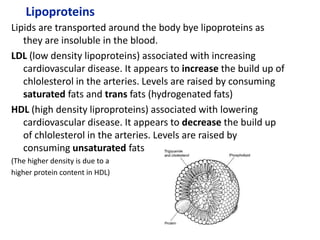
Lipids are transported around the body bye lipoproteins as
they are insoluble in the blood.
LDL (low density lipoproteins) associated with increasing
cardiovascular disease. It appears to increase the build up of
chlolesterol in the arteries. Levels are raised by consuming
saturated fats and trans fats (hydrogenated fats)
HDL (high density liproproteins) associated with lowering
cardiovascular disease. It appears to decrease the build up
of chlolesterol in the arteries. Levels are raised by
consuming unsaturated fats
(The higher density is due to a
higher protein content in HDL)
Lipoproteins
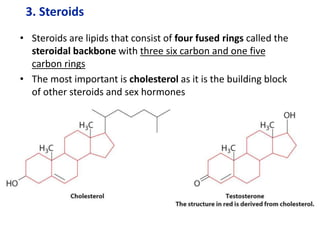
3. Steroids
• Steroids are lipids that consist of four fused rings called the
steroidal backbone with three six carbon and one five
carbon rings
• The most important is cholesterol as it is the building block
of other steroids and sex hormones
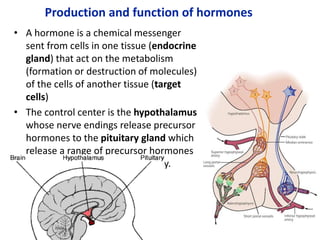
Production and function of hormones
• A hormone is a chemical messenger
sent from cells in one tissue (endocrine
gland) that act on the metabolism
(formation or destruction of molecules)
of the cells of another tissue (target
cells)
• The control center is the hypothalamus
whose nerve endings release precursor
hormones to the pituitary gland which
release a range of precursor hormones
to target organs around the body.
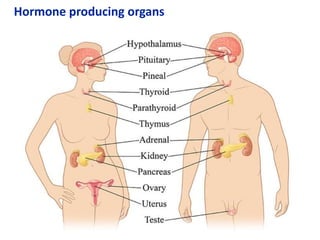
Hormone producing organs
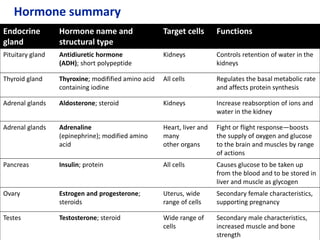
Hormone summary
Endocrine
gland
Hormone name and
structural type
Target cells Functions
Pituitary gland Antidiuretic hormone
(ADH); short polypeptide
Kidneys Controls retention of water in the
kidneys
Thyroid gland Thyroxine; modifified amino acid
containing iodine
All cells Regulates the basal metabolic rate
and affects protein synthesis
Adrenal glands Aldosterone; steroid Kidneys Increase reabsorption of ions and
water in the kidney
Adrenal glands Adrenaline
(epinephrine); modified amino
acid
Heart, liver and
many
other organs
Fight or flight response—boosts
the supply of oxygen and glucose
to the brain and muscles by range
of actions
Pancreas Insulin; protein All cells Causes glucose to be taken up
from the blood and to be stored in
liver and muscle as glycogen
Ovary Estrogen and progesterone;
steroids
Uterus, wide
range of cells
Secondary female characteristics,
supporting pregnancy
Testes Testosterone; steroid Wide range of
cells
Secondary male characteristics,
increased muscle and bone
strength
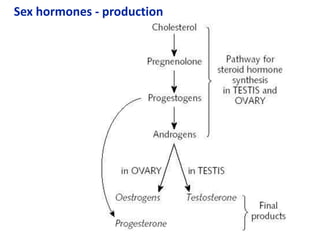
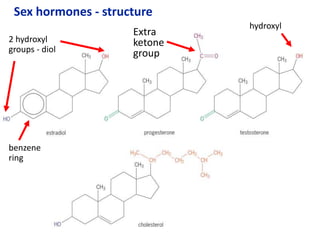
Sex hormones - production
Extra
ketone
group
Sex hormones - structure
2 hydroxyl
groups - diol
benzene
ring
hydroxyl
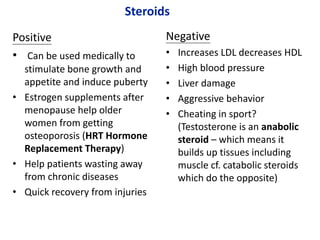
Steroids
Positive
• Can be used medically to
stimulate bone growth and
appetite and induce puberty
• Estrogen supplements after
menopause help older
women from getting
osteoporosis (HRT Hormone
Replacement Therapy)
• Help patients wasting away
from chronic diseases
• Quick recovery from injuries
Negative
• Increases LDL decreases HDL
• High blood pressure
• Liver damage
• Aggressive behavior
• Cheating in sport?
(Testosterone is an anabolic
steroid – which means it
builds up tissues including
muscle cf. catabolic steroids
which do the opposite)
B.4 Carbohydrates
OBJECTIVES
• Carbohydrates have the general formula Cx(H2O)y .
• Haworth projections represent the cyclic structures of monosaccharides.
• Monosaccharides contain either an aldehyde group (aldose) or a ketone group
(ketose) and several –OH groups.
• Straight chain forms of sugars cyclize in solution to form ring structures containing
an ether linkage.
• Glycosidic bonds form between monosaccharides forming disaccharides and
polysaccharides.
• Carbohydrates are used as energy sources and energy reserves.
• Deduction of the structural formulas of disaccharides and polysaccharides from
given monosaccharides.
• Relationship of the properties and functions of monosaccharides and
polysaccharides to their chemical structures.
(The straight chain and α-ring forms of glucose and fructose are given in the data
booklet in section 34. The component monosaccharides of specific disaccharides and
the linkage details of polysaccharides are not required. The distinction between α-
and β- forms and the structure of cellulose are not required.)
Carbohydrates
• Carbohydrates are compounds with the chemical formula
Cx(H2O)y
• There are two types – simple monosaccharides (monomers)
and complex polysaccharides (polymers) which may be as small
as 2 monomers (disaccharides).
1. Monosaccharides
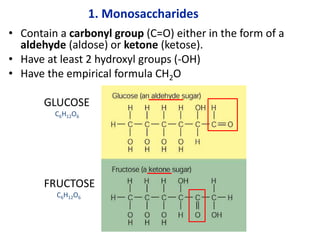
• Contain a carbonyl group (C=O) either in the form of a
aldehyde (aldose) or ketone (ketose).
• Have at least 2 hydroxyl groups (-OH)
• Have the empirical formula CH2O
GLUCOSE
C6H12O6
FRUCTOSE
C6H12O6
Cyclical forms
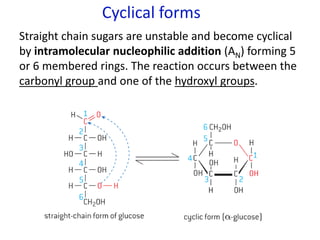
Straight chain sugars are unstable and become cyclical
by intramolecular nucleophilic addition (AN) forming 5
or 6 membered rings. The reaction occurs between the
carbonyl group and one of the hydroxyl groups.
Haworth projections
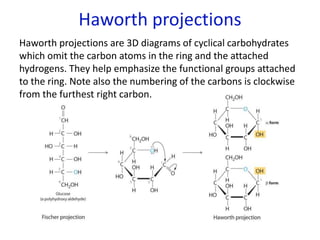
Haworth projections are 3D diagrams of cyclical carbohydrates
which omit the carbon atoms in the ring and the attached
hydrogens. They help emphasize the functional groups attached
to the ring. Note also the numbering of the carbons is clockwise
from the furthest right carbon.
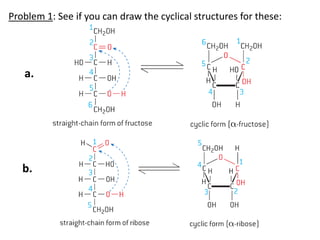
Problem 1: See if you can draw the cyclical structures for these:
a.
b.
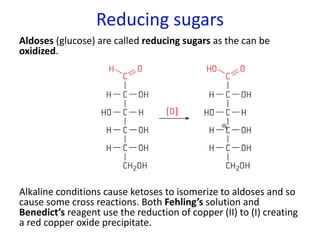
Reducing sugars
Aldoses (glucose) are called reducing sugars as the can be
oxidized.
Alkaline conditions cause ketoses to isomerize to aldoses and so
cause some cross reactions. Both Fehling’s solution and
Benedict’s reagent use the reduction of copper (II) to (I) creating
a red copper oxide precipitate.
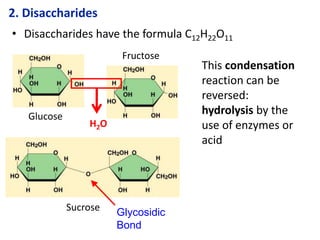
Glucose
Fructose
H2O
2. Disaccharides
Sucrose Glycosidic
Bond
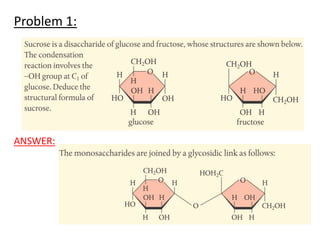
• Disaccharides have the formula C12H22O11
This condensation
reaction can be
reversed:
hydrolysis by the
use of enzymes or
acid
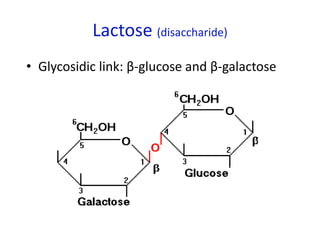
Lactose (disaccharide)
• Glycosidic link: β-glucose and β-galactose
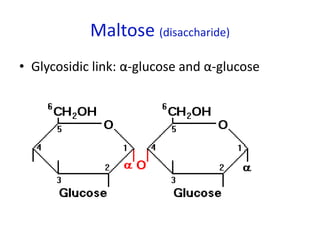
Maltose (disaccharide)
• Glycosidic link: α-glucose and α-glucose
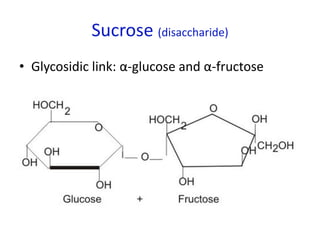
Sucrose (disaccharide)
• Glycosidic link: α-glucose and α-fructose
Problem 1:
ANSWER:
3. Polysaccharides
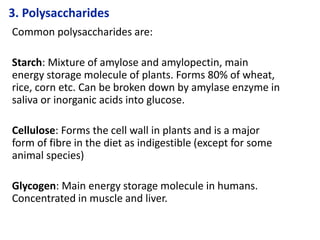
Common polysaccharides are:
Starch: Mixture of amylose and amylopectin, main
energy storage molecule of plants. Forms 80% of wheat,
rice, corn etc. Can be broken down by amylase enzyme in
saliva or inorganic acids into glucose.
Cellulose: Forms the cell wall in plants and is a major
form of fibre in the diet as indigestible (except for some
animal species)
Glycogen: Main energy storage molecule in humans.
Concentrated in muscle and liver.
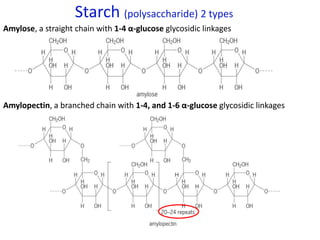
Starch (polysaccharide) 2 types
Amylose, a straight chain with 1-4 α-glucose glycosidic linkages
Amylopectin, a branched chain with 1-4, and 1-6 α-glucose glycosidic linkages
Iodine test for starch
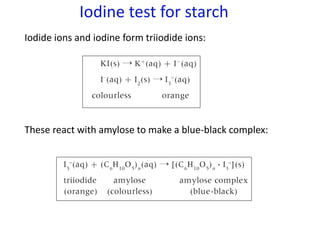
Iodide ions and iodine form triiodide ions:
These react with amylose to make a blue-black complex:
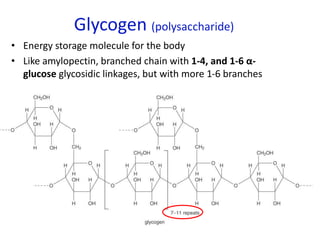
Glycogen (polysaccharide)
• Energy storage molecule for the body
• Like amylopectin, branched chain with 1-4, and 1-6 α-
glucose glycosidic linkages, but with more 1-6 branches
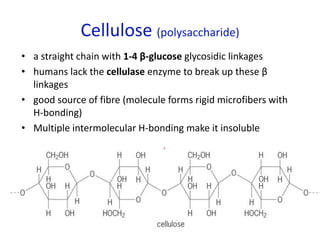
Cellulose (polysaccharide)
• a straight chain with 1-4 β-glucose glycosidic linkages
• humans lack the cellulase enzyme to break up these β
linkages
• good source of fibre (molecule forms rigid microfibers with
H-bonding)
• Multiple intermolecular H-bonding make it insoluble
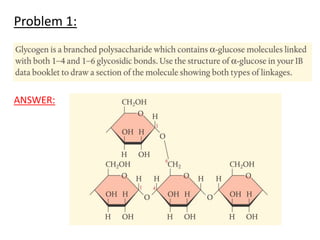
Problem 1:
ANSWER:
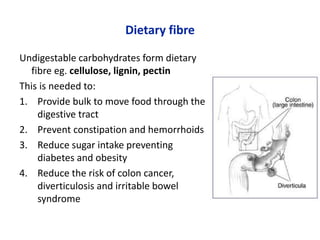
Dietary fibre
Undigestable carbohydrates form dietary
fibre eg. cellulose, lignin, pectin
This is needed to:
1. Provide bulk to move food through the
digestive tract
2. Prevent constipation and hemorrhoids
3. Reduce sugar intake preventing
diabetes and obesity
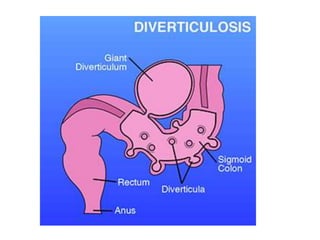
4. Reduce the risk of colon cancer,
diverticulosis and irritable bowel
syndrome
B.5 Vitamins
OBJECTIVES
• Vitamins are organic micronutrients which (mostly) cannot be synthesized by
the body but must be obtained from suitable food sources.
• The solubility (water or fat) of a vitamin can be predicted from its structure.
• Most vitamins are sensitive to heat.
• Vitamin deficiencies in the diet cause particular diseases and affect millions of
people worldwide.
• Comparison of the structures of vitamins A, C and D.
• Discussion of the causes and effects of vitamin deficiencies in different
countries and suggestion of solutions.
(The structures of vitamins A, C and D are provided in the data booklet section
35. Specific food sources of vitamins or names of deficiency diseases do not have
to be learned.)
Nutrients
Macronutrients – substances that make up more than
0.005% of our body weight. These include proteins, fats,
carbohydrates and minerals (Na, Mg, K, Ca, P, S, Cl).
Micronutrients – substances that make up less than 0.005%
of our body weight. These include the vitamins (water
soluable – B, C, fat soluable – A, D, E, K) and minerals (Fe,
Cu, Zn, I, Se, Mn, Mo, Cr, Co, B).
Co-factors – substances that help enzymes work
Vitamins
Vitamins are organic micronutrients that cannot be
synthesized by the organism in sufficient amounts and must
either be obtained from suitable foods or taken as food
supplements.
Water soluble vitamins:
Need daily supply as can be eliminated from 30min to several
weeks.
Fat soluble vitamins:
Accumulate in liver and fat tissue. Can be stored for up to
several months. Excess can cause vitamin poisoning.
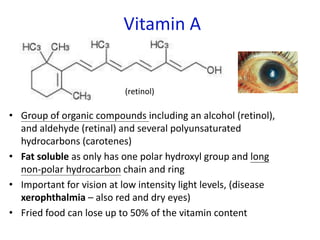
Vitamin A
• Group of organic compounds including an alcohol (retinol),
and aldehyde (retinal) and several polyunsaturated
hydrocarbons (carotenes)
• Fat soluble as only has one polar hydroxyl group and long
non-polar hydrocarbon chain and ring
• Important for vision at low intensity light levels, (disease
xerophthalmia – also red and dry eyes)
• Fried food can lose up to 50% of the vitamin content
(retinol)
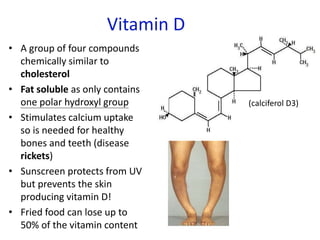
Vitamin D
• A group of four compounds
chemically similar to
cholesterol
• Fat soluble as only contains
one polar hydroxyl group
• Stimulates calcium uptake
so is needed for healthy
bones and teeth (disease
rickets)
• Sunscreen protects from UV
but prevents the skin
producing vitamin D!
• Fried food can lose up to
50% of the vitamin content
(calciferol D3)
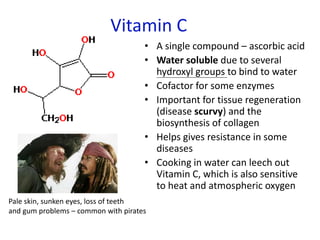
Vitamin C
• A single compound – ascorbic acid
• Water soluble due to several
hydroxyl groups to bind to water
• Cofactor for some enzymes
• Important for tissue regeneration
(disease scurvy) and the
biosynthesis of collagen
• Helps gives resistance in some
diseases
• Cooking in water can leech out
Vitamin C, which is also sensitive
to heat and atmospheric oxygen
Pale skin, sunken eyes, loss of teeth
and gum problems – common with pirates
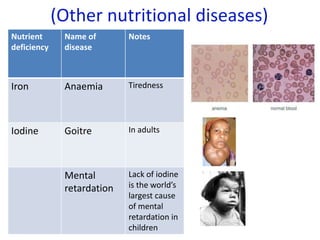
(Other nutritional diseases)
Nutrient
deficiency
Name of
disease
Notes
Iron Anaemia Tiredness
Iodine Goitre In adults
Mental
retardation
Lack of iodine
is the world’s
largest cause
of mental
retardation in
children
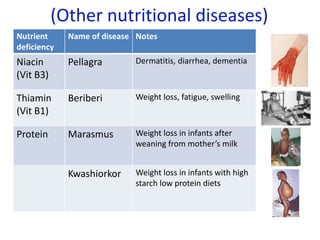
(Other nutritional diseases)
Nutrient
deficiency
Name of disease Notes
Niacin
(Vit B3)
Pellagra Dermatitis, diarrhea, dementia
Thiamin
(Vit B1)
Beriberi Weight loss, fatigue, swelling
Protein Marasmus Weight loss in infants after
weaning from mother’s milk
Kwashiorkor Weight loss in infants with high
starch low protein diets
World health
Malnutrition is the lack of regular, balanced supply of nutrients. The
term hence can also be applied to obesity and diabetes due to the
consumption of energy-dense, micronutrient-poor foods in
industrialized countries.
Solutions include:
• providing food rations that are composed of fresh and vitamin- and
mineral-rich foods
• fortification - adding nutrients missing in commonly consumed
foods (eg I2 to salt, Vit A to margarine, Vit B, D and C to cereals)
• genetic modification of food
• providing nutritional supplements
• providing selenium supplements to people eating foods grown in
selenium-poor soil
B.6 Biochemistry and the environment
OBJECTIVES
• Xenobiotics refer to chemicals that are found in an organism that are not normally present there.
• Biodegradable/compostable plastics can be consumed or broken down by bacteria or other living
organisms.
• Host–guest chemistry involves the creation of synthetic host molecules that mimic some of the
actions performed by enzymes in cells, by selectively binding to specific guest species, such as toxic
materials in the environment.
• Enzymes have been developed to help in the breakdown of oil spills and other industrial wastes.
• Enzymes in biological detergents can improve energy efficiency by enabling effective cleaning at
lower temperatures.
• Biomagnification is the increase in concentration of a substance in a food chain.
• Green chemistry, also called sustainable chemistry, is an approach to chemical research and
engineering that seeks to minimize the production and release to the environment of hazardous
substances.
• Discussion of the increasing problem of xenobiotics such as antibiotics in sewage treatment plants.
• Description of the role of starch in biodegradable plastics.
• Application of host–guest chemistry to the removal of a specific pollutant in the environment.
• Description of an example of biomagnification, including the chemical source of the substance.
Examples could include heavy metals or pesticides.
• Discussion of the challenges and criteria in assessing the “greenness” of a substance used in
biochemical research, including the atom economy.
(Specific names of “green chemicals” such as solvents are not expected. The emphasis in explanations
of host–guest chemistry should be on non-covalent bonding within the supramolecule.)
Xenobiotics
Xenobiotics are chemical compounds that are found in a
living organism, but which are foreign to that organism. This
includes the build up of excess levels of a compound in an
organism. Xenobiotics that remain the in environment for
long periods of time without being metabolized are called
persistent organic pollutants (POPs).
Xenobiotics can include:
• Antibiotics
• Insecticides (DDT)
• Heavy metals (Hg, Pb etc)
• Hormones
Examples xenobiotic problems
1. Bioaccumulation (eg. DDT, Hg)
2. Pharmaceutically active compounds – PACs (eg.
xenoestrogens )
3. Non-biodegradable plastics
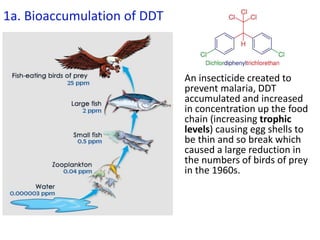
1a. Bioaccumulation of DDT
An insecticide created to
prevent malaria, DDT
accumulated and increased
in concentration up the food
chain (increasing trophic
levels) causing egg shells to
be thin and so break which
caused a large reduction in
the numbers of birds of prey
in the 1960s.
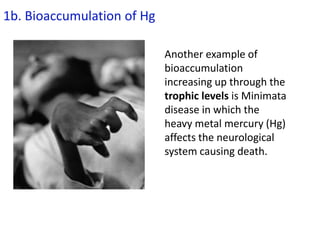
1b. Bioaccumulation of Hg
Another example of
bioaccumulation
increasing up through the
trophic levels is Minimata
disease in which the
heavy metal mercury (Hg)
affects the neurological
system causing death.
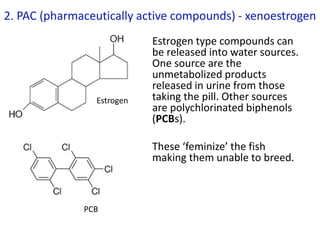
2. PAC (pharmaceutically active compounds) - xenoestrogen
Estrogen type compounds can
be released into water sources.
One source are the
unmetabolized products
released in urine from those
taking the pill. Other sources
are polychlorinated biphenols
(PCBs).
These ‘feminize’ the fish
making them unable to breed.
Estrogen
PCB
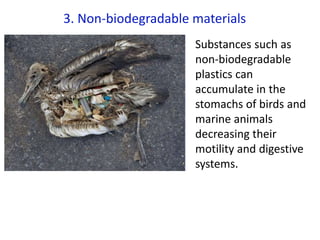
3. Non-biodegradable materials
Substances such as
non-biodegradable
plastics can
accumulate in the
stomachs of birds and
marine animals
decreasing their
motility and digestive
systems.
Amelioration of xenobiotics
1. Host-guest complexes
2. Biodegradable materials
3. Enzymes and microorganisms
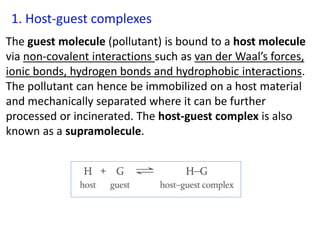
1. Host-guest complexes
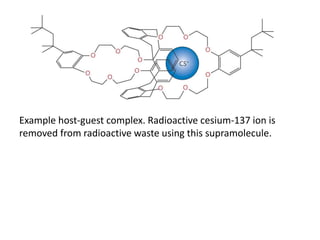
The guest molecule (pollutant) is bound to a host molecule
via non-covalent interactions such as van der Waal’s forces,
ionic bonds, hydrogen bonds and hydrophobic interactions.
The pollutant can hence be immobilized on a host material
and mechanically separated where it can be further
processed or incinerated. The host-guest complex is also
known as a supramolecule.
Example host-guest complex. Radioactive cesium-137 ion is
removed from radioactive waste using this supramolecule.
2. Biodegradable materials
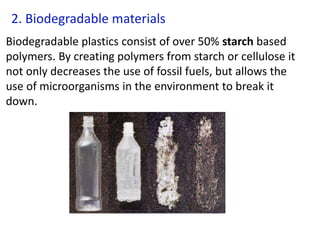
Biodegradable plastics consist of over 50% starch based
polymers. By creating polymers from starch or cellulose it
not only decreases the use of fossil fuels, but allows the
use of microorganisms in the environment to break it
down.
3. Enzymes and microorganisms
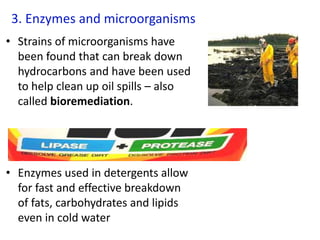
• Strains of microorganisms have
been found that can break down
hydrocarbons and have been used
to help clean up oil spills – also
called bioremediation.
• Enzymes used in detergents allow
for fast and effective breakdown
of fats, carbohydrates and lipids
even in cold water
Green chemistry
Green chemistry is an approach that works to minimize the
use and generation of hazardous chemicals. The 12
principles are:
1. Prevention It is better to prevent waste than to treat or clean up waste after it has been
created.
2. Atom Economy Synthetic methods should be designed to maximize the incorporation of
all materials used in the process into the final product.
3. Less Hazardous Chemical Syntheses Wherever practicable, synthetic methods should be
designed to use and generate substances that possess little or no toxicity to human health
and the environment.
4. Designing Safer Chemicals Chemical products should be designed to affect their desired
function while minimizing their toxicity.
5. Safer Solvents and Auxiliaries The use of auxiliary substances (e.g., solvents, separation
agents, etc.) should be made unnecessary wherever possible and innocuous when used.
6. Design for Energy Efficiency Energy requirements of chemical processes should be
recognized for their environmental and economic impacts and should be minimized. If
possible, synthetic methods should be conducted at ambient temperature and pressure.
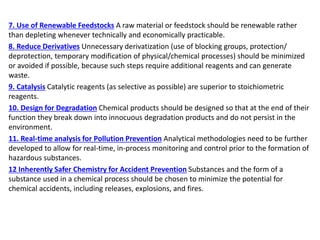
7. Use of Renewable Feedstocks A raw material or feedstock should be renewable rather
than depleting whenever technically and economically practicable.
8. Reduce Derivatives Unnecessary derivatization (use of blocking groups, protection/
deprotection, temporary modification of physical/chemical processes) should be minimized
or avoided if possible, because such steps require additional reagents and can generate
waste.
9. Catalysis Catalytic reagents (as selective as possible) are superior to stoichiometric
reagents.
10. Design for Degradation Chemical products should be designed so that at the end of their
function they break down into innocuous degradation products and do not persist in the
environment.
11. Real-time analysis for Pollution Prevention Analytical methodologies need to be further
developed to allow for real-time, in-process monitoring and control prior to the formation of
hazardous substances.
12 Inherently Safer Chemistry for Accident Prevention Substances and the form of a
substance used in a chemical process should be chosen to minimize the potential for
chemical accidents, including releases, explosions, and fires.
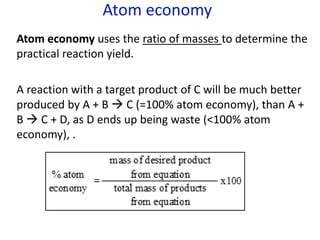
Atom economy
Atom economy uses the ratio of masses to determine the
practical reaction yield.
A reaction with a target product of C will be much better
produced by A + B  C (=100% atom economy), than A +
B  C + D, as D ends up being waste (<100% atom
economy), .
B.7 Proteins and enzymes
OBJECTIVES
• Inhibitors play an important role in regulating the activities of enzymes.
• Amino acids and proteins can act as buffers in solution.
• Protein assays commonly use UV-vis spectroscopy and a calibration curve based on
known standards.
• Determination of the maximum rate of reaction (V max) and the value of the
Michaelis constant (Km) for an enzyme by graphical means, and explanation of its
significance.
• Comparison of competitive and non-competitive inhibition of enzymes with
reference to protein structure, the active site and allosteric site.
• Explanation of the concept of product inhibition in metabolic pathways.
• Calculation of the pH of buffer solutions, such as those used in protein analysis and
in reactions involving amino acids in solution.
• Determination of the concentration of a protein in solution from a calibration curve
using the Beer–Lambert law.
(The effects of competitive and non-competitive inhibitors on K m and V max values
should be covered. The Henderson–Hasselbalch equation is given in the data booklet
in section 1. For UV-vis spectroscopy, knowledge of particular reagents and
wavelengths is not required.)
Higher
level
Amino acids as buffers
This ‘pH of isoelectric point’ for specific amino
acids is found in the Data Booklet. This pH is
known as the pI (at the isoelectric point).
Higher
level
= pI
Higher
level
= pI
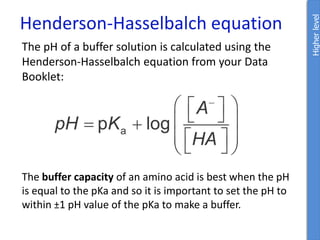
Henderson-Hasselbalch equation
The pH of a buffer solution is calculated using the
Henderson-Hasselbalch equation from your Data
Booklet:
Higher
level
The buffer capacity of an amino acid is best when the pH
is equal to the pKa and so it is important to set the pH to
within ±1 pH value of the pKa to make a buffer.
Problem 1: Calculate the pH of an aqueous solution that contains
0.8M zwitterionic and 0.2M anionic forms of serine.
Solution contains anions therefore high pH due to H+ removed.
pKa = 9.1 zwitterion anion + H+
Therefore zwitterion is the acid and anion is the conj base.
From data booklet:
pH = pKa + log ([A-]/[HA])
= pKa + log ([anion]/[zwitterion])
= 9.1 + log (0.2/0.8)
= 9.1 + -0.6
= 8.5
Higher
level
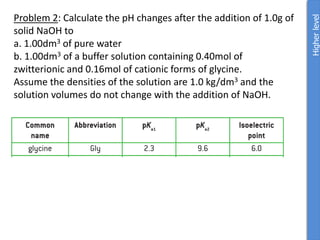
Problem 2: Calculate the pH changes after the addition of 1.0g of
solid NaOH to
a. 1.00dm3 of pure water
b. 1.00dm3 of a buffer solution containing 0.40mol of
zwitterionic and 0.16mol of cationic forms of glycine.
Assume the densities of the solution are 1.0 kg/dm3 and the
solution volumes do not change with the addition of NaOH.
Higher
level
a. NaOH  Na+ + OH-
n(NaOH) = m/M = 1g/40g/mol = 0.025mol NaOH
1 mol NaOH : 1 mol OH-
Therefore [OH] = 0.025mol
pOH = -log [OH] = -log0.025 = 1.059
pKw = pOH + pH
pH = 14 – pOH = 14-1.6 = 12.4
pH water is 7 so change in pH = 12.4 – 7.0 = 5.4
Higher
level
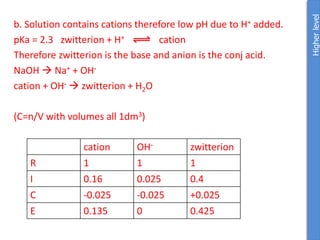
b. Solution contains cations therefore low pH due to H+ added.
pKa = 2.3 zwitterion + H+ cation
Therefore zwitterion is the base and anion is the conj acid.
NaOH  Na+ + OH-
cation + OH-  zwitterion + H2O
(C=n/V with volumes all 1dm3)
Higher
level
cation OH- zwitterion
R 1 1 1
I 0.16 0.025 0.4
C -0.025 -0.025 +0.025
E 0.135 0 0.425
From data booklet:
pH(before) = pKa + log ([A-]/[HA])
= pKa + log ([zwitterion]/[cation])
= 2.3 + log (0.4/0.16)
= 2.3 + 0.4
= 2.7
pH(after) = pKa + log ([A-]/[HA])
= pKa + log ([zwitterion]/[cation])
= 2.3 + log (0.425/0.135)
= 2.3 + 0.5
= 2.8
Therefore the change in pH = 2.8-2.7 = 0.1
*The comparison of parts a and b show the effectiveness of a
buffer to resist pH changes.
Higher
level
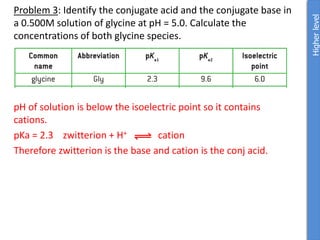
Problem 3: Identify the conjugate acid and the conjugate base in
a 0.500M solution of glycine at pH = 5.0. Calculate the
concentrations of both glycine species.
pH of solution is below the isoelectric point so it contains
cations.
pKa = 2.3 zwitterion + H+ cation
Therefore zwitterion is the base and cation is the conj acid.
Higher
level
Higher
level
From data booklet:
pH = pKa + log ([A-]/[HA])
5.0 = 2.3 + log ([zwitterion]/[cation])
log ([zwitterion]/[cation]) = 2.7
[zwitterion]/[cation] = 501
If [cation] = x, then [zwitterion] = 501x
Total concentration is x + 501x = 0.500M
502x = 0.500M
x = 0.0001M
(We already know this is not an effective buffer because the pH is more
than 1 pH value away from the pKa)
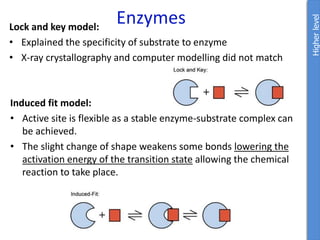
Enzymes
Lock and key model:
• Explained the specificity of substrate to enzyme
• X-ray crystallography and computer modelling did not match
Higher
level
Induced fit model:
• Active site is flexible as a stable enzyme-substrate complex can
be achieved.
• The slight change of shape weakens some bonds lowering the
activation energy of the transition state allowing the chemical
reaction to take place.
Enzymes
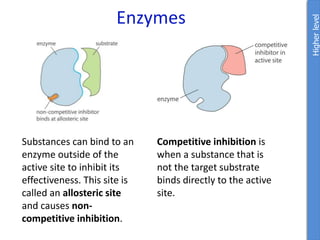
Substances can bind to an
enzyme outside of the
active site to inhibit its
effectiveness. This site is
called an allosteric site
and causes non-
competitive inhibition.
Higher
level
Competitive inhibition is
when a substance that is
not the target substrate
binds directly to the active
site.
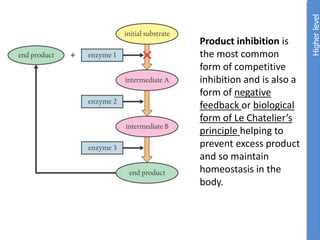
Product inhibition is
the most common
form of competitive
inhibition and is also a
form of negative
feedback or biological
form of Le Chatelier’s
principle helping to
prevent excess product
and so maintain
homeostasis in the
body.
Higher
level
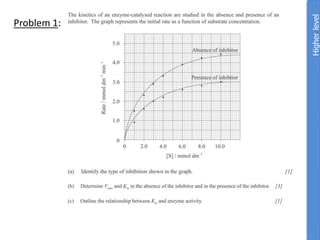
Enzymes – rates of reaction
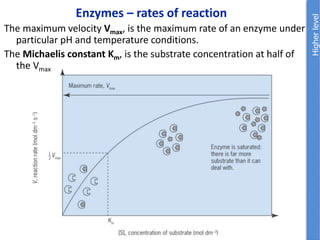
The maximum velocity Vmax, is the maximum rate of an enzyme under
particular pH and temperature conditions.
The Michaelis constant Km, is the substrate concentration at half of
the Vmax
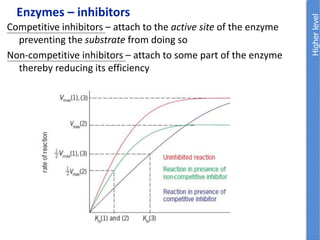
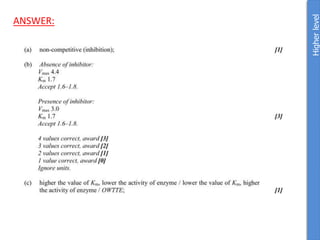
Competitive inhibitors – attach to the active site of the enzyme
preventing the substrate from doing so
Non-competitive inhibitors – attach to some part of the enzyme
thereby reducing its efficiency
Enzymes – inhibitors
Problem 1:
Higher
level
ANSWER:
Higher
level
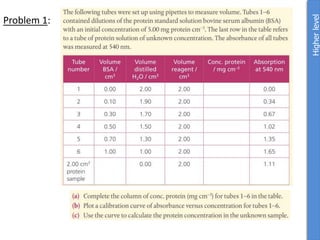
Protein assay
Higher
level
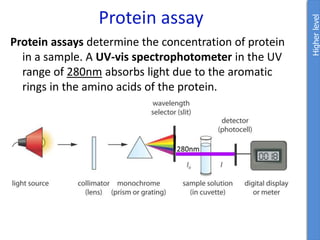
Protein assays determine the concentration of protein
in a sample. A UV-vis spectrophotometer in the UV
range of 280nm absorbs light due to the aromatic
rings in the amino acids of the protein.
Beer-Lambert law
Higher
level
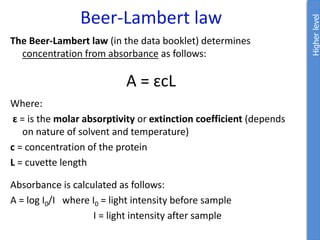
The Beer-Lambert law (in the data booklet) determines
concentration from absorbance as follows:
A = ɛcL
Where:
ɛ = is the molar absorptivity or extinction coefficient (depends
on nature of solvent and temperature)
c = concentration of the protein
L = cuvette length
Absorbance is calculated as follows:
A = log I0/I where I0 = light intensity before sample
I = light intensity after sample
Qualitative determination of proteins
Higher
level
To identify a particular protein, it first needs to be separated out
by high-performace liquid chromatography (HPLC) and then
compared to a database with information from UV-vis
spectra, gel electrophoresis, HNMR, and mass spectrometry.
Problem 1:
Higher
level
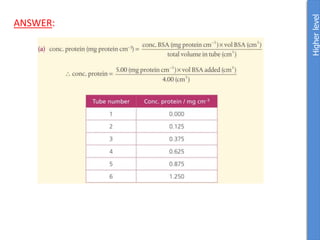
ANSWER:
Higher
level
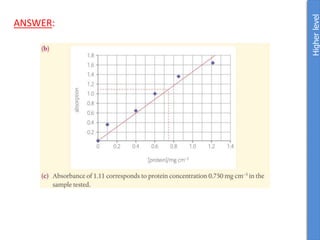
ANSWER:
Higher
level
B.8 Nucleic acids
OBJECTIVES
• Nucleotides are the condensation products of a pentose sugar, phosphoric acid and a nitrogenous base—
adenine (A), guanine (G), cytosine (C), thymine (T) or uracil (U).
• Polynucleotides form by condensation reactions.
• DNA is a double helix of two polynucleotide strands held together by hydrogen bonds.
• RNA is usually a single polynucleotide chain that contains uracil in place of thymine, and a sugar ribose in
place of deoxyribose.
• The sequence of bases in DNA determines the primary structure of proteins synthesized by the cell using a
triplet code, known as the genetic code, which is universal.
• Genetically modified organisms have genetic material that has been altered by genetic engineering
techniques, involving transferring DNA between species.
• Explanation of the stability of DNA in terms of the interactions between its hydrophilic and hydrophobic
components.
• Explanation of the origin of the negative charge on DNA and its association with basic proteins (histones) in
chromosomes.
• Deduction of the nucleotide sequence in a complementary strand of DNA or a molecule of RNA from a
given polynucleotide sequence.
• Explanation of how the complementary pairing between bases enables DNA to replicate itself exactly.
• Discussion of the benefits and concerns of using genetically modified foods.
(Structures of the nitrogenous bases and ribose and deoxyribose sugars are
given in the data booklet in section 34. Knowledge of the different forms of RNA is not required. Details of
the process of DNA replication are not required. Limit expression of DNA to the concept of a four-unit base
code determining a twenty-unit amino acid sequence. Details of transcription and translation are not
required.)
Higher
level
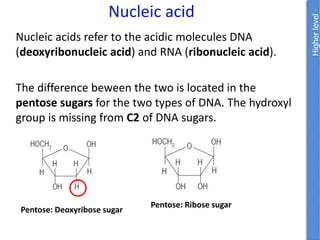
Nucleic acids refer to the acidic molecules DNA
(deoxyribonucleic acid) and RNA (ribonucleic acid).
The difference beween the two is located in the
pentose sugars for the two types of DNA. The hydroxyl
group is missing from C2 of DNA sugars.
Nucleic acid
Pentose: Ribose sugar
Pentose: Deoxyribose sugar
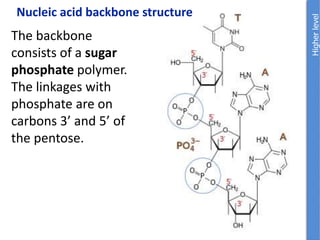
Nucleic acid backbone structure
The backbone
consists of a sugar
phosphate polymer.
The linkages with
phosphate are on
carbons 3’ and 5’ of
the pentose.
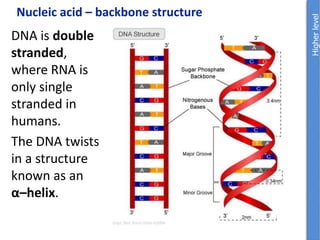
Nucleic acid – backbone structure
DNA is double
stranded,
where RNA is
only single
stranded in
humans.
The DNA twists
in a structure
known as an
α–helix.
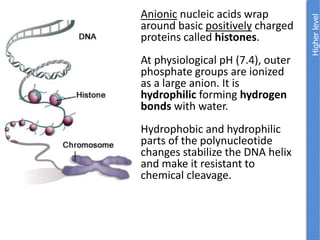
Anionic nucleic acids wrap
around basic positively charged
proteins called histones.
At physiological pH (7.4), outer
phosphate groups are ionized
as a large anion. It is
hydrophilic forming hydrogen
bonds with water.
Hydrophobic and hydrophilic
parts of the polynucleotide
changes stabilize the DNA helix
and make it resistant to
chemical cleavage.
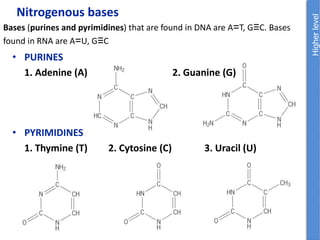
• PURINES
1. Adenine (A) 2. Guanine (G)
• PYRIMIDINES
1. Thymine (T) 2. Cytosine (C) 3. Uracil (U)
Nitrogenous bases
Bases (purines and pyrimidines) that are found in DNA are A=T, G≡C. Bases
found in RNA are A=U, G≡C
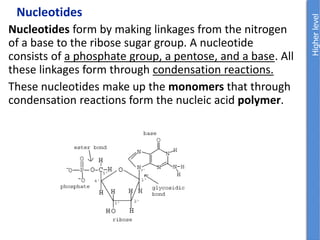
Nucleotides
Nucleotides form by making linkages from the nitrogen
of a base to the ribose sugar group. A nucleotide
consists of a phosphate group, a pentose, and a base. All
these linkages form through condensation reactions.
These nucleotides make up the monomers that through
condensation reactions form the nucleic acid polymer.
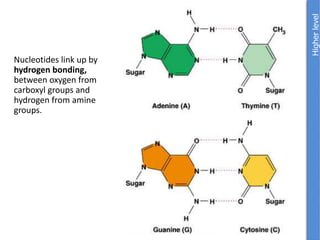
Nucleotides link up by
hydrogen bonding,
between oxygen from
carboxyl groups and
hydrogen from amine
groups.
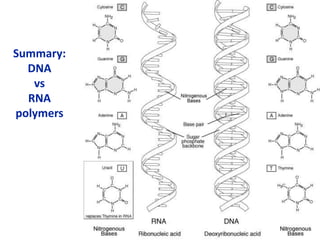
Summary:
DNA
vs
RNA
polymers
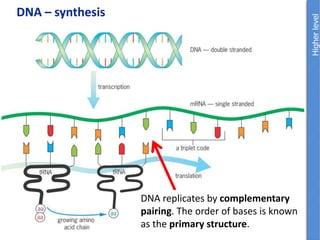
DNA – synthesis
DNA replicates by complementary
pairing. The order of bases is known
as the primary structure.
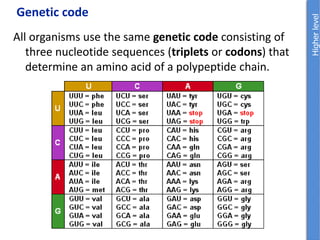
Genetic code
All organisms use the same genetic code consisting of
three nucleotide sequences (triplets or codons) that
determine an amino acid of a polypeptide chain.
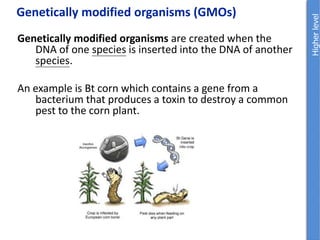
Genetically modified organisms are created when the
DNA of one species is inserted into the DNA of another
species.
An example is Bt corn which contains a gene from a
bacterium that produces a toxin to destroy a common
pest to the corn plant.
Genetically modified organisms (GMOs)
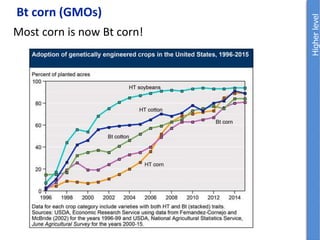
Bt corn (GMOs)
Most corn is now Bt corn!
• Longer shelf life
• Improved flavour, texture, nutritional value
• Increased resistance to diseases and pests
• Producing a supply of vitamins and vaccines
• Increased crop yeilds
• Tolerance for wider growing conditions eg. drought
(Taken directly from Pearson 2014)
Benefits of GMOs
• Lack of information about long-term effects
• Changes to the natural ecosystem from cross-
pollination
• Possible links to allergies
• Altering the natural composition of food
• Concerns of breeding species that are resistant to
control
• Lack of information on food labeling
(Taken directly from Pearson 2014)
Concerns of GMOs
B.9 Biological pigments
OBJECTIVES
• Biological pigments are coloured compounds produced by metabolism.
• The colour of pigments is due to highly conjugated systems with delocalized electrons, which have intense absorption
bands in the visible region.
• Porphyrin compounds, such as hemoglobin, myoglobin, chlorophyll and many cytochromes are chelates of metals with
large nitrogen-containing macrocyclic ligands.
• Hemoglobin and myoglobin contain heme groups with the porphyrin group bound to an iron(II) ion.
• Cytochromes contain heme groups in which the iron ion interconverts between iron(II) and iron(III) during redox reactions.
• Anthocyanins are aromatic, water-soluble pigments widely distributed in plants. Their specific colour depends on metal
ions and pH.
• Carotenoids are lipid-soluble pigments, and are involved in harvesting light in photosynthesis. They are susceptible to
oxidation, catalysed by light.
• Explanation of the sigmoidal shape of hemoglobin’s oxygen dissociation curve in terms of the cooperative binding of
hemoglobin to oxygen.
• Discussion of the factors that influence oxygen saturation of hemoglobin, including temperature, pH and carbon dioxide.
• Description of the greater affinity of oxygen for foetal hemoglobin.
• Explanation of the action of carbon monoxide as a competitive inhibitor of oxygen binding.
• Outline of the factors that affect the stabilities of anthocyanins, carotenoids and chlorophyll in relation to their structures.
• Explanation of the ability of anthocyanins to act as indicators based on their sensitivity to pH.
• Description of the function of photosynthetic pigments in trapping light energy during photosynthesis.
• Investigation of pigments through paper and thin layer chromatography.
(The structures of chlorophyll, heme B and specific examples of anthocyanins and carotenoids are given in the data booklet
in section 35; details of other pigment names and structures are not required. Explanation of cooperative binding in
hemoglobin should be limited to conformational changes occurring in one polypeptide when it becomes oxygenated.
Knowledge of specific colour changes with changing conditions is not required.)
Higher
level
Biological pigments
Biological pigments are coloured compounds produced
by metabolism. They absorb light in the visible
spectrum due to the lower energy transitions of
delocalized electrons in the p orbitals. Hence these
compounds include many alternating single and double
bonds called conjugation. The part of the molecule
absorbing light is called the chromophore.
Biological pigments include:
1. Cartotenes
2. Porphyrins
3. Anthocyanins
Higher
level
Higher
level
The transition metal ion in porphyrins further adds to
the ability of the molecule to interact with visible light.
The major porphyrins are:
a. Hemoglobin (and myoglobin)
b. Cytochromes
c. Chlorophyll
Higher
level
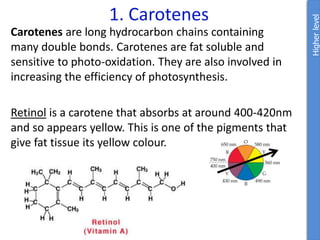
1. Carotenes
Carotenes are long hydrocarbon chains containing
many double bonds. Carotenes are fat soluble and
sensitive to photo-oxidation. They are also involved in
increasing the efficiency of photosynthesis.
Retinol is a carotene that absorbs at around 400-420nm
and so appears yellow. This is one of the pigments that
give fat tissue its yellow colour.
Higher
level
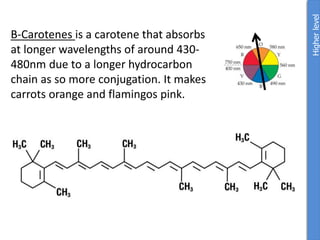
Β-Carotenes is a carotene that absorbs
at longer wavelengths of around 430-
480nm due to a longer hydrocarbon
chain as so more conjugation. It makes
carrots orange and flamingos pink.
Higher
level
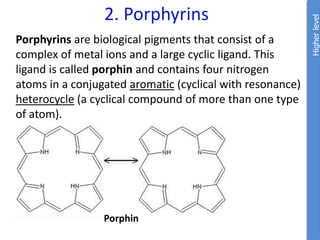
2. Porphyrins
Porphyrins are biological pigments that consist of a
complex of metal ions and a large cyclic ligand. This
ligand is called porphin and contains four nitrogen
atoms in a conjugated aromatic (cyclical with resonance)
heterocycle (a cyclical compound of more than one type
of atom).
Higher
level
Porphin
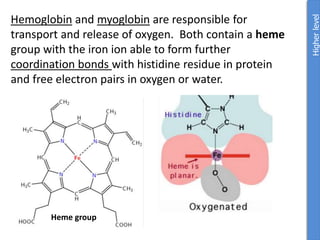
Hemoglobin and myoglobin are responsible for
transport and release of oxygen. Both contain a heme
group with the iron ion able to form further
coordination bonds with histidine residue in protein
and free electron pairs in oxygen or water.
Higher
level
Heme group
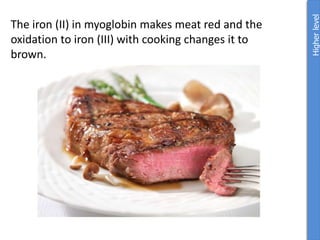
The iron (II) in myoglobin makes meat red and the
oxidation to iron (III) with cooking changes it to
brown.
Higher
level
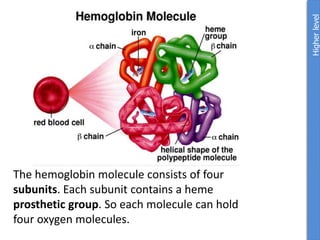
The hemoglobin molecule consists of four
subunits. Each subunit contains a heme
prosthetic group. So each molecule can hold
four oxygen molecules.
Higher
level
Bound oxygen changes the shape
of the entire molecule including
the subunits, which increases the
ability of the molecule to further
bind oxygen.
This is called cooperative binding.
This is why the oxygen affinity
curve is sigmoidal.
Higher
level
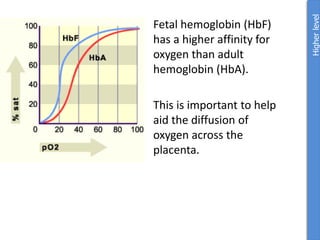
Fetal hemoglobin (HbF)
has a higher affinity for
oxygen than adult
hemoglobin (HbA).
This is important to help
aid the diffusion of
oxygen across the
placenta.
Higher
level
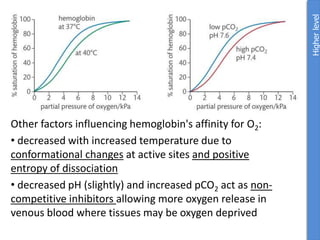
Other factors influencing hemoglobin's affinity for O2:
• decreased with increased temperature due to
conformational changes at active sites and positive
entropy of dissociation
• decreased pH (slightly) and increased pCO2 act as non-
competitive inhibitors allowing more oxygen release in
venous blood where tissues may be oxygen deprived
Higher
level
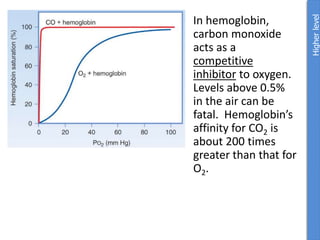
In hemoglobin,
carbon monoxide
acts as a
competitive
inhibitor to oxygen.
Levels above 0.5%
in the air can be
fatal. Hemoglobin’s
affinity for CO2 is
about 200 times
greater than that for
O2.
Higher
level
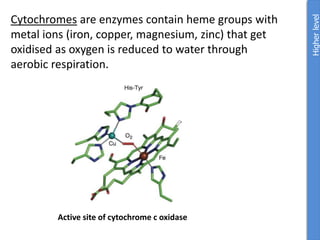
Cytochromes are enzymes contain heme groups with
metal ions (iron, copper, magnesium, zinc) that get
oxidised as oxygen is reduced to water through
aerobic respiration.
Higher
level
Active site of cytochrome c oxidase
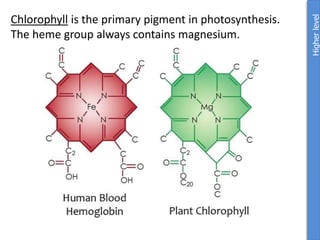
Chlorophyll is the primary pigment in photosynthesis.
The heme group always contains magnesium.
Higher
level
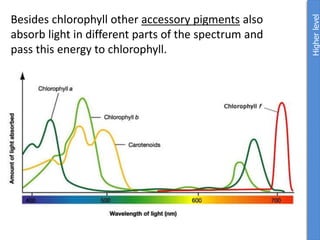
Besides chlorophyll other accessory pigments also
absorb light in different parts of the spectrum and
pass this energy to chlorophyll.
Higher
level
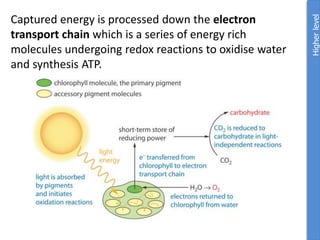
Captured energy is processed down the electron
transport chain which is a series of energy rich
molecules undergoing redox reactions to oxidise water
and synthesis ATP.
Higher
level
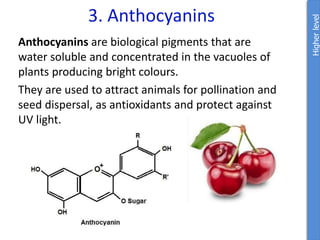
3. Anthocyanins
Anthocyanins are biological pigments that are
water soluble and concentrated in the vacuoles of
plants producing bright colours.
They are used to attract animals for pollination and
seed dispersal, as antioxidants and protect against
UV light.
Higher
level
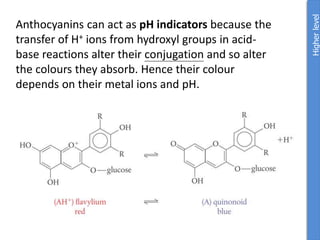
Anthocyanins can act as pH indicators because the
transfer of H+ ions from hydroxyl groups in acid-
base reactions alter their conjugation and so alter
the colours they absorb. Hence their colour
depends on their metal ions and pH.
Higher
level
B.10 Stereochemistry in biomolecules
OBJECTIVES
• With one exception, amino acids are chiral, and only the L-configuration is found in proteins.
• Naturally occurring unsaturated fat is mostly in the cis form, but food processing can convert it
into the trans form.
• D and L stereoisomers of sugars refer to the configuration of the chiral carbon atom furthest
from the aldehyde or ketone group, and D forms occur most frequently in nature.
• Ring forms of sugars have isomers, known as α and β, depending on whether the position of
the hydroxyl group at carbon 1 (glucose) or carbon 2 (fructose) lies below the plane of the ring
(α) or above the plane of the ring (β).
• Vision chemistry involves the light activated interconversion of cis- and trans-isomers of
retinal.
• Description of the hydrogenation and partial hydrogenation of unsaturated fats, including the
production of trans-fats, and a discussion of the advantages and disadvantages of these
processes.
• Explanation of the structure and properties of cellulose, and comparison with starch.
• Discussion of the importance of cellulose as a structural material and in the diet.
• Outline of the role of vitamin A in vision, including the roles of opsin, rhodopsin and cis- and
trans-retinal.
(Names of the enzymes involved in the visual cycle are not required. Relative melting points of
saturated and cis-/trans-unsaturated fats should be covered.)
Higher
level
Isomers (organic review)
Higher
level
C
S
Amino acids
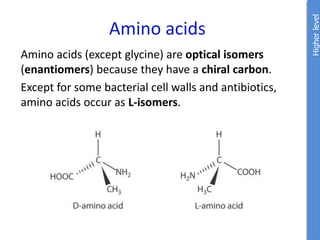
Amino acids (except glycine) are optical isomers
(enantiomers) because they have a chiral carbon.
Except for some bacterial cell walls and antibiotics,
amino acids occur as L-isomers.
Higher
level
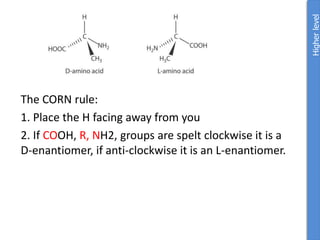
The CORN rule:
1. Place the H facing away from you
2. If COOH, R, NH2, groups are spelt clockwise it is a
D-enantiomer, if anti-clockwise it is an L-enantiomer.
Higher
level
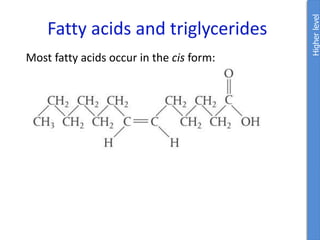
Fatty acids and triglycerides
Most fatty acids occur in the cis form:
Higher
level
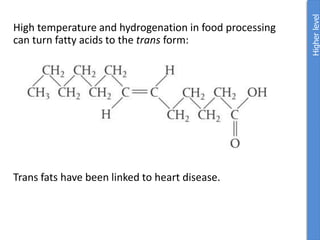
High temperature and hydrogenation in food processing
can turn fatty acids to the trans form:
Trans fats have been linked to heart disease.
Higher
level
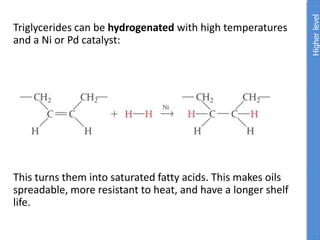
Triglycerides can be hydrogenated with high temperatures
and a Ni or Pd catalyst:
This turns them into saturated fatty acids. This makes oils
spreadable, more resistant to heat, and have a longer shelf
life.
Higher
level
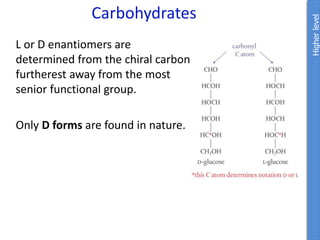
Carbohydrates
L or D enantiomers are
determined from the chiral carbon
furtherest away from the most
senior functional group.
Only D forms are found in nature.
Higher
level
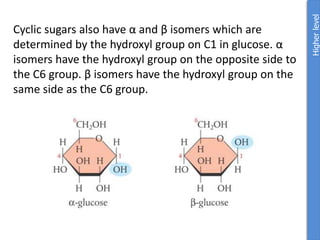
Cyclic sugars also have α and β isomers which are
determined by the hydroxyl group on C1 in glucose. α
isomers have the hydroxyl group on the opposite side to
the C6 group. β isomers have the hydroxyl group on the
same side as the C6 group.
Higher
level
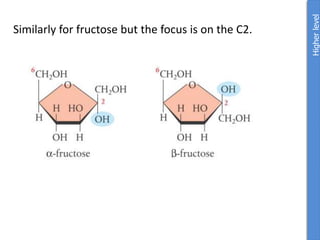
Similarly for fructose but the focus is on the C2.
Higher
level
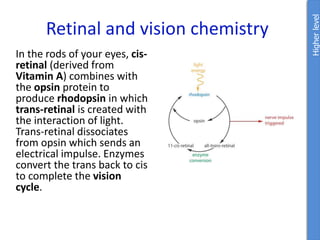
Retinal and vision chemistry
In the rods of your eyes, cis-
retinal (derived from
Vitamin A) combines with
the opsin protein to
produce rhodopsin in which
trans-retinal is created with
the interaction of light.
Trans-retinal dissociates
from opsin which sends an
electrical impulse. Enzymes
convert the trans back to cis
to complete the vision
cycle.
Higher
level
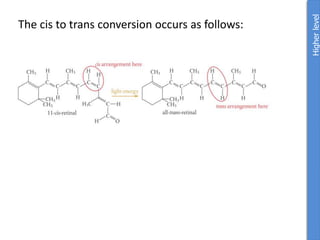
The cis to trans conversion occurs as follows:
Higher
level

Ib Biochemistry Complete Topic SL and HL.ppt

  • 1.
    Option B Biochemistry Higherlevel IB CHEMISTRY
  • 2.
    B.1 Introduction tobiochemistry OBJECTIVES • The diverse functions of biological molecules depend on their structures and shapes. • Metabolic reactions take place in highly controlled aqueous environments. • Reactions of breakdown are called catabolism and reactions of synthesis are called anabolism. • Biopolymers form by condensation reactions and are broken down by hydrolysis reactions. • Photosynthesis is the synthesis of energy-rich molecules from carbon dioxide and water using light energy. • Respiration is a complex set of metabolic processes providing energy for cells. • Explanation of the difference between condensation and hydrolysis reactions. • The use of summary equations of photosynthesis and respiration to explain the potential balancing of oxygen and carbon dioxide in the atmosphere. (Intermediates of aerobic respiration and photosynthesis are not required.)
  • 3.
    Classification of biomolecules Anabolic- complex molecules from smaller inorganic or organic substances Catabolic - complex molecules broken to smaller fragments
  • 4.
    Metabolic pathways Most anabolicprocesses are condensation reactions. Condensation reaction monomers require 2 function groups and the release of a small molecule (H2O, HCl, NH3 etc). Most catabolic processes are hydrolysis reactions.
  • 5.
    The most importantof these catabolic/anabolic pairings are respiration and photosynthesis.
  • 6.
  • 7.
    B.2 Proteins andenzymes OBJECTIVES • Proteins are polymers of 2-amino acids, joined by amide links (also known as peptide bonds). • Amino acids are amphoteric and can exist as zwitterions, cations and anions. • Protein structures are diverse and are described at the primary, secondary, tertiary and quaternary levels. • A protein’s three-dimensional shape determines its role in structural components or in metabolic processes. • Most enzymes are proteins that act as catalysts by binding specifically to a substrate at the active site. • As enzyme activity depends on the conformation, it is sensitive to changes in temperature and pH and the presence of heavy metal ions. • Chromatography separation is based on different physical and chemical principles. • Deduction of the structural formulas of reactants and products in condensation reactions of amino acids, and hydrolysis reactions of peptides. • Explanation of the solubilities and melting points of amino acids in terms of zwitterions. • Application of the relationships between charge, pH and isoelectric point for amino acids and proteins. • Description of the four levels of protein structure, including the origin and types of bonds and interactions involved. • Deduction and interpretation of graphs of enzyme activity involving changes in substrate concentration, pH and temperature. • Explanation of the processes of paper chromatography and gel electrophoresis in amino acid and protein separation and identification. (The names and structural formulas of the amino acids are given in the data booklet in section 33. Reference should be made to alpha helix and beta pleated sheet, and to fibrous and globular proteins with examples of each. In paper chromatography the use of Rf values and locating agents should be covered. In enzyme kinetics Km and Vmax are not required.)
  • 8.
    • Amino acidsare the monomers or building blocks of proteins (polymers) • There are 20 amino acids which combine to form proteins (see data booklet) which vary with the R side chain • Each amino acid contains an amino group (-NH2) and a carboxyl group (-COOH) Amino acids
  • 9.
    Amino acid properties •Amino acids can have both positive and negative charged groups called a zwitterion, often denoted as the H from the carboxyl group moving to the amino group • Amino acids are amphoteric meaning they can act as both acids and bases • Amino acids will act as buffers by absorbing excess H+ or OH- ions. • Each amino acid has a pH in which it is electrically neutral called the isoelectric point. • When the pH is below this it will be a positive ion, above this and it will be a negative ion.
  • 10.
    Relationship between pHand ionic character zwitterion anion cation
  • 11.
  • 12.
  • 13.
    Serine Valine TyrosineCysteine 3 H2O A Short Polypeptide Peptide Bond Formation of a Protein
  • 14.
    Formation of aProtein β
  • 15.
    Primary structure • Theamino acid sequence of the protein (intramolecular forces). Covalent (amide peptide) bonding. Secondary structure • This is due to regular repeating hydrogen bonding along the same peptide chain and may consist of turns known as α–helix, or sheets known as β–pleated sheets. Tertiary structure • This is due to the R side groups (note these are called intramolecular forces) • These groups not only influence the isoelectric point but also include hydrophobic/hydophilic groups, hydrogen bonding, ionic bonds between charged side groups, and disulfide bridges (covalent and strongest of all these linkages) • Denaturing of the protein is said to occur at this level Quaternary structure • The relationship of the polypeptide to other polypeptides (proteins such as hemoglobin are actually four interlinking polypeptides) Protein structure
  • 16.
  • 17.
  • 18.
    Fibrous vs Globularproteins Protein Type Role Function Keratin Fibrous Structure Protective covering for hair, wool, claws Collagen Fibrous Structure Connective tissue of skin and tendons Polymerase Globular Enzyme Catalyzes DNA synthesis Insulin Globular Communication Hormone for glucose homeostasis Hemoglobin Globular Transport O2 transport Antibodies Globular Immune system Protection from pathogens Fibrous proteins – insoluble structural components that are elongated with a dominant secondary structure Globular proteins – soluble functional tools that have a spherical shape and a dominant tertiary structure
  • 19.
    • By usinghydrolysis, proteins can be broken up into their constituent amino acids • Hydrolysis uses enzymes, or heat/acid • Amino acids can then be detected by either chromatography or electrophoresis Protein analysis
  • 20.
    • Amino acidswill move at different rates depending on their solubility with the solvent and molecular size • Amino acids are made visible by spraying with a locating reagent (ninhydrin). • Each amino acid will have a special Rfvalue (Retardation factor). Rf = 𝑑𝑖𝑠𝑡𝑎𝑛𝑐𝑒 𝑚𝑜𝑣𝑒𝑑 𝑏𝑦 𝑎𝑚𝑖𝑛𝑜 𝑎𝑐𝑖𝑑 𝑑𝑖𝑠𝑡𝑎𝑛𝑐𝑒 𝑚𝑜𝑣𝑒𝑑 𝑏𝑦 𝑠𝑜𝑙𝑣𝑒𝑛𝑡 1. Chromatography
  • 21.
  • 22.
  • 23.
    2. Electrophoresis • Aminoacids are placed in a pH buffer solution • An electric current is then passed through • Amino acids will move at different rates depending on their isoelectric point • Detection is made by staining, or by fluorescing under UV light
  • 24.
    Enzymes - action •Organic molecules (proteins) that increase reaction rates faster than inorganic catalysts by binding substrate to a specific active site • Sensitive to temperature and pH, heavy metal ions can also denature the proteins • Can be very specific (and vary in their specificity) determined by there tertiary and quarternary shape • Some proteins require co-factors to bind to them for activity • Organic co-factors such as vitamins are also called co-enzymes • Inorganic co-factors include metal ions • Animation of enzyme specificity • Animation of induced fit model
  • 25.
    Enzymes – organicvs inorganic Enzyme • Proteins (except ribosomes) • Highly specific • Maximum rate with substrate saturation • Homogenous (in aq state) • Regulated by inhibitors and activators • Work within narrow limits • Increase rates by 1000 to 1000 000 Inorganic catalyst • Metal ions or complex molecules • Much less specific • Do not show saturation • Homogenous and heterogenous • Not regulated • Work at high temp and pressure • Relatively small increase in rate compared to enzymes
  • 26.
    Enzymes – effectof temperature and pH Temperature: • Initial inc in rate due to inc in temp as any normal reaction. • Sudden dec in rate due to the disruption of hydrogen bonds and other forces holding the tertiary structure pH: • Reactions with the R-groups and H ion concentrations change the tertiary structure
  • 27.
    Enzymes – effectof heavy metal ions Heavy metal ions: • Pb, Cu, Hg, Ag react with sulfhydryl groups – SH forming covalent bonds which many change the tertiary structure
  • 28.
    B.3 Lipids OBJECTIVES • Fatsare more reduced than carbohydrates and so yield more energy when oxidized. • Triglycerides are produced by condensation of glycerol with three fatty acids and contain ester links. Fatty acids can be saturated, monounsaturated or polyunsaturated. • Phospholipids are derivatives of triglycerides. • Hydrolysis of triglycerides and phospholipids can occur using enzymes or in alkaline or acidic conditions. • Steroids have a characteristic fused ring structure, known as a steroidal backbone. • Lipids act as structural components of cell membranes, in energy storage, thermal and electrical insulation, as transporters of lipid soluble vitamins and as hormones. • Deduction of the structural formulas of reactants and products in condensation and hydrolysis reactions between glycerol and fatty acids and/or phosphate. • Prediction of the relative melting points of fats and oils from their structures. • Comparison of the processes of hydrolytic and oxidative rancidity in fats with respect to the site of reactivity in the molecules and the conditions that favour the reaction. • Application of the concept of iodine number to determine the unsaturation of a fat. • Comparison of carbohydrates and lipids as energy storage molecules with respect to their solubility and energy density. • Discussion of the impact of lipids on health, including the roles of dietary high-density lipoprotein (HDL) and low-density lipoprotein (LDL) cholesterol, saturated, unsaturated and trans-fat and the use and abuse of steroids. (The structures of some fatty acids are given in the data booklet in section 34. Specific named examples of fats and oils do not have to be learned. The structural differences between cis- and trans- fats are not required.)
  • 29.
    Lipids Lipids are characterizedas biological molecules that are mostly non-polar and so insoluble in water. Molecules interact with each other with weak Van der Waal’s forces. There are three major lipid groups: 1. Triglycerides (fats and oils) 2. Phospholipid 3. Steroids
  • 30.
    Glycerol Fatty AcidTails 3 H2O 1. Triglycerides - formation • Formation is a condensation reaction to create an ester link • The reverse – hydrolysis occurs during digestion by lipases
  • 31.
  • 32.
    1. Triglycerides -structure • The length of the carbon chains are usually even numbers between 14-22 carbons long and are of an even number • No double bonds means it is saturated (with hydrogens). Mono- unsaturated has one double bond. Polyunsaturated means there are many double bonds • Bond angles on saturated carbons is 109.5° • Omega 3 and omega 6 fatty acids are essential fatty acids in that the body cannot make these and must consume them • Omega refers to the last carbon, the 3 (or 6) is the number of carbons from the end where the first double bond occurs (total 18 carbon chain) • Most fatty acids are cis. Trans fatty acids are often a by-product of food processing
  • 34.
    1. Triglycerides –saturated vs unsaturated fat The kink in the chain caused by the double bonds means less effective Van der Waals forces hence lower melting points – cf. fat (solid) to oil (lquid) above.
  • 35.
    1. Triglycerides –iodine number • Iodine number is the number of grams of iodine that react with 100g of fat • It is a measure of the degree of saturation in the fat and expresses the average number of double bonds pure unit mass of oil/fat. • Usually fat is reacted with iodine and excess iodine is determined by titration with sodium thiosulphate (Na2S2O3) Brown Colourless
  • 36.
    Problem 1: 0.01moles of linoleic acid reacts with 5.1 g of iodine. Determine the number of double bonds present in the acid. Answer: n(I2)= m/M = 5.1 g / 254 g/mol = 0.020 moles I2 This implies a ratio of 0.01 mol linoleic acid : 0.020 mole I2 Therefore, Every molecule of linoleic acid contains 2 double bonds
  • 37.
    Problem 2: Calculatethe iodine number of linoloeic acid, C17H31COOH. Answer: Molecular Weight of Acid = 18(12) + 32(1) +2(16) = 280 g/mol Molecular Weight of Iodine = 2(127) = 254 g/mol Linoleic Acid has 2 double bonds per molecule (from last problem). 280 grams of fat reacts with 2 x 254 g of iodine = 508 g iodine 100 grams of fat reacts with 508/280 = 181 The iodine number of linoleic acid is 181
  • 38.
    RANCIDITY • Rancidity isthe chemical or biological decomposition of fats and oils that produces unpleasant odours.
  • 39.
    Hydrolytic rancidity • Hydrolyticrancidity is caused by the hydrolysis of ester bonds on exposure to water creating unpleasant smelling short chain fatty acids and is caused by enzymes (lipases), high temperatures and organic acids (autocatalytic effect). Prevention is by sterilizing foods, keeping at low temperature and adding acidic components at the last stage of cooking.
  • 40.
    Oxidative rancidity • Oxidativerancidity is caused by oxygen free radical reactions with double bonds and is accelerated by sunlight creating unpleasant smelling volatile aldehyde and ketones. Prevention is by blocking sunlight and adding antioxidants including vitamins A, C and E.
  • 41.
    ENERGY Fats give highenergy yields because: • Large numbers of reduced carbons that can be oxidized • Hydrophobic nature decreases water content and compacts molecules together • The insolubility of fat makes it slower to transport and metabolize in the body explaining why carbohydrates provide a faster source of energy
  • 42.
    2. Phospholipids -structure Phospholipids (or glycerophospholipids) are derivatives of triglycerides. They have a fatty acid replaced with a phosphate group.
  • 43.
    • The formationof this membrane in water is called a phospholipid bilayer • Phospholipids are amphiphilic as the phosphate group is hydrophilic and the fatty acid group is hydrophobic. • The most common phospholipid is lecithin. Phospholipids in water
  • 44.
    • POSITIVE: Lipidsare important for energy storage, insulation and protection of organs, production of components such as steroid hormones and the cell membrane, essential fatty acids reduce risk of heart disease and lower LDL levels • NEGATIVE: Lipids can cause obesity due to their high energy content, saturated and trans fats can increase LDL levels increasing risk of heart disease and atherosclerosis Lipids and health
  • 45.
    Lipids are transportedaround the body bye lipoproteins as they are insoluble in the blood. LDL (low density lipoproteins) associated with increasing cardiovascular disease. It appears to increase the build up of chlolesterol in the arteries. Levels are raised by consuming saturated fats and trans fats (hydrogenated fats) HDL (high density liproproteins) associated with lowering cardiovascular disease. It appears to decrease the build up of chlolesterol in the arteries. Levels are raised by consuming unsaturated fats (The higher density is due to a higher protein content in HDL) Lipoproteins
  • 46.
    3. Steroids • Steroidsare lipids that consist of four fused rings called the steroidal backbone with three six carbon and one five carbon rings • The most important is cholesterol as it is the building block of other steroids and sex hormones
  • 47.
    Production and functionof hormones • A hormone is a chemical messenger sent from cells in one tissue (endocrine gland) that act on the metabolism (formation or destruction of molecules) of the cells of another tissue (target cells) • The control center is the hypothalamus whose nerve endings release precursor hormones to the pituitary gland which release a range of precursor hormones to target organs around the body.
  • 48.
  • 49.
    Hormone summary Endocrine gland Hormone nameand structural type Target cells Functions Pituitary gland Antidiuretic hormone (ADH); short polypeptide Kidneys Controls retention of water in the kidneys Thyroid gland Thyroxine; modifified amino acid containing iodine All cells Regulates the basal metabolic rate and affects protein synthesis Adrenal glands Aldosterone; steroid Kidneys Increase reabsorption of ions and water in the kidney Adrenal glands Adrenaline (epinephrine); modified amino acid Heart, liver and many other organs Fight or flight response—boosts the supply of oxygen and glucose to the brain and muscles by range of actions Pancreas Insulin; protein All cells Causes glucose to be taken up from the blood and to be stored in liver and muscle as glycogen Ovary Estrogen and progesterone; steroids Uterus, wide range of cells Secondary female characteristics, supporting pregnancy Testes Testosterone; steroid Wide range of cells Secondary male characteristics, increased muscle and bone strength
  • 50.
    Sex hormones -production
  • 51.
    Extra ketone group Sex hormones -structure 2 hydroxyl groups - diol benzene ring hydroxyl
  • 52.
    Steroids Positive • Can beused medically to stimulate bone growth and appetite and induce puberty • Estrogen supplements after menopause help older women from getting osteoporosis (HRT Hormone Replacement Therapy) • Help patients wasting away from chronic diseases • Quick recovery from injuries Negative • Increases LDL decreases HDL • High blood pressure • Liver damage • Aggressive behavior • Cheating in sport? (Testosterone is an anabolic steroid – which means it builds up tissues including muscle cf. catabolic steroids which do the opposite)
  • 53.
    B.4 Carbohydrates OBJECTIVES • Carbohydrateshave the general formula Cx(H2O)y . • Haworth projections represent the cyclic structures of monosaccharides. • Monosaccharides contain either an aldehyde group (aldose) or a ketone group (ketose) and several –OH groups. • Straight chain forms of sugars cyclize in solution to form ring structures containing an ether linkage. • Glycosidic bonds form between monosaccharides forming disaccharides and polysaccharides. • Carbohydrates are used as energy sources and energy reserves. • Deduction of the structural formulas of disaccharides and polysaccharides from given monosaccharides. • Relationship of the properties and functions of monosaccharides and polysaccharides to their chemical structures. (The straight chain and α-ring forms of glucose and fructose are given in the data booklet in section 34. The component monosaccharides of specific disaccharides and the linkage details of polysaccharides are not required. The distinction between α- and β- forms and the structure of cellulose are not required.)
  • 54.
    Carbohydrates • Carbohydrates arecompounds with the chemical formula Cx(H2O)y • There are two types – simple monosaccharides (monomers) and complex polysaccharides (polymers) which may be as small as 2 monomers (disaccharides).
  • 55.
    1. Monosaccharides • Containa carbonyl group (C=O) either in the form of a aldehyde (aldose) or ketone (ketose). • Have at least 2 hydroxyl groups (-OH) • Have the empirical formula CH2O GLUCOSE C6H12O6 FRUCTOSE C6H12O6
  • 56.
    Cyclical forms Straight chainsugars are unstable and become cyclical by intramolecular nucleophilic addition (AN) forming 5 or 6 membered rings. The reaction occurs between the carbonyl group and one of the hydroxyl groups.
  • 57.
    Haworth projections Haworth projectionsare 3D diagrams of cyclical carbohydrates which omit the carbon atoms in the ring and the attached hydrogens. They help emphasize the functional groups attached to the ring. Note also the numbering of the carbons is clockwise from the furthest right carbon.
  • 58.
    Problem 1: Seeif you can draw the cyclical structures for these: a. b.
  • 59.
    Reducing sugars Aldoses (glucose)are called reducing sugars as the can be oxidized. Alkaline conditions cause ketoses to isomerize to aldoses and so cause some cross reactions. Both Fehling’s solution and Benedict’s reagent use the reduction of copper (II) to (I) creating a red copper oxide precipitate.
  • 60.
    Glucose Fructose H2O 2. Disaccharides Sucrose Glycosidic Bond •Disaccharides have the formula C12H22O11 This condensation reaction can be reversed: hydrolysis by the use of enzymes or acid
  • 61.
    Lactose (disaccharide) • Glycosidiclink: β-glucose and β-galactose
  • 62.
    Maltose (disaccharide) • Glycosidiclink: α-glucose and α-glucose
  • 63.
    Sucrose (disaccharide) • Glycosidiclink: α-glucose and α-fructose
  • 64.
  • 65.
    3. Polysaccharides Common polysaccharidesare: Starch: Mixture of amylose and amylopectin, main energy storage molecule of plants. Forms 80% of wheat, rice, corn etc. Can be broken down by amylase enzyme in saliva or inorganic acids into glucose. Cellulose: Forms the cell wall in plants and is a major form of fibre in the diet as indigestible (except for some animal species) Glycogen: Main energy storage molecule in humans. Concentrated in muscle and liver.
  • 66.
    Starch (polysaccharide) 2types Amylose, a straight chain with 1-4 α-glucose glycosidic linkages Amylopectin, a branched chain with 1-4, and 1-6 α-glucose glycosidic linkages
  • 67.
    Iodine test forstarch Iodide ions and iodine form triiodide ions: These react with amylose to make a blue-black complex:
  • 68.
    Glycogen (polysaccharide) • Energystorage molecule for the body • Like amylopectin, branched chain with 1-4, and 1-6 α- glucose glycosidic linkages, but with more 1-6 branches
  • 69.
    Cellulose (polysaccharide) • astraight chain with 1-4 β-glucose glycosidic linkages • humans lack the cellulase enzyme to break up these β linkages • good source of fibre (molecule forms rigid microfibers with H-bonding) • Multiple intermolecular H-bonding make it insoluble
  • 70.
  • 71.
    Dietary fibre Undigestable carbohydratesform dietary fibre eg. cellulose, lignin, pectin This is needed to: 1. Provide bulk to move food through the digestive tract 2. Prevent constipation and hemorrhoids 3. Reduce sugar intake preventing diabetes and obesity 4. Reduce the risk of colon cancer, diverticulosis and irritable bowel syndrome
  • 73.
    B.5 Vitamins OBJECTIVES • Vitaminsare organic micronutrients which (mostly) cannot be synthesized by the body but must be obtained from suitable food sources. • The solubility (water or fat) of a vitamin can be predicted from its structure. • Most vitamins are sensitive to heat. • Vitamin deficiencies in the diet cause particular diseases and affect millions of people worldwide. • Comparison of the structures of vitamins A, C and D. • Discussion of the causes and effects of vitamin deficiencies in different countries and suggestion of solutions. (The structures of vitamins A, C and D are provided in the data booklet section 35. Specific food sources of vitamins or names of deficiency diseases do not have to be learned.)
  • 74.
    Nutrients Macronutrients – substancesthat make up more than 0.005% of our body weight. These include proteins, fats, carbohydrates and minerals (Na, Mg, K, Ca, P, S, Cl). Micronutrients – substances that make up less than 0.005% of our body weight. These include the vitamins (water soluable – B, C, fat soluable – A, D, E, K) and minerals (Fe, Cu, Zn, I, Se, Mn, Mo, Cr, Co, B). Co-factors – substances that help enzymes work
  • 75.
    Vitamins Vitamins are organicmicronutrients that cannot be synthesized by the organism in sufficient amounts and must either be obtained from suitable foods or taken as food supplements. Water soluble vitamins: Need daily supply as can be eliminated from 30min to several weeks. Fat soluble vitamins: Accumulate in liver and fat tissue. Can be stored for up to several months. Excess can cause vitamin poisoning.
  • 76.
    Vitamin A • Groupof organic compounds including an alcohol (retinol), and aldehyde (retinal) and several polyunsaturated hydrocarbons (carotenes) • Fat soluble as only has one polar hydroxyl group and long non-polar hydrocarbon chain and ring • Important for vision at low intensity light levels, (disease xerophthalmia – also red and dry eyes) • Fried food can lose up to 50% of the vitamin content (retinol)
  • 77.
    Vitamin D • Agroup of four compounds chemically similar to cholesterol • Fat soluble as only contains one polar hydroxyl group • Stimulates calcium uptake so is needed for healthy bones and teeth (disease rickets) • Sunscreen protects from UV but prevents the skin producing vitamin D! • Fried food can lose up to 50% of the vitamin content (calciferol D3)
  • 78.
    Vitamin C • Asingle compound – ascorbic acid • Water soluble due to several hydroxyl groups to bind to water • Cofactor for some enzymes • Important for tissue regeneration (disease scurvy) and the biosynthesis of collagen • Helps gives resistance in some diseases • Cooking in water can leech out Vitamin C, which is also sensitive to heat and atmospheric oxygen Pale skin, sunken eyes, loss of teeth and gum problems – common with pirates
  • 79.
    (Other nutritional diseases) Nutrient deficiency Nameof disease Notes Iron Anaemia Tiredness Iodine Goitre In adults Mental retardation Lack of iodine is the world’s largest cause of mental retardation in children
  • 80.
    (Other nutritional diseases) Nutrient deficiency Nameof disease Notes Niacin (Vit B3) Pellagra Dermatitis, diarrhea, dementia Thiamin (Vit B1) Beriberi Weight loss, fatigue, swelling Protein Marasmus Weight loss in infants after weaning from mother’s milk Kwashiorkor Weight loss in infants with high starch low protein diets
  • 81.
    World health Malnutrition isthe lack of regular, balanced supply of nutrients. The term hence can also be applied to obesity and diabetes due to the consumption of energy-dense, micronutrient-poor foods in industrialized countries. Solutions include: • providing food rations that are composed of fresh and vitamin- and mineral-rich foods • fortification - adding nutrients missing in commonly consumed foods (eg I2 to salt, Vit A to margarine, Vit B, D and C to cereals) • genetic modification of food • providing nutritional supplements • providing selenium supplements to people eating foods grown in selenium-poor soil
  • 82.
    B.6 Biochemistry andthe environment OBJECTIVES • Xenobiotics refer to chemicals that are found in an organism that are not normally present there. • Biodegradable/compostable plastics can be consumed or broken down by bacteria or other living organisms. • Host–guest chemistry involves the creation of synthetic host molecules that mimic some of the actions performed by enzymes in cells, by selectively binding to specific guest species, such as toxic materials in the environment. • Enzymes have been developed to help in the breakdown of oil spills and other industrial wastes. • Enzymes in biological detergents can improve energy efficiency by enabling effective cleaning at lower temperatures. • Biomagnification is the increase in concentration of a substance in a food chain. • Green chemistry, also called sustainable chemistry, is an approach to chemical research and engineering that seeks to minimize the production and release to the environment of hazardous substances. • Discussion of the increasing problem of xenobiotics such as antibiotics in sewage treatment plants. • Description of the role of starch in biodegradable plastics. • Application of host–guest chemistry to the removal of a specific pollutant in the environment. • Description of an example of biomagnification, including the chemical source of the substance. Examples could include heavy metals or pesticides. • Discussion of the challenges and criteria in assessing the “greenness” of a substance used in biochemical research, including the atom economy. (Specific names of “green chemicals” such as solvents are not expected. The emphasis in explanations of host–guest chemistry should be on non-covalent bonding within the supramolecule.)
  • 83.
    Xenobiotics Xenobiotics are chemicalcompounds that are found in a living organism, but which are foreign to that organism. This includes the build up of excess levels of a compound in an organism. Xenobiotics that remain the in environment for long periods of time without being metabolized are called persistent organic pollutants (POPs). Xenobiotics can include: • Antibiotics • Insecticides (DDT) • Heavy metals (Hg, Pb etc) • Hormones
  • 84.
    Examples xenobiotic problems 1.Bioaccumulation (eg. DDT, Hg) 2. Pharmaceutically active compounds – PACs (eg. xenoestrogens ) 3. Non-biodegradable plastics
  • 85.
    1a. Bioaccumulation ofDDT An insecticide created to prevent malaria, DDT accumulated and increased in concentration up the food chain (increasing trophic levels) causing egg shells to be thin and so break which caused a large reduction in the numbers of birds of prey in the 1960s.
  • 86.
    1b. Bioaccumulation ofHg Another example of bioaccumulation increasing up through the trophic levels is Minimata disease in which the heavy metal mercury (Hg) affects the neurological system causing death.
  • 87.
    2. PAC (pharmaceuticallyactive compounds) - xenoestrogen Estrogen type compounds can be released into water sources. One source are the unmetabolized products released in urine from those taking the pill. Other sources are polychlorinated biphenols (PCBs). These ‘feminize’ the fish making them unable to breed. Estrogen PCB
  • 88.
    3. Non-biodegradable materials Substancessuch as non-biodegradable plastics can accumulate in the stomachs of birds and marine animals decreasing their motility and digestive systems.
  • 89.
    Amelioration of xenobiotics 1.Host-guest complexes 2. Biodegradable materials 3. Enzymes and microorganisms
  • 90.
    1. Host-guest complexes Theguest molecule (pollutant) is bound to a host molecule via non-covalent interactions such as van der Waal’s forces, ionic bonds, hydrogen bonds and hydrophobic interactions. The pollutant can hence be immobilized on a host material and mechanically separated where it can be further processed or incinerated. The host-guest complex is also known as a supramolecule.
  • 91.
    Example host-guest complex.Radioactive cesium-137 ion is removed from radioactive waste using this supramolecule.
  • 92.
    2. Biodegradable materials Biodegradableplastics consist of over 50% starch based polymers. By creating polymers from starch or cellulose it not only decreases the use of fossil fuels, but allows the use of microorganisms in the environment to break it down.
  • 93.
    3. Enzymes andmicroorganisms • Strains of microorganisms have been found that can break down hydrocarbons and have been used to help clean up oil spills – also called bioremediation. • Enzymes used in detergents allow for fast and effective breakdown of fats, carbohydrates and lipids even in cold water
  • 94.
    Green chemistry Green chemistryis an approach that works to minimize the use and generation of hazardous chemicals. The 12 principles are: 1. Prevention It is better to prevent waste than to treat or clean up waste after it has been created. 2. Atom Economy Synthetic methods should be designed to maximize the incorporation of all materials used in the process into the final product. 3. Less Hazardous Chemical Syntheses Wherever practicable, synthetic methods should be designed to use and generate substances that possess little or no toxicity to human health and the environment. 4. Designing Safer Chemicals Chemical products should be designed to affect their desired function while minimizing their toxicity. 5. Safer Solvents and Auxiliaries The use of auxiliary substances (e.g., solvents, separation agents, etc.) should be made unnecessary wherever possible and innocuous when used. 6. Design for Energy Efficiency Energy requirements of chemical processes should be recognized for their environmental and economic impacts and should be minimized. If possible, synthetic methods should be conducted at ambient temperature and pressure.
  • 95.
    7. Use ofRenewable Feedstocks A raw material or feedstock should be renewable rather than depleting whenever technically and economically practicable. 8. Reduce Derivatives Unnecessary derivatization (use of blocking groups, protection/ deprotection, temporary modification of physical/chemical processes) should be minimized or avoided if possible, because such steps require additional reagents and can generate waste. 9. Catalysis Catalytic reagents (as selective as possible) are superior to stoichiometric reagents. 10. Design for Degradation Chemical products should be designed so that at the end of their function they break down into innocuous degradation products and do not persist in the environment. 11. Real-time analysis for Pollution Prevention Analytical methodologies need to be further developed to allow for real-time, in-process monitoring and control prior to the formation of hazardous substances. 12 Inherently Safer Chemistry for Accident Prevention Substances and the form of a substance used in a chemical process should be chosen to minimize the potential for chemical accidents, including releases, explosions, and fires.
  • 96.
    Atom economy Atom economyuses the ratio of masses to determine the practical reaction yield. A reaction with a target product of C will be much better produced by A + B  C (=100% atom economy), than A + B  C + D, as D ends up being waste (<100% atom economy), .
  • 97.
    B.7 Proteins andenzymes OBJECTIVES • Inhibitors play an important role in regulating the activities of enzymes. • Amino acids and proteins can act as buffers in solution. • Protein assays commonly use UV-vis spectroscopy and a calibration curve based on known standards. • Determination of the maximum rate of reaction (V max) and the value of the Michaelis constant (Km) for an enzyme by graphical means, and explanation of its significance. • Comparison of competitive and non-competitive inhibition of enzymes with reference to protein structure, the active site and allosteric site. • Explanation of the concept of product inhibition in metabolic pathways. • Calculation of the pH of buffer solutions, such as those used in protein analysis and in reactions involving amino acids in solution. • Determination of the concentration of a protein in solution from a calibration curve using the Beer–Lambert law. (The effects of competitive and non-competitive inhibitors on K m and V max values should be covered. The Henderson–Hasselbalch equation is given in the data booklet in section 1. For UV-vis spectroscopy, knowledge of particular reagents and wavelengths is not required.) Higher level
  • 98.
    Amino acids asbuffers This ‘pH of isoelectric point’ for specific amino acids is found in the Data Booklet. This pH is known as the pI (at the isoelectric point). Higher level = pI
  • 99.
  • 100.
    Henderson-Hasselbalch equation The pHof a buffer solution is calculated using the Henderson-Hasselbalch equation from your Data Booklet: Higher level The buffer capacity of an amino acid is best when the pH is equal to the pKa and so it is important to set the pH to within ±1 pH value of the pKa to make a buffer.
  • 101.
    Problem 1: Calculatethe pH of an aqueous solution that contains 0.8M zwitterionic and 0.2M anionic forms of serine. Solution contains anions therefore high pH due to H+ removed. pKa = 9.1 zwitterion anion + H+ Therefore zwitterion is the acid and anion is the conj base. From data booklet: pH = pKa + log ([A-]/[HA]) = pKa + log ([anion]/[zwitterion]) = 9.1 + log (0.2/0.8) = 9.1 + -0.6 = 8.5 Higher level
  • 102.
    Problem 2: Calculatethe pH changes after the addition of 1.0g of solid NaOH to a. 1.00dm3 of pure water b. 1.00dm3 of a buffer solution containing 0.40mol of zwitterionic and 0.16mol of cationic forms of glycine. Assume the densities of the solution are 1.0 kg/dm3 and the solution volumes do not change with the addition of NaOH. Higher level
  • 103.
    a. NaOH Na+ + OH- n(NaOH) = m/M = 1g/40g/mol = 0.025mol NaOH 1 mol NaOH : 1 mol OH- Therefore [OH] = 0.025mol pOH = -log [OH] = -log0.025 = 1.059 pKw = pOH + pH pH = 14 – pOH = 14-1.6 = 12.4 pH water is 7 so change in pH = 12.4 – 7.0 = 5.4 Higher level
  • 104.
    b. Solution containscations therefore low pH due to H+ added. pKa = 2.3 zwitterion + H+ cation Therefore zwitterion is the base and anion is the conj acid. NaOH  Na+ + OH- cation + OH-  zwitterion + H2O (C=n/V with volumes all 1dm3) Higher level cation OH- zwitterion R 1 1 1 I 0.16 0.025 0.4 C -0.025 -0.025 +0.025 E 0.135 0 0.425
  • 105.
    From data booklet: pH(before)= pKa + log ([A-]/[HA]) = pKa + log ([zwitterion]/[cation]) = 2.3 + log (0.4/0.16) = 2.3 + 0.4 = 2.7 pH(after) = pKa + log ([A-]/[HA]) = pKa + log ([zwitterion]/[cation]) = 2.3 + log (0.425/0.135) = 2.3 + 0.5 = 2.8 Therefore the change in pH = 2.8-2.7 = 0.1 *The comparison of parts a and b show the effectiveness of a buffer to resist pH changes. Higher level
  • 106.
    Problem 3: Identifythe conjugate acid and the conjugate base in a 0.500M solution of glycine at pH = 5.0. Calculate the concentrations of both glycine species. pH of solution is below the isoelectric point so it contains cations. pKa = 2.3 zwitterion + H+ cation Therefore zwitterion is the base and cation is the conj acid. Higher level
  • 107.
    Higher level From data booklet: pH= pKa + log ([A-]/[HA]) 5.0 = 2.3 + log ([zwitterion]/[cation]) log ([zwitterion]/[cation]) = 2.7 [zwitterion]/[cation] = 501 If [cation] = x, then [zwitterion] = 501x Total concentration is x + 501x = 0.500M 502x = 0.500M x = 0.0001M (We already know this is not an effective buffer because the pH is more than 1 pH value away from the pKa)
  • 108.
    Enzymes Lock and keymodel: • Explained the specificity of substrate to enzyme • X-ray crystallography and computer modelling did not match Higher level Induced fit model: • Active site is flexible as a stable enzyme-substrate complex can be achieved. • The slight change of shape weakens some bonds lowering the activation energy of the transition state allowing the chemical reaction to take place.
  • 109.
    Enzymes Substances can bindto an enzyme outside of the active site to inhibit its effectiveness. This site is called an allosteric site and causes non- competitive inhibition. Higher level Competitive inhibition is when a substance that is not the target substrate binds directly to the active site.
  • 110.
    Product inhibition is themost common form of competitive inhibition and is also a form of negative feedback or biological form of Le Chatelier’s principle helping to prevent excess product and so maintain homeostasis in the body. Higher level
  • 111.
    Enzymes – ratesof reaction The maximum velocity Vmax, is the maximum rate of an enzyme under particular pH and temperature conditions. The Michaelis constant Km, is the substrate concentration at half of the Vmax
  • 112.
    Competitive inhibitors –attach to the active site of the enzyme preventing the substrate from doing so Non-competitive inhibitors – attach to some part of the enzyme thereby reducing its efficiency Enzymes – inhibitors
  • 113.
  • 114.
  • 115.
    Protein assay Higher level Protein assaysdetermine the concentration of protein in a sample. A UV-vis spectrophotometer in the UV range of 280nm absorbs light due to the aromatic rings in the amino acids of the protein.
  • 116.
    Beer-Lambert law Higher level The Beer-Lambertlaw (in the data booklet) determines concentration from absorbance as follows: A = ɛcL Where: ɛ = is the molar absorptivity or extinction coefficient (depends on nature of solvent and temperature) c = concentration of the protein L = cuvette length Absorbance is calculated as follows: A = log I0/I where I0 = light intensity before sample I = light intensity after sample
  • 117.
    Qualitative determination ofproteins Higher level To identify a particular protein, it first needs to be separated out by high-performace liquid chromatography (HPLC) and then compared to a database with information from UV-vis spectra, gel electrophoresis, HNMR, and mass spectrometry.
  • 118.
  • 119.
  • 120.
  • 121.
    B.8 Nucleic acids OBJECTIVES •Nucleotides are the condensation products of a pentose sugar, phosphoric acid and a nitrogenous base— adenine (A), guanine (G), cytosine (C), thymine (T) or uracil (U). • Polynucleotides form by condensation reactions. • DNA is a double helix of two polynucleotide strands held together by hydrogen bonds. • RNA is usually a single polynucleotide chain that contains uracil in place of thymine, and a sugar ribose in place of deoxyribose. • The sequence of bases in DNA determines the primary structure of proteins synthesized by the cell using a triplet code, known as the genetic code, which is universal. • Genetically modified organisms have genetic material that has been altered by genetic engineering techniques, involving transferring DNA between species. • Explanation of the stability of DNA in terms of the interactions between its hydrophilic and hydrophobic components. • Explanation of the origin of the negative charge on DNA and its association with basic proteins (histones) in chromosomes. • Deduction of the nucleotide sequence in a complementary strand of DNA or a molecule of RNA from a given polynucleotide sequence. • Explanation of how the complementary pairing between bases enables DNA to replicate itself exactly. • Discussion of the benefits and concerns of using genetically modified foods. (Structures of the nitrogenous bases and ribose and deoxyribose sugars are given in the data booklet in section 34. Knowledge of the different forms of RNA is not required. Details of the process of DNA replication are not required. Limit expression of DNA to the concept of a four-unit base code determining a twenty-unit amino acid sequence. Details of transcription and translation are not required.) Higher level
  • 122.
    Nucleic acids referto the acidic molecules DNA (deoxyribonucleic acid) and RNA (ribonucleic acid). The difference beween the two is located in the pentose sugars for the two types of DNA. The hydroxyl group is missing from C2 of DNA sugars. Nucleic acid Pentose: Ribose sugar Pentose: Deoxyribose sugar
  • 123.
    Nucleic acid backbonestructure The backbone consists of a sugar phosphate polymer. The linkages with phosphate are on carbons 3’ and 5’ of the pentose.
  • 124.
    Nucleic acid –backbone structure DNA is double stranded, where RNA is only single stranded in humans. The DNA twists in a structure known as an α–helix.
  • 125.
    Anionic nucleic acidswrap around basic positively charged proteins called histones. At physiological pH (7.4), outer phosphate groups are ionized as a large anion. It is hydrophilic forming hydrogen bonds with water. Hydrophobic and hydrophilic parts of the polynucleotide changes stabilize the DNA helix and make it resistant to chemical cleavage.
  • 126.
    • PURINES 1. Adenine(A) 2. Guanine (G) • PYRIMIDINES 1. Thymine (T) 2. Cytosine (C) 3. Uracil (U) Nitrogenous bases Bases (purines and pyrimidines) that are found in DNA are A=T, G≡C. Bases found in RNA are A=U, G≡C
  • 127.
    Nucleotides Nucleotides form bymaking linkages from the nitrogen of a base to the ribose sugar group. A nucleotide consists of a phosphate group, a pentose, and a base. All these linkages form through condensation reactions. These nucleotides make up the monomers that through condensation reactions form the nucleic acid polymer.
  • 128.
    Nucleotides link upby hydrogen bonding, between oxygen from carboxyl groups and hydrogen from amine groups.
  • 129.
  • 130.
    DNA – synthesis DNAreplicates by complementary pairing. The order of bases is known as the primary structure.
  • 131.
    Genetic code All organismsuse the same genetic code consisting of three nucleotide sequences (triplets or codons) that determine an amino acid of a polypeptide chain.
  • 132.
    Genetically modified organismsare created when the DNA of one species is inserted into the DNA of another species. An example is Bt corn which contains a gene from a bacterium that produces a toxin to destroy a common pest to the corn plant. Genetically modified organisms (GMOs)
  • 133.
    Bt corn (GMOs) Mostcorn is now Bt corn!
  • 134.
    • Longer shelflife • Improved flavour, texture, nutritional value • Increased resistance to diseases and pests • Producing a supply of vitamins and vaccines • Increased crop yeilds • Tolerance for wider growing conditions eg. drought (Taken directly from Pearson 2014) Benefits of GMOs
  • 135.
    • Lack ofinformation about long-term effects • Changes to the natural ecosystem from cross- pollination • Possible links to allergies • Altering the natural composition of food • Concerns of breeding species that are resistant to control • Lack of information on food labeling (Taken directly from Pearson 2014) Concerns of GMOs
  • 136.
    B.9 Biological pigments OBJECTIVES •Biological pigments are coloured compounds produced by metabolism. • The colour of pigments is due to highly conjugated systems with delocalized electrons, which have intense absorption bands in the visible region. • Porphyrin compounds, such as hemoglobin, myoglobin, chlorophyll and many cytochromes are chelates of metals with large nitrogen-containing macrocyclic ligands. • Hemoglobin and myoglobin contain heme groups with the porphyrin group bound to an iron(II) ion. • Cytochromes contain heme groups in which the iron ion interconverts between iron(II) and iron(III) during redox reactions. • Anthocyanins are aromatic, water-soluble pigments widely distributed in plants. Their specific colour depends on metal ions and pH. • Carotenoids are lipid-soluble pigments, and are involved in harvesting light in photosynthesis. They are susceptible to oxidation, catalysed by light. • Explanation of the sigmoidal shape of hemoglobin’s oxygen dissociation curve in terms of the cooperative binding of hemoglobin to oxygen. • Discussion of the factors that influence oxygen saturation of hemoglobin, including temperature, pH and carbon dioxide. • Description of the greater affinity of oxygen for foetal hemoglobin. • Explanation of the action of carbon monoxide as a competitive inhibitor of oxygen binding. • Outline of the factors that affect the stabilities of anthocyanins, carotenoids and chlorophyll in relation to their structures. • Explanation of the ability of anthocyanins to act as indicators based on their sensitivity to pH. • Description of the function of photosynthetic pigments in trapping light energy during photosynthesis. • Investigation of pigments through paper and thin layer chromatography. (The structures of chlorophyll, heme B and specific examples of anthocyanins and carotenoids are given in the data booklet in section 35; details of other pigment names and structures are not required. Explanation of cooperative binding in hemoglobin should be limited to conformational changes occurring in one polypeptide when it becomes oxygenated. Knowledge of specific colour changes with changing conditions is not required.) Higher level
  • 137.
    Biological pigments Biological pigmentsare coloured compounds produced by metabolism. They absorb light in the visible spectrum due to the lower energy transitions of delocalized electrons in the p orbitals. Hence these compounds include many alternating single and double bonds called conjugation. The part of the molecule absorbing light is called the chromophore. Biological pigments include: 1. Cartotenes 2. Porphyrins 3. Anthocyanins Higher level
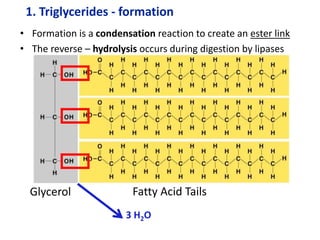
  • 138.
  • 139.
    The transition metalion in porphyrins further adds to the ability of the molecule to interact with visible light. The major porphyrins are: a. Hemoglobin (and myoglobin) b. Cytochromes c. Chlorophyll Higher level
  • 140.
    1. Carotenes Carotenes arelong hydrocarbon chains containing many double bonds. Carotenes are fat soluble and sensitive to photo-oxidation. They are also involved in increasing the efficiency of photosynthesis. Retinol is a carotene that absorbs at around 400-420nm and so appears yellow. This is one of the pigments that give fat tissue its yellow colour. Higher level
  • 141.
    Β-Carotenes is acarotene that absorbs at longer wavelengths of around 430- 480nm due to a longer hydrocarbon chain as so more conjugation. It makes carrots orange and flamingos pink. Higher level
  • 142.
    2. Porphyrins Porphyrins arebiological pigments that consist of a complex of metal ions and a large cyclic ligand. This ligand is called porphin and contains four nitrogen atoms in a conjugated aromatic (cyclical with resonance) heterocycle (a cyclical compound of more than one type of atom). Higher level Porphin
  • 143.
    Hemoglobin and myoglobinare responsible for transport and release of oxygen. Both contain a heme group with the iron ion able to form further coordination bonds with histidine residue in protein and free electron pairs in oxygen or water. Higher level Heme group
  • 144.
    The iron (II)in myoglobin makes meat red and the oxidation to iron (III) with cooking changes it to brown. Higher level
  • 145.
    The hemoglobin moleculeconsists of four subunits. Each subunit contains a heme prosthetic group. So each molecule can hold four oxygen molecules. Higher level
  • 146.
    Bound oxygen changesthe shape of the entire molecule including the subunits, which increases the ability of the molecule to further bind oxygen. This is called cooperative binding. This is why the oxygen affinity curve is sigmoidal. Higher level
  • 147.
    Fetal hemoglobin (HbF) hasa higher affinity for oxygen than adult hemoglobin (HbA). This is important to help aid the diffusion of oxygen across the placenta. Higher level
  • 148.
    Other factors influencinghemoglobin's affinity for O2: • decreased with increased temperature due to conformational changes at active sites and positive entropy of dissociation • decreased pH (slightly) and increased pCO2 act as non- competitive inhibitors allowing more oxygen release in venous blood where tissues may be oxygen deprived Higher level
  • 149.
    In hemoglobin, carbon monoxide actsas a competitive inhibitor to oxygen. Levels above 0.5% in the air can be fatal. Hemoglobin’s affinity for CO2 is about 200 times greater than that for O2. Higher level
  • 150.
    Cytochromes are enzymescontain heme groups with metal ions (iron, copper, magnesium, zinc) that get oxidised as oxygen is reduced to water through aerobic respiration. Higher level Active site of cytochrome c oxidase
  • 151.
    Chlorophyll is theprimary pigment in photosynthesis. The heme group always contains magnesium. Higher level
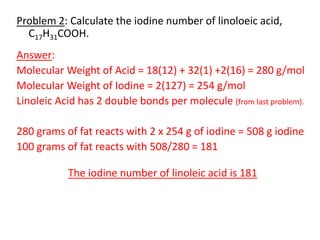
  • 152.
    Besides chlorophyll otheraccessory pigments also absorb light in different parts of the spectrum and pass this energy to chlorophyll. Higher level
  • 153.
    Captured energy isprocessed down the electron transport chain which is a series of energy rich molecules undergoing redox reactions to oxidise water and synthesis ATP. Higher level
  • 154.
    3. Anthocyanins Anthocyanins arebiological pigments that are water soluble and concentrated in the vacuoles of plants producing bright colours. They are used to attract animals for pollination and seed dispersal, as antioxidants and protect against UV light. Higher level
  • 155.
    Anthocyanins can actas pH indicators because the transfer of H+ ions from hydroxyl groups in acid- base reactions alter their conjugation and so alter the colours they absorb. Hence their colour depends on their metal ions and pH. Higher level
  • 156.
    B.10 Stereochemistry inbiomolecules OBJECTIVES • With one exception, amino acids are chiral, and only the L-configuration is found in proteins. • Naturally occurring unsaturated fat is mostly in the cis form, but food processing can convert it into the trans form. • D and L stereoisomers of sugars refer to the configuration of the chiral carbon atom furthest from the aldehyde or ketone group, and D forms occur most frequently in nature. • Ring forms of sugars have isomers, known as α and β, depending on whether the position of the hydroxyl group at carbon 1 (glucose) or carbon 2 (fructose) lies below the plane of the ring (α) or above the plane of the ring (β). • Vision chemistry involves the light activated interconversion of cis- and trans-isomers of retinal. • Description of the hydrogenation and partial hydrogenation of unsaturated fats, including the production of trans-fats, and a discussion of the advantages and disadvantages of these processes. • Explanation of the structure and properties of cellulose, and comparison with starch. • Discussion of the importance of cellulose as a structural material and in the diet. • Outline of the role of vitamin A in vision, including the roles of opsin, rhodopsin and cis- and trans-retinal. (Names of the enzymes involved in the visual cycle are not required. Relative melting points of saturated and cis-/trans-unsaturated fats should be covered.) Higher level
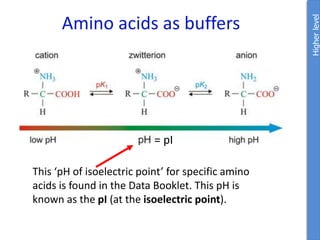
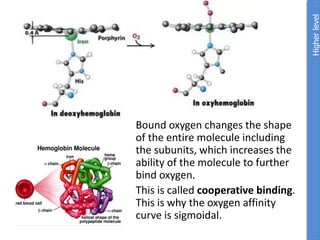
  • 157.
  • 158.
    Amino acids Amino acids(except glycine) are optical isomers (enantiomers) because they have a chiral carbon. Except for some bacterial cell walls and antibiotics, amino acids occur as L-isomers. Higher level
  • 159.
    The CORN rule: 1.Place the H facing away from you 2. If COOH, R, NH2, groups are spelt clockwise it is a D-enantiomer, if anti-clockwise it is an L-enantiomer. Higher level
  • 160.
    Fatty acids andtriglycerides Most fatty acids occur in the cis form: Higher level
  • 161.
    High temperature andhydrogenation in food processing can turn fatty acids to the trans form: Trans fats have been linked to heart disease. Higher level
  • 162.
    Triglycerides can behydrogenated with high temperatures and a Ni or Pd catalyst: This turns them into saturated fatty acids. This makes oils spreadable, more resistant to heat, and have a longer shelf life. Higher level
  • 163.
    Carbohydrates L or Denantiomers are determined from the chiral carbon furtherest away from the most senior functional group. Only D forms are found in nature. Higher level
  • 164.
    Cyclic sugars alsohave α and β isomers which are determined by the hydroxyl group on C1 in glucose. α isomers have the hydroxyl group on the opposite side to the C6 group. β isomers have the hydroxyl group on the same side as the C6 group. Higher level
  • 165.
    Similarly for fructosebut the focus is on the C2. Higher level
  • 166.
    Retinal and visionchemistry In the rods of your eyes, cis- retinal (derived from Vitamin A) combines with the opsin protein to produce rhodopsin in which trans-retinal is created with the interaction of light. Trans-retinal dissociates from opsin which sends an electrical impulse. Enzymes convert the trans back to cis to complete the vision cycle. Higher level
  • 167.
    The cis totrans conversion occurs as follows: Higher level