Computer Security Management
(ISYS20261)
Lecture 5 - Host-based Attacks


 Module Leader: Dr Xiaoqi Ma
 School of Science and Technology
Last Time:

• CSI Computer Security Survey
• Offers good overview
• Three basic types of attacks:
  – Host-based Attacks
  – Network-based Attacks
  – Social Engineering

• Host-based attacks:
  – Malicious Code
  – Malicious Software


Computer Security Management
Page 2
Today

• Malicious Code
  – Backdoors
  – Computer Viruses

• Malicious Software (Malware)
  – Computer Worms
  – Trojan Horses (Trojans)
  – Rootkits
  – Spyware


Computer Security Management
Page 3
Backdoors (1)

• Sometimes referred to as Trapdoor
• Secret build-in method for (unauthorised) access to a system
  – Universal standard password
  – Secret admin account

• Usually smuggled in by a third party
  – Programmer who wants to gain access to the system once it is put into
    operations
  – Espionage
  – Viruses and Trojans
  – etc


Computer Security Management
Page 4
Backdoors (2)

• Can be inserted at any point in tool-chain
  – Source code
  – Compiler
  – Executable

• Open source software less likely to contain a backdoor
• Symmetric Backdoor
  – everybody who knows about the Backdoor can use it

• Asymmetric Backdoor
  – can only be used by the attacker who plants it
  – Based on asymmetric cryptography


Computer Security Management
Page 5
Finding backdoors

• Code reviews
  – Only possible if the code is available (Open Source)
  – Similar to white box testing
  – Example: backdoor in Linux kernel's source code

• Disassembling and analysing of executables
  – Can be done for programs and libraries
  – Laborious and error prone


Computer Security Management
Page 6
Computer viruses (1)

• Term was introduced in 1983 by Fred Cohen
• Self-replicating code (viral code) that secretly embeds itself into a
  host program without permission or knowledge of the owner/user
  (infection)
• If the infected program is executed, the virus is executed as well
  and tries to spread itself by infecting other programs
• Sometimes a virus is modifying its own code before it infects other
  programs to avoid detection (no fixed signature, i.e. sequence of
  instructions)
  – Polymorphic virus re-encrypts itself with each infection
  – Metamorphic virus re-writes its own code with each infection


Computer Security Management
Page 7
Computer viruses (2)

• Viruses usually carry a payload, i.e. serve another (criminal)
  purpose
  – Installing malicious software on the computer
  – Deleting data and/or programs
  – Encryption of data (blackmailing!)

• Different infection methods
  – Boot sectors
  – Executable files
  – Macros in documents
  – Scripts on web pages


Computer Security Management
Page 8
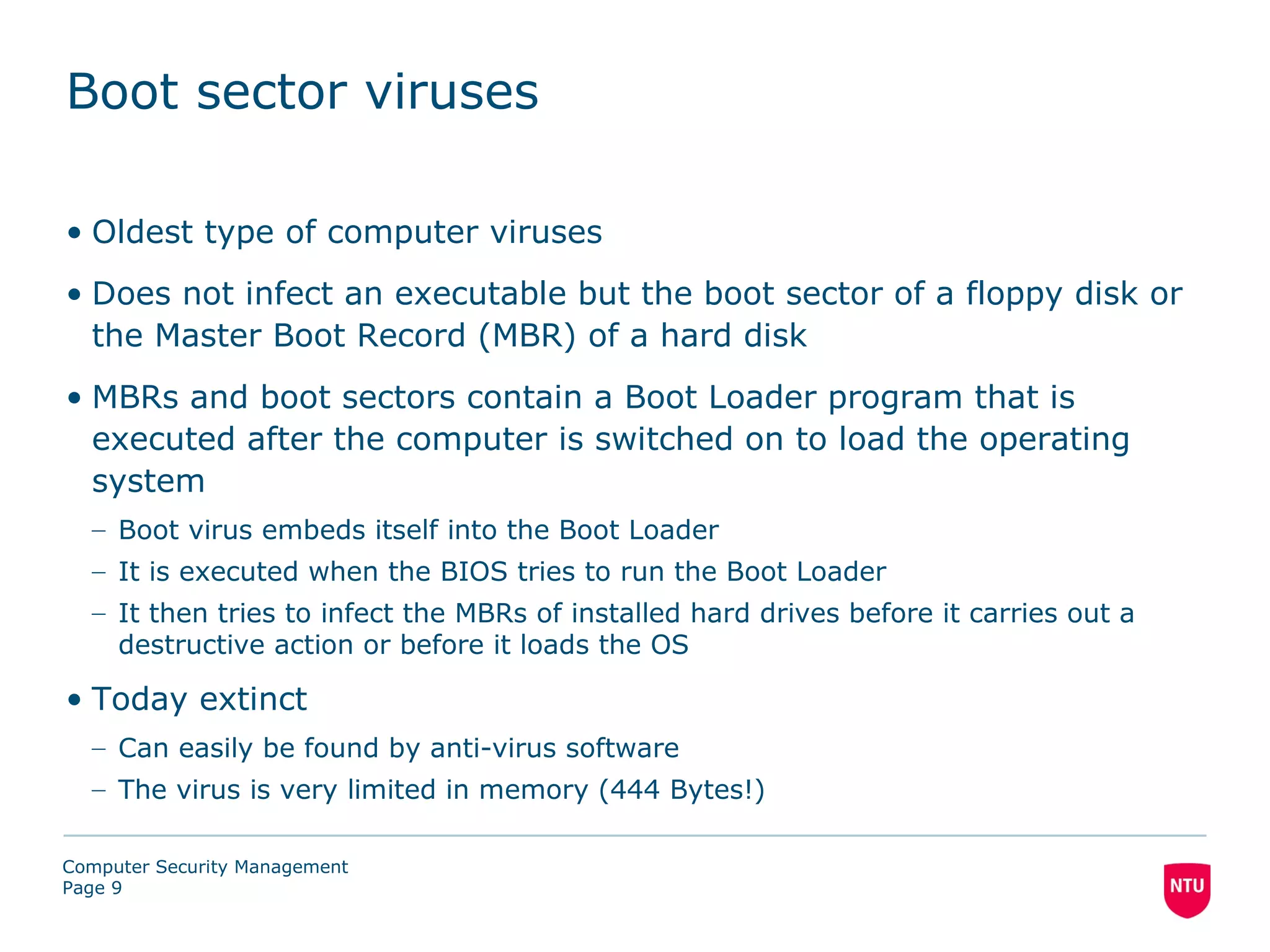
Boot sector viruses

• Oldest type of computer viruses
• Does not infect an executable but the boot sector of a floppy disk or
  the Master Boot Record (MBR) of a hard disk
• MBRs and boot sectors contain a Boot Loader program that is
  executed after the computer is switched on to load the operating
  system
  – Boot virus embeds itself into the Boot Loader
  – It is executed when the BIOS tries to run the Boot Loader
  – It then tries to infect the MBRs of installed hard drives before it carries out a
    destructive action or before it loads the OS

• Today extinct
  – Can easily be found by anti-virus software
  – The virus is very limited in memory (444 Bytes!)

Computer Security Management
Page 9
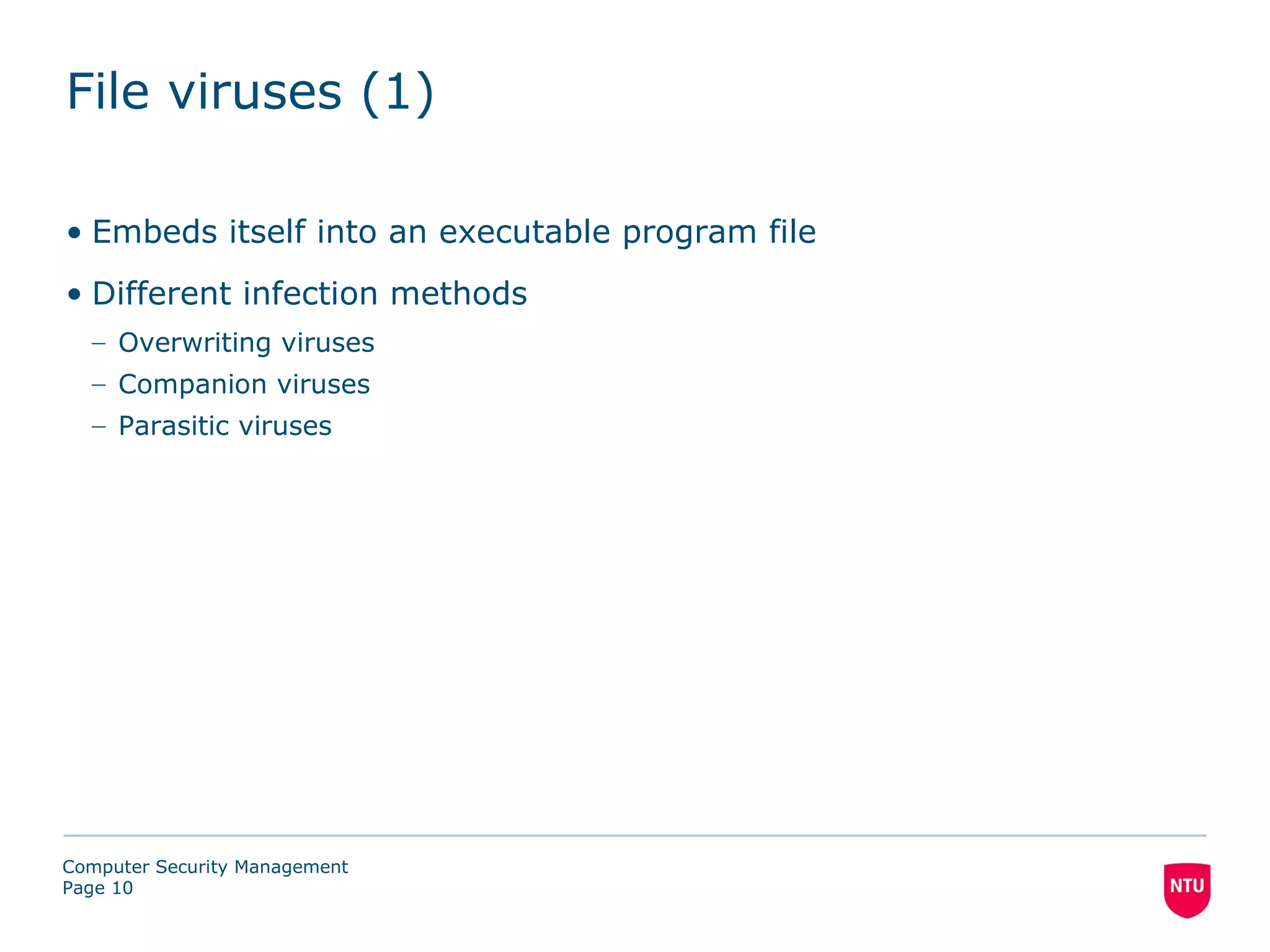
File viruses (1)

• Embeds itself into an executable program file
• Different infection methods
  – Overwriting viruses
  – Companion viruses
  – Parasitic viruses


Computer Security Management
Page 10
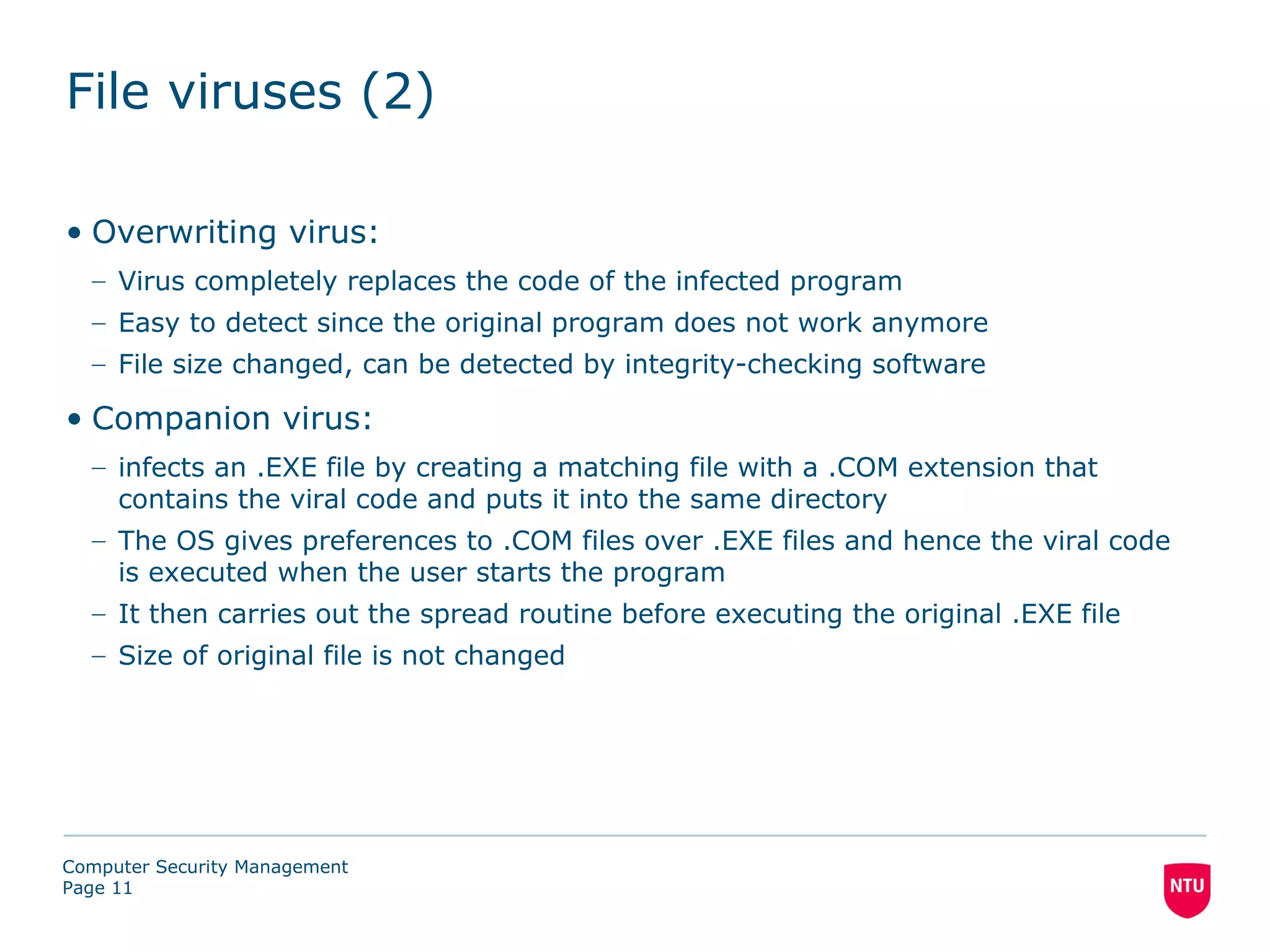
File viruses (2)

• Overwriting virus:
  – Virus completely replaces the code of the infected program
  – Easy to detect since the original program does not work anymore
  – File size changed, can be detected by integrity-checking software

• Companion virus:
  – infects an .EXE file by creating a matching file with a .COM extension that
    contains the viral code and puts it into the same directory
  – The OS gives preferences to .COM files over .EXE files and hence the viral code
    is executed when the user starts the program
  – It then carries out the spread routine before executing the original .EXE file
  – Size of original file is not changed


Computer Security Management
Page 11
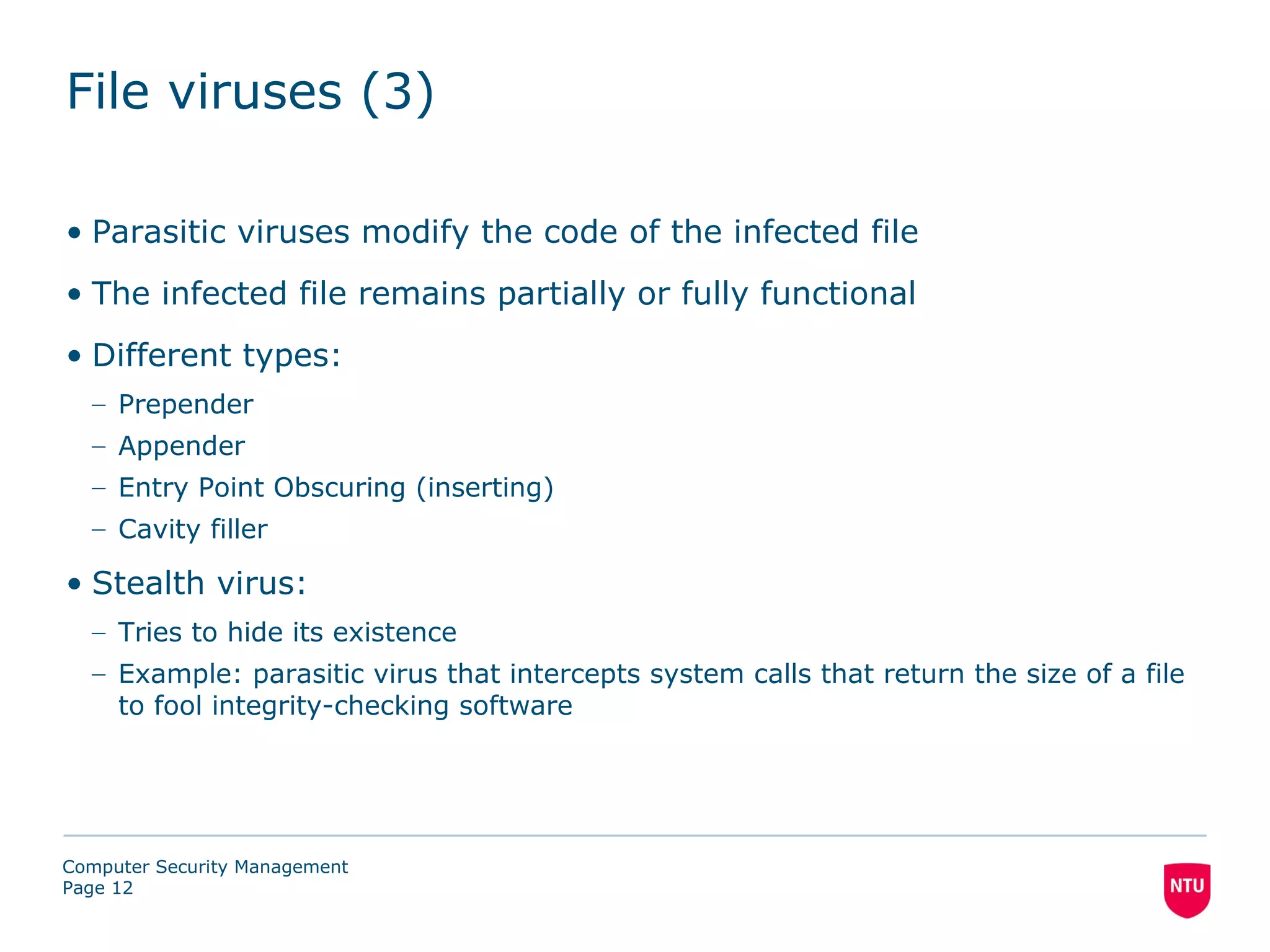
File viruses (3)

• Parasitic viruses modify the code of the infected file
• The infected file remains partially or fully functional
• Different types:
  – Prepender
  – Appender
  – Entry Point Obscuring (inserting)
  – Cavity filler

• Stealth virus:
  – Tries to hide its existence
  – Example: parasitic virus that intercepts system calls that return the size of a file
    to fool integrity-checking software


Computer Security Management
Page 12
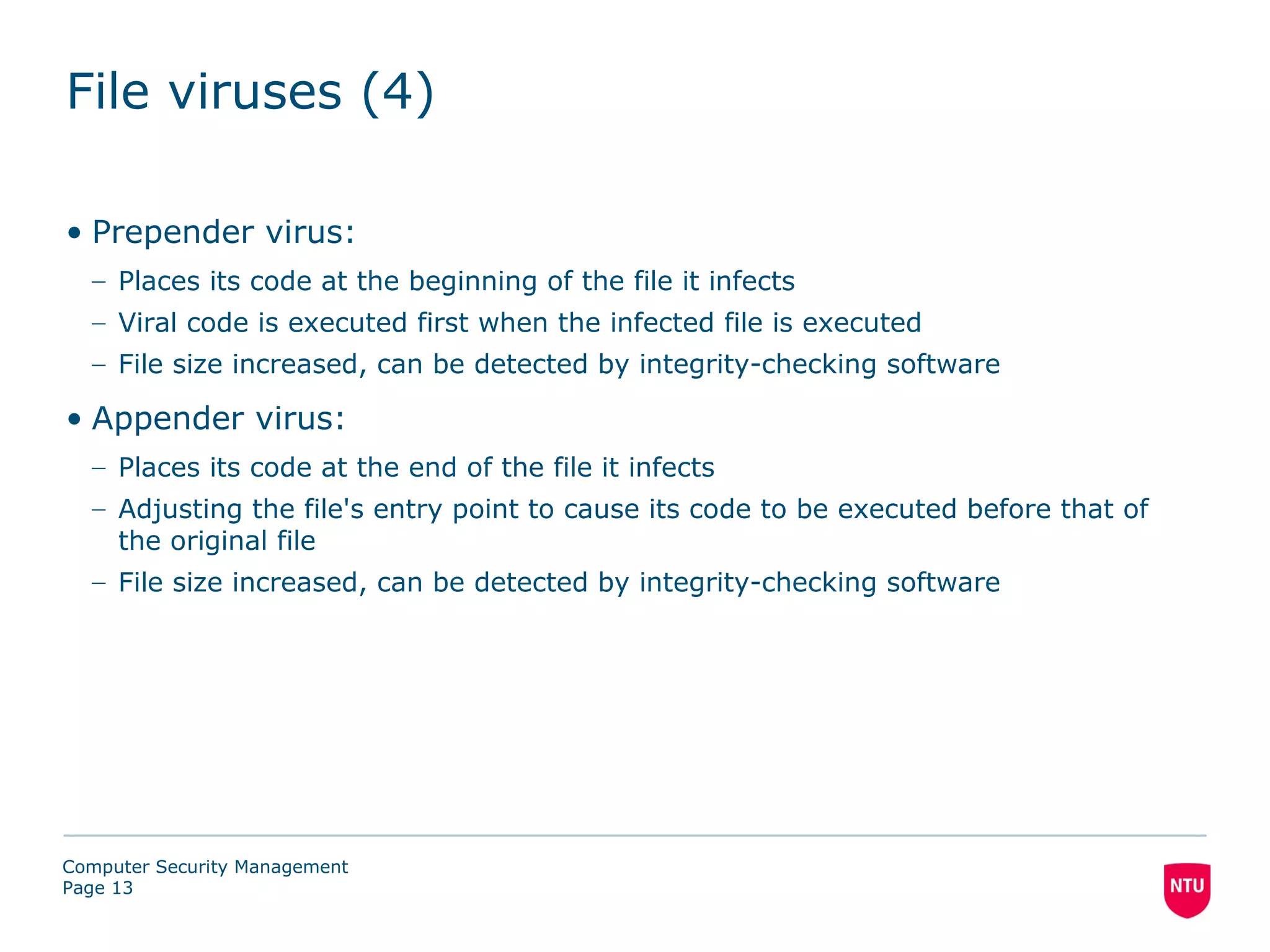
File viruses (4)

• Prepender virus:
  – Places its code at the beginning of the file it infects
  – Viral code is executed first when the infected file is executed
  – File size increased, can be detected by integrity-checking software

• Appender virus:
  – Places its code at the end of the file it infects
  – Adjusting the file's entry point to cause its code to be executed before that of
    the original file
  – File size increased, can be detected by integrity-checking software


Computer Security Management
Page 13
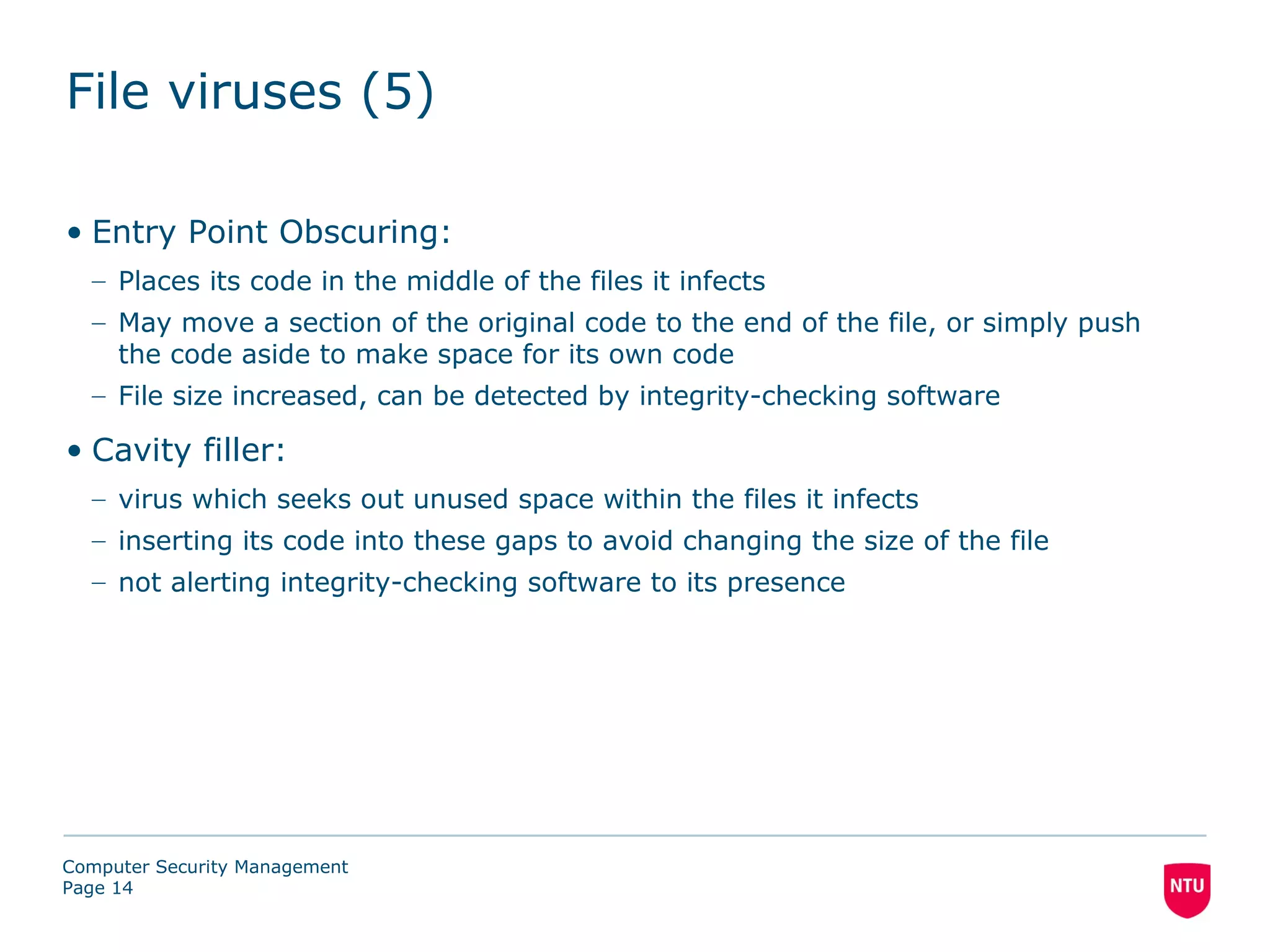
File viruses (5)

• Entry Point Obscuring:
  – Places its code in the middle of the files it infects
  – May move a section of the original code to the end of the file, or simply push
    the code aside to make space for its own code
  – File size increased, can be detected by integrity-checking software

• Cavity filler:
  – virus which seeks out unused space within the files it infects
  – inserting its code into these gaps to avoid changing the size of the file
  – not alerting integrity-checking software to its presence


Computer Security Management
Page 14
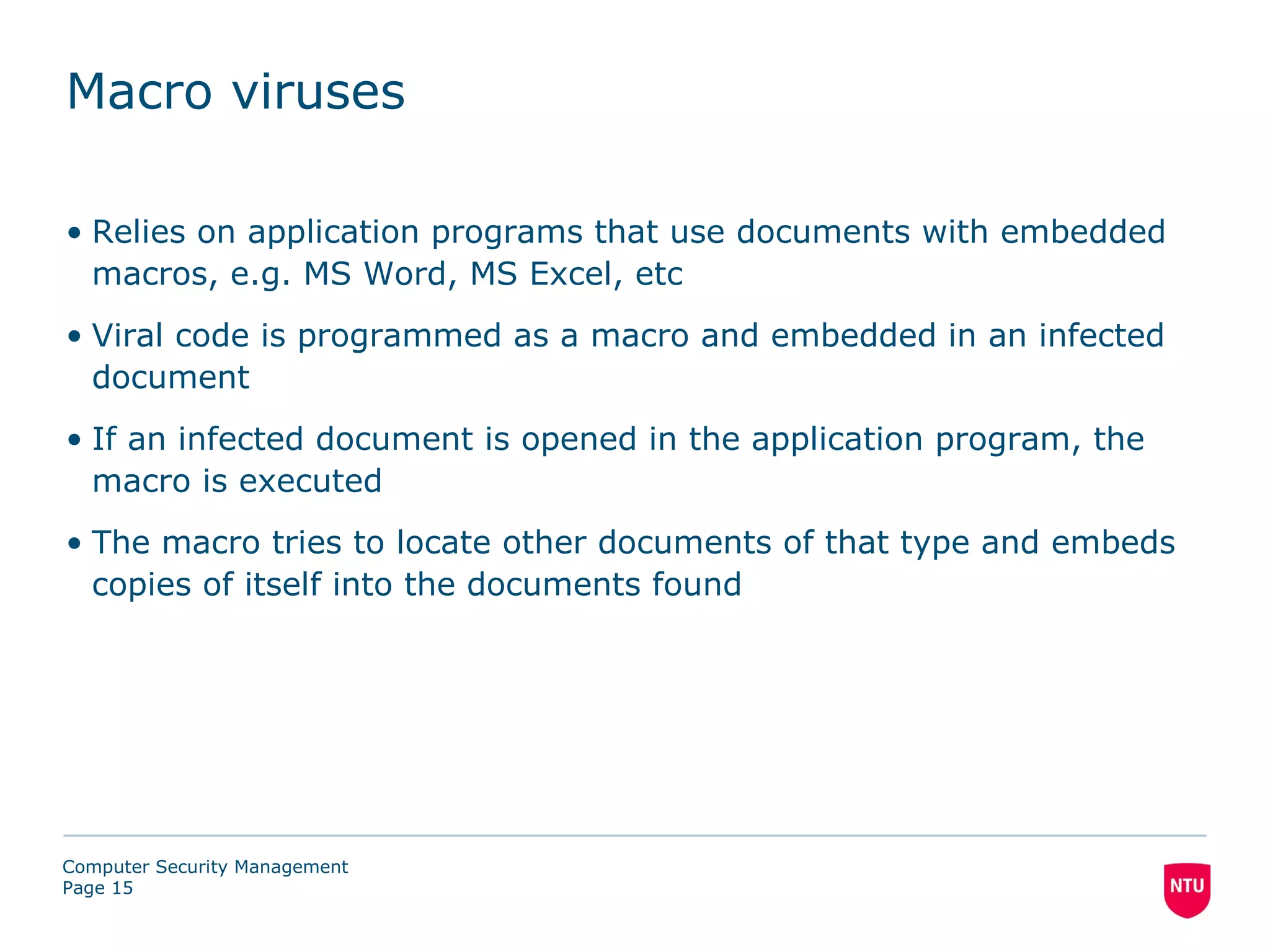
Macro viruses

• Relies on application programs that use documents with embedded
  macros, e.g. MS Word, MS Excel, etc
• Viral code is programmed as a macro and embedded in an infected
  document
• If an infected document is opened in the application program, the
  macro is executed
• The macro tries to locate other documents of that type and embeds
  copies of itself into the documents found


Computer Security Management
Page 15
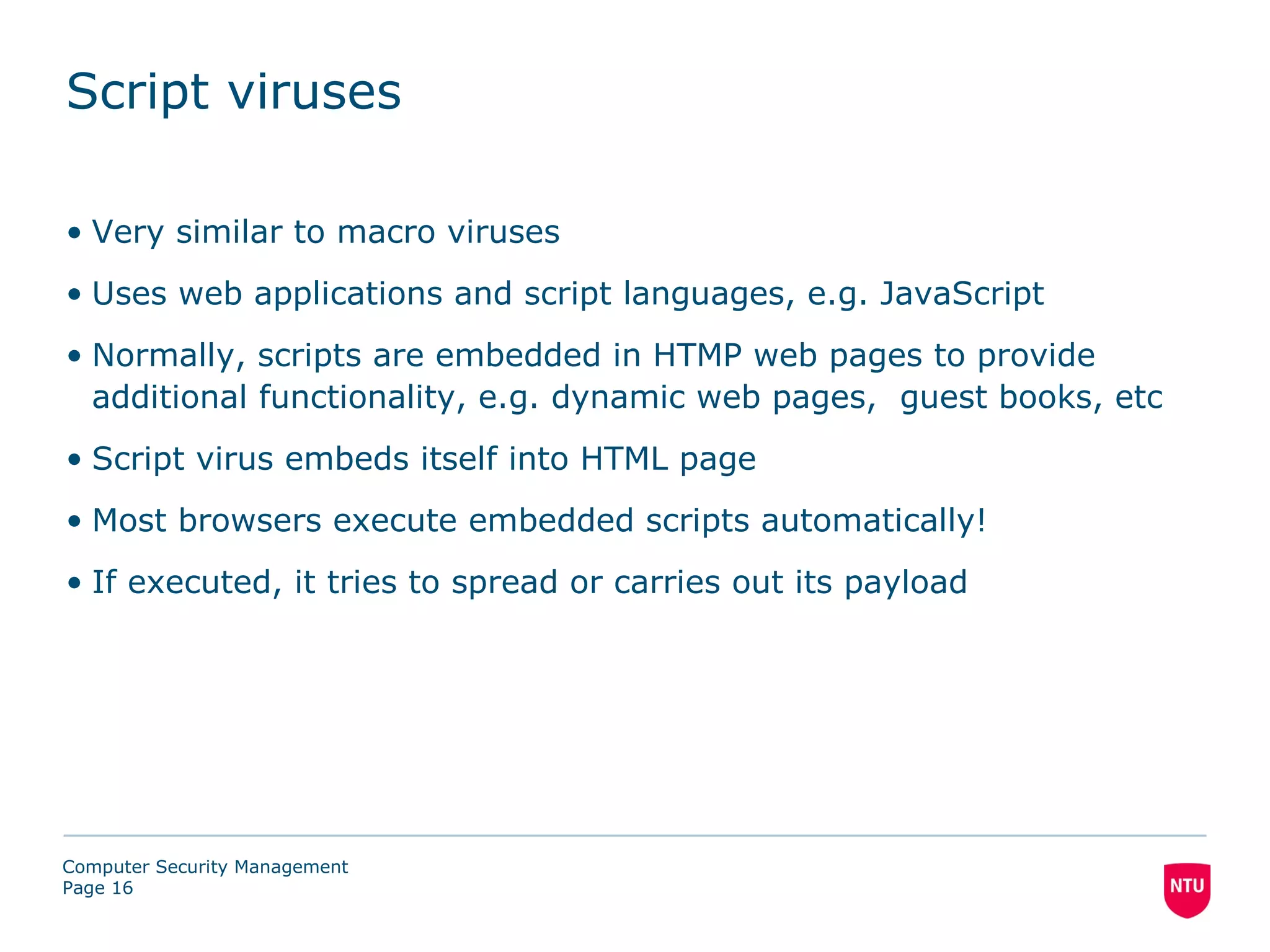
Script viruses

• Very similar to macro viruses
• Uses web applications and script languages, e.g. JavaScript
• Normally, scripts are embedded in HTMP web pages to provide
  additional functionality, e.g. dynamic web pages, guest books, etc
• Script virus embeds itself into HTML page
• Most browsers execute embedded scripts automatically!
• If executed, it tries to spread or carries out its payload


Computer Security Management
Page 16
How to protect against computer viruses

• Use anti-virus software with up-to-date signature database
• Install software patches immediately (OS and applications)
• Disable macros in applications unless you really need them
• Disable scripting in web browsers


Computer Security Management
Page 17
Computer Worms

• Self-replicating computer program that secretly copies itself to other
  computers without permission or knowledge of the owner/user
  (infection)
• It uses a network to send copies of itself to other nodes (computers)
• It may do so without any user intervention but sometimes some
  user action is required (email worms)
• Unlike viruses, worms do not need to attach themselves to an
  existing program
• Worms always consume network bandwidth and might carry a
  payload, e.g. to install backdoors on infected machines


Computer Security Management
Page 18
How to protect against computer worms

• Use a firewall
• Install software patches immediately (OS and applications)
• Do not open unexpected emails or run unknown email attachments


Computer Security Management
Page 19
Trojan Horses (Trojans)

• Malicious software (malware) that appears to perform a desirable
  function but also performs undisclosed malicious functions
• Term is derived from the classical story of the Trojan Horse
• Always requires some user action to install
• Trojans usually installs malware (payload) to
  – Gain unauthorised remote access (backdoors)
  – Destruct data
  – Download even more malware (spyware)
  – Disable security software
  – Start denial-of-service attacks

• Once the malware is installed, deleting the Trojan does not help!


Computer Security Management
Page 20
How to protect against Trojans

• Do not install software from an unknown source
• Do not run attachments from unexpected emails
• Use anti-virus software with up-to-date signature database


Computer Security Management
Page 21
Rootkits (1)

• Malicious program that hides malicious files or folders from normal
  sight
• Often used by malware to conceal its presence and activities
• The term rootkit applied originally to the UNIX-based operating
  systems
• It is a collection of tools to enable a user to obtain root
  (administrator-level) access to a system and to conceal any changes
  they might make
• Such tools often included malicious versions of standard system
  monitoring programs which would hide the rootkit operators'
  activities
• More recently: malware using stealth techniques

Computer Security Management
Page 22
Rootkits (2)

• Rootkits can operate at a number of levels
• Application level
  – replacing or adjusting the settings of system software to prevent the display of
    certain information

• Operating system level
  – hooking certain system functions
  – inserting modules or drivers into the operating system kernel

• Firmware level/virtualisation level
  – firmware and/or virtual machines are activated before the operating system and
    thus even harder to detect while the system is running


Computer Security Management
Page 23
Rootkits (3)

• Example: in 2005, Sony BMG caused a scandal by including a
  rootkit on music CDs, in an attempt to enforce DRM; it allowed
  anyone who knew about the rootkit to gain administrator rights on
  an infected machine
• Rootkit binaries are easy to detect using anti-virus software
• However, once they run they are hidden and hence very difficult to
  detect
• Might be detected using anti-spyware software
• Detection based on analysis of the behaviour of a system
• Rootkits are difficult to remove once detected!


Computer Security Management
Page 24
Spyware/Adware
• Software that collects private information or monitors user
  behaviour secretly
• The term spyware essentially covers any software that gathers
  information and passes it to a third party without adequate
  permission from the owner of the data
• Examples
  – Keylogger: monitors the keys pressed and thus records any sensitive data, such
    as passwords, entered by the user
  – Password stealer: steals user data such as login IDs/passwords
  – Packet analyser (sniffer): intercepts and logs traffic passing over a digital
    network
  – Cookies: allows the identification of a computer/user, e.g. for tracking etc

• Adware: software package which automatically plays, displays, or
  downloads advertisements to a computer after the software is
  installed ( privacy-invasive software)
Computer Security Management
Page 25
Summary

• Host-based attacks are carried out using malicious code and
  software
  – Code: Backdoors and viruses
  – Software: Worms, trojans, rootkits, spyware, …

• The sophistication increases all the time which led to an arms race
  between the developers of malicious software and security software
• The baddies are usually one step ahead
• They are professionals, highly trained and educated
• Usually linked to organised crime


Computer Security Management
Page 26

Isys20261 lecture 05

  • 1.
    Computer Security Management (ISYS20261) Lecture5 - Host-based Attacks Module Leader: Dr Xiaoqi Ma School of Science and Technology
  • 2.
    Last Time: • CSIComputer Security Survey • Offers good overview • Three basic types of attacks: – Host-based Attacks – Network-based Attacks – Social Engineering • Host-based attacks: – Malicious Code – Malicious Software Computer Security Management Page 2
  • 3.
    Today • Malicious Code – Backdoors – Computer Viruses • Malicious Software (Malware) – Computer Worms – Trojan Horses (Trojans) – Rootkits – Spyware Computer Security Management Page 3
  • 4.
    Backdoors (1) • Sometimesreferred to as Trapdoor • Secret build-in method for (unauthorised) access to a system – Universal standard password – Secret admin account • Usually smuggled in by a third party – Programmer who wants to gain access to the system once it is put into operations – Espionage – Viruses and Trojans – etc Computer Security Management Page 4
  • 5.
    Backdoors (2) • Canbe inserted at any point in tool-chain – Source code – Compiler – Executable • Open source software less likely to contain a backdoor • Symmetric Backdoor – everybody who knows about the Backdoor can use it • Asymmetric Backdoor – can only be used by the attacker who plants it – Based on asymmetric cryptography Computer Security Management Page 5
  • 6.
    Finding backdoors • Codereviews – Only possible if the code is available (Open Source) – Similar to white box testing – Example: backdoor in Linux kernel's source code • Disassembling and analysing of executables – Can be done for programs and libraries – Laborious and error prone Computer Security Management Page 6
  • 7.
    Computer viruses (1) •Term was introduced in 1983 by Fred Cohen • Self-replicating code (viral code) that secretly embeds itself into a host program without permission or knowledge of the owner/user (infection) • If the infected program is executed, the virus is executed as well and tries to spread itself by infecting other programs • Sometimes a virus is modifying its own code before it infects other programs to avoid detection (no fixed signature, i.e. sequence of instructions) – Polymorphic virus re-encrypts itself with each infection – Metamorphic virus re-writes its own code with each infection Computer Security Management Page 7
  • 8.
    Computer viruses (2) •Viruses usually carry a payload, i.e. serve another (criminal) purpose – Installing malicious software on the computer – Deleting data and/or programs – Encryption of data (blackmailing!) • Different infection methods – Boot sectors – Executable files – Macros in documents – Scripts on web pages Computer Security Management Page 8
  • 9.
    Boot sector viruses •Oldest type of computer viruses • Does not infect an executable but the boot sector of a floppy disk or the Master Boot Record (MBR) of a hard disk • MBRs and boot sectors contain a Boot Loader program that is executed after the computer is switched on to load the operating system – Boot virus embeds itself into the Boot Loader – It is executed when the BIOS tries to run the Boot Loader – It then tries to infect the MBRs of installed hard drives before it carries out a destructive action or before it loads the OS • Today extinct – Can easily be found by anti-virus software – The virus is very limited in memory (444 Bytes!) Computer Security Management Page 9
  • 10.
    File viruses (1) •Embeds itself into an executable program file • Different infection methods – Overwriting viruses – Companion viruses – Parasitic viruses Computer Security Management Page 10
  • 11.
    File viruses (2) •Overwriting virus: – Virus completely replaces the code of the infected program – Easy to detect since the original program does not work anymore – File size changed, can be detected by integrity-checking software • Companion virus: – infects an .EXE file by creating a matching file with a .COM extension that contains the viral code and puts it into the same directory – The OS gives preferences to .COM files over .EXE files and hence the viral code is executed when the user starts the program – It then carries out the spread routine before executing the original .EXE file – Size of original file is not changed Computer Security Management Page 11
  • 12.
    File viruses (3) •Parasitic viruses modify the code of the infected file • The infected file remains partially or fully functional • Different types: – Prepender – Appender – Entry Point Obscuring (inserting) – Cavity filler • Stealth virus: – Tries to hide its existence – Example: parasitic virus that intercepts system calls that return the size of a file to fool integrity-checking software Computer Security Management Page 12
  • 13.
    File viruses (4) •Prepender virus: – Places its code at the beginning of the file it infects – Viral code is executed first when the infected file is executed – File size increased, can be detected by integrity-checking software • Appender virus: – Places its code at the end of the file it infects – Adjusting the file's entry point to cause its code to be executed before that of the original file – File size increased, can be detected by integrity-checking software Computer Security Management Page 13
  • 14.
    File viruses (5) •Entry Point Obscuring: – Places its code in the middle of the files it infects – May move a section of the original code to the end of the file, or simply push the code aside to make space for its own code – File size increased, can be detected by integrity-checking software • Cavity filler: – virus which seeks out unused space within the files it infects – inserting its code into these gaps to avoid changing the size of the file – not alerting integrity-checking software to its presence Computer Security Management Page 14
  • 15.
    Macro viruses • Relieson application programs that use documents with embedded macros, e.g. MS Word, MS Excel, etc • Viral code is programmed as a macro and embedded in an infected document • If an infected document is opened in the application program, the macro is executed • The macro tries to locate other documents of that type and embeds copies of itself into the documents found Computer Security Management Page 15
  • 16.
    Script viruses • Verysimilar to macro viruses • Uses web applications and script languages, e.g. JavaScript • Normally, scripts are embedded in HTMP web pages to provide additional functionality, e.g. dynamic web pages, guest books, etc • Script virus embeds itself into HTML page • Most browsers execute embedded scripts automatically! • If executed, it tries to spread or carries out its payload Computer Security Management Page 16
  • 17.
    How to protectagainst computer viruses • Use anti-virus software with up-to-date signature database • Install software patches immediately (OS and applications) • Disable macros in applications unless you really need them • Disable scripting in web browsers Computer Security Management Page 17
  • 18.
    Computer Worms • Self-replicatingcomputer program that secretly copies itself to other computers without permission or knowledge of the owner/user (infection) • It uses a network to send copies of itself to other nodes (computers) • It may do so without any user intervention but sometimes some user action is required (email worms) • Unlike viruses, worms do not need to attach themselves to an existing program • Worms always consume network bandwidth and might carry a payload, e.g. to install backdoors on infected machines Computer Security Management Page 18
  • 19.
    How to protectagainst computer worms • Use a firewall • Install software patches immediately (OS and applications) • Do not open unexpected emails or run unknown email attachments Computer Security Management Page 19
  • 20.
    Trojan Horses (Trojans) •Malicious software (malware) that appears to perform a desirable function but also performs undisclosed malicious functions • Term is derived from the classical story of the Trojan Horse • Always requires some user action to install • Trojans usually installs malware (payload) to – Gain unauthorised remote access (backdoors) – Destruct data – Download even more malware (spyware) – Disable security software – Start denial-of-service attacks • Once the malware is installed, deleting the Trojan does not help! Computer Security Management Page 20
  • 21.
    How to protectagainst Trojans • Do not install software from an unknown source • Do not run attachments from unexpected emails • Use anti-virus software with up-to-date signature database Computer Security Management Page 21
  • 22.
    Rootkits (1) • Maliciousprogram that hides malicious files or folders from normal sight • Often used by malware to conceal its presence and activities • The term rootkit applied originally to the UNIX-based operating systems • It is a collection of tools to enable a user to obtain root (administrator-level) access to a system and to conceal any changes they might make • Such tools often included malicious versions of standard system monitoring programs which would hide the rootkit operators' activities • More recently: malware using stealth techniques Computer Security Management Page 22
  • 23.
    Rootkits (2) • Rootkitscan operate at a number of levels • Application level – replacing or adjusting the settings of system software to prevent the display of certain information • Operating system level – hooking certain system functions – inserting modules or drivers into the operating system kernel • Firmware level/virtualisation level – firmware and/or virtual machines are activated before the operating system and thus even harder to detect while the system is running Computer Security Management Page 23
  • 24.
    Rootkits (3) • Example:in 2005, Sony BMG caused a scandal by including a rootkit on music CDs, in an attempt to enforce DRM; it allowed anyone who knew about the rootkit to gain administrator rights on an infected machine • Rootkit binaries are easy to detect using anti-virus software • However, once they run they are hidden and hence very difficult to detect • Might be detected using anti-spyware software • Detection based on analysis of the behaviour of a system • Rootkits are difficult to remove once detected! Computer Security Management Page 24
  • 25.
    Spyware/Adware • Software thatcollects private information or monitors user behaviour secretly • The term spyware essentially covers any software that gathers information and passes it to a third party without adequate permission from the owner of the data • Examples – Keylogger: monitors the keys pressed and thus records any sensitive data, such as passwords, entered by the user – Password stealer: steals user data such as login IDs/passwords – Packet analyser (sniffer): intercepts and logs traffic passing over a digital network – Cookies: allows the identification of a computer/user, e.g. for tracking etc • Adware: software package which automatically plays, displays, or downloads advertisements to a computer after the software is installed ( privacy-invasive software) Computer Security Management Page 25
  • 26.
    Summary • Host-based attacksare carried out using malicious code and software – Code: Backdoors and viruses – Software: Worms, trojans, rootkits, spyware, … • The sophistication increases all the time which led to an arms race between the developers of malicious software and security software • The baddies are usually one step ahead • They are professionals, highly trained and educated • Usually linked to organised crime Computer Security Management Page 26