Topics:
Virus
Types of virus
Malware
Types of Malware
Difference B/W virus and malware
 How can we protect pc from viruses and
malwares.
What is Virus?
• A computer virus is a program, script or macro
designed to cause damage, steal personal
information, modify data, send e-mail, display
messages or some combination of these action.
• A computer virus is much like flu virus, is
designed to spread from host to host and has the
ability to replicate itself.
• Similarly in the same way that viruses cannot
produce without a host cell.
Continue:
• Virus is program or piece of code that is
loaded onto your computer without your
knowledge and runs against your wishes.
• When the virus is execute, it spread by
copying itself over data files, programs or boot
sector of computers hard drive or potentially
any thing else writeable.
Continue:
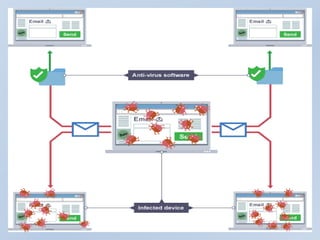
• To help spread an infection the virus writers
use detailed knowledge of security
vulnerabilities, zero days or social engineering
to gain access to hosts computers..
Types of virus:
1. Boot Sector Virus:
• From a user perspective, boot sector viruses
are some of the most dangerous.
• Because they infect the master boot record,
they are notoriously difficult to remove, often
requiring a full system format.
• They typically spread via removable media.
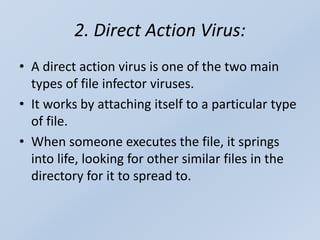
2. Direct Action Virus:
• A direct action virus is one of the two main
types of file infector viruses.
• It works by attaching itself to a particular type
of file.
• When someone executes the file, it springs
into life, looking for other similar files in the
directory for it to spread to.
3. Resident Virus:
• Resident viruses are the other primary type of
file infectors.
• they install themselves on a computer.
• It allows them to work even when the original
source of the infection has been eradicated.
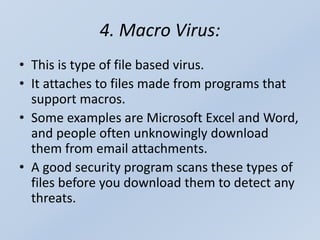
4. Macro Virus:
• This is type of file based virus.
• It attaches to files made from programs that
support macros.
• Some examples are Microsoft Excel and Word,
and people often unknowingly download
them from email attachments.
• A good security program scans these types of
files before you download them to detect any
threats.
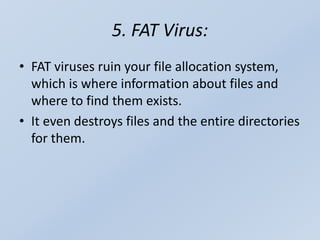
5. FAT Virus:
• FAT viruses ruin your file allocation system,
which is where information about files and
where to find them exists.
• It even destroys files and the entire directories
for them.
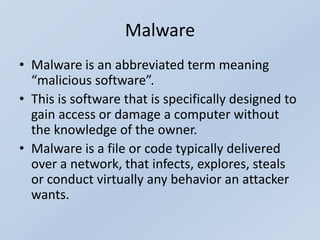
Malware
• Malware is an abbreviated term meaning
“malicious software”.
• This is software that is specifically designed to
gain access or damage a computer without
the knowledge of the owner.
• Malware is a file or code typically delivered
over a network, that infects, explores, steals
or conduct virtually any behavior an attacker
wants.
Continue:
• Malware usually has one of the following
objectives:
• Provide remote control for an attacker to use
an infected machine.
• Send spam from the infected machine to
unsuspecting targets.
• Steal sensitive data.
Types of Malware:
1. Adware:
• Adware is a type of malware that
automatically delivers advertisements.
• Common examples of adware include pop-up
ads on websites and advertisements that are
displayed by software.
2. Bug:
• In the context of software, a bug is a flaw
produces an undesired outcome.
• These flaws are usually the result of human
error and typically exist in the source code or
compilers of a program.
• Security bugs are the most severe type of bugs
and can allow attackers to bypass user
authentication, override access privileges, or
steal data.
3. Rootkit:
• A Rootkit is a type of malicious software
design to remotely access or control a
computer without being detected by users or
security program.
• Once a rootkit has been installed it is possible
for the malicious party behind the rootkit to
remotely execute files, access/steal
information.
4. Trojan Horse:
• A Trojan horse, commonly known as a
“Trojan,” is a type of malware that disguises
itself as a normal file or program to trick users
into downloading and installing malware.
• A Trojan can give a malicious party remote
access to an infected computer.
5.Ransomware:
• Ransom ware is a form of malware that
essentially holds a computer system captive
while demanding a ransom.
• The malware restricts user access to the
computer either by encrypting files on the
hard drive or locking down the system.
Difference B/W virus and malware
• Virus:
A virus is just one type of malware. But the term virus is
more widely used by the public.
And this is the biggest reason that we know about virus
more than malware.
But malware is a term which refers to any malicious
software, including a computer virus.
How can we protect pc from virus and
malware:
• There are many ways to protect our machines
from virus and malware.
• Download up-to-date security programs,
including antivirus and anti-malware software,
anti-spyware, and a firewall.
• Do not use open Wi-Fi it makes it too easy for
hackers to steal your connection and
download illegal files.
Continue:
• Protect your Wi-Fi with an encrypted
password, and consider refreshing your
equipment every few years.
• Use a strong password that is complex, with a
mix of letters, numbers, and symbols. While
some people use the same password for
everything, try to avoid that practice.
• During password try to use short phrases
separated by spaces or underscore marks
• Such as:
• “Amjad-ALI/55”?
• Just like this…
• Make sure web browser security setting is
high enough to detect unauthorized
downloads.
• You should take proactive measures not to
click on links or attachment that you don’t
trust.
Continue:
• Always use a pop-up blocker for your browser
for experiencing a secure online session.
• A firewall enacts the role of a security guard.
• A firewall is the first step to provide security to
the computer.
• It creates a barrier between the computer and
any unauthorized program trying to come in
through the Internet.

Virus and malware presentation

  • 1.
    Topics: Virus Types of virus Malware Typesof Malware Difference B/W virus and malware  How can we protect pc from viruses and malwares.
  • 2.
    What is Virus? •A computer virus is a program, script or macro designed to cause damage, steal personal information, modify data, send e-mail, display messages or some combination of these action. • A computer virus is much like flu virus, is designed to spread from host to host and has the ability to replicate itself. • Similarly in the same way that viruses cannot produce without a host cell.
  • 3.
    Continue: • Virus isprogram or piece of code that is loaded onto your computer without your knowledge and runs against your wishes. • When the virus is execute, it spread by copying itself over data files, programs or boot sector of computers hard drive or potentially any thing else writeable.
  • 4.
    Continue: • To helpspread an infection the virus writers use detailed knowledge of security vulnerabilities, zero days or social engineering to gain access to hosts computers..
  • 6.
  • 7.
    1. Boot SectorVirus: • From a user perspective, boot sector viruses are some of the most dangerous. • Because they infect the master boot record, they are notoriously difficult to remove, often requiring a full system format. • They typically spread via removable media.
  • 8.
    2. Direct ActionVirus: • A direct action virus is one of the two main types of file infector viruses. • It works by attaching itself to a particular type of file. • When someone executes the file, it springs into life, looking for other similar files in the directory for it to spread to.
  • 9.
    3. Resident Virus: •Resident viruses are the other primary type of file infectors. • they install themselves on a computer. • It allows them to work even when the original source of the infection has been eradicated.
  • 10.
    4. Macro Virus: •This is type of file based virus. • It attaches to files made from programs that support macros. • Some examples are Microsoft Excel and Word, and people often unknowingly download them from email attachments. • A good security program scans these types of files before you download them to detect any threats.
  • 11.
    5. FAT Virus: •FAT viruses ruin your file allocation system, which is where information about files and where to find them exists. • It even destroys files and the entire directories for them.
  • 12.
    Malware • Malware isan abbreviated term meaning “malicious software”. • This is software that is specifically designed to gain access or damage a computer without the knowledge of the owner. • Malware is a file or code typically delivered over a network, that infects, explores, steals or conduct virtually any behavior an attacker wants.
  • 13.
    Continue: • Malware usuallyhas one of the following objectives: • Provide remote control for an attacker to use an infected machine. • Send spam from the infected machine to unsuspecting targets. • Steal sensitive data.
  • 14.
  • 15.
    1. Adware: • Adwareis a type of malware that automatically delivers advertisements. • Common examples of adware include pop-up ads on websites and advertisements that are displayed by software.
  • 16.
    2. Bug: • Inthe context of software, a bug is a flaw produces an undesired outcome. • These flaws are usually the result of human error and typically exist in the source code or compilers of a program. • Security bugs are the most severe type of bugs and can allow attackers to bypass user authentication, override access privileges, or steal data.
  • 17.
    3. Rootkit: • ARootkit is a type of malicious software design to remotely access or control a computer without being detected by users or security program. • Once a rootkit has been installed it is possible for the malicious party behind the rootkit to remotely execute files, access/steal information.
  • 18.
    4. Trojan Horse: •A Trojan horse, commonly known as a “Trojan,” is a type of malware that disguises itself as a normal file or program to trick users into downloading and installing malware. • A Trojan can give a malicious party remote access to an infected computer.
  • 19.
    5.Ransomware: • Ransom wareis a form of malware that essentially holds a computer system captive while demanding a ransom. • The malware restricts user access to the computer either by encrypting files on the hard drive or locking down the system.
  • 20.
    Difference B/W virusand malware • Virus: A virus is just one type of malware. But the term virus is more widely used by the public. And this is the biggest reason that we know about virus more than malware. But malware is a term which refers to any malicious software, including a computer virus.
  • 21.
    How can weprotect pc from virus and malware: • There are many ways to protect our machines from virus and malware. • Download up-to-date security programs, including antivirus and anti-malware software, anti-spyware, and a firewall. • Do not use open Wi-Fi it makes it too easy for hackers to steal your connection and download illegal files.
  • 22.
    Continue: • Protect yourWi-Fi with an encrypted password, and consider refreshing your equipment every few years. • Use a strong password that is complex, with a mix of letters, numbers, and symbols. While some people use the same password for everything, try to avoid that practice. • During password try to use short phrases separated by spaces or underscore marks
  • 23.
    • Such as: •“Amjad-ALI/55”? • Just like this… • Make sure web browser security setting is high enough to detect unauthorized downloads. • You should take proactive measures not to click on links or attachment that you don’t trust.
  • 24.
    Continue: • Always usea pop-up blocker for your browser for experiencing a secure online session. • A firewall enacts the role of a security guard. • A firewall is the first step to provide security to the computer. • It creates a barrier between the computer and any unauthorized program trying to come in through the Internet.