Malicious Code 
Presented by: 
Niki Patel 
Hiralkumar Bhimani 
Khyati Rajput 
UVPCE, Ahmedabad 
Guide: Prof. Ketan Savarkar
Contents 
• Malicious Program 
• Viruses 
• Worms 
• Trojan 
• Logic Bombs 
• Spywares 
• Adwares
Malicious Program 
• Malicious programs refers to a broad 
category of programs that can cause 
damage or undesirable effects to computer 
networks. 
• The other words for this is Malware 
(Malicious Software), Badware, Rouge 
Program (a form of internet fraud using 
internet) 
• Besides malicious programs there are 
non-malicious programs as well.
Malicious program cont… 
• Malicious program is not a new concept, it 
was officially defined by Cohen in 1984, 
but the behaviour of the viruses was first 
observed in 1970. 
• The damages caused because of 
malicious code are: 
Potential damage can include modifying. 
Destroying or stealing data.
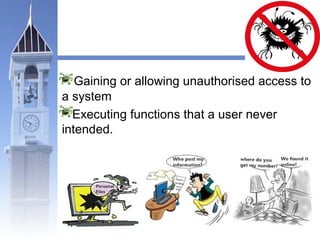
Gaining or allowing unauthorised access to 
a system 
Executing functions that a user never 
intended.
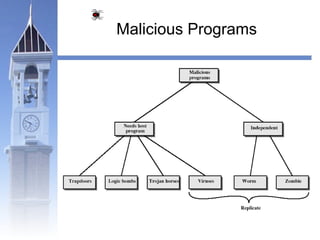
Malicious Programs
Viruses: 
• Viruses: A hidden self-replicating 
section of computer software, 
usually malicious code that 
propagates by infecting (i.e. 
inserting a copy into becoming a 
part of) another program or 
system memory. 
The viruses can damage your 
hardware, software or files and 
replicate themselves.
Categories of Viruses 
1. Boot sector virus : 
• infect boot sector of systems. 
• become resident. 
• activate while booting machine 
2. File virus : 
• infects program files. 
• activates when program is run.
Types of Viruses 
• Can classify on basis of how they 
attack 
• Parasitic virus 
• Memory-resident virus 
• Boot sector virus 
• Stealth 
• Polymorphic virus 
• Macro virus
Transient Virus is active only when its host 
program is active. 
Resident virus establishes itself in the computer’s 
memory & can remain active without its host. 
Macro Virus attached to some data file 
Email Virus spread using email with attachment 
containing a macro virus
Properties of Viruses 
 Virus program should be hard to detect by 
anti-virus software. 
 Viruses should be hard to destroy or deactivate. 
 Spread infection widely. 
 Should be easy to create. 
 Be able to re-infect. 
 Should be machine / platform independent, so 
that it can spread on different hosts.
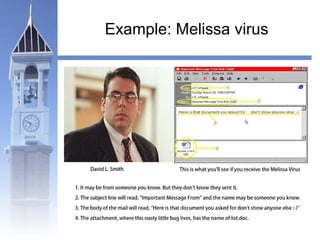
Example: Melissa virus
Worms: 
• Worms: Reproducing programs that run 
independently and travel across network 
connections. 
• “Famous” worms are: 
- Morris Internet Worm(1988) 
- Code Red : had triggered time for Denial of 
Service attacks. 
- Code Red 2 : had backdoor installed to allow 
remote control. 
- Nimba : use multiple infection i.e.email,share, 
web clients, etc.
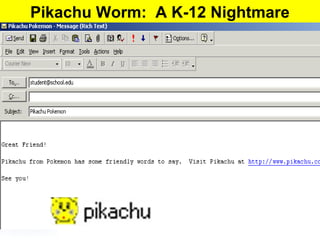
Pikachu Worm: A K-12 Nightmare
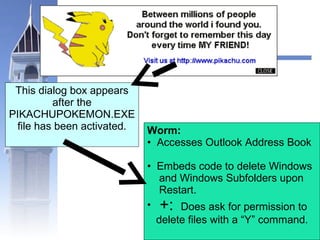
This dialog box appears 
after the 
PIKACHUPOKEMON.EXE 
file has been activated. Worm: 
• Accesses Outlook Address Book 
• Embeds code to delete Windows 
and Windows Subfolders upon 
Restart. 
• +: Does ask for permission to 
delete files with a “Y” command.
Virus v/s. Worms: 
• Viruses require interaction whereas 
worms act on there own. 
• Viruses has to relay on users 
transferring to infect files / programs 
while worms can use a network to 
replicate itself . 
• Speed of worms is more 
than viruses.
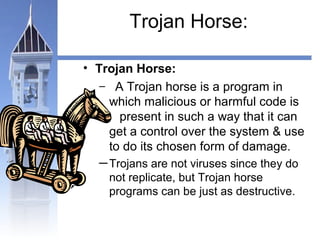
Trojan Horse: 
• Trojan Horse: 
– A Trojan horse is a program in 
which malicious or harmful code is 
present in such a way that it can 
get a control over the system & use 
to do its chosen form of damage. 
─Trojans are not viruses since they do 
not replicate, but Trojan horse 
programs can be just as destructive.
Continued… 
• Trojan Horses appear to be useful or 
interesting to an unsuspecting user, but 
are actually harmful. 
• A Trojan horse can be attached to any 
useful software by a cracker & can be 
spread by tricking users into believing that 
it is a useful program.
Damages caused by Trojans 
• Erasing or overwriting data on a computer. 
• Corrupting files. 
• Installing a backdoor on a computer. 
• Spreading other malware, such as viruses, 
hence they are also known as “dropper”. 
• Logging keystrokes to steal information 
such as passwords & credit card numbers 
(known as key loggers).
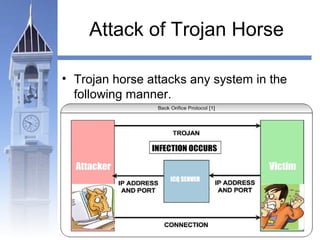
Attack of Trojan Horse 
• Trojan horse attacks any system in the 
following manner.
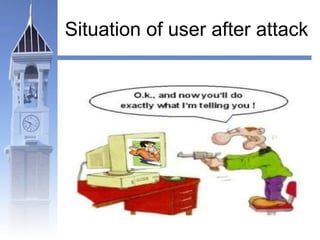
Situation of user after attack
Logic Bomb: 
• Logic Bomb: A logic bomb is a 
type of Trojan Horse that executes 
when specific conditions occur. 
– Triggers for logic bombs can include 
change in a file, by a particular series of 
keystrokes, or at a specific time or date. 
– Suppose a programmer may hide a 
piece of code that starts deleting files.
Spyware 
• A spyware is a computer 
software which is installed 
automatically when you surf 
internet or when you install 
free software. 
• Spyware is known to 
change computer settings.
• Spyware collects various types of 
information like: 
Internet surfing habits. 
Visited sites. 
Interfere in installing additional software. 
Redirect web browser activity.
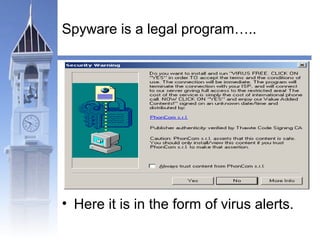
Spyware is a legal program….. 
• Here it is in the form of virus alerts.
Adware 
• Adware is any software package which 
automatically plays, displays or downloads 
advertisements to a computer after the 
software is installed on it or while the 
application is being used. 
• It’s a legal program. 
• Well known adware program is 
“123 Messenger”
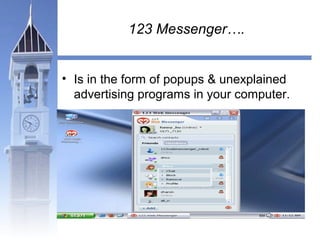
123 Messenger…. 
• Is in the form of popups & unexplained 
advertising programs in your computer.
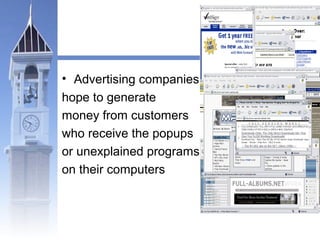
• Advertising companies 
hope to generate 
money from customers 
who receive the popups 
or unexplained programs 
on their computers
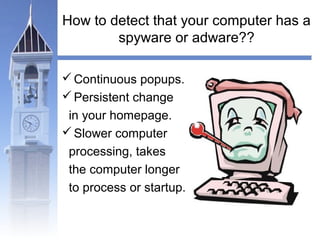
How to detect that your computer has a 
spyware or adware?? 
Continuous popups. 
Persistent change 
in your homepage. 
Slower computer 
processing, takes 
the computer longer 
to process or startup.
Software Security 
• Only install necessary and trusted 
software. 
• Beware of *free* games, screen savers, 
and graphics. 
• Keep a hard copy of the copyright 
release for all “free” products! 
• Run and UPDATE anti-virus software!!
Thank you….

Malicious

  • 1.
    Malicious Code Presentedby: Niki Patel Hiralkumar Bhimani Khyati Rajput UVPCE, Ahmedabad Guide: Prof. Ketan Savarkar
  • 2.
    Contents • MaliciousProgram • Viruses • Worms • Trojan • Logic Bombs • Spywares • Adwares
  • 3.
    Malicious Program •Malicious programs refers to a broad category of programs that can cause damage or undesirable effects to computer networks. • The other words for this is Malware (Malicious Software), Badware, Rouge Program (a form of internet fraud using internet) • Besides malicious programs there are non-malicious programs as well.
  • 4.
    Malicious program cont… • Malicious program is not a new concept, it was officially defined by Cohen in 1984, but the behaviour of the viruses was first observed in 1970. • The damages caused because of malicious code are: Potential damage can include modifying. Destroying or stealing data.
  • 5.
    Gaining or allowingunauthorised access to a system Executing functions that a user never intended.
  • 6.
  • 7.
    Viruses: • Viruses:A hidden self-replicating section of computer software, usually malicious code that propagates by infecting (i.e. inserting a copy into becoming a part of) another program or system memory. The viruses can damage your hardware, software or files and replicate themselves.
  • 8.
    Categories of Viruses 1. Boot sector virus : • infect boot sector of systems. • become resident. • activate while booting machine 2. File virus : • infects program files. • activates when program is run.
  • 9.
    Types of Viruses • Can classify on basis of how they attack • Parasitic virus • Memory-resident virus • Boot sector virus • Stealth • Polymorphic virus • Macro virus
  • 10.
    Transient Virus isactive only when its host program is active. Resident virus establishes itself in the computer’s memory & can remain active without its host. Macro Virus attached to some data file Email Virus spread using email with attachment containing a macro virus
  • 11.
    Properties of Viruses  Virus program should be hard to detect by anti-virus software.  Viruses should be hard to destroy or deactivate.  Spread infection widely.  Should be easy to create.  Be able to re-infect.  Should be machine / platform independent, so that it can spread on different hosts.
  • 12.
  • 13.
    Worms: • Worms:Reproducing programs that run independently and travel across network connections. • “Famous” worms are: - Morris Internet Worm(1988) - Code Red : had triggered time for Denial of Service attacks. - Code Red 2 : had backdoor installed to allow remote control. - Nimba : use multiple infection i.e.email,share, web clients, etc.
  • 14.
    Pikachu Worm: AK-12 Nightmare
  • 15.
    This dialog boxappears after the PIKACHUPOKEMON.EXE file has been activated. Worm: • Accesses Outlook Address Book • Embeds code to delete Windows and Windows Subfolders upon Restart. • +: Does ask for permission to delete files with a “Y” command.
  • 16.
    Virus v/s. Worms: • Viruses require interaction whereas worms act on there own. • Viruses has to relay on users transferring to infect files / programs while worms can use a network to replicate itself . • Speed of worms is more than viruses.
  • 17.
    Trojan Horse: •Trojan Horse: – A Trojan horse is a program in which malicious or harmful code is present in such a way that it can get a control over the system & use to do its chosen form of damage. ─Trojans are not viruses since they do not replicate, but Trojan horse programs can be just as destructive.
  • 18.
    Continued… • TrojanHorses appear to be useful or interesting to an unsuspecting user, but are actually harmful. • A Trojan horse can be attached to any useful software by a cracker & can be spread by tricking users into believing that it is a useful program.
  • 19.
    Damages caused byTrojans • Erasing or overwriting data on a computer. • Corrupting files. • Installing a backdoor on a computer. • Spreading other malware, such as viruses, hence they are also known as “dropper”. • Logging keystrokes to steal information such as passwords & credit card numbers (known as key loggers).
  • 20.
    Attack of TrojanHorse • Trojan horse attacks any system in the following manner.
  • 21.
    Situation of userafter attack
  • 22.
    Logic Bomb: •Logic Bomb: A logic bomb is a type of Trojan Horse that executes when specific conditions occur. – Triggers for logic bombs can include change in a file, by a particular series of keystrokes, or at a specific time or date. – Suppose a programmer may hide a piece of code that starts deleting files.
  • 23.
    Spyware • Aspyware is a computer software which is installed automatically when you surf internet or when you install free software. • Spyware is known to change computer settings.
  • 24.
    • Spyware collectsvarious types of information like: Internet surfing habits. Visited sites. Interfere in installing additional software. Redirect web browser activity.
  • 25.
    Spyware is alegal program….. • Here it is in the form of virus alerts.
  • 26.
    Adware • Adwareis any software package which automatically plays, displays or downloads advertisements to a computer after the software is installed on it or while the application is being used. • It’s a legal program. • Well known adware program is “123 Messenger”
  • 27.
    123 Messenger…. •Is in the form of popups & unexplained advertising programs in your computer.
  • 28.
    • Advertising companies hope to generate money from customers who receive the popups or unexplained programs on their computers
  • 29.
    How to detectthat your computer has a spyware or adware?? Continuous popups. Persistent change in your homepage. Slower computer processing, takes the computer longer to process or startup.
  • 30.
    Software Security •Only install necessary and trusted software. • Beware of *free* games, screen savers, and graphics. • Keep a hard copy of the copyright release for all “free” products! • Run and UPDATE anti-virus software!!
  • 31.