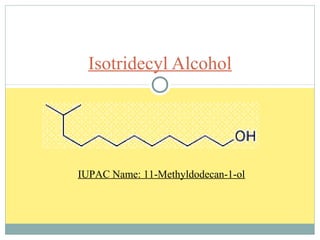
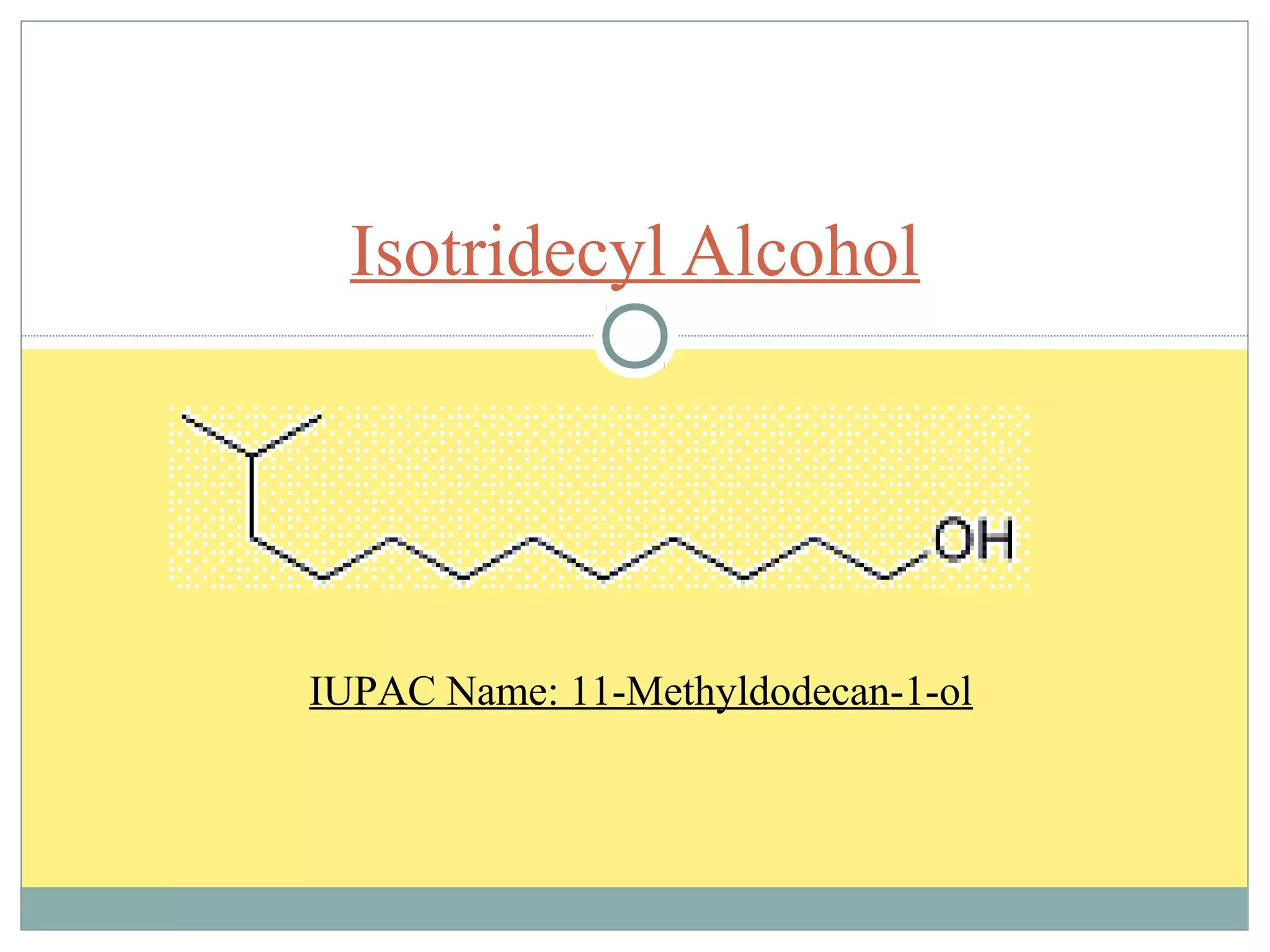
Isotridecyl Alcohol
IUPAC Name: 11-Methyldodecan-1-ol
Family- Fatty Alcohols
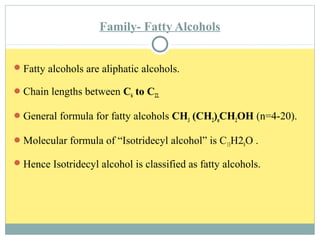
Fatty alcohols are aliphatic alcohols.
Chain lengths between C6 to C22.
General formula for fatty alcohols CH3 (CH2)nCH2OH (n=4-20).
Molecular formula of “Isotridecyl alcohol” is C13H28O .
Hence Isotridecyl alcohol is classified as fatty alcohols.
Fatty Alcohols
 Predominantly straight-chain and monohydric and can be saturated or have
one or more double bond.
 Alcohols with a carbon chain length above C22 are referred to as wax alcohols.
 The character of fatty alcohol is determined by the manufacturing process and
the raw materials used.
 Following is the general comparison of processes to manufacture fatty
alcohols:
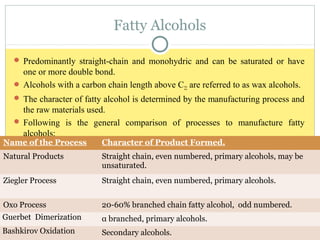
Name of the Process Character of Product Formed.
Natural Products Straight chain, even numbered, primary alcohols, may be
unsaturated.
Ziegler Process Straight chain, even numbered, primary alcohols.
Oxo Process 20-60% branched chain fatty alcohol, odd numbered.
Guerbet Dimerization α branched, primary alcohols.
Bashkirov Oxidation Secondary alcohols.
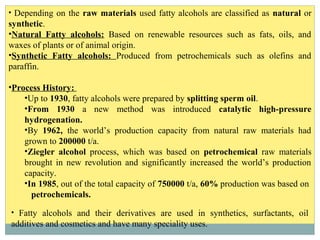
• Depending on the raw materials used fatty alcohols are classified as natural or
synthetic.
•Natural Fatty alcohols: Based on renewable resources such as fats, oils, and
waxes of plants or of animal origin.
•Synthetic Fatty alcohols: Produced from petrochemicals such as olefins and
paraffin.
•Process History:
•Up to 1930, fatty alcohols were prepared by splitting sperm oil.
•From 1930 a new method was introduced catalytic high-pressure
hydrogenation.
•By 1962, the world’s production capacity from natural raw materials had
grown to 200000 t/a.
•Ziegler alcohol process, which was based on petrochemical raw materials
brought in new revolution and significantly increased the world’s production
capacity.
•In 1985, out of the total capacity of 750000 t/a, 60% production was based on
petrochemicals.
• Fatty alcohols and their derivatives are used in synthetics, surfactants, oil
additives and cosmetics and have many speciality uses.
Isotridecyl alcohol
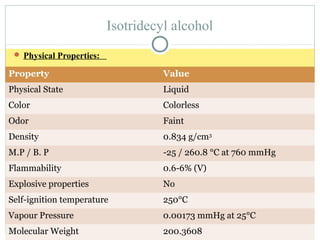
 Physical Properties:
Property Value
Physical State Liquid
Color Colorless
Odor Faint
Density 0.834 g/cm3
M.P / B. P -25 / 260.8 °C at 760 mmHg
Flammability 0.6-6% (V)
Explosive properties No
Self-ignition temperature 250°C
Vapour Pressure 0.00173 mmHg at 25°C
Molecular Weight 200.3608
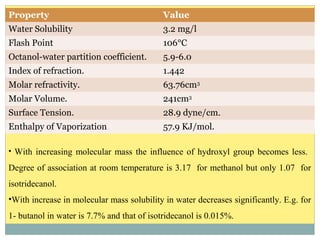
Property Value
Water Solubility 3.2 mg/l
Flash Point 106°C
Octanol-water partition coefficient. 5.9-6.0
Index of refraction. 1.442
Molar refractivity. 63.76cm3
Molar Volume. 241cm3
Surface Tension. 28.9 dyne/cm.
Enthalpy of Vaporization 57.9 KJ/mol.
• With increasing molecular mass the influence of hydroxyl group becomes less.
Degree of association at room temperature is 3.17 for methanol but only 1.07 for
isotridecanol.
•With increase in molecular mass solubility in water decreases significantly. E.g. for
1- butanol in water is 7.7% and that of isotridecanol is 0.015%.
• Chemical Properties :
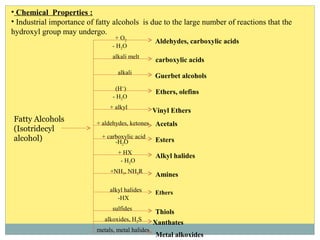
• Industrial importance of fatty alcohols is due to the large number of reactions that the
hydroxyl group may undergo.
+ O2
- H2O
Aldehydes, carboxylic acids
alkali melt
carboxylic acids
alkali
Guerbet alcohols
- H2O
(H+
)
Ethers, olefins
+ alkyl
Vinyl Ethers
+ aldehydes, ketones Acetals
+ carboxylic acid
-H2O Esters
+ HX
- H2O
Alkyl halides
+NH3, NH2R
Amines
alkyl halides
-HX
Ethers
sulfides
Thiols
alkoxides, H2S
Xanthates
metals, metal halides
Metal alkoxides
Fatty Alcohols
(Isotridecyl
alcohol)
Manufacturing Processes
A. Production of Natural Sources:
Two groups of natural raw materials are used
1) Fats and oils of plant and animal origin, which contain fatty acids in
the form of triglycerides that can be hydrogenated after suitable
pretreatment.
2) Wax esters from sperm oil(whale) from which fatty alcohols are
obtained by simple hydrolysis or reduction with sodium.
 Commercial exploitation of sperm oil has led to depletion of whale
population, hence this route is banned. Oil from jojoba has been considered
as a replacement.
 Fatty alcohols obtained from this route has chain length of C16-C18, with
limited availability of C12-C14 carbon atoms. Hence this forced to develop
processes of producing fatty alcohols from petrochemicals.
B. Synthesis from Petrochemical Feedstocks:
1. Zeigler Alcohol Processes:
• Two processes for the production of synthetic fatty alcohol are based on
the work of Zeigler on organic aluminum compounds.
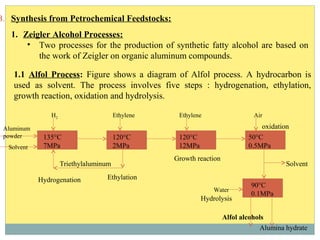
1.1 Alfol Process: Figure shows a diagram of Alfol process. A hydrocarbon is
used as solvent. The process involves five steps : hydrogenation, ethylation,
growth reaction, oxidation and hydrolysis.
Aluminum
powder
Solvent
H2 Ethylene Ethylene Air
Water
135°C
7MPa
120°C
2MPa
120°C
12MPa
50°C
0.5MPa
90°C
0.1MPa
Alfol alcohols
Alumina hydrate
SolventTriethylaluminum
Hydrogenation Ethylation
Growth reaction
oxidation
Hydrolysis
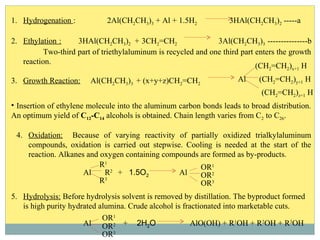
1. Hydrogenation : 2Al(CH2CH3)3 + Al + 1.5H2 3HAl(CH2CH3)2 -----a
2. Ethylation : 3HAl(CH2CH3)2 + 3CH2=CH2 3Al(CH2CH3)3 ---------------b
Two-third part of triethylaluminum is recycled and one third part enters the growth
reaction.
3. Growth Reaction: Al(CH2CH3)3 + (x+y+z)CH2=CH2
Al
(CH2=CH2)x+1 H
(CH2=CH2)y+1 H
(CH2=CH2)z+1 H
• Insertion of ethylene molecule into the aluminum carbon bonds leads to broad distribution.
An optimum yield of C12-C14 alcohols is obtained. Chain length varies from C2 to C26.
4. Oxidation: Because of varying reactivity of partially oxidized trialkylaluminum
compounds, oxidation is carried out stepwise. Cooling is needed at the start of the
reaction. Alkanes and oxygen containing compounds are formed as by-products.
Al
R1
R2
R3
+ 1.5O2 Al
OR1
OR3
OR2
5. Hydrolysis: Before hydrolysis solvent is removed by distillation. The byproduct formed
is high purity hydrated alumina. Crude alcohol is fractionated into marketable cuts.
OR3
OR2
OR1
Al + 2H2O AlO(OH) + R1
OH + R2
OH + R3
OH
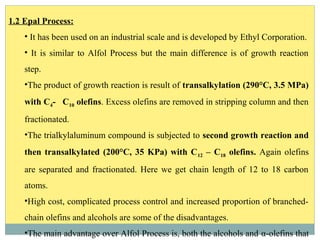
1.2 Epal Process:
• It has been used on an industrial scale and is developed by Ethyl Corporation.
• It is similar to Alfol Process but the main difference is of growth reaction
step.
•The product of growth reaction is result of transalkylation (290°C, 3.5 MPa)
with C4- C10 olefins. Excess olefins are removed in stripping column and then
fractionated.
•The trialkylaluminum compound is subjected to second growth reaction and
then transalkylated (200°C, 35 KPa) with C12 – C18 olefins. Again olefins
are separated and fractionated. Here we get chain length of 12 to 18 carbon
atoms.
•High cost, complicated process control and increased proportion of branched-
chain olefins and alcohols are some of the disadvantages.
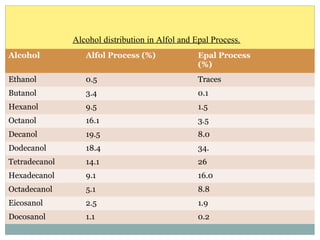
•The main advantage over Alfol Process is, both the alcohols and α-olefins that
Alcohol Alfol Process (%) Epal Process
(%)
Ethanol 0.5 Traces
Butanol 3.4 0.1
Hexanol 9.5 1.5
Octanol 16.1 3.5
Decanol 19.5 8.0
Dodecanol 18.4 34.
Tetradecanol 14.1 26
Hexadecanol 9.1 16.0
Octadecanol 5.1 8.8
Eicosanol 2.5 1.9
Docosanol 1.1 0.2
Alcohol distribution in Alfol and Epal Process.
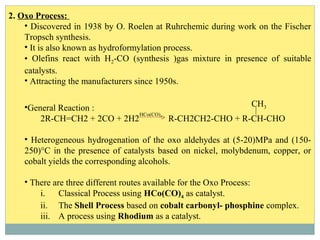
2. Oxo Process:
• Discovered in 1938 by O. Roelen at Ruhrchemic during work on the Fischer
Tropsch synthesis.
• It is also known as hydroformylation process.
• Olefins react with H2-CO (synthesis )gas mixture in presence of suitable
catalysts.
• Attracting the manufacturers since 1950s.
•General Reaction :
2R-CH=CH2 + 2CO + 2H2 R-CH2CH2-CHO + R-CH-CHO
• Heterogeneous hydrogenation of the oxo aldehydes at (5-20)MPa and (150-
250)°C in the presence of catalysts based on nickel, molybdenum, copper, or
cobalt yields the corresponding alcohols.
• There are three different routes available for the Oxo Process:
i. Classical Process using HCo(CO)4 as catalyst.
ii. The Shell Process based on cobalt carbonyl- phosphine complex.
iii. A process using Rhodium as a catalyst.
HCo(CO)4
CH3
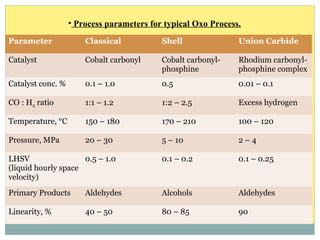
• Process parameters for typical Oxo Process.
Parameter Classical Shell Union Carbide
Catalyst Cobalt carbonyl Cobalt carbonyl-
phosphine
Rhodium carbonyl-
phosphine complex
Catalyst conc. % 0.1 – 1.0 0.5 0.01 – 0.1
CO : H2 ratio 1:1 – 1.2 1:2 – 2.5 Excess hydrogen
Temperature, °C 150 – 180 170 – 210 100 – 120
Pressure, MPa 20 – 30 5 – 10 2 – 4
LHSV
(liquid hourly space
velocity)
0.5 – 1.0 0.1 – 0.2 0.1 – 0.25
Primary Products Aldehydes Alcohols Aldehydes
Linearity, % 40 – 50 80 – 85 90
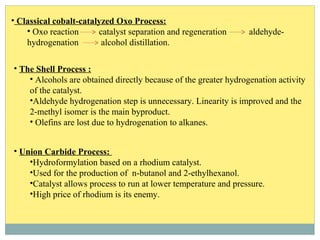
• Classical cobalt-catalyzed Oxo Process:
• Oxo reaction catalyst separation and regeneration aldehyde-
hydrogenation alcohol distillation.
• The Shell Process :
• Alcohols are obtained directly because of the greater hydrogenation activity
of the catalyst.
•Aldehyde hydrogenation step is unnecessary. Linearity is improved and the
2-methyl isomer is the main byproduct.
• Olefins are lost due to hydrogenation to alkanes.
• Union Carbide Process:
•Hydroformylation based on a rhodium catalyst.
•Used for the production of n-butanol and 2-ethylhexanol.
•Catalyst allows process to run at lower temperature and pressure.
•High price of rhodium is its enemy.
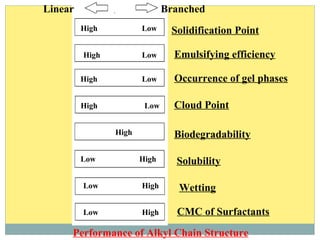
BranchedLinear
Solidification Point
Emulsifying efficiency
Occurrence of gel phases
Cloud Point
Biodegradability
Solubility
Wetting
CMC of Surfactants
Low
Low
Low
Low
Low
Low
Low
High
High
High
High
High
High
High
High
Performance of Alkyl Chain Structure
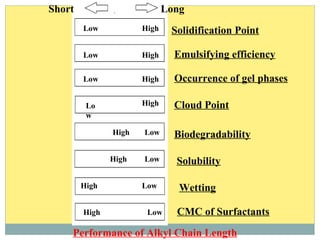
LongShort
Solidification Point
Emulsifying efficiency
Occurrence of gel phases
Cloud Point
Biodegradability
Solubility
Wetting
CMC of Surfactants
Low
Low
Lo
w
LowHigh
Low High
High
Low
High
Performance of Alkyl Chain Length
High
High
High
Low
High
Low
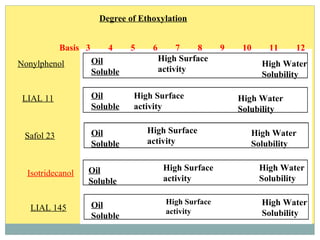
Degree of Ethoxylation
3 4 5 6 7 8 9 10 11 12Basis
Oil
Soluble
Oil
Soluble
Oil
Soluble
Oil
Soluble
Oil
Soluble
High Surface
activity
High Surface
activity
High Surface
activity
High Surface
activity
High Surface
activity
High Water
Solubility
High Water
Solubility
High Water
Solubility
High Water
Solubility
High Water
Solubility
Nonylphenol
LIAL 11
Safol 23
Isotridecanol
LIAL 145
• Uses:
• Reduces the surface tension of liquids.
• The very low (2, 2.5 or 3) mole ratio products are used to prepare SLES
(sodium lauryl ether sulfate) which is used as a foaming and cleansing agent
for shampoos and cleansers, suited for high viscosity products and low pH
products.
•Slightly higher mole ratio products are used as wetting agent.
•The E.O surfactants of 7-12 moles ratio with alcohol are suitable for
detergent application.
•Higher moles ratio products are emulsifiers. Their 3 representative functions
are as wetting agent, detergency and emulsifier.
•End Applications:
Detergents, Industrial Cleaners, Dispersants, Stabilizers, Sanitizers,
Defoaming Agents. Agrochemical Emulsifiers, Metal Working, Textile
Processing, Paper De-inking, Drilling Products Intermediate Anionic
Surfactants Synthesis, Dust Control, Adhesive, Plastic Industry, Lube
Oil, Cosmetic and Pharmaceuticals.
• Storage:
•Containers of pure aluminum and alloy of Al-Mg-Mn (DIN 1725/1745).
•SS are for extremely water-free alcohols.
•In aluminum vessel corrosion is expected , which results in formation of
aluminum alkoxide. The storage temperature should be as low as possible.
•To avoid oxidation, inert gas unit should be installed to enable flushing with
nitrogen, etc.
• Transportation:
• Liquid alcohols are transported in painted, corrugated iron vessels, in road
tankers or in tank wagons.
•Solid products such as higher alcohols are sold as flakes contained in
multilayer polyethylene lined paper bags.
•Number of instructions and legal regulations are to be followed for
transporting volatile and flammable substances.
References
• Ullmann’s Encyclopedia : Industrial Chemistry : VolA 10
• Ullmann’s Encyclopedia : Industrial Chemistry : VolA 18
• Ullmann’s Encyclopedia : Industrial Chemistry : VolA 28
• www.lookchem.com
• www.chemya.com
•www.wikipedia.org

Isotridecyl alcohol

  • 1.
    Isotridecyl Alcohol IUPAC Name:11-Methyldodecan-1-ol
  • 2.
    Family- Fatty Alcohols Fattyalcohols are aliphatic alcohols. Chain lengths between C6 to C22. General formula for fatty alcohols CH3 (CH2)nCH2OH (n=4-20). Molecular formula of “Isotridecyl alcohol” is C13H28O . Hence Isotridecyl alcohol is classified as fatty alcohols.
  • 3.
    Fatty Alcohols  Predominantlystraight-chain and monohydric and can be saturated or have one or more double bond.  Alcohols with a carbon chain length above C22 are referred to as wax alcohols.  The character of fatty alcohol is determined by the manufacturing process and the raw materials used.  Following is the general comparison of processes to manufacture fatty alcohols: Name of the Process Character of Product Formed. Natural Products Straight chain, even numbered, primary alcohols, may be unsaturated. Ziegler Process Straight chain, even numbered, primary alcohols. Oxo Process 20-60% branched chain fatty alcohol, odd numbered. Guerbet Dimerization α branched, primary alcohols. Bashkirov Oxidation Secondary alcohols.
  • 4.
    • Depending onthe raw materials used fatty alcohols are classified as natural or synthetic. •Natural Fatty alcohols: Based on renewable resources such as fats, oils, and waxes of plants or of animal origin. •Synthetic Fatty alcohols: Produced from petrochemicals such as olefins and paraffin. •Process History: •Up to 1930, fatty alcohols were prepared by splitting sperm oil. •From 1930 a new method was introduced catalytic high-pressure hydrogenation. •By 1962, the world’s production capacity from natural raw materials had grown to 200000 t/a. •Ziegler alcohol process, which was based on petrochemical raw materials brought in new revolution and significantly increased the world’s production capacity. •In 1985, out of the total capacity of 750000 t/a, 60% production was based on petrochemicals. • Fatty alcohols and their derivatives are used in synthetics, surfactants, oil additives and cosmetics and have many speciality uses.
  • 5.
    Isotridecyl alcohol  PhysicalProperties: Property Value Physical State Liquid Color Colorless Odor Faint Density 0.834 g/cm3 M.P / B. P -25 / 260.8 °C at 760 mmHg Flammability 0.6-6% (V) Explosive properties No Self-ignition temperature 250°C Vapour Pressure 0.00173 mmHg at 25°C Molecular Weight 200.3608
  • 6.
    Property Value Water Solubility3.2 mg/l Flash Point 106°C Octanol-water partition coefficient. 5.9-6.0 Index of refraction. 1.442 Molar refractivity. 63.76cm3 Molar Volume. 241cm3 Surface Tension. 28.9 dyne/cm. Enthalpy of Vaporization 57.9 KJ/mol. • With increasing molecular mass the influence of hydroxyl group becomes less. Degree of association at room temperature is 3.17 for methanol but only 1.07 for isotridecanol. •With increase in molecular mass solubility in water decreases significantly. E.g. for 1- butanol in water is 7.7% and that of isotridecanol is 0.015%.
  • 7.
    • Chemical Properties: • Industrial importance of fatty alcohols is due to the large number of reactions that the hydroxyl group may undergo. + O2 - H2O Aldehydes, carboxylic acids alkali melt carboxylic acids alkali Guerbet alcohols - H2O (H+ ) Ethers, olefins + alkyl Vinyl Ethers + aldehydes, ketones Acetals + carboxylic acid -H2O Esters + HX - H2O Alkyl halides +NH3, NH2R Amines alkyl halides -HX Ethers sulfides Thiols alkoxides, H2S Xanthates metals, metal halides Metal alkoxides Fatty Alcohols (Isotridecyl alcohol)
  • 8.
    Manufacturing Processes A. Productionof Natural Sources: Two groups of natural raw materials are used 1) Fats and oils of plant and animal origin, which contain fatty acids in the form of triglycerides that can be hydrogenated after suitable pretreatment. 2) Wax esters from sperm oil(whale) from which fatty alcohols are obtained by simple hydrolysis or reduction with sodium.  Commercial exploitation of sperm oil has led to depletion of whale population, hence this route is banned. Oil from jojoba has been considered as a replacement.  Fatty alcohols obtained from this route has chain length of C16-C18, with limited availability of C12-C14 carbon atoms. Hence this forced to develop processes of producing fatty alcohols from petrochemicals.
  • 9.
    B. Synthesis fromPetrochemical Feedstocks: 1. Zeigler Alcohol Processes: • Two processes for the production of synthetic fatty alcohol are based on the work of Zeigler on organic aluminum compounds. 1.1 Alfol Process: Figure shows a diagram of Alfol process. A hydrocarbon is used as solvent. The process involves five steps : hydrogenation, ethylation, growth reaction, oxidation and hydrolysis. Aluminum powder Solvent H2 Ethylene Ethylene Air Water 135°C 7MPa 120°C 2MPa 120°C 12MPa 50°C 0.5MPa 90°C 0.1MPa Alfol alcohols Alumina hydrate SolventTriethylaluminum Hydrogenation Ethylation Growth reaction oxidation Hydrolysis
  • 10.
    1. Hydrogenation :2Al(CH2CH3)3 + Al + 1.5H2 3HAl(CH2CH3)2 -----a 2. Ethylation : 3HAl(CH2CH3)2 + 3CH2=CH2 3Al(CH2CH3)3 ---------------b Two-third part of triethylaluminum is recycled and one third part enters the growth reaction. 3. Growth Reaction: Al(CH2CH3)3 + (x+y+z)CH2=CH2 Al (CH2=CH2)x+1 H (CH2=CH2)y+1 H (CH2=CH2)z+1 H • Insertion of ethylene molecule into the aluminum carbon bonds leads to broad distribution. An optimum yield of C12-C14 alcohols is obtained. Chain length varies from C2 to C26. 4. Oxidation: Because of varying reactivity of partially oxidized trialkylaluminum compounds, oxidation is carried out stepwise. Cooling is needed at the start of the reaction. Alkanes and oxygen containing compounds are formed as by-products. Al R1 R2 R3 + 1.5O2 Al OR1 OR3 OR2 5. Hydrolysis: Before hydrolysis solvent is removed by distillation. The byproduct formed is high purity hydrated alumina. Crude alcohol is fractionated into marketable cuts. OR3 OR2 OR1 Al + 2H2O AlO(OH) + R1 OH + R2 OH + R3 OH
  • 11.
    1.2 Epal Process: •It has been used on an industrial scale and is developed by Ethyl Corporation. • It is similar to Alfol Process but the main difference is of growth reaction step. •The product of growth reaction is result of transalkylation (290°C, 3.5 MPa) with C4- C10 olefins. Excess olefins are removed in stripping column and then fractionated. •The trialkylaluminum compound is subjected to second growth reaction and then transalkylated (200°C, 35 KPa) with C12 – C18 olefins. Again olefins are separated and fractionated. Here we get chain length of 12 to 18 carbon atoms. •High cost, complicated process control and increased proportion of branched- chain olefins and alcohols are some of the disadvantages. •The main advantage over Alfol Process is, both the alcohols and α-olefins that
  • 12.
    Alcohol Alfol Process(%) Epal Process (%) Ethanol 0.5 Traces Butanol 3.4 0.1 Hexanol 9.5 1.5 Octanol 16.1 3.5 Decanol 19.5 8.0 Dodecanol 18.4 34. Tetradecanol 14.1 26 Hexadecanol 9.1 16.0 Octadecanol 5.1 8.8 Eicosanol 2.5 1.9 Docosanol 1.1 0.2 Alcohol distribution in Alfol and Epal Process.
  • 13.
    2. Oxo Process: •Discovered in 1938 by O. Roelen at Ruhrchemic during work on the Fischer Tropsch synthesis. • It is also known as hydroformylation process. • Olefins react with H2-CO (synthesis )gas mixture in presence of suitable catalysts. • Attracting the manufacturers since 1950s. •General Reaction : 2R-CH=CH2 + 2CO + 2H2 R-CH2CH2-CHO + R-CH-CHO • Heterogeneous hydrogenation of the oxo aldehydes at (5-20)MPa and (150- 250)°C in the presence of catalysts based on nickel, molybdenum, copper, or cobalt yields the corresponding alcohols. • There are three different routes available for the Oxo Process: i. Classical Process using HCo(CO)4 as catalyst. ii. The Shell Process based on cobalt carbonyl- phosphine complex. iii. A process using Rhodium as a catalyst. HCo(CO)4 CH3
  • 14.
    • Process parametersfor typical Oxo Process. Parameter Classical Shell Union Carbide Catalyst Cobalt carbonyl Cobalt carbonyl- phosphine Rhodium carbonyl- phosphine complex Catalyst conc. % 0.1 – 1.0 0.5 0.01 – 0.1 CO : H2 ratio 1:1 – 1.2 1:2 – 2.5 Excess hydrogen Temperature, °C 150 – 180 170 – 210 100 – 120 Pressure, MPa 20 – 30 5 – 10 2 – 4 LHSV (liquid hourly space velocity) 0.5 – 1.0 0.1 – 0.2 0.1 – 0.25 Primary Products Aldehydes Alcohols Aldehydes Linearity, % 40 – 50 80 – 85 90
  • 15.
    • Classical cobalt-catalyzedOxo Process: • Oxo reaction catalyst separation and regeneration aldehyde- hydrogenation alcohol distillation. • The Shell Process : • Alcohols are obtained directly because of the greater hydrogenation activity of the catalyst. •Aldehyde hydrogenation step is unnecessary. Linearity is improved and the 2-methyl isomer is the main byproduct. • Olefins are lost due to hydrogenation to alkanes. • Union Carbide Process: •Hydroformylation based on a rhodium catalyst. •Used for the production of n-butanol and 2-ethylhexanol. •Catalyst allows process to run at lower temperature and pressure. •High price of rhodium is its enemy.
  • 16.
    BranchedLinear Solidification Point Emulsifying efficiency Occurrenceof gel phases Cloud Point Biodegradability Solubility Wetting CMC of Surfactants Low Low Low Low Low Low Low High High High High High High High High Performance of Alkyl Chain Structure
  • 17.
    LongShort Solidification Point Emulsifying efficiency Occurrenceof gel phases Cloud Point Biodegradability Solubility Wetting CMC of Surfactants Low Low Lo w LowHigh Low High High Low High Performance of Alkyl Chain Length High High High Low High Low
  • 18.
    Degree of Ethoxylation 34 5 6 7 8 9 10 11 12Basis Oil Soluble Oil Soluble Oil Soluble Oil Soluble Oil Soluble High Surface activity High Surface activity High Surface activity High Surface activity High Surface activity High Water Solubility High Water Solubility High Water Solubility High Water Solubility High Water Solubility Nonylphenol LIAL 11 Safol 23 Isotridecanol LIAL 145
  • 19.
    • Uses: • Reducesthe surface tension of liquids. • The very low (2, 2.5 or 3) mole ratio products are used to prepare SLES (sodium lauryl ether sulfate) which is used as a foaming and cleansing agent for shampoos and cleansers, suited for high viscosity products and low pH products. •Slightly higher mole ratio products are used as wetting agent. •The E.O surfactants of 7-12 moles ratio with alcohol are suitable for detergent application. •Higher moles ratio products are emulsifiers. Their 3 representative functions are as wetting agent, detergency and emulsifier. •End Applications: Detergents, Industrial Cleaners, Dispersants, Stabilizers, Sanitizers, Defoaming Agents. Agrochemical Emulsifiers, Metal Working, Textile Processing, Paper De-inking, Drilling Products Intermediate Anionic Surfactants Synthesis, Dust Control, Adhesive, Plastic Industry, Lube Oil, Cosmetic and Pharmaceuticals.
  • 20.
    • Storage: •Containers ofpure aluminum and alloy of Al-Mg-Mn (DIN 1725/1745). •SS are for extremely water-free alcohols. •In aluminum vessel corrosion is expected , which results in formation of aluminum alkoxide. The storage temperature should be as low as possible. •To avoid oxidation, inert gas unit should be installed to enable flushing with nitrogen, etc. • Transportation: • Liquid alcohols are transported in painted, corrugated iron vessels, in road tankers or in tank wagons. •Solid products such as higher alcohols are sold as flakes contained in multilayer polyethylene lined paper bags. •Number of instructions and legal regulations are to be followed for transporting volatile and flammable substances.
  • 21.
    References • Ullmann’s Encyclopedia: Industrial Chemistry : VolA 10 • Ullmann’s Encyclopedia : Industrial Chemistry : VolA 18 • Ullmann’s Encyclopedia : Industrial Chemistry : VolA 28 • www.lookchem.com • www.chemya.com •www.wikipedia.org