Introduction
 A palm oil mill produces crude palm oil and kernels, as
primary products and biomass as secondary product.
 The capacity of mills varies between 60- 100 tons FFB/h.
http://lipidlibrary.aocs.org/processing/palmoil/index.htm
Figure 1
 A typical mill has many operation units as shown in
Figure.
http://lipidlibrary.aocs.org/processing/palmoil/index.htm
Sterilization
 Bunches are cooked using steam at 40psig. in horizontal cylindrical
autoclaves for 60-90 minutes.
 The length of the sterilizer is dependent on the number of cages
required for operation of the mill.
 Each cage can hold 2.5 to 10tons of FFB.
 Steam consumption varies from 140 kg/ton FFB for a single-peak
cycle to 224 kg/ton FFB for a triple
Figure 3. A
conventional
sterilizer
http://lipidlibrary.aocs.org/processing/palmoil/index.htm
Stripping
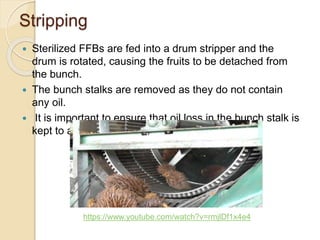
 Sterilized FFBs are fed into a drum stripper and the
drum is rotated, causing the fruits to be detached from
the bunch.
 The bunch stalks are removed as they do not contain
any oil.
 It is important to ensure that oil loss in the bunch stalk is
kept to a minimum.
https://www.youtube.com/watch?v=rmjlDf1x4e4
Digestion and Pressing
 The fruits are moved into a digester
where, the fruits are reheated.
 The steam heated vessels have
rotating shafts to which are attached
stirring arms.
 The fruits are rotated about, causing
the loosening of the pericarps from the
nuts.
 The digester is kept full and as the
digested fruit is drawn out, freshly
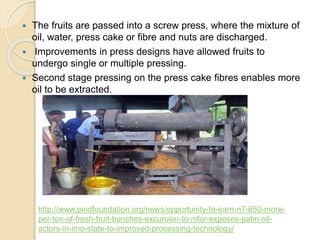
 The fruits are passed into a screw press, where the mixture of
oil, water, press cake or fibre and nuts are discharged.
 Improvements in press designs have allowed fruits to
undergo single or multiple pressing.
 Second stage pressing on the press cake fibres enables more
oil to be extracted.
http://www.pindfoundation.org/news/opportunity-to-earn-n7-650-more-
per-ton-of-fresh-fruit-bunches-excursion-to-nifor-exposes-palm-oil-
actors-in-imo-state-to-improved-processing-technology/
Clarification
 A mixture of oil, water, solids from the bunch fibres is
delivered from the press to a clarification tank.
 The mixture containing the crude oil is diluted with hot water
to reduce its viscosity.
 A vibrating screen helps remove some of the solids.
 The oil mixture is heated to 85-90◦C and allowed to separate
in the clarification tank.
 A settling time of 1-3 h. is acceptable. Oil from the top is
skimmed off and purified in the centrifuge prior to drying in
vacuum dryer.
 The final crude palm oil is then cooled and stored.
 The lower layer from the clarification tank is sent to the
centrifugal separator where the remaining oil is recovered.
 The oil is dried in vacuum dryers, cooled and sent to storage
tanks.
That’s all, thank you ! =)

Palm oil milling process

  • 2.
    Introduction  A palmoil mill produces crude palm oil and kernels, as primary products and biomass as secondary product.  The capacity of mills varies between 60- 100 tons FFB/h. http://lipidlibrary.aocs.org/processing/palmoil/index.htm Figure 1
  • 3.
     A typicalmill has many operation units as shown in Figure. http://lipidlibrary.aocs.org/processing/palmoil/index.htm
  • 4.
    Sterilization  Bunches arecooked using steam at 40psig. in horizontal cylindrical autoclaves for 60-90 minutes.  The length of the sterilizer is dependent on the number of cages required for operation of the mill.  Each cage can hold 2.5 to 10tons of FFB.  Steam consumption varies from 140 kg/ton FFB for a single-peak cycle to 224 kg/ton FFB for a triple Figure 3. A conventional sterilizer http://lipidlibrary.aocs.org/processing/palmoil/index.htm
  • 5.
    Stripping  Sterilized FFBsare fed into a drum stripper and the drum is rotated, causing the fruits to be detached from the bunch.  The bunch stalks are removed as they do not contain any oil.  It is important to ensure that oil loss in the bunch stalk is kept to a minimum. https://www.youtube.com/watch?v=rmjlDf1x4e4
  • 6.
    Digestion and Pressing The fruits are moved into a digester where, the fruits are reheated.  The steam heated vessels have rotating shafts to which are attached stirring arms.  The fruits are rotated about, causing the loosening of the pericarps from the nuts.  The digester is kept full and as the digested fruit is drawn out, freshly
  • 7.
     The fruitsare passed into a screw press, where the mixture of oil, water, press cake or fibre and nuts are discharged.  Improvements in press designs have allowed fruits to undergo single or multiple pressing.  Second stage pressing on the press cake fibres enables more oil to be extracted. http://www.pindfoundation.org/news/opportunity-to-earn-n7-650-more- per-ton-of-fresh-fruit-bunches-excursion-to-nifor-exposes-palm-oil- actors-in-imo-state-to-improved-processing-technology/
  • 8.
    Clarification  A mixtureof oil, water, solids from the bunch fibres is delivered from the press to a clarification tank.  The mixture containing the crude oil is diluted with hot water to reduce its viscosity.  A vibrating screen helps remove some of the solids.  The oil mixture is heated to 85-90◦C and allowed to separate in the clarification tank.  A settling time of 1-3 h. is acceptable. Oil from the top is skimmed off and purified in the centrifuge prior to drying in vacuum dryer.  The final crude palm oil is then cooled and stored.  The lower layer from the clarification tank is sent to the centrifugal separator where the remaining oil is recovered.  The oil is dried in vacuum dryers, cooled and sent to storage tanks.
  • 9.

Editor's Notes

  • #3   An average size FFB weighs about 20-30kg and contains 1500-2000 fruits (Figure1).
  • #4 This comprises of sterilization, stripping, digestion and pressing, clarification, purification, drying and storage. For the kernel line, there are steps such as nut/fibre separation, nut conditioning and cracking, cracked mixture separation, and kernel drying, storage. The dried kernels are often sold to palm kernel crushers for extraction of crude palm kernel oil.  In some integrated plants, kernel crushing facilities exist side by side at the same complex.
  • #5 Sterilization is very important because :  it inactivates the lipases in the fruits, and prevents build-up of free fatty acids (FFA).  it softens the fruit mesocarp for digestion and release of oil. conditioning of nuts to minimize kernel breakage.
  • #6 The stalks are often disposed by incineration, giving ash as potash fertilizer, and fuel for boilers. Others are transported to the plantations for use as fertilisers in mulching near the palms. The total oil loss absorbed on the stalks depends on the sterilizing conditions and partly on the way the stripper is operated. Prolonged sterilization will increase oil loss in stalks. Irregular feeding of the stripper may also result in increase of oil loss in stalks. Stalks which have fruits still attached on them are called hard bunches, and have to be recycled back to sterilizers for further cooking. Hard bunches are detected by visible inspection.
  • #7  the fruits are reheated to loosen the pericarp.
  • #9 In the conventional process, separation of the oil from the rest of the liquor is achieved by setting tanks based on gravity.