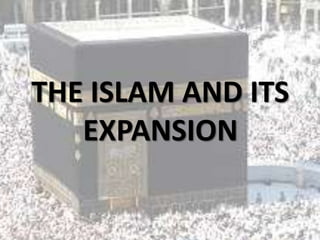
THE ISLAM AND ITS
EXPANSION
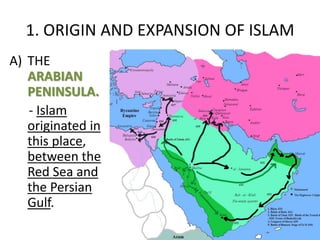
1. ORIGIN AND EXPANSION OF ISLAM
A) THE
ARABIAN
PENINSULA.
- Islam
originated in
this place,
between the
Red Sea and
the Persian
Gulf.
A) THE ARABIAN PENINSULA.
- The inhabitants of this place were tribes:
- in the South they dedicated to farming.
- in the North the dedicated to
shepsherding.
- The most important cities were La Meca and
Yatrib- later Medina.
- Common things all the inhabitants shared in the
Peninsula:
arabic language.
worsip to the “Black Stone” in the sanctuary of
La Kaaba, in La Meca.
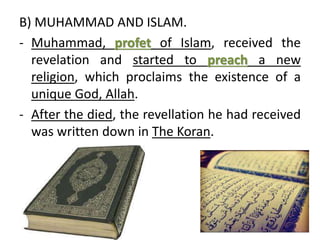
B) MUHAMMAD AND ISLAM.
- Muhammad, profet of Islam, received the
revelation and started to preach a new
religion, which proclaims the existence of a
unique God, Allah.
- After the died, the revellation he had received
was written down in The Koran.
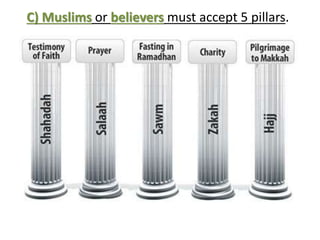
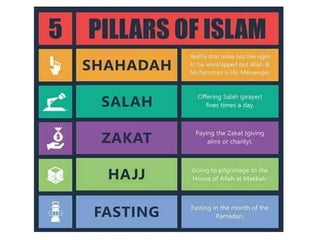
C) Muslims or believers must accept 5 pillars.
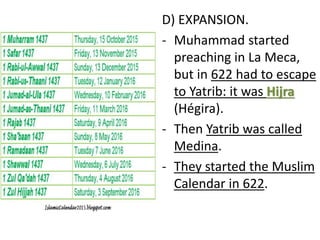
D) EXPANSION.
- Muhammad started
preaching in La Meca,
but in 622 had to escape
to Yatrib: it was Hijra
(Hégira).
- Then Yatrib was called
Medina.
- They started the Muslim
Calendar in 622.
EXPANSION OF ISLAM
RASHIDUN
CALIPHATE (VII
CENTURY)
(Califato Ortodoxo)
UMAYYAD
CALIPHATE (VII-
VIII CENTURY)
(Califato Omeya)
ABBASID
CALIPHATE (VIII-XI
CENTURY)
(Califato Abasí)
- Leaders from the
family and close
friends of
Muhammad.
-Title of Caliph.
-Syria, Palestine,
Egypt, North Africa,
Mesopothamia,
Persia.
-Capital city changed
to Damasco.
-Title of calipha was
hereditary.
-Extended to the
west.
-Capital moved to
Bagdag.
-Expansion ceased.
-Internecine battles.
-Turks conquered
the caliphate in
1055.
2. ISLAMIC GOVERNMENT AND
ECONOMY
A) GOVERNMENT AND TERRITORY.
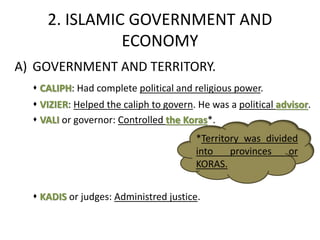
 CALIPH: Had complete political and religious power.
 VIZIER: Helped the caliph to govern. He was a political advisor.
 VALI or governor: Controlled the Koras*.
 KADIS or judges: Administred justice.
*Territory was divided
into provinces or
KORAS.
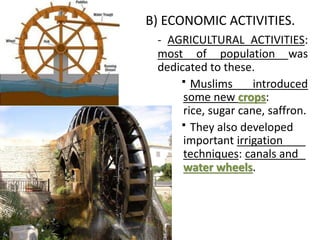
B) ECONOMIC ACTIVITIES.
- AGRICULTURAL ACTIVITIES:
most of population was
dedicated to these.
Muslims introduced
some new crops:
rice, sugar cane, saffron.
They also developed
important irrigation
techniques: canals and
water wheels.
- CRAFTMEN: they worked in small workshops. There were
textiles, carpets, leather, pottery, perfumes, paper and
tapestry.
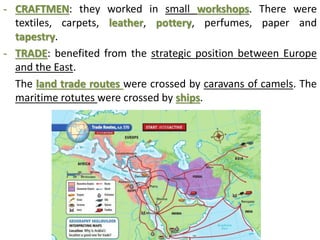
- TRADE: benefited from the strategic position between Europe
and the East.
The land trade routes were crossed by caravans of camels. The
maritime rotutes were crossed by ships.
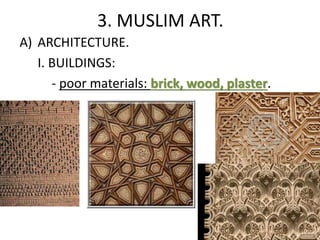
3. MUSLIM ART.
A) ARCHITECTURE.
I. BUILDINGS:
- poor materials: brick, wood, plaster.
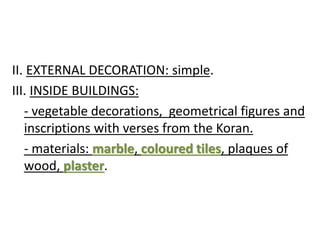
II. EXTERNAL DECORATION: simple.
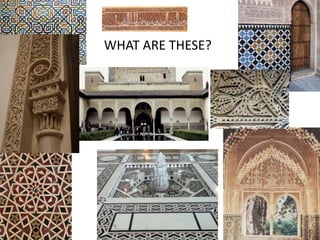
III. INSIDE BUILDINGS:
- vegetable decorations, geometrical figures and
inscriptions with verses from the Koran.
- materials: marble, coloured tiles, plaques of
wood, plaster.
WHAT ARE THESE?
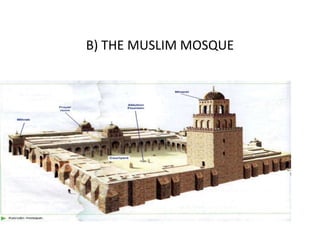
B) THE MUSLIM MOSQUE

Islam

  • 1.
    THE ISLAM ANDITS EXPANSION
  • 2.
    1. ORIGIN ANDEXPANSION OF ISLAM A) THE ARABIAN PENINSULA. - Islam originated in this place, between the Red Sea and the Persian Gulf.
  • 3.
    A) THE ARABIANPENINSULA. - The inhabitants of this place were tribes: - in the South they dedicated to farming. - in the North the dedicated to shepsherding. - The most important cities were La Meca and Yatrib- later Medina. - Common things all the inhabitants shared in the Peninsula: arabic language. worsip to the “Black Stone” in the sanctuary of La Kaaba, in La Meca.
  • 4.
    B) MUHAMMAD ANDISLAM. - Muhammad, profet of Islam, received the revelation and started to preach a new religion, which proclaims the existence of a unique God, Allah. - After the died, the revellation he had received was written down in The Koran.
  • 5.
    C) Muslims orbelievers must accept 5 pillars.
  • 7.
    D) EXPANSION. - Muhammadstarted preaching in La Meca, but in 622 had to escape to Yatrib: it was Hijra (Hégira). - Then Yatrib was called Medina. - They started the Muslim Calendar in 622.
  • 8.
    EXPANSION OF ISLAM RASHIDUN CALIPHATE(VII CENTURY) (Califato Ortodoxo) UMAYYAD CALIPHATE (VII- VIII CENTURY) (Califato Omeya) ABBASID CALIPHATE (VIII-XI CENTURY) (Califato Abasí) - Leaders from the family and close friends of Muhammad. -Title of Caliph. -Syria, Palestine, Egypt, North Africa, Mesopothamia, Persia. -Capital city changed to Damasco. -Title of calipha was hereditary. -Extended to the west. -Capital moved to Bagdag. -Expansion ceased. -Internecine battles. -Turks conquered the caliphate in 1055.
  • 9.
    2. ISLAMIC GOVERNMENTAND ECONOMY A) GOVERNMENT AND TERRITORY.  CALIPH: Had complete political and religious power.  VIZIER: Helped the caliph to govern. He was a political advisor.  VALI or governor: Controlled the Koras*.  KADIS or judges: Administred justice. *Territory was divided into provinces or KORAS.
  • 10.
    B) ECONOMIC ACTIVITIES. -AGRICULTURAL ACTIVITIES: most of population was dedicated to these. Muslims introduced some new crops: rice, sugar cane, saffron. They also developed important irrigation techniques: canals and water wheels.
  • 11.
    - CRAFTMEN: theyworked in small workshops. There were textiles, carpets, leather, pottery, perfumes, paper and tapestry. - TRADE: benefited from the strategic position between Europe and the East. The land trade routes were crossed by caravans of camels. The maritime rotutes were crossed by ships.
  • 12.
    3. MUSLIM ART. A)ARCHITECTURE. I. BUILDINGS: - poor materials: brick, wood, plaster.
  • 13.
    II. EXTERNAL DECORATION:simple. III. INSIDE BUILDINGS: - vegetable decorations, geometrical figures and inscriptions with verses from the Koran. - materials: marble, coloured tiles, plaques of wood, plaster.
  • 14.
  • 15.