Islam and Al- 
Andalus
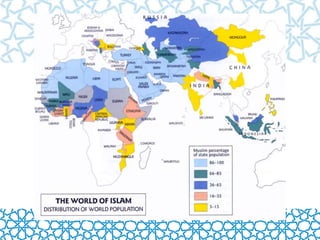
• Islam is one the biggest religions in the world. It’s a 
monotheist religion that believes in one god. It was first 
preached by the Prophet Muhammad in Arabia, in the early 
7th century, around the cities of Mecca and Yathrib (present-day 
Medina or Madinat An Nabi = city of the Prophet). 
• Its principles rapidly spread throughout the north of Africa, 
Asia and parts of Europe. 
• Today Islam is the second biggest religion in the world with 
1570 million followers.
• The Muslims arrived on the Iberian peninsula in 711. They 
defeated the Visigoth kingdom and created the Islamic state, 
al-Andalus.
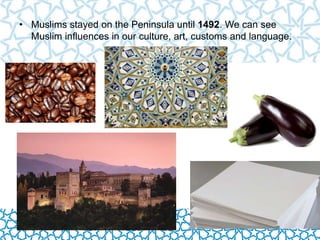
• Muslims stayed on the Peninsula until 1492. We can see 
Muslim influences in our culture, art, customs and language.
Islam of the Iberian Peninsula: al- 
Andalus 
THE CONQUEST 
• In 711 Tarik, lieutenant of Musa (North Africa governor) crossed the 
Strait of Gibraltar with Arab and Berber troops. 
• They wanted to plunder the area, but the victory over the King 
Roderick (Rodrigo) at the Battle of Guadalete (711) encourage 
them to advance. 
• In 4 years, they conquered most of the Peninsula; following the 
battle of Covadonga (722), only the North remained Christian 
(Cantabria and Asturias). 
• Muslims reached France (Battle of Poitiers, 732), but were defeated 
by Charles Martel.
THE DEPENDENT EMIRATE OF DAMASCUS 
• After the conquest, al-Andalus became an emirate: province 
depending on the Umayyad caliphate of Damascus. The capital was 
Cordoba. 
THE INDEPENDENT EMIRATE 
• In 756, Abd al-Rahman I, an Umayyad prince came to al-Andalus 
escaping from the Abbasids of Baghdad. He proclaimed himself 
independent emir, but recognised the religious authority of 
Baghdad. 
• During this period, Christians conquered Zamora, and Franks 
Gerona and Barcelona (Hispanic March).
THE CALIPHATE OF CORDOBA 
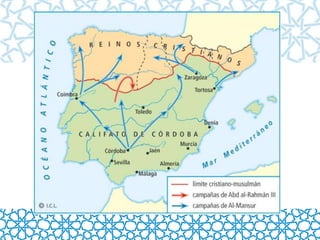
• In 929, Abd al-Rahman III proclaimed himself caliph, declaring the 
religious independence of al-Andalus. 
• He ended internal rebellions and fought against the Christians in the 
north. It was a golden age, and Cordoba was the most prosperous 
city in the west. 
• Under Al-Haken II and Hixen II, the situation was the same. Hixem 
II’s vizier, Almanzor, plundered Barcelona and Santiago. With his 
death, the caliphate was in crisis.
THE TAIFAS 
• In 1031, the Caliphate of Cordoba was divided into 28 
different taifas or kingdoms. Christians made them paying 
taxes (parias). Christians conquered Toledo in 1085 
(Alphonse VI). 
ALMORAVIDS AND ALMOHADS. 
• Almoravid were nomadic Berbers who had an empire in North 
Africa (Marrakech was its capital). They came to al-Andalus 
and beated the Christians in the battle of Sagrajas. 
• Almohads replaced Almoravids, and incorporated al-Andalus 
to their empire. But in 1212 they were defeated at the battle 
of Las Navas de Tolosa. Christian penetrated into the valley 
of Guadalquivir. Al-Andalus was reduced to a small kingdom 
(Granada).
THE NASRID KINGDOM OF GRANADA 
• The Muslim Kingdom of Granada, governed by the Nasrid dinasty, 
survied in the Peninsula until 1492, due to 2 circumstances: 
– The support of the Muslims from North Africa. 
– They paid tributes to the Castillian kings.
The economy and society in al- 
Andalus 
ECONOMY 
• The city was the centre of 
the economic activity 
(market=souqs=zoco). 
• Agriculture was the main 
activity. They developed 
irrigation, using wells, 
waterwheels and ditches. 
Introduced new crops (rice, 
citrus fruits, hemp). 
• Artisans also produces 
textiles, leather and glass. 
• Trade was very important in 
al-Andalus.
The economy and society in al- 
Andalus
Islamic art and culture 
ISLAMIC CULTURE 
• Islamic culture made important advances and inventions.
Islamic Art 
ARCHITECTURE AND DESIGN 
• Islam forbids the presentation of 
human and animal forms, so 
their art is based on architecture 
and design. 
• Buildings were made with poor-quality 
construction materiales 
(brick, wood, plaster). 
• They used columns and pillars 
to support horseshoe arches 
and vaulted roofs.
• The usually decorated the buildings with vegetables (arabesque), 
geometric figures (tracery) and inscriptions from the Koran 
(epigraphy).
• The Mosque is the most important building (based on Muhammad’s 
house in Medina): 
– Courtyard, where we find a fountain, and a minaret or tower. 
– The hall of prayer, covered with arches and columns. The kiblah 
faces to the Mecca and holds the mihrab. 
– Damascus, Kairouan, Samarra, Jerusalem, Córdoba.
Mosque of Damascus
Mosque of Jerusalem
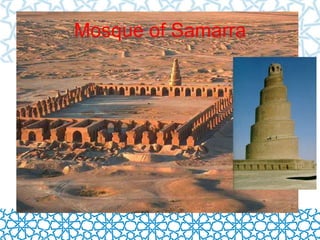
Mosque of Samarra
Mosque of Kairouan
Mosque of Córdoba
Mosque of Córdoba - Mihrab
Mosque of Córdoba – Prayer 
room
Old minaret of 
Seville’s Mosque 
(Giralda tower)
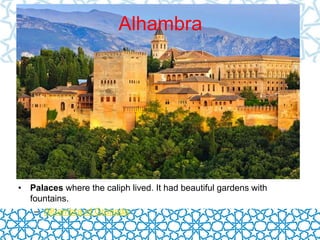
Alhambra 
• Palaces where the caliph lived. It had beautiful gardens with 
fountains. 
– Alhambra of Granada
Madinat Al-Zahra
Madinat Al-Zahra

Al-Andalus

  • 1.
    Islam and Al- Andalus
  • 2.
    • Islam isone the biggest religions in the world. It’s a monotheist religion that believes in one god. It was first preached by the Prophet Muhammad in Arabia, in the early 7th century, around the cities of Mecca and Yathrib (present-day Medina or Madinat An Nabi = city of the Prophet). • Its principles rapidly spread throughout the north of Africa, Asia and parts of Europe. • Today Islam is the second biggest religion in the world with 1570 million followers.
  • 4.
    • The Muslimsarrived on the Iberian peninsula in 711. They defeated the Visigoth kingdom and created the Islamic state, al-Andalus.
  • 5.
    • Muslims stayedon the Peninsula until 1492. We can see Muslim influences in our culture, art, customs and language.
  • 6.
    Islam of theIberian Peninsula: al- Andalus THE CONQUEST • In 711 Tarik, lieutenant of Musa (North Africa governor) crossed the Strait of Gibraltar with Arab and Berber troops. • They wanted to plunder the area, but the victory over the King Roderick (Rodrigo) at the Battle of Guadalete (711) encourage them to advance. • In 4 years, they conquered most of the Peninsula; following the battle of Covadonga (722), only the North remained Christian (Cantabria and Asturias). • Muslims reached France (Battle of Poitiers, 732), but were defeated by Charles Martel.
  • 7.
    THE DEPENDENT EMIRATEOF DAMASCUS • After the conquest, al-Andalus became an emirate: province depending on the Umayyad caliphate of Damascus. The capital was Cordoba. THE INDEPENDENT EMIRATE • In 756, Abd al-Rahman I, an Umayyad prince came to al-Andalus escaping from the Abbasids of Baghdad. He proclaimed himself independent emir, but recognised the religious authority of Baghdad. • During this period, Christians conquered Zamora, and Franks Gerona and Barcelona (Hispanic March).
  • 9.
    THE CALIPHATE OFCORDOBA • In 929, Abd al-Rahman III proclaimed himself caliph, declaring the religious independence of al-Andalus. • He ended internal rebellions and fought against the Christians in the north. It was a golden age, and Cordoba was the most prosperous city in the west. • Under Al-Haken II and Hixen II, the situation was the same. Hixem II’s vizier, Almanzor, plundered Barcelona and Santiago. With his death, the caliphate was in crisis.
  • 11.
    THE TAIFAS •In 1031, the Caliphate of Cordoba was divided into 28 different taifas or kingdoms. Christians made them paying taxes (parias). Christians conquered Toledo in 1085 (Alphonse VI). ALMORAVIDS AND ALMOHADS. • Almoravid were nomadic Berbers who had an empire in North Africa (Marrakech was its capital). They came to al-Andalus and beated the Christians in the battle of Sagrajas. • Almohads replaced Almoravids, and incorporated al-Andalus to their empire. But in 1212 they were defeated at the battle of Las Navas de Tolosa. Christian penetrated into the valley of Guadalquivir. Al-Andalus was reduced to a small kingdom (Granada).
  • 13.
    THE NASRID KINGDOMOF GRANADA • The Muslim Kingdom of Granada, governed by the Nasrid dinasty, survied in the Peninsula until 1492, due to 2 circumstances: – The support of the Muslims from North Africa. – They paid tributes to the Castillian kings.
  • 15.
    The economy andsociety in al- Andalus ECONOMY • The city was the centre of the economic activity (market=souqs=zoco). • Agriculture was the main activity. They developed irrigation, using wells, waterwheels and ditches. Introduced new crops (rice, citrus fruits, hemp). • Artisans also produces textiles, leather and glass. • Trade was very important in al-Andalus.
  • 16.
    The economy andsociety in al- Andalus
  • 17.
    Islamic art andculture ISLAMIC CULTURE • Islamic culture made important advances and inventions.
  • 18.
    Islamic Art ARCHITECTUREAND DESIGN • Islam forbids the presentation of human and animal forms, so their art is based on architecture and design. • Buildings were made with poor-quality construction materiales (brick, wood, plaster). • They used columns and pillars to support horseshoe arches and vaulted roofs.
  • 19.
    • The usuallydecorated the buildings with vegetables (arabesque), geometric figures (tracery) and inscriptions from the Koran (epigraphy).
  • 20.
    • The Mosqueis the most important building (based on Muhammad’s house in Medina): – Courtyard, where we find a fountain, and a minaret or tower. – The hall of prayer, covered with arches and columns. The kiblah faces to the Mecca and holds the mihrab. – Damascus, Kairouan, Samarra, Jerusalem, Córdoba.
  • 21.
  • 22.
  • 23.
  • 24.
  • 25.
  • 26.
  • 27.
    Mosque of Córdoba– Prayer room
  • 28.
    Old minaret of Seville’s Mosque (Giralda tower)
  • 29.
    Alhambra • Palaceswhere the caliph lived. It had beautiful gardens with fountains. – Alhambra of Granada
  • 30.
  • 31.