CONTEMPORARY
SOCIETY
SOCIAL SCIENCE 2º ESO
WHAT IS A SOCIETY?
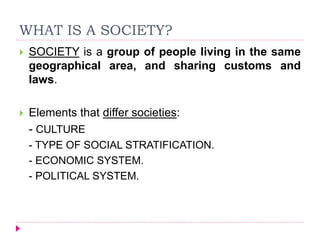
 SOCIETY is a group of people living in the same
geographical area, and sharing customs and
laws.
 Elements that differ societies:
- CULTURE
- TYPE OF SOCIAL STRATIFICATION.
- ECONOMIC SYSTEM.
- POLITICAL SYSTEM.
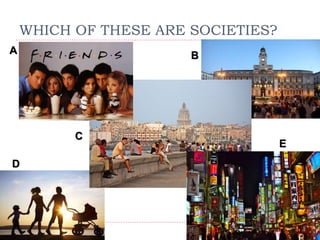
WHICH OF THESE ARE SOCIETIES?
A B
C
D
E
TYPES OF SOCIETIES – Traditional Societies
 Prehistory – 19th century.
 Thoughts and very strict rules.
 Little amount of goods.
 Primitive production techniques or little use of
technology.
 Hunting, fishing and gathering. After 8000 bc,
farming and stockbreeding.
 Families; tribes; social inequality.
 Now it keeps in some areas of Latin America,
southeast of Asia and Africa.
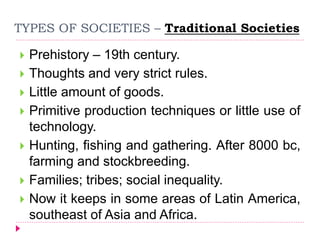
 Thai farmers
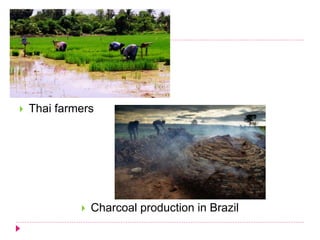
 Charcoal production in Brazil
TYPES OF SOCIETIES – Industrial Societies
 Western Europe around 1780 (Industrial
Revolution). During 19th and 20th centuries it
spreads to other areas in world due to
colonisation.
 Different ways of thinking, more freedom.
 Bigger amount of goods.
 Social classes differ because of the wealth.
 Social inequality between owners and
workers.
 Industry and services.
 States, borders, rise of democracy.
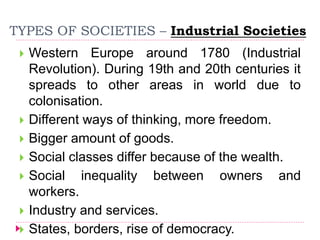
 Industry in China.
TYPES OF SOCIETIES – The information
or post - Industrial Societies
 Arose in 1970 with information and
telecommunication revolution.
 Many different ways of thinking and
lifestyles.
 Massive production of goods thanks to
high – tech.
 Middle class.
 Information, High – tech, services.
 Welfare state.
 EEUU, European Union, Japan, etc.
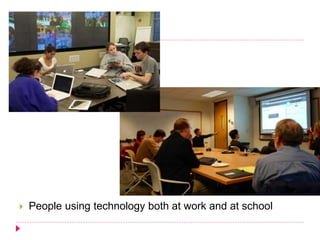
 People using technology both at work and at school
HOMEWORK.
 1. DEFINE SOCIETY.
 2. LOOK AT THE PICTURES ON YOUR WORKSHEET
AND SAY WHICH TYPE OF SOCIETY EACH OF THEM
SHOWS, AND EXPLAIN WHY.
 3. GIVE EXAMPLES OF EACH TYPES OF SOCIETY
GIVING NAMES OF DIFFERENT COUNTRIES IN THE
WORLD.
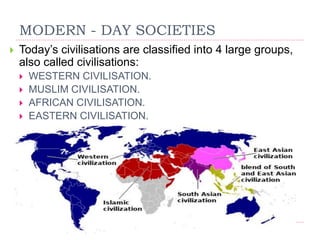
MODERN - DAY SOCIETIES
 Today’s civilisations are classified into 4 large groups,
also called civilisations:
 WESTERN CIVILISATION.
 MUSLIM CIVILISATION.
 AFRICAN CIVILISATION.
 EASTERN CIVILISATION.
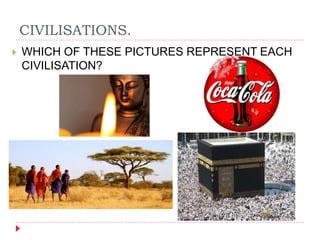
CIVILISATIONS.
 WHICH OF THESE PICTURES REPRESENT EACH
CIVILISATION?
MODERN - DAY SOCIETIES
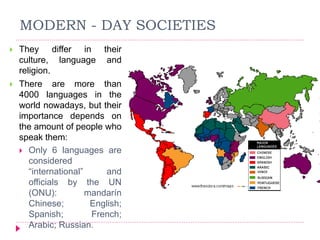
 They differ in their
culture, language and
religion.
 There are more than
4000 languages in the
world nowadays, but their
importance depends on
the amount of people who
speak them:
 Only 6 languages are
considered
“international” and
officials by the UN
(ONU): mandarín
Chinese; English;
Spanish; French;
Arabic; Russian.
MODERN - DAY SOCIETIES
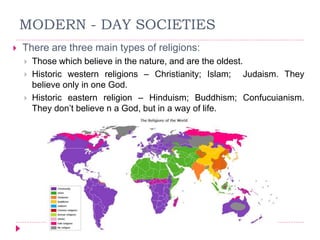
 There are three main types of religions:
 Those which believe in the nature, and are the oldest.
 Historic western religions – Christianity; Islam; Judaism. They
believe only in one God.
 Historic eastern religion – Hinduism; Buddhism; Confucuianism.
They don’t believe n a God, but in a way of life.
HOMEWORK
 1. COMPLETE YOUR WORKSHEETS WITH THE
WORLD’S MAPS.
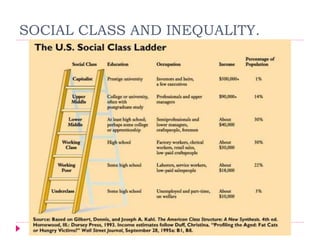
SOCIAL CLASS AND INEQUALITY.
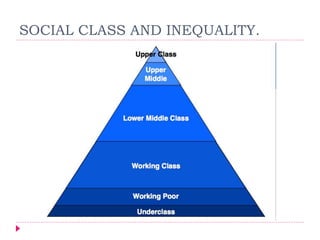
 Societies nowadays are classified into social
groups called classes.
 Each class share lifestyles and standards of
living, and are structured in a hierarchical way,
according to the social power they hold.
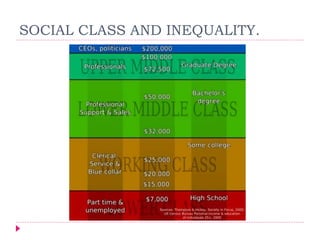
 The factor that stablishes whether a person belongs
to one or another social class is the personal
wealth.
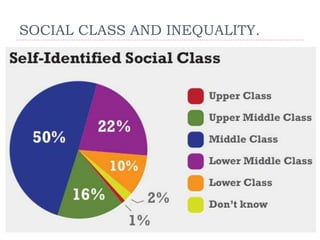
SOCIAL CLASS AND INEQUALITY.
 DEVELOPED COUNTRIES:
 Social differences tend to be less severe.
 Society is divided into three main groups:
 SMALL UPPER CLASS: very rich and powerful
people, and sometimes, a small number of other
proffessions.
 VERY LARGE MIDDLE CLASS: small to medium
business owners and high – ranking professionals
(doctors, lawyers, teachers); middle – ranking
professionals (office workers)
 VERY LARGE WORKING CLASS: skilled manual
workers (electricians, plumbers) and unskilled
workers and labourers.
SOCIAL CLASS AND INEQUALITY.
 DEVELOPING COUNTRIES.
 Rigid social divisions.
 Powerful ruling class that controls the nation’s power
and wealth.
 Small middle class.
 General population: labourers and urban poor, who
live in poverty in marginalized areas of big cities and
have no participation in government affairs.
HOMEWORK.
 1. READ THE THREE PARAGRAPH ABOUT
SOCIAL CLASSES ON YOUR TEXT BOOK, PAGE
74, AND DRAW YOUR OWN DIAGRAM SHOWING
AND EXPLAINING THE DIFFERENT TYPES OF
SOCIETIES. (YOU CAN TAKE SOME IDEAS FROM THE DIAGRAMS
WE HAVE JUST SEEN).
 II. READ THE TEXT ABOUT THE HUMAN RIGHTS
AND ANSWER THE QUESTIONS.
 III. GO TO PAGE 75, AND DO ACTIVITIES 9 AND
10.
SOCIETY AND STATE.
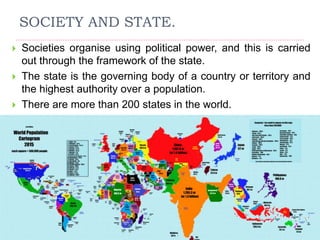
 Societies organise using political power, and this is carried
out through the framework of the state.
 The state is the governing body of a country or territory and
the highest authority over a population.
 There are more than 200 states in the world.
SOCIETY AND STATE.
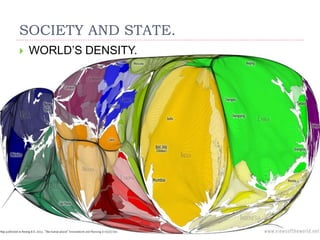
 WORLD’S DENSITY.
SOCIETY AND STATE. – WORK ON YOUR
OWN
 THE SPANISH STATE.
 READ PAGE 78 FROM YOUR TEXT BOOK.
 COMPLETE THE MAP OF THE TERRITORIAL
ORGANISATION OF THE SPANISH STATE.
 DO ACTIVITIES 18, 24, 25, 26, 27, 28.
SOCIETY AND STATE.
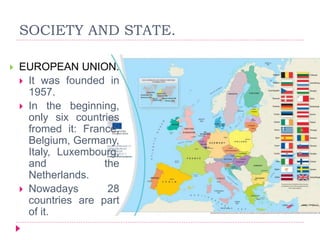
 EUROPEAN UNION.
 It was founded in
1957.
 In the beginning,
only six countries
fromed it: France,
Belgium, Germany,
Italy, Luxembourg,
and the
Netherlands.
 Nowadays 28
countries are part
of it.
EUROPEAN AND SPANISH SOCIETY.
 Both European and Spanish societies share three
features:
 They are organised in three social classes: upper (5%);
middle class (most of population); working class – they
have more purchasing power than in the past.
 Most european countries have democratic
governments, and societies that guarantee basic rights
and political participation.
 They are post – industrial societies:
 The majority of people are employed in the service
sector.
 High standard of living, although poverty is still an
issue.
EUROPEAN AND SPANISH SOCIETY.
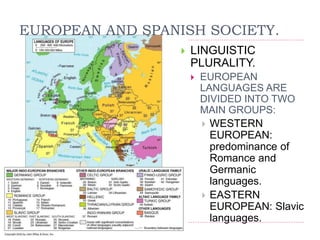
 LINGUISTIC
PLURALITY.
 EUROPEAN
LANGUAGES ARE
DIVIDED INTO TWO
MAIN GROUPS:
 WESTERN
EUROPEAN:
predominance of
Romance and
Germanic
languages.
 EASTERN
EUROPEAN: Slavic
languages.
EUROPEAN AND SPANISH SOCIETY.
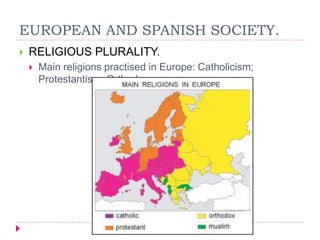
 RELIGIOUS PLURALITY.
 Main religions practised in Europe: Catholicism;
Protestantism; Orthodoxy.
EUROPEAN AND SPANISH SOCIETY.
 MULTICULTURALISM.
 Due to inmigration to Europe and to Spain, their societies
are more diverse.
 Coexistence of different cultures.
 Cultural enrichment.
 Social problems: xenophobic attitudes towards
immigrants.
HOMEWORK.
 DO ACTIVITIES 17, 18, 19, 20, 21 AND 22 FROM
PAGE 77.

Contemporary society

  • 1.
  • 2.
    WHAT IS ASOCIETY?  SOCIETY is a group of people living in the same geographical area, and sharing customs and laws.  Elements that differ societies: - CULTURE - TYPE OF SOCIAL STRATIFICATION. - ECONOMIC SYSTEM. - POLITICAL SYSTEM.
  • 3.
    WHICH OF THESEARE SOCIETIES? A B C D E
  • 4.
    TYPES OF SOCIETIES– Traditional Societies  Prehistory – 19th century.  Thoughts and very strict rules.  Little amount of goods.  Primitive production techniques or little use of technology.  Hunting, fishing and gathering. After 8000 bc, farming and stockbreeding.  Families; tribes; social inequality.  Now it keeps in some areas of Latin America, southeast of Asia and Africa.
  • 5.
     Thai farmers Charcoal production in Brazil
  • 6.
    TYPES OF SOCIETIES– Industrial Societies  Western Europe around 1780 (Industrial Revolution). During 19th and 20th centuries it spreads to other areas in world due to colonisation.  Different ways of thinking, more freedom.  Bigger amount of goods.  Social classes differ because of the wealth.  Social inequality between owners and workers.  Industry and services.  States, borders, rise of democracy.
  • 7.
  • 8.
    TYPES OF SOCIETIES– The information or post - Industrial Societies  Arose in 1970 with information and telecommunication revolution.  Many different ways of thinking and lifestyles.  Massive production of goods thanks to high – tech.  Middle class.  Information, High – tech, services.  Welfare state.  EEUU, European Union, Japan, etc.
  • 9.
     People usingtechnology both at work and at school
  • 10.
    HOMEWORK.  1. DEFINESOCIETY.  2. LOOK AT THE PICTURES ON YOUR WORKSHEET AND SAY WHICH TYPE OF SOCIETY EACH OF THEM SHOWS, AND EXPLAIN WHY.  3. GIVE EXAMPLES OF EACH TYPES OF SOCIETY GIVING NAMES OF DIFFERENT COUNTRIES IN THE WORLD.
  • 11.
    MODERN - DAYSOCIETIES  Today’s civilisations are classified into 4 large groups, also called civilisations:  WESTERN CIVILISATION.  MUSLIM CIVILISATION.  AFRICAN CIVILISATION.  EASTERN CIVILISATION.
  • 12.
    CIVILISATIONS.  WHICH OFTHESE PICTURES REPRESENT EACH CIVILISATION?
  • 13.
    MODERN - DAYSOCIETIES  They differ in their culture, language and religion.  There are more than 4000 languages in the world nowadays, but their importance depends on the amount of people who speak them:  Only 6 languages are considered “international” and officials by the UN (ONU): mandarín Chinese; English; Spanish; French; Arabic; Russian.
  • 14.
    MODERN - DAYSOCIETIES  There are three main types of religions:  Those which believe in the nature, and are the oldest.  Historic western religions – Christianity; Islam; Judaism. They believe only in one God.  Historic eastern religion – Hinduism; Buddhism; Confucuianism. They don’t believe n a God, but in a way of life.
  • 15.
    HOMEWORK  1. COMPLETEYOUR WORKSHEETS WITH THE WORLD’S MAPS.
  • 16.
    SOCIAL CLASS ANDINEQUALITY.  Societies nowadays are classified into social groups called classes.  Each class share lifestyles and standards of living, and are structured in a hierarchical way, according to the social power they hold.  The factor that stablishes whether a person belongs to one or another social class is the personal wealth.
  • 17.
    SOCIAL CLASS ANDINEQUALITY.
  • 18.
    SOCIAL CLASS ANDINEQUALITY.
  • 19.
    SOCIAL CLASS ANDINEQUALITY.
  • 20.
    SOCIAL CLASS ANDINEQUALITY.
  • 21.
    SOCIAL CLASS ANDINEQUALITY.  DEVELOPED COUNTRIES:  Social differences tend to be less severe.  Society is divided into three main groups:  SMALL UPPER CLASS: very rich and powerful people, and sometimes, a small number of other proffessions.  VERY LARGE MIDDLE CLASS: small to medium business owners and high – ranking professionals (doctors, lawyers, teachers); middle – ranking professionals (office workers)  VERY LARGE WORKING CLASS: skilled manual workers (electricians, plumbers) and unskilled workers and labourers.
  • 22.
    SOCIAL CLASS ANDINEQUALITY.  DEVELOPING COUNTRIES.  Rigid social divisions.  Powerful ruling class that controls the nation’s power and wealth.  Small middle class.  General population: labourers and urban poor, who live in poverty in marginalized areas of big cities and have no participation in government affairs.
  • 23.
    HOMEWORK.  1. READTHE THREE PARAGRAPH ABOUT SOCIAL CLASSES ON YOUR TEXT BOOK, PAGE 74, AND DRAW YOUR OWN DIAGRAM SHOWING AND EXPLAINING THE DIFFERENT TYPES OF SOCIETIES. (YOU CAN TAKE SOME IDEAS FROM THE DIAGRAMS WE HAVE JUST SEEN).  II. READ THE TEXT ABOUT THE HUMAN RIGHTS AND ANSWER THE QUESTIONS.  III. GO TO PAGE 75, AND DO ACTIVITIES 9 AND 10.
  • 24.
    SOCIETY AND STATE. Societies organise using political power, and this is carried out through the framework of the state.  The state is the governing body of a country or territory and the highest authority over a population.  There are more than 200 states in the world.
  • 25.
    SOCIETY AND STATE. WORLD’S DENSITY.
  • 26.
    SOCIETY AND STATE.– WORK ON YOUR OWN  THE SPANISH STATE.  READ PAGE 78 FROM YOUR TEXT BOOK.  COMPLETE THE MAP OF THE TERRITORIAL ORGANISATION OF THE SPANISH STATE.  DO ACTIVITIES 18, 24, 25, 26, 27, 28.
  • 27.
    SOCIETY AND STATE. EUROPEAN UNION.  It was founded in 1957.  In the beginning, only six countries fromed it: France, Belgium, Germany, Italy, Luxembourg, and the Netherlands.  Nowadays 28 countries are part of it.
  • 28.
    EUROPEAN AND SPANISHSOCIETY.  Both European and Spanish societies share three features:  They are organised in three social classes: upper (5%); middle class (most of population); working class – they have more purchasing power than in the past.  Most european countries have democratic governments, and societies that guarantee basic rights and political participation.  They are post – industrial societies:  The majority of people are employed in the service sector.  High standard of living, although poverty is still an issue.
  • 29.
    EUROPEAN AND SPANISHSOCIETY.  LINGUISTIC PLURALITY.  EUROPEAN LANGUAGES ARE DIVIDED INTO TWO MAIN GROUPS:  WESTERN EUROPEAN: predominance of Romance and Germanic languages.  EASTERN EUROPEAN: Slavic languages.
  • 30.
    EUROPEAN AND SPANISHSOCIETY.  RELIGIOUS PLURALITY.  Main religions practised in Europe: Catholicism; Protestantism; Orthodoxy.
  • 31.
    EUROPEAN AND SPANISHSOCIETY.  MULTICULTURALISM.  Due to inmigration to Europe and to Spain, their societies are more diverse.  Coexistence of different cultures.  Cultural enrichment.  Social problems: xenophobic attitudes towards immigrants.
  • 32.
    HOMEWORK.  DO ACTIVITIES17, 18, 19, 20, 21 AND 22 FROM PAGE 77.