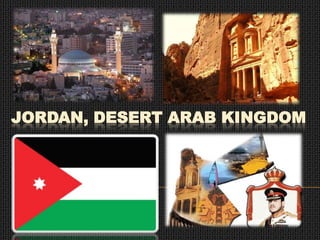
JORDAN, DESERT ARAB KINGDOM
GEOGRAPHY
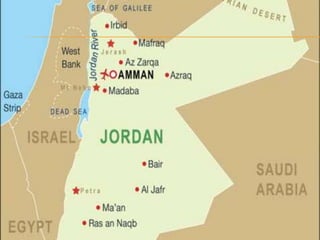
   The Hashemite Kingdom of Jordan is
    almost everywhere semi-arid or desert.
    With an area of 96,188 sq. km., part of it
    (6,333 sq. km.) is still occupied by Israel.
    It shares borders with Israel, Syria.
    Iraq, and Saudi Arabia. It has the small
    port of Aqaba and the Red Sea. The only
    region fit irrigated agriculture is the
    Jordan River valley.
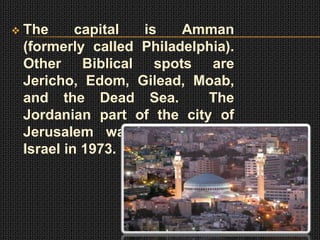
   The      capital is    Amman
    (formerly called Philadelphia).
    Other Biblical spots are
    Jericho, Edom, Gilead, Moab,
    and the Dead Sea.         The
    Jordanian part of the city of
    Jerusalem was captured by
    Israel in 1973.
PEOPLE
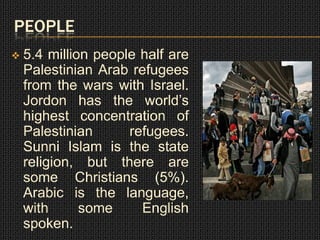
   5.4 million people half are
    Palestinian Arab refugees
    from the wars with Israel.
    Jordon has the world’s
    highest concentration of
    Palestinian      refugees.
    Sunni Islam is the state
    religion, but there are
    some Christians (5%).
    Arabic is the language,
    with      some     English
    spoken.
   Jordan is the most successful Arab country.
    Though it has a poor natural resources (no oil)
    and a diverse population, it has more political
    stability and a better life than most Arab
    countries. It exports phosphate, vegetables,
    chemicals, and citrus fruits to neighboring Arab
    states and the Socialist bloc. Tourism is also a
    major industry (1 million, tourists yearly) to see
    places in the Holy Land, the rock tombs of Petra,
    and the Wadi Rum wilderness.

   Jordanians are courteous, hospitable, and law-
    abiding. There is no serious crime rate in Jordan.
    Women enjoy a higher status than in other Arab
    countries. Literacy is high, and they have a new
    university. The skilled workers of Jordan are
    highly regarded throughout the Middle East, and
    their remittances home are important to the
    economy.
HISTORY
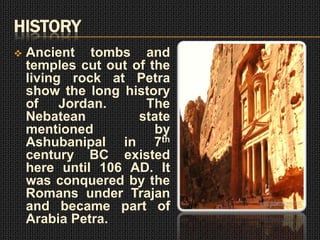
   Ancient tombs and
    temples cut out of the
    living rock at Petra
    show the long history
    of Jordan.        The
    Nebatean         state
    mentioned           by
    Ashubanipal in 7th
    century BC existed
    here until 106 AD. It
    was conquered by the
    Romans under Trajan
    and became part of
    Arabia Petra.
   The southern part of Jordan was called Seir,
    where Ammon, Moab, Sodom and Gomorrha
    existed. The Jordan River was the site of
    the baptism of Jesus, and Mt. Moab was the
    traditional scene of his temptation. Jordan
    was part of the tetrarchy of Herod.

   During the Crusades (1095 – 1291), most of
    Jordan was included as Outrejodan in the
    kingdom of Jerusalem. Under the Ottoman
    Turks, it became part of Syria.
 After World War I, the Palestine area (which
  included Jordan) came under British
  mandate. In 1921 Britain separated Palestine
  and made a new emirate of Trans-Jordan,
  with Amman as the capital. Prince Adbullah,
  oldest son of King Hussein of the Arabian
  Hashemite Kingdom (and brother of King
  Faisal of Iraq), became the new emir with
  limited power.
 After World War II, Jordan became a
  sovereign independent state on May 25,
  1946. Abdullah remained as king and played
  a leading role in the, formation of the Arab
  League and the 1948-1945 war with Israel. In
  1950 he annexed part of Palestine still
  remaining in Arab hands.
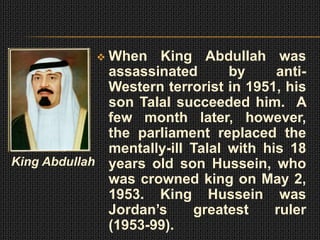
 When King Abdullah was
              assassinated       by     anti-
              Western terrorist in 1951, his
              son Talal succeeded him. A
              few month later, however,
              the parliament replaced the
              mentally-ill Talal with his 18
King Abdullah years old son Hussein, who
              was crowned king on May 2,
              1953. King Hussein was
              Jordan’s     greatest     ruler
              (1953-99).
   From the beginning of his reign, King
    Hussein had to steer a dangerous course
    between Israel, his more powerful Arab
    neighbors, and rising Palestian nationalism.
    He survived several assassination attempts
    due to his policies. His brave Bedouin
    desert army of desert warriors stod by him
    at all times.

   In 1955 riots erupted in Amman when he
    joined the Baghdad Pact (CENTO). He
    incurred further unpopularity when he
    placed his army at the disposal of Egypt’s
    Nasser during the 1956 Suez Canal crisis.
    Jordan was swept into the 1967 Arab –
    Israeli war, and lost the old city of
JORDAN UNDER HUSSEIN.
              After the defeat, bitter Palestinian
               guerrillas took over sections of
               Jordan, and they battled with
               Jordanian government troops in
               1970. Despite the help of Syrian
               tanks, the Palestians were defeated
               by Hussein’s Bedouin army.       The
               Jordanians also drove out thousands
               of Syrian and Iraqi troops from their
               country.

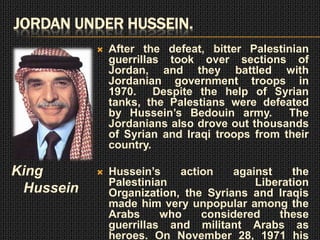
King          Hussein’s    action    against    the
               Palestinian                Liberation
 Hussein       Organization, the Syrians and Iraqis
               made him very unpopular among the
               Arabs     who    considered    these
               guerrillas and militant Arabs as
               heroes. On November 28, 1971 his
After taking sides with the losing Arab wars
with Israel, King Hussein decided to play a
more moderate role to protect his small
kingdom. Jordan had lost the West Bank
territory and the city of Jerusalem to the
Israelis. He relinquished all claims to the
Palestinian West Bank and Jerusalem. He
personally visited the family of the Israeli
solider shot in a border incident. Following
a Jewish custom of mouring, he knelt down
and wept before the Jewish mother for her
son’s loss, a sincere gesture that captured
the need for forgiveness for both sides.
As conditions also changed in
the Arab world, King Hussein
acquired a new image and role.
By the mid – 1990S he emerged
as the only Middle Eastern leader
to enjoy good relations with all –
Arabs, Palestinians, Israelis, the
Western,    and     the    former
Communist powers.
 Towards  the end of his life, King
 Hussein became the most popular
 man in the Middle East Like King
 Solomon, friends and enemies alike
 sought his wisdom and benediction
 important moves. He interceded for
 and between Arabs, hosted Arab
 summits, settled local disputes, and
 influenced the Palestinians to make
 peace with the Israelis.
His death in February 1999 was a great
loss to the cause of peace in the Middle
East. For a man with a small build, and
coming from a small desert kingdom,
King Hussein (1953 – 99) and his acts of
forgiveness, humility and peace were
the most valuable and powerful
commodities in the region.
His son Adbdullah took over as the new
king of the Hashemite Kingdom.
- END -

Jordan, desert arab kingdom

  • 1.
  • 2.
    GEOGRAPHY  The Hashemite Kingdom of Jordan is almost everywhere semi-arid or desert. With an area of 96,188 sq. km., part of it (6,333 sq. km.) is still occupied by Israel. It shares borders with Israel, Syria. Iraq, and Saudi Arabia. It has the small port of Aqaba and the Red Sea. The only region fit irrigated agriculture is the Jordan River valley.
  • 4.
    The capital is Amman (formerly called Philadelphia). Other Biblical spots are Jericho, Edom, Gilead, Moab, and the Dead Sea. The Jordanian part of the city of Jerusalem was captured by Israel in 1973.
  • 5.
    PEOPLE  5.4 million people half are Palestinian Arab refugees from the wars with Israel. Jordon has the world’s highest concentration of Palestinian refugees. Sunni Islam is the state religion, but there are some Christians (5%). Arabic is the language, with some English spoken.
  • 6.
    Jordan is the most successful Arab country. Though it has a poor natural resources (no oil) and a diverse population, it has more political stability and a better life than most Arab countries. It exports phosphate, vegetables, chemicals, and citrus fruits to neighboring Arab states and the Socialist bloc. Tourism is also a major industry (1 million, tourists yearly) to see places in the Holy Land, the rock tombs of Petra, and the Wadi Rum wilderness.  Jordanians are courteous, hospitable, and law- abiding. There is no serious crime rate in Jordan. Women enjoy a higher status than in other Arab countries. Literacy is high, and they have a new university. The skilled workers of Jordan are highly regarded throughout the Middle East, and their remittances home are important to the economy.
  • 7.
    HISTORY  Ancient tombs and temples cut out of the living rock at Petra show the long history of Jordan. The Nebatean state mentioned by Ashubanipal in 7th century BC existed here until 106 AD. It was conquered by the Romans under Trajan and became part of Arabia Petra.
  • 8.
    The southern part of Jordan was called Seir, where Ammon, Moab, Sodom and Gomorrha existed. The Jordan River was the site of the baptism of Jesus, and Mt. Moab was the traditional scene of his temptation. Jordan was part of the tetrarchy of Herod.  During the Crusades (1095 – 1291), most of Jordan was included as Outrejodan in the kingdom of Jerusalem. Under the Ottoman Turks, it became part of Syria.
  • 9.
     After WorldWar I, the Palestine area (which included Jordan) came under British mandate. In 1921 Britain separated Palestine and made a new emirate of Trans-Jordan, with Amman as the capital. Prince Adbullah, oldest son of King Hussein of the Arabian Hashemite Kingdom (and brother of King Faisal of Iraq), became the new emir with limited power.  After World War II, Jordan became a sovereign independent state on May 25, 1946. Abdullah remained as king and played a leading role in the, formation of the Arab League and the 1948-1945 war with Israel. In 1950 he annexed part of Palestine still remaining in Arab hands.
  • 10.
     When KingAbdullah was assassinated by anti- Western terrorist in 1951, his son Talal succeeded him. A few month later, however, the parliament replaced the mentally-ill Talal with his 18 King Abdullah years old son Hussein, who was crowned king on May 2, 1953. King Hussein was Jordan’s greatest ruler (1953-99).
  • 11.
    From the beginning of his reign, King Hussein had to steer a dangerous course between Israel, his more powerful Arab neighbors, and rising Palestian nationalism. He survived several assassination attempts due to his policies. His brave Bedouin desert army of desert warriors stod by him at all times.  In 1955 riots erupted in Amman when he joined the Baghdad Pact (CENTO). He incurred further unpopularity when he placed his army at the disposal of Egypt’s Nasser during the 1956 Suez Canal crisis. Jordan was swept into the 1967 Arab – Israeli war, and lost the old city of
  • 12.
    JORDAN UNDER HUSSEIN.  After the defeat, bitter Palestinian guerrillas took over sections of Jordan, and they battled with Jordanian government troops in 1970. Despite the help of Syrian tanks, the Palestians were defeated by Hussein’s Bedouin army. The Jordanians also drove out thousands of Syrian and Iraqi troops from their country. King  Hussein’s action against the Palestinian Liberation Hussein Organization, the Syrians and Iraqis made him very unpopular among the Arabs who considered these guerrillas and militant Arabs as heroes. On November 28, 1971 his
  • 13.
    After taking sideswith the losing Arab wars with Israel, King Hussein decided to play a more moderate role to protect his small kingdom. Jordan had lost the West Bank territory and the city of Jerusalem to the Israelis. He relinquished all claims to the Palestinian West Bank and Jerusalem. He personally visited the family of the Israeli solider shot in a border incident. Following a Jewish custom of mouring, he knelt down and wept before the Jewish mother for her son’s loss, a sincere gesture that captured the need for forgiveness for both sides.
  • 14.
    As conditions alsochanged in the Arab world, King Hussein acquired a new image and role. By the mid – 1990S he emerged as the only Middle Eastern leader to enjoy good relations with all – Arabs, Palestinians, Israelis, the Western, and the former Communist powers.
  • 15.
     Towards the end of his life, King Hussein became the most popular man in the Middle East Like King Solomon, friends and enemies alike sought his wisdom and benediction important moves. He interceded for and between Arabs, hosted Arab summits, settled local disputes, and influenced the Palestinians to make peace with the Israelis.
  • 16.
    His death inFebruary 1999 was a great loss to the cause of peace in the Middle East. For a man with a small build, and coming from a small desert kingdom, King Hussein (1953 – 99) and his acts of forgiveness, humility and peace were the most valuable and powerful commodities in the region. His son Adbdullah took over as the new king of the Hashemite Kingdom.
  • 17.