ISLAM THE FIRST TRANS-REGIONAL CIVILIZATION
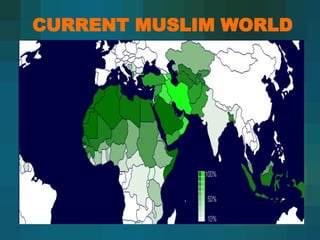
CURRENT MUSLIM WORLD
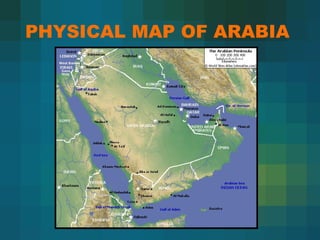
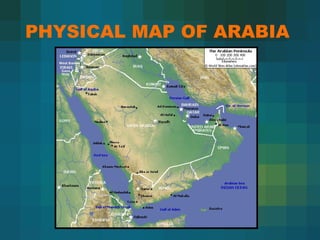
PRE-ISLAMIC ARABIA The Arabian peninsula  Largely deserts with mountains, oases Fertile areas in the southern mountains around Yemen Nomadic  Bedouin  Lived in the desert-covered peninsula for millennia  Kept herds of sheep, goats, and camels  Organized in family and clan groups  Importance of kinship and loyalty to the clan Many tribes seem to have been matrilineal with some rights for women  Post-classical Arabia Romans (Byzantines) and Persians had client kingdoms in area Active in long-distance over land trade Trade from Damascus to Mecca/Medina to Yemen Trade across desert to Persian Gulf and along coast  Part of Red Sea trade system; links between Yemen and Abyssinia Trade includes gold, frankincense and myrrh Religion was polytheist Groups of Jews in Arabia; Monophysite Christians in cities
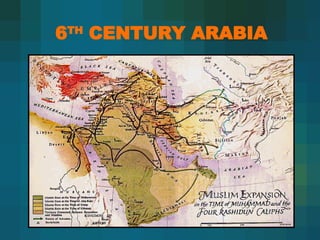
6 TH  CENTURY ARABIA
PHYSICAL MAP OF ARABIA
MUHAMMAD’S EARLY LIFE Muhammad  ibn Abdullah  Born in a Mecca merchant family, 570 C.E.  Difficult early life: orphaned, lived with uncle  Married a wealthy widow, Khadija, in 595  Became a merchant at age 30, exposed to various faiths  Muhammad's spiritual transformation  At age 40, he experienced visions  There was only one true god, Allah ("the god")  Allah would soon bring judgment on the world  The archangel Gabriel delivered these revelations to Muhammad  Did not intend to found a new religion, but his message became appealing  The  Quran  Followers compiled Muhammad's actual revelations after his death Quran ("recitation"), became the holy book of Islam Suras are chapters; organized from longest to shortest  A work of magnificent poetry The  Hadith Sayings attributed to Muhammad; not included in Quran Three levels from most accurate/likely to highly suspect
THE HIJRA (FLIGHT) Conflict at Mecca  His teachings offended others, especially ruling elite of Mecca  Attacks on greed offended wealthy merchants  Attacks on idolatry threatened shrines, especially the Kaa'ba  The  hijra   Under persecution, Muhammad, followers fled to Medina, 622 C.E.  The move, known as  hijra , was starting point of Islamic calendar  The  umma   Organized a cohesive community called  umma  in Medina  Led commercial adventure Sometimes launched raids against Mecca caravans  Helped the poor and needy  The "seal of the prophets"  Referred himself as "seal of the prophets," - final prophet of Allah  Held Hebrew scriptures and New Testament in high esteem Referred to followers as “Peoples of the Book” If they did not threaten umma, were to be protected  Determined to spread Allah's wish to all humankind
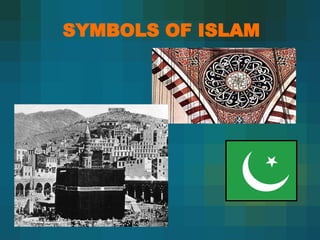
CONQUEST OF ARABIA Muhammad's return to Mecca  Conquered Mecca, 630  Imposed a theocratic government dedicated to Allah  Destroyed pagan shrines and built mosques  The  Kaa'ba  The Kaa'ba shrine was not destroyed  In 632, Muhammad led the first Islamic pilgrimage to the Ka'ba  The  Five Pillars of Islam   Obligations taught by Muhammad, known as the Five Pillars  The Five Pillars bound the  umma  into a cohesive community of faith Profession of faith, prayer, tithing, pilgrimage, fasting at Ramadan  Islamic law: the  s haria   Emerged during the centuries after Muhammad  Detailed guidance on proper behavior in almost every aspect of life  Drew laws, precepts from the Quran  Drew traditions from Arabic culture, Hadith Through the s haria , Islam became a religion and a way of life
SYMBOLS OF ISLAM
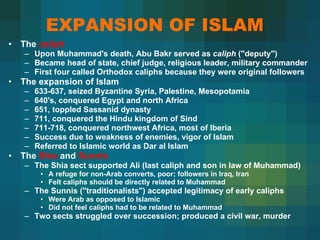
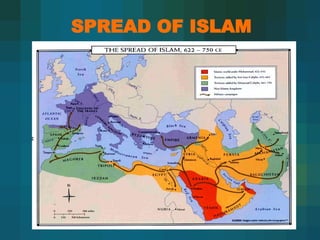
EXPANSION OF ISLAM The  caliph   Upon Muhammad's death, Abu Bakr served as  caliph  ("deputy")  Became head of state, chief judge, religious leader, military commander First four called Orthodox caliphs because they were original followers  The expansion of Islam  633-637, seized Byzantine Syria, Palestine, Mesopotamia  640's, conquered Egypt and north Africa  651, toppled Sassanid dynasty  711, conquered the Hindu kingdom of Sind  711-718, conquered northwest Africa, most of Iberia Success due to weakness of enemies, vigor of Islam Referred to Islamic world as Dar al Islam  The  Shia  and  Sunnis  The Shia sect supported Ali (last caliph and son in law of Muhammad) A refuge for non-Arab converts, poor; followers in Iraq, Iran Felt caliphs should be directly related to Muhammad  The Sunnis ("traditionalists") accepted legitimacy of early caliphs Were Arab as opposed to Islamic Did not feel caliphs had to be related to Muhammad  Two sects struggled over succession; produced a civil war, murder
SPREAD OF ISLAM
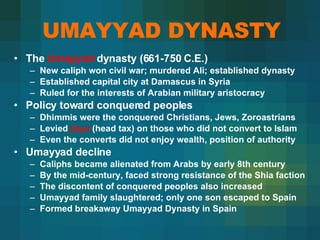
UMAYYAD DYNASTY The  Umayyad  dynasty (661-750 C.E.)  New caliph won civil war; murdered Ali; established dynasty Established capital city at Damascus in Syria  Ruled for the interests of Arabian military aristocracy  Policy toward conquered peoples  Dhimmis were the conquered Christians, Jews, Zoroastrians Levied  jizya  (head tax) on those who did not convert to Islam Even the converts did not enjoy wealth, position of authority  Umayyad decline  Caliphs became alienated from Arabs by early 8th century  By the mid-century, faced strong resistance of the Shia faction  The discontent of conquered peoples also increased Umayyad family slaughtered; only one son escaped to Spain Formed breakaway Umayyad Dynasty in Spain
ABBASID DYNASTY Abu al-Abbas  A descendant of Muhammad's uncle; allied with Shias and non-Arab Muslims  Seized control of Persia and Mesopotamia during 740's  Shattered Umayyad forces at a battle in 750; annihilated the Umayyad clan  The  Abbasid  dynasty (750-1258 C.E.)  Showed no special favor to Arab military aristocracy  Empire still growing, but not initiated by the central government  Abbasid administration  Relied heavily on Persians, Persian techniques of statecraft  Central authority ruled from the court at Baghdad, newly built city  Governors ruled provinces;  Ulama, qadis  (judges) ruled local areas Harun al-Rashid (786-809 C.E.)  Represented the high point of the dynasty  Baghdad became metropolis, center for commerce, industry, and culture  Abbasid decline  Struggle for succession between Harun's sons led to civil war  Governors built their own power bases, regional dynasties Local military commanders took title of  Sultan   Popular uprisings and peasant rebellions weakened the dynasty  A Persian noble seized control of Baghdad in 945  Later, the Seljuk Turks controlled the imperial family
AN URBAN CIVILIZATION Arab Urban History Pre-Islamic Arabs were both urban, bedouin Mecca, Medina, Yemeni cities, cities of Palmyra, Arab Petropolis Center of the city was a market place often shared with religious center Cities designed with human-environment interaction in mind Nomads came to city to trade, city often settled by whole tribes Arabs had settled in cities in Syria, Iraq, Jordan Arabic cities linked to wider world through merchants, trade Arab cities exposed to Jews, Persians, Monophysites, Sabeans Arabic Empire and Urban Growth Islam as a culture requires mosque, merchant: very urban in outlook Capital moved from Mecca to Damascus by Umayyads Arabs founded military cities on edges of desert to rule empire As empire grew, needed something more permanent Abbasids moved capital from Damascus, Kufa to Baghdad Other designed for purpose cities include Fez, Cairo, Tunis Increasing agricultural production contributed to growth of cities  Cities: centers for administration, industry, trade, education, faith Many different ethnic minorities settled in Muslim cities (quarters) Mosque at center surrounded by suk, square, in decreasing social order
CHANGED ECONOMICS Merchants, pilgrims, travelers exchanged foods across empire The exchange and spread of food and industrial crops  Indian plants traveled to other lands of the empire  Staple crops: sugarcane, rice, new varieties of sorghum and wheat  Vegetables: spinach, artichokes, eggplants  Fruits: oranges, lemons, limes, bananas, coconuts, watermelons, mangoes  Industrial crops: cotton, indigo, henna  Effects of new crops  Increased varieties and quantities of food  Industrial crops became the basis for a thriving textile industry Foodstuffs increased health, populations of cities  Agricultural experimentation  Numerous agricultural manuals  Agricultural methods and techniques improved Improved irrigation
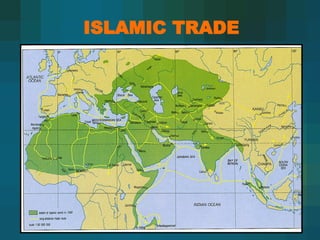
A VAST TRADE ZONE Camels and caravans  Overland desert trade traveled mostly by camel caravan  Caravanserais (motel, corrals) in Islamic cities Trading goods usually luxury in nature  Maritime trade based on technological borrowing  Arab, Persian mariners borrowed  Compass from the Chinese  Lateen sail from southeast Asian, Indian mariners  Astrolabe from the Hellenistic mariners Organization and dominance of trade  In North Africa across Sahara, down Nile, SW Asia, to India Eastern Mediterranean, Red Sea, Persian Gulf, Arabia Gulf down coasts Many cities grew rich from trade Entrepreneurs often pooled their resources in group investments  Different kinds of joint endeavors  Banks  Operated on large scale and provided extensive services  Letters of credit, or  sakk , functioned as bank checks Exchange of Ideas included Islam, technology, culture
ISLAMIC TRADE
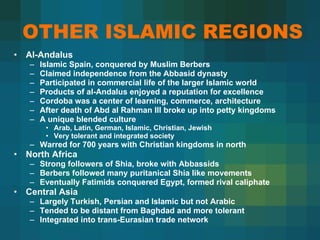
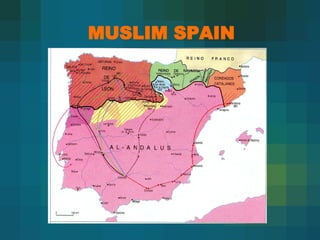
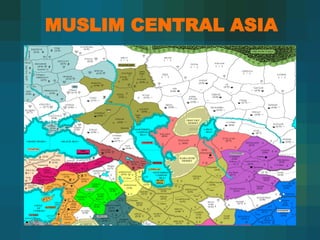
OTHER ISLAMIC REGIONS Al-Andalus  Islamic Spain, conquered by Muslim Berbers  Claimed independence from the Abbasid dynasty  Participated in commercial life of the larger Islamic world  Products of al-Andalus enjoyed a reputation for excellence  Cordoba was a center of learning, commerce, architecture After death of Abd al Rahman III broke up into petty kingdoms A unique blended culture Arab, Latin, German, Islamic, Christian, Jewish  Very tolerant and integrated society Warred for 700 years with Christian kingdoms in north North Africa Strong followers of Shia, broke with Abbassids Berbers followed many puritanical Shia like movements Eventually Fatimids conquered Egypt, formed rival caliphate Central Asia Largely Turkish, Persian and Islamic but not Arabic Tended to be distant from Baghdad and more tolerant Integrated into trans-Eurasian trade network
MUSLIM SPAIN
MUSLIM CENTRAL ASIA
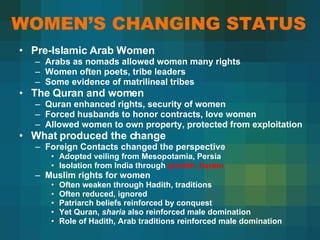
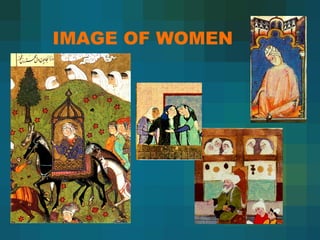
WOMEN’S CHANGING STATUS   Pre-Islamic Arab Women Arabs as nomads allowed women many rights Women often poets, tribe leaders Some evidence of matrilineal tribes  The Quran and women  Quran enhanced rights, security of women Forced husbands to honor contracts, love women Allowed women to own property, protected from exploitation  What produced the change  Foreign Contacts changed the perspective Adopted veiling from Mesopotamia, Persia Isolation from India through  purdah, harem   Muslim rights for women  Often weaken through Hadith, traditions Often reduced, ignored Patriarch beliefs reinforced by conquest   Yet Quran,  sharia  also reinforced male domination Role of Hadith, Arab traditions reinforced male domination
IMAGE OF WOMEN
ISLAMIC CULTURAL TRADITION Quran,  sharia  were main sources to formulate moral guidelines  Constant struggle between what is Arabic and what is Islamic Use of Arabic script as only language of Islam strengthened trend Persians, Turks, Indians, and Africans struggled for acceptance Promotion of Islamic values  Ulama, qadis , and missionaries were main agents  Education also promoted Islamic values  Sufis   Islamic mystics, effective missionaries  Encouraged devotion by singing, dancing  Led ascetic, holy lives, won respect  Encouraged followers to revere Allah in own ways  Tolerated those who associated Allah with other beliefs  The hajj  The Kaa'ba became the symbol of Islamic cultural unity  Pilgrims helped to spread Islamic beliefs and values
ISLAM & OTHER CONTACTS Persian influence on Islam  After Arabs most prominent of Muslims, resisted Arabization Cultural traditions often borrowed heavily by Islam Became early followers of Shia Government and regionalism Many advisors (vizer is Persian word) to Caliphs were Persian Cultured, diplomatic language of Abbassid court became Persian Literary achievements  Omar Khayyam was greatest of Medieval Muslim poets  The Arabian Nights  largely in a Persian style Turkish influences Central Asian nomads converted to Islam, developed literary culture Invaded SW Asia and made caliphate dependent on Turkish nomads Formed military might, leadership of late Abbassid state Indian Influences Purdah and harem borrowed from Hindus  "Hindi numerals," which Europeans called "Arabic numerals"  Greek Influences  Muslims philosophers especially liked Plato and Aristotle; Greek math  Effort of harmonizing two traditions met resistance from Sufis

Arabic Islamic World

  • 1.
    ISLAM THE FIRSTTRANS-REGIONAL CIVILIZATION
  • 2.
  • 3.
    PRE-ISLAMIC ARABIA TheArabian peninsula Largely deserts with mountains, oases Fertile areas in the southern mountains around Yemen Nomadic Bedouin Lived in the desert-covered peninsula for millennia Kept herds of sheep, goats, and camels Organized in family and clan groups Importance of kinship and loyalty to the clan Many tribes seem to have been matrilineal with some rights for women Post-classical Arabia Romans (Byzantines) and Persians had client kingdoms in area Active in long-distance over land trade Trade from Damascus to Mecca/Medina to Yemen Trade across desert to Persian Gulf and along coast Part of Red Sea trade system; links between Yemen and Abyssinia Trade includes gold, frankincense and myrrh Religion was polytheist Groups of Jews in Arabia; Monophysite Christians in cities
  • 4.
    6 TH CENTURY ARABIA
  • 5.
  • 6.
  • 7.
    MUHAMMAD’S EARLY LIFEMuhammad ibn Abdullah Born in a Mecca merchant family, 570 C.E. Difficult early life: orphaned, lived with uncle Married a wealthy widow, Khadija, in 595 Became a merchant at age 30, exposed to various faiths Muhammad's spiritual transformation At age 40, he experienced visions There was only one true god, Allah ("the god") Allah would soon bring judgment on the world The archangel Gabriel delivered these revelations to Muhammad Did not intend to found a new religion, but his message became appealing The Quran Followers compiled Muhammad's actual revelations after his death Quran ("recitation"), became the holy book of Islam Suras are chapters; organized from longest to shortest A work of magnificent poetry The Hadith Sayings attributed to Muhammad; not included in Quran Three levels from most accurate/likely to highly suspect
  • 8.
    THE HIJRA (FLIGHT)Conflict at Mecca His teachings offended others, especially ruling elite of Mecca Attacks on greed offended wealthy merchants Attacks on idolatry threatened shrines, especially the Kaa'ba The hijra Under persecution, Muhammad, followers fled to Medina, 622 C.E. The move, known as hijra , was starting point of Islamic calendar The umma Organized a cohesive community called umma in Medina Led commercial adventure Sometimes launched raids against Mecca caravans Helped the poor and needy The "seal of the prophets" Referred himself as "seal of the prophets," - final prophet of Allah Held Hebrew scriptures and New Testament in high esteem Referred to followers as “Peoples of the Book” If they did not threaten umma, were to be protected Determined to spread Allah's wish to all humankind
  • 9.
    CONQUEST OF ARABIAMuhammad's return to Mecca Conquered Mecca, 630 Imposed a theocratic government dedicated to Allah Destroyed pagan shrines and built mosques The Kaa'ba The Kaa'ba shrine was not destroyed In 632, Muhammad led the first Islamic pilgrimage to the Ka'ba The Five Pillars of Islam Obligations taught by Muhammad, known as the Five Pillars The Five Pillars bound the umma into a cohesive community of faith Profession of faith, prayer, tithing, pilgrimage, fasting at Ramadan Islamic law: the s haria Emerged during the centuries after Muhammad Detailed guidance on proper behavior in almost every aspect of life Drew laws, precepts from the Quran Drew traditions from Arabic culture, Hadith Through the s haria , Islam became a religion and a way of life
  • 10.
  • 11.
    EXPANSION OF ISLAMThe caliph Upon Muhammad's death, Abu Bakr served as caliph ("deputy") Became head of state, chief judge, religious leader, military commander First four called Orthodox caliphs because they were original followers The expansion of Islam 633-637, seized Byzantine Syria, Palestine, Mesopotamia 640's, conquered Egypt and north Africa 651, toppled Sassanid dynasty 711, conquered the Hindu kingdom of Sind 711-718, conquered northwest Africa, most of Iberia Success due to weakness of enemies, vigor of Islam Referred to Islamic world as Dar al Islam The Shia and Sunnis The Shia sect supported Ali (last caliph and son in law of Muhammad) A refuge for non-Arab converts, poor; followers in Iraq, Iran Felt caliphs should be directly related to Muhammad The Sunnis ("traditionalists") accepted legitimacy of early caliphs Were Arab as opposed to Islamic Did not feel caliphs had to be related to Muhammad Two sects struggled over succession; produced a civil war, murder
  • 12.
  • 13.
    UMAYYAD DYNASTY The Umayyad dynasty (661-750 C.E.) New caliph won civil war; murdered Ali; established dynasty Established capital city at Damascus in Syria Ruled for the interests of Arabian military aristocracy Policy toward conquered peoples Dhimmis were the conquered Christians, Jews, Zoroastrians Levied jizya (head tax) on those who did not convert to Islam Even the converts did not enjoy wealth, position of authority Umayyad decline Caliphs became alienated from Arabs by early 8th century By the mid-century, faced strong resistance of the Shia faction The discontent of conquered peoples also increased Umayyad family slaughtered; only one son escaped to Spain Formed breakaway Umayyad Dynasty in Spain
  • 14.
    ABBASID DYNASTY Abual-Abbas A descendant of Muhammad's uncle; allied with Shias and non-Arab Muslims Seized control of Persia and Mesopotamia during 740's Shattered Umayyad forces at a battle in 750; annihilated the Umayyad clan The Abbasid dynasty (750-1258 C.E.) Showed no special favor to Arab military aristocracy Empire still growing, but not initiated by the central government Abbasid administration Relied heavily on Persians, Persian techniques of statecraft Central authority ruled from the court at Baghdad, newly built city Governors ruled provinces; Ulama, qadis (judges) ruled local areas Harun al-Rashid (786-809 C.E.) Represented the high point of the dynasty Baghdad became metropolis, center for commerce, industry, and culture Abbasid decline Struggle for succession between Harun's sons led to civil war Governors built their own power bases, regional dynasties Local military commanders took title of Sultan Popular uprisings and peasant rebellions weakened the dynasty A Persian noble seized control of Baghdad in 945 Later, the Seljuk Turks controlled the imperial family
  • 15.
    AN URBAN CIVILIZATIONArab Urban History Pre-Islamic Arabs were both urban, bedouin Mecca, Medina, Yemeni cities, cities of Palmyra, Arab Petropolis Center of the city was a market place often shared with religious center Cities designed with human-environment interaction in mind Nomads came to city to trade, city often settled by whole tribes Arabs had settled in cities in Syria, Iraq, Jordan Arabic cities linked to wider world through merchants, trade Arab cities exposed to Jews, Persians, Monophysites, Sabeans Arabic Empire and Urban Growth Islam as a culture requires mosque, merchant: very urban in outlook Capital moved from Mecca to Damascus by Umayyads Arabs founded military cities on edges of desert to rule empire As empire grew, needed something more permanent Abbasids moved capital from Damascus, Kufa to Baghdad Other designed for purpose cities include Fez, Cairo, Tunis Increasing agricultural production contributed to growth of cities Cities: centers for administration, industry, trade, education, faith Many different ethnic minorities settled in Muslim cities (quarters) Mosque at center surrounded by suk, square, in decreasing social order
  • 16.
    CHANGED ECONOMICS Merchants,pilgrims, travelers exchanged foods across empire The exchange and spread of food and industrial crops Indian plants traveled to other lands of the empire Staple crops: sugarcane, rice, new varieties of sorghum and wheat Vegetables: spinach, artichokes, eggplants Fruits: oranges, lemons, limes, bananas, coconuts, watermelons, mangoes Industrial crops: cotton, indigo, henna Effects of new crops Increased varieties and quantities of food Industrial crops became the basis for a thriving textile industry Foodstuffs increased health, populations of cities Agricultural experimentation Numerous agricultural manuals Agricultural methods and techniques improved Improved irrigation
  • 17.
    A VAST TRADEZONE Camels and caravans Overland desert trade traveled mostly by camel caravan Caravanserais (motel, corrals) in Islamic cities Trading goods usually luxury in nature Maritime trade based on technological borrowing Arab, Persian mariners borrowed Compass from the Chinese Lateen sail from southeast Asian, Indian mariners Astrolabe from the Hellenistic mariners Organization and dominance of trade In North Africa across Sahara, down Nile, SW Asia, to India Eastern Mediterranean, Red Sea, Persian Gulf, Arabia Gulf down coasts Many cities grew rich from trade Entrepreneurs often pooled their resources in group investments Different kinds of joint endeavors Banks Operated on large scale and provided extensive services Letters of credit, or sakk , functioned as bank checks Exchange of Ideas included Islam, technology, culture
  • 18.
  • 19.
    OTHER ISLAMIC REGIONSAl-Andalus Islamic Spain, conquered by Muslim Berbers Claimed independence from the Abbasid dynasty Participated in commercial life of the larger Islamic world Products of al-Andalus enjoyed a reputation for excellence Cordoba was a center of learning, commerce, architecture After death of Abd al Rahman III broke up into petty kingdoms A unique blended culture Arab, Latin, German, Islamic, Christian, Jewish Very tolerant and integrated society Warred for 700 years with Christian kingdoms in north North Africa Strong followers of Shia, broke with Abbassids Berbers followed many puritanical Shia like movements Eventually Fatimids conquered Egypt, formed rival caliphate Central Asia Largely Turkish, Persian and Islamic but not Arabic Tended to be distant from Baghdad and more tolerant Integrated into trans-Eurasian trade network
  • 20.
  • 21.
  • 22.
    WOMEN’S CHANGING STATUS Pre-Islamic Arab Women Arabs as nomads allowed women many rights Women often poets, tribe leaders Some evidence of matrilineal tribes The Quran and women Quran enhanced rights, security of women Forced husbands to honor contracts, love women Allowed women to own property, protected from exploitation What produced the change Foreign Contacts changed the perspective Adopted veiling from Mesopotamia, Persia Isolation from India through purdah, harem Muslim rights for women Often weaken through Hadith, traditions Often reduced, ignored Patriarch beliefs reinforced by conquest Yet Quran, sharia also reinforced male domination Role of Hadith, Arab traditions reinforced male domination
  • 23.
  • 24.
    ISLAMIC CULTURAL TRADITIONQuran, sharia were main sources to formulate moral guidelines Constant struggle between what is Arabic and what is Islamic Use of Arabic script as only language of Islam strengthened trend Persians, Turks, Indians, and Africans struggled for acceptance Promotion of Islamic values Ulama, qadis , and missionaries were main agents Education also promoted Islamic values Sufis Islamic mystics, effective missionaries Encouraged devotion by singing, dancing Led ascetic, holy lives, won respect Encouraged followers to revere Allah in own ways Tolerated those who associated Allah with other beliefs The hajj The Kaa'ba became the symbol of Islamic cultural unity Pilgrims helped to spread Islamic beliefs and values
  • 25.
    ISLAM & OTHERCONTACTS Persian influence on Islam After Arabs most prominent of Muslims, resisted Arabization Cultural traditions often borrowed heavily by Islam Became early followers of Shia Government and regionalism Many advisors (vizer is Persian word) to Caliphs were Persian Cultured, diplomatic language of Abbassid court became Persian Literary achievements Omar Khayyam was greatest of Medieval Muslim poets The Arabian Nights largely in a Persian style Turkish influences Central Asian nomads converted to Islam, developed literary culture Invaded SW Asia and made caliphate dependent on Turkish nomads Formed military might, leadership of late Abbassid state Indian Influences Purdah and harem borrowed from Hindus "Hindi numerals," which Europeans called "Arabic numerals" Greek Influences Muslims philosophers especially liked Plato and Aristotle; Greek math Effort of harmonizing two traditions met resistance from Sufis