UNIT 1.UNIT 1. THE 18THTHE 18TH
CENTURY AND THE AGECENTURY AND THE AGE
OF ENLIGHTENMENT.OF ENLIGHTENMENT.
4º ESO4º ESO
MªEulalia Castillo Sáez.MªEulalia Castillo Sáez.
1. OLD REGIME AND1. OLD REGIME AND
ENLIGHTENMENT.ENLIGHTENMENT.
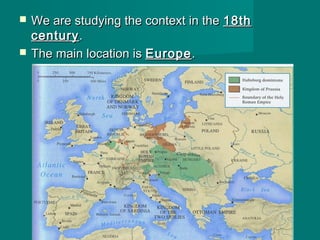
 We are studying the context in theWe are studying the context in the 18th18th
centurycentury..
 The main location isThe main location is EuropeEurope..
1.1. WHAT WAS THE1.1. WHAT WAS THE OLDOLD
REGIMEREGIME??
 It was used by the french revolutionares toIt was used by the french revolutionares to
designate the political situation before thedesignate the political situation before the
French Revolution.French Revolution.
 CHARACTERISTICS:CHARACTERISTICS:
- Absolutist political systemAbsolutist political system
- Agrarian economyAgrarian economy
- Stratified society dominated by privileged groupsStratified society dominated by privileged groups
- Great influence of religion on every field of lifeGreat influence of religion on every field of life
1.2.THE1.2.THE ENLIGHTENMENTENLIGHTENMENT ..
 It was a movement emerged inIt was a movement emerged in FranceFrance..
 Main features:Main features:
- Confidence in reasonConfidence in reason : they believe it was the only way to: they believe it was the only way to
understand the world and tounderstand the world and to achieve progress and happinessachieve progress and happiness. For. For
enlightenment intellectuals human intelligence is the light which dispelsenlightenment intellectuals human intelligence is the light which dispels
the darkness crerated by traditional beliefs, ignorance and superstition.the darkness crerated by traditional beliefs, ignorance and superstition.
(“(“Age of the reasonAge of the reason”)”)
- Faith in human progressFaith in human progress . It would be made. It would be made through the advancesthrough the advances
made in sciences.made in sciences.
- Criticism of the Old RegimeCriticism of the Old Regime . It was seen as an. It was seen as an obstacle to achieveobstacle to achieve
human progress and happinesshuman progress and happiness..
HOMEWORK.HOMEWORK.
1.- Explain the reasons behind these : the terms1.- Explain the reasons behind these : the terms OldOld
RegimeRegime,, Age of ReasonAge of Reason;; Age of EnlightenmentAge of Enlightenment;; criticismcriticism
of the Old Regime made by Enlightenment intellectualsof the Old Regime made by Enlightenment intellectuals..
2.- Read the texts and write down which ideas of the2.- Read the texts and write down which ideas of the
Enlightenment are present in each of them.Enlightenment are present in each of them.
1.2. THE ENLIGHTENMENT.1.2. THE ENLIGHTENMENT. THETHE
SALONSSALONS..
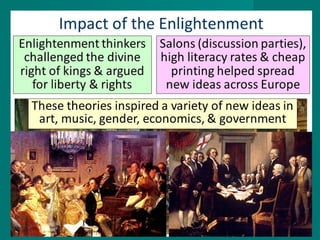
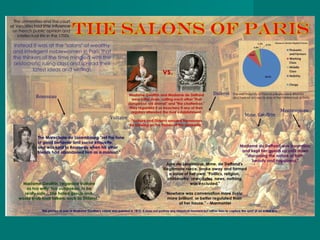
- Enlightenment ideas were spread through
newspapers, books, and through schools
and special academies.
- In addition, Enlightenment thinkers organised
meetings in the salons of their homes to
discuss new ideas.
1.2. THE ENLIGHTENMENT.1.2. THE ENLIGHTENMENT. THETHE
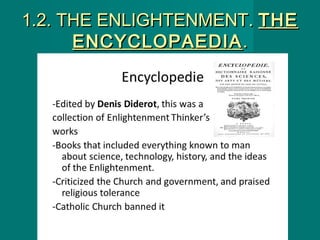
ENCYCLOPAEDIAENCYCLOPAEDIA..
1.2. THE ENLIGHTENMENT.1.2. THE ENLIGHTENMENT. THETHE
THINKERSTHINKERS..
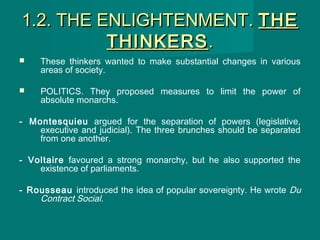
 These thinkers wanted to make substantial changes in various
areas of society.
 POLITICS. They proposed measures to limit the power of
absolute monarchs.
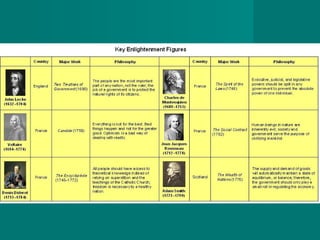
- Montesquieu argued for the separation of powers (legislative,
executive and judicial). The three brunches should be separated
from one another.
- Voltaire favoured a strong monarchy, but he also supported the
existence of parliaments.
- Rousseau introduced the idea of popular sovereignty. He wrote Du
Contract Social.
HOMEWORK.HOMEWORK.
1.- Why were these thinkers important?:1.- Why were these thinkers important?:
Diderot; Voltaire; Rousseau.Diderot; Voltaire; Rousseau.
2.- Who claimed for the separation of the2.- Who claimed for the separation of the
three powers? Why do you think it could bethree powers? Why do you think it could be
necessary?necessary?
2. POLITICAL2. POLITICAL
CHANGES.CHANGES.
2.1. CRITICISM OF ABSOLUTE2.1. CRITICISM OF ABSOLUTE
MONARCHY.MONARCHY.
 WHAT WAS ABSOLUTE MONARCHY?WHAT WAS ABSOLUTE MONARCHY?
- Prevalent in EuropePrevalent in Europe in the Old Regime.in the Old Regime.
- It considered that the power of the king was aIt considered that the power of the king was a
divine right*divine right*..
- The king held theThe king held the three powersthree powers*.*.
- The king controlled the army and ran theThe king controlled the army and ran the
economy.economy.
- He alsoHe also forego the Courtsforego the Courts where the threewhere the three
staments were represented.staments were represented.
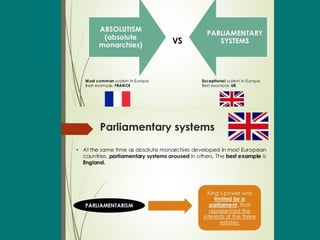
- Parliamentary political systemParliamentary political system* was scarce (only* was scarce (only
in England)in England)
HOMEWORK.HOMEWORK.
1.- Look at the key concepts* and give an1.- Look at the key concepts* and give an
explanation behind them.explanation behind them.
2.2. ENLIGHTENED2.2. ENLIGHTENED
DESPOTISMDESPOTISM
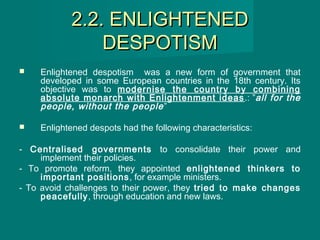
 Enlightened despotism was a new form of government that
developed in some European countries in the 18th century. Its
objective was to modernise the country by combining
absolute monarch with Enlightenment ideas.: ”all for the
people, without the people”
 Enlightened despots had the following characteristics:
- Centralised governments to consolidate their power and
implement their policies.
- To promote reform, they appointed enlightened thinkers to
important positions, for example ministers.
- To avoid challenges to their power, they tried to make changes
peacefully, through education and new laws.
2.2. ENLIGHTENED2.2. ENLIGHTENED
DESPOTISMDESPOTISM
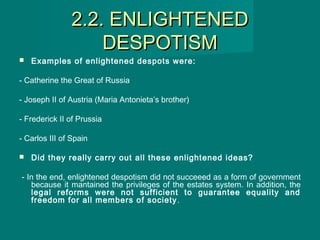
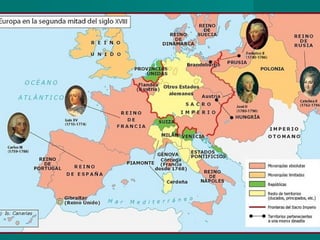
 Examples of enlightened despots were:
- Catherine the Great of Russia
- Joseph II of Austria (Maria Antonieta’s brother)
- Frederick II of Prussia
- Carlos III of Spain
 Did they really carry out all these enlightened ideas?
- In the end, enlightened despotism did not succeeed as a form of government
because it mantained the privileges of the estates system. In addition, the
legal reforms were not sufficient to guarantee equality and
freedom for all members of society.
HOMEWORK.HOMEWORK.
1.- Label the map of Europe with the names of the main1.- Label the map of Europe with the names of the main
despots.despots.
2.- Answer the questions:2.- Answer the questions:
-Which political system was prevalent in Europe in the 18thWhich political system was prevalent in Europe in the 18th
century?century?
-Which territories had a republican political system?Which territories had a republican political system?
3.- Match the following statements to a political system and3.- Match the following statements to a political system and
explain your answer:explain your answer:
a)a)““All for the people, withouth the people”All for the people, withouth the people”
b)b)““I’m the state”I’m the state”
c)c)““Sovereignty essentially consists of the general will of theSovereignty essentially consists of the general will of the
people”people”
3. ECONOMIC CHANGES3. ECONOMIC CHANGES..
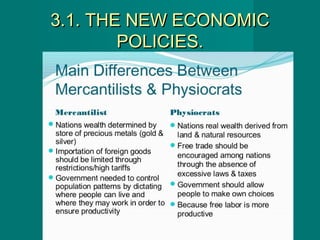
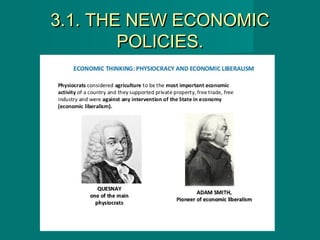
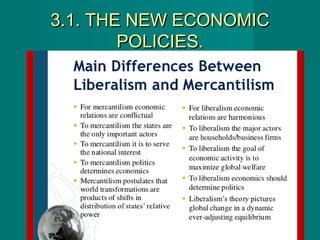
3.1. THE NEW ECONOMIC3.1. THE NEW ECONOMIC
POLICIES.POLICIES.
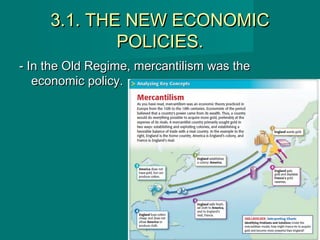
- In the Old Regime, mercantilism was the- In the Old Regime, mercantilism was the
economic policy.economic policy.
3.1. THE NEW ECONOMIC3.1. THE NEW ECONOMIC
POLICIES.POLICIES.
3.1. THE NEW ECONOMIC3.1. THE NEW ECONOMIC
POLICIES.POLICIES.
3.1. THE NEW ECONOMIC3.1. THE NEW ECONOMIC
POLICIES.POLICIES.
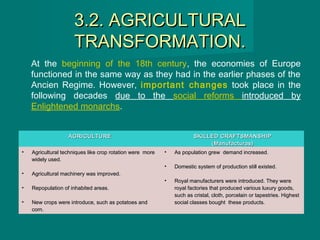
3.2. AGRICULTURAL3.2. AGRICULTURAL
TRANSFORMATION.TRANSFORMATION.
At the beginning of the 18th century, the economies of Europe
functioned in the same way as they had in the earlier phases of the
Ancien Regime. However, important changes took place in the
following decades due to the social reforms introduced by
Enlightened monarchs.
AGRICULTUREAGRICULTURE SKILLED CRAFTSMANSHIPSKILLED CRAFTSMANSHIP
(Manufacturas)(Manufacturas)
• Agricultural techniques like crop rotation were moreAgricultural techniques like crop rotation were more
widely used.widely used.
• Agricultural machinery was improved.Agricultural machinery was improved.
• Repopulation of inhabited areas.Repopulation of inhabited areas.
• New crops were introduce, such as potatoes andNew crops were introduce, such as potatoes and
corn.corn.
• As population grew demand increased.As population grew demand increased.
• Domestic system of production still existed.Domestic system of production still existed.
• Royal manufacturers were introduced. They wereRoyal manufacturers were introduced. They were
royal factories that produced various luxury goods,royal factories that produced various luxury goods,
such as cristal, cloth, porcelain or tapestries. Highestsuch as cristal, cloth, porcelain or tapestries. Highest
social classes bought these products.social classes bought these products.
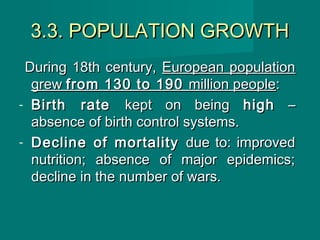
3.3. POPULATION GROWTH3.3. POPULATION GROWTH
During 18th century,During 18th century, European populationEuropean population
grewgrew from 130 to 190from 130 to 190 million peoplemillion people::
- Birth rateBirth rate kept on beingkept on being highhigh ––
absence of birth control systems.absence of birth control systems.
- Decline of mortalityDecline of mortality due to: improveddue to: improved
nutrition; absence of major epidemics;nutrition; absence of major epidemics;
decline in the number of wars.decline in the number of wars.
HOMEWORK.HOMEWORK.
1.- Draw a chart with three columns and write the main characteristics of mercantilism,1.- Draw a chart with three columns and write the main characteristics of mercantilism,
physiocracy, and liberalism.physiocracy, and liberalism.
2.- Explain why:2.- Explain why:
a)a) Mercantilists prohibited the export of metals.Mercantilists prohibited the export of metals.
b)b) Physiocrats promoted agricultural development.Physiocrats promoted agricultural development.
c)c) Liberalists held that prices are regulated by the law of supply and demand.Liberalists held that prices are regulated by the law of supply and demand.
3.- Read the texts and copy two sentences from each which reflect the ideas held by3.- Read the texts and copy two sentences from each which reflect the ideas held by
physiocracy and economic liberalism.physiocracy and economic liberalism.
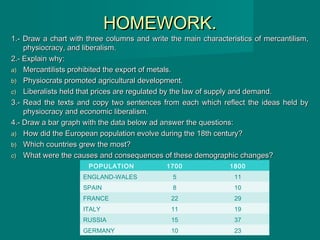
4.- Draw a bar graph with the data below ad answer the questions:4.- Draw a bar graph with the data below ad answer the questions:
a)a) How did the European population evolve during the 18th century?How did the European population evolve during the 18th century?
b)b) Which countries grew the most?Which countries grew the most?
c)c) What were the causes and consequences of these demographic changes?What were the causes and consequences of these demographic changes?
POPULATION 1700 1800
ENGLAND-WALES 5 11
SPAIN 8 10
FRANCE 22 29
ITALY 11 19
RUSSIA 15 37
GERMANY 10 23
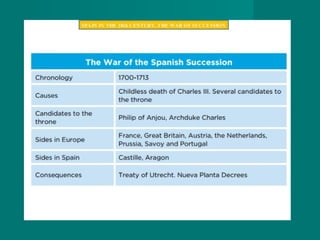
4. THE BOURBONS IN4. THE BOURBONS IN
SPAIN.SPAIN.
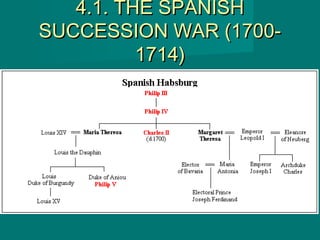
4.1. THE SPANISH4.1. THE SPANISH
SUCCESSION WAR (1700-SUCCESSION WAR (1700-
1714)1714)
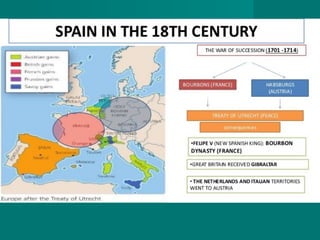
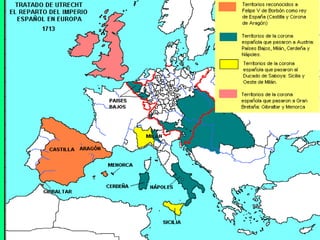
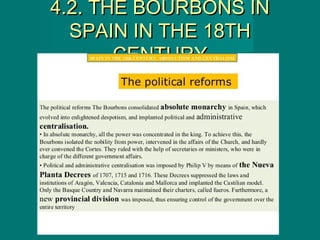
4.2. THE BOURBONS IN4.2. THE BOURBONS IN
SPAIN IN THE 18THSPAIN IN THE 18TH
CENTURYCENTURY
HOMEWORK.HOMEWORK.
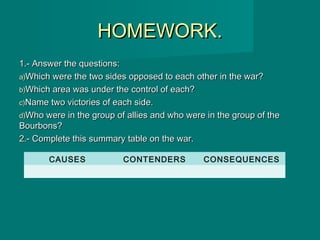
1.- Answer the questions:1.- Answer the questions:
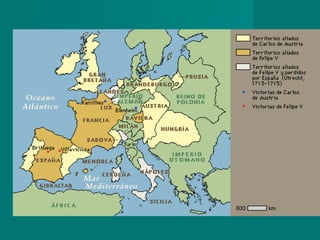
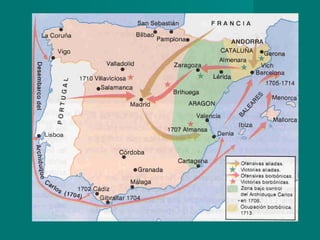
a)a)Which were the two sides opposed to each other in the war?Which were the two sides opposed to each other in the war?
b)b)Which area was under the control of each?Which area was under the control of each?
c)c)Name two victories of each side.Name two victories of each side.
d)d)Who were in the group of allies and who were in the group of theWho were in the group of allies and who were in the group of the
Bourbons?Bourbons?
2.- Complete this summary table on the war.2.- Complete this summary table on the war.
CAUSES CONTENDERS CONSEQUENCES
5. ART.5. ART.
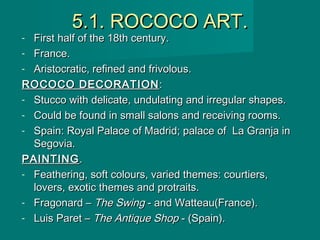
5.1. ROCOCO ART.5.1. ROCOCO ART.
- First half of the 18th century.First half of the 18th century.
- France.France.
- Aristocratic, refined and frivolous.Aristocratic, refined and frivolous.
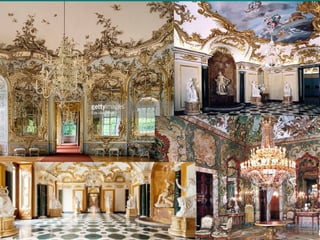
ROCOCO DECORATIONROCOCO DECORATION ::
- Stucco with delicate, undulating and irregular shapes.Stucco with delicate, undulating and irregular shapes.
- Could be found in small salons and receiving rooms.Could be found in small salons and receiving rooms.
- Spain: Royal Palace of Madrid; palace of La Granja inSpain: Royal Palace of Madrid; palace of La Granja in
Segovia.Segovia.
PAINTINGPAINTING..
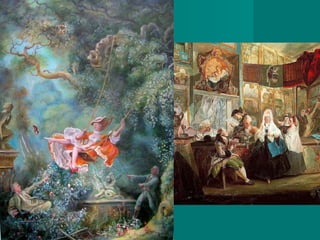
- Feathering, soft colours, varied themes: courtiers,Feathering, soft colours, varied themes: courtiers,
lovers, exotic themes and protraits.lovers, exotic themes and protraits.
- Fragonard –Fragonard – The SwingThe Swing - and Watteau(France).- and Watteau(France).
- Luis Paret –Luis Paret – The Antique ShopThe Antique Shop - (Spain).- (Spain).
5.2. NEOCLASSICAL ART.5.2. NEOCLASSICAL ART.
- Second half of the 18th century.Second half of the 18th century.
- France.France.
- Bourgeois, austere and rational style.Bourgeois, austere and rational style.
ARCHITECTUREARCHITECTURE..
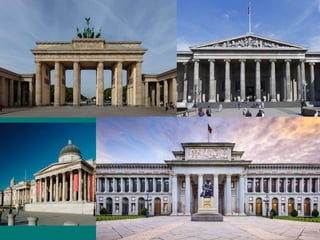
- Imitated Greek and Roman models.Imitated Greek and Roman models.
- Pure and simple forms.Pure and simple forms.
- Main buildings: churches, palaces, public buildings.Main buildings: churches, palaces, public buildings.
- The Pantheon in France; British Museum; Natiola Gallery; Brandenburg Gate; PuertaThe Pantheon in France; British Museum; Natiola Gallery; Brandenburg Gate; Puerta
de Alcalá, The Prado Museum.de Alcalá, The Prado Museum.
SCULPTURESCULPTURE ..
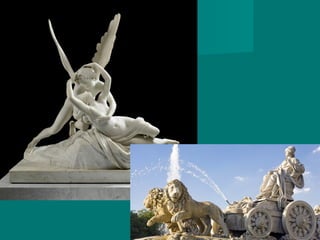
- Beauty, simplicity and serenity.Beauty, simplicity and serenity.
- Subjects: mitology, ancient history and portraits.Subjects: mitology, ancient history and portraits.
- Antonio Canova in Italy; Fco. Gutiérrez and Álvarez Cubero in Spain.Antonio Canova in Italy; Fco. Gutiérrez and Álvarez Cubero in Spain.
PAINTINGPAINTING ..
- Perfection in drawing; lost interest in colour.Perfection in drawing; lost interest in colour.
- Mythological and historical themes.Mythological and historical themes.
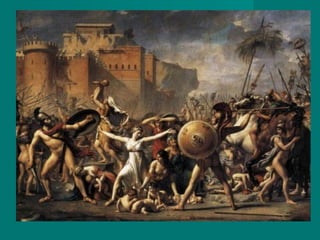
- Jacques-Louis David in France,Jacques-Louis David in France, the Oath of the Horatiithe Oath of the Horatii;; The intervention of theThe intervention of the
Sabine WomenSabine Women. Spain, the German painter Mengs. Spain, the German painter Mengs
HOMEWORK.HOMEWORK.
1.- Summarise the features of Rococo and1.- Summarise the features of Rococo and
Neoclassical art.Neoclassical art.

Old regime 18 th century

  • 1.
    UNIT 1.UNIT 1.THE 18THTHE 18TH CENTURY AND THE AGECENTURY AND THE AGE OF ENLIGHTENMENT.OF ENLIGHTENMENT. 4º ESO4º ESO MªEulalia Castillo Sáez.MªEulalia Castillo Sáez.
  • 2.
    1. OLD REGIMEAND1. OLD REGIME AND ENLIGHTENMENT.ENLIGHTENMENT.
  • 3.
     We arestudying the context in theWe are studying the context in the 18th18th centurycentury..  The main location isThe main location is EuropeEurope..
  • 4.
    1.1. WHAT WASTHE1.1. WHAT WAS THE OLDOLD REGIMEREGIME??  It was used by the french revolutionares toIt was used by the french revolutionares to designate the political situation before thedesignate the political situation before the French Revolution.French Revolution.  CHARACTERISTICS:CHARACTERISTICS: - Absolutist political systemAbsolutist political system - Agrarian economyAgrarian economy - Stratified society dominated by privileged groupsStratified society dominated by privileged groups - Great influence of religion on every field of lifeGreat influence of religion on every field of life
  • 5.
    1.2.THE1.2.THE ENLIGHTENMENTENLIGHTENMENT .. It was a movement emerged inIt was a movement emerged in FranceFrance..  Main features:Main features: - Confidence in reasonConfidence in reason : they believe it was the only way to: they believe it was the only way to understand the world and tounderstand the world and to achieve progress and happinessachieve progress and happiness. For. For enlightenment intellectuals human intelligence is the light which dispelsenlightenment intellectuals human intelligence is the light which dispels the darkness crerated by traditional beliefs, ignorance and superstition.the darkness crerated by traditional beliefs, ignorance and superstition. (“(“Age of the reasonAge of the reason”)”) - Faith in human progressFaith in human progress . It would be made. It would be made through the advancesthrough the advances made in sciences.made in sciences. - Criticism of the Old RegimeCriticism of the Old Regime . It was seen as an. It was seen as an obstacle to achieveobstacle to achieve human progress and happinesshuman progress and happiness..
  • 6.
    HOMEWORK.HOMEWORK. 1.- Explain thereasons behind these : the terms1.- Explain the reasons behind these : the terms OldOld RegimeRegime,, Age of ReasonAge of Reason;; Age of EnlightenmentAge of Enlightenment;; criticismcriticism of the Old Regime made by Enlightenment intellectualsof the Old Regime made by Enlightenment intellectuals.. 2.- Read the texts and write down which ideas of the2.- Read the texts and write down which ideas of the Enlightenment are present in each of them.Enlightenment are present in each of them.
  • 7.
    1.2. THE ENLIGHTENMENT.1.2.THE ENLIGHTENMENT. THETHE SALONSSALONS.. - Enlightenment ideas were spread through newspapers, books, and through schools and special academies. - In addition, Enlightenment thinkers organised meetings in the salons of their homes to discuss new ideas.
  • 10.
    1.2. THE ENLIGHTENMENT.1.2.THE ENLIGHTENMENT. THETHE ENCYCLOPAEDIAENCYCLOPAEDIA..
  • 11.
    1.2. THE ENLIGHTENMENT.1.2.THE ENLIGHTENMENT. THETHE THINKERSTHINKERS..  These thinkers wanted to make substantial changes in various areas of society.  POLITICS. They proposed measures to limit the power of absolute monarchs. - Montesquieu argued for the separation of powers (legislative, executive and judicial). The three brunches should be separated from one another. - Voltaire favoured a strong monarchy, but he also supported the existence of parliaments. - Rousseau introduced the idea of popular sovereignty. He wrote Du Contract Social.
  • 13.
    HOMEWORK.HOMEWORK. 1.- Why werethese thinkers important?:1.- Why were these thinkers important?: Diderot; Voltaire; Rousseau.Diderot; Voltaire; Rousseau. 2.- Who claimed for the separation of the2.- Who claimed for the separation of the three powers? Why do you think it could bethree powers? Why do you think it could be necessary?necessary?
  • 14.
  • 15.
    2.1. CRITICISM OFABSOLUTE2.1. CRITICISM OF ABSOLUTE MONARCHY.MONARCHY.  WHAT WAS ABSOLUTE MONARCHY?WHAT WAS ABSOLUTE MONARCHY? - Prevalent in EuropePrevalent in Europe in the Old Regime.in the Old Regime. - It considered that the power of the king was aIt considered that the power of the king was a divine right*divine right*.. - The king held theThe king held the three powersthree powers*.*. - The king controlled the army and ran theThe king controlled the army and ran the economy.economy. - He alsoHe also forego the Courtsforego the Courts where the threewhere the three staments were represented.staments were represented. - Parliamentary political systemParliamentary political system* was scarce (only* was scarce (only in England)in England)
  • 17.
    HOMEWORK.HOMEWORK. 1.- Look atthe key concepts* and give an1.- Look at the key concepts* and give an explanation behind them.explanation behind them.
  • 18.
    2.2. ENLIGHTENED2.2. ENLIGHTENED DESPOTISMDESPOTISM Enlightened despotism was a new form of government that developed in some European countries in the 18th century. Its objective was to modernise the country by combining absolute monarch with Enlightenment ideas.: ”all for the people, without the people”  Enlightened despots had the following characteristics: - Centralised governments to consolidate their power and implement their policies. - To promote reform, they appointed enlightened thinkers to important positions, for example ministers. - To avoid challenges to their power, they tried to make changes peacefully, through education and new laws.
  • 19.
    2.2. ENLIGHTENED2.2. ENLIGHTENED DESPOTISMDESPOTISM Examples of enlightened despots were: - Catherine the Great of Russia - Joseph II of Austria (Maria Antonieta’s brother) - Frederick II of Prussia - Carlos III of Spain  Did they really carry out all these enlightened ideas? - In the end, enlightened despotism did not succeeed as a form of government because it mantained the privileges of the estates system. In addition, the legal reforms were not sufficient to guarantee equality and freedom for all members of society.
  • 21.
    HOMEWORK.HOMEWORK. 1.- Label themap of Europe with the names of the main1.- Label the map of Europe with the names of the main despots.despots. 2.- Answer the questions:2.- Answer the questions: -Which political system was prevalent in Europe in the 18thWhich political system was prevalent in Europe in the 18th century?century? -Which territories had a republican political system?Which territories had a republican political system? 3.- Match the following statements to a political system and3.- Match the following statements to a political system and explain your answer:explain your answer: a)a)““All for the people, withouth the people”All for the people, withouth the people” b)b)““I’m the state”I’m the state” c)c)““Sovereignty essentially consists of the general will of theSovereignty essentially consists of the general will of the people”people”
  • 22.
    3. ECONOMIC CHANGES3.ECONOMIC CHANGES..
  • 23.
    3.1. THE NEWECONOMIC3.1. THE NEW ECONOMIC POLICIES.POLICIES. - In the Old Regime, mercantilism was the- In the Old Regime, mercantilism was the economic policy.economic policy.
  • 24.
    3.1. THE NEWECONOMIC3.1. THE NEW ECONOMIC POLICIES.POLICIES.
  • 25.
    3.1. THE NEWECONOMIC3.1. THE NEW ECONOMIC POLICIES.POLICIES.
  • 26.
    3.1. THE NEWECONOMIC3.1. THE NEW ECONOMIC POLICIES.POLICIES.
  • 27.
    3.2. AGRICULTURAL3.2. AGRICULTURAL TRANSFORMATION.TRANSFORMATION. Atthe beginning of the 18th century, the economies of Europe functioned in the same way as they had in the earlier phases of the Ancien Regime. However, important changes took place in the following decades due to the social reforms introduced by Enlightened monarchs. AGRICULTUREAGRICULTURE SKILLED CRAFTSMANSHIPSKILLED CRAFTSMANSHIP (Manufacturas)(Manufacturas) • Agricultural techniques like crop rotation were moreAgricultural techniques like crop rotation were more widely used.widely used. • Agricultural machinery was improved.Agricultural machinery was improved. • Repopulation of inhabited areas.Repopulation of inhabited areas. • New crops were introduce, such as potatoes andNew crops were introduce, such as potatoes and corn.corn. • As population grew demand increased.As population grew demand increased. • Domestic system of production still existed.Domestic system of production still existed. • Royal manufacturers were introduced. They wereRoyal manufacturers were introduced. They were royal factories that produced various luxury goods,royal factories that produced various luxury goods, such as cristal, cloth, porcelain or tapestries. Highestsuch as cristal, cloth, porcelain or tapestries. Highest social classes bought these products.social classes bought these products.
  • 28.
    3.3. POPULATION GROWTH3.3.POPULATION GROWTH During 18th century,During 18th century, European populationEuropean population grewgrew from 130 to 190from 130 to 190 million peoplemillion people:: - Birth rateBirth rate kept on beingkept on being highhigh –– absence of birth control systems.absence of birth control systems. - Decline of mortalityDecline of mortality due to: improveddue to: improved nutrition; absence of major epidemics;nutrition; absence of major epidemics; decline in the number of wars.decline in the number of wars.
  • 29.
    HOMEWORK.HOMEWORK. 1.- Draw achart with three columns and write the main characteristics of mercantilism,1.- Draw a chart with three columns and write the main characteristics of mercantilism, physiocracy, and liberalism.physiocracy, and liberalism. 2.- Explain why:2.- Explain why: a)a) Mercantilists prohibited the export of metals.Mercantilists prohibited the export of metals. b)b) Physiocrats promoted agricultural development.Physiocrats promoted agricultural development. c)c) Liberalists held that prices are regulated by the law of supply and demand.Liberalists held that prices are regulated by the law of supply and demand. 3.- Read the texts and copy two sentences from each which reflect the ideas held by3.- Read the texts and copy two sentences from each which reflect the ideas held by physiocracy and economic liberalism.physiocracy and economic liberalism. 4.- Draw a bar graph with the data below ad answer the questions:4.- Draw a bar graph with the data below ad answer the questions: a)a) How did the European population evolve during the 18th century?How did the European population evolve during the 18th century? b)b) Which countries grew the most?Which countries grew the most? c)c) What were the causes and consequences of these demographic changes?What were the causes and consequences of these demographic changes? POPULATION 1700 1800 ENGLAND-WALES 5 11 SPAIN 8 10 FRANCE 22 29 ITALY 11 19 RUSSIA 15 37 GERMANY 10 23
  • 30.
    4. THE BOURBONSIN4. THE BOURBONS IN SPAIN.SPAIN.
  • 31.
    4.1. THE SPANISH4.1.THE SPANISH SUCCESSION WAR (1700-SUCCESSION WAR (1700- 1714)1714)
  • 37.
    4.2. THE BOURBONSIN4.2. THE BOURBONS IN SPAIN IN THE 18THSPAIN IN THE 18TH CENTURYCENTURY
  • 41.
    HOMEWORK.HOMEWORK. 1.- Answer thequestions:1.- Answer the questions: a)a)Which were the two sides opposed to each other in the war?Which were the two sides opposed to each other in the war? b)b)Which area was under the control of each?Which area was under the control of each? c)c)Name two victories of each side.Name two victories of each side. d)d)Who were in the group of allies and who were in the group of theWho were in the group of allies and who were in the group of the Bourbons?Bourbons? 2.- Complete this summary table on the war.2.- Complete this summary table on the war. CAUSES CONTENDERS CONSEQUENCES
  • 42.
  • 43.
    5.1. ROCOCO ART.5.1.ROCOCO ART. - First half of the 18th century.First half of the 18th century. - France.France. - Aristocratic, refined and frivolous.Aristocratic, refined and frivolous. ROCOCO DECORATIONROCOCO DECORATION :: - Stucco with delicate, undulating and irregular shapes.Stucco with delicate, undulating and irregular shapes. - Could be found in small salons and receiving rooms.Could be found in small salons and receiving rooms. - Spain: Royal Palace of Madrid; palace of La Granja inSpain: Royal Palace of Madrid; palace of La Granja in Segovia.Segovia. PAINTINGPAINTING.. - Feathering, soft colours, varied themes: courtiers,Feathering, soft colours, varied themes: courtiers, lovers, exotic themes and protraits.lovers, exotic themes and protraits. - Fragonard –Fragonard – The SwingThe Swing - and Watteau(France).- and Watteau(France). - Luis Paret –Luis Paret – The Antique ShopThe Antique Shop - (Spain).- (Spain).
  • 46.
    5.2. NEOCLASSICAL ART.5.2.NEOCLASSICAL ART. - Second half of the 18th century.Second half of the 18th century. - France.France. - Bourgeois, austere and rational style.Bourgeois, austere and rational style. ARCHITECTUREARCHITECTURE.. - Imitated Greek and Roman models.Imitated Greek and Roman models. - Pure and simple forms.Pure and simple forms. - Main buildings: churches, palaces, public buildings.Main buildings: churches, palaces, public buildings. - The Pantheon in France; British Museum; Natiola Gallery; Brandenburg Gate; PuertaThe Pantheon in France; British Museum; Natiola Gallery; Brandenburg Gate; Puerta de Alcalá, The Prado Museum.de Alcalá, The Prado Museum. SCULPTURESCULPTURE .. - Beauty, simplicity and serenity.Beauty, simplicity and serenity. - Subjects: mitology, ancient history and portraits.Subjects: mitology, ancient history and portraits. - Antonio Canova in Italy; Fco. Gutiérrez and Álvarez Cubero in Spain.Antonio Canova in Italy; Fco. Gutiérrez and Álvarez Cubero in Spain. PAINTINGPAINTING .. - Perfection in drawing; lost interest in colour.Perfection in drawing; lost interest in colour. - Mythological and historical themes.Mythological and historical themes. - Jacques-Louis David in France,Jacques-Louis David in France, the Oath of the Horatiithe Oath of the Horatii;; The intervention of theThe intervention of the Sabine WomenSabine Women. Spain, the German painter Mengs. Spain, the German painter Mengs
  • 50.
    HOMEWORK.HOMEWORK. 1.- Summarise thefeatures of Rococo and1.- Summarise the features of Rococo and Neoclassical art.Neoclassical art.