The Rise of Islam
AP World History
The Arabs
• Semitic speaking people
of the Middle East
• Nomads who moved
regularly to find water
and food
• Settled in the Arabian
peninsula
– desert land
– lack of rivers and lakes
The Arabs
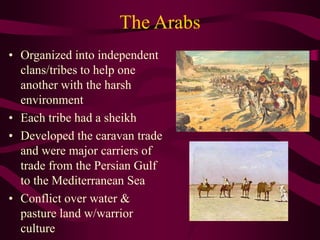
• Organized into independent
clans/tribes to help one
another with the harsh
environment
• Each tribe had a sheikh
• Developed the caravan trade
and were major carriers of
trade from the Persian Gulf
to the Mediterranean Sea
• Conflict over water &
pasture land w/warrior
culture
The Arabs
• Early Arabs were
polytheistic
• Allah (Arabic for
“God”) was
worshipped as a
supreme god over
other gods
• Each tribe had a
sacred stone that was
worshipped as a
symbol of Allah
The Arabs
• Mecca grew as a result of the
caravan trade and the worship
of the Black Stone (meteorite)
in a central shrine called the
Ka’bah
• Tensions arose between
Bedouins & the wealthier
merchants from Mecca
• Umayyad tribe controlled
Mecca (monotheistic -
believed in Allah)
The Life of
Muhammad
Early Life
• Born in Mecca in 570 A.D. to a merchant
family
• Was an orphan, but grew up to become a
caravan manager; contact with Jews &
Christians
• Married a rich widow named Khadija;
bothered by class inequalities & rivalries
• Experienced visions and was visited by the
angel Gabriel
• Came to believe that he received the final
revelations of Allah (God)
Early Spread of Islam
• His followers (only 30) were
persecuted so he leaves on the Hegira
(to Medina).
• He gains support in Medina and among
the Bedouin tribes.
• The first Muslim community (Umma)is
formed here.
Conquering of Mecca
• 630 Muhammad conquers Mecca declares
the Ka’bah a holy shrine.
• He removes the tribal idols, but keeps the
Black Stone.
• Muhammad becomes the religious and
political leader .
Why was Islam Attractive?
• Equality
• Single authority
Spread of Islam
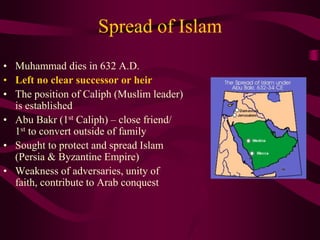
• Muhammad dies in 632 A.D.
• Left no clear successor or heir
• The position of Caliph (Muslim leader)
is established
• Abu Bakr (1st Caliph) – close friend/
1st to convert outside of family
• Sought to protect and spread Islam
(Persia & Byzantine Empire)
• Weakness of adversaries, unity of
faith, contribute to Arab conquest
1. Profession of Faith
(Shahada)
• “There is no God but
Allah, and
Mohammed is His
Prophet”
There are five pillars of Islam are
–
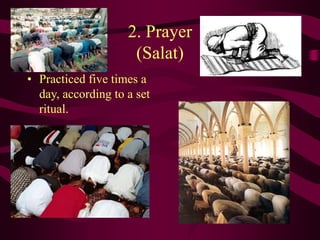
2. Prayer
(Salat)
• Practiced five times a
day, according to a set
ritual.
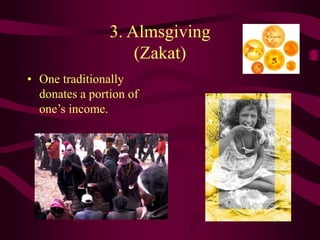
3. Almsgiving
(Zakat)
• One traditionally
donates a portion of
one’s income.
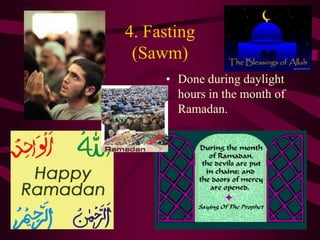
4. Fasting
(Sawm)
• Done during daylight
hours in the month of
Ramadan.
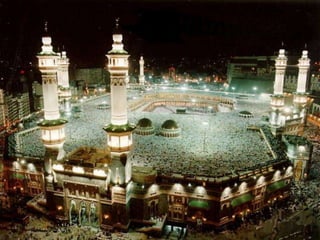
5. Pilgrimage
(Hajj)
• A pilgrimage to
Mecca is made
once during
one’s lifetime.
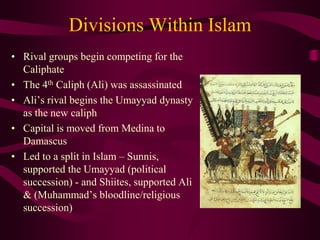
Divisions Within Islam
• Rival groups begin competing for the
Caliphate
• The 4th Caliph (Ali) was assassinated
• Ali’s rival begins the Umayyad dynasty
as the new caliph
• Capital is moved from Medina to
Damascus
• Led to a split in Islam – Sunnis,
supported the Umayyad (political
succession) - and Shiites, supported Ali
& (Muhammad’s bloodline/religious
succession)
Sunnis & Shiites
• Sunnis
• Believed the caliph was
primarily a leader and any
devout Muslim could
serve in the office with the
acceptance of the people
• 90% of Muslims today are
Sunnis
• Shias
• Believed the caliph was
primarily a religious
authority and should be
held only by the
descendants of
Muhammad
• 10% of Muslims today are
Shias (most are in Iran,
Iraq, & Lebanon)
Umayyad Dynasty (661-750)
• Emphasized Arab ethnicity
over adherence to Islam
• Converts to Islam were
considered inferior
• Respect for Jews and
Christians (allowed freedom
of worship and self rule
within their own
communities). Sometimes
required to pay taxes for
charity and on property
• Ruling families lived
excessively prompting riots
and ultimately their downfall
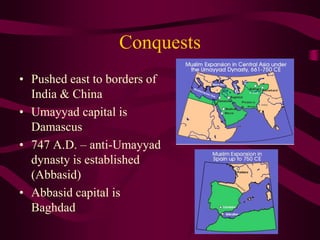
Conquests
• Pushed east to borders of
India & China
• Umayyad capital is
Damascus
• 747 A.D. – anti-Umayyad
dynasty is established
(Abbasid)
• Abbasid capital is
Baghdad
Abbasid Dynasty (750-945)
• Succession disputes
• Converts were appreciated – education
available and career advancement
• Shia dissention
• Civil violence drains imperial treasury
• Revolts and slavery increased
• Trade with the western Mediterranean
to China
• Greek, Roman, and Persian learning
was preserved. Greek logic, esp.
Aristotle was valued.
• Arabic numbers (from India)
• Mathematics – algebra, geometry, &
trigonometry
• Astrolabe – measured stars (used in
navigation)
• Zenith of Islamic culture
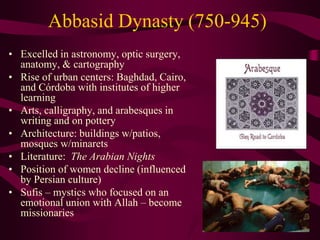
Abbasid Dynasty (750-945)
• Excelled in astronomy, optic surgery,
anatomy, & cartography
• Rise of urban centers: Baghdad, Cairo,
and Córdoba with institutes of higher
learning
• Arts, calligraphy, and arabesques in
writing and on pottery
• Architecture: buildings w/patios,
mosques w/minarets
• Literature: The Arabian Nights
• Position of women decline (influenced
by Persian culture)
• Sufis – mystics who focused on an
emotional union with Allah – become
missionaries
Women In Islam
• Early days of Islam: women were
not required to wear the veil & not
secluded
• Up to four wives allowed since the
time of Muhammad; women - only
one husband
• In general Islamic women had
more rights than other women of
the same time
• Equal with men before Allah
• Female infanticide forbidden
• Could own property (before & after marriage)
• In some cases could divorce husband
• Eventual isolation created barriers
to acceptance of Islam, especially
in Africa

Rise spread of_islam

  • 1.
    The Rise ofIslam AP World History
  • 2.
    The Arabs • Semiticspeaking people of the Middle East • Nomads who moved regularly to find water and food • Settled in the Arabian peninsula – desert land – lack of rivers and lakes
  • 3.
    The Arabs • Organizedinto independent clans/tribes to help one another with the harsh environment • Each tribe had a sheikh • Developed the caravan trade and were major carriers of trade from the Persian Gulf to the Mediterranean Sea • Conflict over water & pasture land w/warrior culture
  • 4.
    The Arabs • EarlyArabs were polytheistic • Allah (Arabic for “God”) was worshipped as a supreme god over other gods • Each tribe had a sacred stone that was worshipped as a symbol of Allah
  • 5.
    The Arabs • Meccagrew as a result of the caravan trade and the worship of the Black Stone (meteorite) in a central shrine called the Ka’bah • Tensions arose between Bedouins & the wealthier merchants from Mecca • Umayyad tribe controlled Mecca (monotheistic - believed in Allah)
  • 6.
  • 7.
    Early Life • Bornin Mecca in 570 A.D. to a merchant family • Was an orphan, but grew up to become a caravan manager; contact with Jews & Christians • Married a rich widow named Khadija; bothered by class inequalities & rivalries • Experienced visions and was visited by the angel Gabriel • Came to believe that he received the final revelations of Allah (God)
  • 8.
    Early Spread ofIslam • His followers (only 30) were persecuted so he leaves on the Hegira (to Medina). • He gains support in Medina and among the Bedouin tribes. • The first Muslim community (Umma)is formed here.
  • 9.
    Conquering of Mecca •630 Muhammad conquers Mecca declares the Ka’bah a holy shrine. • He removes the tribal idols, but keeps the Black Stone. • Muhammad becomes the religious and political leader .
  • 10.
    Why was IslamAttractive? • Equality • Single authority
  • 11.
    Spread of Islam •Muhammad dies in 632 A.D. • Left no clear successor or heir • The position of Caliph (Muslim leader) is established • Abu Bakr (1st Caliph) – close friend/ 1st to convert outside of family • Sought to protect and spread Islam (Persia & Byzantine Empire) • Weakness of adversaries, unity of faith, contribute to Arab conquest
  • 12.
    1. Profession ofFaith (Shahada) • “There is no God but Allah, and Mohammed is His Prophet” There are five pillars of Islam are –
  • 13.
    2. Prayer (Salat) • Practicedfive times a day, according to a set ritual.
  • 14.
    3. Almsgiving (Zakat) • Onetraditionally donates a portion of one’s income.
  • 15.
    4. Fasting (Sawm) • Doneduring daylight hours in the month of Ramadan.
  • 16.
    5. Pilgrimage (Hajj) • Apilgrimage to Mecca is made once during one’s lifetime.
  • 18.
    Divisions Within Islam •Rival groups begin competing for the Caliphate • The 4th Caliph (Ali) was assassinated • Ali’s rival begins the Umayyad dynasty as the new caliph • Capital is moved from Medina to Damascus • Led to a split in Islam – Sunnis, supported the Umayyad (political succession) - and Shiites, supported Ali & (Muhammad’s bloodline/religious succession)
  • 19.
    Sunnis & Shiites •Sunnis • Believed the caliph was primarily a leader and any devout Muslim could serve in the office with the acceptance of the people • 90% of Muslims today are Sunnis • Shias • Believed the caliph was primarily a religious authority and should be held only by the descendants of Muhammad • 10% of Muslims today are Shias (most are in Iran, Iraq, & Lebanon)
  • 20.
    Umayyad Dynasty (661-750) •Emphasized Arab ethnicity over adherence to Islam • Converts to Islam were considered inferior • Respect for Jews and Christians (allowed freedom of worship and self rule within their own communities). Sometimes required to pay taxes for charity and on property • Ruling families lived excessively prompting riots and ultimately their downfall
  • 21.
    Conquests • Pushed eastto borders of India & China • Umayyad capital is Damascus • 747 A.D. – anti-Umayyad dynasty is established (Abbasid) • Abbasid capital is Baghdad
  • 22.
    Abbasid Dynasty (750-945) •Succession disputes • Converts were appreciated – education available and career advancement • Shia dissention • Civil violence drains imperial treasury • Revolts and slavery increased • Trade with the western Mediterranean to China • Greek, Roman, and Persian learning was preserved. Greek logic, esp. Aristotle was valued. • Arabic numbers (from India) • Mathematics – algebra, geometry, & trigonometry • Astrolabe – measured stars (used in navigation) • Zenith of Islamic culture
  • 23.
    Abbasid Dynasty (750-945) •Excelled in astronomy, optic surgery, anatomy, & cartography • Rise of urban centers: Baghdad, Cairo, and Córdoba with institutes of higher learning • Arts, calligraphy, and arabesques in writing and on pottery • Architecture: buildings w/patios, mosques w/minarets • Literature: The Arabian Nights • Position of women decline (influenced by Persian culture) • Sufis – mystics who focused on an emotional union with Allah – become missionaries
  • 24.
    Women In Islam •Early days of Islam: women were not required to wear the veil & not secluded • Up to four wives allowed since the time of Muhammad; women - only one husband • In general Islamic women had more rights than other women of the same time • Equal with men before Allah • Female infanticide forbidden • Could own property (before & after marriage) • In some cases could divorce husband • Eventual isolation created barriers to acceptance of Islam, especially in Africa