WELCOME
An assignment on Canopy types & structures with special
emphasis on geometry of planting
FSC 504 Canopy Management in Fruit Crops (1+1)
Submitted to : Dr. B.M.Tandel
Associate Professor
Dept. of Fruit Science
ACHF, NAU
Sub. by : Avisha Ram Budhani
Reg. No. : 2020216001
2nd Semester
M.Sc. (Horticulture) Vegetable Science
ACHF, NAU
Major Guide : Dr. D.R.Bhanderi
Associate Professor
Dept. of Vegetable Science
ACHF, NAU
2
Minor Guide : Dr. R.V. Tank
Associate Professor
Dept. of Fruit Science
ACHF, NAU
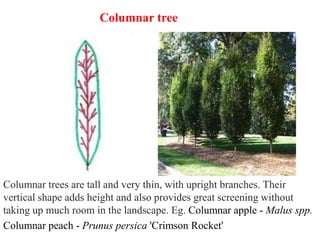
Columnar trees are tall and very thin, with upright branches. Their
vertical shape adds height and also provides great screening without
taking up much room in the landscape. Eg. Columnar apple - Malus spp.
Columnar peach - Prunus persica 'Crimson Rocket'
Columnar tree
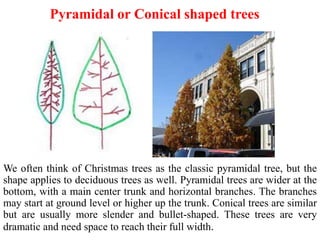
Pyramidal or Conical shaped trees
We often think of Christmas trees as the classic pyramidal tree, but the
shape applies to deciduous trees as well. Pyramidal trees are wider at the
bottom, with a main center trunk and horizontal branches. The branches
may start at ground level or higher up the trunk. Conical trees are similar
but are usually more slender and bullet-shaped. These trees are very
dramatic and need space to reach their full width.
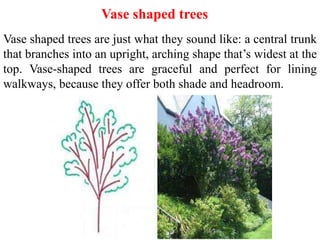
Vase shaped trees
Vase shaped trees are just what they sound like: a central trunk
that branches into an upright, arching shape that’s widest at the
top. Vase-shaped trees are graceful and perfect for lining
walkways, because they offer both shade and headroom.
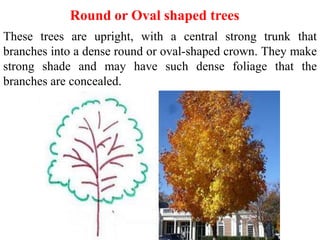
Round or Oval shaped trees
These trees are upright, with a central strong trunk that
branches into a dense round or oval-shaped crown. They make
strong shade and may have such dense foliage that the
branches are concealed.
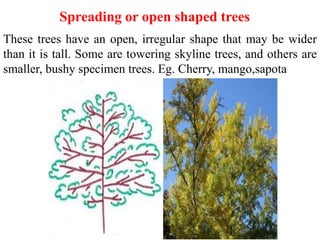
Spreading or open shaped trees
These trees have an open, irregular shape that may be wider
than it is tall. Some are towering skyline trees, and others are
smaller, bushy specimen trees. Eg. Cherry, mango,sapota
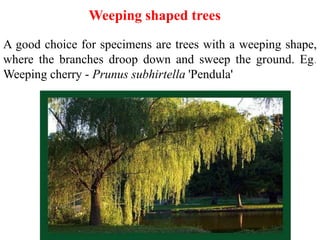
Weeping shaped trees
A good choice for specimens are trees with a weeping shape,
where the branches droop down and sweep the ground. Eg.
Weeping cherry - Prunus subhirtella 'Pendula'
Fruit trees are grown in a variety of shapes, sometimes to
please the eye but mainly to encourage fruit production. The
form or shape of fruit trees can be manipulated by pruning and
training. Shaping and promoting a particular tree form is done
to establish the plant in a particular situation under certain
environmental conditions, to increase fruit yield, and to
enhance fruit quality. For example, pruning a tree to a pyramid
shape enables trees to be planted closer together. An open
bowl or cup form helps sunlight penetrate the canopy, thus
encouraging a high fruit yield whilst keeping the tree short and
accessible for harvesting. Other shapes such as cordons,
espaliers and fans offer opportunities for growing trees two
dimensionally against walls or fences, or they can be trained to
function as barriers.
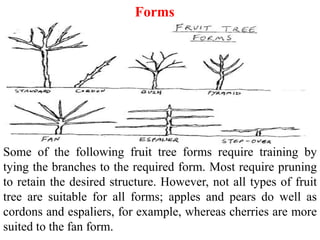
Forms
Some of the following fruit tree forms require training by
tying the branches to the required form. Most require pruning
to retain the desired structure. However, not all types of fruit
tree are suitable for all forms; apples and pears do well as
cordons and espaliers, for example, whereas cherries are more
suited to the fan form.
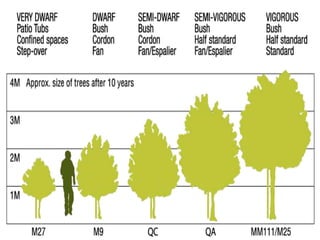
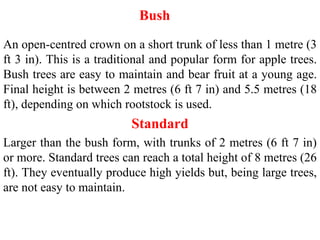
Bush
An open-centred crown on a short trunk of less than 1 metre (3
ft 3 in). This is a traditional and popular form for apple trees.
Bush trees are easy to maintain and bear fruit at a young age.
Final height is between 2 metres (6 ft 7 in) and 5.5 metres (18
ft), depending on which rootstock is used.
Standard
Larger than the bush form, with trunks of 2 metres (6 ft 7 in)
or more. Standard trees can reach a total height of 8 metres (26
ft). They eventually produce high yields but, being large trees,
are not easy to maintain.
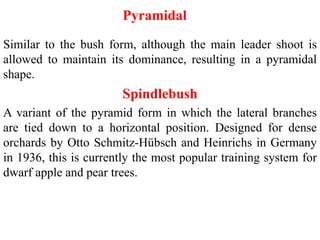
Pyramidal
Similar to the bush form, although the main leader shoot is
allowed to maintain its dominance, resulting in a pyramidal
shape.
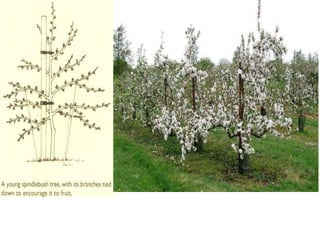
Spindlebush
A variant of the pyramid form in which the lateral branches
are tied down to a horizontal position. Designed for dense
orchards by Otto Schmitz-Hübsch and Heinrichs in Germany
in 1936, this is currently the most popular training system for
dwarf apple and pear trees.
Cordon
Single-stemmed trees planted at an angle (usually 45°), with
fruiting spurs encouraged to form along the stem. Any side
branches are removed by pruning. Cordons take less space and
crop earlier than most other forms, so more varieties can be
got into a small space, but yields are smaller per tree. A special
cordon set-up is the Bouché-Thomas system.
Espalier
A central vertical trunk with three or four horizontal branches
on each side.
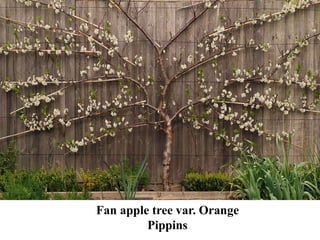
Fan
A short central trunk with several radiating branches growing
from the crown.
Espalier apple tree Cordon apple trees
Fan apple tree var. Orange
Pippins
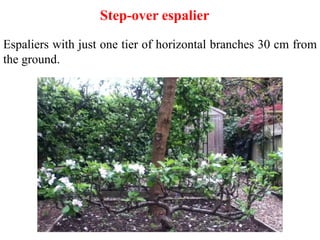
Step-over espalier
Espaliers with just one tier of horizontal branches 30 cm from
the ground.
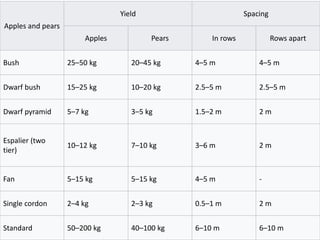
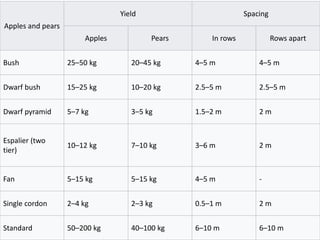
Apples and pears
Yield Spacing
Apples Pears In rows Rows apart
Bush 25–50 kg 20–45 kg 4–5 m 4–5 m
Dwarf bush 15–25 kg 10–20 kg 2.5–5 m 2.5–5 m
Dwarf pyramid 5–7 kg 3–5 kg 1.5–2 m 2 m
Espalier (two
tier)
10–12 kg 7–10 kg 3–6 m 2 m
Fan 5–15 kg 5–15 kg 4–5 m -
Single cordon 2–4 kg 2–3 kg 0.5–1 m 2 m
Standard 50–200 kg 40–100 kg 6–10 m 6–10 m
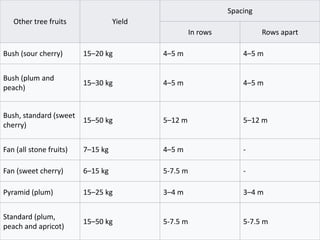
Other tree fruits Yield
Spacing
In rows Rows apart
Bush (sour cherry) 15–20 kg 4–5 m 4–5 m
Bush (plum and
peach)
15–30 kg 4–5 m 4–5 m
Bush, standard (sweet
cherry)
15–50 kg 5–12 m 5–12 m
Fan (all stone fruits) 7–15 kg 4–5 m -
Fan (sweet cherry) 6–15 kg 5-7.5 m -
Pyramid (plum) 15–25 kg 3–4 m 3–4 m
Standard (plum,
peach and apricot)
15–50 kg 5-7.5 m 5-7.5 m
Apples and pears
Yield Spacing
Apples Pears In rows Rows apart
Bush 25–50 kg 20–45 kg 4–5 m 4–5 m
Dwarf bush 15–25 kg 10–20 kg 2.5–5 m 2.5–5 m
Dwarf pyramid 5–7 kg 3–5 kg 1.5–2 m 2 m
Espalier (two
tier)
10–12 kg 7–10 kg 3–6 m 2 m
Fan 5–15 kg 5–15 kg 4–5 m -
Single cordon 2–4 kg 2–3 kg 0.5–1 m 2 m
Standard 50–200 kg 40–100 kg 6–10 m 6–10 m
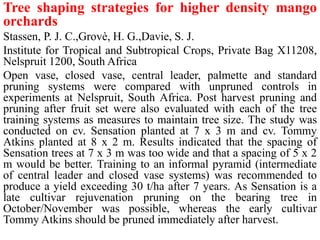
Tree shaping strategies for higher density mango
orchards

Stassen, P. J. C.,Grovè, H. G.,Davie, S. J.
Institute for Tropical and Subtropical Crops, Private Bag X11208,
Nelspruit 1200, South Africa
Open vase, closed vase, central leader, palmette and standard
pruning systems were compared with unpruned controls in
experiments at Nelspruit, South Africa. Post harvest pruning and
pruning after fruit set were also evaluated with each of the tree
training systems as measures to maintain tree size. The study was
conducted on cv. Sensation planted at 7 x 3 m and cv. Tommy
Atkins planted at 8 x 2 m. Results indicated that the spacing of
Sensation trees at 7 x 3 m was too wide and that a spacing of 5 x 2
m would be better. Training to an informal pyramid (intermediate
of central leader and closed vase systems) was recommended to
produce a yield exceeding 30 t/ha after 7 years. As Sensation is a
late cultivar rejuvenation pruning on the bearing tree in
October/November was possible, whereas the early cultivar
Tommy Atkins should be pruned immediately after harvest.
24

Canopy types

  • 1.
  • 2.
    An assignment onCanopy types & structures with special emphasis on geometry of planting FSC 504 Canopy Management in Fruit Crops (1+1) Submitted to : Dr. B.M.Tandel Associate Professor Dept. of Fruit Science ACHF, NAU Sub. by : Avisha Ram Budhani Reg. No. : 2020216001 2nd Semester M.Sc. (Horticulture) Vegetable Science ACHF, NAU Major Guide : Dr. D.R.Bhanderi Associate Professor Dept. of Vegetable Science ACHF, NAU 2 Minor Guide : Dr. R.V. Tank Associate Professor Dept. of Fruit Science ACHF, NAU
  • 3.
    Columnar trees aretall and very thin, with upright branches. Their vertical shape adds height and also provides great screening without taking up much room in the landscape. Eg. Columnar apple - Malus spp. Columnar peach - Prunus persica 'Crimson Rocket' Columnar tree
  • 4.
    Pyramidal or Conicalshaped trees We often think of Christmas trees as the classic pyramidal tree, but the shape applies to deciduous trees as well. Pyramidal trees are wider at the bottom, with a main center trunk and horizontal branches. The branches may start at ground level or higher up the trunk. Conical trees are similar but are usually more slender and bullet-shaped. These trees are very dramatic and need space to reach their full width.
  • 5.
    Vase shaped trees Vaseshaped trees are just what they sound like: a central trunk that branches into an upright, arching shape that’s widest at the top. Vase-shaped trees are graceful and perfect for lining walkways, because they offer both shade and headroom.
  • 6.
    Round or Ovalshaped trees These trees are upright, with a central strong trunk that branches into a dense round or oval-shaped crown. They make strong shade and may have such dense foliage that the branches are concealed.
  • 7.
    Spreading or openshaped trees These trees have an open, irregular shape that may be wider than it is tall. Some are towering skyline trees, and others are smaller, bushy specimen trees. Eg. Cherry, mango,sapota
  • 8.
    Weeping shaped trees Agood choice for specimens are trees with a weeping shape, where the branches droop down and sweep the ground. Eg. Weeping cherry - Prunus subhirtella 'Pendula'
  • 10.
    Fruit trees aregrown in a variety of shapes, sometimes to please the eye but mainly to encourage fruit production. The form or shape of fruit trees can be manipulated by pruning and training. Shaping and promoting a particular tree form is done to establish the plant in a particular situation under certain environmental conditions, to increase fruit yield, and to enhance fruit quality. For example, pruning a tree to a pyramid shape enables trees to be planted closer together. An open bowl or cup form helps sunlight penetrate the canopy, thus encouraging a high fruit yield whilst keeping the tree short and accessible for harvesting. Other shapes such as cordons, espaliers and fans offer opportunities for growing trees two dimensionally against walls or fences, or they can be trained to function as barriers.
  • 11.
    Forms Some of thefollowing fruit tree forms require training by tying the branches to the required form. Most require pruning to retain the desired structure. However, not all types of fruit tree are suitable for all forms; apples and pears do well as cordons and espaliers, for example, whereas cherries are more suited to the fan form.
  • 13.
    Bush An open-centred crownon a short trunk of less than 1 metre (3 ft 3 in). This is a traditional and popular form for apple trees. Bush trees are easy to maintain and bear fruit at a young age. Final height is between 2 metres (6 ft 7 in) and 5.5 metres (18 ft), depending on which rootstock is used. Standard Larger than the bush form, with trunks of 2 metres (6 ft 7 in) or more. Standard trees can reach a total height of 8 metres (26 ft). They eventually produce high yields but, being large trees, are not easy to maintain.
  • 14.
    Pyramidal Similar to thebush form, although the main leader shoot is allowed to maintain its dominance, resulting in a pyramidal shape. Spindlebush A variant of the pyramid form in which the lateral branches are tied down to a horizontal position. Designed for dense orchards by Otto Schmitz-Hübsch and Heinrichs in Germany in 1936, this is currently the most popular training system for dwarf apple and pear trees.
  • 16.
    Cordon Single-stemmed trees plantedat an angle (usually 45°), with fruiting spurs encouraged to form along the stem. Any side branches are removed by pruning. Cordons take less space and crop earlier than most other forms, so more varieties can be got into a small space, but yields are smaller per tree. A special cordon set-up is the Bouché-Thomas system. Espalier A central vertical trunk with three or four horizontal branches on each side. Fan A short central trunk with several radiating branches growing from the crown.
  • 17.
    Espalier apple treeCordon apple trees
  • 18.
    Fan apple treevar. Orange Pippins
  • 19.
    Step-over espalier Espaliers withjust one tier of horizontal branches 30 cm from the ground.
  • 20.
    Apples and pears YieldSpacing Apples Pears In rows Rows apart Bush 25–50 kg 20–45 kg 4–5 m 4–5 m Dwarf bush 15–25 kg 10–20 kg 2.5–5 m 2.5–5 m Dwarf pyramid 5–7 kg 3–5 kg 1.5–2 m 2 m Espalier (two tier) 10–12 kg 7–10 kg 3–6 m 2 m Fan 5–15 kg 5–15 kg 4–5 m - Single cordon 2–4 kg 2–3 kg 0.5–1 m 2 m Standard 50–200 kg 40–100 kg 6–10 m 6–10 m
  • 21.
    Other tree fruitsYield Spacing In rows Rows apart Bush (sour cherry) 15–20 kg 4–5 m 4–5 m Bush (plum and peach) 15–30 kg 4–5 m 4–5 m Bush, standard (sweet cherry) 15–50 kg 5–12 m 5–12 m Fan (all stone fruits) 7–15 kg 4–5 m - Fan (sweet cherry) 6–15 kg 5-7.5 m - Pyramid (plum) 15–25 kg 3–4 m 3–4 m Standard (plum, peach and apricot) 15–50 kg 5-7.5 m 5-7.5 m
  • 22.
    Apples and pears YieldSpacing Apples Pears In rows Rows apart Bush 25–50 kg 20–45 kg 4–5 m 4–5 m Dwarf bush 15–25 kg 10–20 kg 2.5–5 m 2.5–5 m Dwarf pyramid 5–7 kg 3–5 kg 1.5–2 m 2 m Espalier (two tier) 10–12 kg 7–10 kg 3–6 m 2 m Fan 5–15 kg 5–15 kg 4–5 m - Single cordon 2–4 kg 2–3 kg 0.5–1 m 2 m Standard 50–200 kg 40–100 kg 6–10 m 6–10 m
  • 23.
    Tree shaping strategiesfor higher density mango orchards Stassen, P. J. C.,Grovè, H. G.,Davie, S. J. Institute for Tropical and Subtropical Crops, Private Bag X11208, Nelspruit 1200, South Africa Open vase, closed vase, central leader, palmette and standard pruning systems were compared with unpruned controls in experiments at Nelspruit, South Africa. Post harvest pruning and pruning after fruit set were also evaluated with each of the tree training systems as measures to maintain tree size. The study was conducted on cv. Sensation planted at 7 x 3 m and cv. Tommy Atkins planted at 8 x 2 m. Results indicated that the spacing of Sensation trees at 7 x 3 m was too wide and that a spacing of 5 x 2 m would be better. Training to an informal pyramid (intermediate of central leader and closed vase systems) was recommended to produce a yield exceeding 30 t/ha after 7 years. As Sensation is a late cultivar rejuvenation pruning on the bearing tree in October/November was possible, whereas the early cultivar Tommy Atkins should be pruned immediately after harvest.
  • 24.