6/1/2015
1
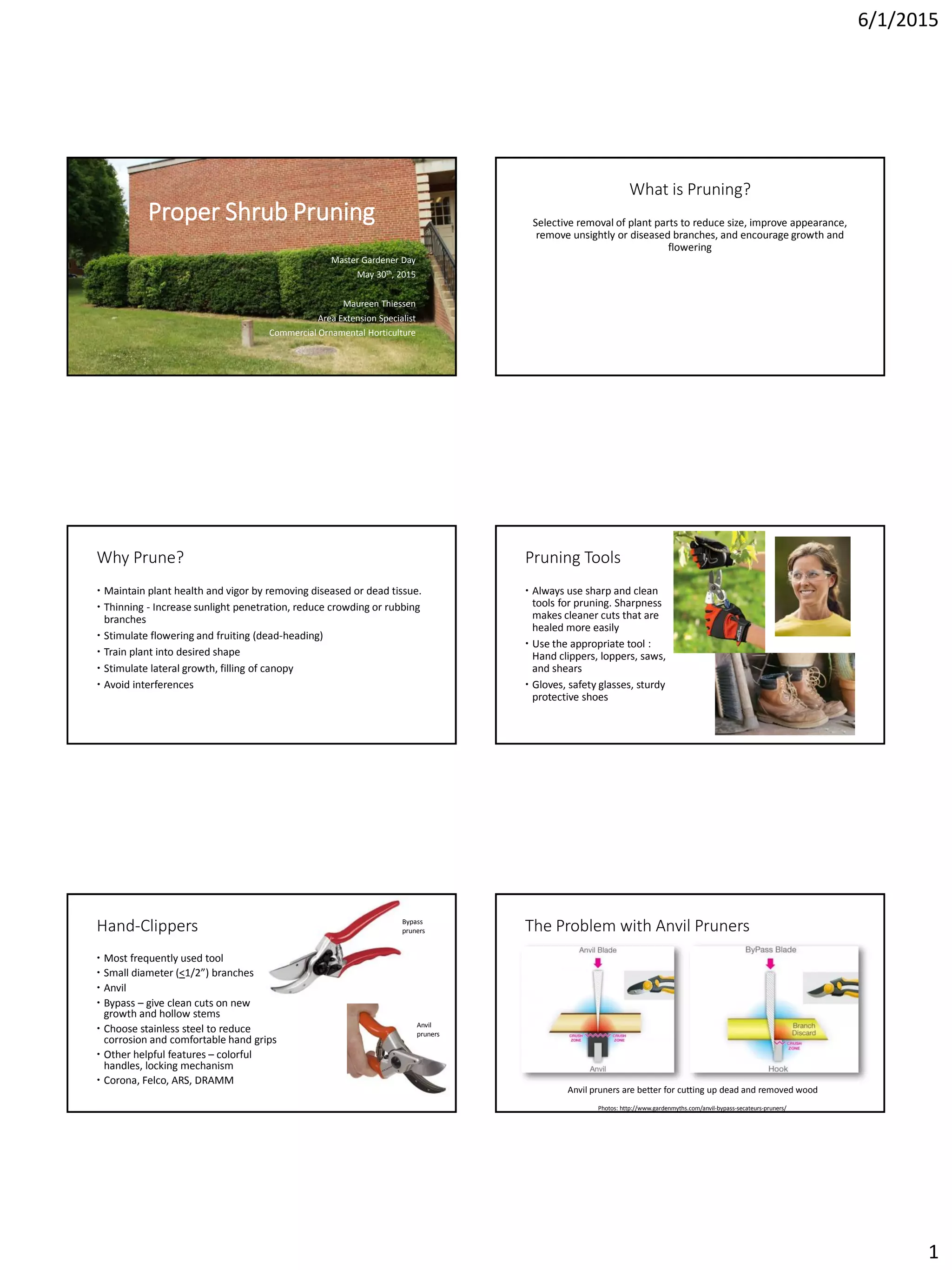
Proper Shrub Pruning
Master Gardener Day
May 30th, 2015
Maureen Thiessen
Area Extension Specialist
Commercial Ornamental Horticulture
What is Pruning?
Selective removal of plant parts to reduce size, improve appearance,
remove unsightly or diseased branches, and encourage growth and
flowering
Why Prune?
 Maintain plant health and vigor by removing diseased or dead tissue.
 Thinning - Increase sunlight penetration, reduce crowding or rubbing
branches
 Stimulate flowering and fruiting (dead-heading)
 Train plant into desired shape
 Stimulate lateral growth, filling of canopy
 Avoid interferences
Pruning Tools
 Always use sharp and clean
tools for pruning. Sharpness
makes cleaner cuts that are
healed more easily
 Use the appropriate tool :
Hand clippers, loppers, saws,
and shears
 Gloves, safety glasses, sturdy
protective shoes
Hand-Clippers
 Most frequently used tool
 Small diameter (<1/2”) branches
 Anvil
 Bypass – give clean cuts on new
growth and hollow stems
 Choose stainless steel to reduce
corrosion and comfortable hand grips
 Other helpful features – colorful
handles, locking mechanism
 Corona, Felco, ARS, DRAMM
Bypass
pruners
Anvil
pruners
The Problem with Anvil Pruners
Anvil pruners are better for cutting up dead and removed wood
Photos: http://www.gardenmyths.com/anvil-bypass-secateurs-pruners/
6/1/2015
2
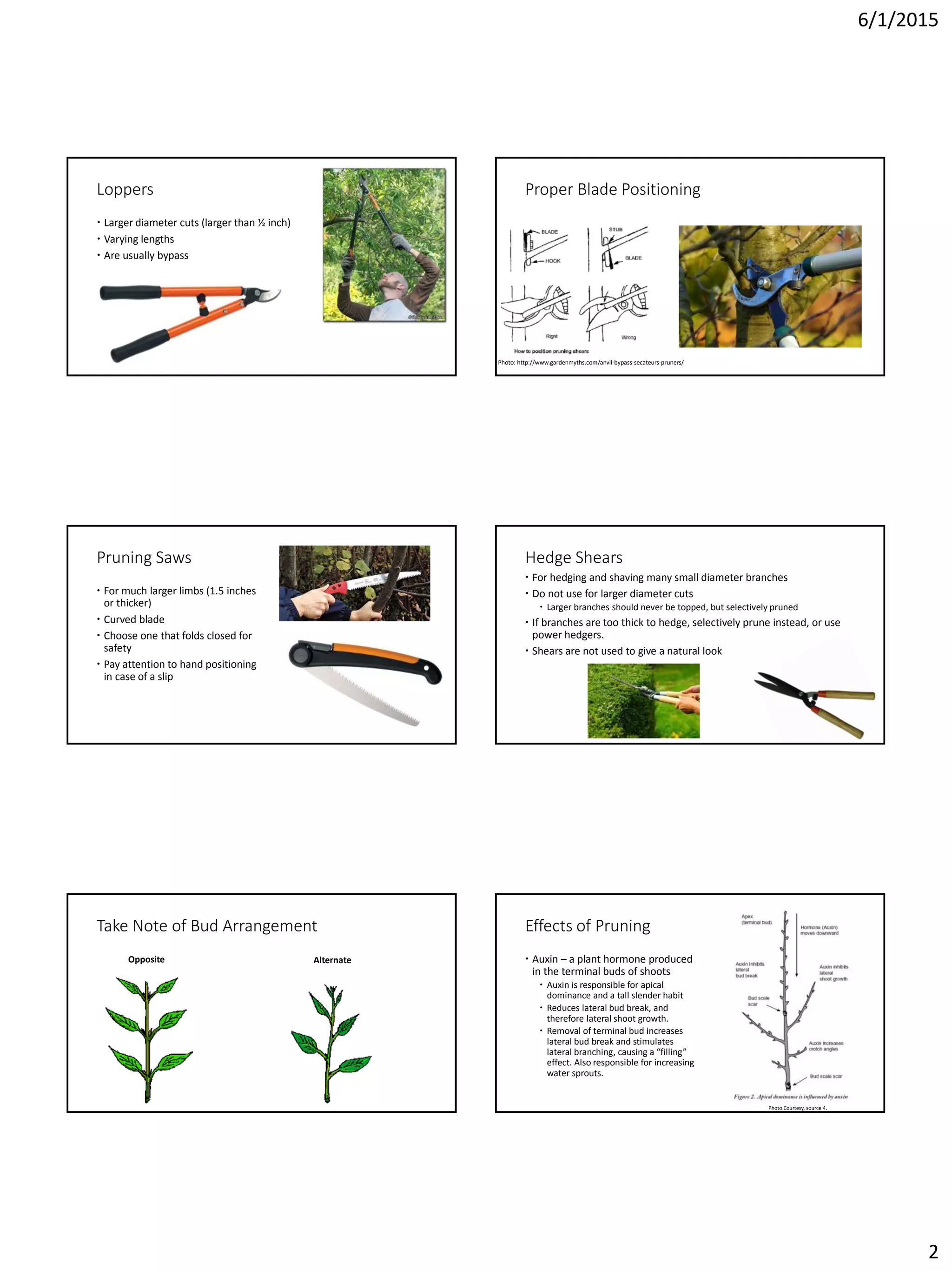
Loppers
 Larger diameter cuts (larger than ½ inch)
 Varying lengths
 Are usually bypass
Proper Blade Positioning
Photo: http://www.gardenmyths.com/anvil-bypass-secateurs-pruners/
Pruning Saws
 For much larger limbs (1.5 inches
or thicker)
 Curved blade
 Choose one that folds closed for
safety
 Pay attention to hand positioning
in case of a slip
Hedge Shears
 For hedging and shaving many small diameter branches
 Do not use for larger diameter cuts
 Larger branches should never be topped, but selectively pruned
 If branches are too thick to hedge, selectively prune instead, or use
power hedgers.
 Shears are not used to give a natural look
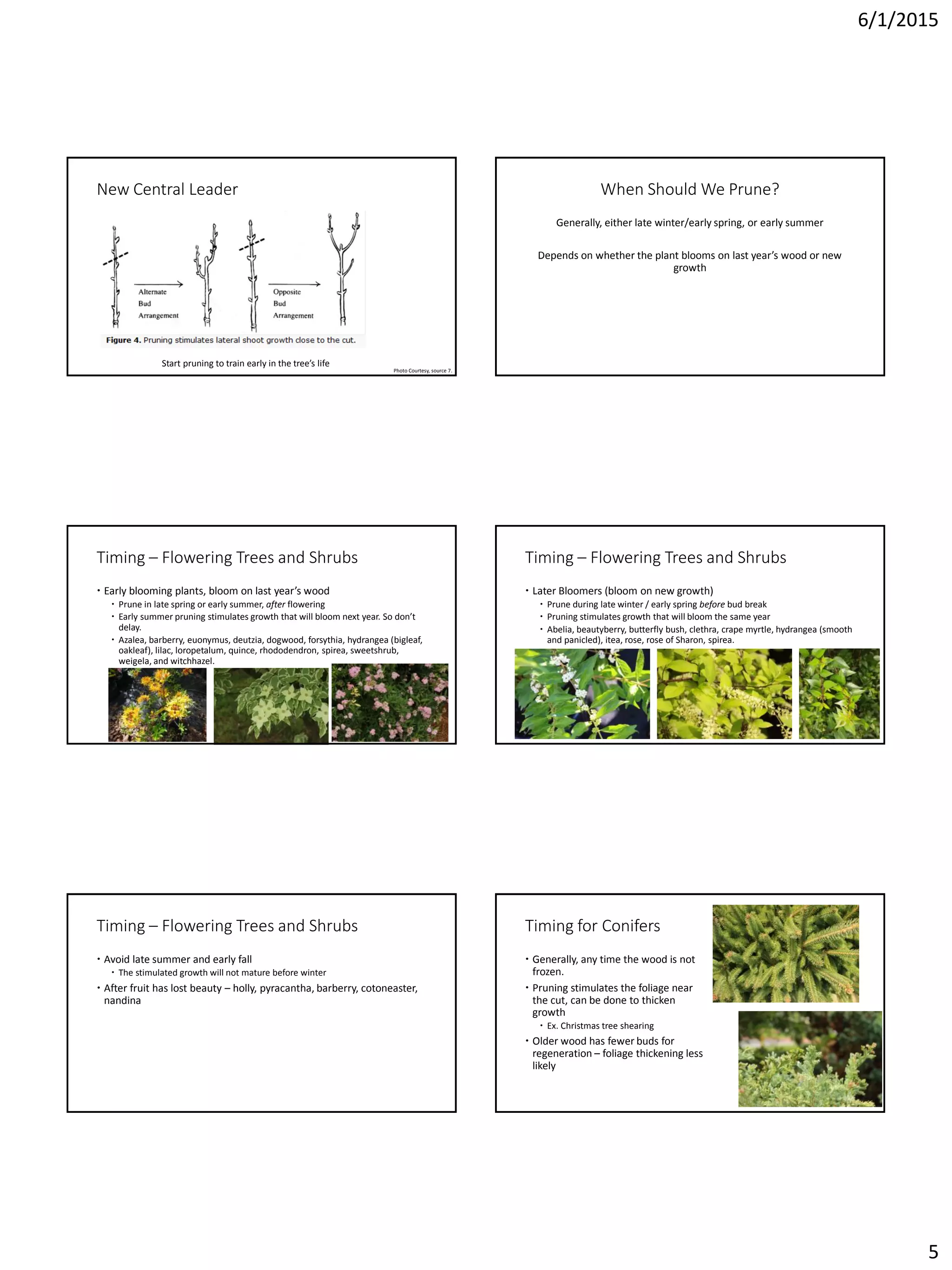
Opposite Alternate
Take Note of Bud Arrangement Effects of Pruning
 Auxin – a plant hormone produced
in the terminal buds of shoots
 Auxin is responsible for apical
dominance and a tall slender habit
 Reduces lateral bud break, and
therefore lateral shoot growth.
 Removal of terminal bud increases
lateral bud break and stimulates
lateral branching, causing a “filling”
effect. Also responsible for increasing
water sprouts.
Photo Courtesy, source 4.
6/1/2015
3
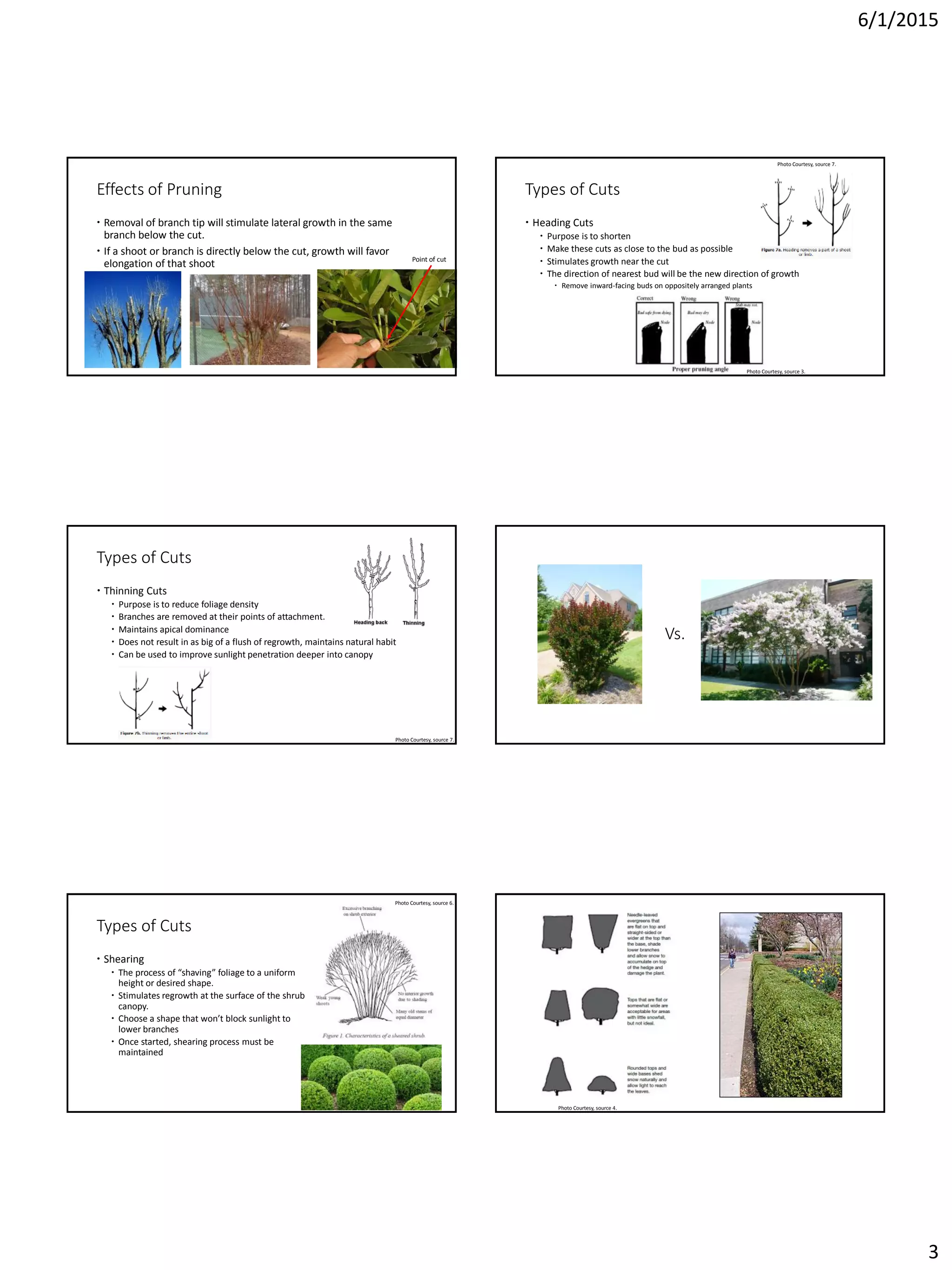
Effects of Pruning
 Removal of branch tip will stimulate lateral growth in the same
branch below the cut.
 If a shoot or branch is directly below the cut, growth will favor
elongation of that shoot Point of cut
Types of Cuts
 Heading Cuts
 Purpose is to shorten
 Make these cuts as close to the bud as possible
 Stimulates growth near the cut
 The direction of nearest bud will be the new direction of growth
 Remove inward-facing buds on oppositely arranged plants
Photo Courtesy, source 3.
Photo Courtesy, source 7.
Types of Cuts
 Thinning Cuts
 Purpose is to reduce foliage density
 Branches are removed at their points of attachment.
 Maintains apical dominance
 Does not result in as big of a flush of regrowth, maintains natural habit
 Can be used to improve sunlight penetration deeper into canopy
Photo Courtesy, source 7.
Vs.
Types of Cuts
 Shearing
 The process of “shaving” foliage to a uniform
height or desired shape.
 Stimulates regrowth at the surface of the shrub
canopy.
 Choose a shape that won’t block sunlight to
lower branches
 Once started, shearing process must be
maintained
Photo Courtesy, source 6.
Photo Courtesy, source 4.
6/1/2015
4
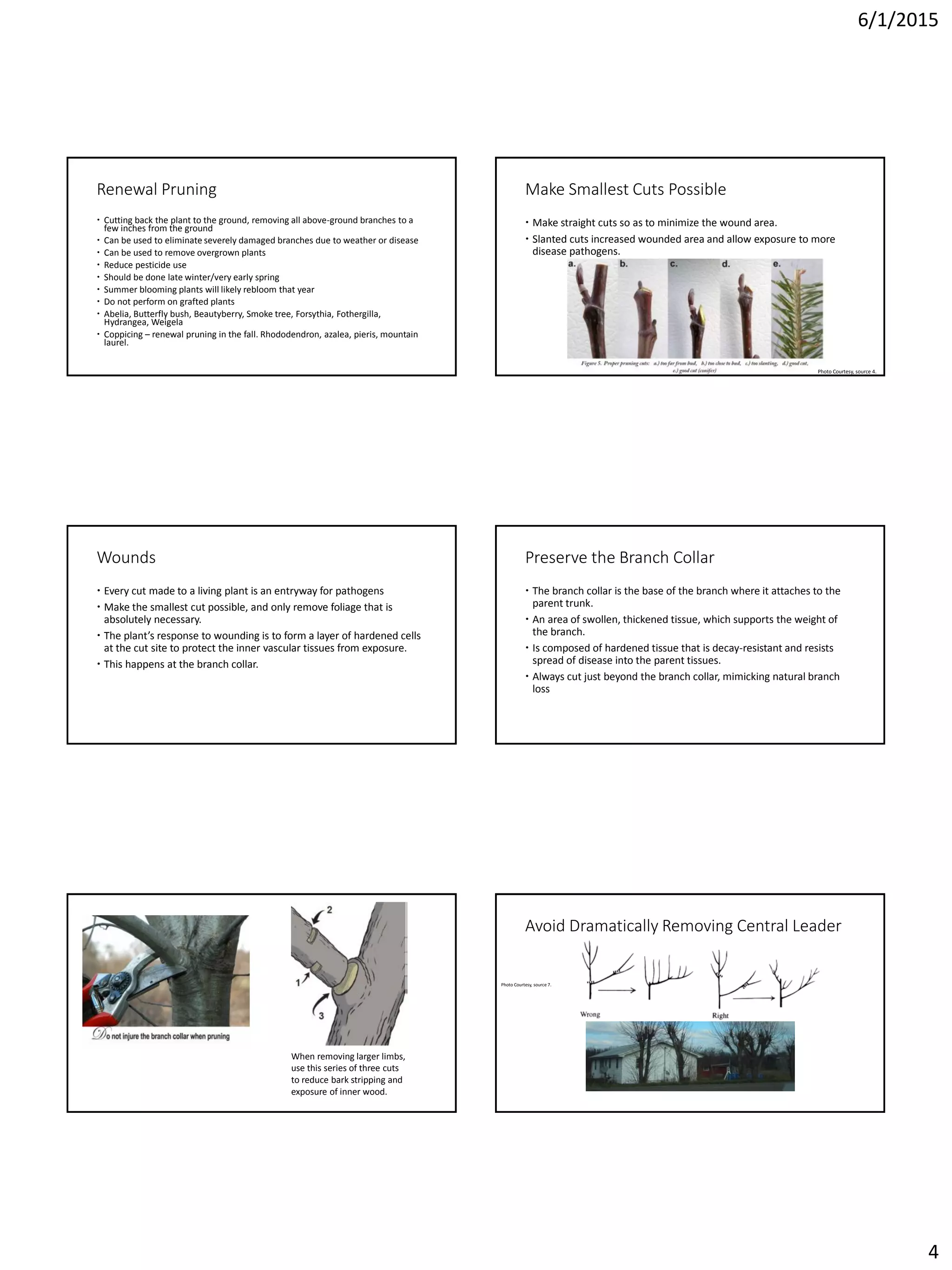
Renewal Pruning
 Cutting back the plant to the ground, removing all above-ground branches to a
few inches from the ground
 Can be used to eliminate severely damaged branches due to weather or disease
 Can be used to remove overgrown plants
 Reduce pesticide use
 Should be done late winter/very early spring
 Summer blooming plants will likely rebloom that year
 Do not perform on grafted plants
 Abelia, Butterfly bush, Beautyberry, Smoke tree, Forsythia, Fothergilla,
Hydrangea, Weigela
 Coppicing – renewal pruning in the fall. Rhododendron, azalea, pieris, mountain
laurel.
Make Smallest Cuts Possible
 Make straight cuts so as to minimize the wound area.
 Slanted cuts increased wounded area and allow exposure to more
disease pathogens.
Photo Courtesy, source 4.
Wounds
 Every cut made to a living plant is an entryway for pathogens
 Make the smallest cut possible, and only remove foliage that is
absolutely necessary.
 The plant’s response to wounding is to form a layer of hardened cells
at the cut site to protect the inner vascular tissues from exposure.
 This happens at the branch collar.
Preserve the Branch Collar
 The branch collar is the base of the branch where it attaches to the
parent trunk.
 An area of swollen, thickened tissue, which supports the weight of
the branch.
 Is composed of hardened tissue that is decay-resistant and resists
spread of disease into the parent tissues.
 Always cut just beyond the branch collar, mimicking natural branch
loss
When removing larger limbs,
use this series of three cuts
to reduce bark stripping and
exposure of inner wood.
Avoid Dramatically Removing Central Leader
Photo Courtesy, source 7.
6/1/2015
5
New Central Leader
Start pruning to train early in the tree’s life
Photo Courtesy, source 7.
When Should We Prune?
Generally, either late winter/early spring, or early summer
Depends on whether the plant blooms on last year’s wood or new
growth
Timing – Flowering Trees and Shrubs
 Early blooming plants, bloom on last year’s wood
 Prune in late spring or early summer, after flowering
 Early summer pruning stimulates growth that will bloom next year. So don’t
delay.
 Azalea, barberry, euonymus, deutzia, dogwood, forsythia, hydrangea (bigleaf,
oakleaf), lilac, loropetalum, quince, rhododendron, spirea, sweetshrub,
weigela, and witchhazel.
Timing – Flowering Trees and Shrubs
 Later Bloomers (bloom on new growth)
 Prune during late winter / early spring before bud break
 Pruning stimulates growth that will bloom the same year
 Abelia, beautyberry, butterfly bush, clethra, crape myrtle, hydrangea (smooth
and panicled), itea, rose, rose of Sharon, spirea.
Timing – Flowering Trees and Shrubs
 Avoid late summer and early fall
 The stimulated growth will not mature before winter
 After fruit has lost beauty – holly, pyracantha, barberry, cotoneaster,
nandina
Timing for Conifers
 Generally, any time the wood is not
frozen.
 Pruning stimulates the foliage near
the cut, can be done to thicken
growth
 Ex. Christmas tree shearing
 Older wood has fewer buds for
regeneration – foliage thickening less
likely
6/1/2015
6
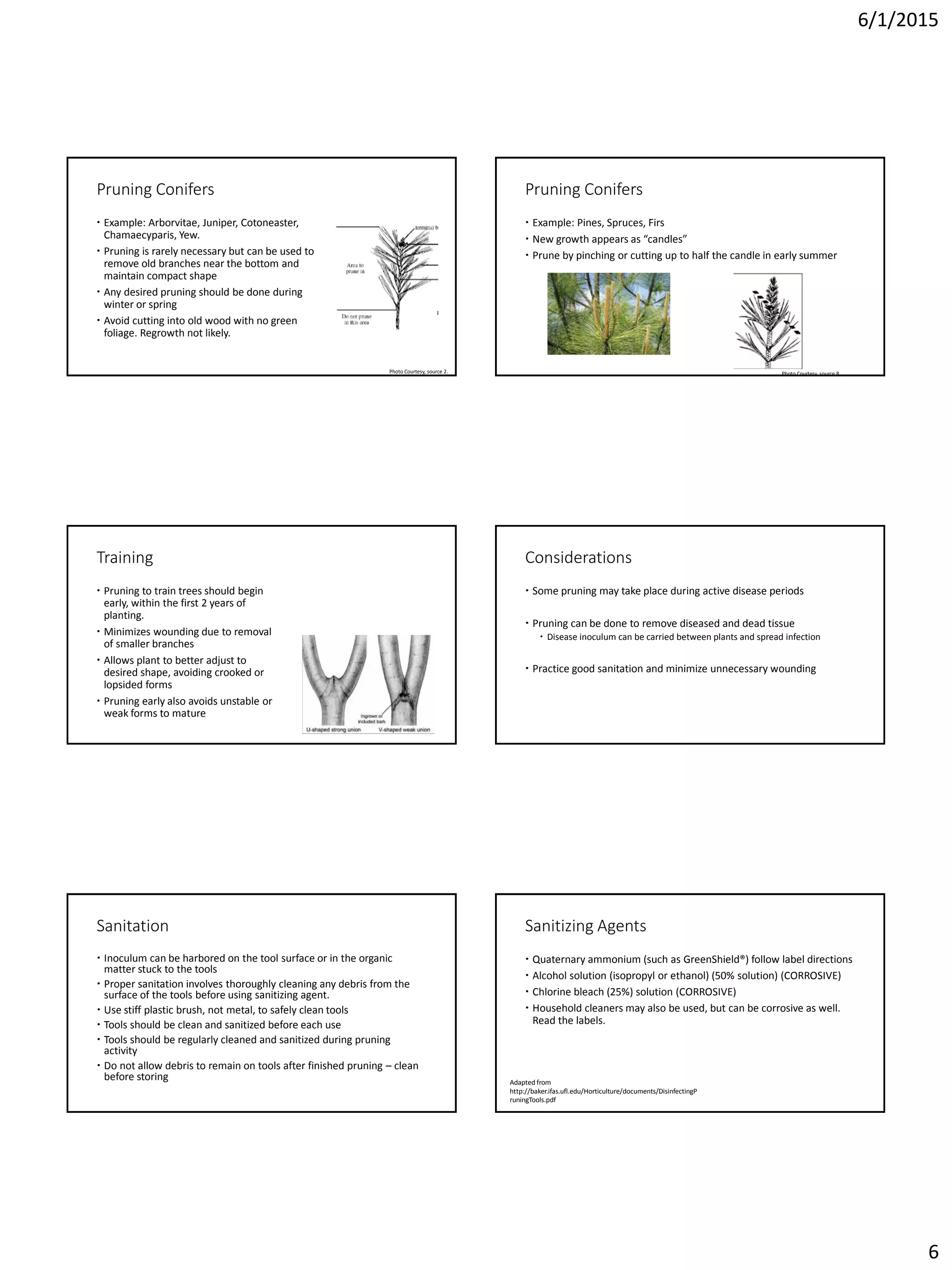
Pruning Conifers
 Example: Arborvitae, Juniper, Cotoneaster,
Chamaecyparis, Yew.
 Pruning is rarely necessary but can be used to
remove old branches near the bottom and
maintain compact shape
 Any desired pruning should be done during
winter or spring
 Avoid cutting into old wood with no green
foliage. Regrowth not likely.
Photo Courtesy, source 2.
Pruning Conifers
 Example: Pines, Spruces, Firs
 New growth appears as “candles”
 Prune by pinching or cutting up to half the candle in early summer
Photo Courtesy, source 8.
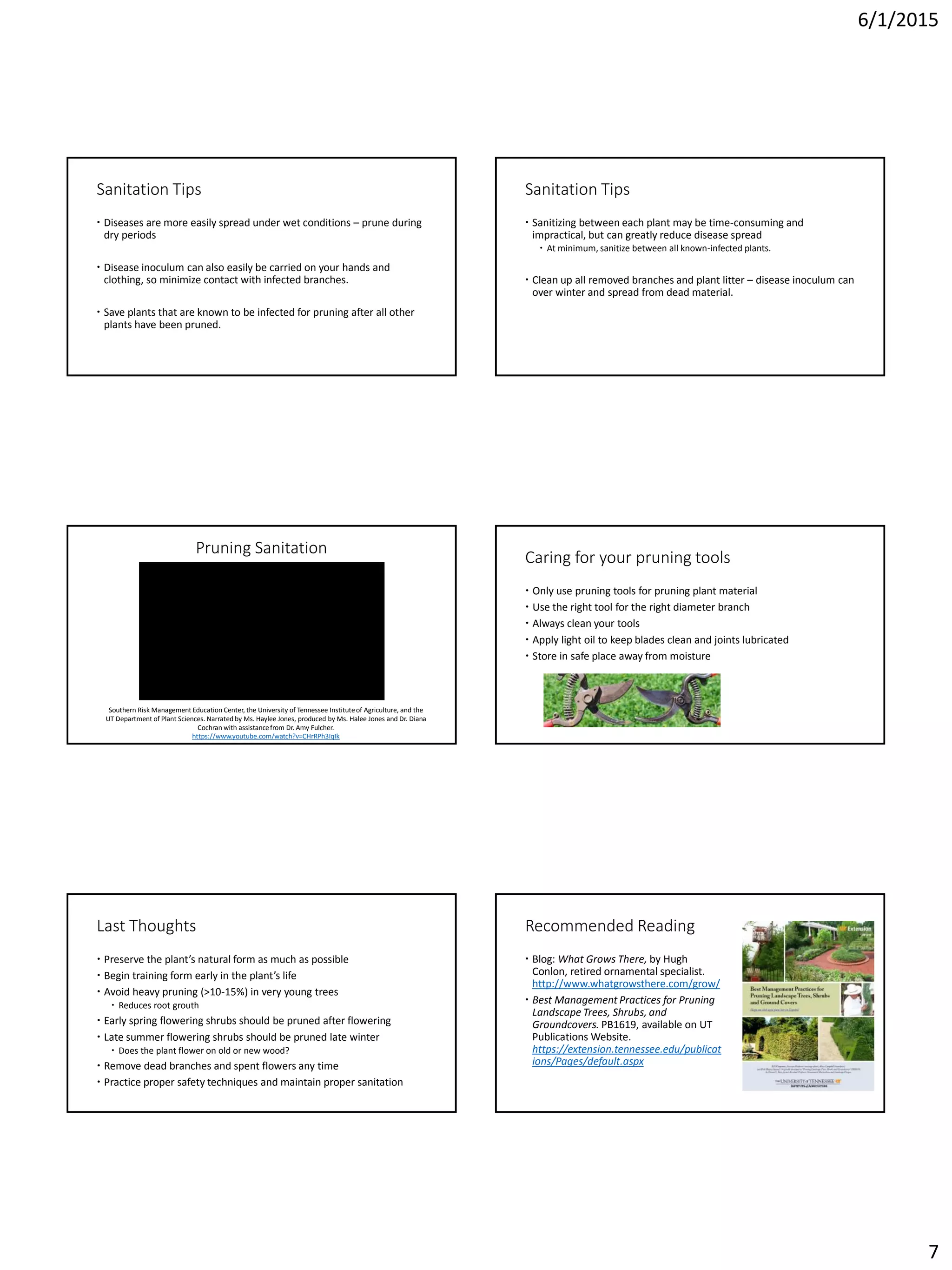
Training
 Pruning to train trees should begin
early, within the first 2 years of
planting.
 Minimizes wounding due to removal
of smaller branches
 Allows plant to better adjust to
desired shape, avoiding crooked or
lopsided forms
 Pruning early also avoids unstable or
weak forms to mature
Considerations
 Some pruning may take place during active disease periods
 Pruning can be done to remove diseased and dead tissue
 Disease inoculum can be carried between plants and spread infection
 Practice good sanitation and minimize unnecessary wounding
Sanitation
 Inoculum can be harbored on the tool surface or in the organic
matter stuck to the tools
 Proper sanitation involves thoroughly cleaning any debris from the
surface of the tools before using sanitizing agent.
 Use stiff plastic brush, not metal, to safely clean tools
 Tools should be clean and sanitized before each use
 Tools should be regularly cleaned and sanitized during pruning
activity
 Do not allow debris to remain on tools after finished pruning – clean
before storing
Sanitizing Agents
 Quaternary ammonium (such as GreenShield®) follow label directions
 Alcohol solution (isopropyl or ethanol) (50% solution) (CORROSIVE)
 Chlorine bleach (25%) solution (CORROSIVE)
 Household cleaners may also be used, but can be corrosive as well.
Read the labels.
Adapted from
http://baker.ifas.ufl.edu/Horticulture/documents/DisinfectingP
runingTools.pdf
6/1/2015
7
Sanitation Tips
 Diseases are more easily spread under wet conditions – prune during
dry periods
 Disease inoculum can also easily be carried on your hands and
clothing, so minimize contact with infected branches.
 Save plants that are known to be infected for pruning after all other
plants have been pruned.
Sanitation Tips
 Sanitizing between each plant may be time-consuming and
impractical, but can greatly reduce disease spread
 At minimum, sanitize between all known-infected plants.
 Clean up all removed branches and plant litter – disease inoculum can
over winter and spread from dead material.
Pruning Sanitation
Southern Risk Management Education Center, the University of Tennessee Instituteof Agriculture, and the
UT Department of Plant Sciences. Narrated by Ms. Haylee Jones, produced by Ms. Halee Jones and Dr. Diana
Cochran with assistancefrom Dr. Amy Fulcher.
https://www.youtube.com/watch?v=CHrRPh3IqIk
Caring for your pruning tools
 Only use pruning tools for pruning plant material
 Use the right tool for the right diameter branch
 Always clean your tools
 Apply light oil to keep blades clean and joints lubricated
 Store in safe place away from moisture
Last Thoughts
 Preserve the plant’s natural form as much as possible
 Begin training form early in the plant’s life
 Avoid heavy pruning (>10-15%) in very young trees
 Reduces root grouth
 Early spring flowering shrubs should be pruned after flowering
 Late summer flowering shrubs should be pruned late winter
 Does the plant flower on old or new wood?
 Remove dead branches and spent flowers any time
 Practice proper safety techniques and maintain proper sanitation
Recommended Reading
 Blog: What Grows There, by Hugh
Conlon, retired ornamental specialist.
http://www.whatgrowsthere.com/grow/
 Best Management Practices for Pruning
Landscape Trees, Shrubs, and
Groundcovers. PB1619, available on UT
Publications Website.
https://extension.tennessee.edu/publicat
ions/Pages/default.aspx
6/1/2015
8
Questions or Comments?
Maureen Thiessen
Extension Area Specialist
Commercial Ornamental Horticulture
mthiesse@utk.edu
Thank You!
Resources Used
1. Conlon, Hugh. 10 Tips for Pruning Trees and Shrubs. www.whatgrowsthere.com.
2. French, S., and Appleton, B.L. A Guide to Successful Pruning, Pruning Evergreen Trees.
Virginia Cooperative Extension Publication 430-459.
3. French, S., and Appleton, B.L. A Guide to Successful Pruning, Pruning Shrubs. Virginia
Cooperative Extension Publication 430-459.
4. Klingeman, B., Campbell, A., and Maxey, R. Best Management Practices for Pruning
Landscape Trees, Shrubs, and Groundcovers. UT Extension Publication PB1619.
5. Lamborn, A.R. Disinfecting Pruning Tools. University of Florida, Baker County Extension.
http://baker.ifas.ufl.edu/Horticulture/documents/DisinfectingPruningTools.pdf
6. Seavey, David. Pruning Deciduos Shrubs in the Landscape. University of New
Hampshire Cooperative Extension.
7. Westerfield, R., and Wade, G. Basic Principles of Pruning Woody Plants. University of
Georgia at Athens Extension Publication B949.
8. Starbuck, C.J. Pruning Ornamental Shrubs. University of Missouri Extension Publication
G6870.

Proper Shrub Pruning

  • 1.
    6/1/2015 1 Proper Shrub Pruning MasterGardener Day May 30th, 2015 Maureen Thiessen Area Extension Specialist Commercial Ornamental Horticulture What is Pruning? Selective removal of plant parts to reduce size, improve appearance, remove unsightly or diseased branches, and encourage growth and flowering Why Prune?  Maintain plant health and vigor by removing diseased or dead tissue.  Thinning - Increase sunlight penetration, reduce crowding or rubbing branches  Stimulate flowering and fruiting (dead-heading)  Train plant into desired shape  Stimulate lateral growth, filling of canopy  Avoid interferences Pruning Tools  Always use sharp and clean tools for pruning. Sharpness makes cleaner cuts that are healed more easily  Use the appropriate tool : Hand clippers, loppers, saws, and shears  Gloves, safety glasses, sturdy protective shoes Hand-Clippers  Most frequently used tool  Small diameter (<1/2”) branches  Anvil  Bypass – give clean cuts on new growth and hollow stems  Choose stainless steel to reduce corrosion and comfortable hand grips  Other helpful features – colorful handles, locking mechanism  Corona, Felco, ARS, DRAMM Bypass pruners Anvil pruners The Problem with Anvil Pruners Anvil pruners are better for cutting up dead and removed wood Photos: http://www.gardenmyths.com/anvil-bypass-secateurs-pruners/
  • 2.
    6/1/2015 2 Loppers  Larger diametercuts (larger than ½ inch)  Varying lengths  Are usually bypass Proper Blade Positioning Photo: http://www.gardenmyths.com/anvil-bypass-secateurs-pruners/ Pruning Saws  For much larger limbs (1.5 inches or thicker)  Curved blade  Choose one that folds closed for safety  Pay attention to hand positioning in case of a slip Hedge Shears  For hedging and shaving many small diameter branches  Do not use for larger diameter cuts  Larger branches should never be topped, but selectively pruned  If branches are too thick to hedge, selectively prune instead, or use power hedgers.  Shears are not used to give a natural look Opposite Alternate Take Note of Bud Arrangement Effects of Pruning  Auxin – a plant hormone produced in the terminal buds of shoots  Auxin is responsible for apical dominance and a tall slender habit  Reduces lateral bud break, and therefore lateral shoot growth.  Removal of terminal bud increases lateral bud break and stimulates lateral branching, causing a “filling” effect. Also responsible for increasing water sprouts. Photo Courtesy, source 4.
  • 3.
    6/1/2015 3 Effects of Pruning Removal of branch tip will stimulate lateral growth in the same branch below the cut.  If a shoot or branch is directly below the cut, growth will favor elongation of that shoot Point of cut Types of Cuts  Heading Cuts  Purpose is to shorten  Make these cuts as close to the bud as possible  Stimulates growth near the cut  The direction of nearest bud will be the new direction of growth  Remove inward-facing buds on oppositely arranged plants Photo Courtesy, source 3. Photo Courtesy, source 7. Types of Cuts  Thinning Cuts  Purpose is to reduce foliage density  Branches are removed at their points of attachment.  Maintains apical dominance  Does not result in as big of a flush of regrowth, maintains natural habit  Can be used to improve sunlight penetration deeper into canopy Photo Courtesy, source 7. Vs. Types of Cuts  Shearing  The process of “shaving” foliage to a uniform height or desired shape.  Stimulates regrowth at the surface of the shrub canopy.  Choose a shape that won’t block sunlight to lower branches  Once started, shearing process must be maintained Photo Courtesy, source 6. Photo Courtesy, source 4.
  • 4.
    6/1/2015 4 Renewal Pruning  Cuttingback the plant to the ground, removing all above-ground branches to a few inches from the ground  Can be used to eliminate severely damaged branches due to weather or disease  Can be used to remove overgrown plants  Reduce pesticide use  Should be done late winter/very early spring  Summer blooming plants will likely rebloom that year  Do not perform on grafted plants  Abelia, Butterfly bush, Beautyberry, Smoke tree, Forsythia, Fothergilla, Hydrangea, Weigela  Coppicing – renewal pruning in the fall. Rhododendron, azalea, pieris, mountain laurel. Make Smallest Cuts Possible  Make straight cuts so as to minimize the wound area.  Slanted cuts increased wounded area and allow exposure to more disease pathogens. Photo Courtesy, source 4. Wounds  Every cut made to a living plant is an entryway for pathogens  Make the smallest cut possible, and only remove foliage that is absolutely necessary.  The plant’s response to wounding is to form a layer of hardened cells at the cut site to protect the inner vascular tissues from exposure.  This happens at the branch collar. Preserve the Branch Collar  The branch collar is the base of the branch where it attaches to the parent trunk.  An area of swollen, thickened tissue, which supports the weight of the branch.  Is composed of hardened tissue that is decay-resistant and resists spread of disease into the parent tissues.  Always cut just beyond the branch collar, mimicking natural branch loss When removing larger limbs, use this series of three cuts to reduce bark stripping and exposure of inner wood. Avoid Dramatically Removing Central Leader Photo Courtesy, source 7.
  • 5.
    6/1/2015 5 New Central Leader Startpruning to train early in the tree’s life Photo Courtesy, source 7. When Should We Prune? Generally, either late winter/early spring, or early summer Depends on whether the plant blooms on last year’s wood or new growth Timing – Flowering Trees and Shrubs  Early blooming plants, bloom on last year’s wood  Prune in late spring or early summer, after flowering  Early summer pruning stimulates growth that will bloom next year. So don’t delay.  Azalea, barberry, euonymus, deutzia, dogwood, forsythia, hydrangea (bigleaf, oakleaf), lilac, loropetalum, quince, rhododendron, spirea, sweetshrub, weigela, and witchhazel. Timing – Flowering Trees and Shrubs  Later Bloomers (bloom on new growth)  Prune during late winter / early spring before bud break  Pruning stimulates growth that will bloom the same year  Abelia, beautyberry, butterfly bush, clethra, crape myrtle, hydrangea (smooth and panicled), itea, rose, rose of Sharon, spirea. Timing – Flowering Trees and Shrubs  Avoid late summer and early fall  The stimulated growth will not mature before winter  After fruit has lost beauty – holly, pyracantha, barberry, cotoneaster, nandina Timing for Conifers  Generally, any time the wood is not frozen.  Pruning stimulates the foliage near the cut, can be done to thicken growth  Ex. Christmas tree shearing  Older wood has fewer buds for regeneration – foliage thickening less likely
  • 6.
    6/1/2015 6 Pruning Conifers  Example:Arborvitae, Juniper, Cotoneaster, Chamaecyparis, Yew.  Pruning is rarely necessary but can be used to remove old branches near the bottom and maintain compact shape  Any desired pruning should be done during winter or spring  Avoid cutting into old wood with no green foliage. Regrowth not likely. Photo Courtesy, source 2. Pruning Conifers  Example: Pines, Spruces, Firs  New growth appears as “candles”  Prune by pinching or cutting up to half the candle in early summer Photo Courtesy, source 8. Training  Pruning to train trees should begin early, within the first 2 years of planting.  Minimizes wounding due to removal of smaller branches  Allows plant to better adjust to desired shape, avoiding crooked or lopsided forms  Pruning early also avoids unstable or weak forms to mature Considerations  Some pruning may take place during active disease periods  Pruning can be done to remove diseased and dead tissue  Disease inoculum can be carried between plants and spread infection  Practice good sanitation and minimize unnecessary wounding Sanitation  Inoculum can be harbored on the tool surface or in the organic matter stuck to the tools  Proper sanitation involves thoroughly cleaning any debris from the surface of the tools before using sanitizing agent.  Use stiff plastic brush, not metal, to safely clean tools  Tools should be clean and sanitized before each use  Tools should be regularly cleaned and sanitized during pruning activity  Do not allow debris to remain on tools after finished pruning – clean before storing Sanitizing Agents  Quaternary ammonium (such as GreenShield®) follow label directions  Alcohol solution (isopropyl or ethanol) (50% solution) (CORROSIVE)  Chlorine bleach (25%) solution (CORROSIVE)  Household cleaners may also be used, but can be corrosive as well. Read the labels. Adapted from http://baker.ifas.ufl.edu/Horticulture/documents/DisinfectingP runingTools.pdf
  • 7.
    6/1/2015 7 Sanitation Tips  Diseasesare more easily spread under wet conditions – prune during dry periods  Disease inoculum can also easily be carried on your hands and clothing, so minimize contact with infected branches.  Save plants that are known to be infected for pruning after all other plants have been pruned. Sanitation Tips  Sanitizing between each plant may be time-consuming and impractical, but can greatly reduce disease spread  At minimum, sanitize between all known-infected plants.  Clean up all removed branches and plant litter – disease inoculum can over winter and spread from dead material. Pruning Sanitation Southern Risk Management Education Center, the University of Tennessee Instituteof Agriculture, and the UT Department of Plant Sciences. Narrated by Ms. Haylee Jones, produced by Ms. Halee Jones and Dr. Diana Cochran with assistancefrom Dr. Amy Fulcher. https://www.youtube.com/watch?v=CHrRPh3IqIk Caring for your pruning tools  Only use pruning tools for pruning plant material  Use the right tool for the right diameter branch  Always clean your tools  Apply light oil to keep blades clean and joints lubricated  Store in safe place away from moisture Last Thoughts  Preserve the plant’s natural form as much as possible  Begin training form early in the plant’s life  Avoid heavy pruning (>10-15%) in very young trees  Reduces root grouth  Early spring flowering shrubs should be pruned after flowering  Late summer flowering shrubs should be pruned late winter  Does the plant flower on old or new wood?  Remove dead branches and spent flowers any time  Practice proper safety techniques and maintain proper sanitation Recommended Reading  Blog: What Grows There, by Hugh Conlon, retired ornamental specialist. http://www.whatgrowsthere.com/grow/  Best Management Practices for Pruning Landscape Trees, Shrubs, and Groundcovers. PB1619, available on UT Publications Website. https://extension.tennessee.edu/publicat ions/Pages/default.aspx
  • 8.
    6/1/2015 8 Questions or Comments? MaureenThiessen Extension Area Specialist Commercial Ornamental Horticulture mthiesse@utk.edu Thank You! Resources Used 1. Conlon, Hugh. 10 Tips for Pruning Trees and Shrubs. www.whatgrowsthere.com. 2. French, S., and Appleton, B.L. A Guide to Successful Pruning, Pruning Evergreen Trees. Virginia Cooperative Extension Publication 430-459. 3. French, S., and Appleton, B.L. A Guide to Successful Pruning, Pruning Shrubs. Virginia Cooperative Extension Publication 430-459. 4. Klingeman, B., Campbell, A., and Maxey, R. Best Management Practices for Pruning Landscape Trees, Shrubs, and Groundcovers. UT Extension Publication PB1619. 5. Lamborn, A.R. Disinfecting Pruning Tools. University of Florida, Baker County Extension. http://baker.ifas.ufl.edu/Horticulture/documents/DisinfectingPruningTools.pdf 6. Seavey, David. Pruning Deciduos Shrubs in the Landscape. University of New Hampshire Cooperative Extension. 7. Westerfield, R., and Wade, G. Basic Principles of Pruning Woody Plants. University of Georgia at Athens Extension Publication B949. 8. Starbuck, C.J. Pruning Ornamental Shrubs. University of Missouri Extension Publication G6870.