Winter Tree Pruning Tips
and Techniques
tips for proper tree pruning
Winter Pruning
Winter is the ideal time to prune. From late-November to mid-March, you
can thin and shape your deciduous trees to prepare for the spring
season. Evergreens should be pruned in the growing season, since they’re
never fully dormant and may suffer tip burn if cut back in the winter.
Why prune in the winter
• All the dead, cracked and broken branches
are easy to spot when trees shed their leaves.
• Trees are able to adapt to cuts more easily
by fluctuating leaf production the following
season.
• The stress is minimal compared to pruning in
spring or summer.
• Experienced tree workers and arborists are
more readily available.
• Tree pathogens are dormant leaving little
risk of spreading infectious diseases.
• Leafless debris produces high-quality mulch.
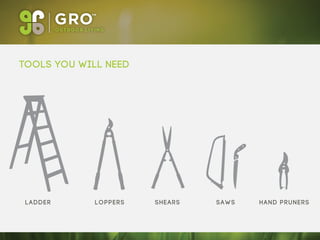
tools you will Need
LoppersLadder Shears saws Hand pruners
Six Tree Pruning Tips
When in doubt, don’t cut
Begin with a visual inspection from top to bottom. Weak, sick or elderly trees should be
pruned minimally, or not at all. As a general rule of thumb: If you’re unsure whether
you should prune a branch—don’t. You can always go back later but there’s no going
back after an incorrect cut.
The five D’s
Remember the “5D” rule when looking
for branches to trim or remove:
Also remove:
Any branch that crosses another
at an odd angle, any branch
rubbing against other branches
and any branch growing inwardly
toward the center
1
2
• Dead
• Dying
• Damaged
• Deformed
• Diseased
3
4
• Never remove more
than 1⁄3 of a tree’s crown
in a season.
• Don’t prune up from the
bottom any more than 1/3
of the tree’s total height.
• The side branches should be
at least 1/3 smaller than the
diameter of the trunk.
Rule of thirds
Don’t cut flush—Don’t leave stubs
When trimming branches, don’t cut completely flush to the trunk or larger
branch. Leave intact the branch bark ridge and collar where the branch meets the
trunk. At the same time, don’t leave a protruding stub and trim as close to the
branch collar as possible.
5
6
Keep tools sharp
One-handed pruning shears with curved blades work best on young trees.
Loppers are adequate for branches up to an inch—but they’re clumsy and don’t
always make the cleanest cuts. We suggest using pruning handsaws for branches
over a half inch.
Safety
Homeowners can safely handle most pruning of a young tree, but pruning high,
heavy limbs of mature trees using sharp cutting tools or a chainsaw can be very
dangerous. For high branches use a pole pruner—don’t climb the tree—leave
that to a professional arborist.
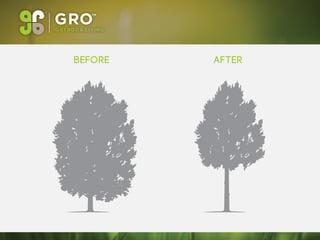
Before after
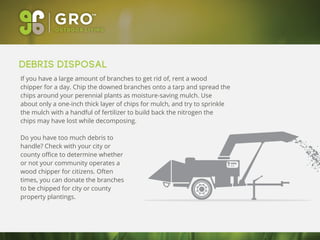
Debris Disposal
If you have a large amount of branches to get rid of, rent a wood
chipper for a day. Chip the downed branches onto a tarp and spread the
chips around your perennial plants as moisture-saving mulch. Use
about only a one-inch thick layer of chips for mulch, and try to sprinkle
the mulch with a handful of fertilizer to build back the nitrogen the
chips may have lost while decomposing.
Do you have too much debris to
handle? Check with your city or
county office to determine whether
or not your community operates a
wood chipper for citizens. Often
times, you can donate the branches
to be chipped for city or county
property plantings.

Tree Pruning Slideshow

  • 1.
    Winter Tree PruningTips and Techniques
  • 2.
    tips for propertree pruning Winter Pruning Winter is the ideal time to prune. From late-November to mid-March, you can thin and shape your deciduous trees to prepare for the spring season. Evergreens should be pruned in the growing season, since they’re never fully dormant and may suffer tip burn if cut back in the winter. Why prune in the winter • All the dead, cracked and broken branches are easy to spot when trees shed their leaves. • Trees are able to adapt to cuts more easily by fluctuating leaf production the following season. • The stress is minimal compared to pruning in spring or summer. • Experienced tree workers and arborists are more readily available. • Tree pathogens are dormant leaving little risk of spreading infectious diseases. • Leafless debris produces high-quality mulch.
  • 3.
    tools you willNeed LoppersLadder Shears saws Hand pruners
  • 4.
    Six Tree PruningTips When in doubt, don’t cut Begin with a visual inspection from top to bottom. Weak, sick or elderly trees should be pruned minimally, or not at all. As a general rule of thumb: If you’re unsure whether you should prune a branch—don’t. You can always go back later but there’s no going back after an incorrect cut. The five D’s Remember the “5D” rule when looking for branches to trim or remove: Also remove: Any branch that crosses another at an odd angle, any branch rubbing against other branches and any branch growing inwardly toward the center 1 2 • Dead • Dying • Damaged • Deformed • Diseased
  • 5.
    3 4 • Never removemore than 1⁄3 of a tree’s crown in a season. • Don’t prune up from the bottom any more than 1/3 of the tree’s total height. • The side branches should be at least 1/3 smaller than the diameter of the trunk. Rule of thirds Don’t cut flush—Don’t leave stubs When trimming branches, don’t cut completely flush to the trunk or larger branch. Leave intact the branch bark ridge and collar where the branch meets the trunk. At the same time, don’t leave a protruding stub and trim as close to the branch collar as possible.
  • 6.
    5 6 Keep tools sharp One-handedpruning shears with curved blades work best on young trees. Loppers are adequate for branches up to an inch—but they’re clumsy and don’t always make the cleanest cuts. We suggest using pruning handsaws for branches over a half inch. Safety Homeowners can safely handle most pruning of a young tree, but pruning high, heavy limbs of mature trees using sharp cutting tools or a chainsaw can be very dangerous. For high branches use a pole pruner—don’t climb the tree—leave that to a professional arborist.
  • 7.
  • 8.
    Debris Disposal If youhave a large amount of branches to get rid of, rent a wood chipper for a day. Chip the downed branches onto a tarp and spread the chips around your perennial plants as moisture-saving mulch. Use about only a one-inch thick layer of chips for mulch, and try to sprinkle the mulch with a handful of fertilizer to build back the nitrogen the chips may have lost while decomposing. Do you have too much debris to handle? Check with your city or county office to determine whether or not your community operates a wood chipper for citizens. Often times, you can donate the branches to be chipped for city or county property plantings.