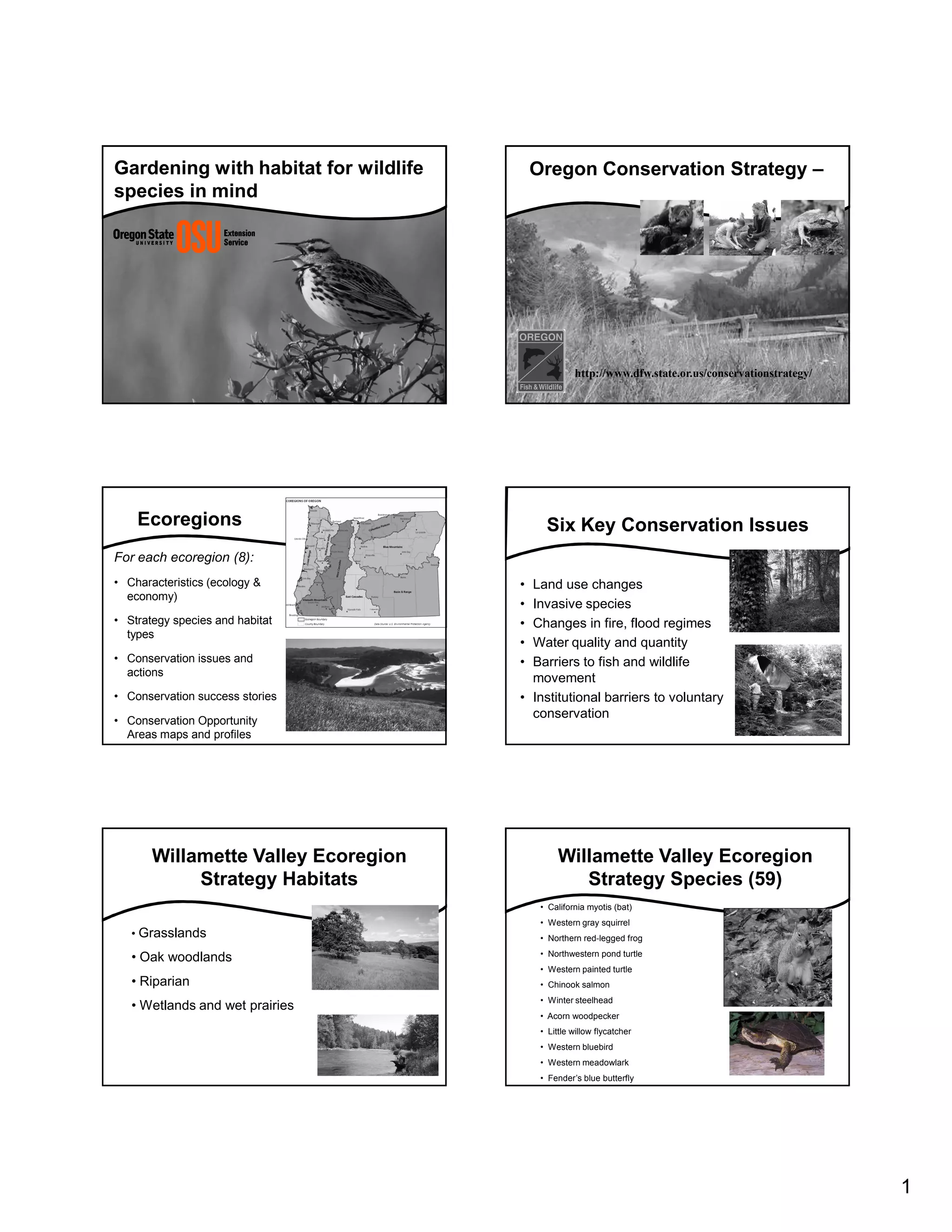
Gardening with habitat for wildlife       Oregon Conservation Strategy –
species in mind


                                                                                          Oregon
                                                                                      Department
                                                    http://www.dfw.state.or.us/conservationstrategy/
                                                                                      of Fish and
                                                                                          Wildlife


    Ecoregions                                  Habitats and Species
                                            Six Key Conservation Issues
For each ecoregion (8):
• Characteristics (ecology &          • Land use changes
  economy)
                                      • Invasive species
• Strategy species and habitat        • Changes in fire, flood regimes
  types
                                      • Water quality and quantity
• Conservation issues and             • Barriers to fish and wildlife
  actions
                                        movement
• Conservation success stories        • Institutional barriers to voluntary
• Conservation Opportunity
                                        conservation
  Areas maps and profiles


       Willamette Valley Ecoregion              Willamette Valley Ecoregion
            Strategy Habitats                      Strategy Species (59)
                                           • California myotis (bat)
                                           • Western gray squirrel
   • Grasslands                            • Northern red-legged frog
                                           • Northwestern pond turtle
   • Oak woodlands
                                           • Western painted turtle
   • Riparian                              • Chinook salmon
                                           • Winter steelhead
   • Wetlands and wet prairies
                                           • Acorn woodpecker
                                           • Little willow flycatcher
                                           • Western bluebird
                                           • Western meadowlark
                                           • Fender’s blue butterfly


                                                                                                       1
Oak Woodlands: Why Care?                                     Oak Woodlands: Threats


• Benefits to wildlife                                 • Land use conversion
   – Used by 200+ species                              • Fire suppression
• Ecosystems services                                  • Invasive species


Oak Woodlands and how we can employ
    the Strategy’s Habitat Approach                        Recommended Conservation Actions

• Characterized by open canopy                         •   Maintain existing oak woodlands
  dominated by oak                                     •   Control encroaching conifers
   – 30-60% tree cover                                 •   Address over-crowding
• Common plant associates:                             •   Re-establish oak woodlands
   – Ponderosa pine, Big leaf maple, OR
     ash, snowberry, poison oak, hazel,                •   Control invasive plant species
     serviceberry, sword fern, grasses                 •   Restore understory plants
• Historically abundant; <4% remains


                                                            Broad scale benefits of functioning
       Opportunities within existing
                                                                        systems
              woodlands                                    •   Nutrient cycling
    • Provide for basic wildlife needs by protecting       •   Pollination
      & enhancing food, cover, water, space                •   Germination
    • Identify and address limiting factors                •   Seed dispersal
    • Manage habitats to provide multiple stages of        •   Soil generation
      succession                                           •   Habitats & niches
    • Minimize fragmentation                               •   Predators on pests
       – Decrease edges                                    •   Excrete natural fertilizer
       – Provide corridors between patches                 •   Wildfire risk reduction
                                                           •   Soil stabilization
    • Increase habitat diversity
                                                           •   Water quality, quantity, runoff storage
       – Species & structure
       – Snags and downed logs


                                                                                                         2
Habitat, a biological definition                              Habitat is:
Habitat is the combination of factors                                 •   Food
• biotic                                                              •   Water
• abiotic                                                             •   Cover
• necessary to produce                                                •   Space
   – Occupancy, survival, and reproduction by members                 •   Other species-specific
     of a given species                                                   needs


    Native species and species
       habitat requirements
• Each species’ habitat requirements reflects the
  native communities in which the species evolved

• Our efforts to provide habitat for native species
  will be most successful when we can provide
  native plants, structures, and habitat elements


             Structure:
                                                        The perils of fragmentation
        Complex can be good!
                                                                       • Reduced interior area
             “hard” vs. “soft” edges
                                                                       • Increased edge area
                                                                       • Incursion of exterior
                                                                         conditions in the interior
                                                                       • Increased permeability of
                                                                         interior to predators,
                                                                         competitors, invasives
                                                                       • Species-specific
                                                                         minimum patch size may
                                                                         be lost
                                                                       • Lost connectivity among
                                                                         patches
                                                                       • Others…


                                                                                                      3
Cottonwood galleries along the main rivers
are the sole source of declining Great Blue                     Build it (or protect it) and they
              Heron Rookeries
                                                                           will come…


                                                            >>We can provide necessary elements of
                                                             habitat for native species…


                Invertebrates                                               Amphibians
• Butterflies, native pollinators, and other                •   Maintain wet areas, native water & flows
  beneficials                                               •   No (non-native) fish!
• Some require very species-specific, life                  •   No bullfrogs!
  stage-specific plants                                     •   Minimize disturbance – Some species
  – Example: Fender’s blue butterfly and Kincaid’s lupine
                                                                cannot endure any handling
• Others are more generalist and can
  benefit from a broad range of pollen and
  nectar-bearing plants


                                                                                                           4
Reptiles                                     Herpetiles to consider:
• Structure or cover for thermoregulation                    • Pacific tree frog
    – Typically need some structure for                      • Red-legged frog
      overwintering                                          • Western newts (permanent ponds)
    – Turtles especially:                                    • Long-toed salamanders (ephemeral ponds)
        • Basking structure                                  Reptiles:
        • Protect from non-native predation – bullfrogs on
                                                             • Western pond turtle
          young!
        • Protect from non-native, invasive competitors      • Western painted turtle
                                                             • Garter snakes (They eat slugs!)
• No persecution


                          Birds                                                        Birds
WV has forest species, grassland species, and                • Do not create an ecological trap
 edge specialists – Remember to consider                       – Non-native/invasive competitors?
 species-specific needs
                                                               – Non-native predators?
•   Food
–   via choice of plants                                       – Availability of cover near food and water
–   Feeders – Pro’s and con’s
•   Water
•   Cover and complex structure
–   via choice and variety of plants
•   Species preferences for nesting materials
•   Some will use nest boxes, but size, type, and location
    matters! Consult a book or site to learn more,
    e.g.,www.birdhouses101.com


                                                                                  Mammals
                                                             • Small terrestrial and arboreal mammals
                                                               – Food: Several are generalists and
                                                                 omnivorous, but others are more specialized
                                                               – Food, cover, and structure in proximity so as
                                                                 to decrease predation
                               Think of songbirds, but
                                                                  • Example: Squirrels need fruit and seed-bearing trees and
                               don’t forget the                     shrubs, esp. oaks. They need big enough trees to allow drey
                               woodpeckers, owls, and               and nest-building, along with larder hoards. They are preyed
                               raptors!                             on by avian and terrestrial predators, so cover needs to be
                                                                    close by at all times.
                                                               – Avoid creating artificial sources of predation


                                                                                                                                   5
Mammals                                            Be careful of:
• Bats
  – Roost structures
  – Vegetation that provides habitat for insect
    food sources
  – Water – Some will use
  – Low- to no-disturbance, especially of
    maternity colonies
  – Very sensitive to pesticides


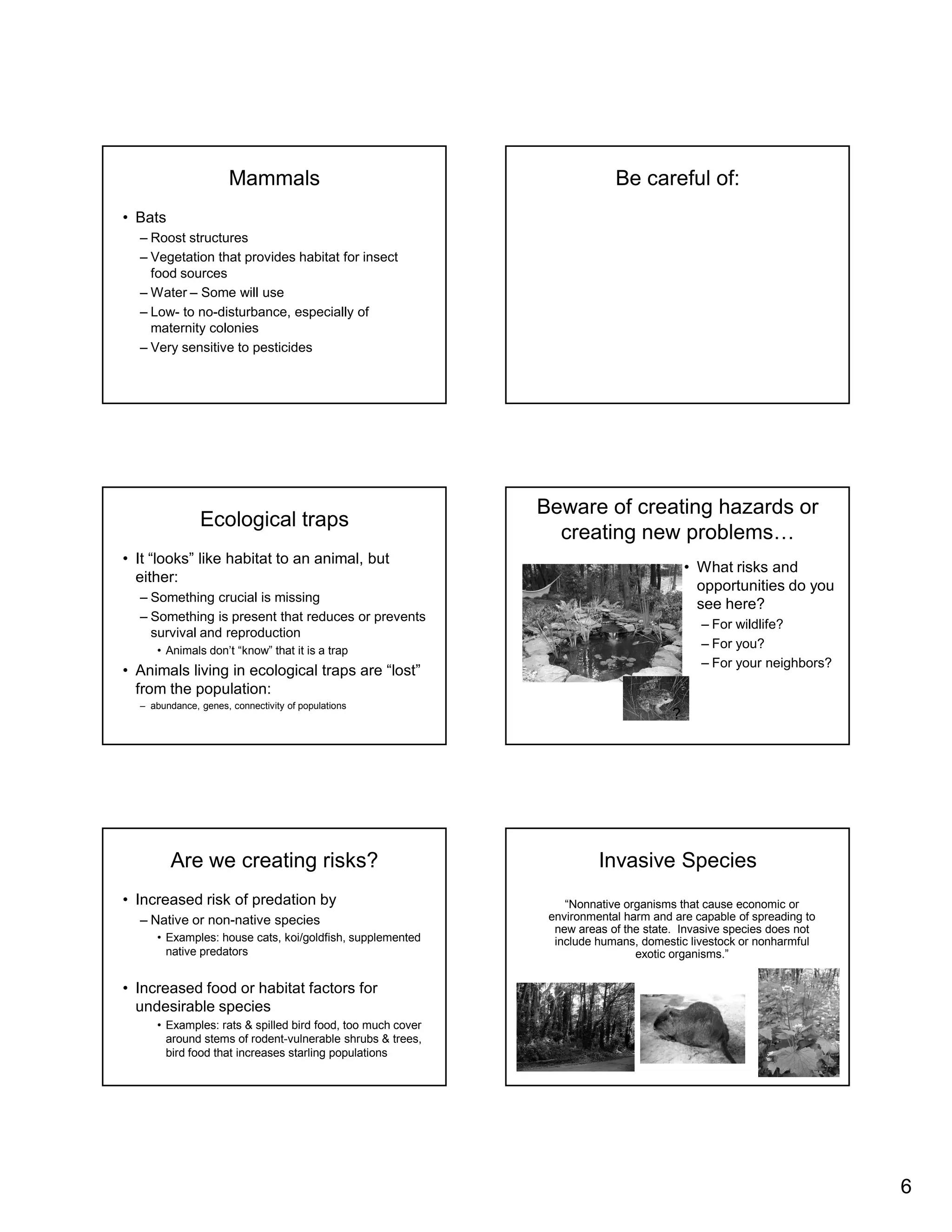
                                                            Beware of creating hazards or
               Ecological traps
                                                              creating new problems…
• It “looks” like habitat to an animal, but
                                                                                        • What risks and
  either:
                                                                                          opportunities do you
  – Something crucial is missing
                                                                                          see here?
  – Something is present that reduces or prevents
                                                                                          – For wildlife?
    survival and reproduction
     • Animals don’t “know” that it is a trap
                                                                                          – For you?
                                                                                          – For your neighbors?
• Animals living in ecological traps are “lost”
  from the population:
  – abundance, genes, connectivity of populations
                                                                                    ?


         Are we creating risks?                                       Invasive Species
• Increased risk of predation by                                “Nonnative organisms that cause economic or
  – Native or non-native species                             environmental harm and are capable of spreading to
                                                              new areas of the state. Invasive species does not
     • Examples: house cats, koi/goldfish, supplemented       include humans, domestic livestock or nonharmful
       native predators                                                      exotic organisms.”


• Increased food or habitat factors for
  undesirable species
     • Examples: rats & spilled bird food, too much cover
       around stems of rodent-vulnerable shrubs & trees,
       bird food that increases starling populations


                                                                                                                  6
Invasive Species:
                                                          Keep Wildlife WILD!
   Risks posed for native species
• Changes to ecosystem functions
• Loss of biodiversity
• Reduction in habitat quality or
  direct habitat loss
• Direct competition
• Direct mortality (e.g., predation)
• Introduction of disease


    Habituation can be deadly,                           But remember: With
    damaging, and dangerous                         forethought, your choices can
• “Fed bears are dead bears”                      • Provide habitat and connectivity for native
• A wild animal is always a wild animal             species
• Habituation often centers on food               • Increase ecological services in your
   – Decreased fear of humans                       garden:
   – Increased aggressiveness for food or space     – Examples: pollination, predation on insects
   – Competition/elimination of domestic          • Increase your enjoyment and the value of
     “competitors”                                  YOUR habitat while still reaping gardening
   – Disease or waste products                      rewards!
   – Prey species attract predators               • Contribute to maintaining Oregon’s natural
   – Other risks…                                   riches


                                                                                                    7

Habitat Enhancements

  • 1.
    Gardening with habitatfor wildlife Oregon Conservation Strategy – species in mind Oregon Department http://www.dfw.state.or.us/conservationstrategy/ of Fish and Wildlife Ecoregions Habitats and Species Six Key Conservation Issues For each ecoregion (8): • Characteristics (ecology & • Land use changes economy) • Invasive species • Strategy species and habitat • Changes in fire, flood regimes types • Water quality and quantity • Conservation issues and • Barriers to fish and wildlife actions movement • Conservation success stories • Institutional barriers to voluntary • Conservation Opportunity conservation Areas maps and profiles Willamette Valley Ecoregion Willamette Valley Ecoregion Strategy Habitats Strategy Species (59) • California myotis (bat) • Western gray squirrel • Grasslands • Northern red-legged frog • Northwestern pond turtle • Oak woodlands • Western painted turtle • Riparian • Chinook salmon • Winter steelhead • Wetlands and wet prairies • Acorn woodpecker • Little willow flycatcher • Western bluebird • Western meadowlark • Fender’s blue butterfly 1
  • 2.
    Oak Woodlands: WhyCare? Oak Woodlands: Threats • Benefits to wildlife • Land use conversion – Used by 200+ species • Fire suppression • Ecosystems services • Invasive species Oak Woodlands and how we can employ the Strategy’s Habitat Approach Recommended Conservation Actions • Characterized by open canopy • Maintain existing oak woodlands dominated by oak • Control encroaching conifers – 30-60% tree cover • Address over-crowding • Common plant associates: • Re-establish oak woodlands – Ponderosa pine, Big leaf maple, OR ash, snowberry, poison oak, hazel, • Control invasive plant species serviceberry, sword fern, grasses • Restore understory plants • Historically abundant; <4% remains Broad scale benefits of functioning Opportunities within existing systems woodlands • Nutrient cycling • Provide for basic wildlife needs by protecting • Pollination & enhancing food, cover, water, space • Germination • Identify and address limiting factors • Seed dispersal • Manage habitats to provide multiple stages of • Soil generation succession • Habitats & niches • Minimize fragmentation • Predators on pests – Decrease edges • Excrete natural fertilizer – Provide corridors between patches • Wildfire risk reduction • Soil stabilization • Increase habitat diversity • Water quality, quantity, runoff storage – Species & structure – Snags and downed logs 2
  • 3.
    Habitat, a biologicaldefinition Habitat is: Habitat is the combination of factors • Food • biotic • Water • abiotic • Cover • necessary to produce • Space – Occupancy, survival, and reproduction by members • Other species-specific of a given species needs Native species and species habitat requirements • Each species’ habitat requirements reflects the native communities in which the species evolved • Our efforts to provide habitat for native species will be most successful when we can provide native plants, structures, and habitat elements Structure: The perils of fragmentation Complex can be good! • Reduced interior area “hard” vs. “soft” edges • Increased edge area • Incursion of exterior conditions in the interior • Increased permeability of interior to predators, competitors, invasives • Species-specific minimum patch size may be lost • Lost connectivity among patches • Others… 3
  • 4.
    Cottonwood galleries alongthe main rivers are the sole source of declining Great Blue Build it (or protect it) and they Heron Rookeries will come… >>We can provide necessary elements of habitat for native species… Invertebrates Amphibians • Butterflies, native pollinators, and other • Maintain wet areas, native water & flows beneficials • No (non-native) fish! • Some require very species-specific, life • No bullfrogs! stage-specific plants • Minimize disturbance – Some species – Example: Fender’s blue butterfly and Kincaid’s lupine cannot endure any handling • Others are more generalist and can benefit from a broad range of pollen and nectar-bearing plants 4
  • 5.
    Reptiles Herpetiles to consider: • Structure or cover for thermoregulation • Pacific tree frog – Typically need some structure for • Red-legged frog overwintering • Western newts (permanent ponds) – Turtles especially: • Long-toed salamanders (ephemeral ponds) • Basking structure Reptiles: • Protect from non-native predation – bullfrogs on • Western pond turtle young! • Protect from non-native, invasive competitors • Western painted turtle • Garter snakes (They eat slugs!) • No persecution Birds Birds WV has forest species, grassland species, and • Do not create an ecological trap edge specialists – Remember to consider – Non-native/invasive competitors? species-specific needs – Non-native predators? • Food – via choice of plants – Availability of cover near food and water – Feeders – Pro’s and con’s • Water • Cover and complex structure – via choice and variety of plants • Species preferences for nesting materials • Some will use nest boxes, but size, type, and location matters! Consult a book or site to learn more, e.g.,www.birdhouses101.com Mammals • Small terrestrial and arboreal mammals – Food: Several are generalists and omnivorous, but others are more specialized – Food, cover, and structure in proximity so as to decrease predation Think of songbirds, but • Example: Squirrels need fruit and seed-bearing trees and don’t forget the shrubs, esp. oaks. They need big enough trees to allow drey woodpeckers, owls, and and nest-building, along with larder hoards. They are preyed raptors! on by avian and terrestrial predators, so cover needs to be close by at all times. – Avoid creating artificial sources of predation 5
  • 6.
    Mammals Be careful of: • Bats – Roost structures – Vegetation that provides habitat for insect food sources – Water – Some will use – Low- to no-disturbance, especially of maternity colonies – Very sensitive to pesticides Beware of creating hazards or Ecological traps creating new problems… • It “looks” like habitat to an animal, but • What risks and either: opportunities do you – Something crucial is missing see here? – Something is present that reduces or prevents – For wildlife? survival and reproduction • Animals don’t “know” that it is a trap – For you? – For your neighbors? • Animals living in ecological traps are “lost” from the population: – abundance, genes, connectivity of populations ? Are we creating risks? Invasive Species • Increased risk of predation by “Nonnative organisms that cause economic or – Native or non-native species environmental harm and are capable of spreading to new areas of the state. Invasive species does not • Examples: house cats, koi/goldfish, supplemented include humans, domestic livestock or nonharmful native predators exotic organisms.” • Increased food or habitat factors for undesirable species • Examples: rats & spilled bird food, too much cover around stems of rodent-vulnerable shrubs & trees, bird food that increases starling populations 6
  • 7.
    Invasive Species: Keep Wildlife WILD! Risks posed for native species • Changes to ecosystem functions • Loss of biodiversity • Reduction in habitat quality or direct habitat loss • Direct competition • Direct mortality (e.g., predation) • Introduction of disease Habituation can be deadly, But remember: With damaging, and dangerous forethought, your choices can • “Fed bears are dead bears” • Provide habitat and connectivity for native • A wild animal is always a wild animal species • Habituation often centers on food • Increase ecological services in your – Decreased fear of humans garden: – Increased aggressiveness for food or space – Examples: pollination, predation on insects – Competition/elimination of domestic • Increase your enjoyment and the value of “competitors” YOUR habitat while still reaping gardening – Disease or waste products rewards! – Prey species attract predators • Contribute to maintaining Oregon’s natural – Other risks… riches 7