
This document provides information on seed collection and preservation techniques. It discusses when, where, and how to collect seeds, including from natural seed fall, climbing trees, shaking trees, pruning branches, and collecting from felled trees. It also outlines seed extraction, cleaning, testing, storage and preservation methods. The goal of proper seed collection and preservation is to maintain seed viability and quality until they are ready to be sown.
Presentation
On
seed collection andseed preservation
Presented by:
Faisal Khalid
M.Phil semester 2st
FORESTRY AND WILDLIFE MANAGEMENT
University of Haripur
4.
SEED
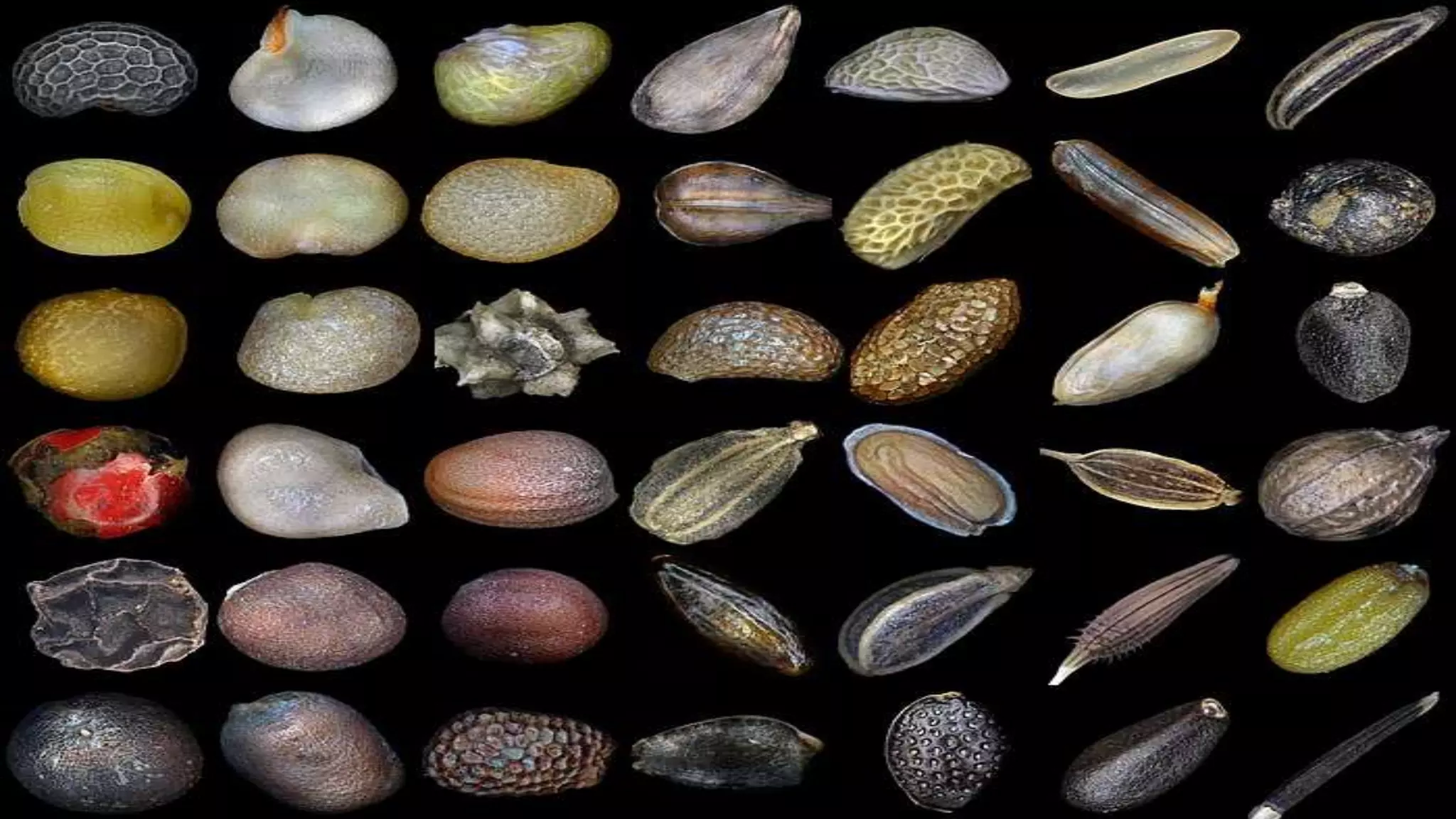
The grainsor ripened ovules of plants used for sowing.
A mature plant ovule containing an embryo.
A small dry fruit, spore, or other propagative plant part.
The reproductive body of a flowering plant; the mature ovule.
A seed is an embryonic plant enclosed in a protective outer covering .
Seed is material which is used for planting or regeneration purposes.
7.
Seed collection Techniques:
Agencies for collecting of Seed:
Pakistan Forest Institute
Forest Department
Pakistan Forestry research
institute (Faisalabad)
Responsible Contractor
8.
When, Where andHow to Collect Seed:
Proper Season
Plus Tree
Skilled Labour
Used of proper Tools
9.
Methods Of Collection:
Seed collection is one of the most important steps in the development of an agroforestry system is the
proper collection and production of the seed. After selecting and marking good mother trees, several seed
collection methods can be used.
Collecting from natural seed fall:
This is the simplest way to collect seed. It does not require skilled labour. Collection from natural seed fall is
suitable for trees with large fruits, pods, and seeds e.g Tectona
The following tools will be helpful: Rake, Sieve, Seed container, Large canvas, cloth or plastic sheet.
Follow these steps: Clear the ground beneath the tree ,
spread plastic sheets, Use a rake to gather the seeds and Extract seeds from the litter by sieving.
Advantages: Easy method, Time saving, less costly etc
Disadvantages: Immaturity, Fungal infection, lose viability or start germinating.
11.
Climbing trees tocollect seed:
To use this method, you must have skill in climbing trees and using some specialized
equipment. This is the method normally used to collect from standing dry zone trees.
The roof of a car may serve as a platformor climb into the crown of the tree and use a
saw, large knife or similar implement to cut down seed bearing branches. Well-
designed portable ladders provide a quick and safe means of reaching the live crowns
of trees. Ladders may be made of light wood, metal or bamboo 6–15 metres in
length. For small trees a light wooden or aluminium ladder 6–8 metres long is
appropriate.
13.
Shaking the tree:
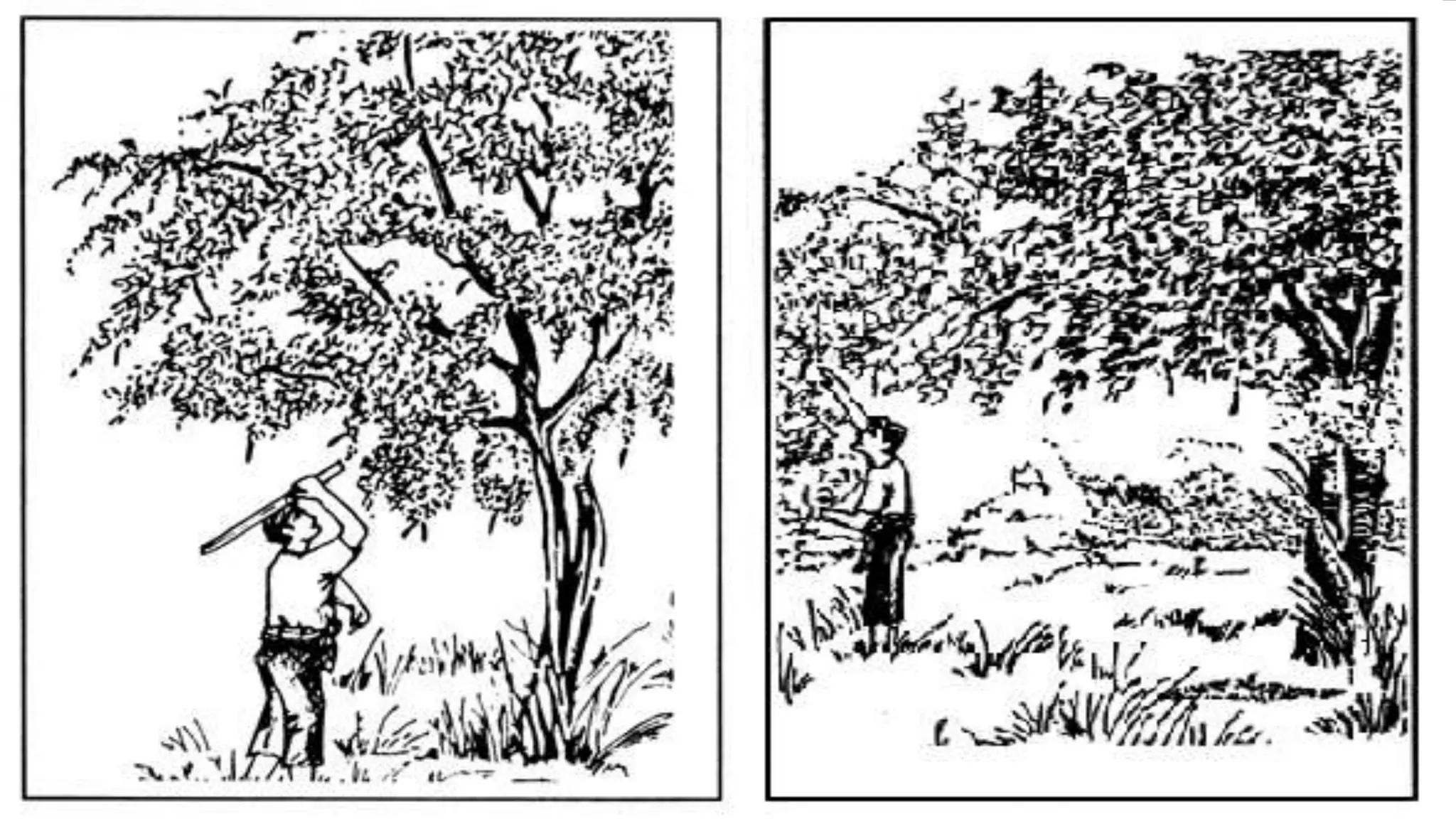
If natural seed fall is spread over a long period of time, manual shaking of the tree is a useful
method to get seeds to fall to the ground at the same time. This makes their collection easier.
Before shaking the tree:
Clean the ground, or lay down a plastic or canvas sheet.
Shake the trunks of trees or low branches by hand. (Higher branches may be shaken using a
stick, long pole, hook on rope)
Separate seed from the dry pods.
15.
Pruning off seedbearing branches:
When the seed is out of reach for hand picking various pole implements may be used for pruning
branches.
Select branches with a heavy load of good looking pods.
Carefully locate the ground sheets so that pods and seeds will fall onto them from pruned branches.
Cut the branches.
Collect the pods.
Remove the seeds.
To use this method you will need:
A special pole pruner with shears attached, or,
A long pole with a saw or hooked knife attached.
Light, rigid bamboo, aluminium or plastic poles 4–6 metres in length can also be used.
17.
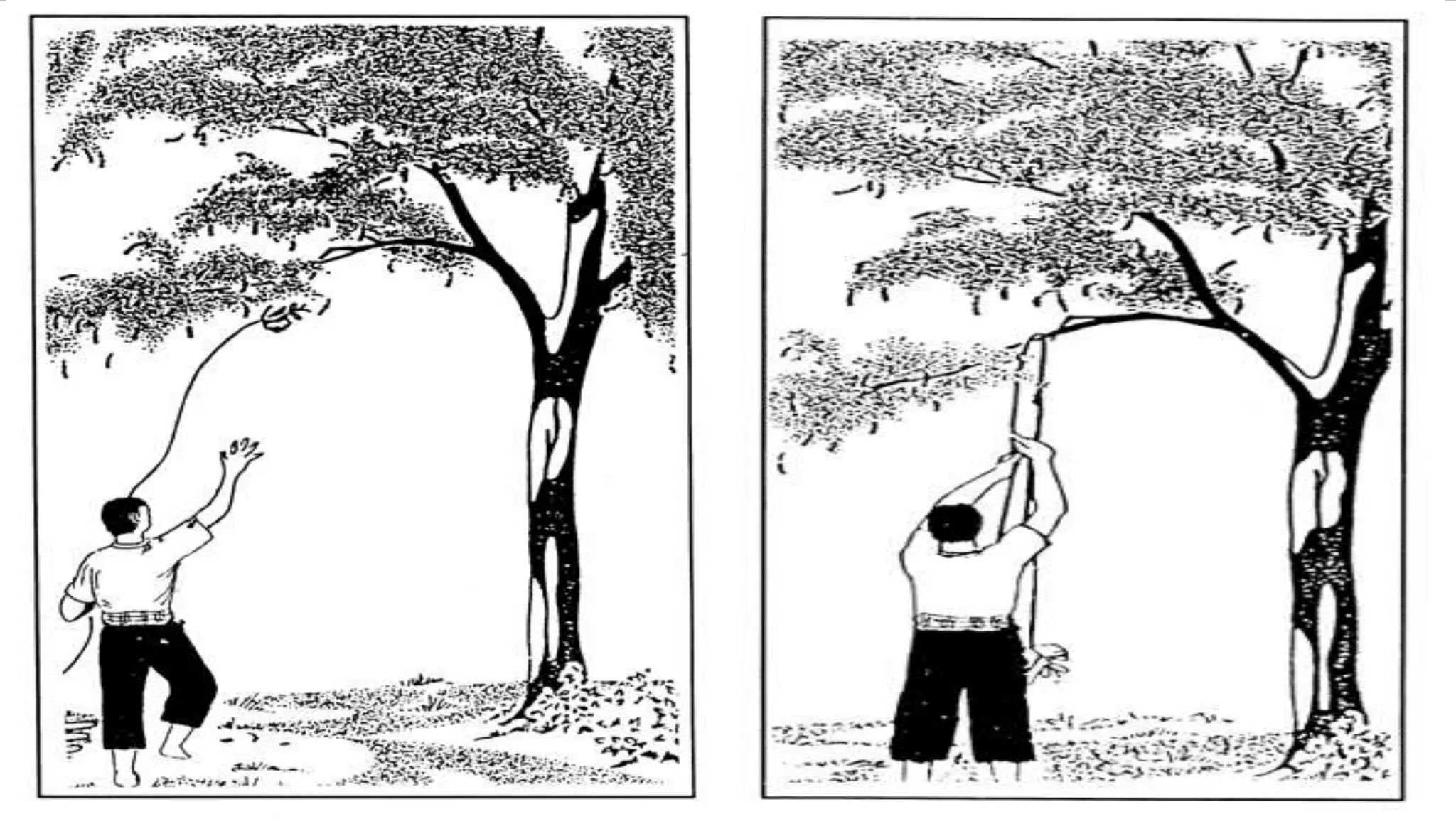
Throwing a ropewith weighted end to
break off a seed bearing branch:
As the last possibility this destructive method may be used to reach high seed bearing branches from the
ground. Branches up to 12 metres from the ground can be reached. Skill is required to throw the rope over
the selected branch and in the correct position for ease of breakage.
For this method we will need:
A strong 5 millimetre diameter rope about 25 metres in length;
A 400 gram stone, or small bag of sand or soil.
Attach the weight at one end of the rope.
Throw the weight over the seed bearing branch.
Break off the branch by holding the two ends of the rope, and pulling.
20.
Collecting seed fromfelled trees:
If a tree is to be felled, try to wait until its seed is ripe. Never fell trees just for seed
collection. Seed collectors generally aim to sow or dispatch their seed soon after
acquiring it. For various reasons, they may need to store the seed for future use. But
remember, the longer seed is stored, the greater chance that viability will be reduced or
lost. This is also a cheap and commonly used method of seed collection. This method
can be very safely practiced where fallings are in progress.
22.
Rifle:
The advantages ofusing a rifle in order to shoot down seed bearing limbs of tall Eucalyptus are worth
mentioning. This technique has also been approved useful for the collection of acacias pods from moist
forest in Australia. This system, however, is not practicable in our country.
23.
Pole implements:
Wherethe crop is out of reach for hand picking, the use
of various pole implements may be appropriate. Pole
with shears, saws, or hook of various designs attached
to one end are commonly used for detaching the fruit
or cutting the seed veering .twigs
24.
Manual collection:
Thismay prove very effective where trees are
small and their branches are low enough for the
collector to reach them easily from the ground.
The use of pruning shears for cutting off thin
branches are effective in collecting additional seed
e.g. Toot, Shisham, Beri, Kikar, etc.
25.
Seed extraction
Seedis collected while embedded
in ripe fleshy fruits, dried fruits, in
pods, or as single seeds.
OR
It is the process of separation or
removing out of seeds from the
fruits.
26.
Methods of SeedExtraction:
By rolling seeds in the hands
By beating, walking, feeding
By spreading in the sunlight
By watering
By floatation
27.
CLEANING OF SEED:
After extraction of seed from fruit, some debris i.e
parts of cones, capsules, pods, Some diseased
seeds also must be cleaning affect the germination.
Seed collection from the field is rarely fit for
immediate storage. Drying extraction from the
pods (leguminous) and further cleaning are
required.
28.
Pre-cleaning
After collectionand before storage the seed
collected must be inspected to determine it
conditions.
Moist pods must be spread out to dry and
also require treatment with fungicide to
avoid further fermentation.
29.
Methods of Cleaning
Water Method
Winnowing method
Hand picking
Sieving method
30.
DRYING
Natural Drying
Seeds are spread in a thin layer on beds over the ground.
Depending on species, the degree of maturity of the seed
and weather conditions.
Artificial drying
A temperature is 450C for a maximum period of 48-72
hours.
SEED STORAGE/ PRESERVATION
Seedstorage may be defined as the preservation
of viable seed from the time of collection until
they are required for sowing.
The activity process of keeping something valued
alive, intact, or free from damage or decay.
33.
Importance of SeedStorage:
To preserve seeds for interval between
collection and time of sowing.
To protect seeds from damage by rodents,
birds, and insects.
To preserve qualities of seeds collected during
year of heavy seed crops to furnish a supply
during years of little or no crop.
34.
Factors Influencing Storage
Fully ripened seeds will retain viability longer than seeds collected
when immature.
Seeds of high initial viability will store better than those with low
initial viability.
Seeds with hard, impermeable seed coats will retain viability longer
than soft.
Undamaged seed viability better in storage than damaged.
Lower the moisture content (i.e. 32%) and lower the temperature
(i.e. 40OC), longer viability.
35.
Others Factors include
Temperature
Moisture Content
Maturity of Seed
Oxygen and other factors
Longevity of Seed
36.
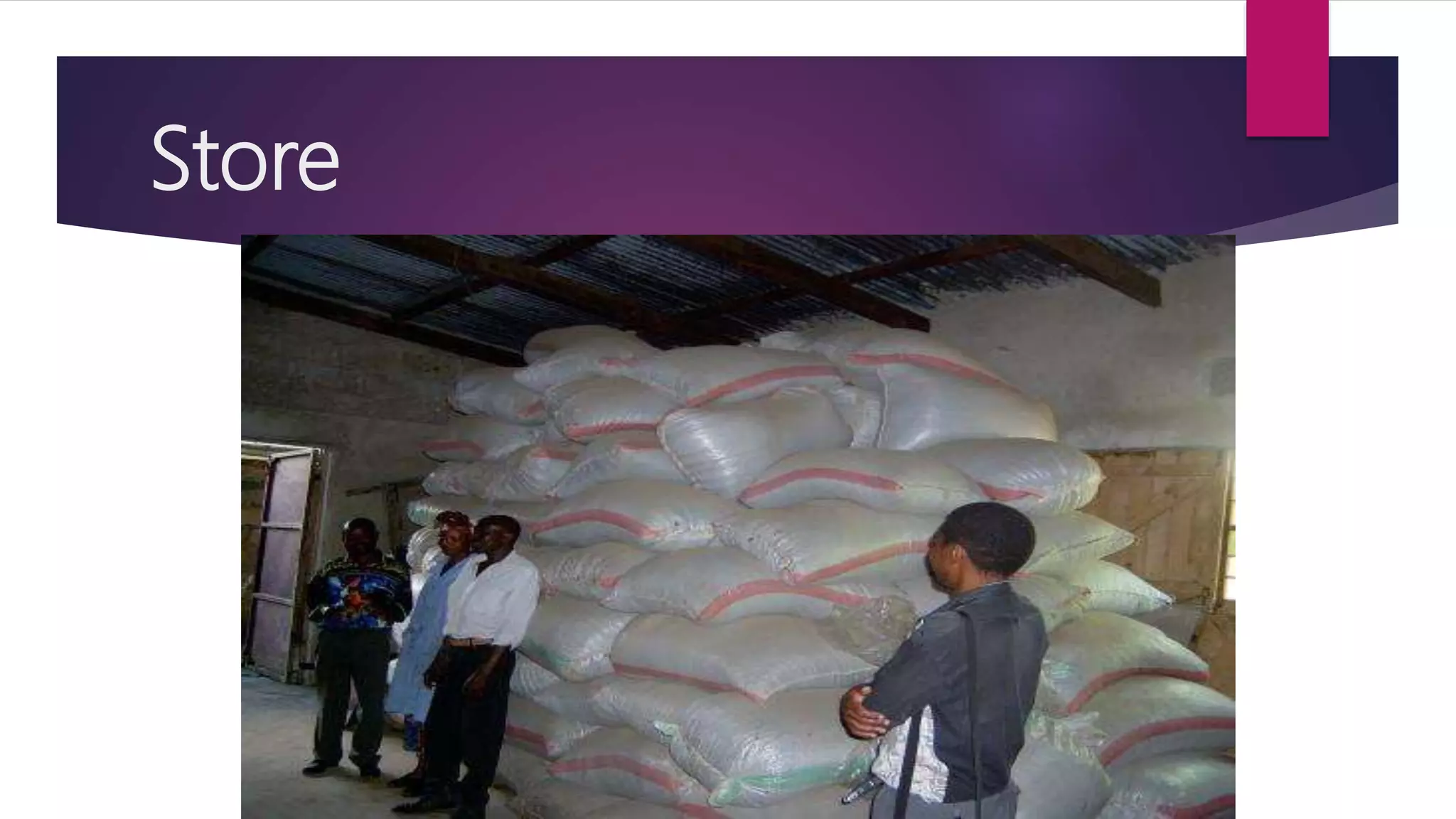
Seed Store orSeed Bank
Permanent seed store.
Seed store should be well ventilated.
Cemented and damp proof floor.
Guarded openings with wire netting.
Other facilities like water, electricity for seed testing
stratification.
Storage Method
Fromspecies to species .
Store only new, mature, healthy and well-dried seeds.
Keep them in dry and cool place.
Seed easily reabsorb moisture. To maintain dryness.
Put moisture absorbing material like dry wood ash, dry charcoal.
The drying material up about one-forth of the container space..
Label the containers with the type of seed, place and date of
collection
If possible, include the initiate percent viability of the seeds.
Protect seeds from insects and fungi.
Protect from rodents and birds.
40.
KINDS OF SEED:
Orthodox
Seeds dried without damage, to low moisture
contents (5 – 10%)
Can be stored at sub freezing temperature 2 to 5
OC
Their longevity increases with reductions in both
moisture content and temperature
Examples: Pines, Acacia, Eucalyptus, Casuarina,
41.
Intermediate
Seeds thoseare more tolerant of desiccation than
recalcitrant, though that tolerance is much more
limited than is the case with orthodox seeds
They generally lose viability more rapidly at low
temperature
Can be stored at sub freezing temperature
E.g. Walnut, fir, Poplus, Salix
42.
Recalcitrant
Seeds thatdo not survive drying to any
larger degree, and no long term storage
Can’t be stored in air tight containers
Storage must be above freezing
E.g. Quercus, Aesculus, Mango, Neem
43.
TYPES OF STORAGE
Drystorage
Good for orthodox seeds
At room temp for few week or months or at cool
temp for longer periods
Store seed in piles, sacks, or containers
Work well in cool climate with low humidity
Optimum temp 32 – 41 OF
44.
Moist Storage
Usedfor recalcitrant seed
Used for short period
Basic requirement is good ventilation to prevent heating
and fungal growth
For uniform moisture conditions the seeds are mixed
with moist medium, like sand, cloth, charcoal, saw dust
Moisture requirement 11 – 40%
Temp requirements 32 – 50O F
Storage Procedure
Storeonly new, mature, healthy and well-dried
seeds
Keep them in dry and cool place to extend their
viability
Put in some moisture absorbing material. Dry
wood ash, dry charcoal, or small pieces of
newspaper
The drying material should take up about one-
forth of the container space
Use of containersfor storage
For good seed storage, always use sealed containers.
After seed has been dried properly, store it in tin
cans, metal boxes, glass jars, or plastic bags or
containers with lids that can be seals (pic: ahead)
Points to remember when using sealed containers.
Never seal the moist seed in container
Use airtight container
Make sure that the container is clean
Open the seed containers only when necessary.
Care during Storage
Store different types of seeds separately (pic: ahead)
Regular inspection
Use fumigation and pesticides
After fumigation clean seed store to remove all dead
insects
Fill containers completely to reduce possibility of
moisture exchange with the air
Use porous bags for moist seed
Maintain uniform temperature
Label the bag or container with name of species, date of
collection, locality, germination percentage.
List of TreeSeeds their seeding period,
viability and no. of seeds per Kg.
Species Seeding Period Viability No of seed /kg
Acacia nilotica May – Jun Upto one year 6600 – 11000
Acacia modesta Dec – Feb Upto one year 32000-36000
Albezzia lebbek Jan – March Upto one year 4940 – 12430
Casuarina
equisetifolia
June – Dec 3 to 4 months 660000-990000
Cassia fistula June – April Best upto 2 years 5500-6010
Cedrus deodara Sep – Nov - Do - 7050-9110
Dalbergia sissoo Dec – Jan Up to one year 13220 – 15870
Eucalyptus
camaldulensis
Oct – Feb Upto 2 years 330000 – 660000
Morus alba Mar – may Best when fresh 42300-46800
Pinus helepensis Oct – Nov Upto 2 years 48400-88000
Pinus wallichiana Sep – Nov Upto 18 months 12340 approx
Tamarix aphylla Sep – Dec Very low even fresh 481000 approx