Chap 5 BEHAVIOR Evolution by natural selection has become the great unifying concept of biology.
BEHAVIOR  Chap 5 Adaptiveness Evolutionarily Stable StrategiesCultural TransmissionGenes & BehaviorKin Selection & Inclusive Fitness
Adaptiveness of Behavior
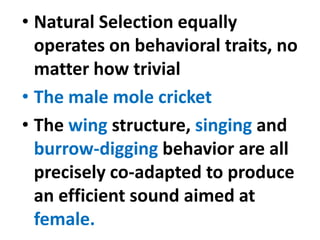
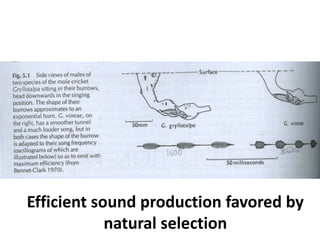
Natural Selection equally operates on behavioral traits, no matter how trivialThe male mole cricketThe wing structure, singing and burrow-digging behavior are all precisely co-adapted to produce an efficient sound aimed at female.
Efficient sound production favored by natural selection
The Black-headed Gull removing the empty eggshells, less vulnerable to crows and herring gulls.
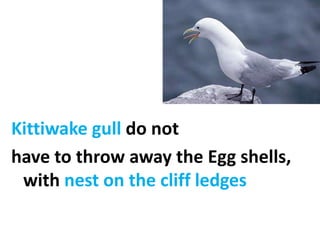
Kittiwake gull do nothave to throw away the Egg shells, with nest on the cliff ledges
How effective the natural selection can be in the shaping of behavior.
It  often result not in the best but in the best compromise, because
one single aspect of behavior can rarely evolve in isolation.
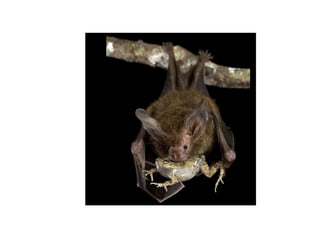
 not the best but the BEST COMPROMISEdisplays or loud songsattract their mates, are also likely to attract the a predator. the croaking frog attracting mate….. frog-eating-bat.
Evolutionarily Stable Strategies(ESS),simply a specific action of an animal,  as removing egg shell. female wasps which uses burrows dug by other wasps; the success of the strategy depends on whether few or  many digger wasps present.  frequency dependent.
ESS benefits depends on what other animals around are doing, Applied to aggression , the best strategy (e.g attack or retreat) is very dependent on what strategy an opponent takes up.
Cultural Transmission of Behaviora behavioral trait may be horizontally propagated, without any genetic changes involved ______ the cultural evolution. E.g : the human languages and cultureIn other primates, Macaques washing potatoes.Chimpanzees fish for termitesOpening of milk bottles by blue tits in UK
Maintenance of the song dialect in many birds e.g  White Crowned Sparrow.    The chick’s ability to learn song depends on both biological and social cues.
The chick’s ability to learn song depends on both biological and social cues. A.If exposed to the songs of many species while growing up, the chick invariably picks out and learns the correct song. B.If isolated during the song-learning phase, the chick produces only a rough outline of the normal song.
C.If deafened at an early age, the chick’s song is entirely abnormal. D.A chick that is socially (but not acoustically) isolated from its own species but in contact with the adult of another species learns its tutor’s song.
Alaram Calls development , in black birdChicks see the plastic bucket while the adults are shown the stuffed owl
Genes and BehaviorGenes are the products of evolution. Evolution is about changes in gene frequency   “the genes making the more fit”Easy to contemplate genes for physical characters, but GENES FOR BEHAVIORAL TRAITS!Behavior: Interaction of nerves, muscles, sense organs, hormones etc. Many difficulties in studying behavioral genetics(especially in humans)
DrosophilaBar eye, reduces the number of facets in compound eye.The white eye, reduces pigmentO-> difficulty in locating O+Vestigial or dumpy Wings, O-> unable to vibrate wingsAll these genes affect the courtship behavior
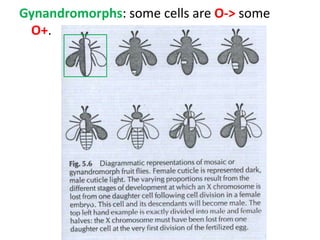
DrosophilaMosaic Flies(Hotta 1976) are genetically different in different parts of their body. E.g. Gynandromorphs: some cells are O-> some O+.
Gynandromorphs: some cells are O-> some O+.
DrosophilaGynandromorphs:The male pulse vibrating depends on the presence of males cells in mesothoracic ganglia
We could not expect such results in vertebrates, where sexual behavior develops as a result of hormones, secreted by the gonads, that affect the whole body
An examples of naturally occurring behavior showing a classical Mendelian pattern  Gwadz's (1970) .The females of different populations of  mosquitoes become sexually receptive at different times after emergence. The females of one strain GP receptive 38h. In another strain TEX  takes much longer 120. Hybrids between the two strains  TEX/GP) , with a mean of about 54 h, but with a slope like GP strain. When the F1 hybrids were backcrossed to the GP and TEX parental strains, the results were compatible with the idea that early receptivity was due to a single, autosomal, semidominant gene.
GP[38 h]      X   TEX [120 h]GGTTF1       GT[56 h]GT   X  GG
Classic Mendelion Results are rare in Behavior Genetics. Behavioral traits affected by more than one gene, or large number of genes may interact to produce a certain behavior, which in most of the cases is not an all or non phenomenon.Mice can not be classified as aggressive and non-aggressive____________Continous Variation need quantitative genetics.
Migratory Restlessness in Different populations of Black Cap FinlandCorelation between how far they have to migrate and the intenisty of migratory restlessness at the time of migrationThose who had to go far-away___More restlessCrosses between birds from different populations resulted in hybrids with intermediate degrees of restlessnessCanary IslandsAFRICA
Two lovebirds of the Genus AgapornisThe peach-faced tuck the nest material in to their rump, while Fischer’s lovebird carry the strips singly in their billWhen crossedThe hybrid for some time not capable of building the nest because they were attempting some sort of compromise between the two.
After months of practice, successful only in 41 % trialsTwo years later 100 % sucessful, but before carrying a strip in their bill they would make a brief turning movement of the head( a reminiscent of tucking).Hybridswere sterile so the F2 or F3 could not be known.
Genetic Lines relevant to Behavior can be selectedThe Rate of Mating in Pairs of Drosophila
KIN SELECTION AND INCLUSIVE FITNESS
Darwin was aware of altruistic social behavior in animals, and of how this phenomenon challenged his theory of natural selection.
Eusociality in Hymenoptera2n O+ Workers and Queenn O-> Drones
 bees colony,  worker bees are responsible for collecting food, defending the colony,and caring for the nest and the young, but they are sterile and create no offspring.
Scientists now recognize that among social insects, such as bees, wasps, and ants, the sterile workers are actually more closely related genetically to one another and to their fertile sisters, the queens, than brothers and sisters are among other organisms.
Samuel Butler, A chicken is an egg’s way of producing another egg’An animal is a gene way of producing more copies of that geneSome people uneasy with  A gene-centered view of evolution / existence. Consider Parental Care
Success in evolutionary terms means leaving offspring that themselves reproduce, but the 'success' of an individual is short-lived and ephemeral. In sexually reproducing species, an individual does not survive for more than one generation. But the genes are passed on to the future generations>>>>
Genetic variation in ('genes for') a tendency to defend young—perhaps mediated through variations in the level of a hormone —will result in a variation in the numbers of offspring that survive to pass on the favoured genes, and so on down the generations.
The direct line of parents to offspring is the only way that genes are passed on into the future, but direct parental care is not necessarily the only genetic strategy that will be successful. Helping a brother, sister, or other relatives to reproduce may also enable genes to perpetuate themselves.
Inclusive fitnessHamilton invented the idea of inclusive fitness.  Fitness can be divided into two components: Direct fitness results from personal reproductionIndirect fitness results from additional reproduction by relatives, that is made possible by an individual’s actions.
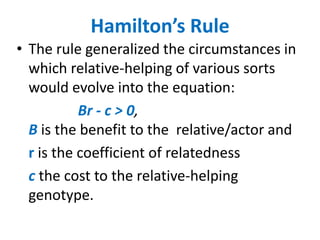
Hamilton’s RuleThe rule generalized the circumstances in which relative-helping of various sorts would evolve into the equation:                 Br - c > 0, Bis the benefit to the  relative/actor and 	r is the coefficient of relatedness 	c the cost to the relative-helping genotype.
r b - c > 0, calculating values for r, b and c.rdoes not cause problem. r is the probability that the homologous alleles in two individuals are identical by descent.From basic geneticsFull Siblings, and Parents & Offspring have a 50 per cent chance of sharing a given rare gene(r = 0.5); Nieces and Nephews have a 25 per cent chance of sharing with an uncle or an aunt(r = 0.25) 						and so on.
Calculating rTo calculate r one should trace each path between the two individuals and count the number of steps needed.  Then for this path r = 0.5 (number of steps)Thus, if two steps r for this path = 0.5 (2) = 0.25.To calculate final value of r one adds together the r values calculated from each path.
It is not just the degree of relatedness that matters, but the number of relatives that can be helped.Haldane, “ I am prepared to  lay down my life on behalf of four grandchildren or eighth first cousins!”
r b - c > 0, values b and c More ProblematicHow to measure the effect of help. If we observe one animal helping another torear its yourn, how do we know that the parent wouldn’t have been just as scessful without the help? Ando how do we know whtat the cost to the helper was in terms of the offspring it wold have had if it hadn’t been helping someone else?The mythical offspring
r b - c > 0, values b and c, Some Practical ExamplesHamilton on Isoptera(termites) and Hymenoptera(ants, bees, wasps)With Extreme Altruistic Behavior.
The 0.75 relatedness among Hymenoptera Sisters
How to Explain the sociality of Termites1  0  0  0,  0  0  0  s  Offspring
Naked Mole-ratsNaked mole-rats are highly unusual mammals.They are nearly hairless and ectothermic.  They are eusocial and, like termites, can digest cellulose with the help of bacteria in their gut.
Naked Mole RatsFig 51.33
Naked Mole-ratsThe behavior of naked mole-rats is similar to that of colonial insects.  There is a single reproductive female (queen) and 1-3  reproductive males.  The remaining individuals act as workers.  They dig tunnels to find food, defend the tunnel system from other mole-rats, and tend the young.
Naked Mole-ratsLeading hypothesis for why naked mole-rats are eusocial is inbreeding.Average coefficient of relatedness is 0.81 and about 85% of matings are between parents and offspring or between full siblings.
Naked Mole-ratsDespite high level of relatedness conflicts still occur because reproductive interests of workers and reproductives are not identical.
Naked Mole-ratsQueens maintain control through physical dominance.  Queen aggressively shoves workers who do not work hard enough and shoves are mainly directly towards less closely related individuals.  Workers double their work rate after being shoved.

Chap 5 Kin Selection Altruism

  • 1.
    Chap 5 BEHAVIOREvolution by natural selection has become the great unifying concept of biology.
  • 2.
    BEHAVIOR Chap5 Adaptiveness Evolutionarily Stable StrategiesCultural TransmissionGenes & BehaviorKin Selection & Inclusive Fitness
  • 3.
  • 4.
    Natural Selection equallyoperates on behavioral traits, no matter how trivialThe male mole cricketThe wing structure, singing and burrow-digging behavior are all precisely co-adapted to produce an efficient sound aimed at female.
  • 5.
    Efficient sound productionfavored by natural selection
  • 6.
    The Black-headed Gullremoving the empty eggshells, less vulnerable to crows and herring gulls.
  • 7.
    Kittiwake gull donothave to throw away the Egg shells, with nest on the cliff ledges
  • 8.
    How effective thenatural selection can be in the shaping of behavior.
  • 9.
    It oftenresult not in the best but in the best compromise, because
  • 10.
    one single aspectof behavior can rarely evolve in isolation.
  • 11.
    not thebest but the BEST COMPROMISEdisplays or loud songsattract their mates, are also likely to attract the a predator. the croaking frog attracting mate….. frog-eating-bat.
  • 12.
    Evolutionarily Stable Strategies(ESS),simplya specific action of an animal, as removing egg shell. female wasps which uses burrows dug by other wasps; the success of the strategy depends on whether few or many digger wasps present. frequency dependent.
  • 13.
    ESS benefits dependson what other animals around are doing, Applied to aggression , the best strategy (e.g attack or retreat) is very dependent on what strategy an opponent takes up.
  • 14.
    Cultural Transmission ofBehaviora behavioral trait may be horizontally propagated, without any genetic changes involved ______ the cultural evolution. E.g : the human languages and cultureIn other primates, Macaques washing potatoes.Chimpanzees fish for termitesOpening of milk bottles by blue tits in UK
  • 15.
    Maintenance of thesong dialect in many birds e.g White Crowned Sparrow. The chick’s ability to learn song depends on both biological and social cues.
  • 16.
    The chick’s abilityto learn song depends on both biological and social cues. A.If exposed to the songs of many species while growing up, the chick invariably picks out and learns the correct song. B.If isolated during the song-learning phase, the chick produces only a rough outline of the normal song.
  • 17.
    C.If deafened atan early age, the chick’s song is entirely abnormal. D.A chick that is socially (but not acoustically) isolated from its own species but in contact with the adult of another species learns its tutor’s song.
  • 18.
    Alaram Calls development, in black birdChicks see the plastic bucket while the adults are shown the stuffed owl
  • 19.
    Genes and BehaviorGenesare the products of evolution. Evolution is about changes in gene frequency  “the genes making the more fit”Easy to contemplate genes for physical characters, but GENES FOR BEHAVIORAL TRAITS!Behavior: Interaction of nerves, muscles, sense organs, hormones etc. Many difficulties in studying behavioral genetics(especially in humans)
  • 20.
    DrosophilaBar eye, reducesthe number of facets in compound eye.The white eye, reduces pigmentO-> difficulty in locating O+Vestigial or dumpy Wings, O-> unable to vibrate wingsAll these genes affect the courtship behavior
  • 21.
    DrosophilaMosaic Flies(Hotta 1976)are genetically different in different parts of their body. E.g. Gynandromorphs: some cells are O-> some O+.
  • 22.
  • 23.
    DrosophilaGynandromorphs:The male pulsevibrating depends on the presence of males cells in mesothoracic ganglia
  • 24.
    We could notexpect such results in vertebrates, where sexual behavior develops as a result of hormones, secreted by the gonads, that affect the whole body
  • 25.
    We could notexpect such results in vertebrates, where sexual behavior develops as a result of hormones, secreted by the gonads, that affect the whole body
  • 26.
    We could notexpect such results in vertebrates, where sexual behavior develops as a result of hormones, secreted by the gonads, that affect the whole body
  • 27.
    An examples ofnaturally occurring behavior showing a classical Mendelian pattern Gwadz's (1970) .The females of different populations of mosquitoes become sexually receptive at different times after emergence. The females of one strain GP receptive 38h. In another strain TEX takes much longer 120. Hybrids between the two strains TEX/GP) , with a mean of about 54 h, but with a slope like GP strain. When the F1 hybrids were backcrossed to the GP and TEX parental strains, the results were compatible with the idea that early receptivity was due to a single, autosomal, semidominant gene.
  • 28.
    GP[38 h] X TEX [120 h]GGTTF1 GT[56 h]GT X GG
  • 29.
    Classic Mendelion Resultsare rare in Behavior Genetics. Behavioral traits affected by more than one gene, or large number of genes may interact to produce a certain behavior, which in most of the cases is not an all or non phenomenon.Mice can not be classified as aggressive and non-aggressive____________Continous Variation need quantitative genetics.
  • 30.
    Migratory Restlessness inDifferent populations of Black Cap FinlandCorelation between how far they have to migrate and the intenisty of migratory restlessness at the time of migrationThose who had to go far-away___More restlessCrosses between birds from different populations resulted in hybrids with intermediate degrees of restlessnessCanary IslandsAFRICA
  • 31.
    Two lovebirds ofthe Genus AgapornisThe peach-faced tuck the nest material in to their rump, while Fischer’s lovebird carry the strips singly in their billWhen crossedThe hybrid for some time not capable of building the nest because they were attempting some sort of compromise between the two.
  • 32.
    After months ofpractice, successful only in 41 % trialsTwo years later 100 % sucessful, but before carrying a strip in their bill they would make a brief turning movement of the head( a reminiscent of tucking).Hybridswere sterile so the F2 or F3 could not be known.
  • 33.
    Genetic Lines relevantto Behavior can be selectedThe Rate of Mating in Pairs of Drosophila
  • 36.
    KIN SELECTION ANDINCLUSIVE FITNESS
  • 37.
    Darwin was aware of altruistic social behaviorin animals, and of how this phenomenon challenged his theory of natural selection.
  • 38.
    Eusociality in Hymenoptera2nO+ Workers and Queenn O-> Drones
  • 39.
    bees colony, worker bees are responsible for collecting food, defending the colony,and caring for the nest and the young, but they are sterile and create no offspring.
  • 40.
    Scientists now recognize that amongsocial insects, such as bees, wasps, and ants, the sterile workers are actually more closely related genetically to one another and to their fertile sisters, the queens, than brothers and sisters are among other organisms.
  • 41.
    Samuel Butler, Achicken is an egg’s way of producing another egg’An animal is a gene way of producing more copies of that geneSome people uneasy with A gene-centered view of evolution / existence. Consider Parental Care
  • 42.
    Success in evolutionaryterms means leaving offspring that themselves reproduce, but the 'success' of an individual is short-lived and ephemeral. In sexually reproducing species, an individual does not survive for more than one generation. But the genes are passed on to the future generations>>>>
  • 43.
    Genetic variation in('genes for') a tendency to defend young—perhaps mediated through variations in the level of a hormone —will result in a variation in the numbers of offspring that survive to pass on the favoured genes, and so on down the generations.
  • 44.
    The direct lineof parents to offspring is the only way that genes are passed on into the future, but direct parental care is not necessarily the only genetic strategy that will be successful. Helping a brother, sister, or other relatives to reproduce may also enable genes to perpetuate themselves.
  • 45.
    Inclusive fitnessHamilton inventedthe idea of inclusive fitness. Fitness can be divided into two components: Direct fitness results from personal reproductionIndirect fitness results from additional reproduction by relatives, that is made possible by an individual’s actions.
  • 46.
    Hamilton’s RuleThe rulegeneralized the circumstances in which relative-helping of various sorts would evolve into the equation: Br - c > 0, Bis the benefit to the relative/actor and r is the coefficient of relatedness c the cost to the relative-helping genotype.
  • 47.
    r b -c > 0, calculating values for r, b and c.rdoes not cause problem. r is the probability that the homologous alleles in two individuals are identical by descent.From basic geneticsFull Siblings, and Parents & Offspring have a 50 per cent chance of sharing a given rare gene(r = 0.5); Nieces and Nephews have a 25 per cent chance of sharing with an uncle or an aunt(r = 0.25) and so on.
  • 48.
    Calculating rTo calculater one should trace each path between the two individuals and count the number of steps needed. Then for this path r = 0.5 (number of steps)Thus, if two steps r for this path = 0.5 (2) = 0.25.To calculate final value of r one adds together the r values calculated from each path.
  • 52.
    It is notjust the degree of relatedness that matters, but the number of relatives that can be helped.Haldane, “ I am prepared to lay down my life on behalf of four grandchildren or eighth first cousins!”
  • 53.
    r b -c > 0, values b and c More ProblematicHow to measure the effect of help. If we observe one animal helping another torear its yourn, how do we know that the parent wouldn’t have been just as scessful without the help? Ando how do we know whtat the cost to the helper was in terms of the offspring it wold have had if it hadn’t been helping someone else?The mythical offspring
  • 54.
    r b -c > 0, values b and c, Some Practical ExamplesHamilton on Isoptera(termites) and Hymenoptera(ants, bees, wasps)With Extreme Altruistic Behavior.
  • 56.
    The 0.75 relatednessamong Hymenoptera Sisters
  • 57.
    How to Explainthe sociality of Termites1 0 0 0, 0 0 0 s Offspring
  • 58.
    Naked Mole-ratsNaked mole-ratsare highly unusual mammals.They are nearly hairless and ectothermic. They are eusocial and, like termites, can digest cellulose with the help of bacteria in their gut.
  • 59.
  • 60.
    Naked Mole-ratsThe behaviorof naked mole-rats is similar to that of colonial insects. There is a single reproductive female (queen) and 1-3 reproductive males. The remaining individuals act as workers. They dig tunnels to find food, defend the tunnel system from other mole-rats, and tend the young.
  • 61.
    Naked Mole-ratsLeading hypothesisfor why naked mole-rats are eusocial is inbreeding.Average coefficient of relatedness is 0.81 and about 85% of matings are between parents and offspring or between full siblings.
  • 62.
    Naked Mole-ratsDespite highlevel of relatedness conflicts still occur because reproductive interests of workers and reproductives are not identical.
  • 63.
    Naked Mole-ratsQueens maintaincontrol through physical dominance. Queen aggressively shoves workers who do not work hard enough and shoves are mainly directly towards less closely related individuals. Workers double their work rate after being shoved.