Page 1 of 11
B C Das
IS: 14489:1998 - CHECKLIST AUDIT
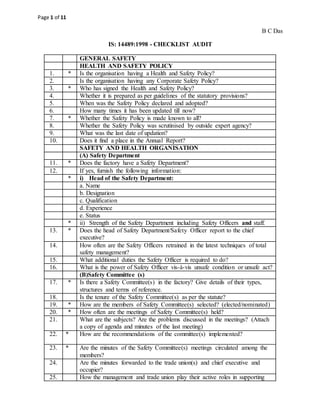
GENERAL SAFETY
HEALTH AND SAFETY POLICY
1. * Is the organisation having a Health and Safety Policy?
2. Is the organisation having any Corporate Safety Policy?
3. * Who has signed the Health and Safety Policy?
4. Whether it is prepared as per guidelines of the statutory provisions?
5. When was the Safety Policy declared and adopted?
6. How many times it has been updated till now?
7. * Whether the Safety Policy is made known to all?
8. Whether the Safety Policy was scrutinised by outside expert agency?
9. What was the last date of updation?
10. Does it find a place in the Annual Report?
SAFETY AND HEALTH ORGANISATION
(A) Safety Department
11. * Does the factory have a Safety Department?
12. If yes, furnish the following information:
* i) Head of the Safety Department:
a. Name
b. Designation
c. Qualification
d. Experience
e. Status
* ii) Strength of the Safety Department including Safety Officers and staff.
13. * Does the head of Safety Department/Safety Officer report to the chief
executive?
14. How often are the Safety Officers retrained in the latest techniques of total
safety management?
15. What additional duties the Safety Officer is required to do?
16. What is the power of Safety Officer vis-à-vis unsafe condition or unsafe act?
(B)Safety Committee (s)
17. * Is there a Safety Committee(s) in the factory? Give details of their types,
structures and terms of reference.
18. Is the tenure of the Safety Committee(s) as per the statute?
19. * How are the members of Safety Committee(s) selected? (elected/nominated)
20. * How often are the meetings of Safety Committee(s) held?
21. What are the subjects? Are the problems discussed in the meetings? (Attach
a copy of agenda and minutes of the last meeting)
22. * How are the recommendations of the committee(s) implemented?
23. * Are the minutes of the Safety Committee(s) meetings circulated among the
members?
24. Are the minutes forwarded to the trade union(s) and chief executive and
occupier?
25. How the management and trade union play their active roles in supporting
Page 2 of 11
B C Das
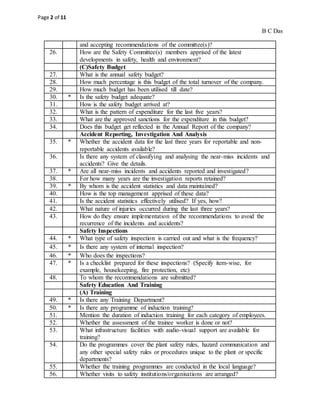
and accepting recommendations of the committee(s)?
26. How are the Safety Committee(s) members apprised of the latest
developments in safety, health and environment?
(C)Safety Budget
27. What is the annual safety budget?
28. How much percentage is this budget of the total turnover of the company.
29. How much budget has been utilised till date?
30. * Is the safety budget adequate?
31. How is the safety budget arrived at?
32. What is the pattern of expenditure for the last five years?
33. What are the approved sanctions for the expenditure in this budget?
34. Does this budget get reflected in the Annual Report of the company?
Accident Reporting, Investigation And Analysis
35. * Whether the accident data for the last three years for reportable and non-
reportable accidents available?
36. Is there any system of classifying and analysing the near-miss incidents and
accidents? Give the details.
37. * Are all near-miss incidents and accidents reported and investigated?
38. For how many years are the investigation reports retained?
39. * By whom is the accident statistics and data maintained?
40. How is the top management apprised of these data?
41. Is the accident statistics effectively utilised? If yes, how?
42. What nature of injuries occurred during the last three years?
43. How do they ensure implementation of the recommendations to avoid the
recurrence of the incidents and accidents?
Safety Inspections
44. * What type of safety inspection is carried out and what is the frequency?
45. * Is there any system of internal inspection?
46. * Who does the inspections?
47. * Is a checklist prepared for these inspections? (Specify item-wise, for
example, housekeeping, fire protection, etc)
48. To whom the recommendations are submitted?
Safety Education And Training
(A) Training
49. * Is there any Training Department?
50. * Is there any programme of induction training?
51. Mention the duration of induction training for each category of employees.
52. Whether the assessment of the trainee worker is done or not?
53. What infrastructure facilities with audio-visual support are available for
training?
54. Do the programmes cover the plant safety rules, hazard communication and
any other special safety rules or procedures unique to the plant or specific
departments?
55. Whether the training programmes are conducted in the local language?
56. Whether visits to safety institutions/organisations are arranged?
Page 3 of 11
B C Das
(B) Periodic Training/Retraining
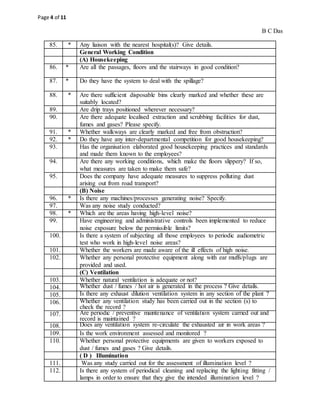
57. * Are all the employees trained and what is the frequency of such training?
58. Do the training programmes cover safety and health aspects and if so how
much (in terms of number of sessions/hours)?
59. Do the trained supervisors train their own employees in safety and health
aspects?
60. Is the retraining performed whenever new hazards/process changes are
followed / introduced?
61. * How are the senior management personnel trained in safety and Health?
62. * How many employees have been trained in safety and health in the last five
years? Give break up with details.
63. How many man-days/hours are used in training the employees?
64. How do they ensure that the training is put to use by the employees trained
in safety and Health.
65. What is the training plan for the next two years? Give details
66. What documentation system has been established regarding safety and
health training?
(C)Safety Communication/ Motivation/ Promotion
67. * Does the factory have safety suggestion scheme? Give details.
68. * Does the factory participate in National Awards/Suggestion Schemes?
69. Has the factory been awarded during last five years?
70. Are safety contests organised in the factory? Give details.
71. * What are the publications of the organisation? Do they include information
on safety and Health subjects?
72. Is the literature on safety and health made available to the employees?
73. * How is the safety and health publicised in the factory?
i. Bulletin boards?
ii. Post serious accidents?
iii. News letter?
iv. Others? Specify
74. * Does the organisation celebrate Safety Day/Week or organise safety
exhibition?
75. When was the last Safety Day/Week celebrated?
First-Aid
76. * Are adequate numbers of first-aid boxes provided? Give location details?
77. Is there any first-aid/ambulance room?
78. Are qualified/trained first-aiders available in each shift?
79. How many qualified/trained first-aiders are available at each
plant/department?
80. How many persons are trained/given refreshers training in first-aid in a
year?
Occupational Health Centre
81. * Whether Occupational Safety and Health Centre is provided or not?
82. Does it conform to the provisions of the existing legislation?
83. Are the Medical Attendants/Doctors available in each shift?
84. * Is ambulance van available in each shift?
Page 4 of 11
B C Das
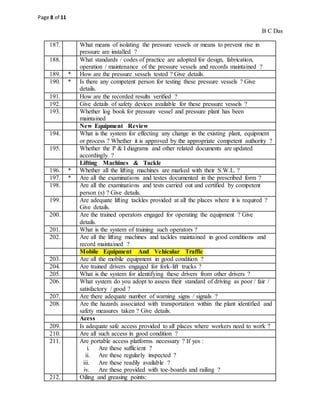
85. * Any liaison with the nearest hospital(s)? Give details.
General Working Condition
(A) Housekeeping
86. * Are all the passages, floors and the stairways in good condition?
87. * Do they have the system to deal with the spillage?
88. * Are there sufficient disposable bins clearly marked and whether these are
suitably located?
89. Are drip trays positioned wherever necessary?
90. Are there adequate localised extraction and scrubbing facilities for dust,
fumes and gases? Please specify.
91. * Whether walkways are clearly marked and free from obstruction?
92. * Do they have any inter-departmental competition for good housekeeping?
93. Has the organisation elaborated good housekeeping practices and standards
and made them known to the employees?
94. Are there any working conditions, which make the floors slippery? If so,
what measures are taken to make them safe?
95. Does the company have adequate measures to suppress polluting dust
arising out from road transport?
(B) Noise
96. * Is there any machines/processes generating noise? Specify.
97. Was any noise study conducted?
98. * Which are the areas having high-level noise?
99. Have engineering and administrative controls been implemented to reduce
noise exposure below the permissible limits?
100. Is there a system of subjecting all those employees to periodic audiometric
test who work in high-level noise areas?
101. Whether the workers are made aware of the ill effects of high noise.
102. Whether any personal protective equipment along with ear muffs/plugs are
provided and used.
(C) Ventilation
103. Whether natural ventilation is adequate or not?
104. Whether dust / fumes / hot air is generated in the process ? Give details.
105. Is there any exhaust dilution ventilation system in any section of the plant ?
106. Whether any ventilation study has been carried out in the section (s) to
check the record ?
107. Are periodic / preventive maintenance of ventilation system carried out and
record is maintained ?
108. Does any ventilation system re-circulate the exhausted air in work areas ?
109. Is the work environment assessed and monitored ?
110. Whether personal protective equipments are given to workers exposed to
dust / fumes and gases ? Give details.
( D ) Illumination
111. Was any study carried out for the assessment of illumination level ?
112. Is there any system of periodical cleaning and replacing the lighting fitting /
lamps in order to ensure that they give the intended illumination level ?
Page 5 of 11
B C Das
113. Are the workers subjects to periodic optometry tests and records maintained
? Give details.
Hazard Identification And Control
114. * Are all the hazardous areas identified ?
115. * What are type of hazards ( physical- noise, heat, etc and chemical-fire,
explosion, toxic release, etc ) ?
116. * What steps have been taken to prevent these hazards ? Give details.
117. Are there any safety inter-locks, alarms and trip system ? Give details.
118. Are these tested periodically ? How often ? Please specify.
119. Are there any ambient monitoring devices with alarms fir leakage of
hazardous materials ? Give details.
120. * Are Safety Audit or HAZOP or any other studies carried out and the
recommendations implemented ? Give details.
121. What has been the major modification done in plant / process and has the
approval of the competent authority concerned ?
122. What decision and monitoring equipment are available and used for
checking the environmental conditions in and around the plant ? Give
details.
Technical Aspect
Safe Operating procedures
123. * Are written safe operating procedures available for all operations ?
124. * Whether the written safe operating procedures displayed or made available
and explained in the local language to the workers ?
125. * Whether the safe operating procedures are prepared jointly by the plant and
safety department ?
126. What system is used to ensure that the existing safe operating procedures are
updated ? Give details.
127. Have the workers been informed of the consequences of failure to observe
the safe operating procedures?
128. Are contractor’s workers educated and trained to observe safety at
workplace ?
129. Whether contractor’s workers are permitted on process / operations ?
Work Permit System
130. * What necessary type of work permits exists in your factory ? Give details.
131. What are the hazardous chemicals handled ?
132. Are the keys for individual locks which are used for electrical lock outs with
the supervisor concerned ?
Waste Disposal System
133. * Is identification done for various types of wastes ? Give details.
134. Are these quantities less than those specified by the hazardous wastes.(
Management & Handling Rules. 1989 ) ?
135. What are their disposal modes ?
136. * What are the systems / measures adopted for controlling air / water / land
pollution ?
137. What is the system of effluent treatment plant and whether it is approved by
the competent authority?
Page 6 of 11
B C Das
138. How are the treated effluent used ?
Personal Protective Equipment ( PPE )
139. * Has a list of required PPE for each area / operation been developed and the
required PPE is made available to the workers ?
140. Are the safety department and the workers consulted in the selection of
PPE?
141. Have the workers been trained in proper use of PPE ?
142. What is the system of replacement / issue of PPE ?
143. What are the arrangements for safe custody and storage of PPE provider to
the workers ?
144. Are the contractor’s workers provided with the required PPE ? Who is
responsible ? Give details.
145. Are the PPE conform to any standard ? Give details.
146. Give the details of PPE and also specify the responsibility for their
inspection and maintenance ?
Fire Protection
147. Indicate on a plant layout the location number ( quantity ) and types of
portable fire extinguishers available.
148. Are the fire fighting system and equipment approved, tested and maintained
as per relevant standards ?
149. * What is the inspection and maintenance schedule of the above extinguishers
? Who performs these functions ?
150. * Which areas of the plant are covered by fire hydrants ? Indicate the locations
of the hydrant points and how the required pressure maintained in the
system and ensured.
151. What is the capacity of dedicated water reservoir for supply to the hydrants ?
What is the source of water ?
152. i. How is the power supply to the fire hydrant pump ensured ?
ii. What is the alternate source of supply in case of supply in case of
power failure ? Give details.
153. Are all personnel conversant with the fire prevention and protection
measures ? Give details.
154. * What percentage of plant personnel and staff and officers have been trained
in the use of portable fire extinguishers ? Give details.
155. Do you have fixed or automatic fire fighting installation (s) in any section of
your plant ?
156. Are the fire alarms adequate and free from obstructions ?
157. * Do you have fire department ? If yes, give details.
158. * What is the system for conduction mock drills ? Give details.
159. Do you have any mutual aid scheme with any of your neighboring industry
or any local organization (s) ?
160. Give details of the existing fire resistant wall and doors.
161. Do you have any system of color coding for all the pipelines for hazardous
chemicals ? Give details including marking of flow directions.
162. Are there any safe containers for the movement of small quantities of
Page 7 of 11
B C Das
hazardous chemical ? Give details.
163. Are all self-closing fire doors in good condition and free from obstructions ?
164. How many major and minor incidents / fires were there in the factory during
the last five years ? Give department / plant-wise
165. Have all the fires / incidents been investigated and corrective actions taken ?
Give break up.
Emergency Preparedness
166. * Is there an on-site emergency plan for your factory ? ( attach a copy of the
plan )
167. * What is the frequency of conducting mock drills of on-site emergency plan ?
168. * What are the number and location of emergency control centre, assembly
points ?
169. Whether emergency team or the key personnel identified?
170. Are suitable and adequate protective and rescue equipment available ? How
is the emergency rescue team trained to use these equipments ?
171. How is the medical emergency communication with local bodies and other
organizations ensured ? Give details.
172. Is any alternate power source identified ? Give details.
173. What is the medical emergency response system ? Give details.
174. Are you a member of any MUTUAL-AID-SCHEME of your area ? If so
give details.
175. How many emergency alarm system (s) is / are available? Give details.
Plant Layout And Area Classification
176. What is the system of classification of hazardous zones in the plant for
electrical installations ? Please specify.
177. Whether periodic inspection and preventive maintenance of electrical
installations is done by a qualified person and record is maintained ?
178. Whether plant layout with area classification has been displayed at
appropriate place (s) ?
Static Electicity
179. Whether the process (s) and equipment generate and accumulate static
charge have been identified ? Give details.
180. Whether all such equipment are properly bonded and earthed ?
181. How is electrical resistance for earthing circuits maintained ? Are periodic
inspections done and recorded?
182. Are adequate earthing arrangement made at the terminal points where
hazardous chemicals are handled through pipes ?
183. Are anti-static charge devices fitted wherever necessary ?
184. Whether these devices are periodically checked and maintained by a
qualified person ?
Pressure Vessels ( Fired And Unfired )
185. * Give details of the plants, piping and vessels which are operated at a
pressure grater than the atmospheric pressure ?
186. How is it ensured that the working pressure inside the pressure vessels /
pressure plants will not exceed their maximum working pressure for which it
is designed ?
Page 8 of 11
B C Das
187. What means of isolating the pressure vessels or means to prevent rise in
pressure are installed ?
188. What standards / codes of practice are adopted for design, fabrication,
operation / maintenance of the pressure vessels and records maintained ?
189. * How are the pressure vessels tested ? Give details.
190. * Is there any competent person for testing these pressure vessels ? Give
details.
191. How are the recorded results verified ?
192. Give details of safety devices available for these pressure vessels ?
193. Whether log book for pressure vessel and pressure plant has been
maintained
New Equipment Review
194. What is the system for effecting any change in the existing plant, equipment
or process ? Whether it is approved by the appropriate competent authority ?
195. Whether the P & I diagrams and other related documents are updated
accordingly ?
Lifting Machines & Tackle
196. * Whether all the lifting machines are marked with their S.W.L. ?
197. * Are all the examinations and testes documented in the prescribed form ?
198. Are all the examinations and tests carried out and certified by competent
person (s) ? Give details.
199. Are adequate lifting tackles provided at all the places where it is required ?
Give details.
200. Are the trained operators engaged for operating the equipment ? Give
details.
201. What is the system of training such operators ?
202. Are all the lifting machines and tackles maintained in good conditions and
record maintained ?
Mobile Equipment And Vehicular Traffic
203. Are all the mobile equipment in good condition ?
204. Are trained drivers engaged for fork-lift trucks ?
205. What is the system for identifying these drivers from other drivers ?
206. What system do you adopt to assess their standard of driving as poor / fair /
satisfactory / good ?
207. Are there adequate number of warning signs / signals ?
208. Are the hazards associated with transportation within the plant identified and
safety measures taken ? Give details.
Acess
209. Is adequate safe access provided to all places where workers need to work ?
210. Are all such access in good condition ?
211. Are portable access platforms necessary ? If yes :
i. Are these sufficient ?
ii. Are these regularly inspected ?
iii. Are these readily available ?
iv. Are these provided with toe-boards and railing ?
212. Oiling and greasing points:
Page 9 of 11
B C Das
i. Are these located and extended to safe place clear of moving parts ?
ii. Are these easily accessible ?
iii. Are these liable to drip in to walk ways ?
iv. Whether such workers wear trained and whether they are provided
with fit-tight clothing and register is maintained ?
213. Are all drain covers in good condition and fitting flush ?
Material Handling
214. Are there adequate storage facilities available ?
215. Are these areas clearly defined ?
216. Are all racks and steel ages in good condition ?
217. Have you adequate equipment for handling materials ?
218. Do the workers know the hazards associated with manual material handling
?
219. Where manual handling is necessary, are the workers been trained ?
220. Do they practice this ?
221. Do workers follow safe procedures for storage of materials ?
222. Whether contractor workers are trained in safety ?
223. What is the system for handling over plant to the maintenance department
and receiving back ?
224. Is the system consistently applied ?
225. What is the system for the preventive and predictive maintenance and how
do you ensure its effectiveness ? Give details.
Tank Storage Vessel Area
226. Whether it is pressure vessel or not ?
227. Give storage vessels designation ( exceeding threshold quantities specified
in MSIHC. Rules 1989 ).
228. Give the names of storage material in each of them.
229. What are the vessel sizes ( capacity in tones ) ?
230. What is the material of construction for each vessel and what standards
followed in designing / fabricating the vessel ?
231. What are the operating pressure and temperature ?
232. What are the vessel location ? (Please indicate on-site plan or plot plan )
233. Indicate whether vessels are above ground / underground.
234. If any of the tanks string flammable material, whether electrical installations
are flameproof or not ?
235. Are these storage vessels bunded / dyked ?
236. If yes, what is the capacity of the bunds / dykes ?
237. Are the vessels properly bonded and earthed and whether periodically
checked and record maintained ?
238. How are vessels isolated in the event of a mishap ?
239. Are the vessels fitted with remotely controlled isolation valves ?
240. Are vessels provided with emergency vent, relief valve, bursting disc, level
indicator, pressure gauge, overflow line?
241. Where do such vents discharge ?
242. Are the vessel provided with alarms for high level, high temperature and
high pressure ?
Page 10 of 11
B C Das
243. Are stand by empty tanks provided for employing in case of emergencies ?
244. What are the provisions made for fire fighting / tackling emergency
situations around the storage vessels ?
245. Has any consequence analysis been carried out for these vessels ? (If yes,
give details )
246. What periodical testing are carried out on the vessels to find out the integrity
of the vessels ?
247. Whether these tests are certified by the approved competent persons ?
248. Whether log sheet are filled up on daily basis for recording the parameters of
these vessels ?
On-Site Gas Cylinder Storage Area
249. What are the various gas cylinder used in the plant ? Give details.
250. What are the storage facilities ?
251. What are the measures taken for combating any emergency in the cylinders
storages area ?
252. Are valid licenses available for storage all these cylinders ?
253. Whether integrity test certificates are obtained from the suppliers of the
cylinder ?
Communication System Adopted In Plant
254. Are publicaddresssystemsavailable inall plantareas?
255. Are public address systems provided with uninterrupted power supply ?
256. Whether public address system is checked periodically for its proper
functioning ?
257. Is there any hot line provided to fire station ?
258. What is the means of communicating emergency in the plant ?
Transportation
259. What potentially hazardous materials are transported to or from the site
(including ) ?
260. What modes of transport are used ?
i) Road ?
ii) Rail ?
iii) Pipelines ?
Road
261. Does the company employ licensed vehicle of its own / outside sources ?
262. Are the loading / unloading procedures on-site and safety precautions
displayed ?
263. Are loaded tankers or trucks parked in a specific area on-site ?
264. Do all truck and tanker drivers carry TREM card or instruction booked ?
265. Do all truck and tanker driver get training in handling emergencies during
transport ?
Rail
266. What hazardous materials are transported by rail ?
267. Does the company have a direct siding on site ?
268. Are tankers or other wagons used in transportation ?
Pipelines
269. What material are transported to and from the site by pipelines ?
Page 11 of 11
B C Das
270. Are the pipelines underground or over ground ?
271. Are corrosion protection measures employed in pipelines ?
272. Whether intermediate booster pumps are used ?
273. What is the maximum, minimum and average transfer rates ?
274. Are the pipelines extended in the public domain ?
275. Are the pipelines dedicated for each type of chemicals ?
276. Are the pipelines fitted with safety equipment such as leak detectors,
automatic shut-off valves, etc ?
277. What is the frequency and method of testing of the pipeline ?
278. Is there written procedure for tackling leakages in pipeline ?
*****

IS 14489 Q.doc

  • 1.
    Page 1 of11 B C Das IS: 14489:1998 - CHECKLIST AUDIT GENERAL SAFETY HEALTH AND SAFETY POLICY 1. * Is the organisation having a Health and Safety Policy? 2. Is the organisation having any Corporate Safety Policy? 3. * Who has signed the Health and Safety Policy? 4. Whether it is prepared as per guidelines of the statutory provisions? 5. When was the Safety Policy declared and adopted? 6. How many times it has been updated till now? 7. * Whether the Safety Policy is made known to all? 8. Whether the Safety Policy was scrutinised by outside expert agency? 9. What was the last date of updation? 10. Does it find a place in the Annual Report? SAFETY AND HEALTH ORGANISATION (A) Safety Department 11. * Does the factory have a Safety Department? 12. If yes, furnish the following information: * i) Head of the Safety Department: a. Name b. Designation c. Qualification d. Experience e. Status * ii) Strength of the Safety Department including Safety Officers and staff. 13. * Does the head of Safety Department/Safety Officer report to the chief executive? 14. How often are the Safety Officers retrained in the latest techniques of total safety management? 15. What additional duties the Safety Officer is required to do? 16. What is the power of Safety Officer vis-à-vis unsafe condition or unsafe act? (B)Safety Committee (s) 17. * Is there a Safety Committee(s) in the factory? Give details of their types, structures and terms of reference. 18. Is the tenure of the Safety Committee(s) as per the statute? 19. * How are the members of Safety Committee(s) selected? (elected/nominated) 20. * How often are the meetings of Safety Committee(s) held? 21. What are the subjects? Are the problems discussed in the meetings? (Attach a copy of agenda and minutes of the last meeting) 22. * How are the recommendations of the committee(s) implemented? 23. * Are the minutes of the Safety Committee(s) meetings circulated among the members? 24. Are the minutes forwarded to the trade union(s) and chief executive and occupier? 25. How the management and trade union play their active roles in supporting
  • 2.
    Page 2 of11 B C Das and accepting recommendations of the committee(s)? 26. How are the Safety Committee(s) members apprised of the latest developments in safety, health and environment? (C)Safety Budget 27. What is the annual safety budget? 28. How much percentage is this budget of the total turnover of the company. 29. How much budget has been utilised till date? 30. * Is the safety budget adequate? 31. How is the safety budget arrived at? 32. What is the pattern of expenditure for the last five years? 33. What are the approved sanctions for the expenditure in this budget? 34. Does this budget get reflected in the Annual Report of the company? Accident Reporting, Investigation And Analysis 35. * Whether the accident data for the last three years for reportable and non- reportable accidents available? 36. Is there any system of classifying and analysing the near-miss incidents and accidents? Give the details. 37. * Are all near-miss incidents and accidents reported and investigated? 38. For how many years are the investigation reports retained? 39. * By whom is the accident statistics and data maintained? 40. How is the top management apprised of these data? 41. Is the accident statistics effectively utilised? If yes, how? 42. What nature of injuries occurred during the last three years? 43. How do they ensure implementation of the recommendations to avoid the recurrence of the incidents and accidents? Safety Inspections 44. * What type of safety inspection is carried out and what is the frequency? 45. * Is there any system of internal inspection? 46. * Who does the inspections? 47. * Is a checklist prepared for these inspections? (Specify item-wise, for example, housekeeping, fire protection, etc) 48. To whom the recommendations are submitted? Safety Education And Training (A) Training 49. * Is there any Training Department? 50. * Is there any programme of induction training? 51. Mention the duration of induction training for each category of employees. 52. Whether the assessment of the trainee worker is done or not? 53. What infrastructure facilities with audio-visual support are available for training? 54. Do the programmes cover the plant safety rules, hazard communication and any other special safety rules or procedures unique to the plant or specific departments? 55. Whether the training programmes are conducted in the local language? 56. Whether visits to safety institutions/organisations are arranged?
  • 3.
    Page 3 of11 B C Das (B) Periodic Training/Retraining 57. * Are all the employees trained and what is the frequency of such training? 58. Do the training programmes cover safety and health aspects and if so how much (in terms of number of sessions/hours)? 59. Do the trained supervisors train their own employees in safety and health aspects? 60. Is the retraining performed whenever new hazards/process changes are followed / introduced? 61. * How are the senior management personnel trained in safety and Health? 62. * How many employees have been trained in safety and health in the last five years? Give break up with details. 63. How many man-days/hours are used in training the employees? 64. How do they ensure that the training is put to use by the employees trained in safety and Health. 65. What is the training plan for the next two years? Give details 66. What documentation system has been established regarding safety and health training? (C)Safety Communication/ Motivation/ Promotion 67. * Does the factory have safety suggestion scheme? Give details. 68. * Does the factory participate in National Awards/Suggestion Schemes? 69. Has the factory been awarded during last five years? 70. Are safety contests organised in the factory? Give details. 71. * What are the publications of the organisation? Do they include information on safety and Health subjects? 72. Is the literature on safety and health made available to the employees? 73. * How is the safety and health publicised in the factory? i. Bulletin boards? ii. Post serious accidents? iii. News letter? iv. Others? Specify 74. * Does the organisation celebrate Safety Day/Week or organise safety exhibition? 75. When was the last Safety Day/Week celebrated? First-Aid 76. * Are adequate numbers of first-aid boxes provided? Give location details? 77. Is there any first-aid/ambulance room? 78. Are qualified/trained first-aiders available in each shift? 79. How many qualified/trained first-aiders are available at each plant/department? 80. How many persons are trained/given refreshers training in first-aid in a year? Occupational Health Centre 81. * Whether Occupational Safety and Health Centre is provided or not? 82. Does it conform to the provisions of the existing legislation? 83. Are the Medical Attendants/Doctors available in each shift? 84. * Is ambulance van available in each shift?
  • 4.
    Page 4 of11 B C Das 85. * Any liaison with the nearest hospital(s)? Give details. General Working Condition (A) Housekeeping 86. * Are all the passages, floors and the stairways in good condition? 87. * Do they have the system to deal with the spillage? 88. * Are there sufficient disposable bins clearly marked and whether these are suitably located? 89. Are drip trays positioned wherever necessary? 90. Are there adequate localised extraction and scrubbing facilities for dust, fumes and gases? Please specify. 91. * Whether walkways are clearly marked and free from obstruction? 92. * Do they have any inter-departmental competition for good housekeeping? 93. Has the organisation elaborated good housekeeping practices and standards and made them known to the employees? 94. Are there any working conditions, which make the floors slippery? If so, what measures are taken to make them safe? 95. Does the company have adequate measures to suppress polluting dust arising out from road transport? (B) Noise 96. * Is there any machines/processes generating noise? Specify. 97. Was any noise study conducted? 98. * Which are the areas having high-level noise? 99. Have engineering and administrative controls been implemented to reduce noise exposure below the permissible limits? 100. Is there a system of subjecting all those employees to periodic audiometric test who work in high-level noise areas? 101. Whether the workers are made aware of the ill effects of high noise. 102. Whether any personal protective equipment along with ear muffs/plugs are provided and used. (C) Ventilation 103. Whether natural ventilation is adequate or not? 104. Whether dust / fumes / hot air is generated in the process ? Give details. 105. Is there any exhaust dilution ventilation system in any section of the plant ? 106. Whether any ventilation study has been carried out in the section (s) to check the record ? 107. Are periodic / preventive maintenance of ventilation system carried out and record is maintained ? 108. Does any ventilation system re-circulate the exhausted air in work areas ? 109. Is the work environment assessed and monitored ? 110. Whether personal protective equipments are given to workers exposed to dust / fumes and gases ? Give details. ( D ) Illumination 111. Was any study carried out for the assessment of illumination level ? 112. Is there any system of periodical cleaning and replacing the lighting fitting / lamps in order to ensure that they give the intended illumination level ?
  • 5.
    Page 5 of11 B C Das 113. Are the workers subjects to periodic optometry tests and records maintained ? Give details. Hazard Identification And Control 114. * Are all the hazardous areas identified ? 115. * What are type of hazards ( physical- noise, heat, etc and chemical-fire, explosion, toxic release, etc ) ? 116. * What steps have been taken to prevent these hazards ? Give details. 117. Are there any safety inter-locks, alarms and trip system ? Give details. 118. Are these tested periodically ? How often ? Please specify. 119. Are there any ambient monitoring devices with alarms fir leakage of hazardous materials ? Give details. 120. * Are Safety Audit or HAZOP or any other studies carried out and the recommendations implemented ? Give details. 121. What has been the major modification done in plant / process and has the approval of the competent authority concerned ? 122. What decision and monitoring equipment are available and used for checking the environmental conditions in and around the plant ? Give details. Technical Aspect Safe Operating procedures 123. * Are written safe operating procedures available for all operations ? 124. * Whether the written safe operating procedures displayed or made available and explained in the local language to the workers ? 125. * Whether the safe operating procedures are prepared jointly by the plant and safety department ? 126. What system is used to ensure that the existing safe operating procedures are updated ? Give details. 127. Have the workers been informed of the consequences of failure to observe the safe operating procedures? 128. Are contractor’s workers educated and trained to observe safety at workplace ? 129. Whether contractor’s workers are permitted on process / operations ? Work Permit System 130. * What necessary type of work permits exists in your factory ? Give details. 131. What are the hazardous chemicals handled ? 132. Are the keys for individual locks which are used for electrical lock outs with the supervisor concerned ? Waste Disposal System 133. * Is identification done for various types of wastes ? Give details. 134. Are these quantities less than those specified by the hazardous wastes.( Management & Handling Rules. 1989 ) ? 135. What are their disposal modes ? 136. * What are the systems / measures adopted for controlling air / water / land pollution ? 137. What is the system of effluent treatment plant and whether it is approved by the competent authority?
  • 6.
    Page 6 of11 B C Das 138. How are the treated effluent used ? Personal Protective Equipment ( PPE ) 139. * Has a list of required PPE for each area / operation been developed and the required PPE is made available to the workers ? 140. Are the safety department and the workers consulted in the selection of PPE? 141. Have the workers been trained in proper use of PPE ? 142. What is the system of replacement / issue of PPE ? 143. What are the arrangements for safe custody and storage of PPE provider to the workers ? 144. Are the contractor’s workers provided with the required PPE ? Who is responsible ? Give details. 145. Are the PPE conform to any standard ? Give details. 146. Give the details of PPE and also specify the responsibility for their inspection and maintenance ? Fire Protection 147. Indicate on a plant layout the location number ( quantity ) and types of portable fire extinguishers available. 148. Are the fire fighting system and equipment approved, tested and maintained as per relevant standards ? 149. * What is the inspection and maintenance schedule of the above extinguishers ? Who performs these functions ? 150. * Which areas of the plant are covered by fire hydrants ? Indicate the locations of the hydrant points and how the required pressure maintained in the system and ensured. 151. What is the capacity of dedicated water reservoir for supply to the hydrants ? What is the source of water ? 152. i. How is the power supply to the fire hydrant pump ensured ? ii. What is the alternate source of supply in case of supply in case of power failure ? Give details. 153. Are all personnel conversant with the fire prevention and protection measures ? Give details. 154. * What percentage of plant personnel and staff and officers have been trained in the use of portable fire extinguishers ? Give details. 155. Do you have fixed or automatic fire fighting installation (s) in any section of your plant ? 156. Are the fire alarms adequate and free from obstructions ? 157. * Do you have fire department ? If yes, give details. 158. * What is the system for conduction mock drills ? Give details. 159. Do you have any mutual aid scheme with any of your neighboring industry or any local organization (s) ? 160. Give details of the existing fire resistant wall and doors. 161. Do you have any system of color coding for all the pipelines for hazardous chemicals ? Give details including marking of flow directions. 162. Are there any safe containers for the movement of small quantities of
  • 7.
    Page 7 of11 B C Das hazardous chemical ? Give details. 163. Are all self-closing fire doors in good condition and free from obstructions ? 164. How many major and minor incidents / fires were there in the factory during the last five years ? Give department / plant-wise 165. Have all the fires / incidents been investigated and corrective actions taken ? Give break up. Emergency Preparedness 166. * Is there an on-site emergency plan for your factory ? ( attach a copy of the plan ) 167. * What is the frequency of conducting mock drills of on-site emergency plan ? 168. * What are the number and location of emergency control centre, assembly points ? 169. Whether emergency team or the key personnel identified? 170. Are suitable and adequate protective and rescue equipment available ? How is the emergency rescue team trained to use these equipments ? 171. How is the medical emergency communication with local bodies and other organizations ensured ? Give details. 172. Is any alternate power source identified ? Give details. 173. What is the medical emergency response system ? Give details. 174. Are you a member of any MUTUAL-AID-SCHEME of your area ? If so give details. 175. How many emergency alarm system (s) is / are available? Give details. Plant Layout And Area Classification 176. What is the system of classification of hazardous zones in the plant for electrical installations ? Please specify. 177. Whether periodic inspection and preventive maintenance of electrical installations is done by a qualified person and record is maintained ? 178. Whether plant layout with area classification has been displayed at appropriate place (s) ? Static Electicity 179. Whether the process (s) and equipment generate and accumulate static charge have been identified ? Give details. 180. Whether all such equipment are properly bonded and earthed ? 181. How is electrical resistance for earthing circuits maintained ? Are periodic inspections done and recorded? 182. Are adequate earthing arrangement made at the terminal points where hazardous chemicals are handled through pipes ? 183. Are anti-static charge devices fitted wherever necessary ? 184. Whether these devices are periodically checked and maintained by a qualified person ? Pressure Vessels ( Fired And Unfired ) 185. * Give details of the plants, piping and vessels which are operated at a pressure grater than the atmospheric pressure ? 186. How is it ensured that the working pressure inside the pressure vessels / pressure plants will not exceed their maximum working pressure for which it is designed ?
  • 8.
    Page 8 of11 B C Das 187. What means of isolating the pressure vessels or means to prevent rise in pressure are installed ? 188. What standards / codes of practice are adopted for design, fabrication, operation / maintenance of the pressure vessels and records maintained ? 189. * How are the pressure vessels tested ? Give details. 190. * Is there any competent person for testing these pressure vessels ? Give details. 191. How are the recorded results verified ? 192. Give details of safety devices available for these pressure vessels ? 193. Whether log book for pressure vessel and pressure plant has been maintained New Equipment Review 194. What is the system for effecting any change in the existing plant, equipment or process ? Whether it is approved by the appropriate competent authority ? 195. Whether the P & I diagrams and other related documents are updated accordingly ? Lifting Machines & Tackle 196. * Whether all the lifting machines are marked with their S.W.L. ? 197. * Are all the examinations and testes documented in the prescribed form ? 198. Are all the examinations and tests carried out and certified by competent person (s) ? Give details. 199. Are adequate lifting tackles provided at all the places where it is required ? Give details. 200. Are the trained operators engaged for operating the equipment ? Give details. 201. What is the system of training such operators ? 202. Are all the lifting machines and tackles maintained in good conditions and record maintained ? Mobile Equipment And Vehicular Traffic 203. Are all the mobile equipment in good condition ? 204. Are trained drivers engaged for fork-lift trucks ? 205. What is the system for identifying these drivers from other drivers ? 206. What system do you adopt to assess their standard of driving as poor / fair / satisfactory / good ? 207. Are there adequate number of warning signs / signals ? 208. Are the hazards associated with transportation within the plant identified and safety measures taken ? Give details. Acess 209. Is adequate safe access provided to all places where workers need to work ? 210. Are all such access in good condition ? 211. Are portable access platforms necessary ? If yes : i. Are these sufficient ? ii. Are these regularly inspected ? iii. Are these readily available ? iv. Are these provided with toe-boards and railing ? 212. Oiling and greasing points:
  • 9.
    Page 9 of11 B C Das i. Are these located and extended to safe place clear of moving parts ? ii. Are these easily accessible ? iii. Are these liable to drip in to walk ways ? iv. Whether such workers wear trained and whether they are provided with fit-tight clothing and register is maintained ? 213. Are all drain covers in good condition and fitting flush ? Material Handling 214. Are there adequate storage facilities available ? 215. Are these areas clearly defined ? 216. Are all racks and steel ages in good condition ? 217. Have you adequate equipment for handling materials ? 218. Do the workers know the hazards associated with manual material handling ? 219. Where manual handling is necessary, are the workers been trained ? 220. Do they practice this ? 221. Do workers follow safe procedures for storage of materials ? 222. Whether contractor workers are trained in safety ? 223. What is the system for handling over plant to the maintenance department and receiving back ? 224. Is the system consistently applied ? 225. What is the system for the preventive and predictive maintenance and how do you ensure its effectiveness ? Give details. Tank Storage Vessel Area 226. Whether it is pressure vessel or not ? 227. Give storage vessels designation ( exceeding threshold quantities specified in MSIHC. Rules 1989 ). 228. Give the names of storage material in each of them. 229. What are the vessel sizes ( capacity in tones ) ? 230. What is the material of construction for each vessel and what standards followed in designing / fabricating the vessel ? 231. What are the operating pressure and temperature ? 232. What are the vessel location ? (Please indicate on-site plan or plot plan ) 233. Indicate whether vessels are above ground / underground. 234. If any of the tanks string flammable material, whether electrical installations are flameproof or not ? 235. Are these storage vessels bunded / dyked ? 236. If yes, what is the capacity of the bunds / dykes ? 237. Are the vessels properly bonded and earthed and whether periodically checked and record maintained ? 238. How are vessels isolated in the event of a mishap ? 239. Are the vessels fitted with remotely controlled isolation valves ? 240. Are vessels provided with emergency vent, relief valve, bursting disc, level indicator, pressure gauge, overflow line? 241. Where do such vents discharge ? 242. Are the vessel provided with alarms for high level, high temperature and high pressure ?
  • 10.
    Page 10 of11 B C Das 243. Are stand by empty tanks provided for employing in case of emergencies ? 244. What are the provisions made for fire fighting / tackling emergency situations around the storage vessels ? 245. Has any consequence analysis been carried out for these vessels ? (If yes, give details ) 246. What periodical testing are carried out on the vessels to find out the integrity of the vessels ? 247. Whether these tests are certified by the approved competent persons ? 248. Whether log sheet are filled up on daily basis for recording the parameters of these vessels ? On-Site Gas Cylinder Storage Area 249. What are the various gas cylinder used in the plant ? Give details. 250. What are the storage facilities ? 251. What are the measures taken for combating any emergency in the cylinders storages area ? 252. Are valid licenses available for storage all these cylinders ? 253. Whether integrity test certificates are obtained from the suppliers of the cylinder ? Communication System Adopted In Plant 254. Are publicaddresssystemsavailable inall plantareas? 255. Are public address systems provided with uninterrupted power supply ? 256. Whether public address system is checked periodically for its proper functioning ? 257. Is there any hot line provided to fire station ? 258. What is the means of communicating emergency in the plant ? Transportation 259. What potentially hazardous materials are transported to or from the site (including ) ? 260. What modes of transport are used ? i) Road ? ii) Rail ? iii) Pipelines ? Road 261. Does the company employ licensed vehicle of its own / outside sources ? 262. Are the loading / unloading procedures on-site and safety precautions displayed ? 263. Are loaded tankers or trucks parked in a specific area on-site ? 264. Do all truck and tanker drivers carry TREM card or instruction booked ? 265. Do all truck and tanker driver get training in handling emergencies during transport ? Rail 266. What hazardous materials are transported by rail ? 267. Does the company have a direct siding on site ? 268. Are tankers or other wagons used in transportation ? Pipelines 269. What material are transported to and from the site by pipelines ?
  • 11.
    Page 11 of11 B C Das 270. Are the pipelines underground or over ground ? 271. Are corrosion protection measures employed in pipelines ? 272. Whether intermediate booster pumps are used ? 273. What is the maximum, minimum and average transfer rates ? 274. Are the pipelines extended in the public domain ? 275. Are the pipelines dedicated for each type of chemicals ? 276. Are the pipelines fitted with safety equipment such as leak detectors, automatic shut-off valves, etc ? 277. What is the frequency and method of testing of the pipeline ? 278. Is there written procedure for tackling leakages in pipeline ? *****