INSPECTION CHECKLIST
PART-A(For all factories)
General Information
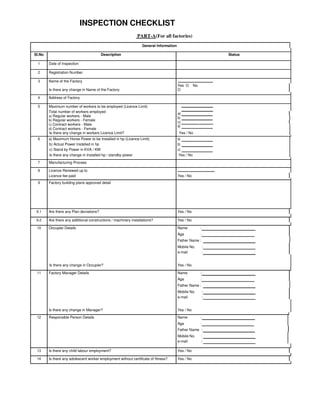
Sl.No Description Status
1 Date of Inspection
2 Registration Number
3 Name of the Factory
Is there any change in Name of the Factory
Yes O No
O
4 Address of Factory
5 Maximum number of workers to be employed (Licence Limit)
Total number of workers employed a)
a) Regular workers - Male b)
b) Regular workers - Female
c)
c) Contract workers - Male d)
d) Contract workers - Female
Yes / No
Is there any change in workers Licence Limit?
6 a) Maximum Horse Power to be Installed in hp (Licence Limit) a)
b) Actual Power Installed in hp b)
c) Stand by Power in KVA / KW c)
Is there any change in Installed hp / standby power Yes / No
7 Manufacturing Process
8 Licence Renewed up to
Licence fee paid Yes / No
9 Factory building plans approved detail
9.1 Are there any Plan deviations? Yes / No
9.2 Are there any additional constructions / machinery installations? Yes / No
10 Occupier Details Name :
Age :
Father Name :
Mobile No. :
e-mail :
Is there any change in Occupier? Yes / No
11 Factory Manager Details Name :
Age :
Father Name :
Mobile No. :
e-mail :
Is there any change in Manager? Yes / No
12 Responsible Person Details Name :
Age :
Father Name :
Mobile No. :
e-mail :
13 Is there any child labour employment? Yes / No
14 Is there any adolescent worker employment without certificate of fitness? Yes / No
Safety Provisions
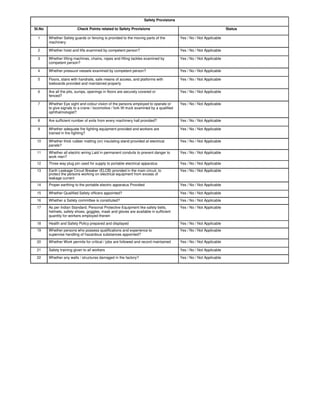
Sl.No Check Points related to Safety Provisions Status
1 Whether Safety guards or fencing is provided to the moving parts of the Yes / No / Not Applicable
machinery
2 Whether hoist and lifts examined by competent person? Yes / No / Not Applicable
3 Whether lifting machines, chains, ropes and lifting tackles examined by Yes / No / Not Applicable
competent person?
4 Whether pressure vessels examined by competent person? Yes / No / Not Applicable
5 Floors, stairs with handrails, safe means of access, and platforms with Yes / No / Not Applicable
toeboards provided and maintained properly
6 Are all the pits, sumps, openings in floors are securely covered or Yes / No / Not Applicable
fenced?
7 Whether Eye sight and colour vision of the persons employed to operate or Yes / No / Not Applicable
to give signals to a crane / locomotive / fork lift truck examined by a qualified
ophthalmologist?
8 Are sufficient number of exits from every machinery hall provided? Yes / No / Not Applicable
9 Whether adequate fire fighting equipment provided and workers are Yes / No / Not Applicable
trained in fire fighting?
10 Whether thick rubber matting (or) insulating stand provided at electrical Yes / No / Not Applicable
panels?
11 Whether all electric wiring Laid in permanent conduits to prevent danger to Yes / No / Not Applicable
work men?
12 Three way plug pin used for supply to portable electrical apparatus Yes / No / Not Applicable
13 Earth Leakage Circuit Breaker (ELCB) provided in the main circuit, to Yes / No / Not Applicable
protect the persons working on electrical equipment from excess of
leakage current
14 Proper earthing to the portable electric apparatus Provided Yes / No / Not Applicable
15 Whether Qualified Safety officers appointed? Yes / No / Not Applicable
16 Whether a Safety committee is constituted? Yes / No / Not Applicable
17 As per Indian Standard, Personal Protective Equipment like safety belts, Yes / No / Not Applicable
helmets, safety shoes, goggles, mask and gloves are available in sufficient
quantity for workers employed therein
18 Health and Safety Policy prepared and displayed Yes / No / Not Applicable
19 Whether persons who possess qualifications and experience to Yes / No / Not Applicable
supervise handling of hazardous substances appointed?
20 Whether Work permits for critical / jobs are followed and record maintained Yes / No / Not Applicable
21 Safety training given to all workers Yes / No / Not Applicable
22 Whether any walls / structures damaged in the factory? Yes / No / Not Applicable
Fire Prevention and Control
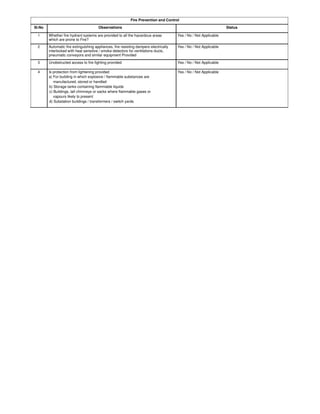
Sl.No Observations Status
1 Whether fire hydrant systems are provided to all the hazardous areas Yes / No / Not Applicable
which are prone to Fire?
2 Automatic fire extinguishing appliances, fire resisting dampers electrically Yes / No / Not Applicable
interlocked with heat sensitive / smoke detectors for ventilations ducts,
pneumatic conveyors and similar equipment Provided
3 Unobstructed access to fire fighting provided Yes / No / Not Applicable
4 Is protection from lightening provided Yes / No / Not Applicable
a) For building in which explosive / flammable substances are
manufactured, stored or handled
b) Storage tanks containing flammable liquids
c) Buildings, tall chimneys or sacks where flammable gases or
vapours likely to present
d) Substation buildings / transformers / switch yards
Welfare Amenities
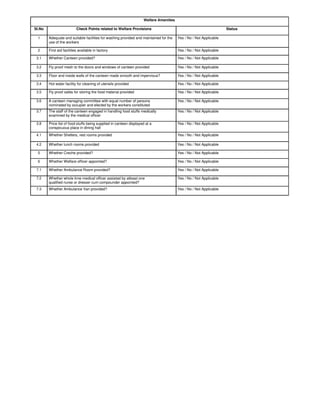
Sl.No Check Points related to Welfare Provisions Status
1 Adequate and suitable facilities for washing provided and maintained for the Yes / No / Not Applicable
use of the workers
2 First aid facilities available in factory Yes / No / Not Applicable
3.1 Whether Canteen provided? Yes / No / Not Applicable
3.2 Fly proof mesh to the doors and windows of canteen provided Yes / No / Not Applicable
3.3 Floor and inside walls of the canteen made smooth and impervious? Yes / No / Not Applicable
3.4 Hot water facility for cleaning of utensils provided Yes / No / Not Applicable
3.5 Fly proof safes for storing the food material provided Yes / No / Not Applicable
3.6 A canteen managing committee with equal number of persons Yes / No / Not Applicable
nominated by occupier and elected by the workers constituted
3.7 The staff of the canteen engaged in handling food stuffs medically Yes / No / Not Applicable
examined by the medical officer
3.8 Price list of food stuffs being supplied in canteen displayed at a Yes / No / Not Applicable
conspicuous place in dining hall
4.1 Whether Shelters, rest rooms provided Yes / No / Not Applicable
4.2 Whether lunch rooms provided Yes / No / Not Applicable
5 Whether Creche provided? Yes / No / Not Applicable
6 Whether Welfare officer appointed? Yes / No / Not Applicable
7.1 Whether Ambulance Room provided? Yes / No / Not Applicable
7.2 Whether whole time medical officer assisted by atleast one Yes / No / Not Applicable
qualified nurse or dresser cum compounder appointed?
7.3 Whether Ambulance Van provided? Yes / No / Not Applicable
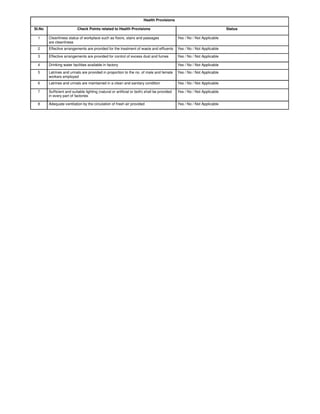
Health Provisions
Sl.No Check Points related to Health Provisions Status
1 Cleanliness status of workplace such as floors, stairs and passages Yes / No / Not Applicable
are cleanliness
2 Effective arrangements are provided for the treatment of waste and effluents Yes / No / Not Applicable
3 Effective arrangements are provided for control of excess dust and fumes Yes / No / Not Applicable
4 Drinking water facilities available in factory Yes / No / Not Applicable
5 Latrines and urinals are provided in proportion to the no. of male and female Yes / No / Not Applicable
workers employed
6 Latrines and urinals are maintained in a clean and sanitary condition Yes / No / Not Applicable
7 Sufficient and suitable lighting (natural or artificial or both) shall be provided Yes / No / Not Applicable
in every part of factories
8 Adequate ventilation by the circulation of fresh air provided Yes / No / Not Applicable
Occupational Health Centres
Sl.No Observations Status
1 Whether Occupational Health Centre provided? Yes / No / Not Applicable
2 Whether medical officer is appointed? Yes / No / Not Applicable
Whether qualified and trained dresser cum compounder
Whether a minimum of 5 persons are trained in First aid procedures
3 Whether a fully equipped ambulance van provided? Yes / No / Not Applicable
4 Pre employment and Periodical (once in six months) medical examination of Yes / No / Not Applicable
all the workers engaged in hazardous process carried out
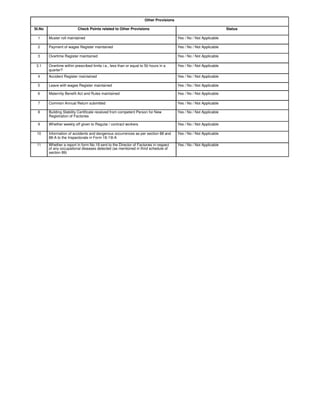
Other Provisions
Sl.No Check Points related to Other Provisions Status
1 Muster roll maintained Yes / No / Not Applicable
2 Payment of wages Register maintained Yes / No / Not Applicable
3 Overtime Register maintained Yes / No / Not Applicable
3.1 Overtime within prescribed limits i.e., less than or equal to 50 hours in a Yes / No / Not Applicable
quarter?
4 Accident Register maintained Yes / No / Not Applicable
5 Leave with wages Register maintained Yes / No / Not Applicable
6 Maternity Benefit Act and Rules maintained Yes / No / Not Applicable
7 Common Annual Return submitted Yes / No / Not Applicable
8 Building Stability Certificate received from competent Person for New Yes / No / Not Applicable
Registration of Factories
9 Whether weekly off given to Regular / contract workers Yes / No / Not Applicable
10 Information of accidents and dangerous occurrences as per section 88 and Yes / No / Not Applicable
88-A to the Inspectorate in Form 18 /18-A
11 Whether a report in form No.19 sent to the Director of Factories in respect Yes / No / Not Applicable
of any occupational diseases detected (as mentioned in third schedule of
section 89)
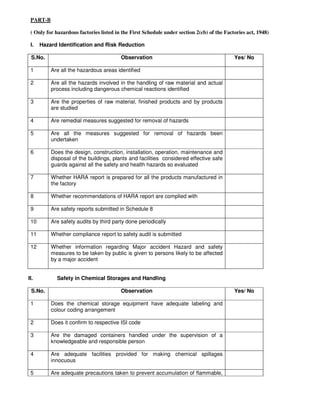
PART-B
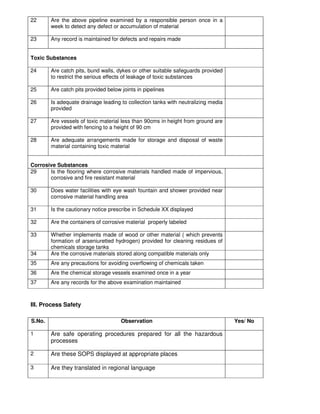
( Only for hazardous factories listed in the First Schedule under section 2(cb) of the Factories act, 1948)
I. Hazard Identification and Risk Reduction
S.No. Observation Yes/ No
1 Are all the hazardous areas identified
2 Are all the hazards involved in the handling of raw material and actual
process including dangerous chemical reactions identified
3 Are the properties of raw material, finished products and by products
are studied
4 Are remedial measures suggested for removal of hazards
5 Are all the measures suggested for removal of hazards been
undertaken
6 Does the design, construction, installation, operation, maintenance and
disposal of the buildings, plants and facilities considered effective safe
guards against all the safety and health hazards so evaluated
7 Whether HARA report is prepared for all the products manufactured in
the factory
8 Whether recommendations of HARA report are complied with
9 Are safety reports submitted in Schedule 8
10 Are safety audits by third party done periodically
11 Whether compliance report to safety audit is submitted
12 Whether information regarding Major accident Hazard and safety
measures to be taken by public is given to persons likely to be affected
by a major accident
II. Safety in Chemical Storages and Handling
S.No. Observation Yes/ No
1 Does the chemical storage equipment have adequate labeling and
colour coding arrangement
2 Does it confirm to respective ISI code
3 Are the damaged containers handled under the supervision of a
knowledgeable and responsible person
4 Are adequate facilities provided for making chemical spillages
innocuous
5 Are adequate precautions taken to prevent accumulation of flammable,
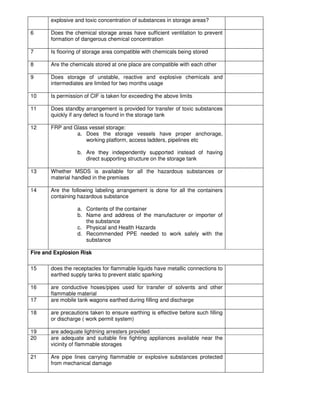
explosive and toxic concentration of substances in storage areas?
6 Does the chemical storage areas have sufficient ventilation to prevent
formation of dangerous chemical concentration
7 Is flooring of storage area compatible with chemicals being stored
8 Are the chemicals stored at one place are compatible with each other
9 Does storage of unstable, reactive and explosive chemicals and
intermediates are limited for two months usage
10 Is permission of CIF is taken for exceeding the above limits
11 Does standby arrangement is provided for transfer of toxic substances
quickly if any defect is found in the storage tank
12 FRP and Glass vessel storage:
a. Does the storage vessels have proper anchorage,
working platform, access ladders, pipelines etc
b. Are they independently supported instead of having
direct supporting structure on the storage tank
13 Whether MSDS is available for all the hazardous substances or
material handled in the premises
14 Are the following labeling arrangement is done for all the containers
containing hazardous substance
a. Contents of the container
b. Name and address of the manufacturer or importer of
the substance
c. Physical and Health Hazards
d. Recommended PPE needed to work safely with the
substance
Fire and Explosion Risk
15 does the receptacles for flammable liquids have metallic connections to
earthed supply tanks to prevent static sparking
16 are conductive hoses/pipes used for transfer of solvents and other
flammable material
17 are mobile tank wagons earthed during filling and discharge
18 are precautions taken to ensure earthing is effective before such filling
or discharge ( work permit system)
19 are adequate lightning arresters provided
20 are adequate and suitable fire fighting appliances available near the
vicinity of flammable storages
21 Are pipe lines carrying flammable or explosive substances protected
from mechanical damage
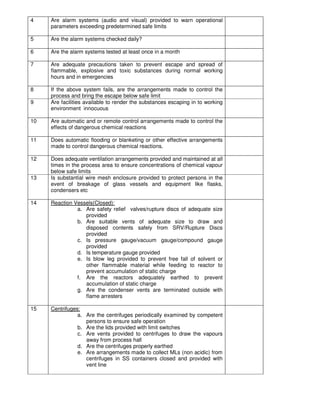
22 Are the above pipeline examined by a responsible person once in a
week to detect any defect or accumulation of material
23 Any record is maintained for defects and repairs made
Toxic Substances
24 Are catch pits, bund walls, dykes or other suitable safeguards provided
to restrict the serious effects of leakage of toxic substances
25 Are catch pits provided below joints in pipelines
26 Is adequate drainage leading to collection tanks with neutralizing media
provided
27 Are vessels of toxic material less than 90cms in height from ground are
provided with fencing to a height of 90 cm
28 Are adequate arrangements made for storage and disposal of waste
material containing toxic material
Corrosive Substances
29 Is the flooring where corrosive materials handled made of impervious,
corrosive and fire resistant material
30 Does water facilities with eye wash fountain and shower provided near
corrosive material handling area
31 Is the cautionary notice prescribe in Schedule XX displayed
32 Are the containers of corrosive material properly labeled
33 Whether implements made of wood or other material ( which prevents
formation of arseniuretted hydrogen) provided for cleaning residues of
chemicals storage tanks
34 Are the corrosive materials stored along compatible materials only
35 Are any precautions for avoiding overflowing of chemicals taken
36 Are the chemical storage vessels examined once in a year
37 Are any records for the above examination maintained
III. Process Safety
S.No. Observation Yes/ No
1 Are safe operating procedures prepared for all the hazardous
processes
2 Are these SOPS displayed at appropriate places
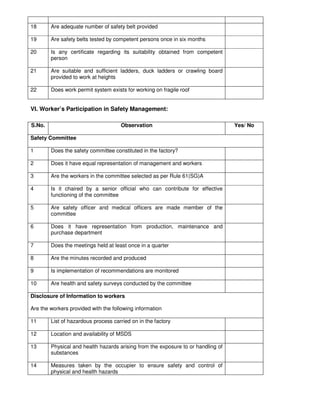
3 Are they translated in regional language
4 Are workers adequately trained on these SOPs
5 Do the management obtained undertaking from the workers that
they were informed the hazards and trained about preventive
measures and SOPs
6 Does authorized entry system prescribed and followed for entry in
to factory or plant having dangerous operations or dangerous
chemical reactions
7 Are adequate precautions taken while cleaning and removal of
sludge from the equipment for testing to avoid fire, explosion
8 Does adequate seating arrangement provided to operating
personnel to prevent exposure to toxic, flammable and explosive
substances during course of manufacturing and maintenance
9 Are sampling workers adequately informed about safe
procedures
10 Are adequate precautions taken to prevent mixing of effluents
from different processes and operations which may cause
evolution of dangerous or poisonous gases
11 Are qualified supervisors appointed for supervising the handling
of hazardous substances
12 are any hot exhaust pipes are installed inside the building
13 whether all hot pipes, surfaces and surfaces likely to become hot
are suitably protected
14 is hazardous area classification done
15 are the electrical appliances are provided based on hazardous
area classification
16 does soles of shoes worn by workers contain metal on them
17 are wheels of trucks of conveyors conductive
18 are tools and appliances used in the above area are non sparking
type
19 is smoking prohibited in the above areas and cautionary notice
displayed
20 does machinery, plant, equipment, pipe lines, belt drives etc
which are source of accumulation of static charge are effectively
earthed
21 does automatic cutoff ( solenoid valve etc) of heating is provided
to limit the temperatures of process below predetermined safe
limits
22 are bund walls, dykes, sumps etc are provide to confined
possible leakages from flammable liquid storage tanks
23 are arrangements made to dispose off waste material in contact
with flammable substances under supervision of knowledgeable
and responsible person
24 Whether continuous exhaust arrangement is provided to draw the
toxic gases, vapors and fumes
25 Whether the above arrangement is interlocked with process
26 Does the facility exist for automatic stoppage of process in the
event of failure of exhaust arrangement (for processes generating
toxic fumes)
27 Are work benches on which toxic substances are manipulated,
have smooth impervious surface
28 Does the above surface is washed daily after the completion of
work
Personal Protective Equipment:
29 Are workers provided with appropriate and approved type of PPE
30 Are they adequately supervised for usage of PPE
31 Are safety sampling workers provided with proper and approved
PPE
32 Does suitable personal protective equipment ( suitable protective
wear for hands and feet, suitable aprons, face shields, chemical
safety goggles and respirators etc) are provided for persons
handling corrosive material
33 Are the workers using the PPE while handling corrosive materials
IV. Equipment Safety
S.No. Observation Yes/ No
Equipment in built safety measures:
1 Does the electrical installations used in the process suitable to the
hazards prevailing in the area like dust, dampness, corrosion,
flammability and explosivity
2 Is quick isolation of plant or part of the plant or equipment is possible
3 Does the lay out plan containing quick isolation facility available with
security, maintenance and safety personnel
4 Are alarm systems (audio and visual) provided to warn operational
parameters exceeding predetermined safe limits
5 Are the alarm systems checked daily?
6 Are the alarm systems tested at least once in a month
7 Are adequate precautions taken to prevent escape and spread of
flammable, explosive and toxic substances during normal working
hours and in emergencies
8 If the above system fails, are the arrangements made to control the
process and bring the escape below safe limit
9 Are facilities available to render the substances escaping in to working
environment innocuous
10 Are automatic and or remote control arrangements made to control the
effects of dangerous chemical reactions
11 Does automatic flooding or blanketing or other effective arrangements
made to control dangerous chemical reactions.
12 Does adequate ventilation arrangements provided and maintained at all
times in the process area to ensure concentrations of chemical vapour
below safe limits
13 Is substantial wire mesh enclosure provided to protect persons in the
event of breakage of glass vessels and equipment like flasks,
condensers etc
14 Reaction Vessels(Closed):
a. Are safety relief valves/rupture discs of adequate size
provided
b. Are suitable vents of adequate size to draw and
disposed contents safely from SRV/Rupture Discs
provided
c. Is pressure gauge/vacuum gauge/compound gauge
provided
d. Is temperature gauge provided
e. Is blow leg provided to prevent free fall of solvent or
other flammable material while feeding to reactor to
prevent accumulation of static charge
f. Are the reactors adequately earthed to prevent
accumulation of static charge
g. Are the condenser vents are terminated outside with
flame arresters
15 Centrifuges:
a. Are the centrifuges periodically examined by competent
persons to ensure safe operation
b. Are the lids provided with limit switches
c. Are vents provided to centrifuges to draw the vapours
away from process hall
d. Are the centrifuges properly earthed
e. Are arrangements made to collect MLs (non acidic) from
centrifuges in SS containers closed and provided with
vent line
16 Driers:
a. Are the driers fixed with explosion relief panels of
adequate size and capacity
b. Are Automatic temperature control arrangements( like
solenoid valve in steam line or water line) provided to
limit temperature below predetermined safe limits
c. Are the driers examined by competent persons once in a
year and once in a year
d. Are any records maintained showing such examination
e. Are the operators trained in safe operating procedures of
driers
f. Does safety ventilation system provided to dilute
flammable mixture in air to limit the concentration to 25%
of LEL
g. Does the exhaust ducts of safety ventilation system
designed to discharge flammable mixture away from
work room
h. is automatic pre ventilation provided to purge the driers
before activation of heating system
i. are arrangements made to prevent dripping of
combustible substances on electric heaters or burner
flame
Testing of Equipment:
17 Does all the instruments and safety devices used in the process tested
before taking into use and after carrying out any repair to them
18 Are they examined once in a month by a competent person
19 Does records of above tests and examinations maintained in a register
20 Does all instruments and safety devices used in the process operated
daily or as often as it is necessary to ensure efficient and effective
functioning at all times
21 Are all parts of the plant, equipment and machinery used in the process
examined by competent person before commencement of process
22 Are they retested once in two years or after carrying out repairs to it.
23 Are equipment found to be unfit for safe use destroyed or rendered
unusable under intimation to Chief Inspector
24 Does testing marks indicating person by whom testing is done and date
of testing indicated on the equipment.
25 Are all parts of the plant, equipment, machinery which in the likely event
of failure may give rise to an emergency situation examined once in a
month by competent person
26 Are the records of above testing and examination maintaining
27 Are the repair works including alteration, modification and addition to
plant, equipment and machinery done under the supervision of a
responsible person
28 Any permit to work system is adopted for the above work
V. Maintenance Safety:
S.No. Observation Yes/ No
1 Does the staging erected for the purpose of maintenance work confirms
to ISI
2 Does adequate ventilation is provided to prevent exposure of persons
working on the stages
3 Does the staging provided with safe access and proper hand rails of
one meter height and toe board
4 Are all the confined spaces identified
5 Does the work in confined space is regulated by means of work permit
system.
6 Does facilities for adequate testing of confined space by ca competent
person available
7 Are the persons involved in confined space entry are educated and
trained about the hazards in the work
8 Is the confined space work undertaken under the supervision by a
responsible and knowledgeable person
9 Whether a log book is maintained for confined space entry with all
relevant entries
10 Does permit to work system is followed for cleaning of empty containers
previously containing hazardous chemicals.
11 Are the persons involved in cleaning of chemical containers are
educated and trained about the hazards in the work
12 Is the cleaning work undertaken under the supervision by a responsible
and knowledgeable person
13 Whether isolation of plant, machinery, equipment etc is forming part of
work permit system
14 Does the system has work procedures integrating safety with the work
15 Are the workers engaged in activity under Permit to Work are physically
fit to carry out the specified
16 Are they provided with adequate PPE for rescue, resurrection and first
aid
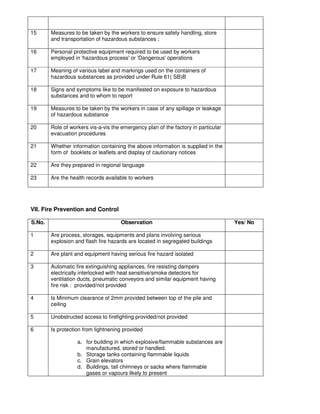
17 Does work permit system exists for working at heights
18 Are adequate number of safety belt provided
19 Are safety belts tested by competent persons once in six months
20 Is any certificate regarding its suitability obtained from competent
person
21 Are suitable and sufficient ladders, duck ladders or crawling board
provided to work at heights
22 Does work permit system exists for working on fragile roof
VI. Worker’s Participation in Safety Management:
S.No. Observation Yes/ No
Safety Committee
1 Does the safety committee constituted in the factory?
2 Does it have equal representation of management and workers
3 Are the workers in the committee selected as per Rule 61(SG)A
4 Is it chaired by a senior official who can contribute for effective
functioning of the committee
5 Are safety officer and medical officers are made member of the
committee
6 Does it have representation from production, maintenance and
purchase department
7 Does the meetings held at least once in a quarter
8 Are the minutes recorded and produced
9 Is implementation of recommendations are monitored
10 Are health and safety surveys conducted by the committee
Disclosure of Information to workers
Are the workers provided with the following information
11 List of hazardous process carried on in the factory
12 Location and availability of MSDS
13 Physical and health hazards arising from the exposure to or handling of
substances
14 Measures taken by the occupier to ensure safety and control of
physical and health hazards
15 Measures to be taken by the workers to ensure safety handling, store
and transportation of hazardous substances ;
16 Personal protective equipment required to be used by workers
employed in 'hazardous process' or 'Dangerous' operations
17 Meaning of various label and markings used on the containers of
hazardous substances as provided under Rule 61( SB)B
18 Signs and symptoms like to be manifested on exposure to hazardous
substances and to whom to report
19 Measures to be taken by the workers in case of any spillage or leakage
of hazardous substance
20 Role of workers vis-a-vis the emergency plan of the factory in particular
evacuation procedures
21 Whether information containing the above information is supplied in the
form of booklets or leaflets and display of cautionary notices
22 Are they prepared in regional language
23 Are the health records available to workers
VII. Fire Prevention and Control
S.No. Observation Yes/ No
1 Are process, storages, equipments and plans involving serious
explosion and flash fire hazards are located in segregated buildings
2 Are plant and equipment having serious fire hazard isolated
3 Automatic fire extinguishing appliances, fire resisting dampers
electrically interlocked with heat sensitive/smoke detectors for
ventilation ducts, pneumatic conveyors and similar equipment having
fire risk : provided/not provided
4 Is Minimum clearance of 2mm provided between top of the pile and
ceiling
5 Unobstructed access to firefighting provided/not provided
6 Is protection from lightnening provided
a. for building in which explosive/flammable substances are
manufactured, stored or handled.
b. Storage tanks containing flammable liquids
c. Grain elevators
d. Buildings, tall chimneys or sacks where flammable
gases or vapours likely to present
e. Substation buildings/transformers/switchyards
7 Precautions against ignition:
a. Flame proof electrical fittings in areas of risk
b. Effective measures for prevention of accumulation of
static charge
c. Workers shoes without iron or steel nails to cause
friction
d. Prohibition of smoking
e. Transmission belts with iron fasteners
f. Open flames/frictional sparks/overheated surfaces
8 Precautions to remove air pockets and maintenance of wet condition in
case of substances causing spontaneous ignition
9 Storage of compressed cylinders – shade/away from flammable
substances, furnace
10 Storage of flammable liquids:
a. Is the quantity stored in a room is more than the
minimum required for the process
b. Close fitting covers are provided to containers of
flammable liquids
c. Is the storage of flammable liquid with flashpoint less
than 21°
C more than 20 liters
d. Storage of flammable liquids in containers: limited
quantity in well ventilated room, isolated from remainder
of the building by fire walls and self closing fire doors
e. Storage of large quantities of flammable material,
preferably below the ground, and at a distance from any
building as required under Petroleum Rules
f. Effective steps to prevent leakage of liquids and
confining the escaping liquid ( BundWalls)
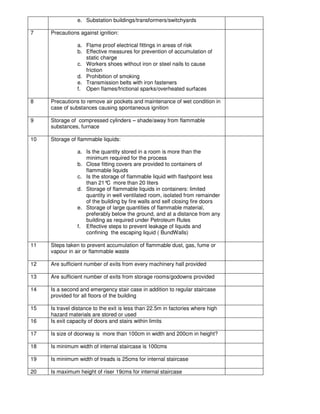
11 Steps taken to prevent accumulation of flammable dust, gas, fume or
vapour in air or flammable waste
12 Are sufficient number of exits from every machinery hall provided
13 Are sufficient number of exits from storage rooms/godowns provided
14 Is a second and emergency stair case in addition to regular staircase
provided for all floors of the building
15 Is travel distance to the exit is less than 22.5m in factories where high
hazard materials are stored or used
16 Is exit capacity of doors and stairs within limits
17 Is size of doorway is more than 100cm in width and 200cm in height?
18 Is minimum width of internal staircase is 100cms
19 Is minimum width of treads is 25cms for internal staircase
20 Is maximum height of riser 19cms for internal staircase
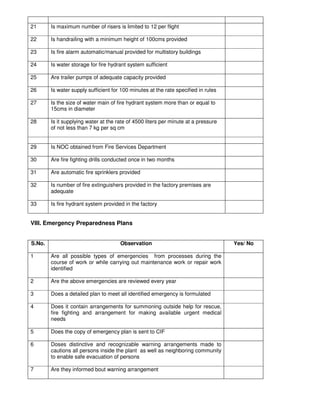
21 Is maximum number of risers is limited to 12 per flight
22 Is handrailing with a minimum height of 100cms provided
23 Is fire alarm automatic/manual provided for multistory buildings
24 Is water storage for fire hydrant system sufficient
25 Are trailer pumps of adequate capacity provided
26 Is water supply sufficient for 100 minutes at the rate specified in rules
27 Is the size of water main of fire hydrant system more than or equal to
15cms in diameter
28 Is it supplying water at the rate of 4500 liters per minute at a pressure
of not less than 7 kg per sq cm
29 Is NOC obtained from Fire Services Department
30 Are fire fighting drills conducted once in two months
31 Are automatic fire sprinklers provided
32 Is number of fire extinguishers provided in the factory premises are
adequate
33 Is fire hydrant system provided in the factory
VIII. Emergency Preparedness Plans
S.No. Observation Yes/ No
1 Are all possible types of emergencies from processes during the
course of work or while carrying out maintenance work or repair work
identified
2 Are the above emergencies are reviewed every year
3 Does a detailed plan to meet all identified emergency is formulated
4 Does it contain arrangements for summoning outside help for rescue,
fire fighting and arrangement for making available urgent medical
needs
5 Does the copy of emergency plan is sent to CIF
6 Doses distinctive and recognizable warning arrangements made to
cautions all persons inside the plant as well as neighboring community
to enable safe evacuation of persons
7 Are they informed bout warning arrangement
8 a) Are these arrangements reviewed once in a month
8 b) Are Alternate power supply arrangements and interlocking it with
normal power supply made to ensure constant supply of power to
facilities and equipment to ensure safety of the equipment and process
9 Are the workers trained in emergency procedures and action to be
taken by them during emergencies
10 Are at least 10% of workers trained in the use of first aide, fire fighting
appliances and rendering specific first aide measures on the special
hazards of the particular process
11 Are arrangements made to furnish identity of hazardous substances to
treating physician
12 Are mock drills conducted twice a year
13 Are all the stake holders informed during conducting of mock drills
IX. Occupational Health:
S.No. Observation Yes/ No
1 Are all the workers engaged in hazardous process are medically
examined by factory medical officer
a. Pre employment
b. Periodical ( once in six months)
2 Is certificate of fitness granted to every worker by factory medical officer
3 Are medical examination particulars entered in register
Occupational Health Centres (OHC)
(A) Factories with Haz process employing > 50 workers but < 200
workers:
Please specify Yes or No against each of the items below:
1) Is an occupational Health Centre having a room with a minimum
floor area of 15 sq. mt. with floors and wall made of smooth
and impervious surface and with adequate illumination and
ventilation provided?
2) Have the plans of OHC been approved by Director of Factories,
AP, Hyd?
3) If so, furnish the reference number:
4) Has the OHC been constructed as per plans?
5) Is a part time Medical Officer appointed?
6) Name and qualifications:
7) If appointed, is he visiting the factory at least twice in a week?
8) Are his services are readily available during medical
emergencies?
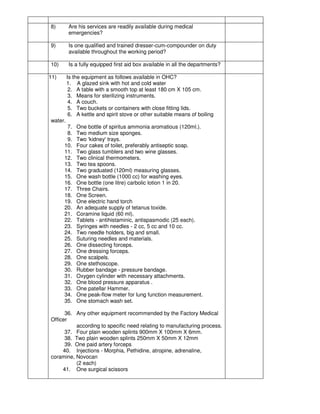
9) Is one qualified and trained dresser-cum-compounder on duty
available throughout the working period?
10) Is a fully equipped first aid box available in all the departments?
11) Is the equipment as follows available in OHC?
1. A glazed sink with hot and cold water
2. A table with a smooth top at least 180 cm X 105 cm.
3. Means for sterilizing instruments.
4. A couch.
5. Two buckets or containers with close fitting lids.
6. A kettle and spirit stove or other suitable means of boiling
water.
7. One bottle of spiritus ammonia aromatious (120ml.).
8. Two medium size sponges.
9. Two 'kidney' trays.
10. Four cakes of toilet, preferably antiseptic soap.
11. Two glass tumblers and two wine glasses.
12. Two clinical thermometers.
13. Two tea spoons.
14. Two graduated (120ml) measuring glasses.
15. One wash bottle (1000 cc) for washing eyes.
16. One bottle (one litre) carbolic lotion 1 in 20.
17. Three Chairs.
18. One Screen.
19. One electric hand torch
20. An adequate supply of tetanus toxide.
21. Coramine liquid (60 ml).
22. Tablets - antihistaminic, antispasmodic (25 each).
23. Syringes with needles - 2 cc, 5 cc and 10 cc.
24. Two needle holders, big and small.
25. Suturing needles and materials.
26. One dissecting forceps.
27. One dressing forceps.
28. One scalpels.
29. One stethoscope.
30. Rubber bandage - pressure bandage.
31. Oxygen cylinder with necessary attachments.
32. One blood pressure apparatus .
33. One patellar Hammer.
34. One peak-flow meter for lung function measurement.
35. One stomach wash set.
36. Any other equipment recommended by the Factory Medical
Officer
according to specific need relating to manufacturing process.
37. Four plain wooden splints 900mm X 100mm X 6mm.
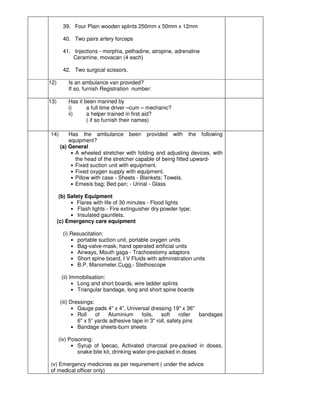
38. Two plain wooden splints 250mm X 50mm X 12mm
39. One paid artery forceps
40. Injections - Morphia, Pethidine, atropine, adrenaline,
coramine, Novocan
(2 each)
41. One surgical scissors
12) Has an arrangement been made for procuring an ambulance
with out loss of time in case of any need? If so, furnish the
details:
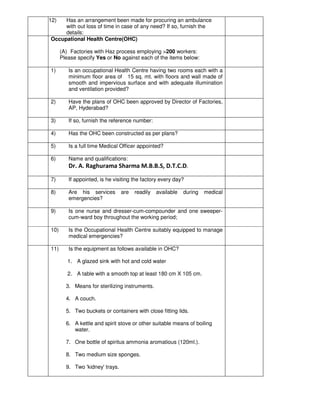
Occupational Health Centre(OHC)
(A) Factories with Haz process employing >200 workers:
Please specify Yes or No against each of the items below:
1) Is an occupational Health Centre having two rooms each with a
minimum floor area of 15 sq. mt. with floors and wall made of
smooth and impervious surface and with adequate illumination
and ventilation provided?
2) Have the plans of OHC been approved by Director of Factories,
AP, Hyderabad?
3) If so, furnish the reference number:
4) Has the OHC been constructed as per plans?
5) Is a full time Medical Officer appointed?
6) Name and qualifications:
Dr. A. Raghurama Sharma M.B.B.S, D.T.C.D.
7) If appointed, is he visiting the factory every day?
8) Are his services are readily available during medical
emergencies?
9) Is one nurse and dresser-cum-compounder and one sweeper-
cum-ward boy throughout the working period;
10) Is the Occupational Health Centre suitably equipped to manage
medical emergencies?
11) Is the equipment as follows available in OHC?
1. A glazed sink with hot and cold water
2. A table with a smooth top at least 180 cm X 105 cm.
3. Means for sterilizing instruments.
4. A couch.
5. Two buckets or containers with close fitting lids.
6. A kettle and spirit stove or other suitable means of boiling
water.
7. One bottle of spiritus ammonia aromatious (120ml.).
8. Two medium size sponges.
9. Two 'kidney' trays.
10. Four cakes of toilet, preferably antiseptic soap.
11. Two glass tumblers and two wine glasses.
12. Two clinical thermometers.
13. Two tea spoons.
14. Two graduated (120ml) measuring glasses.
15. One wash bottle (1000 cc) for washing eyes.
16. One bottle (one litre) carbolic lotion 1 in 20.
17. Three Chairs.
18. One Screen.
19. One electric hand torch
20. An adequate supply of tetanus toxide.
21. Coramine liquid (60 ml).
22. Tablets - antihistaminic, antispasmodic (25 each).
23. Syringes with needles - 2 cc, 5 cc and 10 cc.
24. Two needle holders, big and small.
25. Suturing needles and materials.
26. One dissecting forceps.
27. One dressing forceps.
28. One scalpels.
29. One stethoscope.
30. Rubber bandage - pressure bandage.
31. Oxygen cylinder with necessary attachments.
32. One blood pressure apparatus .
33. One patellar Hammer.
34. One peak-flow meter for lung function measurement.
35. One stomach wash set.
36. Any other equipment recommended by the Factory Medical
Officer according to specific need relating to manufacturing
process.
37. Eight Plain wooden splints 900mm x 100mm x 6mm
38. Eight Plain wooden splints 350mm x 75mm x 6mm
39. Four Plain wooden splints 250mm x 50mm x 12mm
40. Two pairs artery forceps
41. Injections - morphia, pethadine, atropine, adrenaline
Ceramine, movacan (4 each)
42. Two surgical scissors.
12) Is an ambulance van provided?
If so, furnish Registration number:
13) Has it been manned by
i) a full time driver –cum – mechanic?
ii) a helper trained in first aid?
( if so furnish their names)
14) Has the ambulance been provided with the following
equipment?
(a) General
• A wheeled stretcher with folding and adjusting devices, with
the head of the stretcher capable of being fitted upward-
• Fixed suction unit with equipment.
• Fixed oxygen supply with equipment.
• Pillow with case - Sheets - Blankets; Towels.
• Emesis bag; Bed pan; - Urinal - Glass
(b) Safety Equipment
• Flares with life of 30 minutes - Flood lights
• Flash lights - Fire extinguisher dry powder type;
• Insulated gauntlets.
(c) Emergency care equipment
(i) Resuscitation:
• portable suction unit, portable oxygen units
• Bag-valve-mask, hand operated artificial units
• Airways, Mouth gaga - Trachoestomy adaptors
• Short spine board, I V Fluids with administration units
• B.P. Manometer,Cugg,- Stethoscope
(ii) Immobilisation:
• Long and short boards, wire ladder splints
• Triangular bandage, long and short spine boards
(iii) Dressings:
• Gauge pads 4" x 4", Universal dressing 19" x 36"
• Roll of Aluminium foils, soft roller bandages
6" x 5” yards adhesive tape in 3" roll, safety pins
• Bandage sheets-burn sheets
(iv) Poisoning:
• Syrup of Ipecac, Activated charcoal pre-packed in doses,
snake bite kit, drinking water-pre-packed in doses
(v) Emergency medicines as per requirement ( under the advice
of medical officer only)
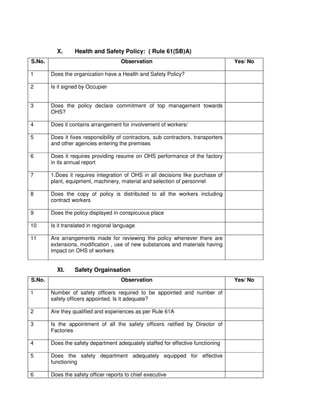
X. Health and Safety Policy: ( Rule 61(SB)A)
S.No. Observation Yes/ No
1 Does the organization have a Health and Safety Policy?
2 Is it signed by Occupier
3 Does the policy declare commitment of top management towards
OHS?
4 Does it contains arrangement for involvement of workers/
5 Does it fixes responsibility of contractors, sub contractors, transporters
and other agencies entering the premises
6 Does it requires providing resume on OHS performance of the factory
in its annual report
7 1.Does it requires integration of OHS in all decisions like purchase of
plant, equipment, machinery, material and selection of personnel
8 Does the copy of policy is distributed to all the workers including
contract workers
9 Does the policy displayed in conspicuous place
10 Is it translated in regional language
11 Are arrangements made for reviewing the policy whenever there are
extensions, modification , use of new substances and materials having
impact on OHS of workers
XI. Safety Orgainsation
S.No. Observation Yes/ No
1 Number of safety officers required to be appointed and number of
safety officers appointed. Is it adequate?
2 Are they qualified and experiences as per Rule 61A
3 Is the appointment of all the safety officers ratified by Director of
Factories
4 Does the safety department adequately staffed for effective functioning
5 Does the safety department adequately equipped for effective
functioning
6 Does the safety officer reports to chief executive
7 Are the safety officers required to perform other duties not connected to
duties of safety officer
8 Does safety officer undertakes job safety studies of selected hazardous
processes
9 Does safety officer is having a role in purchase of PPE
10 Does he conducts periodical safety inspections and advise on hazard
mitigation measures
11 Does he investigate accidents, dangerous occurrences and
occupational diseases
12 Does he associate in organizing safety campaigns and competitions to
promote safety
13 Is he involved in organizing safety training programmes
14 Does he actively participate and advise safety committees
XI. Education, Training and motivational measures
S.No. Observation Yes/ No
1 Whether adequate training provide to all the workers including contract
workers on OSH (Sec 7A)
2 Are specially trained adult workers appointed for adjustment operation
as required under Sec 22
3 Are the workers are trained to be familiar with the means of escape in
case of fire and have been adequately trained in the routine to be
followed in such cases.
4 Are sufficient number of workers trained in usage of first aid firefighting
equipment
5 Are workers trained in routine examination and maintenance of first aid
firefighting equipment
6 Are adequate number of t rained operators available for operation of
thermic fluid heaters
7 Are adequate number of trained operators available for operation of
driers/ovens
8 Are the arrangements available for education, training and retraining of
workers
9 Are the workers trained adequately to work in confined space
10 Are workers trained to work in maintenance works like cleaning of tanks
11 Are the workers informed and trained on use of PPE
12 Are workers trained in opening valves fitted to containers holding
corrosive material
13 Are the workers trained regarding evacuation procedures as part of
emergency plan
14 Are 10% of workers trained in first aid and fire fighting operations
15 Does trained and responsible fire fighting squad available to handle
firefighting and life saving equipment
16 Are the squad leaders trained in recognized Government Institutions
17 Are certified and trained operator available for operating solvent
extraction plan
18 Are operators trained in safe operation of electric furnace of Carbon Di
Sulphide Plant
19 Are workers trained in usage of personal protective equipment,
particularly SCBA
20 Are safety competitions organized in factory to increase safety
awareness among workers
21 Are safety poster and slogans displayed in the factory premises
22 Does the factory have induction training progamme in which OSH is
included
23 Are the workers periodically trained on safety systems and changed
processes/products/equipment
24 Are the employees sponsored for any external training programmes on
safety
Factories checklist
Factories checklist

Factories checklist

  • 1.
    INSPECTION CHECKLIST PART-A(For allfactories) General Information Sl.No Description Status 1 Date of Inspection 2 Registration Number 3 Name of the Factory Is there any change in Name of the Factory Yes O No O 4 Address of Factory 5 Maximum number of workers to be employed (Licence Limit) Total number of workers employed a) a) Regular workers - Male b) b) Regular workers - Female c) c) Contract workers - Male d) d) Contract workers - Female Yes / No Is there any change in workers Licence Limit? 6 a) Maximum Horse Power to be Installed in hp (Licence Limit) a) b) Actual Power Installed in hp b) c) Stand by Power in KVA / KW c) Is there any change in Installed hp / standby power Yes / No 7 Manufacturing Process 8 Licence Renewed up to Licence fee paid Yes / No 9 Factory building plans approved detail 9.1 Are there any Plan deviations? Yes / No 9.2 Are there any additional constructions / machinery installations? Yes / No 10 Occupier Details Name : Age : Father Name : Mobile No. : e-mail : Is there any change in Occupier? Yes / No 11 Factory Manager Details Name : Age : Father Name : Mobile No. : e-mail : Is there any change in Manager? Yes / No 12 Responsible Person Details Name : Age : Father Name : Mobile No. : e-mail : 13 Is there any child labour employment? Yes / No 14 Is there any adolescent worker employment without certificate of fitness? Yes / No
  • 2.
    Safety Provisions Sl.No CheckPoints related to Safety Provisions Status 1 Whether Safety guards or fencing is provided to the moving parts of the Yes / No / Not Applicable machinery 2 Whether hoist and lifts examined by competent person? Yes / No / Not Applicable 3 Whether lifting machines, chains, ropes and lifting tackles examined by Yes / No / Not Applicable competent person? 4 Whether pressure vessels examined by competent person? Yes / No / Not Applicable 5 Floors, stairs with handrails, safe means of access, and platforms with Yes / No / Not Applicable toeboards provided and maintained properly 6 Are all the pits, sumps, openings in floors are securely covered or Yes / No / Not Applicable fenced? 7 Whether Eye sight and colour vision of the persons employed to operate or Yes / No / Not Applicable to give signals to a crane / locomotive / fork lift truck examined by a qualified ophthalmologist? 8 Are sufficient number of exits from every machinery hall provided? Yes / No / Not Applicable 9 Whether adequate fire fighting equipment provided and workers are Yes / No / Not Applicable trained in fire fighting? 10 Whether thick rubber matting (or) insulating stand provided at electrical Yes / No / Not Applicable panels? 11 Whether all electric wiring Laid in permanent conduits to prevent danger to Yes / No / Not Applicable work men? 12 Three way plug pin used for supply to portable electrical apparatus Yes / No / Not Applicable 13 Earth Leakage Circuit Breaker (ELCB) provided in the main circuit, to Yes / No / Not Applicable protect the persons working on electrical equipment from excess of leakage current 14 Proper earthing to the portable electric apparatus Provided Yes / No / Not Applicable 15 Whether Qualified Safety officers appointed? Yes / No / Not Applicable 16 Whether a Safety committee is constituted? Yes / No / Not Applicable 17 As per Indian Standard, Personal Protective Equipment like safety belts, Yes / No / Not Applicable helmets, safety shoes, goggles, mask and gloves are available in sufficient quantity for workers employed therein 18 Health and Safety Policy prepared and displayed Yes / No / Not Applicable 19 Whether persons who possess qualifications and experience to Yes / No / Not Applicable supervise handling of hazardous substances appointed? 20 Whether Work permits for critical / jobs are followed and record maintained Yes / No / Not Applicable 21 Safety training given to all workers Yes / No / Not Applicable 22 Whether any walls / structures damaged in the factory? Yes / No / Not Applicable
  • 3.
    Fire Prevention andControl Sl.No Observations Status 1 Whether fire hydrant systems are provided to all the hazardous areas Yes / No / Not Applicable which are prone to Fire? 2 Automatic fire extinguishing appliances, fire resisting dampers electrically Yes / No / Not Applicable interlocked with heat sensitive / smoke detectors for ventilations ducts, pneumatic conveyors and similar equipment Provided 3 Unobstructed access to fire fighting provided Yes / No / Not Applicable 4 Is protection from lightening provided Yes / No / Not Applicable a) For building in which explosive / flammable substances are manufactured, stored or handled b) Storage tanks containing flammable liquids c) Buildings, tall chimneys or sacks where flammable gases or vapours likely to present d) Substation buildings / transformers / switch yards
  • 4.
    Welfare Amenities Sl.No CheckPoints related to Welfare Provisions Status 1 Adequate and suitable facilities for washing provided and maintained for the Yes / No / Not Applicable use of the workers 2 First aid facilities available in factory Yes / No / Not Applicable 3.1 Whether Canteen provided? Yes / No / Not Applicable 3.2 Fly proof mesh to the doors and windows of canteen provided Yes / No / Not Applicable 3.3 Floor and inside walls of the canteen made smooth and impervious? Yes / No / Not Applicable 3.4 Hot water facility for cleaning of utensils provided Yes / No / Not Applicable 3.5 Fly proof safes for storing the food material provided Yes / No / Not Applicable 3.6 A canteen managing committee with equal number of persons Yes / No / Not Applicable nominated by occupier and elected by the workers constituted 3.7 The staff of the canteen engaged in handling food stuffs medically Yes / No / Not Applicable examined by the medical officer 3.8 Price list of food stuffs being supplied in canteen displayed at a Yes / No / Not Applicable conspicuous place in dining hall 4.1 Whether Shelters, rest rooms provided Yes / No / Not Applicable 4.2 Whether lunch rooms provided Yes / No / Not Applicable 5 Whether Creche provided? Yes / No / Not Applicable 6 Whether Welfare officer appointed? Yes / No / Not Applicable 7.1 Whether Ambulance Room provided? Yes / No / Not Applicable 7.2 Whether whole time medical officer assisted by atleast one Yes / No / Not Applicable qualified nurse or dresser cum compounder appointed? 7.3 Whether Ambulance Van provided? Yes / No / Not Applicable
  • 5.
    Health Provisions Sl.No CheckPoints related to Health Provisions Status 1 Cleanliness status of workplace such as floors, stairs and passages Yes / No / Not Applicable are cleanliness 2 Effective arrangements are provided for the treatment of waste and effluents Yes / No / Not Applicable 3 Effective arrangements are provided for control of excess dust and fumes Yes / No / Not Applicable 4 Drinking water facilities available in factory Yes / No / Not Applicable 5 Latrines and urinals are provided in proportion to the no. of male and female Yes / No / Not Applicable workers employed 6 Latrines and urinals are maintained in a clean and sanitary condition Yes / No / Not Applicable 7 Sufficient and suitable lighting (natural or artificial or both) shall be provided Yes / No / Not Applicable in every part of factories 8 Adequate ventilation by the circulation of fresh air provided Yes / No / Not Applicable
  • 6.
    Occupational Health Centres Sl.NoObservations Status 1 Whether Occupational Health Centre provided? Yes / No / Not Applicable 2 Whether medical officer is appointed? Yes / No / Not Applicable Whether qualified and trained dresser cum compounder Whether a minimum of 5 persons are trained in First aid procedures 3 Whether a fully equipped ambulance van provided? Yes / No / Not Applicable 4 Pre employment and Periodical (once in six months) medical examination of Yes / No / Not Applicable all the workers engaged in hazardous process carried out
  • 7.
    Other Provisions Sl.No CheckPoints related to Other Provisions Status 1 Muster roll maintained Yes / No / Not Applicable 2 Payment of wages Register maintained Yes / No / Not Applicable 3 Overtime Register maintained Yes / No / Not Applicable 3.1 Overtime within prescribed limits i.e., less than or equal to 50 hours in a Yes / No / Not Applicable quarter? 4 Accident Register maintained Yes / No / Not Applicable 5 Leave with wages Register maintained Yes / No / Not Applicable 6 Maternity Benefit Act and Rules maintained Yes / No / Not Applicable 7 Common Annual Return submitted Yes / No / Not Applicable 8 Building Stability Certificate received from competent Person for New Yes / No / Not Applicable Registration of Factories 9 Whether weekly off given to Regular / contract workers Yes / No / Not Applicable 10 Information of accidents and dangerous occurrences as per section 88 and Yes / No / Not Applicable 88-A to the Inspectorate in Form 18 /18-A 11 Whether a report in form No.19 sent to the Director of Factories in respect Yes / No / Not Applicable of any occupational diseases detected (as mentioned in third schedule of section 89)
  • 8.
    PART-B ( Only forhazardous factories listed in the First Schedule under section 2(cb) of the Factories act, 1948) I. Hazard Identification and Risk Reduction S.No. Observation Yes/ No 1 Are all the hazardous areas identified 2 Are all the hazards involved in the handling of raw material and actual process including dangerous chemical reactions identified 3 Are the properties of raw material, finished products and by products are studied 4 Are remedial measures suggested for removal of hazards 5 Are all the measures suggested for removal of hazards been undertaken 6 Does the design, construction, installation, operation, maintenance and disposal of the buildings, plants and facilities considered effective safe guards against all the safety and health hazards so evaluated 7 Whether HARA report is prepared for all the products manufactured in the factory 8 Whether recommendations of HARA report are complied with 9 Are safety reports submitted in Schedule 8 10 Are safety audits by third party done periodically 11 Whether compliance report to safety audit is submitted 12 Whether information regarding Major accident Hazard and safety measures to be taken by public is given to persons likely to be affected by a major accident II. Safety in Chemical Storages and Handling S.No. Observation Yes/ No 1 Does the chemical storage equipment have adequate labeling and colour coding arrangement 2 Does it confirm to respective ISI code 3 Are the damaged containers handled under the supervision of a knowledgeable and responsible person 4 Are adequate facilities provided for making chemical spillages innocuous 5 Are adequate precautions taken to prevent accumulation of flammable,
  • 9.
    explosive and toxicconcentration of substances in storage areas? 6 Does the chemical storage areas have sufficient ventilation to prevent formation of dangerous chemical concentration 7 Is flooring of storage area compatible with chemicals being stored 8 Are the chemicals stored at one place are compatible with each other 9 Does storage of unstable, reactive and explosive chemicals and intermediates are limited for two months usage 10 Is permission of CIF is taken for exceeding the above limits 11 Does standby arrangement is provided for transfer of toxic substances quickly if any defect is found in the storage tank 12 FRP and Glass vessel storage: a. Does the storage vessels have proper anchorage, working platform, access ladders, pipelines etc b. Are they independently supported instead of having direct supporting structure on the storage tank 13 Whether MSDS is available for all the hazardous substances or material handled in the premises 14 Are the following labeling arrangement is done for all the containers containing hazardous substance a. Contents of the container b. Name and address of the manufacturer or importer of the substance c. Physical and Health Hazards d. Recommended PPE needed to work safely with the substance Fire and Explosion Risk 15 does the receptacles for flammable liquids have metallic connections to earthed supply tanks to prevent static sparking 16 are conductive hoses/pipes used for transfer of solvents and other flammable material 17 are mobile tank wagons earthed during filling and discharge 18 are precautions taken to ensure earthing is effective before such filling or discharge ( work permit system) 19 are adequate lightning arresters provided 20 are adequate and suitable fire fighting appliances available near the vicinity of flammable storages 21 Are pipe lines carrying flammable or explosive substances protected from mechanical damage
  • 10.
    22 Are theabove pipeline examined by a responsible person once in a week to detect any defect or accumulation of material 23 Any record is maintained for defects and repairs made Toxic Substances 24 Are catch pits, bund walls, dykes or other suitable safeguards provided to restrict the serious effects of leakage of toxic substances 25 Are catch pits provided below joints in pipelines 26 Is adequate drainage leading to collection tanks with neutralizing media provided 27 Are vessels of toxic material less than 90cms in height from ground are provided with fencing to a height of 90 cm 28 Are adequate arrangements made for storage and disposal of waste material containing toxic material Corrosive Substances 29 Is the flooring where corrosive materials handled made of impervious, corrosive and fire resistant material 30 Does water facilities with eye wash fountain and shower provided near corrosive material handling area 31 Is the cautionary notice prescribe in Schedule XX displayed 32 Are the containers of corrosive material properly labeled 33 Whether implements made of wood or other material ( which prevents formation of arseniuretted hydrogen) provided for cleaning residues of chemicals storage tanks 34 Are the corrosive materials stored along compatible materials only 35 Are any precautions for avoiding overflowing of chemicals taken 36 Are the chemical storage vessels examined once in a year 37 Are any records for the above examination maintained III. Process Safety S.No. Observation Yes/ No 1 Are safe operating procedures prepared for all the hazardous processes 2 Are these SOPS displayed at appropriate places 3 Are they translated in regional language
  • 11.
    4 Are workersadequately trained on these SOPs 5 Do the management obtained undertaking from the workers that they were informed the hazards and trained about preventive measures and SOPs 6 Does authorized entry system prescribed and followed for entry in to factory or plant having dangerous operations or dangerous chemical reactions 7 Are adequate precautions taken while cleaning and removal of sludge from the equipment for testing to avoid fire, explosion 8 Does adequate seating arrangement provided to operating personnel to prevent exposure to toxic, flammable and explosive substances during course of manufacturing and maintenance 9 Are sampling workers adequately informed about safe procedures 10 Are adequate precautions taken to prevent mixing of effluents from different processes and operations which may cause evolution of dangerous or poisonous gases 11 Are qualified supervisors appointed for supervising the handling of hazardous substances 12 are any hot exhaust pipes are installed inside the building 13 whether all hot pipes, surfaces and surfaces likely to become hot are suitably protected 14 is hazardous area classification done 15 are the electrical appliances are provided based on hazardous area classification 16 does soles of shoes worn by workers contain metal on them 17 are wheels of trucks of conveyors conductive 18 are tools and appliances used in the above area are non sparking type 19 is smoking prohibited in the above areas and cautionary notice displayed 20 does machinery, plant, equipment, pipe lines, belt drives etc which are source of accumulation of static charge are effectively earthed 21 does automatic cutoff ( solenoid valve etc) of heating is provided to limit the temperatures of process below predetermined safe limits
  • 12.
    22 are bundwalls, dykes, sumps etc are provide to confined possible leakages from flammable liquid storage tanks 23 are arrangements made to dispose off waste material in contact with flammable substances under supervision of knowledgeable and responsible person 24 Whether continuous exhaust arrangement is provided to draw the toxic gases, vapors and fumes 25 Whether the above arrangement is interlocked with process 26 Does the facility exist for automatic stoppage of process in the event of failure of exhaust arrangement (for processes generating toxic fumes) 27 Are work benches on which toxic substances are manipulated, have smooth impervious surface 28 Does the above surface is washed daily after the completion of work Personal Protective Equipment: 29 Are workers provided with appropriate and approved type of PPE 30 Are they adequately supervised for usage of PPE 31 Are safety sampling workers provided with proper and approved PPE 32 Does suitable personal protective equipment ( suitable protective wear for hands and feet, suitable aprons, face shields, chemical safety goggles and respirators etc) are provided for persons handling corrosive material 33 Are the workers using the PPE while handling corrosive materials IV. Equipment Safety S.No. Observation Yes/ No Equipment in built safety measures: 1 Does the electrical installations used in the process suitable to the hazards prevailing in the area like dust, dampness, corrosion, flammability and explosivity 2 Is quick isolation of plant or part of the plant or equipment is possible 3 Does the lay out plan containing quick isolation facility available with security, maintenance and safety personnel
  • 13.
    4 Are alarmsystems (audio and visual) provided to warn operational parameters exceeding predetermined safe limits 5 Are the alarm systems checked daily? 6 Are the alarm systems tested at least once in a month 7 Are adequate precautions taken to prevent escape and spread of flammable, explosive and toxic substances during normal working hours and in emergencies 8 If the above system fails, are the arrangements made to control the process and bring the escape below safe limit 9 Are facilities available to render the substances escaping in to working environment innocuous 10 Are automatic and or remote control arrangements made to control the effects of dangerous chemical reactions 11 Does automatic flooding or blanketing or other effective arrangements made to control dangerous chemical reactions. 12 Does adequate ventilation arrangements provided and maintained at all times in the process area to ensure concentrations of chemical vapour below safe limits 13 Is substantial wire mesh enclosure provided to protect persons in the event of breakage of glass vessels and equipment like flasks, condensers etc 14 Reaction Vessels(Closed): a. Are safety relief valves/rupture discs of adequate size provided b. Are suitable vents of adequate size to draw and disposed contents safely from SRV/Rupture Discs provided c. Is pressure gauge/vacuum gauge/compound gauge provided d. Is temperature gauge provided e. Is blow leg provided to prevent free fall of solvent or other flammable material while feeding to reactor to prevent accumulation of static charge f. Are the reactors adequately earthed to prevent accumulation of static charge g. Are the condenser vents are terminated outside with flame arresters 15 Centrifuges: a. Are the centrifuges periodically examined by competent persons to ensure safe operation b. Are the lids provided with limit switches c. Are vents provided to centrifuges to draw the vapours away from process hall d. Are the centrifuges properly earthed e. Are arrangements made to collect MLs (non acidic) from centrifuges in SS containers closed and provided with vent line
  • 14.
    16 Driers: a. Arethe driers fixed with explosion relief panels of adequate size and capacity b. Are Automatic temperature control arrangements( like solenoid valve in steam line or water line) provided to limit temperature below predetermined safe limits c. Are the driers examined by competent persons once in a year and once in a year d. Are any records maintained showing such examination e. Are the operators trained in safe operating procedures of driers f. Does safety ventilation system provided to dilute flammable mixture in air to limit the concentration to 25% of LEL g. Does the exhaust ducts of safety ventilation system designed to discharge flammable mixture away from work room h. is automatic pre ventilation provided to purge the driers before activation of heating system i. are arrangements made to prevent dripping of combustible substances on electric heaters or burner flame Testing of Equipment: 17 Does all the instruments and safety devices used in the process tested before taking into use and after carrying out any repair to them 18 Are they examined once in a month by a competent person 19 Does records of above tests and examinations maintained in a register 20 Does all instruments and safety devices used in the process operated daily or as often as it is necessary to ensure efficient and effective functioning at all times 21 Are all parts of the plant, equipment and machinery used in the process examined by competent person before commencement of process 22 Are they retested once in two years or after carrying out repairs to it. 23 Are equipment found to be unfit for safe use destroyed or rendered unusable under intimation to Chief Inspector 24 Does testing marks indicating person by whom testing is done and date of testing indicated on the equipment. 25 Are all parts of the plant, equipment, machinery which in the likely event of failure may give rise to an emergency situation examined once in a month by competent person 26 Are the records of above testing and examination maintaining 27 Are the repair works including alteration, modification and addition to plant, equipment and machinery done under the supervision of a responsible person
  • 15.
    28 Any permitto work system is adopted for the above work V. Maintenance Safety: S.No. Observation Yes/ No 1 Does the staging erected for the purpose of maintenance work confirms to ISI 2 Does adequate ventilation is provided to prevent exposure of persons working on the stages 3 Does the staging provided with safe access and proper hand rails of one meter height and toe board 4 Are all the confined spaces identified 5 Does the work in confined space is regulated by means of work permit system. 6 Does facilities for adequate testing of confined space by ca competent person available 7 Are the persons involved in confined space entry are educated and trained about the hazards in the work 8 Is the confined space work undertaken under the supervision by a responsible and knowledgeable person 9 Whether a log book is maintained for confined space entry with all relevant entries 10 Does permit to work system is followed for cleaning of empty containers previously containing hazardous chemicals. 11 Are the persons involved in cleaning of chemical containers are educated and trained about the hazards in the work 12 Is the cleaning work undertaken under the supervision by a responsible and knowledgeable person 13 Whether isolation of plant, machinery, equipment etc is forming part of work permit system 14 Does the system has work procedures integrating safety with the work 15 Are the workers engaged in activity under Permit to Work are physically fit to carry out the specified 16 Are they provided with adequate PPE for rescue, resurrection and first aid 17 Does work permit system exists for working at heights
  • 16.
    18 Are adequatenumber of safety belt provided 19 Are safety belts tested by competent persons once in six months 20 Is any certificate regarding its suitability obtained from competent person 21 Are suitable and sufficient ladders, duck ladders or crawling board provided to work at heights 22 Does work permit system exists for working on fragile roof VI. Worker’s Participation in Safety Management: S.No. Observation Yes/ No Safety Committee 1 Does the safety committee constituted in the factory? 2 Does it have equal representation of management and workers 3 Are the workers in the committee selected as per Rule 61(SG)A 4 Is it chaired by a senior official who can contribute for effective functioning of the committee 5 Are safety officer and medical officers are made member of the committee 6 Does it have representation from production, maintenance and purchase department 7 Does the meetings held at least once in a quarter 8 Are the minutes recorded and produced 9 Is implementation of recommendations are monitored 10 Are health and safety surveys conducted by the committee Disclosure of Information to workers Are the workers provided with the following information 11 List of hazardous process carried on in the factory 12 Location and availability of MSDS 13 Physical and health hazards arising from the exposure to or handling of substances 14 Measures taken by the occupier to ensure safety and control of physical and health hazards
  • 17.
    15 Measures tobe taken by the workers to ensure safety handling, store and transportation of hazardous substances ; 16 Personal protective equipment required to be used by workers employed in 'hazardous process' or 'Dangerous' operations 17 Meaning of various label and markings used on the containers of hazardous substances as provided under Rule 61( SB)B 18 Signs and symptoms like to be manifested on exposure to hazardous substances and to whom to report 19 Measures to be taken by the workers in case of any spillage or leakage of hazardous substance 20 Role of workers vis-a-vis the emergency plan of the factory in particular evacuation procedures 21 Whether information containing the above information is supplied in the form of booklets or leaflets and display of cautionary notices 22 Are they prepared in regional language 23 Are the health records available to workers VII. Fire Prevention and Control S.No. Observation Yes/ No 1 Are process, storages, equipments and plans involving serious explosion and flash fire hazards are located in segregated buildings 2 Are plant and equipment having serious fire hazard isolated 3 Automatic fire extinguishing appliances, fire resisting dampers electrically interlocked with heat sensitive/smoke detectors for ventilation ducts, pneumatic conveyors and similar equipment having fire risk : provided/not provided 4 Is Minimum clearance of 2mm provided between top of the pile and ceiling 5 Unobstructed access to firefighting provided/not provided 6 Is protection from lightnening provided a. for building in which explosive/flammable substances are manufactured, stored or handled. b. Storage tanks containing flammable liquids c. Grain elevators d. Buildings, tall chimneys or sacks where flammable gases or vapours likely to present
  • 18.
    e. Substation buildings/transformers/switchyards 7Precautions against ignition: a. Flame proof electrical fittings in areas of risk b. Effective measures for prevention of accumulation of static charge c. Workers shoes without iron or steel nails to cause friction d. Prohibition of smoking e. Transmission belts with iron fasteners f. Open flames/frictional sparks/overheated surfaces 8 Precautions to remove air pockets and maintenance of wet condition in case of substances causing spontaneous ignition 9 Storage of compressed cylinders – shade/away from flammable substances, furnace 10 Storage of flammable liquids: a. Is the quantity stored in a room is more than the minimum required for the process b. Close fitting covers are provided to containers of flammable liquids c. Is the storage of flammable liquid with flashpoint less than 21° C more than 20 liters d. Storage of flammable liquids in containers: limited quantity in well ventilated room, isolated from remainder of the building by fire walls and self closing fire doors e. Storage of large quantities of flammable material, preferably below the ground, and at a distance from any building as required under Petroleum Rules f. Effective steps to prevent leakage of liquids and confining the escaping liquid ( BundWalls) 11 Steps taken to prevent accumulation of flammable dust, gas, fume or vapour in air or flammable waste 12 Are sufficient number of exits from every machinery hall provided 13 Are sufficient number of exits from storage rooms/godowns provided 14 Is a second and emergency stair case in addition to regular staircase provided for all floors of the building 15 Is travel distance to the exit is less than 22.5m in factories where high hazard materials are stored or used 16 Is exit capacity of doors and stairs within limits 17 Is size of doorway is more than 100cm in width and 200cm in height? 18 Is minimum width of internal staircase is 100cms 19 Is minimum width of treads is 25cms for internal staircase 20 Is maximum height of riser 19cms for internal staircase
  • 19.
    21 Is maximumnumber of risers is limited to 12 per flight 22 Is handrailing with a minimum height of 100cms provided 23 Is fire alarm automatic/manual provided for multistory buildings 24 Is water storage for fire hydrant system sufficient 25 Are trailer pumps of adequate capacity provided 26 Is water supply sufficient for 100 minutes at the rate specified in rules 27 Is the size of water main of fire hydrant system more than or equal to 15cms in diameter 28 Is it supplying water at the rate of 4500 liters per minute at a pressure of not less than 7 kg per sq cm 29 Is NOC obtained from Fire Services Department 30 Are fire fighting drills conducted once in two months 31 Are automatic fire sprinklers provided 32 Is number of fire extinguishers provided in the factory premises are adequate 33 Is fire hydrant system provided in the factory VIII. Emergency Preparedness Plans S.No. Observation Yes/ No 1 Are all possible types of emergencies from processes during the course of work or while carrying out maintenance work or repair work identified 2 Are the above emergencies are reviewed every year 3 Does a detailed plan to meet all identified emergency is formulated 4 Does it contain arrangements for summoning outside help for rescue, fire fighting and arrangement for making available urgent medical needs 5 Does the copy of emergency plan is sent to CIF 6 Doses distinctive and recognizable warning arrangements made to cautions all persons inside the plant as well as neighboring community to enable safe evacuation of persons 7 Are they informed bout warning arrangement
  • 20.
    8 a) Arethese arrangements reviewed once in a month 8 b) Are Alternate power supply arrangements and interlocking it with normal power supply made to ensure constant supply of power to facilities and equipment to ensure safety of the equipment and process 9 Are the workers trained in emergency procedures and action to be taken by them during emergencies 10 Are at least 10% of workers trained in the use of first aide, fire fighting appliances and rendering specific first aide measures on the special hazards of the particular process 11 Are arrangements made to furnish identity of hazardous substances to treating physician 12 Are mock drills conducted twice a year 13 Are all the stake holders informed during conducting of mock drills IX. Occupational Health: S.No. Observation Yes/ No 1 Are all the workers engaged in hazardous process are medically examined by factory medical officer a. Pre employment b. Periodical ( once in six months) 2 Is certificate of fitness granted to every worker by factory medical officer 3 Are medical examination particulars entered in register Occupational Health Centres (OHC) (A) Factories with Haz process employing > 50 workers but < 200 workers: Please specify Yes or No against each of the items below: 1) Is an occupational Health Centre having a room with a minimum floor area of 15 sq. mt. with floors and wall made of smooth and impervious surface and with adequate illumination and ventilation provided? 2) Have the plans of OHC been approved by Director of Factories, AP, Hyd? 3) If so, furnish the reference number: 4) Has the OHC been constructed as per plans? 5) Is a part time Medical Officer appointed? 6) Name and qualifications: 7) If appointed, is he visiting the factory at least twice in a week?
  • 21.
    8) Are hisservices are readily available during medical emergencies? 9) Is one qualified and trained dresser-cum-compounder on duty available throughout the working period? 10) Is a fully equipped first aid box available in all the departments? 11) Is the equipment as follows available in OHC? 1. A glazed sink with hot and cold water 2. A table with a smooth top at least 180 cm X 105 cm. 3. Means for sterilizing instruments. 4. A couch. 5. Two buckets or containers with close fitting lids. 6. A kettle and spirit stove or other suitable means of boiling water. 7. One bottle of spiritus ammonia aromatious (120ml.). 8. Two medium size sponges. 9. Two 'kidney' trays. 10. Four cakes of toilet, preferably antiseptic soap. 11. Two glass tumblers and two wine glasses. 12. Two clinical thermometers. 13. Two tea spoons. 14. Two graduated (120ml) measuring glasses. 15. One wash bottle (1000 cc) for washing eyes. 16. One bottle (one litre) carbolic lotion 1 in 20. 17. Three Chairs. 18. One Screen. 19. One electric hand torch 20. An adequate supply of tetanus toxide. 21. Coramine liquid (60 ml). 22. Tablets - antihistaminic, antispasmodic (25 each). 23. Syringes with needles - 2 cc, 5 cc and 10 cc. 24. Two needle holders, big and small. 25. Suturing needles and materials. 26. One dissecting forceps. 27. One dressing forceps. 28. One scalpels. 29. One stethoscope. 30. Rubber bandage - pressure bandage. 31. Oxygen cylinder with necessary attachments. 32. One blood pressure apparatus . 33. One patellar Hammer. 34. One peak-flow meter for lung function measurement. 35. One stomach wash set. 36. Any other equipment recommended by the Factory Medical Officer according to specific need relating to manufacturing process. 37. Four plain wooden splints 900mm X 100mm X 6mm. 38. Two plain wooden splints 250mm X 50mm X 12mm 39. One paid artery forceps 40. Injections - Morphia, Pethidine, atropine, adrenaline, coramine, Novocan (2 each) 41. One surgical scissors
  • 22.
    12) Has anarrangement been made for procuring an ambulance with out loss of time in case of any need? If so, furnish the details: Occupational Health Centre(OHC) (A) Factories with Haz process employing >200 workers: Please specify Yes or No against each of the items below: 1) Is an occupational Health Centre having two rooms each with a minimum floor area of 15 sq. mt. with floors and wall made of smooth and impervious surface and with adequate illumination and ventilation provided? 2) Have the plans of OHC been approved by Director of Factories, AP, Hyderabad? 3) If so, furnish the reference number: 4) Has the OHC been constructed as per plans? 5) Is a full time Medical Officer appointed? 6) Name and qualifications: Dr. A. Raghurama Sharma M.B.B.S, D.T.C.D. 7) If appointed, is he visiting the factory every day? 8) Are his services are readily available during medical emergencies? 9) Is one nurse and dresser-cum-compounder and one sweeper- cum-ward boy throughout the working period; 10) Is the Occupational Health Centre suitably equipped to manage medical emergencies? 11) Is the equipment as follows available in OHC? 1. A glazed sink with hot and cold water 2. A table with a smooth top at least 180 cm X 105 cm. 3. Means for sterilizing instruments. 4. A couch. 5. Two buckets or containers with close fitting lids. 6. A kettle and spirit stove or other suitable means of boiling water. 7. One bottle of spiritus ammonia aromatious (120ml.). 8. Two medium size sponges. 9. Two 'kidney' trays.
  • 23.
    10. Four cakesof toilet, preferably antiseptic soap. 11. Two glass tumblers and two wine glasses. 12. Two clinical thermometers. 13. Two tea spoons. 14. Two graduated (120ml) measuring glasses. 15. One wash bottle (1000 cc) for washing eyes. 16. One bottle (one litre) carbolic lotion 1 in 20. 17. Three Chairs. 18. One Screen. 19. One electric hand torch 20. An adequate supply of tetanus toxide. 21. Coramine liquid (60 ml). 22. Tablets - antihistaminic, antispasmodic (25 each). 23. Syringes with needles - 2 cc, 5 cc and 10 cc. 24. Two needle holders, big and small. 25. Suturing needles and materials. 26. One dissecting forceps. 27. One dressing forceps. 28. One scalpels. 29. One stethoscope. 30. Rubber bandage - pressure bandage. 31. Oxygen cylinder with necessary attachments. 32. One blood pressure apparatus . 33. One patellar Hammer. 34. One peak-flow meter for lung function measurement. 35. One stomach wash set. 36. Any other equipment recommended by the Factory Medical Officer according to specific need relating to manufacturing process. 37. Eight Plain wooden splints 900mm x 100mm x 6mm 38. Eight Plain wooden splints 350mm x 75mm x 6mm
  • 24.
    39. Four Plainwooden splints 250mm x 50mm x 12mm 40. Two pairs artery forceps 41. Injections - morphia, pethadine, atropine, adrenaline Ceramine, movacan (4 each) 42. Two surgical scissors. 12) Is an ambulance van provided? If so, furnish Registration number: 13) Has it been manned by i) a full time driver –cum – mechanic? ii) a helper trained in first aid? ( if so furnish their names) 14) Has the ambulance been provided with the following equipment? (a) General • A wheeled stretcher with folding and adjusting devices, with the head of the stretcher capable of being fitted upward- • Fixed suction unit with equipment. • Fixed oxygen supply with equipment. • Pillow with case - Sheets - Blankets; Towels. • Emesis bag; Bed pan; - Urinal - Glass (b) Safety Equipment • Flares with life of 30 minutes - Flood lights • Flash lights - Fire extinguisher dry powder type; • Insulated gauntlets. (c) Emergency care equipment (i) Resuscitation: • portable suction unit, portable oxygen units • Bag-valve-mask, hand operated artificial units • Airways, Mouth gaga - Trachoestomy adaptors • Short spine board, I V Fluids with administration units • B.P. Manometer,Cugg,- Stethoscope (ii) Immobilisation: • Long and short boards, wire ladder splints • Triangular bandage, long and short spine boards (iii) Dressings: • Gauge pads 4" x 4", Universal dressing 19" x 36" • Roll of Aluminium foils, soft roller bandages 6" x 5” yards adhesive tape in 3" roll, safety pins • Bandage sheets-burn sheets (iv) Poisoning: • Syrup of Ipecac, Activated charcoal pre-packed in doses, snake bite kit, drinking water-pre-packed in doses (v) Emergency medicines as per requirement ( under the advice of medical officer only)
  • 25.
    X. Health andSafety Policy: ( Rule 61(SB)A) S.No. Observation Yes/ No 1 Does the organization have a Health and Safety Policy? 2 Is it signed by Occupier 3 Does the policy declare commitment of top management towards OHS? 4 Does it contains arrangement for involvement of workers/ 5 Does it fixes responsibility of contractors, sub contractors, transporters and other agencies entering the premises 6 Does it requires providing resume on OHS performance of the factory in its annual report 7 1.Does it requires integration of OHS in all decisions like purchase of plant, equipment, machinery, material and selection of personnel 8 Does the copy of policy is distributed to all the workers including contract workers 9 Does the policy displayed in conspicuous place 10 Is it translated in regional language 11 Are arrangements made for reviewing the policy whenever there are extensions, modification , use of new substances and materials having impact on OHS of workers XI. Safety Orgainsation S.No. Observation Yes/ No 1 Number of safety officers required to be appointed and number of safety officers appointed. Is it adequate? 2 Are they qualified and experiences as per Rule 61A 3 Is the appointment of all the safety officers ratified by Director of Factories 4 Does the safety department adequately staffed for effective functioning 5 Does the safety department adequately equipped for effective functioning 6 Does the safety officer reports to chief executive
  • 26.
    7 Are thesafety officers required to perform other duties not connected to duties of safety officer 8 Does safety officer undertakes job safety studies of selected hazardous processes 9 Does safety officer is having a role in purchase of PPE 10 Does he conducts periodical safety inspections and advise on hazard mitigation measures 11 Does he investigate accidents, dangerous occurrences and occupational diseases 12 Does he associate in organizing safety campaigns and competitions to promote safety 13 Is he involved in organizing safety training programmes 14 Does he actively participate and advise safety committees XI. Education, Training and motivational measures S.No. Observation Yes/ No 1 Whether adequate training provide to all the workers including contract workers on OSH (Sec 7A) 2 Are specially trained adult workers appointed for adjustment operation as required under Sec 22 3 Are the workers are trained to be familiar with the means of escape in case of fire and have been adequately trained in the routine to be followed in such cases. 4 Are sufficient number of workers trained in usage of first aid firefighting equipment 5 Are workers trained in routine examination and maintenance of first aid firefighting equipment 6 Are adequate number of t rained operators available for operation of thermic fluid heaters 7 Are adequate number of trained operators available for operation of driers/ovens 8 Are the arrangements available for education, training and retraining of workers 9 Are the workers trained adequately to work in confined space 10 Are workers trained to work in maintenance works like cleaning of tanks 11 Are the workers informed and trained on use of PPE
  • 27.
    12 Are workerstrained in opening valves fitted to containers holding corrosive material 13 Are the workers trained regarding evacuation procedures as part of emergency plan 14 Are 10% of workers trained in first aid and fire fighting operations 15 Does trained and responsible fire fighting squad available to handle firefighting and life saving equipment 16 Are the squad leaders trained in recognized Government Institutions 17 Are certified and trained operator available for operating solvent extraction plan 18 Are operators trained in safe operation of electric furnace of Carbon Di Sulphide Plant 19 Are workers trained in usage of personal protective equipment, particularly SCBA 20 Are safety competitions organized in factory to increase safety awareness among workers 21 Are safety poster and slogans displayed in the factory premises 22 Does the factory have induction training progamme in which OSH is included 23 Are the workers periodically trained on safety systems and changed processes/products/equipment 24 Are the employees sponsored for any external training programmes on safety