International Research Journal of Engineering and Technology (IRJET) e-ISSN: 2395-0056
Volume: 06 Issue: 07 | July 2019 www.irjet.net p-ISSN: 2395-0072
© 2019, IRJET | Impact Factor value: 7.211 | ISO 9001:2008 Certified Journal | Page 1074
R Peak Detection with Diagnosis of Arrhythmia using Adaptive Filter
and Hilbert Transform
Saudagar1, Bhawna Jindal2
1Student, M.Tech, Department of ECE, UIET, Kurukshetra University, Kurukshetra, Haryana, India
2Student, M.Tech, Department of ECE, UIET, Kurukshetra University, Kurukshetra, Haryana, India
---------------------------------------------------------------------***---------------------------------------------------------------------
Abstract - R peak of electrocardiogram (ECG) signal
detected with good accuracy by combining adaptive filterand
Hilbert transform. In proposed algorithm adaptive filter
reduces the mean square error to an extent and estimates the
fundamental signal even in nonappearance of prior data
about statistical properties of the signal and noise, and gives
improved detection outcomes. AllpasscharacteristicofHilbert
transform eliminatesunnecessarysignal distortionandexhibit
the property of time dependency. Arrhythmiahappeneddueto
irregular heart rhythm which diagnosed by extracting
numerous ECG features such as RR interval, Heart rate, QRS
width, PR interval. A graphical user interface (GUI) also
developed which is a convenient way to represent output
waveform, features and type of abnormalities in a single
window screen with more simplicity, consistency and
familiarity. The signal has been taken from MIT-BIH
arrhythmia database. Sensitivity of 99.22% and positive
predictivity of 99.34% achieved by proposed methodology.
Key Words: Electrocardiogram, adaptive filtering, Hilbert
transform, features, GUI, arrhythmia.
1. INTRODUCTION
Electrocardiogram (ECG) also abbreviatedasEKGsignal.For
diagnosis electrocardiogram remainsthereferencestandard
in spite of the development of many other diagnostic
procedures. EKG signal comprises six wave i.e. P wave, QRS
complex (Q wave, S wave and peak R wave), T wave and U
wave. P wave generated due to depolarization of atria, QRS
complex indicates the depolarization of left and right
ventricles, R wave has peak amplitudeinQRS complex which
is a point of interest in detection process and contains most
of the important clinical information regarding heart [1], PR
interval estimated from beginning of P-wave to the starting
of QRS complex, RR interval is the difference between two
successive R peaks, also named as Inter-beat- interval (IBI).
Electrocardiographyisanimportanttool usedfordiagnosing
heart condition. Deviation from normal sinus rhythm
(normal heart cycle) are the symptoms of arrhythmia that
denotes some form of cardiovascular disease (CVD) [2].
Cardiac arrhythmia displays a situation of abnormal
electrical movement in the heart which is a danger to
humans [3]. The heart produces miniature electrical
impulses which spread over the heart muscle to make the
heart contract. These impulses can be identified by the ECG
machine. The electrocardiogram signal and heart rate
reveals the cardiac health of human heart. Any disorder in
heart rate or rhythm or variation in the morphological
pattern of this signal is a sign of cardiac arrhythmia. It is
detected and diagnosed by scrutiny of the recorded
waveform. The amplitude and duration of the P-QRS-T-U
wave holds beneficial information about the nature of
disease associated to heart. An electrocardiogram (EKG) is
completed to determine the heart electrical activity,tocheck
exactly how rapid your heart is beating and to find the
reason of symptoms of heart diseaselikeshortnessofbreath,
dizziness, unbalances heartbeat [1]. Various noise or
artifacts such as power line interference, baseline
wandering, motion artifacts, and electrode contact noise
distort the signal quality, frequency resolution, which
generates signals with large amplitudethatcanbeanalogous
to PQRST waveforms and masks miniature features that are
essential for clinical diagnosis and monitoring [4].
Elimination of these artifacts is a significant task for better
diagnosis. For that purpose wavelet denoising used in
proposed work. R-Peak is the most noticeable part during
signal examination which relates to the contraction of the
ventricles for the duration of a heartbeat. QRS complex
detected more accurately with presented algorithm that
escalates detection sensitivity by processing the RR interval
as compared to some previous methods such as wavelet
Transform method in which accuracythrowsdownto77.3%
for large muscle artifact signals [5], Template matching
technique [6], Wavelet Transform with histogram, moving
average and two thresholds technique [7], Wavelets and
artificial neural networks based method [8]. So the main
objective of this study to detect R peak with good accuracy
and to extract electrocardiogram features along with
arrhythmia diagnosis by using an algorithm formed with
combination of adaptive filter and Hilbert transform.
2. MATERIAL AND METHODS
The processing of ECG signal involve of de-noising, baseline
correction, filtering, thresholding, feature extraction and
arrhythmia detection. Flow chart of proposed algorithm
represented inFig.1.Thewholeexplanationof preprocessing
steps and evaluation of performance parameters discussed
here.
International Research Journal of Engineering and Technology (IRJET) e-ISSN: 2395-0056
Volume: 06 Issue: 07 | July 2019 www.irjet.net p-ISSN: 2395-0072
© 2019, IRJET | Impact Factor value: 7.211 | ISO 9001:2008 Certified Journal | Page 1075
Fig -1: Flowchart of proposed algorithm
2.1 Original ECG signal
An offline data used for processing electrocardiogram
signals that can be taken from MIT-BIHarrhythmia database
available on Physionet ATM bank [9]. The raw data basically
contaminated with numerous noise artifacts which needsto
be eliminate to enhance detection performance. These
artifacts added to the signal while recording due to
movement in muscles, electrode etc.
2.2 Wavelet denoising and subtraction
Most of the signal corrupted with the baseline wandering
noise which shift the signal upward or downward and affect
the pattern of QRS recognition. Elimination of baseline drift
is hence mandatory in the analysis of the ECG signal to
decrease the fluctuations in beat morphology with no
physiological equivalent [10]. Electrode impedance and
respiration alters because of perspiration which is the
leading sources of baseline wander in utmost types of ECG
recordings.Thisbaselinewanderingcanbe removedwithout
troubling the ECG waveform features.Tokeep baselineatthe
correct position firstly signal denoise using waveletfunction
wden(db6) and then subtracted from the original signal.
2.3 Adaptive filtering
An adaptive filter uses iterative computations to decrease
the error “in forming the relationship among two signals in
real time”. Basic diagram of an adaptivefilterisshownbelow
in Fig.2. Here, the input denotes the ECG which is
observed with the additive noise n. The reference signal c is
either a pure noise generator or a signal associated to n.
Since the n and are uncorrelated, then
(1)
Fig -2: A general diagram of an adaptive filter
Let the N coefficients of the filter at the iteration be
represented as = . For an
input vector = ,
the output will be given in equation as:
d(k)= (2)
The working of filter is to adjust its weights W iteratively to
decrease the mean square error (MSE) within the primary
and the reference inputs [11]. Usually, LMS and RLS
algorithm has been used to bring up to date the coefficients
of predictor. In present work, RLS (Recursive least square)
have been used for the said purpose. Upon convergence, a
predictor is able to predict the gradually varying
components (low frequency content) accurately i.e.
producing a reduced amount of error in comparison to fast
moving components (high frequency content).
2.3.1 RLS Algorithm
Recursive least square(RLS)algorithmrecursivelydiscovers
the filter coefficients with an objective function of lessening
the cost function of summation of weighted linear least
squares linking to the input vector unlike LMS (least mean
square) and other analogous variants that aim to decrease
the mean square error. The RLS algorithm shows very fast
convergence at the price of biggercomputational complexity
[2]. Eigen value spread problem also eliminated by this
algorithm. Equation representing the relations for updating
weights is as follows:
(3)
(4)
International Research Journal of Engineering and Technology (IRJET) e-ISSN: 2395-0056
Volume: 06 Issue: 07 | July 2019 www.irjet.net p-ISSN: 2395-0072
© 2019, IRJET | Impact Factor value: 7.211 | ISO 9001:2008 Certified Journal | Page 1076
(5)
(6)
where c(n) is desired signal value of nth sample, λ is
exponential forgetting factor, P(n) is a k*k matrix, is a
1*k vector, is transposed input vector, ,
represent weight vectors at nth and (n-1)th
sample having dimension of 1*K , ande(n)arethestepsize
parameter and the instantaneous error respectively having
dimension of 1*1, is a 1*K input signal vector
containing signal values from c(n) to c(n-k).
2.4 Savitzky-Golay Filtering
A technique of data smoothing centered on local least
squares polynomial approximation was given by Savitzky
and Golay in 1964. They revealed that fitting a polynomial to
a set of input samples and then estimating the resulting
polynomial at a distinct point within the approximation
interval is corresponding to discrete convolution with a
static impulse response. The low pass filtersachievedbythis
process are broadly known as Savitzky Golay filters. Noisy
data gained from chemical spectrum analyzers smoothens
and least squares smoothing decreases noise while
preserving the shape and heightofwaveformpeaks[12]. For
N data points (N is odd, N=2M+1) a data vector X having M
points on either side of :
(7)
Then by a polynomial of degree d, N data samples fitted in X:
(8)
In this case , i=0,1,…,d, is defined to have components
which is a d+1 polynomial basis vectors:
(9)
The corresponding matrix S (N*(d+1)) is well-defined to
have as columns:
(10)
Then the design stages for the SG filters can be explained as
follows:
(11)
(12)
(13)
The steady state equation of SG filter for smoothing a noisy
sequence x(n) with length N, order d as:
= (14)
For proposed work the SG filter has order of 3 and window
length of 15.
2.5 Squaring and differentiation
The strength of the signal decreased after passing through
number of preprocessing steps. Hence it is required to
enhance the strength of signal so that squaring performed
[13]. This raises the amplitude of signal and all the
information available in the positive half which added
easiness in detection of correct peaks. Then the signal
differentiated to acquire the slope information of QRS
complex.
2.6 Hilbert transform
To detect R peaks proficiently the proposed technique is
described in a very suitable manner. A real valued time
function x(t) i.e. differentiated ECG, and the Hilbert
transform of the that signal is given by equation:
(15)
In accordance with transformationtheindependentvariable
do not altered so that Hilbert transform shows the property
of time dependency [14]. And this relation comes from the
convolution calculation:
(16)
(17)
where sgnf= (18)
The i/o correlation of Hilbert transform is the conversion of
linear function, therefore it act like a linear filter where all
the amplitudes of spectral components are lasting identical
where the phases altered with ±90°. The imaginary part of
the analytic signal is Hilbert transformanditsreal partactas
its input. Output waveform demonstrates the Hilbert
transform of a differentiated EKG segment. The R-peaks
happened due to the zero-crossings of the differentiated
EKG, because the Hilbert transform is an odd filterandin the
output of the transform represented as peaks. On the
differentiated electrocardiogram the effects of the Hilbert
transform described in terms of its signal envelope and odd
symmetry property. All pass characteristic of the Hilbert
transform avoids needless signal distortion, in comparison
to the additional derivative technique which tends to
diminish the signal at the lower frequencies. Therefore, the
International Research Journal of Engineering and Technology (IRJET) e-ISSN: 2395-0056
Volume: 06 Issue: 07 | July 2019 www.irjet.net p-ISSN: 2395-0072
© 2019, IRJET | Impact Factor value: 7.211 | ISO 9001:2008 Certified Journal | Page 1077
essential rectification of the differentiated EKG signal
delivered by the odd phase element of the filter in order to
recognize the QRS peaks while the uniform magnitudeofthe
filter confirms that essential information of the QRS
complexes is preserved[15]. TheHilberttransformedoutput
signal is stated as;
(19)
(20)
(21)
Where V(t) is the envelop of x(t) and is instantaneous
phase angle.
2.7 R peak detection
There is need of extraction of suitable metrics from the
signal. Before the extraction of these metrics from the ECG
signal, the Q, R, S peaks with their position in each beat were
identified. This is achieved with an algorithmic script with
the following approach: The first aimisthedetectionoftheR
Peak because one time the R-Peak is detected; it can be used
to notice the Q and S points effortlessly. Because of the
idiosyncratic nature of the QRS complex and the typical
characteristics of the R peak, this is willingly identified even
in the utmost distorted ECG readings. Thus it is castoff asthe
basis for ECG feature computations [16]. By choosing a
window of particular length, the peak with maximum value
detected. A threshold also applied for better detection,
distinguishing correctly detected and falselydetectedpeaks.
Then R peaks detected on the envelope of Hilbert
transformed signal represented by the small red circles as
shown in Fig.4.
2.8 Feature extraction
For the resolution of diagnosis after R peak detection, there
is need to extract several features from the preprocessed
ECG data, comprising QRS width, RR interval, PR intervals.
The deflection positional information provides the feature
such as RR interval which used in medical as a pointer of
Ventricular Heart Rate. Two R peaks in successive beats is
calculated and their difference is figuredfordetermining the
RR interval.Electrocardiogramfeatureextractedonthebasis
of given equations:
(22)
(23)
(24)
Where stand for sampling frequency specify
current R peak locations and indicates current P peak
locations. Here variable x shows instant 5 ms, added to
and are subtracted from .S and Q peak sitesrepresented
by and respectively [17]. Heart rate computed in
beats per minutes (bpm) and for a normal person in resting
state varies from 60 to 100 bpm.
2.9 Arrhythmia
Arrhythmia happened due to irregular heart rhythm and
various types of arrhythmias diagnosed in this paper. With
extractedfeaturesnumerouscardiovasculararrhythmiasare
noticed as Right bundle branch block. Within the right
bundle branch it act as a delay or block of conduction. An
interruption of conduction reveals as incomplete right
bundle branch block.Rightbundlebranchblock occurswhen
QRS duration > 0.14 sec. Sinus Bradycardia occurs when
heart rate is less than 60 beats per minute in resting state,
though it is rarely suggestive until the rate falls below 50
beat/min. Sinus Tachycardia states to quick beating of the
heart as a heart rate more than 100 beats per minute in
adult. Diseases were predicted from extracted features as
according to medical science condition for Tachycardia
fulfilled if heart rate > 100 bpm (beats per minute) [18].
Normal range of heart rhythm is 60 to 100 bpm. When QRS
width > 0.12 sec and heart rate varies from 101 to 250 bpm
then Ventricular tachycardia happened. Normal range QRS
width lies between 0.08 to 0.10 sec. Incomplete Bundle
Branch Block occurred when QRS width between 0.10sec to
0.12 sec and QRS width > 0.12 sec for Bundle Branch Block
[16]. First degree heart block take place when PR interval >
0.2 sec.
3. ECG DATABASE
MIT-BIH arrhythmia database used in this work which
available on Physionet ATM bank. This offline data firstly
collected in a directory which further used for
preprocessing. It consistsoftotal 48subjectssignal including
males and females. There are 25 men of age group 32-89
years and 23 women of age group 23-89 years. For
estimation of arrhythmia detection this database was firstly
usually accessible from the set of standard test material and
has been used for that purpose as well as for elementary
investigation into cardiac dynamics at larger than 500 sites
worldwide [9]. These signals have voltage of 10mV,
resolution of 10 bit and 360 Hz sampling frequency.
4. RESULTS
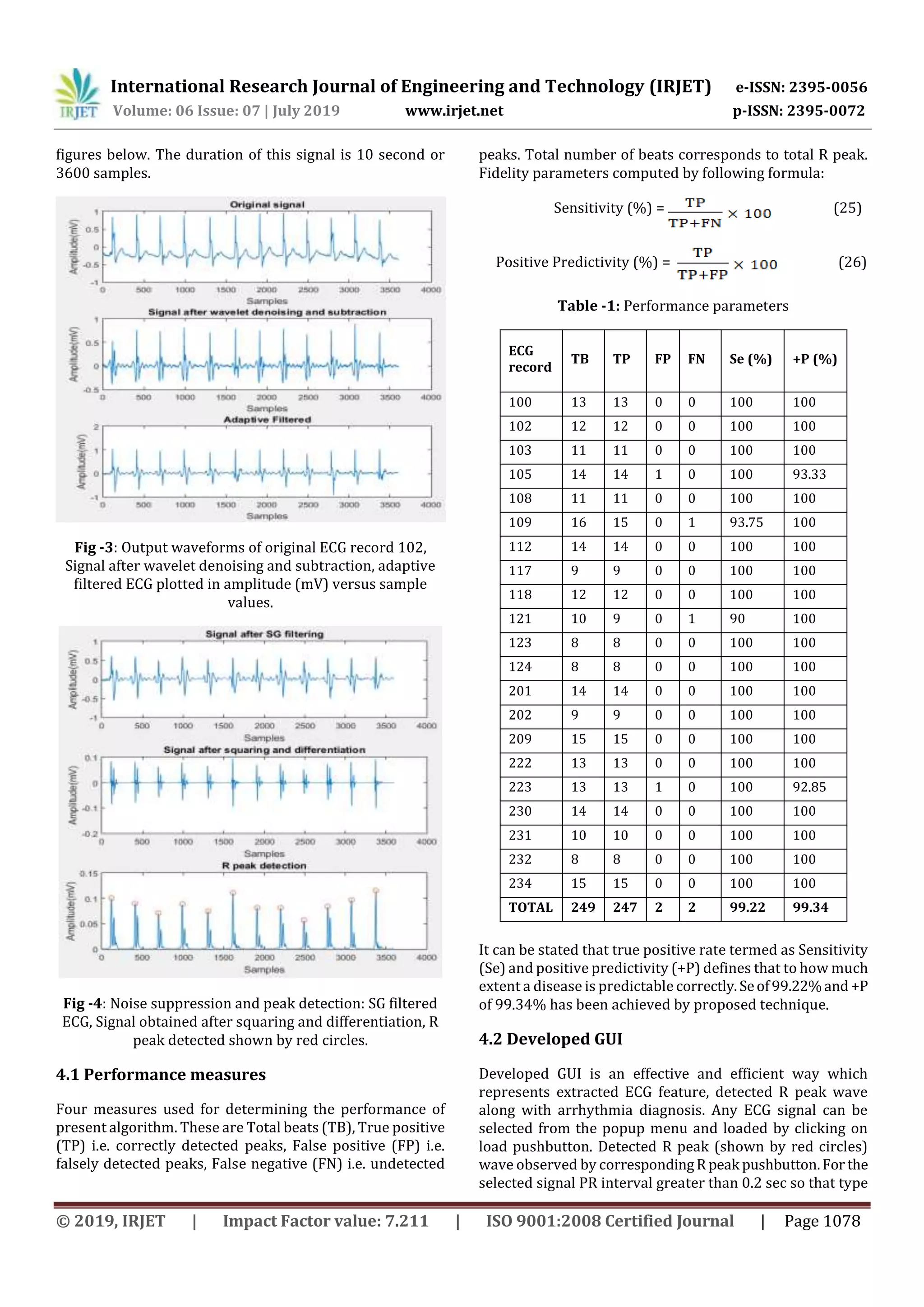
Output waveforms obtained from proposed methodology as
shown in Fig.3 and Fig.4. These waveforms produced in
MATLAB tool. An ECG record 102 has been taken from MIT-
BIH arrhythmia database and processed as illustrated in
International Research Journal of Engineering and Technology (IRJET) e-ISSN: 2395-0056
Volume: 06 Issue: 07 | July 2019 www.irjet.net p-ISSN: 2395-0072
© 2019, IRJET | Impact Factor value: 7.211 | ISO 9001:2008 Certified Journal | Page 1078
figures below. The duration of this signal is 10 second or
3600 samples.
Fig -3: Output waveforms of original ECG record 102,
Signal after wavelet denoising and subtraction, adaptive
filtered ECG plotted in amplitude (mV) versus sample
values.
Fig -4: Noise suppression and peak detection: SG filtered
ECG, Signal obtained after squaring and differentiation, R
peak detected shown by red circles.
4.1 Performance measures
Four measures used for determining the performance of
present algorithm. These are Total beats (TB), True positive
(TP) i.e. correctly detected peaks, False positive (FP) i.e.
falsely detected peaks, False negative (FN) i.e. undetected
peaks. Total number of beats corresponds to total R peak.
Fidelity parameters computed by following formula:
Sensitivity (%) = (25)
Positive Predictivity (%) = (26)
Table -1: Performance parameters
ECG
record
TB TP FP FN Se (%) +P (%)
100 13 13 0 0 100 100
102 12 12 0 0 100 100
103 11 11 0 0 100 100
105 14 14 1 0 100 93.33
108 11 11 0 0 100 100
109 16 15 0 1 93.75 100
112 14 14 0 0 100 100
117 9 9 0 0 100 100
118 12 12 0 0 100 100
121 10 9 0 1 90 100
123 8 8 0 0 100 100
124 8 8 0 0 100 100
201 14 14 0 0 100 100
202 9 9 0 0 100 100
209 15 15 0 0 100 100
222 13 13 0 0 100 100
223 13 13 1 0 100 92.85
230 14 14 0 0 100 100
231 10 10 0 0 100 100
232 8 8 0 0 100 100
234 15 15 0 0 100 100
TOTAL 249 247 2 2 99.22 99.34
It can be stated that true positive rate termed as Sensitivity
(Se) and positive predictivity (+P) defines that to how much
extent a disease is predictable correctly.Seof99.22%and +P
of 99.34% has been achieved by proposed technique.
4.2 Developed GUI
Developed GUI is an effective and efficient way which
represents extracted ECG feature, detected R peak wave
along with arrhythmia diagnosis. Any ECG signal can be
selected from the popup menu and loaded by clicking on
load pushbutton. Detected R peak (shown by red circles)
wave observed by correspondingRpeak pushbutton.For the
selected signal PR interval greater than 0.2 sec so that type
International Research Journal of Engineering and Technology (IRJET) e-ISSN: 2395-0056
Volume: 06 Issue: 07 | July 2019 www.irjet.net p-ISSN: 2395-0072
© 2019, IRJET | Impact Factor value: 7.211 | ISO 9001:2008 Certified Journal | Page 1079
of arrhythmia diagnosed is first degree heartblock asshown
in Fig.5.
Fig -5: Developed GUI
4.3 Comparison with previous state of art methods
A quick survey of some previous studies has been provided
to compare the best performance observed in the present
study. Se and +P are listed in Table with methods, novelty of
particular study. In this paper a newalgorithmbycombining
adaptive filter and Hilbert transform for QRS complex
detection is proposed. This method achieves good accuracy
in term of sensitivity and positive predictivityincomparison
with other competing methods, offering an advantage of
minimized mean square error and low computational
complexity. A graphical user interface also developed which
provide unity, clarity, directness, alignment, integrity,
comfort and charm to the user. The user interface is a single
object with a certain personality to help a particular user
perform a particular task.
Table -2: Comparison with previous state of art methods
Methods Novelty Se
(%)
+P
(%)
Wavelet Transform
method [5]
Detect arrhythmia types
by relating the extracted
ECG features.
94.12 88.90
Template matching
algorithm [6]
Template waveform
produced using a short-
term autocorrelation
95.80 98.30
process for QRS
detection.
Wavelet Transform
with histogram,
moving average
and two thresholds
technique [7]
Two wavelet function
(haar &db10) with dual
thresholding for QRS
detection
98.68 97.24
Second derivative
method [15]
Bandpass filtering,
squaring and variable
thresholds comparison
for QRS detection
98.08 99.18
Wavelets and
artificial neural
networks method
[8]
Four wavelet basis
functions those are
appropriate in detection
of QRS complexes inside
dissimilar QRS
morphologies in the
signal.
97.20 98.52
Geometrical
matching algorithm
[19]
Use decision function in
a confined moving-
window process for QRS
detection.
97.94 99.13
Presented
methodology
Combination of
adaptive filter and
Hilbert transform for
R peak detection with
arrhythmia diagnosis.
99.22 99.34
5. CONCLUSION
This paper presents an improved R peak detection system
that work on adaptive filtering and Hilbert transform. Type
of arrhythmia also diagnosed on the basis of extracted ECG
features. By adopting a wavelet function for denoising and
Savitzky Golay filter for filtering occurrence of false positive
and false negative beats reduced. During recording extra
ventricular waveform formed due to which artifacts
generated that are also removed with adaptive filtering.
Presented technique achieves better-quality detection of
delayed potentials. So sensitivity of 99.22% and positive
predictivity of 99.34% has been attained by proposed
methodology.
REFERENCES
[1] Joshi AK, Tomar A, Tomar M. A Review Paper on
Analysis of Electrocardiograph (ECG) Signal for the
Detection of Arrhythmia Abnormalities.IntJAdvRes
Electr2014;3(10):12466–75.
http://dx.doi.org/10.15662/ijareeie.2014.0310028.
[2] Jain S, Ahirwal MK, Kumar A, Bajaj V, Singh GK. QRS
detection usingadaptivefilters:Acomparativestudy.
ISA Trans 2017;66:362–75.
http://dx.doi.org/10.1016/j.isatra.2016.09.023.
[3] Khadirnaikar S, Aparna P. A feasible QRS detection
algorithm for arrhythmia diagnosis. 2016 Int. Conf.
International Research Journal of Engineering and Technology (IRJET) e-ISSN: 2395-0056
Volume: 06 Issue: 07 | July 2019 www.irjet.net p-ISSN: 2395-0072
© 2019, IRJET | Impact Factor value: 7.211 | ISO 9001:2008 Certified Journal | Page 1080
Adv. Electr. Electron. Syst. Eng. ICAEES 2016;32–7.
http://dx.doi.org/10.1109/ICAEES.2016.7888004.
[4] Mr. HrishikeshLimayeMVVD.ECGNoiseSourcesand
Various Noise Removal Techniques: A Survey. Int J
Appl or Innov Eng Manag 2016;5(2):2319–4847.
[5] Priya PK, Reddy GU. MATLAB Based GUI for
Arrhythmia Detection Using Wavelet Transform.
Ijareeie 2015;4(2):807–16.
http://dx.doi.org/10.15662/ijareeie.2015.0402055.
[6] Nakai Y, Izumi S, Nakano M, Yamashita K, Fujii T,
Kawaguchi H, et al. Noise tolerant QRS detection
using template matching with short-term
autocorrelation. 2014 36th Annu Int Conf IEEE Eng
Med Biol Soc EMBC 2014;34–7.
http://dx.doi.org/10.1109/EMBC.2014.6943522.
[7] Chouakri SA, Bereksi-Reguig F, Taleb-Ahmed A. QRS
complex detection based on multi wavelet packet
decomposition. Appl Math Comput
2011;217(23):9508–25.
http://dx.doi.org/10.1016/j.amc.2011.03.001.
[8] Abibullaev B, Seo HD. A new QRS detection method
using wavelets and artificial neural networks. J Med
Syst 2011;35(4):683–91.
http://dx.doi.org/10.1007/s10916-009-9405-3.
[9] Moody RGM and GB. The MIT-BIH Arrhythmia
Database on CD-ROM and software for use with it.
Proc. Int. Conf. Comput. Cardiol., 1990, p. 185–8.
[10] Pokharkar S, Kulkarni A. ECG Real Time Feature
Extraction Using MATLAB. Int J Technol Sci
2015;V(1):2350–1111.
[11] AlMahamdy M, Riley HB. Performance study of
different denoising methods for ECG signals.
Procedia Comput Sci 2014;37:325–32.
http://dx.doi.org/10.1016/j.procs.2014.08.048.
[12] Nahiyan KMT, Amin A. Removal of ECG Baseline
Wander using Savitzky-Golay Filter Based Method.
Bangladesh J Med Phys 2015;8:32–45.
[13] Pan J, Tompkins WJ. A Real-Time QRS Detection
Algorithm. IEEE Trans Biomed Eng 1985;BME-
32(3):230–6.
http://dx.doi.org/10.1109/TBME.1985.325532.
[14] Sahoo S, Biswal P, Das T, Sabut S. De-noising of ECG
Signal and QRS Detection Using Hilbert Transform
and Adaptive Thresholding. Procedia Technol
2016;25:68–75.
http://dx.doi.org/10.1016/j.protcy.2016.08.082.
[15] Arzeno NM, Deng Z De, Poon CS. Analysis of first-
derivative based QRS detection algorithms. IEEE
Trans Biomed Eng 2008;55(2):478–84.
http://dx.doi.org/10.1109/TBME.2007.912658.
[16] Gothwal H, KedawatS,KumarR.Cardiacarrhythmias
detection in an ECG beat signal using fast fourier
transform and artificial neural network.JBiomedSci
Eng 2011;04:289–96.
http://dx.doi.org/10.4236/jbise.2011.44039.
[17] Umer M, Bhatti BA, Tariq MH, Zia-Ul-HassanM,Khan
MY, Zaidi T. Electrocardiogram Feature Extraction
and Pattern Recognition Using a Novel Windowing
Algorithm. Adv Biosci Biotechnol 2014;5:886–94.
http://dx.doi.org/10.4236/abb.2014.511103.
[18] Miller JM, Das MK, Yadav A V, Bhakta D, Nair G,
Alberte C. Value of the 12-Lead ECG in Wide QRS
Tachycardia. Cardiol Clin 2006;24:439–51.
http://dx.doi.org/10.1016/j.ccl.2006.03.003.
[19] Suárez K V., Silva JC, Berthoumieu Y, Gomis P, Najim
M. ECG beat detection using a geometrical matching
approach. IEEE Trans Biomed Eng 2007;54(4):641–
50. http://dx.doi.org/10.1109/TBME.2006.889944.
[20] Mhetre MR, Vaishampayan A, Raskar M. ECG
Processing & Arrhythmia Detection : An Attempt. Int
J Eng Innov Technol 2013;2(10):272–6.
[21] AL-Ziarjawey H. Heart Rate Monitoring and PQRST
Detection Based on Graphical User Interface with
Matlab. Int J Inf Electron Eng 2015;5(4):311–6.
http://dx.doi.org/10.7763/IJIEE.2015.V5.550.

IRJET- R Peak Detection with Diagnosis of Arrhythmia using Adaptive Filter and Hilbert Transform

  • 1.
    International Research Journalof Engineering and Technology (IRJET) e-ISSN: 2395-0056 Volume: 06 Issue: 07 | July 2019 www.irjet.net p-ISSN: 2395-0072 © 2019, IRJET | Impact Factor value: 7.211 | ISO 9001:2008 Certified Journal | Page 1074 R Peak Detection with Diagnosis of Arrhythmia using Adaptive Filter and Hilbert Transform Saudagar1, Bhawna Jindal2 1Student, M.Tech, Department of ECE, UIET, Kurukshetra University, Kurukshetra, Haryana, India 2Student, M.Tech, Department of ECE, UIET, Kurukshetra University, Kurukshetra, Haryana, India ---------------------------------------------------------------------***--------------------------------------------------------------------- Abstract - R peak of electrocardiogram (ECG) signal detected with good accuracy by combining adaptive filterand Hilbert transform. In proposed algorithm adaptive filter reduces the mean square error to an extent and estimates the fundamental signal even in nonappearance of prior data about statistical properties of the signal and noise, and gives improved detection outcomes. AllpasscharacteristicofHilbert transform eliminatesunnecessarysignal distortionandexhibit the property of time dependency. Arrhythmiahappeneddueto irregular heart rhythm which diagnosed by extracting numerous ECG features such as RR interval, Heart rate, QRS width, PR interval. A graphical user interface (GUI) also developed which is a convenient way to represent output waveform, features and type of abnormalities in a single window screen with more simplicity, consistency and familiarity. The signal has been taken from MIT-BIH arrhythmia database. Sensitivity of 99.22% and positive predictivity of 99.34% achieved by proposed methodology. Key Words: Electrocardiogram, adaptive filtering, Hilbert transform, features, GUI, arrhythmia. 1. INTRODUCTION Electrocardiogram (ECG) also abbreviatedasEKGsignal.For diagnosis electrocardiogram remainsthereferencestandard in spite of the development of many other diagnostic procedures. EKG signal comprises six wave i.e. P wave, QRS complex (Q wave, S wave and peak R wave), T wave and U wave. P wave generated due to depolarization of atria, QRS complex indicates the depolarization of left and right ventricles, R wave has peak amplitudeinQRS complex which is a point of interest in detection process and contains most of the important clinical information regarding heart [1], PR interval estimated from beginning of P-wave to the starting of QRS complex, RR interval is the difference between two successive R peaks, also named as Inter-beat- interval (IBI). Electrocardiographyisanimportanttool usedfordiagnosing heart condition. Deviation from normal sinus rhythm (normal heart cycle) are the symptoms of arrhythmia that denotes some form of cardiovascular disease (CVD) [2]. Cardiac arrhythmia displays a situation of abnormal electrical movement in the heart which is a danger to humans [3]. The heart produces miniature electrical impulses which spread over the heart muscle to make the heart contract. These impulses can be identified by the ECG machine. The electrocardiogram signal and heart rate reveals the cardiac health of human heart. Any disorder in heart rate or rhythm or variation in the morphological pattern of this signal is a sign of cardiac arrhythmia. It is detected and diagnosed by scrutiny of the recorded waveform. The amplitude and duration of the P-QRS-T-U wave holds beneficial information about the nature of disease associated to heart. An electrocardiogram (EKG) is completed to determine the heart electrical activity,tocheck exactly how rapid your heart is beating and to find the reason of symptoms of heart diseaselikeshortnessofbreath, dizziness, unbalances heartbeat [1]. Various noise or artifacts such as power line interference, baseline wandering, motion artifacts, and electrode contact noise distort the signal quality, frequency resolution, which generates signals with large amplitudethatcanbeanalogous to PQRST waveforms and masks miniature features that are essential for clinical diagnosis and monitoring [4]. Elimination of these artifacts is a significant task for better diagnosis. For that purpose wavelet denoising used in proposed work. R-Peak is the most noticeable part during signal examination which relates to the contraction of the ventricles for the duration of a heartbeat. QRS complex detected more accurately with presented algorithm that escalates detection sensitivity by processing the RR interval as compared to some previous methods such as wavelet Transform method in which accuracythrowsdownto77.3% for large muscle artifact signals [5], Template matching technique [6], Wavelet Transform with histogram, moving average and two thresholds technique [7], Wavelets and artificial neural networks based method [8]. So the main objective of this study to detect R peak with good accuracy and to extract electrocardiogram features along with arrhythmia diagnosis by using an algorithm formed with combination of adaptive filter and Hilbert transform. 2. MATERIAL AND METHODS The processing of ECG signal involve of de-noising, baseline correction, filtering, thresholding, feature extraction and arrhythmia detection. Flow chart of proposed algorithm represented inFig.1.Thewholeexplanationof preprocessing steps and evaluation of performance parameters discussed here.
  • 2.
    International Research Journalof Engineering and Technology (IRJET) e-ISSN: 2395-0056 Volume: 06 Issue: 07 | July 2019 www.irjet.net p-ISSN: 2395-0072 © 2019, IRJET | Impact Factor value: 7.211 | ISO 9001:2008 Certified Journal | Page 1075 Fig -1: Flowchart of proposed algorithm 2.1 Original ECG signal An offline data used for processing electrocardiogram signals that can be taken from MIT-BIHarrhythmia database available on Physionet ATM bank [9]. The raw data basically contaminated with numerous noise artifacts which needsto be eliminate to enhance detection performance. These artifacts added to the signal while recording due to movement in muscles, electrode etc. 2.2 Wavelet denoising and subtraction Most of the signal corrupted with the baseline wandering noise which shift the signal upward or downward and affect the pattern of QRS recognition. Elimination of baseline drift is hence mandatory in the analysis of the ECG signal to decrease the fluctuations in beat morphology with no physiological equivalent [10]. Electrode impedance and respiration alters because of perspiration which is the leading sources of baseline wander in utmost types of ECG recordings.Thisbaselinewanderingcanbe removedwithout troubling the ECG waveform features.Tokeep baselineatthe correct position firstly signal denoise using waveletfunction wden(db6) and then subtracted from the original signal. 2.3 Adaptive filtering An adaptive filter uses iterative computations to decrease the error “in forming the relationship among two signals in real time”. Basic diagram of an adaptivefilterisshownbelow in Fig.2. Here, the input denotes the ECG which is observed with the additive noise n. The reference signal c is either a pure noise generator or a signal associated to n. Since the n and are uncorrelated, then (1) Fig -2: A general diagram of an adaptive filter Let the N coefficients of the filter at the iteration be represented as = . For an input vector = , the output will be given in equation as: d(k)= (2) The working of filter is to adjust its weights W iteratively to decrease the mean square error (MSE) within the primary and the reference inputs [11]. Usually, LMS and RLS algorithm has been used to bring up to date the coefficients of predictor. In present work, RLS (Recursive least square) have been used for the said purpose. Upon convergence, a predictor is able to predict the gradually varying components (low frequency content) accurately i.e. producing a reduced amount of error in comparison to fast moving components (high frequency content). 2.3.1 RLS Algorithm Recursive least square(RLS)algorithmrecursivelydiscovers the filter coefficients with an objective function of lessening the cost function of summation of weighted linear least squares linking to the input vector unlike LMS (least mean square) and other analogous variants that aim to decrease the mean square error. The RLS algorithm shows very fast convergence at the price of biggercomputational complexity [2]. Eigen value spread problem also eliminated by this algorithm. Equation representing the relations for updating weights is as follows: (3) (4)
  • 3.
    International Research Journalof Engineering and Technology (IRJET) e-ISSN: 2395-0056 Volume: 06 Issue: 07 | July 2019 www.irjet.net p-ISSN: 2395-0072 © 2019, IRJET | Impact Factor value: 7.211 | ISO 9001:2008 Certified Journal | Page 1076 (5) (6) where c(n) is desired signal value of nth sample, λ is exponential forgetting factor, P(n) is a k*k matrix, is a 1*k vector, is transposed input vector, , represent weight vectors at nth and (n-1)th sample having dimension of 1*K , ande(n)arethestepsize parameter and the instantaneous error respectively having dimension of 1*1, is a 1*K input signal vector containing signal values from c(n) to c(n-k). 2.4 Savitzky-Golay Filtering A technique of data smoothing centered on local least squares polynomial approximation was given by Savitzky and Golay in 1964. They revealed that fitting a polynomial to a set of input samples and then estimating the resulting polynomial at a distinct point within the approximation interval is corresponding to discrete convolution with a static impulse response. The low pass filtersachievedbythis process are broadly known as Savitzky Golay filters. Noisy data gained from chemical spectrum analyzers smoothens and least squares smoothing decreases noise while preserving the shape and heightofwaveformpeaks[12]. For N data points (N is odd, N=2M+1) a data vector X having M points on either side of : (7) Then by a polynomial of degree d, N data samples fitted in X: (8) In this case , i=0,1,…,d, is defined to have components which is a d+1 polynomial basis vectors: (9) The corresponding matrix S (N*(d+1)) is well-defined to have as columns: (10) Then the design stages for the SG filters can be explained as follows: (11) (12) (13) The steady state equation of SG filter for smoothing a noisy sequence x(n) with length N, order d as: = (14) For proposed work the SG filter has order of 3 and window length of 15. 2.5 Squaring and differentiation The strength of the signal decreased after passing through number of preprocessing steps. Hence it is required to enhance the strength of signal so that squaring performed [13]. This raises the amplitude of signal and all the information available in the positive half which added easiness in detection of correct peaks. Then the signal differentiated to acquire the slope information of QRS complex. 2.6 Hilbert transform To detect R peaks proficiently the proposed technique is described in a very suitable manner. A real valued time function x(t) i.e. differentiated ECG, and the Hilbert transform of the that signal is given by equation: (15) In accordance with transformationtheindependentvariable do not altered so that Hilbert transform shows the property of time dependency [14]. And this relation comes from the convolution calculation: (16) (17) where sgnf= (18) The i/o correlation of Hilbert transform is the conversion of linear function, therefore it act like a linear filter where all the amplitudes of spectral components are lasting identical where the phases altered with ±90°. The imaginary part of the analytic signal is Hilbert transformanditsreal partactas its input. Output waveform demonstrates the Hilbert transform of a differentiated EKG segment. The R-peaks happened due to the zero-crossings of the differentiated EKG, because the Hilbert transform is an odd filterandin the output of the transform represented as peaks. On the differentiated electrocardiogram the effects of the Hilbert transform described in terms of its signal envelope and odd symmetry property. All pass characteristic of the Hilbert transform avoids needless signal distortion, in comparison to the additional derivative technique which tends to diminish the signal at the lower frequencies. Therefore, the
  • 4.
    International Research Journalof Engineering and Technology (IRJET) e-ISSN: 2395-0056 Volume: 06 Issue: 07 | July 2019 www.irjet.net p-ISSN: 2395-0072 © 2019, IRJET | Impact Factor value: 7.211 | ISO 9001:2008 Certified Journal | Page 1077 essential rectification of the differentiated EKG signal delivered by the odd phase element of the filter in order to recognize the QRS peaks while the uniform magnitudeofthe filter confirms that essential information of the QRS complexes is preserved[15]. TheHilberttransformedoutput signal is stated as; (19) (20) (21) Where V(t) is the envelop of x(t) and is instantaneous phase angle. 2.7 R peak detection There is need of extraction of suitable metrics from the signal. Before the extraction of these metrics from the ECG signal, the Q, R, S peaks with their position in each beat were identified. This is achieved with an algorithmic script with the following approach: The first aimisthedetectionoftheR Peak because one time the R-Peak is detected; it can be used to notice the Q and S points effortlessly. Because of the idiosyncratic nature of the QRS complex and the typical characteristics of the R peak, this is willingly identified even in the utmost distorted ECG readings. Thus it is castoff asthe basis for ECG feature computations [16]. By choosing a window of particular length, the peak with maximum value detected. A threshold also applied for better detection, distinguishing correctly detected and falselydetectedpeaks. Then R peaks detected on the envelope of Hilbert transformed signal represented by the small red circles as shown in Fig.4. 2.8 Feature extraction For the resolution of diagnosis after R peak detection, there is need to extract several features from the preprocessed ECG data, comprising QRS width, RR interval, PR intervals. The deflection positional information provides the feature such as RR interval which used in medical as a pointer of Ventricular Heart Rate. Two R peaks in successive beats is calculated and their difference is figuredfordetermining the RR interval.Electrocardiogramfeatureextractedonthebasis of given equations: (22) (23) (24) Where stand for sampling frequency specify current R peak locations and indicates current P peak locations. Here variable x shows instant 5 ms, added to and are subtracted from .S and Q peak sitesrepresented by and respectively [17]. Heart rate computed in beats per minutes (bpm) and for a normal person in resting state varies from 60 to 100 bpm. 2.9 Arrhythmia Arrhythmia happened due to irregular heart rhythm and various types of arrhythmias diagnosed in this paper. With extractedfeaturesnumerouscardiovasculararrhythmiasare noticed as Right bundle branch block. Within the right bundle branch it act as a delay or block of conduction. An interruption of conduction reveals as incomplete right bundle branch block.Rightbundlebranchblock occurswhen QRS duration > 0.14 sec. Sinus Bradycardia occurs when heart rate is less than 60 beats per minute in resting state, though it is rarely suggestive until the rate falls below 50 beat/min. Sinus Tachycardia states to quick beating of the heart as a heart rate more than 100 beats per minute in adult. Diseases were predicted from extracted features as according to medical science condition for Tachycardia fulfilled if heart rate > 100 bpm (beats per minute) [18]. Normal range of heart rhythm is 60 to 100 bpm. When QRS width > 0.12 sec and heart rate varies from 101 to 250 bpm then Ventricular tachycardia happened. Normal range QRS width lies between 0.08 to 0.10 sec. Incomplete Bundle Branch Block occurred when QRS width between 0.10sec to 0.12 sec and QRS width > 0.12 sec for Bundle Branch Block [16]. First degree heart block take place when PR interval > 0.2 sec. 3. ECG DATABASE MIT-BIH arrhythmia database used in this work which available on Physionet ATM bank. This offline data firstly collected in a directory which further used for preprocessing. It consistsoftotal 48subjectssignal including males and females. There are 25 men of age group 32-89 years and 23 women of age group 23-89 years. For estimation of arrhythmia detection this database was firstly usually accessible from the set of standard test material and has been used for that purpose as well as for elementary investigation into cardiac dynamics at larger than 500 sites worldwide [9]. These signals have voltage of 10mV, resolution of 10 bit and 360 Hz sampling frequency. 4. RESULTS Output waveforms obtained from proposed methodology as shown in Fig.3 and Fig.4. These waveforms produced in MATLAB tool. An ECG record 102 has been taken from MIT- BIH arrhythmia database and processed as illustrated in
  • 5.
    International Research Journalof Engineering and Technology (IRJET) e-ISSN: 2395-0056 Volume: 06 Issue: 07 | July 2019 www.irjet.net p-ISSN: 2395-0072 © 2019, IRJET | Impact Factor value: 7.211 | ISO 9001:2008 Certified Journal | Page 1078 figures below. The duration of this signal is 10 second or 3600 samples. Fig -3: Output waveforms of original ECG record 102, Signal after wavelet denoising and subtraction, adaptive filtered ECG plotted in amplitude (mV) versus sample values. Fig -4: Noise suppression and peak detection: SG filtered ECG, Signal obtained after squaring and differentiation, R peak detected shown by red circles. 4.1 Performance measures Four measures used for determining the performance of present algorithm. These are Total beats (TB), True positive (TP) i.e. correctly detected peaks, False positive (FP) i.e. falsely detected peaks, False negative (FN) i.e. undetected peaks. Total number of beats corresponds to total R peak. Fidelity parameters computed by following formula: Sensitivity (%) = (25) Positive Predictivity (%) = (26) Table -1: Performance parameters ECG record TB TP FP FN Se (%) +P (%) 100 13 13 0 0 100 100 102 12 12 0 0 100 100 103 11 11 0 0 100 100 105 14 14 1 0 100 93.33 108 11 11 0 0 100 100 109 16 15 0 1 93.75 100 112 14 14 0 0 100 100 117 9 9 0 0 100 100 118 12 12 0 0 100 100 121 10 9 0 1 90 100 123 8 8 0 0 100 100 124 8 8 0 0 100 100 201 14 14 0 0 100 100 202 9 9 0 0 100 100 209 15 15 0 0 100 100 222 13 13 0 0 100 100 223 13 13 1 0 100 92.85 230 14 14 0 0 100 100 231 10 10 0 0 100 100 232 8 8 0 0 100 100 234 15 15 0 0 100 100 TOTAL 249 247 2 2 99.22 99.34 It can be stated that true positive rate termed as Sensitivity (Se) and positive predictivity (+P) defines that to how much extent a disease is predictable correctly.Seof99.22%and +P of 99.34% has been achieved by proposed technique. 4.2 Developed GUI Developed GUI is an effective and efficient way which represents extracted ECG feature, detected R peak wave along with arrhythmia diagnosis. Any ECG signal can be selected from the popup menu and loaded by clicking on load pushbutton. Detected R peak (shown by red circles) wave observed by correspondingRpeak pushbutton.For the selected signal PR interval greater than 0.2 sec so that type
  • 6.
    International Research Journalof Engineering and Technology (IRJET) e-ISSN: 2395-0056 Volume: 06 Issue: 07 | July 2019 www.irjet.net p-ISSN: 2395-0072 © 2019, IRJET | Impact Factor value: 7.211 | ISO 9001:2008 Certified Journal | Page 1079 of arrhythmia diagnosed is first degree heartblock asshown in Fig.5. Fig -5: Developed GUI 4.3 Comparison with previous state of art methods A quick survey of some previous studies has been provided to compare the best performance observed in the present study. Se and +P are listed in Table with methods, novelty of particular study. In this paper a newalgorithmbycombining adaptive filter and Hilbert transform for QRS complex detection is proposed. This method achieves good accuracy in term of sensitivity and positive predictivityincomparison with other competing methods, offering an advantage of minimized mean square error and low computational complexity. A graphical user interface also developed which provide unity, clarity, directness, alignment, integrity, comfort and charm to the user. The user interface is a single object with a certain personality to help a particular user perform a particular task. Table -2: Comparison with previous state of art methods Methods Novelty Se (%) +P (%) Wavelet Transform method [5] Detect arrhythmia types by relating the extracted ECG features. 94.12 88.90 Template matching algorithm [6] Template waveform produced using a short- term autocorrelation 95.80 98.30 process for QRS detection. Wavelet Transform with histogram, moving average and two thresholds technique [7] Two wavelet function (haar &db10) with dual thresholding for QRS detection 98.68 97.24 Second derivative method [15] Bandpass filtering, squaring and variable thresholds comparison for QRS detection 98.08 99.18 Wavelets and artificial neural networks method [8] Four wavelet basis functions those are appropriate in detection of QRS complexes inside dissimilar QRS morphologies in the signal. 97.20 98.52 Geometrical matching algorithm [19] Use decision function in a confined moving- window process for QRS detection. 97.94 99.13 Presented methodology Combination of adaptive filter and Hilbert transform for R peak detection with arrhythmia diagnosis. 99.22 99.34 5. CONCLUSION This paper presents an improved R peak detection system that work on adaptive filtering and Hilbert transform. Type of arrhythmia also diagnosed on the basis of extracted ECG features. By adopting a wavelet function for denoising and Savitzky Golay filter for filtering occurrence of false positive and false negative beats reduced. During recording extra ventricular waveform formed due to which artifacts generated that are also removed with adaptive filtering. Presented technique achieves better-quality detection of delayed potentials. So sensitivity of 99.22% and positive predictivity of 99.34% has been attained by proposed methodology. REFERENCES [1] Joshi AK, Tomar A, Tomar M. A Review Paper on Analysis of Electrocardiograph (ECG) Signal for the Detection of Arrhythmia Abnormalities.IntJAdvRes Electr2014;3(10):12466–75. http://dx.doi.org/10.15662/ijareeie.2014.0310028. [2] Jain S, Ahirwal MK, Kumar A, Bajaj V, Singh GK. QRS detection usingadaptivefilters:Acomparativestudy. ISA Trans 2017;66:362–75. http://dx.doi.org/10.1016/j.isatra.2016.09.023. [3] Khadirnaikar S, Aparna P. A feasible QRS detection algorithm for arrhythmia diagnosis. 2016 Int. Conf.
  • 7.
    International Research Journalof Engineering and Technology (IRJET) e-ISSN: 2395-0056 Volume: 06 Issue: 07 | July 2019 www.irjet.net p-ISSN: 2395-0072 © 2019, IRJET | Impact Factor value: 7.211 | ISO 9001:2008 Certified Journal | Page 1080 Adv. Electr. Electron. Syst. Eng. ICAEES 2016;32–7. http://dx.doi.org/10.1109/ICAEES.2016.7888004. [4] Mr. HrishikeshLimayeMVVD.ECGNoiseSourcesand Various Noise Removal Techniques: A Survey. Int J Appl or Innov Eng Manag 2016;5(2):2319–4847. [5] Priya PK, Reddy GU. MATLAB Based GUI for Arrhythmia Detection Using Wavelet Transform. Ijareeie 2015;4(2):807–16. http://dx.doi.org/10.15662/ijareeie.2015.0402055. [6] Nakai Y, Izumi S, Nakano M, Yamashita K, Fujii T, Kawaguchi H, et al. Noise tolerant QRS detection using template matching with short-term autocorrelation. 2014 36th Annu Int Conf IEEE Eng Med Biol Soc EMBC 2014;34–7. http://dx.doi.org/10.1109/EMBC.2014.6943522. [7] Chouakri SA, Bereksi-Reguig F, Taleb-Ahmed A. QRS complex detection based on multi wavelet packet decomposition. Appl Math Comput 2011;217(23):9508–25. http://dx.doi.org/10.1016/j.amc.2011.03.001. [8] Abibullaev B, Seo HD. A new QRS detection method using wavelets and artificial neural networks. J Med Syst 2011;35(4):683–91. http://dx.doi.org/10.1007/s10916-009-9405-3. [9] Moody RGM and GB. The MIT-BIH Arrhythmia Database on CD-ROM and software for use with it. Proc. Int. Conf. Comput. Cardiol., 1990, p. 185–8. [10] Pokharkar S, Kulkarni A. ECG Real Time Feature Extraction Using MATLAB. Int J Technol Sci 2015;V(1):2350–1111. [11] AlMahamdy M, Riley HB. Performance study of different denoising methods for ECG signals. Procedia Comput Sci 2014;37:325–32. http://dx.doi.org/10.1016/j.procs.2014.08.048. [12] Nahiyan KMT, Amin A. Removal of ECG Baseline Wander using Savitzky-Golay Filter Based Method. Bangladesh J Med Phys 2015;8:32–45. [13] Pan J, Tompkins WJ. A Real-Time QRS Detection Algorithm. IEEE Trans Biomed Eng 1985;BME- 32(3):230–6. http://dx.doi.org/10.1109/TBME.1985.325532. [14] Sahoo S, Biswal P, Das T, Sabut S. De-noising of ECG Signal and QRS Detection Using Hilbert Transform and Adaptive Thresholding. Procedia Technol 2016;25:68–75. http://dx.doi.org/10.1016/j.protcy.2016.08.082. [15] Arzeno NM, Deng Z De, Poon CS. Analysis of first- derivative based QRS detection algorithms. IEEE Trans Biomed Eng 2008;55(2):478–84. http://dx.doi.org/10.1109/TBME.2007.912658. [16] Gothwal H, KedawatS,KumarR.Cardiacarrhythmias detection in an ECG beat signal using fast fourier transform and artificial neural network.JBiomedSci Eng 2011;04:289–96. http://dx.doi.org/10.4236/jbise.2011.44039. [17] Umer M, Bhatti BA, Tariq MH, Zia-Ul-HassanM,Khan MY, Zaidi T. Electrocardiogram Feature Extraction and Pattern Recognition Using a Novel Windowing Algorithm. Adv Biosci Biotechnol 2014;5:886–94. http://dx.doi.org/10.4236/abb.2014.511103. [18] Miller JM, Das MK, Yadav A V, Bhakta D, Nair G, Alberte C. Value of the 12-Lead ECG in Wide QRS Tachycardia. Cardiol Clin 2006;24:439–51. http://dx.doi.org/10.1016/j.ccl.2006.03.003. [19] Suárez K V., Silva JC, Berthoumieu Y, Gomis P, Najim M. ECG beat detection using a geometrical matching approach. IEEE Trans Biomed Eng 2007;54(4):641– 50. http://dx.doi.org/10.1109/TBME.2006.889944. [20] Mhetre MR, Vaishampayan A, Raskar M. ECG Processing & Arrhythmia Detection : An Attempt. Int J Eng Innov Technol 2013;2(10):272–6. [21] AL-Ziarjawey H. Heart Rate Monitoring and PQRST Detection Based on Graphical User Interface with Matlab. Int J Inf Electron Eng 2015;5(4):311–6. http://dx.doi.org/10.7763/IJIEE.2015.V5.550.