APPLICATIONS- MOTOR DRIVES
Dr.L.Kurinjimalar
Associate Professor/EEE
• A grinding machine, often shortened to grinder, is a machine
tool used for grinding, which is a type of machining using an
abrasive wheel as the cutting tool.
• Each grain of abrasive on the wheel's surface cuts a small chip
from the work piece via shear deformation.
2
Dr.L.Kurinjimalar
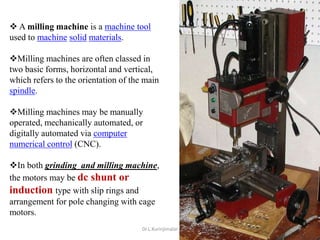
 A milling machine is a machine tool
used to machine solid materials.
Milling machines are often classed in
two basic forms, horizontal and vertical,
which refers to the orientation of the main
spindle.
Milling machines may be manually
operated, mechanically automated, or
digitally automated via computer
numerical control (CNC).
In both grinding and milling machine,
the motors may be dc shunt or
induction type with slip rings and
arrangement for pole changing with cage
motors.
3
Dr.L.Kurinjimalar
 A planer is a type of metalworking
machine tool that uses linear relative
motion between the work piece and a
single-point cutting tool to machine a
linear tool path.
 Its cut is analogous to that of a lathe,
except that it is linear instead of helical.
There is cutting stroke and a quick
return stroke.
Arrangements for speed reversing
should be incorporated.
A DC compound motor can be used.
4
Dr.L.Kurinjimalar
 Most punch presses are large
machines with either a 'C' type frame, or a
'portal' (bridge) type frame.
 Shearing, also known as die cutting,
is a process which cuts stock without the
formation of chips or the use of burning or
melting. Strictly speaking, if the cutting
blades are straight the process is called
shearing.
 On account of heavy fluctuation of
load, a flywheel is provided.
The motor may be DC shunt or
compound or slip ring induction type.
5
Dr.L.Kurinjimalar
6
Dr.L.Kurinjimalar
 Centrifugal compressors, sometimes referred to as radial compressors, are a
special class of radial-flow work-absorbing turbomachinery that include pumps,
fans, blowers and compressors.
 In the case of centrifugal pumps,blowers,fans and other loads involving the
turbulent flow of fluid,the load torque varies as the square of speed.
The motor may be squirrel cage induction or slip ring induction type.
T
w
Load torque characteristics
7
Dr.L.Kurinjimalar
 Excavators are heavy construction
equipment consisting of a boom, bucket
and cab on a rotating platform (known as
the "house").
 The house sits atop an undercarriage
with tracks or wheels.
 All movement and functions of the
excavator are accomplished through the use
of hydraulic fluid, be it with rams or motors.
T
w
8
Dr.L.Kurinjimalar
COILER DRIVES
In a single production cycle, the wire is
coiled to spring, knotted at both ends and
heat treated.
The group of six conveyor arms moves
the spring from a processing station to the
other.
When the production cycle is completed,
the springs are collected in the outlet
channel for stored.
The operator no longer has to bend to
collect the springs.
T
Wm
9
Dr.L.Kurinjimalar
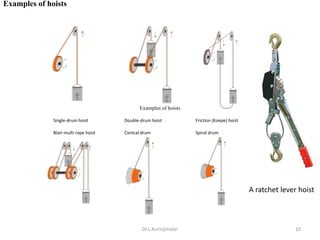
Examples of hoists
Single-drum hoist Double-drum hoist Friction (Koepe) hoist
Blair-multi rope hoist Conical drum Spiral drum
Examples of hoists
A ratchet lever hoist
10
Dr.L.Kurinjimalar
When using a drum hoist the hoisting cable is
wound around the drum when the conveyance
is lifted.
INDUCTION MOTORS are used for hoisting.
A drum hoist and motor
High
speed
Low speed
T
w
11
Dr.L.Kurinjimalar
diesel locomotive
A diesel electric locomotive employs a dc motor fed by a dc generator driven by a
diesel engine.
12
Dr.L.Kurinjimalar
13
Dr.L.Kurinjimalar
14
Dr.L.Kurinjimalar
DC torque motors
• Some high-end motors are available for direct
drive servo or force applications (no gears).
• They have low speed (a few rpm), high
precision (with servo-ing), and moderate
torque.
• Typically have large diameter vs. length, and
use rare-earth magnetic material.
• Cost $100’s (but maybe
less as surplus).
15
Dr.L.Kurinjimalar
Sensors
• Shaft encoders can be fitted to almost any DC
motor. They provide position sensing.
• Many motor families offer integrated
encoders.
• Strain gauges can be used to sense force
directly. Or DC brush motor current can be
used to estimate force.
16
Dr.L.Kurinjimalar
Linear movement
• There are several ways to produce linear
movement from rotation:
• Rotary to linear gearing:
17
Dr.L.Kurinjimalar
Linear movement
• Ball screws: low linear speed, good precision
• Motor drives shaft, stages move (must be
attached to linear bearing to stop from
rotating).
18
Dr.L.Kurinjimalar
Linear movement
• Belt drive: attach moving stage to a toothed
belt:
• Used in inkjet printers and some large XY
robots.
19
Dr.L.Kurinjimalar
True Linear movement
• There are some true linear magnetic drives.
• BEI-Kimco voice coils:
• Up to 1” travel
• 100 lbf
• > 10 g acceleration
• 6 lbs weight
• 500 Hz corner
frequency.
• Used for precision vibration control.
20
Dr.L.Kurinjimalar
Summary
• AC motors are good for inexpensive high-power
applications where fine control is not needed.
• DC motors provide a range of performance:
– DC brush: versatile, “servo” motor, high speed, torque
– DC brushless: speed/toque depend on electronics
– Stepper: simple control signals, variable
speed/accuracy without gearing, lower power
– Direct-drive (torque) motors, expensive, lower torque
21
Dr.L.Kurinjimalar

APPLICATIONS-AC/DC DRIVES-OPERATING CHARACTERISTICS

  • 1.
  • 2.
    • A grindingmachine, often shortened to grinder, is a machine tool used for grinding, which is a type of machining using an abrasive wheel as the cutting tool. • Each grain of abrasive on the wheel's surface cuts a small chip from the work piece via shear deformation. 2 Dr.L.Kurinjimalar
  • 3.
     A millingmachine is a machine tool used to machine solid materials. Milling machines are often classed in two basic forms, horizontal and vertical, which refers to the orientation of the main spindle. Milling machines may be manually operated, mechanically automated, or digitally automated via computer numerical control (CNC). In both grinding and milling machine, the motors may be dc shunt or induction type with slip rings and arrangement for pole changing with cage motors. 3 Dr.L.Kurinjimalar
  • 4.
     A planeris a type of metalworking machine tool that uses linear relative motion between the work piece and a single-point cutting tool to machine a linear tool path.  Its cut is analogous to that of a lathe, except that it is linear instead of helical. There is cutting stroke and a quick return stroke. Arrangements for speed reversing should be incorporated. A DC compound motor can be used. 4 Dr.L.Kurinjimalar
  • 5.
     Most punchpresses are large machines with either a 'C' type frame, or a 'portal' (bridge) type frame.  Shearing, also known as die cutting, is a process which cuts stock without the formation of chips or the use of burning or melting. Strictly speaking, if the cutting blades are straight the process is called shearing.  On account of heavy fluctuation of load, a flywheel is provided. The motor may be DC shunt or compound or slip ring induction type. 5 Dr.L.Kurinjimalar
  • 6.
  • 7.
     Centrifugal compressors,sometimes referred to as radial compressors, are a special class of radial-flow work-absorbing turbomachinery that include pumps, fans, blowers and compressors.  In the case of centrifugal pumps,blowers,fans and other loads involving the turbulent flow of fluid,the load torque varies as the square of speed. The motor may be squirrel cage induction or slip ring induction type. T w Load torque characteristics 7 Dr.L.Kurinjimalar
  • 8.
     Excavators areheavy construction equipment consisting of a boom, bucket and cab on a rotating platform (known as the "house").  The house sits atop an undercarriage with tracks or wheels.  All movement and functions of the excavator are accomplished through the use of hydraulic fluid, be it with rams or motors. T w 8 Dr.L.Kurinjimalar
  • 9.
    COILER DRIVES In asingle production cycle, the wire is coiled to spring, knotted at both ends and heat treated. The group of six conveyor arms moves the spring from a processing station to the other. When the production cycle is completed, the springs are collected in the outlet channel for stored. The operator no longer has to bend to collect the springs. T Wm 9 Dr.L.Kurinjimalar
  • 10.
    Examples of hoists Single-drumhoist Double-drum hoist Friction (Koepe) hoist Blair-multi rope hoist Conical drum Spiral drum Examples of hoists A ratchet lever hoist 10 Dr.L.Kurinjimalar
  • 11.
    When using adrum hoist the hoisting cable is wound around the drum when the conveyance is lifted. INDUCTION MOTORS are used for hoisting. A drum hoist and motor High speed Low speed T w 11 Dr.L.Kurinjimalar
  • 12.
    diesel locomotive A dieselelectric locomotive employs a dc motor fed by a dc generator driven by a diesel engine. 12 Dr.L.Kurinjimalar
  • 13.
  • 14.
  • 15.
    DC torque motors •Some high-end motors are available for direct drive servo or force applications (no gears). • They have low speed (a few rpm), high precision (with servo-ing), and moderate torque. • Typically have large diameter vs. length, and use rare-earth magnetic material. • Cost $100’s (but maybe less as surplus). 15 Dr.L.Kurinjimalar
  • 16.
    Sensors • Shaft encoderscan be fitted to almost any DC motor. They provide position sensing. • Many motor families offer integrated encoders. • Strain gauges can be used to sense force directly. Or DC brush motor current can be used to estimate force. 16 Dr.L.Kurinjimalar
  • 17.
    Linear movement • Thereare several ways to produce linear movement from rotation: • Rotary to linear gearing: 17 Dr.L.Kurinjimalar
  • 18.
    Linear movement • Ballscrews: low linear speed, good precision • Motor drives shaft, stages move (must be attached to linear bearing to stop from rotating). 18 Dr.L.Kurinjimalar
  • 19.
    Linear movement • Beltdrive: attach moving stage to a toothed belt: • Used in inkjet printers and some large XY robots. 19 Dr.L.Kurinjimalar
  • 20.
    True Linear movement •There are some true linear magnetic drives. • BEI-Kimco voice coils: • Up to 1” travel • 100 lbf • > 10 g acceleration • 6 lbs weight • 500 Hz corner frequency. • Used for precision vibration control. 20 Dr.L.Kurinjimalar
  • 21.
    Summary • AC motorsare good for inexpensive high-power applications where fine control is not needed. • DC motors provide a range of performance: – DC brush: versatile, “servo” motor, high speed, torque – DC brushless: speed/toque depend on electronics – Stepper: simple control signals, variable speed/accuracy without gearing, lower power – Direct-drive (torque) motors, expensive, lower torque 21 Dr.L.Kurinjimalar