International Research Journal of Engineering and Technology (IRJET) e-ISSN: 2395-0056
Volume: 05 Issue: 11 | Nov 2018 www.irjet.net p-ISSN: 2395-0072
© 2018, IRJET | Impact Factor value: 7.211 | ISO 9001:2008 Certified Journal | Page 1600
Credit Card Fraud Detection Analysis
Dushyant Singh1, Saubhagya Vardhan2, Dr. (Mrs.) Neha Agrawal3
1Department of Information Technology, Maharaja Agrasen Institute of Technology, Delhi, New Delhi, India
2Department of Information Technology, Maharaja Agrasen Institute of Technology, Delhi, New Delhi, India
3Assistant Professor, Department of Information Technology, Maharaja Agrasen Institute of Technology, Delhi,
New Delhi, India
---------------------------------------------------------------------***---------------------------------------------------------------------
Abstract:- With the advent of cashless economy the use of
credit cards as a method of transaction is on the rise and so is
the rise in the number of credit card fraud transactions. To
prevent this and instil confidence in peoplethatcreditcard isa
secure method of transaction data analysis of a credit card
transaction dataset has been done. The process becomes
challenging because of two major reasons-first, behaviour of
such transactions changes very frequently and secondly
because datasets of such transactions are highly skewed.
The dataset consists of transaction data from Europe and
contains over two hundred and eighty thousand transactions.
This dataset is analysed and pre-processed. This analysis is
used to design and implement a credit card fraud detection
algorithm using Machine Learning techniques. The algorithm
designed will detect patterns that fraudulent transactions
follow and prevent them. Furthermore, thealgorithm willhave
a high accuracy and low processing time
Key Words: Credit Card Fraud Detection, Random
Forest, Local Outlier, SVM, Machine Learning
1. INTRODUCTION
Credit card frauds areprevalentinmodernsociety.Detecting
such transactions is a daunting task when normal
procedures are used, hence development of such creditcard
fraud detection projects has become momentous, in major
fields whether it may be academic or the business
community. Data mining and machine learning techniques
are notable and popularmethodsusedinsolvingcreditfraud
detection problem. Fraud detection in credit card involves
identifying of those transactions thatarefraudulentintotwo
classes of legit class and fraud class transactions, several
techniques are designed and implemented to solve to credit
card fraud detection such as genetic algorithm, artificial
neural network frequent item set mining, machine learning
algorithms, migrating birds optimization algorithm,
comparative analysis of logistic regression, SVM, decision
tree, neural networks and random forest. These analyse the
spending patterns on every card and to figure out any
inconsistencies with respect to the “usual” spending
patterns. Since humans tend to exhibit specific behaviourist
profiles, every cardholder can be represented by a set of
patterns containing informationsuch asthetypical purchase
category, the time since the last purchase, the amount of
money spent, etc. deviation from such patternsisrecognised
as a potential fraud transaction by the system.This paper
evaluates some such frauddetectionstrategiesandidentifies
what are the difficulties in identifying the frauds.
1.1 Difficulties in Credit Card Fraud Detection
Fraud detection systems are prone to several difficultiesand
challenges enumerated bellow. An effective fraud detection
technique should havetheabilitytoaddressthesedifficulties
in order to achieve best performance.
Imbalanced data: The credit card fraud detection data has
imbalanced nature which meansthatverysmall percentages
of all credit card transactions are fraudulent. This makesthe
detection of fraud transactions very difficult and imprecise.
Differentmisclassification importance:Infrauddetection,
different misclassification errors have varying importance.
Misclassification of a normal transaction as fraud is not as
harmful as detecting a fraud transaction as normal. Because
in the first case the mistake in classification can beidentified
in further investigations.
Overlapping data: Many transactions may be considered
fraudulent, even though they are normal (false positive)and
conversely, a fraudulent transaction may seem to be
legitimate (false negative). Hence, obtaining a low rate of
false positive and false negative is a key challenge of fraud
detection systems.
Lack of adaptability: Classification algorithms are usually
faced with the problem of adaptability. The supervised and
unsupervised fraud detection systems are inefficient in
detecting new patterns of normal and fraud behaviors.
Fraud detection cost: The system should take intoaccount
both the value of fraudulent transaction that is detected and
the cost of preventing it. For example,norevenueisobtained
by stopping a fraudulent transaction of a few dollars.
Lack of standard metrics: there is no standard evaluation
criterion for assessing and comparing the results of fraud
detection systems to decide which is most efficient.
2. RELATED WORKONCREDITCARDFRAUDDETECTION
This paper represents a research on European credit card
holders, where data normalization is done before doing
Cluster Analysis of the dataset. The data is MLP trained and
Machine learning algorithms are employed for generating
accurate results. Promising results are obtained by using
normalized data. This research was based on both
supervised and unsupervised learning. Significance of this
International Research Journal of Engineering and Technology (IRJET) e-ISSN: 2395-0056
Volume: 05 Issue: 11 | Nov 2018 www.irjet.net p-ISSN: 2395-0072
© 2018, IRJET | Impact Factor value: 7.211 | ISO 9001:2008 Certified Journal | Page 1601
paper was to find new methods for fraud detection and to
increase the accuracy of results.
This paper investigates the usefulness of applying different
learning approaches
2.1 SVM Model (Support Vector Machine)
SVM is a popular machine learning algorithm used for
regression and classification. It is a supervised learning
algorithm that involves analyzing data usedforclassification
and regression. SVM modeling involves two steps, first to
train a data set in order to obtain a model & then, to use this
model to predict information for testing the data set. A
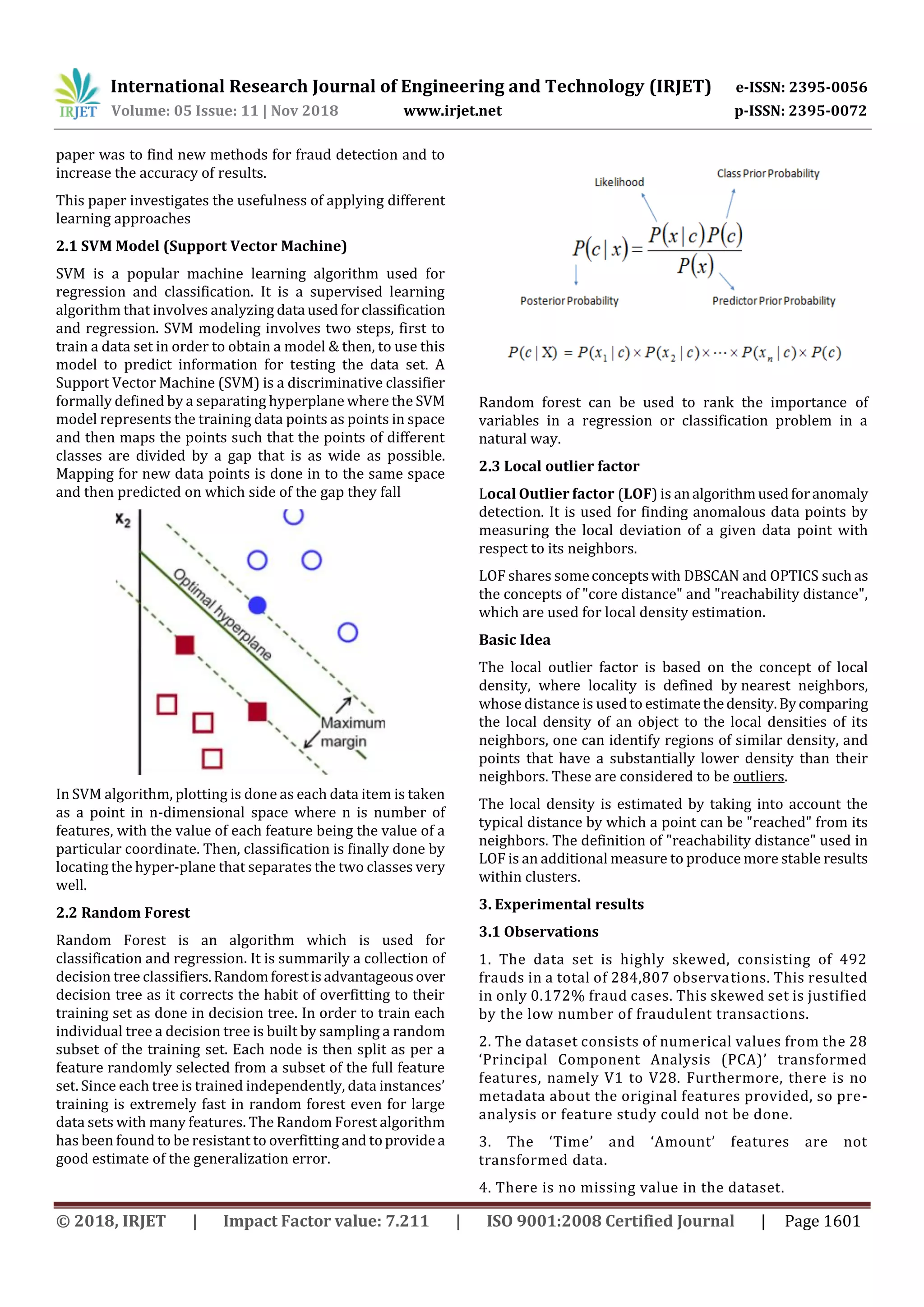
Support Vector Machine (SVM) is a discriminative classifier
formally defined by a separating hyperplane where the SVM
model represents the training data points as points in space
and then maps the points such that the points of different
classes are divided by a gap that is as wide as possible.
Mapping for new data points is done in to the same space
and then predicted on which side of the gap they fall
In SVM algorithm, plotting is done as each data item is taken
as a point in n-dimensional space where n is number of
features, with the value of each feature being the value of a
particular coordinate. Then, classification is finally done by
locating the hyper-plane that separates the two classes very
well.
2.2 Random Forest
Random Forest is an algorithm which is used for
classification and regression. It is summarily a collection of
decision tree classifiers.Randomforestisadvantageousover
decision tree as it corrects the habit of overfitting to their
training set as done in decision tree. In order to train each
individual tree a decision tree is built by sampling a random
subset of the training set. Each node is then split as per a
feature randomly selected from a subset of the full feature
set. Since each tree is trained independently, data instances’
training is extremely fast in random forest even for large
data sets with many features. The Random Forest algorithm
has been found to be resistant to overfitting and toprovidea
good estimate of the generalization error.
Random forest can be used to rank the importance of
variables in a regression or classification problem in a
natural way.
2.3 Local outlier factor
Local Outlier factor (LOF) is analgorithmusedforanomaly
detection. It is used for finding anomalous data points by
measuring the local deviation of a given data point with
respect to its neighbors.
LOF shares someconceptswith DBSCAN and OPTICS suchas
the concepts of "core distance" and "reachability distance",
which are used for local density estimation.
Basic Idea
The local outlier factor is based on the concept of local
density, where locality is defined by nearest neighbors,
whose distance is usedto estimatethedensity.Bycomparing
the local density of an object to the local densities of its
neighbors, one can identify regions of similar density, and
points that have a substantially lower density than their
neighbors. These are considered to be outliers.
The local density is estimated by taking into account the
typical distance by which a point can be "reached" from its
neighbors. The definition of "reachability distance" used in
LOF is an additional measure to produce more stable results
within clusters.
3. Experimental results
3.1 Observations
1. The data set is highly skewed, consisting of 492
frauds in a total of 284,807 observations. This resulted
in only 0.172% fraud cases. This skewed set is justified
by the low number of fraudulent transactions.
2. The dataset consists of numerical values from the 28
‘Principal Component Analysis (PCA)’ transformed
features, namely V1 to V28. Furthermore, there is no
metadata about the original features provided, so pre-
analysis or feature study could not be done.
3. The ‘Time’ and ‘Amount’ features are not
transformed data.
4. There is no missing value in the dataset.
International Research Journal of Engineering and Technology (IRJET) e-ISSN: 2395-0056
Volume: 05 Issue: 11 | Nov 2018 www.irjet.net p-ISSN: 2395-0072
© 2018, IRJET | Impact Factor value: 7.211 | ISO 9001:2008 Certified Journal | Page 1602
3.2 Inferences drawn
1. Owing to such imbalance in data, an algorithm
that does not do any feature analysis and
predicts all the transactions as non-frauds will
also achieve an accuracy of 99.828%.
Therefore, accuracy is not a correct measure of
efficiency in our case. We need some other
standard of correctness while classifying
transactions as fraud or non-fraud.
2. The ‘Time’ feature does not indicate the actual
time of the transaction and is more of a list of
the data in chronological order. So we assume
that the ‘Time’ feature has little or no
significance in classifying a fraud transaction.
Therefore, we eliminate this column from
further analysis.
3. Number of seconds elapsed between this
transaction and the first transaction in the
dataset
4. In Amount, mean is closer to 0, this means we
have large no of valid transactions as compared
to fraud transactions
5. Mean of fraud transaction is higher than valid
transactions, it means when high value
transactions are done, it could possibly be a
fraud!!
6. The algorithm is harder to train since very few
valid cases are present in the dataset
7. Most values (in middle) are closer to 0,
depicting no great correlation between v1 to
v28 parameters
8. No co-relation between prediction, most fraud
transaction done in large amounts
9. No strong co-relation between class, amount or
class, time
10. We expected strong co-relation between
amount and class since fraudsters would want
to gain max from single transaction
11. If that were the case we could have
recommended limiting the max amount on
transactions, but it is not useful now
12. One reason for this could be to avoid detection
and for them to do multiple transaction from
single credit card
13. This is odd since the algorithm can predict
which transaction was fraudulent and if
transaction is done 3-4 times so by limiting
transaction amount they would only be
reducing their profits
14. The reason behind this could be that police
investigation is more likely to bear fruits in
case when large amounts of transactions are
done
15. Which means they are afraid of being caught,
and hence are biased towards safer frauds!!
International Research Journal of Engineering and Technology (IRJET) e-ISSN: 2395-0056
Volume: 05 Issue: 11 | Nov 2018 www.irjet.net p-ISSN: 2395-0072
© 2018, IRJET | Impact Factor value: 7.211 | ISO 9001:2008 Certified Journal | Page 1603
4. CONCLUSION
The study focuses on analysis of credit card transactions’
dataset and identifies patterns that fraudulent credit card
transactions follow to help design and implement a credit
card fraud detection algorithm.
The data analysis is done by creating histograms of the
variables related to the dataset and by creating co-relation
matrix of the variables. The data analysis further helps us
identify the appropriate Machine Learning techniques
applicable to implement the algorithm.
The algorithm is implemented by using Local Outlier Factor
Machine Learning technique the results of which showsthat
the precision of this technique is very high but the accuracy
in detecting credit card fraud is low. The algorithm can be
used to detect fraudulent transactions which follow the
pattern.
REFERENCES
[1] Samaneh Sorournejad, Zahra Zojaji, Reza Ebrahimi
Atani, Amir Hassan Monadjemi “A Survey of Credit Card
Fraud Detection Techniques: Data and Technique
Oriented Perspective”
[2] https://en.wikipedia.org/wiki/Local_outlier_factor
[3] https://www.3pillarglobal.com/insights/credit-card-
fraud-detection

IRJET- Credit Card Fraud Detection Analysis

  • 1.
    International Research Journalof Engineering and Technology (IRJET) e-ISSN: 2395-0056 Volume: 05 Issue: 11 | Nov 2018 www.irjet.net p-ISSN: 2395-0072 © 2018, IRJET | Impact Factor value: 7.211 | ISO 9001:2008 Certified Journal | Page 1600 Credit Card Fraud Detection Analysis Dushyant Singh1, Saubhagya Vardhan2, Dr. (Mrs.) Neha Agrawal3 1Department of Information Technology, Maharaja Agrasen Institute of Technology, Delhi, New Delhi, India 2Department of Information Technology, Maharaja Agrasen Institute of Technology, Delhi, New Delhi, India 3Assistant Professor, Department of Information Technology, Maharaja Agrasen Institute of Technology, Delhi, New Delhi, India ---------------------------------------------------------------------***--------------------------------------------------------------------- Abstract:- With the advent of cashless economy the use of credit cards as a method of transaction is on the rise and so is the rise in the number of credit card fraud transactions. To prevent this and instil confidence in peoplethatcreditcard isa secure method of transaction data analysis of a credit card transaction dataset has been done. The process becomes challenging because of two major reasons-first, behaviour of such transactions changes very frequently and secondly because datasets of such transactions are highly skewed. The dataset consists of transaction data from Europe and contains over two hundred and eighty thousand transactions. This dataset is analysed and pre-processed. This analysis is used to design and implement a credit card fraud detection algorithm using Machine Learning techniques. The algorithm designed will detect patterns that fraudulent transactions follow and prevent them. Furthermore, thealgorithm willhave a high accuracy and low processing time Key Words: Credit Card Fraud Detection, Random Forest, Local Outlier, SVM, Machine Learning 1. INTRODUCTION Credit card frauds areprevalentinmodernsociety.Detecting such transactions is a daunting task when normal procedures are used, hence development of such creditcard fraud detection projects has become momentous, in major fields whether it may be academic or the business community. Data mining and machine learning techniques are notable and popularmethodsusedinsolvingcreditfraud detection problem. Fraud detection in credit card involves identifying of those transactions thatarefraudulentintotwo classes of legit class and fraud class transactions, several techniques are designed and implemented to solve to credit card fraud detection such as genetic algorithm, artificial neural network frequent item set mining, machine learning algorithms, migrating birds optimization algorithm, comparative analysis of logistic regression, SVM, decision tree, neural networks and random forest. These analyse the spending patterns on every card and to figure out any inconsistencies with respect to the “usual” spending patterns. Since humans tend to exhibit specific behaviourist profiles, every cardholder can be represented by a set of patterns containing informationsuch asthetypical purchase category, the time since the last purchase, the amount of money spent, etc. deviation from such patternsisrecognised as a potential fraud transaction by the system.This paper evaluates some such frauddetectionstrategiesandidentifies what are the difficulties in identifying the frauds. 1.1 Difficulties in Credit Card Fraud Detection Fraud detection systems are prone to several difficultiesand challenges enumerated bellow. An effective fraud detection technique should havetheabilitytoaddressthesedifficulties in order to achieve best performance. Imbalanced data: The credit card fraud detection data has imbalanced nature which meansthatverysmall percentages of all credit card transactions are fraudulent. This makesthe detection of fraud transactions very difficult and imprecise. Differentmisclassification importance:Infrauddetection, different misclassification errors have varying importance. Misclassification of a normal transaction as fraud is not as harmful as detecting a fraud transaction as normal. Because in the first case the mistake in classification can beidentified in further investigations. Overlapping data: Many transactions may be considered fraudulent, even though they are normal (false positive)and conversely, a fraudulent transaction may seem to be legitimate (false negative). Hence, obtaining a low rate of false positive and false negative is a key challenge of fraud detection systems. Lack of adaptability: Classification algorithms are usually faced with the problem of adaptability. The supervised and unsupervised fraud detection systems are inefficient in detecting new patterns of normal and fraud behaviors. Fraud detection cost: The system should take intoaccount both the value of fraudulent transaction that is detected and the cost of preventing it. For example,norevenueisobtained by stopping a fraudulent transaction of a few dollars. Lack of standard metrics: there is no standard evaluation criterion for assessing and comparing the results of fraud detection systems to decide which is most efficient. 2. RELATED WORKONCREDITCARDFRAUDDETECTION This paper represents a research on European credit card holders, where data normalization is done before doing Cluster Analysis of the dataset. The data is MLP trained and Machine learning algorithms are employed for generating accurate results. Promising results are obtained by using normalized data. This research was based on both supervised and unsupervised learning. Significance of this
  • 2.
    International Research Journalof Engineering and Technology (IRJET) e-ISSN: 2395-0056 Volume: 05 Issue: 11 | Nov 2018 www.irjet.net p-ISSN: 2395-0072 © 2018, IRJET | Impact Factor value: 7.211 | ISO 9001:2008 Certified Journal | Page 1601 paper was to find new methods for fraud detection and to increase the accuracy of results. This paper investigates the usefulness of applying different learning approaches 2.1 SVM Model (Support Vector Machine) SVM is a popular machine learning algorithm used for regression and classification. It is a supervised learning algorithm that involves analyzing data usedforclassification and regression. SVM modeling involves two steps, first to train a data set in order to obtain a model & then, to use this model to predict information for testing the data set. A Support Vector Machine (SVM) is a discriminative classifier formally defined by a separating hyperplane where the SVM model represents the training data points as points in space and then maps the points such that the points of different classes are divided by a gap that is as wide as possible. Mapping for new data points is done in to the same space and then predicted on which side of the gap they fall In SVM algorithm, plotting is done as each data item is taken as a point in n-dimensional space where n is number of features, with the value of each feature being the value of a particular coordinate. Then, classification is finally done by locating the hyper-plane that separates the two classes very well. 2.2 Random Forest Random Forest is an algorithm which is used for classification and regression. It is summarily a collection of decision tree classifiers.Randomforestisadvantageousover decision tree as it corrects the habit of overfitting to their training set as done in decision tree. In order to train each individual tree a decision tree is built by sampling a random subset of the training set. Each node is then split as per a feature randomly selected from a subset of the full feature set. Since each tree is trained independently, data instances’ training is extremely fast in random forest even for large data sets with many features. The Random Forest algorithm has been found to be resistant to overfitting and toprovidea good estimate of the generalization error. Random forest can be used to rank the importance of variables in a regression or classification problem in a natural way. 2.3 Local outlier factor Local Outlier factor (LOF) is analgorithmusedforanomaly detection. It is used for finding anomalous data points by measuring the local deviation of a given data point with respect to its neighbors. LOF shares someconceptswith DBSCAN and OPTICS suchas the concepts of "core distance" and "reachability distance", which are used for local density estimation. Basic Idea The local outlier factor is based on the concept of local density, where locality is defined by nearest neighbors, whose distance is usedto estimatethedensity.Bycomparing the local density of an object to the local densities of its neighbors, one can identify regions of similar density, and points that have a substantially lower density than their neighbors. These are considered to be outliers. The local density is estimated by taking into account the typical distance by which a point can be "reached" from its neighbors. The definition of "reachability distance" used in LOF is an additional measure to produce more stable results within clusters. 3. Experimental results 3.1 Observations 1. The data set is highly skewed, consisting of 492 frauds in a total of 284,807 observations. This resulted in only 0.172% fraud cases. This skewed set is justified by the low number of fraudulent transactions. 2. The dataset consists of numerical values from the 28 ‘Principal Component Analysis (PCA)’ transformed features, namely V1 to V28. Furthermore, there is no metadata about the original features provided, so pre- analysis or feature study could not be done. 3. The ‘Time’ and ‘Amount’ features are not transformed data. 4. There is no missing value in the dataset.
  • 3.
    International Research Journalof Engineering and Technology (IRJET) e-ISSN: 2395-0056 Volume: 05 Issue: 11 | Nov 2018 www.irjet.net p-ISSN: 2395-0072 © 2018, IRJET | Impact Factor value: 7.211 | ISO 9001:2008 Certified Journal | Page 1602 3.2 Inferences drawn 1. Owing to such imbalance in data, an algorithm that does not do any feature analysis and predicts all the transactions as non-frauds will also achieve an accuracy of 99.828%. Therefore, accuracy is not a correct measure of efficiency in our case. We need some other standard of correctness while classifying transactions as fraud or non-fraud. 2. The ‘Time’ feature does not indicate the actual time of the transaction and is more of a list of the data in chronological order. So we assume that the ‘Time’ feature has little or no significance in classifying a fraud transaction. Therefore, we eliminate this column from further analysis. 3. Number of seconds elapsed between this transaction and the first transaction in the dataset 4. In Amount, mean is closer to 0, this means we have large no of valid transactions as compared to fraud transactions 5. Mean of fraud transaction is higher than valid transactions, it means when high value transactions are done, it could possibly be a fraud!! 6. The algorithm is harder to train since very few valid cases are present in the dataset 7. Most values (in middle) are closer to 0, depicting no great correlation between v1 to v28 parameters 8. No co-relation between prediction, most fraud transaction done in large amounts 9. No strong co-relation between class, amount or class, time 10. We expected strong co-relation between amount and class since fraudsters would want to gain max from single transaction 11. If that were the case we could have recommended limiting the max amount on transactions, but it is not useful now 12. One reason for this could be to avoid detection and for them to do multiple transaction from single credit card 13. This is odd since the algorithm can predict which transaction was fraudulent and if transaction is done 3-4 times so by limiting transaction amount they would only be reducing their profits 14. The reason behind this could be that police investigation is more likely to bear fruits in case when large amounts of transactions are done 15. Which means they are afraid of being caught, and hence are biased towards safer frauds!!
  • 4.
    International Research Journalof Engineering and Technology (IRJET) e-ISSN: 2395-0056 Volume: 05 Issue: 11 | Nov 2018 www.irjet.net p-ISSN: 2395-0072 © 2018, IRJET | Impact Factor value: 7.211 | ISO 9001:2008 Certified Journal | Page 1603 4. CONCLUSION The study focuses on analysis of credit card transactions’ dataset and identifies patterns that fraudulent credit card transactions follow to help design and implement a credit card fraud detection algorithm. The data analysis is done by creating histograms of the variables related to the dataset and by creating co-relation matrix of the variables. The data analysis further helps us identify the appropriate Machine Learning techniques applicable to implement the algorithm. The algorithm is implemented by using Local Outlier Factor Machine Learning technique the results of which showsthat the precision of this technique is very high but the accuracy in detecting credit card fraud is low. The algorithm can be used to detect fraudulent transactions which follow the pattern. REFERENCES [1] Samaneh Sorournejad, Zahra Zojaji, Reza Ebrahimi Atani, Amir Hassan Monadjemi “A Survey of Credit Card Fraud Detection Techniques: Data and Technique Oriented Perspective” [2] https://en.wikipedia.org/wiki/Local_outlier_factor [3] https://www.3pillarglobal.com/insights/credit-card- fraud-detection