International Research Journal of Engineering and Technology (IRJET) e-ISSN: 2395-0056
Volume: 05 Issue: 10 | Oct 2018 www.irjet.net p-ISSN: 2395-0072
© 2018, IRJET | Impact Factor value: 7.211 | ISO 9001:2008 Certified Journal | Page 656
A DETAILED STUDY ON CLASSIFICATION TECHNIQUES FOR
DATA MINING
1Jyoti Kesarwani, 2Kshama Tiwari
1M. Tech Student, UIT College, Allahabad Uttar Pradesh
2Assistant Professor, UIT College, Allahabad, Uttar Pradesh
---------------------------------------------------------------------***---------------------------------------------------------------------
Abstract – Extraction of useful information from huge amount of data is known as data mining also known as knowledge
discovery in database (KDD). There are so many sources that generates data in a very large amount like social networking sites,
camera, sensors etc. This is the main reason that data mining is increasing rapidly. This paper presents a survey of clustering
techniques and tools used for data mining. Classification is a supervised learning technique in which it identifies the class of
unknown objects whereas clustering is an unsupervised learning. Clustering is the process of partitioningasetofdataobjectsinto
subsets. Objects with in a cluster are more similar and dissimilar to other clusters. The similarity between objects is calculated
using various distance measures like Euclidean distance, Manhattan distance, cosine etc.
Key Words: Data Mining, Machine Learning, Classification, clustering algorithms,Supervised,UnsupervisedLearning
1. INTRODUCTION
Data mining plays a very important role for finding the frequentdata patternfrominternet,data set,data warehouse,data mart
etc. Data mining, also called as data archeology, data dredging, data harvesting, is the process of extracting hidden
knowledge from large volumes of raw data and using it to make critical business decisions. Data mining is used in various
applications like finance, marketing, banking, credit card fraud detection, whether prediction.
Data mining helps to extract hidden patterns and make hypothesis from the raw data. Data mining process has mainly 7 steps
as Data integration, data cleaning, data selection, data transformation, data mining, pattern evaluation and knowledge
representation [1]. This process is shown in Fig-1.
Data Cleaning: Data in the real world is dirty,meansincomplete,noisyandinconsistentdata.Qualitydecisionsmustbebased
on quality data. So, before performing the analysis on the raw data, data cleaning is performed, which includes the following
tasks:
 Filling missing values.
 Smooth noisy data and remove outliers by using algorithms like Binning algorithm.
 Resolve inconsistencies.
Figure 1: Data Mining Process
International Research Journal of Engineering and Technology (IRJET) e-ISSN: 2395-0056
Volume: 05 Issue: 10 | Oct 2018 www.irjet.net p-ISSN: 2395-0072
© 2018, IRJET | Impact Factor value: 7.211 | ISO 9001:2008 Certified Journal | Page 657
Data Integration: where multiple heterogeneous data sources may be combined.
Data Selection: Where task relevant data are selected from data warehouse or any other data sources including www,
RDBMS etc.
Data Transformation: In data transformation, the data are transformed into format appropriatefordata mining.Forex:An
attribute data may be normalized so as to fall between a small range 0 to 1. It includes the following tasks:
 Smoothing: which works to remove noise from the data. Such techniques include binning, regression and clustering.
 Aggregation: Various aggregation operations such as mean and median are applied to the data.Forex:thedailysales
data may be aggregated.
 Normalization: where the attribute data are scaled so as to fall within a small specified range, such as 0 to 1.
Data Mining: It is the process of extraction of interesting information or patterns from data in large database is known as
data mining.
Pattern Evaluation: This component typically employs interestingness measures and interacts with the data mining
modules so as to focus the search towards interesting patterns.
Knowledge representation: Various visualization and knowledge representation techniques are used to present the
extracted knowledge to the user.
2. Related Work
A lot of researchers have implemented various data mining approaches in order to solve the various problems related to
forecasting and analysis. Decision tree algorithm is a kind of data mining model tomakeinductionlearningalgorithmbasedon
examples. It is easy to extract display rule, hassmallercomputationamount,andcoulddisplayimportantdecision propertyand
own higher classification precision. We select decision-making tree whichis veryvisibleandeasyrealizedasdata miningtools,
and set up decision-making tree model which is used to predict groups of elements. Nowadays is necessary to take decisions
based in the knowledge obtained through advanced techniques of date analysis, decision tree is an interesting option. In this
work a Rich Internet Application to visualize a decision tree in a mobile device is presented. This application lets deploy the
complete tree decision and the categorization of new registers, with this tool is possible to take decisions basedintheanalysis
of data in an extended data base. The support vectors play an important roleinthetrainingtofindtheoptimal hyper-plane.For
the problem of many non-support vectors and a few support vectors in the classification of SVM, a method to reduce the
samples that may be not support vectors is proposed in this paper. First, adopt the Support Vector Domain Description tofind
the smallest sphere containing the most data points, and then remove the objects outside the sphere. Second,removethe edge
points based on the distance of each pattern to the centers of other classes k-nearest neighbor algorithm (kNN) which usually
identifies the same number of nearest neighbors for each test example. It is known that the value of k has crucial influence on
the performance of the kNN algorithm, and our improved kNN algorithm focuses on finding out the suitable k for each test
example. The proposed algorithm finds out the optimal k, the number of the fewest nearest neighbors that every training
example can use to get its correct class label. For classifying each test example using the kNN algorithm,wesetkto bethesame
as the optimal k of its nearest neighbor in the training set. Naive bayes classifier,a classificationmethod basedonbayestheory,
shows excellent properties in many fields.
3. Classification Algorithms
3.1 Decision Tree Induction:
Decision tree induction is the learning of decision trees from class labeled tuples. A decision tree is a flow chart like tree
structure where each internal node denotes a test on an attributes, each branch represents an output of the test and each leaf
node denotes a class label. Decision trees are trees that classify data by sorting them based on feature values. These decision
tree induction methods are supervised machine learning methodsthatconstructdecisiontreefroma setofinputoutputvalues.
A decision tree uses top down approach that searches solution from search spaces.
International Research Journal of Engineering and Technology (IRJET) e-ISSN: 2395-0056
Volume: 05 Issue: 10 | Oct 2018 www.irjet.net p-ISSN: 2395-0072
© 2018, IRJET | Impact Factor value: 7.211 | ISO 9001:2008 Certified Journal | Page 658
In order to classify an unknown sample, the attribute values of the sample are tested against the decision tree. A path istraced
from the root to a leaf node that holds the class prediction for that sample. Decision trees were then convertedtoclassification
rules using IF-THEN-ELSE.
A typical Decision Tree is shown in Figure 1. This represents the concept buy a computer that is, the tree tries to predict
whether a customer of an electronics shop or cannot buy a computer. The internal nodes are denoted by rectangles and leaf
nodes ovals are denoted by [3].
Figure 2: Decision Tree Example
3.2 K Nearest Neighbour Algorithm:
KNN means k nearest neighbor. It is a very simple algorithm. Given N training vectors, suppose we have ‘a’ and ‘o’ letters as
training vectors in the bi dimensional feature space. the KNN algorithm identifies k nearest neighbors of ‘c’.’c’ isanotherspace
vector that we want to estimate its class regardless of labels.
The kNN expects the class conditional probabilities to be locally constant, and suffers from bias in high dimensions. kNN is an
extremely flexible classification scheme, and does not involve any preprocessing of the training data. Thiscanofferbothspace
and speed advantages in very large problems.
KNN is an example-based learning group. This algorithm is also one of the lazy learning techniques. KNN is done by searching
for the group of K objects in the closest training data (similar) to objects in new data or data testing [2]. Generally, the
Euclidean distance formula is used to define the distance between two training objects and testing [10].
3.3 Naïve Bayes Classification:
“naive” Bayes classification is a method of supervised learning if the attributesareconditionallyindependentgiven theclasses.
It is a classification technique based on Bayes’ Theorem with an assumption of independence among predictors. In simple
terms, a Naive Bayes classifier assumes that the presence of a particular feature in a class is unrelated to the presence of any
other feature. For example, a fruit may be considered to be an apple if it is red, round, and about 3 inches in diameter. Even if
these features depend on each other or upon the existence of the other features, all of these properties independently
contribute to the probability that this fruit is an apple and that is why it is known as ‘Naive’.
The Naive Bayes Classifier technique is based on the so-called Bayesian theorem and is particularly suited when the
dimensionality of the inputs is high. Despite its simplicity, Naive Bayes can often outperform more sophisticatedclassification
methods.
It tells us how often A happens given that B happens, written P(A|B), when weknow how often B happens giventhatAhappens,
written P(B|A) , and how likely A and B are on their own.
 P(A|B) is “Probability of A given B”, the probability of A given that B happens
International Research Journal of Engineering and Technology (IRJET) e-ISSN: 2395-0056
Volume: 05 Issue: 10 | Oct 2018 www.irjet.net p-ISSN: 2395-0072
© 2018, IRJET | Impact Factor value: 7.211 | ISO 9001:2008 Certified Journal | Page 659
 P(A) is Probability of A
 P(B|A) is “Probability of B given A”, the probability of B given that A happens
 P(B) is Probability of B
3.4 Support Vector Machine(SVM)
“Support Vector Machine” (SVM) is a supervised machine learning algorithm which can be used for classification. In this
algorithm, we plot each data item as a point in n-dimensional space (where n is number of features you have)withthevalueof
each feature being the value of a particular coordinate. Then, we perform classification by finding the hyper-plane
that differentiate the two classes
Binary SVM:
Binary classification is a technique to find the category of data points.
For example- Let us consider that C1 and C2 are the two class labels. And we have data point one is positive and other is
negative but here the problem is they are mixed so we need no find the decision boundary between the classlabel andsupport
vectors. There could be exist more than one separable line but we need to identify the maximum margin line from the support
vectors and this line is called ‘Decision Boundary’. And one side of decision boundary are positive points and other side has
negative points.
4. Comparison of Different Classification algorithms
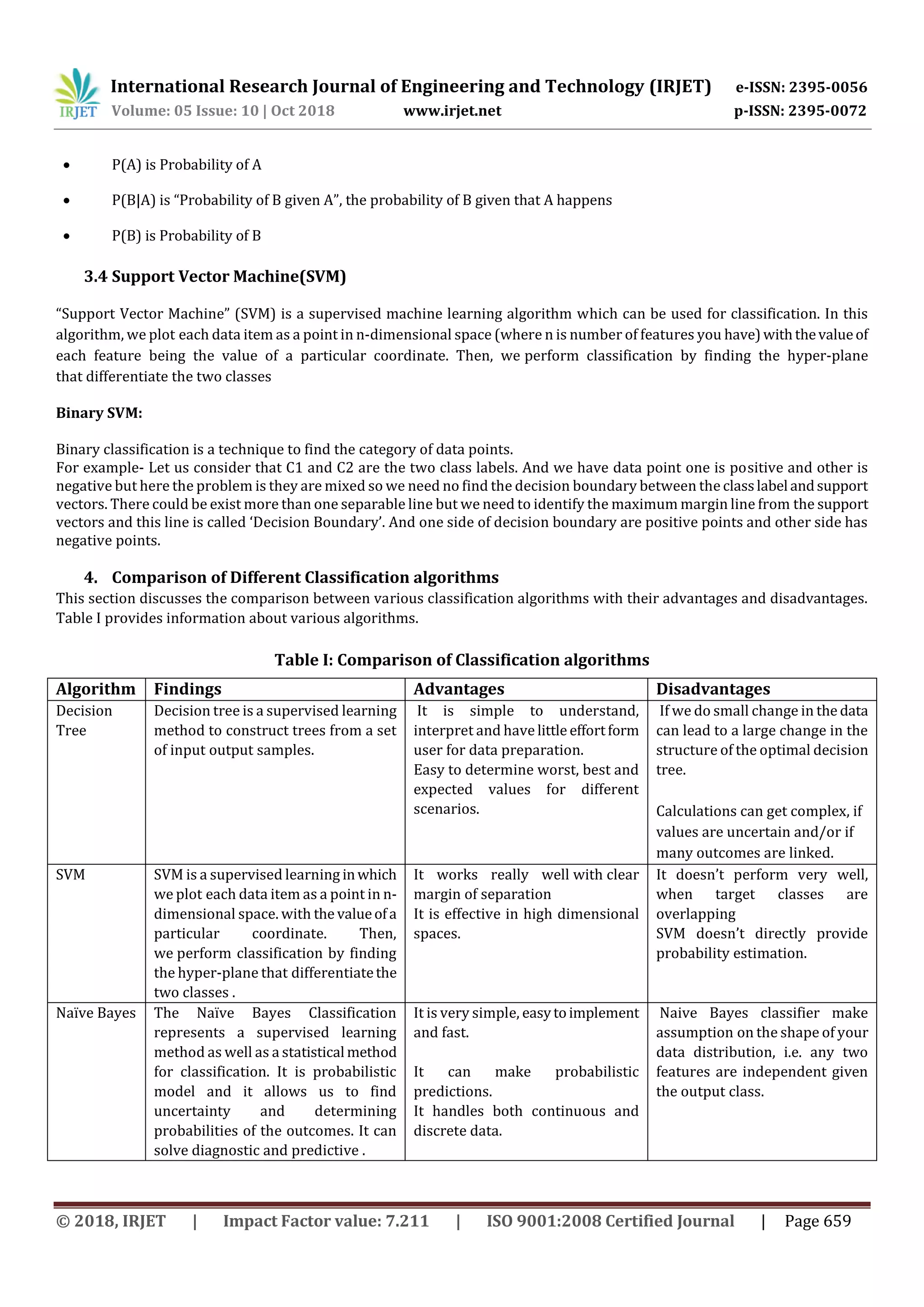
This section discusses the comparison between various classification algorithms with their advantages and disadvantages.
Table I provides information about various algorithms.
Table I: Comparison of Classification algorithms
Algorithm Findings Advantages Disadvantages
Decision
Tree
Decision tree is a supervised learning
method to construct trees from a set
of input output samples.
It is simple to understand,
interpret and have little effortform
user for data preparation.
Easy to determine worst, best and
expected values for different
scenarios.
If we do small change in the data
can lead to a large change in the
structure of the optimal decision
tree.
Calculations can get complex, if
values are uncertain and/or if
many outcomes are linked.
SVM SVM is a supervised learning inwhich
we plot each data item as a point in n-
dimensional space. with the valueofa
particular coordinate. Then,
we perform classification by finding
the hyper-plane that differentiatethe
two classes .
It works really well with clear
margin of separation
It is effective in high dimensional
spaces.
It doesn’t perform very well,
when target classes are
overlapping
SVM doesn’t directly provide
probability estimation.
Naïve Bayes The Naïve Bayes Classification
represents a supervised learning
method as well as a statistical method
for classification. It is probabilistic
model and it allows us to find
uncertainty and determining
probabilities of the outcomes. It can
solve diagnostic and predictive .
It is very simple, easytoimplement
and fast.
It can make probabilistic
predictions.
It handles both continuous and
discrete data.
Naive Bayes classifier make
assumption on the shape of your
data distribution, i.e. any two
features are independent given
the output class.
International Research Journal of Engineering and Technology (IRJET) e-ISSN: 2395-0056
Volume: 05 Issue: 10 | Oct 2018 www.irjet.net p-ISSN: 2395-0072
© 2018, IRJET | Impact Factor value: 7.211 | ISO 9001:2008 Certified Journal | Page 660
5. Conclusion:
In this paper, we have presented the survey of various
classification algorithms used for analysis. There are mainly
three types of classification methods are discussed.
REFERENCES:
[1] Kiran Kumar Patro, P. Rajesh Kumar, “Denoising of ECG
Raw signal by cascaded window based digital filters
configuration”,IEEEPower, CommunicationandInformation
Technology Conference (PCITC), Oct, 2015.
[2] Bhumika Chandrakar, O.P.Yadav and V.K.Chandra, “A
survey of noise removal techniques for ECG signal”, Int.
Journal of Advanced Research in Computer and
Communication Engineering, March 2013.
[3] Mostafa Guda, Safa Gasser, “MATLAB Simulation
Comparison for Different Adaptive Noise Cancelation
Algorithms”, the SDIWC in 2014.
[4] Sarita Mishra, Debasmit Das, Roshan Kumar and
Parasuraman Sumathi, “ A power-lineintereferencecanceler
based on sliding DFT Phase locking scheme for ECG signals”,
IEEE Transactions on Instrumentation & Measurement,
Vol.64, No.1, Jan 2015.
[5] Prakruti J.joshi, Vivek P.Patkar, “ECG denoising using
MATLAB” Int. Journal of Scientific & Engineering Research,
May-2013.
[6] Mbachu C.B. , Offor K.J, “Reduction of power line noise in
ECG signal using FIR digital filter implemented with
hamming window”,Int. Journal of Science, Environment and
Technology, 2013.
[7] Fatin A. Elhaj, Naomie Salim, Arief R. Harris, Tan Tian
Swee,Taqwa Ahmed, “Arrhythmia recognition and
classification using combined linear and nonlinear features
of ECG signals”, Computer Methods and Programs in
Biomedicine I27, Elsevier Ireland Ltd., Pg 52-63, 2016.
[8] Aya F. Khalaf , Mohamed I. Owis, Inas A. Yassine, “A novel
techniqueforcardiacarrhythmia classificationusingspectral
correlation and support vector machines”, Expert Systems
with Applications 42, Elsevier Ltd., Pg 8361-8368, 2015.
[9] Sakuntala Mahapatra, Debasis Mohanta, Prasant
Mohanty, Santanu kumar Nayak, Pranab kumar Behari, “A
Neuro-fuzzy based model for analysis of an ECG signal using
Wavelet Packet Tree”, 2nd International Conference on
IntelligentComputing,Communication& Convergence,ICCC-
2016, Elsevier Ltd, Odisha, India, Pg 175-180.
[10] Dae-Geun Jang, Seung-Hun Park, and Minsoo Hahn, “A
Gaussian
Model-Based Probabilistic Approach for Pulse Transit Time
Estimation”, IEEE Journal of Biomedical and Health
Informatics,Vol.20, No.1, Jan 2016.
[11] Raquel Gutiérrez-Rivas, J. Jesús García, William P.
Marnane, and Alvaro Hernández, “Novel Real-Time Low-
Complexity QRS Complex Detector Based on Adaptive
Thresholding”, IEEE Sensors Journal, VOL. 15, NO. 10,
October 2015.
[12] Michael Alb, Piergiorgio Alotto1, Christian Magele,
Werner Renhart, Kurt Preis and Bernhard Trapp, “Firefly
Algorithm for Finding Optimal Shapes of Electromagnetic
Devices”, IEEE Transactions On Magnetics, VOL. 52, NO. 3,
March 2016.
[13] Jyh-Shing and Roger Jang., “ANFIS: AdaptiveNetwork-
Based Fuzzy Inference System,” computer methods and
programs in biomedicine, IEEE Transactions on Systems,
University of California,1993
[14] Abdulkadir Sengur., “An expert system based on linear
discriminant analysis and adaptive neurofuzzy inference
system to diagnosis heart valve diseases,” Expert Systems
with Applications, 2008.
[15] G. Zhao, C. Peng and Xiting Wang., “Intelligent Control
for AMT Based on Driver’s Intention and ANFIS Decision-
Making,” World Congress on Intelligent Control and
Automation, 2008.
[16] Anupam Das, J. Maiti and R.N. Banerjee., “Process
control strategies for a steel making furnace using ANN with
bayesian regularization and ANFIS,” Expert Systems with
Applications, 2009.
[17] N. Deepak, Anu Mathew, “Adaptive Neuro-Fuzzy
Inference System for Classification of ECG Signal”,
International Journal of Advanced Research in Electrical,
Electronics and Instrumentation Engineering,
Vol. 1, Issue 1, July 2012.

IRJET- A Detailed Study on Classification Techniques for Data Mining

  • 1.
    International Research Journalof Engineering and Technology (IRJET) e-ISSN: 2395-0056 Volume: 05 Issue: 10 | Oct 2018 www.irjet.net p-ISSN: 2395-0072 © 2018, IRJET | Impact Factor value: 7.211 | ISO 9001:2008 Certified Journal | Page 656 A DETAILED STUDY ON CLASSIFICATION TECHNIQUES FOR DATA MINING 1Jyoti Kesarwani, 2Kshama Tiwari 1M. Tech Student, UIT College, Allahabad Uttar Pradesh 2Assistant Professor, UIT College, Allahabad, Uttar Pradesh ---------------------------------------------------------------------***--------------------------------------------------------------------- Abstract – Extraction of useful information from huge amount of data is known as data mining also known as knowledge discovery in database (KDD). There are so many sources that generates data in a very large amount like social networking sites, camera, sensors etc. This is the main reason that data mining is increasing rapidly. This paper presents a survey of clustering techniques and tools used for data mining. Classification is a supervised learning technique in which it identifies the class of unknown objects whereas clustering is an unsupervised learning. Clustering is the process of partitioningasetofdataobjectsinto subsets. Objects with in a cluster are more similar and dissimilar to other clusters. The similarity between objects is calculated using various distance measures like Euclidean distance, Manhattan distance, cosine etc. Key Words: Data Mining, Machine Learning, Classification, clustering algorithms,Supervised,UnsupervisedLearning 1. INTRODUCTION Data mining plays a very important role for finding the frequentdata patternfrominternet,data set,data warehouse,data mart etc. Data mining, also called as data archeology, data dredging, data harvesting, is the process of extracting hidden knowledge from large volumes of raw data and using it to make critical business decisions. Data mining is used in various applications like finance, marketing, banking, credit card fraud detection, whether prediction. Data mining helps to extract hidden patterns and make hypothesis from the raw data. Data mining process has mainly 7 steps as Data integration, data cleaning, data selection, data transformation, data mining, pattern evaluation and knowledge representation [1]. This process is shown in Fig-1. Data Cleaning: Data in the real world is dirty,meansincomplete,noisyandinconsistentdata.Qualitydecisionsmustbebased on quality data. So, before performing the analysis on the raw data, data cleaning is performed, which includes the following tasks:  Filling missing values.  Smooth noisy data and remove outliers by using algorithms like Binning algorithm.  Resolve inconsistencies. Figure 1: Data Mining Process
  • 2.
    International Research Journalof Engineering and Technology (IRJET) e-ISSN: 2395-0056 Volume: 05 Issue: 10 | Oct 2018 www.irjet.net p-ISSN: 2395-0072 © 2018, IRJET | Impact Factor value: 7.211 | ISO 9001:2008 Certified Journal | Page 657 Data Integration: where multiple heterogeneous data sources may be combined. Data Selection: Where task relevant data are selected from data warehouse or any other data sources including www, RDBMS etc. Data Transformation: In data transformation, the data are transformed into format appropriatefordata mining.Forex:An attribute data may be normalized so as to fall between a small range 0 to 1. It includes the following tasks:  Smoothing: which works to remove noise from the data. Such techniques include binning, regression and clustering.  Aggregation: Various aggregation operations such as mean and median are applied to the data.Forex:thedailysales data may be aggregated.  Normalization: where the attribute data are scaled so as to fall within a small specified range, such as 0 to 1. Data Mining: It is the process of extraction of interesting information or patterns from data in large database is known as data mining. Pattern Evaluation: This component typically employs interestingness measures and interacts with the data mining modules so as to focus the search towards interesting patterns. Knowledge representation: Various visualization and knowledge representation techniques are used to present the extracted knowledge to the user. 2. Related Work A lot of researchers have implemented various data mining approaches in order to solve the various problems related to forecasting and analysis. Decision tree algorithm is a kind of data mining model tomakeinductionlearningalgorithmbasedon examples. It is easy to extract display rule, hassmallercomputationamount,andcoulddisplayimportantdecision propertyand own higher classification precision. We select decision-making tree whichis veryvisibleandeasyrealizedasdata miningtools, and set up decision-making tree model which is used to predict groups of elements. Nowadays is necessary to take decisions based in the knowledge obtained through advanced techniques of date analysis, decision tree is an interesting option. In this work a Rich Internet Application to visualize a decision tree in a mobile device is presented. This application lets deploy the complete tree decision and the categorization of new registers, with this tool is possible to take decisions basedintheanalysis of data in an extended data base. The support vectors play an important roleinthetrainingtofindtheoptimal hyper-plane.For the problem of many non-support vectors and a few support vectors in the classification of SVM, a method to reduce the samples that may be not support vectors is proposed in this paper. First, adopt the Support Vector Domain Description tofind the smallest sphere containing the most data points, and then remove the objects outside the sphere. Second,removethe edge points based on the distance of each pattern to the centers of other classes k-nearest neighbor algorithm (kNN) which usually identifies the same number of nearest neighbors for each test example. It is known that the value of k has crucial influence on the performance of the kNN algorithm, and our improved kNN algorithm focuses on finding out the suitable k for each test example. The proposed algorithm finds out the optimal k, the number of the fewest nearest neighbors that every training example can use to get its correct class label. For classifying each test example using the kNN algorithm,wesetkto bethesame as the optimal k of its nearest neighbor in the training set. Naive bayes classifier,a classificationmethod basedonbayestheory, shows excellent properties in many fields. 3. Classification Algorithms 3.1 Decision Tree Induction: Decision tree induction is the learning of decision trees from class labeled tuples. A decision tree is a flow chart like tree structure where each internal node denotes a test on an attributes, each branch represents an output of the test and each leaf node denotes a class label. Decision trees are trees that classify data by sorting them based on feature values. These decision tree induction methods are supervised machine learning methodsthatconstructdecisiontreefroma setofinputoutputvalues. A decision tree uses top down approach that searches solution from search spaces.
  • 3.
    International Research Journalof Engineering and Technology (IRJET) e-ISSN: 2395-0056 Volume: 05 Issue: 10 | Oct 2018 www.irjet.net p-ISSN: 2395-0072 © 2018, IRJET | Impact Factor value: 7.211 | ISO 9001:2008 Certified Journal | Page 658 In order to classify an unknown sample, the attribute values of the sample are tested against the decision tree. A path istraced from the root to a leaf node that holds the class prediction for that sample. Decision trees were then convertedtoclassification rules using IF-THEN-ELSE. A typical Decision Tree is shown in Figure 1. This represents the concept buy a computer that is, the tree tries to predict whether a customer of an electronics shop or cannot buy a computer. The internal nodes are denoted by rectangles and leaf nodes ovals are denoted by [3]. Figure 2: Decision Tree Example 3.2 K Nearest Neighbour Algorithm: KNN means k nearest neighbor. It is a very simple algorithm. Given N training vectors, suppose we have ‘a’ and ‘o’ letters as training vectors in the bi dimensional feature space. the KNN algorithm identifies k nearest neighbors of ‘c’.’c’ isanotherspace vector that we want to estimate its class regardless of labels. The kNN expects the class conditional probabilities to be locally constant, and suffers from bias in high dimensions. kNN is an extremely flexible classification scheme, and does not involve any preprocessing of the training data. Thiscanofferbothspace and speed advantages in very large problems. KNN is an example-based learning group. This algorithm is also one of the lazy learning techniques. KNN is done by searching for the group of K objects in the closest training data (similar) to objects in new data or data testing [2]. Generally, the Euclidean distance formula is used to define the distance between two training objects and testing [10]. 3.3 Naïve Bayes Classification: “naive” Bayes classification is a method of supervised learning if the attributesareconditionallyindependentgiven theclasses. It is a classification technique based on Bayes’ Theorem with an assumption of independence among predictors. In simple terms, a Naive Bayes classifier assumes that the presence of a particular feature in a class is unrelated to the presence of any other feature. For example, a fruit may be considered to be an apple if it is red, round, and about 3 inches in diameter. Even if these features depend on each other or upon the existence of the other features, all of these properties independently contribute to the probability that this fruit is an apple and that is why it is known as ‘Naive’. The Naive Bayes Classifier technique is based on the so-called Bayesian theorem and is particularly suited when the dimensionality of the inputs is high. Despite its simplicity, Naive Bayes can often outperform more sophisticatedclassification methods. It tells us how often A happens given that B happens, written P(A|B), when weknow how often B happens giventhatAhappens, written P(B|A) , and how likely A and B are on their own.  P(A|B) is “Probability of A given B”, the probability of A given that B happens
  • 4.
    International Research Journalof Engineering and Technology (IRJET) e-ISSN: 2395-0056 Volume: 05 Issue: 10 | Oct 2018 www.irjet.net p-ISSN: 2395-0072 © 2018, IRJET | Impact Factor value: 7.211 | ISO 9001:2008 Certified Journal | Page 659  P(A) is Probability of A  P(B|A) is “Probability of B given A”, the probability of B given that A happens  P(B) is Probability of B 3.4 Support Vector Machine(SVM) “Support Vector Machine” (SVM) is a supervised machine learning algorithm which can be used for classification. In this algorithm, we plot each data item as a point in n-dimensional space (where n is number of features you have)withthevalueof each feature being the value of a particular coordinate. Then, we perform classification by finding the hyper-plane that differentiate the two classes Binary SVM: Binary classification is a technique to find the category of data points. For example- Let us consider that C1 and C2 are the two class labels. And we have data point one is positive and other is negative but here the problem is they are mixed so we need no find the decision boundary between the classlabel andsupport vectors. There could be exist more than one separable line but we need to identify the maximum margin line from the support vectors and this line is called ‘Decision Boundary’. And one side of decision boundary are positive points and other side has negative points. 4. Comparison of Different Classification algorithms This section discusses the comparison between various classification algorithms with their advantages and disadvantages. Table I provides information about various algorithms. Table I: Comparison of Classification algorithms Algorithm Findings Advantages Disadvantages Decision Tree Decision tree is a supervised learning method to construct trees from a set of input output samples. It is simple to understand, interpret and have little effortform user for data preparation. Easy to determine worst, best and expected values for different scenarios. If we do small change in the data can lead to a large change in the structure of the optimal decision tree. Calculations can get complex, if values are uncertain and/or if many outcomes are linked. SVM SVM is a supervised learning inwhich we plot each data item as a point in n- dimensional space. with the valueofa particular coordinate. Then, we perform classification by finding the hyper-plane that differentiatethe two classes . It works really well with clear margin of separation It is effective in high dimensional spaces. It doesn’t perform very well, when target classes are overlapping SVM doesn’t directly provide probability estimation. Naïve Bayes The Naïve Bayes Classification represents a supervised learning method as well as a statistical method for classification. It is probabilistic model and it allows us to find uncertainty and determining probabilities of the outcomes. It can solve diagnostic and predictive . It is very simple, easytoimplement and fast. It can make probabilistic predictions. It handles both continuous and discrete data. Naive Bayes classifier make assumption on the shape of your data distribution, i.e. any two features are independent given the output class.
  • 5.
    International Research Journalof Engineering and Technology (IRJET) e-ISSN: 2395-0056 Volume: 05 Issue: 10 | Oct 2018 www.irjet.net p-ISSN: 2395-0072 © 2018, IRJET | Impact Factor value: 7.211 | ISO 9001:2008 Certified Journal | Page 660 5. Conclusion: In this paper, we have presented the survey of various classification algorithms used for analysis. There are mainly three types of classification methods are discussed. REFERENCES: [1] Kiran Kumar Patro, P. Rajesh Kumar, “Denoising of ECG Raw signal by cascaded window based digital filters configuration”,IEEEPower, CommunicationandInformation Technology Conference (PCITC), Oct, 2015. [2] Bhumika Chandrakar, O.P.Yadav and V.K.Chandra, “A survey of noise removal techniques for ECG signal”, Int. Journal of Advanced Research in Computer and Communication Engineering, March 2013. [3] Mostafa Guda, Safa Gasser, “MATLAB Simulation Comparison for Different Adaptive Noise Cancelation Algorithms”, the SDIWC in 2014. [4] Sarita Mishra, Debasmit Das, Roshan Kumar and Parasuraman Sumathi, “ A power-lineintereferencecanceler based on sliding DFT Phase locking scheme for ECG signals”, IEEE Transactions on Instrumentation & Measurement, Vol.64, No.1, Jan 2015. [5] Prakruti J.joshi, Vivek P.Patkar, “ECG denoising using MATLAB” Int. Journal of Scientific & Engineering Research, May-2013. [6] Mbachu C.B. , Offor K.J, “Reduction of power line noise in ECG signal using FIR digital filter implemented with hamming window”,Int. Journal of Science, Environment and Technology, 2013. [7] Fatin A. Elhaj, Naomie Salim, Arief R. Harris, Tan Tian Swee,Taqwa Ahmed, “Arrhythmia recognition and classification using combined linear and nonlinear features of ECG signals”, Computer Methods and Programs in Biomedicine I27, Elsevier Ireland Ltd., Pg 52-63, 2016. [8] Aya F. Khalaf , Mohamed I. Owis, Inas A. Yassine, “A novel techniqueforcardiacarrhythmia classificationusingspectral correlation and support vector machines”, Expert Systems with Applications 42, Elsevier Ltd., Pg 8361-8368, 2015. [9] Sakuntala Mahapatra, Debasis Mohanta, Prasant Mohanty, Santanu kumar Nayak, Pranab kumar Behari, “A Neuro-fuzzy based model for analysis of an ECG signal using Wavelet Packet Tree”, 2nd International Conference on IntelligentComputing,Communication& Convergence,ICCC- 2016, Elsevier Ltd, Odisha, India, Pg 175-180. [10] Dae-Geun Jang, Seung-Hun Park, and Minsoo Hahn, “A Gaussian Model-Based Probabilistic Approach for Pulse Transit Time Estimation”, IEEE Journal of Biomedical and Health Informatics,Vol.20, No.1, Jan 2016. [11] Raquel Gutiérrez-Rivas, J. Jesús García, William P. Marnane, and Alvaro Hernández, “Novel Real-Time Low- Complexity QRS Complex Detector Based on Adaptive Thresholding”, IEEE Sensors Journal, VOL. 15, NO. 10, October 2015. [12] Michael Alb, Piergiorgio Alotto1, Christian Magele, Werner Renhart, Kurt Preis and Bernhard Trapp, “Firefly Algorithm for Finding Optimal Shapes of Electromagnetic Devices”, IEEE Transactions On Magnetics, VOL. 52, NO. 3, March 2016. [13] Jyh-Shing and Roger Jang., “ANFIS: AdaptiveNetwork- Based Fuzzy Inference System,” computer methods and programs in biomedicine, IEEE Transactions on Systems, University of California,1993 [14] Abdulkadir Sengur., “An expert system based on linear discriminant analysis and adaptive neurofuzzy inference system to diagnosis heart valve diseases,” Expert Systems with Applications, 2008. [15] G. Zhao, C. Peng and Xiting Wang., “Intelligent Control for AMT Based on Driver’s Intention and ANFIS Decision- Making,” World Congress on Intelligent Control and Automation, 2008. [16] Anupam Das, J. Maiti and R.N. Banerjee., “Process control strategies for a steel making furnace using ANN with bayesian regularization and ANFIS,” Expert Systems with Applications, 2009. [17] N. Deepak, Anu Mathew, “Adaptive Neuro-Fuzzy Inference System for Classification of ECG Signal”, International Journal of Advanced Research in Electrical, Electronics and Instrumentation Engineering, Vol. 1, Issue 1, July 2012.