Credit card fraud detection using
Machine Learning Techniques:
A Comparative Analysis
Flow of Talk
 Introduction
 Experimental Set Up and Methods
 Performance Evaluation and Results
 Conclusion
 References
Introduction
 Credit Card Fraud
Inner Card Fraud: Done by using false identity
External Card Fraud: Done by using stolen credit card
 How Frauds are Recognized
Location: Purchase made from different location
Items you buy: If you deviate from your regular buying
pattern or time
Frequency: Make a large number of transactions in short
period of time
Amount: Suddenly if the costly items are purchased
Fraud can be defined as criminal deception with intent of
acquiring financial gain.
Contd…
Challenges:
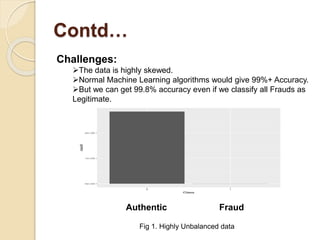
The data is highly skewed.
Normal Machine Learning algorithms would give 99%+ Accuracy.
But we can get 99.8% accuracy even if we classify all Frauds as
Legitimate.
Authentic Fraud
Fig 1. Highly Unbalanced data
Contd…
 Feature (Variables) Selection
 Transaction statistics
 Regional statistics
 Merchant type statistics
 Time based amount statistics
 Time based number of transaction statistics
 Credit Card Fraud Detection
 Supervised: Models are estimated based on samples of
fraudulent and legitimate transactions to classify new transactions
as fraud or legitimate.
 Unsupervised: The outliers’ transactions are considered as
potential instance of fraud.
 Comparative Study
Experimental Set Up and
Methods
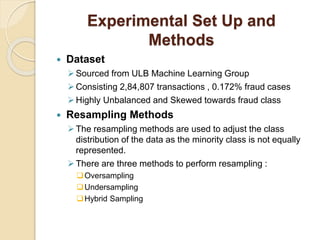
 Dataset
Sourced from ULB Machine Learning Group
Consisting 2,84,807 transactions , 0.172% fraud cases
Highly Unbalanced and Skewed towards fraud class
 Resampling Methods
The resampling methods are used to adjust the class
distribution of the data as the minority class is not equally
represented.
There are three methods to perform resampling :
Oversampling
Undersampling
Hybrid Sampling
Contd…
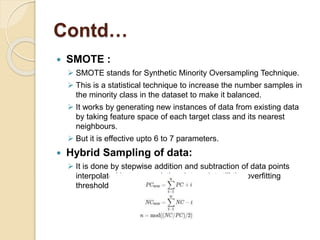
 SMOTE :
 SMOTE stands for Synthetic Minority Oversampling Technique.
 This is a statistical technique to increase the number samples in
the minority class in the dataset to make it balanced.
 It works by generating new instances of data from existing data
by taking feature space of each target class and its nearest
neighbours.
 But it is effective upto 6 to 7 parameters.
 Hybrid Sampling of data:
 It is done by stepwise addition and subtraction of data points
interpolated between existing data points till the overfitting
threshold is reached.
Contd…
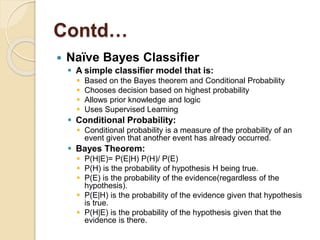
 Naïve Bayes Classifier
 A simple classifier model that is:
 Based on the Bayes theorem and Conditional Probability
 Chooses decision based on highest probability
 Allows prior knowledge and logic
 Uses Supervised Learning
 Conditional Probability:
 Conditional probability is a measure of the probability of an
event given that another event has already occurred.
 Bayes Theorem:
 P(H|E)= P(E|H) P(H)/ P(E)
 P(H) is the probability of hypothesis H being true.
 P(E) is the probability of the evidence(regardless of the
hypothesis).
 P(E|H) is the probability of the evidence given that hypothesis
is true.
 P(H|E) is the probability of the hypothesis given that the
evidence is there.
Contd..
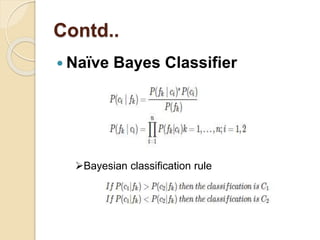
 Naïve Bayes Classifier
Bayesian classification rule
Contd…
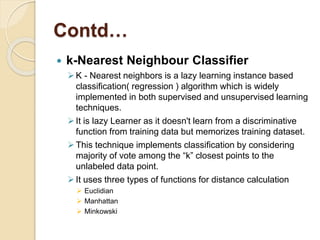
 k-Nearest Neighbour Classifier
K - Nearest neighbors is a lazy learning instance based
classification( regression ) algorithm which is widely
implemented in both supervised and unsupervised learning
techniques.
It is lazy Learner as it doesn't learn from a discriminative
function from training data but memorizes training dataset.
This technique implements classification by considering
majority of vote among the “k” closest points to the
unlabeled data point.
It uses three types of functions for distance calculation
 Euclidian
 Manhattan
 Minkowski
Contd…
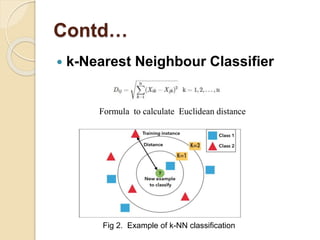
 k-Nearest Neighbour Classifier
Formula to calculate Euclidean distance
Fig 2. Example of k-NN classification
Contd…
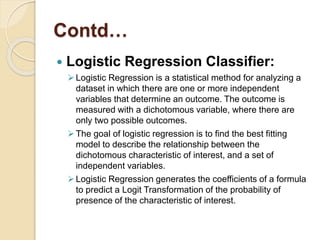
 Logistic Regression Classifier:
Logistic Regression is a statistical method for analyzing a
dataset in which there are one or more independent
variables that determine an outcome. The outcome is
measured with a dichotomous variable, where there are
only two possible outcomes.
The goal of logistic regression is to find the best fitting
model to describe the relationship between the
dichotomous characteristic of interest, and a set of
independent variables.
Logistic Regression generates the coefficients of a formula
to predict a Logit Transformation of the probability of
presence of the characteristic of interest.
Contd…
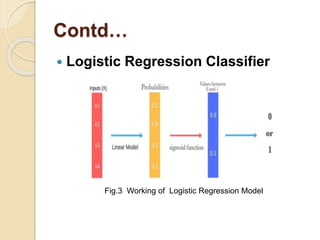
 Logistic Regression Classifier
Fig.3 Working of Logistic Regression Model
Contd…
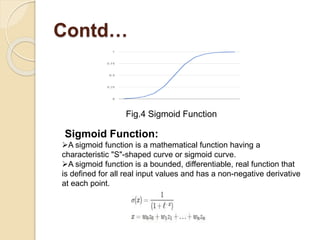
Sigmoid Function:
A sigmoid function is a mathematical function having a
characteristic "S"-shaped curve or sigmoid curve.
A sigmoid function is a bounded, differentiable, real function that
is defined for all real input values and has a non-negative derivative
at each point.
Fig.4 Sigmoid Function
Performance Evaluation and
Results
 Four metrics used in evaluation
◦ True Positive Rate(TPR)
◦ True Negative Rate (TNR)
◦ False Positive Rate (FPR)
◦ False Negative Rate (FNR)
Contd …
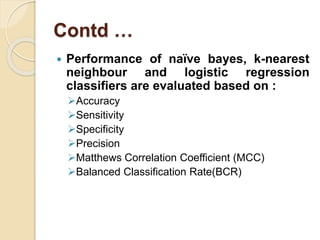
 Performance of naïve bayes, k-nearest
neighbour and logistic regression
classifiers are evaluated based on :
Accuracy
Sensitivity
Specificity
Precision
Matthews Correlation Coefficient (MCC)
Balanced Classification Rate(BCR)
Contd…
Contd..
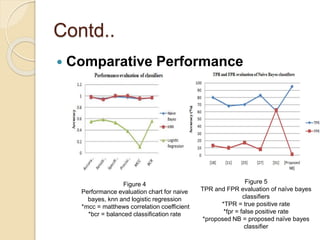
 Comparative Performance
Figure 4
Performance evaluation chart for naive
bayes, knn and logistic regression
*mcc = matthews correlation coefficient
*bcr = balanced classification rate
Figure 5
TPR and FPR evaluation of naïve bayes
classifiers
*TPR = true positive rate
*fpr = false positive rate
*proposed NB = proposed naïve bayes
classifier
Contd…
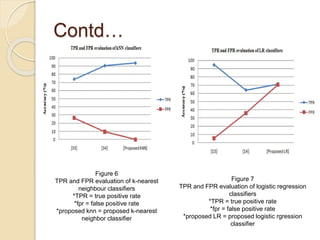
Figure 6
TPR and FPR evaluation of k-nearest
neighbour classifiers
*TPR = true positive rate
*fpr = false positive rate
*proposed knn = proposed k-nearest
neighbor classifier
Figure 7
TPR and FPR evaluation of logistic regression
classifiers
*TPR = true positive rate
*fpr = false positive rate
*proposed LR = proposed logistic rgression
classifier
Conclusion
 Three classifiers based on different machine learning
techniques (Naïve Bayes, K-nearest neighbours and Logistic
Regression) are trained on real life of credit card transactions
data and their performances on credit card fraud detection
evaluated and compared based on several relevant metrics.
 The highly imbalanced dataset is sampled in a hybrid approach
where the positive class is oversampled and the negative class
under-sampled, achieving two sets of data distributions.
 The performances of the three classifiers are examined on the
two sets of data distributions using accuracy, sensitivity,
specificity, precision, balanced classification rate and Matthews
Correlation coefficient metrics.
 Results from the experiment shows that the kNN shows
significant performance for all metrics evaluated except for
accuracy in the 10:90 data distribution.
References
1. S. Maes, K. Tuyls, B. Vanschoenwinkel, B. Manderick, "Credit card fraud detection
using Bayesian and neural networks", Proceeding International NAISO Congress
on Neuro Fuzzy Technologies, 2002.
2. F. N. Ogwueleka, "Data Mining Application in Credit Card Fraud Detection
System", Journal of Engineering Science and Technology, vol. 6, no. 3, pp. 311-
322, 2011.
3. K. RamaKalyani, D. UmaDevi, "Fraud Detection of Credit Card Payment System by
Genetic Algorithm", International Journal of Scientific & Engineering Research,
vol. 3, no. 7, pp. 1-6, 2012, ISSN 2229-5518.
4. P. L. Meshram, P. Bhanarkar, "Credit and ATM Card Fraud Detection Using Genetic
Approach", International Journal of Engineering Research & Technology (IJERT),
vol. 1, no. 10, pp. 1-5, 2012, ISSN ISSN: 2278-0181.
5. G. Singh, R. Gupta, A. Rastogi, M. D. S. Chandel, A. Riyaz, "A Machine Learning
Approach for Detection of Fraud based on SVM", International Journal of Scientific
Engineering and Technology, vol. 1, no. 3, pp. 194-198, 2012, ISSN ISSN: 2277-
1581.
6. K. R. Seeja, M. Zareapoor, "FraudMiner: A Novel Credit Card Fraud Detection
Model Based on Frequent Itemset Mining" in The Scientific World Journal,
Hindawi Publishing Corporation, vol. 2014, pp. 1-10, 2014.
7. S. Patil, H. Somavanshi, J. Gaikwad, A. Deshmane, R. Badgujar, "Credit Card
Fraud Detection Using Decision Tree Induction Algorithm", International Journal of
Computer Science and Mobile Computing (IJCSMC), vol. 4, no. 4, pp. 92-95,
2015, ISSN ISSN: 2320-088X.
8. E. Duman, A. Buyukkaya, I. Elikucuk, "A novel and successful credit card fraud
detection system implemented in aturkish bank", Data Mining Workshops
(ICDMW). 2013 IEEE 13th International Conference on, pp. 162-171, 2013.
9. A. C. Bahnsen, A. Stojanovic, D. Aouada, B. Ottersten, "Improving credit card fraud
detection with calibrated probabilities", Proceedingis of the 2014 SIAM International
Conference on Data Mining, pp. 677-685, 2014.
10. A. Y. Ng, M. I. Jordan, "On discriminative vs. generative classifiers: A comparison of
logistic regression and naive bayes", Advances in neural information processing
systems, vol. 2, pp. 841-848, 2002.
11. S. Maes, K. Tuyls, B. Vanschoenwinkel, B. Manderick, "Credit card fraud detection
using Bayesian and neural networks", Proceedings of the 1st international naiso
congress on neuro fuzzy technologies, pp. 261-270, 2002.
12. A. Shen, R. Tong, Y. Deng, "Application of classification models on credit card fraud
detection", Service Systems and Service Management 2007 International
Conference on, pp. 1-4, 2007.
13. S. Bhattacharyya, S. Jha, K. Tharakunnel, J. C. Westland, "Data mining for credit
card fraud: A comparative study", Decision Support Systems, vol. 50, no. 3, pp.
602-613, 2011.
14. Y. Sahin, E. Duman, "Detecting credit card fraud by ANN and logistic
regression", Innovations in Intelligent Systems and Applications (INISTA) 2011
International Symposium on, pp. 315-319, 2011.
15. K. Chaudhary, B. Mallick, "Credit Card Fraud: The study of its impact and detection
techniques", International Journal of Computer Science and Network (IJCSN), vol.
1, no. 4, pp. 31-35, 2012, ISSN ISSN: 2277-5420.
16. T. P. Bhatla, V. Prabhu, A. Dua, Understanding credit card frauds. Crads Business
Review# 2003-1, Tata Consultancy Services, 2003.
17. U. S. Credit & Debit Cards 2015, David Robertson, 2015.
18. S. Stolfo, D. W. Fan, W. Lee, A. Prodromidis, P. Chan, "Credit card fraud detection
using meta-learning: Issues and initial results", AAAI-97 Workshop on Fraud
Detection and Risk Management, 1997.
Thank you

Credit card fraud detection using machine learning Algorithms

  • 1.
    Credit card frauddetection using Machine Learning Techniques: A Comparative Analysis
  • 2.
    Flow of Talk Introduction  Experimental Set Up and Methods  Performance Evaluation and Results  Conclusion  References
  • 3.
    Introduction  Credit CardFraud Inner Card Fraud: Done by using false identity External Card Fraud: Done by using stolen credit card  How Frauds are Recognized Location: Purchase made from different location Items you buy: If you deviate from your regular buying pattern or time Frequency: Make a large number of transactions in short period of time Amount: Suddenly if the costly items are purchased Fraud can be defined as criminal deception with intent of acquiring financial gain.
  • 4.
    Contd… Challenges: The data ishighly skewed. Normal Machine Learning algorithms would give 99%+ Accuracy. But we can get 99.8% accuracy even if we classify all Frauds as Legitimate. Authentic Fraud Fig 1. Highly Unbalanced data
  • 5.
    Contd…  Feature (Variables)Selection  Transaction statistics  Regional statistics  Merchant type statistics  Time based amount statistics  Time based number of transaction statistics  Credit Card Fraud Detection  Supervised: Models are estimated based on samples of fraudulent and legitimate transactions to classify new transactions as fraud or legitimate.  Unsupervised: The outliers’ transactions are considered as potential instance of fraud.  Comparative Study
  • 6.
    Experimental Set Upand Methods  Dataset Sourced from ULB Machine Learning Group Consisting 2,84,807 transactions , 0.172% fraud cases Highly Unbalanced and Skewed towards fraud class  Resampling Methods The resampling methods are used to adjust the class distribution of the data as the minority class is not equally represented. There are three methods to perform resampling : Oversampling Undersampling Hybrid Sampling
  • 7.
    Contd…  SMOTE : SMOTE stands for Synthetic Minority Oversampling Technique.  This is a statistical technique to increase the number samples in the minority class in the dataset to make it balanced.  It works by generating new instances of data from existing data by taking feature space of each target class and its nearest neighbours.  But it is effective upto 6 to 7 parameters.  Hybrid Sampling of data:  It is done by stepwise addition and subtraction of data points interpolated between existing data points till the overfitting threshold is reached.
  • 8.
    Contd…  Naïve BayesClassifier  A simple classifier model that is:  Based on the Bayes theorem and Conditional Probability  Chooses decision based on highest probability  Allows prior knowledge and logic  Uses Supervised Learning  Conditional Probability:  Conditional probability is a measure of the probability of an event given that another event has already occurred.  Bayes Theorem:  P(H|E)= P(E|H) P(H)/ P(E)  P(H) is the probability of hypothesis H being true.  P(E) is the probability of the evidence(regardless of the hypothesis).  P(E|H) is the probability of the evidence given that hypothesis is true.  P(H|E) is the probability of the hypothesis given that the evidence is there.
  • 9.
    Contd..  Naïve BayesClassifier Bayesian classification rule
  • 10.
    Contd…  k-Nearest NeighbourClassifier K - Nearest neighbors is a lazy learning instance based classification( regression ) algorithm which is widely implemented in both supervised and unsupervised learning techniques. It is lazy Learner as it doesn't learn from a discriminative function from training data but memorizes training dataset. This technique implements classification by considering majority of vote among the “k” closest points to the unlabeled data point. It uses three types of functions for distance calculation  Euclidian  Manhattan  Minkowski
  • 11.
    Contd…  k-Nearest NeighbourClassifier Formula to calculate Euclidean distance Fig 2. Example of k-NN classification
  • 12.
    Contd…  Logistic RegressionClassifier: Logistic Regression is a statistical method for analyzing a dataset in which there are one or more independent variables that determine an outcome. The outcome is measured with a dichotomous variable, where there are only two possible outcomes. The goal of logistic regression is to find the best fitting model to describe the relationship between the dichotomous characteristic of interest, and a set of independent variables. Logistic Regression generates the coefficients of a formula to predict a Logit Transformation of the probability of presence of the characteristic of interest.
  • 13.
    Contd…  Logistic RegressionClassifier Fig.3 Working of Logistic Regression Model
  • 14.
    Contd… Sigmoid Function: A sigmoidfunction is a mathematical function having a characteristic "S"-shaped curve or sigmoid curve. A sigmoid function is a bounded, differentiable, real function that is defined for all real input values and has a non-negative derivative at each point. Fig.4 Sigmoid Function
  • 15.
    Performance Evaluation and Results Four metrics used in evaluation ◦ True Positive Rate(TPR) ◦ True Negative Rate (TNR) ◦ False Positive Rate (FPR) ◦ False Negative Rate (FNR)
  • 16.
    Contd …  Performanceof naïve bayes, k-nearest neighbour and logistic regression classifiers are evaluated based on : Accuracy Sensitivity Specificity Precision Matthews Correlation Coefficient (MCC) Balanced Classification Rate(BCR)
  • 17.
  • 18.
    Contd..  Comparative Performance Figure4 Performance evaluation chart for naive bayes, knn and logistic regression *mcc = matthews correlation coefficient *bcr = balanced classification rate Figure 5 TPR and FPR evaluation of naïve bayes classifiers *TPR = true positive rate *fpr = false positive rate *proposed NB = proposed naïve bayes classifier
  • 19.
    Contd… Figure 6 TPR andFPR evaluation of k-nearest neighbour classifiers *TPR = true positive rate *fpr = false positive rate *proposed knn = proposed k-nearest neighbor classifier Figure 7 TPR and FPR evaluation of logistic regression classifiers *TPR = true positive rate *fpr = false positive rate *proposed LR = proposed logistic rgression classifier
  • 20.
    Conclusion  Three classifiersbased on different machine learning techniques (Naïve Bayes, K-nearest neighbours and Logistic Regression) are trained on real life of credit card transactions data and their performances on credit card fraud detection evaluated and compared based on several relevant metrics.  The highly imbalanced dataset is sampled in a hybrid approach where the positive class is oversampled and the negative class under-sampled, achieving two sets of data distributions.  The performances of the three classifiers are examined on the two sets of data distributions using accuracy, sensitivity, specificity, precision, balanced classification rate and Matthews Correlation coefficient metrics.  Results from the experiment shows that the kNN shows significant performance for all metrics evaluated except for accuracy in the 10:90 data distribution.
  • 21.
    References 1. S. Maes,K. Tuyls, B. Vanschoenwinkel, B. Manderick, "Credit card fraud detection using Bayesian and neural networks", Proceeding International NAISO Congress on Neuro Fuzzy Technologies, 2002. 2. F. N. Ogwueleka, "Data Mining Application in Credit Card Fraud Detection System", Journal of Engineering Science and Technology, vol. 6, no. 3, pp. 311- 322, 2011. 3. K. RamaKalyani, D. UmaDevi, "Fraud Detection of Credit Card Payment System by Genetic Algorithm", International Journal of Scientific & Engineering Research, vol. 3, no. 7, pp. 1-6, 2012, ISSN 2229-5518. 4. P. L. Meshram, P. Bhanarkar, "Credit and ATM Card Fraud Detection Using Genetic Approach", International Journal of Engineering Research & Technology (IJERT), vol. 1, no. 10, pp. 1-5, 2012, ISSN ISSN: 2278-0181. 5. G. Singh, R. Gupta, A. Rastogi, M. D. S. Chandel, A. Riyaz, "A Machine Learning Approach for Detection of Fraud based on SVM", International Journal of Scientific Engineering and Technology, vol. 1, no. 3, pp. 194-198, 2012, ISSN ISSN: 2277- 1581. 6. K. R. Seeja, M. Zareapoor, "FraudMiner: A Novel Credit Card Fraud Detection Model Based on Frequent Itemset Mining" in The Scientific World Journal, Hindawi Publishing Corporation, vol. 2014, pp. 1-10, 2014. 7. S. Patil, H. Somavanshi, J. Gaikwad, A. Deshmane, R. Badgujar, "Credit Card Fraud Detection Using Decision Tree Induction Algorithm", International Journal of Computer Science and Mobile Computing (IJCSMC), vol. 4, no. 4, pp. 92-95, 2015, ISSN ISSN: 2320-088X. 8. E. Duman, A. Buyukkaya, I. Elikucuk, "A novel and successful credit card fraud detection system implemented in aturkish bank", Data Mining Workshops (ICDMW). 2013 IEEE 13th International Conference on, pp. 162-171, 2013.
  • 22.
    9. A. C.Bahnsen, A. Stojanovic, D. Aouada, B. Ottersten, "Improving credit card fraud detection with calibrated probabilities", Proceedingis of the 2014 SIAM International Conference on Data Mining, pp. 677-685, 2014. 10. A. Y. Ng, M. I. Jordan, "On discriminative vs. generative classifiers: A comparison of logistic regression and naive bayes", Advances in neural information processing systems, vol. 2, pp. 841-848, 2002. 11. S. Maes, K. Tuyls, B. Vanschoenwinkel, B. Manderick, "Credit card fraud detection using Bayesian and neural networks", Proceedings of the 1st international naiso congress on neuro fuzzy technologies, pp. 261-270, 2002. 12. A. Shen, R. Tong, Y. Deng, "Application of classification models on credit card fraud detection", Service Systems and Service Management 2007 International Conference on, pp. 1-4, 2007. 13. S. Bhattacharyya, S. Jha, K. Tharakunnel, J. C. Westland, "Data mining for credit card fraud: A comparative study", Decision Support Systems, vol. 50, no. 3, pp. 602-613, 2011. 14. Y. Sahin, E. Duman, "Detecting credit card fraud by ANN and logistic regression", Innovations in Intelligent Systems and Applications (INISTA) 2011 International Symposium on, pp. 315-319, 2011. 15. K. Chaudhary, B. Mallick, "Credit Card Fraud: The study of its impact and detection techniques", International Journal of Computer Science and Network (IJCSN), vol. 1, no. 4, pp. 31-35, 2012, ISSN ISSN: 2277-5420. 16. T. P. Bhatla, V. Prabhu, A. Dua, Understanding credit card frauds. Crads Business Review# 2003-1, Tata Consultancy Services, 2003. 17. U. S. Credit & Debit Cards 2015, David Robertson, 2015. 18. S. Stolfo, D. W. Fan, W. Lee, A. Prodromidis, P. Chan, "Credit card fraud detection using meta-learning: Issues and initial results", AAAI-97 Workshop on Fraud Detection and Risk Management, 1997.
  • 23.