International Research Journal of Engineering and Technology (IRJET) e-ISSN: 2395-0056
Volume: 05 Issue: 12 | Dec 2018 www.irjet.net p-ISSN: 2395-0072
© 2018, IRJET | Impact Factor value: 7.211 | ISO 9001:2008 Certified Journal | Page 1421
A Review Analysis to Detect an Object in Video Surveillance System
Sunanda Mohanta
Sunanda Mohanta, Department of Computer Science and Applications, Sambalpur University, Odisha, India
---------------------------------------------------------------------***----------------------------------------------------------------------
Abstract - This survey paper presentsanapproachtodefine
the existence of moving object and various techniques related
to video surveillance system to improve security. Generally
visual surveillance can be classified into three phases of data
processing: moving object recognition, object extraction &
tracking and to extract temporal information about such
objects. This paper focuses on detection of moving objects in
video surveillance system. Moving object detection is first low
level important task for any video surveillance application.
Detection of moving object is a challenging task. Object
detection in video image obtained from single camera with
static background that means fixing camera is achieved by
background subtraction approach. This literature review
presents the techniques available for detection, their
fundamental study and comparative analysis of these
techniques in visual surveillance which helps for its future
research.
Key Words: Object Detection, Background Subtraction,
Optical Flow, Frame Differencing.
1. INTRODUCTION
Object detection technologies are increasingly popular
choices which involve verifying the presence of an object in
image sequences of videos. Objectdetectionandtracking are
important in many computer vision applications including
activity recognition, automotive safety and surveillance.
However extracting moving objects from a video is a
fundamental and critical task since isolating required object
from a video is necessary for further process of surveillance
as well as differentiating the interested object from other
background objects becomes a typical problem, hence it
becomes essential to understand video, its constituent and
visual surveillance.
Video surveillance is a highly identified research
area including applications in traffic monitoring, human
activity monitoring, ensuring security at airport, banks,
shopping malls etc, autonomous robot navigation and other
commercial areas. Videos are basically sequences of images,
and each image is called a frame, displayed in fast enough
frequency so that human eyes can percept the continuity of
its content. The contents of two consecutive frames are
usually closely related, so that two adjacent frames can be
used to track status of objects in the scene as moving or still.
2. OBJECT DETECTION
Moving object detection from a video is an essential step in
video surveillance applications. To identify objects of
interest in video sequences and to cluster pixels of these
objects, object detection technique is used. The detection of
an object in video sequence plays a significant role in many
applications specifically as video surveillance applications.
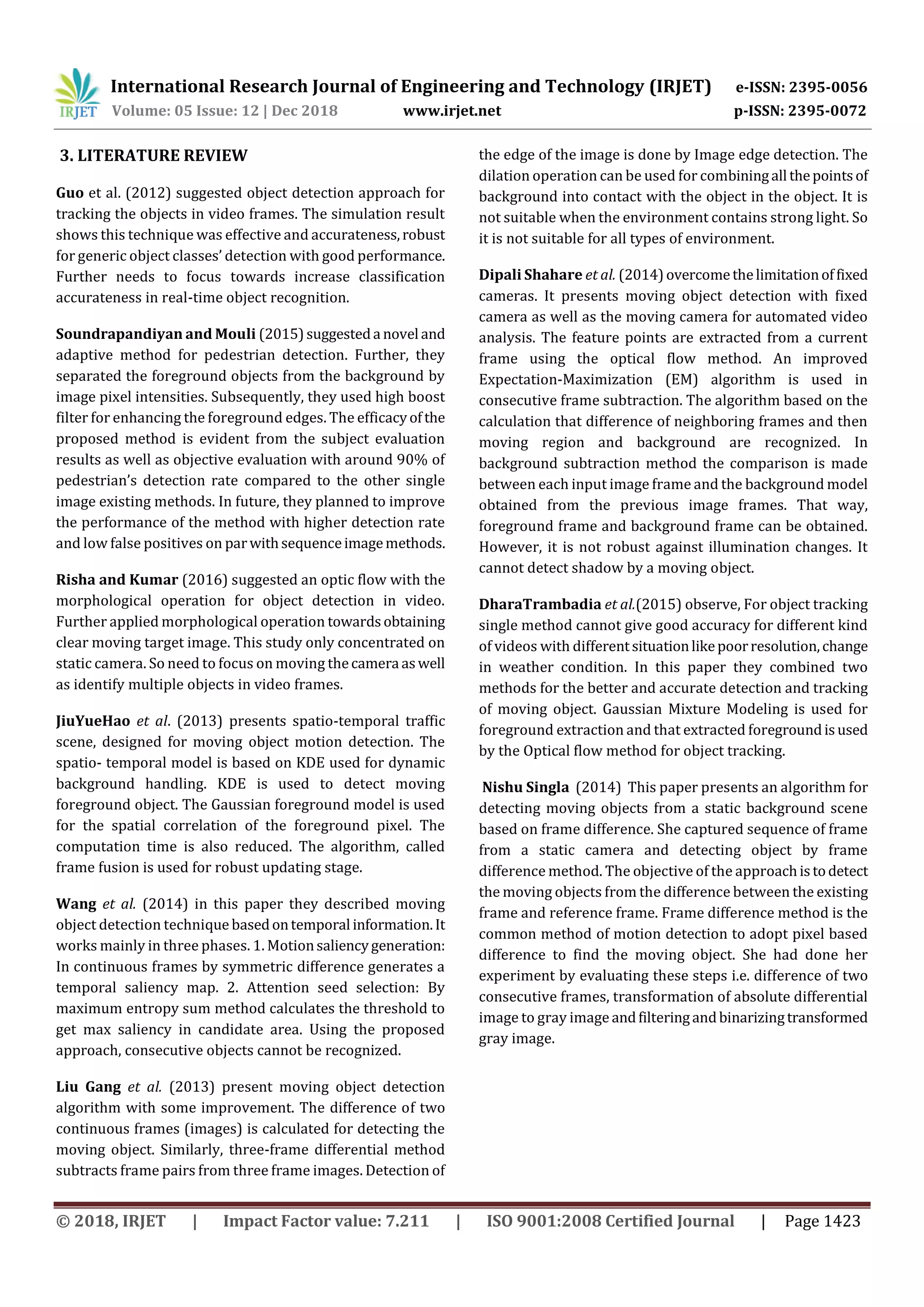
The object in a video stream can be detected by processes
like preprocessing, segmentation, foreground and
background extraction, feature extraction. The different
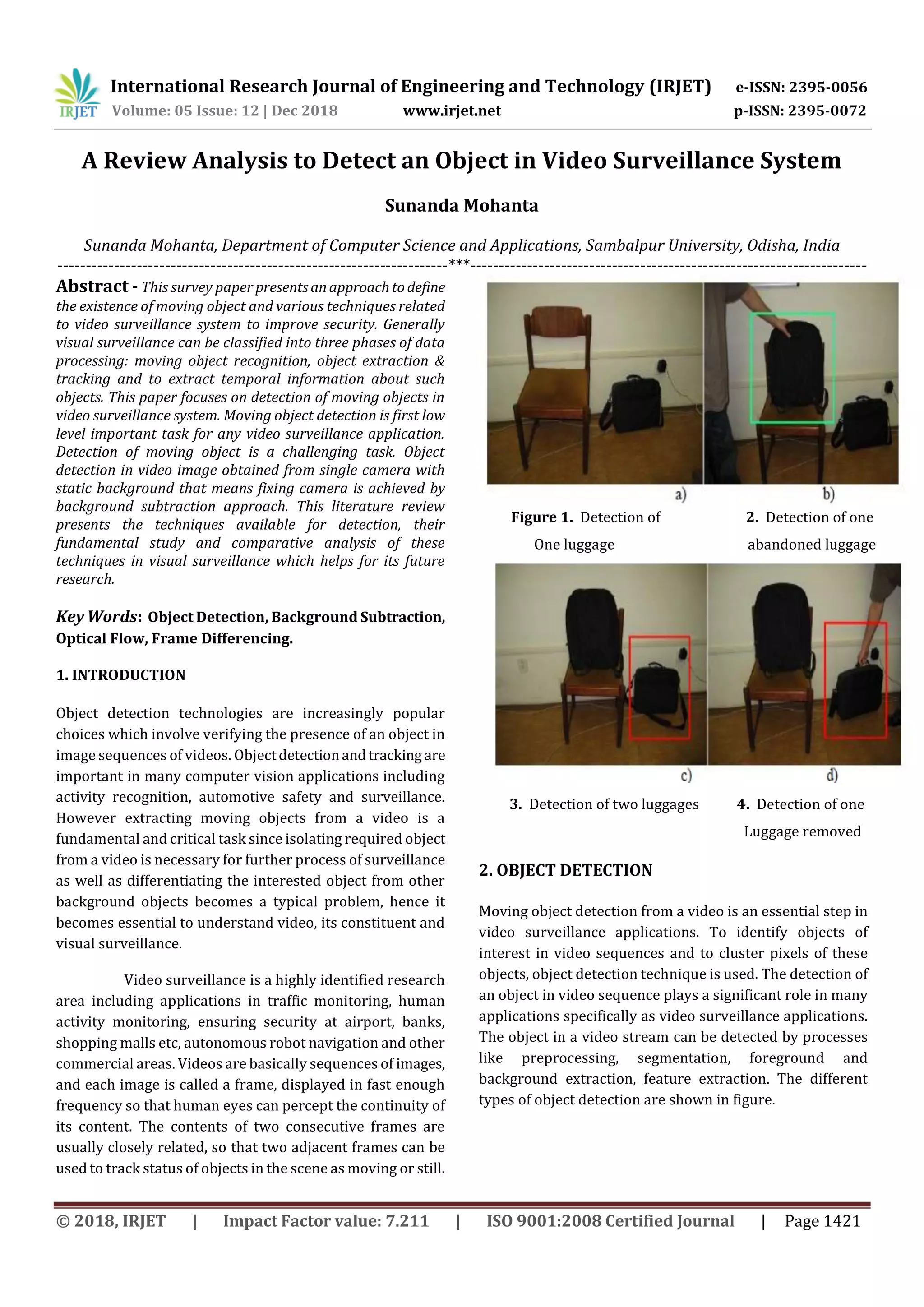
types of object detection are shown in figure.
Figure 1. Detection of 2. Detection of one
One luggage abandoned luggage
3. Detection of two luggages 4. Detection of one
Luggage removed
International Research Journal of Engineering and Technology (IRJET) e-ISSN: 2395-0056
Volume: 05 Issue: 12 | Dec 2018 www.irjet.net p-ISSN: 2395-0072
© 2018, IRJET | Impact Factor value: 7.211 | ISO 9001:2008 Certified Journal | Page 1422
Figure 5. Types of object detection methods
2.1. Frame Differencing
This method uses the pixel-wise difference between two or
three adjacent frames in video imagery to extract moving
regions. It is highly adaptive approachandverymuchsimilar
to background subtraction, after the subtraction of image it
gives moving target information through threshold value.
This method is not applicable for still objects detection,
complex scenes computation and cannot be used for real
time applications [6][8]. Detecting moving objects from a
static background scene based onframedifferenceoccurs by
the following steps. Firstly the first frame is captured
through the static camera then that sequence of frames is
captured at regular intervals, Secondly the absolute
difference is calculated between the consecutive framesand
the difference image is stored in the system, thirdly the
difference image is converted into gray image and then
translated into binary image. Finally, morphological filtering
is done to remove noise. [10]
Difference of Two Consecutive Frames:
Suppose IK is the value of the kth frame in image sequences.
Ik+1 is the value of the (k+1)th frame in image sequences. The
absolute differential image is defined as
Follows:
Id(k, k+1) = |Ik+1 – Ik|
After that the differencing value will be compare with
threshold value, if the differencing pixel valueisgreaterthan
the threshold value. So the value is considered to be a partof
moving object. Otherwise, it is considered to be the
background.
2.2. Optical Flow
Optical flow technique used to describe image motion .This
is the method in which motion target of vector
characteristics, changed with time to detect motion area in
image sequence. Optical flow calculates a velocity for points
within the images and provides an estimation of where
points could be in the next image sequence. Suppose two
image frames which are taken at times t and t+∆t at every
pixel position, here optical flowemphasizestheaccuracyand
density of measurement. Optical flow estimation is used in
computer vision to characterize and quantify the motion of
objects in a video stream, often for motion-based object
detection systems[7]. The application of optical flow
includes not only the motion of the observer and objects in
the scene, but also the structure of objects and the
environment i.e perception of the shape, distance and
movement of objects in the world and the control of
locomotion. Optical flow information recognized as being
useful for controlling micro air vehicles likeUAV(Unmanned
Aerial Vehicle). Lucas-Kanade method is one of the method
of optical flow technique which determines image patches
and an affine model for the flow field. Basically it is an
algorithm mainly focused on bunch of pixels share similar
property.
2.3. Background Subtraction
This method is most commonly used technique for motion
segmentation in videoimages.Backgroundsubtractionis the
process of separating out foreground objects from the
background in a sequence of video frames. It detectsmoving
regions by performing absolute differencing between the
current frame pixel-by-pixel and a reference background
image that is produced by averaging frames over time in an
initialization period[13][15]. The basic idea of background
subtraction method is to initialize a background through
background modeling and then subtracting current frame
with background frame to detect moving objects. The major
steps in background subtraction algorithm are
preprocessing, background modeling, foreground detection
and data validation. Background modelingistheheartof any
background subtraction algorithm. Background model is
that, which robust against environment changes in the
background, but sensitive enough to identify all moving
objects of interest. Background modeling technique is
categorized in to two parts i.e. recursive and non-recursive.
Some of the commonly used non-recursive techniques are
frame differencing, median filter, mean filter. Non-recursive
techniques are highly adaptive as they don’t depend on the
history beyond those frames stored in the buffer.
International Research Journal of Engineering and Technology (IRJET) e-ISSN: 2395-0056
Volume: 05 Issue: 12 | Dec 2018 www.irjet.net p-ISSN: 2395-0072
© 2018, IRJET | Impact Factor value: 7.211 | ISO 9001:2008 Certified Journal | Page 1423
3. LITERATURE REVIEW
Guo et al. (2012) suggested object detection approach for
tracking the objects in video frames. The simulation result
shows this technique was effective and accurateness,robust
for generic object classes’ detection with good performance.
Further needs to focus towards increase classification
accurateness in real-time object recognition.
Soundrapandiyan and Mouli (2015)suggesteda novel and
adaptive method for pedestrian detection. Further, they
separated the foreground objects from the background by
image pixel intensities. Subsequently, they used high boost
filter for enhancing the foreground edges. The efficacyofthe
proposed method is evident from the subject evaluation
results as well as objective evaluation with around 90% of
pedestrian’s detection rate compared to the other single
image existing methods. In future, they planned to improve
the performance of the method with higher detection rate
and low false positives on parwithsequenceimagemethods.
Risha and Kumar (2016) suggested an optic flow with the
morphological operation for object detection in video.
Further applied morphological operation towardsobtaining
clear moving target image. This study only concentrated on
static camera. So need to focus on moving thecamera aswell
as identify multiple objects in video frames.
JiuYueHao et al. (2013) presents spatio-temporal traffic
scene, designed for moving object motion detection. The
spatio- temporal model is based on KDE used for dynamic
background handling. KDE is used to detect moving
foreground object. The Gaussian foreground model is used
for the spatial correlation of the foreground pixel. The
computation time is also reduced. The algorithm, called
frame fusion is used for robust updating stage.
Wang et al. (2014) in this paper they described moving
object detection technique basedontemporal information.It
works mainly in three phases. 1. Motionsaliencygeneration:
In continuous frames by symmetric difference generates a
temporal saliency map. 2. Attention seed selection: By
maximum entropy sum method calculates the threshold to
get max saliency in candidate area. Using the proposed
approach, consecutive objects cannot be recognized.
Liu Gang et al. (2013) present moving object detection
algorithm with some improvement. The difference of two
continuous frames (images) is calculated for detecting the
moving object. Similarly, three-frame differential method
subtracts frame pairs from three frame images. Detection of
the edge of the image is done by Image edge detection. The
dilation operation can be used for combiningall thepointsof
background into contact with the object in the object. It is
not suitable when the environment contains strong light. So
it is not suitable for all types of environment.
Dipali Shahare et al. (2014)overcomethelimitationoffixed
cameras. It presents moving object detection with fixed
camera as well as the moving camera for automated video
analysis. The feature points are extracted from a current
frame using the optical flow method. An improved
Expectation-Maximization (EM) algorithm is used in
consecutive frame subtraction. The algorithm based on the
calculation that difference of neighboring frames and then
moving region and background are recognized. In
background subtraction method the comparison is made
between each input image frame and the background model
obtained from the previous image frames. That way,
foreground frame and background frame can be obtained.
However, it is not robust against illumination changes. It
cannot detect shadow by a moving object.
DharaTrambadia et al.(2015) observe, For object tracking
single method cannot give good accuracy for different kind
of videos with differentsituationlikepoorresolution,change
in weather condition. In this paper they combined two
methods for the better and accurate detection and tracking
of moving object. Gaussian Mixture Modeling is used for
foreground extraction and that extracted foregroundisused
by the Optical flow method for object tracking.
Nishu Singla (2014) This paper presents an algorithm for
detecting moving objects from a static background scene
based on frame difference. She captured sequence of frame
from a static camera and detecting object by frame
difference method. The objective of the approachistodetect
the moving objects from the difference between the existing
frame and reference frame. Frame difference method is the
common method of motion detection to adopt pixel based
difference to find the moving object. She had done her
experiment by evaluating these steps i.e. difference of two
consecutive frames, transformation of absolute differential
image to gray image andfilteringandbinarizingtransformed
gray image.
International Research Journal of Engineering and Technology (IRJET) e-ISSN: 2395-0056
Volume: 05 Issue: 12 | Dec 2018 www.irjet.net p-ISSN: 2395-0072
© 2018, IRJET | Impact Factor value: 7.211 | ISO 9001:2008 Certified Journal | Page 1424
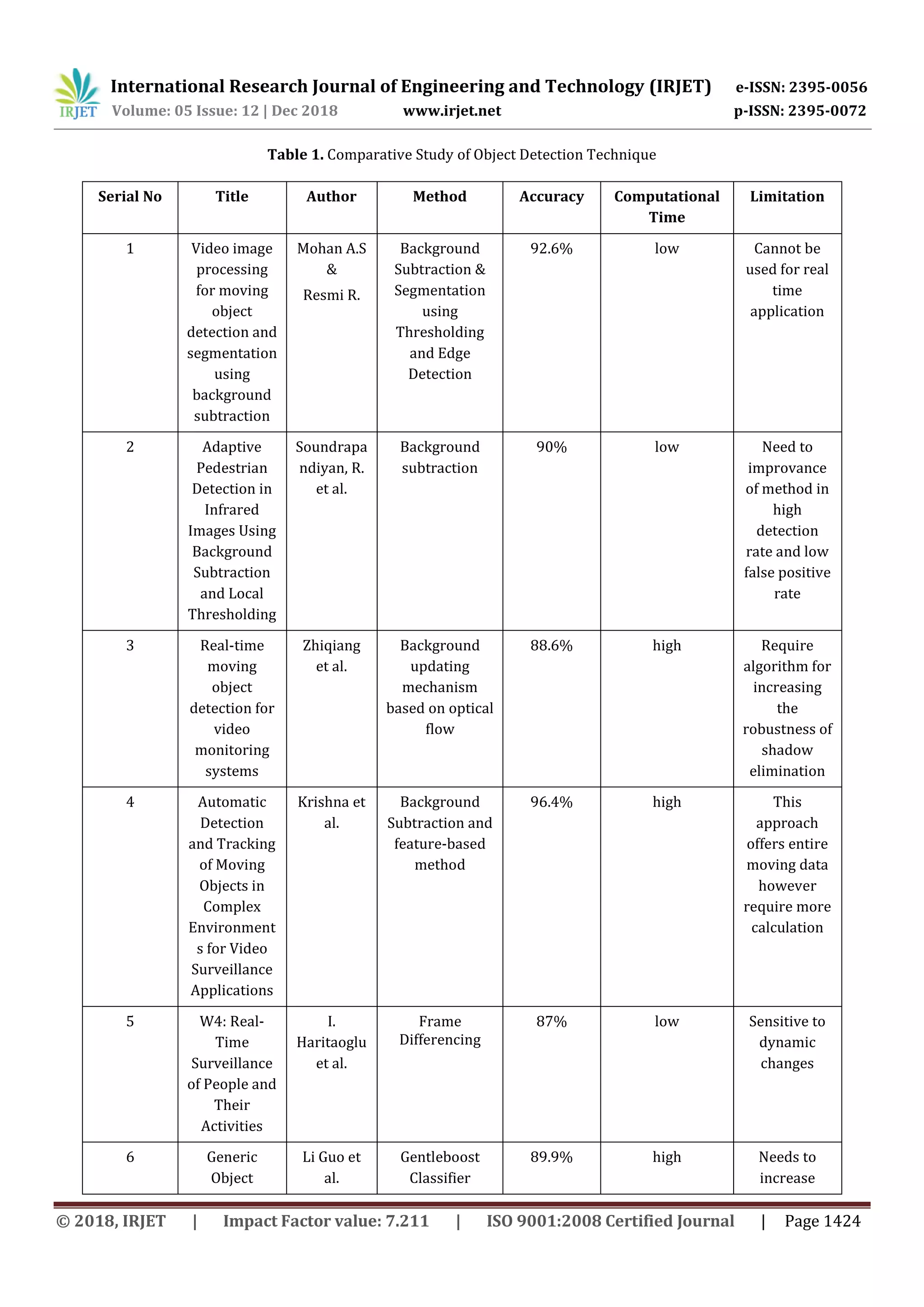
Table 1. Comparative Study of Object Detection Technique
Serial No Title Author Method Accuracy Computational
Time
Limitation
1 Video image
processing
for moving
object
detection and
segmentation
using
background
subtraction
Mohan A.S
&
Resmi R.
Background
Subtraction &
Segmentation
using
Thresholding
and Edge
Detection
92.6% low Cannot be
used for real
time
application
2 Adaptive
Pedestrian
Detection in
Infrared
Images Using
Background
Subtraction
and Local
Thresholding
Soundrapa
ndiyan, R.
et al.
Background
subtraction
90% low Need to
improvance
of method in
high
detection
rate and low
false positive
rate
3 Real-time
moving
object
detection for
video
monitoring
systems
Zhiqiang
et al.
Background
updating
mechanism
based on optical
flow
88.6% high Require
algorithm for
increasing
the
robustness of
shadow
elimination
4 Automatic
Detection
and Tracking
of Moving
Objects in
Complex
Environment
s for Video
Surveillance
Applications
Krishna et
al.
Background
Subtraction and
feature-based
method
96.4% high This
approach
offers entire
moving data
however
require more
calculation
5 W4: Real-
Time
Surveillance
of People and
Their
Activities
I.
Haritaoglu
et al.
Frame
Differencing
87% low Sensitive to
dynamic
changes
6 Generic
Object
Li Guo et
al.
Gentleboost
Classifier
89.9% high Needs to
increase
International Research Journal of Engineering and Technology (IRJET) e-ISSN: 2395-0056
Volume: 05 Issue: 12 | Dec 2018 www.irjet.net p-ISSN: 2395-0072
© 2018, IRJET | Impact Factor value: 7.211 | ISO 9001:2008 Certified Journal | Page 1425
Detection
Using
Improved
Gentleboost
Classifier
classification
accurateness
in real-time
object
recognition
7 Novel
method of
detecting
moving
object in
video
Risha and
Kumar
Optical Flow
with
Morphological
Operation
88.3% High Unable to
identify
multiple
objects in
video frames
8 Moving
Object
Detection
and Tracking
Using Hybrid
Approach in
Real Time to
Improve
Accuracy
Dhara
Trambadia
et al.
Gaussian
Mixture
Modelling
99.4% High
9 Motion
Detection
Based on
Frame
Difference
Method
Nishu
Singla
Frame
Difference
method
90.1% low The motion
of air should
not be
captured to
affect the
object
detection
process
4. CONCLUSION
This paper is a detailed survey of the object detection
methods. In this paper various popular phasesareexplained
which are helpful in object detection for visual surveillance
systems. Various approaches of object detection techniques
like temporal differentiating, background subtraction,
optical flow are briefly described and a comparative study is
also presented. Background subtraction technique iseasy to
implement with less calculation and generally used for real
time applications. The bibliography content is the most
significant contribution of research sinceitwill leadtoa new
area of research. We have identified and discussed the
limitation/future scope of various methods. Also, we have
noted some methods which give accuracy but have high
computational complexity. Specifically, background
subtraction, temporal differencing with the optical flowwas
discussed.
5. FUTURE SCOPE
Surveillance system is important to be worthy of situation
control, such systems transform video under surveillance
from data to informationand intelligenceacquisitionsystem.
Real-time video analysis provides surveillancesystemswith
the ability to react to an activity in real time.
In future, the work can be extended to detect the moving
object with non-static background, having multiplecameras
which can be used in real time surveillance applications.
Need to focus on new features that are not only more
powerful, but also more robust and capture more
information than the currently popular features.
6. REFERENCES
[1] DharaTrambadia, ChintanVarnagar, Prajesh Kathiriya,
(2015). “Moving ObjectDetectionandTrackingUsingHybrid
Approach in Real Time to Improve Accuracy,” International
International Research Journal of Engineering and Technology (IRJET) e-ISSN: 2395-0056
Volume: 05 Issue: 12 | Dec 2018 www.irjet.net p-ISSN: 2395-0072
© 2018, IRJET | Impact Factor value: 7.211 | ISO 9001:2008 Certified Journal | Page 1426
Journal of Innovative Research in Computer and
Communication Engineering(An ISO 3297: 2007 Certified
Organization), Vol. 3, Issue 4.
[2] Divyani Prajapati, Hiren J Galiyawala, (2015). “ A Review
on Moving Object Detection and Tracking ,” International
Journal of Computer Application (2250-1797) Volume 5.
[3] Gang, Liu, NingShangkun, You Yugan, Wen Guanglei, and
Zheng Siguo,(2013). “An improved movingobjectsdetection
algorithm”. In WaveletAnalysis and Pattern Recognition
(ICWAPR), 2013 International Conference on, pp 96-102.
[4] Guo, L., Liao, Y., Luo, D. & Liao, H., 2012. “Generic Object
Detection Using Improved Gentleboost Classifier”. Phys.
Procedia 25,pp 1528–1535.
[5] Hao, Jiu Yue, Chao Li, Zuwhan Kim, and Zhang
Xiong,(2013). “Spatio temporal traffic scene modeling for
object motiondetection”.IntelligentTransportationSystems,
IEEE Transactions on 14, no. 1,pp 295-302.
[6] Haritaoglu, I., Harwood, D. & Davis, L.S., (2000). “ W4:
real-time surveillance of people and their activities”. IEEE
Trans. Pattern Anal. Mach. Intell. 22, pp 809–830.
[7] Krishna, M.T.G., Ravishankar, M. & Babu, D.R.R.,(2011).
“Automatic detection and tracking of moving objects in
complex environments for video surveillance applications,”
in: 2011 3rd International Conference on Electronics
Computer Technology. IEEE, pp 234–238.
[8] Mohan, A.S. & Resmi, R.,(2014). “Video image processing
for moving object detection and segmentation using
background subtraction,” in First International Conference
on Computational Systems and Communications (ICCSC).
IEEE, pp 288–292.
[9] Mukesh Tiwari & Dr. Rakesh Singhai.,(2017). “A Review
of Detection and tracking of object from image and video
sequences,”International Journal of Computational
Intelligence Research ISSN 0973-1873Volume13,Number5
, pp 745-765.
[10] Nishu Singla,(2014). “MotionDetectionBasedonFrame
Difference Method, ” International Journal of Information &
Computation Technology.ISSN 0974-2239 Volume 4,
Number 15 (2014), pp. 1559-1565
[11] Risha, K.P. & Kumar, A.C., (2016). “Novel Method of
Detecting Moving Object in Video”. Procedia Technol. 24, pp
1055–1060.
[12] Shahare, Dipali, and Ranjana Shende.,(2014) . “Moving
Object Detection with Fixed Camera and Moving Camera for
Automated Video Analysis.” International Journal of
Computer Applications Technologyand Research 3, no.5,pp
277-283.
[13] Soundrapandiyan, R. & Mouli, P.V.S.S.R.C., (2015).
“Adaptive Pedestrian Detection in Infrared Images Using
Background Subtraction and Local Thresholding.” Procedia
Comput. Sci. 58, pp 706–713.
[14] Tao Zhang, Zaiwen Liu, Xiaofeng Lian & Xiaoyi Wang,
(2010). “Study on moving-objects detection technique in
video surveillance system,” in Chinese Control and Decision
Conference. IEEE, pp 2375–2380.
[15] Zhihu Wang; Kai Liao; JiulongXiong; Qi Zhang,(2014)
“Moving Object Detection Based on Temporal Information,”
Signal Processing Letters, EEE, vol.21, no.11, pp 1403-1407.
[16] Zhiqiang, W., Xiaopeng, J. & Peng, W., (2006).“Real-time
is moving object detection for video monitoring systems.” J.
Syst. Eng. Electron. 17: pp 731–736.

IRJET- A Review Analysis to Detect an Object in Video Surveillance System

  • 1.
    International Research Journalof Engineering and Technology (IRJET) e-ISSN: 2395-0056 Volume: 05 Issue: 12 | Dec 2018 www.irjet.net p-ISSN: 2395-0072 © 2018, IRJET | Impact Factor value: 7.211 | ISO 9001:2008 Certified Journal | Page 1421 A Review Analysis to Detect an Object in Video Surveillance System Sunanda Mohanta Sunanda Mohanta, Department of Computer Science and Applications, Sambalpur University, Odisha, India ---------------------------------------------------------------------***---------------------------------------------------------------------- Abstract - This survey paper presentsanapproachtodefine the existence of moving object and various techniques related to video surveillance system to improve security. Generally visual surveillance can be classified into three phases of data processing: moving object recognition, object extraction & tracking and to extract temporal information about such objects. This paper focuses on detection of moving objects in video surveillance system. Moving object detection is first low level important task for any video surveillance application. Detection of moving object is a challenging task. Object detection in video image obtained from single camera with static background that means fixing camera is achieved by background subtraction approach. This literature review presents the techniques available for detection, their fundamental study and comparative analysis of these techniques in visual surveillance which helps for its future research. Key Words: Object Detection, Background Subtraction, Optical Flow, Frame Differencing. 1. INTRODUCTION Object detection technologies are increasingly popular choices which involve verifying the presence of an object in image sequences of videos. Objectdetectionandtracking are important in many computer vision applications including activity recognition, automotive safety and surveillance. However extracting moving objects from a video is a fundamental and critical task since isolating required object from a video is necessary for further process of surveillance as well as differentiating the interested object from other background objects becomes a typical problem, hence it becomes essential to understand video, its constituent and visual surveillance. Video surveillance is a highly identified research area including applications in traffic monitoring, human activity monitoring, ensuring security at airport, banks, shopping malls etc, autonomous robot navigation and other commercial areas. Videos are basically sequences of images, and each image is called a frame, displayed in fast enough frequency so that human eyes can percept the continuity of its content. The contents of two consecutive frames are usually closely related, so that two adjacent frames can be used to track status of objects in the scene as moving or still. 2. OBJECT DETECTION Moving object detection from a video is an essential step in video surveillance applications. To identify objects of interest in video sequences and to cluster pixels of these objects, object detection technique is used. The detection of an object in video sequence plays a significant role in many applications specifically as video surveillance applications. The object in a video stream can be detected by processes like preprocessing, segmentation, foreground and background extraction, feature extraction. The different types of object detection are shown in figure. Figure 1. Detection of 2. Detection of one One luggage abandoned luggage 3. Detection of two luggages 4. Detection of one Luggage removed
  • 2.
    International Research Journalof Engineering and Technology (IRJET) e-ISSN: 2395-0056 Volume: 05 Issue: 12 | Dec 2018 www.irjet.net p-ISSN: 2395-0072 © 2018, IRJET | Impact Factor value: 7.211 | ISO 9001:2008 Certified Journal | Page 1422 Figure 5. Types of object detection methods 2.1. Frame Differencing This method uses the pixel-wise difference between two or three adjacent frames in video imagery to extract moving regions. It is highly adaptive approachandverymuchsimilar to background subtraction, after the subtraction of image it gives moving target information through threshold value. This method is not applicable for still objects detection, complex scenes computation and cannot be used for real time applications [6][8]. Detecting moving objects from a static background scene based onframedifferenceoccurs by the following steps. Firstly the first frame is captured through the static camera then that sequence of frames is captured at regular intervals, Secondly the absolute difference is calculated between the consecutive framesand the difference image is stored in the system, thirdly the difference image is converted into gray image and then translated into binary image. Finally, morphological filtering is done to remove noise. [10] Difference of Two Consecutive Frames: Suppose IK is the value of the kth frame in image sequences. Ik+1 is the value of the (k+1)th frame in image sequences. The absolute differential image is defined as Follows: Id(k, k+1) = |Ik+1 – Ik| After that the differencing value will be compare with threshold value, if the differencing pixel valueisgreaterthan the threshold value. So the value is considered to be a partof moving object. Otherwise, it is considered to be the background. 2.2. Optical Flow Optical flow technique used to describe image motion .This is the method in which motion target of vector characteristics, changed with time to detect motion area in image sequence. Optical flow calculates a velocity for points within the images and provides an estimation of where points could be in the next image sequence. Suppose two image frames which are taken at times t and t+∆t at every pixel position, here optical flowemphasizestheaccuracyand density of measurement. Optical flow estimation is used in computer vision to characterize and quantify the motion of objects in a video stream, often for motion-based object detection systems[7]. The application of optical flow includes not only the motion of the observer and objects in the scene, but also the structure of objects and the environment i.e perception of the shape, distance and movement of objects in the world and the control of locomotion. Optical flow information recognized as being useful for controlling micro air vehicles likeUAV(Unmanned Aerial Vehicle). Lucas-Kanade method is one of the method of optical flow technique which determines image patches and an affine model for the flow field. Basically it is an algorithm mainly focused on bunch of pixels share similar property. 2.3. Background Subtraction This method is most commonly used technique for motion segmentation in videoimages.Backgroundsubtractionis the process of separating out foreground objects from the background in a sequence of video frames. It detectsmoving regions by performing absolute differencing between the current frame pixel-by-pixel and a reference background image that is produced by averaging frames over time in an initialization period[13][15]. The basic idea of background subtraction method is to initialize a background through background modeling and then subtracting current frame with background frame to detect moving objects. The major steps in background subtraction algorithm are preprocessing, background modeling, foreground detection and data validation. Background modelingistheheartof any background subtraction algorithm. Background model is that, which robust against environment changes in the background, but sensitive enough to identify all moving objects of interest. Background modeling technique is categorized in to two parts i.e. recursive and non-recursive. Some of the commonly used non-recursive techniques are frame differencing, median filter, mean filter. Non-recursive techniques are highly adaptive as they don’t depend on the history beyond those frames stored in the buffer.
  • 3.
    International Research Journalof Engineering and Technology (IRJET) e-ISSN: 2395-0056 Volume: 05 Issue: 12 | Dec 2018 www.irjet.net p-ISSN: 2395-0072 © 2018, IRJET | Impact Factor value: 7.211 | ISO 9001:2008 Certified Journal | Page 1423 3. LITERATURE REVIEW Guo et al. (2012) suggested object detection approach for tracking the objects in video frames. The simulation result shows this technique was effective and accurateness,robust for generic object classes’ detection with good performance. Further needs to focus towards increase classification accurateness in real-time object recognition. Soundrapandiyan and Mouli (2015)suggesteda novel and adaptive method for pedestrian detection. Further, they separated the foreground objects from the background by image pixel intensities. Subsequently, they used high boost filter for enhancing the foreground edges. The efficacyofthe proposed method is evident from the subject evaluation results as well as objective evaluation with around 90% of pedestrian’s detection rate compared to the other single image existing methods. In future, they planned to improve the performance of the method with higher detection rate and low false positives on parwithsequenceimagemethods. Risha and Kumar (2016) suggested an optic flow with the morphological operation for object detection in video. Further applied morphological operation towardsobtaining clear moving target image. This study only concentrated on static camera. So need to focus on moving thecamera aswell as identify multiple objects in video frames. JiuYueHao et al. (2013) presents spatio-temporal traffic scene, designed for moving object motion detection. The spatio- temporal model is based on KDE used for dynamic background handling. KDE is used to detect moving foreground object. The Gaussian foreground model is used for the spatial correlation of the foreground pixel. The computation time is also reduced. The algorithm, called frame fusion is used for robust updating stage. Wang et al. (2014) in this paper they described moving object detection technique basedontemporal information.It works mainly in three phases. 1. Motionsaliencygeneration: In continuous frames by symmetric difference generates a temporal saliency map. 2. Attention seed selection: By maximum entropy sum method calculates the threshold to get max saliency in candidate area. Using the proposed approach, consecutive objects cannot be recognized. Liu Gang et al. (2013) present moving object detection algorithm with some improvement. The difference of two continuous frames (images) is calculated for detecting the moving object. Similarly, three-frame differential method subtracts frame pairs from three frame images. Detection of the edge of the image is done by Image edge detection. The dilation operation can be used for combiningall thepointsof background into contact with the object in the object. It is not suitable when the environment contains strong light. So it is not suitable for all types of environment. Dipali Shahare et al. (2014)overcomethelimitationoffixed cameras. It presents moving object detection with fixed camera as well as the moving camera for automated video analysis. The feature points are extracted from a current frame using the optical flow method. An improved Expectation-Maximization (EM) algorithm is used in consecutive frame subtraction. The algorithm based on the calculation that difference of neighboring frames and then moving region and background are recognized. In background subtraction method the comparison is made between each input image frame and the background model obtained from the previous image frames. That way, foreground frame and background frame can be obtained. However, it is not robust against illumination changes. It cannot detect shadow by a moving object. DharaTrambadia et al.(2015) observe, For object tracking single method cannot give good accuracy for different kind of videos with differentsituationlikepoorresolution,change in weather condition. In this paper they combined two methods for the better and accurate detection and tracking of moving object. Gaussian Mixture Modeling is used for foreground extraction and that extracted foregroundisused by the Optical flow method for object tracking. Nishu Singla (2014) This paper presents an algorithm for detecting moving objects from a static background scene based on frame difference. She captured sequence of frame from a static camera and detecting object by frame difference method. The objective of the approachistodetect the moving objects from the difference between the existing frame and reference frame. Frame difference method is the common method of motion detection to adopt pixel based difference to find the moving object. She had done her experiment by evaluating these steps i.e. difference of two consecutive frames, transformation of absolute differential image to gray image andfilteringandbinarizingtransformed gray image.
  • 4.
    International Research Journalof Engineering and Technology (IRJET) e-ISSN: 2395-0056 Volume: 05 Issue: 12 | Dec 2018 www.irjet.net p-ISSN: 2395-0072 © 2018, IRJET | Impact Factor value: 7.211 | ISO 9001:2008 Certified Journal | Page 1424 Table 1. Comparative Study of Object Detection Technique Serial No Title Author Method Accuracy Computational Time Limitation 1 Video image processing for moving object detection and segmentation using background subtraction Mohan A.S & Resmi R. Background Subtraction & Segmentation using Thresholding and Edge Detection 92.6% low Cannot be used for real time application 2 Adaptive Pedestrian Detection in Infrared Images Using Background Subtraction and Local Thresholding Soundrapa ndiyan, R. et al. Background subtraction 90% low Need to improvance of method in high detection rate and low false positive rate 3 Real-time moving object detection for video monitoring systems Zhiqiang et al. Background updating mechanism based on optical flow 88.6% high Require algorithm for increasing the robustness of shadow elimination 4 Automatic Detection and Tracking of Moving Objects in Complex Environment s for Video Surveillance Applications Krishna et al. Background Subtraction and feature-based method 96.4% high This approach offers entire moving data however require more calculation 5 W4: Real- Time Surveillance of People and Their Activities I. Haritaoglu et al. Frame Differencing 87% low Sensitive to dynamic changes 6 Generic Object Li Guo et al. Gentleboost Classifier 89.9% high Needs to increase
  • 5.
    International Research Journalof Engineering and Technology (IRJET) e-ISSN: 2395-0056 Volume: 05 Issue: 12 | Dec 2018 www.irjet.net p-ISSN: 2395-0072 © 2018, IRJET | Impact Factor value: 7.211 | ISO 9001:2008 Certified Journal | Page 1425 Detection Using Improved Gentleboost Classifier classification accurateness in real-time object recognition 7 Novel method of detecting moving object in video Risha and Kumar Optical Flow with Morphological Operation 88.3% High Unable to identify multiple objects in video frames 8 Moving Object Detection and Tracking Using Hybrid Approach in Real Time to Improve Accuracy Dhara Trambadia et al. Gaussian Mixture Modelling 99.4% High 9 Motion Detection Based on Frame Difference Method Nishu Singla Frame Difference method 90.1% low The motion of air should not be captured to affect the object detection process 4. CONCLUSION This paper is a detailed survey of the object detection methods. In this paper various popular phasesareexplained which are helpful in object detection for visual surveillance systems. Various approaches of object detection techniques like temporal differentiating, background subtraction, optical flow are briefly described and a comparative study is also presented. Background subtraction technique iseasy to implement with less calculation and generally used for real time applications. The bibliography content is the most significant contribution of research sinceitwill leadtoa new area of research. We have identified and discussed the limitation/future scope of various methods. Also, we have noted some methods which give accuracy but have high computational complexity. Specifically, background subtraction, temporal differencing with the optical flowwas discussed. 5. FUTURE SCOPE Surveillance system is important to be worthy of situation control, such systems transform video under surveillance from data to informationand intelligenceacquisitionsystem. Real-time video analysis provides surveillancesystemswith the ability to react to an activity in real time. In future, the work can be extended to detect the moving object with non-static background, having multiplecameras which can be used in real time surveillance applications. Need to focus on new features that are not only more powerful, but also more robust and capture more information than the currently popular features. 6. REFERENCES [1] DharaTrambadia, ChintanVarnagar, Prajesh Kathiriya, (2015). “Moving ObjectDetectionandTrackingUsingHybrid Approach in Real Time to Improve Accuracy,” International
  • 6.
    International Research Journalof Engineering and Technology (IRJET) e-ISSN: 2395-0056 Volume: 05 Issue: 12 | Dec 2018 www.irjet.net p-ISSN: 2395-0072 © 2018, IRJET | Impact Factor value: 7.211 | ISO 9001:2008 Certified Journal | Page 1426 Journal of Innovative Research in Computer and Communication Engineering(An ISO 3297: 2007 Certified Organization), Vol. 3, Issue 4. [2] Divyani Prajapati, Hiren J Galiyawala, (2015). “ A Review on Moving Object Detection and Tracking ,” International Journal of Computer Application (2250-1797) Volume 5. [3] Gang, Liu, NingShangkun, You Yugan, Wen Guanglei, and Zheng Siguo,(2013). “An improved movingobjectsdetection algorithm”. In WaveletAnalysis and Pattern Recognition (ICWAPR), 2013 International Conference on, pp 96-102. [4] Guo, L., Liao, Y., Luo, D. & Liao, H., 2012. “Generic Object Detection Using Improved Gentleboost Classifier”. Phys. Procedia 25,pp 1528–1535. [5] Hao, Jiu Yue, Chao Li, Zuwhan Kim, and Zhang Xiong,(2013). “Spatio temporal traffic scene modeling for object motiondetection”.IntelligentTransportationSystems, IEEE Transactions on 14, no. 1,pp 295-302. [6] Haritaoglu, I., Harwood, D. & Davis, L.S., (2000). “ W4: real-time surveillance of people and their activities”. IEEE Trans. Pattern Anal. Mach. Intell. 22, pp 809–830. [7] Krishna, M.T.G., Ravishankar, M. & Babu, D.R.R.,(2011). “Automatic detection and tracking of moving objects in complex environments for video surveillance applications,” in: 2011 3rd International Conference on Electronics Computer Technology. IEEE, pp 234–238. [8] Mohan, A.S. & Resmi, R.,(2014). “Video image processing for moving object detection and segmentation using background subtraction,” in First International Conference on Computational Systems and Communications (ICCSC). IEEE, pp 288–292. [9] Mukesh Tiwari & Dr. Rakesh Singhai.,(2017). “A Review of Detection and tracking of object from image and video sequences,”International Journal of Computational Intelligence Research ISSN 0973-1873Volume13,Number5 , pp 745-765. [10] Nishu Singla,(2014). “MotionDetectionBasedonFrame Difference Method, ” International Journal of Information & Computation Technology.ISSN 0974-2239 Volume 4, Number 15 (2014), pp. 1559-1565 [11] Risha, K.P. & Kumar, A.C., (2016). “Novel Method of Detecting Moving Object in Video”. Procedia Technol. 24, pp 1055–1060. [12] Shahare, Dipali, and Ranjana Shende.,(2014) . “Moving Object Detection with Fixed Camera and Moving Camera for Automated Video Analysis.” International Journal of Computer Applications Technologyand Research 3, no.5,pp 277-283. [13] Soundrapandiyan, R. & Mouli, P.V.S.S.R.C., (2015). “Adaptive Pedestrian Detection in Infrared Images Using Background Subtraction and Local Thresholding.” Procedia Comput. Sci. 58, pp 706–713. [14] Tao Zhang, Zaiwen Liu, Xiaofeng Lian & Xiaoyi Wang, (2010). “Study on moving-objects detection technique in video surveillance system,” in Chinese Control and Decision Conference. IEEE, pp 2375–2380. [15] Zhihu Wang; Kai Liao; JiulongXiong; Qi Zhang,(2014) “Moving Object Detection Based on Temporal Information,” Signal Processing Letters, EEE, vol.21, no.11, pp 1403-1407. [16] Zhiqiang, W., Xiaopeng, J. & Peng, W., (2006).“Real-time is moving object detection for video monitoring systems.” J. Syst. Eng. Electron. 17: pp 731–736.