IOSR Journal of Computer Engineering (IOSR-JCE)
e-ISSN: 2278-0661, p- ISSN: 2278-8727Volume 12, Issue 6 (Jul. - Aug. 2013), PP 36-42
www.iosrjournals.org
www.iosrjournals.org 36 | Page
A Novel Approach for Tracking with Implicit Video Shot
Detection
Kiran S1
, Amith Kamath B2
1,2
(Master of Technology, Department of Computer Science, NMIT, Bangalore, India)
Abstract: Video shot detection – Shot change detection is an essential step in video content analysis. The field
of Video Shot Detection (VSD) is a well exploited area. In the past, there have been numerous approaches
designed to successfully detect shot boundaries for temporal segmentation. Robust Pixel Based Method is used
to detect shot changes in a video sequence. Tracking algorithm is a time consuming process due to the large
amount of data contained in video using the video shot detection the computational cost can be reduced to a
great extent by the discarding the frames which are not of any interest for the tracking algorithm. In this paper
we present a novel approach of combining the concepts of Video shot detection and Object tracking using
particle filter to give us a efficient Tracking algorithm with implicit shot detection.
Keywords – Bhattacharyya distance, Local adaptive threshold, Particle filter, Robust Pixel Difference method,
Residual Re-sampling, Shot detection.
I. INTRODUCTION
The rapid development of storage and multimedia technologies has made the retrieval and processing
of videos relatively easy. Temporal segmentation is a fundamental step in video processing, and shot change
detection is the most basic way to achieve it. However, while hard cuts (abrupt transitions) can be easily
detected by finding changes in a color histogram, gradual transitions such as dissolves, fades, and wipes are hard
to locate.
In practice, however, 99% of all edits fall into one of the following four categories hard cuts, fades,
wipes and dissolves. Many shot change detection studies focus on finding low-level visual features, e.g., color
histograms and edges, and then locate the spots of changes in those features. We focus on using Robust Pixel
Method for shot detection. The conventional shot detection method using pixel wise comparison is not very
efficient since it doesn’t provide noise tolerance and because of its global thresholding nature. Many scenes
involving sudden illumination changes such as lighting etc false trigger a shot change in the conventional
method. The robust pixel method used in this paper provides threshold for noise and also locally adaptive
threshold which makes it effective in situations where the conventional method fails.
Object tracking is an important task in the field of computer vision. It generates the path traced by a
specified object by locating its position in each frame of the video sequence. The use of Object tracking is
pertinent in many vision applications such as automated surveillance, video indexing, vehicle navigation,
motion based recognition, security and defence areas. Occlusion and noise are generally the biggest problems in
any target tracking implementation. Tracking algorithms robustness is a measure of how well it continues to
track and when it loses its target. Tracking is the observation of person(s) or object(s) on the move and
supplying a timely ordered sequence of respective location data to a model under consideration. It is the process
of locating a moving human or object over time using a camera. It is based on computer vision. Image
registration is the basic step used in tracking application. It is a process that finds the location where a good
matching is obtained by matching the template over the searching area of an input image. Registration algorithm
fails in complex situations and loses the target in presence of noise, scaling and transformation changes. To
address the above mentioned problems, we use a particle filter based tracking method for efficient tracking.
Video shot detection and tracking algorithms have both been extensively researched and have been used in real
world applications individually. Very less effort has been made to combine the concepts of video shot detection
and tracking which can be of great help in real-world as both the technologies complement each other.
Combining the two concepts guarantees a computationally quicker, cost effective solution for tracking on large
video database with minimal pre-processing. In this paper Section II covers the concepts of Video shot detection
using robust pixel difference method and also demonstrates it effectiveness with results. Section III focuses on
concepts of tracking algorithm with results. Section IV elaborates the method of combining the two approaches
where tracking algorithm is initiated after every shot change hence serving its final purpose of computationally
efficient shot detection cum tracking system.
A Novel Approach for Tracking with Implicit Video Shot Detection
www.iosrjournals.org 37 | Page
II. VIDEO SHOT DETECTION
1.1 Robust Pixel Method(Rpm)
In Robust Pixel Method, we consider a Metric M, computed for each Video Frame.
Defined as:

ji
K
ji
KK
HW
IIM
,
,
1 1
)( 
where Ik and Ik-1 are each pair of consecutive images to be compared. H and W are the image height and
width.(i; j) are the coordinates of each one of the pixels in the image.
And ρ is:







 

otherwise
IsignIsignTIf
IsignIsignTIif
KK
ji
KK
jin
KK
ji
KK
ji
KK
jin
KK
ji
K
ji
0
)()(&||1
)()(&||1
11
,,,
11
,,,
, 


where µk is the mean value of the image Ik, and Tn is a noise threshold (Heuristically set to Tn = 2).
Between two consecutive images belonging to the same shot, a large amount of pixels change their values when
there is a sudden illumination change. Conventional pixel-based method computes a large difference between
and falsely classify the images as a transition or shot change. This limitation is addressed by computing the
above mentioned metric M, as all the pixels in an image change the intensity evenly in case of sudden
illumination change. Therefore, if the difference between pixel values and the mean of the image is computed,
for each one of the two consecutive images, no significant variations occur for pixels. Robustness to sudden
illumination changes is achieved by using Metric M for purpose of Shot Change detection. The Noise threshold
Tn takes care of any noise distortions in images.
1.2 Locally ADAPTIVE THRESHOLDING
Conventional Pixel difference method uses a Global Threshold value which is computed using the
mean and standard deviation of the Pixel Difference values for the entire video, this threshold is often too High (
does not detect many shot changes that are actually present in the video) or too Low (Falsely Detects shot
changes).In Robust Pixel Method it is necessary to use a locally adaptive threshold value, to overcome false
detections, or missed shot changes [5]. Therefore we can consider a window of 20 frames ( as not more than 1
shot change occurs in a window of 20 frames) as Tw, for which we adaptively compute a threshold, and detect if
there has been a shot change or not. We consider the Value of Metric M for every frame between Ia and Ia+Tw
to set the threshold. The two local minimum values of M between Ia and Ia+Tw are identified as M min1 and
Mmin2. The shot is classified as a shot Change only if:
iveLocalAdaptTMM  || 2min1min
Where T Local Adaptive is heuristically set to 0.3.
1.3 RESULTS
Fig 1. Test Data set to demonstrate the effectiveness of robust pixel method.
A Novel Approach for Tracking with Implicit Video Shot Detection
www.iosrjournals.org 38 | Page
Fig 2. Graph of conventional pixel difference for above test video
Conventional Pixel Difference Method Falsely Detects 7 shots, due to the sudden change of intensity in
the video.
Fig 3. Graph of Robust pixel difference for above test video sequence
Robust Pixel Difference Method does not detect any false shot changes which occur due to sudden
change in global illumination. Hence this method is more robust and resistant to sudden intensity changes [6].
III. PARTICLE FILTER BASED TRACKING
Particle filtering has emerged recently in the domain of computer vision. Particle Filter is concerned
with the problem of tracking single and multiple objects. It is a hypothesis tracker that is intended to explain
certain observations, that approximates the filtered posterior distribution by a set of weighted particles. It
weights the particles based on the likelihood score and propagates them according to the motion model used The
advantage of particle filter over other types of filters (Kalman, Extended Kalman, etc.) is that it allows for a
state space representation of any distribution. It also allows for non-linear, non-Gaussian models and processes.
Particle Filter is concerned with the problem of tracking single or multiple objects. It is a hypothesis
tracker that is intended to explain certain observations, that approximates the filtered posterior distribution by a
set of weighted particles. It weights the particles based on the likelihood score and propagates them according
to the motion model used. Particle filter algorithm is a popular substitute for the Kalman filter in presence of
non-Gaussianity of the noise statistics and non-linearity of the relationships between consecutive state. Particle
Filter is a promising technique because of its inherent property that cope up with data association problems,
account for certain uncertainties, also allows fusion of other algorithms and data.
The algorithm for Particle filter based tracking is shown below.
1.4 STEPS
i. Select the number of samples(particles).
ii. Select the target to track and initiate the start point.
iii. Generate a randomly distributed uniform number of particles around the start point.
iv. Observe the color distribution.
A Novel Approach for Tracking with Implicit Video Shot Detection
www.iosrjournals.org 39 | Page
v. Calculate the RGB color distribution from each sample of the set.
vi. Then calculate the Bhattacharyya coefficient for each sample of the set ‘s’.
vii. Weight each sample.
viii. Resample these samples using residual Re-Sampling.
ix. Iterate these steps.
Fig 4. Flowchart of Particle filter based tracking algorithm
The tracking algorithm employs color model based particle filter. It integrates the Color distribution
into particle filtering. [3] They are applied as they are robust to partial occlusion, are rotation and scale invariant
and computationally efficient. The observation model of particle filter is defined by the Color information of
the tracked object. This model is compared to hypotheses of the grey model particle filter using the
Bhattachayya coefficient. Color histograms in particular have many advantages for tracking non-rigid objects as
they are robust to partial occlusion, are rotation and scale invariant and are calculated efficiently. A target model
is tracked using particle filter by comparing its histogram with the histograms of the sample positions using the
Bhattacharyya distance and further Re-Sampling them. A complete segmentation of the image is not required as
the image content only needs to be evaluated at the sample positions. We apply such a particle filter in a color-
based context. To achieve robustness against non-rigidity, rotation and partial occlusion we focus on color
distributions as target models. These are represented by histograms which are produced with the function h(xi),
that assigns one of the m-bins to a given color at location (xi). The histograms are typically calculated in the
RGB space using 8x8x8 bins. To weight the sample set, the Bhattacharyya coefficient has to be computed
between the target distribution and distribution of hypotheses in RGB color space. Bhattacharyya coefficient or
the Bhattacharyya distance [1], measure the similarity of two continuous probability distributions. The
coefficient can be used to determine the relative closeness of the two samples being considered.
Eqn 1: Bhattacharyya distance measure
The measurement process is based on histogram similarity: the target histogram is compared with that
of other candidate patches extracted from last captured frame and the most similar one is chosen. The similarity
measure is directly computed over the entire sample point sets. The affinities between all pairs of sample points
are considered based on their distances. We can compute the similarity measure between target model and
candidate model by applying distance measure methods. The value obtained from the distance measure for
every particle set is called the score. They are used to represent and predict the next match point. The particles
Compute the
weight
1 2 3 n
Initialize the object
Initialize the
particles
Generate the particles
1 2 n3
Re-Sampling.
Exit
More
observations
Output the estimate points
Outpu
t
Normalize the weights
A Novel Approach for Tracking with Implicit Video Shot Detection
www.iosrjournals.org 40 | Page
set are to be re-sampled to select and re-generate the particles around the target location to keep the tracking
process intact. This avoids particle degeneracy. Residual re-sampling method is used in our algorithm [2].
The algorithm for Residual Re-Sampling is shown below
Input: Match Values, Score points
Output: Re-sampled particles
1.5 STEPS FOR RESIDUAL RE-SAMPLING
i. Calculate the sum of scores and select the maximum score.
ii. Select the index of the particle with maximum score.
iii. Normalize all the weights of the particles to the sum of scores.
iv. Initialize the Index with Integer part.
v. Select only the particles with particles greater than 1.
vi. Generate random particles around the particle with maximum score with existing particles.
The above steps[2] give only those selected particles that assist to predict the object in further frames. The
particles will be re-generated at each frame for prediction. After re-sampling step the algorithm again runs
observation part calculates scores and re-samples them. These steps run iteratively. Even when re-sampling
steps is in progress at some time few particles having low weights tends to be discarded hence to maintain the
number of particles, the remaining number of particles that are discarded has to be randomly re-generated.
1.6 RESULTS
Below shown are the results of particle filter based tracking algorithm that uses HSV color model to
show is insensitivity to light changes taken in an indoor environment with illumination changes, it uses
remainder re-sampling for regeneration of particles. The algorithm provides satisfactory results and is test for
videos that has various light changes, scaling and rotation.
Fig 5. Output of Particle Filter based tracking algorithm on the sequence of video frames with illumination
changes.
IV. COMBINING OF VIDEO SHOT DETECTION AND TRACKING ALGORITHM
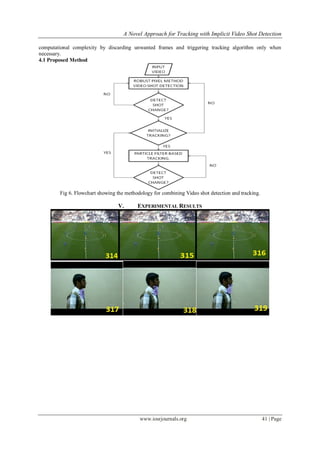
This section elaborates combining methodology of shot detection along with tracking. The proposed
model acts at two levels. The first level is Video Shot Detection, where a huge video is temporally segmented
into individual shots based on the algorithm described in Section II. The second level is particle filter based
tracking in the video sequence as described in Section III. Upon each occurrence of a shot change the Video
shot detection algorithm is interrupted and the tracking algorithm is triggered for initiation. On initiation, the
object to be tracked has to be selected manually by a mouse where the position of the object is fed to the
algorithm. If the tracking algorithm is not initiated then shot detection algorithm continues until it finds the next
shot change. The tracking algorithm, whenever active, runs in phase with video shot detection algorithm, the
detection of next shot change terminates the tracking algorithm. The algorithm again prompts the user for a
valid input either to initiate the tracking algorithm or continue the shot detection algorithm at the occurrence of
next shot change. Tracking algorithm will start from the video frame that is fed by shot detection algorithm at a
shot change. It will continue tracking the selected object until the algorithm is interrupted for termination. In a
large video data such as unedited footage of CCTV surveillance etc, this approach guarantees reduction of pre-
processing time by directly presenting the tracking algorithm, the initial frame from which tracking can be
initiated. As tracking algorithm has high computational demand, this approach greatly reduces the
A Novel Approach for Tracking with Implicit Video Shot Detection
www.iosrjournals.org 41 | Page
computational complexity by discarding unwanted frames and triggering tracking algorithm only when
necessary.
4.1 Proposed Method
Fig 6. Flowchart showing the methodology for combining Video shot detection and tracking.
V. EXPERIMENTAL RESULTS
A Novel Approach for Tracking with Implicit Video Shot Detection
www.iosrjournals.org 42 | Page
Fig 7.
In fig 7 in a transition from frame 316 to frame 317 a shot change has been detected and the user is
prompted for input to initiate the tracking algorithm when the user initializes the object, the particle filter
algorithm tracks the object continuously until the next shot change is detected. In this phase the Video shot
detection algorithm will work in phase with the tracking to detect every possible shot change. It is also observed
that tracking and video shot detection continues positively without losing the target and false shot detection
respectively even in presence of illumination changes. When the algorithm encounters frame 523 a new shot has
been detected and the tracking algorithm is asked for a decision whether to re-initiate the tracking or to
terminate it. On termination the video continues with shot detection algorithm to find the next change in shot.
VI. CONCLUSION
Tracking with implicit shot detection algorithm provides an efficient framework for temporal
segmentation and tracking in huge videos. It reduces data computational complexity to a great extent. In our
methods we have observed the merits of video shot detection using robust pixel method that is insensitive to
light sources or sudden illumination changes and its locally adaptive thresholding adds additional adaptability to
the approach. Particle filter based tracking is an promising technique in various situation and also is insensitive
to illumination changes and scaling. The advantages of both the methods makes it possible to integrate them
together to provide real-time applicable system which automatically detect shot change and also gives a chance
to track the objects of interest.
REFERENCES
[1] The computation of the bhattacharyya distance between histograms without histograms S´everine Dubuisson Laboratoire
d’Informatique de Paris 6, Universit´e Pierre et Marie Curie. Presented at: TIPR’97, Prague 9-11 June, 1997.and publiseed in
Kybernetika, 34, 4, 363-368, 1997.
[2] An Efficient Fixed-Point Implementation of Residual Resampling Scheme for High-Speed Particle Filters Sangjin Hong, Member,
IEEE, Miodrag Bolic´, Student Member, IEEE, and Petar M. Djuric´, Senior Member, IEEE IEEE SIGNAL PROCESSING
LETTERS, VOL. 11, NO. 5, MAY 2004.
[3] An adaptive color-based particle filter Katja Nummiaroa,*, Esther Koller-Meierb, Luc Van Gool Katholieke Universiteit Leuven,
ESAT/PSI-VISICS, Kasteelpark Arenberg 10, 3001 Heverlee, Belgium Swiss Federal Institute of Technology (ETH), D-ITET/BIWI,
Gloriastrasse 35, 8092 Zurich, Switzerland..
[4] A Shot Boundary Detection Technique Based On Local Color Moments In Ycbcr Color Space S.A.Angadi and Vilas Naik Natarajan
Meghanathan, et al. (Eds): SIPM, FCST, ITCA, WSE, ACSIT, CS & IT (2012)
[5] Keyframe Based Video Summarization Using Automatic Threshold & Edge Matching Rate. Mr. Sandip T. Dhagdi, Dr. P.R.
Deshmukh ,International Journal of Scientific and Research Publications, July (2012)
[6] Real-time shot detection based on motion analysis and multiple low-level techniques.Carlos Cuevas and Narciso Garcia,Grupo de
Tratamiento de Imagenes - E.T.S. Ing. Telecomunicacion (2010)

A Novel Approach for Tracking with Implicit Video Shot Detection

  • 1.
    IOSR Journal ofComputer Engineering (IOSR-JCE) e-ISSN: 2278-0661, p- ISSN: 2278-8727Volume 12, Issue 6 (Jul. - Aug. 2013), PP 36-42 www.iosrjournals.org www.iosrjournals.org 36 | Page A Novel Approach for Tracking with Implicit Video Shot Detection Kiran S1 , Amith Kamath B2 1,2 (Master of Technology, Department of Computer Science, NMIT, Bangalore, India) Abstract: Video shot detection – Shot change detection is an essential step in video content analysis. The field of Video Shot Detection (VSD) is a well exploited area. In the past, there have been numerous approaches designed to successfully detect shot boundaries for temporal segmentation. Robust Pixel Based Method is used to detect shot changes in a video sequence. Tracking algorithm is a time consuming process due to the large amount of data contained in video using the video shot detection the computational cost can be reduced to a great extent by the discarding the frames which are not of any interest for the tracking algorithm. In this paper we present a novel approach of combining the concepts of Video shot detection and Object tracking using particle filter to give us a efficient Tracking algorithm with implicit shot detection. Keywords – Bhattacharyya distance, Local adaptive threshold, Particle filter, Robust Pixel Difference method, Residual Re-sampling, Shot detection. I. INTRODUCTION The rapid development of storage and multimedia technologies has made the retrieval and processing of videos relatively easy. Temporal segmentation is a fundamental step in video processing, and shot change detection is the most basic way to achieve it. However, while hard cuts (abrupt transitions) can be easily detected by finding changes in a color histogram, gradual transitions such as dissolves, fades, and wipes are hard to locate. In practice, however, 99% of all edits fall into one of the following four categories hard cuts, fades, wipes and dissolves. Many shot change detection studies focus on finding low-level visual features, e.g., color histograms and edges, and then locate the spots of changes in those features. We focus on using Robust Pixel Method for shot detection. The conventional shot detection method using pixel wise comparison is not very efficient since it doesn’t provide noise tolerance and because of its global thresholding nature. Many scenes involving sudden illumination changes such as lighting etc false trigger a shot change in the conventional method. The robust pixel method used in this paper provides threshold for noise and also locally adaptive threshold which makes it effective in situations where the conventional method fails. Object tracking is an important task in the field of computer vision. It generates the path traced by a specified object by locating its position in each frame of the video sequence. The use of Object tracking is pertinent in many vision applications such as automated surveillance, video indexing, vehicle navigation, motion based recognition, security and defence areas. Occlusion and noise are generally the biggest problems in any target tracking implementation. Tracking algorithms robustness is a measure of how well it continues to track and when it loses its target. Tracking is the observation of person(s) or object(s) on the move and supplying a timely ordered sequence of respective location data to a model under consideration. It is the process of locating a moving human or object over time using a camera. It is based on computer vision. Image registration is the basic step used in tracking application. It is a process that finds the location where a good matching is obtained by matching the template over the searching area of an input image. Registration algorithm fails in complex situations and loses the target in presence of noise, scaling and transformation changes. To address the above mentioned problems, we use a particle filter based tracking method for efficient tracking. Video shot detection and tracking algorithms have both been extensively researched and have been used in real world applications individually. Very less effort has been made to combine the concepts of video shot detection and tracking which can be of great help in real-world as both the technologies complement each other. Combining the two concepts guarantees a computationally quicker, cost effective solution for tracking on large video database with minimal pre-processing. In this paper Section II covers the concepts of Video shot detection using robust pixel difference method and also demonstrates it effectiveness with results. Section III focuses on concepts of tracking algorithm with results. Section IV elaborates the method of combining the two approaches where tracking algorithm is initiated after every shot change hence serving its final purpose of computationally efficient shot detection cum tracking system.
  • 2.
    A Novel Approachfor Tracking with Implicit Video Shot Detection www.iosrjournals.org 37 | Page II. VIDEO SHOT DETECTION 1.1 Robust Pixel Method(Rpm) In Robust Pixel Method, we consider a Metric M, computed for each Video Frame. Defined as:  ji K ji KK HW IIM , , 1 1 )(  where Ik and Ik-1 are each pair of consecutive images to be compared. H and W are the image height and width.(i; j) are the coordinates of each one of the pixels in the image. And ρ is:           otherwise IsignIsignTIf IsignIsignTIif KK ji KK jin KK ji KK ji KK jin KK ji K ji 0 )()(&||1 )()(&||1 11 ,,, 11 ,,, ,    where µk is the mean value of the image Ik, and Tn is a noise threshold (Heuristically set to Tn = 2). Between two consecutive images belonging to the same shot, a large amount of pixels change their values when there is a sudden illumination change. Conventional pixel-based method computes a large difference between and falsely classify the images as a transition or shot change. This limitation is addressed by computing the above mentioned metric M, as all the pixels in an image change the intensity evenly in case of sudden illumination change. Therefore, if the difference between pixel values and the mean of the image is computed, for each one of the two consecutive images, no significant variations occur for pixels. Robustness to sudden illumination changes is achieved by using Metric M for purpose of Shot Change detection. The Noise threshold Tn takes care of any noise distortions in images. 1.2 Locally ADAPTIVE THRESHOLDING Conventional Pixel difference method uses a Global Threshold value which is computed using the mean and standard deviation of the Pixel Difference values for the entire video, this threshold is often too High ( does not detect many shot changes that are actually present in the video) or too Low (Falsely Detects shot changes).In Robust Pixel Method it is necessary to use a locally adaptive threshold value, to overcome false detections, or missed shot changes [5]. Therefore we can consider a window of 20 frames ( as not more than 1 shot change occurs in a window of 20 frames) as Tw, for which we adaptively compute a threshold, and detect if there has been a shot change or not. We consider the Value of Metric M for every frame between Ia and Ia+Tw to set the threshold. The two local minimum values of M between Ia and Ia+Tw are identified as M min1 and Mmin2. The shot is classified as a shot Change only if: iveLocalAdaptTMM  || 2min1min Where T Local Adaptive is heuristically set to 0.3. 1.3 RESULTS Fig 1. Test Data set to demonstrate the effectiveness of robust pixel method.
  • 3.
    A Novel Approachfor Tracking with Implicit Video Shot Detection www.iosrjournals.org 38 | Page Fig 2. Graph of conventional pixel difference for above test video Conventional Pixel Difference Method Falsely Detects 7 shots, due to the sudden change of intensity in the video. Fig 3. Graph of Robust pixel difference for above test video sequence Robust Pixel Difference Method does not detect any false shot changes which occur due to sudden change in global illumination. Hence this method is more robust and resistant to sudden intensity changes [6]. III. PARTICLE FILTER BASED TRACKING Particle filtering has emerged recently in the domain of computer vision. Particle Filter is concerned with the problem of tracking single and multiple objects. It is a hypothesis tracker that is intended to explain certain observations, that approximates the filtered posterior distribution by a set of weighted particles. It weights the particles based on the likelihood score and propagates them according to the motion model used The advantage of particle filter over other types of filters (Kalman, Extended Kalman, etc.) is that it allows for a state space representation of any distribution. It also allows for non-linear, non-Gaussian models and processes. Particle Filter is concerned with the problem of tracking single or multiple objects. It is a hypothesis tracker that is intended to explain certain observations, that approximates the filtered posterior distribution by a set of weighted particles. It weights the particles based on the likelihood score and propagates them according to the motion model used. Particle filter algorithm is a popular substitute for the Kalman filter in presence of non-Gaussianity of the noise statistics and non-linearity of the relationships between consecutive state. Particle Filter is a promising technique because of its inherent property that cope up with data association problems, account for certain uncertainties, also allows fusion of other algorithms and data. The algorithm for Particle filter based tracking is shown below. 1.4 STEPS i. Select the number of samples(particles). ii. Select the target to track and initiate the start point. iii. Generate a randomly distributed uniform number of particles around the start point. iv. Observe the color distribution.
  • 4.
    A Novel Approachfor Tracking with Implicit Video Shot Detection www.iosrjournals.org 39 | Page v. Calculate the RGB color distribution from each sample of the set. vi. Then calculate the Bhattacharyya coefficient for each sample of the set ‘s’. vii. Weight each sample. viii. Resample these samples using residual Re-Sampling. ix. Iterate these steps. Fig 4. Flowchart of Particle filter based tracking algorithm The tracking algorithm employs color model based particle filter. It integrates the Color distribution into particle filtering. [3] They are applied as they are robust to partial occlusion, are rotation and scale invariant and computationally efficient. The observation model of particle filter is defined by the Color information of the tracked object. This model is compared to hypotheses of the grey model particle filter using the Bhattachayya coefficient. Color histograms in particular have many advantages for tracking non-rigid objects as they are robust to partial occlusion, are rotation and scale invariant and are calculated efficiently. A target model is tracked using particle filter by comparing its histogram with the histograms of the sample positions using the Bhattacharyya distance and further Re-Sampling them. A complete segmentation of the image is not required as the image content only needs to be evaluated at the sample positions. We apply such a particle filter in a color- based context. To achieve robustness against non-rigidity, rotation and partial occlusion we focus on color distributions as target models. These are represented by histograms which are produced with the function h(xi), that assigns one of the m-bins to a given color at location (xi). The histograms are typically calculated in the RGB space using 8x8x8 bins. To weight the sample set, the Bhattacharyya coefficient has to be computed between the target distribution and distribution of hypotheses in RGB color space. Bhattacharyya coefficient or the Bhattacharyya distance [1], measure the similarity of two continuous probability distributions. The coefficient can be used to determine the relative closeness of the two samples being considered. Eqn 1: Bhattacharyya distance measure The measurement process is based on histogram similarity: the target histogram is compared with that of other candidate patches extracted from last captured frame and the most similar one is chosen. The similarity measure is directly computed over the entire sample point sets. The affinities between all pairs of sample points are considered based on their distances. We can compute the similarity measure between target model and candidate model by applying distance measure methods. The value obtained from the distance measure for every particle set is called the score. They are used to represent and predict the next match point. The particles Compute the weight 1 2 3 n Initialize the object Initialize the particles Generate the particles 1 2 n3 Re-Sampling. Exit More observations Output the estimate points Outpu t Normalize the weights
  • 5.
    A Novel Approachfor Tracking with Implicit Video Shot Detection www.iosrjournals.org 40 | Page set are to be re-sampled to select and re-generate the particles around the target location to keep the tracking process intact. This avoids particle degeneracy. Residual re-sampling method is used in our algorithm [2]. The algorithm for Residual Re-Sampling is shown below Input: Match Values, Score points Output: Re-sampled particles 1.5 STEPS FOR RESIDUAL RE-SAMPLING i. Calculate the sum of scores and select the maximum score. ii. Select the index of the particle with maximum score. iii. Normalize all the weights of the particles to the sum of scores. iv. Initialize the Index with Integer part. v. Select only the particles with particles greater than 1. vi. Generate random particles around the particle with maximum score with existing particles. The above steps[2] give only those selected particles that assist to predict the object in further frames. The particles will be re-generated at each frame for prediction. After re-sampling step the algorithm again runs observation part calculates scores and re-samples them. These steps run iteratively. Even when re-sampling steps is in progress at some time few particles having low weights tends to be discarded hence to maintain the number of particles, the remaining number of particles that are discarded has to be randomly re-generated. 1.6 RESULTS Below shown are the results of particle filter based tracking algorithm that uses HSV color model to show is insensitivity to light changes taken in an indoor environment with illumination changes, it uses remainder re-sampling for regeneration of particles. The algorithm provides satisfactory results and is test for videos that has various light changes, scaling and rotation. Fig 5. Output of Particle Filter based tracking algorithm on the sequence of video frames with illumination changes. IV. COMBINING OF VIDEO SHOT DETECTION AND TRACKING ALGORITHM This section elaborates combining methodology of shot detection along with tracking. The proposed model acts at two levels. The first level is Video Shot Detection, where a huge video is temporally segmented into individual shots based on the algorithm described in Section II. The second level is particle filter based tracking in the video sequence as described in Section III. Upon each occurrence of a shot change the Video shot detection algorithm is interrupted and the tracking algorithm is triggered for initiation. On initiation, the object to be tracked has to be selected manually by a mouse where the position of the object is fed to the algorithm. If the tracking algorithm is not initiated then shot detection algorithm continues until it finds the next shot change. The tracking algorithm, whenever active, runs in phase with video shot detection algorithm, the detection of next shot change terminates the tracking algorithm. The algorithm again prompts the user for a valid input either to initiate the tracking algorithm or continue the shot detection algorithm at the occurrence of next shot change. Tracking algorithm will start from the video frame that is fed by shot detection algorithm at a shot change. It will continue tracking the selected object until the algorithm is interrupted for termination. In a large video data such as unedited footage of CCTV surveillance etc, this approach guarantees reduction of pre- processing time by directly presenting the tracking algorithm, the initial frame from which tracking can be initiated. As tracking algorithm has high computational demand, this approach greatly reduces the
  • 6.
    A Novel Approachfor Tracking with Implicit Video Shot Detection www.iosrjournals.org 41 | Page computational complexity by discarding unwanted frames and triggering tracking algorithm only when necessary. 4.1 Proposed Method Fig 6. Flowchart showing the methodology for combining Video shot detection and tracking. V. EXPERIMENTAL RESULTS
  • 7.
    A Novel Approachfor Tracking with Implicit Video Shot Detection www.iosrjournals.org 42 | Page Fig 7. In fig 7 in a transition from frame 316 to frame 317 a shot change has been detected and the user is prompted for input to initiate the tracking algorithm when the user initializes the object, the particle filter algorithm tracks the object continuously until the next shot change is detected. In this phase the Video shot detection algorithm will work in phase with the tracking to detect every possible shot change. It is also observed that tracking and video shot detection continues positively without losing the target and false shot detection respectively even in presence of illumination changes. When the algorithm encounters frame 523 a new shot has been detected and the tracking algorithm is asked for a decision whether to re-initiate the tracking or to terminate it. On termination the video continues with shot detection algorithm to find the next change in shot. VI. CONCLUSION Tracking with implicit shot detection algorithm provides an efficient framework for temporal segmentation and tracking in huge videos. It reduces data computational complexity to a great extent. In our methods we have observed the merits of video shot detection using robust pixel method that is insensitive to light sources or sudden illumination changes and its locally adaptive thresholding adds additional adaptability to the approach. Particle filter based tracking is an promising technique in various situation and also is insensitive to illumination changes and scaling. The advantages of both the methods makes it possible to integrate them together to provide real-time applicable system which automatically detect shot change and also gives a chance to track the objects of interest. REFERENCES [1] The computation of the bhattacharyya distance between histograms without histograms S´everine Dubuisson Laboratoire d’Informatique de Paris 6, Universit´e Pierre et Marie Curie. Presented at: TIPR’97, Prague 9-11 June, 1997.and publiseed in Kybernetika, 34, 4, 363-368, 1997. [2] An Efficient Fixed-Point Implementation of Residual Resampling Scheme for High-Speed Particle Filters Sangjin Hong, Member, IEEE, Miodrag Bolic´, Student Member, IEEE, and Petar M. Djuric´, Senior Member, IEEE IEEE SIGNAL PROCESSING LETTERS, VOL. 11, NO. 5, MAY 2004. [3] An adaptive color-based particle filter Katja Nummiaroa,*, Esther Koller-Meierb, Luc Van Gool Katholieke Universiteit Leuven, ESAT/PSI-VISICS, Kasteelpark Arenberg 10, 3001 Heverlee, Belgium Swiss Federal Institute of Technology (ETH), D-ITET/BIWI, Gloriastrasse 35, 8092 Zurich, Switzerland.. [4] A Shot Boundary Detection Technique Based On Local Color Moments In Ycbcr Color Space S.A.Angadi and Vilas Naik Natarajan Meghanathan, et al. (Eds): SIPM, FCST, ITCA, WSE, ACSIT, CS & IT (2012) [5] Keyframe Based Video Summarization Using Automatic Threshold & Edge Matching Rate. Mr. Sandip T. Dhagdi, Dr. P.R. Deshmukh ,International Journal of Scientific and Research Publications, July (2012) [6] Real-time shot detection based on motion analysis and multiple low-level techniques.Carlos Cuevas and Narciso Garcia,Grupo de Tratamiento de Imagenes - E.T.S. Ing. Telecomunicacion (2010)