POORNIMA COLLEGE OF
ENGINEERING
JAIPUR

Training Presentation
on
IRIS SCANNER
at
MANTRA SOFT TECH.
Submitted by:
Rajvrit Singh
ECE 4th yr 7th sem.
www.powerpointpresentationon.blogspot.com
•
•
•
•
•
•
•
•

Company profile
Introduction
Working of Iris Scanner
Iris performance
Advantages
Applications
Software required
Conclusion
• Mantra Softech (India) Pvt Ltd is a leader in Biometric security
and Business solutions. Automated Fingerprint Identification
System(AFIS) and Iris identification search matching are the
primary products of Mantra Technologies.
• Established in 2002, the Mantra Softech (India) Pvt Ltd
develops identity management and access control solutions for
the information security requirements of large and medium
sized organizations. In addition to the standard access
protection systems in common use such as passwords, smart
cards, solutions offered by Mantra Softech (India) Pvt Ltd also
include sophisticated biometric identification systems.
• Mr. Sachin Verma (Director)
• Mr. Jignesh Prajapati (HR Manager)
• Mr. Vikash Verma (Training Coordinator)
• Mr. Keyur Patel (Training Coordinator)
•
•
•
•
•
•
•

Ahmedabad
Bangalore
Jaipur
Surat
Delhi
Mumbai
Uk
• Biometrics is the science of measuring physical
or anatomical characteristics of individuals.
• It performs automatic identification of a person
based on his/her physiological characteristics.
• Iris Recognition
• Fingerprint Recognition
• Voice Recognition
• Signature Recognition
• Face Recognition
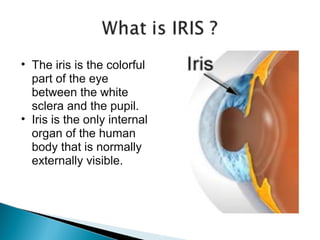
• The iris is the colorful
part of the eye
between the white
sclera and the pupil.
• Iris is the only internal
organ of the human
body that is normally
externally visible.
• The iris identification program may be divided into
four main functional blocks:
1.Image Acquisition.
• Preprocessing.
• Image Analysis.
• Image Recognition.
• The acquired image always not only “useful” parts
(IRIS), but also some “irrelevant” parts
e.g. eyelid, pupil .
1.So the preprocessing is composed of two steps:
2.Iris Localization.
• Edge Detection.
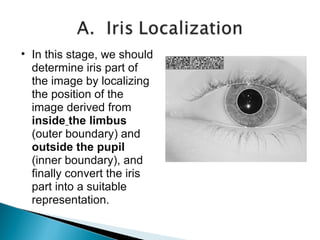
• In this stage, we should
determine iris part of
the image by localizing
the position of the
image derived from
inside the limbus
(outer boundary) and
outside the pupil
(inner boundary), and
finally convert the iris
part into a suitable
representation.
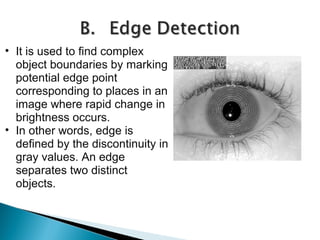
• It is used to find complex
object boundaries by marking
potential edge point
corresponding to places in an
image where rapid change in
brightness occurs.
• In other words, edge is
defined by the discontinuity in
gray values. An edge
separates two distinct
objects.
• The features of the iris are then analyzed and
digitized into a 512 byte (4096 bits) Iris Code
record.
• In this iris code half of the describes the features
and another half of the describes the control the
comparison process.
• Iris code record is stored in the database for future
comparison
• During a recognition attempt, when an iris is
presented at a recognition point, the same process
is repeated ; however the resulting Iris Code
record is not stored but is compared to every file in
the database.
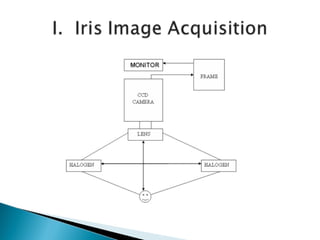
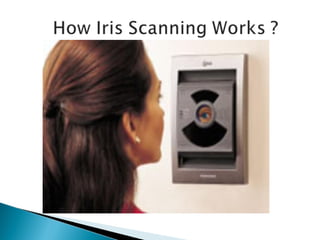
1. A person stands in front of the iris identification system,
between one and three feet away, while a wide angle
camera calculates the position of their eye.
2. A second camera zooms in on the eye and takes a
black and white image.
3. Once the iris is in focus, it overlays a circular grid on the
image of the iris and identifies the light and dark areas,
like an “eye print”.
4. To prevent a fake eye from being used to fool system,
these devices may very the light shone into the eye and
watch for pupil dilation.
• FAR - As low as 1 in 1,000,000
• FRR –around 2%
1.Highly Protected Internal Organ Of The Eye.
2.Externally Visible Patterns Imaged From A
Distance.
3.Pattern Apparently Stable Throughout The Life.
4.Image Analysis And Encoding Time: 1 Seconds.
5.Search Speed: 1,00,000 Iris Code Per Second.
1. Computer login: the iris as a living password.
2. National border controls: the iris as a living passport.
3. Driving licenses and personal certificates.
4. Internet security.
5. Premises access control (Home, Office, Laboratory).
6. Anti-terrorism (e.g. security screening at airports)
7. Financial Transactions (electronic commerce and
banking).
8. Secure accesses to bank cash machine accounts.
• Iris recognition system 1.0
• Iris application server 2.0
• Iris 3D 1.0.8
• Biometric technology has great potential
• There are many biometric products around,
regarding the different biometric technologies
• Since September 11th, biometric products are
pushed forward
• Shortcomings of biometric systems due to
o Manufacturers ignorance of security concerns
o Lack of quality control
o Standardisation problems
• Manufacturers have to take security concerns
serious
 IRIS Scaner

IRIS Scaner

  • 1.
    POORNIMA COLLEGE OF ENGINEERING JAIPUR TrainingPresentation on IRIS SCANNER at MANTRA SOFT TECH. Submitted by: Rajvrit Singh ECE 4th yr 7th sem. www.powerpointpresentationon.blogspot.com
  • 2.
    • • • • • • • • Company profile Introduction Working ofIris Scanner Iris performance Advantages Applications Software required Conclusion
  • 3.
    • Mantra Softech(India) Pvt Ltd is a leader in Biometric security and Business solutions. Automated Fingerprint Identification System(AFIS) and Iris identification search matching are the primary products of Mantra Technologies. • Established in 2002, the Mantra Softech (India) Pvt Ltd develops identity management and access control solutions for the information security requirements of large and medium sized organizations. In addition to the standard access protection systems in common use such as passwords, smart cards, solutions offered by Mantra Softech (India) Pvt Ltd also include sophisticated biometric identification systems.
  • 4.
    • Mr. SachinVerma (Director) • Mr. Jignesh Prajapati (HR Manager) • Mr. Vikash Verma (Training Coordinator) • Mr. Keyur Patel (Training Coordinator)
  • 5.
  • 6.
    • Biometrics isthe science of measuring physical or anatomical characteristics of individuals. • It performs automatic identification of a person based on his/her physiological characteristics.
  • 7.
    • Iris Recognition •Fingerprint Recognition • Voice Recognition • Signature Recognition • Face Recognition
  • 8.
    • The irisis the colorful part of the eye between the white sclera and the pupil. • Iris is the only internal organ of the human body that is normally externally visible.
  • 9.
    • The irisidentification program may be divided into four main functional blocks: 1.Image Acquisition. • Preprocessing. • Image Analysis. • Image Recognition.
  • 11.
    • The acquiredimage always not only “useful” parts (IRIS), but also some “irrelevant” parts e.g. eyelid, pupil . 1.So the preprocessing is composed of two steps: 2.Iris Localization. • Edge Detection.
  • 12.
    • In thisstage, we should determine iris part of the image by localizing the position of the image derived from inside the limbus (outer boundary) and outside the pupil (inner boundary), and finally convert the iris part into a suitable representation.
  • 13.
    • It isused to find complex object boundaries by marking potential edge point corresponding to places in an image where rapid change in brightness occurs. • In other words, edge is defined by the discontinuity in gray values. An edge separates two distinct objects.
  • 14.
    • The featuresof the iris are then analyzed and digitized into a 512 byte (4096 bits) Iris Code record. • In this iris code half of the describes the features and another half of the describes the control the comparison process.
  • 15.
    • Iris coderecord is stored in the database for future comparison • During a recognition attempt, when an iris is presented at a recognition point, the same process is repeated ; however the resulting Iris Code record is not stored but is compared to every file in the database.
  • 17.
    1. A personstands in front of the iris identification system, between one and three feet away, while a wide angle camera calculates the position of their eye. 2. A second camera zooms in on the eye and takes a black and white image. 3. Once the iris is in focus, it overlays a circular grid on the image of the iris and identifies the light and dark areas, like an “eye print”. 4. To prevent a fake eye from being used to fool system, these devices may very the light shone into the eye and watch for pupil dilation.
  • 18.
    • FAR -As low as 1 in 1,000,000 • FRR –around 2%
  • 19.
    1.Highly Protected InternalOrgan Of The Eye. 2.Externally Visible Patterns Imaged From A Distance. 3.Pattern Apparently Stable Throughout The Life. 4.Image Analysis And Encoding Time: 1 Seconds. 5.Search Speed: 1,00,000 Iris Code Per Second.
  • 20.
    1. Computer login:the iris as a living password. 2. National border controls: the iris as a living passport. 3. Driving licenses and personal certificates. 4. Internet security. 5. Premises access control (Home, Office, Laboratory). 6. Anti-terrorism (e.g. security screening at airports) 7. Financial Transactions (electronic commerce and banking). 8. Secure accesses to bank cash machine accounts.
  • 21.
    • Iris recognitionsystem 1.0 • Iris application server 2.0 • Iris 3D 1.0.8
  • 22.
    • Biometric technologyhas great potential • There are many biometric products around, regarding the different biometric technologies • Since September 11th, biometric products are pushed forward • Shortcomings of biometric systems due to o Manufacturers ignorance of security concerns o Lack of quality control o Standardisation problems • Manufacturers have to take security concerns serious