OBJECTIVES
TO KNOW ABOUT DIFFERENT TYPES
OF SCANNER
TO UNDERSTAND THEIR WORKING
PRINCIPLE
What is Scanner?
Scanner is device that optically scans
images, printed texts, handwriting, or an
object and converts it into digital image.
The first scanner developed for use with a computer,
was a drum scanner .
It was built in 1957 at the US National Bureau of
Standards by a team led by Russell A. Kirsch, working
on America's first internally programmable (stored-
program) computer, the Standards Eastern Automatic
Computer (SEAC).
TYPES OF SCANNER
BARCODE SCANNER
FLATBED SCANNER
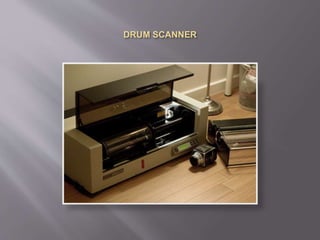
DRUM SCANNER
HANDHELD SCANNER
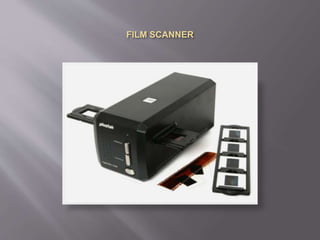
FILM SCANNER
1= Led/Fluorescent Light emitter
2= Barcodes
3= Photoelectric cell
4= CCD(Charge Coupled Device)
5= Computer
1A bar code consists of white and black bars. Data retrieval is achieved when
bar code scanners shine a light at a bar code, capture the reflected light and
replace the black and white bars with binary digital signals.
2 Reflections are strong in white areas and weak in black areas. A sensor
receives reflections to obtain analog waveforms.
3 The analog signal is converted into a digital signal via an A/D converter.
(Binarization)
4 Data retrieval is achieved when a code system is determined from the
digital signal obtained. (Decoding process)
UPC (universal product code)
LASER METHOD
Laser light is shone on the label
surface and its reflection is captured
by a sensor (laser photo detector) to
read a bar code. A laser beam is
reflected off a mirror and swept left
and right to read a bar code
Using laser allows reading of
distant and wide bar code labels.
PEN METHOD
This method only has a LED
light source and a sensor to
capture its reflection. Since a
person moves a scanner to read a
bar code, practice is required for
operation.
The mechanism is simple,
making this method
inexpensive.
CCD METHOD
The CCD method bar code
scanner has a built-in light. A
scanner shines this light at a bar
code and its reflection is
captured via CCD for reading.
A bar code is captured once,
allowing fast reading. There are
no movable parts and impact
resistance is excellent.
Along with the glass bed, the scanner has a source of light, which is in-built.
Most commonly the light used is LED or fluorescent. This light is regulated by
a voltage regulator or a similar device. This enables the light to spread evenly
across the document.
This light source then illuminates the document, this is when the actual
encoding of the document takes place. The scanner contains a lens, mirror a
filter and a CCD array, that are fixed on the top, called the scan head. This
combined mechanism then rolls or moves over the entire document. The scan
head takes help of a belt.
The scan head is fixed to a bar that acts like a stabilizer. So the entire process
takes place smoothly, without any wobble or deviation.
An angled mirror then reflects the image of the document, on another mirror.
After the image is reflected on this second mirror, it gets reflected again on the
lens.
This lens then projects the captured image on to the CCD array, through a filter.
Scanner
Scanner
Scanner
Scanner

Scanner

  • 2.
    OBJECTIVES TO KNOW ABOUTDIFFERENT TYPES OF SCANNER TO UNDERSTAND THEIR WORKING PRINCIPLE
  • 3.
    What is Scanner? Scanneris device that optically scans images, printed texts, handwriting, or an object and converts it into digital image.
  • 4.
    The first scannerdeveloped for use with a computer, was a drum scanner . It was built in 1957 at the US National Bureau of Standards by a team led by Russell A. Kirsch, working on America's first internally programmable (stored- program) computer, the Standards Eastern Automatic Computer (SEAC).
  • 5.
    TYPES OF SCANNER BARCODESCANNER FLATBED SCANNER DRUM SCANNER HANDHELD SCANNER FILM SCANNER
  • 8.
    1= Led/Fluorescent Lightemitter 2= Barcodes 3= Photoelectric cell 4= CCD(Charge Coupled Device) 5= Computer
  • 9.
    1A bar codeconsists of white and black bars. Data retrieval is achieved when bar code scanners shine a light at a bar code, capture the reflected light and replace the black and white bars with binary digital signals. 2 Reflections are strong in white areas and weak in black areas. A sensor receives reflections to obtain analog waveforms. 3 The analog signal is converted into a digital signal via an A/D converter. (Binarization) 4 Data retrieval is achieved when a code system is determined from the digital signal obtained. (Decoding process)
  • 10.
  • 12.
  • 13.
    Laser light isshone on the label surface and its reflection is captured by a sensor (laser photo detector) to read a bar code. A laser beam is reflected off a mirror and swept left and right to read a bar code Using laser allows reading of distant and wide bar code labels.
  • 14.
  • 15.
    This method onlyhas a LED light source and a sensor to capture its reflection. Since a person moves a scanner to read a bar code, practice is required for operation. The mechanism is simple, making this method inexpensive.
  • 16.
  • 17.
    The CCD methodbar code scanner has a built-in light. A scanner shines this light at a bar code and its reflection is captured via CCD for reading. A bar code is captured once, allowing fast reading. There are no movable parts and impact resistance is excellent.
  • 20.
    Along with theglass bed, the scanner has a source of light, which is in-built. Most commonly the light used is LED or fluorescent. This light is regulated by a voltage regulator or a similar device. This enables the light to spread evenly across the document. This light source then illuminates the document, this is when the actual encoding of the document takes place. The scanner contains a lens, mirror a filter and a CCD array, that are fixed on the top, called the scan head. This combined mechanism then rolls or moves over the entire document. The scan head takes help of a belt. The scan head is fixed to a bar that acts like a stabilizer. So the entire process takes place smoothly, without any wobble or deviation. An angled mirror then reflects the image of the document, on another mirror. After the image is reflected on this second mirror, it gets reflected again on the lens. This lens then projects the captured image on to the CCD array, through a filter.