BASICS OF IPv6 JUBIN AGHARA
Tropics
 Its Need
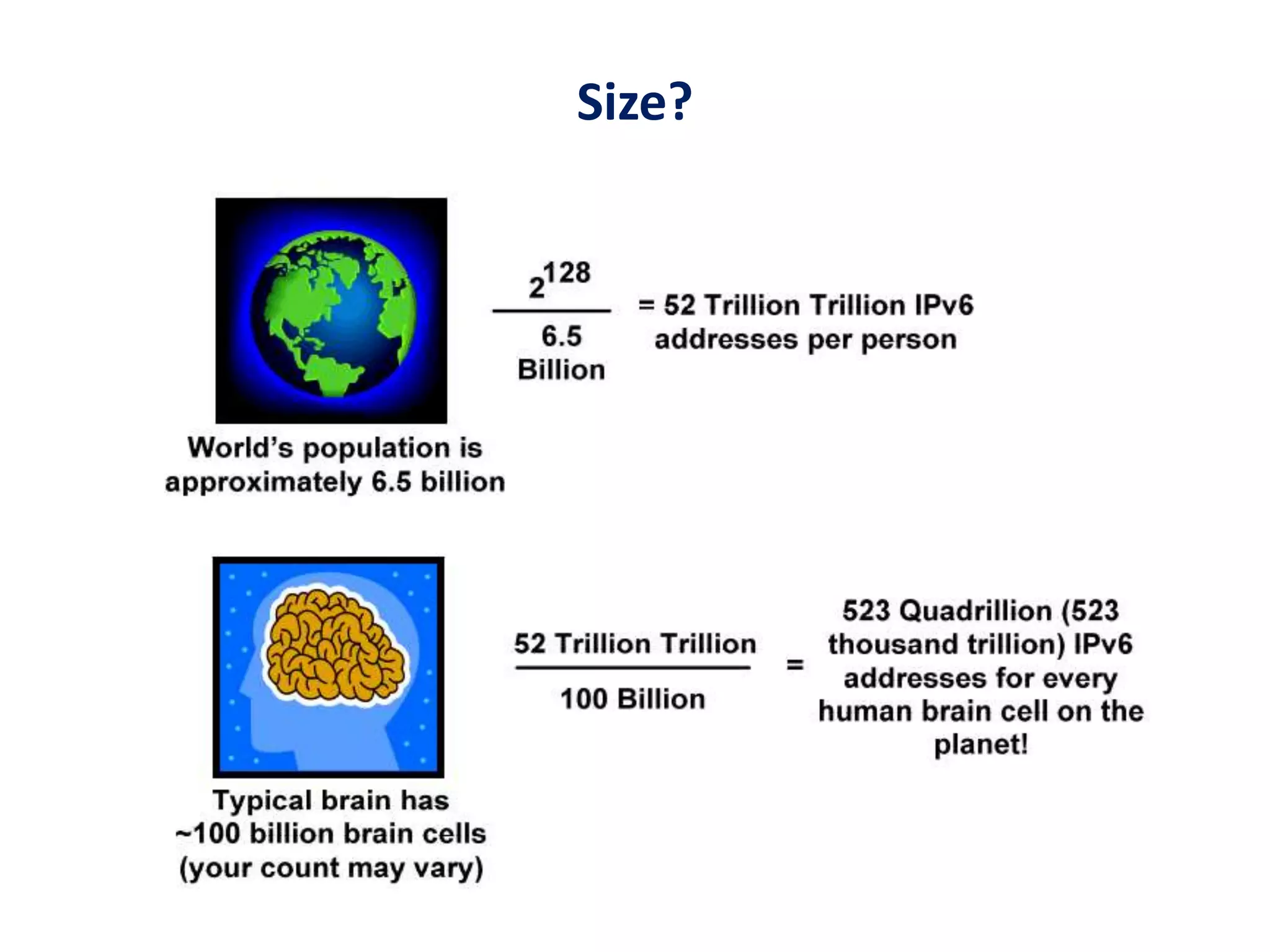
 IPv6 Size Comparison
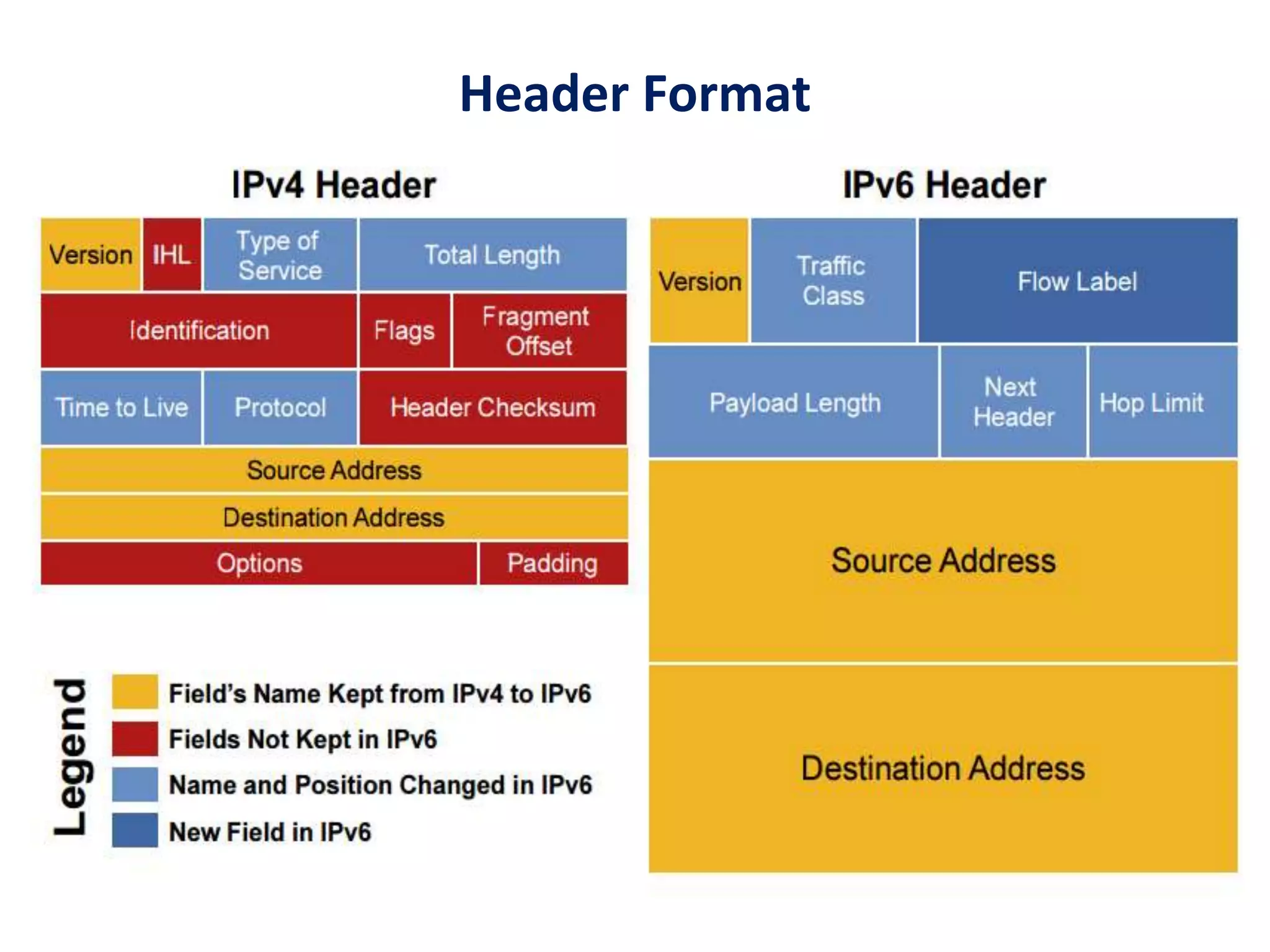
 Header Format
 IPv6 Addressing Format
 Prefix Presentation and CIDR Notation
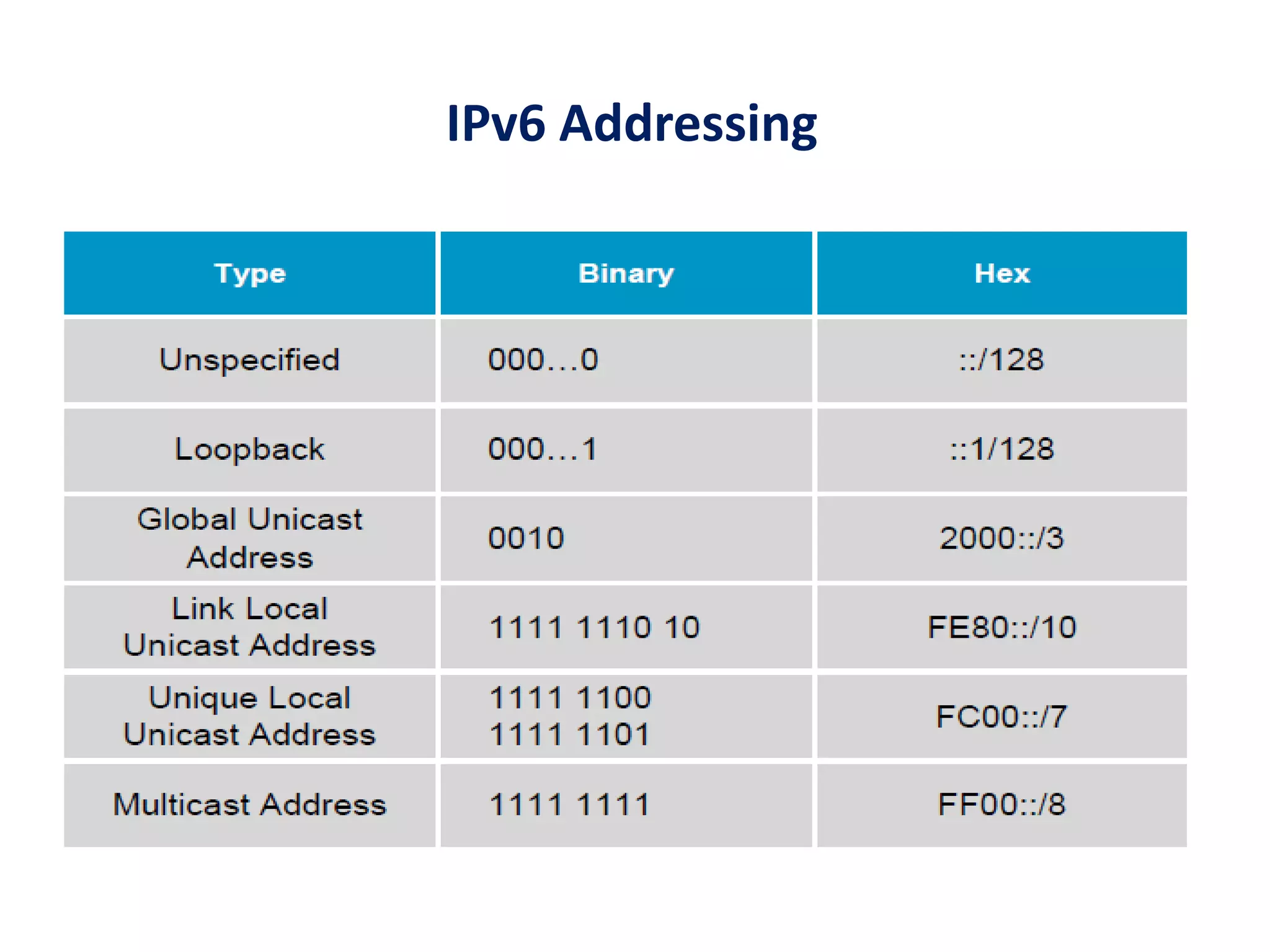
 IPv6 Addressing types
 IPv6 Address Allocation
 Interface ID
 Subnetting
 Host Configuration
Need of IPV6
 IETF IPv6 working group began in early 90s, to solve
addressing growth issues, but CIDR, NAT were developed to
fix the shortage of IPv4 address.
 IPv4 32 bit address = 4 billion hosts
 40% of the IPv4 address space is still unused which is
different from unallocated.
 The rising of Internet connected device, IoT, IoE and
appliance will eventually deplete the IPv4 address space.
 IP is everywhere, Data, voice, audio and video integration is
a reality.
 So, only compelling reason: More IP addresses
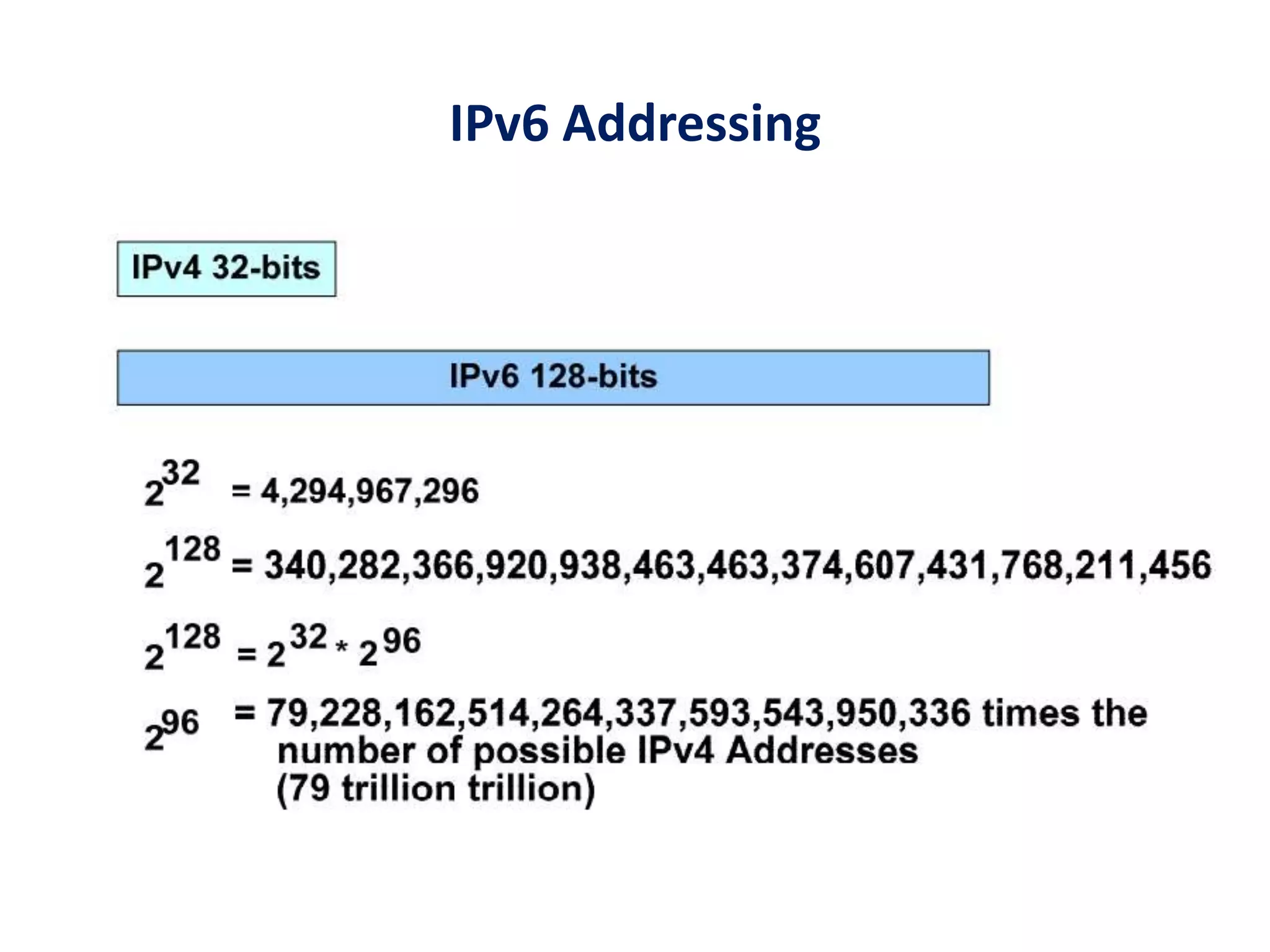
IPv6 Addressing
Size?
Header Format
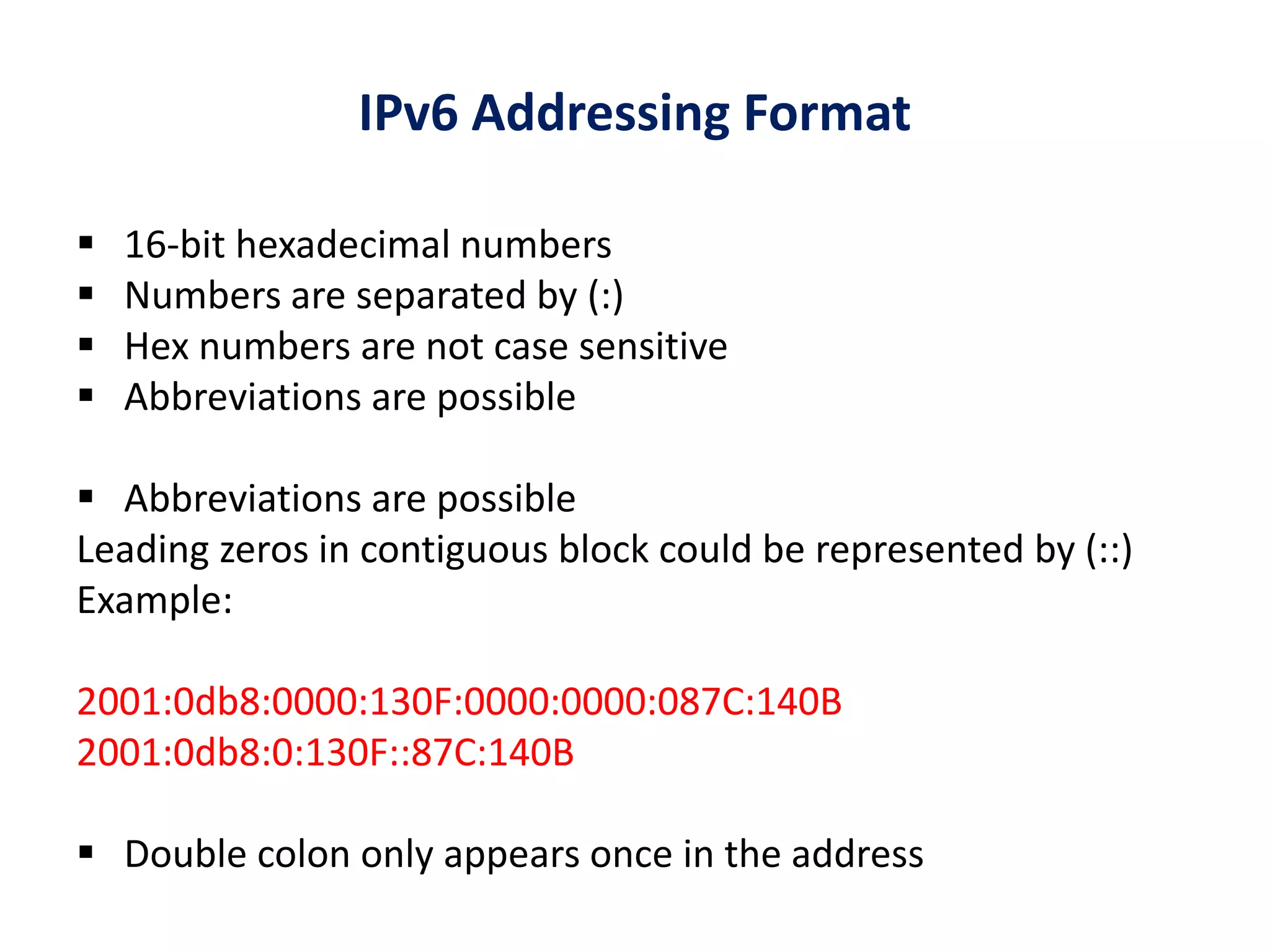
IPv6 Addressing Format
 16-bit hexadecimal numbers
 Numbers are separated by (:)
 Hex numbers are not case sensitive
 Abbreviations are possible
Leading zeros in contiguous block could be represented by (::)
Example:
2001:0db8:0000:130F:0000:0000:087C:140B
2001:0db8:0:130F::87C:140B
 Double colon only appears once in the address
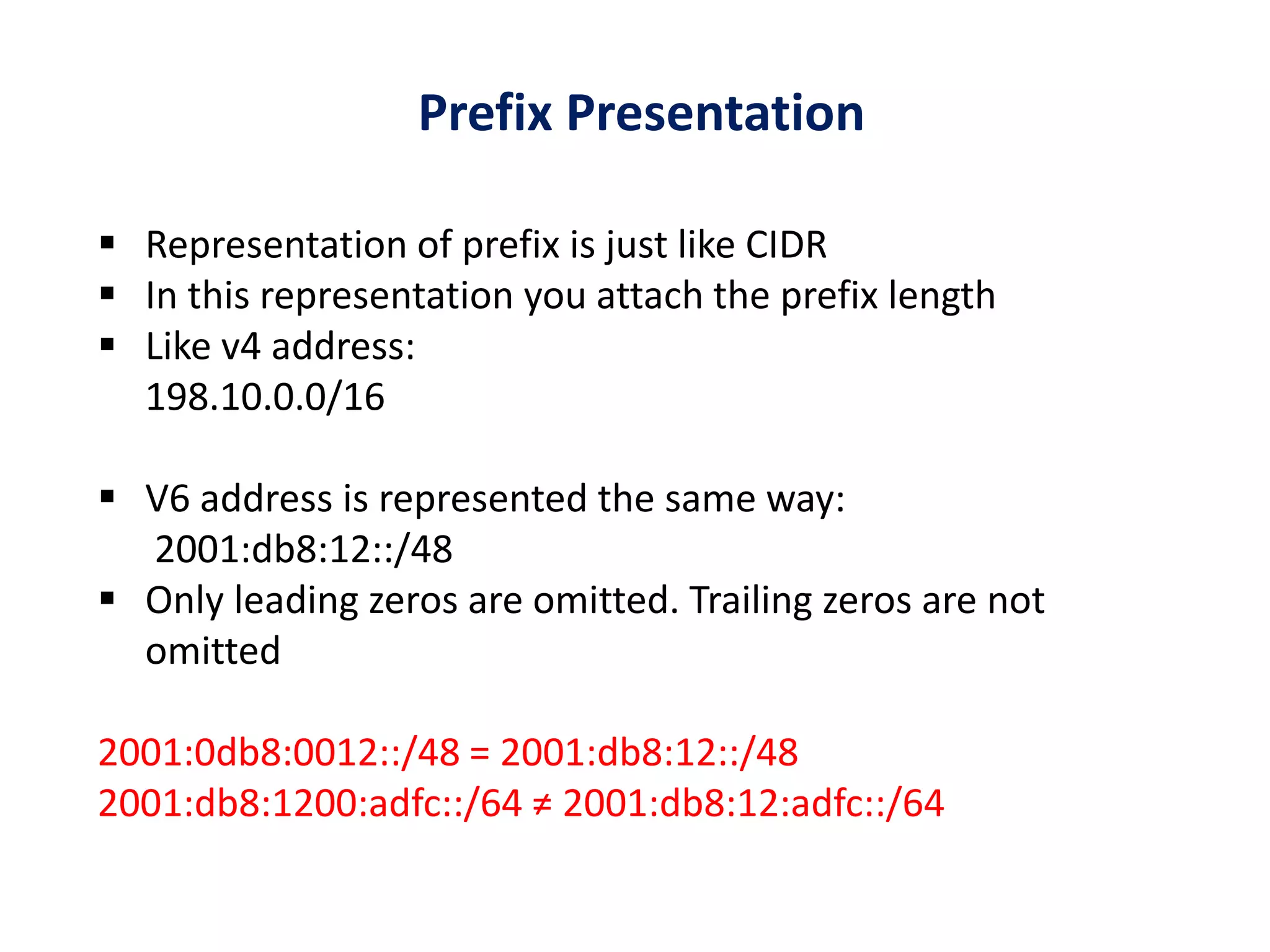
Prefix Presentation
 Representation of prefix is just like CIDR
 In this representation you attach the prefix length
 Like v4 address:
198.10.0.0/16
 V6 address is represented the same way:
2001:db8:12::/48
 Only leading zeros are omitted. Trailing zeros are not
omitted
2001:0db8:0012::/48 = 2001:db8:12::/48
2001:db8:1200:adfc::/64 ≠ 2001:db8:12:adfc::/64
IPv6 Addressing
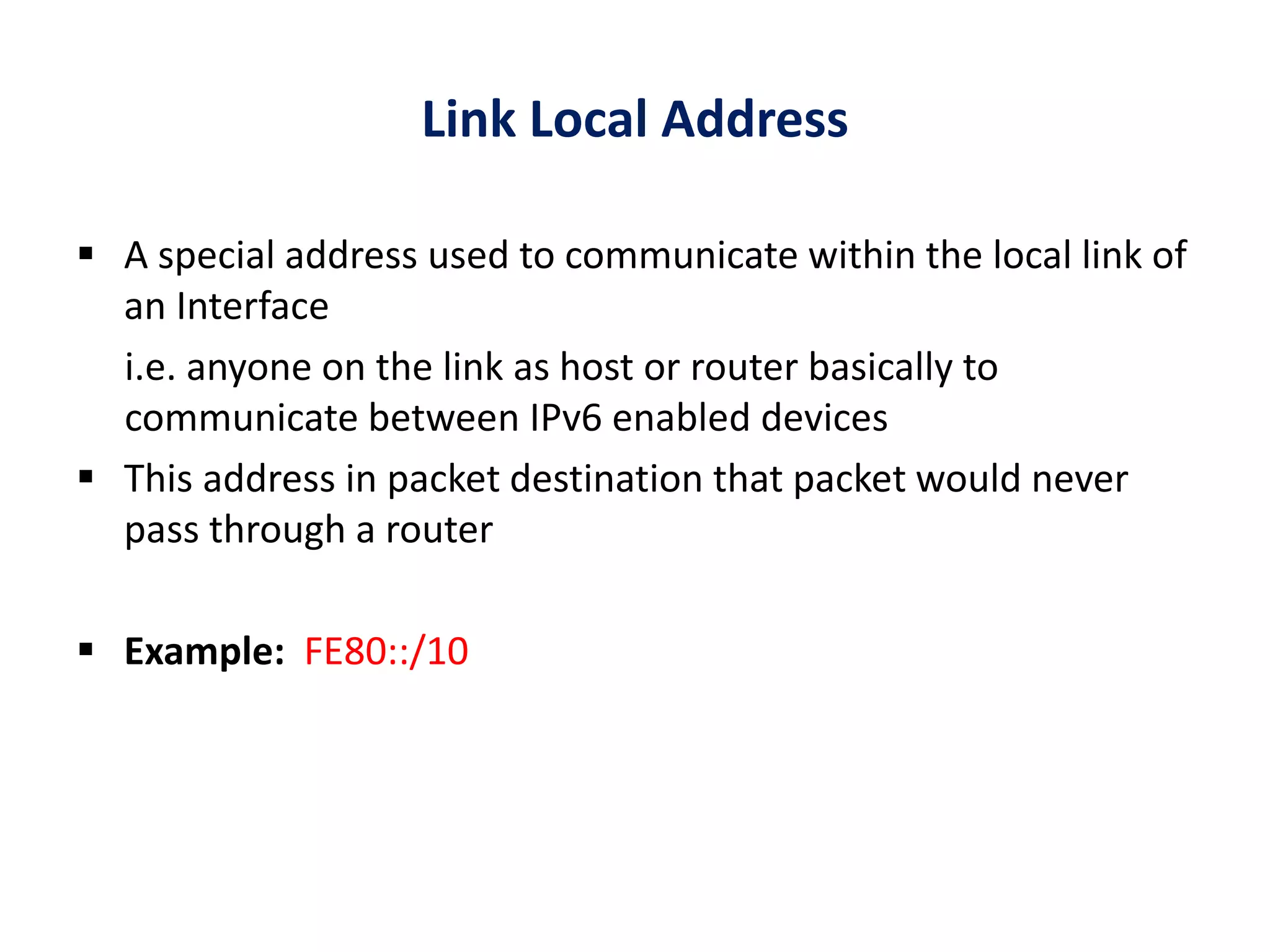
Link Local Address
 A special address used to communicate within the local link of
an Interface
i.e. anyone on the link as host or router basically to
communicate between IPv6 enabled devices
 This address in packet destination that packet would never
pass through a router
 Example: FE80::/10
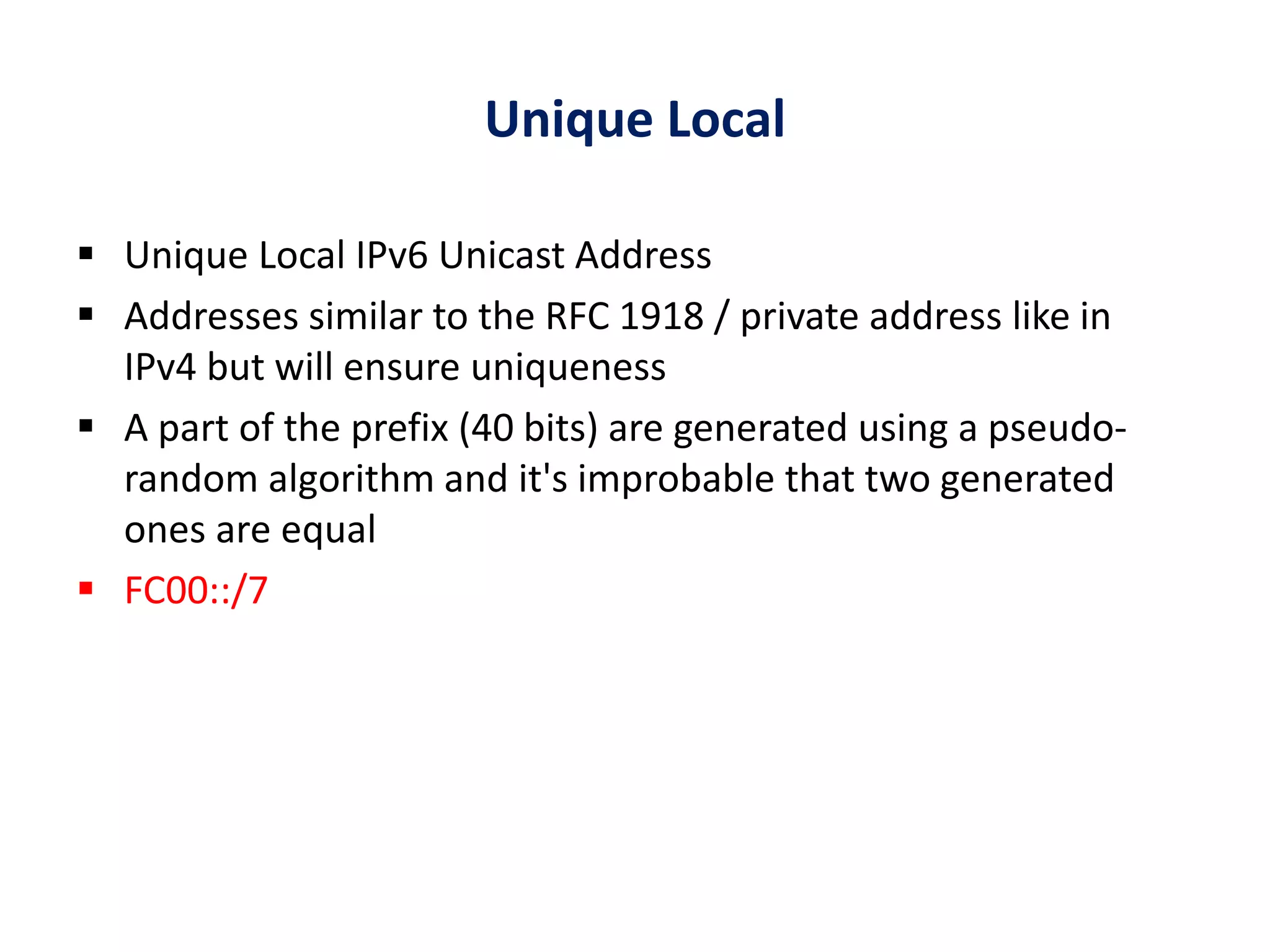
Unique Local
 Unique Local IPv6 Unicast Address
 Addresses similar to the RFC 1918 / private address like in
IPv4 but will ensure uniqueness
 A part of the prefix (40 bits) are generated using a pseudo-
random algorithm and it's improbable that two generated
ones are equal
 FC00::/7
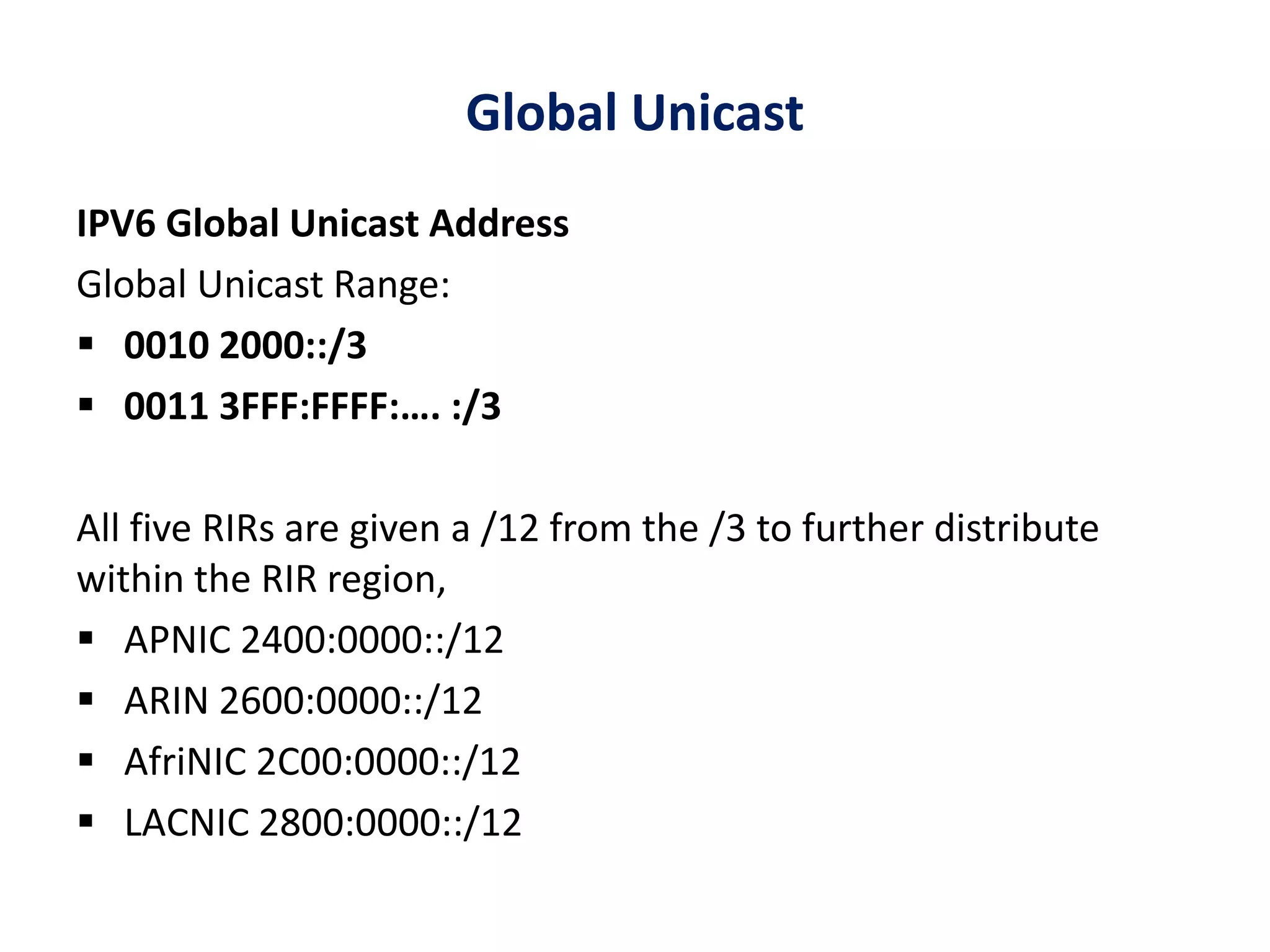
Global Unicast
IPV6 Global Unicast Address
Global Unicast Range:
 0010 2000::/3
 0011 3FFF:FFFF:…. :/3
All five RIRs are given a /12 from the /3 to further distribute
within the RIR region,
 APNIC 2400:0000::/12
 ARIN 2600:0000::/12
 AfriNIC 2C00:0000::/12
 LACNIC 2800:0000::/12
IPv6 Address Allocation
The allocation process is:
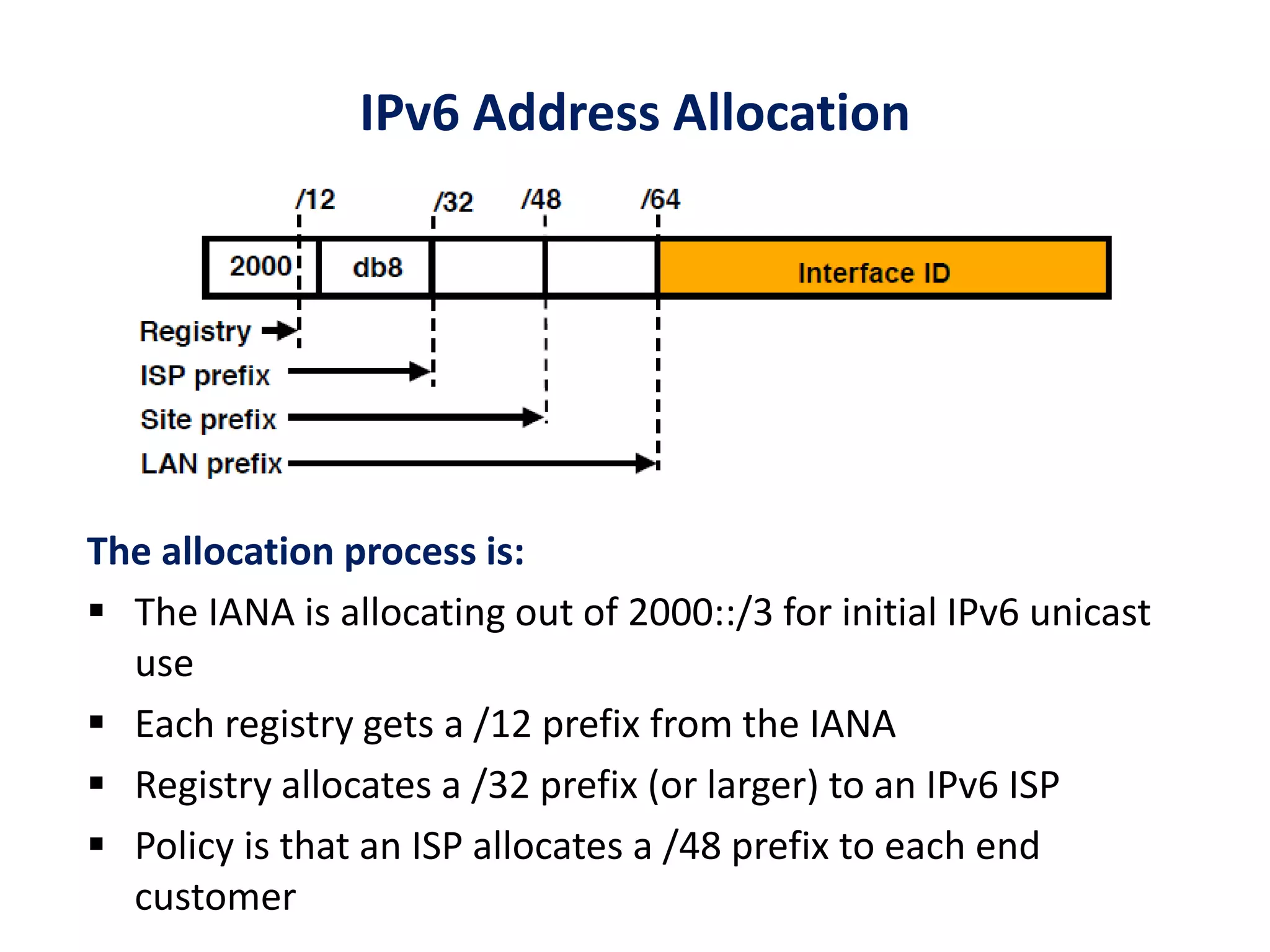
 The IANA is allocating out of 2000::/3 for initial IPv6 unicast
use
 Each registry gets a /12 prefix from the IANA
 Registry allocates a /32 prefix (or larger) to an IPv6 ISP
 Policy is that an ISP allocates a /48 prefix to each end
customer
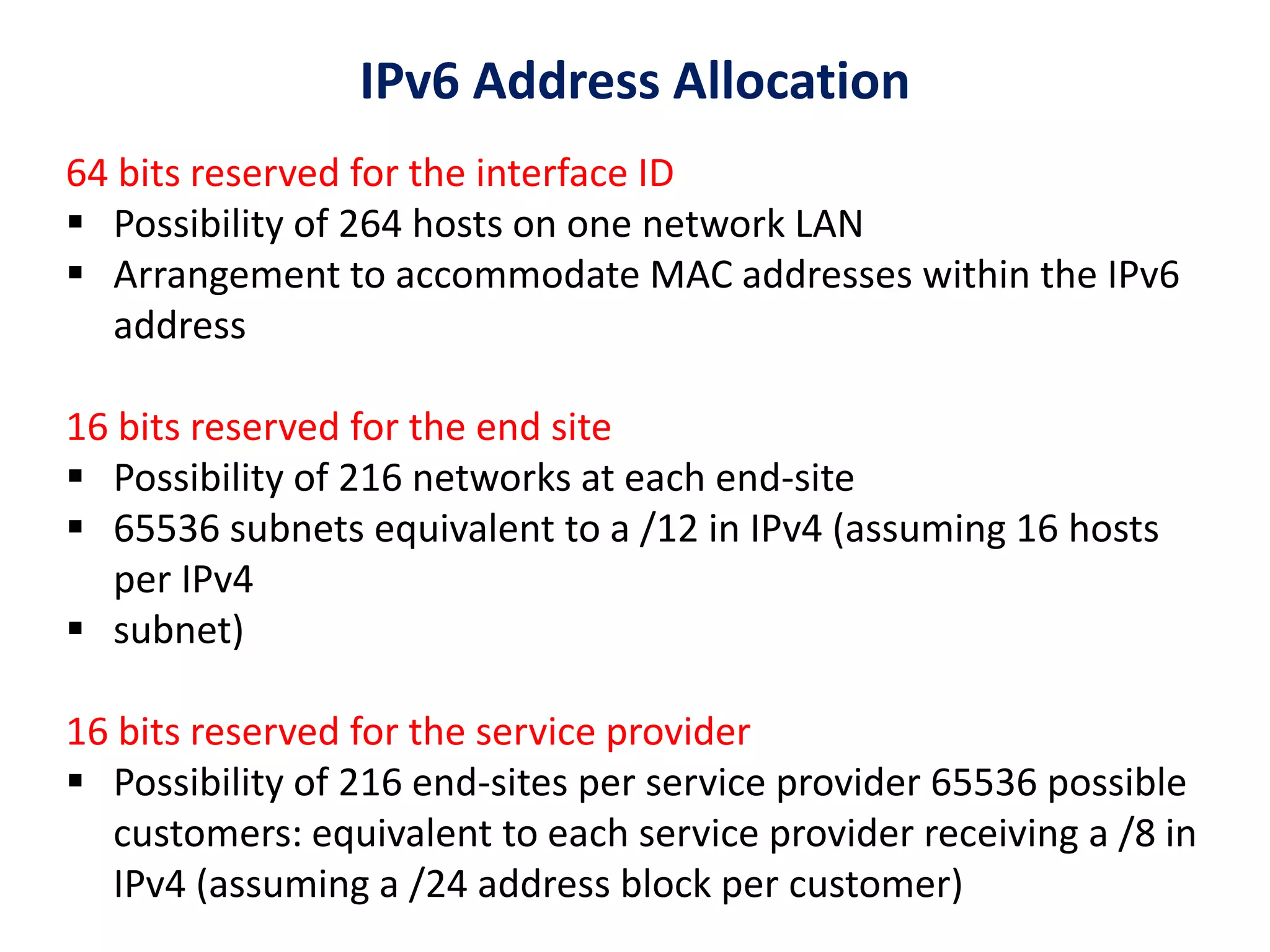
64 bits reserved for the interface ID
 Possibility of 264 hosts on one network LAN
 Arrangement to accommodate MAC addresses within the IPv6
address
16 bits reserved for the end site
 Possibility of 216 networks at each end-site
 65536 subnets equivalent to a /12 in IPv4 (assuming 16 hosts
per IPv4
 subnet)
16 bits reserved for the service provider
 Possibility of 216 end-sites per service provider 65536 possible
customers: equivalent to each service provider receiving a /8 in
IPv4 (assuming a /24 address block per customer)
IPv6 Address Allocation
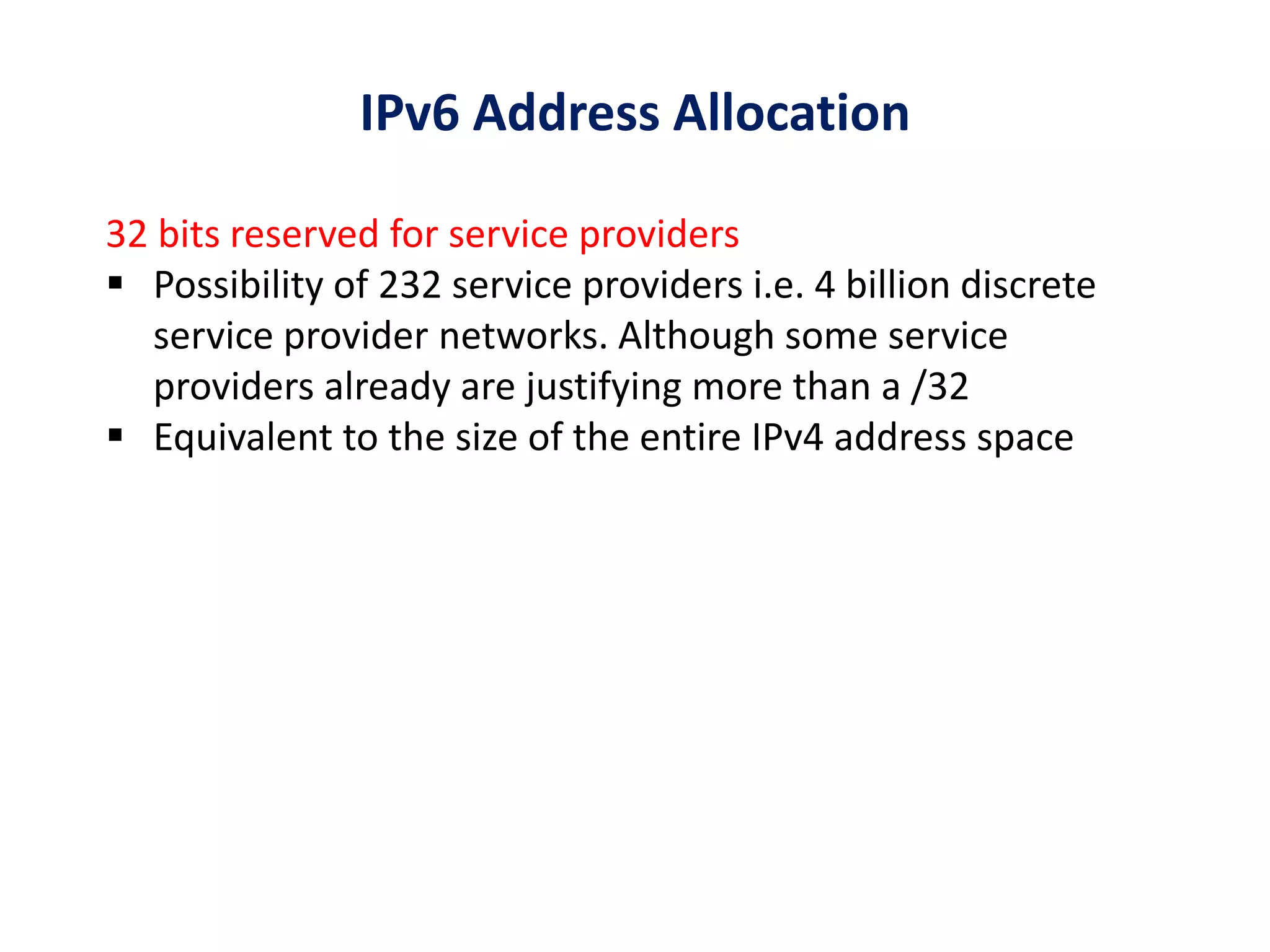
32 bits reserved for service providers
 Possibility of 232 service providers i.e. 4 billion discrete
service provider networks. Although some service
providers already are justifying more than a /32
 Equivalent to the size of the entire IPv4 address space
IPv6 Address Allocation
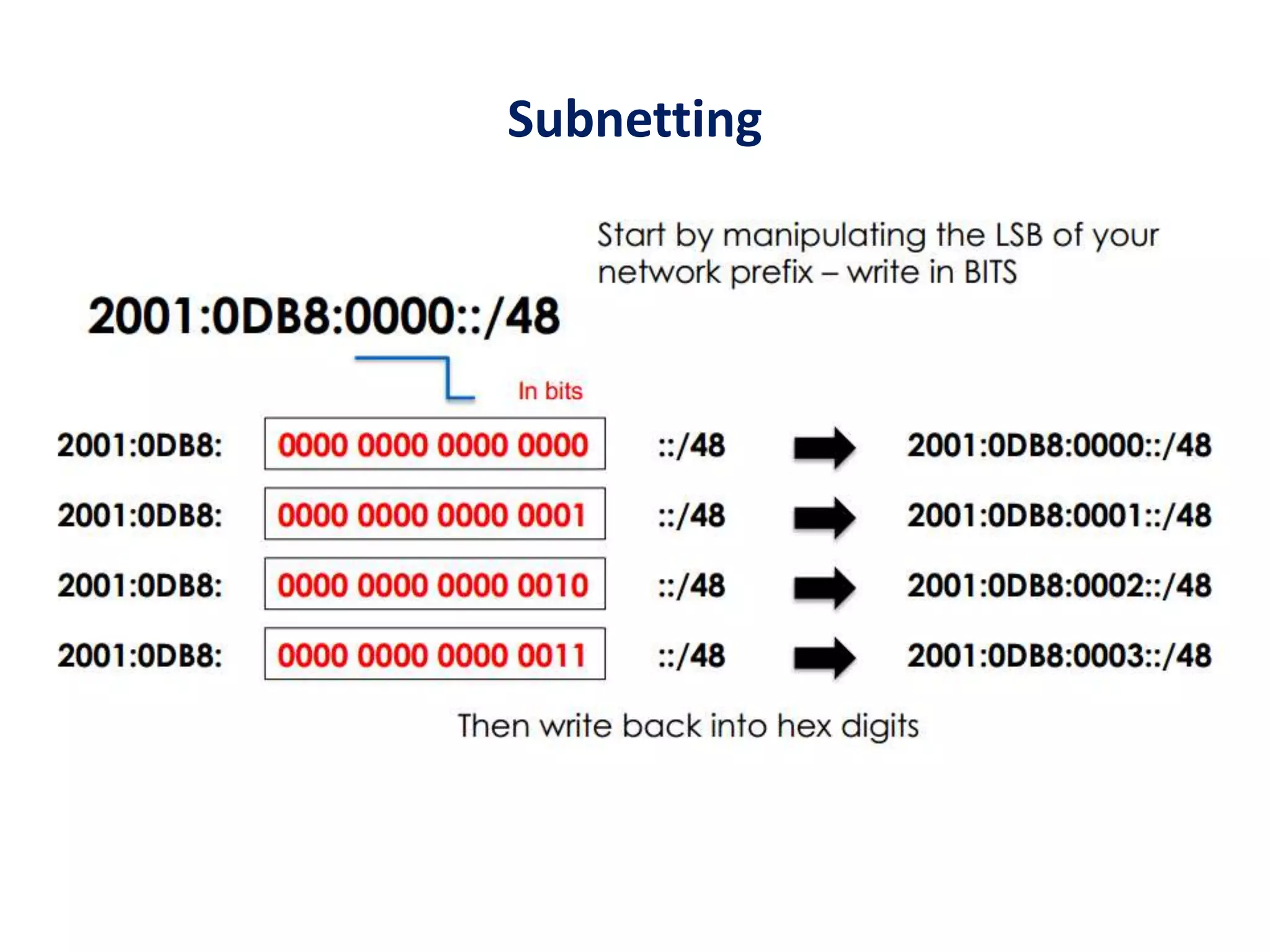
Subnetting
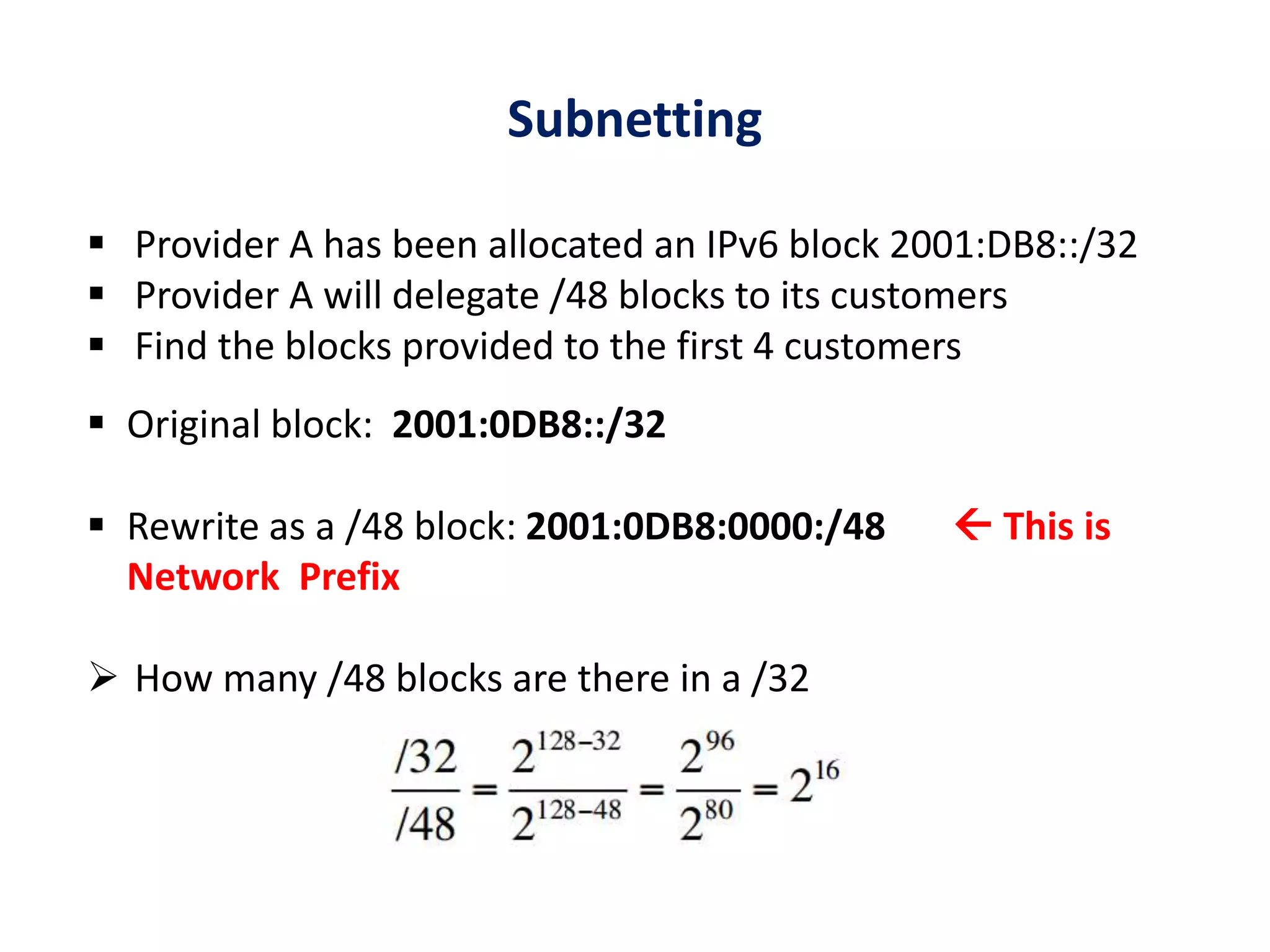
 Provider A has been allocated an IPv6 block 2001:DB8::/32
 Provider A will delegate /48 blocks to its customers
 Find the blocks provided to the first 4 customers
 Original block: 2001:0DB8::/32
 Rewrite as a /48 block: 2001:0DB8:0000:/48  This is
Network Prefix
 How many /48 blocks are there in a /32
Subnetting
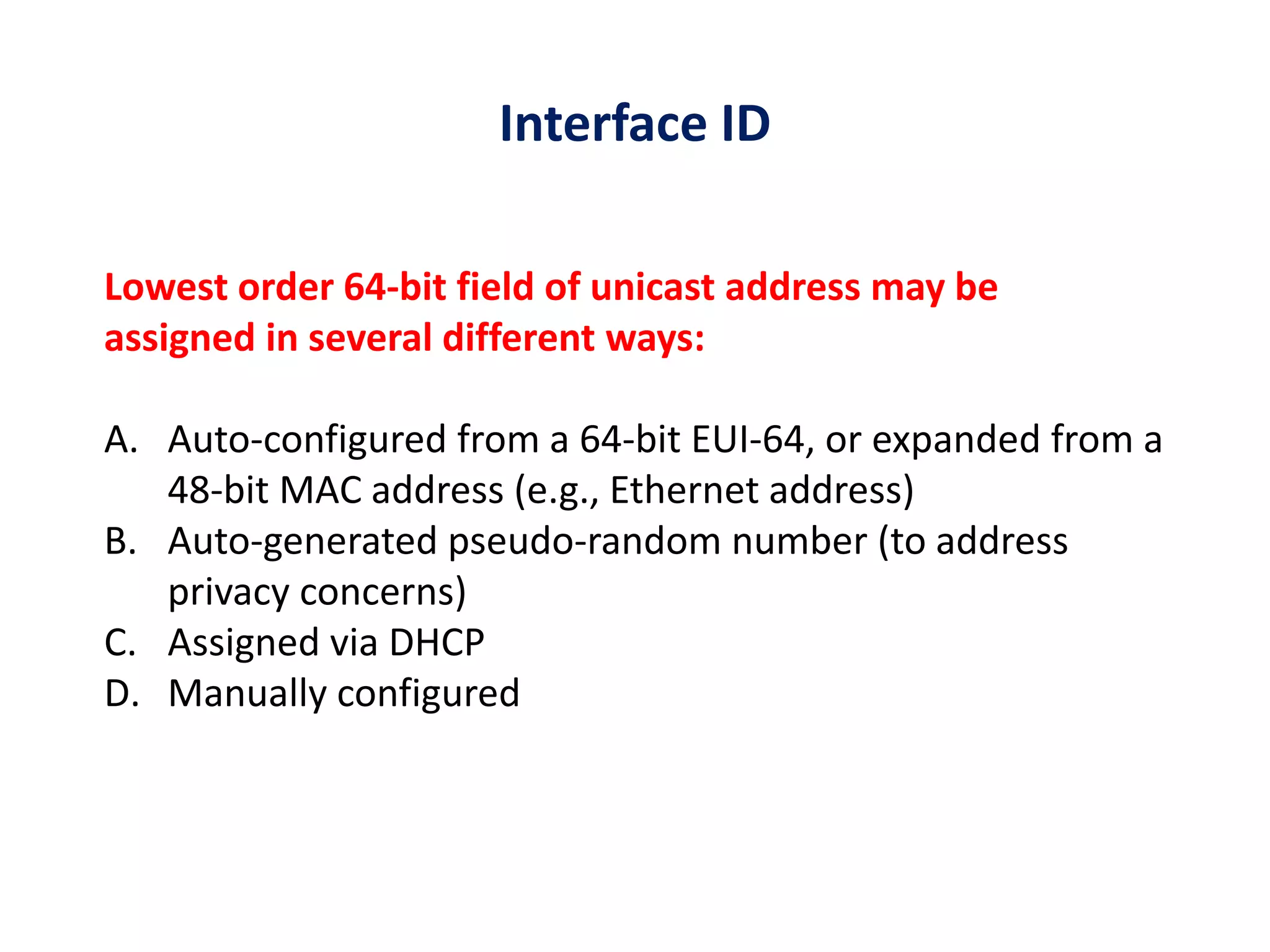
Interface ID
Lowest order 64-bit field of unicast address may be
assigned in several different ways:
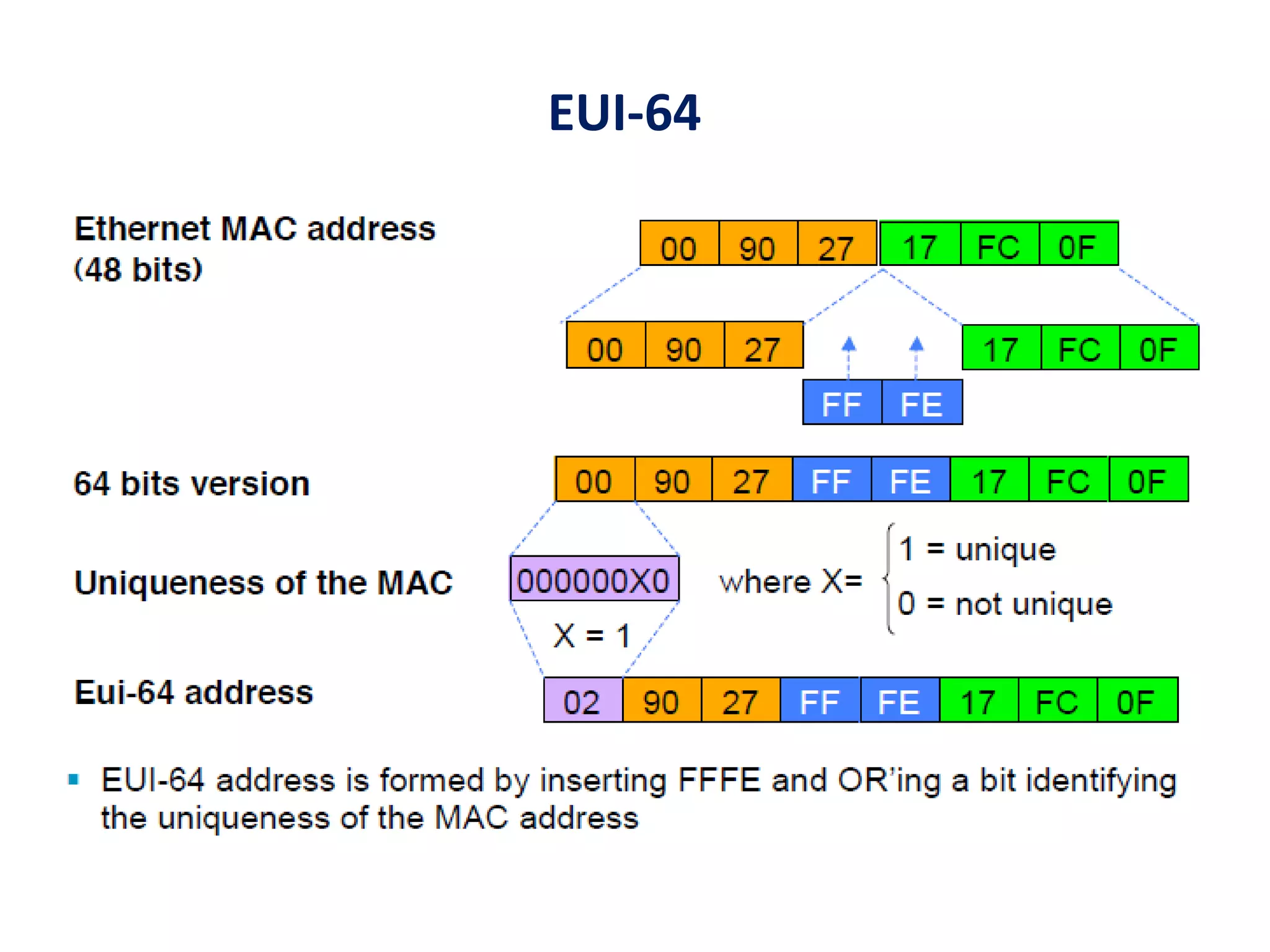
A. Auto-configured from a 64-bit EUI-64, or expanded from a
48-bit MAC address (e.g., Ethernet address)
B. Auto-generated pseudo-random number (to address
privacy concerns)
C. Assigned via DHCP
D. Manually configured
EUI-64
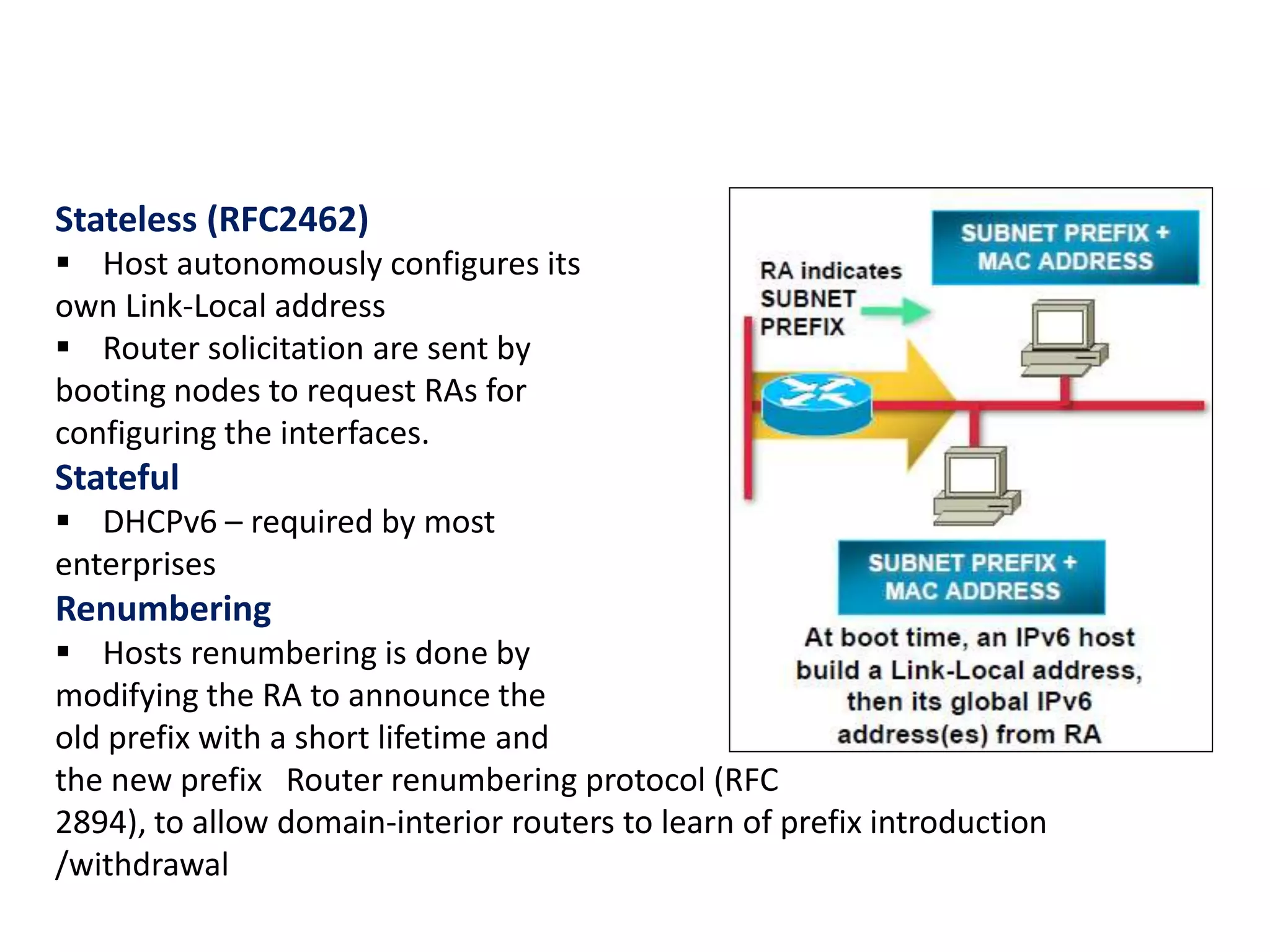
Stateless (RFC2462)
 Host autonomously configures its
own Link-Local address
 Router solicitation are sent by
booting nodes to request RAs for
configuring the interfaces.
Stateful
 DHCPv6 – required by most
enterprises
Renumbering
 Hosts renumbering is done by
modifying the RA to announce the
old prefix with a short lifetime and
the new prefix Router renumbering protocol (RFC
2894), to allow domain-interior routers to learn of prefix introduction
/withdrawal
IPv6 Auto Configuration
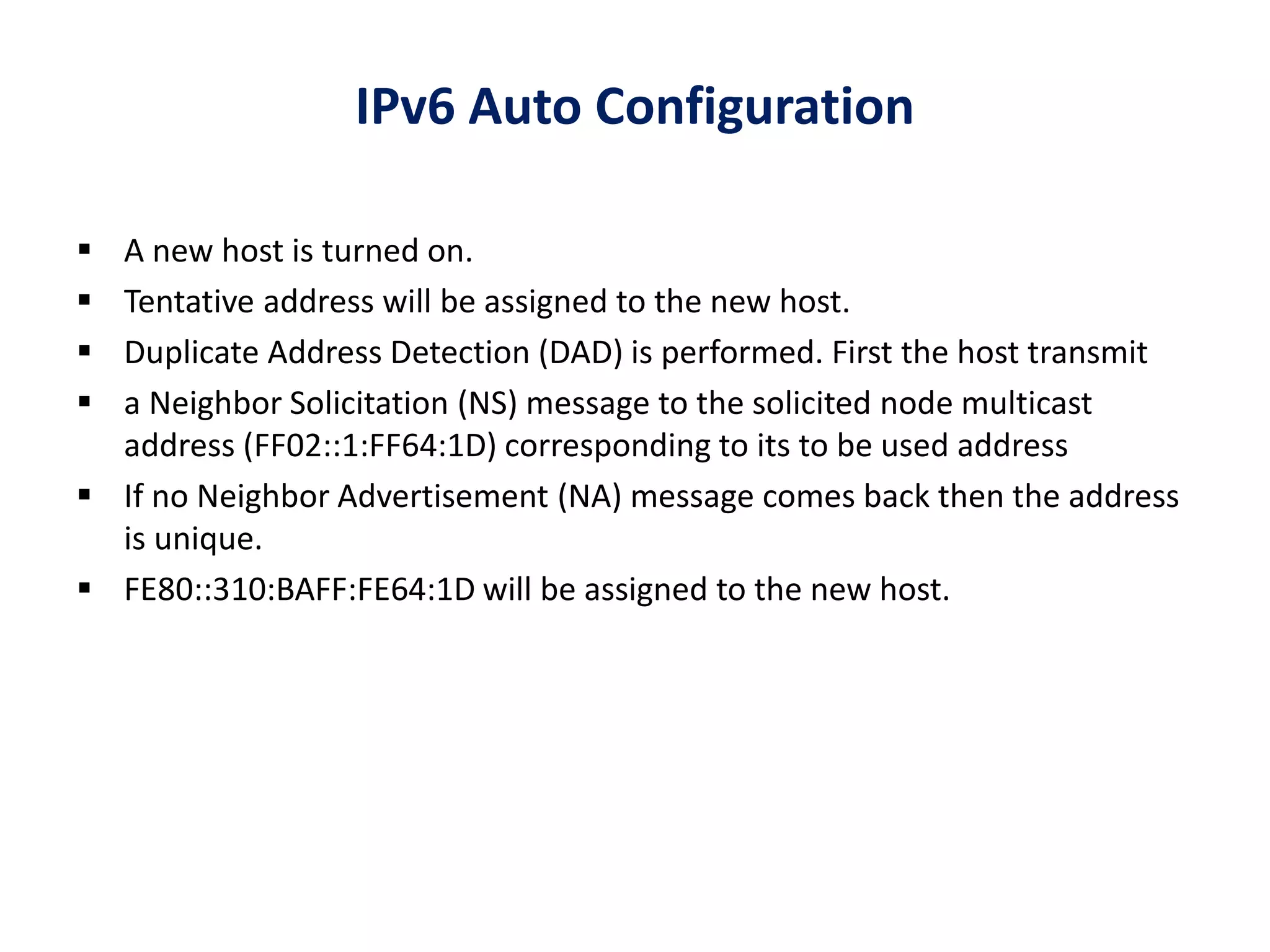
 A new host is turned on.
 Tentative address will be assigned to the new host.
 Duplicate Address Detection (DAD) is performed. First the host transmit
 a Neighbor Solicitation (NS) message to the solicited node multicast
address (FF02::1:FF64:1D) corresponding to its to be used address
 If no Neighbor Advertisement (NA) message comes back then the address
is unique.
 FE80::310:BAFF:FE64:1D will be assigned to the new host.
IPv6 Auto Configuration
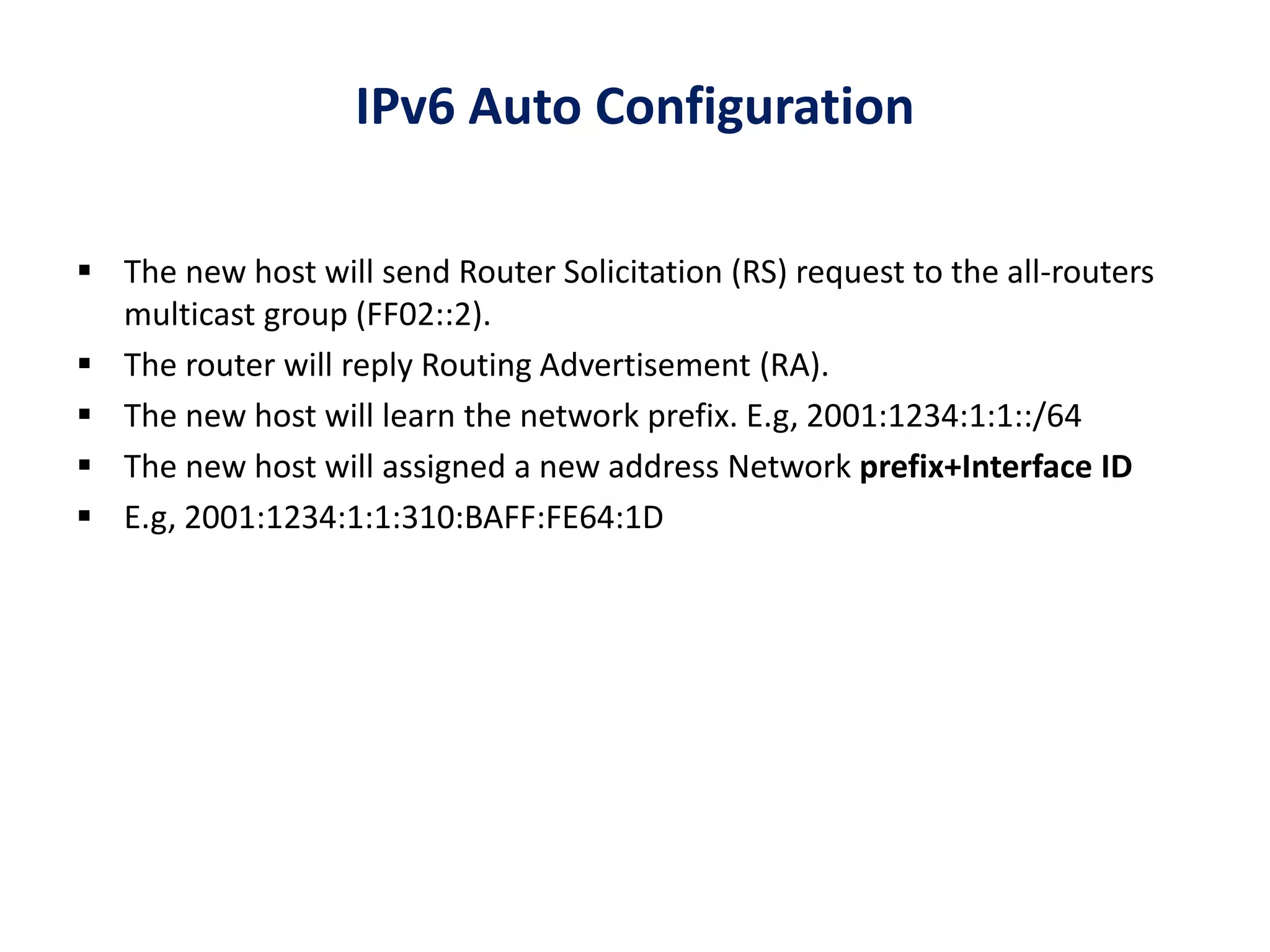
 The new host will send Router Solicitation (RS) request to the all-routers
multicast group (FF02::2).
 The router will reply Routing Advertisement (RA).
 The new host will learn the network prefix. E.g, 2001:1234:1:1::/64
 The new host will assigned a new address Network prefix+Interface ID
 E.g, 2001:1234:1:1:310:BAFF:FE64:1D
DHCPv6
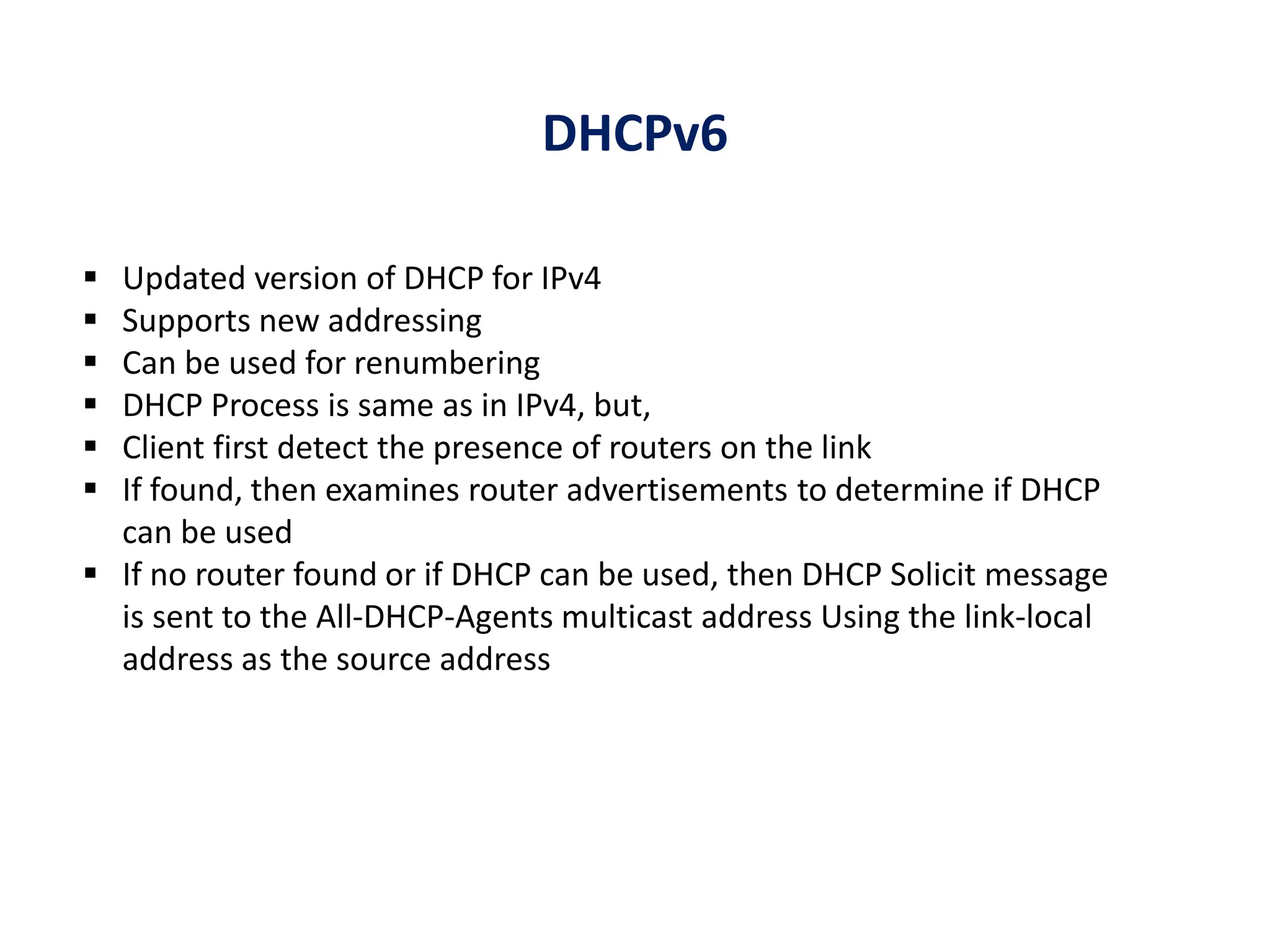
 Updated version of DHCP for IPv4
 Supports new addressing
 Can be used for renumbering
 DHCP Process is same as in IPv4, but,
 Client first detect the presence of routers on the link
 If found, then examines router advertisements to determine if DHCP
can be used
 If no router found or if DHCP can be used, then DHCP Solicit message
is sent to the All-DHCP-Agents multicast address Using the link-local
address as the source address
Types of DHCP
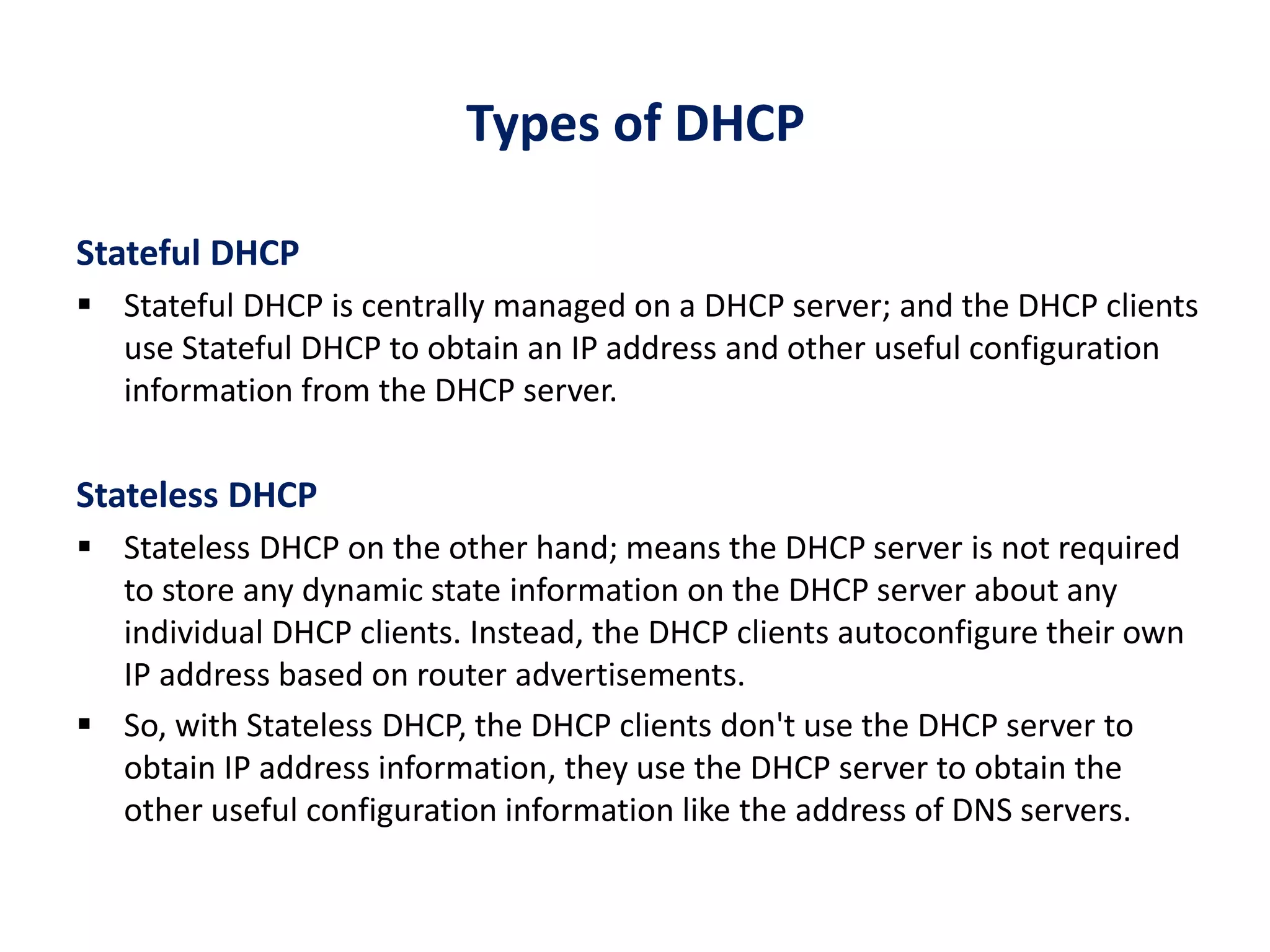
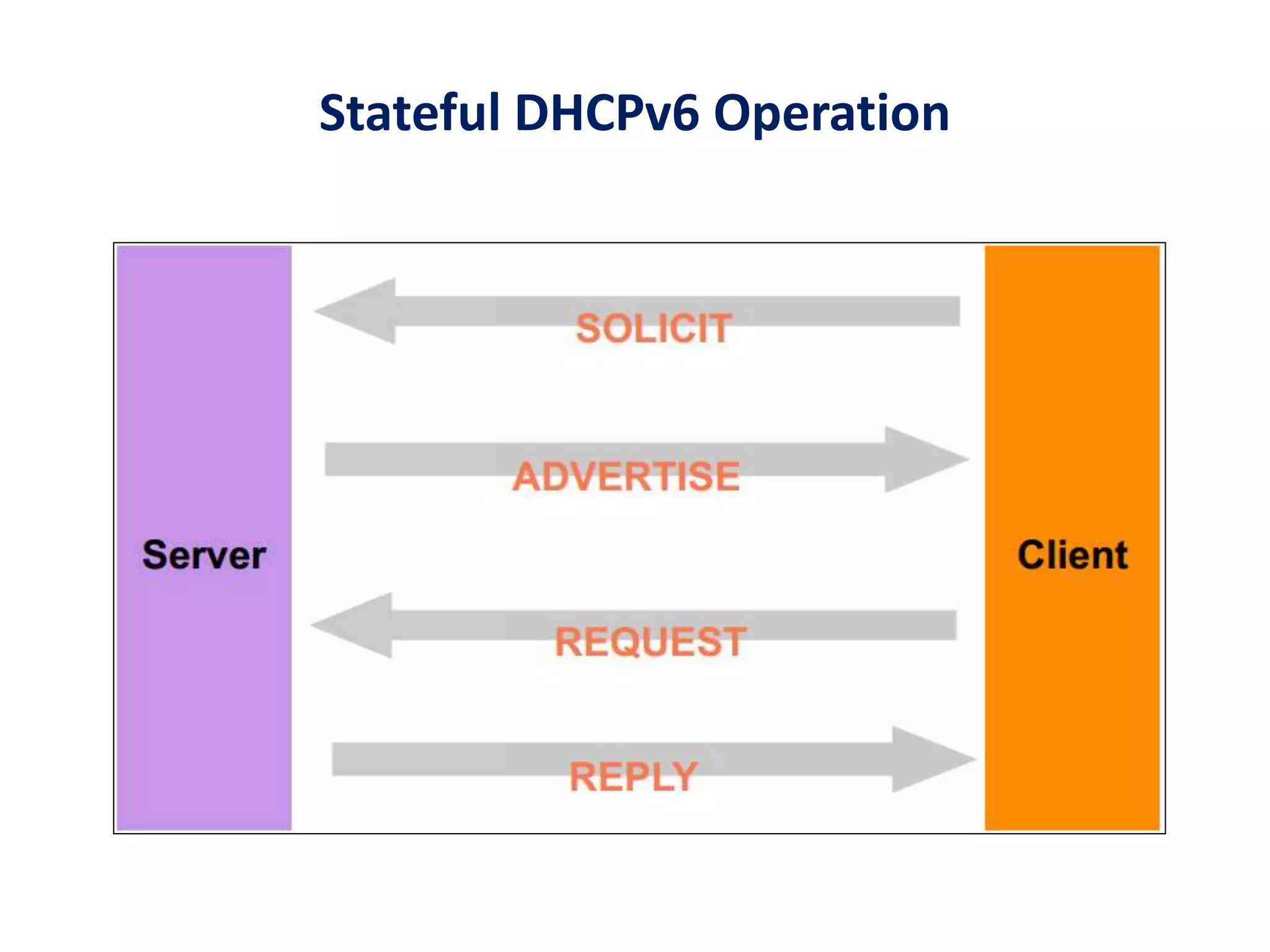
Stateful DHCP
 Stateful DHCP is centrally managed on a DHCP server; and the DHCP clients
use Stateful DHCP to obtain an IP address and other useful configuration
information from the DHCP server.
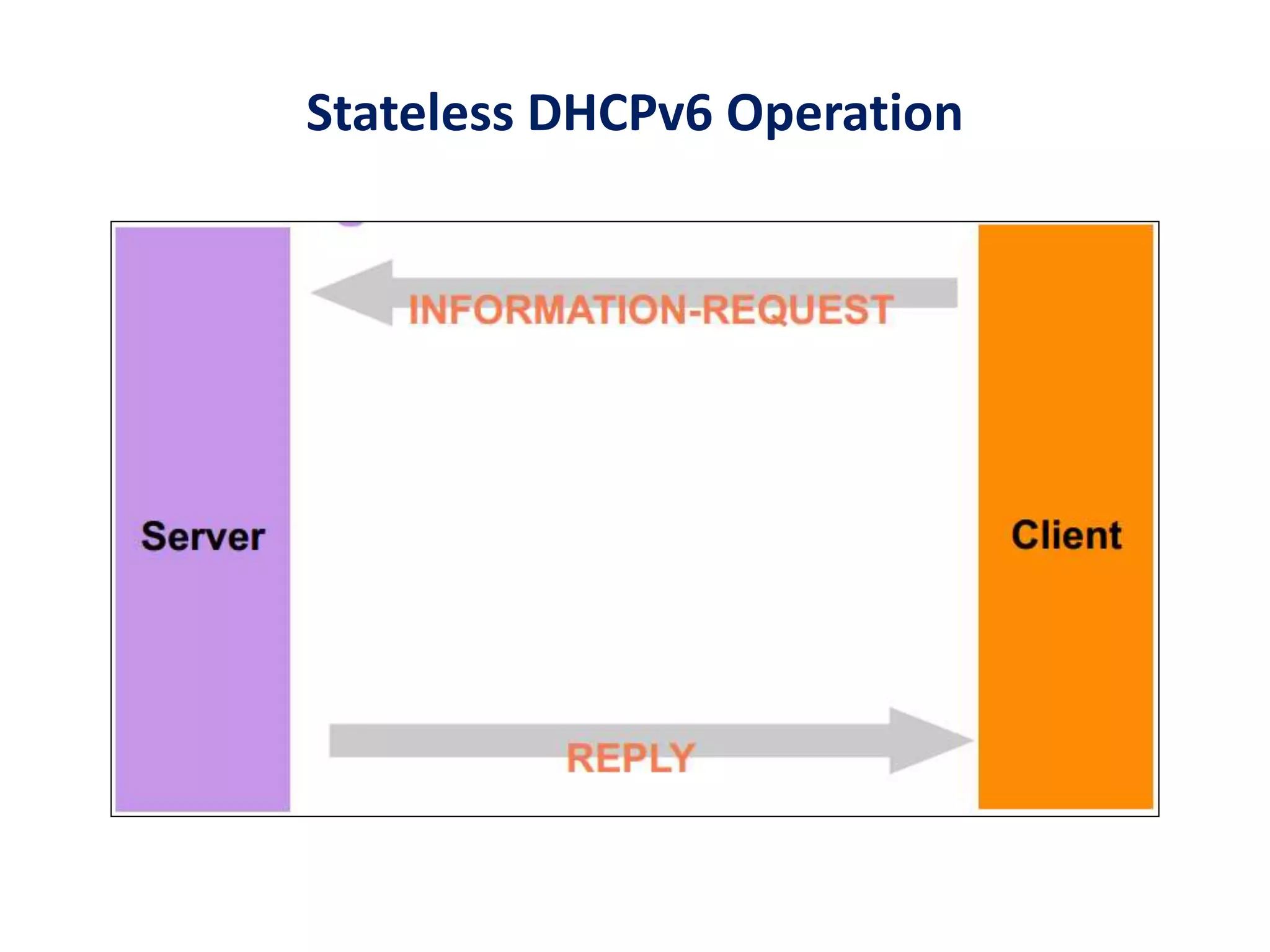
Stateless DHCP
 Stateless DHCP on the other hand; means the DHCP server is not required
to store any dynamic state information on the DHCP server about any
individual DHCP clients. Instead, the DHCP clients autoconfigure their own
IP address based on router advertisements.
 So, with Stateless DHCP, the DHCP clients don't use the DHCP server to
obtain IP address information, they use the DHCP server to obtain the
other useful configuration information like the address of DNS servers.
Stateful DHCPv6 Operation
Stateless DHCPv6 Operation
THANK YOU

Basic of IPv6

  • 1.
    BASICS OF IPv6JUBIN AGHARA
  • 2.
    Tropics  Its Need IPv6 Size Comparison  Header Format  IPv6 Addressing Format  Prefix Presentation and CIDR Notation  IPv6 Addressing types  IPv6 Address Allocation  Interface ID  Subnetting  Host Configuration
  • 3.
    Need of IPV6 IETF IPv6 working group began in early 90s, to solve addressing growth issues, but CIDR, NAT were developed to fix the shortage of IPv4 address.  IPv4 32 bit address = 4 billion hosts  40% of the IPv4 address space is still unused which is different from unallocated.  The rising of Internet connected device, IoT, IoE and appliance will eventually deplete the IPv4 address space.  IP is everywhere, Data, voice, audio and video integration is a reality.  So, only compelling reason: More IP addresses
  • 4.
  • 5.
  • 6.
  • 7.
    IPv6 Addressing Format 16-bit hexadecimal numbers  Numbers are separated by (:)  Hex numbers are not case sensitive  Abbreviations are possible  Abbreviations are possible Leading zeros in contiguous block could be represented by (::) Example: 2001:0db8:0000:130F:0000:0000:087C:140B 2001:0db8:0:130F::87C:140B  Double colon only appears once in the address
  • 8.
    Prefix Presentation  Representationof prefix is just like CIDR  In this representation you attach the prefix length  Like v4 address: 198.10.0.0/16  V6 address is represented the same way: 2001:db8:12::/48  Only leading zeros are omitted. Trailing zeros are not omitted 2001:0db8:0012::/48 = 2001:db8:12::/48 2001:db8:1200:adfc::/64 ≠ 2001:db8:12:adfc::/64
  • 9.
  • 10.
    Link Local Address A special address used to communicate within the local link of an Interface i.e. anyone on the link as host or router basically to communicate between IPv6 enabled devices  This address in packet destination that packet would never pass through a router  Example: FE80::/10
  • 11.
    Unique Local  UniqueLocal IPv6 Unicast Address  Addresses similar to the RFC 1918 / private address like in IPv4 but will ensure uniqueness  A part of the prefix (40 bits) are generated using a pseudo- random algorithm and it's improbable that two generated ones are equal  FC00::/7
  • 12.
    Global Unicast IPV6 GlobalUnicast Address Global Unicast Range:  0010 2000::/3  0011 3FFF:FFFF:…. :/3 All five RIRs are given a /12 from the /3 to further distribute within the RIR region,  APNIC 2400:0000::/12  ARIN 2600:0000::/12  AfriNIC 2C00:0000::/12  LACNIC 2800:0000::/12
  • 13.
    IPv6 Address Allocation Theallocation process is:  The IANA is allocating out of 2000::/3 for initial IPv6 unicast use  Each registry gets a /12 prefix from the IANA  Registry allocates a /32 prefix (or larger) to an IPv6 ISP  Policy is that an ISP allocates a /48 prefix to each end customer
  • 14.
    64 bits reservedfor the interface ID  Possibility of 264 hosts on one network LAN  Arrangement to accommodate MAC addresses within the IPv6 address 16 bits reserved for the end site  Possibility of 216 networks at each end-site  65536 subnets equivalent to a /12 in IPv4 (assuming 16 hosts per IPv4  subnet) 16 bits reserved for the service provider  Possibility of 216 end-sites per service provider 65536 possible customers: equivalent to each service provider receiving a /8 in IPv4 (assuming a /24 address block per customer) IPv6 Address Allocation
  • 15.
    32 bits reservedfor service providers  Possibility of 232 service providers i.e. 4 billion discrete service provider networks. Although some service providers already are justifying more than a /32  Equivalent to the size of the entire IPv4 address space IPv6 Address Allocation
  • 16.
    Subnetting  Provider Ahas been allocated an IPv6 block 2001:DB8::/32  Provider A will delegate /48 blocks to its customers  Find the blocks provided to the first 4 customers  Original block: 2001:0DB8::/32  Rewrite as a /48 block: 2001:0DB8:0000:/48  This is Network Prefix  How many /48 blocks are there in a /32
  • 17.
  • 18.
    Interface ID Lowest order64-bit field of unicast address may be assigned in several different ways: A. Auto-configured from a 64-bit EUI-64, or expanded from a 48-bit MAC address (e.g., Ethernet address) B. Auto-generated pseudo-random number (to address privacy concerns) C. Assigned via DHCP D. Manually configured
  • 19.
  • 20.
    Stateless (RFC2462)  Hostautonomously configures its own Link-Local address  Router solicitation are sent by booting nodes to request RAs for configuring the interfaces. Stateful  DHCPv6 – required by most enterprises Renumbering  Hosts renumbering is done by modifying the RA to announce the old prefix with a short lifetime and the new prefix Router renumbering protocol (RFC 2894), to allow domain-interior routers to learn of prefix introduction /withdrawal
  • 21.
    IPv6 Auto Configuration A new host is turned on.  Tentative address will be assigned to the new host.  Duplicate Address Detection (DAD) is performed. First the host transmit  a Neighbor Solicitation (NS) message to the solicited node multicast address (FF02::1:FF64:1D) corresponding to its to be used address  If no Neighbor Advertisement (NA) message comes back then the address is unique.  FE80::310:BAFF:FE64:1D will be assigned to the new host.
  • 22.
    IPv6 Auto Configuration The new host will send Router Solicitation (RS) request to the all-routers multicast group (FF02::2).  The router will reply Routing Advertisement (RA).  The new host will learn the network prefix. E.g, 2001:1234:1:1::/64  The new host will assigned a new address Network prefix+Interface ID  E.g, 2001:1234:1:1:310:BAFF:FE64:1D
  • 23.
    DHCPv6  Updated versionof DHCP for IPv4  Supports new addressing  Can be used for renumbering  DHCP Process is same as in IPv4, but,  Client first detect the presence of routers on the link  If found, then examines router advertisements to determine if DHCP can be used  If no router found or if DHCP can be used, then DHCP Solicit message is sent to the All-DHCP-Agents multicast address Using the link-local address as the source address
  • 24.
    Types of DHCP StatefulDHCP  Stateful DHCP is centrally managed on a DHCP server; and the DHCP clients use Stateful DHCP to obtain an IP address and other useful configuration information from the DHCP server. Stateless DHCP  Stateless DHCP on the other hand; means the DHCP server is not required to store any dynamic state information on the DHCP server about any individual DHCP clients. Instead, the DHCP clients autoconfigure their own IP address based on router advertisements.  So, with Stateless DHCP, the DHCP clients don't use the DHCP server to obtain IP address information, they use the DHCP server to obtain the other useful configuration information like the address of DNS servers.
  • 25.
  • 26.
  • 27.