1
Chapter
Outline 2 Introduction
3 Address Space Allocation
4 Autoconfiguration
5 Renumbering, Address Types and
Migration
1 Overview
IPv6 Addressing
Before we start…
_____ IPng _____
_____ IPv6 _____
_____ CIDR _____
_____ NAT _____
_____ Autoconfiguration_____
_____ Unicast _____
_____ Multicast _____
_____ Anycast _____
_____ IPv4-Compatible _____
_____ IANA _____
_____ VLSM _____
_____ ICANN _____
_____ Dual-Stack _____
_____ Tunneling _____
_____ Translation _____
_____ Node _____
_____ Packet _____
Please write down the following Key Terms on a blank piece of paper leaving a small
underline before and after each word. Label your paper IPv6 Pre/Post Concept Check.
Pre Check of Knowledge
1. Rate yourself as to your perceived knowledge
of these key words.
2. Assess how much you already know about
these terms by placing a (+), a check (√), or a
zero (0) in the space to the left of each word.
 Plus (+) = Expert
 Check (√) = Heard of it
 Zero (0) = Have not heard of it.
We will do a Post Check at the end of this chapter.
4
1- Overview
IPv6 Defined
 Internet Protocol version 6
 Originally known as IPng, or IP Next Generation
 Network Layer protocol for packet switched
networks
 Successor of IPv4 which supports about 4.3 billion
addresses (232 addresses)
 IPv6 increased the number of addresses to (2128
addresses)
Benefits
 IPv6 longer address length is needed for:
 Routing Aggregation
 Autoconfiguration of Addresses
 Easier allocation of address blocks
 Flexibility of ISPs to subdivide blocks for
customers
 Organizations can subdivide blocks for internal
networks
 Embedded Quality of Service (QoS) to support
services like VoIP & IP Video
 Improved scalability for multicast routing
 More efficient packet forwarding
Okay, so what happened to
IPv5?
 IPv5 was NOT a successor to IPv6
 Known as Internet ST (Stream Protocol)
 Experimental protocol….Not in public use
What’s driving the need for
IPv6??
 Internet growth
 Mobile devices
 PDAs
 Mobile phones
 Tablet PCs
 Gaming
 Voice/Video
 Security Monitoring
 Appliances
 Medical Imaging
 Animal Tags
 Media Services
 Traffic Control
 Planes
 Automobiles
 Hotspots
8
2- INTRODUCTION
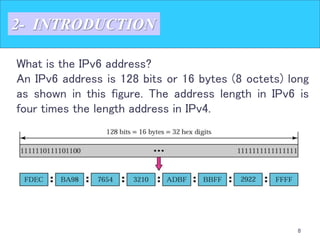
What is the IPv6 address?
An IPv6 address is 128 bits or 16 bytes (8 octets) long
as shown in this figure. The address length in IPv6 is
four times the length address in IPv4.
9
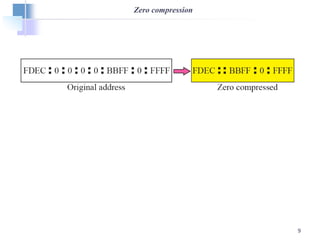
Zero compression
10
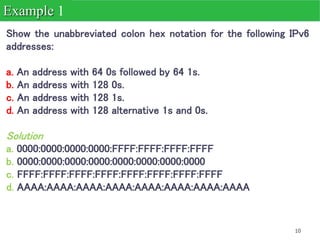
Show the unabbreviated colon hex notation for the following IPv6
addresses:
a. An address with 64 0s followed by 64 1s.
b. An address with 128 0s.
c. An address with 128 1s.
d. An address with 128 alternative 1s and 0s.
Solution
a. 0000:0000:0000:0000:FFFF:FFFF:FFFF:FFFF
b. 0000:0000:0000:0000:0000:0000:0000:0000
c. FFFF:FFFF:FFFF:FFFF:FFFF:FFFF:FFFF:FFFF
d. AAAA:AAAA:AAAA:AAAA:AAAA:AAAA:AAAA:AAAA
Example 1
11
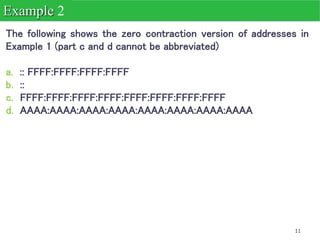
The following shows the zero contraction version of addresses in
Example 1 (part c and d cannot be abbreviated)
a. :: FFFF:FFFF:FFFF:FFFF
b. ::
c. FFFF:FFFF:FFFF:FFFF:FFFF:FFFF:FFFF:FFFF
d. AAAA:AAAA:AAAA:AAAA:AAAA:AAAA:AAAA:AAAA
Example 2
12
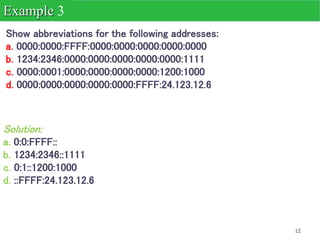
Show abbreviations for the following addresses:
a. 0000:0000:FFFF:0000:0000:0000:0000:0000
b. 1234:2346:0000:0000:0000:0000:0000:1111
c. 0000:0001:0000:0000:0000:0000:1200:1000
d. 0000:0000:0000:0000:0000:FFFF:24.123.12.6
Example 3
Solution:
a. 0:0:FFFF::
b. 1234:2346::1111
c. 0:1::1200:1000
d. ::FFFF:24.123.12.6
13
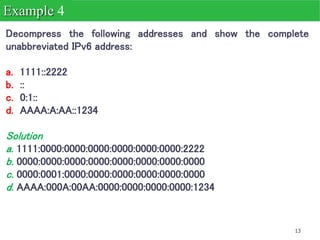
Decompress the following addresses and show the complete
unabbreviated IPv6 address:
a. 1111::2222
b. ::
c. 0:1::
d. AAAA:A:AA::1234
Solution
a. 1111:0000:0000:0000:0000:0000:0000:2222
b. 0000:0000:0000:0000:0000:0000:0000:0000
c. 0000:0001:0000:0000:0000:0000:0000:0000
d. AAAA:000A:00AA:0000:0000:0000:0000:1234
Example 4
IPv6 Number of Addresses
 To give some idea about the number of IPv6
addresses, let us assume that the number of people
on the planet earth is soon to be 234 (more than 16
billion). Each person can have 294 addresses to use.
 If we assign 260 addresses to the users each year
(almost one billion each second), it takes 268 years
to deplete addresses.
15
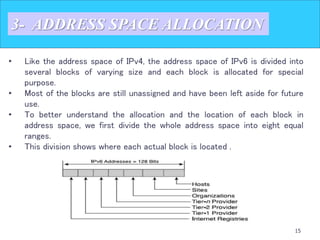
3- ADDRESS SPACE ALLOCATION
• Like the address space of IPv4, the address space of IPv6 is divided into
several blocks of varying size and each block is allocated for special
purpose.
• Most of the blocks are still unassigned and have been left aside for future
use.
• To better understand the allocation and the location of each block in
address space, we first divide the whole address space into eight equal
ranges.
• This division shows where each actual block is located .
16
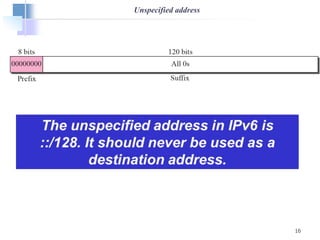
Unspecified address
17
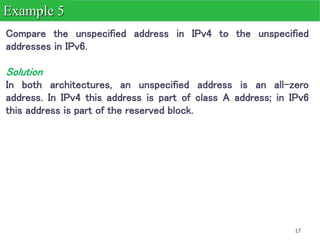
Compare the unspecified address in IPv4 to the unspecified
addresses in IPv6.
Solution
In both architectures, an unspecified address is an all-zero
address. In IPv4 this address is part of class A address; in IPv6
this address is part of the reserved block.
Example 5
18
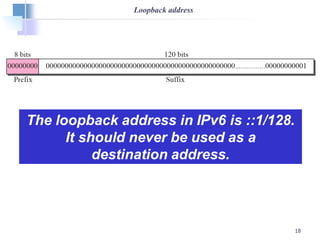
Loopback address
19
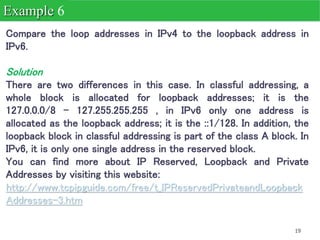
Compare the loop addresses in IPv4 to the loopback address in
IPv6.
Solution
There are two differences in this case. In classful addressing, a
whole block is allocated for loopback addresses; it is the
127.0.0.0/8 - 127.255.255.255 , in IPv6 only one address is
allocated as the loopback address; it is the ::1/128. In addition, the
loopback block in classful addressing is part of the class A block. In
IPv6, it is only one single address in the reserved block.
You can find more about IP Reserved, Loopback and Private
Addresses by visiting this website:
http://www.tcpipguide.com/free/t_IPReservedPrivateandLoopback
Addresses-3.htm
Example 6
20
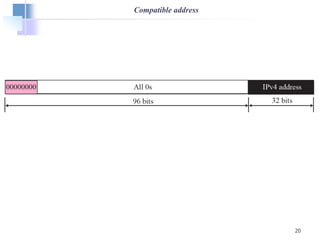
Compatible address
21
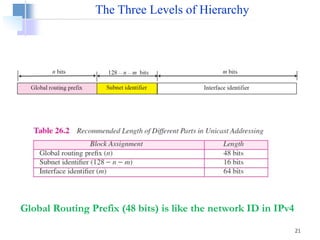
The Three Levels of Hierarchy
Global Routing Prefix (48 bits) is like the network ID in IPv4
22
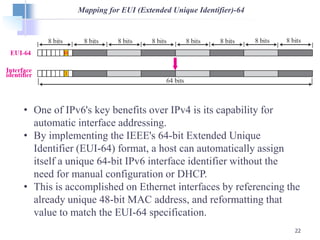
Mapping for EUI (Extended Unique Identifier)-64
• One of IPv6's key benefits over IPv4 is its capability for
automatic interface addressing.
• By implementing the IEEE's 64-bit Extended Unique
Identifier (EUI-64) format, a host can automatically assign
itself a unique 64-bit IPv6 interface identifier without the
need for manual configuration or DHCP.
• This is accomplished on Ethernet interfaces by referencing the
already unique 48-bit MAC address, and reformatting that
value to match the EUI-64 specification.
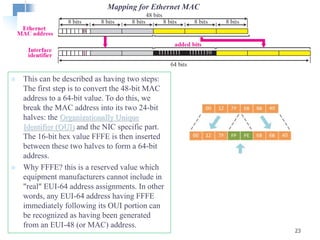
 This can be described as having two steps:
The first step is to convert the 48-bit MAC
address to a 64-bit value. To do this, we
break the MAC address into its two 24-bit
halves: the Organizationally Unique
Identifier (OUI) and the NIC specific part.
The 16-bit hex value FFFE is then inserted
between these two halves to form a 64-bit
address.
 Why FFFE? this is a reserved value which
equipment manufacturers cannot include in
"real" EUI-64 address assignments. In other
words, any EUI-64 address having FFFE
immediately following its OUI portion can
be recognized as having been generated
from an EUI-48 (or MAC) address.
23
Mapping for Ethernet MAC
24
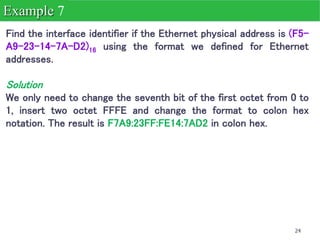
Find the interface identifier if the Ethernet physical address is (F5-
A9-23-14-7A-D2)16 using the format we defined for Ethernet
addresses.
Solution
We only need to change the seventh bit of the first octet from 0 to
1, insert two octet FFFE and change the format to colon hex
notation. The result is F7A9:23FF:FE14:7AD2 in colon hex.
Example 7
25
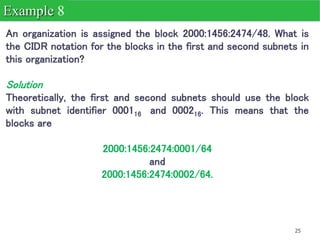
An organization is assigned the block 2000:1456:2474/48. What is
the CIDR notation for the blocks in the first and second subnets in
this organization?
Solution
Theoretically, the first and second subnets should use the block
with subnet identifier 000116 and 000216. This means that the
blocks are
2000:1456:2474:0001/64
and
2000:1456:2474:0002/64.
Example 8
26
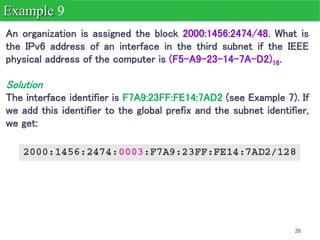
An organization is assigned the block 2000:1456:2474/48. What is
the IPv6 address of an interface in the third subnet if the IEEE
physical address of the computer is (F5-A9-23-14-7A-D2)16.
Solution
The interface identifier is F7A9:23FF:FE14:7AD2 (see Example 7). If
we add this identifier to the global prefix and the subnet identifier,
we get:
Example 9
27
4- AUTOCONFIGURATION
• One of the interesting features of IPv6 addressing is
the autoconfiguration of hosts.
• As we discussed in IPv4, the host and routers are
originally configured manually by the network
manager using static addresses, however, the
Dynamic Host Configuration Protocol, DHCP, can
also be used to allocate an IPv4 address to a host
that joins the network.
• In IPv6, DHCP protocol can still be used to allocate
an IPv6 address to a host, but a host can also
configure itself.
28
Assume a host with Ethernet address (F5-A9-23-11-9B-E2)16 has
joined the network. What would be its global unicast address if the
global unicast prefix of the organization is 3A21:1216:2165 and the
subnet identifier is 1232 ?
Solution
The host first creates its interface identifier as
F7A9:23FF:FE11:9BE2
using the Ethernet MAC address read from its NIC card.
Assuming that this address is unique, the host sends a router
solicitation message and receives the router advertisement
message that announces the combination of global unicast prefix
and the subnet identifier as 3A21:1216:2165:1232. The host then
appends its interface identifier to this prefix to find and store its
global unicast address as:
Example 10
3A21:1216:2165:1232:F7A9:23FF:FE11:9BE2
29
5- RENUMBERING , ADDRESS TYPES
and MIGRATION
• To allow sites to change the service provider, renumbering of the address
prefix (n) was built into IPv6 addressing.
• As we discussed before, each site is given a prefix by the service provider
to which it is connected. If the site changes the provider, the address
prefix needs to be changed.
• A router to which the site is connected to can advertise a new prefix and
let the site use the old prefix for a short time before disabling it. In other
words, during the transition period, a site has two prefixes.
IPv6 Provider-Based Addresses
 The first IPv6 addresses will be allocated to a provider-
based plan
 Type: Set to “010” for provider-based addresses
 Registry: identifies the agency that registered the address
The following fields have a variable length (recommended lengths are in“()” )
 Provider: Id of Internet access provider (16 bits)
 Subscriber: Id of the organization at provider (24 bits)
 Subnetwork: Id of subnet within organization (32 bits)
 Interface: identifies an interface at a node (48 bits)
Registry
ID
Provider
ID
010
Subscriber
ID
Interface
ID
Subnetwork
ID
IPv6 Address Types
 Unicast – identifies a single interface on a single
node. A unicast packet is delivered to the
identified single interface.
 Multicast - identifies a set of interfaces that
belong to different nodes. A multicast packet is
delivered to all identified interfaces.
 Anycast – a global unicast address such as DNS
that is assigned to a set of interfaces that belong
to different nodes. An anycast packet is
delivered to the closest interface.
For more information on Unicast, Multicast and Anycast, you may visit the
website:
http://www.omnisecu.com/tcpip/ipv6/unicast-multicast-anycast-types-of-
network-communication-in-ipv6.php
 Broadcast – Not in IPv6!!!
IPv6 Unicast Addresses
 64 bits for Global Routing and Subnet + 64 bits
for Interface ID
 Prefix + Subnet ID + Interface ID = 128 bit IPv6
Address
 Prefix is the Global Routing Prefix (48 bits)
 Subnet ID is the subnet identifier within a site (16 bits)
 Interface ID is the interface identifier for a particular host or
other device (64 bits)
From ONE: To ONE:
SOURCE -----------------------------Unicast Destination
IPv6 Multicast Addresses
 1st 8 bits are all 1’s i.e., 1111 1111; Translate into Hex: FF
 Indicator (8 bits) + Flags (4 bits) + Scope ID (4 bits) + Group ID
(112 bits) = IPv6 128 bit Multicast Address
 Indicator – 1st eight bits set to 1’s signifying a multicast
packet.
 Flags – 1st three are 0’s. The last is either a “0” for a
permanent/well known multicast address or a “1” for a
temporary multicast address.
 Scopes – Globally across the Internet or Locally within the
organization
 Group – Defines a particular group within a scope.
From ONE: To MANY:
SOURCE Multicast Destinations
Multicast Destinations
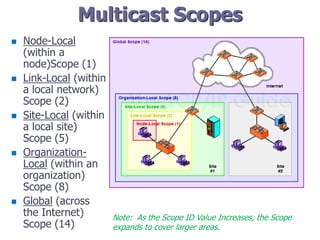
Multicast Scopes
 Node-Local
(within a
node)Scope (1)
 Link-Local (within
a local network)
Scope (2)
 Site-Local (within
a local site)
Scope (5)
 Organization-
Local (within an
organization)
Scope (8)
 Global (across
the Internet)
Scope (14)
Note: As the Scope ID Value Increases, the Scope
expands to cover larger areas.
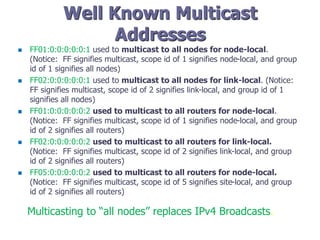
Well Known Multicast
Addresses
 FF01:0:0:0:0:0:1 used to multicast to all nodes for node-local.
(Notice: FF signifies multicast, scope id of 1 signifies node-local, and group
id of 1 signifies all nodes)
 FF02:0:0:0:0:0:1 used to multicast to all nodes for link-local. (Notice:
FF signifies multicast, scope id of 2 signifies link-local, and group id of 1
signifies all nodes)
 FF01:0:0:0:0:0:2 used to multicast to all routers for node-local.
(Notice: FF signifies multicast, scope id of 1 signifies node-local, and group
id of 2 signifies all routers)
 FF02:0:0:0:0:0:2 used to multicast to all routers for link-local.
(Notice: FF signifies multicast, scope id of 2 signifies link-local, and group
id of 2 signifies all routers)
 FF05:0:0:0:0:0:2 used to multicast to all routers for node-local.
(Notice: FF signifies multicast, scope id of 5 signifies site-local, and group
id of 2 signifies all routers)
Multicasting to “all nodes” replaces IPv4 Broadcasts.
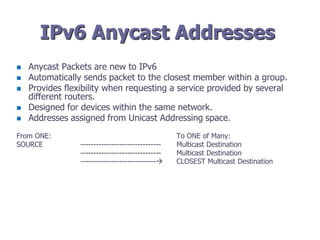
IPv6 Anycast Addresses
 Anycast Packets are new to IPv6
 Automatically sends packet to the closest member within a group.
 Provides flexibility when requesting a service provided by several
different routers.
 Designed for devices within the same network.
 Addresses assigned from Unicast Addressing space.
From ONE: To ONE of Many:
SOURCE ------------------------------- Multicast Destination
------------------------------- Multicast Destination
----------------------------- CLOSEST Multicast Destination
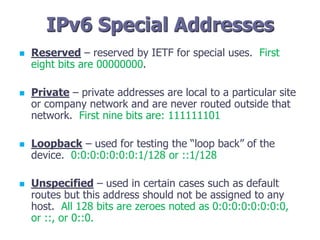
IPv6 Special Addresses
 Reserved – reserved by IETF for special uses. First
eight bits are 00000000.
 Private – private addresses are local to a particular site
or company network and are never routed outside that
network. First nine bits are: 111111101
 Loopback – used for testing the “loop back” of the
device. 0:0:0:0:0:0:0:1/128 or ::1/128
 Unspecified – used in certain cases such as default
routes but this address should not be assigned to any
host. All 128 bits are zeroes noted as 0:0:0:0:0:0:0:0,
or ::, or 0::0.
Who’s in charge?
 IANA – Internet Assigned Numbers Authority is in
charge of all IP address assignment and internet
parameters. (owned and ran by ICANN)
 ICANN – Internet Corporation for Assigned Names and
Numbers is a private, non-profit company responsible for
all registration tasks such as IP address assignment,
domain name assignment, and protocol parameters
management. (ICANN has allowed accredited registrars
to register names in many of the top-level domains)
Often referred to as: IANA/ICANN or ICANN/IANA
Migrating from IPv4 to IPv6
 Methods that make the migration easier:
 Dual-Stack – running both IPv4 and IPv6
simultaneously. Applications talk to both.
 Tunneling – wrapping or packaging one type of
packet into another to be sent on dissimilar network
i.e., tunneling ipV6 packets on IPv4 network.
 Translation – converting IPv4 to IPv6 and vice versa
which can be complex and result in problems.
Required for devices that only support one version.
(temporary solution until more devices make the
move to IPv6)
 IPv6/IPv4 Address Embedding – embeds the
IPv4 addresses within the IPv6 address structure
Dual-Stack
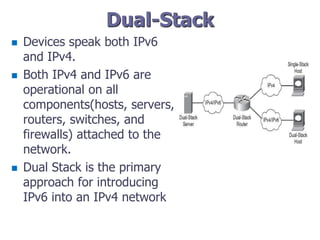
 Devices speak both IPv6
and IPv4.
 Both IPv4 and IPv6 are
operational on all
components(hosts, servers,
routers, switches, and
firewalls) attached to the
network.
 Dual Stack is the primary
approach for introducing
IPv6 into an IPv4 network
Tunneling
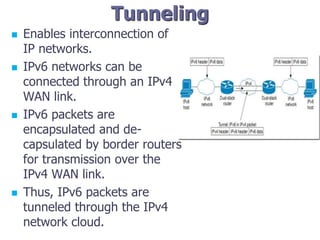
 Enables interconnection of
IP networks.
 IPv6 networks can be
connected through an IPv4
WAN link.
 IPv6 packets are
encapsulated and de-
capsulated by border routers
for transmission over the
IPv4 WAN link.
 Thus, IPv6 packets are
tunneled through the IPv4
network cloud.
Translation
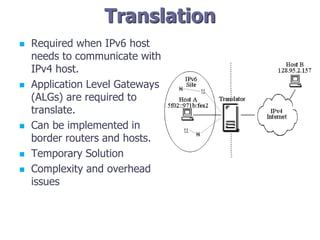
 Required when IPv6 host
needs to communicate with
IPv4 host.
 Application Level Gateways
(ALGs) are required to
translate.
 Can be implemented in
border routers and hosts.
 Temporary Solution
 Complexity and overhead
issues
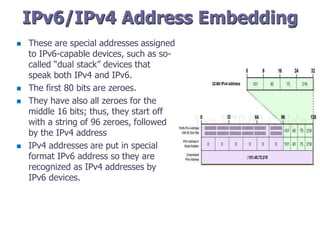
IPv6/IPv4 Address Embedding
 These are special addresses assigned
to IPv6-capable devices, such as so-
called “dual stack” devices that
speak both IPv4 and IPv6.
 The first 80 bits are zeroes.
 They have also all zeroes for the
middle 16 bits; thus, they start off
with a string of 96 zeroes, followed
by the IPv4 address
 IPv4 addresses are put in special
format IPv6 address so they are
recognized as IPv4 addresses by
IPv6 devices.
44
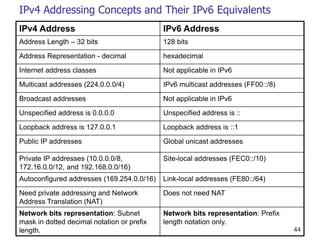
IPv4 Addressing Concepts and Their IPv6 Equivalents
IPv4 Address IPv6 Address
Address Length – 32 bits 128 bits
Address Representation - decimal hexadecimal
Internet address classes Not applicable in IPv6
Multicast addresses (224.0.0.0/4) IPv6 multicast addresses (FF00::/8)
Broadcast addresses Not applicable in IPv6
Unspecified address is 0.0.0.0 Unspecified address is ::
Loopback address is 127.0.0.1 Loopback address is ::1
Public IP addresses Global unicast addresses
Private IP addresses (10.0.0.0/8,
172.16.0.0/12, and 192.168.0.0/16)
Site-local addresses (FEC0::/10)
Autoconfigured addresses (169.254.0.0/16) Link-local addresses (FE80::/64)
Need private addressing and Network
Address Translation (NAT)
Does not need NAT
Network bits representation: Subnet
mask in dotted decimal notation or prefix
length.
Network bits representation: Prefix
length notation only.
IPv6 Post Check
 Now, go back to your IPv6 Pre/Post
Concept Check paper with your Key Terms
 Rate your understanding of the Key Terms
on the Right Side. Remember:
 (+) = Expert
 (√ ) = Heard of it
 (-) = Have not heard of it
 Reflection as a group.
Summary
 IPv6 or Internet Protocol Version 6 is the successor to IPv4 or
Internet Protocol Version 4. It is needed to address the need
for additional address space with an ever growing Internet
population as well as new internet devices.
 IPv6 addresses are written in Colon Hex notation.
 IPv6 addresses are Unicast, Multicast, and Anycast.
Broadcast is not part of IPv6.
 IPv6 has four special addresses: Reserved, Private,
Loopback, and Unspecified.
 Two colons in an address represent successive leading zeroes.
 Full IPv6 deployment will take years. IPv4 and IPv6 must
coexist in the meantime. Dual-Stack, Tunneling, Translation,
and IPv6/IPv4 Address Embedding all make the migration
easier.

Lect 2 i pv6-latest-rami

  • 1.
    1 Chapter Outline 2 Introduction 3Address Space Allocation 4 Autoconfiguration 5 Renumbering, Address Types and Migration 1 Overview IPv6 Addressing
  • 2.
    Before we start… _____IPng _____ _____ IPv6 _____ _____ CIDR _____ _____ NAT _____ _____ Autoconfiguration_____ _____ Unicast _____ _____ Multicast _____ _____ Anycast _____ _____ IPv4-Compatible _____ _____ IANA _____ _____ VLSM _____ _____ ICANN _____ _____ Dual-Stack _____ _____ Tunneling _____ _____ Translation _____ _____ Node _____ _____ Packet _____ Please write down the following Key Terms on a blank piece of paper leaving a small underline before and after each word. Label your paper IPv6 Pre/Post Concept Check.
  • 3.
    Pre Check ofKnowledge 1. Rate yourself as to your perceived knowledge of these key words. 2. Assess how much you already know about these terms by placing a (+), a check (√), or a zero (0) in the space to the left of each word.  Plus (+) = Expert  Check (√) = Heard of it  Zero (0) = Have not heard of it. We will do a Post Check at the end of this chapter.
  • 4.
    4 1- Overview IPv6 Defined Internet Protocol version 6  Originally known as IPng, or IP Next Generation  Network Layer protocol for packet switched networks  Successor of IPv4 which supports about 4.3 billion addresses (232 addresses)  IPv6 increased the number of addresses to (2128 addresses)
  • 5.
    Benefits  IPv6 longeraddress length is needed for:  Routing Aggregation  Autoconfiguration of Addresses  Easier allocation of address blocks  Flexibility of ISPs to subdivide blocks for customers  Organizations can subdivide blocks for internal networks  Embedded Quality of Service (QoS) to support services like VoIP & IP Video  Improved scalability for multicast routing  More efficient packet forwarding
  • 6.
    Okay, so whathappened to IPv5?  IPv5 was NOT a successor to IPv6  Known as Internet ST (Stream Protocol)  Experimental protocol….Not in public use
  • 7.
    What’s driving theneed for IPv6??  Internet growth  Mobile devices  PDAs  Mobile phones  Tablet PCs  Gaming  Voice/Video  Security Monitoring  Appliances  Medical Imaging  Animal Tags  Media Services  Traffic Control  Planes  Automobiles  Hotspots
  • 8.
    8 2- INTRODUCTION What isthe IPv6 address? An IPv6 address is 128 bits or 16 bytes (8 octets) long as shown in this figure. The address length in IPv6 is four times the length address in IPv4.
  • 9.
  • 10.
    10 Show the unabbreviatedcolon hex notation for the following IPv6 addresses: a. An address with 64 0s followed by 64 1s. b. An address with 128 0s. c. An address with 128 1s. d. An address with 128 alternative 1s and 0s. Solution a. 0000:0000:0000:0000:FFFF:FFFF:FFFF:FFFF b. 0000:0000:0000:0000:0000:0000:0000:0000 c. FFFF:FFFF:FFFF:FFFF:FFFF:FFFF:FFFF:FFFF d. AAAA:AAAA:AAAA:AAAA:AAAA:AAAA:AAAA:AAAA Example 1
  • 11.
    11 The following showsthe zero contraction version of addresses in Example 1 (part c and d cannot be abbreviated) a. :: FFFF:FFFF:FFFF:FFFF b. :: c. FFFF:FFFF:FFFF:FFFF:FFFF:FFFF:FFFF:FFFF d. AAAA:AAAA:AAAA:AAAA:AAAA:AAAA:AAAA:AAAA Example 2
  • 12.
    12 Show abbreviations forthe following addresses: a. 0000:0000:FFFF:0000:0000:0000:0000:0000 b. 1234:2346:0000:0000:0000:0000:0000:1111 c. 0000:0001:0000:0000:0000:0000:1200:1000 d. 0000:0000:0000:0000:0000:FFFF:24.123.12.6 Example 3 Solution: a. 0:0:FFFF:: b. 1234:2346::1111 c. 0:1::1200:1000 d. ::FFFF:24.123.12.6
  • 13.
    13 Decompress the followingaddresses and show the complete unabbreviated IPv6 address: a. 1111::2222 b. :: c. 0:1:: d. AAAA:A:AA::1234 Solution a. 1111:0000:0000:0000:0000:0000:0000:2222 b. 0000:0000:0000:0000:0000:0000:0000:0000 c. 0000:0001:0000:0000:0000:0000:0000:0000 d. AAAA:000A:00AA:0000:0000:0000:0000:1234 Example 4
  • 14.
    IPv6 Number ofAddresses  To give some idea about the number of IPv6 addresses, let us assume that the number of people on the planet earth is soon to be 234 (more than 16 billion). Each person can have 294 addresses to use.  If we assign 260 addresses to the users each year (almost one billion each second), it takes 268 years to deplete addresses.
  • 15.
    15 3- ADDRESS SPACEALLOCATION • Like the address space of IPv4, the address space of IPv6 is divided into several blocks of varying size and each block is allocated for special purpose. • Most of the blocks are still unassigned and have been left aside for future use. • To better understand the allocation and the location of each block in address space, we first divide the whole address space into eight equal ranges. • This division shows where each actual block is located .
  • 16.
  • 17.
    17 Compare the unspecifiedaddress in IPv4 to the unspecified addresses in IPv6. Solution In both architectures, an unspecified address is an all-zero address. In IPv4 this address is part of class A address; in IPv6 this address is part of the reserved block. Example 5
  • 18.
  • 19.
    19 Compare the loopaddresses in IPv4 to the loopback address in IPv6. Solution There are two differences in this case. In classful addressing, a whole block is allocated for loopback addresses; it is the 127.0.0.0/8 - 127.255.255.255 , in IPv6 only one address is allocated as the loopback address; it is the ::1/128. In addition, the loopback block in classful addressing is part of the class A block. In IPv6, it is only one single address in the reserved block. You can find more about IP Reserved, Loopback and Private Addresses by visiting this website: http://www.tcpipguide.com/free/t_IPReservedPrivateandLoopback Addresses-3.htm Example 6
  • 20.
  • 21.
    21 The Three Levelsof Hierarchy Global Routing Prefix (48 bits) is like the network ID in IPv4
  • 22.
    22 Mapping for EUI(Extended Unique Identifier)-64 • One of IPv6's key benefits over IPv4 is its capability for automatic interface addressing. • By implementing the IEEE's 64-bit Extended Unique Identifier (EUI-64) format, a host can automatically assign itself a unique 64-bit IPv6 interface identifier without the need for manual configuration or DHCP. • This is accomplished on Ethernet interfaces by referencing the already unique 48-bit MAC address, and reformatting that value to match the EUI-64 specification.
  • 23.
     This canbe described as having two steps: The first step is to convert the 48-bit MAC address to a 64-bit value. To do this, we break the MAC address into its two 24-bit halves: the Organizationally Unique Identifier (OUI) and the NIC specific part. The 16-bit hex value FFFE is then inserted between these two halves to form a 64-bit address.  Why FFFE? this is a reserved value which equipment manufacturers cannot include in "real" EUI-64 address assignments. In other words, any EUI-64 address having FFFE immediately following its OUI portion can be recognized as having been generated from an EUI-48 (or MAC) address. 23 Mapping for Ethernet MAC
  • 24.
    24 Find the interfaceidentifier if the Ethernet physical address is (F5- A9-23-14-7A-D2)16 using the format we defined for Ethernet addresses. Solution We only need to change the seventh bit of the first octet from 0 to 1, insert two octet FFFE and change the format to colon hex notation. The result is F7A9:23FF:FE14:7AD2 in colon hex. Example 7
  • 25.
    25 An organization isassigned the block 2000:1456:2474/48. What is the CIDR notation for the blocks in the first and second subnets in this organization? Solution Theoretically, the first and second subnets should use the block with subnet identifier 000116 and 000216. This means that the blocks are 2000:1456:2474:0001/64 and 2000:1456:2474:0002/64. Example 8
  • 26.
    26 An organization isassigned the block 2000:1456:2474/48. What is the IPv6 address of an interface in the third subnet if the IEEE physical address of the computer is (F5-A9-23-14-7A-D2)16. Solution The interface identifier is F7A9:23FF:FE14:7AD2 (see Example 7). If we add this identifier to the global prefix and the subnet identifier, we get: Example 9
  • 27.
    27 4- AUTOCONFIGURATION • Oneof the interesting features of IPv6 addressing is the autoconfiguration of hosts. • As we discussed in IPv4, the host and routers are originally configured manually by the network manager using static addresses, however, the Dynamic Host Configuration Protocol, DHCP, can also be used to allocate an IPv4 address to a host that joins the network. • In IPv6, DHCP protocol can still be used to allocate an IPv6 address to a host, but a host can also configure itself.
  • 28.
    28 Assume a hostwith Ethernet address (F5-A9-23-11-9B-E2)16 has joined the network. What would be its global unicast address if the global unicast prefix of the organization is 3A21:1216:2165 and the subnet identifier is 1232 ? Solution The host first creates its interface identifier as F7A9:23FF:FE11:9BE2 using the Ethernet MAC address read from its NIC card. Assuming that this address is unique, the host sends a router solicitation message and receives the router advertisement message that announces the combination of global unicast prefix and the subnet identifier as 3A21:1216:2165:1232. The host then appends its interface identifier to this prefix to find and store its global unicast address as: Example 10 3A21:1216:2165:1232:F7A9:23FF:FE11:9BE2
  • 29.
    29 5- RENUMBERING ,ADDRESS TYPES and MIGRATION • To allow sites to change the service provider, renumbering of the address prefix (n) was built into IPv6 addressing. • As we discussed before, each site is given a prefix by the service provider to which it is connected. If the site changes the provider, the address prefix needs to be changed. • A router to which the site is connected to can advertise a new prefix and let the site use the old prefix for a short time before disabling it. In other words, during the transition period, a site has two prefixes.
  • 30.
    IPv6 Provider-Based Addresses The first IPv6 addresses will be allocated to a provider- based plan  Type: Set to “010” for provider-based addresses  Registry: identifies the agency that registered the address The following fields have a variable length (recommended lengths are in“()” )  Provider: Id of Internet access provider (16 bits)  Subscriber: Id of the organization at provider (24 bits)  Subnetwork: Id of subnet within organization (32 bits)  Interface: identifies an interface at a node (48 bits) Registry ID Provider ID 010 Subscriber ID Interface ID Subnetwork ID
  • 31.
    IPv6 Address Types Unicast – identifies a single interface on a single node. A unicast packet is delivered to the identified single interface.  Multicast - identifies a set of interfaces that belong to different nodes. A multicast packet is delivered to all identified interfaces.  Anycast – a global unicast address such as DNS that is assigned to a set of interfaces that belong to different nodes. An anycast packet is delivered to the closest interface. For more information on Unicast, Multicast and Anycast, you may visit the website: http://www.omnisecu.com/tcpip/ipv6/unicast-multicast-anycast-types-of- network-communication-in-ipv6.php  Broadcast – Not in IPv6!!!
  • 32.
    IPv6 Unicast Addresses 64 bits for Global Routing and Subnet + 64 bits for Interface ID  Prefix + Subnet ID + Interface ID = 128 bit IPv6 Address  Prefix is the Global Routing Prefix (48 bits)  Subnet ID is the subnet identifier within a site (16 bits)  Interface ID is the interface identifier for a particular host or other device (64 bits) From ONE: To ONE: SOURCE -----------------------------Unicast Destination
  • 33.
    IPv6 Multicast Addresses 1st 8 bits are all 1’s i.e., 1111 1111; Translate into Hex: FF  Indicator (8 bits) + Flags (4 bits) + Scope ID (4 bits) + Group ID (112 bits) = IPv6 128 bit Multicast Address  Indicator – 1st eight bits set to 1’s signifying a multicast packet.  Flags – 1st three are 0’s. The last is either a “0” for a permanent/well known multicast address or a “1” for a temporary multicast address.  Scopes – Globally across the Internet or Locally within the organization  Group – Defines a particular group within a scope. From ONE: To MANY: SOURCE Multicast Destinations Multicast Destinations Multicast Destinations
  • 34.
    Multicast Scopes  Node-Local (withina node)Scope (1)  Link-Local (within a local network) Scope (2)  Site-Local (within a local site) Scope (5)  Organization- Local (within an organization) Scope (8)  Global (across the Internet) Scope (14) Note: As the Scope ID Value Increases, the Scope expands to cover larger areas.
  • 35.
    Well Known Multicast Addresses FF01:0:0:0:0:0:1 used to multicast to all nodes for node-local. (Notice: FF signifies multicast, scope id of 1 signifies node-local, and group id of 1 signifies all nodes)  FF02:0:0:0:0:0:1 used to multicast to all nodes for link-local. (Notice: FF signifies multicast, scope id of 2 signifies link-local, and group id of 1 signifies all nodes)  FF01:0:0:0:0:0:2 used to multicast to all routers for node-local. (Notice: FF signifies multicast, scope id of 1 signifies node-local, and group id of 2 signifies all routers)  FF02:0:0:0:0:0:2 used to multicast to all routers for link-local. (Notice: FF signifies multicast, scope id of 2 signifies link-local, and group id of 2 signifies all routers)  FF05:0:0:0:0:0:2 used to multicast to all routers for node-local. (Notice: FF signifies multicast, scope id of 5 signifies site-local, and group id of 2 signifies all routers) Multicasting to “all nodes” replaces IPv4 Broadcasts.
  • 36.
    IPv6 Anycast Addresses Anycast Packets are new to IPv6  Automatically sends packet to the closest member within a group.  Provides flexibility when requesting a service provided by several different routers.  Designed for devices within the same network.  Addresses assigned from Unicast Addressing space. From ONE: To ONE of Many: SOURCE ------------------------------- Multicast Destination ------------------------------- Multicast Destination ----------------------------- CLOSEST Multicast Destination
  • 37.
    IPv6 Special Addresses Reserved – reserved by IETF for special uses. First eight bits are 00000000.  Private – private addresses are local to a particular site or company network and are never routed outside that network. First nine bits are: 111111101  Loopback – used for testing the “loop back” of the device. 0:0:0:0:0:0:0:1/128 or ::1/128  Unspecified – used in certain cases such as default routes but this address should not be assigned to any host. All 128 bits are zeroes noted as 0:0:0:0:0:0:0:0, or ::, or 0::0.
  • 38.
    Who’s in charge? IANA – Internet Assigned Numbers Authority is in charge of all IP address assignment and internet parameters. (owned and ran by ICANN)  ICANN – Internet Corporation for Assigned Names and Numbers is a private, non-profit company responsible for all registration tasks such as IP address assignment, domain name assignment, and protocol parameters management. (ICANN has allowed accredited registrars to register names in many of the top-level domains) Often referred to as: IANA/ICANN or ICANN/IANA
  • 39.
    Migrating from IPv4to IPv6  Methods that make the migration easier:  Dual-Stack – running both IPv4 and IPv6 simultaneously. Applications talk to both.  Tunneling – wrapping or packaging one type of packet into another to be sent on dissimilar network i.e., tunneling ipV6 packets on IPv4 network.  Translation – converting IPv4 to IPv6 and vice versa which can be complex and result in problems. Required for devices that only support one version. (temporary solution until more devices make the move to IPv6)  IPv6/IPv4 Address Embedding – embeds the IPv4 addresses within the IPv6 address structure
  • 40.
    Dual-Stack  Devices speakboth IPv6 and IPv4.  Both IPv4 and IPv6 are operational on all components(hosts, servers, routers, switches, and firewalls) attached to the network.  Dual Stack is the primary approach for introducing IPv6 into an IPv4 network
  • 41.
    Tunneling  Enables interconnectionof IP networks.  IPv6 networks can be connected through an IPv4 WAN link.  IPv6 packets are encapsulated and de- capsulated by border routers for transmission over the IPv4 WAN link.  Thus, IPv6 packets are tunneled through the IPv4 network cloud.
  • 42.
    Translation  Required whenIPv6 host needs to communicate with IPv4 host.  Application Level Gateways (ALGs) are required to translate.  Can be implemented in border routers and hosts.  Temporary Solution  Complexity and overhead issues
  • 43.
    IPv6/IPv4 Address Embedding These are special addresses assigned to IPv6-capable devices, such as so- called “dual stack” devices that speak both IPv4 and IPv6.  The first 80 bits are zeroes.  They have also all zeroes for the middle 16 bits; thus, they start off with a string of 96 zeroes, followed by the IPv4 address  IPv4 addresses are put in special format IPv6 address so they are recognized as IPv4 addresses by IPv6 devices.
  • 44.
    44 IPv4 Addressing Conceptsand Their IPv6 Equivalents IPv4 Address IPv6 Address Address Length – 32 bits 128 bits Address Representation - decimal hexadecimal Internet address classes Not applicable in IPv6 Multicast addresses (224.0.0.0/4) IPv6 multicast addresses (FF00::/8) Broadcast addresses Not applicable in IPv6 Unspecified address is 0.0.0.0 Unspecified address is :: Loopback address is 127.0.0.1 Loopback address is ::1 Public IP addresses Global unicast addresses Private IP addresses (10.0.0.0/8, 172.16.0.0/12, and 192.168.0.0/16) Site-local addresses (FEC0::/10) Autoconfigured addresses (169.254.0.0/16) Link-local addresses (FE80::/64) Need private addressing and Network Address Translation (NAT) Does not need NAT Network bits representation: Subnet mask in dotted decimal notation or prefix length. Network bits representation: Prefix length notation only.
  • 45.
    IPv6 Post Check Now, go back to your IPv6 Pre/Post Concept Check paper with your Key Terms  Rate your understanding of the Key Terms on the Right Side. Remember:  (+) = Expert  (√ ) = Heard of it  (-) = Have not heard of it  Reflection as a group.
  • 46.
    Summary  IPv6 orInternet Protocol Version 6 is the successor to IPv4 or Internet Protocol Version 4. It is needed to address the need for additional address space with an ever growing Internet population as well as new internet devices.  IPv6 addresses are written in Colon Hex notation.  IPv6 addresses are Unicast, Multicast, and Anycast. Broadcast is not part of IPv6.  IPv6 has four special addresses: Reserved, Private, Loopback, and Unspecified.  Two colons in an address represent successive leading zeroes.  Full IPv6 deployment will take years. IPv4 and IPv6 must coexist in the meantime. Dual-Stack, Tunneling, Translation, and IPv6/IPv4 Address Embedding all make the migration easier.