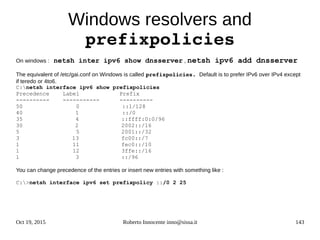
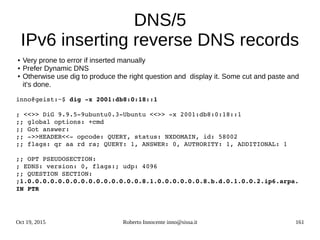
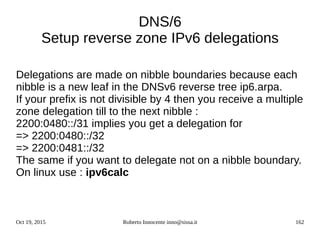
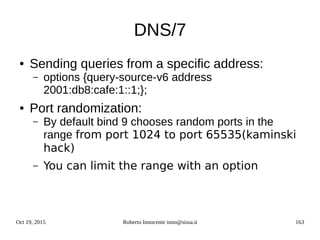
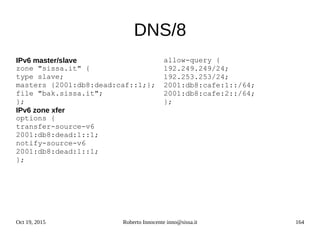
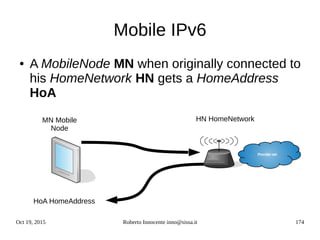
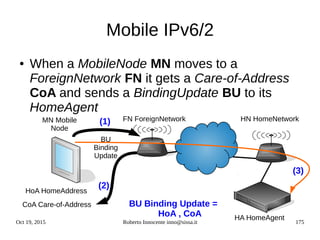
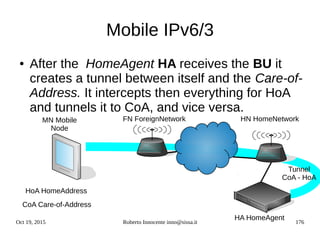
Oct 19, 2015 Roberto Innocente inno@sissa.it 1
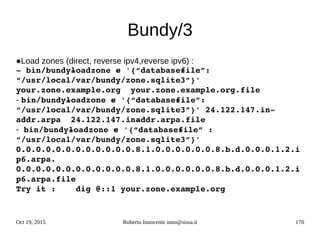
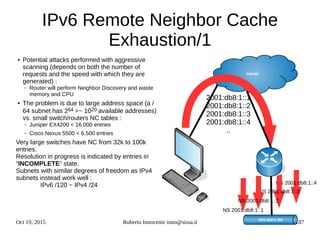
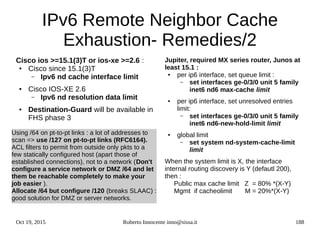
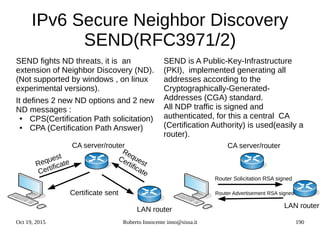
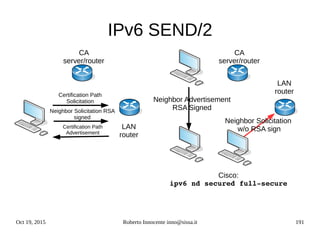
ipv6
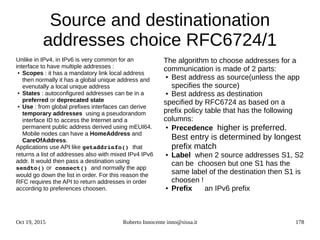
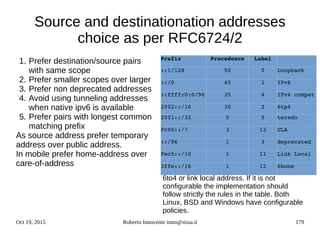
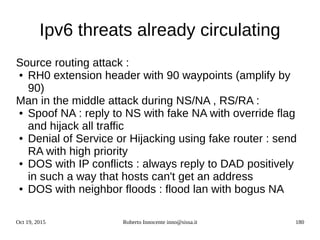
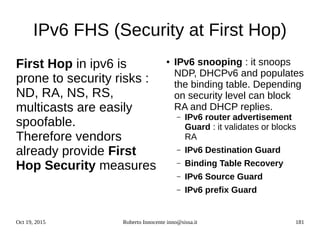
● History and motivations
● Introduction to ipv6 : addressing and prefixes
● Proposal for gradual deployment
● Transition technologies: tunnels (6to4, teredo)
● Multicast, Control protocols : ICMPv6 ( ND, RD)
● Booting (SLAAC/DHCPv6), naming (DNSv6,
mDNS)
● Routing : RIPng, OSPFv3, IS-IS, BGP4+
Oct 19, 2015 Roberto Innocente inno@sissa.it 2
IPv6 history
● Well , probably all of you know that since the '90 the Internet governing bodies thought about a
technical way out from the foreseeable moment of IPv4 address consumption.
● First named IPng and then IPv6 a new protocol was finalized between '94 and 2000.
● The main feature of it was ( impressive at that time) the increase of the address size from 32
bits(up to 2^32 ~ 10^10 addresses) to 128 bits (4 times more bits up to 2^128 ~ 10^40
addresses). Explanation for physicists : 30 orders of magnitude more, Millions of Avogadro's
number IPv4 address spaces ( sic! )
● Don't be astonished. Many think that if it would be developed now the address would be at least
256 bits.
● In fact there was before IPv6 an ISO protocol that to be smart implemented variable length
addresses (up to 20 bytes, 160 bits) ISO 8473/1998 CLNP (Connectionless Network Protocol
RFC1162). Their supporters proposed to solve the IPv4 problem by the substitution of IP by
CLNP with a solution called TUBA (TCP and UDP with Bigger Addresses RFC1437)
● The NSFNET backbone in US and some GARR parts( bologna – trieste) supported CLNP for
some time from 1990 to 1993. The nsfnet together with ip, ts-bo encapsulating ip in clnp (“routing
pass like ships in the night”).
● Soon it was realized that Variable Length Addresses were a really bad idea from the point of view
of routing and switching efficiency. This was of course also giving variable offsets to options : a
nightmare for hardware switching.
Oct 19, 2015 Roberto Innocente inno@sissa.it 3
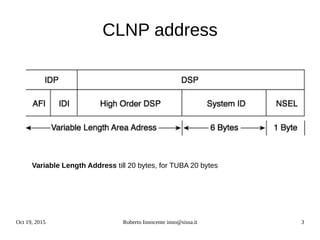
CLNP address
Variable Length Address till 20 bytes, for TUBA 20 bytes
Oct 19, 2015 Roberto Innocente inno@sissa.it 4
Why ? Why now ?
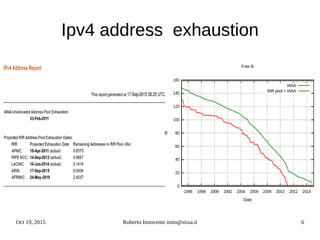
The IPv4 address prefixes are finished at IANA (Internet Assigned Numbers
Authority) and at ARIN (Canada, USA registry ) some remain in the hands of ISPs.
Therefore soon some islands of IPv6 only will appear and it will be necessary to
speak IPv6 to reach them.
The vision that is behind the Internet Of Things (IOT) is pushing hard to have an IP
address for everything :
● Washing machines, dish-washers, fridges, ovens .. smartphones, TV top boxes, ..
Mobile 4G (LTE) provides voice as the service Voice over IP.
In the orig 3GPP spec it was only requested to be available and IPv4 optional, but
most operators now use IPv6 for this.
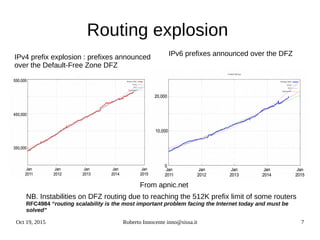
There is another difficult problem that afflicts today IPv4 Internet at large: the
routing prefix explosion (now routers in the Default Free Zone have over 500.000
prefixes). With IPv6 there is the hope to aggregate prefixes by LIR/ISP , RIRs.
Last but not least IPv6 will give to people now constrained behind a NAT, End-to-
End Transparency (some nonetheless consider this a threat ) : RFC2775 Internet
Transparency, RFC4924 Reflexions on Internet Transparency.
Oct 19, 2015 Roberto Innocente inno@sissa.it 5
We want to avoid the chaos :
Dagen H (hå), 5 am. Stockholm 1967
when traffic switched from left to right
Benjamin Edelman,
Running out of numbers
http://www.benedelman.org/publications/runningout-draft.pdf
Oct 19, 2015 Roberto Innocente inno@sissa.it 6
Ipv4 address exhaustion
Oct 19, 2015 Roberto Innocente inno@sissa.it 7
Routing explosion
IPv6 prefixes announced over the DFZIPv4 prefix explosion : prefixes announced
over the Default-Free Zone DFZ
From apnic.net
NB. Instabilities on DFZ routing due to reaching the 512K prefix limit of some routers
RFC4984 “routing scalability is the most important problem facing the Internet today and must be
solved”
Oct 19, 2015 Roberto Innocente inno@sissa.it 8
End-to-End transparency
RFC4924
It is not often cited as a
motive for the adoption of
IPv6, but the new protocol
will give back to the current
Internet and the
forthcoming Internet of
Things (IOT) end-to-end
transparency.
This at the same time is a
threat for some and an
essential tool for others.
“Two ports Internet”
Today Internet is filtered
and NATted everywhere,
except for the web ports.
Therefore whoever today is
developing new things
doesn't care to use new
ports and register them, but
uses exclusively :
● Port 80 http
● Port 443 https
Oct 19, 2015 Roberto Innocente inno@sissa.it 9
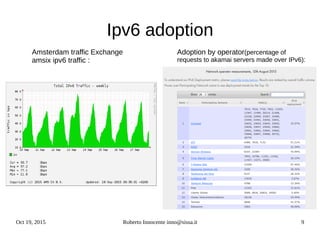
Ipv6 adoption
Amsterdam traffic Exchange
amsix ipv6 traffic :
Adoption by operator(percentage of
requests to akamai servers made over IPv6):
Oct 19, 2015 Roberto Innocente inno@sissa.it 10
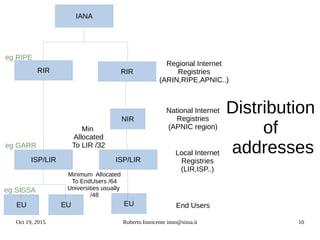
Distribution
of
addresses
Min
Allocated
To LIR /32
Minimum Allocated
To EndUsers /64
Universities usually
/48
eg RIPE
eg GARR
eg SISSA
IANA
RIR RIR
NIR
ISP/LIRISP/LIR
EU EU EU End Users
Local Internet
Registries
(LIR,ISP..)
National Internet
Registries
(APNIC region)
Regional Internet
Registries
(ARIN,RIPE,APNIC..)
Oct 19, 2015 Roberto Innocente inno@sissa.it 11
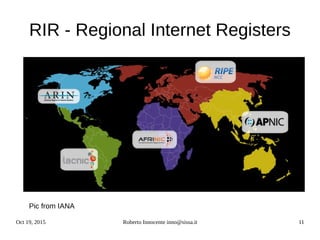
RIR - Regional Internet Registers
Pic from IANA
Oct 19, 2015 Roberto Innocente inno@sissa.it 12
PI (Provider Independent)
PA (Provider Assigned) prefixes
There have been lots of discussion about ipv6 addresses deployment. 3 methods were
proposed :
● PA provider assigned or aggregatable : specified in the RFC's, usually
universities in italy got their ipv6 /48 prefix from GARR. These addresses will stay
with provider and if you change provider you have to change addresses.
● PI provider independent : these addresses will be announced independently over
the whole Internet and will stay with you. Registries are now providing also these
● Geographically
In 2009 RIPE accepted a policy proposal on this topic :
● RIPE will assign directly to organization PI prefixes that should be at least /48 or /32.
The request can be addressed directly to RIPE or trough a sponsoring LIR
● This will make possible for an organization to move to another provider without
renumbering
● On the other side this poses a burden on global routing because it blocks the
possibility of an efficient route aggregation.
Oct 19, 2015 Roberto Innocente inno@sissa.it 13
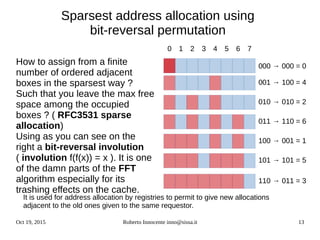
Sparsest address allocation using
bit-reversal permutation
How to assign from a finite
number of ordered adjacent
boxes in the sparsest way ?
Such that you leave the max free
space among the occupied
boxes ? ( RFC3531 sparse
allocation)
Using as you can see on the
right a bit-reversal involution
( involution f(f(x)) = x ). It is one
of the damn parts of the FFT
algorithm especially for its
trashing effects on the cache.
001 → 100 = 4
010 → 010 = 2
011 → 110 = 6
100 → 001 = 1
101 → 101 = 5
110 → 011 = 3
It is used for address allocation by registries to permit to give new allocations
adjacent to the old ones given to the same requestor.
000 → 000 = 0
1 2 3 4 5 6 70
Oct 19, 2015 Roberto Innocente inno@sissa.it 14
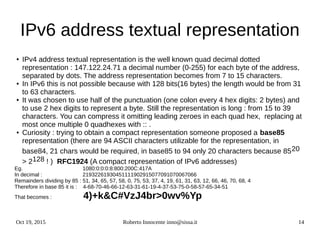
IPv6 address textual representation
● IPv4 address textual representation is the well known quad decimal dotted
representation : 147.122.24.71 a decimal number (0-255) for each byte of the address,
separated by dots. The address representation becomes from 7 to 15 characters.
● In IPv6 this is not possible because with 128 bits(16 bytes) the length would be from 31
to 63 characters.
● It was chosen to use half of the punctuation (one colon every 4 hex digits: 2 bytes) and
to use 2 hex digits to represent a byte. Still the representation is long : from 15 to 39
characters. You can compress it omitting leading zeroes in each quad hex, replacing at
most once multiple 0 quadhexes with :: .
● Curiosity : trying to obtain a compact representation someone proposed a base85
representation (there are 94 ASCII characters utilizable for the representation, in
base84, 21 chars would be required, in base85 to 94 only 20 characters because 8520
> 2128 ! ) RFC1924 (A compact representation of IPv6 addresses)
Eg. 1080:0:0:0:8:800:200C:417A
In decimal : 21932261930451111902915077091070067066
Remainders dividing by 85 : 51, 34, 65, 57, 58, 0, 75, 53, 37, 4, 19, 61, 31, 63, 12, 66, 46, 70, 68, 4
Therefore in base 85 it is : 4-68-70-46-66-12-63-31-61-19-4-37-53-75-0-58-57-65-34-51
That becomes : 4)+k&C#VzJ4br>0wv%Yp
Oct 19, 2015 Roberto Innocente inno@sissa.it 15
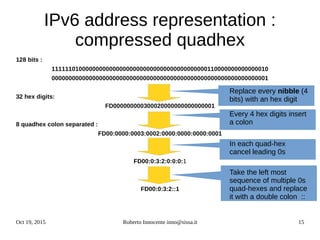
IPv6 address representation :
compressed quadhex
128 bits :
1111110100000000000000000000000000000000000000110000000000000010
0000000000000000000000000000000000000000000000000000000000000001
32 hex digits:
FD000000000300020000000000000001
8 quadhex colon separated :
FD00:0000:0003:0002:0000:0000:0000:0001
FD00:0:3:2:0:0:0:1
FD00:0:3:2::1
Replace every nibble (4
bits) with an hex digit
Take the left most
sequence of multiple 0s
quad-hexes and replace
it with a double colon ::
In each quad-hex
cancel leading 0s
Every 4 hex digits insert
a colon
Oct 19, 2015 Roberto Innocente inno@sissa.it 16
IPv6 prefix text representation
RFC4291 Text Representation of Address Prefixes
The text representation of IPv6 address prefixes is similar to the way IPv4 address prefixes are
written in Classless Inter-Domain Routing (CIDR) notation [CIDR]. An IPv6 address prefix is
represented by the notation:
ipv6-address/prefix-length
where
ipv6-address is an IPv6 address in any of the notations listed in Section 2.2.
prefix-length is a decimal value specifying how many of the leftmost contiguous bits of the
address comprise the prefix.
For example, the following are legal representations of the 60-bit prefix 20010DB80000CD3
(hexadecimal):
2001:0DB8:0000:CD30:0000:0000:0000:0000/60
2001:0DB8::CD30:0:0:0:0/60
2001:0DB8:0:CD30::/60
The following are NOT legal representations of the above prefix:
2001:0DB8:0:CD3/60 may drop leading zeros, but not trailing
zeros, within any 16-bit chunk of the address
2001:0DB8::CD30/60 address to left of "/" expands to
2001:0DB8:0000:0000:0000:0000:0000:CD30
2001:0DB8::CD3/60 address to left of "/" expands to
2001:0DB8:0000:0000:0000:0000:0000:0CD3
Oct 19, 2015 Roberto Innocente inno@sissa.it 17
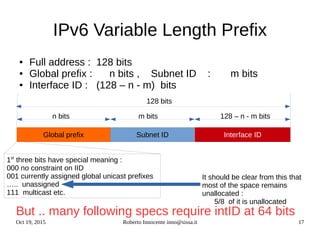
IPv6 Variable Length Prefix
● Full address : 128 bits
● Global prefix : n bits , Subnet ID : m bits
● Interface ID : (128 – n - m) bits
But .. many following specs require intID at 64 bits
Subnet ID Interface ID
128 bits
Global prefix
n bits m bits 128 – n - m bits
1st
three bits have special meaning :
000 no constraint on IID
001 currently assigned global unicast prefixes
….. unassigned
111 multicast etc.
It should be clear from this that
most of the space remains
unallocated :
5/8 of it is unallocated
Oct 19, 2015 Roberto Innocente inno@sissa.it 18
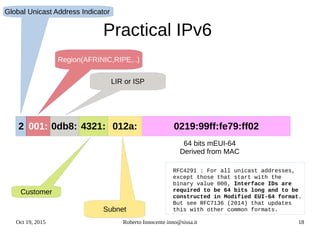
Practical IPv6
Global Unicast Address Indicator
Region(AFRINIC,RIPE,..)
LIR or ISP
Customer
Subnet
2 001: 0db8: 4321: 012a: 0219:99ff:fe79:ff02
64 bits mEUI-64
Derived from MAC
RFC4291 : For all unicast addresses,
except those that start with the
binary value 000, Interface IDs are
required to be 64 bits long and to be
constructed in Modified EUI-64 format.
But see RFC7136 (2014) that updates
this with other common formats.
Oct 19, 2015 Roberto Innocente inno@sissa.it 19
Put out of your mind ..
the idea that one of the things to know for a
subnet plan is the possible number of hosts !!
e.g. We were used to think that if maybe 300/400
hosts would at the end populate a subnet then we
had to give to this subnet a /22 subnet address
and a coupled netmask of 255.255.252.0.
Using 8 bytes for the interface identifier there
will never be problems with this part of the
address : it allows 264 ~ 1020 different hosts !
Oct 19, 2015 Roberto Innocente inno@sissa.it 20
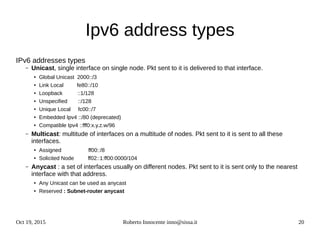
Ipv6 address types
IPv6 addresses types
– Unicast, single interface on single node. Pkt sent to it is delivered to that interface.
● Global Unicast 2000::/3
● Link Local fe80::/10
● Loopback ::1/128
● Unspecified ::/128
● Unique Local fc00::/7
● Embedded Ipv4 ::/80 (deprecated)
● Compatible Ipv4 ::fff0:x.y.z.w/96
– Multicast: multitude of interfaces on a multitude of nodes. Pkt sent to it is sent to all these
interfaces.
● Assigned ff00::/8
● Solicited Node ff02::1:ff00:0000/104
– Anycast : a set of interfaces usually on different nodes. Pkt sent to it is sent only to the nearest
interface with that address.
● Any Unicast can be used as anycast
● Reserved : Subnet-router anycast
Oct 19, 2015 Roberto Innocente inno@sissa.it 21
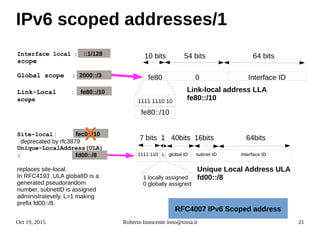
IPv6 scoped addresses/1
Interface local : ::1/128
scope
Global scope : 2000::/3
Link-Local : fe80::/10
scope
Site-local : fec0::/10
deprecated by rfc3879
Unique-LocalAddress(ULA)
: fd00::/8
replaces site-local.
In RFC4193 ,ULA globalID is a
generated pseudorandom
number, subnetID is assigned
administratevely, L=1 making
prefix fd00::/8.
fe80 0 Interface ID
1111 1110 10
fe80::/10
1111 110 L global ID subnet ID Interface ID
1 locally assigned
0 globally assigned
7 bits 1 40bits 16bits 64bits
Link-local address LLA
fe80::/10
Unique Local Address ULA
fd00::/8
RFC4007 IPv6 Scoped address
10 bits 54 bits 64 bits
x
Oct 19, 2015 Roberto Innocente inno@sissa.it 22
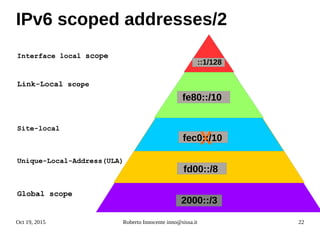
IPv6 scoped addresses/2
Interface local scope
Link-Local scope
Site-local
Unique-Local-Address(ULA)
Global scope
x
::1/128
fec0::/10
fd00::/8
2000::/3
fe80::/10
Oct 19, 2015 Roberto Innocente inno@sissa.it 23
IPv6 address scopes
or simply zones
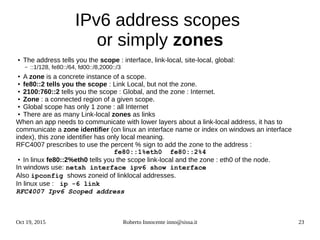
● The address tells you the scope : interface, link-local, site-local, global:
– ::1/128, fe80::/64, fd00::/8,2000::/3
● A zone is a concrete instance of a scope.
● fe80::2 tells you the scope : Link Local, but not the zone.
● 2100:760::2 tells you the scope : Global, and the zone : Internet.
● Zone : a connected region of a given scope.
● Global scope has only 1 zone : all Internet
● There are as many Link-local zones as links
When an app needs to communicate with lower layers about a link-local address, it has to
communicate a zone identifier (on linux an interface name or index on windows an interface
index), this zone identifier has only local meaning.
RFC4007 prescribes to use the percent % sign to add the zone to the address :
fe80::1%eth0 fe80::2%4
● In linux fe80::2%eth0 tells you the scope link-local and the zone : eth0 of the node.
In windows use: netsh interface ipv6 show interface
Also ipconfig shows zoneid of linklocal addresses.
In linux use : ip -6 link
RFC4007 Ipv6 Scoped address
Oct 19, 2015 Roberto Innocente inno@sissa.it 24
Ipv6 anycast - RFC3513
● Anycast are explicitly contemplated by IPv6.
● An anycast address is taken from the unicast addresses and assigned to multiple
interfaces (RFC4921), it has the same scope as the unicast family from which is taken.
The node to which an anycast is assigned should be explicitly configured to recognize
the address.
● The routing infrastructure, that should be aware of it, will deliver a packet having as
destination an anycast address to the nearest of the instances of that address.
● Usage examples :
– TLD anycast dns servers
– Reserve Subnet-router anycast address (RFC4291)
– 6to4 relay anycast address RFC3068
This is accomplished trough the propagation of host routes for the anycasts in all the
parts of the network that can't summarize the anycast with a route prefix.
There is a longest prefix P that is common to the region of all these interfaces … in the
worst case this prefix P can be null and the region be then the whole Internet.
In this case the host route should be maintained over all Internet.
Oct 19, 2015 Roberto Innocente inno@sissa.it 25
128 – n Bitsn bits
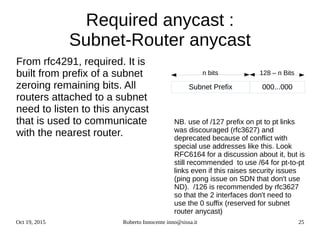
Required anycast :
Subnet-Router anycast
From rfc4291, required. It is
built from prefix of a subnet
zeroing remaining bits. All
routers attached to a subnet
need to listen to this anycast
that is used to communicate
with the nearest router.
NB. use of /127 prefix on pt to pt links
was discouraged (rfc3627) and
deprecated because of conflict with
special use addresses like this. Look
RFC6164 for a discussion about it, but is
still recommended to use /64 for pt-to-pt
links even if this raises security issues
(ping pong issue on SDN that don't use
ND). /126 is recommended by rfc3627
so that the 2 interfaces don't need to
use the 0 suffix (reserved for subnet
router anycast)
Subnet Prefix 000...000
Oct 19, 2015 Roberto Innocente inno@sissa.it 26
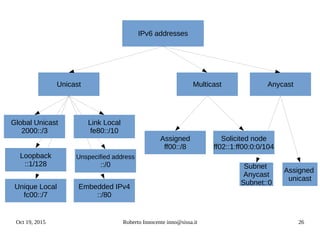
IPv6 addresses
Multicast AnycastUnicastUnicast
Unique Local
fc00::/7
Assigned
ff00::/8
Global Unicast
2000::/3
Link Local
fe80::/10
Loopback
::1/128
Embedded IPv4
::/80
Unspecified address
::/0
Assigned
unicast
Subnet
Anycast
Subnet::0
Solicited node
ff02::1:ff00:0:0/104
Oct 19, 2015 Roberto Innocente inno@sissa.it 27
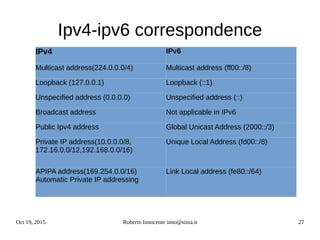
Ipv4-ipv6 correspondence
IPv4 IPv6
Multicast address(224.0.0.0/4) Multicast address (ff00::/8)
Loopback (127.0.0.1) Loopback (::1)
Unspecified address (0.0.0.0) Unspecified address (::)
Broadcast address Not applicable in IPv6
Public Ipv4 address Global Unicast Address (2000::/3)
Private IP address(10.0.0.0/8,
172.16.0.0/12,192.168.0.0/16)
Unique Local Address (fd00::/8)
APIPA address(169.254.0.0/16)
Automatic Private IP addressing
Link Local address (fe80::/64)
Oct 19, 2015 Roberto Innocente inno@sissa.it 28
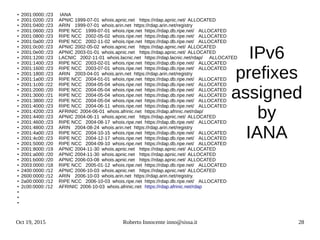
IPv6
prefixes
assigned
by
IANA
● 2001:0000::/23 IANA
● 2001:0200::/23 APNIC 1999-07-01 whois.apnic.net https://rdap.apnic.net/ ALLOCATED
● 2001:0400::/23 ARIN 1999-07-01 whois.arin.net https://rdap.arin.net/registry
●
2001:0600::/23 RIPE NCC 1999-07-01 whois.ripe.net https://rdap.db.ripe.net/ ALLOCATED
● 2001:0800::/23 RIPE NCC 2002-05-02 whois.ripe.net https://rdap.db.ripe.net/ ALLOCATED
● 2001:0a00::/23 RIPE NCC 2002-11-02 whois.ripe.net https://rdap.db.ripe.net/ ALLOCATED
● 2001:0c00::/23 APNIC 2002-05-02 whois.apnic.net https://rdap.apnic.net/ ALLOCATED
●
2001:0e00::/23 APNIC 2003-01-01 whois.apnic.net https://rdap.apnic.net/ ALLOCATED
● 2001:1200::/23 LACNIC 2002-11-01 whois.lacnic.net https://rdap.lacnic.net/rdap/ ALLOCATED
● 2001:1400::/23 RIPE NCC 2003-02-01 whois.ripe.net https://rdap.db.ripe.net/ ALLOCATED
● 2001:1600::/23 RIPE NCC 2003-07-01 whois.ripe.net https://rdap.db.ripe.net/ ALLOCATED
● 2001:1800::/23 ARIN 2003-04-01 whois.arin.net https://rdap.arin.net/registry
●
2001:1a00::/23 RIPE NCC 2004-01-01 whois.ripe.net https://rdap.db.ripe.net/ ALLOCATED
● 2001:1c00::/22 RIPE NCC 2004-05-04 whois.ripe.net https://rdap.db.ripe.net/ ALLOCATED
● 2001:2000::/20 RIPE NCC 2004-05-04 whois.ripe.net https://rdap.db.ripe.net/ ALLOCATED
● 2001:3000::/21 RIPE NCC 2004-05-04 whois.ripe.net https://rdap.db.ripe.net/ ALLOCATED
●
2001:3800::/22 RIPE NCC 2004-05-04 whois.ripe.net https://rdap.db.ripe.net/ ALLOCATED
● 2001:4000::/23 RIPE NCC 2004-06-11 whois.ripe.net https://rdap.db.ripe.net/ ALLOCATED
● 2001:4200::/23 AFRINIC 2004-06-01 whois.afrinic.net https://rdap.afrinic.net/rdap/
● 2001:4400::/23 APNIC 2004-06-11 whois.apnic.net https://rdap.apnic.net/ ALLOCATED
●
2001:4600::/23 RIPE NCC 2004-08-17 whois.ripe.net https://rdap.db.ripe.net/ ALLOCATED
● 2001:4800::/23 ARIN 2004-08-24 whois.arin.net https://rdap.arin.net/registry
● 2001:4a00::/23 RIPE NCC 2004-10-15 whois.ripe.net https://rdap.db.ripe.net/ ALLOCATED
● 2001:4c00::/23 RIPE NCC 2004-12-17 whois.ripe.net https://rdap.db.ripe.net/ ALLOCATED
● 2001:5000::/20 RIPE NCC 2004-09-10 whois.ripe.net https://rdap.db.ripe.net/ ALLOCATED
●
2001:8000::/19 APNIC 2004-11-30 whois.apnic.net https://rdap.apnic.net/ ALLOCATED
● 2001:a000::/20 APNIC 2004-11-30 whois.apnic.net https://rdap.apnic.net/ ALLOCATED
● 2001:b000::/20 APNIC 2006-03-08 whois.apnic.net https://rdap.apnic.net/ ALLOCATED
● 2003:0000::/18 RIPE NCC 2005-01-12 whois.ripe.net https://rdap.db.ripe.net/ ALLOCATED
●
2400:0000::/12 APNIC 2006-10-03 whois.apnic.net https://rdap.apnic.net/ ALLOCATED
● 2600:0000::/12 ARIN 2006-10-03 whois.arin.net https://rdap.arin.net/registry.
● 2a00:0000::/12 RIPE NCC 2006-10-03 whois.ripe.net https://rdap.db.ripe.net/ ALLOCATED
● 2c00:0000::/12 AFRINIC 2006-10-03 whois.afrinic.net https://rdap.afrinic.net/rdap
●
●
●
Oct 19, 2015 Roberto Innocente inno@sissa.it 29
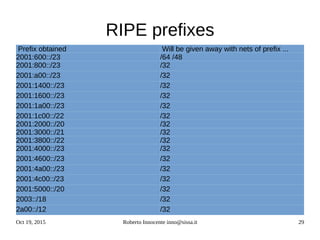
RIPE prefixes
Prefix obtained Will be given away with nets of prefix ...
2001:600::/23 /64 /48
2001:800::/23 /32
2001:a00::/23 /32
2001:1400::/23 /32
2001:1600::/23 /32
2001:1a00::/23 /32
2001:1c00::/22 /32
2001:2000::/20 /32
2001:3000::/21 /32
2001:3800::/22 /32
2001:4000::/23 /32
2001:4600::/23 /32
2001:4a00::/23 /32
2001:4c00::/23 /32
2001:5000::/20 /32
2003::/18 /32
2a00::/12 /32
Oct 19, 2015 Roberto Innocente inno@sissa.it 30
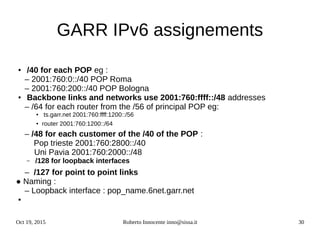
GARR IPv6 assignements
● /40 for each POP eg :
– 2001:760:0::/40 POP Roma
– 2001:760:200::/40 POP Bologna
● Backbone links and networks use 2001:760:ffff::/48 addresses
– /64 for each router from the /56 of principal POP eg:
● ts.garr.net 2001:760:ffff:1200::/56
● router 2001:760:1200::/64
– /48 for each customer of the /40 of the POP :
Pop trieste 2001:760:2800::/40
Uni Pavia 2001:760:2000::/48
– /128 for loopback interfaces
– /127 for point to point links
● Naming :
– Loopback interface : pop_name.6net.garr.net
●
Oct 19, 2015 Roberto Innocente inno@sissa.it 31
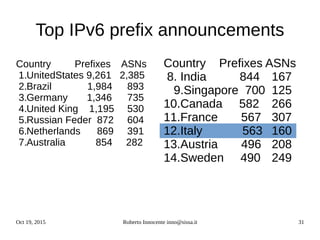
Country Prefixes ASNs
1.UnitedStates 9,261 2,385
2.Brazil 1,984 893
3.Germany 1,346 735
4.United King 1,195 530
5.Russian Feder 872 604
6.Netherlands 869 391
7.Australia 854 282
Top IPv6 prefix announcements
Country Prefixes ASNs
8. India 844 167
9.Singapore 700 125
10.Canada 582 266
11.France 567 307
12.Italy 563 160
13.Austria 496 208
14.Sweden 490 249
Oct 19, 2015 Roberto Innocente inno@sissa.it 32
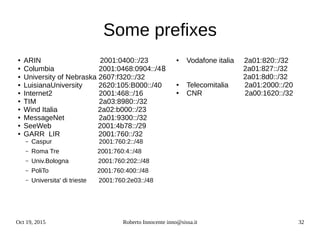
● ARIN 2001:0400::/23
● Columbia 2001:0468:0904::/48
● University of Nebraska 2607:f320::/32
● LuisianaUniversity 2620:105:B000::/40
● Internet2 2001:468::/16
● TIM 2a03:8980::/32
● Wind Italia 2a02:b000::/23
● MessageNet 2a01:9300::/32
● SeeWeb 2001:4b78::/29
● GARR LIR 2001:760::/32
– Caspur 2001:760:2::/48
– Roma Tre 2001:760:4::/48
– Univ.Bologna 2001:760:202::/48
– PoliTo 2001:760:400::/48
– Universita' di trieste 2001:760:2e03::/48
Some prefixes
● Vodafone italia 2a01:820::/32
2a01:827::/32
2a01:8d0::/32
● Telecomitalia 2a01:2000::/20
● CNR 2a00:1620::/32
Oct 19, 2015 Roberto Innocente inno@sissa.it 33
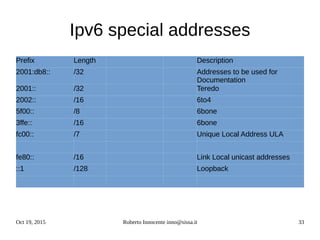
Ipv6 special addresses
Prefix Length Description
2001:db8:: /32 Addresses to be used for
Documentation
2001:: /32 Teredo
2002:: /16 6to4
5f00:: /8 6bone
3ffe:: /16 6bone
fc00:: /7 Unique Local Address ULA
fe80:: /16 Link Local unicast addresses
::1 /128 Loopback
Oct 19, 2015 Roberto Innocente inno@sissa.it 34
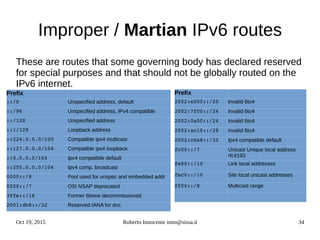
Improper / Martian IPv6 routes
These are routes that some governing body has declared reserved
for special purposes and that should not be globally routed on the
IPv6 internet.
Prefix
::/0 Unspecified address, default
::/96 Unspecified address, IPv4 compatible
::/128 Unspecified address
::1/128 Loopback address
::224.0.0.0/100 Compatible ipv4 multicast
::127.0.0.0/104 Compatible ipv4 loopback
::0.0.0.0/104 Ipv4 compatbile default
::255.0.0.0/104 Ipv4 comp. broadcast
0000::/8 Pool used for unspec and embedded addr
0200::/7 OSI NSAP deprecated
3ffe::/16 Former 6bone decommissioned
2001:db8::/32 Reserved IANA for doc
Prefix
2002:e000::/20 Invalid 6to4
2002:7f00::/24 Invalid 6to4
2002:0a00::/24 Invalid 6to4
2002:ac10::/28 Invalid 6to4
2002:c0a8::/32 Ipv4 compatible default
fc00::/7 Unicast Unique local address
rfc4193
fe80::/10 Link local addresses
fec0::/10 Site local unicast addresses
ff00::/8 Multicast range
Oct 19, 2015 Roberto Innocente inno@sissa.it 35
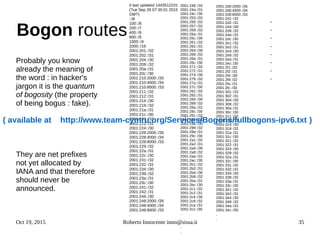
Bogon routes
Probably you know
already the meaning of
the word : in hacker's
jargon it is the quantum
of bogosity (the property
of being bogus : fake).
They are net prefixes
not yet allocated by
IANA and that therefore
should never be
announced.
# last updated 1443512101
(Tue Sep 29 07:35:01 2015
GMT)
::/8
100::/8
200::/7
400::/6
800::/5
1000::/4
2000::/16
2001:201::/32
2001:202::/31
2001:204::/30
2001:209::/32
2001:20a::/31
2001:20c::/30
2001:210:2000::/35
2001:210:4000::/34
2001:210:8000::/33
2001:211::/32
2001:212::/31
2001:214::/30
2001:219::/32
2001:21a::/31
2001:21c::/30
2001:221::/32
2001:222::/31
2001:224::/30
2001:228:2000::/35
2001:228:4000::/34
2001:228:8000::/33
2001:229::/32
2001:22a::/31
2001:22c::/30
2001:231::/32
2001:232::/31
2001:234::/30
2001:239::/32
2001:23a::/31
2001:23c::/30
2001:241::/32
2001:242::/31
2001:244::/30
2001:248:2000::/35
2001:248:4000::/34
2001:248:8000::/33
.
2001:249::/32
2001:24a::/31
2001:24c::/30
2001:253::/32
2001:255::/32
2001:257::/32
2001:259::/32
2001:25a::/31
2001:25c::/30
2001:261::/32
2001:262::/31
2001:264::/30
2001:269::/32
2001:26a::/31
2001:26c::/30
2001:271::/32
2001:272::/31
2001:274::/30
2001:279::/32
2001:27a::/31
2001:27c::/30
2001:281::/32
2001:282::/31
2001:284::/30
2001:289::/32
2001:28a::/31
2001:28c::/30
2001:291::/32
2001:292::/31
2001:294::/30
2001:299::/32
2001:29a::/31
2001:29c::/30
2001:2a1::/32
2001:2a2::/31
2001:2a4::/30
2001:2a9::/32
2001:2aa::/31
2001:2ac::/30
2001:2b1::/32
2001:2b2::/31
2001:2b4::/30
2001:2b9::/32
2001:2ba::/31
2001:2bc::/30
2001:2c1::/32
2001:2c2::/31
2001:2c4::/30
2001:2c9::/32
2001:2ca::/31
2001:2cc::/30
.
.
.
.
.
2001:2d0:2000::/35
2001:2d0:4000::/34
2001:2d0:8000::/33
2001:2d1::/32
2001:2d2::/31
2001:2d4::/30
2001:2d9::/32
2001:2da::/31
2001:2dc::/30
2001:2e1::/32
2001:2e2::/31
2001:2e4::/30
2001:2e9::/32
2001:2ea::/31
2001:2ec::/30
2001:2f1::/32
2001:2f2::/31
2001:2f4::/30
2001:2f9::/32
2001:2fa::/31
2001:2fc::/30
2001:301::/32
2001:302::/31
2001:304::/30
2001:309::/32
2001:30a::/31
2001:30c::/30
2001:311::/32
2001:312::/31
2001:314::/30
2001:319::/32
2001:31a::/31
2001:31c::/30
2001:321::/32
2001:322::/31
2001:324::/30
2001:329::/32
2001:32a::/31
2001:32c::/30
2001:331::/32
2001:332::/31
2001:334::/30
2001:339::/32
2001:33a::/31
2001:33c::/30
2001:341::/32
2001:342::/31
2001:344::/30
2001:349::/32
2001:34a::/31
2001:34c::/30
.
.
.
.
.
.
.
.
.
.
( available at http://www.team-cymru.org/Services/Bogons/fullbogons-ipv6.txt )
Oct 19, 2015 Roberto Innocente inno@sissa.it 36
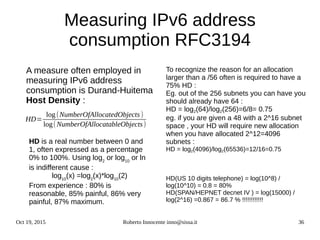
Measuring IPv6 address
consumption RFC3194
HD=
log(NumberOfAllocatedObjects)
log(NumberOfAllocatableObjects)
To recognize the reason for an allocation
larger than a /56 often is required to have a
75% HD :
Eg. out of the 256 subnets you can have you
should already have 64 :
HD = log2(64)/log2(256)=6/8= 0.75
eg. if you are given a 48 with a 2^16 subnet
space , your HD will require new allocation
when you have allocated 2^12=4096
subnets :
HD = log2(4096)/log2(65536)=12/16=0.75
HD(US 10 digits telephone) = log(10^8) /
log(10^10) = 0.8 = 80%
HD(SPAN/HEPNET decnet IV ) = log(15000) /
log(2^16) =0.867 = 86.7 % !!!!!!!!!!!!
A measure often employed in
measuring IPv6 address
consumption is Durand-Huitema
Host Density :
HD is a real number between 0 and
1, often expressed as a percentage
0% to 100%. Using log2
or log10
or ln
is indifferent cause :
log10
(x) =log2
(x)*log10
(2)
From experience : 80% is
reasonable, 85% painful, 86% very
painful, 87% maximum.
Oct 19, 2015 Roberto Innocente inno@sissa.it 37
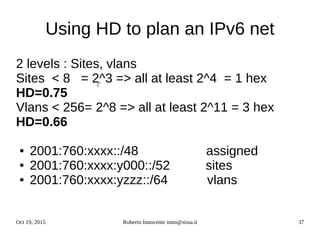
Using HD to plan an IPv6 net
2 levels : Sites, vlans
Sites < 8 = 2^3 => all at least 2^4 = 1 hex
HD=0.75
Vlans < 256= 2^8 => all at least 2^11 = 3 hex
HD=0.66
● 2001:760:xxxx::/48 assigned
● 2001:760:xxxx:y000::/52 sites
● 2001:760:xxxx:yzzz::/64 vlans
2
3
Oct 19, 2015 Roberto Innocente inno@sissa.it 38
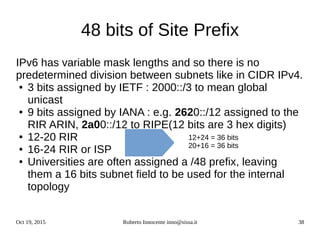
48 bits of Site Prefix
IPv6 has variable mask lengths and so there is no
predetermined division between subnets like in CIDR IPv4.
● 3 bits assigned by IETF : 2000::/3 to mean global
unicast
● 9 bits assigned by IANA : e.g. 2620::/12 assigned to the
RIR ARIN, 2a00::/12 to RIPE(12 bits are 3 hex digits)
● 12-20 RIR
● 16-24 RIR or ISP
● Universities are often assigned a /48 prefix, leaving
them a 16 bits subnet field to be used for the internal
topology
12+24 = 36 bits
20+16 = 36 bits
Oct 19, 2015 Roberto Innocente inno@sissa.it 39
Gradual deployment. How ?
● First : it will be given to the IT personnel the
possibility to browse IPv6 trough a tunnel to
create appropriate skills
● Second : an IPv6 island will be configured on
the router interface for the IT personnel vlan or
the DMZ
● Third : it will be configured on all routers and
switches and given to the users
Oct 19, 2015 Roberto Innocente inno@sissa.it 40
Transition technologies
Tunnels (poor men IPv6) :
● 6to4 doesn't work behind our fw,
encapsulates IPv6 pkt in IPv4 pkt using IPv6-in-
IPv4 protocol type
● ISATAP
● Teredo encapsulates Ipv6 in IPv4 UDP
● ...
Oct 19, 2015 Roberto Innocente inno@sissa.it 41
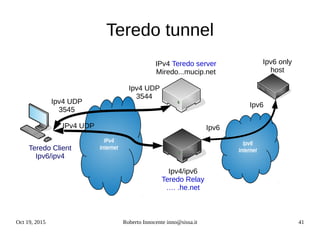
Teredo tunnel
Ipv6
Internet
IPv4
Internet
IPv4 Teredo server
Miredo...mucip.net
Ipv4 UDP
3545
Ipv4 UDP
3544
Ipv4/ipv6
Teredo Relay
…. .he.net
Ipv6 only
host
Ipv6
Ipv6
Teredo Client
Ipv6/ipv4
IPv4 UDP
Oct 19, 2015 Roberto Innocente inno@sissa.it 42
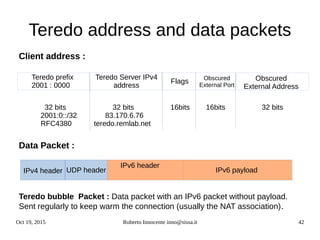
Teredo address and data packets
Teredo prefix
2001 : 0000
Teredo Server IPv4
address
Obscured
External Address
Flags Obscured
External Port
32 bits 32 bits 16bits 16bits 32 bits
2001:0::/32 83.170.6.76
RFC4380 teredo.remlab.net
IPv4 header UDP header IPv6 payload
IPv6 header
Client address :
Data Packet :
Client address :
Teredo bubble Packet : Data packet with an IPv6 packet without payload.
Sent regularly to keep warm the connection (usually the NAT association).
Oct 19, 2015 Roberto Innocente inno@sissa.it 43
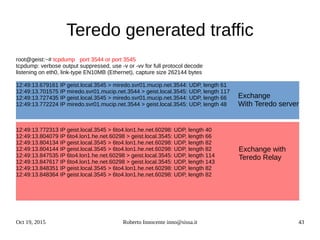
Teredo generated traffic
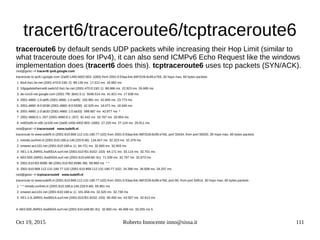
root@geist:~# tcpdump port 3544 or port 3545
tcpdump: verbose output suppressed, use -v or -vv for full protocol decode
listening on eth0, link-type EN10MB (Ethernet), capture size 262144 bytes
12:49:13.679161 IP geist.local.3545 > miredo.svr01.mucip.net.3544: UDP, length 61
12:49:13.701575 IP miredo.svr01.mucip.net.3544 > geist.local.3545: UDP, length 117
12:49:13.727435 IP geist.local.3545 > miredo.svr01.mucip.net.3544: UDP, length 66
12:49:13.772224 IP miredo.svr01.mucip.net.3544 > geist.local.3545: UDP, length 48
12:49:13.772313 IP geist.local.3545 > 6to4.lon1.he.net.60298: UDP, length 40
12:49:13.804079 IP 6to4.lon1.he.net.60298 > geist.local.3545: UDP, length 66
12:49:13.804134 IP geist.local.3545 > 6to4.lon1.he.net.60298: UDP, length 82
12:49:13.804144 IP geist.local.3545 > 6to4.lon1.he.net.60298: UDP, length 82
12:49:13.847535 IP 6to4.lon1.he.net.60298 > geist.local.3545: UDP, length 114
12:49:13.847617 IP 6to4.lon1.he.net.60298 > geist.local.3545: UDP, length 143
12:49:13.848351 IP geist.local.3545 > 6to4.lon1.he.net.60298: UDP, length 82
12:49:13.848364 IP geist.local.3545 > 6to4.lon1.he.net.60298: UDP, length 82
Exchange
With Teredo server
Exchange with
Teredo Relay
Oct 19, 2015 Roberto Innocente inno@sissa.it 44
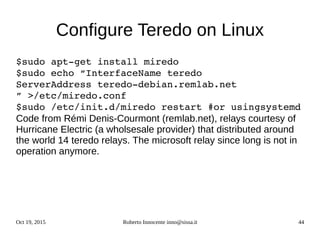
Configure Teredo on Linux
$sudo apt­get install miredo
$sudo echo “InterfaceName teredo
ServerAddress teredo­debian.remlab.net
” >/etc/miredo.conf
$sudo /etc/init.d/miredo restart #or usingsystemd
Code from Rémi Denis-Courmont (remlab.net), relays courtesy of
Hurricane Electric (a wholsesale provider) that distributed around
the world 14 teredo relays. The microsoft relay since long is not in
operation anymore.
Oct 19, 2015 Roberto Innocente inno@sissa.it 45
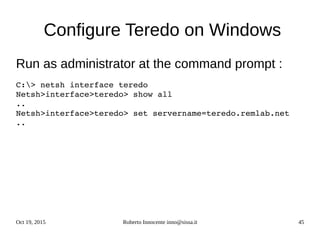
Configure Teredo on Windows
Run as administrator at the command prompt :
C:> netsh interface teredo
Netsh>interface>teredo> show all
..
Netsh>interface>teredo> set servername=teredo.remlab.net
..
Oct 19, 2015 Roberto Innocente inno@sissa.it 46
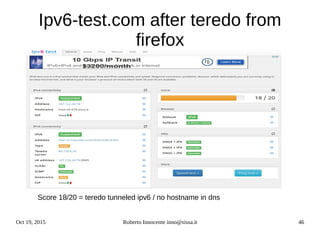
Ipv6-test.com after teredo from
firefox
Score 18/20 = teredo tunneled ipv6 / no hostname in dns
Oct 19, 2015 Roberto Innocente inno@sissa.it 47
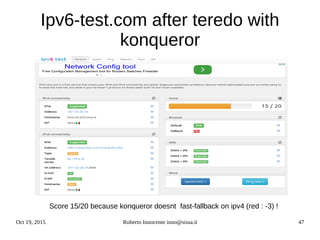
Ipv6-test.com after teredo with
konqueror
Score 15/20 because konqueror doesnt fast-fallback on ipv4 (red : -3) !
Oct 19, 2015 Roberto Innocente inno@sissa.it 48
Ipv6 test sites
● ipv6.google.com
● ipv6-test.com
● test-ipv6.com
● [2001:200:dff:fff1:216:3eff:feb1:44d7]
(www.kame.net : turtle swimms if your reach
the site using ipv6)
● http://ip.bieringer.de/
Oct 19, 2015 Roberto Innocente inno@sissa.it 49
Questions/1
●
How many bits in an IPv6 address ? How many bits in the interface part ?
– 128, 64
●
Protocol with longer addresses ?
– ISO CLNP (Connectionless protocol) addresses up to 160 bits
●
Chain of control for IPv6 addresses ?
– IANA, RIRs, ISPs/LIRs
●
In which case end users should renumber if they change provider ?
– Provider aggregatable address
●
How long will be normally the IPv6 prefix assigned to an institution or a company ? How many
bits for the site topology will remain ?
– /48, 16
●
Algorithm for assigning addresses in the sparsest way, an example ?
– Bit reversal, 0 8 4 12 2 10 6 14 1 9 5 7 3 11 7 15
●
Objective measure of being “short of addresses” ?
– Host density = log(allocated)/log(allocateable) > 0.75, hd=log(23)/log(24)=3/4=0.75
● Prefix for Link local addresses ? Unique Local ? Teredo ?
– Fe80::/10, fd00::/8, 2001:0::/32
Oct 19, 2015 Roberto Innocente inno@sissa.it 50
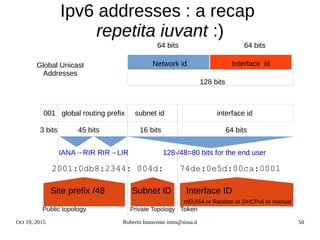
Ipv6 addresses : a recap
repetita iuvant :)
64 bits 64 bits
Interface idNetwork id
128 bits
001 global routing prefix subnet id interface id
45 bits3 bits 16 bits 64 bits
IANA→RIR RIR→LIR 128-/48=80 bits for the end user
2001:0db8:2344: 004d: 74de:0e5d:00ca:0001
Site prefix /48 Subnet ID Interface ID
mEUI64 or Random or DHCPv6 or manual
Public topology Private Topology Token
Global Unicast
Addresses
Oct 19, 2015 Roberto Innocente inno@sissa.it 51
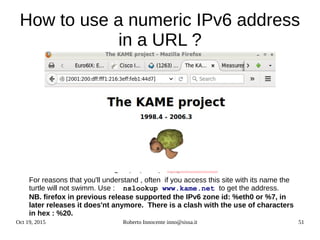
How to use a numeric IPv6 address
in a URL ?
For reasons that you'll understand , often if you access this site with its name the
turtle will not swimm. Use : nslookup www.kame.net to get the address.
NB. firefox in previous release supported the IPv6 zone id: %eth0 or %7, in
later releases it does'nt anymore. There is a clash with the use of characters
in hex : %20.
Oct 19, 2015 Roberto Innocente inno@sissa.it 52
apt­get 
You are using a tunnel technology and apt-get over IPv6 is a
snail ?
1. Valid for the single command , add the option :
apt­­get install log4cplus ­o Acquire::ForceIPv4=true
2. Valid forever, create
/etc/apt/apt.conf.d/99force­ipv4 and
put in it the line :
Acquire::ForceIPv4 “true”;
Oct 19, 2015 Roberto Innocente inno@sissa.it 53
ping
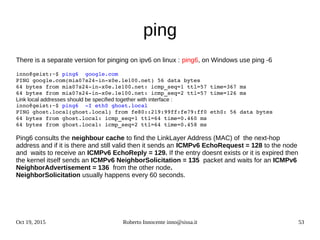
There is a separate version for pinging on ipv6 on linux : ping6, on Windows use ping -6
inno@geist:~$ ping6  google.com
PING google.com(mia07s24­in­x0e.1e100.net) 56 data bytes
64 bytes from mia07s24­in­x0e.1e100.net: icmp_seq=1 ttl=57 time=367 ms
64 bytes from mia07s24­in­x0e.1e100.net: icmp_seq=2 ttl=57 time=126 ms
Link local addresses should be specified together with interface :
inno@geist:~$ ping6  ­I eth0 ghost.local
PING ghost.local(ghost.local) from fe80::219:99ff:fe79:ff0 eth0: 56 data bytes
64 bytes from ghost.local: icmp_seq=1 ttl=64 time=0.460 ms
64 bytes from ghost.local: icmp_seq=2 ttl=64 time=0.458 ms
Ping6 consults the neighbour cache to find the LinkLayer Address (MAC) of the next-hop
address and if it is there and still valid then it sends an ICMPv6 EchoRequest = 128 to the node
and waits to receive an ICMPv6 EchoReply = 129. If the entry doesnt exists or it is expired then
the kernel itself sends an ICMPv6 NeighborSolicitation = 135 packet and waits for an ICMPv6
NeighborAdvertisement = 136 from the other node.
NeighborSolicitation usually happens every 60 seconds.
Oct 19, 2015 Roberto Innocente inno@sissa.it 54
IPv6 Node Information
● Rfc4620 (experimental)
● NIC (Node Information Query)
● Implemented in the original KAME on bsd :
ping6 as client and ninfod as server.
● On Ubuntu Linux ping6 implements the client,
but no server (daemon) for it (security
concerns)
● A server ninfod exists in the iputils of the
USAGI/WIDE project, in fedora iputils-ninfod
Oct 19, 2015 Roberto Innocente inno@sissa.it 55
Ping as rfc4620/NIQ
client
ping ­N ...
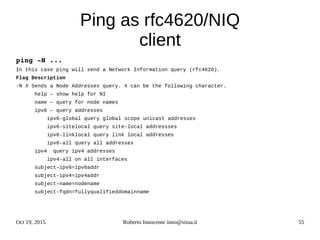
In this case ping will send a Network Information query (rfc4620).
Flag Description
-N X Sends a Node Addresses query. X can be the following character.
help – show help for NI
name – query for node names
ipv6 – query addresses
ipv6-global query global scope unicast addresses
ipv6-sitelocal query site-local addressses
ipv6-linklocal query link local addresses
ipv6-all query all addresses
ipv4 query ipv4 addresses
ipv4-all on all interfaces
subject-ipv6=ipv6addr
subject-ipv4=ipv4addr
subject-name=nodename
subject-fqdn=fullyqualifieddomainname
Oct 19, 2015 Roberto Innocente inno@sissa.it 56
ssh to link local ipv6 address
inno@geist:~$ avahi-resolve -6n ghost.local
ghost.local fe80::b6b6:76ff:fe60:588c
inno@geist:~$ ssh -6 inno@fe80::b6b6:76ff:fe60:588c%eth0 #doesn't
work with .local%eth0
Welcome to Ubuntu 15.04 (GNU/Linux 3.19.3-031903-generic x86_64)
* Documentation: https://help.ubuntu.com/
Last login: Thu Sep 17 09:59:42 2015 from fe80::219:99ff:fe79:ff0%eth0
inno@ghost:~$ tail /var/log/auth.log
Sep 17 10:05:55 ghost sshd[4245]: Address fe80::219:99ff:fe79:ff0%eth0
maps to geist.local, but this does not map back to the address -
POSSIBLE BREAK-IN ATTEMPT!
Sep 17 10:05:55 ghost sshd[4245]: Accepted publickey for inno from
fe80::219:99ff:fe79:ff0%eth0 port 59205 ssh2: RSA
fe:6b:ef:53:f7:78:fe:55:5e:b8:b8:60:d1:d2:90:ab
Oct 19, 2015 Roberto Innocente inno@sissa.it 57
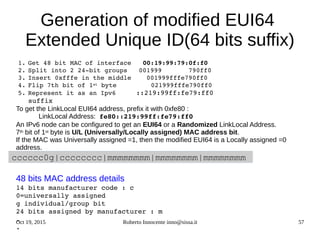
cccccc0g|cccccccc|mmmmmmmm|mmmmmmmm|mmmmmmmm
Generation of modified EUI64
Extended Unique ID(64 bits suffix)
1. Get 48 bit MAC of interface   00:19:99:79:0f:f0
2. Split into 2 24­bit groups   001999       790ff0
3. Insert 0xfffe in the middle    001999fffe790ff0
4. Flip 7th bit of 1st byte         021999fffe790ff0
5. Represent it as an Ipv6     ::219:99ff:fe79:ff0
   suffix
To get the LinkLocal EUI64 address, prefix it with 0xfe80 :
LinkLocal Address: fe80::219:99ff:fe79:ff0
An IPv6 node can be configured to get an EUI64 or a Randomized LinkLocal Address.
7th bit of 1st byte is U/L (Universally/Locally assigned) MAC address bit.
If the MAC was Universally assigned =1, then the modified EUI64 is a Locally assigned =0
address.
           
48 bits MAC address details  
14 bits manufacturer code : c
0=universally assigned
g individual/group bit
24 bits assigned by manufacturer : m
.
.
Oct 19, 2015 Roberto Innocente inno@sissa.it 58
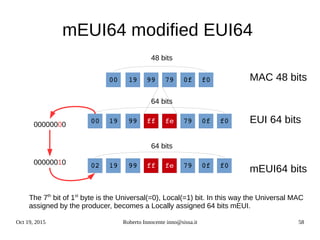
mEUI64 modified EUI64
00 f00f799919
19 0f79feff99 f000
19 0f79feff99 f002
00000000
00000010
MAC 48 bits
mEUI64 bits
EUI 64 bits
The 7th
bit of 1st
byte is the Universal(=0), Local(=1) bit. In this way the Universal MAC
assigned by the producer, becomes a Locally assigned 64 bits mEUI.
48 bits
64 bits
64 bits
Oct 19, 2015 Roberto Innocente inno@sissa.it 59
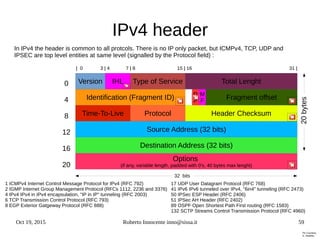
IPv4 header
Version IHL Type of Service
Identification (Fragment ID)
Total Lenght
M
F
D
F Fragment offset
ProtocolTime-To-Live Header Checksum
0
4
8
12
16
20
20bytes
| 0 3 | 4 7 | 8 15 | 16 31 |
32 bits
In IPv4 the header is common to all protcols. There is no IP only packet, but ICMPv4, TCP, UDP and
IPSEC are top level entities at same level (signalled by the Protocol field) :
1 ICMPv4 Internet Control Message Protocol for IPv4 (RFC 792)
2 IGMP Internet Group Management Protocol (RFCs 1112, 2236 and 3376)
4 IPv4 IPv4 in IPv4 encapsulation, "IP in IP" tunneling (RFC 2003)
6 TCP Transmission Control Protocol (RFC 793)
8 EGP Exterior Gatgeway Protocol (RFC 888)
Pic Courtesy
G. Radeka
17 UDP User Datagram Protocol (RFC 768)
41 IPv6 IPv6 tunneled over IPv4, "6in4" tunneling (RFC 2473)
50 IPSec ESP Header (RFC 2406)
51 IPSec AH Header (RFC 2402)
89 OSPF Open Shortest Path First routing (RFC 1583)
132 SCTP Streams Control Transmission Protocol (RFC 4960)
Oct 19, 2015 Roberto Innocente inno@sissa.it 60
Header checksum,
Upper Layer Checksum
● A major decision for IPv6 was to eliminate the header checksum : it was due
to the fact that most of the errors revealed were due to the memory of
routers when this checksum is in any case recalculated and so it was not of
any help.
● UDP and TCP provide a checksum by themselves that covers not the real
header (that changes along the way [ think about the HopLimit] and would
require expensive recalculations, but a pseudo header (that doesn't change,
same strategy as IPv4) that will be checked only by the destination.
Source address
16 bytes
Destination address
16 bytes
Upper layer packet-length (4 bytes)
Zeroes (3 bytes) Next Header
0 31
IPv6
pseudo-header
Oct 19, 2015 Roberto Innocente inno@sissa.it 61
IPv6 header
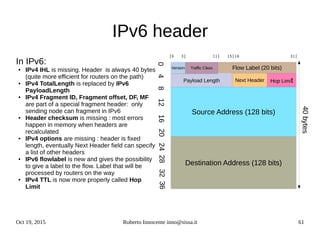
In IPv6:
● IPv4 IHL is missing. Header is always 40 bytes
(quite more efficient for routers on the path)
● IPv4 TotalLength is replaced by IPv6
PayloadLength
● IPv4 Fragment ID, Fragment offset, DF, MF
are part of a special fragment header: only
sending node can fragment in IPv6
● Header checksum is missing : most errors
happen in memory when headers are
recalculated
● IPv4 options are missing : header is fixed
length, eventually Next Header field can specify
a list of other headers
● IPv6 flowlabel is new and gives the possibility
to give a label to the flow. Label that will be
processed by routers on the way
● IPv4 TTL is now more properly called Hop
Limit
Version Traffic Class Flow Label (20 bits)
Payload Length Next Header Hop Limit
Source Address (128 bits)
Destination Address (128 bits)
|0   3|           11|   15|16                     31|
40bytes
04812162024283236
Oct 19, 2015 Roberto Innocente inno@sissa.it 62
IPv6 Next Header
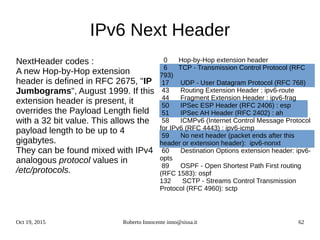
NextHeader codes :
A new Hop-by-Hop extension
header is defined in RFC 2675, "IP
Jumbograms", August 1999. If this
extension header is present, it
overrides the Payload Length field
with a 32 bit value. This allows the
payload length to be up to 4
gigabytes.
They can be found mixed with IPv4
analogous protocol values in
/etc/protocols.
0 Hop-by-Hop extension header
6 TCP - Transmission Control Protocol (RFC
793)
17 UDP - User Datagram Protocol (RFC 768)
43 Routing Extension Header : ipv6-route
44 Fragment Extension Header : ipv6-frag
50 IPSec ESP Header (RFC 2406) : esp
51 IPSec AH Header (RFC 2402) : ah
58 ICMPv6 (Internet Control Message Protocol
for IPv6 (RFC 4443) : ipv6-icmp
59 No next header (packet ends after this
header or extension header): ipv6-nonxt
60 Destination Options extension header: ipv6-
opts
89 OSPF - Open Shortest Path First routing
(RFC 1583): ospf
132 SCTP - Streams Control Transmission
Protocol (RFC 4960): sctp
Oct 19, 2015 Roberto Innocente inno@sissa.it 63
IPv6 header chains
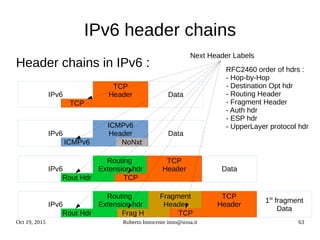
Header chains in IPv6 :
IPv6
TCP
TCP
Header Data
IPv6
ICMPv6
ICMPv6
Header Data
IPv6
Rout Hdr
Routing
Extension hdr Data
IPv6
Fragment
Header
1st
fragment
Data
TCP
Header
Routing
Extension hdr
Frag H TCPRout Hdr
TCP
Header
TCP
NoNxt
Next Header Labels
RFC2460 order of hdrs :
- Hop-by-Hop
- Destination Opt hdr
- Routing Header
- Fragment Header
- Auth hdr
- ESP hdr
- UpperLayer protocol hdr
Oct 19, 2015 Roberto Innocente inno@sissa.it 64
IPv6 fragmentation/1
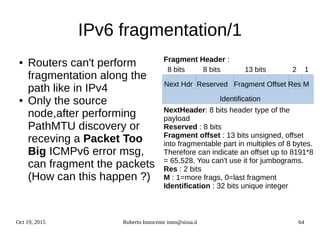
● Routers can't perform
fragmentation along the
path like in IPv4
● Only the source
node,after performing
PathMTU discovery or
receving a Packet Too
Big ICMPv6 error msg,
can fragment the packets
(How can this happen ?)
Fragment Header :
NextHeader: 8 bits header type of the
payload
Reserved : 8 bits
Fragment offset : 13 bits unsigned, offset
into fragmentable part in multiples of 8 bytes.
Therefore can indicate an offset up to 8191*8
= 65,528. You can't use it for jumbograms.
Res : 2 bits
M : 1=more frags, 0=last fragment
Identification : 32 bits unique integer
Next Hdr Reserved Fragment Offset Res M
Identification
8 bits 8 bits 13 bits 2 1
Oct 19, 2015 Roberto Innocente inno@sissa.it 65
IPv6 fragmentation/2
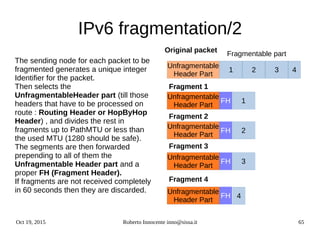
The sending node for each packet to be
fragmented generates a unique integer
Identifier for the packet.
Then selects the
UnfragmentableHeader part (till those
headers that have to be processed on
route : Routing Header or HopByHop
Header) , and divides the rest in
fragments up to PathMTU or less than
the used MTU (1280 should be safe).
The segments are then forwarded
prepending to all of them the
Unfragmentable Header part and a
proper FH (Fragment Header).
If fragments are not received completely
in 60 seconds then they are discarded.
Unfragmentable
Header Part
1
Fragmentable part
432
Unfragmentable
Header Part
3
4
Original packet
Unfragmentable
Header Part
Unfragmentable
Header Part
Unfragmentable
Header Part
2
Fragment 1Fragment 1Fragment 1
Fragment 2
Unfragmentable
Header Part
Unfragmentable
Header Part
Unfragmentable
Header Part
Unfragmentable
Header Part
1
Unfragmentable
Header Part
Unfragmentable
Header Part
Fragment 4
Fragment 3
Unfragmentable
Header Part
FH
FH
FH
FH
Oct 19, 2015 Roberto Innocente inno@sissa.it 66
IPv6 fragmentation/3
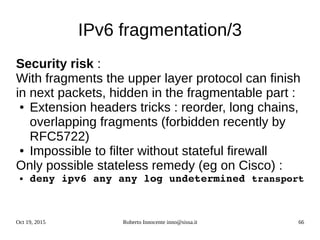
Security risk :
With fragments the upper layer protocol can finish
in next packets, hidden in the fragmentable part :
● Extension headers tricks : reorder, long chains,
overlapping fragments (forbidden recently by
RFC5722)
● Impossible to filter without stateful firewall
Only possible stateless remedy (eg on Cisco) :
● deny ipv6 any any log undetermined transport
Oct 19, 2015 Roberto Innocente inno@sissa.it 67
IPv6 jumbograms (RFC2675)
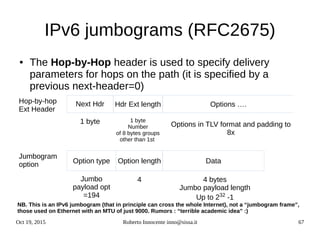
● The Hop-by-Hop header is used to specify delivery
parameters for hops on the path (it is specified by a
previous next-header=0)
Next Hdr Hdr Ext length Options ….
1 byte 1 byte
Number
of 8 bytes groups
other than 1st
Options in TLV format and padding to
8x
Option type Option length Data
Jumbo
payload opt
=194
4 4 bytes
Jumbo payload length
Up to 232
-1
Hop-by-hop
Ext Header
Jumbogram
option
NB. This is an IPv6 jumbogram (that in principle can cross the whole Internet), not a “jumbogram frame”,
those used on Ethernet with an MTU of just 9000. Rumors : “terrible academic idea” :)
Oct 19, 2015 Roberto Innocente inno@sissa.it 68
Routing extension header/1
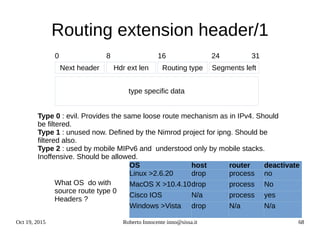
Next header Segments leftRouting typeHdr ext len
0 24168 31
type specific data
Type 0 : evil. Provides the same loose route mechanism as in IPv4. Should
be filtered.
Type 1 : unused now. Defined by the Nimrod project for ipng. Should be
filtered also.
Type 2 : used by mobile MIPv6 and understood only by mobile stacks.
Inoffensive. Should be allowed.
OS host router deactivate
Linux >2.6.20 drop process no
MacOS X >10.4.10drop process No
Cisco IOS N/a process yes
Windows >Vista drop N/a N/a
What OS do with
source route type 0
Headers ?
Oct 19, 2015 Roberto Innocente inno@sissa.it 69
Routing extension type 0/2
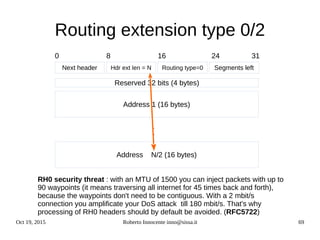
Next header Segments leftRouting type=0Hdr ext len = N
0 24168 31
Address 1 (16 bytes)
Reserved 32 bits (4 bytes)
Address N/2 (16 bytes)
.
.
.
RH0 security threat : with an MTU of 1500 you can inject packets with up to
90 waypoints (it means traversing all internet for 45 times back and forth),
because the waypoints don't need to be contiguous. With a 2 mbit/s
connection you amplificate your DoS attack till 180 mbit/s. That's why
processing of RH0 headers should by default be avoided. (RFC5722)
Oct 19, 2015 Roberto Innocente inno@sissa.it 70
Routing extension type 0/3
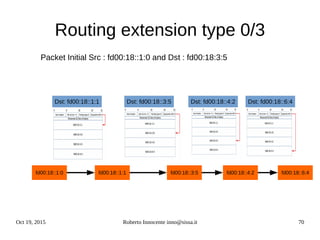
Packet Initial Src : fd00:18::1:0 and Dst : fd00:18:3:5
fd00:18::1:0 fd00:18::4:2fd00:18::3:5fd00:18::1:1
Dst: fd00:18::1:1 Dst: fd00:18::6:4Dst: fd00:18::4:2Dst: fd00:18::3:5
Oct 19, 2015 Roberto Innocente inno@sissa.it 71
Cisco and RH0
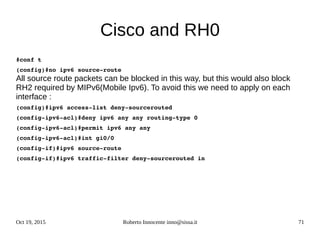
#conf t
(config)#no ipv6 source­route
All source route packets can be blocked in this way, but this would also block
RH2 required by MIPv6(Mobile Ipv6). To avoid this we need to apply on each
interface :
(config)#ipv6 access­list deny­sourcerouted
(config­ipv6­acl)#deny ipv6 any any routing­type 0
(config­ipv6­acl)#permit ipv6 any any
(config­ipv6­acl)#int gi0/0
(config­if)#ipv6 source­route
(config­if)#ipv6 traffic­filter deny­sourcerouted in
Oct 19, 2015 Roberto Innocente inno@sissa.it 72
IPv6 on Ethernet
Max size of ethernet frames was since the beginning established in 1518 bytes.
IPv4 was encapsulated on Ethernet II using a 16 bits ether-type of 0x0800 (look at
/etc/ethertypes).
NB. IPv4 Arp uses a different ethertype of 0x0806.
IPv6 uses the 0x86dd ethertype for all its functions ICMPv6, Neighbor Discovery, Router
Discovery, …
08:44:54.554797 f0:79:59:62:02:42 (oui Unknown) > 00:19:99:79:0f:f0 (oui Unknown), ethertype IPv6 (0x86dd), length 118: (hlim 64, 
next­header ICMPv6 (58) payload length: 64) linux.local > geist.local: [icmp6 sum ok] ICMP6, echo reply, seq 1
Ethernet II header = 14 bytes + 4 bytes FrameCheckSequence = RFC894 encapsulation 18 bytes
IPv6 packets sent over Ethernet II have a maximum transmission unit of 1500 (9000 for ethernet jumbograms)
and a minimum size of 46 (to comply with the minimum ethernet frame size of 64 bytes: eventually should be
padded to 46 bytes).
Ethernet 802.3 header = 14 bytes + 8 bytes LLC/SNAP hdr + 4 bytes FCS = RFC1042 encapsulation 26 bytes
IPv6 over 802.3 Ethernet (very rare now) and LLC/SNAP encapsulation has an MTU of 1492 bytes due to the 8
bytes of the LLC/SNAP header.
IEEE 802.11 Wireless has an MTU of 2312 bytes
FDDI has an MTU of 4352 bytes
With the large diffusion of VLANs use the max size of Ethernet frames has been increased for the purpose of
including the VLAN tag (4 bytes) to 1522 bytes, Leaving the MTU to 1500 and 1492.
Oct 19, 2015 Roberto Innocente inno@sissa.it 73
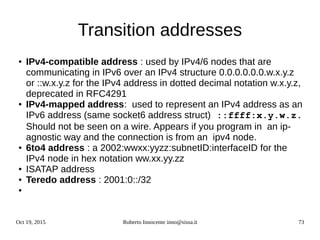
Transition addresses
● IPv4-compatible address : used by IPv4/6 nodes that are
communicating in IPv6 over an IPv4 structure 0.0.0.0.0.0.w.x.y.z
or ::w.x.y.z for the IPv4 address in dotted decimal notation w.x.y.z,
deprecated in RFC4291
● IPv4-mapped address: used to represent an IPv4 address as an
IPv6 address (same socket6 address struct) ::ffff:x.y.w.z.
Should not be seen on a wire. Appears if you program in an ip-
agnostic way and the connection is from an ipv4 node.
●
6to4 address : a 2002:wwxx:yyzz:subnetID:interfaceID for the
IPv4 node in hex notation ww.xx.yy.zz
● ISATAP address
● Teredo address : 2001:0::/32
●
Oct 19, 2015 Roberto Innocente inno@sissa.it 74
Network programming/1
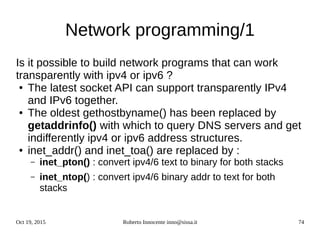
Is it possible to build network programs that can work
transparently with ipv4 or ipv6 ?
● The latest socket API can support transparently IPv4
and IPv6 together.
● The oldest gethostbyname() has been replaced by
getaddrinfo() with which to query DNS servers and get
indifferently ipv4 or ipv6 address structures.
● inet_addr() and inet_toa() are replaced by :
– inet_pton() : convert ipv4/6 text to binary for both stacks
– inet_ntop() : convert ipv4/6 binary addr to text for both
stacks
Oct 19, 2015 Roberto Innocente inno@sissa.it 75
sockets
struct in_addr {
        __be32  s_addr;
};
#define __SOCK_SIZE__  16/* 
sizeof(structsockaddr) */
struct sockaddr_in {
 __kernel_sa_family_t
sin_family; /*Addressfamily*/
  __be16 sin_port; /* Port number */
  struct in_addr
sin_addr; /*Internet 
address*/
  /* Pad to size of `struct 
sockaddr'. */
  unsigned char __pad[__SOCK_SIZE__ 
­ sizeof(short int)­sizeof(unsigned 
short int)­ sizeof(struct 
in_addr)];
};
struct sockaddr_in6 {
 sa_family_t     sin6_family;   
/*AF_INET6 */
 in_port_t       sin6_port;     /*port 
number*/
 uint32_t        sin6_flowinfo; /*IPv6 
flow */
 struct in6_addr 
sin6_addr;   /*IPv6 address*/
 uint32_t        sin6_scope_id; /*Scope 
ID*/
};
struct in6_addr {
 unsigned char   s6_addr[16]; /* IPv6 
address*/
};
struct addrinfo {
  int          ai_flags;
  int         ai_family;
  int       ai_socktype;
  int       ai_protocol;
  socklen_t   ai_addrlen;
  struct sockaddr 
*ai_addr;
  char       *ai_canonname;
  struct addrinfo *ai_next;
};
family
flags
*next
*addr
addrlen
type
Oct 19, 2015 Roberto Innocente inno@sissa.it 76
IPv4/IPv6 network programming/2
#include <stdio.h>
#include <string.h>
#include <sys/types.h>
#include <sys/socket.h>
#include <netinet/in.h>
#include <arpa/inet.h>
#include <netdb.h>
#define RECEIVEBUFFERLENGTH 1024
void main(int argc, char *argv[])
{
int SocketFileDescriptor;
int ReturnValue;
struct in6_addr ServerAddress;
struct addrinfo *LinkedListOfResultingAi=NULL;
char ServerName[255];
char ServerPort[] = "80";
char QueryString[] = "GET / HTTP/1.0nn";
char ReceiveBuffer[RECEIVEBUFFERLENGTH];
strcpy(ServerName, argv[1]);
ReturnValue = getaddrinfo(ServerName,
ServerPort, NULL, &LinkedListOfResultingAi);
SocketFileDescriptor = socket
(LinkedListOfResultingAi->ai_family,
LinkedListOfResultingAi->ai_socktype,
LinkedListOfResultingAi->ai_protocol);
ReturnValue = connect
(SocketFileDescriptor, LinkedListOfResultingAi-
>ai_addr, LinkedListOfResultingAi->ai_addrlen);
ReturnValue = send(SocketFileDescriptor,
QueryString, sizeof(QueryString), 0);
ReturnValue = recv(SocketFileDescriptor,
ReceiveBuffer, RECEIVEBUFFERLENGTH, 0);
printf(ReceiveBuffer,"%sn");
}
All checks and close and free removed, don't use as a pattern for real work !
getaddrinfo()
recv()
send()
connect()
socket()
Oct 19, 2015 Roberto Innocente inno@sissa.it 77
IPv4/IPv6 network programming/3
#include <stdio.h>
#include <string.h>
#include <sys/types.h>
#include <sys/socket.h>
#include <netinet/in.h>
#include <arpa/inet.h>
#include <string.h>
#define RECEIVEBUFFERLENGTH 1024
void main(int argc, char* argv[])
{
int SocketFileDescriptor;
int DescriptorOfAcceptedSocket;
int ReturnValue;
int on, ReturnValuedsize=RECEIVEBUFFERLENGTH;
char ReceiveBuffer[RECEIVEBUFFERLENGTH];
struct sockaddr_in6 ServerAddress, ClientAddress;
int AddressLength=sizeof(ClientAddress);
char IPv6Address[INET6_ADDRSTRLEN];
char* StringToSend = "HTTP/1.1 200 OKrnDate: Thu, 22
Oct 2015 08:17:45 GMTinServer: ApachenConnection:
closenContent-Type: text/htmlnn<!DOCTYPE HTML
PUBLIC "-//W3C//DTD HTML 4.0
Transitional//EN">n<html>n<head></head><body>hello !
</body></html>n";
uint16_t ServerPort;
sscanf(argv[1],"%hd",&ServerPort);
printf("Listening on port %dn",ServerPort);
SocketFileDescriptor = socket(AF_INET6, SOCK_STREAM, 0);
setsockopt(SocketFileDescriptor, SOL_SOCKET, SO_REUSEADDR,
(char *)&on,
sizeof(on));
memset((void*)&ServerAddress, 0, sizeof(ServerAddress));
ServerAddress.sin6_family = AF_INET6;
ServerAddress.sin6_port = htons(ServerPort);
ServerAddress.sin6_addr = in6addr_any;
bind(SocketFileDescriptor,(struct sockaddr *)
&ServerAddress,
sizeof(ServerAddress));
listen(SocketFileDescriptor, 10);
printf("Waiting client connectionsn");
DescriptorOfAcceptedSocket=accept(SocketFileDescriptor,
NULL, NULL);
getpeername(DescriptorOfAcceptedSocket,(struct sockaddr
*)&ClientAddress,
&AddressLength);
if(inet_ntop(AF_INET6, &ClientAddress.sin6_addr,
IPv6Address,
sizeof(IPv6Address)))
{
printf("Address client %s, port%dn",IPv6Address,
ntohs(ClientAddress.sin6_port));
}
ReturnValue = recv(DescriptorOfAcceptedSocket,
ReceiveBuffer,
sizeof(ReceiveBuffer)-1, 0);
if (ReturnValue>0) ReceiveBuffer[ReturnValue]= '0';
printf(ReceiveBuffer,"%sn");
printf("We received %d bytesn", ReturnValue);
printf("Sending %d bytesn", (int)strlen(StringToSend));
printf(StringToSend,"%sn");
ReturnValue = send(DescriptorOfAcceptedSocket, StringToSend,
(int)strlen(StringToSend),0);
}
All checks and close and free removed, don't use as a working example !
socket()
recv()
accept()
listen()
bind()
IPv4 client addr printed as ::ffff:x.y.z.w
Oct 19, 2015 Roberto Innocente inno@sissa.it 78
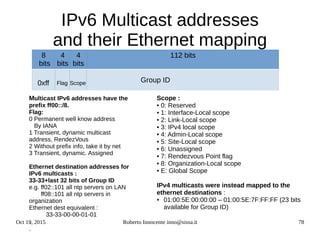
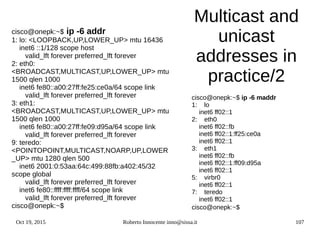
IPv6 Multicast addresses
and their Ethernet mapping
Group ID
8
bits
4
bits
4
bits
112 bits
ScopeFlag0xff
Multicast IPv6 addresses have the
prefix ff00::/8.
Flag:
0 Permanent well know address
By IANA
1 Transient, dynamic multicast
address, RendezVous
2 Without prefix info, take it by net
3 Transient, dynamic. Assigned
Ethernet destination addresses for
IPv6 multicasts :
33-33+last 32 bits of Group ID
e.g. ff02::101 all ntp servers on LAN
ff08::101 all ntp servers in
organization
Ethernet dest equivalent :
33-33-00-00-01-01
.
.
Scope :
• 0: Reserved
• 1: Interface-Local scope
• 2: Link-Local scope
• 3: IPv4 local scope
• 4: Admin-Local scope
• 5: Site-Local scope
• 6: Unassigned
• 7: Rendezvous Point flag
• 8: Organization-Local scope
• E: Global Scope
IPv4 multicasts were instead mapped to the
ethernet destinations :
● 01:00:5E:00:00:00 – 01:00:5E:7F:FF:FF (23 bits
available for Group ID)
Oct 19, 2015 Roberto Innocente inno@sissa.it 79
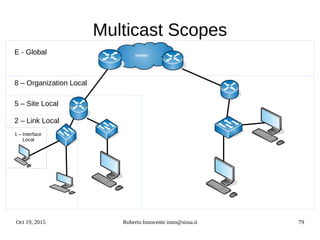
Multicast Scopes
Internet
E - GlobalE - Global
1 – Interface
Local
2 – Link Local
5 – Site Local
8 – Organization Local
Oct 19, 2015 Roberto Innocente inno@sissa.it 80
Multicast groups
IPv6 tries to be minimal in resources it consumes so it replaced
broadcast messages (as used by IPv4 : eg. arp) with multicast
messages. There are 2 well known groups (that can be usually
used with literals because they appear in /etc/hosts ) :
● ff02::1 ip6-allnodes
● ff02::2 ip6-allrouters
E.g. : ping6 -I eth0 ip6-allnodes
ping6 -I eth0 ip6-allrouters
All nodes should be listen on the ip6-allnodes multicast
address and all routers should be listen to the ip6-allrouters
address. Therefore a node can easily discover its neighbours
nodes, and the routers in its broadcast domain.
Oct 19, 2015 Roberto Innocente inno@sissa.it 81
Multicast groups/2
well known
Well known multicast groups :
● ff02::1 All nodes on the local network segment
● ff02::2 All routers on the local network segment
● ff02::5 OSPFv3 All SPF routers
● ff02::6 OSPFv3 All DR routers
● ff02::8 IS-IS for IPv6 routers
● ff02::9 RIP routers
● ff02::a EIGRP routers
● ff02::d PIM routers
● ff02::16 MLDv2 reports (defined in RFC 3810)
● ff02::1:2 All DHCP servers and relay agents on the local network segment (defined in RFC 3315)
● ff02::1:3 All LLMNR hosts on the local network segment (defined in RFC 4795)
● ff05::1:3 All DHCP servers on the local network site (defined in RFC 3315)
● ff0x::c Simple Service Discovery Protocol
● ff0x::fb Multicast DNS
● ff0x::101 Network Time Protocol
● ff0x::108 Network Information Service
● ff0x::181 Precision Time Protocol (PTP) version 2 messages
● ff02::6b Precision Time Protocol (PTP) version 2 peer delay measurement messages
Oct 19, 2015 Roberto Innocente inno@sissa.it 82
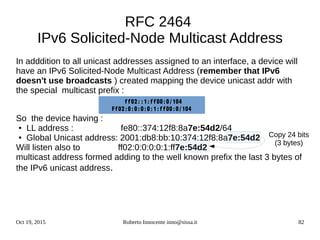
RFC 2464
IPv6 Solicited-Node Multicast Address
In adddition to all unicast addresses assigned to an interface, a device will
have an IPv6 Solicited-Node Multicast Address (remember that IPv6
doesn't use broadcasts ) created mapping the device unicast addr with
the special multicast prefix :
So the device having :
● LL address : fe80::374:12f8:8a7e:54d2/64
● Global Unicast address: 2001:db8:bb:10:374:12f8:8a7e:54d2
Will listen also to ff02:0:0:0:0:1:ff7e:54d2
multicast address formed adding to the well known prefix the last 3 bytes of
the IPv6 unicast address.
Copy 24 bits
(3 bytes)
ff02::1:ff00:0/104
Ff02:0:0:0:0:1:ff00:0/104
Oct 19, 2015 Roberto Innocente inno@sissa.it 83
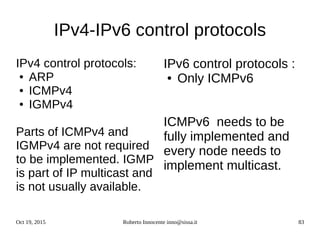
IPv4-IPv6 control protocols
IPv4 control protocols:
● ARP
● ICMPv4
● IGMPv4
Parts of ICMPv4 and
IGMPv4 are not required
to be implemented. IGMP
is part of IP multicast and
is not usually available.
IPv6 control protocols :
● Only ICMPv6
ICMPv6 needs to be
fully implemented and
every node needs to
implement multicast.
Oct 19, 2015 Roberto Innocente inno@sissa.it 84
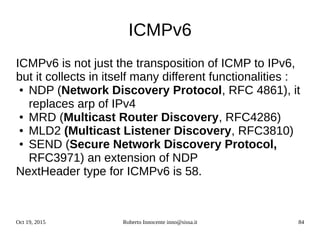
ICMPv6
ICMPv6 is not just the transposition of ICMP to IPv6,
but it collects in itself many different functionalities :
● NDP (Network Discovery Protocol, RFC 4861), it
replaces arp of IPv4
● MRD (Multicast Router Discovery, RFC4286)
● MLD2 (Multicast Listener Discovery, RFC3810)
● SEND (Secure Network Discovery Protocol,
RFC3971) an extension of NDP
NextHeader type for ICMPv6 is 58.
Oct 19, 2015 Roberto Innocente inno@sissa.it 85
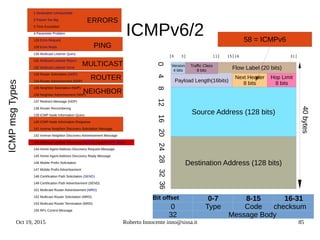
ICMPv6/2
1 Destination Unreachable
2 Packet Too Big
3 Time Exceeded
4 Parameter Problem
128 Echo Request
129 Echo Reply
130 Multicast Listener Query
131 Multicast Listener Report
132 Multicast Listener Done
133 Router Solicitation (NDP)
134 Router Advertisement (NDP)
135 Neighbor Solicitation (NDP)
136 Neighbor Advertisement (NDP)
137 Redirect Message (NDP)
138 Router Renumbering
139 ICMP Node Information Query
140 ICMP Node Information Response
141 Inverse Neighbor Discovery Solicitation Message
142 Inverse Neighbor Discovery Advertisement Message
143 Multicast Listener Discovery (MLDv2) reports (RFC 3810)
144 Home Agent Address Discovery Request Message
145 Home Agent Address Discovery Reply Message
146 Mobile Prefix Solicitation
147 Mobile Prefix Advertisement
148 Certification Path Solicitation (SEND)
149 Certification Path Advertisement (SEND)
151 Multicast Router Advertisement (MRD)
152 Multicast Router Solicitation (MRD)
153 Multicast Router Termination (MRD)
155 RPL Control Message
58 = ICMPv6
PING
ROUTER
PING
NEIGHBOR
MULTICAST
Bit offset 0-7 8-15 16-31
0 Type Code checksum
32 Message Body
Version
4 bits
Traffic Class
8 bits Flow Label (20 bits)
Payload Length(16bits)
Next Header
8 bits
Hop Limit
8 bits
Source Address (128 bits)
Destination Address (128 bits)
|0   3|           11|   15|16                     31|
40bytes
04812162024283236
ICMPmsgTypes
ERRORS
Oct 19, 2015 Roberto Innocente inno@sissa.it 86
ICMPv6/3
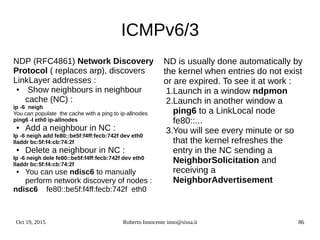
NDP (RFC4861) Network Discovery
Protocol ( replaces arp), discovers
LinkLayer addresses :
● Show neighbours in neighbour
cache (NC) :
ip -6 neigh
You can populate the cache with a ping to ip-allnodes
ping6 -I eth0 ip-allnodes
● Add a neighbour in NC :
Ip -6 neigh add fe80::be5f:f4ff:fecb:742f dev eth0
lladdr bc:5f:f4:cb:74:2f
● Delete a neighbour in NC :
Ip -6 neigh dele fe80::be5f:f4ff:fecb:742f dev eth0
lladdr bc:5f:f4:cb:74:2f
● You can use ndisc6 to manually
perform network discovery of nodes :
ndisc6 fe80::be5f:f4ff:fecb:742f eth0
ND is usually done automatically by
the kernel when entries do not exist
or are expired. To see it at work :
1.Launch in a window ndpmon
2.Launch in another window a
ping6 to a LinkLocal node
fe80::...
3.You will see every minute or so
that the kernel refreshes the
entry in the NC sending a
NeighborSolicitation and
receiving a
NeighborAdvertisement
Oct 19, 2015 Roberto Innocente inno@sissa.it 87
ICMPv6/4
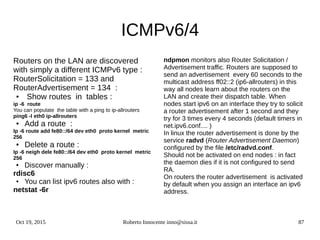
Routers on the LAN are discovered
with simply a different ICMPv6 type :
RouterSolicitation = 133 and
RouterAdvertisement = 134 :
● Show routes in tables :
ip -6 route
You can populate the table with a ping to ip-allrouters
ping6 -I eth0 ip-allrouters
● Add a route :
Ip -6 route add fe80::/64 dev eth0 proto kernel metric
256
● Delete a route :
Ip -6 neigh dele fe80::/64 dev eth0 proto kernel metric
256
● Discover manually :
rdisc6
● You can list ipv6 routes also with :
netstat -6r
ndpmon monitors also Router Solicitation /
Advertisement traffic. Routers are supposed to
send an advertisement every 60 seconds to the
multicast address ff02::2 (ip6-allrouters) in this
way all nodes learn about the routers on the
LAN and create their dispatch table. When
nodes start ipv6 on an interface they try to solicit
a router advertisement after 1 second and they
try for 3 times every 4 seconds (default timers in
net.ipv6.conf.... )
In linux the router advertisement is done by the
service radvd (Router Advertisement Daemon)
configured by the file /etc/radvd.conf.
Should not be activated on end nodes : in fact
the daemon dies if it is not configured to send
RA.
On routers the router advertisement is activated
by default when you assign an interface an ipv6
address.
Oct 19, 2015 Roberto Innocente inno@sissa.it 88
ICMPv6 Router Advertisement pkt/1
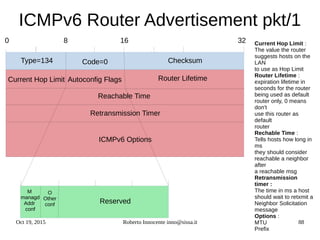
Current Hop Limit :
The value the router
suggests hosts on the
LAN
to use as Hop Limit
Router Lifetime :
expiration lifetime in
seconds for the router
being used as default
router only, 0 means
don't
use this router as
default
router
Rechable Time :
Tells hosts how long in
ms
they should consider
reachable a neighbor
after
a reachable msg
Retransmission
timer :
The time in ms a host
should wait to retxmit a
Neighbor Solicitation
message
Options :
MTU
Prefix
Reserved
ICMPv6 Options
Reachable Time
Retransmission Timer
Autoconfig Flags Router LifetimeCurrent Hop Limit
Code=0 ChecksumType=134
0 8 16 32
M
managd
Addr
conf
O
Other
conf
Oct 19, 2015 Roberto Innocente inno@sissa.it 89
ICMPv6 Router Advertisement pkt/2
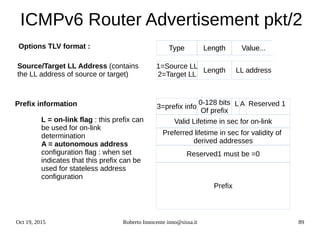
Type Length Value...Options TLV format :
Source/Target LL Address (contains
the LL address of source or target)
Type Length Value...
1=Source LL
2=Target LL
Length LL address
3=prefix info
0-128 bits
Of prefix
Prefix information L A Reserved 1
Valid Lifetime in sec for on-link
Preferred lifetime in sec for validity of
derived addresses
Reserved1 must be =0
Prefix
L = on-link flag : this prefix can
be used for on-link
determination
A = autonomous address
configuration flag : when set
indicates that this prefix can be
used for stateless address
configuration
Oct 19, 2015 Roberto Innocente inno@sissa.it 90
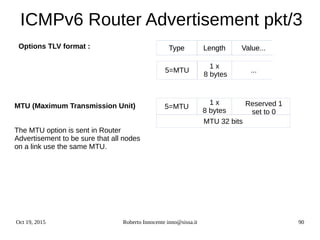
ICMPv6 Router Advertisement pkt/3
Type Length Value...Options TLV format : Type Length Value...
5=MTU
1 x
8 bytes
...
5=MTU
1 x
8 bytes
Reserved 1
set to 0
MTU 32 bits
MTU (Maximum Transmission Unit)
The MTU option is sent in Router
Advertisement to be sure that all nodes
on a link use the same MTU.
Oct 19, 2015 Roberto Innocente inno@sissa.it 91
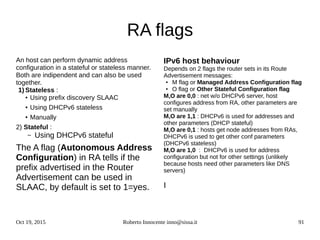
RA flags
An host can perform dynamic address
configuration in a stateful or stateless manner.
Both are indipendent and can also be used
together.
1) Stateless :
● Using prefix discovery SLAAC
● Using DHCPv6 stateless
● Manually
2) Stateful :
– Using DHCPv6 stateful
The A flag (Autonomous Address
Configuration) in RA tells if the
prefix advertised in the Router
Advertisement can be used in
SLAAC, by default is set to 1=yes.
IPv6 host behaviour
Depends on 2 flags the router sets in its Route
Advertisement messages:
● M flag or Managed Address Configuration flag
●
O flag or Other Stateful Configuration flag
M,O are 0,0 : net w/o DHCPv6 server, host
configures address from RA, other parameters are
set manually
M,O are 1,1 : DHCPv6 is used for addresses and
other parameters (DHCP stateful)
M,O are 0,1 : hosts get node addresses from RAs,
DHCPv6 is used to get other conf parameters
(DHCPv6 stateless)
M,O are 1,0 : DHCPv6 is used for address
configuration but not for other settings (unlikely
because hosts need other parameters like DNS
servers)
I
Oct 19, 2015 Roberto Innocente inno@sissa.it 92
Questions 2
● How do you use a numeric address in an URL ?
– [2001:760:……]
● Length of IPv4 header ? Length of IPv6 header ?
– Variable 20.. , fixed 40 bytes
● Why header checksum was abandoned in IPv6 ?
– Because errors were mostly caused by bad memory in routers were header checksum is in any case recalculated
●
Is there any remnant of fragment management in the IPv6 header ?
– No, it is part of an extension header
● If in an extension header the next header field =TCP , what will be the nextheader field in the TCP header ?
– Tcp header is just the normal tcp header, it is not an ipv6 extension header and has no next header field
● Components of ICMPv6 ?
– ND neighbour discovery, RD router discovery , MLD multicast listener discovery
● Fragmentation can manage packets up to how many bytes ?
– 64 K
● What is a jumbogram in IPv6 lingo ? how many bytes in it ?
–
A packet with the jumbo payload option in an icmpv6 header, up to 232 -1 bytes
● Important flags of Router Advertisement packets ?
– Managed stateful flag, Other stateful flag . Options of prefixes : On-link prefix, Autonomous Address configuration prefix
Oct 19, 2015 Roberto Innocente inno@sissa.it 93
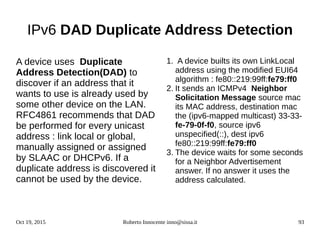
IPv6 DAD Duplicate Address Detection
A device uses Duplicate
Address Detection(DAD) to
discover if an address that it
wants to use is already used by
some other device on the LAN.
RFC4861 recommends that DAD
be performed for every unicast
address : link local or global,
manually assigned or assigned
by SLAAC or DHCPv6. If a
duplicate address is discovered it
cannot be used by the device.
1. A device builts its own LinkLocal
address using the modified EUI64
algorithm : fe80::219:99ff:fe79:ff0
2. It sends an ICMPv4 Neighbor
Solicitation Message source mac
its MAC address, destination mac
the (ipv6-mapped multicast) 33-33-
fe-79-0f-f0, source ipv6
unspecified(::), dest ipv6
fe80::219:99ff:fe79:ff0
3. The device waits for some seconds
for a Neighbor Advertisement
answer. If no answer it uses the
address calculated.
Oct 19, 2015 Roberto Innocente inno@sissa.it 94
IPv6 NUD Neighbor Unreachability Detection
RFC4861
Devices monitor the reachability of neighbors to which they are sending
traffic. The reachability is confirmed by a response to a Neighbor
Solicitation or an ACK in a TCP connection for instance.
When a path seems to be failing :
1. If the neighbor is the ultimate destination : address resolution should
be performed again :
1. Send a NeighborSolicitation msg
2. Wait for a NeighborAdvertisement msg
2. If the neighbor is a router try to use a different default gateway
NUD, of course, is performed only for neighbors to which unicast packets
are sent
Oct 19, 2015 Roberto Innocente inno@sissa.it 95
IPv6 MLDv2 (RFC3810)
Multicast Listener Discovery
Based on IGMPv3, compatible with MLDv1
extends MLDv1 with support of Source Specific
Multicast (SSM).
Oct 19, 2015 Roberto Innocente inno@sissa.it 96
IPv6 MLDv2/2
● Multicast Listener Query
type=130
– General Query
– Multicast-Address-specific
query
● Multicast Listener Report
type=131
● Multicast Listener Done
type=132
With these messages the routers on
the LAN learn which channels
(multicast addresses) should be re-
txmitted on the LAN.
1. The router priodically sends a General Query
to the ip6-allnodes multicast address
2. A host member of the multicast group
ff3e:0060:2002:0DB8:ccc:1:0000:2222 receives the
query, waits a random amount of time and if it
doesn't hear another host to report for the same
group, it sends a Multicast Listener Report for it to the
multicast address all MLDv2 capable router ff02::16
3. Another host member of a different group waits also a rnd
amount of time and sends its Multicast Listener Report
also to ff02::16
4. When a host wants to stop listening to a multicast
address it sends a Multicast Listener Done msg to
the ff02::16
5. The router doesn't maintain a list of nodes listening
on an address so when it receives the Done message
it needs to send a Multicast-Address-specific query to
the multicast address of the group to see if there are
nodes still listening to the address and if not to clear
it from the listened mcast addresses on the LAN
Oct 19, 2015 Roberto Innocente inno@sissa.it 97
Path MTU
In IPv4 routers can fragment a
packet along the path. These
fragments pose some security risks
and usually security appliances will
re-assemble them.
In IPv6 only the sender can
fragment a packet, routers do not
fragment it. For this reason it is
recommended to discover the
maximum Path MTU to have a more
efficient transmission.
IPv6 dictates that all links support
an MTU of at least 1280 bytes, in
IPv4 this was 64 bytes.
Path MTU discovery
The sender supposes the path has a
PathMTU equal to the one of the
first hop and tries to send a packet of
that size. If the packet is ack then it
sets that as the PMTU, otherwise a
router will refuse to forward the pkt
and sends back an ICMPv6 Error
Message : Packet too big that
contains a supported smaller MTU
that the sender will now try to use.
This is one of the reasons why
ICMPv6 should not be blocked. They
are essential for normal behaviour.
Oct 19, 2015 Roberto Innocente inno@sissa.it 98
Multihoming in IPv6
To deploy a fault tolerant
connection to the Internet
many connect to 2 different
ISPs. In this case the idea of
the IPv6 Provider
Aggregatable addresses
does'nt work well.
The initial answer from IPv6
specs was that the company
should get a different prefix
from both providers and its host
should configure in both networks.
In reality today, despite the initial
aims, companies that want to be
multihomed get a Provider
Independent prefix from RIRs. It
is hoped that before an IPv6 route
explosion something different will
be devised (~20.000 IPv6 prefixes
announced as of today).
Oct 19, 2015 Roberto Innocente inno@sissa.it 99
RFCs
More than 100 RFCs are available for IPv6. In the Rfcs Node is a host or
router.
Therefore rfc6434 applies to both.
● Rfc2460 Internet Protocol, Version6, Specification
● Rfc6434 IPv6 node requirements
● Rfc6204 Basic requirements for IPv6 customer edge routers
● RIPE-554 Requirements for IPv6 in ICT equipment
● Rfc4291 IPv6 addressing architecture
● Rfc4007 IPv6 scoped address architecture
● Rfc3879 Deprecating Site-Local addresses
● Rfc4193 Unique Local IPv6 unicast addresses
● Rfc5942 IPv6 subnet model : the relationship between subnet and link
prefixes
● Rfc4941 Privacy extension for stateless address autoconfiguration in IPv6
● Rfc3971 Secure Neighbor Discovery (SEND)
Oct 19, 2015 Roberto Innocente inno@sissa.it 100
Linux tools for ipv6/1
● ifconfig
● ip -6 route
● Ip -6 addr
● ip -6 maddr
● iip -6 neigh
● ip -6 ntable
● ip -6 neigh show nup all
Oct 19, 2015 Roberto Innocente inno@sissa.it 101
Linux tools for ipv6/2
● ipv6calc
● ipv6loganon
● ipv6logconv
● ipv6logstats
Oct 19, 2015 Roberto Innocente inno@sissa.it 102
Linux tools for ipv6/3
● ndisc6 ICMPv6 Neighbour Discovery tool
● rdisc6 ICMPv6 Route Discovery tool
● tracepath6 Trace path using UDP and discovering path MTU
● ip6tables ipv6 version of iptables
● traceroute6 / tcptraceroute6 Equivalent to : traceroute -6
●
● Install with : sudo apt-get install ndisc6
inno@geist:~$ traceroute6 google.com
traceroute to 2607:f8b0:4008:804::200e (2607:f8b0:4008:804::200e) from 2001:0:53aa:64c:3422:f226:6c85:e7b5, 30 hops max, 60
bytes packets
1 2001:0:53aa:64c:2ccf:708d:27bd:bf75 (2001:0:53aa:64c:2ccf:708d:27bd:bf75) 234.680 ms 101.461 ms 100.401 ms
2 gigabitethernet5-2.core1.ash1.he.net (2001:470:0:136::1) 209.740 ms 100.546 ms 108.117 ms
3 * * *
4 2001:4860::1:0:9ff (2001:4860::1:0:9ff) 212.682 ms 113.411 ms 107.457 ms
5 2001:4860::8:0:6374 (2001:4860::8:0:6374) 210.626 ms 103.878 ms 235.942 ms
6 2001:4860::8:0:5b13 (2001:4860::8:0:5b13) 263.756 ms 246.549 ms 117.172 ms
7 2001:4860::1:0:245b (2001:4860::1:0:245b) 398.464 ms 139.171 ms 126.571 ms
8 2001:4860:0:1::f3 (2001:4860:0:1::f3) 268.305 ms 126.539 ms 126.867 ms
9 mia07s24-in-x0e.1e100.net (2607:f8b0:4008:804::200e) 126.467 ms 125.864 ms 125.758 ms
Oct 19, 2015 Roberto Innocente inno@sissa.it 103
ifconfig
inno@ghost:~/ipv6$ ifconfig eth0
eth0 Link encap:Ethernet HWaddr b4:b6:76:60:58:8c
inet addr:147.122.24.71 Bcast:147.122.24.255 Mask:255.255.255.0
inet6 addr: fe80::b6b6:76ff:fe60:588c/64
Scope:Link
UP BROADCAST RUNNING MULTICAST MTU:1500 Metric:1
RX packets:12862876 errors:0 dropped:0 overruns:0 frame:0
TX packets:19512845 errors:0 dropped:0 overruns:0 carrier:0
collisions:0 txqueuelen:1000
RX bytes:11451349683 (11.4 GB) TX bytes:26499471613 (26.4 GB)
inno@ghost:~/ipv6$ ifconfig teredo
teredo Link encap:UNSPEC HWaddr 00-00-00-00-00-00-00-00-00-00-00-00-00-00-00-00
inet6 addr: 2001:0:53aa:64c:38a9:399e:6c85:e7b8/32
Scope:Global
inet6 addr: fe80::ffff:ffff:ffff/64 Scope:Link
UP POINTOPOINT RUNNING NOARP MULTICAST MTU:1280 Metric:1
RX packets:48992 errors:0 dropped:0 overruns:0 frame:0
TX packets:41757 errors:0 dropped:0 overruns:0 carrier:0
collisions:0 txqueuelen:500
RX bytes:19399443 (19.3 MB) TX bytes:8271112 (8.2 MB)
inno@ghost:~/ipv6$ sudo ifconfig eth0 add 2001:db8:0204::1
inno@ghost:~/ipv6$ sudo ifconfig eth0 del 2001:db8:0205::1
Adding and deleting an Unicast Global address from an interface
Oct 19, 2015 Roberto Innocente inno@sissa.it 104
Windows commands for IPv6
● Netsh inter ipv6 show address
● Netsh inter ipv6 show neighbor
● Netsh inter ipv6 show route
● Netsh inter ipv6 show dnsserv
● Netsh inter ipv6 show global
● Netsh inter ipv6 show interf
● Netsh inter ipv6 show privacy
● Netsh inter ipv6 show siteprefix
● Netsh inter ipv6 add address
● Netsh inter ipv6 del address
● Netsh inter ipv6 show joins
Oct 19, 2015 Roberto Innocente inno@sissa.it 105
Linux/Windows commands
Linux Windows
Ping6 ip6-localhost Ping -6 ::1
Ping6 -I eth0 ip6-allnodes Ping -6 fe02::1%7
Ping6 -I eth0 ip6-allrouters Ping -6 fe02::1%7
Ip -6 addr Netsh inter ipv6 show addr
Ip -6 maddr Netsh inter ipv6 show joins
Ip -6 neigh Netsh inter ipv6 show neigh
Ip -6 route Netsh inter ipv6 show route
For windows add the literal names in c:windowssystem32driversetchosts
Oct 19, 2015 Roberto Innocente inno@sissa.it 106
Multicast and
unicast addresses
in practice/1
C:>netsh inter ipv6 show joins
Interface 21: Wi-Fi
Scope References Last Address
---------- ---------- ---- --------------------------
0 0 Yes ff01::1
0 0 Yes ff02::1
0 4 Yes ff02::c
0 1 Yes ff02::fb
0 1 Yes ff02::1:3
0 1 Yes ff02::1:ff52:8f8c
Interface 1: Loopback Pseudo-Interface 1
Scope References Last Address
---------- ---------- ---- ------------------------
0 4 Yes ff02::c
Interface 19: Teredo Tunneling Pseudo-Interface
Scope Ref Last Address
---------- ------ ---- ---------
0 0 Yes ff01::1
0 0 Yes ff02::1
0 2 Yes ff02::1:ff02:45
Interface 7: Ethernet
Scope Ref Last Address
---------- ----- ---- -----------
0 0 Yes ff01::1
0 0 Yes ff02::1
0 1 Yes ff02::1:ff7f:c528
C:>netsh inter ipv6 show addr
Interface 21: Wi-Fi
Addr Type DAD State Valid Life Pref. Life Address
--------- ----------- ---------- ---------- --------------------
Other Preferred infinite infinite fe80::517c:baca:1852:8f8c%21
Interface 1: Loopback Pseudo-Interface 1
Addr Type DAD State Valid Life Pref. Life Address
--------- ----------- ---------- ---------- ------------------------
Other Preferred infinite infinite ::1
Interface 19: Teredo Tunneling Pseudo-Interface
Addr Type DAD State Valid Life Pref. Life Address
--------- ----------- ---------- ---------- ------------------------
Public Preferred infinite infinite 2001:0:53aa:64c:a5:8bbe:a402:45
Other Preferred infinite infinite fe80::a5:8bbe:a402:45%19
Interface 7: Ethernet
Addr Type DAD State Valid Life Pref. Life Address
--------- ----------- ---------- ---------- ------------------------
Other Deprecated infinite infinitefe80::e12f:2f9a:a07f:c528%7
Oct 19, 2015 Roberto Innocente inno@sissa.it 107
Multicast and
unicast
addresses in
practice/2
cisco@onepk:~$ ip -6 addr
1: lo: <LOOPBACK,UP,LOWER_UP> mtu 16436
inet6 ::1/128 scope host
valid_lft forever preferred_lft forever
2: eth0:
<BROADCAST,MULTICAST,UP,LOWER_UP> mtu
1500 qlen 1000
inet6 fe80::a00:27ff:fe25:ce0a/64 scope link
valid_lft forever preferred_lft forever
3: eth1:
<BROADCAST,MULTICAST,UP,LOWER_UP> mtu
1500 qlen 1000
inet6 fe80::a00:27ff:fe09:d95a/64 scope link
valid_lft forever preferred_lft forever
9: teredo:
<POINTOPOINT,MULTICAST,NOARP,UP,LOWER
_UP> mtu 1280 qlen 500
inet6 2001:0:53aa:64c:499:88fb:a402:45/32
scope global
valid_lft forever preferred_lft forever
inet6 fe80::ffff:ffff:ffff/64 scope link
valid_lft forever preferred_lft forever
cisco@onepk:~$
cisco@onepk:~$ ip -6 maddr
1: lo
inet6 ff02::1
2: eth0
inet6 ff02::fb
inet6 ff02::1:ff25:ce0a
inet6 ff02::1
3: eth1
inet6 ff02::fb
inet6 ff02::1:ff09:d95a
inet6 ff02::1
5: virbr0
inet6 ff02::1
7: teredo
inet6 ff02::1
cisco@onepk:~$
Oct 19, 2015 Roberto Innocente inno@sissa.it 108
ndisc6
Neighbor discovery :
root@geist:~# ndisc6  hawx.local eth0
Soliciting hawx.local (fe80::219:99ff:fe7b:feab) on eth0...
Target link­layer address: 00:19:99:7B:FE:AB
 from fe80::219:99ff:fe7b:feab
Trace of it :
root@geist:~# tcpdump  ­i eth0 ­e ip6
tcpdump: verbose output suppressed, use ­v or ­vv for full protocol decode
listening on eth0, link­type EN10MB (Ethernet), capture size 262144 bytes
11:27:27.847150 00:19:99:79:0f:f0 (oui Unknown) > 33:33:00:00:00:fb (oui Unknown), ethertype IPv6 (0x86dd), 
length 90: geist.local.mdns > ff02::fb.mdns: 0 AAAA (QM)? hawx.local. (28)
11:27:27.847541 00:19:99:7b:fe:ab (oui Unknown) > 33:33:00:00:00:fb (oui Unknown), ethertype IPv6 (0x86dd), 
length 112: hawx.local.mdns > ff02::fb.mdns: 0*­ [0q] 1/0/0 (Cache flush) AAAA fe80::219:99ff:fe7b:feab (50)
11:27:27.848084 00:19:99:79:0f:f0 (oui Unknown) > 33:33:ff:7b:fe:ab (oui Unknown), ethertype IPv6 (0x86dd), 
length 86: geist.local > ff02::1:ff7b:feab: ICMP6, neighbor solicitation, who has hawx.local, length 32
11:27:27.848337 00:19:99:7b:fe:ab (oui Unknown) > 00:19:99:79:0f:f0 (oui Unknown), ethertype IPv6 (0x86dd), 
length 86: hawx.local > geist.local: ICMP6, neighbor advertisement, tgt is hawx.local, length 32
11:27:28.922283 00:19:99:79:0f:f0 (oui Unknown) > 33:33:00:00:00:fb (oui Unknown), ethertype IPv6 (0x86dd), 
length 152: geist.local.mdns > ff02::fb.mdns: 0 PTR (QM)? 
0.f.f.0.9.7.e.f.f.f.9.9.9.1.2.0.0.0.0.0.0.0.0.0.0.0.0.0.0.8.e.f.ip6.arpa. (90)
11:27:28.922514 00:19:99:79:0f:f0 (oui Unknown) > 33:33:00:00:00:fb (oui Unknown), ethertype IPv6 (0x86dd), 
length 171: geist.local.mdns > ff02::fb.mdns: 0*­ [0q] 1/0/0 (Cache flush) PTR geist.local. (109)
11:27:29.023351 00:19:99:79:0f:f0 (oui Unknown) > 33:33:00:00:00:fb (oui Unknown), ethertype IPv6 (0x86dd), 
length 152: geist.local.mdns > ff02::fb.mdns: 0 PTR (QM)? 
b.a.e.f.b.7.e.f.f.f.9.9.9.1.2.0.0.0.0.0.0.0.0.0.0.0.0.0.0.8.e.f.ip6.arpa. (90)
11:27:29.023796 00:19:99:7b:fe:ab (oui Unknown) > 33:33:00:00:00:fb (oui Unknown), ethertype IPv6 (0x86dd), 
length 170: hawx.local.mdns > ff02::fb.mdns: 0*­ [0q] 1/0/0 (Cache flush) PTR hawx.local. (108)
11:27:32.853122 00:19:99:7b:fe:ab (oui Unknown) > 00:19:99:79:0f:f0 (oui Unknown), ethertype IPv6 (0x86dd), 
length 86: hawx.local > geist.local: ICMP6, neighbor solicitation, who has geist.local, length 32
11:27:32.853163 00:19:99:79:0f:f0 (oui Unknown) > 00:19:99:7b:fe:ab (oui Unknown), ethertype IPv6 (0x86dd), 
length 78: geist.local > hawx.local: ICMP6, neighbor advertisement, tgt is geist.local, length 24
Solicited-node-multicast address
Oct 19, 2015 Roberto Innocente inno@sissa.it 109
rdisc6
Discover routers on the LAN :
root@geist:~# rdisc6 ­m  eth0
Soliciting ff02::2 (ff02::2) on eth0...
Hop limit                 :           64 (      0x40)
Stateful address conf.    :           No
Stateful other conf.      :           No
Router preference         :       medium
Router lifetime           :         1800 (0x00000708) seconds
Reachable time            :  unspecified (0x00000000)
Retransmit time           :  unspecified (0x00000000)
 Prefix                   : fd00:b3:18::/64
  Valid time              :        86400 (0x00015180) seconds
  Pref. time              :        14400 (0x00003840) seconds
 MTU                      :         1280 bytes (valid)
 Source link­layer address: 00:19:99:79:0F:F0
 from fe80::219:99ff:fe79:ff0
Trace of it :
root@geist:~# tcpdump ­e ­i eth0 ip6
tcpdump: verbose output suppressed, use ­v or ­vv for full protocol decode
listening on eth0, link­type EN10MB (Ethernet), capture size 262144 bytes
12:57:17.164777 00:19:99:79:0f:f0 (oui Unknown) > 33:33:00:00:00:02 (oui Unknown), ethertype IPv6 
(0x86dd), length 62: geist.local > ip6­allrouters: ICMP6, router solicitation, length 8
12:57:17.164996 00:19:99:79:0f:f0 (oui Unknown) > 33:33:00:00:00:01 (oui Unknown), ethertype IPv6 
(0x86dd), length 118: geist.local > ip6­allnodes: ICMP6, router advertisement, length 64
12:57:18.247996 00:19:99:79:0f:f0 (oui Unknown) > 33:33:00:00:00:fb (oui Unknown), ethertype IPv6 
(0x86dd), length 152: geist.local.mdns > ff02::fb.mdns: 0 PTR (QM)? 
0.f.f.0.9.7.e.f.f.f.9.9.9.1.2.0.0.0.0.0.0.0.0.0.0.0.0.0.0.8.e.f.ip6.arpa. (90)
12:57:18.248221 00:19:99:79:0f:f0 (oui Unknown) > 33:33:00:00:00:fb (oui Unknown), ethertype IPv6 
(0x86dd), length 171: geist.local.mdns > ff02::fb.mdns: 0*­ [0q] 1/0/0 (Cache flush) PTR 
geist.local. (109)
Router Advertisement Flags :
M=0, O=0 no dhcpv6
ip6-allrouters multicast
Oct 19, 2015 Roberto Innocente inno@sissa.it 110
tracepath6
Discovers hops and Path MTU :
root@geist:~# tracepath6  ­b www.tudelft.nl
 1?: [LOCALHOST]                        0.058ms pmtu 1280
 1:  miredo.surfnet.nl (2001:610:168:a:145:220:0:46)     101.349ms 
 1:  miredo.surfnet.nl (2001:610:168:a:145:220:0:46)      32.535ms 
 2:  onweer.as1101.net (2001:610:168:a::1)                77.222ms 
 3:  XE1­1­6.JNR01.Asd001A.surf.net (2001:610:f01:8152::153)  
77.039ms 
 4:  AE0.500.JNR01.Asd002A.surf.net (2001:610:e08:80::81)  
67.500ms 
 5:  2001:610:f02:6096::98 (2001:610:f02:6096::98)        70.445ms 
 6:  2001:610:908:112:131:180:77:102 
(2001:610:908:112:131:180:77:102)  34.837ms reached
     Resume: pmtu 1280 hops 6 back 6 
Oct 19, 2015 Roberto Innocente inno@sissa.it 111
tracert6/traceroute6/tcptraceroute6
traceroute6 by default sends UDP packets while increasing their Hop Limit (similar to
what traceroute does for IPv4), it can also send ICMPv6 Echo Request like the windows
implementation does (tracert6 does this). tcptraceroute6 uses tcp packets (SYN/ACK).
root@geist:~# tracert6 ipv6.google.com
traceroute to ipv6.l.google.com (2a00:1450:4002:803::1000) from 2001:0:53aa:64c:86f:f226:6c85:e7b5, 30 hops max, 60 bytes packets
1 6to4.fra1.he.net (2001:470:0:150::2) 99.130 ms 17.012 ms 16.992 ms
2 10gigabitethernet6.switch2.fra1.he.net (2001:470:0:150::1) 98.886 ms 22.923 ms 26.685 ms
3 de-cix10.net.google.com (2001:7f8::3b41:0:1) 5046.514 ms 41.821 ms 17.838 ms
4 2001:4860::1:0:abf5 (2001:4860::1:0:abf5) 155.991 ms 42.605 ms 23.773 ms
5 2001:4860::8:0:5038 (2001:4860::8:0:5038) 42.525 ms 18.071 ms 18.040 ms
6 2001:4860::1:0:ab33 (2001:4860::1:0:ab33) 599.687 ms 42.877 ms *
7 2001:4860:0:1::207 (2001:4860:0:1::207) 91.442 ms 33.767 ms 33.954 ms
8 mil02s05-in-x00.1e100.net (2a00:1450:4002:803::1000) 27.220 ms 27.124 ms 26.911 ms
root@geist:~# traceroute6 www.tudelft.nl
traceroute to www.tudelft.nl (2001:610:908:112:131:180:77:102) from 2001:0:53aa:64c:86f:f226:6c85:e7b5, port 33434, from port 55020, 30 hops max, 60 bytes packets
1 miredo.surfnet.nl (2001:610:168:a:145:220:0:46) 134.457 ms 32.323 ms 32.379 ms
2 onweer.as1101.net (2001:610:168:a::1) 84.721 ms 32.683 ms 32.503 ms
3 XE1-1-6.JNR01.Asd001A.surf.net (2001:610:f01:8152::153) 84.171 ms 33.115 ms 32.701 ms
4 AE0.500.JNR01.Asd002A.surf.net (2001:610:e08:80::81) 71.039 ms 32.797 ms 32.673 ms
5 2001:610:f02:6096::98 (2001:610:f02:6096::98) 69.960 ms * *
6 2001:610:908:112:131:180:77:102 (2001:610:908:112:131:180:77:102) 34.390 ms 34.608 ms 34.257 ms
root@geist:~# tcptraceroute6 www.tudelft.nl
traceroute to www.tudelft.nl (2001:610:908:112:131:180:77:102) from 2001:0:53aa:64c:86f:f226:6c85:e7b5, port 80, from port 54914, 30 hops max, 60 bytes packets
1 * * miredo.surfnet.nl (2001:610:168:a:145:220:0:46) 65.961 ms
2 onweer.as1101.net (2001:610:168:a::1) 101.656 ms 32.520 ms 32.738 ms
3 XE1-1-6.JNR01.Asd001A.surf.net (2001:610:f01:8152::153) 90.450 ms 43.507 ms 32.813 ms
4 AE0.500.JNR01.Asd002A.surf.net (2001:610:e08:80::81) 32.800 ms 40.499 ms 33.255 ms 5
Oct 19, 2015 Roberto Innocente inno@sissa.it 112
Conceptual model of a host/1
rfc4861
Data structures :
Neighbor cache : on-link unicast address, LL
address, R/H, neighbor reachability, unanswered
probes, next scheduled NUD
Destination cache : includes both on-link and off-
link destinations. It maps the IPv6 address to the
next-hop neighbor (an entry in the neighbor
cache). This cache is update by ICMPv6 redirects.
It can contain PMTU and RTT informations.
Prefix list : a list of the prefixes received in
Router Advertisements with the on-link flag on.
The link local (fe80::) prefix is considered to be
on the list with an infinite validity timer.
Default Router List : a list of routers to which
packets can be send. Entries can be added
manually, trough router advertisements, or
DHCPv6.
Neighbor cache reachability state :
INCOMPLETE address resolution in progress
REACHABLE it is know it was reachable
STALE it is not known anymore, but nothing
will be done till new pkts sent
DELAY is no longer known to be reachable, pkt
were sent not long ago, waiting for an ULP
confirmation
PROBE is no longer known to be reachable and
NS packets are sent to verify
Oct 19, 2015 Roberto Innocente inno@sissa.it 113
Conceptual model of a host/2
Next hop determination:
1. Longest prefix match against Prefix List, if
found determine if it is on-link or not,
otherwise is off-link.
2. If dest on-link then next-hop=destination,
otherwise next-hop is a router choosen from
Default Router List. Next-hop for efficiency
is not performed for every packet but its
results are stored in the Destination Cache.
Next time 1st the destination cache will be
searched for next-hop and only if not found
the normal prefix search will be started.
3. When the next-hop is known it will be
searched in the Neighbor Cache and if no
entry exist an Address Resolution (Neighbor
Solicitation) will be performed entering the
next-hop in the cache as an entry in state
INCOMPLETE.
For multicast pkts :
The destination is considered the same multicast
address and supposed on-link. The pkt is simply
sent to the multicast address on the interface.
The LL destination address is computed from the
IPv6 multicast address.
Oct 19, 2015 Roberto Innocente inno@sissa.it 114
Destination
Cache
Next hop determination
Neighbour
Cache
(2)
Longest prefix
match. On-link ?
(3)
Search next-hop in NC.
If onlink, next-hop =
destination. If not found
initiates Address Resolution.
(1)
Search Destination
Cache, if found don't
perform next-hop
determination
(4)
Destination OffLink,
Select a router
Next hop determination
Default
Router List
Next-hop determination is not
performed for every connection,
but only when there is no entry in
the Destionation Cache. After
next-hop determination the entry
is inserted in the Destination
Cache.
Oct 19, 2015 Roberto Innocente inno@sissa.it 115
NDP functions
1.Router discovery:host
discover router that are on an
attached link
2.Prefix discovery: nodes
discover which prefixes denote
nodes on-link
3.Parameter discovery: nodes
learn about MTU, hop limits,
etc ..
4.Address autoconfiguration:
nodes discover prefixes to be
used for address
autoconfiguation
5.Address resolution: node
discover the Link Layer address
(like ARP)
6.Next hop determination: node
determine next hop
7.Neighbor Unreachability
Detection(NUD): node can
determine if a node is still
reachable
8.Duplicate Address
Detection(DAD): node can
determine if an address is in use
9.Redirect : routers can tell nodes
a better next-hop for a destination
Oct 19, 2015 Roberto Innocente inno@sissa.it 116
Different subnet model: RFC5942
IPv6 has a subnet model that is slightly different from IPv4 in
subtle ways and this resulted in some implementations not
able to interoperate. The most important difference is that
an IPv6 address isn't automatically related to an
on-link prefix ! .
In IPv4 an interface is assigned an address and a
netmask. Based on that info nodes decide which addresses
are on-link and should be contacted directly.
In IPv6 address assignement and on-link determination
are separate :
● A host can have IPv6 addresses not related to any on-
link prefix, or without knowing on-link prefixes (think
about anycasts).
● A host can have IPv6 prefixes not related to any other
address it has.
By default only the Link­local fe80::/16 prefix is
treated as on-link.
The reception of a Prefix Information Option (PIO)
(rfc4861 on RD) with the L bit (on-Link bit) set and with a
nonzero lifetime creates an entry in the Prefix List of a node
for that interface. The same the manual configuration of an
on-link prefix (can be a /128 : host route).
All prefixes on a Prefix List of a node are considered on-link
by that node. Pkt for destinations that are considered on-link
by sender, trigger name resolution, pkt for other destinations
are forwarded to a default router (if the Default Router List is
empty then an ICMPv6 dest unreachable is sent back).
In this way Non-Broadcast Multi-Access (NBMA) is
supported.
A link can have multiple prefixes, a prefix can be assigned to
multiple links.
Host rule :
If a host gets an address trough one of the many methods, it
should not suppose a prefix derived arbitrarily from it be
treated as on-link.
E.g. : a link is assigned 2 prefixes by 2 different routers. 2
nodes can use the different prefixes for SLAAC : in IPv4
those nodes would not speak each other, in IPv6 yes, using
their link-local addresses.
.
Oct 19, 2015 Roberto Innocente inno@sissa.it 117
IPv6 addreses for a ...
Router :
●
Unicast addresses
– A link-local address for each interface
– Additional global or ULA for each interface
– The loopback address ::1 for the loopback
interface
●
Anycast addresses
– A subnet router anycast for each subnet
– Additional optional anycast
● Multicast addresses
– Interface-local scope multicast all-nodes ff01::1
– Interface-local scope multicast all-routers
ff01::2
– Link-local scope multicast all-nodes ff02::1
– Link-local scope multicast all-routers ff02::2
– Site-local scope multicast all-routers ff05::2
Host:
● Unicast addresses
– A link-local address for each interface
– Additional global or ULA for each interface
– The loopback ::1 for the loopback interface
●
Anycast addresses
– Any anycast address assigned to the node
●
Multicast addresses
– Interface-local scope multicast all-nodes
ff01::1
– Link-local scope multicast all-nodes ff02::1
– The solicited node multicast for each
unicast address
– The multicast groups to which the node
subscribed
Oct 19, 2015 Roberto Innocente inno@sissa.it 118
Happy eyeballs algorithm
aka FastFallback RFC6555
During the passage to IPv6, tunnels, not reliable IPv6 connections, etc can
prejudicate user experience. Therefore an algorithm was devised to mitigate the
drawbacks of dual stack users.
DNS Server Client Server
| | |
1. |<--www.example.com A?-----| |
2. |<--www.example.com AAAA?--| |
3. |---192.0.2.1------------->| |
4. |---2001:db8::1----------->| |
5. | | |
6. | |==TCP SYN, IPv6===>X |
7. | |==TCP SYN, IPv6===>X |
8. | |==TCP SYN, IPv6===>X |
9. | | |
10. | |--TCP SYN, IPv4------->|
11. | |<-TCP SYN+ACK, IPv4----|
12. | |--TCP ACK, IPv4------->|
Figure 1: Existing Behavior Message Flow
Typical browser behaviour pre rfc6555 : many seconds
wasted to try IPv6 SYNs repeatedly.
NB. konqueror works this way. At least the one now in ubuntu 15.04
Oct 19, 2015 Roberto Innocente inno@sissa.it 119
Happy eyeballs/2
DNS Server Client Server
| | |
1. |<--www.example.com A?-----| |
2. |<--www.example.com AAAA?--| |
3. |---192.0.2.1------------->| |
4. |---2001:db8::1----------->| |
5. | | |
6. | |==TCP SYN, IPv6===>X |
7. | |--TCP SYN, IPv4------->|
8. | |<-TCP SYN+ACK, IPv4----|
9. | |--TCP ACK, IPv4------->|
10. | |==TCP SYN, IPv6===>X |
Figure 2: Happy Eyeballs Flow 1, IPv6 Broken
Solution : try both addresses at SYN time and take IPv4 if IPv6 broken :
Firefox 13, MacOSX Lion, Chrome implement it
Oct 19, 2015 Roberto Innocente inno@sissa.it 120
Happy eyeballs/3
DNS Server Client Server
| | |
1. |<--www.example.com A?-----| |
2. |<--www.example.com AAAA?--| |
3. |---192.0.2.1------------->| |
4. |---2001:db8::1----------->| |
5. | | |
6. | |==TCP SYN, IPv6=======>|
7. | |--TCP SYN, IPv4------->|
8. | |<=TCP SYN+ACK, IPv6====|
9. | |<-TCP SYN+ACK, IPv4----|
10. | |==TCP ACK, IPv6=======>|
11. | |--TCP ACK, IPv4------->|
12. | |--TCP RST, IPv4------->|
Figure 3: Happy Eyeballs Flow 2, IPv6 Working
Try both : prefer IPv6 if it works and reset IPv4 connection
NB. On firefox you can disable the algorithm with : Enter about:config, unset
network.http.fast-fallback-to-IPv4
Oct 19, 2015 Roberto Innocente inno@sissa.it 121
Coexistence of IPv4/IPv6 in DNS
This is the standard way to declare a double stack host :
ghost IN A 147.122.24.71
IN AAAA 2001:db8:12::213:45ea:3aef
Unfortunately there are many broken resolvers out there that
despite not being able to reach the Ipv6 Internet at large would try
to contact only the IPv6 address without falling back to the IPv4.
In the past many used the trick to put the ipv6 under a different
name or domain :
ghost IN A 147.122.24.71
ghost.ipv6 IN AAAA 2001:db8:12::213:45ea:3aef
Oct 19, 2015 Roberto Innocente inno@sissa.it 122
IPv6 routing
Routing on the LAN :
● Is done using Router Advertisement instead of a routing protocol
– Router Discovery
– Prefix discovery
Oct 19, 2015 Roberto Innocente inno@sissa.it 123
Router Advertisement
IPv6 routers send regularly avertisements and they reply to Router solicitations. On linux this is
done by the service daemon : radvd. It is configured by the file : /etc/radvd.conf. If the file
doesn't exist the daemon dies.
# /etc/radvd.conf example on eth0 advertise the prefixfd00:b3:18::/64  
interface eth0
{
  AdvSendAdvert on; # send RA
  AdvLinkMTU 1500;  # optional
  prefix  2001:db8:0:18::/64 # Unique Local Address Space, not routable
  {
    AdvOnLink on;
    AdvAutonomous on;  # this prefix can be used for autonomous
                       # address configuration
    AdvRouterAddr on;
  };
After creating the configuration file you can start the service with /etc/init.d/radvd start or
with systemd .
radvd will die out if ipv6 forwarding is not enabled :
         sysctl net.ipv6.conf.all.forwarding=1
         sysctl net.ipv6.conf.default.forwarding=1
Oct 19, 2015 Roberto Innocente inno@sissa.it 124
/etc/radvd.conf
By default radvd would read all
interface routable addresses and
would advertise their prefixes.
Anyway the behaviour can be
controlled per interface.
Therefore its configurations is made
by one or more interface definitions :
interface eth0 {
   List of interface opt
   List of prefix
   List of clients
   List of routes
   List of RDNSS
   List of DNSSL
};
prefix prefix/length {
   List of prefix opt
}; 
route prefix/length {
    List of route opt
};
RDNSS ip [ip] [ip] {
   List of rdnss opt
};
DNSSL suffix [suffix] [suffix]{
   List of dnssl opt
}; 
INTERFACE
OPTIONS
IgnoreIfMissing on|off
AdvSendAdvert on|off
UnicastOnly on|off
MaxRtrAdvInterval seconds
MinRtrAdvInterval seconds
MinDelayBetweenRAs seconds
AdvManagedFlag on|off
AdvOtherConfigFlag on|off
AdvLinkMTU integer
AdvReachableTime 
milliseconds
AdvRetransTimer 
milliseconds
AdvCurHopLimit integer
AdvDefaultLifetime seconds
AdvDefaultPreference low|
medium|high
AdvSourceLLAddress on|off
AdvHomeAgentFlag on|off
AdvHomeAgentInfo on|off
HomeAgentLifetime seconds
HomeAgentPreference integer
AdvMobRtrSupportFlag on|off
AdvIntervalOpt on|off
PREFIX OPTIONS
AdvOnLink on|off
AdvAutonomous on|off
AdvRouterAddr on|off
AdvValidLifetime seconds|infinity
AdvPreferredLifetime seconds|
infinity
DeprecatePrefix on|off
DecrementLifetimes on|off
Base6Interface name
Base6to4Interface name
ROUTE OPTIONS
AdvRouteLifetime seconds|infinity
AdvRoutePreference low|medium|
high
RemoveRoute on|off
RDNSS, DNSSL OPTIONS
AdvRDNSSLifetime seconds|infinity
FlushRDNSS on|off
AdvDNSSLLifetime seconds|
infinity;
FlushDNSSL on|off
Oct 19, 2015 Roberto Innocente inno@sissa.it 125
IPv6 node configuration
IPv6 addresses are made up of 2 parts : interface
ID and network ID.
● Interface ID :
– manual
– auto (stateful or stateless)
● Network ID :
– manual
– auto (stateful or stateless)
– predefined well known prefix like link local : fe80::/10
Oct 19, 2015 Roberto Innocente inno@sissa.it 126
Ubuntu
/etc/network/interfaces
Auto method:
● privext (0­
off,1=on,2=p
refer)
● accept_ra 
int (0=off, 
1=on,2=on+fw
d)  
● dhcp int 
(0=off,1=sta
teless dhcp)
Static method:
address address Address (colon
delimited/netmask) required
netmask mask Netmask (number of bits, eg 64)
gateway address Default gateway (colon
delimited), required
media type Medium type, driver dependent
hwaddress address Hardware address
mtu size MTU size
accept_ra int Accept router advertisements
(0=off, 1=on, 2=on+forwarding)
autoconf  (0=off,1=on) stateless autoconf
privext int Privacy extensions (RFC3041)
(0=off, 1=assign, 2=prefer)
scope Address validity scope.
Possible values: global, site, link, host
preferred­lifetime int Time that
address remains preferred
dad­attempts Number of attempts
to settle DAD (0 to disable). Default
value: "60"
dad­interval  DAD state polling
interval in seconds. Default value:
"0.1"
Manual method :
hwaddress address
Hardware
address
mtu sizeMTU size
Dhcp method :
hwaddress  addr
accept_ra int
autoconf int
iface eth? inet6 [ auto | static | manual | dhcp ]
Oct 19, 2015 Roberto Innocente inno@sissa.it 127
Zeroconf
Zero Configuration Networking is whatever set of
technologies that automatically creates a working and usable
computer network when machines are interconnected.
A group of the same name was created inside the IETF in
1999, to organize the efforts in this direction :
● Address selection : autoconfiguration
● Name resolution
● Service discovery
Apple since its AppleTalk had this kind of technologies, that
now form a suite called Bonjour (previously Rendezvous).
IPv6 made strong efforts to reach a similar goal.
Oct 19, 2015 Roberto Innocente inno@sissa.it 128
SLAAC
StateLess Address AutoConfiguration
IPv6 was devised to allow nodes to autoconfigure, copying
ideas from the Zero Configuration architectures like
Bonjour/RendezVous. In IPv6 a node can autoconfigure in
any case at least a Link Local Address to be used to
communicate with nodes on the same broadcast domain. In
this case the network ID is set to the well known Link
Local prefix fe80:0::/10 and the interface ID is created by
the OS in 2 possible ways :
– Using a modified EUI64 suffix from the interface 48 bits MAC
– Using a randomized suffix
Oct 19, 2015 Roberto Innocente inno@sissa.it 129
Simple Service Discovery Protocol
SSDP
It is a text protocol that uses HTTPU (Http over UDP), the proposal
was described in an internet draft in 1999 that expired, it was then
used by UpnP and appears in their docs, used by windows.
Services are announced by hosts sending the announcements,
UDP port 1800 , to the following addresses:
239.255.255.250 (IPv4 site-local address)
[FF02::C] (IPv6 link-local)
[FF05::C] (IPv6 site-local)
[FF08::C] (IPv6 organization-local)
[FF0E::C] (IPv6 global)
Microsoft implements it in MediaPlayer and Server using the link-
local address, using port 2869.
IPv6 ff0x::c
Oct 19, 2015 Roberto Innocente inno@sissa.it 130
LLMNR and the battle with Bonjour
● LLMNR (Link Local Multicast Name Resolution) is a protocol
used by Windows from Vista on and proposed by Msoft to the
IETF as RFC 4795 pretending it was a better solution than
Bonjour. It allows computers on the same LAN to perform name
resolution (both IPv4 and IPv6) without the help of a DNS server
using multicasting. It performs part of the job of mDNS, but is
not compatible with it. LLMNR sends a mcast query to ipv6:
ff02::1:3 udp port 5355. Messages use DNS format.
● Therefore IETF after long discussion in which they asked msoft to
make it compatible with the existing Bonjour, moved RFC4795 to
the Informational state and asked Apple to submit rfcs for their
protocols : RFC6762 about mDNS was then moved to the state
of proposed standard.
Oct 19, 2015 Roberto Innocente inno@sissa.it 131
Multicast DNS
mDNS (zeroconf-dnsext groups)
Finds DNS names or addresses for local nodes without a server.
mDNS at work:
1. Sends a mcast query to MAC 33:33:00:00:00:fb ipv6: ff02::fb udp port 5353
2. If the node is on the LAN it answers with a mcast packet with its addresses
Happens when you ping a .local node.
RFC6762 specifies how to make DNS request over IP multicast for small networks where there is
no DNS server. It forms the basis of the easy-to-use Apple Bonjour from 2002, together with DNS
- service discovery (RFC6763 DNS/SD).
It uses the same API as the normal DNS in this way avoiding the necessity to rewrite applications :
it can use normal DNS at large and mDNS locally.
By default mDNS resolves only names of the .local domain (conflict with DNS specs).
mDNS sends queries to the multicast :
The mDNS Ethernet frame is a multicast UDP packet to:
MAC address 01:00:5E:00:00:FB (for IPv4) or 33:33:00:00:00:FB (for IPv6)
IPv4 address 224.0.0.251 or IPv6 address FF02::FB
UDP port 5353
Its payloads have essentially the DNS packet format .
Oct 19, 2015 Roberto Innocente inno@sissa.it 132
DNS Service Discovery (DNS-SD)/1
It discovers services in a way compatible with regular DNS : its queries and replies are based on standard dns
SRV and TXT records. A client queries for a service making an inverse query : a PTR record to _ipp._tcp for
instance or _ssh._tcp .
$ dig ptr  _ipp._tcp.sissa.it.
_ipp._tcp.sissa.it. 0 IN PTR “SISSA ps3rc._ipp._tcp.sissa.it.”
_ipp._tcp.sissa.it. 0 IN PTR “SISSA ps7lc._ipp._tcp.sissa.it.”
_ipp._tcp.sissa.it. 0 IN PTR “SISSA ps2r._ipp._tcp.sissa.it.”
...
It receives an answer of zero or more <service>.<domain> record pointers.
$ dig any “SISSA ps1r._ipp._tcp.sissa.it”
“SISSA ps1r._ipp._tcp.sissa.it.” 0 IN TXT "txtvers=1" "rp=printers/ps1r" "ty=Xerox 
Phaser 5550DT" "Product=(Phaser 5550DT)" "note=Level 1 East Wing" "qtotal=1" 
"Color=F" "Duplex=T" "Transparent=T" "Copies=T" "pdl=application/postscript" 
"PaperMax=legal­A4" "adminurl=http://ipp.sissa.it:631/printers/ps1r"
“SISSA ps1r._ipp._tcp.sissa.it.” 0 IN SRV 0 0 631 ipp.sissa.it.
Then the client gets SRV and TXT records for the pointed service : in the service SRV record there is the port
and the host to contact for it : ipp.sissa.it:631 .
Service types are now managed by IANA together with SRV record types :
It can work together with mDNS on a LAN using multicast or with DNS using unicasts.
RFC 6763 DNS-based Service Discovery
Oct 19, 2015 Roberto Innocente inno@sissa.it 133
DNS-SD srv records/2
A service (SRV) record has the form:
_service._proto.name. TTL class SRV priority weight port
target.
service: the symbolic name of the desired service(_http,_ssh,_afpovertcp,_workstation,_vnc...) .
proto: the transport protocol of the desired service; this is usually either TCP or UDP.
name: the domain name for which this record is valid, ending in a dot.
TTL: standard DNS time to live field.
class: standard DNS class field (this is always IN).
priority: the priority of the target host, lower value means more preferred.
weight: A relative weight for records with the same priority, higher value means more preferred.
port: the TCP or UDP port on which the service is to be found.
target: the canonical hostname of the machine providing the service, ending in a dot.
An example SRV record in textual form that might be found in a zone file might be the following:
_sip._tcp.example.com. 86400 IN SRV 0 5 5060
sipserver.example.com.
This points to a server named sipserver.example.com listening on TCP port 5060
for Session Initiation Protocol (SIP) protocol services.
The priority given here is 0, and the weight is 5.
Oct 19, 2015 Roberto Innocente inno@sissa.it 134
DNS-SD /3
$ dig -t PTR _services._dns-sd._udp.dns-sd.org
_services._dns-sd._udp.dns-sd.org. 60 IN PTR _http._tcp.dns-sd.org.
_services._dns-sd._udp.dns-sd.org. 60 IN PTR _afpovertcp._tcp.dns-sd.org.
_services._dns-sd._udp.dns-sd.org. 60 IN PTR _ftp._tcp.dns-sd.org.
_services._dns-sd._udp.dns-sd.org. 60 IN PTR _printer._tcp.dns-sd.org.
_services._dns-sd._udp.dns-sd.org. 60 IN PTR _pdl-datastream._tcp.dns-sd.org.
_services._dns-sd._udp.dns-sd.org. 60 IN PTR _ipp._tcp.dns-sd.org.
_services._dns-sd._udp.dns-sd.org. 60 IN PTR _ssh._tcp.dns-sd.org.
$ avahi-browse -a -d dns-sd.org
http://www.iana.org/assignments/service-names-port-numbers/service-names-port-numb
ers.xhtml?&page=2
_http - web service
_ftp - file transfer service
_ldap - LDAP service
_imap - IMAP mail service
_PKIXREP - PKIX Repository (X.509 certificates)
_printer
Oct 19, 2015 Roberto Innocente inno@sissa.it 135
DNS-SD/4
When a computer starts it is given a default
domain like (eg sissa.it ). DNS-SD searches for
the ptr records :
$dig ptr b._udp.sissa.it. ;browsing
$dig ptr lb._udp.sissa.it. ;legacy browsing
This is a suggestion for the compter to use widearea DNS-SD to browse
(or legacy browse) the domain for obtaining a list of services available.
Oct 19, 2015 Roberto Innocente inno@sissa.it 136
Bonjour/Zeroconf/Avahi/1
Avahi is an implementation of mDNS and DNS-SD for Zeroconf Networking.
Look at http://www.enterprisenetworkingplanet.com/netos/article.php/3618026/Run-Zeroconf-for-Linux-in-a-Snap.htm
This service registers ipv4/ipv6 addresses and services according to Apple's zero configuration architecture. Very
popular among MacOS users it's not frequently used by linux users despite it is quite useful. In particular even without
any network connection let the nodes to work on the local LAN/VLAN. When it starts or when it finds that interfaces are
up but don't have a routable IPv4 ( in IPv6 this is part of the protocol IPv6: stateless address autoconfiguration
SLAAC ) address, it tries to assigns to them a pseudorandom private IPv4 address (RFC3927) from the range
168.254.0.0/16 and checks if there is no duplicate for it. It then goes on using such address and transmits the service
it offers trough multicast to well know multicast addresses on which the other nodes part of the group are all listening.
It's very useful because even with no network connection (no DHCP, no DNS, ..) all the nodes running it can
autoconfigure and cooperate on a LAN. Main components are the multicast DNS (mDNS) and the DNS/SD Service
Discovery by DNS service.
The most commonly used implementation in Linux is avahi :
- avahi-daemon , avahi-autoipd, avahi-dnsconfd
- avahi-resolve
- avahi-browse
- avahi-discover
- avahi-publish
- avahi-set-host-name
Avahi sends to the mcast IPv6 addr ff02::1:3 udp port 5353 and answers are also on the same address.
Oct 19, 2015 Roberto Innocente inno@sissa.it 137
Bonjour/Zeroconf/Avahi/2
From nmap.list :
● mdns 5353/tcp 0.000152 # Multicast DNS
● zeroconf 5353/udp 0.100166 # Mac OS X
Bonjour/Zeroconf port
● mdnsresponder 5354/udp 0.000661 # Multicast DNS Responder
IPC
Oct 19, 2015 Roberto Innocente inno@sissa.it 138
Bonjour/Zeroconf/Avahi/3
List all service types :
● avahi­browse ­bk
Browse all offered services with :
● avahi­browse ­alr
Or specifically browse ssh services :
● bssh
Equivalent to : avahi­browse _ssh._tcp
Or VNC remote access services :
● bvnc
Equivalent to : avahi­browse  _rfb._tcp
Resolve addresses :
root@geist:~# avahi­resolve ­n6 
hawx.local
  hawx.local fe80::219:99ff:fe7b:feab
  root@geist:~# avahi­resolve ­n4 
hawx.local
  hawx.local 147.122.24.27
Inverse address resolution :
root@geist:~# avahi­resolve ­a 
fe80::219:99ff:fe7b:feab
  fe80::219:99ff:fe7b:feabhawx.local
● Avahi-browse _printer._tcp
● Avahi-browse _ssh._tcp
● Avahi-browse _http._tcp
Oct 19, 2015 Roberto Innocente inno@sissa.it 139
RFC4941 : Ipv6 privacy/1
Typically hosts configure addresses using SLAAC (StateLess Address AutoConfiguration) that inserts some parts of the MAC
address into the ipv6 LinkLocal and Global addresses. This poses a privacy concern. What can we do ?
We can insert a randomized interface id in the address instead of the mEUI64.
● Ubuntu, lively change for a specific interface (not always works) :
– sudo sysctl net.ipv6.conf.eth0.use_tempaddr=2
– sudo /etc/init.d/networking restart or sudo “ip link set dev eth0 down; ip link set dev eth0 up “
● Ubuntu, change that works at reboot for all interfaces, that are attached after :
– echo “net.ipv6.conf.all.use_tempaddr=2” >>/etc/sysctl.conf
– Because /etc/sysctl.conf will be applied after interfaces are already attached will not work as expected
● Windows by default generates random EUI64 addresses to insert into ipv6 addresses. To disable this behaviour :
– netsh interface ipv6 set privacy state=disabled store=active
– netsh interface ipv6 set privacy state=disabled store=persistent
Privacy concerns can be of course better solved with use of DHCPv6.
With teredo you get only 1 global unicast address that doesn't expose your MAC addr : you can't use temporary addresses
with it.
inno@geist:~/ipv6$ sudo sysctl ­a|grep net.ipv6|grep tempaddr
net.ipv6.conf.all.use_tempaddr = 2
net.ipv6.conf.default.use_tempaddr = 2
net.ipv6.conf.eth0.use_tempaddr = 0
net.ipv6.conf.lo.use_tempaddr = ­1
net.ipv6.conf.teredo.use_tempaddr = ­1
Oct 19, 2015 Roberto Innocente inno@sissa.it 140
RFC4941 IPv6 privacy /2
● The default on Linux when using privacy extension (privext) is to maintain the mEUI64
derived address for inbound connections and use RFC4941 temporary addresses for outbound
connections.
● Windows Vista and 7 (not Server 2008) even if you disable random suffixes, continues to
configure temporary addresses (also Mac OS X since 10.7), against the advice of the RFC : “The 
use of temporary addresses may cause unexpected difficulties with some 
applications... Consequently, the use of temporary addresses SHOULD be 
disabled by default in order to minimize potential disruptions. 
Individual applications, which have specific knowledge about the normal 
duration of connections, MAY override this as appropriate.”
●To disable completely the privacy extension you need to set :
netsh interface ipv6 set privacy state=disabled store=active
netsh interface ipv6 set privacy state=disabled store=persistent
and reboot.
●
Oct 19, 2015 Roberto Innocente inno@sissa.it 141
Linux IPv6 Name resolution
The GNU name service switch configuration /etc/nsswitch.conf decides in which order to
search for host names :
hosts:  files mdns_minimal [NOTFOUND=return] dns
This line specifies to consult first the file /etc/hosts, then to consult the avahi ipv6 database
(mdns6) for .local names and, if not found, return without proceeding. Then for other (not .local)
addresses consult the internet dns.
With this configuration (getent applies exactly these rules) :
root@geist:~# getent hosts geist.local
fe80::219:99ff:fe79:ff0 geist.local
Unfortunately many applications dont use the GNU name service for host names.
The commands host and nslookup use only dns services and dont resolve .local names :
root@geist:~# host geist.local
Host geist.local not found: 3(NXDOMAIN)
root@geist:~# nslookup  geist.local
Server: 2001:4860:4860::8888
Address: 2001:4860:4860::8888#53
** server can't find geist.local: NXDOMAIN
Oct 19, 2015 Roberto Innocente inno@sissa.it 142
Linux /etc/gai.conf switch
This is the getaddrinfo(3) configuration file
(RFC3484).
For hosts that have both ipv4 and ipv6
addresses, you can manage preference over
address families adding at the end of file
/etc/gai.conf :
● Case 1: prefer IPv4
– precedence ::ffff:0:0/96 100
● Case 2: prefer IPv6 for specific hosts :
– precedence 2001:760::/32 100
● Case 3: prefer IPv4 for specific hosts :
– precedence 2001:760::/32 0
● Case 4: prefer IPv6
– precedence 2000::/3 100
– precedence fe80::/16 100
Test the cases with the command : 
getent hosts google.com
Default by RFC3484 and POSIX
gai.conf :
precedence  ::1/128       50
precedence  ::/0          40
precedence  2002::/16     30
precedence ::/96          20
precedence ::ffff:0:0/96  10
Oct 19, 2015 Roberto Innocente inno@sissa.it 143
Windows resolvers and
prefixpolicies
On windows : netsh inter ipv6 show dnsserver , netsh ipv6 add dnsserver
The equivalent of /etc/gai.conf on Windows is called prefixpolicies. Default is to prefer IPv6 over IPv4 except
if teredo or 4to6.
C:netsh interface ipv6 show prefixpolicies
Precedence Label Prefix
---------- ----------- ----------
50 0 ::1/128
40 1 ::/0
35 4 ::ffff:0:0/96
30 2 2002::/16
5 5 2001::/32
3 13 fc00::/7
1 11 fec0::/10
1 12 3ffe::/16
1 3 ::/96
You can change precedence of the entries or insert new entries with something like :
C:>netsh interface ipv6 set prefixpolicy ::/0 2 25
 
Oct 19, 2015 Roberto Innocente inno@sissa.it 144
IPv6 Firewalls issues
● FTP
– Is a complex protocol with many variants and
commands : PORT, LPRT, EPRT, PSV , EPSV,
LPSV (RFC1639-2428)
– Not supported in all its variants in many IPv6
firewalls
– Probably HTTP with WEBDAV and DELTA will
substitute it in the future
● Many firewalls don't support IPv6 H.323
Oct 19, 2015 Roberto Innocente inno@sissa.it 145
ip6tables by hand
Packet filters for IPv6 are managed by an iptables version for IPv6 :
– ip6tables
Routing header type 0 is a threat only for forwarding nodes.
# Flush & default
ip6tables ­F INPUT
ip6tables ­F OUTPUT
ip6tables ­F FORWARD
ip6tables ­F
# Enable the following lines only if a router!
# Enabling IPv6 forwarding disables route­
advertisement reception.
# A static gateway will need to be assigned.
#
#echo "1" >/proc/sys/net/ipv6/conf/all/forwarding
#
#End router forwarding rules
# Disable processing of any RH0 packet
# Which could allow a ping­pong of packets
ip6tables ­A INPUT ­m rt ­­rt­type 0 ­j DROP
ip6tables ­A OUTPUT ­m rt ­­rt­type 0 ­j DROP
ip6tables ­A FORWARD ­m rt ­­rt­type 0 ­j DROP
# Allow anything on the local link
ip6tables ­A INPUT ­i lo ­j ACCEPT
ip6tables ­A OUTPUT ­o lo ­j ACCEPT
# Allow Link­Local addresses
ip6tables ­A INPUT ­s fe80::/10 ­j ACCEPT
ip6tables ­A OUTPUT ­s fe80::/10 ­j ACCEPT
# Allow multicast
ip6tables ­A INPUT ­d ff00::/8 ­j ACCEPT
ip6tables ­A OUTPUT ­d ff00::/8 ­j ACCEPT
# Allow ICMP
ip6tables ­A INPUT ­p icmpv6 ­j ACCEPT
ip6tables ­A OUTPUT ­p icmpv6 ­j ACCEPT
#ip6tables ­A FORWARD ­p icmpv6 ­j ACCEPT
# Disable privileged ports for the outside, except ports 
22, 515, and 631
# Specifying an interface (­i ethX) is probably a good 
idea to specify what is the outside
ip6tables ­A INPUT ­p tcp ­­dport 1:21 ­j REJECT
ip6tables ­A INPUT ­p udp ­­dport 1:21 ­j REJECT
ip6tables ­A INPUT ­p tcp ­­dport 23:514 ­j REJECT
ip6tables ­A INPUT ­p udp ­­dport 23:514 ­j REJECT
ip6tables ­A INPUT ­p tcp ­­dport 516:630 ­j REJECT
ip6tables ­A INPUT ­p udp ­­dport 516:630 ­j REJECT
ip6tables ­A INPUT ­p tcp ­­dport 632:1024 ­j REJECT
ip6tables ­A INPUT ­p udp ­­dport 632:1024 ­j REJECT
Oct 19, 2015 Roberto Innocente inno@sissa.it 146
Default ip6tables on
RedHat/CentOS/Fedora
Routing header type 0 is a threat only if the
node is forwarding packets.
Configuration is in file /etc/sysconfig/ip6tables :
*filter
:INPUT ACCEPT [0:0]
:FORWARD ACCEPT [0:0]
:OUTPUT ACCEPT [0:0]
:RH­Firewall­1­INPUT ­ [0:0]
­A INPUT ­j RH­Firewall­1­INPUT
­A FORWARD ­j RH­Firewall­1­INPUT
­A RH­Firewall­1­INPUT ­i lo ­j ACCEPT
­A RH­Firewall­1­INPUT ­i eth0 ­j ACCEPT
­A RH­Firewall­1­INPUT ­i br0 ­j ACCEPT
­A RH­Firewall­1­INPUT ­p icmpv6 ­j ACCEPT
­A RH­Firewall­1­INPUT ­p 50 ­j ACCEPT
­A RH­Firewall­1­INPUT ­p 51 ­j ACCEPT
­A RH­Firewall­1­INPUT ­p udp ­­dport 5353 ­d ff02::fb ­j 
ACCEPT
­A RH­Firewall­1­INPUT ­p udp ­m udp ­­dport 631 ­j ACCEPT
­A RH­Firewall­1­INPUT ­p tcp ­m tcp ­­dport 631 ­j ACCEPT
­A RH­Firewall­1­INPUT ­p udp ­m udp ­­dport 32768:61000 ­j 
ACCEPT
­A RH­Firewall­1­INPUT ­p tcp ­m tcp ­­dport 32768:61000 ! 
­­syn ­j ACCEPT
­A RH­Firewall­1­INPUT ­j REJECT ­­reject­with icmp6­adm­
prohibited
COMMIT
● To open ssh, insert before the last
reject :
– ­A RH­Firewall­1­INPUT ­m tcp 
­p tcp ­­dport 22 ­j ACCEPT
● And restart everything typing :
– sudo service ip6tables restart
● Automatic set up of a restricted fw by script :
.
.
#!/bin/bash
IPT="/sbin/ip6tables"
IF="eth0"
$IPT -F;$IPT -X;$IPT -t mangle -F;$IPT -t mangle -X
#unlimited access to loopback
$IPT -A INPUT -i lo -j ACCEPT; $IPT -A OUTPUT -o lo -j ACCEPT
# DROP all incomming traffic
$IPT -P INPUT DROP; $IPT -P OUTPUT DROP; $IPT -P FORWARD DROP
# Allow full outgoing connection but no incomming stuff
$IPT -A INPUT -i $IF -m state --state ESTABLISHED,RELATED -j ACCEPT
$IPT -A OUTPUT -o $IF -m state --state NEW,ESTABLISHED,RELATED -j ACCEPT
# allow incoming ICMP ping pong stuff
$IPT -A INPUT -i $IF -p ipv6-icmp -j ACCEPT
$IPT -A OUTPUT -o $IF -p ipv6-icmp -j ACCEPT 
############# add your rules below ############
### open IPv6 port 22
$IPT -A INPUT -i $IF -p tcp --destination-port 22 -j ACCEPT
##################
# log everything else
$IPT -A INPUT -i $IF -j LOG; $IPT -A INPUT -i $IF -j DROP
Oct 19, 2015 Roberto Innocente inno@sissa.it 147
ip6tables by butler
ufw (Uncomplicated Firewall)
It manages at the same time (by default)
ipv4 and ipv6 filters using iptables and
ip6tables. We say it is ip-agnostic
because the rules apply to both stacks.
● sudo apt­get install ufw
Be sure in /etc/default/ufw 
there is a line : IPV6=yes.
Do the following :
ufw status
ufw default deny
ufw logging on
ufw allow 22/tcp
ufw enable
ufw status
This will configure the ip[6]tables firewall to (for
both ipv4 and ipv6) :
● Block any incoming connection except ssh
● Let go all outgoing connections
It will insert automatically for ipv6 proper defaults
that :
● Will drop pkts with routing header RH0 on all
chains
● Will drop NDP pkts with hop limit less than 255
● If the pkt belongs to an established connection
pass it on
● Accept echo replies from link local addresses
● Accept some safe icmp pkts
● Allow dhcp
● Allow mDNS
● Drop pkts not belonging to an established
connection
There is a graphical interface too : apt­get install gufw
Status: active
To Action From
-- ------ ----
22/tcp ALLOW Anywhere
22/tcp (v6) ALLOW Anywhere (v6)
Oct 19, 2015 Roberto Innocente inno@sissa.it 148
Ufw/2
On input :
Target   prot    src           dst
ACCEPT   all     ::/0          ::/0
DROP     all     ::/0          ::/0         rt type:0 segsleft:0                  # pkt with rh type 0
ACCEPT   icmpv6  ::/0          ::/0         ipv6­icmptype 135 HL match HL == 255  # neighbor solicitation
ACCEPT   icmpv6  ::/0          ::/0         ipv6­icmptype 136 HL match HL == 255  # neighbor advertisement
ACCEPT   icmpv6  ::/0          ::/0         ipv6­icmptype 133 HL match HL == 255  # router solicitation
ACCEPT   icmpv6  ::/           ::/0         ipv6­icmptype 134 HL match HL == 255  # router advertisement
ACCEPT   all     ::/0          ::/0         ctstate RELATED,ESTABLISHED
ACCEPT   icmpv6   fe80::/10    ::/0         ipv6­icmptype 129     # echo reply
DROP       all      ::/0       ::/0         ctstate INVALID
ACCEPT     icmpv6    ::/0      ::/0         ipv6­icmptype 1       # Destination Unreachable
ACCEPT     icmpv6    ::/0      ::/0         ipv6­icmptype 2       # Packet too big
ACCEPT     icmpv6    ::/0      ::/0         ipv6­icmptype 3       # Time exceeded
ACCEPT     icmpv6    ::/0      ::/0         ipv6­icmptype 4       # Parameter problem
ACCEPT     icmpv6    ::/0      ::/0         ipv6­icmptype 128     # echo request
ACCEPT     udp      fe80::/10 fe80::/10     udp spt:547 dpt:546   # dhcp server/relay to client
ACCEPT     udp      ::/0      ff02::fb      udp dpt:5353          # mDNS
ACCEPT     udp      ::/0      ff02::f       udp dpt:1900          # Simple Service Discovery Protocol
On output :
target prot src dst
ACCEPT   all        ::/0       ::/0                
DROP     all        ::/0       ::/0         rt type:0 segsleft:0                   # pkt with rh type 0
ACCEPT   icmpv6     ::/0       ::/0         ipv6­icmptype 135 HL match HL == 255   # neighbor solicitation
ACCEPT   icmpv6     ::/0       ::/0         ipv6­icmptype 136 HL match HL == 255   # neighbor advertisement
ACCEPT   all        ::/0       ::/0         ctstate RELATED,ESTABLISHED 
Oct 19, 2015 Roberto Innocente inno@sissa.it 149
Windows advfirewall
● Reset firewall :
–  netsh advfirewall reset
● Enable/Disable fw :
– netsh advfirewall set allprofiles 
state on
● Query rules :
– netsh advfirewall firewall show rule 
name=all
● Set/Change log file :
– netsh advfirewall set 
currentprofile logging filename 
"C:.....”
● Allow a program :
– netsh advfirewall firewall add 
rule name="Allow Messenger" 
dir=in action=allow
● Import/Export rules
● Most of the rules are ip-
agnostic, there are some ipv6
specific
● Long list to read, many
exceptions activated by
application and not by port :
– firefox C:Program Files 
(x86)MozillaFirefoxfirefox.exe
allowed (any any , any any ) !
Oct 19, 2015 Roberto Innocente inno@sissa.it 150
Node startup with randomized interface ID
Router Prefix 2001:db8:bb:10::/64
MAC
00:19:99:79:0f:f0
1.Receives RouterSolicitation, sends
RouterAdvertisement to ip6-allnodes
multicast for prefix 2001:db8:bb:10::/64
1.LinkLocal address created using
random suffix of 64 bits :
fe80::374:12f8:8a7e:54d2/64
2.NDP Neighbor Solicitation Message
sent according to DAD for LL address
3.NDP Router Solicitation sent to
ip6-allrouters multicast address
4.Receives RouteAdv, sets Global
Unicast address to the prefix heard +
random interface ID created in step 1:
2001:db8:bb:10:374:12f8:8a7e:54d2
5.Performs DAD on the Global Unicast
address sending a Neighbor
Solicitation message
Internet ipv6
Oct 19, 2015 Roberto Innocente inno@sissa.it 151
RFC3315/RFC3736 – DHCPv6/1
A device can receive an IPv6 dynamic
address without using DHCPv6 but
using SLAAC : from the ICMPv6 Router
Advertisement (RA) gets the network ID
and creates the interface ID by itself.
There are 2 kinds of DHCPv6 services :
1) Stateful, DHCP RFC3315, similar to
dhcpv4, the node gets the
address(because of the M=1 flag of
the RA) and other params from the
dhcp server
2) Stateless, DHCP RFC3736 ,
M=0,O=1, nodes get other info (DNS,
default gw,..) from dhcpv6 server
The following terms conserve their
IPv4 meaning :
● DHCPv6 client
● DHCPv6 server
● DHCPv6 relay
New terms :
● DUID DHCPv6 Unique Identifier (2
bytes type + LL addr + time, LL addr
,..)
● IA Identity Association : a collection
of addresses assigned to a client
per interface
● IAID Identity Association Identifier
chosen by the client unique
between all IA of that client
Oct 19, 2015 Roberto Innocente inno@sissa.it 152
DHCPv6/2
Instead of the broadcasts used by
dhcpv4, dhcpv6 uses multicast addresses
:
● All_DHCP_Relay_Agents_and_S
ervers (FF02::1:2) used by
clients to communicate with servers
and relays
● All_DHCP_Servers (FF05::1:3)
used by relays to communicate with
servers
Ports :
● UDP port 546 : clients listen on this
port
● UDP port 547 : clients send messages
to servers and relays over this port
DHCPv4 is using port 67 and 68.
Most important DHCPv6
messages :
1) SOLICIT sent by clients to
discover servers (v4 discover)
2) ADVERTISE sent by server
as answer to a client SOLICIT
(v4 offer)
3) REQUEST sent by client to
request parameters
7) REPLY to answer to a client
REQUEST with addresses and
other parameters (v4 ack)
Oct 19, 2015 Roberto Innocente inno@sissa.it 153
DHCPv6/3
Normal (rfc3315) :
● Client → multicast: solicit
● Server → client: advertise
● Client → server: request
● Server → client: reply
Rapid commit option:
● Client → multicast : solicit
● Server → client : reply
DHCPv6 DUID :
Clients in IPv6 don't use just MAC addresses to identify themselves (problems : multiple interface,
multiple VM ,mobility,..) but a long lived Unique Identifier.
DUID : Device Unique Identifier Used by both clients and servers : it should be stored in
permanent memory. 3 methods were defined in rfc3315 for its generation :
● LinkLayer address + time (LLT)
● Vendor assigned Unique ID based on Enterprise Number
● LinkLayer address
http://www.tc.mtu.edu/ipv6/wide_mkduid.pl
Each interface has an IAID Interface Association Identifier that is a binding between an interface and
1 or more ipv6 addresses. DHCPv6 gives addresses based on DUID and IAID.
Oct 19, 2015 Roberto Innocente inno@sissa.it 154
DHCPv6/4
A duplicate DUID can cause a client not to be able to obtain an address
from the DHCP server, the DUID is unique for the client for all interfaces.
On windows delete the DUID registry key and reboot.
Ipconfig /all :
Ethernet adapter Ethernet:
Physical Address. . . . . . . . . : B4-B6-76-60-58-8C
DHCPv6 IAID . . . . . . . . . . . : 621412391
DHCPv6 Client DUID. . . . . . . . : 00-01-00-01-1D-6C-FF-06-B4-B6-76-60-58-8C
On linux the duid is created when the dhcp client is installed and stored
in /var/lib/dhcpv6 :
hexdump -e '"%07.7_ax " 1/2 "%04x" " " 14/1 "%02x:" "n"'
/var/lib/dhcpv6/dhcp6c_duid
Remove it, or reinstall.
$ man dhcp6c
Oct 19, 2015 Roberto Innocente inno@sissa.it 155
ISC DHCPv6/5
The DHCPv6 server has a new functionality for
home and SOHO environments : it can ask a
range of IPv6 addresses from the DHCPv6 server
of the provider.
The ISC DHCP server supports IPv6, you provide
also a separate configuration file, to start and
debug it in foreground :
# /usr/sbin/dhcpd -6 -d -cf /etc/dhcp/dhcpd6.conf
eth0
Oct 19, 2015 Roberto Innocente inno@sissa.it 156
ISC DHCPv6/6
default-lease-time 600;
max-lease-time 7200;
log-facility local7;
subnet6 2001:db8:0:18::/64 {
# Range for clients
range6 2001:db8:0:18::100 2001:db8:0:1::a00;
# 2560 addresses for normal dhcp
# Range for clients requesting a temporary
address
range6 2001:db8:0:19::/64 temporary;
# 2^64 addresses as temporary addresses/priv
# Additional options
option dhcp6.name-servers fec0:0:0:ffff::1;
# follow windows default for dns servers
option dhcp6.domain-search "sissa.it";
# Prefix range for delegation to sub-routers
prefix6 2001:db8:0:100:: 2001:db8:0:f00:: /56;
# Example for a fixed host address
host specialhost {
host-identifier option dhcp6.client-id
22:21:10:d9:ac:21:a4:33:01:17:a4:aa:32:51;
fixed-address6 2001:db8:0:18::2ab;
}
}
● Lease time 10 min
● Max lease time 2h
● Range for public
permanent addresses
separated from that of
temporary
Uses the file /var/lib/dhcpv6/dhcp6c_duid as unique identity : created at first start.
Its a 14 bytes key with an initial 2 bytes length :
hexdump -e '"%07.7_ax " 1/2 "%04x" " " 14/1 "%02x:" "n"' /var/lib/dhcpv6/dhcp6c_duid
Oct 19, 2015 Roberto Innocente inno@sissa.it 157
DNS/1
Any record related to IPv6 can be stored and served in a normal
DNSv4 server. With DNSv6 we mean a server that can answer
queries and eventually make them(recursive resolver) over IPv6.
By default BIND9 doesn't listen on ipv6 :
options {
listen-on-v6 { any;};
};
Behaviour changed on bind 9.10 : now by default listen on all
ipv4/ipv6 addresses. And it can use ipv6/ipv4 on recursive queries
indifferently.
If you want to use only v4 or v6 start named with :
named -4
named -6
Oct 19, 2015 Roberto Innocente inno@sissa.it 158
DNS/2
IPv6 and DNS - RFC1886
● Simple solution: IPv6 128 bits addresses are
registered in the DNS with an AAAA record (being
128 bits, 4 times 32 bits of an A address)
ipv6-host AAAA 2001:db8:12::213:45ea:3aef
● Reverse addresses : registered in the new
.ip6.arpa. domain :
f.e.a.3.a.e.5.4.3.1.2.0.0.0.0.0.0.0.0.2.1.0.0.8.b.d.0.1.0.0.2.ip6.arpa IN PTR ipv6-
host.example.com
It's simpler to see it than to explain it : each hex digit of the IPv6
address in reverse order is now a label in the hierarchy.
NB. pronounce AAAA as quad A, not
AAAAAAAAAAAAAHH !
Oct 19, 2015 Roberto Innocente inno@sissa.it 159
DNS forward mapping/3
Not many changes had to be done for direct mapping of names. Simply a new
record for 128 bits addresses was added and its type name set to AAAA (four
time more bits than the normal IPv4 A record, aka quad A)
Web.example.org   A          10.1.0.3
                  AAAA   2001:db8::11:1
For the reverse mapping, the story was a bit more complicate and after a
proposed suffix of ip6.int, now deprecated, the ip6.arpa suffix is now
used.
1.0.0.0.1.1.0.0.0.0.0.0.0.0.0.0.0.0.0.0.0.0.0.0.8.b.d.0.1.0.0.2.ip6.arpa. PTR web.example.org.
Better to declare an origin like the given prefix to avoid errors :
$ORIGIN   0.0.0.0.0.0.0.0.0.0.0.0.0.0.0.0.8.b.d.0.1.0.0.2.ip6.arpa.
1.0.0.0.1.1.0.0     PTR web.example.org.
zone “0.0.0.0.0.0.0.0.0.0.0.0.0.0.0.0.8.b.d.0.1.0.0.2.ip6.arpa” {
    type master;
    File “db.2001:db8::” ;
};    
Perfectly legitimate
to use shortcuts for
IPv6 addresses in conf files,
but not on reverse zones !
Oct 19, 2015 Roberto Innocente inno@sissa.it 160
DNS reverse mapping/4
emtpy reverse-mapping zones
There are many reserved address ranges in IPv6
Latest ISC BIND 9 includes built-in reverse-mappings for these empty zones, so that any
request it receives for those, will result in a negative answer :
0.0.0.0.0.0.0.0.0.0.0.0.0.0.0.0.0.0.0.0.0.0.0.0.0.0.0.0.0.0.0.0.ip6.arpa Unspecified IPv6address
1.0.0.0.0.0.0.0.0.0.0.0.0.0.0.0.0.0.0.0.0.0.0.0.0.0.0.0.0.0.0.0.ip6.arpa IPv6 Loopback Address
8.b.d.0.1.0.0.2.ip6.arpa                                             IPv6 Documentation Network
d.f.ip6.arpa                                                         Unique Local Addresses
8.e.f.ip6.arpa                                                       Link­Local Addresses
9.e.f.ip6.arpa                                                       Link­Local Addresses
a.e.f.ip6.arpa                                                       Link­Local Addresses
b.e.f.ip6.arpa                                                       Link­Local Addresses 
To disable one of the empty zones without creating a zone for it :
options {
   disable empty­zone : “d.f.ip6.arpa”; 
};
Oct 19, 2015 Roberto Innocente inno@sissa.it 161
DNS/5
IPv6 inserting reverse DNS records
● Very prone to error if inserted manually
● Prefer Dynamic DNS
● Otherwise use dig to produce the right question and display it. Some cut and paste and
it's done.
inno@geist:~$ dig ­x 2001:db8:0:18::1
; <<>> DiG 9.9.5­9ubuntu0.3­Ubuntu <<>> ­x 2001:db8:0:18::1
;; global options: +cmd
;; Got answer:
;; ­>>HEADER<<­ opcode: QUERY, status: NXDOMAIN, id: 58002
;; flags: qr aa rd ra; QUERY: 1, ANSWER: 0, AUTHORITY: 1, ADDITIONAL: 1
;; OPT PSEUDOSECTION:
; EDNS: version: 0, flags:; udp: 4096
;; QUESTION SECTION:
;1.0.0.0.0.0.0.0.0.0.0.0.0.0.0.0.8.1.0.0.0.0.0.0.8.b.d.0.1.0.0.2.ip6.arpa. 
IN PTR
Oct 19, 2015 Roberto Innocente inno@sissa.it 162
DNS/6
Setup reverse zone IPv6 delegations
Delegations are made on nibble boundaries because each
nibble is a new leaf in the DNSv6 reverse tree ip6.arpa.
If your prefix is not divisible by 4 then you receive a multiple
zone delegation till to the next nibble :
2200:0480::/31 implies you get a delegation for
=> 2200:0480::/32
=> 2200:0481::/32
The same if you want to delegate not on a nibble boundary.
On linux use : ipv6calc
Oct 19, 2015 Roberto Innocente inno@sissa.it 163
DNS/7
● Sending queries from a specific address:
– options {query-source-v6 address
2001:db8:cafe:1::1;};
● Port randomization:
– By default bind 9 chooses random ports in the
range from port 1024 to port 65535(kaminski
hack)
– You can limit the range with an option
Oct 19, 2015 Roberto Innocente inno@sissa.it 164
DNS/8
IPv6 master/slave
zone "sissa.it" {
type slave;
masters {2001:db8:dead:caf::1;};
file "bak.sissa.it";
};
IPv6 zone xfer
options {
transfer-source-v6
2001:db8:dead:1::1;
notify-source-v6
2001:db8:dead:1::1;
};
allow-query {
192.249.249/24;
192.253.253/24;
2001:db8:cafe:1::/64;
2001:db8:cafe:2::/64;
};
Oct 19, 2015 Roberto Innocente inno@sissa.it 165
DNS/9
$TTL 3600
$ORIGIN ipv6.sissa.it.
@ IN SOA ghost.ipv6.sissa.it. 
inno.ghost.ipv6.sissa.it. (
        2015092202   ; serial
             21600   ; refresh after 6 hours 
(forslaves)
              3600   ; retry after 1 hour (for 
slaves)
            604800   ; expire after 1 week (for 
slaves)
              3600 ) ; minimum TTL of 1 hour 
(for resolvers)
@           IN NS  ghost.ipv6.sissa.it.
ghost       IN AAAA fd00::22:b6b6:76ff:fe60:588c
            IN AAAA fd00::18:b6b6:76ff:fe60:588c
                       
geist       IN AAAA fd00::22:219:99ff:fe79:ff0
            IN AAAA fd00::18:219:99ff:fe79:ff0
                     
; SPF record
$TTL 1h
;               1 1 1 1 1 1 1 9 8 7 6 5 4 3 2 1
;               6 5 4 3 2 1 0
$ORIGIN      
8.1.0.0.0.0.0.0.0.0.0.0.0.0.d.f.ip6.arpa.
; 8 bytes = 16 nibbles = 64 bits prefix
@       IN      SOA 
8.1.0.0.0.0.0.0.0.0.0.0.0.0.d.f.ip6.arpa.  
inno.ghost.ipv6.sissa.it. (
   2015092202   ; serial
        21600   ; refresh after 6 hours(for 
slaves)
         3600   ; retry after 1 hour (for slaves)
       604800   ; expire after 1 week (for slaves)
         3600 ) ; minimum TTL of 1 hour (for 
resolvers)
@       IN      NS      ghost.ipv6.sissa.it.
; 3 3 2 2 2 2 2 2 2 2 2 2 1 1 1
; 1 0 9 8 7 6 5 4 3 2 1 0 9 8 7
c.8.8.5.0.6.e.f.f.f.6.7.6.b.6.b IN PTR 
ghost.ipv6.sissa.it.
0.f.f.0.9.7.e.f.f.f.9.9.9.1.2.0 IN PTR 
geist.ipv6.sissa.it.
ipv6.sissa.it.file 8.1.0.0.0.0.0.0.0.0.0.0.0.0.0.0.0.0.d.f.ip6.arpa.file
Oct 19, 2015 Roberto Innocente inno@sissa.it 166
ipv6calc
ipv6calc ­­mac_to_eui64 00:19:99:79:0f:f0
No action type specified,try autodetection...found 
type: geneui64
219:99ff:fe79:ff0
ipv6calc ­q ­i 
2001:0:53aa:64c:109d:f226:6c85:e7b5
Address type: unicast, global­unicast, productive, 
teredo
Country Code: IT
Error getting AS number from IPv6 address
Registry for address: reserved(RFC4380#6)
IPv4 address: 147.122.24.74 (TEREDO­CLIENT)
IPv4 address type: unicast, global
Country Code: IT
IPv4 registry[147.122.24.74]: RIPENCC
GeoIP country name and code for [147.122.24.74]: Italy 
(IT)
IPv4 address: 83.170.6.76 (TEREDO­SERVER)
IPv4 address type: unicast, global
Country Code: A2
IPv4 registry[83.170.6.76]: RIPENCC
GeoIP country name and code for [83.170.6.76]: 
Satellite Provider (A2)
Address type is Teredo and included IPv4 server address 
is: 83.170.6.76 and client port: 3545
IPv4 registry for Teredo server address: RIPENCC
ipv6calc ­q ­­out revnibbles.arpa 
2001:0:53aa:64c:109d:f226:6c85:e7b5
5.b.7.e.5.8.c.6.6.2.2.f.d.9.0.1.c.4.
6.0.a.a.3.5.0.0.0.0.1.0.0.2.ip6.arpa
.  
Oct 19, 2015 Roberto Innocente inno@sissa.it 167
Google/Cisco public nameservers
Google provides public nameservers not only over ipv4 but
also over ipv6 :
Ipv4 : 8.8.8.8 8.8.4.4
Ipv6 : 2001:4860:4860::8888 2001:4860:4860::8844
google
Cisco/
opendns
2620:0:ccc::2 2620:0:ccd::2
Oct 19, 2015 Roberto Innocente inno@sissa.it 168
Bundy/1
ISC stopped the development of BIND 10 some
years ago and left it in the public domain on github
the release 1.2.
BIND 10 is a complete rewrite in C++ and python of
the DNS package and it incorporates also DHCP for
both IPv4 and IPv6. It is modular and it can use
different databases for its backend operations.
It is now in the hands of a different set of developers
who called it bundy and whose site is
http://www.bundy.de
Oct 19, 2015 Roberto Innocente inno@sissa.it 169
Bundy/2
● If you download the source, as
usual :
– ./configure; make; 
make  install
● It will install itself by default
in /usr/local, therefore cd 
/usr/local
 ● Create a managing user :
– sbin/bundy­cmd­ctl­ 
usermgr add root
● Start the server : sbin/bundy
By default DNS and DHCP are not started,
so :
bin/bundyctl
● config add Init/Components 
bundy­ auth
● config add 
Init/Components/bundy/auth/speci
al auth
●config add  
Init/Componenents/bundy­auth/kind 
needed 
●config commit
 quit
Test it :
   dig @::1 ­c CH ­t TXT 
version.bind
Oct 19, 2015 Roberto Innocente inno@sissa.it 170
Bundy/3
●Load zones (direct, reverse ipv4,reverse ipv6) :
­ bin/bundy­loadzone ­c '{“database­file”: 
“/usr/local/var/bundy/zone.sqlite3”}' 
your.zone.example.org  your.zone.example.org.file
- bin/bundy­loadzone ­c '{“database­file”:  
“/usr/local/var/bundy/zone.sqlite3”}' 24.122.147.in­
addr.arpa  24.122.147.in­addr.arpa.file
- bin/bundy­loadzone ­c '{“database­file” : 
“/usr/local/var/bundy/zone.sqlite3”}'  
0.0.0.0.0.0.0.0.0.0.0.0.8.1.0.0.0.0.0.0.8.b.d.0.0.0.1.2.i
p6.arpa. 
0.0.0.0.0.0.0.0.0.0.0.0.8.1.0.0.0.0.0.0.8.b.d.0.0.0.1.2.i
p6.arpa.file
Try it :    dig @::1 your.zone.example.org
Oct 19, 2015 Roberto Innocente inno@sissa.it 171
Cisco configuration for various
dynamics methods
Stateful address assignement
Means dhcpv6 is responsible to assign an
address and keep a record of it, like in
dhcpv4:
ipv6 dhcp pool DHCP_POOL_V6
  address prefix 
2001:DB8::18:/64  
  lifetime infinite infinite
  link­address 2001:DB8::18:1/64
  dns­server 2001:DB8::19:2
  domain­name example.org
interface gigabit 0/0
  ipv6 address 2001:DB8::18:1/64
  ipv6 nd ra suppress # can 
suppress RA
  ipv6 dhcp server DHCP_POOL_V6
  ipv6 address dhcp # everything 
by    dhcp
  ipv6 enable 
Stateless address assignment
New feature in ipv6. Clients get their addresses based
on the
prefix advertised on their interfaces : Stateless
Address
Autoconfiguration (SLAAC). SLAAC usually gives only
an
address and a default gateway, other parameters
should be
configured on the server to be provided to the client.
Requirement for SLAAC is that the LAN segment must
use a /64 mask.
DHCPv6 is used only to give out domain-names, DNS
servers
and other parameters that should be configured on
DNS server.
ipv6 dhcp pool DHCP_POOL_V6  
  dns­server 2001:DB8::19:2
  domain­name example.org
interface Ethernet0/0
  ipv6 address 2001:DB8::18:1/64
  ipv6 nd other­config­flag
  ipv6 dhcp server DHCP_POOL_V6  
  ipv6 address auto­config
  ipv6 enable
To debug : debug ipv6 dhcp detail
Oct 19, 2015 Roberto Innocente inno@sissa.it 172
IPv6 ACLs (Access Control Lists)
IPv6 ACLs are very similar to IPv4 ACLs.
At the end of every ACL list implicitly the following
is added :
● permit icmp any any nd-na
● permit icmp any any nd-ns
● deny ipv6 any any
Oct 19, 2015 Roberto Innocente inno@sissa.it 173
IPv6 mobility
● IETF
IPv6 mobility :
– Mobile IPv6 (Host mobility)
– NEMO BS (Network Mobility Basic support )
● SHISA project implemented it on BSD ( the
people of KAME fame)
Oct 19, 2015 Roberto Innocente inno@sissa.it 174
Mobile IPv6
● A MobileNode MN when originally connected to
his HomeNetwork HN gets a HomeAddress
HoA
Provider net
MN Mobile
Node
HN HomeNetwork
HoA HomeAddress
Oct 19, 2015 Roberto Innocente inno@sissa.it 175
Mobile IPv6/2
● When a MobileNode MN moves to a
ForeignNetwork FN it gets a Care-of-Address
CoA and sends a BindingUpdate BU to its
HomeAgent
MN Mobile
Node
FN ForeignNetwork
HoA HomeAddress
HN HomeNetwork
CoA Care-of-Address
HA HomeAgent
BU
Binding
Update
(2)
BU Binding Update =
HoA , CoA
(3)
(1)
Oct 19, 2015 Roberto Innocente inno@sissa.it 176
Mobile IPv6/3
● After the HomeAgent HA receives the BU it
creates a tunnel between itself and the Care-of-
Address. It intercepts then everything for HoA
and tunnels it to CoA, and vice versa.
MN Mobile
Node
FN ForeignNetwork
HoA HomeAddress
HN HomeNetwork
CoA Care-of-Address
HA HomeAgent
Tunnel
CoA - HoA
Oct 19, 2015 Roberto Innocente inno@sissa.it 177
Mobile IPv6/4
Direct Routing
It is contemplated that home agents can redirect
the correspondent to directly reach the Mobile
Node at the CareOfAddress(bypassing) the
encapsulation at the HomeAgent.
Oct 19, 2015 Roberto Innocente inno@sissa.it 178
Source and destinationation
addresses choice RFC6724/1
Unlike in IPv4, in IPv6 is very common for an
interface to have multiple addresses :
●
Scopes : it has a mandatory link local address
then normally it has a global unique address and
evenutally a local unique address
●
States : autoconfigured addresses can be in a
preferred or deprecated state
● Use : from global prefixes interfaces can derive
temporary addresses using a pseudorandom
interface ID to access the Internet and a
permanent public address derived using mEUI64.
Mobile nodes can have a HomeAddress and
CareOfAddress.
Applications use API like getaddrinfo() that
returns a list of addresses also with mixed IPv4 IPv6
addr. It would then pass a destination using
sendto() or connect() and normally the app
would go down the list in order. For this reason the
RFC requires the API to return addresses in order
according to preferences choosen.
The algorithm to choose addresses for a
communication is made of 2 parts:
● Best address as source(unless the app
specifies the source)
● Best address as destination
specified by RFC6724 as based on a
prefix policy table that has the following
columns:
●
Precedence higher is preferred.
Best entry is determined by longest
prefix match
● Label when 2 source addresses S1, S2
can be choosen but one S1 has the
same label of the destination then S1 is
choosen !
● Prefix an IPv6 prefix
Oct 19, 2015 Roberto Innocente inno@sissa.it 179
Source and destinationation addresses
choice as per RFC6724/2
1. Prefer destination/source pairs
with same scope
2. Prefer smaller scopes over larger
3. Prefer non deprecated addresses
4. Avoid using tunneling addresses
when native ipv6 is available
5. Prefer pairs with longest common
matching prefix
As source address prefer temporary
address over public address.
In mobile prefer home-address over
care-of-address RFC6724 suggested policy prefers ipv6 to
ipv4 unless ipv6 is a tunnel like teredo or
6to4 or link local address. If it is not
configurable the implementation should
follow strictly the rules in the table. Both
Linux, BSD and Windows have configurable
policies.
Prefix Precedence Label
::1/128 50 0 Loopback
::/0 40 1 IPv6
::ffff:0:0/96 35 4 IPv4 compat
2002::/16 30 2 6tp4
2001::/32 5 5 teredo
Fc00::/7 3 13 ULA
::/96 1 3 deprecated
Fec0::/10 1 11 Link Local
3ffe::/16 1 12 6bone
Oct 19, 2015 Roberto Innocente inno@sissa.it 180
Ipv6 threats already circulating
Source routing attack :
● RH0 extension header with 90 waypoints (amplify by
90)
Man in the middle attack during NS/NA , RS/RA :
● Spoof NA : reply to NS with fake NA with override flag
and hijack all traffic
● Denial of Service or Hijacking using fake router : send
RA with high priority
● DOS with IP conflicts : always reply to DAD positively
in such a way that hosts can't get an address
● DOS with neighbor floods : flood lan with bogus NA
Oct 19, 2015 Roberto Innocente inno@sissa.it 181
IPv6 FHS (Security at First Hop)
First Hop in ipv6 is
prone to security risks :
ND, RA, NS, RS,
multicasts are easily
spoofable.
Therefore vendors
already provide First
Hop Security measures
● IPv6 snooping : it snoops
NDP, DHCPv6 and populates
the binding table. Depending
on security level can block
RA and DHCP replies.
– IPv6 router advertisement
Guard : it validates or blocks
RA
– IPv6 Destination Guard
– Binding Table Recovery
– IPv6 Source Guard
– IPv6 prefix Guard
Oct 19, 2015 Roberto Innocente inno@sissa.it 182
IPv6 FHS/2
Router Advertisement (RA) :
A host on the LAN can spoof an advertisement of
the legal router RTR setting the expiry time to 2h
(In this case the PIO are not checked) and then
takeover with a higher priority the legal router.
SLAAC
Often 1st hop is a Catalyst switch.
On user ports block dhcp server traffic and router
advertisements with the following PACL (Port
ACL) for Catalysts :
ipv6 access­list ACCESS_PORT
remark Block DHCP server­>client
deny udp any eq 547 any eq 546
remark Block RA
deny icmp any any router­advertisement
permit any any
!
interface gigabitethernet 1/1/3
switchport
ipv6 traffic­filter ACCESS_PORT in 
Oct 19, 2015 Roberto Innocente inno@sissa.it 183
IPv6 FHS/3
● IPv6 snooping : captures traffic like in NDP or DHCPv6 to populate the binding
table.
● IPv6 Router Advertisement Guard (RA Guard) : checks and validates the RAs
(should come from a router port) and eventually blocks the unwanted ones.
● IPv6 Destination Guard (DG) : filters traffic addressed to non-existant
addresses and blocks NDP Resolution for addresses not in the binding table.
● DHCPv6 Guard : filters dhcp replies by ports that are not DHCPv6 servers or relays.
● IPv6 Source Guard (SG) : filters packets from a port having a
source address that is not in the binding table for that port (anti-spoofing).
● IPv6 Prefix Guard (PG): filters ingress packets having a source
address outside any known prefix (prefixes are know trough RA snooping )
IPv6 Snooping
Prefix GuardSource GuardDHCPv6 GuardRA Guard
Oct 19, 2015 Roberto Innocente inno@sissa.it 184
IPv6 FHS Cisco deployment
● 3 phases :
– 1st since 2010 : RA Guard and port based ACL, in
the beginning only on datacenter switches 15.0(2)
on C2960S and C3560-X
– 2nd since beginning of 2012 : DHCPv6 Guard and
NDP snooping (not sure when available on access
layer switches), available on Cat 4500, Cat 4948,..
– 3rd since beginning of 2013 : Destination Guard (to
mitigate NDISC attacks), available on same
switches on which Cisco has implemented phase 2
Oct 19, 2015 Roberto Innocente inno@sissa.it 185
Cisco IPv6 snooping
● dev>enable
● dev#config t
● dev(config)#ipv6 snooping 
policy policy­name
● dev(config­ipv6­snooping)#exit
● dev(config)#interface type 
number
● dev(config­if)#ipv6 snooping 
attach­policy policy­name
Introduced in IOS :
12.2(50)SY
15.0(1)SY
15.0(2)SE
15.1(2)SG
15.3(1)S
Cisco IOS XE Release
3.2SE
Cisco IOS XE Release 3.8S
Cisco IOS XE Release 3.9S
Cisco IOS Release
15.2(1)E
Oct 19, 2015 Roberto Innocente inno@sissa.it 186
IPv6 Alcatel-Lucent snooping
Alcatel AOS >6.7.1R01 :
● ipv6 helper dhcp-snooping enable
- Globally enables dhcpv6 snooping and dhcpv6 pkts are filtered
● ipv6 helper dhcp-snooping vlan
● Ipv6 helper dhcp-snooping port 1/24 [ trusted | block | client-only-untrusted |client-
only-trusted]
● ipv6 helper dhcp-snooping linkagg number [ trusted | block | client-only-untrusted |
client-only-trusted]
● ipv6 helper dhcp-snooping binding enable
- The binding table contains the linklocal address, ipv6 address, vlan, interface info
● ipv6 helper dhcp-snooping ip-source-filter port 1/64 enable
Oct 19, 2015 Roberto Innocente inno@sissa.it 187
NS 2001:db8:1::4
NS 2001:db8:1::3
NS 2001:db8:1::1
NS 2001:db8:1::2
IPv6 Remote Neighbor Cache
Exhaustion/1
● Potential attacks performed with aggressive
scanning (depends on both the number of
requests and the speed with which they are
generated) :
– Router will perform Neighbor Discovery and waste
memory and CPU
● The problem is due to large address space (a /
64 subnet has 264 =~ 1020 available addresses)
vs. small switch/routers NC tables :
– Juniper EX4200 < 16.000 entries
– Cisco Nexus 5500 < 6.500 entries
Very large switches have NC from 32k to 100k
entries.
Resolution in progress is indicated by entries in
“INCOMPLETE” state.
Subnets with similar degrees of freedom as IPv4
subnets instead work well :
IPv6 /120 ~ IPv4 /24
Internet
2001:db8:1::/64
2001:db8:1::1
2001:db8:1::2
2001:db8:1::3
2001:db8:1::4
..
Oct 19, 2015 Roberto Innocente inno@sissa.it 188
IPv6 Remote Neighbor Cache
Exhaustion- Remedies/2
Cisco ios >=15.1(3)T or ios-xe >=2.6 :
● Cisco since 15.1(3)T
– Ipv6 nd cache interface limit
● Cisco IOS-XE 2.6
– Ipv6 nd resolution data limit
● Destination-Guard will be available in
FHS phase 3
Using /64 on pt-to-pt links : a lot of addresses to
scan => use /127 on pt-to-pt links (RFC6164).
ACL filters to permit from outside only pkts to a
few statically configured host (apart those of
established connections), not to a network (Don't
configure a service network or DMZ /64 and let
them be reachable completely to make your
job easier ).
Allocate /64 but configure /120 (breaks SLAAC) :
good solution for DMZ or server networks.
Jupiter, required MX series router, Junos at
least 15.1 :
● per ip6 interface, set queue limit :
– set interfaces ge-0/3/0 unit 5 family
inet6 nd6 max-cache limit
● per ip6 interface, set unresolved entries
limit:
– set interfaces ge-0/3/0 unit 5 family
inet6 nd6-new-hold-limit limit
● global limit
– set system nd-system-cache-limit
limit
When the system limit is X, the interface
internal routing discovery is Y (defautl 200),
then :
Public max cache limit Z = 80% *(X-Y)
Mgmt if cacheolimit M = 20%*(X-Y)
Oct 19, 2015 Roberto Innocente inno@sissa.it 189
IPv6 Remote Neighbor Cache
Exhaustion- Remedies/3
Linux ( > 3. ) :
● Garbage collection over Neighbor Table or Cache :
– if entries are < gc_thresh1 (default = 128) it exits doing nothing
– If entries are > gc_thresh1 (default = 128), entries are cleaned and the process is repeated every gc_interval seconds
– If entries are > gc_thresh2 (default = 512) for more than 5 seconds then the gc is run (independently from gc_interval)
– If entries = gc_thresh3 (default = 1024) : gc runs continuously
To see the GC at work list all NUD (Network Unreachability Detection) entries and count them :
● ip ­6 neigh show nud all | wc  
● ip ­6 ntable
You can change these defaults, trying to keep them scaled as they are :
gc_thresh3 = 2 * gc_thresh2 = 4 * gc_thresh1
● ip ­6 ntable change name name [dev DEV] parms
With which we can change thresh1, thresh2, thresh3, gc_interval, … most of the kernel parameters related to
NDISC.
If you use the system as a router better values are :
● gc_interval    = 3600 ms
● gc_stale_time  = 3600 ms 
● gc_thresh1 = 1024, gc_thresh2 = 2048, gc_thresh3 = 4096
Oct 19, 2015 Roberto Innocente inno@sissa.it 190
IPv6 Secure Neighbor Discovery
SEND(RFC3971/2)
SEND fights ND threats, it is an
extension of Neighbor Discovery (ND).
(Not supported by windows , on linux
experimental versions).
It defines 2 new ND options and 2 new
ND messages :
● CPS(Certification Path solicitation)
● CPA (Certification Path Answer)
SEND is A Public-Key-Infrastructure
(PKI), implemented generating all
addresses according to the
Cryptographically-Generated-
Addresses (CGA) standard.
All NDP traffic is signed and
authenticated, for this a central CA
(Certification Authority) is used(easily a
router).
Request
Certificate
Request
Certificate
Certificate sent
CA server/router
LAN router
CA server/router
LAN router
Router Solicitation RSA signed
Router Advertisement RSA signed
Oct 19, 2015 Roberto Innocente inno@sissa.it 191
IPv6 SEND/2
CA
server/router
LAN
router
Certification Path
Solicitation
Certification Path
Advertisement
Neighbor Solicitation RSA
signed
CA
server/router
LAN
router
Neighbor Advertisement
RSA Signed
Neighbor Solicitation
w/o RSA sign
Cisco:
ipv6 nd secured full­secure
Oct 19, 2015 Roberto Innocente inno@sissa.it 192
IPv6 SEND/3
CA
server/router
LAN
router
NeighborAdvertisement
w/RSAsign
Cisco:
no ipv6 nd secured full­secure
NeighborAdvertisement
w/RSAsign
Neighbor Advertisem
ent
w/o
RSA
sign
ROUTERS :
Cisco supports SEND on some
routers >12.4.24 on ISR
Juniper supports it.
HP, Huawei support it using ipv6-
send-cga Linux pkg.
HOSTS:
Windows seems does'nt support it
natively : only with 2 apps .
TrustRouter application and
WinSEND.
Apple : Trust Router.
Linux :
● Easy-SEND
● ND-Protector
● Ipv6-send-cga
A Patent exists ! (US 2008/0307516
A1 : from Cisco )
Oct 19, 2015 Roberto Innocente inno@sissa.it 193
CGA (Experimental Protocol)
(Cryptographically Generated Addresses)
New autoconfiguration
mechanism based on the hash of
a public key and some other
parameters.
Sketch :
1.Generate a key pair : P,S (RSA
algorithm)
2.InterfaceID = fingerprint eg
sha1(P,CGA params, ...)
3.IPv6 = prefix + sha1(P,CGA
params,...)
4.Ip -6 addr add IPv6
5.DDNS publish address
Draft is evolving and
now CGA params used
in fingerprint are :
● Modifier (Random
128 bits)
● Subnet prefix (64 bits)
● Collision count(8 bits)
● Public key (variable
length)
Oct 19, 2015 Roberto Innocente inno@sissa.it 194
Configuring SEND (Secure ND)
Cisco :
● crypto key generate rsa label key-label on
devicename:
● ipv6 cga modifier rsakeypair key-label
sec-label 1
● crypto pki trustpoint name
● enrollment url url [pem]
● revocation-check
● exit
● crypto pki authenticate name
● ipv6 nd secured sec-level value
● interface gi0/0
● ipv6 cga rsakeypair key-label
● ipv6 address address/prefix-len link-
local cga
● ipv6 nd secured timestamp
● exit
● ipv6 nd secured full-secure
Juniper :
Generate RSA key pair:
● request security pki generate key-
pair type rsa certificate-id certificate-
id-name size size
● set protocols neighbor-discovery
secure security-level secure-
messages-only
● set protocols neighbor-discovery
secure cryptographic-address key-
length 1024
● set protocols neighbor-discovery
secure cryptographic-address key-
pair /var/etc/rsa_key
● set protocols neighbor-discovery
secure timestamp
Oct 19, 2015 Roberto Innocente inno@sissa.it 195
Amnesiak NDProtector
● Part of the MobiSEND
project funded by ANR
(french research
agency).
● It implements the
SEND(Secure ND)
protocol of RFC3756
using CGA addresses (as
per RFC3972) in linux
userspace to avoid
kernel patches.
● When an ND msg is
received or emitted a hook in
ip6tables transfers the msg
in userspace before going to
the net/kernel (this is done
trough libnetfilter_queue).
● A modified version of scapy6
is then used to extract and
inspect the msg and add an
RSA signature for outgoing
pkts or let correct SEND
signed pkts go in.
http://amnesiak.org/NDprotector/
Oct 19, 2015 Roberto Innocente inno@sissa.it 196
Windows sorcery
When some windows system have only a link-local
and/or teredo address they will not query the DNS for
an AAAA if an A record is present (only literal ipv6 url will
use ipv6) but will use ipv4.
Go to the following registry key:
HKEY_LOCAL_MACHINESYSTEMCurrentControlSets
ervicesDnscacheParameters
Add a DWORD value:
AddrConfigControl = 0
You will have DNS resolving through the Teredo tunnel.
Oct 19, 2015 Roberto Innocente inno@sissa.it 197
Cisco ASA configuration
● interface gigabitethernet 0/0
– no shutdown
– nameif inside
– ipv6 enable
– ipv6 address 2001::db8:2:3::1/64
– security level 100
● interface gigabitethernet 0/1
– ipv6 address 2001:db8:2:2::2/64
– nameif outside
– security level 0
● ipv6 route outside ::0/0 2001:db8:2:2::1/64
● ipv6 router ospf 1 
– passive­interface default
– no passive­interface outside
– log­adjacency­changes
– redistribute connected
– exit
ASA can be configured to accept only mEUI64 addresses :
● ipv6 enforce­eui64 nameif
“As of ASA Version 9.0(1), all ACLs on the ASA are unified, which means that an
ACL supports a mix of both IPv4 and IPv6 entries in the same ACL.
In ASA Versions 9.0(1) and later, the ACLs are simply merged together and the
single, unified ACL is applied to the interface via the access-group command.”
ASA(Adaptive Security Appliance) works with
security levels (0-100). BGP with IPv6 still not
supported on ASA.
Level 100 is the most trusted, 0 the least trusted.
By default all connections are allowed from a
more trusted security level to a lower trusted one
and viceversa. Usually the internet has security
level 0, the DMZ 50 and the core network 100.
The routing extension header type 0 can be
matched by :
● policy­map type inspect ipv6 
– match header routing type eq 0
Common debug commands :
● debug ipv6 routing
● debug ipv6 nd
● debug ipv6 ospf ?
Interface is
given a Link local
Ipv6 address
Static route
OSPF
Oct 19, 2015 Roberto Innocente inno@sissa.it 198
Dynamic Routing protocols
Intra Domain Routing or IGP (Interior Gateway Protocol) : routing
within an AS, ignores the Internet outside the Autonomous System.
– Distance-vector protocols : routers get summary information from neighbors
only (not first hand information : ”routing by rumors” ). Use distributed Bellmann-
Ford algorithm. RIPng is an extension of RIPv2 supporting IPv6 prefixes.
– Link-state protocols : all routers have complete information about the
network trough the exchange over all routers of LinkStates. Use distributed
Dijkstra algorithm. OSPFv3 (Open Shortest Path First) extends OSPF2 with
support for IPv6.
Inter Domain Routing or EGP (Exterior Gateway Protocol) : routing
between AS, assumes the Internet is a collection of AS
– Path-vector protocols : use a path-vector for each prefix , eliminating paths
that contain its ASN. Based on Autonomous System Numbers. BGP4+ is the
extension of BGP4 for IPv6.
Oct 19, 2015 Roberto Innocente inno@sissa.it 199
Distributed distance-vector protocols
● Each router keeps a vector of distances (or
costs) from routers with next hops: it is
assumed that each router knows its address
and distances (costs) to reach neighbor routers.
● It communicates this table periodically to
neighbor routers
● Each router when it receives an update from
neighbors recalculates distances adding the
own link distance and keeps the shortest
announcements (Bellmann-Ford Algorithm)
● Someone said it's like the kids' old telephone
game : 1st kid says a sentence to the 2nd, etc.
when it arrives to the last kid the sentence is
garbled ..
.
.
I. Table : Da(b)=min cost from a to b
II. Announcement from c: Dc(b) = min
cost from c to b
III. Update : Da(b) = min(cost(a,c)
+Dc(b),Da(b)), next hop =old or c
aa
b
c
d
Dc(b)
22
2
1
3
Node Da
Next
Hop
a 0 -
b 3 c
c 2 c
d 2 d
Node Da
Next
Hop
a 0 -
b ¥ -
c 2 c
d 2 d
Initial
Distance
Vector for
node a
Distance Vector
After Update
Dc
(b)=1
Oct 19, 2015 Roberto Innocente inno@sissa.it 200
Distributed distance-vector routing/2
Remedies to some of the
problems :
● Hold downs
● Loop avoidance
● Split horizon/poison
reverse
● Triggered updates
RIPng (RFC2080)
Distance vector with hop as metric.
Sends updates every 30 seconds, plus triggered
updates for link failures.
Infinity is 16 hops(max dist 15).
Split horizon/poison reverse
Routes by default are given a validity lifetime of 3
minutes(6 updates).
Uses UDP port 521 instead of port 520 used by
RIPv2.
Uses standard IPsec AH/ESP authentication
/encryption.
Stay away from it if possible !
Distance-vector protocols were abandoned in
favour of the more cpu intensive, but with faster
convergence times link-state protocols.
Oct 19, 2015 Roberto Innocente inno@sissa.it 201
Distributed distance-vector routing/3
● Defect : slow convergence !
1 432 5
T1 D2
(5)=3 D3
(5)=2 D4
(5)=1
Problem : Counting to infinity ..
After convergence node 5 breaks :
X
3,2,1,0,12,1,0,1,21,0,1,2,30,1,2,3,4
D1
(5)=4 D3
(5)=2D2
(5)=3
6 update times = 180
sec=3 min
before route expiry
T7 D2
(5)=3 D3
(5)=2
D1
(5)=4 D3
(5)=2D2
(5)=3
3,2,1,0,32,1,0,1,41,0,1,2,30,1,2,3,4
Oct 19, 2015 Roberto Innocente inno@sissa.it 202
Distance vector failures
● RIPng can't properly manage the different
link properties and sends traffic along the
1 ® 3 path (all links cost 1)
● Count to infinity : only way to break
looping of information (slow
convergence and requires use of small
number for infinity)
2
31
FastEther 100mb/s
G
igaEther1G
b/s
G
igaEther1G
b/s
1 5432
X
Oct 19, 2015 Roberto Innocente inno@sissa.it 203
Configure RIPng (RIPv2 for IPv6)/1
RFC2080 on Cisco
In global configuration mode :
● ipv6 unicast­routing
● ipv6 router rip ripng1
In interface configuration
mode :
● interface 
gigabitethernet 0/0
– ipv6 address 
fd00:0:ffff::1/127
– ipv6 rip ripng1 
enable
Configuration file results in :
..
hostname r1
ipv6 unicast­routing
..
int gi0/0
ipv6 address fd00:0:1::1/64
ipv6 rip ripng1 enable
no shutdown
int gi0/1
ipv6 address fd00:0:ffff::1/127
ipv6 rip ripng1 enable
no shutdown
..
ipv6 router rip ripng1
Oct 19, 2015 Roberto Innocente inno@sissa.it 204
Configure RIPng and debug/2
on Cisco
Common commands :
● show ipv6 route rip
● show ipv6 rip ripng1 database
● show ipv6 rip ripng1 next­hop
● debug ipv6 packet
● debug ipv6 icmp
● debug ipv6 rip
Oct 19, 2015 Roberto Innocente inno@sissa.it 205
Configure RIPng/3
on Cisco
Encryption trough the IPSec ipv6 mechanism :
● crypto isakmp policy 1
● authentication pre­share
● crypto isakmp key cisco address ipv6 
2001:DB8:3:2::1/64
● crypto ipsec transform­set 3des ah­sha­hmac 
esp­3des
● crypto ipsec transform­set my3des ah­sha­
hmac esp­3des
● crypto ipsec profile myipsecprofile0
● set transform­set 3des
● interface Tunnel2
– no ip address
– ipv6 address 2001:DB8:1212::1/64
– ipv6 enable
– ipv6 rip myrip enable
● tunnel source GigaEthernet0/0
● tunnel destination 2001:DB8:3:2::2
● tunnel mode ipsec ipv6
● tunnel protection ipsec profile 
myipsecprofile0
BGP, IS-IS, EIGRP for IPv6 use
their own MD5 authentication
mechanism
OSPF3, RIPng , PIM can use
IPv6 intrinsic IPSec
authentication and/or encryption
AH/ESP
Oct 19, 2015 Roberto Innocente inno@sissa.it 206
Link-state routing/1
● Forwarding : needs to be fast performed for
every packet. Routing : can go slower, make
sure next-hop goes to destination
● Each host computes routes based on global
topology knowledge
● First IGP protocol to implement link state
was IS-IS (Intermediate Systems to
Intermediate Systems) initially thought for
Decnet V and then accepted for ISO/OSI
● IETF to keep up with novelty and stay away
from proprietary/uncoded protocols, devised
OSPF
● IS-IS had a resurrection when double stack
ISP wanted a unique IGP for both IPv4 and
IPv6 and OSPFv3 needed to run together
with OSPFv2 to provide that. Recently also
OSPFv3 allowed similar multiprotocol
support (IPv4/v6).
● Each router tells everything it
knows about its links and
their costs
● 2 phases :
– Reliable flooding (tell all
routers what you know
about your local topology)
– Shortest Path calculation
(Dijkstra)
Oct 19, 2015 Roberto Innocente inno@sissa.it 207
Link-state routing/2
Dijkstra's Shortest Path Tree
calculation :
S={} //set of nearest |S| nodes
T=<remaining nodes by distance>
while T != {}
// extract nearest node from T
● u=NodeWithMinDistance(T)
● S = S + {u} //u is done
● T = T - {u}
● for each node vÎT adjacent
to u :
– “relax” the cost of v
Flooding :
● Each router transmits a Link State
Packet/Advertisement (LSP or LSA) on
all links
● The neighbor routers forward it to all
links except to the incoming
● Ack and re-txmit
● LSPs have sequence numbers : send
a LSP with cost infinity to signal a link
down. TTL in every LSP decremented
at each router
Flood is done at :
● Topology change
● Periodically (30 sec)
OSPF and IS-IS are the most used link-
state protocols.
Oct 19, 2015 Roberto Innocente inno@sissa.it 208
Link-state routing/3
OSPFv3 (RFC5340) is the adaptation of
OSPFv2 for IPv6.
The cost of each link is a unitless number
assigned by network admin. The
accumulated network cost between
network segments in OSPF must be less
than 65.535.
It no longer provides authentication as the
v2 for IPv4 because it wants to use the
standard IPsec provided by IPv6 :
AH/ESP. But see RFC6506(not widely
implemented yet).
It is sent as an upper layer PDU with next
header type 89 (it doesn't run on top of
UDP or TCP).
It provides Equal Cost Multipath (ECM).
Normally it uses the link-local IPv6 address
of the interface where it runs as source
address. Depending on the situation OSPF
msgs can be sent as unicasts to a specific
neighbor, or as multicasts to multiple
neighbors. Two multicasts are reserved for
this:
AllSPFRouters : ff02::5
AllDRouters :   ff02::5
RFC5838 : OSPFv3 was born for IPv6
support only, now rfc5838 establishes the
possibility to support multiple address
family with OSPv3 (like IS-IS to which
some people migrated to support their
double stack environment)
Oct 19, 2015 Roberto Innocente inno@sissa.it 209
Shortest Path Tree (Dijkstra)
1
5
4
3
2
1
1
1
2
2
3
0 1
5
4
3
2
1
1
1
2
2
3
0
1
5
4
3
2
1
1
1
2
2
3
2
1
5
4
3
2
1
1
1
2
2
3 1
5
4
3
2
1
1
1
2
2
3
0
1
5
4
3
2
1
1
1
2
2
3
0
1
5
4
3
2
1
1
1
2
2
3
1
5
4
3
2
1
1
1
2
2
3
1
5
4
3
2
1
12
2
3
1
5
4
3
2
1
1
1
2
2
3
1
¥
¥
¥
¥ 1
2
¥
¥
¥
¥
0
1
2
4
S={1,2}, Nearest:
S={1,2,3},Nearest:
S={}, Nearest: S={1}, Relax:
S={1,2,3,5}, Relax:
S={1,2},Relax:
0
2 2
11
4 4
¥¥
4
3
1
23
5
4
Shortest Path
Tree
4 4
In green
Equal Cost
Multipaths
to node 4
12
4
4
4
3
Oct 19, 2015 Roberto Innocente inno@sissa.it 210
Configure OSPFv3/1
RFC5340 on Cisco
● OSPFv3 to reduce the
computing required for
large installation divides
the network in areas.
● Shortest path tree is
computed indipendently for
each area and external
destinations are reached
via OSPF area 0 (=
Backbone)
Conf R0 :
● ipv6 unicast­routing
● interface serial 0/0
– ipv6 enable
– ipv6 address fd00:ffff::/64 eui64
– ipv6 ospf 1 area 2 
● ipv6 router ospf 1
– router­id 5.5.5.5
– area 2 stub
Conf R1 :
● ipv6 unicast­routing
● int serial 0/0
– ipv6 enable
– ipv6 address fd00:ffff::/64 eui64
– ipv6 ospf 1 area 0
● ipv6 router ospf 1
– router­id 4.4.4.4
– area 2 stub
Oct 19, 2015 Roberto Innocente inno@sissa.it 211
Configure OSPFv3/2
RFC5340 on Cisco
The metric in OSPF is a number from 0 to 100. No path can cost more than 64k.
By default any link 100mb/s or faster is assigned a cost of 1, loopback a cost of 0. In this case a FastEthernet will be treated
equal to a Gigabit Ethernet : cost=1.
Cost in OSPF3 is computed simply :
Interface Cost = Reference Bw/Interface bw
By default reference bandwidth is 100Mb/s (100 Mbit/s indicated by Mb/s) , therefore :
Interface Cost = 102/Interface bw in Mbit/s
Not useful today : everything ³ 100 Mb/s gets a cost of 1.
You can change the reference bandwidth with :
router ospf 100
● auto­cost reference­bandwith 10000
● Exit
In this case the reference bandwidth will be 10 Gb/s and the automatic costs for different links will be :
● 10 gb/s cost 1
● 1 gb/s cost 10
● 100 mb/s cost 100
With these costs the problem of the 3 nodes, 3 links at slide 188, unsolvable by RIPng, will be easily managed by OSPF3.
You can also change by hand the cost of a specific link :
router ospf 100
● neighbor fd00:0:3::1 cost 3
● exit 
Oct 19, 2015 Roberto Innocente inno@sissa.it 212
IS-IS and others
IS-IS (Intermediate Systems to Intermediate Systems) was the
first link-state routing protocol with a large diffusion, developed by
DEC for its DECNET V, became then an ISO std (ISO
10589/1992) .
● It is a link layer protocol (differently from OSPF that is based
on IP or IPv6 and runs over the network layer)
● In the last times there was a revival of this protocol due to :
– Instabilities of Spanning Tree Protocol or (M/R)STP in
large installations (when STP fails, it fails disgracefully)
– Waste of available bandwidth by STP due to shutdown of
links for loop avoidance
– Necessity of having a routing protocol for both IPv4 and
IPv6
– Need of lower convergence times (STP needs 20/30 sec)
Shortest Path Bridging (SPB 802.1aq, IEEE std, 2012)
based on an extended IS-IS with equal cost multipath. It computes
ECMT (Equal Cost Multipath Trees). Avaya, Alcatel-Lucent and
Huawei at InterOp 2013 demonstrated their SPD interoperability.
Devised to replace (M/R)Spanning Tree in large installations and
datacenters.
TRILL (TRansparent Interconnection of a
Lot of Links), standardized by IETF as
RFC 6325, 7172/3/5/6/7 :
– uses special switches(RBridges)
that can run IS-IS between them
FabricPath is a proprietary ( Cisco ) pre-
standard implementation of it, as it is the
Brocade Virtual Cluster Switching (both
not interoperable and non standard).
MC-LAG or MLAG (Multichassis Link
Aggregation .., or Fat Trees) 802.1AX-
2008
Oct 19, 2015 Roberto Innocente inno@sissa.it 213
Path-vector protocols
● Inter domain routing (routing between
administrative separate entities)
● Autonomous system : set of nodes
with same routing goals ( GARR , an
ISP,…). Sissa had 2 ASNs (1352,
1353) around 1990 but after the first
uses garr required the use of ASN 137
● Called this way because they keep a
vector of paths for each net prefix :
– Prefix ASN_PATH
– 2001:bd8:2::/64 100,12,58,59
– 2001:bd8:3::/64 12,58,59
Meaning : to reach net 2001:bd8:2::/64
you need to pass ASes 100,12,58,59
● Shortest path doesn't work :
impossible to accommodate a
metric for all uses. Incompatible
with commercial relationships
National
ISP1
National
ISP2
Regional
isp1
Regional
isp2
Regional
isp3
Customer
1
Customer
2
Customer
3
Transit
agreement
Peering
agreement
Transit
agreement
Peering
agreement
Peering
agreement
Oct 19, 2015 Roberto Innocente inno@sissa.it 214
AS relationships
● Transit agreement :
– Provider comunicates all
the routes he has to the
customer, it accepts from
the customer only the
customer's prefixes.
– Usually it is payed :
stipulated between a large
player and a smaller one
that has to pay a fee for
connecting
● Peering agreement :
– Each peer comunicates to
the other only networks
that are part of its AS
(Regional ISP3 can't
exchange with ISP2 traffic
for ISP1)
– Usually free : stipulated
between similar size
subjects
Tier 1 providers (those in the Default-free zone) don't pay each other.
But are required to peer with each other over multiple continents.
Oct 19, 2015 Roberto Innocente inno@sissa.it 215
Path vector routing
● An extension of distance
vector : for each entry
keeps the complete ASN
path to destination
● It avoids loops discarding
annoucements that
contain its ASN
● Usually keeps best path
(minimum number of
ASNs in the path)
ASN 2
ASN 3
ASN 1
a
a=path(1)
a=path(3,2,1)
a=path(2,1)
Rejected
Oct 19, 2015 Roberto Innocente inno@sissa.it 216
Multiprotocol BGP for IPv6
MP-BGP4 : RFC2858, RFC2545.
On cisco supported EGP(Exterior Gateway
Protocol) for IPv6 and IPv6 multicast.
Packet types :
● Hello
● Database Description
● Link State Request
● Link State Update
● Link State Acknowledgement
Oct 19, 2015 Roberto Innocente inno@sissa.it 217
BGP4+/1
● BGP4 is since long the established standard used by providers to
exchange routing information among them. It is an Inter-domain
Routing Protocol meaning that it supports the tidy exchange of
routing information between administrative boundaries. It doesnt
pretend to create the best and more efficient path between 2
nodes, but to nicely obey all the administrative rules given,
avoiding loops by construction (RFC4271, RFC6286).
● BGP4+ adds to this protocol the possibility to exchange IPv6
routes (RFC2545, RFC4760).
● It bases its work on entities called Autonomous System (AS) that
are indicated by an Autonomous System Number (ASN). These
are adminstratevely separate entities (like a single ISP, GARR,..).
● It's not usually a protocol that runs on nodes, but on routers.
Oct 19, 2015 Roberto Innocente inno@sissa.it 218
BGP4+/2
BGP bases its routing decisions on
10 parameters :
● Origin (IGP,EGP, other=INCOMPLETE)
● AS_path length
● Next Hop
● Multi-Exit Discriminator (MED)
● Local Preference
● Atomic Aggregate
● Aggregator
● Community
● Originator ID
●
Cluster List
● Weight is a local attribute never propagated. If 2
advertisements are received for the same network a local
weight will be set for them :
– Both routes will be recorded in the bgp routing table
– Only the one with the max weight will be installed in
the IP routing table
● Best path selection :
– Prefer highest weight
– Prefer highest local pref (default 100)
– Prefer path locally originated
– Prefer path with shortest AS_PATH
– Prefer lowest origin : IGP < EGP < Incomplete
– Prefer lowest MultiExit Discriminator (MED)
– Prefer eBGP over iBGP
– If both paths external prefer the 1st received
– Prefer the route that comes from the BGP router with
lowest router-id
– ...
Oct 19, 2015 Roberto Innocente inno@sissa.it 219
BGP4+/3 on
Cisco IOS
router bgp 1352
  no synchronization
  neighbor 2001:DB8:3:2::2 remote­as 1353
  no auto­summary
  address­family ipv4
    no neighbor 2001:DB8:3:2::2 activate
  exit address­family
  address­family ipv6
     redistribute connected
     redistribute static
     redistribute isis level­2
     neighbor 2001:DB8:3:2::2 activate
     neighbor 2001:DB8:3:2::2 soft­reconfiguration inbound
     aggregate­address 2001:DB8:2:::/61 summary­only
     no synchronization
  exit address­family    
Oct 19, 2015 Roberto Innocente inno@sissa.it 220
Routing Lab
>>
Fd00:0:20::/64
FastEthernet 100 Mb/s
GigabitEthernet1
G
b/s
G
igabitEthernet 1
G
b/s
1 Gb/s
1 Gb/s1 Gb/s
fd00:0:30::1/64
fd00:0:20::1/64
fd00:0:10::1/64
fd00:0:3::1/127
fd00:0:3::0/127
fd00:0:2::1/127
fd00:0:2::0/127
fd00:0:1::1/127fd00:0:1::0/127
3
2
1

Ipv6 course

  • 1.
    Oct 19, 2015Roberto Innocente inno@sissa.it 1 ipv6 ● History and motivations ● Introduction to ipv6 : addressing and prefixes ● Proposal for gradual deployment ● Transition technologies: tunnels (6to4, teredo) ● Multicast, Control protocols : ICMPv6 ( ND, RD) ● Booting (SLAAC/DHCPv6), naming (DNSv6, mDNS) ● Routing : RIPng, OSPFv3, IS-IS, BGP4+
  • 2.
    Oct 19, 2015Roberto Innocente inno@sissa.it 2 IPv6 history ● Well , probably all of you know that since the '90 the Internet governing bodies thought about a technical way out from the foreseeable moment of IPv4 address consumption. ● First named IPng and then IPv6 a new protocol was finalized between '94 and 2000. ● The main feature of it was ( impressive at that time) the increase of the address size from 32 bits(up to 2^32 ~ 10^10 addresses) to 128 bits (4 times more bits up to 2^128 ~ 10^40 addresses). Explanation for physicists : 30 orders of magnitude more, Millions of Avogadro's number IPv4 address spaces ( sic! ) ● Don't be astonished. Many think that if it would be developed now the address would be at least 256 bits. ● In fact there was before IPv6 an ISO protocol that to be smart implemented variable length addresses (up to 20 bytes, 160 bits) ISO 8473/1998 CLNP (Connectionless Network Protocol RFC1162). Their supporters proposed to solve the IPv4 problem by the substitution of IP by CLNP with a solution called TUBA (TCP and UDP with Bigger Addresses RFC1437) ● The NSFNET backbone in US and some GARR parts( bologna – trieste) supported CLNP for some time from 1990 to 1993. The nsfnet together with ip, ts-bo encapsulating ip in clnp (“routing pass like ships in the night”). ● Soon it was realized that Variable Length Addresses were a really bad idea from the point of view of routing and switching efficiency. This was of course also giving variable offsets to options : a nightmare for hardware switching.
  • 3.
    Oct 19, 2015Roberto Innocente inno@sissa.it 3 CLNP address Variable Length Address till 20 bytes, for TUBA 20 bytes
  • 4.
    Oct 19, 2015Roberto Innocente inno@sissa.it 4 Why ? Why now ? The IPv4 address prefixes are finished at IANA (Internet Assigned Numbers Authority) and at ARIN (Canada, USA registry ) some remain in the hands of ISPs. Therefore soon some islands of IPv6 only will appear and it will be necessary to speak IPv6 to reach them. The vision that is behind the Internet Of Things (IOT) is pushing hard to have an IP address for everything : ● Washing machines, dish-washers, fridges, ovens .. smartphones, TV top boxes, .. Mobile 4G (LTE) provides voice as the service Voice over IP. In the orig 3GPP spec it was only requested to be available and IPv4 optional, but most operators now use IPv6 for this. There is another difficult problem that afflicts today IPv4 Internet at large: the routing prefix explosion (now routers in the Default Free Zone have over 500.000 prefixes). With IPv6 there is the hope to aggregate prefixes by LIR/ISP , RIRs. Last but not least IPv6 will give to people now constrained behind a NAT, End-to- End Transparency (some nonetheless consider this a threat ) : RFC2775 Internet Transparency, RFC4924 Reflexions on Internet Transparency.
  • 5.
    Oct 19, 2015Roberto Innocente inno@sissa.it 5 We want to avoid the chaos : Dagen H (hå), 5 am. Stockholm 1967 when traffic switched from left to right Benjamin Edelman, Running out of numbers http://www.benedelman.org/publications/runningout-draft.pdf
  • 6.
    Oct 19, 2015Roberto Innocente inno@sissa.it 6 Ipv4 address exhaustion
  • 7.
    Oct 19, 2015Roberto Innocente inno@sissa.it 7 Routing explosion IPv6 prefixes announced over the DFZIPv4 prefix explosion : prefixes announced over the Default-Free Zone DFZ From apnic.net NB. Instabilities on DFZ routing due to reaching the 512K prefix limit of some routers RFC4984 “routing scalability is the most important problem facing the Internet today and must be solved”
  • 8.
    Oct 19, 2015Roberto Innocente inno@sissa.it 8 End-to-End transparency RFC4924 It is not often cited as a motive for the adoption of IPv6, but the new protocol will give back to the current Internet and the forthcoming Internet of Things (IOT) end-to-end transparency. This at the same time is a threat for some and an essential tool for others. “Two ports Internet” Today Internet is filtered and NATted everywhere, except for the web ports. Therefore whoever today is developing new things doesn't care to use new ports and register them, but uses exclusively : ● Port 80 http ● Port 443 https
  • 9.
    Oct 19, 2015Roberto Innocente inno@sissa.it 9 Ipv6 adoption Amsterdam traffic Exchange amsix ipv6 traffic : Adoption by operator(percentage of requests to akamai servers made over IPv6):
  • 10.
    Oct 19, 2015Roberto Innocente inno@sissa.it 10 Distribution of addresses Min Allocated To LIR /32 Minimum Allocated To EndUsers /64 Universities usually /48 eg RIPE eg GARR eg SISSA IANA RIR RIR NIR ISP/LIRISP/LIR EU EU EU End Users Local Internet Registries (LIR,ISP..) National Internet Registries (APNIC region) Regional Internet Registries (ARIN,RIPE,APNIC..)
  • 11.
    Oct 19, 2015Roberto Innocente inno@sissa.it 11 RIR - Regional Internet Registers Pic from IANA
  • 12.
    Oct 19, 2015Roberto Innocente inno@sissa.it 12 PI (Provider Independent) PA (Provider Assigned) prefixes There have been lots of discussion about ipv6 addresses deployment. 3 methods were proposed : ● PA provider assigned or aggregatable : specified in the RFC's, usually universities in italy got their ipv6 /48 prefix from GARR. These addresses will stay with provider and if you change provider you have to change addresses. ● PI provider independent : these addresses will be announced independently over the whole Internet and will stay with you. Registries are now providing also these ● Geographically In 2009 RIPE accepted a policy proposal on this topic : ● RIPE will assign directly to organization PI prefixes that should be at least /48 or /32. The request can be addressed directly to RIPE or trough a sponsoring LIR ● This will make possible for an organization to move to another provider without renumbering ● On the other side this poses a burden on global routing because it blocks the possibility of an efficient route aggregation.
  • 13.
    Oct 19, 2015Roberto Innocente inno@sissa.it 13 Sparsest address allocation using bit-reversal permutation How to assign from a finite number of ordered adjacent boxes in the sparsest way ? Such that you leave the max free space among the occupied boxes ? ( RFC3531 sparse allocation) Using as you can see on the right a bit-reversal involution ( involution f(f(x)) = x ). It is one of the damn parts of the FFT algorithm especially for its trashing effects on the cache. 001 → 100 = 4 010 → 010 = 2 011 → 110 = 6 100 → 001 = 1 101 → 101 = 5 110 → 011 = 3 It is used for address allocation by registries to permit to give new allocations adjacent to the old ones given to the same requestor. 000 → 000 = 0 1 2 3 4 5 6 70
  • 14.
    Oct 19, 2015Roberto Innocente inno@sissa.it 14 IPv6 address textual representation ● IPv4 address textual representation is the well known quad decimal dotted representation : 147.122.24.71 a decimal number (0-255) for each byte of the address, separated by dots. The address representation becomes from 7 to 15 characters. ● In IPv6 this is not possible because with 128 bits(16 bytes) the length would be from 31 to 63 characters. ● It was chosen to use half of the punctuation (one colon every 4 hex digits: 2 bytes) and to use 2 hex digits to represent a byte. Still the representation is long : from 15 to 39 characters. You can compress it omitting leading zeroes in each quad hex, replacing at most once multiple 0 quadhexes with :: . ● Curiosity : trying to obtain a compact representation someone proposed a base85 representation (there are 94 ASCII characters utilizable for the representation, in base84, 21 chars would be required, in base85 to 94 only 20 characters because 8520 > 2128 ! ) RFC1924 (A compact representation of IPv6 addresses) Eg. 1080:0:0:0:8:800:200C:417A In decimal : 21932261930451111902915077091070067066 Remainders dividing by 85 : 51, 34, 65, 57, 58, 0, 75, 53, 37, 4, 19, 61, 31, 63, 12, 66, 46, 70, 68, 4 Therefore in base 85 it is : 4-68-70-46-66-12-63-31-61-19-4-37-53-75-0-58-57-65-34-51 That becomes : 4)+k&C#VzJ4br>0wv%Yp
  • 15.
    Oct 19, 2015Roberto Innocente inno@sissa.it 15 IPv6 address representation : compressed quadhex 128 bits : 1111110100000000000000000000000000000000000000110000000000000010 0000000000000000000000000000000000000000000000000000000000000001 32 hex digits: FD000000000300020000000000000001 8 quadhex colon separated : FD00:0000:0003:0002:0000:0000:0000:0001 FD00:0:3:2:0:0:0:1 FD00:0:3:2::1 Replace every nibble (4 bits) with an hex digit Take the left most sequence of multiple 0s quad-hexes and replace it with a double colon :: In each quad-hex cancel leading 0s Every 4 hex digits insert a colon
  • 16.
    Oct 19, 2015Roberto Innocente inno@sissa.it 16 IPv6 prefix text representation RFC4291 Text Representation of Address Prefixes The text representation of IPv6 address prefixes is similar to the way IPv4 address prefixes are written in Classless Inter-Domain Routing (CIDR) notation [CIDR]. An IPv6 address prefix is represented by the notation: ipv6-address/prefix-length where ipv6-address is an IPv6 address in any of the notations listed in Section 2.2. prefix-length is a decimal value specifying how many of the leftmost contiguous bits of the address comprise the prefix. For example, the following are legal representations of the 60-bit prefix 20010DB80000CD3 (hexadecimal): 2001:0DB8:0000:CD30:0000:0000:0000:0000/60 2001:0DB8::CD30:0:0:0:0/60 2001:0DB8:0:CD30::/60 The following are NOT legal representations of the above prefix: 2001:0DB8:0:CD3/60 may drop leading zeros, but not trailing zeros, within any 16-bit chunk of the address 2001:0DB8::CD30/60 address to left of "/" expands to 2001:0DB8:0000:0000:0000:0000:0000:CD30 2001:0DB8::CD3/60 address to left of "/" expands to 2001:0DB8:0000:0000:0000:0000:0000:0CD3
  • 17.
    Oct 19, 2015Roberto Innocente inno@sissa.it 17 IPv6 Variable Length Prefix ● Full address : 128 bits ● Global prefix : n bits , Subnet ID : m bits ● Interface ID : (128 – n - m) bits But .. many following specs require intID at 64 bits Subnet ID Interface ID 128 bits Global prefix n bits m bits 128 – n - m bits 1st three bits have special meaning : 000 no constraint on IID 001 currently assigned global unicast prefixes ….. unassigned 111 multicast etc. It should be clear from this that most of the space remains unallocated : 5/8 of it is unallocated
  • 18.
    Oct 19, 2015Roberto Innocente inno@sissa.it 18 Practical IPv6 Global Unicast Address Indicator Region(AFRINIC,RIPE,..) LIR or ISP Customer Subnet 2 001: 0db8: 4321: 012a: 0219:99ff:fe79:ff02 64 bits mEUI-64 Derived from MAC RFC4291 : For all unicast addresses, except those that start with the binary value 000, Interface IDs are required to be 64 bits long and to be constructed in Modified EUI-64 format. But see RFC7136 (2014) that updates this with other common formats.
  • 19.
    Oct 19, 2015Roberto Innocente inno@sissa.it 19 Put out of your mind .. the idea that one of the things to know for a subnet plan is the possible number of hosts !! e.g. We were used to think that if maybe 300/400 hosts would at the end populate a subnet then we had to give to this subnet a /22 subnet address and a coupled netmask of 255.255.252.0. Using 8 bytes for the interface identifier there will never be problems with this part of the address : it allows 264 ~ 1020 different hosts !
  • 20.
    Oct 19, 2015Roberto Innocente inno@sissa.it 20 Ipv6 address types IPv6 addresses types – Unicast, single interface on single node. Pkt sent to it is delivered to that interface. ● Global Unicast 2000::/3 ● Link Local fe80::/10 ● Loopback ::1/128 ● Unspecified ::/128 ● Unique Local fc00::/7 ● Embedded Ipv4 ::/80 (deprecated) ● Compatible Ipv4 ::fff0:x.y.z.w/96 – Multicast: multitude of interfaces on a multitude of nodes. Pkt sent to it is sent to all these interfaces. ● Assigned ff00::/8 ● Solicited Node ff02::1:ff00:0000/104 – Anycast : a set of interfaces usually on different nodes. Pkt sent to it is sent only to the nearest interface with that address. ● Any Unicast can be used as anycast ● Reserved : Subnet-router anycast
  • 21.
    Oct 19, 2015Roberto Innocente inno@sissa.it 21 IPv6 scoped addresses/1 Interface local : ::1/128 scope Global scope : 2000::/3 Link-Local : fe80::/10 scope Site-local : fec0::/10 deprecated by rfc3879 Unique-LocalAddress(ULA) : fd00::/8 replaces site-local. In RFC4193 ,ULA globalID is a generated pseudorandom number, subnetID is assigned administratevely, L=1 making prefix fd00::/8. fe80 0 Interface ID 1111 1110 10 fe80::/10 1111 110 L global ID subnet ID Interface ID 1 locally assigned 0 globally assigned 7 bits 1 40bits 16bits 64bits Link-local address LLA fe80::/10 Unique Local Address ULA fd00::/8 RFC4007 IPv6 Scoped address 10 bits 54 bits 64 bits x
  • 22.
    Oct 19, 2015Roberto Innocente inno@sissa.it 22 IPv6 scoped addresses/2 Interface local scope Link-Local scope Site-local Unique-Local-Address(ULA) Global scope x ::1/128 fec0::/10 fd00::/8 2000::/3 fe80::/10
  • 23.
    Oct 19, 2015Roberto Innocente inno@sissa.it 23 IPv6 address scopes or simply zones ● The address tells you the scope : interface, link-local, site-local, global: – ::1/128, fe80::/64, fd00::/8,2000::/3 ● A zone is a concrete instance of a scope. ● fe80::2 tells you the scope : Link Local, but not the zone. ● 2100:760::2 tells you the scope : Global, and the zone : Internet. ● Zone : a connected region of a given scope. ● Global scope has only 1 zone : all Internet ● There are as many Link-local zones as links When an app needs to communicate with lower layers about a link-local address, it has to communicate a zone identifier (on linux an interface name or index on windows an interface index), this zone identifier has only local meaning. RFC4007 prescribes to use the percent % sign to add the zone to the address : fe80::1%eth0 fe80::2%4 ● In linux fe80::2%eth0 tells you the scope link-local and the zone : eth0 of the node. In windows use: netsh interface ipv6 show interface Also ipconfig shows zoneid of linklocal addresses. In linux use : ip -6 link RFC4007 Ipv6 Scoped address
  • 24.
    Oct 19, 2015Roberto Innocente inno@sissa.it 24 Ipv6 anycast - RFC3513 ● Anycast are explicitly contemplated by IPv6. ● An anycast address is taken from the unicast addresses and assigned to multiple interfaces (RFC4921), it has the same scope as the unicast family from which is taken. The node to which an anycast is assigned should be explicitly configured to recognize the address. ● The routing infrastructure, that should be aware of it, will deliver a packet having as destination an anycast address to the nearest of the instances of that address. ● Usage examples : – TLD anycast dns servers – Reserve Subnet-router anycast address (RFC4291) – 6to4 relay anycast address RFC3068 This is accomplished trough the propagation of host routes for the anycasts in all the parts of the network that can't summarize the anycast with a route prefix. There is a longest prefix P that is common to the region of all these interfaces … in the worst case this prefix P can be null and the region be then the whole Internet. In this case the host route should be maintained over all Internet.
  • 25.
    Oct 19, 2015Roberto Innocente inno@sissa.it 25 128 – n Bitsn bits Required anycast : Subnet-Router anycast From rfc4291, required. It is built from prefix of a subnet zeroing remaining bits. All routers attached to a subnet need to listen to this anycast that is used to communicate with the nearest router. NB. use of /127 prefix on pt to pt links was discouraged (rfc3627) and deprecated because of conflict with special use addresses like this. Look RFC6164 for a discussion about it, but is still recommended to use /64 for pt-to-pt links even if this raises security issues (ping pong issue on SDN that don't use ND). /126 is recommended by rfc3627 so that the 2 interfaces don't need to use the 0 suffix (reserved for subnet router anycast) Subnet Prefix 000...000
  • 26.
    Oct 19, 2015Roberto Innocente inno@sissa.it 26 IPv6 addresses Multicast AnycastUnicastUnicast Unique Local fc00::/7 Assigned ff00::/8 Global Unicast 2000::/3 Link Local fe80::/10 Loopback ::1/128 Embedded IPv4 ::/80 Unspecified address ::/0 Assigned unicast Subnet Anycast Subnet::0 Solicited node ff02::1:ff00:0:0/104
  • 27.
    Oct 19, 2015Roberto Innocente inno@sissa.it 27 Ipv4-ipv6 correspondence IPv4 IPv6 Multicast address(224.0.0.0/4) Multicast address (ff00::/8) Loopback (127.0.0.1) Loopback (::1) Unspecified address (0.0.0.0) Unspecified address (::) Broadcast address Not applicable in IPv6 Public Ipv4 address Global Unicast Address (2000::/3) Private IP address(10.0.0.0/8, 172.16.0.0/12,192.168.0.0/16) Unique Local Address (fd00::/8) APIPA address(169.254.0.0/16) Automatic Private IP addressing Link Local address (fe80::/64)
  • 28.
    Oct 19, 2015Roberto Innocente inno@sissa.it 28 IPv6 prefixes assigned by IANA ● 2001:0000::/23 IANA ● 2001:0200::/23 APNIC 1999-07-01 whois.apnic.net https://rdap.apnic.net/ ALLOCATED ● 2001:0400::/23 ARIN 1999-07-01 whois.arin.net https://rdap.arin.net/registry ● 2001:0600::/23 RIPE NCC 1999-07-01 whois.ripe.net https://rdap.db.ripe.net/ ALLOCATED ● 2001:0800::/23 RIPE NCC 2002-05-02 whois.ripe.net https://rdap.db.ripe.net/ ALLOCATED ● 2001:0a00::/23 RIPE NCC 2002-11-02 whois.ripe.net https://rdap.db.ripe.net/ ALLOCATED ● 2001:0c00::/23 APNIC 2002-05-02 whois.apnic.net https://rdap.apnic.net/ ALLOCATED ● 2001:0e00::/23 APNIC 2003-01-01 whois.apnic.net https://rdap.apnic.net/ ALLOCATED ● 2001:1200::/23 LACNIC 2002-11-01 whois.lacnic.net https://rdap.lacnic.net/rdap/ ALLOCATED ● 2001:1400::/23 RIPE NCC 2003-02-01 whois.ripe.net https://rdap.db.ripe.net/ ALLOCATED ● 2001:1600::/23 RIPE NCC 2003-07-01 whois.ripe.net https://rdap.db.ripe.net/ ALLOCATED ● 2001:1800::/23 ARIN 2003-04-01 whois.arin.net https://rdap.arin.net/registry ● 2001:1a00::/23 RIPE NCC 2004-01-01 whois.ripe.net https://rdap.db.ripe.net/ ALLOCATED ● 2001:1c00::/22 RIPE NCC 2004-05-04 whois.ripe.net https://rdap.db.ripe.net/ ALLOCATED ● 2001:2000::/20 RIPE NCC 2004-05-04 whois.ripe.net https://rdap.db.ripe.net/ ALLOCATED ● 2001:3000::/21 RIPE NCC 2004-05-04 whois.ripe.net https://rdap.db.ripe.net/ ALLOCATED ● 2001:3800::/22 RIPE NCC 2004-05-04 whois.ripe.net https://rdap.db.ripe.net/ ALLOCATED ● 2001:4000::/23 RIPE NCC 2004-06-11 whois.ripe.net https://rdap.db.ripe.net/ ALLOCATED ● 2001:4200::/23 AFRINIC 2004-06-01 whois.afrinic.net https://rdap.afrinic.net/rdap/ ● 2001:4400::/23 APNIC 2004-06-11 whois.apnic.net https://rdap.apnic.net/ ALLOCATED ● 2001:4600::/23 RIPE NCC 2004-08-17 whois.ripe.net https://rdap.db.ripe.net/ ALLOCATED ● 2001:4800::/23 ARIN 2004-08-24 whois.arin.net https://rdap.arin.net/registry ● 2001:4a00::/23 RIPE NCC 2004-10-15 whois.ripe.net https://rdap.db.ripe.net/ ALLOCATED ● 2001:4c00::/23 RIPE NCC 2004-12-17 whois.ripe.net https://rdap.db.ripe.net/ ALLOCATED ● 2001:5000::/20 RIPE NCC 2004-09-10 whois.ripe.net https://rdap.db.ripe.net/ ALLOCATED ● 2001:8000::/19 APNIC 2004-11-30 whois.apnic.net https://rdap.apnic.net/ ALLOCATED ● 2001:a000::/20 APNIC 2004-11-30 whois.apnic.net https://rdap.apnic.net/ ALLOCATED ● 2001:b000::/20 APNIC 2006-03-08 whois.apnic.net https://rdap.apnic.net/ ALLOCATED ● 2003:0000::/18 RIPE NCC 2005-01-12 whois.ripe.net https://rdap.db.ripe.net/ ALLOCATED ● 2400:0000::/12 APNIC 2006-10-03 whois.apnic.net https://rdap.apnic.net/ ALLOCATED ● 2600:0000::/12 ARIN 2006-10-03 whois.arin.net https://rdap.arin.net/registry. ● 2a00:0000::/12 RIPE NCC 2006-10-03 whois.ripe.net https://rdap.db.ripe.net/ ALLOCATED ● 2c00:0000::/12 AFRINIC 2006-10-03 whois.afrinic.net https://rdap.afrinic.net/rdap ● ● ●
  • 29.
    Oct 19, 2015Roberto Innocente inno@sissa.it 29 RIPE prefixes Prefix obtained Will be given away with nets of prefix ... 2001:600::/23 /64 /48 2001:800::/23 /32 2001:a00::/23 /32 2001:1400::/23 /32 2001:1600::/23 /32 2001:1a00::/23 /32 2001:1c00::/22 /32 2001:2000::/20 /32 2001:3000::/21 /32 2001:3800::/22 /32 2001:4000::/23 /32 2001:4600::/23 /32 2001:4a00::/23 /32 2001:4c00::/23 /32 2001:5000::/20 /32 2003::/18 /32 2a00::/12 /32
  • 30.
    Oct 19, 2015Roberto Innocente inno@sissa.it 30 GARR IPv6 assignements ● /40 for each POP eg : – 2001:760:0::/40 POP Roma – 2001:760:200::/40 POP Bologna ● Backbone links and networks use 2001:760:ffff::/48 addresses – /64 for each router from the /56 of principal POP eg: ● ts.garr.net 2001:760:ffff:1200::/56 ● router 2001:760:1200::/64 – /48 for each customer of the /40 of the POP : Pop trieste 2001:760:2800::/40 Uni Pavia 2001:760:2000::/48 – /128 for loopback interfaces – /127 for point to point links ● Naming : – Loopback interface : pop_name.6net.garr.net ●
  • 31.
    Oct 19, 2015Roberto Innocente inno@sissa.it 31 Country Prefixes ASNs 1.UnitedStates 9,261 2,385 2.Brazil 1,984 893 3.Germany 1,346 735 4.United King 1,195 530 5.Russian Feder 872 604 6.Netherlands 869 391 7.Australia 854 282 Top IPv6 prefix announcements Country Prefixes ASNs 8. India 844 167 9.Singapore 700 125 10.Canada 582 266 11.France 567 307 12.Italy 563 160 13.Austria 496 208 14.Sweden 490 249
  • 32.
    Oct 19, 2015Roberto Innocente inno@sissa.it 32 ● ARIN 2001:0400::/23 ● Columbia 2001:0468:0904::/48 ● University of Nebraska 2607:f320::/32 ● LuisianaUniversity 2620:105:B000::/40 ● Internet2 2001:468::/16 ● TIM 2a03:8980::/32 ● Wind Italia 2a02:b000::/23 ● MessageNet 2a01:9300::/32 ● SeeWeb 2001:4b78::/29 ● GARR LIR 2001:760::/32 – Caspur 2001:760:2::/48 – Roma Tre 2001:760:4::/48 – Univ.Bologna 2001:760:202::/48 – PoliTo 2001:760:400::/48 – Universita' di trieste 2001:760:2e03::/48 Some prefixes ● Vodafone italia 2a01:820::/32 2a01:827::/32 2a01:8d0::/32 ● Telecomitalia 2a01:2000::/20 ● CNR 2a00:1620::/32
  • 33.
    Oct 19, 2015Roberto Innocente inno@sissa.it 33 Ipv6 special addresses Prefix Length Description 2001:db8:: /32 Addresses to be used for Documentation 2001:: /32 Teredo 2002:: /16 6to4 5f00:: /8 6bone 3ffe:: /16 6bone fc00:: /7 Unique Local Address ULA fe80:: /16 Link Local unicast addresses ::1 /128 Loopback
  • 34.
    Oct 19, 2015Roberto Innocente inno@sissa.it 34 Improper / Martian IPv6 routes These are routes that some governing body has declared reserved for special purposes and that should not be globally routed on the IPv6 internet. Prefix ::/0 Unspecified address, default ::/96 Unspecified address, IPv4 compatible ::/128 Unspecified address ::1/128 Loopback address ::224.0.0.0/100 Compatible ipv4 multicast ::127.0.0.0/104 Compatible ipv4 loopback ::0.0.0.0/104 Ipv4 compatbile default ::255.0.0.0/104 Ipv4 comp. broadcast 0000::/8 Pool used for unspec and embedded addr 0200::/7 OSI NSAP deprecated 3ffe::/16 Former 6bone decommissioned 2001:db8::/32 Reserved IANA for doc Prefix 2002:e000::/20 Invalid 6to4 2002:7f00::/24 Invalid 6to4 2002:0a00::/24 Invalid 6to4 2002:ac10::/28 Invalid 6to4 2002:c0a8::/32 Ipv4 compatible default fc00::/7 Unicast Unique local address rfc4193 fe80::/10 Link local addresses fec0::/10 Site local unicast addresses ff00::/8 Multicast range
  • 35.
    Oct 19, 2015Roberto Innocente inno@sissa.it 35 Bogon routes Probably you know already the meaning of the word : in hacker's jargon it is the quantum of bogosity (the property of being bogus : fake). They are net prefixes not yet allocated by IANA and that therefore should never be announced. # last updated 1443512101 (Tue Sep 29 07:35:01 2015 GMT) ::/8 100::/8 200::/7 400::/6 800::/5 1000::/4 2000::/16 2001:201::/32 2001:202::/31 2001:204::/30 2001:209::/32 2001:20a::/31 2001:20c::/30 2001:210:2000::/35 2001:210:4000::/34 2001:210:8000::/33 2001:211::/32 2001:212::/31 2001:214::/30 2001:219::/32 2001:21a::/31 2001:21c::/30 2001:221::/32 2001:222::/31 2001:224::/30 2001:228:2000::/35 2001:228:4000::/34 2001:228:8000::/33 2001:229::/32 2001:22a::/31 2001:22c::/30 2001:231::/32 2001:232::/31 2001:234::/30 2001:239::/32 2001:23a::/31 2001:23c::/30 2001:241::/32 2001:242::/31 2001:244::/30 2001:248:2000::/35 2001:248:4000::/34 2001:248:8000::/33 . 2001:249::/32 2001:24a::/31 2001:24c::/30 2001:253::/32 2001:255::/32 2001:257::/32 2001:259::/32 2001:25a::/31 2001:25c::/30 2001:261::/32 2001:262::/31 2001:264::/30 2001:269::/32 2001:26a::/31 2001:26c::/30 2001:271::/32 2001:272::/31 2001:274::/30 2001:279::/32 2001:27a::/31 2001:27c::/30 2001:281::/32 2001:282::/31 2001:284::/30 2001:289::/32 2001:28a::/31 2001:28c::/30 2001:291::/32 2001:292::/31 2001:294::/30 2001:299::/32 2001:29a::/31 2001:29c::/30 2001:2a1::/32 2001:2a2::/31 2001:2a4::/30 2001:2a9::/32 2001:2aa::/31 2001:2ac::/30 2001:2b1::/32 2001:2b2::/31 2001:2b4::/30 2001:2b9::/32 2001:2ba::/31 2001:2bc::/30 2001:2c1::/32 2001:2c2::/31 2001:2c4::/30 2001:2c9::/32 2001:2ca::/31 2001:2cc::/30 . . . . . 2001:2d0:2000::/35 2001:2d0:4000::/34 2001:2d0:8000::/33 2001:2d1::/32 2001:2d2::/31 2001:2d4::/30 2001:2d9::/32 2001:2da::/31 2001:2dc::/30 2001:2e1::/32 2001:2e2::/31 2001:2e4::/30 2001:2e9::/32 2001:2ea::/31 2001:2ec::/30 2001:2f1::/32 2001:2f2::/31 2001:2f4::/30 2001:2f9::/32 2001:2fa::/31 2001:2fc::/30 2001:301::/32 2001:302::/31 2001:304::/30 2001:309::/32 2001:30a::/31 2001:30c::/30 2001:311::/32 2001:312::/31 2001:314::/30 2001:319::/32 2001:31a::/31 2001:31c::/30 2001:321::/32 2001:322::/31 2001:324::/30 2001:329::/32 2001:32a::/31 2001:32c::/30 2001:331::/32 2001:332::/31 2001:334::/30 2001:339::/32 2001:33a::/31 2001:33c::/30 2001:341::/32 2001:342::/31 2001:344::/30 2001:349::/32 2001:34a::/31 2001:34c::/30 . . . . . . . . . . ( available at http://www.team-cymru.org/Services/Bogons/fullbogons-ipv6.txt )
  • 36.
    Oct 19, 2015Roberto Innocente inno@sissa.it 36 Measuring IPv6 address consumption RFC3194 HD= log(NumberOfAllocatedObjects) log(NumberOfAllocatableObjects) To recognize the reason for an allocation larger than a /56 often is required to have a 75% HD : Eg. out of the 256 subnets you can have you should already have 64 : HD = log2(64)/log2(256)=6/8= 0.75 eg. if you are given a 48 with a 2^16 subnet space , your HD will require new allocation when you have allocated 2^12=4096 subnets : HD = log2(4096)/log2(65536)=12/16=0.75 HD(US 10 digits telephone) = log(10^8) / log(10^10) = 0.8 = 80% HD(SPAN/HEPNET decnet IV ) = log(15000) / log(2^16) =0.867 = 86.7 % !!!!!!!!!!!! A measure often employed in measuring IPv6 address consumption is Durand-Huitema Host Density : HD is a real number between 0 and 1, often expressed as a percentage 0% to 100%. Using log2 or log10 or ln is indifferent cause : log10 (x) =log2 (x)*log10 (2) From experience : 80% is reasonable, 85% painful, 86% very painful, 87% maximum.
  • 37.
    Oct 19, 2015Roberto Innocente inno@sissa.it 37 Using HD to plan an IPv6 net 2 levels : Sites, vlans Sites < 8 = 2^3 => all at least 2^4 = 1 hex HD=0.75 Vlans < 256= 2^8 => all at least 2^11 = 3 hex HD=0.66 ● 2001:760:xxxx::/48 assigned ● 2001:760:xxxx:y000::/52 sites ● 2001:760:xxxx:yzzz::/64 vlans 2 3
  • 38.
    Oct 19, 2015Roberto Innocente inno@sissa.it 38 48 bits of Site Prefix IPv6 has variable mask lengths and so there is no predetermined division between subnets like in CIDR IPv4. ● 3 bits assigned by IETF : 2000::/3 to mean global unicast ● 9 bits assigned by IANA : e.g. 2620::/12 assigned to the RIR ARIN, 2a00::/12 to RIPE(12 bits are 3 hex digits) ● 12-20 RIR ● 16-24 RIR or ISP ● Universities are often assigned a /48 prefix, leaving them a 16 bits subnet field to be used for the internal topology 12+24 = 36 bits 20+16 = 36 bits
  • 39.
    Oct 19, 2015Roberto Innocente inno@sissa.it 39 Gradual deployment. How ? ● First : it will be given to the IT personnel the possibility to browse IPv6 trough a tunnel to create appropriate skills ● Second : an IPv6 island will be configured on the router interface for the IT personnel vlan or the DMZ ● Third : it will be configured on all routers and switches and given to the users
  • 40.
    Oct 19, 2015Roberto Innocente inno@sissa.it 40 Transition technologies Tunnels (poor men IPv6) : ● 6to4 doesn't work behind our fw, encapsulates IPv6 pkt in IPv4 pkt using IPv6-in- IPv4 protocol type ● ISATAP ● Teredo encapsulates Ipv6 in IPv4 UDP ● ...
  • 41.
    Oct 19, 2015Roberto Innocente inno@sissa.it 41 Teredo tunnel Ipv6 Internet IPv4 Internet IPv4 Teredo server Miredo...mucip.net Ipv4 UDP 3545 Ipv4 UDP 3544 Ipv4/ipv6 Teredo Relay …. .he.net Ipv6 only host Ipv6 Ipv6 Teredo Client Ipv6/ipv4 IPv4 UDP
  • 42.
    Oct 19, 2015Roberto Innocente inno@sissa.it 42 Teredo address and data packets Teredo prefix 2001 : 0000 Teredo Server IPv4 address Obscured External Address Flags Obscured External Port 32 bits 32 bits 16bits 16bits 32 bits 2001:0::/32 83.170.6.76 RFC4380 teredo.remlab.net IPv4 header UDP header IPv6 payload IPv6 header Client address : Data Packet : Client address : Teredo bubble Packet : Data packet with an IPv6 packet without payload. Sent regularly to keep warm the connection (usually the NAT association).
  • 43.
    Oct 19, 2015Roberto Innocente inno@sissa.it 43 Teredo generated traffic root@geist:~# tcpdump port 3544 or port 3545 tcpdump: verbose output suppressed, use -v or -vv for full protocol decode listening on eth0, link-type EN10MB (Ethernet), capture size 262144 bytes 12:49:13.679161 IP geist.local.3545 > miredo.svr01.mucip.net.3544: UDP, length 61 12:49:13.701575 IP miredo.svr01.mucip.net.3544 > geist.local.3545: UDP, length 117 12:49:13.727435 IP geist.local.3545 > miredo.svr01.mucip.net.3544: UDP, length 66 12:49:13.772224 IP miredo.svr01.mucip.net.3544 > geist.local.3545: UDP, length 48 12:49:13.772313 IP geist.local.3545 > 6to4.lon1.he.net.60298: UDP, length 40 12:49:13.804079 IP 6to4.lon1.he.net.60298 > geist.local.3545: UDP, length 66 12:49:13.804134 IP geist.local.3545 > 6to4.lon1.he.net.60298: UDP, length 82 12:49:13.804144 IP geist.local.3545 > 6to4.lon1.he.net.60298: UDP, length 82 12:49:13.847535 IP 6to4.lon1.he.net.60298 > geist.local.3545: UDP, length 114 12:49:13.847617 IP 6to4.lon1.he.net.60298 > geist.local.3545: UDP, length 143 12:49:13.848351 IP geist.local.3545 > 6to4.lon1.he.net.60298: UDP, length 82 12:49:13.848364 IP geist.local.3545 > 6to4.lon1.he.net.60298: UDP, length 82 Exchange With Teredo server Exchange with Teredo Relay
  • 44.
    Oct 19, 2015Roberto Innocente inno@sissa.it 44 Configure Teredo on Linux $sudo apt­get install miredo $sudo echo “InterfaceName teredo ServerAddress teredo­debian.remlab.net ” >/etc/miredo.conf $sudo /etc/init.d/miredo restart #or usingsystemd Code from Rémi Denis-Courmont (remlab.net), relays courtesy of Hurricane Electric (a wholsesale provider) that distributed around the world 14 teredo relays. The microsoft relay since long is not in operation anymore.
  • 45.
    Oct 19, 2015Roberto Innocente inno@sissa.it 45 Configure Teredo on Windows Run as administrator at the command prompt : C:> netsh interface teredo Netsh>interface>teredo> show all .. Netsh>interface>teredo> set servername=teredo.remlab.net ..
  • 46.
    Oct 19, 2015Roberto Innocente inno@sissa.it 46 Ipv6-test.com after teredo from firefox Score 18/20 = teredo tunneled ipv6 / no hostname in dns
  • 47.
    Oct 19, 2015Roberto Innocente inno@sissa.it 47 Ipv6-test.com after teredo with konqueror Score 15/20 because konqueror doesnt fast-fallback on ipv4 (red : -3) !
  • 48.
    Oct 19, 2015Roberto Innocente inno@sissa.it 48 Ipv6 test sites ● ipv6.google.com ● ipv6-test.com ● test-ipv6.com ● [2001:200:dff:fff1:216:3eff:feb1:44d7] (www.kame.net : turtle swimms if your reach the site using ipv6) ● http://ip.bieringer.de/
  • 49.
    Oct 19, 2015Roberto Innocente inno@sissa.it 49 Questions/1 ● How many bits in an IPv6 address ? How many bits in the interface part ? – 128, 64 ● Protocol with longer addresses ? – ISO CLNP (Connectionless protocol) addresses up to 160 bits ● Chain of control for IPv6 addresses ? – IANA, RIRs, ISPs/LIRs ● In which case end users should renumber if they change provider ? – Provider aggregatable address ● How long will be normally the IPv6 prefix assigned to an institution or a company ? How many bits for the site topology will remain ? – /48, 16 ● Algorithm for assigning addresses in the sparsest way, an example ? – Bit reversal, 0 8 4 12 2 10 6 14 1 9 5 7 3 11 7 15 ● Objective measure of being “short of addresses” ? – Host density = log(allocated)/log(allocateable) > 0.75, hd=log(23)/log(24)=3/4=0.75 ● Prefix for Link local addresses ? Unique Local ? Teredo ? – Fe80::/10, fd00::/8, 2001:0::/32
  • 50.
    Oct 19, 2015Roberto Innocente inno@sissa.it 50 Ipv6 addresses : a recap repetita iuvant :) 64 bits 64 bits Interface idNetwork id 128 bits 001 global routing prefix subnet id interface id 45 bits3 bits 16 bits 64 bits IANA→RIR RIR→LIR 128-/48=80 bits for the end user 2001:0db8:2344: 004d: 74de:0e5d:00ca:0001 Site prefix /48 Subnet ID Interface ID mEUI64 or Random or DHCPv6 or manual Public topology Private Topology Token Global Unicast Addresses
  • 51.
    Oct 19, 2015Roberto Innocente inno@sissa.it 51 How to use a numeric IPv6 address in a URL ? For reasons that you'll understand , often if you access this site with its name the turtle will not swimm. Use : nslookup www.kame.net to get the address. NB. firefox in previous release supported the IPv6 zone id: %eth0 or %7, in later releases it does'nt anymore. There is a clash with the use of characters in hex : %20.
  • 52.
    Oct 19, 2015Roberto Innocente inno@sissa.it 52 apt­get  You are using a tunnel technology and apt-get over IPv6 is a snail ? 1. Valid for the single command , add the option : apt­­get install log4cplus ­o Acquire::ForceIPv4=true 2. Valid forever, create /etc/apt/apt.conf.d/99force­ipv4 and put in it the line : Acquire::ForceIPv4 “true”;
  • 53.
    Oct 19, 2015Roberto Innocente inno@sissa.it 53 ping There is a separate version for pinging on ipv6 on linux : ping6, on Windows use ping -6 inno@geist:~$ ping6  google.com PING google.com(mia07s24­in­x0e.1e100.net) 56 data bytes 64 bytes from mia07s24­in­x0e.1e100.net: icmp_seq=1 ttl=57 time=367 ms 64 bytes from mia07s24­in­x0e.1e100.net: icmp_seq=2 ttl=57 time=126 ms Link local addresses should be specified together with interface : inno@geist:~$ ping6  ­I eth0 ghost.local PING ghost.local(ghost.local) from fe80::219:99ff:fe79:ff0 eth0: 56 data bytes 64 bytes from ghost.local: icmp_seq=1 ttl=64 time=0.460 ms 64 bytes from ghost.local: icmp_seq=2 ttl=64 time=0.458 ms Ping6 consults the neighbour cache to find the LinkLayer Address (MAC) of the next-hop address and if it is there and still valid then it sends an ICMPv6 EchoRequest = 128 to the node and waits to receive an ICMPv6 EchoReply = 129. If the entry doesnt exists or it is expired then the kernel itself sends an ICMPv6 NeighborSolicitation = 135 packet and waits for an ICMPv6 NeighborAdvertisement = 136 from the other node. NeighborSolicitation usually happens every 60 seconds.
  • 54.
    Oct 19, 2015Roberto Innocente inno@sissa.it 54 IPv6 Node Information ● Rfc4620 (experimental) ● NIC (Node Information Query) ● Implemented in the original KAME on bsd : ping6 as client and ninfod as server. ● On Ubuntu Linux ping6 implements the client, but no server (daemon) for it (security concerns) ● A server ninfod exists in the iputils of the USAGI/WIDE project, in fedora iputils-ninfod
  • 55.
    Oct 19, 2015Roberto Innocente inno@sissa.it 55 Ping as rfc4620/NIQ client ping ­N ... In this case ping will send a Network Information query (rfc4620). Flag Description -N X Sends a Node Addresses query. X can be the following character. help – show help for NI name – query for node names ipv6 – query addresses ipv6-global query global scope unicast addresses ipv6-sitelocal query site-local addressses ipv6-linklocal query link local addresses ipv6-all query all addresses ipv4 query ipv4 addresses ipv4-all on all interfaces subject-ipv6=ipv6addr subject-ipv4=ipv4addr subject-name=nodename subject-fqdn=fullyqualifieddomainname
  • 56.
    Oct 19, 2015Roberto Innocente inno@sissa.it 56 ssh to link local ipv6 address inno@geist:~$ avahi-resolve -6n ghost.local ghost.local fe80::b6b6:76ff:fe60:588c inno@geist:~$ ssh -6 inno@fe80::b6b6:76ff:fe60:588c%eth0 #doesn't work with .local%eth0 Welcome to Ubuntu 15.04 (GNU/Linux 3.19.3-031903-generic x86_64) * Documentation: https://help.ubuntu.com/ Last login: Thu Sep 17 09:59:42 2015 from fe80::219:99ff:fe79:ff0%eth0 inno@ghost:~$ tail /var/log/auth.log Sep 17 10:05:55 ghost sshd[4245]: Address fe80::219:99ff:fe79:ff0%eth0 maps to geist.local, but this does not map back to the address - POSSIBLE BREAK-IN ATTEMPT! Sep 17 10:05:55 ghost sshd[4245]: Accepted publickey for inno from fe80::219:99ff:fe79:ff0%eth0 port 59205 ssh2: RSA fe:6b:ef:53:f7:78:fe:55:5e:b8:b8:60:d1:d2:90:ab
  • 57.
    Oct 19, 2015Roberto Innocente inno@sissa.it 57 cccccc0g|cccccccc|mmmmmmmm|mmmmmmmm|mmmmmmmm Generation of modified EUI64 Extended Unique ID(64 bits suffix) 1. Get 48 bit MAC of interface   00:19:99:79:0f:f0 2. Split into 2 24­bit groups   001999       790ff0 3. Insert 0xfffe in the middle    001999fffe790ff0 4. Flip 7th bit of 1st byte         021999fffe790ff0 5. Represent it as an Ipv6     ::219:99ff:fe79:ff0    suffix To get the LinkLocal EUI64 address, prefix it with 0xfe80 : LinkLocal Address: fe80::219:99ff:fe79:ff0 An IPv6 node can be configured to get an EUI64 or a Randomized LinkLocal Address. 7th bit of 1st byte is U/L (Universally/Locally assigned) MAC address bit. If the MAC was Universally assigned =1, then the modified EUI64 is a Locally assigned =0 address.             48 bits MAC address details   14 bits manufacturer code : c 0=universally assigned g individual/group bit 24 bits assigned by manufacturer : m . .
  • 58.
    Oct 19, 2015Roberto Innocente inno@sissa.it 58 mEUI64 modified EUI64 00 f00f799919 19 0f79feff99 f000 19 0f79feff99 f002 00000000 00000010 MAC 48 bits mEUI64 bits EUI 64 bits The 7th bit of 1st byte is the Universal(=0), Local(=1) bit. In this way the Universal MAC assigned by the producer, becomes a Locally assigned 64 bits mEUI. 48 bits 64 bits 64 bits
  • 59.
    Oct 19, 2015Roberto Innocente inno@sissa.it 59 IPv4 header Version IHL Type of Service Identification (Fragment ID) Total Lenght M F D F Fragment offset ProtocolTime-To-Live Header Checksum 0 4 8 12 16 20 20bytes | 0 3 | 4 7 | 8 15 | 16 31 | 32 bits In IPv4 the header is common to all protcols. There is no IP only packet, but ICMPv4, TCP, UDP and IPSEC are top level entities at same level (signalled by the Protocol field) : 1 ICMPv4 Internet Control Message Protocol for IPv4 (RFC 792) 2 IGMP Internet Group Management Protocol (RFCs 1112, 2236 and 3376) 4 IPv4 IPv4 in IPv4 encapsulation, "IP in IP" tunneling (RFC 2003) 6 TCP Transmission Control Protocol (RFC 793) 8 EGP Exterior Gatgeway Protocol (RFC 888) Pic Courtesy G. Radeka 17 UDP User Datagram Protocol (RFC 768) 41 IPv6 IPv6 tunneled over IPv4, "6in4" tunneling (RFC 2473) 50 IPSec ESP Header (RFC 2406) 51 IPSec AH Header (RFC 2402) 89 OSPF Open Shortest Path First routing (RFC 1583) 132 SCTP Streams Control Transmission Protocol (RFC 4960)
  • 60.
    Oct 19, 2015Roberto Innocente inno@sissa.it 60 Header checksum, Upper Layer Checksum ● A major decision for IPv6 was to eliminate the header checksum : it was due to the fact that most of the errors revealed were due to the memory of routers when this checksum is in any case recalculated and so it was not of any help. ● UDP and TCP provide a checksum by themselves that covers not the real header (that changes along the way [ think about the HopLimit] and would require expensive recalculations, but a pseudo header (that doesn't change, same strategy as IPv4) that will be checked only by the destination. Source address 16 bytes Destination address 16 bytes Upper layer packet-length (4 bytes) Zeroes (3 bytes) Next Header 0 31 IPv6 pseudo-header
  • 61.
    Oct 19, 2015Roberto Innocente inno@sissa.it 61 IPv6 header In IPv6: ● IPv4 IHL is missing. Header is always 40 bytes (quite more efficient for routers on the path) ● IPv4 TotalLength is replaced by IPv6 PayloadLength ● IPv4 Fragment ID, Fragment offset, DF, MF are part of a special fragment header: only sending node can fragment in IPv6 ● Header checksum is missing : most errors happen in memory when headers are recalculated ● IPv4 options are missing : header is fixed length, eventually Next Header field can specify a list of other headers ● IPv6 flowlabel is new and gives the possibility to give a label to the flow. Label that will be processed by routers on the way ● IPv4 TTL is now more properly called Hop Limit Version Traffic Class Flow Label (20 bits) Payload Length Next Header Hop Limit Source Address (128 bits) Destination Address (128 bits) |0   3|           11|   15|16                     31| 40bytes 04812162024283236
  • 62.
    Oct 19, 2015Roberto Innocente inno@sissa.it 62 IPv6 Next Header NextHeader codes : A new Hop-by-Hop extension header is defined in RFC 2675, "IP Jumbograms", August 1999. If this extension header is present, it overrides the Payload Length field with a 32 bit value. This allows the payload length to be up to 4 gigabytes. They can be found mixed with IPv4 analogous protocol values in /etc/protocols. 0 Hop-by-Hop extension header 6 TCP - Transmission Control Protocol (RFC 793) 17 UDP - User Datagram Protocol (RFC 768) 43 Routing Extension Header : ipv6-route 44 Fragment Extension Header : ipv6-frag 50 IPSec ESP Header (RFC 2406) : esp 51 IPSec AH Header (RFC 2402) : ah 58 ICMPv6 (Internet Control Message Protocol for IPv6 (RFC 4443) : ipv6-icmp 59 No next header (packet ends after this header or extension header): ipv6-nonxt 60 Destination Options extension header: ipv6- opts 89 OSPF - Open Shortest Path First routing (RFC 1583): ospf 132 SCTP - Streams Control Transmission Protocol (RFC 4960): sctp
  • 63.
    Oct 19, 2015Roberto Innocente inno@sissa.it 63 IPv6 header chains Header chains in IPv6 : IPv6 TCP TCP Header Data IPv6 ICMPv6 ICMPv6 Header Data IPv6 Rout Hdr Routing Extension hdr Data IPv6 Fragment Header 1st fragment Data TCP Header Routing Extension hdr Frag H TCPRout Hdr TCP Header TCP NoNxt Next Header Labels RFC2460 order of hdrs : - Hop-by-Hop - Destination Opt hdr - Routing Header - Fragment Header - Auth hdr - ESP hdr - UpperLayer protocol hdr
  • 64.
    Oct 19, 2015Roberto Innocente inno@sissa.it 64 IPv6 fragmentation/1 ● Routers can't perform fragmentation along the path like in IPv4 ● Only the source node,after performing PathMTU discovery or receving a Packet Too Big ICMPv6 error msg, can fragment the packets (How can this happen ?) Fragment Header : NextHeader: 8 bits header type of the payload Reserved : 8 bits Fragment offset : 13 bits unsigned, offset into fragmentable part in multiples of 8 bytes. Therefore can indicate an offset up to 8191*8 = 65,528. You can't use it for jumbograms. Res : 2 bits M : 1=more frags, 0=last fragment Identification : 32 bits unique integer Next Hdr Reserved Fragment Offset Res M Identification 8 bits 8 bits 13 bits 2 1
  • 65.
    Oct 19, 2015Roberto Innocente inno@sissa.it 65 IPv6 fragmentation/2 The sending node for each packet to be fragmented generates a unique integer Identifier for the packet. Then selects the UnfragmentableHeader part (till those headers that have to be processed on route : Routing Header or HopByHop Header) , and divides the rest in fragments up to PathMTU or less than the used MTU (1280 should be safe). The segments are then forwarded prepending to all of them the Unfragmentable Header part and a proper FH (Fragment Header). If fragments are not received completely in 60 seconds then they are discarded. Unfragmentable Header Part 1 Fragmentable part 432 Unfragmentable Header Part 3 4 Original packet Unfragmentable Header Part Unfragmentable Header Part Unfragmentable Header Part 2 Fragment 1Fragment 1Fragment 1 Fragment 2 Unfragmentable Header Part Unfragmentable Header Part Unfragmentable Header Part Unfragmentable Header Part 1 Unfragmentable Header Part Unfragmentable Header Part Fragment 4 Fragment 3 Unfragmentable Header Part FH FH FH FH
  • 66.
    Oct 19, 2015Roberto Innocente inno@sissa.it 66 IPv6 fragmentation/3 Security risk : With fragments the upper layer protocol can finish in next packets, hidden in the fragmentable part : ● Extension headers tricks : reorder, long chains, overlapping fragments (forbidden recently by RFC5722) ● Impossible to filter without stateful firewall Only possible stateless remedy (eg on Cisco) : ● deny ipv6 any any log undetermined transport
  • 67.
    Oct 19, 2015Roberto Innocente inno@sissa.it 67 IPv6 jumbograms (RFC2675) ● The Hop-by-Hop header is used to specify delivery parameters for hops on the path (it is specified by a previous next-header=0) Next Hdr Hdr Ext length Options …. 1 byte 1 byte Number of 8 bytes groups other than 1st Options in TLV format and padding to 8x Option type Option length Data Jumbo payload opt =194 4 4 bytes Jumbo payload length Up to 232 -1 Hop-by-hop Ext Header Jumbogram option NB. This is an IPv6 jumbogram (that in principle can cross the whole Internet), not a “jumbogram frame”, those used on Ethernet with an MTU of just 9000. Rumors : “terrible academic idea” :)
  • 68.
    Oct 19, 2015Roberto Innocente inno@sissa.it 68 Routing extension header/1 Next header Segments leftRouting typeHdr ext len 0 24168 31 type specific data Type 0 : evil. Provides the same loose route mechanism as in IPv4. Should be filtered. Type 1 : unused now. Defined by the Nimrod project for ipng. Should be filtered also. Type 2 : used by mobile MIPv6 and understood only by mobile stacks. Inoffensive. Should be allowed. OS host router deactivate Linux >2.6.20 drop process no MacOS X >10.4.10drop process No Cisco IOS N/a process yes Windows >Vista drop N/a N/a What OS do with source route type 0 Headers ?
  • 69.
    Oct 19, 2015Roberto Innocente inno@sissa.it 69 Routing extension type 0/2 Next header Segments leftRouting type=0Hdr ext len = N 0 24168 31 Address 1 (16 bytes) Reserved 32 bits (4 bytes) Address N/2 (16 bytes) . . . RH0 security threat : with an MTU of 1500 you can inject packets with up to 90 waypoints (it means traversing all internet for 45 times back and forth), because the waypoints don't need to be contiguous. With a 2 mbit/s connection you amplificate your DoS attack till 180 mbit/s. That's why processing of RH0 headers should by default be avoided. (RFC5722)
  • 70.
    Oct 19, 2015Roberto Innocente inno@sissa.it 70 Routing extension type 0/3 Packet Initial Src : fd00:18::1:0 and Dst : fd00:18:3:5 fd00:18::1:0 fd00:18::4:2fd00:18::3:5fd00:18::1:1 Dst: fd00:18::1:1 Dst: fd00:18::6:4Dst: fd00:18::4:2Dst: fd00:18::3:5
  • 71.
    Oct 19, 2015Roberto Innocente inno@sissa.it 71 Cisco and RH0 #conf t (config)#no ipv6 source­route All source route packets can be blocked in this way, but this would also block RH2 required by MIPv6(Mobile Ipv6). To avoid this we need to apply on each interface : (config)#ipv6 access­list deny­sourcerouted (config­ipv6­acl)#deny ipv6 any any routing­type 0 (config­ipv6­acl)#permit ipv6 any any (config­ipv6­acl)#int gi0/0 (config­if)#ipv6 source­route (config­if)#ipv6 traffic­filter deny­sourcerouted in
  • 72.
    Oct 19, 2015Roberto Innocente inno@sissa.it 72 IPv6 on Ethernet Max size of ethernet frames was since the beginning established in 1518 bytes. IPv4 was encapsulated on Ethernet II using a 16 bits ether-type of 0x0800 (look at /etc/ethertypes). NB. IPv4 Arp uses a different ethertype of 0x0806. IPv6 uses the 0x86dd ethertype for all its functions ICMPv6, Neighbor Discovery, Router Discovery, … 08:44:54.554797 f0:79:59:62:02:42 (oui Unknown) > 00:19:99:79:0f:f0 (oui Unknown), ethertype IPv6 (0x86dd), length 118: (hlim 64,  next­header ICMPv6 (58) payload length: 64) linux.local > geist.local: [icmp6 sum ok] ICMP6, echo reply, seq 1 Ethernet II header = 14 bytes + 4 bytes FrameCheckSequence = RFC894 encapsulation 18 bytes IPv6 packets sent over Ethernet II have a maximum transmission unit of 1500 (9000 for ethernet jumbograms) and a minimum size of 46 (to comply with the minimum ethernet frame size of 64 bytes: eventually should be padded to 46 bytes). Ethernet 802.3 header = 14 bytes + 8 bytes LLC/SNAP hdr + 4 bytes FCS = RFC1042 encapsulation 26 bytes IPv6 over 802.3 Ethernet (very rare now) and LLC/SNAP encapsulation has an MTU of 1492 bytes due to the 8 bytes of the LLC/SNAP header. IEEE 802.11 Wireless has an MTU of 2312 bytes FDDI has an MTU of 4352 bytes With the large diffusion of VLANs use the max size of Ethernet frames has been increased for the purpose of including the VLAN tag (4 bytes) to 1522 bytes, Leaving the MTU to 1500 and 1492.
  • 73.
    Oct 19, 2015Roberto Innocente inno@sissa.it 73 Transition addresses ● IPv4-compatible address : used by IPv4/6 nodes that are communicating in IPv6 over an IPv4 structure 0.0.0.0.0.0.w.x.y.z or ::w.x.y.z for the IPv4 address in dotted decimal notation w.x.y.z, deprecated in RFC4291 ● IPv4-mapped address: used to represent an IPv4 address as an IPv6 address (same socket6 address struct) ::ffff:x.y.w.z. Should not be seen on a wire. Appears if you program in an ip- agnostic way and the connection is from an ipv4 node. ● 6to4 address : a 2002:wwxx:yyzz:subnetID:interfaceID for the IPv4 node in hex notation ww.xx.yy.zz ● ISATAP address ● Teredo address : 2001:0::/32 ●
  • 74.
    Oct 19, 2015Roberto Innocente inno@sissa.it 74 Network programming/1 Is it possible to build network programs that can work transparently with ipv4 or ipv6 ? ● The latest socket API can support transparently IPv4 and IPv6 together. ● The oldest gethostbyname() has been replaced by getaddrinfo() with which to query DNS servers and get indifferently ipv4 or ipv6 address structures. ● inet_addr() and inet_toa() are replaced by : – inet_pton() : convert ipv4/6 text to binary for both stacks – inet_ntop() : convert ipv4/6 binary addr to text for both stacks
  • 75.
    Oct 19, 2015Roberto Innocente inno@sissa.it 75 sockets struct in_addr {         __be32  s_addr; }; #define __SOCK_SIZE__  16/*  sizeof(structsockaddr) */ struct sockaddr_in {  __kernel_sa_family_t sin_family; /*Addressfamily*/   __be16 sin_port; /* Port number */   struct in_addr sin_addr; /*Internet  address*/   /* Pad to size of `struct  sockaddr'. */   unsigned char __pad[__SOCK_SIZE__  ­ sizeof(short int)­sizeof(unsigned  short int)­ sizeof(struct  in_addr)]; }; struct sockaddr_in6 {  sa_family_t     sin6_family;    /*AF_INET6 */  in_port_t       sin6_port;     /*port  number*/  uint32_t        sin6_flowinfo; /*IPv6  flow */  struct in6_addr  sin6_addr;   /*IPv6 address*/  uint32_t        sin6_scope_id; /*Scope  ID*/ }; struct in6_addr {  unsigned char   s6_addr[16]; /* IPv6  address*/ }; struct addrinfo {   int          ai_flags;   int         ai_family;   int       ai_socktype;   int       ai_protocol;   socklen_t   ai_addrlen;   struct sockaddr  *ai_addr;   char       *ai_canonname;   struct addrinfo *ai_next; }; family flags *next *addr addrlen type
  • 76.
    Oct 19, 2015Roberto Innocente inno@sissa.it 76 IPv4/IPv6 network programming/2 #include <stdio.h> #include <string.h> #include <sys/types.h> #include <sys/socket.h> #include <netinet/in.h> #include <arpa/inet.h> #include <netdb.h> #define RECEIVEBUFFERLENGTH 1024 void main(int argc, char *argv[]) { int SocketFileDescriptor; int ReturnValue; struct in6_addr ServerAddress; struct addrinfo *LinkedListOfResultingAi=NULL; char ServerName[255]; char ServerPort[] = "80"; char QueryString[] = "GET / HTTP/1.0nn"; char ReceiveBuffer[RECEIVEBUFFERLENGTH]; strcpy(ServerName, argv[1]); ReturnValue = getaddrinfo(ServerName, ServerPort, NULL, &LinkedListOfResultingAi); SocketFileDescriptor = socket (LinkedListOfResultingAi->ai_family, LinkedListOfResultingAi->ai_socktype, LinkedListOfResultingAi->ai_protocol); ReturnValue = connect (SocketFileDescriptor, LinkedListOfResultingAi- >ai_addr, LinkedListOfResultingAi->ai_addrlen); ReturnValue = send(SocketFileDescriptor, QueryString, sizeof(QueryString), 0); ReturnValue = recv(SocketFileDescriptor, ReceiveBuffer, RECEIVEBUFFERLENGTH, 0); printf(ReceiveBuffer,"%sn"); } All checks and close and free removed, don't use as a pattern for real work ! getaddrinfo() recv() send() connect() socket()
  • 77.
    Oct 19, 2015Roberto Innocente inno@sissa.it 77 IPv4/IPv6 network programming/3 #include <stdio.h> #include <string.h> #include <sys/types.h> #include <sys/socket.h> #include <netinet/in.h> #include <arpa/inet.h> #include <string.h> #define RECEIVEBUFFERLENGTH 1024 void main(int argc, char* argv[]) { int SocketFileDescriptor; int DescriptorOfAcceptedSocket; int ReturnValue; int on, ReturnValuedsize=RECEIVEBUFFERLENGTH; char ReceiveBuffer[RECEIVEBUFFERLENGTH]; struct sockaddr_in6 ServerAddress, ClientAddress; int AddressLength=sizeof(ClientAddress); char IPv6Address[INET6_ADDRSTRLEN]; char* StringToSend = "HTTP/1.1 200 OKrnDate: Thu, 22 Oct 2015 08:17:45 GMTinServer: ApachenConnection: closenContent-Type: text/htmlnn<!DOCTYPE HTML PUBLIC "-//W3C//DTD HTML 4.0 Transitional//EN">n<html>n<head></head><body>hello ! </body></html>n"; uint16_t ServerPort; sscanf(argv[1],"%hd",&ServerPort); printf("Listening on port %dn",ServerPort); SocketFileDescriptor = socket(AF_INET6, SOCK_STREAM, 0); setsockopt(SocketFileDescriptor, SOL_SOCKET, SO_REUSEADDR, (char *)&on, sizeof(on)); memset((void*)&ServerAddress, 0, sizeof(ServerAddress)); ServerAddress.sin6_family = AF_INET6; ServerAddress.sin6_port = htons(ServerPort); ServerAddress.sin6_addr = in6addr_any; bind(SocketFileDescriptor,(struct sockaddr *) &ServerAddress, sizeof(ServerAddress)); listen(SocketFileDescriptor, 10); printf("Waiting client connectionsn"); DescriptorOfAcceptedSocket=accept(SocketFileDescriptor, NULL, NULL); getpeername(DescriptorOfAcceptedSocket,(struct sockaddr *)&ClientAddress, &AddressLength); if(inet_ntop(AF_INET6, &ClientAddress.sin6_addr, IPv6Address, sizeof(IPv6Address))) { printf("Address client %s, port%dn",IPv6Address, ntohs(ClientAddress.sin6_port)); } ReturnValue = recv(DescriptorOfAcceptedSocket, ReceiveBuffer, sizeof(ReceiveBuffer)-1, 0); if (ReturnValue>0) ReceiveBuffer[ReturnValue]= '0'; printf(ReceiveBuffer,"%sn"); printf("We received %d bytesn", ReturnValue); printf("Sending %d bytesn", (int)strlen(StringToSend)); printf(StringToSend,"%sn"); ReturnValue = send(DescriptorOfAcceptedSocket, StringToSend, (int)strlen(StringToSend),0); } All checks and close and free removed, don't use as a working example ! socket() recv() accept() listen() bind() IPv4 client addr printed as ::ffff:x.y.z.w
  • 78.
    Oct 19, 2015Roberto Innocente inno@sissa.it 78 IPv6 Multicast addresses and their Ethernet mapping Group ID 8 bits 4 bits 4 bits 112 bits ScopeFlag0xff Multicast IPv6 addresses have the prefix ff00::/8. Flag: 0 Permanent well know address By IANA 1 Transient, dynamic multicast address, RendezVous 2 Without prefix info, take it by net 3 Transient, dynamic. Assigned Ethernet destination addresses for IPv6 multicasts : 33-33+last 32 bits of Group ID e.g. ff02::101 all ntp servers on LAN ff08::101 all ntp servers in organization Ethernet dest equivalent : 33-33-00-00-01-01 . . Scope : • 0: Reserved • 1: Interface-Local scope • 2: Link-Local scope • 3: IPv4 local scope • 4: Admin-Local scope • 5: Site-Local scope • 6: Unassigned • 7: Rendezvous Point flag • 8: Organization-Local scope • E: Global Scope IPv4 multicasts were instead mapped to the ethernet destinations : ● 01:00:5E:00:00:00 – 01:00:5E:7F:FF:FF (23 bits available for Group ID)
  • 79.
    Oct 19, 2015Roberto Innocente inno@sissa.it 79 Multicast Scopes Internet E - GlobalE - Global 1 – Interface Local 2 – Link Local 5 – Site Local 8 – Organization Local
  • 80.
    Oct 19, 2015Roberto Innocente inno@sissa.it 80 Multicast groups IPv6 tries to be minimal in resources it consumes so it replaced broadcast messages (as used by IPv4 : eg. arp) with multicast messages. There are 2 well known groups (that can be usually used with literals because they appear in /etc/hosts ) : ● ff02::1 ip6-allnodes ● ff02::2 ip6-allrouters E.g. : ping6 -I eth0 ip6-allnodes ping6 -I eth0 ip6-allrouters All nodes should be listen on the ip6-allnodes multicast address and all routers should be listen to the ip6-allrouters address. Therefore a node can easily discover its neighbours nodes, and the routers in its broadcast domain.
  • 81.
    Oct 19, 2015Roberto Innocente inno@sissa.it 81 Multicast groups/2 well known Well known multicast groups : ● ff02::1 All nodes on the local network segment ● ff02::2 All routers on the local network segment ● ff02::5 OSPFv3 All SPF routers ● ff02::6 OSPFv3 All DR routers ● ff02::8 IS-IS for IPv6 routers ● ff02::9 RIP routers ● ff02::a EIGRP routers ● ff02::d PIM routers ● ff02::16 MLDv2 reports (defined in RFC 3810) ● ff02::1:2 All DHCP servers and relay agents on the local network segment (defined in RFC 3315) ● ff02::1:3 All LLMNR hosts on the local network segment (defined in RFC 4795) ● ff05::1:3 All DHCP servers on the local network site (defined in RFC 3315) ● ff0x::c Simple Service Discovery Protocol ● ff0x::fb Multicast DNS ● ff0x::101 Network Time Protocol ● ff0x::108 Network Information Service ● ff0x::181 Precision Time Protocol (PTP) version 2 messages ● ff02::6b Precision Time Protocol (PTP) version 2 peer delay measurement messages
  • 82.
    Oct 19, 2015Roberto Innocente inno@sissa.it 82 RFC 2464 IPv6 Solicited-Node Multicast Address In adddition to all unicast addresses assigned to an interface, a device will have an IPv6 Solicited-Node Multicast Address (remember that IPv6 doesn't use broadcasts ) created mapping the device unicast addr with the special multicast prefix : So the device having : ● LL address : fe80::374:12f8:8a7e:54d2/64 ● Global Unicast address: 2001:db8:bb:10:374:12f8:8a7e:54d2 Will listen also to ff02:0:0:0:0:1:ff7e:54d2 multicast address formed adding to the well known prefix the last 3 bytes of the IPv6 unicast address. Copy 24 bits (3 bytes) ff02::1:ff00:0/104 Ff02:0:0:0:0:1:ff00:0/104
  • 83.
    Oct 19, 2015Roberto Innocente inno@sissa.it 83 IPv4-IPv6 control protocols IPv4 control protocols: ● ARP ● ICMPv4 ● IGMPv4 Parts of ICMPv4 and IGMPv4 are not required to be implemented. IGMP is part of IP multicast and is not usually available. IPv6 control protocols : ● Only ICMPv6 ICMPv6 needs to be fully implemented and every node needs to implement multicast.
  • 84.
    Oct 19, 2015Roberto Innocente inno@sissa.it 84 ICMPv6 ICMPv6 is not just the transposition of ICMP to IPv6, but it collects in itself many different functionalities : ● NDP (Network Discovery Protocol, RFC 4861), it replaces arp of IPv4 ● MRD (Multicast Router Discovery, RFC4286) ● MLD2 (Multicast Listener Discovery, RFC3810) ● SEND (Secure Network Discovery Protocol, RFC3971) an extension of NDP NextHeader type for ICMPv6 is 58.
  • 85.
    Oct 19, 2015Roberto Innocente inno@sissa.it 85 ICMPv6/2 1 Destination Unreachable 2 Packet Too Big 3 Time Exceeded 4 Parameter Problem 128 Echo Request 129 Echo Reply 130 Multicast Listener Query 131 Multicast Listener Report 132 Multicast Listener Done 133 Router Solicitation (NDP) 134 Router Advertisement (NDP) 135 Neighbor Solicitation (NDP) 136 Neighbor Advertisement (NDP) 137 Redirect Message (NDP) 138 Router Renumbering 139 ICMP Node Information Query 140 ICMP Node Information Response 141 Inverse Neighbor Discovery Solicitation Message 142 Inverse Neighbor Discovery Advertisement Message 143 Multicast Listener Discovery (MLDv2) reports (RFC 3810) 144 Home Agent Address Discovery Request Message 145 Home Agent Address Discovery Reply Message 146 Mobile Prefix Solicitation 147 Mobile Prefix Advertisement 148 Certification Path Solicitation (SEND) 149 Certification Path Advertisement (SEND) 151 Multicast Router Advertisement (MRD) 152 Multicast Router Solicitation (MRD) 153 Multicast Router Termination (MRD) 155 RPL Control Message 58 = ICMPv6 PING ROUTER PING NEIGHBOR MULTICAST Bit offset 0-7 8-15 16-31 0 Type Code checksum 32 Message Body Version 4 bits Traffic Class 8 bits Flow Label (20 bits) Payload Length(16bits) Next Header 8 bits Hop Limit 8 bits Source Address (128 bits) Destination Address (128 bits) |0   3|           11|   15|16                     31| 40bytes 04812162024283236 ICMPmsgTypes ERRORS
  • 86.
    Oct 19, 2015Roberto Innocente inno@sissa.it 86 ICMPv6/3 NDP (RFC4861) Network Discovery Protocol ( replaces arp), discovers LinkLayer addresses : ● Show neighbours in neighbour cache (NC) : ip -6 neigh You can populate the cache with a ping to ip-allnodes ping6 -I eth0 ip-allnodes ● Add a neighbour in NC : Ip -6 neigh add fe80::be5f:f4ff:fecb:742f dev eth0 lladdr bc:5f:f4:cb:74:2f ● Delete a neighbour in NC : Ip -6 neigh dele fe80::be5f:f4ff:fecb:742f dev eth0 lladdr bc:5f:f4:cb:74:2f ● You can use ndisc6 to manually perform network discovery of nodes : ndisc6 fe80::be5f:f4ff:fecb:742f eth0 ND is usually done automatically by the kernel when entries do not exist or are expired. To see it at work : 1.Launch in a window ndpmon 2.Launch in another window a ping6 to a LinkLocal node fe80::... 3.You will see every minute or so that the kernel refreshes the entry in the NC sending a NeighborSolicitation and receiving a NeighborAdvertisement
  • 87.
    Oct 19, 2015Roberto Innocente inno@sissa.it 87 ICMPv6/4 Routers on the LAN are discovered with simply a different ICMPv6 type : RouterSolicitation = 133 and RouterAdvertisement = 134 : ● Show routes in tables : ip -6 route You can populate the table with a ping to ip-allrouters ping6 -I eth0 ip-allrouters ● Add a route : Ip -6 route add fe80::/64 dev eth0 proto kernel metric 256 ● Delete a route : Ip -6 neigh dele fe80::/64 dev eth0 proto kernel metric 256 ● Discover manually : rdisc6 ● You can list ipv6 routes also with : netstat -6r ndpmon monitors also Router Solicitation / Advertisement traffic. Routers are supposed to send an advertisement every 60 seconds to the multicast address ff02::2 (ip6-allrouters) in this way all nodes learn about the routers on the LAN and create their dispatch table. When nodes start ipv6 on an interface they try to solicit a router advertisement after 1 second and they try for 3 times every 4 seconds (default timers in net.ipv6.conf.... ) In linux the router advertisement is done by the service radvd (Router Advertisement Daemon) configured by the file /etc/radvd.conf. Should not be activated on end nodes : in fact the daemon dies if it is not configured to send RA. On routers the router advertisement is activated by default when you assign an interface an ipv6 address.
  • 88.
    Oct 19, 2015Roberto Innocente inno@sissa.it 88 ICMPv6 Router Advertisement pkt/1 Current Hop Limit : The value the router suggests hosts on the LAN to use as Hop Limit Router Lifetime : expiration lifetime in seconds for the router being used as default router only, 0 means don't use this router as default router Rechable Time : Tells hosts how long in ms they should consider reachable a neighbor after a reachable msg Retransmission timer : The time in ms a host should wait to retxmit a Neighbor Solicitation message Options : MTU Prefix Reserved ICMPv6 Options Reachable Time Retransmission Timer Autoconfig Flags Router LifetimeCurrent Hop Limit Code=0 ChecksumType=134 0 8 16 32 M managd Addr conf O Other conf
  • 89.
    Oct 19, 2015Roberto Innocente inno@sissa.it 89 ICMPv6 Router Advertisement pkt/2 Type Length Value...Options TLV format : Source/Target LL Address (contains the LL address of source or target) Type Length Value... 1=Source LL 2=Target LL Length LL address 3=prefix info 0-128 bits Of prefix Prefix information L A Reserved 1 Valid Lifetime in sec for on-link Preferred lifetime in sec for validity of derived addresses Reserved1 must be =0 Prefix L = on-link flag : this prefix can be used for on-link determination A = autonomous address configuration flag : when set indicates that this prefix can be used for stateless address configuration
  • 90.
    Oct 19, 2015Roberto Innocente inno@sissa.it 90 ICMPv6 Router Advertisement pkt/3 Type Length Value...Options TLV format : Type Length Value... 5=MTU 1 x 8 bytes ... 5=MTU 1 x 8 bytes Reserved 1 set to 0 MTU 32 bits MTU (Maximum Transmission Unit) The MTU option is sent in Router Advertisement to be sure that all nodes on a link use the same MTU.
  • 91.
    Oct 19, 2015Roberto Innocente inno@sissa.it 91 RA flags An host can perform dynamic address configuration in a stateful or stateless manner. Both are indipendent and can also be used together. 1) Stateless : ● Using prefix discovery SLAAC ● Using DHCPv6 stateless ● Manually 2) Stateful : – Using DHCPv6 stateful The A flag (Autonomous Address Configuration) in RA tells if the prefix advertised in the Router Advertisement can be used in SLAAC, by default is set to 1=yes. IPv6 host behaviour Depends on 2 flags the router sets in its Route Advertisement messages: ● M flag or Managed Address Configuration flag ● O flag or Other Stateful Configuration flag M,O are 0,0 : net w/o DHCPv6 server, host configures address from RA, other parameters are set manually M,O are 1,1 : DHCPv6 is used for addresses and other parameters (DHCP stateful) M,O are 0,1 : hosts get node addresses from RAs, DHCPv6 is used to get other conf parameters (DHCPv6 stateless) M,O are 1,0 : DHCPv6 is used for address configuration but not for other settings (unlikely because hosts need other parameters like DNS servers) I
  • 92.
    Oct 19, 2015Roberto Innocente inno@sissa.it 92 Questions 2 ● How do you use a numeric address in an URL ? – [2001:760:……] ● Length of IPv4 header ? Length of IPv6 header ? – Variable 20.. , fixed 40 bytes ● Why header checksum was abandoned in IPv6 ? – Because errors were mostly caused by bad memory in routers were header checksum is in any case recalculated ● Is there any remnant of fragment management in the IPv6 header ? – No, it is part of an extension header ● If in an extension header the next header field =TCP , what will be the nextheader field in the TCP header ? – Tcp header is just the normal tcp header, it is not an ipv6 extension header and has no next header field ● Components of ICMPv6 ? – ND neighbour discovery, RD router discovery , MLD multicast listener discovery ● Fragmentation can manage packets up to how many bytes ? – 64 K ● What is a jumbogram in IPv6 lingo ? how many bytes in it ? – A packet with the jumbo payload option in an icmpv6 header, up to 232 -1 bytes ● Important flags of Router Advertisement packets ? – Managed stateful flag, Other stateful flag . Options of prefixes : On-link prefix, Autonomous Address configuration prefix
  • 93.
    Oct 19, 2015Roberto Innocente inno@sissa.it 93 IPv6 DAD Duplicate Address Detection A device uses Duplicate Address Detection(DAD) to discover if an address that it wants to use is already used by some other device on the LAN. RFC4861 recommends that DAD be performed for every unicast address : link local or global, manually assigned or assigned by SLAAC or DHCPv6. If a duplicate address is discovered it cannot be used by the device. 1. A device builts its own LinkLocal address using the modified EUI64 algorithm : fe80::219:99ff:fe79:ff0 2. It sends an ICMPv4 Neighbor Solicitation Message source mac its MAC address, destination mac the (ipv6-mapped multicast) 33-33- fe-79-0f-f0, source ipv6 unspecified(::), dest ipv6 fe80::219:99ff:fe79:ff0 3. The device waits for some seconds for a Neighbor Advertisement answer. If no answer it uses the address calculated.
  • 94.
    Oct 19, 2015Roberto Innocente inno@sissa.it 94 IPv6 NUD Neighbor Unreachability Detection RFC4861 Devices monitor the reachability of neighbors to which they are sending traffic. The reachability is confirmed by a response to a Neighbor Solicitation or an ACK in a TCP connection for instance. When a path seems to be failing : 1. If the neighbor is the ultimate destination : address resolution should be performed again : 1. Send a NeighborSolicitation msg 2. Wait for a NeighborAdvertisement msg 2. If the neighbor is a router try to use a different default gateway NUD, of course, is performed only for neighbors to which unicast packets are sent
  • 95.
    Oct 19, 2015Roberto Innocente inno@sissa.it 95 IPv6 MLDv2 (RFC3810) Multicast Listener Discovery Based on IGMPv3, compatible with MLDv1 extends MLDv1 with support of Source Specific Multicast (SSM).
  • 96.
    Oct 19, 2015Roberto Innocente inno@sissa.it 96 IPv6 MLDv2/2 ● Multicast Listener Query type=130 – General Query – Multicast-Address-specific query ● Multicast Listener Report type=131 ● Multicast Listener Done type=132 With these messages the routers on the LAN learn which channels (multicast addresses) should be re- txmitted on the LAN. 1. The router priodically sends a General Query to the ip6-allnodes multicast address 2. A host member of the multicast group ff3e:0060:2002:0DB8:ccc:1:0000:2222 receives the query, waits a random amount of time and if it doesn't hear another host to report for the same group, it sends a Multicast Listener Report for it to the multicast address all MLDv2 capable router ff02::16 3. Another host member of a different group waits also a rnd amount of time and sends its Multicast Listener Report also to ff02::16 4. When a host wants to stop listening to a multicast address it sends a Multicast Listener Done msg to the ff02::16 5. The router doesn't maintain a list of nodes listening on an address so when it receives the Done message it needs to send a Multicast-Address-specific query to the multicast address of the group to see if there are nodes still listening to the address and if not to clear it from the listened mcast addresses on the LAN
  • 97.
    Oct 19, 2015Roberto Innocente inno@sissa.it 97 Path MTU In IPv4 routers can fragment a packet along the path. These fragments pose some security risks and usually security appliances will re-assemble them. In IPv6 only the sender can fragment a packet, routers do not fragment it. For this reason it is recommended to discover the maximum Path MTU to have a more efficient transmission. IPv6 dictates that all links support an MTU of at least 1280 bytes, in IPv4 this was 64 bytes. Path MTU discovery The sender supposes the path has a PathMTU equal to the one of the first hop and tries to send a packet of that size. If the packet is ack then it sets that as the PMTU, otherwise a router will refuse to forward the pkt and sends back an ICMPv6 Error Message : Packet too big that contains a supported smaller MTU that the sender will now try to use. This is one of the reasons why ICMPv6 should not be blocked. They are essential for normal behaviour.
  • 98.
    Oct 19, 2015Roberto Innocente inno@sissa.it 98 Multihoming in IPv6 To deploy a fault tolerant connection to the Internet many connect to 2 different ISPs. In this case the idea of the IPv6 Provider Aggregatable addresses does'nt work well. The initial answer from IPv6 specs was that the company should get a different prefix from both providers and its host should configure in both networks. In reality today, despite the initial aims, companies that want to be multihomed get a Provider Independent prefix from RIRs. It is hoped that before an IPv6 route explosion something different will be devised (~20.000 IPv6 prefixes announced as of today).
  • 99.
    Oct 19, 2015Roberto Innocente inno@sissa.it 99 RFCs More than 100 RFCs are available for IPv6. In the Rfcs Node is a host or router. Therefore rfc6434 applies to both. ● Rfc2460 Internet Protocol, Version6, Specification ● Rfc6434 IPv6 node requirements ● Rfc6204 Basic requirements for IPv6 customer edge routers ● RIPE-554 Requirements for IPv6 in ICT equipment ● Rfc4291 IPv6 addressing architecture ● Rfc4007 IPv6 scoped address architecture ● Rfc3879 Deprecating Site-Local addresses ● Rfc4193 Unique Local IPv6 unicast addresses ● Rfc5942 IPv6 subnet model : the relationship between subnet and link prefixes ● Rfc4941 Privacy extension for stateless address autoconfiguration in IPv6 ● Rfc3971 Secure Neighbor Discovery (SEND)
  • 100.
    Oct 19, 2015Roberto Innocente inno@sissa.it 100 Linux tools for ipv6/1 ● ifconfig ● ip -6 route ● Ip -6 addr ● ip -6 maddr ● iip -6 neigh ● ip -6 ntable ● ip -6 neigh show nup all
  • 101.
    Oct 19, 2015Roberto Innocente inno@sissa.it 101 Linux tools for ipv6/2 ● ipv6calc ● ipv6loganon ● ipv6logconv ● ipv6logstats
  • 102.
    Oct 19, 2015Roberto Innocente inno@sissa.it 102 Linux tools for ipv6/3 ● ndisc6 ICMPv6 Neighbour Discovery tool ● rdisc6 ICMPv6 Route Discovery tool ● tracepath6 Trace path using UDP and discovering path MTU ● ip6tables ipv6 version of iptables ● traceroute6 / tcptraceroute6 Equivalent to : traceroute -6 ● ● Install with : sudo apt-get install ndisc6 inno@geist:~$ traceroute6 google.com traceroute to 2607:f8b0:4008:804::200e (2607:f8b0:4008:804::200e) from 2001:0:53aa:64c:3422:f226:6c85:e7b5, 30 hops max, 60 bytes packets 1 2001:0:53aa:64c:2ccf:708d:27bd:bf75 (2001:0:53aa:64c:2ccf:708d:27bd:bf75) 234.680 ms 101.461 ms 100.401 ms 2 gigabitethernet5-2.core1.ash1.he.net (2001:470:0:136::1) 209.740 ms 100.546 ms 108.117 ms 3 * * * 4 2001:4860::1:0:9ff (2001:4860::1:0:9ff) 212.682 ms 113.411 ms 107.457 ms 5 2001:4860::8:0:6374 (2001:4860::8:0:6374) 210.626 ms 103.878 ms 235.942 ms 6 2001:4860::8:0:5b13 (2001:4860::8:0:5b13) 263.756 ms 246.549 ms 117.172 ms 7 2001:4860::1:0:245b (2001:4860::1:0:245b) 398.464 ms 139.171 ms 126.571 ms 8 2001:4860:0:1::f3 (2001:4860:0:1::f3) 268.305 ms 126.539 ms 126.867 ms 9 mia07s24-in-x0e.1e100.net (2607:f8b0:4008:804::200e) 126.467 ms 125.864 ms 125.758 ms
  • 103.
    Oct 19, 2015Roberto Innocente inno@sissa.it 103 ifconfig inno@ghost:~/ipv6$ ifconfig eth0 eth0 Link encap:Ethernet HWaddr b4:b6:76:60:58:8c inet addr:147.122.24.71 Bcast:147.122.24.255 Mask:255.255.255.0 inet6 addr: fe80::b6b6:76ff:fe60:588c/64 Scope:Link UP BROADCAST RUNNING MULTICAST MTU:1500 Metric:1 RX packets:12862876 errors:0 dropped:0 overruns:0 frame:0 TX packets:19512845 errors:0 dropped:0 overruns:0 carrier:0 collisions:0 txqueuelen:1000 RX bytes:11451349683 (11.4 GB) TX bytes:26499471613 (26.4 GB) inno@ghost:~/ipv6$ ifconfig teredo teredo Link encap:UNSPEC HWaddr 00-00-00-00-00-00-00-00-00-00-00-00-00-00-00-00 inet6 addr: 2001:0:53aa:64c:38a9:399e:6c85:e7b8/32 Scope:Global inet6 addr: fe80::ffff:ffff:ffff/64 Scope:Link UP POINTOPOINT RUNNING NOARP MULTICAST MTU:1280 Metric:1 RX packets:48992 errors:0 dropped:0 overruns:0 frame:0 TX packets:41757 errors:0 dropped:0 overruns:0 carrier:0 collisions:0 txqueuelen:500 RX bytes:19399443 (19.3 MB) TX bytes:8271112 (8.2 MB) inno@ghost:~/ipv6$ sudo ifconfig eth0 add 2001:db8:0204::1 inno@ghost:~/ipv6$ sudo ifconfig eth0 del 2001:db8:0205::1 Adding and deleting an Unicast Global address from an interface
  • 104.
    Oct 19, 2015Roberto Innocente inno@sissa.it 104 Windows commands for IPv6 ● Netsh inter ipv6 show address ● Netsh inter ipv6 show neighbor ● Netsh inter ipv6 show route ● Netsh inter ipv6 show dnsserv ● Netsh inter ipv6 show global ● Netsh inter ipv6 show interf ● Netsh inter ipv6 show privacy ● Netsh inter ipv6 show siteprefix ● Netsh inter ipv6 add address ● Netsh inter ipv6 del address ● Netsh inter ipv6 show joins
  • 105.
    Oct 19, 2015Roberto Innocente inno@sissa.it 105 Linux/Windows commands Linux Windows Ping6 ip6-localhost Ping -6 ::1 Ping6 -I eth0 ip6-allnodes Ping -6 fe02::1%7 Ping6 -I eth0 ip6-allrouters Ping -6 fe02::1%7 Ip -6 addr Netsh inter ipv6 show addr Ip -6 maddr Netsh inter ipv6 show joins Ip -6 neigh Netsh inter ipv6 show neigh Ip -6 route Netsh inter ipv6 show route For windows add the literal names in c:windowssystem32driversetchosts
  • 106.
    Oct 19, 2015Roberto Innocente inno@sissa.it 106 Multicast and unicast addresses in practice/1 C:>netsh inter ipv6 show joins Interface 21: Wi-Fi Scope References Last Address ---------- ---------- ---- -------------------------- 0 0 Yes ff01::1 0 0 Yes ff02::1 0 4 Yes ff02::c 0 1 Yes ff02::fb 0 1 Yes ff02::1:3 0 1 Yes ff02::1:ff52:8f8c Interface 1: Loopback Pseudo-Interface 1 Scope References Last Address ---------- ---------- ---- ------------------------ 0 4 Yes ff02::c Interface 19: Teredo Tunneling Pseudo-Interface Scope Ref Last Address ---------- ------ ---- --------- 0 0 Yes ff01::1 0 0 Yes ff02::1 0 2 Yes ff02::1:ff02:45 Interface 7: Ethernet Scope Ref Last Address ---------- ----- ---- ----------- 0 0 Yes ff01::1 0 0 Yes ff02::1 0 1 Yes ff02::1:ff7f:c528 C:>netsh inter ipv6 show addr Interface 21: Wi-Fi Addr Type DAD State Valid Life Pref. Life Address --------- ----------- ---------- ---------- -------------------- Other Preferred infinite infinite fe80::517c:baca:1852:8f8c%21 Interface 1: Loopback Pseudo-Interface 1 Addr Type DAD State Valid Life Pref. Life Address --------- ----------- ---------- ---------- ------------------------ Other Preferred infinite infinite ::1 Interface 19: Teredo Tunneling Pseudo-Interface Addr Type DAD State Valid Life Pref. Life Address --------- ----------- ---------- ---------- ------------------------ Public Preferred infinite infinite 2001:0:53aa:64c:a5:8bbe:a402:45 Other Preferred infinite infinite fe80::a5:8bbe:a402:45%19 Interface 7: Ethernet Addr Type DAD State Valid Life Pref. Life Address --------- ----------- ---------- ---------- ------------------------ Other Deprecated infinite infinitefe80::e12f:2f9a:a07f:c528%7
  • 107.
    Oct 19, 2015Roberto Innocente inno@sissa.it 107 Multicast and unicast addresses in practice/2 cisco@onepk:~$ ip -6 addr 1: lo: <LOOPBACK,UP,LOWER_UP> mtu 16436 inet6 ::1/128 scope host valid_lft forever preferred_lft forever 2: eth0: <BROADCAST,MULTICAST,UP,LOWER_UP> mtu 1500 qlen 1000 inet6 fe80::a00:27ff:fe25:ce0a/64 scope link valid_lft forever preferred_lft forever 3: eth1: <BROADCAST,MULTICAST,UP,LOWER_UP> mtu 1500 qlen 1000 inet6 fe80::a00:27ff:fe09:d95a/64 scope link valid_lft forever preferred_lft forever 9: teredo: <POINTOPOINT,MULTICAST,NOARP,UP,LOWER _UP> mtu 1280 qlen 500 inet6 2001:0:53aa:64c:499:88fb:a402:45/32 scope global valid_lft forever preferred_lft forever inet6 fe80::ffff:ffff:ffff/64 scope link valid_lft forever preferred_lft forever cisco@onepk:~$ cisco@onepk:~$ ip -6 maddr 1: lo inet6 ff02::1 2: eth0 inet6 ff02::fb inet6 ff02::1:ff25:ce0a inet6 ff02::1 3: eth1 inet6 ff02::fb inet6 ff02::1:ff09:d95a inet6 ff02::1 5: virbr0 inet6 ff02::1 7: teredo inet6 ff02::1 cisco@onepk:~$
  • 108.
    Oct 19, 2015Roberto Innocente inno@sissa.it 108 ndisc6 Neighbor discovery : root@geist:~# ndisc6  hawx.local eth0 Soliciting hawx.local (fe80::219:99ff:fe7b:feab) on eth0... Target link­layer address: 00:19:99:7B:FE:AB  from fe80::219:99ff:fe7b:feab Trace of it : root@geist:~# tcpdump  ­i eth0 ­e ip6 tcpdump: verbose output suppressed, use ­v or ­vv for full protocol decode listening on eth0, link­type EN10MB (Ethernet), capture size 262144 bytes 11:27:27.847150 00:19:99:79:0f:f0 (oui Unknown) > 33:33:00:00:00:fb (oui Unknown), ethertype IPv6 (0x86dd),  length 90: geist.local.mdns > ff02::fb.mdns: 0 AAAA (QM)? hawx.local. (28) 11:27:27.847541 00:19:99:7b:fe:ab (oui Unknown) > 33:33:00:00:00:fb (oui Unknown), ethertype IPv6 (0x86dd),  length 112: hawx.local.mdns > ff02::fb.mdns: 0*­ [0q] 1/0/0 (Cache flush) AAAA fe80::219:99ff:fe7b:feab (50) 11:27:27.848084 00:19:99:79:0f:f0 (oui Unknown) > 33:33:ff:7b:fe:ab (oui Unknown), ethertype IPv6 (0x86dd),  length 86: geist.local > ff02::1:ff7b:feab: ICMP6, neighbor solicitation, who has hawx.local, length 32 11:27:27.848337 00:19:99:7b:fe:ab (oui Unknown) > 00:19:99:79:0f:f0 (oui Unknown), ethertype IPv6 (0x86dd),  length 86: hawx.local > geist.local: ICMP6, neighbor advertisement, tgt is hawx.local, length 32 11:27:28.922283 00:19:99:79:0f:f0 (oui Unknown) > 33:33:00:00:00:fb (oui Unknown), ethertype IPv6 (0x86dd),  length 152: geist.local.mdns > ff02::fb.mdns: 0 PTR (QM)?  0.f.f.0.9.7.e.f.f.f.9.9.9.1.2.0.0.0.0.0.0.0.0.0.0.0.0.0.0.8.e.f.ip6.arpa. (90) 11:27:28.922514 00:19:99:79:0f:f0 (oui Unknown) > 33:33:00:00:00:fb (oui Unknown), ethertype IPv6 (0x86dd),  length 171: geist.local.mdns > ff02::fb.mdns: 0*­ [0q] 1/0/0 (Cache flush) PTR geist.local. (109) 11:27:29.023351 00:19:99:79:0f:f0 (oui Unknown) > 33:33:00:00:00:fb (oui Unknown), ethertype IPv6 (0x86dd),  length 152: geist.local.mdns > ff02::fb.mdns: 0 PTR (QM)?  b.a.e.f.b.7.e.f.f.f.9.9.9.1.2.0.0.0.0.0.0.0.0.0.0.0.0.0.0.8.e.f.ip6.arpa. (90) 11:27:29.023796 00:19:99:7b:fe:ab (oui Unknown) > 33:33:00:00:00:fb (oui Unknown), ethertype IPv6 (0x86dd),  length 170: hawx.local.mdns > ff02::fb.mdns: 0*­ [0q] 1/0/0 (Cache flush) PTR hawx.local. (108) 11:27:32.853122 00:19:99:7b:fe:ab (oui Unknown) > 00:19:99:79:0f:f0 (oui Unknown), ethertype IPv6 (0x86dd),  length 86: hawx.local > geist.local: ICMP6, neighbor solicitation, who has geist.local, length 32 11:27:32.853163 00:19:99:79:0f:f0 (oui Unknown) > 00:19:99:7b:fe:ab (oui Unknown), ethertype IPv6 (0x86dd),  length 78: geist.local > hawx.local: ICMP6, neighbor advertisement, tgt is geist.local, length 24 Solicited-node-multicast address
  • 109.
    Oct 19, 2015Roberto Innocente inno@sissa.it 109 rdisc6 Discover routers on the LAN : root@geist:~# rdisc6 ­m  eth0 Soliciting ff02::2 (ff02::2) on eth0... Hop limit                 :           64 (      0x40) Stateful address conf.    :           No Stateful other conf.      :           No Router preference         :       medium Router lifetime           :         1800 (0x00000708) seconds Reachable time            :  unspecified (0x00000000) Retransmit time           :  unspecified (0x00000000)  Prefix                   : fd00:b3:18::/64   Valid time              :        86400 (0x00015180) seconds   Pref. time              :        14400 (0x00003840) seconds  MTU                      :         1280 bytes (valid)  Source link­layer address: 00:19:99:79:0F:F0  from fe80::219:99ff:fe79:ff0 Trace of it : root@geist:~# tcpdump ­e ­i eth0 ip6 tcpdump: verbose output suppressed, use ­v or ­vv for full protocol decode listening on eth0, link­type EN10MB (Ethernet), capture size 262144 bytes 12:57:17.164777 00:19:99:79:0f:f0 (oui Unknown) > 33:33:00:00:00:02 (oui Unknown), ethertype IPv6  (0x86dd), length 62: geist.local > ip6­allrouters: ICMP6, router solicitation, length 8 12:57:17.164996 00:19:99:79:0f:f0 (oui Unknown) > 33:33:00:00:00:01 (oui Unknown), ethertype IPv6  (0x86dd), length 118: geist.local > ip6­allnodes: ICMP6, router advertisement, length 64 12:57:18.247996 00:19:99:79:0f:f0 (oui Unknown) > 33:33:00:00:00:fb (oui Unknown), ethertype IPv6  (0x86dd), length 152: geist.local.mdns > ff02::fb.mdns: 0 PTR (QM)?  0.f.f.0.9.7.e.f.f.f.9.9.9.1.2.0.0.0.0.0.0.0.0.0.0.0.0.0.0.8.e.f.ip6.arpa. (90) 12:57:18.248221 00:19:99:79:0f:f0 (oui Unknown) > 33:33:00:00:00:fb (oui Unknown), ethertype IPv6  (0x86dd), length 171: geist.local.mdns > ff02::fb.mdns: 0*­ [0q] 1/0/0 (Cache flush) PTR  geist.local. (109) Router Advertisement Flags : M=0, O=0 no dhcpv6 ip6-allrouters multicast
  • 110.
    Oct 19, 2015Roberto Innocente inno@sissa.it 110 tracepath6 Discovers hops and Path MTU : root@geist:~# tracepath6  ­b www.tudelft.nl  1?: [LOCALHOST]                        0.058ms pmtu 1280  1:  miredo.surfnet.nl (2001:610:168:a:145:220:0:46)     101.349ms   1:  miredo.surfnet.nl (2001:610:168:a:145:220:0:46)      32.535ms   2:  onweer.as1101.net (2001:610:168:a::1)                77.222ms   3:  XE1­1­6.JNR01.Asd001A.surf.net (2001:610:f01:8152::153)   77.039ms   4:  AE0.500.JNR01.Asd002A.surf.net (2001:610:e08:80::81)   67.500ms   5:  2001:610:f02:6096::98 (2001:610:f02:6096::98)        70.445ms   6:  2001:610:908:112:131:180:77:102  (2001:610:908:112:131:180:77:102)  34.837ms reached      Resume: pmtu 1280 hops 6 back 6 
  • 111.
    Oct 19, 2015Roberto Innocente inno@sissa.it 111 tracert6/traceroute6/tcptraceroute6 traceroute6 by default sends UDP packets while increasing their Hop Limit (similar to what traceroute does for IPv4), it can also send ICMPv6 Echo Request like the windows implementation does (tracert6 does this). tcptraceroute6 uses tcp packets (SYN/ACK). root@geist:~# tracert6 ipv6.google.com traceroute to ipv6.l.google.com (2a00:1450:4002:803::1000) from 2001:0:53aa:64c:86f:f226:6c85:e7b5, 30 hops max, 60 bytes packets 1 6to4.fra1.he.net (2001:470:0:150::2) 99.130 ms 17.012 ms 16.992 ms 2 10gigabitethernet6.switch2.fra1.he.net (2001:470:0:150::1) 98.886 ms 22.923 ms 26.685 ms 3 de-cix10.net.google.com (2001:7f8::3b41:0:1) 5046.514 ms 41.821 ms 17.838 ms 4 2001:4860::1:0:abf5 (2001:4860::1:0:abf5) 155.991 ms 42.605 ms 23.773 ms 5 2001:4860::8:0:5038 (2001:4860::8:0:5038) 42.525 ms 18.071 ms 18.040 ms 6 2001:4860::1:0:ab33 (2001:4860::1:0:ab33) 599.687 ms 42.877 ms * 7 2001:4860:0:1::207 (2001:4860:0:1::207) 91.442 ms 33.767 ms 33.954 ms 8 mil02s05-in-x00.1e100.net (2a00:1450:4002:803::1000) 27.220 ms 27.124 ms 26.911 ms root@geist:~# traceroute6 www.tudelft.nl traceroute to www.tudelft.nl (2001:610:908:112:131:180:77:102) from 2001:0:53aa:64c:86f:f226:6c85:e7b5, port 33434, from port 55020, 30 hops max, 60 bytes packets 1 miredo.surfnet.nl (2001:610:168:a:145:220:0:46) 134.457 ms 32.323 ms 32.379 ms 2 onweer.as1101.net (2001:610:168:a::1) 84.721 ms 32.683 ms 32.503 ms 3 XE1-1-6.JNR01.Asd001A.surf.net (2001:610:f01:8152::153) 84.171 ms 33.115 ms 32.701 ms 4 AE0.500.JNR01.Asd002A.surf.net (2001:610:e08:80::81) 71.039 ms 32.797 ms 32.673 ms 5 2001:610:f02:6096::98 (2001:610:f02:6096::98) 69.960 ms * * 6 2001:610:908:112:131:180:77:102 (2001:610:908:112:131:180:77:102) 34.390 ms 34.608 ms 34.257 ms root@geist:~# tcptraceroute6 www.tudelft.nl traceroute to www.tudelft.nl (2001:610:908:112:131:180:77:102) from 2001:0:53aa:64c:86f:f226:6c85:e7b5, port 80, from port 54914, 30 hops max, 60 bytes packets 1 * * miredo.surfnet.nl (2001:610:168:a:145:220:0:46) 65.961 ms 2 onweer.as1101.net (2001:610:168:a::1) 101.656 ms 32.520 ms 32.738 ms 3 XE1-1-6.JNR01.Asd001A.surf.net (2001:610:f01:8152::153) 90.450 ms 43.507 ms 32.813 ms 4 AE0.500.JNR01.Asd002A.surf.net (2001:610:e08:80::81) 32.800 ms 40.499 ms 33.255 ms 5
  • 112.
    Oct 19, 2015Roberto Innocente inno@sissa.it 112 Conceptual model of a host/1 rfc4861 Data structures : Neighbor cache : on-link unicast address, LL address, R/H, neighbor reachability, unanswered probes, next scheduled NUD Destination cache : includes both on-link and off- link destinations. It maps the IPv6 address to the next-hop neighbor (an entry in the neighbor cache). This cache is update by ICMPv6 redirects. It can contain PMTU and RTT informations. Prefix list : a list of the prefixes received in Router Advertisements with the on-link flag on. The link local (fe80::) prefix is considered to be on the list with an infinite validity timer. Default Router List : a list of routers to which packets can be send. Entries can be added manually, trough router advertisements, or DHCPv6. Neighbor cache reachability state : INCOMPLETE address resolution in progress REACHABLE it is know it was reachable STALE it is not known anymore, but nothing will be done till new pkts sent DELAY is no longer known to be reachable, pkt were sent not long ago, waiting for an ULP confirmation PROBE is no longer known to be reachable and NS packets are sent to verify
  • 113.
    Oct 19, 2015Roberto Innocente inno@sissa.it 113 Conceptual model of a host/2 Next hop determination: 1. Longest prefix match against Prefix List, if found determine if it is on-link or not, otherwise is off-link. 2. If dest on-link then next-hop=destination, otherwise next-hop is a router choosen from Default Router List. Next-hop for efficiency is not performed for every packet but its results are stored in the Destination Cache. Next time 1st the destination cache will be searched for next-hop and only if not found the normal prefix search will be started. 3. When the next-hop is known it will be searched in the Neighbor Cache and if no entry exist an Address Resolution (Neighbor Solicitation) will be performed entering the next-hop in the cache as an entry in state INCOMPLETE. For multicast pkts : The destination is considered the same multicast address and supposed on-link. The pkt is simply sent to the multicast address on the interface. The LL destination address is computed from the IPv6 multicast address.
  • 114.
    Oct 19, 2015Roberto Innocente inno@sissa.it 114 Destination Cache Next hop determination Neighbour Cache (2) Longest prefix match. On-link ? (3) Search next-hop in NC. If onlink, next-hop = destination. If not found initiates Address Resolution. (1) Search Destination Cache, if found don't perform next-hop determination (4) Destination OffLink, Select a router Next hop determination Default Router List Next-hop determination is not performed for every connection, but only when there is no entry in the Destionation Cache. After next-hop determination the entry is inserted in the Destination Cache.
  • 115.
    Oct 19, 2015Roberto Innocente inno@sissa.it 115 NDP functions 1.Router discovery:host discover router that are on an attached link 2.Prefix discovery: nodes discover which prefixes denote nodes on-link 3.Parameter discovery: nodes learn about MTU, hop limits, etc .. 4.Address autoconfiguration: nodes discover prefixes to be used for address autoconfiguation 5.Address resolution: node discover the Link Layer address (like ARP) 6.Next hop determination: node determine next hop 7.Neighbor Unreachability Detection(NUD): node can determine if a node is still reachable 8.Duplicate Address Detection(DAD): node can determine if an address is in use 9.Redirect : routers can tell nodes a better next-hop for a destination
  • 116.
    Oct 19, 2015Roberto Innocente inno@sissa.it 116 Different subnet model: RFC5942 IPv6 has a subnet model that is slightly different from IPv4 in subtle ways and this resulted in some implementations not able to interoperate. The most important difference is that an IPv6 address isn't automatically related to an on-link prefix ! . In IPv4 an interface is assigned an address and a netmask. Based on that info nodes decide which addresses are on-link and should be contacted directly. In IPv6 address assignement and on-link determination are separate : ● A host can have IPv6 addresses not related to any on- link prefix, or without knowing on-link prefixes (think about anycasts). ● A host can have IPv6 prefixes not related to any other address it has. By default only the Link­local fe80::/16 prefix is treated as on-link. The reception of a Prefix Information Option (PIO) (rfc4861 on RD) with the L bit (on-Link bit) set and with a nonzero lifetime creates an entry in the Prefix List of a node for that interface. The same the manual configuration of an on-link prefix (can be a /128 : host route). All prefixes on a Prefix List of a node are considered on-link by that node. Pkt for destinations that are considered on-link by sender, trigger name resolution, pkt for other destinations are forwarded to a default router (if the Default Router List is empty then an ICMPv6 dest unreachable is sent back). In this way Non-Broadcast Multi-Access (NBMA) is supported. A link can have multiple prefixes, a prefix can be assigned to multiple links. Host rule : If a host gets an address trough one of the many methods, it should not suppose a prefix derived arbitrarily from it be treated as on-link. E.g. : a link is assigned 2 prefixes by 2 different routers. 2 nodes can use the different prefixes for SLAAC : in IPv4 those nodes would not speak each other, in IPv6 yes, using their link-local addresses. .
  • 117.
    Oct 19, 2015Roberto Innocente inno@sissa.it 117 IPv6 addreses for a ... Router : ● Unicast addresses – A link-local address for each interface – Additional global or ULA for each interface – The loopback address ::1 for the loopback interface ● Anycast addresses – A subnet router anycast for each subnet – Additional optional anycast ● Multicast addresses – Interface-local scope multicast all-nodes ff01::1 – Interface-local scope multicast all-routers ff01::2 – Link-local scope multicast all-nodes ff02::1 – Link-local scope multicast all-routers ff02::2 – Site-local scope multicast all-routers ff05::2 Host: ● Unicast addresses – A link-local address for each interface – Additional global or ULA for each interface – The loopback ::1 for the loopback interface ● Anycast addresses – Any anycast address assigned to the node ● Multicast addresses – Interface-local scope multicast all-nodes ff01::1 – Link-local scope multicast all-nodes ff02::1 – The solicited node multicast for each unicast address – The multicast groups to which the node subscribed
  • 118.
    Oct 19, 2015Roberto Innocente inno@sissa.it 118 Happy eyeballs algorithm aka FastFallback RFC6555 During the passage to IPv6, tunnels, not reliable IPv6 connections, etc can prejudicate user experience. Therefore an algorithm was devised to mitigate the drawbacks of dual stack users. DNS Server Client Server | | | 1. |<--www.example.com A?-----| | 2. |<--www.example.com AAAA?--| | 3. |---192.0.2.1------------->| | 4. |---2001:db8::1----------->| | 5. | | | 6. | |==TCP SYN, IPv6===>X | 7. | |==TCP SYN, IPv6===>X | 8. | |==TCP SYN, IPv6===>X | 9. | | | 10. | |--TCP SYN, IPv4------->| 11. | |<-TCP SYN+ACK, IPv4----| 12. | |--TCP ACK, IPv4------->| Figure 1: Existing Behavior Message Flow Typical browser behaviour pre rfc6555 : many seconds wasted to try IPv6 SYNs repeatedly. NB. konqueror works this way. At least the one now in ubuntu 15.04
  • 119.
    Oct 19, 2015Roberto Innocente inno@sissa.it 119 Happy eyeballs/2 DNS Server Client Server | | | 1. |<--www.example.com A?-----| | 2. |<--www.example.com AAAA?--| | 3. |---192.0.2.1------------->| | 4. |---2001:db8::1----------->| | 5. | | | 6. | |==TCP SYN, IPv6===>X | 7. | |--TCP SYN, IPv4------->| 8. | |<-TCP SYN+ACK, IPv4----| 9. | |--TCP ACK, IPv4------->| 10. | |==TCP SYN, IPv6===>X | Figure 2: Happy Eyeballs Flow 1, IPv6 Broken Solution : try both addresses at SYN time and take IPv4 if IPv6 broken : Firefox 13, MacOSX Lion, Chrome implement it
  • 120.
    Oct 19, 2015Roberto Innocente inno@sissa.it 120 Happy eyeballs/3 DNS Server Client Server | | | 1. |<--www.example.com A?-----| | 2. |<--www.example.com AAAA?--| | 3. |---192.0.2.1------------->| | 4. |---2001:db8::1----------->| | 5. | | | 6. | |==TCP SYN, IPv6=======>| 7. | |--TCP SYN, IPv4------->| 8. | |<=TCP SYN+ACK, IPv6====| 9. | |<-TCP SYN+ACK, IPv4----| 10. | |==TCP ACK, IPv6=======>| 11. | |--TCP ACK, IPv4------->| 12. | |--TCP RST, IPv4------->| Figure 3: Happy Eyeballs Flow 2, IPv6 Working Try both : prefer IPv6 if it works and reset IPv4 connection NB. On firefox you can disable the algorithm with : Enter about:config, unset network.http.fast-fallback-to-IPv4
  • 121.
    Oct 19, 2015Roberto Innocente inno@sissa.it 121 Coexistence of IPv4/IPv6 in DNS This is the standard way to declare a double stack host : ghost IN A 147.122.24.71 IN AAAA 2001:db8:12::213:45ea:3aef Unfortunately there are many broken resolvers out there that despite not being able to reach the Ipv6 Internet at large would try to contact only the IPv6 address without falling back to the IPv4. In the past many used the trick to put the ipv6 under a different name or domain : ghost IN A 147.122.24.71 ghost.ipv6 IN AAAA 2001:db8:12::213:45ea:3aef
  • 122.
    Oct 19, 2015Roberto Innocente inno@sissa.it 122 IPv6 routing Routing on the LAN : ● Is done using Router Advertisement instead of a routing protocol – Router Discovery – Prefix discovery
  • 123.
    Oct 19, 2015Roberto Innocente inno@sissa.it 123 Router Advertisement IPv6 routers send regularly avertisements and they reply to Router solicitations. On linux this is done by the service daemon : radvd. It is configured by the file : /etc/radvd.conf. If the file doesn't exist the daemon dies. # /etc/radvd.conf example on eth0 advertise the prefixfd00:b3:18::/64   interface eth0 {   AdvSendAdvert on; # send RA   AdvLinkMTU 1500;  # optional   prefix  2001:db8:0:18::/64 # Unique Local Address Space, not routable   {     AdvOnLink on;     AdvAutonomous on;  # this prefix can be used for autonomous                        # address configuration     AdvRouterAddr on;   }; After creating the configuration file you can start the service with /etc/init.d/radvd start or with systemd . radvd will die out if ipv6 forwarding is not enabled :          sysctl net.ipv6.conf.all.forwarding=1          sysctl net.ipv6.conf.default.forwarding=1
  • 124.
    Oct 19, 2015Roberto Innocente inno@sissa.it 124 /etc/radvd.conf By default radvd would read all interface routable addresses and would advertise their prefixes. Anyway the behaviour can be controlled per interface. Therefore its configurations is made by one or more interface definitions : interface eth0 {    List of interface opt    List of prefix    List of clients    List of routes    List of RDNSS    List of DNSSL }; prefix prefix/length {    List of prefix opt };  route prefix/length {     List of route opt }; RDNSS ip [ip] [ip] {    List of rdnss opt }; DNSSL suffix [suffix] [suffix]{    List of dnssl opt };  INTERFACE OPTIONS IgnoreIfMissing on|off AdvSendAdvert on|off UnicastOnly on|off MaxRtrAdvInterval seconds MinRtrAdvInterval seconds MinDelayBetweenRAs seconds AdvManagedFlag on|off AdvOtherConfigFlag on|off AdvLinkMTU integer AdvReachableTime  milliseconds AdvRetransTimer  milliseconds AdvCurHopLimit integer AdvDefaultLifetime seconds AdvDefaultPreference low| medium|high AdvSourceLLAddress on|off AdvHomeAgentFlag on|off AdvHomeAgentInfo on|off HomeAgentLifetime seconds HomeAgentPreference integer AdvMobRtrSupportFlag on|off AdvIntervalOpt on|off PREFIX OPTIONS AdvOnLink on|off AdvAutonomous on|off AdvRouterAddr on|off AdvValidLifetime seconds|infinity AdvPreferredLifetime seconds| infinity DeprecatePrefix on|off DecrementLifetimes on|off Base6Interface name Base6to4Interface name ROUTE OPTIONS AdvRouteLifetime seconds|infinity AdvRoutePreference low|medium| high RemoveRoute on|off RDNSS, DNSSL OPTIONS AdvRDNSSLifetime seconds|infinity FlushRDNSS on|off AdvDNSSLLifetime seconds| infinity; FlushDNSSL on|off
  • 125.
    Oct 19, 2015Roberto Innocente inno@sissa.it 125 IPv6 node configuration IPv6 addresses are made up of 2 parts : interface ID and network ID. ● Interface ID : – manual – auto (stateful or stateless) ● Network ID : – manual – auto (stateful or stateless) – predefined well known prefix like link local : fe80::/10
  • 126.
    Oct 19, 2015Roberto Innocente inno@sissa.it 126 Ubuntu /etc/network/interfaces Auto method: ● privext (0­ off,1=on,2=p refer) ● accept_ra  int (0=off,  1=on,2=on+fw d)   ● dhcp int  (0=off,1=sta teless dhcp) Static method: address address Address (colon delimited/netmask) required netmask mask Netmask (number of bits, eg 64) gateway address Default gateway (colon delimited), required media type Medium type, driver dependent hwaddress address Hardware address mtu size MTU size accept_ra int Accept router advertisements (0=off, 1=on, 2=on+forwarding) autoconf  (0=off,1=on) stateless autoconf privext int Privacy extensions (RFC3041) (0=off, 1=assign, 2=prefer) scope Address validity scope. Possible values: global, site, link, host preferred­lifetime int Time that address remains preferred dad­attempts Number of attempts to settle DAD (0 to disable). Default value: "60" dad­interval  DAD state polling interval in seconds. Default value: "0.1" Manual method : hwaddress address Hardware address mtu sizeMTU size Dhcp method : hwaddress  addr accept_ra int autoconf int iface eth? inet6 [ auto | static | manual | dhcp ]
  • 127.
    Oct 19, 2015Roberto Innocente inno@sissa.it 127 Zeroconf Zero Configuration Networking is whatever set of technologies that automatically creates a working and usable computer network when machines are interconnected. A group of the same name was created inside the IETF in 1999, to organize the efforts in this direction : ● Address selection : autoconfiguration ● Name resolution ● Service discovery Apple since its AppleTalk had this kind of technologies, that now form a suite called Bonjour (previously Rendezvous). IPv6 made strong efforts to reach a similar goal.
  • 128.
    Oct 19, 2015Roberto Innocente inno@sissa.it 128 SLAAC StateLess Address AutoConfiguration IPv6 was devised to allow nodes to autoconfigure, copying ideas from the Zero Configuration architectures like Bonjour/RendezVous. In IPv6 a node can autoconfigure in any case at least a Link Local Address to be used to communicate with nodes on the same broadcast domain. In this case the network ID is set to the well known Link Local prefix fe80:0::/10 and the interface ID is created by the OS in 2 possible ways : – Using a modified EUI64 suffix from the interface 48 bits MAC – Using a randomized suffix
  • 129.
    Oct 19, 2015Roberto Innocente inno@sissa.it 129 Simple Service Discovery Protocol SSDP It is a text protocol that uses HTTPU (Http over UDP), the proposal was described in an internet draft in 1999 that expired, it was then used by UpnP and appears in their docs, used by windows. Services are announced by hosts sending the announcements, UDP port 1800 , to the following addresses: 239.255.255.250 (IPv4 site-local address) [FF02::C] (IPv6 link-local) [FF05::C] (IPv6 site-local) [FF08::C] (IPv6 organization-local) [FF0E::C] (IPv6 global) Microsoft implements it in MediaPlayer and Server using the link- local address, using port 2869. IPv6 ff0x::c
  • 130.
    Oct 19, 2015Roberto Innocente inno@sissa.it 130 LLMNR and the battle with Bonjour ● LLMNR (Link Local Multicast Name Resolution) is a protocol used by Windows from Vista on and proposed by Msoft to the IETF as RFC 4795 pretending it was a better solution than Bonjour. It allows computers on the same LAN to perform name resolution (both IPv4 and IPv6) without the help of a DNS server using multicasting. It performs part of the job of mDNS, but is not compatible with it. LLMNR sends a mcast query to ipv6: ff02::1:3 udp port 5355. Messages use DNS format. ● Therefore IETF after long discussion in which they asked msoft to make it compatible with the existing Bonjour, moved RFC4795 to the Informational state and asked Apple to submit rfcs for their protocols : RFC6762 about mDNS was then moved to the state of proposed standard.
  • 131.
    Oct 19, 2015Roberto Innocente inno@sissa.it 131 Multicast DNS mDNS (zeroconf-dnsext groups) Finds DNS names or addresses for local nodes without a server. mDNS at work: 1. Sends a mcast query to MAC 33:33:00:00:00:fb ipv6: ff02::fb udp port 5353 2. If the node is on the LAN it answers with a mcast packet with its addresses Happens when you ping a .local node. RFC6762 specifies how to make DNS request over IP multicast for small networks where there is no DNS server. It forms the basis of the easy-to-use Apple Bonjour from 2002, together with DNS - service discovery (RFC6763 DNS/SD). It uses the same API as the normal DNS in this way avoiding the necessity to rewrite applications : it can use normal DNS at large and mDNS locally. By default mDNS resolves only names of the .local domain (conflict with DNS specs). mDNS sends queries to the multicast : The mDNS Ethernet frame is a multicast UDP packet to: MAC address 01:00:5E:00:00:FB (for IPv4) or 33:33:00:00:00:FB (for IPv6) IPv4 address 224.0.0.251 or IPv6 address FF02::FB UDP port 5353 Its payloads have essentially the DNS packet format .
  • 132.
    Oct 19, 2015Roberto Innocente inno@sissa.it 132 DNS Service Discovery (DNS-SD)/1 It discovers services in a way compatible with regular DNS : its queries and replies are based on standard dns SRV and TXT records. A client queries for a service making an inverse query : a PTR record to _ipp._tcp for instance or _ssh._tcp . $ dig ptr  _ipp._tcp.sissa.it. _ipp._tcp.sissa.it. 0 IN PTR “SISSA ps3rc._ipp._tcp.sissa.it.” _ipp._tcp.sissa.it. 0 IN PTR “SISSA ps7lc._ipp._tcp.sissa.it.” _ipp._tcp.sissa.it. 0 IN PTR “SISSA ps2r._ipp._tcp.sissa.it.” ... It receives an answer of zero or more <service>.<domain> record pointers. $ dig any “SISSA ps1r._ipp._tcp.sissa.it” “SISSA ps1r._ipp._tcp.sissa.it.” 0 IN TXT "txtvers=1" "rp=printers/ps1r" "ty=Xerox  Phaser 5550DT" "Product=(Phaser 5550DT)" "note=Level 1 East Wing" "qtotal=1"  "Color=F" "Duplex=T" "Transparent=T" "Copies=T" "pdl=application/postscript"  "PaperMax=legal­A4" "adminurl=http://ipp.sissa.it:631/printers/ps1r" “SISSA ps1r._ipp._tcp.sissa.it.” 0 IN SRV 0 0 631 ipp.sissa.it. Then the client gets SRV and TXT records for the pointed service : in the service SRV record there is the port and the host to contact for it : ipp.sissa.it:631 . Service types are now managed by IANA together with SRV record types : It can work together with mDNS on a LAN using multicast or with DNS using unicasts. RFC 6763 DNS-based Service Discovery
  • 133.
    Oct 19, 2015Roberto Innocente inno@sissa.it 133 DNS-SD srv records/2 A service (SRV) record has the form: _service._proto.name. TTL class SRV priority weight port target. service: the symbolic name of the desired service(_http,_ssh,_afpovertcp,_workstation,_vnc...) . proto: the transport protocol of the desired service; this is usually either TCP or UDP. name: the domain name for which this record is valid, ending in a dot. TTL: standard DNS time to live field. class: standard DNS class field (this is always IN). priority: the priority of the target host, lower value means more preferred. weight: A relative weight for records with the same priority, higher value means more preferred. port: the TCP or UDP port on which the service is to be found. target: the canonical hostname of the machine providing the service, ending in a dot. An example SRV record in textual form that might be found in a zone file might be the following: _sip._tcp.example.com. 86400 IN SRV 0 5 5060 sipserver.example.com. This points to a server named sipserver.example.com listening on TCP port 5060 for Session Initiation Protocol (SIP) protocol services. The priority given here is 0, and the weight is 5.
  • 134.
    Oct 19, 2015Roberto Innocente inno@sissa.it 134 DNS-SD /3 $ dig -t PTR _services._dns-sd._udp.dns-sd.org _services._dns-sd._udp.dns-sd.org. 60 IN PTR _http._tcp.dns-sd.org. _services._dns-sd._udp.dns-sd.org. 60 IN PTR _afpovertcp._tcp.dns-sd.org. _services._dns-sd._udp.dns-sd.org. 60 IN PTR _ftp._tcp.dns-sd.org. _services._dns-sd._udp.dns-sd.org. 60 IN PTR _printer._tcp.dns-sd.org. _services._dns-sd._udp.dns-sd.org. 60 IN PTR _pdl-datastream._tcp.dns-sd.org. _services._dns-sd._udp.dns-sd.org. 60 IN PTR _ipp._tcp.dns-sd.org. _services._dns-sd._udp.dns-sd.org. 60 IN PTR _ssh._tcp.dns-sd.org. $ avahi-browse -a -d dns-sd.org http://www.iana.org/assignments/service-names-port-numbers/service-names-port-numb ers.xhtml?&page=2 _http - web service _ftp - file transfer service _ldap - LDAP service _imap - IMAP mail service _PKIXREP - PKIX Repository (X.509 certificates) _printer
  • 135.
    Oct 19, 2015Roberto Innocente inno@sissa.it 135 DNS-SD/4 When a computer starts it is given a default domain like (eg sissa.it ). DNS-SD searches for the ptr records : $dig ptr b._udp.sissa.it. ;browsing $dig ptr lb._udp.sissa.it. ;legacy browsing This is a suggestion for the compter to use widearea DNS-SD to browse (or legacy browse) the domain for obtaining a list of services available.
  • 136.
    Oct 19, 2015Roberto Innocente inno@sissa.it 136 Bonjour/Zeroconf/Avahi/1 Avahi is an implementation of mDNS and DNS-SD for Zeroconf Networking. Look at http://www.enterprisenetworkingplanet.com/netos/article.php/3618026/Run-Zeroconf-for-Linux-in-a-Snap.htm This service registers ipv4/ipv6 addresses and services according to Apple's zero configuration architecture. Very popular among MacOS users it's not frequently used by linux users despite it is quite useful. In particular even without any network connection let the nodes to work on the local LAN/VLAN. When it starts or when it finds that interfaces are up but don't have a routable IPv4 ( in IPv6 this is part of the protocol IPv6: stateless address autoconfiguration SLAAC ) address, it tries to assigns to them a pseudorandom private IPv4 address (RFC3927) from the range 168.254.0.0/16 and checks if there is no duplicate for it. It then goes on using such address and transmits the service it offers trough multicast to well know multicast addresses on which the other nodes part of the group are all listening. It's very useful because even with no network connection (no DHCP, no DNS, ..) all the nodes running it can autoconfigure and cooperate on a LAN. Main components are the multicast DNS (mDNS) and the DNS/SD Service Discovery by DNS service. The most commonly used implementation in Linux is avahi : - avahi-daemon , avahi-autoipd, avahi-dnsconfd - avahi-resolve - avahi-browse - avahi-discover - avahi-publish - avahi-set-host-name Avahi sends to the mcast IPv6 addr ff02::1:3 udp port 5353 and answers are also on the same address.
  • 137.
    Oct 19, 2015Roberto Innocente inno@sissa.it 137 Bonjour/Zeroconf/Avahi/2 From nmap.list : ● mdns 5353/tcp 0.000152 # Multicast DNS ● zeroconf 5353/udp 0.100166 # Mac OS X Bonjour/Zeroconf port ● mdnsresponder 5354/udp 0.000661 # Multicast DNS Responder IPC
  • 138.
    Oct 19, 2015Roberto Innocente inno@sissa.it 138 Bonjour/Zeroconf/Avahi/3 List all service types : ● avahi­browse ­bk Browse all offered services with : ● avahi­browse ­alr Or specifically browse ssh services : ● bssh Equivalent to : avahi­browse _ssh._tcp Or VNC remote access services : ● bvnc Equivalent to : avahi­browse  _rfb._tcp Resolve addresses : root@geist:~# avahi­resolve ­n6  hawx.local   hawx.local fe80::219:99ff:fe7b:feab   root@geist:~# avahi­resolve ­n4  hawx.local   hawx.local 147.122.24.27 Inverse address resolution : root@geist:~# avahi­resolve ­a  fe80::219:99ff:fe7b:feab   fe80::219:99ff:fe7b:feabhawx.local ● Avahi-browse _printer._tcp ● Avahi-browse _ssh._tcp ● Avahi-browse _http._tcp
  • 139.
    Oct 19, 2015Roberto Innocente inno@sissa.it 139 RFC4941 : Ipv6 privacy/1 Typically hosts configure addresses using SLAAC (StateLess Address AutoConfiguration) that inserts some parts of the MAC address into the ipv6 LinkLocal and Global addresses. This poses a privacy concern. What can we do ? We can insert a randomized interface id in the address instead of the mEUI64. ● Ubuntu, lively change for a specific interface (not always works) : – sudo sysctl net.ipv6.conf.eth0.use_tempaddr=2 – sudo /etc/init.d/networking restart or sudo “ip link set dev eth0 down; ip link set dev eth0 up “ ● Ubuntu, change that works at reboot for all interfaces, that are attached after : – echo “net.ipv6.conf.all.use_tempaddr=2” >>/etc/sysctl.conf – Because /etc/sysctl.conf will be applied after interfaces are already attached will not work as expected ● Windows by default generates random EUI64 addresses to insert into ipv6 addresses. To disable this behaviour : – netsh interface ipv6 set privacy state=disabled store=active – netsh interface ipv6 set privacy state=disabled store=persistent Privacy concerns can be of course better solved with use of DHCPv6. With teredo you get only 1 global unicast address that doesn't expose your MAC addr : you can't use temporary addresses with it. inno@geist:~/ipv6$ sudo sysctl ­a|grep net.ipv6|grep tempaddr net.ipv6.conf.all.use_tempaddr = 2 net.ipv6.conf.default.use_tempaddr = 2 net.ipv6.conf.eth0.use_tempaddr = 0 net.ipv6.conf.lo.use_tempaddr = ­1 net.ipv6.conf.teredo.use_tempaddr = ­1
  • 140.
    Oct 19, 2015Roberto Innocente inno@sissa.it 140 RFC4941 IPv6 privacy /2 ● The default on Linux when using privacy extension (privext) is to maintain the mEUI64 derived address for inbound connections and use RFC4941 temporary addresses for outbound connections. ● Windows Vista and 7 (not Server 2008) even if you disable random suffixes, continues to configure temporary addresses (also Mac OS X since 10.7), against the advice of the RFC : “The  use of temporary addresses may cause unexpected difficulties with some  applications... Consequently, the use of temporary addresses SHOULD be  disabled by default in order to minimize potential disruptions.  Individual applications, which have specific knowledge about the normal  duration of connections, MAY override this as appropriate.” ●To disable completely the privacy extension you need to set : netsh interface ipv6 set privacy state=disabled store=active netsh interface ipv6 set privacy state=disabled store=persistent and reboot. ●
  • 141.
    Oct 19, 2015Roberto Innocente inno@sissa.it 141 Linux IPv6 Name resolution The GNU name service switch configuration /etc/nsswitch.conf decides in which order to search for host names : hosts:  files mdns_minimal [NOTFOUND=return] dns This line specifies to consult first the file /etc/hosts, then to consult the avahi ipv6 database (mdns6) for .local names and, if not found, return without proceeding. Then for other (not .local) addresses consult the internet dns. With this configuration (getent applies exactly these rules) : root@geist:~# getent hosts geist.local fe80::219:99ff:fe79:ff0 geist.local Unfortunately many applications dont use the GNU name service for host names. The commands host and nslookup use only dns services and dont resolve .local names : root@geist:~# host geist.local Host geist.local not found: 3(NXDOMAIN) root@geist:~# nslookup  geist.local Server: 2001:4860:4860::8888 Address: 2001:4860:4860::8888#53 ** server can't find geist.local: NXDOMAIN
  • 142.
    Oct 19, 2015Roberto Innocente inno@sissa.it 142 Linux /etc/gai.conf switch This is the getaddrinfo(3) configuration file (RFC3484). For hosts that have both ipv4 and ipv6 addresses, you can manage preference over address families adding at the end of file /etc/gai.conf : ● Case 1: prefer IPv4 – precedence ::ffff:0:0/96 100 ● Case 2: prefer IPv6 for specific hosts : – precedence 2001:760::/32 100 ● Case 3: prefer IPv4 for specific hosts : – precedence 2001:760::/32 0 ● Case 4: prefer IPv6 – precedence 2000::/3 100 – precedence fe80::/16 100 Test the cases with the command :  getent hosts google.com Default by RFC3484 and POSIX gai.conf : precedence  ::1/128       50 precedence  ::/0          40 precedence  2002::/16     30 precedence ::/96          20 precedence ::ffff:0:0/96  10
  • 143.
    Oct 19, 2015Roberto Innocente inno@sissa.it 143 Windows resolvers and prefixpolicies On windows : netsh inter ipv6 show dnsserver , netsh ipv6 add dnsserver The equivalent of /etc/gai.conf on Windows is called prefixpolicies. Default is to prefer IPv6 over IPv4 except if teredo or 4to6. C:netsh interface ipv6 show prefixpolicies Precedence Label Prefix ---------- ----------- ---------- 50 0 ::1/128 40 1 ::/0 35 4 ::ffff:0:0/96 30 2 2002::/16 5 5 2001::/32 3 13 fc00::/7 1 11 fec0::/10 1 12 3ffe::/16 1 3 ::/96 You can change precedence of the entries or insert new entries with something like : C:>netsh interface ipv6 set prefixpolicy ::/0 2 25  
  • 144.
    Oct 19, 2015Roberto Innocente inno@sissa.it 144 IPv6 Firewalls issues ● FTP – Is a complex protocol with many variants and commands : PORT, LPRT, EPRT, PSV , EPSV, LPSV (RFC1639-2428) – Not supported in all its variants in many IPv6 firewalls – Probably HTTP with WEBDAV and DELTA will substitute it in the future ● Many firewalls don't support IPv6 H.323
  • 145.
    Oct 19, 2015Roberto Innocente inno@sissa.it 145 ip6tables by hand Packet filters for IPv6 are managed by an iptables version for IPv6 : – ip6tables Routing header type 0 is a threat only for forwarding nodes. # Flush & default ip6tables ­F INPUT ip6tables ­F OUTPUT ip6tables ­F FORWARD ip6tables ­F # Enable the following lines only if a router! # Enabling IPv6 forwarding disables route­ advertisement reception. # A static gateway will need to be assigned. # #echo "1" >/proc/sys/net/ipv6/conf/all/forwarding # #End router forwarding rules # Disable processing of any RH0 packet # Which could allow a ping­pong of packets ip6tables ­A INPUT ­m rt ­­rt­type 0 ­j DROP ip6tables ­A OUTPUT ­m rt ­­rt­type 0 ­j DROP ip6tables ­A FORWARD ­m rt ­­rt­type 0 ­j DROP # Allow anything on the local link ip6tables ­A INPUT ­i lo ­j ACCEPT ip6tables ­A OUTPUT ­o lo ­j ACCEPT # Allow Link­Local addresses ip6tables ­A INPUT ­s fe80::/10 ­j ACCEPT ip6tables ­A OUTPUT ­s fe80::/10 ­j ACCEPT # Allow multicast ip6tables ­A INPUT ­d ff00::/8 ­j ACCEPT ip6tables ­A OUTPUT ­d ff00::/8 ­j ACCEPT # Allow ICMP ip6tables ­A INPUT ­p icmpv6 ­j ACCEPT ip6tables ­A OUTPUT ­p icmpv6 ­j ACCEPT #ip6tables ­A FORWARD ­p icmpv6 ­j ACCEPT # Disable privileged ports for the outside, except ports  22, 515, and 631 # Specifying an interface (­i ethX) is probably a good  idea to specify what is the outside ip6tables ­A INPUT ­p tcp ­­dport 1:21 ­j REJECT ip6tables ­A INPUT ­p udp ­­dport 1:21 ­j REJECT ip6tables ­A INPUT ­p tcp ­­dport 23:514 ­j REJECT ip6tables ­A INPUT ­p udp ­­dport 23:514 ­j REJECT ip6tables ­A INPUT ­p tcp ­­dport 516:630 ­j REJECT ip6tables ­A INPUT ­p udp ­­dport 516:630 ­j REJECT ip6tables ­A INPUT ­p tcp ­­dport 632:1024 ­j REJECT ip6tables ­A INPUT ­p udp ­­dport 632:1024 ­j REJECT
  • 146.
    Oct 19, 2015Roberto Innocente inno@sissa.it 146 Default ip6tables on RedHat/CentOS/Fedora Routing header type 0 is a threat only if the node is forwarding packets. Configuration is in file /etc/sysconfig/ip6tables : *filter :INPUT ACCEPT [0:0] :FORWARD ACCEPT [0:0] :OUTPUT ACCEPT [0:0] :RH­Firewall­1­INPUT ­ [0:0] ­A INPUT ­j RH­Firewall­1­INPUT ­A FORWARD ­j RH­Firewall­1­INPUT ­A RH­Firewall­1­INPUT ­i lo ­j ACCEPT ­A RH­Firewall­1­INPUT ­i eth0 ­j ACCEPT ­A RH­Firewall­1­INPUT ­i br0 ­j ACCEPT ­A RH­Firewall­1­INPUT ­p icmpv6 ­j ACCEPT ­A RH­Firewall­1­INPUT ­p 50 ­j ACCEPT ­A RH­Firewall­1­INPUT ­p 51 ­j ACCEPT ­A RH­Firewall­1­INPUT ­p udp ­­dport 5353 ­d ff02::fb ­j  ACCEPT ­A RH­Firewall­1­INPUT ­p udp ­m udp ­­dport 631 ­j ACCEPT ­A RH­Firewall­1­INPUT ­p tcp ­m tcp ­­dport 631 ­j ACCEPT ­A RH­Firewall­1­INPUT ­p udp ­m udp ­­dport 32768:61000 ­j  ACCEPT ­A RH­Firewall­1­INPUT ­p tcp ­m tcp ­­dport 32768:61000 !  ­­syn ­j ACCEPT ­A RH­Firewall­1­INPUT ­j REJECT ­­reject­with icmp6­adm­ prohibited COMMIT ● To open ssh, insert before the last reject : – ­A RH­Firewall­1­INPUT ­m tcp  ­p tcp ­­dport 22 ­j ACCEPT ● And restart everything typing : – sudo service ip6tables restart ● Automatic set up of a restricted fw by script : . . #!/bin/bash IPT="/sbin/ip6tables" IF="eth0" $IPT -F;$IPT -X;$IPT -t mangle -F;$IPT -t mangle -X #unlimited access to loopback $IPT -A INPUT -i lo -j ACCEPT; $IPT -A OUTPUT -o lo -j ACCEPT # DROP all incomming traffic $IPT -P INPUT DROP; $IPT -P OUTPUT DROP; $IPT -P FORWARD DROP # Allow full outgoing connection but no incomming stuff $IPT -A INPUT -i $IF -m state --state ESTABLISHED,RELATED -j ACCEPT $IPT -A OUTPUT -o $IF -m state --state NEW,ESTABLISHED,RELATED -j ACCEPT # allow incoming ICMP ping pong stuff $IPT -A INPUT -i $IF -p ipv6-icmp -j ACCEPT $IPT -A OUTPUT -o $IF -p ipv6-icmp -j ACCEPT  ############# add your rules below ############ ### open IPv6 port 22 $IPT -A INPUT -i $IF -p tcp --destination-port 22 -j ACCEPT ################## # log everything else $IPT -A INPUT -i $IF -j LOG; $IPT -A INPUT -i $IF -j DROP
  • 147.
    Oct 19, 2015Roberto Innocente inno@sissa.it 147 ip6tables by butler ufw (Uncomplicated Firewall) It manages at the same time (by default) ipv4 and ipv6 filters using iptables and ip6tables. We say it is ip-agnostic because the rules apply to both stacks. ● sudo apt­get install ufw Be sure in /etc/default/ufw  there is a line : IPV6=yes. Do the following : ufw status ufw default deny ufw logging on ufw allow 22/tcp ufw enable ufw status This will configure the ip[6]tables firewall to (for both ipv4 and ipv6) : ● Block any incoming connection except ssh ● Let go all outgoing connections It will insert automatically for ipv6 proper defaults that : ● Will drop pkts with routing header RH0 on all chains ● Will drop NDP pkts with hop limit less than 255 ● If the pkt belongs to an established connection pass it on ● Accept echo replies from link local addresses ● Accept some safe icmp pkts ● Allow dhcp ● Allow mDNS ● Drop pkts not belonging to an established connection There is a graphical interface too : apt­get install gufw Status: active To Action From -- ------ ---- 22/tcp ALLOW Anywhere 22/tcp (v6) ALLOW Anywhere (v6)
  • 148.
    Oct 19, 2015Roberto Innocente inno@sissa.it 148 Ufw/2 On input : Target   prot    src           dst ACCEPT   all     ::/0          ::/0 DROP     all     ::/0          ::/0         rt type:0 segsleft:0                  # pkt with rh type 0 ACCEPT   icmpv6  ::/0          ::/0         ipv6­icmptype 135 HL match HL == 255  # neighbor solicitation ACCEPT   icmpv6  ::/0          ::/0         ipv6­icmptype 136 HL match HL == 255  # neighbor advertisement ACCEPT   icmpv6  ::/0          ::/0         ipv6­icmptype 133 HL match HL == 255  # router solicitation ACCEPT   icmpv6  ::/           ::/0         ipv6­icmptype 134 HL match HL == 255  # router advertisement ACCEPT   all     ::/0          ::/0         ctstate RELATED,ESTABLISHED ACCEPT   icmpv6   fe80::/10    ::/0         ipv6­icmptype 129     # echo reply DROP       all      ::/0       ::/0         ctstate INVALID ACCEPT     icmpv6    ::/0      ::/0         ipv6­icmptype 1       # Destination Unreachable ACCEPT     icmpv6    ::/0      ::/0         ipv6­icmptype 2       # Packet too big ACCEPT     icmpv6    ::/0      ::/0         ipv6­icmptype 3       # Time exceeded ACCEPT     icmpv6    ::/0      ::/0         ipv6­icmptype 4       # Parameter problem ACCEPT     icmpv6    ::/0      ::/0         ipv6­icmptype 128     # echo request ACCEPT     udp      fe80::/10 fe80::/10     udp spt:547 dpt:546   # dhcp server/relay to client ACCEPT     udp      ::/0      ff02::fb      udp dpt:5353          # mDNS ACCEPT     udp      ::/0      ff02::f       udp dpt:1900          # Simple Service Discovery Protocol On output : target prot src dst ACCEPT   all        ::/0       ::/0                 DROP     all        ::/0       ::/0         rt type:0 segsleft:0                   # pkt with rh type 0 ACCEPT   icmpv6     ::/0       ::/0         ipv6­icmptype 135 HL match HL == 255   # neighbor solicitation ACCEPT   icmpv6     ::/0       ::/0         ipv6­icmptype 136 HL match HL == 255   # neighbor advertisement ACCEPT   all        ::/0       ::/0         ctstate RELATED,ESTABLISHED 
  • 149.
    Oct 19, 2015Roberto Innocente inno@sissa.it 149 Windows advfirewall ● Reset firewall : –  netsh advfirewall reset ● Enable/Disable fw : – netsh advfirewall set allprofiles  state on ● Query rules : – netsh advfirewall firewall show rule  name=all ● Set/Change log file : – netsh advfirewall set  currentprofile logging filename  "C:.....” ● Allow a program : – netsh advfirewall firewall add  rule name="Allow Messenger"  dir=in action=allow ● Import/Export rules ● Most of the rules are ip- agnostic, there are some ipv6 specific ● Long list to read, many exceptions activated by application and not by port : – firefox C:Program Files  (x86)MozillaFirefoxfirefox.exe allowed (any any , any any ) !
  • 150.
    Oct 19, 2015Roberto Innocente inno@sissa.it 150 Node startup with randomized interface ID Router Prefix 2001:db8:bb:10::/64 MAC 00:19:99:79:0f:f0 1.Receives RouterSolicitation, sends RouterAdvertisement to ip6-allnodes multicast for prefix 2001:db8:bb:10::/64 1.LinkLocal address created using random suffix of 64 bits : fe80::374:12f8:8a7e:54d2/64 2.NDP Neighbor Solicitation Message sent according to DAD for LL address 3.NDP Router Solicitation sent to ip6-allrouters multicast address 4.Receives RouteAdv, sets Global Unicast address to the prefix heard + random interface ID created in step 1: 2001:db8:bb:10:374:12f8:8a7e:54d2 5.Performs DAD on the Global Unicast address sending a Neighbor Solicitation message Internet ipv6
  • 151.
    Oct 19, 2015Roberto Innocente inno@sissa.it 151 RFC3315/RFC3736 – DHCPv6/1 A device can receive an IPv6 dynamic address without using DHCPv6 but using SLAAC : from the ICMPv6 Router Advertisement (RA) gets the network ID and creates the interface ID by itself. There are 2 kinds of DHCPv6 services : 1) Stateful, DHCP RFC3315, similar to dhcpv4, the node gets the address(because of the M=1 flag of the RA) and other params from the dhcp server 2) Stateless, DHCP RFC3736 , M=0,O=1, nodes get other info (DNS, default gw,..) from dhcpv6 server The following terms conserve their IPv4 meaning : ● DHCPv6 client ● DHCPv6 server ● DHCPv6 relay New terms : ● DUID DHCPv6 Unique Identifier (2 bytes type + LL addr + time, LL addr ,..) ● IA Identity Association : a collection of addresses assigned to a client per interface ● IAID Identity Association Identifier chosen by the client unique between all IA of that client
  • 152.
    Oct 19, 2015Roberto Innocente inno@sissa.it 152 DHCPv6/2 Instead of the broadcasts used by dhcpv4, dhcpv6 uses multicast addresses : ● All_DHCP_Relay_Agents_and_S ervers (FF02::1:2) used by clients to communicate with servers and relays ● All_DHCP_Servers (FF05::1:3) used by relays to communicate with servers Ports : ● UDP port 546 : clients listen on this port ● UDP port 547 : clients send messages to servers and relays over this port DHCPv4 is using port 67 and 68. Most important DHCPv6 messages : 1) SOLICIT sent by clients to discover servers (v4 discover) 2) ADVERTISE sent by server as answer to a client SOLICIT (v4 offer) 3) REQUEST sent by client to request parameters 7) REPLY to answer to a client REQUEST with addresses and other parameters (v4 ack)
  • 153.
    Oct 19, 2015Roberto Innocente inno@sissa.it 153 DHCPv6/3 Normal (rfc3315) : ● Client → multicast: solicit ● Server → client: advertise ● Client → server: request ● Server → client: reply Rapid commit option: ● Client → multicast : solicit ● Server → client : reply DHCPv6 DUID : Clients in IPv6 don't use just MAC addresses to identify themselves (problems : multiple interface, multiple VM ,mobility,..) but a long lived Unique Identifier. DUID : Device Unique Identifier Used by both clients and servers : it should be stored in permanent memory. 3 methods were defined in rfc3315 for its generation : ● LinkLayer address + time (LLT) ● Vendor assigned Unique ID based on Enterprise Number ● LinkLayer address http://www.tc.mtu.edu/ipv6/wide_mkduid.pl Each interface has an IAID Interface Association Identifier that is a binding between an interface and 1 or more ipv6 addresses. DHCPv6 gives addresses based on DUID and IAID.
  • 154.
    Oct 19, 2015Roberto Innocente inno@sissa.it 154 DHCPv6/4 A duplicate DUID can cause a client not to be able to obtain an address from the DHCP server, the DUID is unique for the client for all interfaces. On windows delete the DUID registry key and reboot. Ipconfig /all : Ethernet adapter Ethernet: Physical Address. . . . . . . . . : B4-B6-76-60-58-8C DHCPv6 IAID . . . . . . . . . . . : 621412391 DHCPv6 Client DUID. . . . . . . . : 00-01-00-01-1D-6C-FF-06-B4-B6-76-60-58-8C On linux the duid is created when the dhcp client is installed and stored in /var/lib/dhcpv6 : hexdump -e '"%07.7_ax " 1/2 "%04x" " " 14/1 "%02x:" "n"' /var/lib/dhcpv6/dhcp6c_duid Remove it, or reinstall. $ man dhcp6c
  • 155.
    Oct 19, 2015Roberto Innocente inno@sissa.it 155 ISC DHCPv6/5 The DHCPv6 server has a new functionality for home and SOHO environments : it can ask a range of IPv6 addresses from the DHCPv6 server of the provider. The ISC DHCP server supports IPv6, you provide also a separate configuration file, to start and debug it in foreground : # /usr/sbin/dhcpd -6 -d -cf /etc/dhcp/dhcpd6.conf eth0
  • 156.
    Oct 19, 2015Roberto Innocente inno@sissa.it 156 ISC DHCPv6/6 default-lease-time 600; max-lease-time 7200; log-facility local7; subnet6 2001:db8:0:18::/64 { # Range for clients range6 2001:db8:0:18::100 2001:db8:0:1::a00; # 2560 addresses for normal dhcp # Range for clients requesting a temporary address range6 2001:db8:0:19::/64 temporary; # 2^64 addresses as temporary addresses/priv # Additional options option dhcp6.name-servers fec0:0:0:ffff::1; # follow windows default for dns servers option dhcp6.domain-search "sissa.it"; # Prefix range for delegation to sub-routers prefix6 2001:db8:0:100:: 2001:db8:0:f00:: /56; # Example for a fixed host address host specialhost { host-identifier option dhcp6.client-id 22:21:10:d9:ac:21:a4:33:01:17:a4:aa:32:51; fixed-address6 2001:db8:0:18::2ab; } } ● Lease time 10 min ● Max lease time 2h ● Range for public permanent addresses separated from that of temporary Uses the file /var/lib/dhcpv6/dhcp6c_duid as unique identity : created at first start. Its a 14 bytes key with an initial 2 bytes length : hexdump -e '"%07.7_ax " 1/2 "%04x" " " 14/1 "%02x:" "n"' /var/lib/dhcpv6/dhcp6c_duid
  • 157.
    Oct 19, 2015Roberto Innocente inno@sissa.it 157 DNS/1 Any record related to IPv6 can be stored and served in a normal DNSv4 server. With DNSv6 we mean a server that can answer queries and eventually make them(recursive resolver) over IPv6. By default BIND9 doesn't listen on ipv6 : options { listen-on-v6 { any;}; }; Behaviour changed on bind 9.10 : now by default listen on all ipv4/ipv6 addresses. And it can use ipv6/ipv4 on recursive queries indifferently. If you want to use only v4 or v6 start named with : named -4 named -6
  • 158.
    Oct 19, 2015Roberto Innocente inno@sissa.it 158 DNS/2 IPv6 and DNS - RFC1886 ● Simple solution: IPv6 128 bits addresses are registered in the DNS with an AAAA record (being 128 bits, 4 times 32 bits of an A address) ipv6-host AAAA 2001:db8:12::213:45ea:3aef ● Reverse addresses : registered in the new .ip6.arpa. domain : f.e.a.3.a.e.5.4.3.1.2.0.0.0.0.0.0.0.0.2.1.0.0.8.b.d.0.1.0.0.2.ip6.arpa IN PTR ipv6- host.example.com It's simpler to see it than to explain it : each hex digit of the IPv6 address in reverse order is now a label in the hierarchy. NB. pronounce AAAA as quad A, not AAAAAAAAAAAAAHH !
  • 159.
    Oct 19, 2015Roberto Innocente inno@sissa.it 159 DNS forward mapping/3 Not many changes had to be done for direct mapping of names. Simply a new record for 128 bits addresses was added and its type name set to AAAA (four time more bits than the normal IPv4 A record, aka quad A) Web.example.org   A          10.1.0.3                   AAAA   2001:db8::11:1 For the reverse mapping, the story was a bit more complicate and after a proposed suffix of ip6.int, now deprecated, the ip6.arpa suffix is now used. 1.0.0.0.1.1.0.0.0.0.0.0.0.0.0.0.0.0.0.0.0.0.0.0.8.b.d.0.1.0.0.2.ip6.arpa. PTR web.example.org. Better to declare an origin like the given prefix to avoid errors : $ORIGIN   0.0.0.0.0.0.0.0.0.0.0.0.0.0.0.0.8.b.d.0.1.0.0.2.ip6.arpa. 1.0.0.0.1.1.0.0     PTR web.example.org. zone “0.0.0.0.0.0.0.0.0.0.0.0.0.0.0.0.8.b.d.0.1.0.0.2.ip6.arpa” {     type master;     File “db.2001:db8::” ; };     Perfectly legitimate to use shortcuts for IPv6 addresses in conf files, but not on reverse zones !
  • 160.
    Oct 19, 2015Roberto Innocente inno@sissa.it 160 DNS reverse mapping/4 emtpy reverse-mapping zones There are many reserved address ranges in IPv6 Latest ISC BIND 9 includes built-in reverse-mappings for these empty zones, so that any request it receives for those, will result in a negative answer : 0.0.0.0.0.0.0.0.0.0.0.0.0.0.0.0.0.0.0.0.0.0.0.0.0.0.0.0.0.0.0.0.ip6.arpa Unspecified IPv6address 1.0.0.0.0.0.0.0.0.0.0.0.0.0.0.0.0.0.0.0.0.0.0.0.0.0.0.0.0.0.0.0.ip6.arpa IPv6 Loopback Address 8.b.d.0.1.0.0.2.ip6.arpa                                             IPv6 Documentation Network d.f.ip6.arpa                                                         Unique Local Addresses 8.e.f.ip6.arpa                                                       Link­Local Addresses 9.e.f.ip6.arpa                                                       Link­Local Addresses a.e.f.ip6.arpa                                                       Link­Local Addresses b.e.f.ip6.arpa                                                       Link­Local Addresses  To disable one of the empty zones without creating a zone for it : options {    disable empty­zone : “d.f.ip6.arpa”;  };
  • 161.
    Oct 19, 2015Roberto Innocente inno@sissa.it 161 DNS/5 IPv6 inserting reverse DNS records ● Very prone to error if inserted manually ● Prefer Dynamic DNS ● Otherwise use dig to produce the right question and display it. Some cut and paste and it's done. inno@geist:~$ dig ­x 2001:db8:0:18::1 ; <<>> DiG 9.9.5­9ubuntu0.3­Ubuntu <<>> ­x 2001:db8:0:18::1 ;; global options: +cmd ;; Got answer: ;; ­>>HEADER<<­ opcode: QUERY, status: NXDOMAIN, id: 58002 ;; flags: qr aa rd ra; QUERY: 1, ANSWER: 0, AUTHORITY: 1, ADDITIONAL: 1 ;; OPT PSEUDOSECTION: ; EDNS: version: 0, flags:; udp: 4096 ;; QUESTION SECTION: ;1.0.0.0.0.0.0.0.0.0.0.0.0.0.0.0.8.1.0.0.0.0.0.0.8.b.d.0.1.0.0.2.ip6.arpa.  IN PTR
  • 162.
    Oct 19, 2015Roberto Innocente inno@sissa.it 162 DNS/6 Setup reverse zone IPv6 delegations Delegations are made on nibble boundaries because each nibble is a new leaf in the DNSv6 reverse tree ip6.arpa. If your prefix is not divisible by 4 then you receive a multiple zone delegation till to the next nibble : 2200:0480::/31 implies you get a delegation for => 2200:0480::/32 => 2200:0481::/32 The same if you want to delegate not on a nibble boundary. On linux use : ipv6calc
  • 163.
    Oct 19, 2015Roberto Innocente inno@sissa.it 163 DNS/7 ● Sending queries from a specific address: – options {query-source-v6 address 2001:db8:cafe:1::1;}; ● Port randomization: – By default bind 9 chooses random ports in the range from port 1024 to port 65535(kaminski hack) – You can limit the range with an option
  • 164.
    Oct 19, 2015Roberto Innocente inno@sissa.it 164 DNS/8 IPv6 master/slave zone "sissa.it" { type slave; masters {2001:db8:dead:caf::1;}; file "bak.sissa.it"; }; IPv6 zone xfer options { transfer-source-v6 2001:db8:dead:1::1; notify-source-v6 2001:db8:dead:1::1; }; allow-query { 192.249.249/24; 192.253.253/24; 2001:db8:cafe:1::/64; 2001:db8:cafe:2::/64; };
  • 165.
    Oct 19, 2015Roberto Innocente inno@sissa.it 165 DNS/9 $TTL 3600 $ORIGIN ipv6.sissa.it. @ IN SOA ghost.ipv6.sissa.it.  inno.ghost.ipv6.sissa.it. (         2015092202   ; serial              21600   ; refresh after 6 hours  (forslaves)               3600   ; retry after 1 hour (for  slaves)             604800   ; expire after 1 week (for  slaves)               3600 ) ; minimum TTL of 1 hour  (for resolvers) @           IN NS  ghost.ipv6.sissa.it. ghost       IN AAAA fd00::22:b6b6:76ff:fe60:588c             IN AAAA fd00::18:b6b6:76ff:fe60:588c                         geist       IN AAAA fd00::22:219:99ff:fe79:ff0             IN AAAA fd00::18:219:99ff:fe79:ff0                       ; SPF record $TTL 1h ;               1 1 1 1 1 1 1 9 8 7 6 5 4 3 2 1 ;               6 5 4 3 2 1 0 $ORIGIN       8.1.0.0.0.0.0.0.0.0.0.0.0.0.d.f.ip6.arpa. ; 8 bytes = 16 nibbles = 64 bits prefix @       IN      SOA  8.1.0.0.0.0.0.0.0.0.0.0.0.0.d.f.ip6.arpa.   inno.ghost.ipv6.sissa.it. (    2015092202   ; serial         21600   ; refresh after 6 hours(for  slaves)          3600   ; retry after 1 hour (for slaves)        604800   ; expire after 1 week (for slaves)          3600 ) ; minimum TTL of 1 hour (for  resolvers) @       IN      NS      ghost.ipv6.sissa.it. ; 3 3 2 2 2 2 2 2 2 2 2 2 1 1 1 ; 1 0 9 8 7 6 5 4 3 2 1 0 9 8 7 c.8.8.5.0.6.e.f.f.f.6.7.6.b.6.b IN PTR  ghost.ipv6.sissa.it. 0.f.f.0.9.7.e.f.f.f.9.9.9.1.2.0 IN PTR  geist.ipv6.sissa.it. ipv6.sissa.it.file 8.1.0.0.0.0.0.0.0.0.0.0.0.0.0.0.0.0.d.f.ip6.arpa.file
  • 166.
    Oct 19, 2015Roberto Innocente inno@sissa.it 166 ipv6calc ipv6calc ­­mac_to_eui64 00:19:99:79:0f:f0 No action type specified,try autodetection...found  type: geneui64 219:99ff:fe79:ff0 ipv6calc ­q ­i  2001:0:53aa:64c:109d:f226:6c85:e7b5 Address type: unicast, global­unicast, productive,  teredo Country Code: IT Error getting AS number from IPv6 address Registry for address: reserved(RFC4380#6) IPv4 address: 147.122.24.74 (TEREDO­CLIENT) IPv4 address type: unicast, global Country Code: IT IPv4 registry[147.122.24.74]: RIPENCC GeoIP country name and code for [147.122.24.74]: Italy  (IT) IPv4 address: 83.170.6.76 (TEREDO­SERVER) IPv4 address type: unicast, global Country Code: A2 IPv4 registry[83.170.6.76]: RIPENCC GeoIP country name and code for [83.170.6.76]:  Satellite Provider (A2) Address type is Teredo and included IPv4 server address  is: 83.170.6.76 and client port: 3545 IPv4 registry for Teredo server address: RIPENCC ipv6calc ­q ­­out revnibbles.arpa  2001:0:53aa:64c:109d:f226:6c85:e7b5 5.b.7.e.5.8.c.6.6.2.2.f.d.9.0.1.c.4. 6.0.a.a.3.5.0.0.0.0.1.0.0.2.ip6.arpa .  
  • 167.
    Oct 19, 2015Roberto Innocente inno@sissa.it 167 Google/Cisco public nameservers Google provides public nameservers not only over ipv4 but also over ipv6 : Ipv4 : 8.8.8.8 8.8.4.4 Ipv6 : 2001:4860:4860::8888 2001:4860:4860::8844 google Cisco/ opendns 2620:0:ccc::2 2620:0:ccd::2
  • 168.
    Oct 19, 2015Roberto Innocente inno@sissa.it 168 Bundy/1 ISC stopped the development of BIND 10 some years ago and left it in the public domain on github the release 1.2. BIND 10 is a complete rewrite in C++ and python of the DNS package and it incorporates also DHCP for both IPv4 and IPv6. It is modular and it can use different databases for its backend operations. It is now in the hands of a different set of developers who called it bundy and whose site is http://www.bundy.de
  • 169.
    Oct 19, 2015Roberto Innocente inno@sissa.it 169 Bundy/2 ● If you download the source, as usual : – ./configure; make;  make  install ● It will install itself by default in /usr/local, therefore cd  /usr/local  ● Create a managing user : – sbin/bundy­cmd­ctl­  usermgr add root ● Start the server : sbin/bundy By default DNS and DHCP are not started, so : bin/bundyctl ● config add Init/Components  bundy­ auth ● config add  Init/Components/bundy/auth/speci al auth ●config add   Init/Componenents/bundy­auth/kind  needed  ●config commit  quit Test it :    dig @::1 ­c CH ­t TXT  version.bind
  • 170.
    Oct 19, 2015Roberto Innocente inno@sissa.it 170 Bundy/3 ●Load zones (direct, reverse ipv4,reverse ipv6) : ­ bin/bundy­loadzone ­c '{“database­file”:  “/usr/local/var/bundy/zone.sqlite3”}'  your.zone.example.org  your.zone.example.org.file - bin/bundy­loadzone ­c '{“database­file”:   “/usr/local/var/bundy/zone.sqlite3”}' 24.122.147.in­ addr.arpa  24.122.147.in­addr.arpa.file - bin/bundy­loadzone ­c '{“database­file” :  “/usr/local/var/bundy/zone.sqlite3”}'   0.0.0.0.0.0.0.0.0.0.0.0.8.1.0.0.0.0.0.0.8.b.d.0.0.0.1.2.i p6.arpa.  0.0.0.0.0.0.0.0.0.0.0.0.8.1.0.0.0.0.0.0.8.b.d.0.0.0.1.2.i p6.arpa.file Try it :    dig @::1 your.zone.example.org
  • 171.
    Oct 19, 2015Roberto Innocente inno@sissa.it 171 Cisco configuration for various dynamics methods Stateful address assignement Means dhcpv6 is responsible to assign an address and keep a record of it, like in dhcpv4: ipv6 dhcp pool DHCP_POOL_V6   address prefix  2001:DB8::18:/64     lifetime infinite infinite   link­address 2001:DB8::18:1/64   dns­server 2001:DB8::19:2   domain­name example.org interface gigabit 0/0   ipv6 address 2001:DB8::18:1/64   ipv6 nd ra suppress # can  suppress RA   ipv6 dhcp server DHCP_POOL_V6   ipv6 address dhcp # everything  by    dhcp   ipv6 enable  Stateless address assignment New feature in ipv6. Clients get their addresses based on the prefix advertised on their interfaces : Stateless Address Autoconfiguration (SLAAC). SLAAC usually gives only an address and a default gateway, other parameters should be configured on the server to be provided to the client. Requirement for SLAAC is that the LAN segment must use a /64 mask. DHCPv6 is used only to give out domain-names, DNS servers and other parameters that should be configured on DNS server. ipv6 dhcp pool DHCP_POOL_V6     dns­server 2001:DB8::19:2   domain­name example.org interface Ethernet0/0   ipv6 address 2001:DB8::18:1/64   ipv6 nd other­config­flag   ipv6 dhcp server DHCP_POOL_V6     ipv6 address auto­config   ipv6 enable To debug : debug ipv6 dhcp detail
  • 172.
    Oct 19, 2015Roberto Innocente inno@sissa.it 172 IPv6 ACLs (Access Control Lists) IPv6 ACLs are very similar to IPv4 ACLs. At the end of every ACL list implicitly the following is added : ● permit icmp any any nd-na ● permit icmp any any nd-ns ● deny ipv6 any any
  • 173.
    Oct 19, 2015Roberto Innocente inno@sissa.it 173 IPv6 mobility ● IETF IPv6 mobility : – Mobile IPv6 (Host mobility) – NEMO BS (Network Mobility Basic support ) ● SHISA project implemented it on BSD ( the people of KAME fame)
  • 174.
    Oct 19, 2015Roberto Innocente inno@sissa.it 174 Mobile IPv6 ● A MobileNode MN when originally connected to his HomeNetwork HN gets a HomeAddress HoA Provider net MN Mobile Node HN HomeNetwork HoA HomeAddress
  • 175.
    Oct 19, 2015Roberto Innocente inno@sissa.it 175 Mobile IPv6/2 ● When a MobileNode MN moves to a ForeignNetwork FN it gets a Care-of-Address CoA and sends a BindingUpdate BU to its HomeAgent MN Mobile Node FN ForeignNetwork HoA HomeAddress HN HomeNetwork CoA Care-of-Address HA HomeAgent BU Binding Update (2) BU Binding Update = HoA , CoA (3) (1)
  • 176.
    Oct 19, 2015Roberto Innocente inno@sissa.it 176 Mobile IPv6/3 ● After the HomeAgent HA receives the BU it creates a tunnel between itself and the Care-of- Address. It intercepts then everything for HoA and tunnels it to CoA, and vice versa. MN Mobile Node FN ForeignNetwork HoA HomeAddress HN HomeNetwork CoA Care-of-Address HA HomeAgent Tunnel CoA - HoA
  • 177.
    Oct 19, 2015Roberto Innocente inno@sissa.it 177 Mobile IPv6/4 Direct Routing It is contemplated that home agents can redirect the correspondent to directly reach the Mobile Node at the CareOfAddress(bypassing) the encapsulation at the HomeAgent.
  • 178.
    Oct 19, 2015Roberto Innocente inno@sissa.it 178 Source and destinationation addresses choice RFC6724/1 Unlike in IPv4, in IPv6 is very common for an interface to have multiple addresses : ● Scopes : it has a mandatory link local address then normally it has a global unique address and evenutally a local unique address ● States : autoconfigured addresses can be in a preferred or deprecated state ● Use : from global prefixes interfaces can derive temporary addresses using a pseudorandom interface ID to access the Internet and a permanent public address derived using mEUI64. Mobile nodes can have a HomeAddress and CareOfAddress. Applications use API like getaddrinfo() that returns a list of addresses also with mixed IPv4 IPv6 addr. It would then pass a destination using sendto() or connect() and normally the app would go down the list in order. For this reason the RFC requires the API to return addresses in order according to preferences choosen. The algorithm to choose addresses for a communication is made of 2 parts: ● Best address as source(unless the app specifies the source) ● Best address as destination specified by RFC6724 as based on a prefix policy table that has the following columns: ● Precedence higher is preferred. Best entry is determined by longest prefix match ● Label when 2 source addresses S1, S2 can be choosen but one S1 has the same label of the destination then S1 is choosen ! ● Prefix an IPv6 prefix
  • 179.
    Oct 19, 2015Roberto Innocente inno@sissa.it 179 Source and destinationation addresses choice as per RFC6724/2 1. Prefer destination/source pairs with same scope 2. Prefer smaller scopes over larger 3. Prefer non deprecated addresses 4. Avoid using tunneling addresses when native ipv6 is available 5. Prefer pairs with longest common matching prefix As source address prefer temporary address over public address. In mobile prefer home-address over care-of-address RFC6724 suggested policy prefers ipv6 to ipv4 unless ipv6 is a tunnel like teredo or 6to4 or link local address. If it is not configurable the implementation should follow strictly the rules in the table. Both Linux, BSD and Windows have configurable policies. Prefix Precedence Label ::1/128 50 0 Loopback ::/0 40 1 IPv6 ::ffff:0:0/96 35 4 IPv4 compat 2002::/16 30 2 6tp4 2001::/32 5 5 teredo Fc00::/7 3 13 ULA ::/96 1 3 deprecated Fec0::/10 1 11 Link Local 3ffe::/16 1 12 6bone
  • 180.
    Oct 19, 2015Roberto Innocente inno@sissa.it 180 Ipv6 threats already circulating Source routing attack : ● RH0 extension header with 90 waypoints (amplify by 90) Man in the middle attack during NS/NA , RS/RA : ● Spoof NA : reply to NS with fake NA with override flag and hijack all traffic ● Denial of Service or Hijacking using fake router : send RA with high priority ● DOS with IP conflicts : always reply to DAD positively in such a way that hosts can't get an address ● DOS with neighbor floods : flood lan with bogus NA
  • 181.
    Oct 19, 2015Roberto Innocente inno@sissa.it 181 IPv6 FHS (Security at First Hop) First Hop in ipv6 is prone to security risks : ND, RA, NS, RS, multicasts are easily spoofable. Therefore vendors already provide First Hop Security measures ● IPv6 snooping : it snoops NDP, DHCPv6 and populates the binding table. Depending on security level can block RA and DHCP replies. – IPv6 router advertisement Guard : it validates or blocks RA – IPv6 Destination Guard – Binding Table Recovery – IPv6 Source Guard – IPv6 prefix Guard
  • 182.
    Oct 19, 2015Roberto Innocente inno@sissa.it 182 IPv6 FHS/2 Router Advertisement (RA) : A host on the LAN can spoof an advertisement of the legal router RTR setting the expiry time to 2h (In this case the PIO are not checked) and then takeover with a higher priority the legal router. SLAAC Often 1st hop is a Catalyst switch. On user ports block dhcp server traffic and router advertisements with the following PACL (Port ACL) for Catalysts : ipv6 access­list ACCESS_PORT remark Block DHCP server­>client deny udp any eq 547 any eq 546 remark Block RA deny icmp any any router­advertisement permit any any ! interface gigabitethernet 1/1/3 switchport ipv6 traffic­filter ACCESS_PORT in 
  • 183.
    Oct 19, 2015Roberto Innocente inno@sissa.it 183 IPv6 FHS/3 ● IPv6 snooping : captures traffic like in NDP or DHCPv6 to populate the binding table. ● IPv6 Router Advertisement Guard (RA Guard) : checks and validates the RAs (should come from a router port) and eventually blocks the unwanted ones. ● IPv6 Destination Guard (DG) : filters traffic addressed to non-existant addresses and blocks NDP Resolution for addresses not in the binding table. ● DHCPv6 Guard : filters dhcp replies by ports that are not DHCPv6 servers or relays. ● IPv6 Source Guard (SG) : filters packets from a port having a source address that is not in the binding table for that port (anti-spoofing). ● IPv6 Prefix Guard (PG): filters ingress packets having a source address outside any known prefix (prefixes are know trough RA snooping ) IPv6 Snooping Prefix GuardSource GuardDHCPv6 GuardRA Guard
  • 184.
    Oct 19, 2015Roberto Innocente inno@sissa.it 184 IPv6 FHS Cisco deployment ● 3 phases : – 1st since 2010 : RA Guard and port based ACL, in the beginning only on datacenter switches 15.0(2) on C2960S and C3560-X – 2nd since beginning of 2012 : DHCPv6 Guard and NDP snooping (not sure when available on access layer switches), available on Cat 4500, Cat 4948,.. – 3rd since beginning of 2013 : Destination Guard (to mitigate NDISC attacks), available on same switches on which Cisco has implemented phase 2
  • 185.
    Oct 19, 2015Roberto Innocente inno@sissa.it 185 Cisco IPv6 snooping ● dev>enable ● dev#config t ● dev(config)#ipv6 snooping  policy policy­name ● dev(config­ipv6­snooping)#exit ● dev(config)#interface type  number ● dev(config­if)#ipv6 snooping  attach­policy policy­name Introduced in IOS : 12.2(50)SY 15.0(1)SY 15.0(2)SE 15.1(2)SG 15.3(1)S Cisco IOS XE Release 3.2SE Cisco IOS XE Release 3.8S Cisco IOS XE Release 3.9S Cisco IOS Release 15.2(1)E
  • 186.
    Oct 19, 2015Roberto Innocente inno@sissa.it 186 IPv6 Alcatel-Lucent snooping Alcatel AOS >6.7.1R01 : ● ipv6 helper dhcp-snooping enable - Globally enables dhcpv6 snooping and dhcpv6 pkts are filtered ● ipv6 helper dhcp-snooping vlan ● Ipv6 helper dhcp-snooping port 1/24 [ trusted | block | client-only-untrusted |client- only-trusted] ● ipv6 helper dhcp-snooping linkagg number [ trusted | block | client-only-untrusted | client-only-trusted] ● ipv6 helper dhcp-snooping binding enable - The binding table contains the linklocal address, ipv6 address, vlan, interface info ● ipv6 helper dhcp-snooping ip-source-filter port 1/64 enable
  • 187.
    Oct 19, 2015Roberto Innocente inno@sissa.it 187 NS 2001:db8:1::4 NS 2001:db8:1::3 NS 2001:db8:1::1 NS 2001:db8:1::2 IPv6 Remote Neighbor Cache Exhaustion/1 ● Potential attacks performed with aggressive scanning (depends on both the number of requests and the speed with which they are generated) : – Router will perform Neighbor Discovery and waste memory and CPU ● The problem is due to large address space (a / 64 subnet has 264 =~ 1020 available addresses) vs. small switch/routers NC tables : – Juniper EX4200 < 16.000 entries – Cisco Nexus 5500 < 6.500 entries Very large switches have NC from 32k to 100k entries. Resolution in progress is indicated by entries in “INCOMPLETE” state. Subnets with similar degrees of freedom as IPv4 subnets instead work well : IPv6 /120 ~ IPv4 /24 Internet 2001:db8:1::/64 2001:db8:1::1 2001:db8:1::2 2001:db8:1::3 2001:db8:1::4 ..
  • 188.
    Oct 19, 2015Roberto Innocente inno@sissa.it 188 IPv6 Remote Neighbor Cache Exhaustion- Remedies/2 Cisco ios >=15.1(3)T or ios-xe >=2.6 : ● Cisco since 15.1(3)T – Ipv6 nd cache interface limit ● Cisco IOS-XE 2.6 – Ipv6 nd resolution data limit ● Destination-Guard will be available in FHS phase 3 Using /64 on pt-to-pt links : a lot of addresses to scan => use /127 on pt-to-pt links (RFC6164). ACL filters to permit from outside only pkts to a few statically configured host (apart those of established connections), not to a network (Don't configure a service network or DMZ /64 and let them be reachable completely to make your job easier ). Allocate /64 but configure /120 (breaks SLAAC) : good solution for DMZ or server networks. Jupiter, required MX series router, Junos at least 15.1 : ● per ip6 interface, set queue limit : – set interfaces ge-0/3/0 unit 5 family inet6 nd6 max-cache limit ● per ip6 interface, set unresolved entries limit: – set interfaces ge-0/3/0 unit 5 family inet6 nd6-new-hold-limit limit ● global limit – set system nd-system-cache-limit limit When the system limit is X, the interface internal routing discovery is Y (defautl 200), then : Public max cache limit Z = 80% *(X-Y) Mgmt if cacheolimit M = 20%*(X-Y)
  • 189.
    Oct 19, 2015Roberto Innocente inno@sissa.it 189 IPv6 Remote Neighbor Cache Exhaustion- Remedies/3 Linux ( > 3. ) : ● Garbage collection over Neighbor Table or Cache : – if entries are < gc_thresh1 (default = 128) it exits doing nothing – If entries are > gc_thresh1 (default = 128), entries are cleaned and the process is repeated every gc_interval seconds – If entries are > gc_thresh2 (default = 512) for more than 5 seconds then the gc is run (independently from gc_interval) – If entries = gc_thresh3 (default = 1024) : gc runs continuously To see the GC at work list all NUD (Network Unreachability Detection) entries and count them : ● ip ­6 neigh show nud all | wc   ● ip ­6 ntable You can change these defaults, trying to keep them scaled as they are : gc_thresh3 = 2 * gc_thresh2 = 4 * gc_thresh1 ● ip ­6 ntable change name name [dev DEV] parms With which we can change thresh1, thresh2, thresh3, gc_interval, … most of the kernel parameters related to NDISC. If you use the system as a router better values are : ● gc_interval    = 3600 ms ● gc_stale_time  = 3600 ms  ● gc_thresh1 = 1024, gc_thresh2 = 2048, gc_thresh3 = 4096
  • 190.
    Oct 19, 2015Roberto Innocente inno@sissa.it 190 IPv6 Secure Neighbor Discovery SEND(RFC3971/2) SEND fights ND threats, it is an extension of Neighbor Discovery (ND). (Not supported by windows , on linux experimental versions). It defines 2 new ND options and 2 new ND messages : ● CPS(Certification Path solicitation) ● CPA (Certification Path Answer) SEND is A Public-Key-Infrastructure (PKI), implemented generating all addresses according to the Cryptographically-Generated- Addresses (CGA) standard. All NDP traffic is signed and authenticated, for this a central CA (Certification Authority) is used(easily a router). Request Certificate Request Certificate Certificate sent CA server/router LAN router CA server/router LAN router Router Solicitation RSA signed Router Advertisement RSA signed
  • 191.
    Oct 19, 2015Roberto Innocente inno@sissa.it 191 IPv6 SEND/2 CA server/router LAN router Certification Path Solicitation Certification Path Advertisement Neighbor Solicitation RSA signed CA server/router LAN router Neighbor Advertisement RSA Signed Neighbor Solicitation w/o RSA sign Cisco: ipv6 nd secured full­secure
  • 192.
    Oct 19, 2015Roberto Innocente inno@sissa.it 192 IPv6 SEND/3 CA server/router LAN router NeighborAdvertisement w/RSAsign Cisco: no ipv6 nd secured full­secure NeighborAdvertisement w/RSAsign Neighbor Advertisem ent w/o RSA sign ROUTERS : Cisco supports SEND on some routers >12.4.24 on ISR Juniper supports it. HP, Huawei support it using ipv6- send-cga Linux pkg. HOSTS: Windows seems does'nt support it natively : only with 2 apps . TrustRouter application and WinSEND. Apple : Trust Router. Linux : ● Easy-SEND ● ND-Protector ● Ipv6-send-cga A Patent exists ! (US 2008/0307516 A1 : from Cisco )
  • 193.
    Oct 19, 2015Roberto Innocente inno@sissa.it 193 CGA (Experimental Protocol) (Cryptographically Generated Addresses) New autoconfiguration mechanism based on the hash of a public key and some other parameters. Sketch : 1.Generate a key pair : P,S (RSA algorithm) 2.InterfaceID = fingerprint eg sha1(P,CGA params, ...) 3.IPv6 = prefix + sha1(P,CGA params,...) 4.Ip -6 addr add IPv6 5.DDNS publish address Draft is evolving and now CGA params used in fingerprint are : ● Modifier (Random 128 bits) ● Subnet prefix (64 bits) ● Collision count(8 bits) ● Public key (variable length)
  • 194.
    Oct 19, 2015Roberto Innocente inno@sissa.it 194 Configuring SEND (Secure ND) Cisco : ● crypto key generate rsa label key-label on devicename: ● ipv6 cga modifier rsakeypair key-label sec-label 1 ● crypto pki trustpoint name ● enrollment url url [pem] ● revocation-check ● exit ● crypto pki authenticate name ● ipv6 nd secured sec-level value ● interface gi0/0 ● ipv6 cga rsakeypair key-label ● ipv6 address address/prefix-len link- local cga ● ipv6 nd secured timestamp ● exit ● ipv6 nd secured full-secure Juniper : Generate RSA key pair: ● request security pki generate key- pair type rsa certificate-id certificate- id-name size size ● set protocols neighbor-discovery secure security-level secure- messages-only ● set protocols neighbor-discovery secure cryptographic-address key- length 1024 ● set protocols neighbor-discovery secure cryptographic-address key- pair /var/etc/rsa_key ● set protocols neighbor-discovery secure timestamp
  • 195.
    Oct 19, 2015Roberto Innocente inno@sissa.it 195 Amnesiak NDProtector ● Part of the MobiSEND project funded by ANR (french research agency). ● It implements the SEND(Secure ND) protocol of RFC3756 using CGA addresses (as per RFC3972) in linux userspace to avoid kernel patches. ● When an ND msg is received or emitted a hook in ip6tables transfers the msg in userspace before going to the net/kernel (this is done trough libnetfilter_queue). ● A modified version of scapy6 is then used to extract and inspect the msg and add an RSA signature for outgoing pkts or let correct SEND signed pkts go in. http://amnesiak.org/NDprotector/
  • 196.
    Oct 19, 2015Roberto Innocente inno@sissa.it 196 Windows sorcery When some windows system have only a link-local and/or teredo address they will not query the DNS for an AAAA if an A record is present (only literal ipv6 url will use ipv6) but will use ipv4. Go to the following registry key: HKEY_LOCAL_MACHINESYSTEMCurrentControlSets ervicesDnscacheParameters Add a DWORD value: AddrConfigControl = 0 You will have DNS resolving through the Teredo tunnel.
  • 197.
    Oct 19, 2015Roberto Innocente inno@sissa.it 197 Cisco ASA configuration ● interface gigabitethernet 0/0 – no shutdown – nameif inside – ipv6 enable – ipv6 address 2001::db8:2:3::1/64 – security level 100 ● interface gigabitethernet 0/1 – ipv6 address 2001:db8:2:2::2/64 – nameif outside – security level 0 ● ipv6 route outside ::0/0 2001:db8:2:2::1/64 ● ipv6 router ospf 1  – passive­interface default – no passive­interface outside – log­adjacency­changes – redistribute connected – exit ASA can be configured to accept only mEUI64 addresses : ● ipv6 enforce­eui64 nameif “As of ASA Version 9.0(1), all ACLs on the ASA are unified, which means that an ACL supports a mix of both IPv4 and IPv6 entries in the same ACL. In ASA Versions 9.0(1) and later, the ACLs are simply merged together and the single, unified ACL is applied to the interface via the access-group command.” ASA(Adaptive Security Appliance) works with security levels (0-100). BGP with IPv6 still not supported on ASA. Level 100 is the most trusted, 0 the least trusted. By default all connections are allowed from a more trusted security level to a lower trusted one and viceversa. Usually the internet has security level 0, the DMZ 50 and the core network 100. The routing extension header type 0 can be matched by : ● policy­map type inspect ipv6  – match header routing type eq 0 Common debug commands : ● debug ipv6 routing ● debug ipv6 nd ● debug ipv6 ospf ? Interface is given a Link local Ipv6 address Static route OSPF
  • 198.
    Oct 19, 2015Roberto Innocente inno@sissa.it 198 Dynamic Routing protocols Intra Domain Routing or IGP (Interior Gateway Protocol) : routing within an AS, ignores the Internet outside the Autonomous System. – Distance-vector protocols : routers get summary information from neighbors only (not first hand information : ”routing by rumors” ). Use distributed Bellmann- Ford algorithm. RIPng is an extension of RIPv2 supporting IPv6 prefixes. – Link-state protocols : all routers have complete information about the network trough the exchange over all routers of LinkStates. Use distributed Dijkstra algorithm. OSPFv3 (Open Shortest Path First) extends OSPF2 with support for IPv6. Inter Domain Routing or EGP (Exterior Gateway Protocol) : routing between AS, assumes the Internet is a collection of AS – Path-vector protocols : use a path-vector for each prefix , eliminating paths that contain its ASN. Based on Autonomous System Numbers. BGP4+ is the extension of BGP4 for IPv6.
  • 199.
    Oct 19, 2015Roberto Innocente inno@sissa.it 199 Distributed distance-vector protocols ● Each router keeps a vector of distances (or costs) from routers with next hops: it is assumed that each router knows its address and distances (costs) to reach neighbor routers. ● It communicates this table periodically to neighbor routers ● Each router when it receives an update from neighbors recalculates distances adding the own link distance and keeps the shortest announcements (Bellmann-Ford Algorithm) ● Someone said it's like the kids' old telephone game : 1st kid says a sentence to the 2nd, etc. when it arrives to the last kid the sentence is garbled .. . . I. Table : Da(b)=min cost from a to b II. Announcement from c: Dc(b) = min cost from c to b III. Update : Da(b) = min(cost(a,c) +Dc(b),Da(b)), next hop =old or c aa b c d Dc(b) 22 2 1 3 Node Da Next Hop a 0 - b 3 c c 2 c d 2 d Node Da Next Hop a 0 - b ¥ - c 2 c d 2 d Initial Distance Vector for node a Distance Vector After Update Dc (b)=1
  • 200.
    Oct 19, 2015Roberto Innocente inno@sissa.it 200 Distributed distance-vector routing/2 Remedies to some of the problems : ● Hold downs ● Loop avoidance ● Split horizon/poison reverse ● Triggered updates RIPng (RFC2080) Distance vector with hop as metric. Sends updates every 30 seconds, plus triggered updates for link failures. Infinity is 16 hops(max dist 15). Split horizon/poison reverse Routes by default are given a validity lifetime of 3 minutes(6 updates). Uses UDP port 521 instead of port 520 used by RIPv2. Uses standard IPsec AH/ESP authentication /encryption. Stay away from it if possible ! Distance-vector protocols were abandoned in favour of the more cpu intensive, but with faster convergence times link-state protocols.
  • 201.
    Oct 19, 2015Roberto Innocente inno@sissa.it 201 Distributed distance-vector routing/3 ● Defect : slow convergence ! 1 432 5 T1 D2 (5)=3 D3 (5)=2 D4 (5)=1 Problem : Counting to infinity .. After convergence node 5 breaks : X 3,2,1,0,12,1,0,1,21,0,1,2,30,1,2,3,4 D1 (5)=4 D3 (5)=2D2 (5)=3 6 update times = 180 sec=3 min before route expiry T7 D2 (5)=3 D3 (5)=2 D1 (5)=4 D3 (5)=2D2 (5)=3 3,2,1,0,32,1,0,1,41,0,1,2,30,1,2,3,4
  • 202.
    Oct 19, 2015Roberto Innocente inno@sissa.it 202 Distance vector failures ● RIPng can't properly manage the different link properties and sends traffic along the 1 ® 3 path (all links cost 1) ● Count to infinity : only way to break looping of information (slow convergence and requires use of small number for infinity) 2 31 FastEther 100mb/s G igaEther1G b/s G igaEther1G b/s 1 5432 X
  • 203.
    Oct 19, 2015Roberto Innocente inno@sissa.it 203 Configure RIPng (RIPv2 for IPv6)/1 RFC2080 on Cisco In global configuration mode : ● ipv6 unicast­routing ● ipv6 router rip ripng1 In interface configuration mode : ● interface  gigabitethernet 0/0 – ipv6 address  fd00:0:ffff::1/127 – ipv6 rip ripng1  enable Configuration file results in : .. hostname r1 ipv6 unicast­routing .. int gi0/0 ipv6 address fd00:0:1::1/64 ipv6 rip ripng1 enable no shutdown int gi0/1 ipv6 address fd00:0:ffff::1/127 ipv6 rip ripng1 enable no shutdown .. ipv6 router rip ripng1
  • 204.
    Oct 19, 2015Roberto Innocente inno@sissa.it 204 Configure RIPng and debug/2 on Cisco Common commands : ● show ipv6 route rip ● show ipv6 rip ripng1 database ● show ipv6 rip ripng1 next­hop ● debug ipv6 packet ● debug ipv6 icmp ● debug ipv6 rip
  • 205.
    Oct 19, 2015Roberto Innocente inno@sissa.it 205 Configure RIPng/3 on Cisco Encryption trough the IPSec ipv6 mechanism : ● crypto isakmp policy 1 ● authentication pre­share ● crypto isakmp key cisco address ipv6  2001:DB8:3:2::1/64 ● crypto ipsec transform­set 3des ah­sha­hmac  esp­3des ● crypto ipsec transform­set my3des ah­sha­ hmac esp­3des ● crypto ipsec profile myipsecprofile0 ● set transform­set 3des ● interface Tunnel2 – no ip address – ipv6 address 2001:DB8:1212::1/64 – ipv6 enable – ipv6 rip myrip enable ● tunnel source GigaEthernet0/0 ● tunnel destination 2001:DB8:3:2::2 ● tunnel mode ipsec ipv6 ● tunnel protection ipsec profile  myipsecprofile0 BGP, IS-IS, EIGRP for IPv6 use their own MD5 authentication mechanism OSPF3, RIPng , PIM can use IPv6 intrinsic IPSec authentication and/or encryption AH/ESP
  • 206.
    Oct 19, 2015Roberto Innocente inno@sissa.it 206 Link-state routing/1 ● Forwarding : needs to be fast performed for every packet. Routing : can go slower, make sure next-hop goes to destination ● Each host computes routes based on global topology knowledge ● First IGP protocol to implement link state was IS-IS (Intermediate Systems to Intermediate Systems) initially thought for Decnet V and then accepted for ISO/OSI ● IETF to keep up with novelty and stay away from proprietary/uncoded protocols, devised OSPF ● IS-IS had a resurrection when double stack ISP wanted a unique IGP for both IPv4 and IPv6 and OSPFv3 needed to run together with OSPFv2 to provide that. Recently also OSPFv3 allowed similar multiprotocol support (IPv4/v6). ● Each router tells everything it knows about its links and their costs ● 2 phases : – Reliable flooding (tell all routers what you know about your local topology) – Shortest Path calculation (Dijkstra)
  • 207.
    Oct 19, 2015Roberto Innocente inno@sissa.it 207 Link-state routing/2 Dijkstra's Shortest Path Tree calculation : S={} //set of nearest |S| nodes T=<remaining nodes by distance> while T != {} // extract nearest node from T ● u=NodeWithMinDistance(T) ● S = S + {u} //u is done ● T = T - {u} ● for each node vÎT adjacent to u : – “relax” the cost of v Flooding : ● Each router transmits a Link State Packet/Advertisement (LSP or LSA) on all links ● The neighbor routers forward it to all links except to the incoming ● Ack and re-txmit ● LSPs have sequence numbers : send a LSP with cost infinity to signal a link down. TTL in every LSP decremented at each router Flood is done at : ● Topology change ● Periodically (30 sec) OSPF and IS-IS are the most used link- state protocols.
  • 208.
    Oct 19, 2015Roberto Innocente inno@sissa.it 208 Link-state routing/3 OSPFv3 (RFC5340) is the adaptation of OSPFv2 for IPv6. The cost of each link is a unitless number assigned by network admin. The accumulated network cost between network segments in OSPF must be less than 65.535. It no longer provides authentication as the v2 for IPv4 because it wants to use the standard IPsec provided by IPv6 : AH/ESP. But see RFC6506(not widely implemented yet). It is sent as an upper layer PDU with next header type 89 (it doesn't run on top of UDP or TCP). It provides Equal Cost Multipath (ECM). Normally it uses the link-local IPv6 address of the interface where it runs as source address. Depending on the situation OSPF msgs can be sent as unicasts to a specific neighbor, or as multicasts to multiple neighbors. Two multicasts are reserved for this: AllSPFRouters : ff02::5 AllDRouters :   ff02::5 RFC5838 : OSPFv3 was born for IPv6 support only, now rfc5838 establishes the possibility to support multiple address family with OSPv3 (like IS-IS to which some people migrated to support their double stack environment)
  • 209.
    Oct 19, 2015Roberto Innocente inno@sissa.it 209 Shortest Path Tree (Dijkstra) 1 5 4 3 2 1 1 1 2 2 3 0 1 5 4 3 2 1 1 1 2 2 3 0 1 5 4 3 2 1 1 1 2 2 3 2 1 5 4 3 2 1 1 1 2 2 3 1 5 4 3 2 1 1 1 2 2 3 0 1 5 4 3 2 1 1 1 2 2 3 0 1 5 4 3 2 1 1 1 2 2 3 1 5 4 3 2 1 1 1 2 2 3 1 5 4 3 2 1 12 2 3 1 5 4 3 2 1 1 1 2 2 3 1 ¥ ¥ ¥ ¥ 1 2 ¥ ¥ ¥ ¥ 0 1 2 4 S={1,2}, Nearest: S={1,2,3},Nearest: S={}, Nearest: S={1}, Relax: S={1,2,3,5}, Relax: S={1,2},Relax: 0 2 2 11 4 4 ¥¥ 4 3 1 23 5 4 Shortest Path Tree 4 4 In green Equal Cost Multipaths to node 4 12 4 4 4 3
  • 210.
    Oct 19, 2015Roberto Innocente inno@sissa.it 210 Configure OSPFv3/1 RFC5340 on Cisco ● OSPFv3 to reduce the computing required for large installation divides the network in areas. ● Shortest path tree is computed indipendently for each area and external destinations are reached via OSPF area 0 (= Backbone) Conf R0 : ● ipv6 unicast­routing ● interface serial 0/0 – ipv6 enable – ipv6 address fd00:ffff::/64 eui64 – ipv6 ospf 1 area 2  ● ipv6 router ospf 1 – router­id 5.5.5.5 – area 2 stub Conf R1 : ● ipv6 unicast­routing ● int serial 0/0 – ipv6 enable – ipv6 address fd00:ffff::/64 eui64 – ipv6 ospf 1 area 0 ● ipv6 router ospf 1 – router­id 4.4.4.4 – area 2 stub
  • 211.
    Oct 19, 2015Roberto Innocente inno@sissa.it 211 Configure OSPFv3/2 RFC5340 on Cisco The metric in OSPF is a number from 0 to 100. No path can cost more than 64k. By default any link 100mb/s or faster is assigned a cost of 1, loopback a cost of 0. In this case a FastEthernet will be treated equal to a Gigabit Ethernet : cost=1. Cost in OSPF3 is computed simply : Interface Cost = Reference Bw/Interface bw By default reference bandwidth is 100Mb/s (100 Mbit/s indicated by Mb/s) , therefore : Interface Cost = 102/Interface bw in Mbit/s Not useful today : everything ³ 100 Mb/s gets a cost of 1. You can change the reference bandwidth with : router ospf 100 ● auto­cost reference­bandwith 10000 ● Exit In this case the reference bandwidth will be 10 Gb/s and the automatic costs for different links will be : ● 10 gb/s cost 1 ● 1 gb/s cost 10 ● 100 mb/s cost 100 With these costs the problem of the 3 nodes, 3 links at slide 188, unsolvable by RIPng, will be easily managed by OSPF3. You can also change by hand the cost of a specific link : router ospf 100 ● neighbor fd00:0:3::1 cost 3 ● exit 
  • 212.
    Oct 19, 2015Roberto Innocente inno@sissa.it 212 IS-IS and others IS-IS (Intermediate Systems to Intermediate Systems) was the first link-state routing protocol with a large diffusion, developed by DEC for its DECNET V, became then an ISO std (ISO 10589/1992) . ● It is a link layer protocol (differently from OSPF that is based on IP or IPv6 and runs over the network layer) ● In the last times there was a revival of this protocol due to : – Instabilities of Spanning Tree Protocol or (M/R)STP in large installations (when STP fails, it fails disgracefully) – Waste of available bandwidth by STP due to shutdown of links for loop avoidance – Necessity of having a routing protocol for both IPv4 and IPv6 – Need of lower convergence times (STP needs 20/30 sec) Shortest Path Bridging (SPB 802.1aq, IEEE std, 2012) based on an extended IS-IS with equal cost multipath. It computes ECMT (Equal Cost Multipath Trees). Avaya, Alcatel-Lucent and Huawei at InterOp 2013 demonstrated their SPD interoperability. Devised to replace (M/R)Spanning Tree in large installations and datacenters. TRILL (TRansparent Interconnection of a Lot of Links), standardized by IETF as RFC 6325, 7172/3/5/6/7 : – uses special switches(RBridges) that can run IS-IS between them FabricPath is a proprietary ( Cisco ) pre- standard implementation of it, as it is the Brocade Virtual Cluster Switching (both not interoperable and non standard). MC-LAG or MLAG (Multichassis Link Aggregation .., or Fat Trees) 802.1AX- 2008
  • 213.
    Oct 19, 2015Roberto Innocente inno@sissa.it 213 Path-vector protocols ● Inter domain routing (routing between administrative separate entities) ● Autonomous system : set of nodes with same routing goals ( GARR , an ISP,…). Sissa had 2 ASNs (1352, 1353) around 1990 but after the first uses garr required the use of ASN 137 ● Called this way because they keep a vector of paths for each net prefix : – Prefix ASN_PATH – 2001:bd8:2::/64 100,12,58,59 – 2001:bd8:3::/64 12,58,59 Meaning : to reach net 2001:bd8:2::/64 you need to pass ASes 100,12,58,59 ● Shortest path doesn't work : impossible to accommodate a metric for all uses. Incompatible with commercial relationships National ISP1 National ISP2 Regional isp1 Regional isp2 Regional isp3 Customer 1 Customer 2 Customer 3 Transit agreement Peering agreement Transit agreement Peering agreement Peering agreement
  • 214.
    Oct 19, 2015Roberto Innocente inno@sissa.it 214 AS relationships ● Transit agreement : – Provider comunicates all the routes he has to the customer, it accepts from the customer only the customer's prefixes. – Usually it is payed : stipulated between a large player and a smaller one that has to pay a fee for connecting ● Peering agreement : – Each peer comunicates to the other only networks that are part of its AS (Regional ISP3 can't exchange with ISP2 traffic for ISP1) – Usually free : stipulated between similar size subjects Tier 1 providers (those in the Default-free zone) don't pay each other. But are required to peer with each other over multiple continents.
  • 215.
    Oct 19, 2015Roberto Innocente inno@sissa.it 215 Path vector routing ● An extension of distance vector : for each entry keeps the complete ASN path to destination ● It avoids loops discarding annoucements that contain its ASN ● Usually keeps best path (minimum number of ASNs in the path) ASN 2 ASN 3 ASN 1 a a=path(1) a=path(3,2,1) a=path(2,1) Rejected
  • 216.
    Oct 19, 2015Roberto Innocente inno@sissa.it 216 Multiprotocol BGP for IPv6 MP-BGP4 : RFC2858, RFC2545. On cisco supported EGP(Exterior Gateway Protocol) for IPv6 and IPv6 multicast. Packet types : ● Hello ● Database Description ● Link State Request ● Link State Update ● Link State Acknowledgement
  • 217.
    Oct 19, 2015Roberto Innocente inno@sissa.it 217 BGP4+/1 ● BGP4 is since long the established standard used by providers to exchange routing information among them. It is an Inter-domain Routing Protocol meaning that it supports the tidy exchange of routing information between administrative boundaries. It doesnt pretend to create the best and more efficient path between 2 nodes, but to nicely obey all the administrative rules given, avoiding loops by construction (RFC4271, RFC6286). ● BGP4+ adds to this protocol the possibility to exchange IPv6 routes (RFC2545, RFC4760). ● It bases its work on entities called Autonomous System (AS) that are indicated by an Autonomous System Number (ASN). These are adminstratevely separate entities (like a single ISP, GARR,..). ● It's not usually a protocol that runs on nodes, but on routers.
  • 218.
    Oct 19, 2015Roberto Innocente inno@sissa.it 218 BGP4+/2 BGP bases its routing decisions on 10 parameters : ● Origin (IGP,EGP, other=INCOMPLETE) ● AS_path length ● Next Hop ● Multi-Exit Discriminator (MED) ● Local Preference ● Atomic Aggregate ● Aggregator ● Community ● Originator ID ● Cluster List ● Weight is a local attribute never propagated. If 2 advertisements are received for the same network a local weight will be set for them : – Both routes will be recorded in the bgp routing table – Only the one with the max weight will be installed in the IP routing table ● Best path selection : – Prefer highest weight – Prefer highest local pref (default 100) – Prefer path locally originated – Prefer path with shortest AS_PATH – Prefer lowest origin : IGP < EGP < Incomplete – Prefer lowest MultiExit Discriminator (MED) – Prefer eBGP over iBGP – If both paths external prefer the 1st received – Prefer the route that comes from the BGP router with lowest router-id – ...
  • 219.
    Oct 19, 2015Roberto Innocente inno@sissa.it 219 BGP4+/3 on Cisco IOS router bgp 1352   no synchronization   neighbor 2001:DB8:3:2::2 remote­as 1353   no auto­summary   address­family ipv4     no neighbor 2001:DB8:3:2::2 activate   exit address­family   address­family ipv6      redistribute connected      redistribute static      redistribute isis level­2      neighbor 2001:DB8:3:2::2 activate      neighbor 2001:DB8:3:2::2 soft­reconfiguration inbound      aggregate­address 2001:DB8:2:::/61 summary­only      no synchronization   exit address­family    
  • 220.
    Oct 19, 2015Roberto Innocente inno@sissa.it 220 Routing Lab >> Fd00:0:20::/64 FastEthernet 100 Mb/s GigabitEthernet1 G b/s G igabitEthernet 1 G b/s 1 Gb/s 1 Gb/s1 Gb/s fd00:0:30::1/64 fd00:0:20::1/64 fd00:0:10::1/64 fd00:0:3::1/127 fd00:0:3::0/127 fd00:0:2::1/127 fd00:0:2::0/127 fd00:0:1::1/127fd00:0:1::0/127 3 2 1