Mahatma Gandhi Vidhyamandir’s pharmacy college
Panchavati Nashik,422003
A seminar on
IPQC Test For Capsule
Presented by,
Ms. Borde Punam Uttam
F.Y. M. Pharmacy
Roll No.37
Under The Guidance Of
Dr. Kunal Bhambar Sir
Department of P.Q.A
Vision:
To be a centre of professional excellence by contributing honesty to the
pharmacist moulding process
Mission:
• Impart high quality education to graduates
• Contribute to all spheres of professional activities
• Up hold human values and ethics
• Nurture them into globally competent professionals
Content
• Introduction of IPQC
• Importance of IPQC
• introduction of capsules
• advantages and disadvantages of capsule
• IPQC test for capsules
• References
1
Introduction of IPQC Test:
• IPQC stand for In Process Quality Control Test,
• IPQC is the activity, performed between Quality control and Quality assurance
• the test which are performed during the manufacturing of product which include
thickness,hardness,friability , dissolution time,disintegration time.
2
• In process quality control test is necessary to insure the safety of finished
pharmaceutical product.
• It Provides for the authorization of approved raw materials for manufacturing
based on actual laboratory testing generally called as IPQC such as physical
chemical, microbiologic and biologic tests.
• It is a planned system to identify, the material, equipment, process and
operation.
3
Importance of IPQC:
• To detect the errors
• To minimize the human errors.
• Provides accurate, specific, and definite description of the procedure to be employed.
• Should detect any abnormality immediately and at the same time indicate the kind of
action needed to correct the problem.
• controls the procedure involved in manufacturing.
• Maintenance of quality of product
• Monitors all features affecting quality.
4
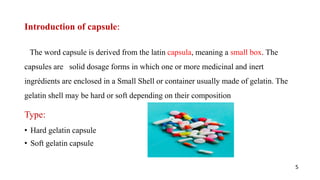
Introduction of capsule:
The word capsule is derived from the latin capsula, meaning a small box. The
capsules are solid dosage forms in which one or more medicinal and inert
ingrédients are enclosed in a Small Shell or container usually made of gelatin. The
gelatin shell may be hard or soft depending on their composition
Type:
• Hard gelatin capsule
• Soft gelatin capsule
5
Advantages of capsule:
• Capsules mask the taste and odour of unpleasant drugs and can be easily
administered.
• They are slippery when moist and hence easy to swallow with a draught of water.
• The shells are physiologically inert and easily and quickly digested in the
gastrointestinal tract.
• They are economical.
• They are easy to handle and carry.
• They are attractive in appearance.
6
Disadvantage of capsule:
• The drugs which are hygroscopic absorb water from the capsules shell making it
brittle and hence are not suitable for filling into capsules.
• Have a greater tendency to adhere to each other
• more expensive
• increased possibility of interactions between drug and shell
7
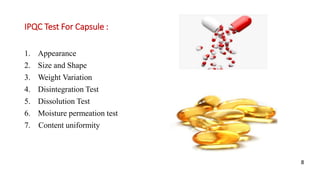
IPQC Test For Capsule :
1. Appearance
2. Size and Shape
3. Weight Variation
4. Disintegration Test
5. Dissolution Test
6. Moisture permeation test
7. Content uniformity
8
1. Appearance:
• Capsules produced on a small or a large scale should be uniform in apperance.
• Apperance means size and shape of capsule
9
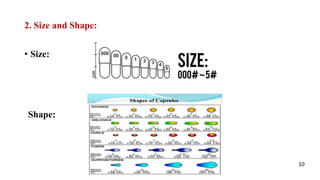
2. Size and Shape:
• Size:
Shape:
10
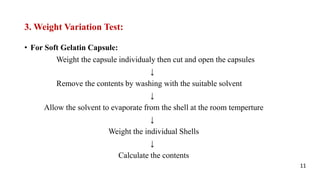
3. Weight Variation Test:
• For Soft Gelatin Capsule:
Weight the capsule individualy then cut and open the capsules
↓
Remove the contents by washing with the suitable solvent
↓
Allow the solvent to evaporate from the shell at the room temperture
↓
Weight the individual Shells
↓
Calculate the contents
11
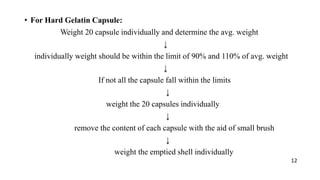
• For Hard Gelatin Capsule:
Weight 20 capsule individually and determine the avg. weight
↓
individually weight should be within the limit of 90% and 110% of avg. weight
↓
If not all the capsule fall within the limits
↓
weight the 20 capsules individually
↓
remove the content of each capsule with the aid of small brush
↓
weight the emptied shell individually
12
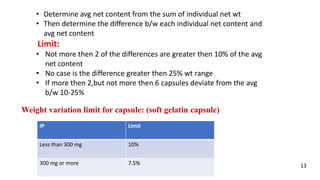
Weight variation limit for capsule: (soft gelatin capsule)
IP Limit
Less than 300 mg 10%
300 mg or more 7.5% 13
• Determine avg net content from the sum of individual net wt
• Then determine the difference b/w each individual net content and
avg net content
Limit:
• Not more then 2 of the differences are greater then 10% of the avg
net content
• No case is the difference greater then 25% wt range
• If more then 2,but not more then 6 capsules deviate from the avg
b/w 10-25%
4. Disintegration test:
• Disintegration is defined as that state in which no residue of the unit under test
remains on the screen of the apparatus or, if a residue remains, it consists of
fragments of disintegrated parts of capsule component parts such as insoluble
coating of the of capsule shells, or of any melted fatty substance from the
pessaries or suppository or is a soft mass with no palpable core.
• If discs have been used with capsules, any residue remaining on the lower
surfaces of the discs consists only of fragments of shells.
14
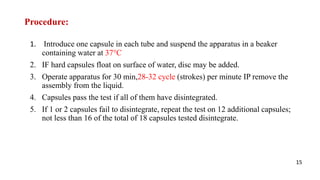
Procedure:
1. Introduce one capsule in each tube and suspend the apparatus in a beaker
containing water at 37°C
2. IF hard capsules float on surface of water, disc may be added.
3. Operate apparatus for 30 min,28-32 cycle (strokes) per minute IP remove the
assembly from the liquid.
4. Capsules pass the test if all of them have disintegrated.
5. If 1 or 2 capsules fail to disintegrate, repeat the test on 12 additional capsules;
not less than 16 of the total of 18 capsules tested disintegrate.
15
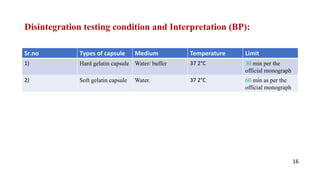
Disintegration testing condition and Interpretation (BP):
Sr.no Types of capsule Medium Temperature Limit
1) Hard gelatin capsule Water/ buffer 37 2°C 30 min per the
official monograph
2) Soft gelatin capsule Water. 37 2°C 60 min as per the
official monograph
16
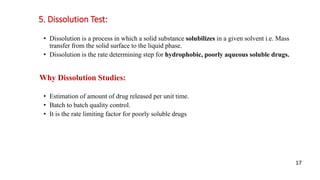
5. Dissolution Test:
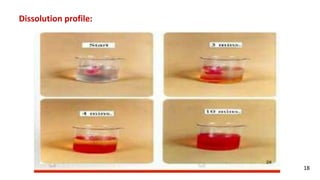
• Dissolution is a process in which a solid substance solubilizes in a given solvent i.e. Mass
transfer from the solid surface to the liquid phase.
• Dissolution is the rate determining step for hydrophobic, poorly aqueous soluble drugs.
Why Dissolution Studies:
• Estimation of amount of drug released per unit time.
• Batch to batch quality control.
• It is the rate limiting factor for poorly soluble drugs
17
Dissolution profile:
18
Sr.no Quantity
stage/Level
Number of
capsule tested
Acceptance
criteria
1 S1 6 Each unit not less
than Q® + 5
percent**
2 S2 6 Average of 12 units
(S1 +$2) is equal to
or greater than (>)Q,
and no unit is less
than Q-15 percent**
3 S3 12 Average of 24 units
(S1+2+53) is equal
to or greater than
(>)Q. Not more than
2 units are less than
Q-15 percent and no
unit is less than Q-
25 percent**
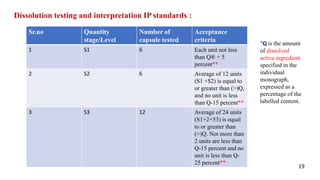
Dissolution testing and interpretation IP standards :
“Q is the amount
of dissolved
active ingredient
specified in the
individual
monograph,
expressed as a
percentage of the
labelled content.
19
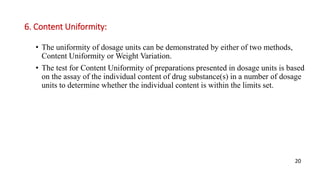
6. Content Uniformity:
• The uniformity of dosage units can be demonstrated by either of two methods,
Content Uniformity or Weight Variation.
• The test for Content Uniformity of preparations presented in dosage units is based
on the assay of the individual content of drug substance(s) in a number of dosage
units to determine whether the individual content is within the limits set.
20
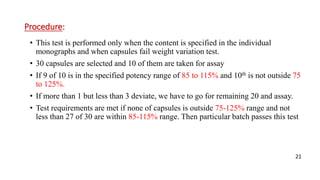
Procedure:
• This test is performed only when the content is specified in the individual
monographs and when capsules fail weight variation test.
• 30 capsules are selected and 10 of them are taken for assay
• If 9 of 10 is in the specified potency range of 85 to 115% and 10th is not outside 75
to 125%.
• If more than 1 but less than 3 deviate, we have to go for remaining 20 and assay.
• Test requirements are met if none of capsules is outside 75-125% range and not
less than 27 of 30 are within 85-115% range. Then particular batch passes this test
21
7. Moisture Permeation Test:
1. The USP requires determination of moisture-permeation characteristics
of single-unit and unit dose containers to assure their suitability for
packaging capsules. The degree and rate of moisture penetration is
determined by
2. packaging the dosage unit together with a colour revealing desiccant
pellet
3. Expose the packed unit to known relative humidity over a specified time
4. Observe the desiccant pellet for colour change
5. Any change in colour indicates absorption of moisture By measuring pre
test weight and post test weight of pellet,amount can be calculated.
22
Conclusion:
• In pharmaceutical industry the maximum quality of pharmaceuticals, depends
on the tests performed during manufacturing and after manufacturing of the
pharmaceuticals as per specifications of the respective pharmacopoeias and
the regulatory requirements of the particular countries. From the present study
it is clearly revealed though various pharmacopoeias suggest different types of
IPQC tests for pharmaceutical tablets and capsules with different
specifications and standards but the main function of the all pharmacopoeias is
to assure the maximum quality of pharmaceuticals for human health.
23
Reference:
• PHARMACEUTICAL DOSAGE FORMS AND DRUG
DELIVERY SYSTEMS published by Lippincott Williams &
Wilkins Howard C. Ansel Loyd V. Allen, Jr.Nicholas G. Popovich
7th edition page no.194-195
• Aulton’s PHARMACEUTICS The Design and Manufacture of
Medicines Kevin M. G. Taylor Edited By Michael E,Fifth
Edition,page no. 551
• Review Article Quality Control Tests for Solid Dosage Forms
prepareRaslan MA, Elshamry HG, Elshamry NR, Elshamry HA,
Elshahry AH, Elrwely ME Department of Pharmaceutics, Pharmacy
College, Al-Jouf University, Sakaka, Kingdom Saudi Arabiad by
Page no.8-15
24
27

In process quality control test (IPQC) test for capsule.pptx

  • 1.
    Mahatma Gandhi Vidhyamandir’spharmacy college Panchavati Nashik,422003 A seminar on IPQC Test For Capsule Presented by, Ms. Borde Punam Uttam F.Y. M. Pharmacy Roll No.37 Under The Guidance Of Dr. Kunal Bhambar Sir Department of P.Q.A
  • 2.
    Vision: To be acentre of professional excellence by contributing honesty to the pharmacist moulding process Mission: • Impart high quality education to graduates • Contribute to all spheres of professional activities • Up hold human values and ethics • Nurture them into globally competent professionals
  • 3.
    Content • Introduction ofIPQC • Importance of IPQC • introduction of capsules • advantages and disadvantages of capsule • IPQC test for capsules • References 1
  • 4.
    Introduction of IPQCTest: • IPQC stand for In Process Quality Control Test, • IPQC is the activity, performed between Quality control and Quality assurance • the test which are performed during the manufacturing of product which include thickness,hardness,friability , dissolution time,disintegration time. 2
  • 5.
    • In processquality control test is necessary to insure the safety of finished pharmaceutical product. • It Provides for the authorization of approved raw materials for manufacturing based on actual laboratory testing generally called as IPQC such as physical chemical, microbiologic and biologic tests. • It is a planned system to identify, the material, equipment, process and operation. 3
  • 6.
    Importance of IPQC: •To detect the errors • To minimize the human errors. • Provides accurate, specific, and definite description of the procedure to be employed. • Should detect any abnormality immediately and at the same time indicate the kind of action needed to correct the problem. • controls the procedure involved in manufacturing. • Maintenance of quality of product • Monitors all features affecting quality. 4
  • 7.
    Introduction of capsule: Theword capsule is derived from the latin capsula, meaning a small box. The capsules are solid dosage forms in which one or more medicinal and inert ingrédients are enclosed in a Small Shell or container usually made of gelatin. The gelatin shell may be hard or soft depending on their composition Type: • Hard gelatin capsule • Soft gelatin capsule 5
  • 8.
    Advantages of capsule: •Capsules mask the taste and odour of unpleasant drugs and can be easily administered. • They are slippery when moist and hence easy to swallow with a draught of water. • The shells are physiologically inert and easily and quickly digested in the gastrointestinal tract. • They are economical. • They are easy to handle and carry. • They are attractive in appearance. 6
  • 9.
    Disadvantage of capsule: •The drugs which are hygroscopic absorb water from the capsules shell making it brittle and hence are not suitable for filling into capsules. • Have a greater tendency to adhere to each other • more expensive • increased possibility of interactions between drug and shell 7
  • 10.
    IPQC Test ForCapsule : 1. Appearance 2. Size and Shape 3. Weight Variation 4. Disintegration Test 5. Dissolution Test 6. Moisture permeation test 7. Content uniformity 8
  • 11.
    1. Appearance: • Capsulesproduced on a small or a large scale should be uniform in apperance. • Apperance means size and shape of capsule 9
  • 12.
    2. Size andShape: • Size: Shape: 10
  • 13.
    3. Weight VariationTest: • For Soft Gelatin Capsule: Weight the capsule individualy then cut and open the capsules ↓ Remove the contents by washing with the suitable solvent ↓ Allow the solvent to evaporate from the shell at the room temperture ↓ Weight the individual Shells ↓ Calculate the contents 11
  • 14.
    • For HardGelatin Capsule: Weight 20 capsule individually and determine the avg. weight ↓ individually weight should be within the limit of 90% and 110% of avg. weight ↓ If not all the capsule fall within the limits ↓ weight the 20 capsules individually ↓ remove the content of each capsule with the aid of small brush ↓ weight the emptied shell individually 12
  • 15.
    Weight variation limitfor capsule: (soft gelatin capsule) IP Limit Less than 300 mg 10% 300 mg or more 7.5% 13 • Determine avg net content from the sum of individual net wt • Then determine the difference b/w each individual net content and avg net content Limit: • Not more then 2 of the differences are greater then 10% of the avg net content • No case is the difference greater then 25% wt range • If more then 2,but not more then 6 capsules deviate from the avg b/w 10-25%
  • 16.
    4. Disintegration test: •Disintegration is defined as that state in which no residue of the unit under test remains on the screen of the apparatus or, if a residue remains, it consists of fragments of disintegrated parts of capsule component parts such as insoluble coating of the of capsule shells, or of any melted fatty substance from the pessaries or suppository or is a soft mass with no palpable core. • If discs have been used with capsules, any residue remaining on the lower surfaces of the discs consists only of fragments of shells. 14
  • 17.
    Procedure: 1. Introduce onecapsule in each tube and suspend the apparatus in a beaker containing water at 37°C 2. IF hard capsules float on surface of water, disc may be added. 3. Operate apparatus for 30 min,28-32 cycle (strokes) per minute IP remove the assembly from the liquid. 4. Capsules pass the test if all of them have disintegrated. 5. If 1 or 2 capsules fail to disintegrate, repeat the test on 12 additional capsules; not less than 16 of the total of 18 capsules tested disintegrate. 15
  • 18.
    Disintegration testing conditionand Interpretation (BP): Sr.no Types of capsule Medium Temperature Limit 1) Hard gelatin capsule Water/ buffer 37 2°C 30 min per the official monograph 2) Soft gelatin capsule Water. 37 2°C 60 min as per the official monograph 16
  • 19.
    5. Dissolution Test: •Dissolution is a process in which a solid substance solubilizes in a given solvent i.e. Mass transfer from the solid surface to the liquid phase. • Dissolution is the rate determining step for hydrophobic, poorly aqueous soluble drugs. Why Dissolution Studies: • Estimation of amount of drug released per unit time. • Batch to batch quality control. • It is the rate limiting factor for poorly soluble drugs 17
  • 20.
  • 21.
    Sr.no Quantity stage/Level Number of capsuletested Acceptance criteria 1 S1 6 Each unit not less than Q® + 5 percent** 2 S2 6 Average of 12 units (S1 +$2) is equal to or greater than (>)Q, and no unit is less than Q-15 percent** 3 S3 12 Average of 24 units (S1+2+53) is equal to or greater than (>)Q. Not more than 2 units are less than Q-15 percent and no unit is less than Q- 25 percent** Dissolution testing and interpretation IP standards : “Q is the amount of dissolved active ingredient specified in the individual monograph, expressed as a percentage of the labelled content. 19
  • 22.
    6. Content Uniformity: •The uniformity of dosage units can be demonstrated by either of two methods, Content Uniformity or Weight Variation. • The test for Content Uniformity of preparations presented in dosage units is based on the assay of the individual content of drug substance(s) in a number of dosage units to determine whether the individual content is within the limits set. 20
  • 23.
    Procedure: • This testis performed only when the content is specified in the individual monographs and when capsules fail weight variation test. • 30 capsules are selected and 10 of them are taken for assay • If 9 of 10 is in the specified potency range of 85 to 115% and 10th is not outside 75 to 125%. • If more than 1 but less than 3 deviate, we have to go for remaining 20 and assay. • Test requirements are met if none of capsules is outside 75-125% range and not less than 27 of 30 are within 85-115% range. Then particular batch passes this test 21
  • 24.
    7. Moisture PermeationTest: 1. The USP requires determination of moisture-permeation characteristics of single-unit and unit dose containers to assure their suitability for packaging capsules. The degree and rate of moisture penetration is determined by 2. packaging the dosage unit together with a colour revealing desiccant pellet 3. Expose the packed unit to known relative humidity over a specified time 4. Observe the desiccant pellet for colour change 5. Any change in colour indicates absorption of moisture By measuring pre test weight and post test weight of pellet,amount can be calculated. 22
  • 25.
    Conclusion: • In pharmaceuticalindustry the maximum quality of pharmaceuticals, depends on the tests performed during manufacturing and after manufacturing of the pharmaceuticals as per specifications of the respective pharmacopoeias and the regulatory requirements of the particular countries. From the present study it is clearly revealed though various pharmacopoeias suggest different types of IPQC tests for pharmaceutical tablets and capsules with different specifications and standards but the main function of the all pharmacopoeias is to assure the maximum quality of pharmaceuticals for human health. 23
  • 26.
    Reference: • PHARMACEUTICAL DOSAGEFORMS AND DRUG DELIVERY SYSTEMS published by Lippincott Williams & Wilkins Howard C. Ansel Loyd V. Allen, Jr.Nicholas G. Popovich 7th edition page no.194-195 • Aulton’s PHARMACEUTICS The Design and Manufacture of Medicines Kevin M. G. Taylor Edited By Michael E,Fifth Edition,page no. 551 • Review Article Quality Control Tests for Solid Dosage Forms prepareRaslan MA, Elshamry HG, Elshamry NR, Elshamry HA, Elshahry AH, Elrwely ME Department of Pharmaceutics, Pharmacy College, Al-Jouf University, Sakaka, Kingdom Saudi Arabiad by Page no.8-15 24
  • 27.