IPQC TESTS FOR TABLETS CAPSULES
AND OINTMENTS
Presented by:
N. Kamakshi Devi
1st year M. Pharmacy
Pharmaceutical Analysis
CONTENTS:
• IPQC
• Importance Of IPQC
• IPQC Tests For Tablets
• IPQC Tests For Capsules
• IPQC Tests For Ointments
IPQC:
• In process quality control [IPQC] is concerned with providing accurate, specific and definite
description of procedures to be employed from the receipt of raw materials to the release of
finished dosage forms.
• IPQC procedures are generally quick, simple and rapid tests that carried out at on going
manufacturing.
• It is a planned system to identify the materials, equipment, process and operations.
IMPORTANCE OF IPQC:
• To detect the errors
• To minimize the human errors
• Provides accurate, specific and definite description of the procedure to be employed.
• Should detect any abnormality immediately and at the same time indicate the kind of action
needed to correct the problem.
• To enforce the flow of manufacturing and packaging operations according to established routes
and practice.
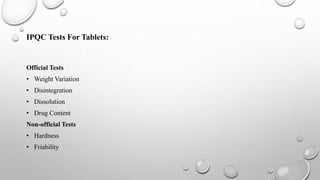
IPQC Tests For Tablets:
Official Tests
• Weight Variation
• Disintegration
• Dissolution
• Drug Content
Non-official Tests
• Hardness
• Friability
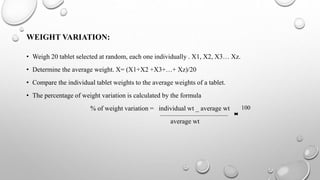
WEIGHT VARIATION:
• Weigh 20 tablet selected at random, each one individually . X1, X2, X3… Xz.
• Determine the average weight. X= (X1+X2 +X3+…+ Xz)/20
• Compare the individual tablet weights to the average weights of a tablet.
• The percentage of weight variation is calculated by the formula
% of weight variation = individual wt _ average wt
average wt
100
Weight variation limits for uncoated tablets:
USP XX-NF Standards:
IP Standards:
S.N
O
Average weight of tablets (mg) Maximum % deviation allowed
1 130 or less 10%
2 130-324 7.5%
3 More than 324 5%
S.NO Average weight of tablets (mg) Maximum % deviation allowed
1 84 or less 10%
2 84-250 7.5%
3 More than 250 5%
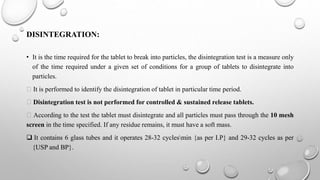
DISINTEGRATION:
• It is the time required for the tablet to break into particles, the disintegration test is a measure only
of the time required under a given set of conditions for a group of tablets to disintegrate into
particles.
It is performed to identify the disintegration of tablet in particular time period.
Disintegration test is not performed for controlled & sustained release tablets.
According to the test the tablet must disintegrate and all particles must pass through the 10 mesh
screen in the time specified. If any residue remains, it must have a soft mass.
 It contains 6 glass tubes and it operates 28-32 cyclesmin {as per I.P} and 29-32 cycles as per
{USP and BP}.
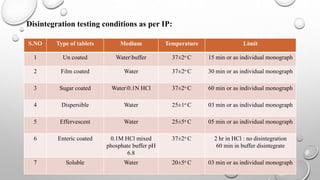
Disintegration testing conditions as per IP:
S.NO Type of tablets Medium Temperature Limit
1 Un coated Waterbuffer 37±2o C 15 min or as individual monograph
2 Film coated Water 37±2o C 30 min or as individual monograph
3 Sugar coated Water0.1N HCl 37±2o C 60 min or as individual monograph
4 Dispersible Water 25±1o C 03 min or as individual monograph
5 Effervescent Water 25±5o C 05 min or as individual monograph
6 Enteric coated 0.1M HCl mixed
phosphate buffer pH
6.8
37±2o C 2 hr in HCl : no disintegration
60 min in buffer disintegrate
7 Soluble Water 20±5o C 03 min or as individual monograph
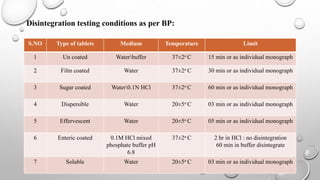
Disintegration testing conditions as per BP:
S.NO Type of tablets Medium Temperature Limit
1 Un coated Waterbuffer 37±2o C 15 min or as individual monograph
2 Film coated Water 37±2o C 30 min or as individual monograph
3 Sugar coated Water0.1N HCl 37±2o C 60 min or as individual monograph
4 Dispersible Water 20±5o C 03 min or as individual monograph
5 Effervescent Water 20±5o C 05 min or as individual monograph
6 Enteric coated 0.1M HCl mixed
phosphate buffer pH
6.8
37±2o C 2 hr in HCl : no disintegration
60 min in buffer disintegrate
7 Soluble Water 20±5o C 03 min or as individual monograph
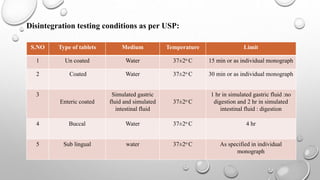
Disintegration testing conditions as per USP:
S.NO Type of tablets Medium Temperature Limit
1 Un coated Water 37±2o C 15 min or as individual monograph
2 Coated Water 37±2o C 30 min or as individual monograph
3
Enteric coated
Simulated gastric
fluid and simulated
intestinal fluid
37±2o C
1 hr in simulated gastric fluid :no
digestion and 2 hr in simulated
intestinal fluid : digestion
4 Buccal Water 37±2o C 4 hr
5 Sub lingual water 37±2o C As specified in individual
monograph
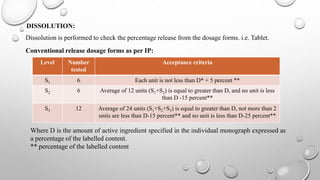
DISSOLUTION:
Dissolution is performed to check the percentage release from the dosage forms. i.e. Tablet.
Conventional release dosage forms as per IP:
Level Number
tested
Acceptance criteria
S1 6 Each unit is not less than D* + 5 percent **
S2 6 Average of 12 units (S1+S2) is equal to greater than D, and no unit is less
than D -15 percent**
S3 12 Average of 24 units (S1+S2+S3) is equal to greater than D, not more than 2
units are less than D-15 percent** and no unit is less than D-25 percent**
Where D is the amount of active ingredient specified in the individual monograph expressed as
a percentage of the labelled content.
** percentage of the labelled content
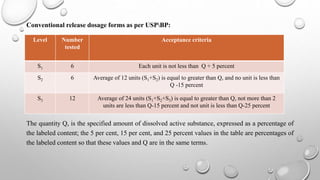
Conventional release dosage forms as per USPBP:
The quantity Q, is the specified amount of dissolved active substance, expressed as a percentage of
the labeled content; the 5 per cent, 15 per cent, and 25 percent values in the table are percentages of
the labeled content so that these values and Q are in the same terms.
Level Number
tested
Acceptance criteria
S1 6 Each unit is not less than Q + 5 percent
S2 6 Average of 12 units (S1+S2) is equal to greater than Q, and no unit is less than
Q -15 percent
S3 12 Average of 24 units (S1+S2+S3) is equal to greater than Q, not more than 2
units are less than Q-15 percent and not unit is less than Q-25 percent
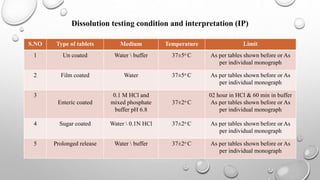
Dissolution testing condition and interpretation (IP)
S.NO Type of tablets Medium Temperature Limit
1 Un coated Water  buffer 37±5o C As per tables shown before or As
per individual monograph
2 Film coated Water 37±5o C As per tables shown before or As
per individual monograph
3
Enteric coated
0.1 M HCl and
mixed phosphate
buffer pH 6.8
37±2o C
02 hour in HCl & 60 min in buffer
As per tables shown before or As
per individual monograph
4 Sugar coated Water  0.1N HCl 37±2o C As per tables shown before or As
per individual monograph
5 Prolonged release Water  buffer 37±2o C As per tables shown before or As
per individual monograph
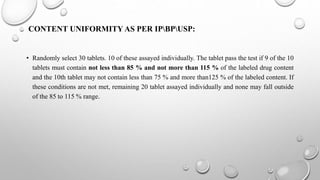
CONTENT UNIFORMITY AS PER IPBPUSP:
• Randomly select 30 tablets. 10 of these assayed individually. The tablet pass the test if 9 of the 10
tablets must contain not less than 85 % and not more than 115 % of the labeled drug content
and the 10th tablet may not contain less than 75 % and more than125 % of the labeled content. If
these conditions are not met, remaining 20 tablet assayed individually and none may fall outside
of the 85 to 115 % range.
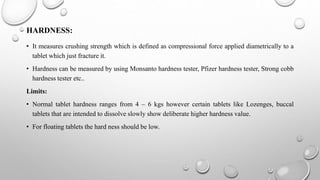
HARDNESS:
• It measures crushing strength which is defined as compressional force applied diametrically to a
tablet which just fracture it.
• Hardness can be measured by using Monsanto hardness tester, Pfizer hardness tester, Strong cobb
hardness tester etc..
Limits:
• Normal tablet hardness ranges from 4 – 6 kgs however certain tablets like Lozenges, buccal
tablets that are intended to dissolve slowly show deliberate higher hardness value.
• For floating tablets the hard ness should be low.
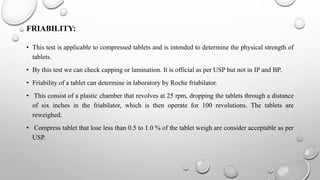
FRIABILITY:
• This test is applicable to compressed tablets and is intended to determine the physical strength of
tablets.
• By this test we can check capping or lamination. It is official as per USP but not in IP and BP.
• Friability of a tablet can determine in laboratory by Roche friabilator.
• This consist of a plastic chamber that revolves at 25 rpm, dropping the tablets through a distance
of six inches in the friabilator, which is then operate for 100 revolutions. The tablets are
reweighed.
• Compress tablet that lose less than 0.5 to 1.0 % of the tablet weigh are consider acceptable as per
USP.
IPQC Tests For Capsules:
• Uniformity of content
• Disintegration test
• Weight variation test
• Dissolution test
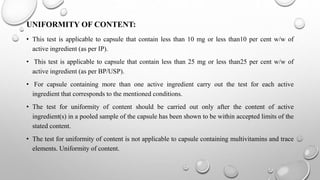
UNIFORMITY OF CONTENT:
• This test is applicable to capsule that contain less than 10 mg or less than10 per cent w/w of
active ingredient (as per IP).
• This test is applicable to capsule that contain less than 25 mg or less than25 per cent w/w of
active ingredient (as per BP/USP).
• For capsule containing more than one active ingredient carry out the test for each active
ingredient that corresponds to the mentioned conditions.
• The test for uniformity of content should be carried out only after the content of active
ingredient(s) in a pooled sample of the capsule has been shown to be within accepted limits of the
stated content.
• The test for uniformity of content is not applicable to capsule containing multivitamins and trace
elements. Uniformity of content.
CONTENT UNIFORMITYAS PER IPBPUSP:
• Randomly select 30 capsules. 10 of these assayed individually. The capsule pass the test if 9 of
the 10 tablets must contain not less than 85 % and not more than 115 % of the labeled drug
content and the 10th capsules may not contain less than 75 % and more than125 % of the labeled
content. If these conditions are not met, remaining 20 capsules assayed individually and none
may fall outside of the 85 to 115 % range.
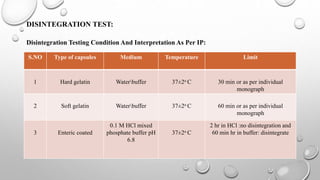
DISINTEGRATION TEST:
Disintegration Testing Condition And Interpretation As Per IP:
S.NO Type of capsules Medium Temperature Limit
1 Hard gelatin Waterbuffer 37±2o C 30 min or as per individual
monograph
2 Soft gelatin Waterbuffer 37±2o C 60 min or as per individual
monograph
3 Enteric coated
0.1 M HCl mixed
phosphate buffer pH
6.8
37±2o C
2 hr in HCl :no disintegration and
60 min hr in buffer: disintegrate
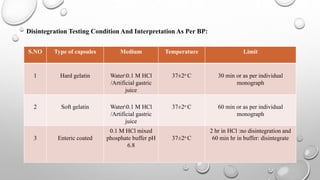
Disintegration Testing Condition And Interpretation As Per BP:
S.NO Type of capsules Medium Temperature Limit
1 Hard gelatin Water0.1 M HCl
/Artificial gastric
juice
37±2o C 30 min or as per individual
monograph
2 Soft gelatin Water0.1 M HCl
/Artificial gastric
juice
37±2o C 60 min or as per individual
monograph
3 Enteric coated
0.1 M HCl mixed
phosphate buffer pH
6.8
37±2o C
2 hr in HCl :no disintegration and
60 min hr in buffer: disintegrate
WEIGHT VARIATION:
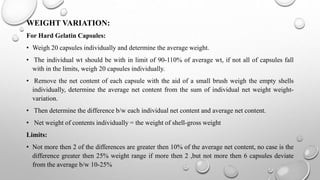
For Hard Gelatin Capsules:
• Weigh 20 capsules individually and determine the average weight.
• The individual wt should be with in limit of 90-110% of average wt, if not all of capsules fall
with in the limits, weigh 20 capsules individually.
• Remove the net content of each capsule with the aid of a small brush weigh the empty shells
individually, determine the average net content from the sum of individual net weight weight-
variation.
• Then determine the difference b/w each individual net content and average net content.
• Net weight of contents individually = the weight of shell-gross weight
Limits:
• Not more then 2 of the differences are greater then 10% of the average net content, no case is the
difference greater then 25% weight range if more then 2 ,but not more then 6 capsules deviate
from the average b/w 10-25%
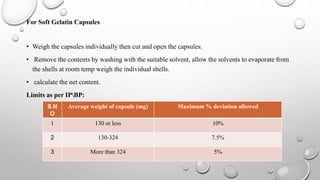
For Soft Gelatin Capsules
• Weigh the capsules individually then cut and open the capsules.
• Remove the contents by washing with the suitable solvent, allow the solvents to evaporate from
the shells at room temp weigh the individual shells.
• calculate the net content.
Limits as per IPBP:
S.N
O
Average weight of capsule (mg) Maximum % deviation allowed
1 130 or less 10%
2 130-324 7.5%
3 More than 324 5%
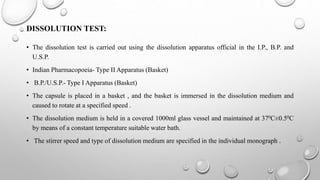
DISSOLUTION TEST:
• The dissolution test is carried out using the dissolution apparatus official in the I.P., B.P. and
U.S.P.
• Indian Pharmacopoeia- Type II Apparatus (Basket)
• B.P./U.S.P.- Type I Apparatus (Basket)
• The capsule is placed in a basket , and the basket is immersed in the dissolution medium and
caused to rotate at a specified speed .
• The dissolution medium is held in a covered 1000ml glass vessel and maintained at 370C±0.50C
by means of a constant temperature suitable water bath.
• The stirrer speed and type of dissolution medium are specified in the individual monograph .
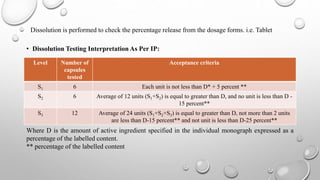
Dissolution is performed to check the percentage release from the dosage forms. i.e. Tablet
• Dissolution Testing Interpretation As Per IP:
Level Number of
capsules
tested
Acceptance criteria
S1 6 Each unit is not less than D* + 5 percent **
S2 6 Average of 12 units (S1+S2) is equal to greater than D, and no unit is less than D -
15 percent**
S3 12 Average of 24 units (S1+S2+S3) is equal to greater than D, not more than 2 units
are less than D-15 percent** and not unit is less than D-25 percent**
Where D is the amount of active ingredient specified in the individual monograph expressed as a
percentage of the labelled content.
** percentage of the labelled content
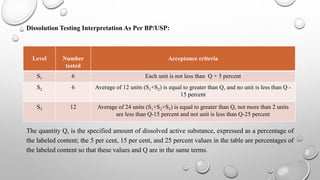
Dissolution Testing Interpretation As Per BP/USP:
• *
The quantity Q, is the specified amount of dissolved active substance, expressed as a percentage of
the labeled content; the 5 per cent, 15 per cent, and 25 percent values in the table are percentages of
the labeled content so that these values and Q are in the same terms.
Level Number
tested
Acceptance criteria
S1 6 Each unit is not less than Q + 5 percent
S2 6 Average of 12 units (S1+S2) is equal to greater than Q, and no unit is less than Q -
15 percent
S3 12 Average of 24 units (S1+S2+S3) is equal to greater than Q, not more than 2 units
are less than Q-15 percent and not unit is less than Q-25 percent
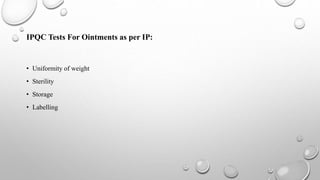
IPQC Tests For Ointments as per IP:
• Uniformity of weight
• Sterility
• Storage
• Labelling
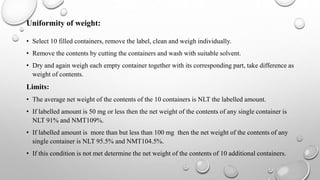
Uniformity of weight:
• Select 10 filled containers, remove the label, clean and weigh individually.
• Remove the contents by cutting the containers and wash with suitable solvent.
• Dry and again weigh each empty container together with its corresponding part, take difference as
weight of contents.
Limits:
• The average net weight of the contents of the 10 containers is NLT the labelled amount.
• If labelled amount is 50 mg or less then the net weight of the contents of any single container is
NLT 91% and NMT109%.
• If labelled amount is more than but less than 100 mg then the net weight of the contents of any
single container is NLT 95.5% and NMT104.5%.
• If this condition is not met determine the net weight of the contents of 10 additional containers.
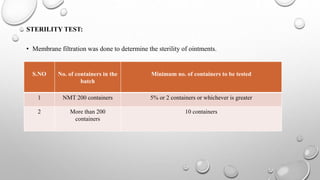
STERILITY TEST:
• Membrane filtration was done to determine the sterility of ointments.
S.NO No. of containers in the
batch
Minimum no. of containers to be tested
1 NMT 200 containers 5% or 2 containers or whichever is greater
2 More than 200
containers
10 containers
STERILITY TEST:
Procedure:
• Fluid A: dissolve 1g of peptic digest of animal tissue (e.g. bacteriological peptone) or its
equivalent in water to make 1litre, filter or centrifuge to clarify, adjust to pH 7.1± 0.2, dispense
into flasks in 100ml quantities & sterilize at 121ºc for 20 mins.
• Fluid B: if the sample contains lecithin or oil, use fluid A to each liter of which has been added
1ml of polysorbate 80, adjust to pH 7.1± 0.2, dispense into flasks & sterilize at 121ºc for 20 mins
Method:
• It is for the routine use of + ve & - ve controls.
• + ve control: it is the small no. (NMT 100CFU) of microorganisms specified in separate portion
of each medium.
STERILITY TEST:
• Dilute in a fatty base & emulsions of the w/o type to give a fluid concentration of 1% w/v, by
heating, if necessary, to NMT 40ºc with a suitable sterile diluent such as isopropyl myristate
previously rendered sterile by filtration through a 0.22µm membrane filter that has been shown
not to have antimicrobial properties under the conditions of the test.
• Filter as rapidly as possible & wash the membrane by filtering through it at least 3 successive
quantities, each of approximately 100ml, of sterile fluid B or any other suitable sterile diluent.
• After filtration, aseptically remove the membrane or cut it aseptically into 2 equal parts. Transfer
one half to each of 2 suitable media.
• Alternatively, transfer the medium on to the membrane in the apparatus.
Incubation and observation:
Incubate the media for NLT 14 days & observe. If the specimen is + ve before 14days, further
incubation is not necessary.
STERILITY TEST:
Interpretation:
• At intervals, media is examined under microscope, if the material being tested is turbid, we
cannot easily determine presence or absence of microbial growth.
• After 14days transfer 1ml of the test medium to fresh medium & incubate for NLT 4days, if there
is no evidence of microbial growth, the preparation under examination complies with the test for
sterility.
• If the evidence of microbial growth is found, the preparation under examination does not comply
with the test for sterility.
• The test is considered to be invalid, only if 1 or more following conditions is fulfilled:
• a. Growth in -ve controls
• b. Sterility testing facility show a fault
• c. -If testing procedure is fault
• d. Material/technique is fault
STERILITY TEST:
• If the test is declared to be invalid, repeat the same no. Of units as in the original test
i. No microbial growth in repeat test, preparation complies with the test for sterility.
ii. If microbial growth is found & confirmed microscopically the preparation does not comply
with the test for sterility.
STORAGE:
Store at a temp not exceeding 30 ºc unless otherwise directed. Do not freeze 40C.
LABELLING:
The label states that:
• That the ointment is sterile, where necessary
• The name & concentration of any added antimicrobial preservative and storage conditions.
REFERENCES:
• Indian Pharmacopeia - 2018
• USP Pharmacopeia - 2018
• British Pharmacopeia - 2004
THANK YOU

IPQC for tablets, capsules and ointments.pptx

  • 1.
    IPQC TESTS FORTABLETS CAPSULES AND OINTMENTS Presented by: N. Kamakshi Devi 1st year M. Pharmacy Pharmaceutical Analysis
  • 2.
    CONTENTS: • IPQC • ImportanceOf IPQC • IPQC Tests For Tablets • IPQC Tests For Capsules • IPQC Tests For Ointments
  • 3.
    IPQC: • In processquality control [IPQC] is concerned with providing accurate, specific and definite description of procedures to be employed from the receipt of raw materials to the release of finished dosage forms. • IPQC procedures are generally quick, simple and rapid tests that carried out at on going manufacturing. • It is a planned system to identify the materials, equipment, process and operations.
  • 4.
    IMPORTANCE OF IPQC: •To detect the errors • To minimize the human errors • Provides accurate, specific and definite description of the procedure to be employed. • Should detect any abnormality immediately and at the same time indicate the kind of action needed to correct the problem. • To enforce the flow of manufacturing and packaging operations according to established routes and practice.
  • 5.
    IPQC Tests ForTablets: Official Tests • Weight Variation • Disintegration • Dissolution • Drug Content Non-official Tests • Hardness • Friability
  • 6.
    WEIGHT VARIATION: • Weigh20 tablet selected at random, each one individually . X1, X2, X3… Xz. • Determine the average weight. X= (X1+X2 +X3+…+ Xz)/20 • Compare the individual tablet weights to the average weights of a tablet. • The percentage of weight variation is calculated by the formula % of weight variation = individual wt _ average wt average wt 100
  • 7.
    Weight variation limitsfor uncoated tablets: USP XX-NF Standards: IP Standards: S.N O Average weight of tablets (mg) Maximum % deviation allowed 1 130 or less 10% 2 130-324 7.5% 3 More than 324 5% S.NO Average weight of tablets (mg) Maximum % deviation allowed 1 84 or less 10% 2 84-250 7.5% 3 More than 250 5%
  • 8.
    DISINTEGRATION: • It isthe time required for the tablet to break into particles, the disintegration test is a measure only of the time required under a given set of conditions for a group of tablets to disintegrate into particles. It is performed to identify the disintegration of tablet in particular time period. Disintegration test is not performed for controlled & sustained release tablets. According to the test the tablet must disintegrate and all particles must pass through the 10 mesh screen in the time specified. If any residue remains, it must have a soft mass.  It contains 6 glass tubes and it operates 28-32 cyclesmin {as per I.P} and 29-32 cycles as per {USP and BP}.
  • 9.
    Disintegration testing conditionsas per IP: S.NO Type of tablets Medium Temperature Limit 1 Un coated Waterbuffer 37±2o C 15 min or as individual monograph 2 Film coated Water 37±2o C 30 min or as individual monograph 3 Sugar coated Water0.1N HCl 37±2o C 60 min or as individual monograph 4 Dispersible Water 25±1o C 03 min or as individual monograph 5 Effervescent Water 25±5o C 05 min or as individual monograph 6 Enteric coated 0.1M HCl mixed phosphate buffer pH 6.8 37±2o C 2 hr in HCl : no disintegration 60 min in buffer disintegrate 7 Soluble Water 20±5o C 03 min or as individual monograph
  • 10.
    Disintegration testing conditionsas per BP: S.NO Type of tablets Medium Temperature Limit 1 Un coated Waterbuffer 37±2o C 15 min or as individual monograph 2 Film coated Water 37±2o C 30 min or as individual monograph 3 Sugar coated Water0.1N HCl 37±2o C 60 min or as individual monograph 4 Dispersible Water 20±5o C 03 min or as individual monograph 5 Effervescent Water 20±5o C 05 min or as individual monograph 6 Enteric coated 0.1M HCl mixed phosphate buffer pH 6.8 37±2o C 2 hr in HCl : no disintegration 60 min in buffer disintegrate 7 Soluble Water 20±5o C 03 min or as individual monograph
  • 11.
    Disintegration testing conditionsas per USP: S.NO Type of tablets Medium Temperature Limit 1 Un coated Water 37±2o C 15 min or as individual monograph 2 Coated Water 37±2o C 30 min or as individual monograph 3 Enteric coated Simulated gastric fluid and simulated intestinal fluid 37±2o C 1 hr in simulated gastric fluid :no digestion and 2 hr in simulated intestinal fluid : digestion 4 Buccal Water 37±2o C 4 hr 5 Sub lingual water 37±2o C As specified in individual monograph
  • 12.
    DISSOLUTION: Dissolution is performedto check the percentage release from the dosage forms. i.e. Tablet. Conventional release dosage forms as per IP: Level Number tested Acceptance criteria S1 6 Each unit is not less than D* + 5 percent ** S2 6 Average of 12 units (S1+S2) is equal to greater than D, and no unit is less than D -15 percent** S3 12 Average of 24 units (S1+S2+S3) is equal to greater than D, not more than 2 units are less than D-15 percent** and no unit is less than D-25 percent** Where D is the amount of active ingredient specified in the individual monograph expressed as a percentage of the labelled content. ** percentage of the labelled content
  • 13.
    Conventional release dosageforms as per USPBP: The quantity Q, is the specified amount of dissolved active substance, expressed as a percentage of the labeled content; the 5 per cent, 15 per cent, and 25 percent values in the table are percentages of the labeled content so that these values and Q are in the same terms. Level Number tested Acceptance criteria S1 6 Each unit is not less than Q + 5 percent S2 6 Average of 12 units (S1+S2) is equal to greater than Q, and no unit is less than Q -15 percent S3 12 Average of 24 units (S1+S2+S3) is equal to greater than Q, not more than 2 units are less than Q-15 percent and not unit is less than Q-25 percent
  • 14.
    Dissolution testing conditionand interpretation (IP) S.NO Type of tablets Medium Temperature Limit 1 Un coated Water buffer 37±5o C As per tables shown before or As per individual monograph 2 Film coated Water 37±5o C As per tables shown before or As per individual monograph 3 Enteric coated 0.1 M HCl and mixed phosphate buffer pH 6.8 37±2o C 02 hour in HCl & 60 min in buffer As per tables shown before or As per individual monograph 4 Sugar coated Water 0.1N HCl 37±2o C As per tables shown before or As per individual monograph 5 Prolonged release Water buffer 37±2o C As per tables shown before or As per individual monograph
  • 15.
    CONTENT UNIFORMITY ASPER IPBPUSP: • Randomly select 30 tablets. 10 of these assayed individually. The tablet pass the test if 9 of the 10 tablets must contain not less than 85 % and not more than 115 % of the labeled drug content and the 10th tablet may not contain less than 75 % and more than125 % of the labeled content. If these conditions are not met, remaining 20 tablet assayed individually and none may fall outside of the 85 to 115 % range.
  • 16.
    HARDNESS: • It measurescrushing strength which is defined as compressional force applied diametrically to a tablet which just fracture it. • Hardness can be measured by using Monsanto hardness tester, Pfizer hardness tester, Strong cobb hardness tester etc.. Limits: • Normal tablet hardness ranges from 4 – 6 kgs however certain tablets like Lozenges, buccal tablets that are intended to dissolve slowly show deliberate higher hardness value. • For floating tablets the hard ness should be low.
  • 17.
    FRIABILITY: • This testis applicable to compressed tablets and is intended to determine the physical strength of tablets. • By this test we can check capping or lamination. It is official as per USP but not in IP and BP. • Friability of a tablet can determine in laboratory by Roche friabilator. • This consist of a plastic chamber that revolves at 25 rpm, dropping the tablets through a distance of six inches in the friabilator, which is then operate for 100 revolutions. The tablets are reweighed. • Compress tablet that lose less than 0.5 to 1.0 % of the tablet weigh are consider acceptable as per USP.
  • 18.
    IPQC Tests ForCapsules: • Uniformity of content • Disintegration test • Weight variation test • Dissolution test
  • 19.
    UNIFORMITY OF CONTENT: •This test is applicable to capsule that contain less than 10 mg or less than10 per cent w/w of active ingredient (as per IP). • This test is applicable to capsule that contain less than 25 mg or less than25 per cent w/w of active ingredient (as per BP/USP). • For capsule containing more than one active ingredient carry out the test for each active ingredient that corresponds to the mentioned conditions. • The test for uniformity of content should be carried out only after the content of active ingredient(s) in a pooled sample of the capsule has been shown to be within accepted limits of the stated content. • The test for uniformity of content is not applicable to capsule containing multivitamins and trace elements. Uniformity of content.
  • 20.
    CONTENT UNIFORMITYAS PERIPBPUSP: • Randomly select 30 capsules. 10 of these assayed individually. The capsule pass the test if 9 of the 10 tablets must contain not less than 85 % and not more than 115 % of the labeled drug content and the 10th capsules may not contain less than 75 % and more than125 % of the labeled content. If these conditions are not met, remaining 20 capsules assayed individually and none may fall outside of the 85 to 115 % range.
  • 21.
    DISINTEGRATION TEST: Disintegration TestingCondition And Interpretation As Per IP: S.NO Type of capsules Medium Temperature Limit 1 Hard gelatin Waterbuffer 37±2o C 30 min or as per individual monograph 2 Soft gelatin Waterbuffer 37±2o C 60 min or as per individual monograph 3 Enteric coated 0.1 M HCl mixed phosphate buffer pH 6.8 37±2o C 2 hr in HCl :no disintegration and 60 min hr in buffer: disintegrate
  • 22.
    Disintegration Testing ConditionAnd Interpretation As Per BP: S.NO Type of capsules Medium Temperature Limit 1 Hard gelatin Water0.1 M HCl /Artificial gastric juice 37±2o C 30 min or as per individual monograph 2 Soft gelatin Water0.1 M HCl /Artificial gastric juice 37±2o C 60 min or as per individual monograph 3 Enteric coated 0.1 M HCl mixed phosphate buffer pH 6.8 37±2o C 2 hr in HCl :no disintegration and 60 min hr in buffer: disintegrate
  • 23.
    WEIGHT VARIATION: For HardGelatin Capsules: • Weigh 20 capsules individually and determine the average weight. • The individual wt should be with in limit of 90-110% of average wt, if not all of capsules fall with in the limits, weigh 20 capsules individually. • Remove the net content of each capsule with the aid of a small brush weigh the empty shells individually, determine the average net content from the sum of individual net weight weight- variation. • Then determine the difference b/w each individual net content and average net content. • Net weight of contents individually = the weight of shell-gross weight Limits: • Not more then 2 of the differences are greater then 10% of the average net content, no case is the difference greater then 25% weight range if more then 2 ,but not more then 6 capsules deviate from the average b/w 10-25%
  • 24.
    For Soft GelatinCapsules • Weigh the capsules individually then cut and open the capsules. • Remove the contents by washing with the suitable solvent, allow the solvents to evaporate from the shells at room temp weigh the individual shells. • calculate the net content. Limits as per IPBP: S.N O Average weight of capsule (mg) Maximum % deviation allowed 1 130 or less 10% 2 130-324 7.5% 3 More than 324 5%
  • 25.
    DISSOLUTION TEST: • Thedissolution test is carried out using the dissolution apparatus official in the I.P., B.P. and U.S.P. • Indian Pharmacopoeia- Type II Apparatus (Basket) • B.P./U.S.P.- Type I Apparatus (Basket) • The capsule is placed in a basket , and the basket is immersed in the dissolution medium and caused to rotate at a specified speed . • The dissolution medium is held in a covered 1000ml glass vessel and maintained at 370C±0.50C by means of a constant temperature suitable water bath. • The stirrer speed and type of dissolution medium are specified in the individual monograph .
  • 26.
    Dissolution is performedto check the percentage release from the dosage forms. i.e. Tablet • Dissolution Testing Interpretation As Per IP: Level Number of capsules tested Acceptance criteria S1 6 Each unit is not less than D* + 5 percent ** S2 6 Average of 12 units (S1+S2) is equal to greater than D, and no unit is less than D - 15 percent** S3 12 Average of 24 units (S1+S2+S3) is equal to greater than D, not more than 2 units are less than D-15 percent** and not unit is less than D-25 percent** Where D is the amount of active ingredient specified in the individual monograph expressed as a percentage of the labelled content. ** percentage of the labelled content
  • 27.
    Dissolution Testing InterpretationAs Per BP/USP: • * The quantity Q, is the specified amount of dissolved active substance, expressed as a percentage of the labeled content; the 5 per cent, 15 per cent, and 25 percent values in the table are percentages of the labeled content so that these values and Q are in the same terms. Level Number tested Acceptance criteria S1 6 Each unit is not less than Q + 5 percent S2 6 Average of 12 units (S1+S2) is equal to greater than Q, and no unit is less than Q - 15 percent S3 12 Average of 24 units (S1+S2+S3) is equal to greater than Q, not more than 2 units are less than Q-15 percent and not unit is less than Q-25 percent
  • 28.
    IPQC Tests ForOintments as per IP: • Uniformity of weight • Sterility • Storage • Labelling
  • 29.
    Uniformity of weight: •Select 10 filled containers, remove the label, clean and weigh individually. • Remove the contents by cutting the containers and wash with suitable solvent. • Dry and again weigh each empty container together with its corresponding part, take difference as weight of contents. Limits: • The average net weight of the contents of the 10 containers is NLT the labelled amount. • If labelled amount is 50 mg or less then the net weight of the contents of any single container is NLT 91% and NMT109%. • If labelled amount is more than but less than 100 mg then the net weight of the contents of any single container is NLT 95.5% and NMT104.5%. • If this condition is not met determine the net weight of the contents of 10 additional containers.
  • 30.
    STERILITY TEST: • Membranefiltration was done to determine the sterility of ointments. S.NO No. of containers in the batch Minimum no. of containers to be tested 1 NMT 200 containers 5% or 2 containers or whichever is greater 2 More than 200 containers 10 containers
  • 31.
    STERILITY TEST: Procedure: • FluidA: dissolve 1g of peptic digest of animal tissue (e.g. bacteriological peptone) or its equivalent in water to make 1litre, filter or centrifuge to clarify, adjust to pH 7.1± 0.2, dispense into flasks in 100ml quantities & sterilize at 121ºc for 20 mins. • Fluid B: if the sample contains lecithin or oil, use fluid A to each liter of which has been added 1ml of polysorbate 80, adjust to pH 7.1± 0.2, dispense into flasks & sterilize at 121ºc for 20 mins Method: • It is for the routine use of + ve & - ve controls. • + ve control: it is the small no. (NMT 100CFU) of microorganisms specified in separate portion of each medium.
  • 32.
    STERILITY TEST: • Dilutein a fatty base & emulsions of the w/o type to give a fluid concentration of 1% w/v, by heating, if necessary, to NMT 40ºc with a suitable sterile diluent such as isopropyl myristate previously rendered sterile by filtration through a 0.22µm membrane filter that has been shown not to have antimicrobial properties under the conditions of the test. • Filter as rapidly as possible & wash the membrane by filtering through it at least 3 successive quantities, each of approximately 100ml, of sterile fluid B or any other suitable sterile diluent. • After filtration, aseptically remove the membrane or cut it aseptically into 2 equal parts. Transfer one half to each of 2 suitable media. • Alternatively, transfer the medium on to the membrane in the apparatus. Incubation and observation: Incubate the media for NLT 14 days & observe. If the specimen is + ve before 14days, further incubation is not necessary.
  • 33.
    STERILITY TEST: Interpretation: • Atintervals, media is examined under microscope, if the material being tested is turbid, we cannot easily determine presence or absence of microbial growth. • After 14days transfer 1ml of the test medium to fresh medium & incubate for NLT 4days, if there is no evidence of microbial growth, the preparation under examination complies with the test for sterility. • If the evidence of microbial growth is found, the preparation under examination does not comply with the test for sterility. • The test is considered to be invalid, only if 1 or more following conditions is fulfilled: • a. Growth in -ve controls • b. Sterility testing facility show a fault • c. -If testing procedure is fault • d. Material/technique is fault
  • 34.
    STERILITY TEST: • Ifthe test is declared to be invalid, repeat the same no. Of units as in the original test i. No microbial growth in repeat test, preparation complies with the test for sterility. ii. If microbial growth is found & confirmed microscopically the preparation does not comply with the test for sterility. STORAGE: Store at a temp not exceeding 30 ºc unless otherwise directed. Do not freeze 40C. LABELLING: The label states that: • That the ointment is sterile, where necessary • The name & concentration of any added antimicrobial preservative and storage conditions.
  • 35.
    REFERENCES: • Indian Pharmacopeia- 2018 • USP Pharmacopeia - 2018 • British Pharmacopeia - 2004
  • 36.