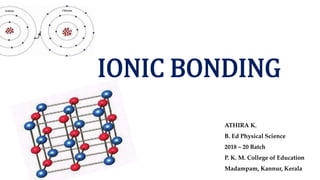
IONIC BONDING
ATHIRA K.
B. Ed Physical Science
2018 – 20 Batch
P. K. M. College of Education
Madampam, Kannur, Kerala
MATTER
Pure substance Mixtures
Element Compound
Atom Molecule Molecule
CHEMICAL
BONDING
Why CHEMICAL BONDING?
CHEMICAL BONDING
Ionic bond
Covalent
bond
Metallic
bond
Formed
by
Influenced
by
Represented by
between
Metal and non-
metal
Transfer of
electrons from
atoms
Electronegativity
Electron
dot
diagram
Leads to
Formation of
ions
Types of Chemical Bonding
IONIC BONDING
 Chemical bond between two oppositely charged ions formed when
one atom transfers electrons to another atom
 Between metal and non-metal
 Cations – ions formed by donating electron
 Anions - ions formed by gaining electron
 e.g., NaCl, MgCl, KCl etc.
Lewis electron dot diagram
• System of representation wherein dots are used to show
the number of valence electrons in ions and molecules
?
Sodium Chloride Formation
Before chemical reaction After chemical reaction
No. of electrons in the
sodium atom
11 10
Electronic configuration 2, 8, 1 2, 8
No. of electrons in the
valence shell
1 8
Charge 0 +1
For sodium atom
Before chemical reaction After chemical reaction
No. of electrons in the
chlorine atom
17 18
Electronic configuration 2, 8, 7 2, 8, 8
No. of electrons in the
valence shell
7 8
Charge 0 -1
For chlorine atom
Sodium chloride is formed
 by the electron transfer between sodium and chlorine atoms
 To attain octet configuration sodium atom loses one electron and become cation
having +1 charge.
 Chlorine atom gains one electron to attain stability and become anion with a
charge -1.
 Electrostatic force of attraction between these oppositely charged ions are called
ionic bond.
Ionic bonding

Ionic bonding

  • 1.
    IONIC BONDING ATHIRA K. B.Ed Physical Science 2018 – 20 Batch P. K. M. College of Education Madampam, Kannur, Kerala
  • 2.
    MATTER Pure substance Mixtures ElementCompound Atom Molecule Molecule CHEMICAL BONDING Why CHEMICAL BONDING?
  • 3.
    CHEMICAL BONDING Ionic bond Covalent bond Metallic bond Formed by Influenced by Representedby between Metal and non- metal Transfer of electrons from atoms Electronegativity Electron dot diagram Leads to Formation of ions Types of Chemical Bonding
  • 4.
    IONIC BONDING  Chemicalbond between two oppositely charged ions formed when one atom transfers electrons to another atom  Between metal and non-metal  Cations – ions formed by donating electron  Anions - ions formed by gaining electron  e.g., NaCl, MgCl, KCl etc.
  • 5.
    Lewis electron dotdiagram • System of representation wherein dots are used to show the number of valence electrons in ions and molecules ?
  • 6.
    Sodium Chloride Formation Beforechemical reaction After chemical reaction No. of electrons in the sodium atom 11 10 Electronic configuration 2, 8, 1 2, 8 No. of electrons in the valence shell 1 8 Charge 0 +1 For sodium atom
  • 7.
    Before chemical reactionAfter chemical reaction No. of electrons in the chlorine atom 17 18 Electronic configuration 2, 8, 7 2, 8, 8 No. of electrons in the valence shell 7 8 Charge 0 -1 For chlorine atom
  • 8.
    Sodium chloride isformed  by the electron transfer between sodium and chlorine atoms  To attain octet configuration sodium atom loses one electron and become cation having +1 charge.  Chlorine atom gains one electron to attain stability and become anion with a charge -1.  Electrostatic force of attraction between these oppositely charged ions are called ionic bond.