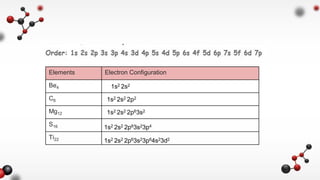
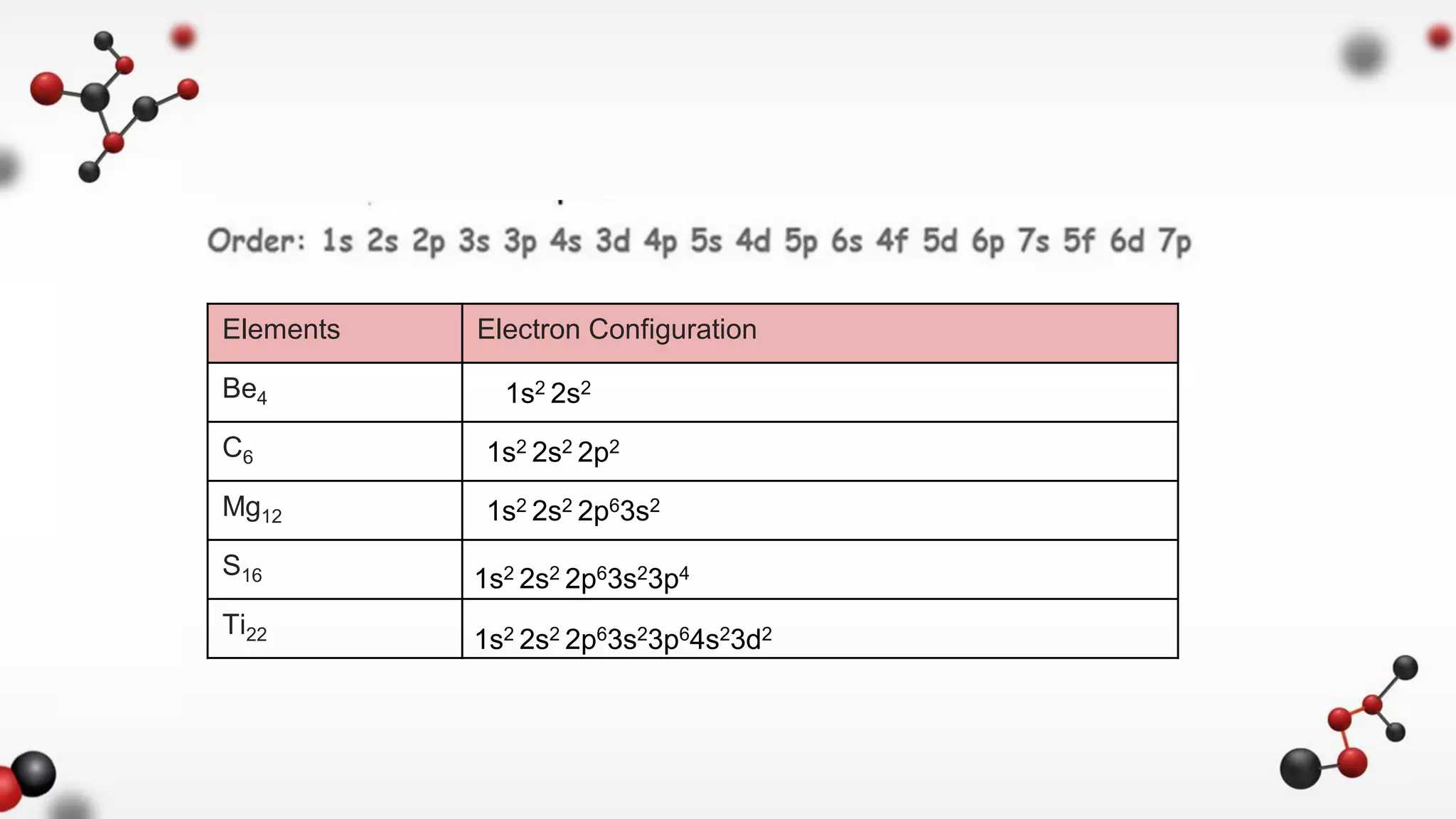
Elements Electron Configuration
Be4
C6
Mg12
S16
Ti22
1s2 2s2
1s2 2s2 2p2
1s2 2s2 2p63s2
1s2 2s2 2p63s23p4
1s2 2s2 2p63s23p64s23d2
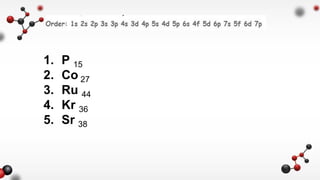
1. P 15
2. Co 27
3. Ru 44
4. Kr 36
5. Sr 38
CHEMICAL BONDING
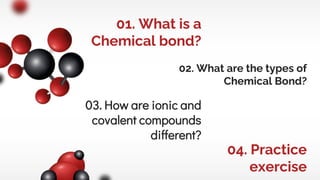
02. What are the types of
Chemical Bond?
03. How are ionic and
covalent compounds
different?
01. What is a
Chemical bond?
04. Practice
exercise
What is a chemical bond?
01. CHEMICAL BOND
CHEMICAL BOND
--- is a force that holds of two or more atoms together
and makes them function as a unit.
-- is the physical phenomenon of chemical substances
being held together by the attraction of atoms to each
other through sharing, as well as exchanging of
electrons or electrostatic force.
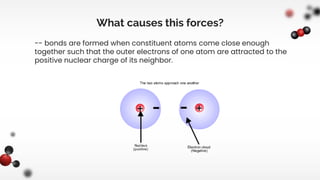
What causes this forces?
-- bonds are formed when constituent atoms come close enough
together such that the outer electrons of one atom are attracted to the
positive nuclear charge of its neighbor.
02. TYPES OF CHEMICAL BOND
What are the different types of
chemical bond and how are each
type formed?
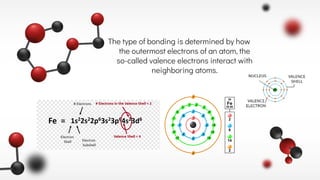
The type of bonding is determined by how
the outermost electrons of an atom, the
so-called valence electrons interact with
neighboring atoms.
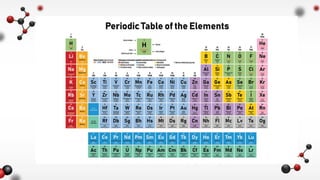
The position of an element in the
periodic table determines the
type of bonds it makes.
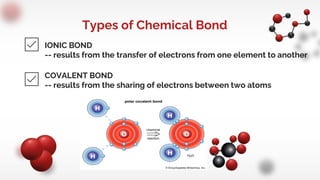
IONIC BOND
-- results from the transfer of electrons from one element to another
Types of Chemical Bond
COVALENT BOND
-- results from the sharing of electrons between two atoms
IONIC BOND
-- form between a metal and nonmetal.
Types of Chemical Bond
COVALENT BOND
-- formed when two nonmetals combine; also formed when a
metalloid bond to a nonmetal.
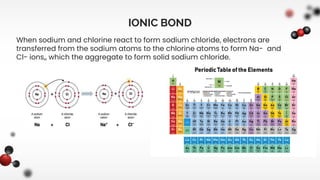
IONIC BOND
When sodium and chlorine react to form sodium chloride, electrons are
transferred from the sodium atoms to the chlorine atoms to form Na- and
Cl- ions,, which the aggregate to form solid sodium chloride.
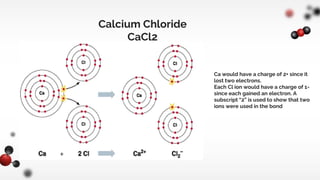
Calcium Chloride
CaCl2
Ca would have a charge of 2+ since it
lost two electrons.
Each Cl ion would have a charge of 1-
since each gained an electron. A
subscript “2” is used to show that two
ions were used in the bond
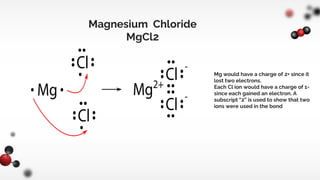
Magnesium Chloride
MgCl2
Mg would have a charge of 2+ since it
lost two electrons.
Each Cl ion would have a charge of 1-
since each gained an electron. A
subscript “2” is used to show that two
ions were used in the bond

Lesson 3 - chemical bonding

  • 1.
    Elements Electron Configuration Be4 C6 Mg12 S16 Ti22 1s22s2 1s2 2s2 2p2 1s2 2s2 2p63s2 1s2 2s2 2p63s23p4 1s2 2s2 2p63s23p64s23d2
  • 2.
    1. P 15 2.Co 27 3. Ru 44 4. Kr 36 5. Sr 38
  • 3.
  • 4.
    02. What arethe types of Chemical Bond? 03. How are ionic and covalent compounds different? 01. What is a Chemical bond? 04. Practice exercise
  • 5.
    What is achemical bond? 01. CHEMICAL BOND
  • 6.
    CHEMICAL BOND --- isa force that holds of two or more atoms together and makes them function as a unit. -- is the physical phenomenon of chemical substances being held together by the attraction of atoms to each other through sharing, as well as exchanging of electrons or electrostatic force.
  • 7.
    What causes thisforces? -- bonds are formed when constituent atoms come close enough together such that the outer electrons of one atom are attracted to the positive nuclear charge of its neighbor.
  • 8.
    02. TYPES OFCHEMICAL BOND What are the different types of chemical bond and how are each type formed?
  • 9.
    The type ofbonding is determined by how the outermost electrons of an atom, the so-called valence electrons interact with neighboring atoms.
  • 10.
    The position ofan element in the periodic table determines the type of bonds it makes.
  • 12.
    IONIC BOND -- resultsfrom the transfer of electrons from one element to another Types of Chemical Bond COVALENT BOND -- results from the sharing of electrons between two atoms
  • 13.
    IONIC BOND -- formbetween a metal and nonmetal. Types of Chemical Bond COVALENT BOND -- formed when two nonmetals combine; also formed when a metalloid bond to a nonmetal.
  • 14.
    IONIC BOND When sodiumand chlorine react to form sodium chloride, electrons are transferred from the sodium atoms to the chlorine atoms to form Na- and Cl- ions,, which the aggregate to form solid sodium chloride.
  • 15.
    Calcium Chloride CaCl2 Ca wouldhave a charge of 2+ since it lost two electrons. Each Cl ion would have a charge of 1- since each gained an electron. A subscript “2” is used to show that two ions were used in the bond
  • 16.
    Magnesium Chloride MgCl2 Mg wouldhave a charge of 2+ since it lost two electrons. Each Cl ion would have a charge of 1- since each gained an electron. A subscript “2” is used to show that two ions were used in the bond