Michaelis Menten kinetic characteristics
Syed Umar Farooq
M pharm ( Ph.D)
Asst Professor
Care College of Pharmacy
contents
• Introduction
• Michaelis Menten characteristics'
• Assumptions and limitation
• Derivation
• Applications
• References
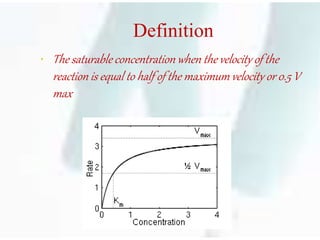
Definition
• The saturable concentration when the velocity of the
reaction is equal to half of the maximum velocity or 0.5 V
max
Nonlinear pharmacokinetics
• In some cases the rate process of drug depends on
carrier or enzyme that are substrate specific ,have
definite capacities and susceptible to saturation at
high concentration
• In such cases first order transforms in to mixture
of first order and zero order rate process and
pharmacokinetic parameters change with dose
• Pharmacokinetics of such drugs are said to be
dose-dependent, or mixed-order ,nonlinear and
capacity limited kinetics
Test to detect non linear
pharmacokinetics
• Determination of steady state plasma
concentration at different doses
• If steady state plasma concentration is directly
proportional to dose then linearity in kinetics exist.
• Determination of some of the important
pharmacokinetics parameter such as fractional bio
available, elimination half life or total systemic
clearance at different doses of drug any change in
these parameters indicate non linearity
Causes of non-linearity
• Occurs in Absorption
• When absorption involves carrier mediate
transport system eg. Absorption of
riboflavin, ascorbic acid
• When absorption is solubility or dissolution
rate limited e.g griseofulvin
• When pre systemic gut wall or hepatic
metabolism attains saturation
In drug distribution
• Non linearity in drug distribution of drugs
administered at high doses may be due to
• Saturation of binding sites on plasma
proteins e.g naproxen
• Saturation of tissue binding sites
• E,g thiopental and fentanyl
In metabolism
• Capacity limited metabolism due to enzyme and co factor
saturation
• E.g phenytoin alcohol
• Enzyme induction
• E.g carbamazepine
• In drug excretion
• Active tubular secretion e.g penciline g
• After saturation of carrier system a decrease in renal
claerence occur
• Active tubular re absorption e.g water soluble vitamins
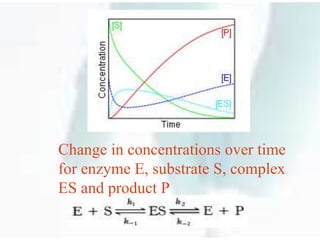
Change in concentrations over time
for enzyme E, substrate S, complex
ES and product P
…
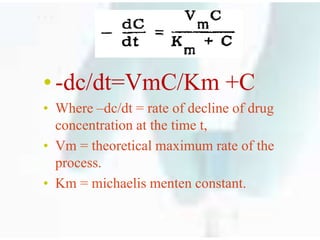
•-dc/dt=VmC/Km +C
• Where –dc/dt = rate of decline of drug
concentration at the time t,
• Vm = theoretical maximum rate of the
process.
• Km = michaelis menten constant.
characteristics
Three situation can be considered depending
up on values of Km and C
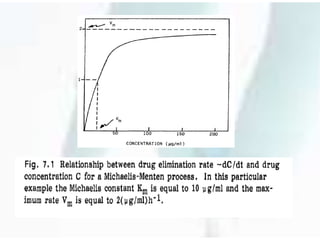
• When Km= C
• -dc/dt = Vmax/2
• i.e rate of process is equal to one half its
maximum rate
When Km = C
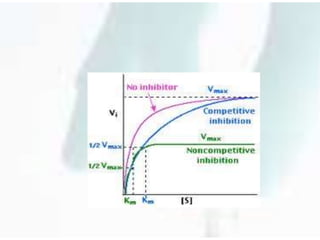
A plot of Michaelis Mentens
equation
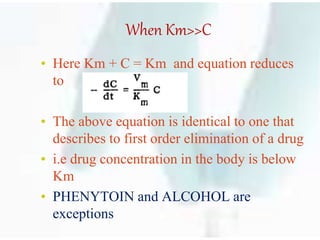
When Km>>C
• Here Km + C = Km and equation reduces
to
• The above equation is identical to one that
describes to first order elimination of a drug
• i.e drug concentration in the body is below
Km
• PHENYTOIN and ALCOHOL are
exceptions
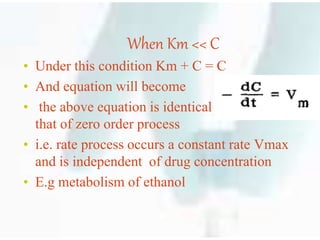
When Km << C
• Under this condition Km + C = C
• And equation will become
• the above equation is identical to
that of zero order process
• i.e. rate process occurs a constant rate Vmax
and is independent of drug concentration
• E.g metabolism of ethanol
Assumptions and limitations
• The first step in the derivation applies the
law of mass action, which is reliant on
free diffusion. However, in the environment
of a living cell where there is a high
concentration of protein, the cytoplasm
often behaves more like a gel than a liquid,
limiting molecular movements and altering
reaction rates
Equilibrium approximation
• In their original analysis, Michaelis and Menten assumed
that the substrate is in instantaneous chemical
equilibrium with the complex, and thus kf[E][S]
= kr[ES]. Combining this relationship with the enzyme
conservation law, the concentration of complex is
Contd…
• where Kd = kr / kf is the dissociation
constant for the enzyme-substrate complex.
Hence the velocity v of the reaction – the
rate at which P is formed – is
• where Vmax = kcat[E]0 is the maximum
reaction velocity.
Derivation
• Applying the law of mass action, which
states that the rate of a reaction is
proportional to the product of the
concentrations of the reactants, gives a
system of four non-linear ordinary
differential equations that define the rate of
change of reactants with time t
In this mechanism, the enzyme E is
a catalyst, which only facilitates the
reaction, so its total concentration, free
plus combined, [E] + [ES] = [E]0 is a
constant. This conservation law can also
be obtained by adding the second and
third equations above
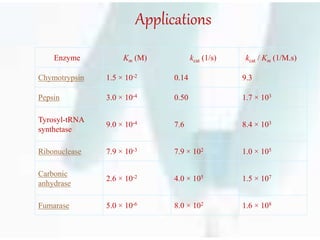
Applications
Enzyme Km (M) kcat (1/s) kcat / Km (1/M.s)
Chymotrypsin 1.5 × 10⁻² 0.14 9.3
Pepsin 3.0 × 10⁻⁴ 0.50 1.7 × 10³
Tyrosyl-tRNA
synthetase
9.0 × 10⁻⁴ 7.6 8.4 × 10³
Ribonuclease 7.9 × 10⁻³ 7.9 × 10² 1.0 × 10⁵
Carbonic
anhydrase
2.6 × 10⁻² 4.0 × 10⁵ 1.5 × 10⁷
Fumarase 5.0 × 10⁻⁶ 8.0 × 10² 1.6 × 10⁸
…
• The constant kcat / Km is a measure of
how efficiently an enzyme converts a
substrate into product. It has a
theoretical upper limit of 108 –
1010 /M.s; enzymes working close to
this, such as fumarase, are termed
superficies
Michaelis-Menten kinetics have also been applied to a variety
of spheres outside of biochemical reactions
• alveolar clearance of dusts
• the richness of species pools
• clearance of blood alcohol
• the photosynthesis-irradiance relationship
and bacterial phage infection
References
• Milo Gibaldi, pharmacokinetics second
edition, page no 271-278
• http://www.ncbi.nlm.nih.gov/books/NBK22
430/figure/A1052/?report=objectohttp://en.
• wikipedia.org/wiki/File:Michaelis-
Menten_saturation_curve_of_an_enzyme_r
eaction_LARGE.svgnly
Thank u………..

Michaelis menten kinetics Nonlinear Pharmacokinetics

  • 1.
    Michaelis Menten kineticcharacteristics Syed Umar Farooq M pharm ( Ph.D) Asst Professor Care College of Pharmacy
  • 2.
    contents • Introduction • MichaelisMenten characteristics' • Assumptions and limitation • Derivation • Applications • References
  • 3.
    Definition • The saturableconcentration when the velocity of the reaction is equal to half of the maximum velocity or 0.5 V max
  • 4.
    Nonlinear pharmacokinetics • Insome cases the rate process of drug depends on carrier or enzyme that are substrate specific ,have definite capacities and susceptible to saturation at high concentration • In such cases first order transforms in to mixture of first order and zero order rate process and pharmacokinetic parameters change with dose • Pharmacokinetics of such drugs are said to be dose-dependent, or mixed-order ,nonlinear and capacity limited kinetics
  • 5.
    Test to detectnon linear pharmacokinetics • Determination of steady state plasma concentration at different doses • If steady state plasma concentration is directly proportional to dose then linearity in kinetics exist. • Determination of some of the important pharmacokinetics parameter such as fractional bio available, elimination half life or total systemic clearance at different doses of drug any change in these parameters indicate non linearity
  • 6.
    Causes of non-linearity •Occurs in Absorption • When absorption involves carrier mediate transport system eg. Absorption of riboflavin, ascorbic acid • When absorption is solubility or dissolution rate limited e.g griseofulvin • When pre systemic gut wall or hepatic metabolism attains saturation
  • 7.
    In drug distribution •Non linearity in drug distribution of drugs administered at high doses may be due to • Saturation of binding sites on plasma proteins e.g naproxen • Saturation of tissue binding sites • E,g thiopental and fentanyl
  • 8.
    In metabolism • Capacitylimited metabolism due to enzyme and co factor saturation • E.g phenytoin alcohol • Enzyme induction • E.g carbamazepine • In drug excretion • Active tubular secretion e.g penciline g • After saturation of carrier system a decrease in renal claerence occur • Active tubular re absorption e.g water soluble vitamins
  • 9.
    Change in concentrationsover time for enzyme E, substrate S, complex ES and product P
  • 10.
    … •-dc/dt=VmC/Km +C • Where–dc/dt = rate of decline of drug concentration at the time t, • Vm = theoretical maximum rate of the process. • Km = michaelis menten constant.
  • 12.
    characteristics Three situation canbe considered depending up on values of Km and C • When Km= C • -dc/dt = Vmax/2 • i.e rate of process is equal to one half its maximum rate
  • 13.
    When Km =C A plot of Michaelis Mentens equation
  • 14.
    When Km>>C • HereKm + C = Km and equation reduces to • The above equation is identical to one that describes to first order elimination of a drug • i.e drug concentration in the body is below Km • PHENYTOIN and ALCOHOL are exceptions
  • 15.
    When Km <<C • Under this condition Km + C = C • And equation will become • the above equation is identical to that of zero order process • i.e. rate process occurs a constant rate Vmax and is independent of drug concentration • E.g metabolism of ethanol
  • 17.
    Assumptions and limitations •The first step in the derivation applies the law of mass action, which is reliant on free diffusion. However, in the environment of a living cell where there is a high concentration of protein, the cytoplasm often behaves more like a gel than a liquid, limiting molecular movements and altering reaction rates
  • 18.
    Equilibrium approximation • Intheir original analysis, Michaelis and Menten assumed that the substrate is in instantaneous chemical equilibrium with the complex, and thus kf[E][S] = kr[ES]. Combining this relationship with the enzyme conservation law, the concentration of complex is
  • 19.
    Contd… • where Kd= kr / kf is the dissociation constant for the enzyme-substrate complex. Hence the velocity v of the reaction – the rate at which P is formed – is • where Vmax = kcat[E]0 is the maximum reaction velocity.
  • 20.
    Derivation • Applying thelaw of mass action, which states that the rate of a reaction is proportional to the product of the concentrations of the reactants, gives a system of four non-linear ordinary differential equations that define the rate of change of reactants with time t
  • 21.
    In this mechanism,the enzyme E is a catalyst, which only facilitates the reaction, so its total concentration, free plus combined, [E] + [ES] = [E]0 is a constant. This conservation law can also be obtained by adding the second and third equations above
  • 22.
    Applications Enzyme Km (M)kcat (1/s) kcat / Km (1/M.s) Chymotrypsin 1.5 × 10⁻² 0.14 9.3 Pepsin 3.0 × 10⁻⁴ 0.50 1.7 × 10³ Tyrosyl-tRNA synthetase 9.0 × 10⁻⁴ 7.6 8.4 × 10³ Ribonuclease 7.9 × 10⁻³ 7.9 × 10² 1.0 × 10⁵ Carbonic anhydrase 2.6 × 10⁻² 4.0 × 10⁵ 1.5 × 10⁷ Fumarase 5.0 × 10⁻⁶ 8.0 × 10² 1.6 × 10⁸
  • 23.
    … • The constantkcat / Km is a measure of how efficiently an enzyme converts a substrate into product. It has a theoretical upper limit of 108 – 1010 /M.s; enzymes working close to this, such as fumarase, are termed superficies
  • 24.
    Michaelis-Menten kinetics havealso been applied to a variety of spheres outside of biochemical reactions • alveolar clearance of dusts • the richness of species pools • clearance of blood alcohol • the photosynthesis-irradiance relationship and bacterial phage infection
  • 25.
    References • Milo Gibaldi,pharmacokinetics second edition, page no 271-278 • http://www.ncbi.nlm.nih.gov/books/NBK22 430/figure/A1052/?report=objectohttp://en. • wikipedia.org/wiki/File:Michaelis- Menten_saturation_curve_of_an_enzyme_r eaction_LARGE.svgnly
  • 26.