PRESENTED BY,
M.GUNASEELAN
M.PHARM 2nd SEMESTER
DEPARTMENT OF PHARMACEUTICS
MADURAI MEDICAL COLLEGE
IN VITRO DISSOLUTION
TESTING
INTRODUCTION TO INVITRO DISSOLUTION TESTING
COMPENDIAL DISSOLUTION METHODS
REGULATORY STANDARDS OF DISSOLUTION
FACTORS AFFECTING DRUG DISSOLUTION
ALTERNATIVE METHODS OF DISSOLUTION
CONCLUSION AND FUTURE PERSPECTIVES
2
INTRODUCTION
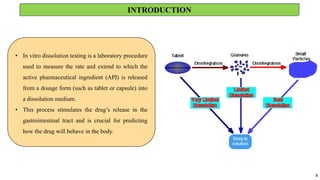
• In vitro dissolution testing is a laboratory procedure
used to measure the rate and extend to which the
active pharmaceutical ingredient (API) is released
from a dosage form (such as tablet or capsule) into
a dissolution medium.
• This process stimulates the drug’s release in the
gastrointestinal tract and is crucial for predicting
how the drug will behave in the body.
3
PURPOSE AND APPLICATION
4
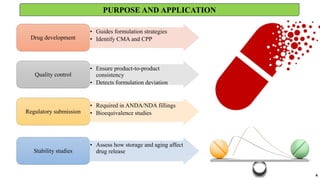
• Guides formulation strategies
• Identify CMA and CPP
Drug development
• Ensure product-to-product
consistency
• Detects formulation deviation
Quality control
• Required in ANDA/NDA fillings
• Bioequivalence studies
Regulatory submission
• Assess how storage and aging affect
drug release
Stability studies
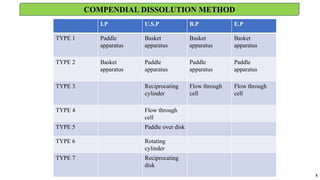
COMPENDIAL DISSOLUTION METHOD
5
I.P U.S.P B.P E.P
TYPE 1 Paddle
apparatus
Basket
apparatus
Basket
apparatus
Basket
apparatus
TYPE 2 Basket
apparatus
Paddle
apparatus
Paddle
apparatus
Paddle
apparatus
TYPE 3 Reciprocating
cylinder
Flow through
cell
Flow through
cell
TYPE 4 Flow through
cell
TYPE 5 Paddle over disk
TYPE 6 Rotating
cylinder
TYPE 7 Reciprocating
disk
6
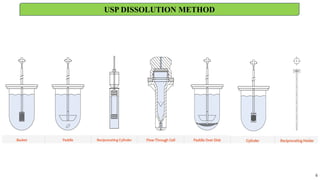
USP DISSOLUTION METHOD
7
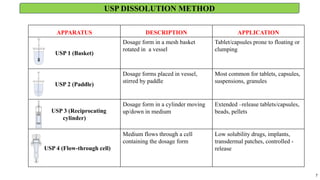
USP DISSOLUTION METHOD
APPARATUS DESCRIPTION APPLICATION
USP 1 (Basket)
Dosage form in a mesh basket
rotated in a vessel
Tablet/capsules prone to floating or
clumping
USP 2 (Paddle)
Dosage forms placed in vessel,
stirred by paddle
Most common for tablets, capsules,
suspensions, granules
USP 3 (Reciprocating
cylinder)
Dosage form in a cylinder moving
up/down in medium
Extended –release tablets/capsules,
beads, pellets
USP 4 (Flow-through cell)
Medium flows through a cell
containing the dosage form
Low solubility drugs, implants,
transdermal patches, controlled -
release
8
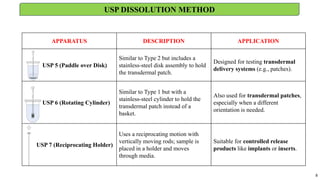
USP DISSOLUTION METHOD
APPARATUS DESCRIPTION APPLICATION
USP 5 (Paddle over Disk)
Similar to Type 2 but includes a
stainless-steel disk assembly to hold
the transdermal patch.
Designed for testing transdermal
delivery systems (e.g., patches).
USP 6 (Rotating Cylinder)
Similar to Type 1 but with a
stainless-steel cylinder to hold the
transdermal patch instead of a
basket.
Also used for transdermal patches,
especially when a different
orientation is needed.
USP 7 (Reciprocating Holder)
Uses a reciprocating motion with
vertically moving rods; sample is
placed in a holder and moves
through media.
Suitable for controlled release
products like implants or inserts.
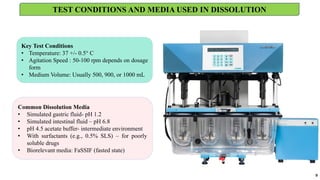
TEST CONDITIONS AND MEDIA USED IN DISSOLUTION
9
Key Test Conditions
• Temperature: 37 +/- 0.5° C
• Agitation Speed : 50-100 rpm depends on dosage
form
• Medium Volume: Usually 500, 900, or 1000 mL
Common Dissolution Media
• Simulated gastric fluid- pH 1.2
• Simulated intestinal fluid – pH 6.8
• pH 4.5 acetate buffer- intermediate environment
• With surfactants (e.g., 0.5% SLS) – for poorly
soluble drugs
• Biorelevant media: FaSSIF (fasted state)
REGULATORY STANDARDS
10
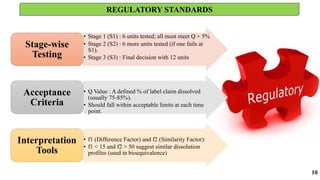
• Stage 1 (S1) : 6 units tested; all must meet Q + 5%
• Stage 2 (S2) : 6 more units tested (if one fails at
S1).
• Stage 3 (S3) : Final decision with 12 units
Stage-wise
Testing
• Q Value : A defined % of label claim dissolved
(usually 75-85%).
• Should fall within acceptable limits at each time
point.
Acceptance
Criteria
• f1 (Difference Factor) and f2 (Similarity Factor):
• f1 < 15 and f2 > 50 suggest similar dissolution
profiles (used in bioequivalence)
Interpretation
Tools
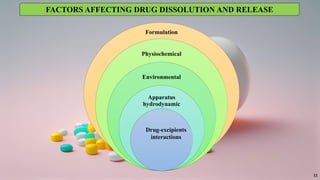
FACTORS AFFECTING DRUG DISSOLUTION AND RELEASE
11
Physiochemical
Environmental
Apparatus
hydrodynamic
Formulation
Drug-excipients
interactions
12
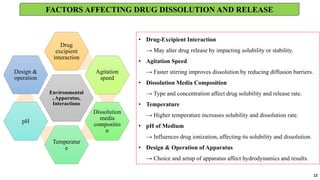
Environmental
, Apparatus,
Interactions
Drug
excipient
interaction
Agitation
speed
Dissolution
media
compositio
n
Temperatur
e
pH
Design &
operation
• Drug-Excipient Interaction
→ May alter drug release by impacting solubility or stability.
• Agitation Speed
→ Faster stirring improves dissolution by reducing diffusion barriers.
• Dissolution Media Composition
→ Type and concentration affect drug solubility and release rate.
• Temperature
→ Higher temperature increases solubility and dissolution rate.
• pH of Medium
→ Influences drug ionization, affecting its solubility and dissolution.
• Design & Operation of Apparatus
→ Choice and setup of apparatus affect hydrodynamics and results.
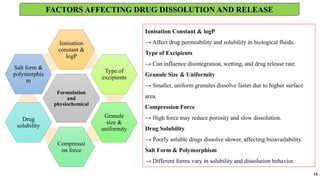
FACTORS AFFECTING DRUG DISSOLUTION AND RELEASE
13
Formulation
and
physiochemical
Ionisation
constant &
logP
Type of
excipients
Granule
size &
uniformity
Compresssi
on force
Drug
solubility
Salt form &
polymorphis
m
Ionisation Constant & logP
→ Affect drug permeability and solubility in biological fluids.
Type of Excipients
→ Can influence disintegration, wetting, and drug release rate.
Granule Size & Uniformity
→ Smaller, uniform granules dissolve faster due to higher surface
area.
Compression Force
→ High force may reduce porosity and slow dissolution.
Drug Solubility
→ Poorly soluble drugs dissolve slower, affecting bioavailability.
Salt Form & Polymorphism
→ Different forms vary in solubility and dissolution behavior.
FACTORS AFFECTING DRUG DISSOLUTION AND RELEASE
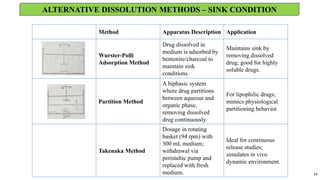
Method Apparatus Description Application
Wurster-Polli
Adsorption Method
Drug dissolved in
medium is adsorbed by
bentonite/charcoal to
maintain sink
conditions.
Maintains sink by
removing dissolved
drug; good for highly
soluble drugs.
Partition Method
A biphasic system
where drug partitions
between aqueous and
organic phase,
removing dissolved
drug continuously.
For lipophilic drugs;
mimics physiological
partitioning behavior.
Takenaka Method
Dosage in rotating
basket (94 rpm) with
300 mL medium;
withdrawal via
peristaltic pump and
replaced with fresh
medium.
Ideal for continuous
release studies;
simulates in vivo
dynamic environment.
14
ALTERNATIVE DISSOLUTION METHODS – SINK CONDITION
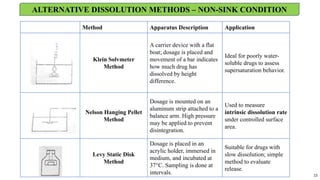
15
Method Apparatus Description Application
Klein Solvmeter
Method
A carrier device with a flat
boat; dosage is placed and
movement of a bar indicates
how much drug has
dissolved by height
difference.
Ideal for poorly water-
soluble drugs to assess
supersaturation behavior.
Nelson Hanging Pellet
Method
Dosage is mounted on an
aluminum strip attached to a
balance arm. High pressure
may be applied to prevent
disintegration.
Used to measure
intrinsic dissolution rate
under controlled surface
area.
Levy Static Disk
Method
Dosage is placed in an
acrylic holder, immersed in
medium, and incubated at
37°C. Sampling is done at
intervals.
Suitable for drugs with
slow dissolution; simple
method to evaluate
release.
ALTERNATIVE DISSOLUTION METHODS – NON-SINK CONDITION
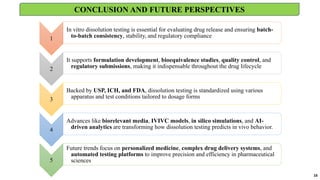
CONCLUSION AND FUTURE PERSPECTIVES
16
1
In vitro dissolution testing is essential for evaluating drug release and ensuring batch-
to-batch consistency, stability, and regulatory compliance
2
It supports formulation development, bioequivalence studies, quality control, and
regulatory submissions, making it indispensable throughout the drug lifecycle
3
Backed by USP, ICH, and FDA, dissolution testing is standardized using various
apparatus and test conditions tailored to dosage forms
4
Advances like biorelevant media, IVIVC models, in silico simulations, and AI-
driven analytics are transforming how dissolution testing predicts in vivo behavior.
5
Future trends focus on personalized medicine, complex drug delivery systems, and
automated testing platforms to improve precision and efficiency in pharmaceutical
sciences
17
• United States Pharmacopeial Convention. (2023). United States Pharmacopeia and National Formulary (USP
46–NF 41). United States Pharmacopeial Convention.
• Food and Drug Administration. (1997). Guidance for industry: Dissolution testing of immediate release solid oral
dosage forms. U.S. Department of Health and Human Services. https://www.fda.gov/media/70936/download
• Dressman, J. B., & Reppas, C. (2000). In vitro–in vivo correlations for lipophilic, poorly water-soluble drugs.
European Journal of Pharmaceutical Sciences, 11, S73–S80. https://doi.org/10.1016/S0928-0987(00)00153-X
• Klein, S. (2010). The use of biorelevant dissolution media to forecast the in vivo performance of a drug. The
AAPS Journal, 12(3), 397–406. https://doi.org/10.1208/s12248-010-9203-3
• Lu, Y., & Park, K. (2013). Polymeric micelles and alternative nanonized delivery vehicles for poorly soluble
drugs. International Journal of Pharmaceutics, 453(1), 198–214. https://doi.org/10.1016/j.ijpharm.2012.05.066
• Shah, V. P., Tsong, Y., Sathe, P., & Liu, J. P. (1998). In vitro dissolution profile comparison—statistics and
analysis of the similarity factor, f2. Pharmaceutical Research, 15(6), 889–896.
https://doi.org/10.1023/A:1011976615750
IN VITRO DISSOLUTION TESTING CEUTICS.pdf

IN VITRO DISSOLUTION TESTING CEUTICS.pdf

  • 1.
    PRESENTED BY, M.GUNASEELAN M.PHARM 2ndSEMESTER DEPARTMENT OF PHARMACEUTICS MADURAI MEDICAL COLLEGE IN VITRO DISSOLUTION TESTING
  • 2.
    INTRODUCTION TO INVITRODISSOLUTION TESTING COMPENDIAL DISSOLUTION METHODS REGULATORY STANDARDS OF DISSOLUTION FACTORS AFFECTING DRUG DISSOLUTION ALTERNATIVE METHODS OF DISSOLUTION CONCLUSION AND FUTURE PERSPECTIVES 2
  • 3.
    INTRODUCTION • In vitrodissolution testing is a laboratory procedure used to measure the rate and extend to which the active pharmaceutical ingredient (API) is released from a dosage form (such as tablet or capsule) into a dissolution medium. • This process stimulates the drug’s release in the gastrointestinal tract and is crucial for predicting how the drug will behave in the body. 3
  • 4.
    PURPOSE AND APPLICATION 4 •Guides formulation strategies • Identify CMA and CPP Drug development • Ensure product-to-product consistency • Detects formulation deviation Quality control • Required in ANDA/NDA fillings • Bioequivalence studies Regulatory submission • Assess how storage and aging affect drug release Stability studies
  • 5.
    COMPENDIAL DISSOLUTION METHOD 5 I.PU.S.P B.P E.P TYPE 1 Paddle apparatus Basket apparatus Basket apparatus Basket apparatus TYPE 2 Basket apparatus Paddle apparatus Paddle apparatus Paddle apparatus TYPE 3 Reciprocating cylinder Flow through cell Flow through cell TYPE 4 Flow through cell TYPE 5 Paddle over disk TYPE 6 Rotating cylinder TYPE 7 Reciprocating disk
  • 6.
  • 7.
    7 USP DISSOLUTION METHOD APPARATUSDESCRIPTION APPLICATION USP 1 (Basket) Dosage form in a mesh basket rotated in a vessel Tablet/capsules prone to floating or clumping USP 2 (Paddle) Dosage forms placed in vessel, stirred by paddle Most common for tablets, capsules, suspensions, granules USP 3 (Reciprocating cylinder) Dosage form in a cylinder moving up/down in medium Extended –release tablets/capsules, beads, pellets USP 4 (Flow-through cell) Medium flows through a cell containing the dosage form Low solubility drugs, implants, transdermal patches, controlled - release
  • 8.
    8 USP DISSOLUTION METHOD APPARATUSDESCRIPTION APPLICATION USP 5 (Paddle over Disk) Similar to Type 2 but includes a stainless-steel disk assembly to hold the transdermal patch. Designed for testing transdermal delivery systems (e.g., patches). USP 6 (Rotating Cylinder) Similar to Type 1 but with a stainless-steel cylinder to hold the transdermal patch instead of a basket. Also used for transdermal patches, especially when a different orientation is needed. USP 7 (Reciprocating Holder) Uses a reciprocating motion with vertically moving rods; sample is placed in a holder and moves through media. Suitable for controlled release products like implants or inserts.
  • 9.
    TEST CONDITIONS ANDMEDIA USED IN DISSOLUTION 9 Key Test Conditions • Temperature: 37 +/- 0.5° C • Agitation Speed : 50-100 rpm depends on dosage form • Medium Volume: Usually 500, 900, or 1000 mL Common Dissolution Media • Simulated gastric fluid- pH 1.2 • Simulated intestinal fluid – pH 6.8 • pH 4.5 acetate buffer- intermediate environment • With surfactants (e.g., 0.5% SLS) – for poorly soluble drugs • Biorelevant media: FaSSIF (fasted state)
  • 10.
    REGULATORY STANDARDS 10 • Stage1 (S1) : 6 units tested; all must meet Q + 5% • Stage 2 (S2) : 6 more units tested (if one fails at S1). • Stage 3 (S3) : Final decision with 12 units Stage-wise Testing • Q Value : A defined % of label claim dissolved (usually 75-85%). • Should fall within acceptable limits at each time point. Acceptance Criteria • f1 (Difference Factor) and f2 (Similarity Factor): • f1 < 15 and f2 > 50 suggest similar dissolution profiles (used in bioequivalence) Interpretation Tools
  • 11.
    FACTORS AFFECTING DRUGDISSOLUTION AND RELEASE 11 Physiochemical Environmental Apparatus hydrodynamic Formulation Drug-excipients interactions
  • 12.
    12 Environmental , Apparatus, Interactions Drug excipient interaction Agitation speed Dissolution media compositio n Temperatur e pH Design & operation •Drug-Excipient Interaction → May alter drug release by impacting solubility or stability. • Agitation Speed → Faster stirring improves dissolution by reducing diffusion barriers. • Dissolution Media Composition → Type and concentration affect drug solubility and release rate. • Temperature → Higher temperature increases solubility and dissolution rate. • pH of Medium → Influences drug ionization, affecting its solubility and dissolution. • Design & Operation of Apparatus → Choice and setup of apparatus affect hydrodynamics and results. FACTORS AFFECTING DRUG DISSOLUTION AND RELEASE
  • 13.
    13 Formulation and physiochemical Ionisation constant & logP Type of excipients Granule size& uniformity Compresssi on force Drug solubility Salt form & polymorphis m Ionisation Constant & logP → Affect drug permeability and solubility in biological fluids. Type of Excipients → Can influence disintegration, wetting, and drug release rate. Granule Size & Uniformity → Smaller, uniform granules dissolve faster due to higher surface area. Compression Force → High force may reduce porosity and slow dissolution. Drug Solubility → Poorly soluble drugs dissolve slower, affecting bioavailability. Salt Form & Polymorphism → Different forms vary in solubility and dissolution behavior. FACTORS AFFECTING DRUG DISSOLUTION AND RELEASE
  • 14.
    Method Apparatus DescriptionApplication Wurster-Polli Adsorption Method Drug dissolved in medium is adsorbed by bentonite/charcoal to maintain sink conditions. Maintains sink by removing dissolved drug; good for highly soluble drugs. Partition Method A biphasic system where drug partitions between aqueous and organic phase, removing dissolved drug continuously. For lipophilic drugs; mimics physiological partitioning behavior. Takenaka Method Dosage in rotating basket (94 rpm) with 300 mL medium; withdrawal via peristaltic pump and replaced with fresh medium. Ideal for continuous release studies; simulates in vivo dynamic environment. 14 ALTERNATIVE DISSOLUTION METHODS – SINK CONDITION
  • 15.
    15 Method Apparatus DescriptionApplication Klein Solvmeter Method A carrier device with a flat boat; dosage is placed and movement of a bar indicates how much drug has dissolved by height difference. Ideal for poorly water- soluble drugs to assess supersaturation behavior. Nelson Hanging Pellet Method Dosage is mounted on an aluminum strip attached to a balance arm. High pressure may be applied to prevent disintegration. Used to measure intrinsic dissolution rate under controlled surface area. Levy Static Disk Method Dosage is placed in an acrylic holder, immersed in medium, and incubated at 37°C. Sampling is done at intervals. Suitable for drugs with slow dissolution; simple method to evaluate release. ALTERNATIVE DISSOLUTION METHODS – NON-SINK CONDITION
  • 16.
    CONCLUSION AND FUTUREPERSPECTIVES 16 1 In vitro dissolution testing is essential for evaluating drug release and ensuring batch- to-batch consistency, stability, and regulatory compliance 2 It supports formulation development, bioequivalence studies, quality control, and regulatory submissions, making it indispensable throughout the drug lifecycle 3 Backed by USP, ICH, and FDA, dissolution testing is standardized using various apparatus and test conditions tailored to dosage forms 4 Advances like biorelevant media, IVIVC models, in silico simulations, and AI- driven analytics are transforming how dissolution testing predicts in vivo behavior. 5 Future trends focus on personalized medicine, complex drug delivery systems, and automated testing platforms to improve precision and efficiency in pharmaceutical sciences
  • 17.
    17 • United StatesPharmacopeial Convention. (2023). United States Pharmacopeia and National Formulary (USP 46–NF 41). United States Pharmacopeial Convention. • Food and Drug Administration. (1997). Guidance for industry: Dissolution testing of immediate release solid oral dosage forms. U.S. Department of Health and Human Services. https://www.fda.gov/media/70936/download • Dressman, J. B., & Reppas, C. (2000). In vitro–in vivo correlations for lipophilic, poorly water-soluble drugs. European Journal of Pharmaceutical Sciences, 11, S73–S80. https://doi.org/10.1016/S0928-0987(00)00153-X • Klein, S. (2010). The use of biorelevant dissolution media to forecast the in vivo performance of a drug. The AAPS Journal, 12(3), 397–406. https://doi.org/10.1208/s12248-010-9203-3 • Lu, Y., & Park, K. (2013). Polymeric micelles and alternative nanonized delivery vehicles for poorly soluble drugs. International Journal of Pharmaceutics, 453(1), 198–214. https://doi.org/10.1016/j.ijpharm.2012.05.066 • Shah, V. P., Tsong, Y., Sathe, P., & Liu, J. P. (1998). In vitro dissolution profile comparison—statistics and analysis of the similarity factor, f2. Pharmaceutical Research, 15(6), 889–896. https://doi.org/10.1023/A:1011976615750