INVERSE LAPLACE
COMPLEX ROOTS
PREPARE BY TURKI NOUR
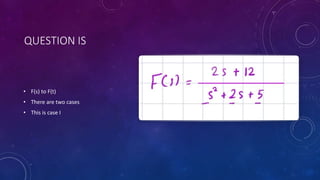
QUESTION IS
• F(s) to F(t)
• There are two cases
• This is case I
WE ARE LOOKING
AT DENOMINATOR
• And find the Coefficient numbers
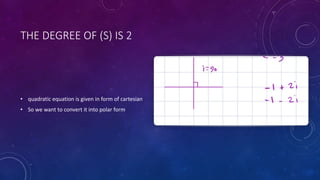
THE DEGREE OF (S) IS 2
• quadratic equation is given in form of cartesian
• So we want to convert it into polar form
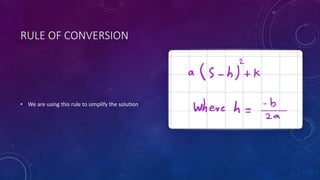
RULE OF CONVERSION
• We are using this rule to simplify the solution
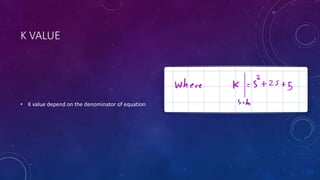
K VALUE
• K value depend on the denominator of equation
IMPLEMENT OF
VALUES
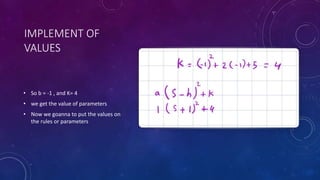
• So b = -1 , and K= 4
• we get the value of parameters
• Now we goanna to put the values on
the rules or parameters
REPLACE
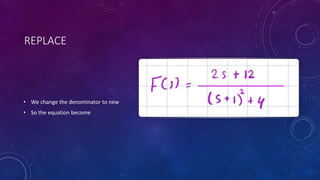
• We change the denominator to new
• So the equation become
WHY IT IS COMPLEX?
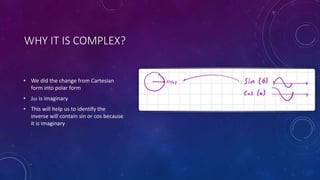
• We did the change from Cartesian
form into polar form
• J𝜔 is imaginary
• This will help us to identify the
inverse will contain sin or cos because
it is imaginary
COS AND SIN
• NOTE b is not from the equation just to
linkage with Laplace table to be more clarify
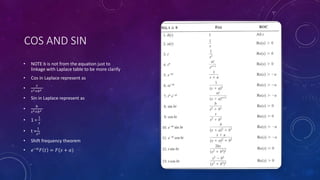
• Cos in Laplace represent as
•
𝑠
𝑠2+𝑏2
• Sin in Laplace represent as
•
𝑏
𝑠2+𝑏2
• 1 =
1
𝑠
• t =
1
𝑠2
• Shift frequency theorem
• 𝑒−𝑎
𝐹 𝑡 = 𝐹(𝑠 + 𝑎)
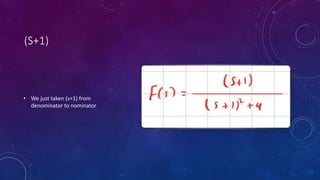
(S+1)
• We just taken (s+1) from
denominator to nominator
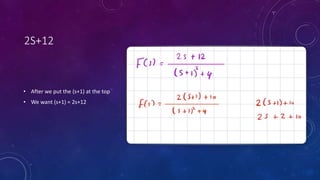
2S+12
• After we put the (s+1) at the top
• We want (s+1) = 2s+12
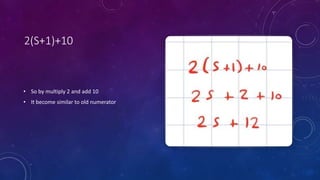
2(S+1)+10
• So by multiply 2 and add 10
• It become similar to old numerator
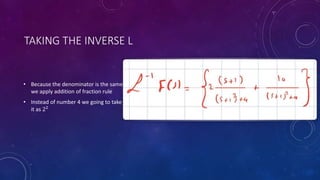
TAKING THE INVERSE L
• Because the denominator is the same
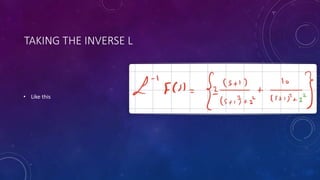
we apply addition of fraction rule
• Instead of number 4 we going to take
it as 22
TAKING THE INVERSE L
• Like this
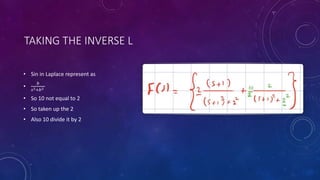
TAKING THE INVERSE L
• Sin in Laplace represent as
•
𝑏
𝑠2+𝑏2
• So 10 not equal to 2
• So taken up the 2
• Also 10 divide it by 2
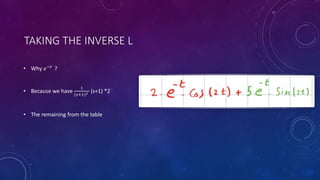
TAKING THE INVERSE L
• Why 𝑒−𝑡
?
• Because we have
1
(𝑠+1)2 (s+1) *2
• The remaining from the table

inverse laplace complex roots

  • 1.
  • 2.
    QUESTION IS • F(s)to F(t) • There are two cases • This is case I
  • 3.
    WE ARE LOOKING ATDENOMINATOR • And find the Coefficient numbers
  • 4.
    THE DEGREE OF(S) IS 2 • quadratic equation is given in form of cartesian • So we want to convert it into polar form
  • 5.
    RULE OF CONVERSION •We are using this rule to simplify the solution
  • 6.
    K VALUE • Kvalue depend on the denominator of equation
  • 7.
    IMPLEMENT OF VALUES • Sob = -1 , and K= 4 • we get the value of parameters • Now we goanna to put the values on the rules or parameters
  • 8.
    REPLACE • We changethe denominator to new • So the equation become
  • 9.
    WHY IT ISCOMPLEX? • We did the change from Cartesian form into polar form • J𝜔 is imaginary • This will help us to identify the inverse will contain sin or cos because it is imaginary
  • 10.
    COS AND SIN •NOTE b is not from the equation just to linkage with Laplace table to be more clarify • Cos in Laplace represent as • 𝑠 𝑠2+𝑏2 • Sin in Laplace represent as • 𝑏 𝑠2+𝑏2 • 1 = 1 𝑠 • t = 1 𝑠2 • Shift frequency theorem • 𝑒−𝑎 𝐹 𝑡 = 𝐹(𝑠 + 𝑎)
  • 11.
    (S+1) • We justtaken (s+1) from denominator to nominator
  • 12.
    2S+12 • After weput the (s+1) at the top • We want (s+1) = 2s+12
  • 13.
    2(S+1)+10 • So bymultiply 2 and add 10 • It become similar to old numerator
  • 14.
    TAKING THE INVERSEL • Because the denominator is the same we apply addition of fraction rule • Instead of number 4 we going to take it as 22
  • 15.
    TAKING THE INVERSEL • Like this
  • 16.
    TAKING THE INVERSEL • Sin in Laplace represent as • 𝑏 𝑠2+𝑏2 • So 10 not equal to 2 • So taken up the 2 • Also 10 divide it by 2
  • 17.
    TAKING THE INVERSEL • Why 𝑒−𝑡 ? • Because we have 1 (𝑠+1)2 (s+1) *2 • The remaining from the table