MATERIAL MANAGEMENT
IN NURSING
SAHELI C
LECTURER
IACN
WHAT IS INVENTORY
 Inventories are the idle resources maintained in various forms:
 Raw materials
 Purchased and manufactured parts
 Subassemblies( work in progress inventories)
 Finished products
 It is the stock to ensure uninterrupted supplies, the idle resources
which have future economic value and cushion between estimated
and actual demand of materials.
Inventory is ‘anything that is brought and held prior to use.
IMPORTANCE
Provides and maintains good customers service
Enables smooth flow of materials
Provides protection against the uncertainty of demand
and supply
Ensures a reasonable utilization of equipment and effort
INVENTORY CONTROL
 Inventory control is about product availability and
balancing the costs of ownership with the costs of
procuring, which includes purchasing, receiving and
paying (Dave Kaczmarek)
OBJECTIVES
To supply the materials in time
To give maximum clients service
To reduce or minimize investment in inventories
To minimize idle time
To avoid shortage of stock
To minimize the losses
To meet unforeseen future demand
To average out demand fluctuations
To balance various inventory costs
IMPORTANCE OF INVENTORY CONTROL
To provide maximum supply service, consistent with maximum
efficiency & optimum investment
To provide cushion between forecasted & actual demand for a
material
To have optimum level of inventory: not too large, not small.
To eliminate duplication in ordering
To take care of fluctuations in demand and lead time
To take care of increasing price tendency of commodities or
rebate in bulk buying
To minimize the inventory costs
To minimizing waiting time
To provide a check against the loss of material
To better utilization of stocks available
To facilitate cost accounting activities
To locate and disposes inactive and obsolete
store items.
METHODS OF INVENTORY CONTROL
A) Use of two bin method:
 This method separates the entire stock of each item into two bins or boxes.
One box contains the main stock and second box contains the enough stock to
satisfy the demand during lead time.
B) Maintenance of buffer stock :
This is the amount of the stock that should be kept in reserve to avoid a stock
exhaustion in case consumption increases unexpectedly.
C) Lead time:
Lead time refers to the interval between the time; when the order placed of an
item and the actual time when the items have been replenished.
This is the period required to obtain the supply once the need is determined.
TOOL USED FOR INVENTORY CONTROL
ABC Analysis (Always Better Control)
VED Analysis (Vital, Essential, Desirable)
FSN Analysis (Fast, Slow moving and Non-moving)
XYZ Analysis
ABC ANALYSIS
• The word ABC stands for ‘Always Better Control’.
•It is one of the key management tools to control the
materials
•Use of ABC analysis are:
Store keeping.
To find out obsolete item.
For receipt of material.
To decide critically of the item.
Inspection and verification
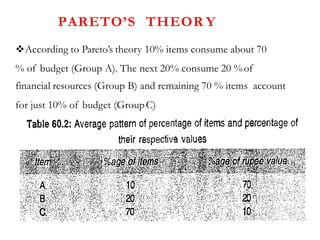
PARETO’S THEOR Y
According to Pareto’s theory 10% items consume about 70
% of budget (Group A). The next 20% consume 20 %of
financial resources (Group B) and remaining 70 % items account
for just 10% of budget (GroupC)
‘A’ Items
 small in number
 consume large amount of resources
managed by top management.
 tight control, rigid estimate of requirements, strict
& closer
watch
require low safety stocks.
consume major portions of funds.
‘B’ Items
moderate control.
purchased based on rigid requirements
strict watch and control.
management is done by middle level
managers.
‘C’ Items
larger in number
consume lesser amount of resources
ordinary control measures.
purchase is based on usage estimates
require high safety stocks.
PROCEDURAL STEPS
Collect all the data of inventory and prepare a list of all the items of stores
indicating the unit price of each item and annual consumption
Calculate their annual usage in Rs. (Annual consumption in units x unit costs
in Rs. = annual consumption value).
 For stores, it will be Quantity issued x unit rate of each item
Arrange all these items in the descending order of total value of annual
consumption of each item in rupees
Mention the item numbers against their annual consumption
Calculate cumulative annual consumption value
Calculate cumulative annual consumption value percentage
Categorize items as per the consumption value (cost) percentage.
ADVANTA GES
Investment in inventory can be maintained
Easy to control the wastage of costlyitems
Helps in maintaining safety to the total cost
Easy to maintain stock and turnover rate
Helps to exercise selective control
Rationalizes the number of orders, number of items & reduce the
inventory
Shows visible results in a short span of time
manger is able to control the inventories specially controlling ‘A’ items.
Helps in reducing clerical cost.
DISADVANTAGES
Proper standardization and codification of
inventory items is required
Considers only the money value not the
importance of items for functioning
Periodic reviews becomes difficult if only ABC
analysis is recalled
VED ANALYSIS
Vital, Essential and Desirable
materials are classified based on criticality
‘V’ is for vital items without which a hospital cannot
function
‘E’ for essential items without which an institution can
function but may affect the quality of theservices
‘D’ stands for desirable items, unavailability of which will
not interfere with functioning because they can be easily
purchased as and when required
ADVANTAGES
useful for monitoring and control of stores and spares
inventory by classifying them into 3 categories viz., Vital,
Essential and Desirable.
Determine the criticality of an item and its effect on
production and other services.
It is specially used for classification of spare parts/items.
It is useful in controlling and maintaining the stock of
varioustypes.
FSN ANALYSIS
‘Fast moving, Slow moving, and Non-moving’
based on the consumption pattern of theitems
Method
Date of receipt or last date of issue whichever is later, is taken to
determine the number of months which has lapsed since the last
transaction. The items are usually grouped in periods of 12
months. Non-moving items must be periodically reviewed to
prevent expiry.
ANALYSIS
For analysis, the issuing of items in past two or three years
are considered
If there is no issuing of item during that period, it is
labeled ‘N’ item
Then up to certain limit say 10-15 issues in that period,
the item is ‘S’ Item
The items exceeding such limits of numbers of issues
during that period is ‘F’ Item
ADVANTA GES
Helps to avoid investment in non-moving
or slow items
Facilitates timely control
Useful in controlling obsolescence.
ROLE OF NURSE MANAGER
Ensuring regular and adequate flow of supply
Monitoring quality and safety of the materials
Indenting, receiving ,storing , checking for all necessary
equipment
and supply
Maintaining of emergency stocks
Arranging and assisting in audit
Participation in policy making for material management
Evaluating the efficacy of the material managementsystem
followed in particular nursing unit.
Make sure that all the personnel in the ward should be
clearly know who may use ward articles and equipments and
who assumes responsibility for it.
The head nurse must be vigilant and prevent waste or
misuse by educating the staff in the economical and
appropriate use of all equipments and materials
Inventory   copy

Inventory copy

  • 1.
  • 2.
    WHAT IS INVENTORY Inventories are the idle resources maintained in various forms:  Raw materials  Purchased and manufactured parts  Subassemblies( work in progress inventories)  Finished products  It is the stock to ensure uninterrupted supplies, the idle resources which have future economic value and cushion between estimated and actual demand of materials. Inventory is ‘anything that is brought and held prior to use.
  • 3.
    IMPORTANCE Provides and maintainsgood customers service Enables smooth flow of materials Provides protection against the uncertainty of demand and supply Ensures a reasonable utilization of equipment and effort
  • 4.
    INVENTORY CONTROL  Inventorycontrol is about product availability and balancing the costs of ownership with the costs of procuring, which includes purchasing, receiving and paying (Dave Kaczmarek)
  • 5.
    OBJECTIVES To supply thematerials in time To give maximum clients service To reduce or minimize investment in inventories To minimize idle time To avoid shortage of stock To minimize the losses To meet unforeseen future demand To average out demand fluctuations To balance various inventory costs
  • 6.
    IMPORTANCE OF INVENTORYCONTROL To provide maximum supply service, consistent with maximum efficiency & optimum investment To provide cushion between forecasted & actual demand for a material To have optimum level of inventory: not too large, not small. To eliminate duplication in ordering To take care of fluctuations in demand and lead time To take care of increasing price tendency of commodities or rebate in bulk buying
  • 7.
    To minimize theinventory costs To minimizing waiting time To provide a check against the loss of material To better utilization of stocks available To facilitate cost accounting activities To locate and disposes inactive and obsolete store items.
  • 8.
    METHODS OF INVENTORYCONTROL A) Use of two bin method:  This method separates the entire stock of each item into two bins or boxes. One box contains the main stock and second box contains the enough stock to satisfy the demand during lead time. B) Maintenance of buffer stock : This is the amount of the stock that should be kept in reserve to avoid a stock exhaustion in case consumption increases unexpectedly. C) Lead time: Lead time refers to the interval between the time; when the order placed of an item and the actual time when the items have been replenished. This is the period required to obtain the supply once the need is determined.
  • 9.
    TOOL USED FORINVENTORY CONTROL ABC Analysis (Always Better Control) VED Analysis (Vital, Essential, Desirable) FSN Analysis (Fast, Slow moving and Non-moving) XYZ Analysis
  • 10.
    ABC ANALYSIS • Theword ABC stands for ‘Always Better Control’. •It is one of the key management tools to control the materials •Use of ABC analysis are: Store keeping. To find out obsolete item. For receipt of material. To decide critically of the item. Inspection and verification
  • 11.
    PARETO’S THEOR Y Accordingto Pareto’s theory 10% items consume about 70 % of budget (Group A). The next 20% consume 20 %of financial resources (Group B) and remaining 70 % items account for just 10% of budget (GroupC)
  • 12.
    ‘A’ Items  smallin number  consume large amount of resources managed by top management.  tight control, rigid estimate of requirements, strict & closer watch require low safety stocks. consume major portions of funds.
  • 13.
    ‘B’ Items moderate control. purchasedbased on rigid requirements strict watch and control. management is done by middle level managers.
  • 14.
    ‘C’ Items larger innumber consume lesser amount of resources ordinary control measures. purchase is based on usage estimates require high safety stocks.
  • 15.
    PROCEDURAL STEPS Collect allthe data of inventory and prepare a list of all the items of stores indicating the unit price of each item and annual consumption Calculate their annual usage in Rs. (Annual consumption in units x unit costs in Rs. = annual consumption value).  For stores, it will be Quantity issued x unit rate of each item Arrange all these items in the descending order of total value of annual consumption of each item in rupees Mention the item numbers against their annual consumption Calculate cumulative annual consumption value Calculate cumulative annual consumption value percentage Categorize items as per the consumption value (cost) percentage.
  • 16.
    ADVANTA GES Investment ininventory can be maintained Easy to control the wastage of costlyitems Helps in maintaining safety to the total cost Easy to maintain stock and turnover rate Helps to exercise selective control Rationalizes the number of orders, number of items & reduce the inventory Shows visible results in a short span of time manger is able to control the inventories specially controlling ‘A’ items. Helps in reducing clerical cost.
  • 17.
    DISADVANTAGES Proper standardization andcodification of inventory items is required Considers only the money value not the importance of items for functioning Periodic reviews becomes difficult if only ABC analysis is recalled
  • 18.
    VED ANALYSIS Vital, Essentialand Desirable materials are classified based on criticality ‘V’ is for vital items without which a hospital cannot function ‘E’ for essential items without which an institution can function but may affect the quality of theservices ‘D’ stands for desirable items, unavailability of which will not interfere with functioning because they can be easily purchased as and when required
  • 19.
    ADVANTAGES useful for monitoringand control of stores and spares inventory by classifying them into 3 categories viz., Vital, Essential and Desirable. Determine the criticality of an item and its effect on production and other services. It is specially used for classification of spare parts/items. It is useful in controlling and maintaining the stock of varioustypes.
  • 20.
    FSN ANALYSIS ‘Fast moving,Slow moving, and Non-moving’ based on the consumption pattern of theitems Method Date of receipt or last date of issue whichever is later, is taken to determine the number of months which has lapsed since the last transaction. The items are usually grouped in periods of 12 months. Non-moving items must be periodically reviewed to prevent expiry.
  • 21.
    ANALYSIS For analysis, theissuing of items in past two or three years are considered If there is no issuing of item during that period, it is labeled ‘N’ item Then up to certain limit say 10-15 issues in that period, the item is ‘S’ Item The items exceeding such limits of numbers of issues during that period is ‘F’ Item
  • 22.
    ADVANTA GES Helps toavoid investment in non-moving or slow items Facilitates timely control Useful in controlling obsolescence.
  • 23.
    ROLE OF NURSEMANAGER Ensuring regular and adequate flow of supply Monitoring quality and safety of the materials Indenting, receiving ,storing , checking for all necessary equipment and supply Maintaining of emergency stocks Arranging and assisting in audit
  • 24.
    Participation in policymaking for material management Evaluating the efficacy of the material managementsystem followed in particular nursing unit. Make sure that all the personnel in the ward should be clearly know who may use ward articles and equipments and who assumes responsibility for it. The head nurse must be vigilant and prevent waste or misuse by educating the staff in the economical and appropriate use of all equipments and materials