INVENTORY CONTROL
Rajarshi Shahu College of Pharmacy Buldana
MR. SADDAM SHAIKH CHAND
M.PHARM ( Pharmaceutics)
ASSISTANT PROFESSOR
Diploma in Pharmacy
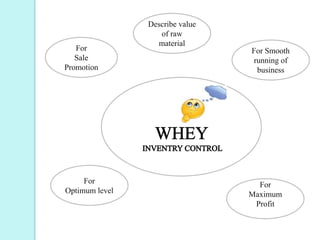
Describe value
of raw
material
For
Maximum
Profit
For
Sale
Promotion
For Smooth
running of
business
For
Optimum level
CONTENTS
 Introduction
 Objectives of inventory control
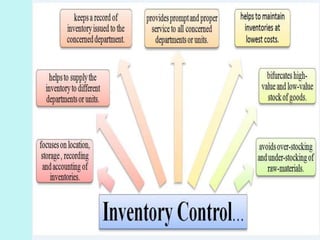
 Functions of inventory control
 Inventory control techniques procedure
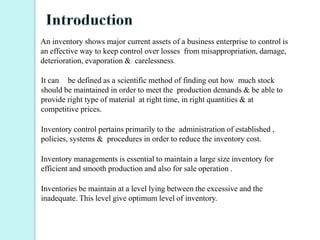
An inventory shows major current assets of a business enterprise to control is
an effective way to keep control over losses from misappropriation, damage,
deterioration, evaporation & carelessness.
It can be defined as a scientific method of finding out how much stock
should be maintained in order to meet the production demands & be able to
provide right type of material at right time, in right quantities & at
competitive prices.
Inventory control pertains primarily to the administration of established ,
policies, systems & procedures in order to reduce the inventory cost.
Inventory managements is essential to maintain a large size inventory for
efficient and smooth production and also for sale operation .
Inventories be maintain at a level lying between the excessive and the
inadequate. This level give optimum level of inventory.
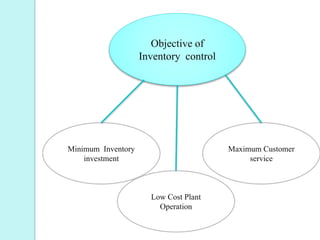
Objective of
Inventory control
Maximum Customer
service
Minimum Inventory
investment
Low Cost Plant
Operation
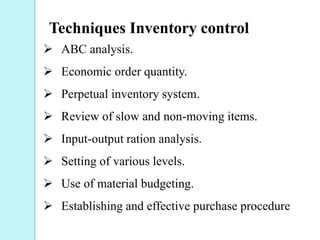
Techniques Inventory control
 ABC analysis.
 Economic order quantity.
 Perpetual inventory system.
 Review of slow and non-moving items.
 Input-output ration analysis.
 Setting of various levels.
 Use of material budgeting.
 Establishing and effective purchase procedure
ABC analysis
In big drug stores, large inventory items are stocked.
In order to maintain a proper control of inventories, the ABC
( always better control) this analysis is for better & economical control
of items in inventory.
Technique divided 3 group
a) Group A items ( High Value Items )
b) Group B items ( Moderate Value Items)
c) Group C items ( Low Value Items)
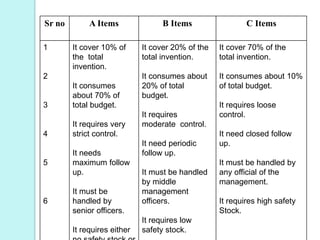
Sr no A Items B Items C Items
1
2
3
4
5
6
It cover 10% of
the total
invention.
It consumes
about 70% of
total budget.
It requires very
strict control.
It needs
maximum follow
up.
It must be
handled by
senior officers.
It requires either
It cover 20% of the
total invention.
It consumes about
20% of total
budget.
It requires
moderate control.
It need periodic
follow up.
It must be handled
by middle
management
officers.
It requires low
safety stock.
It cover 70% of the
total invention.
It consumes about 10%
of total budget.
It requires loose
control.
It need closed follow
up.
It must be handled by
any official of the
management.
It requires high safety
Stock.
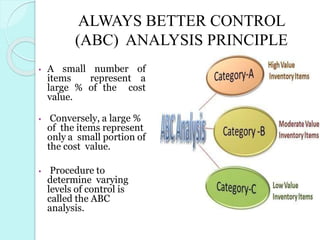
ALWAYS BETTER CONTROL
(ABC) ANALYSIS PRINCIPLE
• A small number of
items represent a
large % of the cost
value.
• Conversely, a large %
of the items represent
only a small portion of
the cost value.
• Procedure to
determine varying
levels of control is
called the ABC
analysis.
ADVANTAGES
 It ensures better control over costly items
 It helps in maintaining the stock in a better approach.
 It helps in reducing the storage costs.
 It helps in developing scientific method of controlling
 inventories.
 Investments in inventory can be regulated and funds can be
 utilised in the best possible manner
DIS ADVANTAGES
 B & C categories can often get neglected &pile in huge stocks or
susceptible to loss and slackness in record control
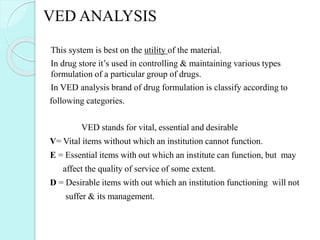
 This system is best on the utility of the material.
 In drug store it’s used in controlling & maintaining various types
formulation of a particular group of drugs.
 In VED analysis brand of drug formulation is classify according to
following categories.

 VED stands for vital, essential and desirable
 V= Vital items without which an institution cannot function.
 E = Essential items with out which an institute can function, but may
 affect the quality of service of some extent.
 D = Desirable items with out which an institution functioning will not
 suffer & its management.
VED ANALYSIS
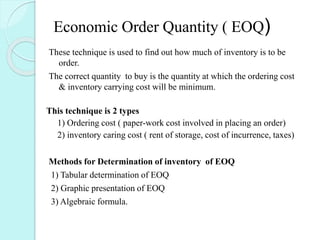
Economic Order Quantity ( EOQ)
These technique is used to find out how much of inventory is to be
order.
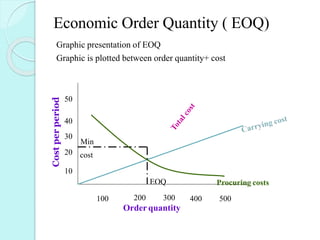
The correct quantity to buy is the quantity at which the ordering cost
& inventory carrying cost will be minimum.
This technique is 2 types
1) Ordering cost ( paper-work cost involved in placing an order)
2) inventory caring cost ( rent of storage, cost of incurrence, taxes)
Methods for Determination of inventory of EOQ
1) Tabular determination of EOQ
2) Graphic presentation of EOQ
3) Algebraic formula.
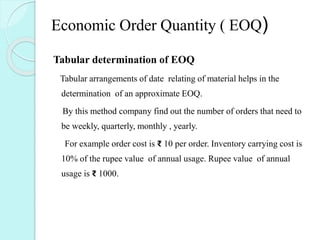
Economic Order Quantity ( EOQ)
Tabular determination of EOQ
Tabular arrangements of date relating of material helps in the
determination of an approximate EOQ.
By this method company find out the number of orders that need to
be weekly, quarterly, monthly , yearly.
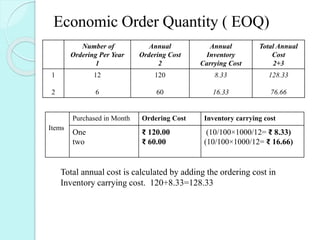
For example order cost is ₹ 10 per order. Inventory carrying cost is
10% of the rupee value of annual usage. Rupee value of annual
usage is ₹ 1000.
Economic Order Quantity ( EOQ)
Number of
Ordering Per Year
1
Annual
Ordering Cost
2
Annual
Inventory
Carrying Cost
Total Annual
Cost
2+3
1
2
12
6
120
60
8.33
16.33
128.33
76.66
Total annual cost is calculated by adding the ordering cost in
Inventory carrying cost. 120+8.33=128.33
Items
Purchased in Month Ordering Cost Inventory carrying cost
One
two
₹ 120.00
₹ 60.00
(10/100×1000/12= ₹ 8.33)
(10/100×1000/12= ₹ 16.66)
Economic Order Quantity ( EOQ)
Graphic presentation of EOQ
Graphic is plotted between order quantity+ cost
Cost
per
period
200 300
Order quantity
100 400 500
EOQ Procuring costs
Min
cost
10
30
20
50
40
Economic Order Quantity ( EOQ)
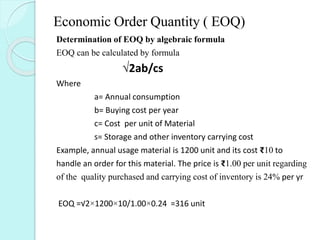
Determination of EOQ by algebraic formula
EOQ can be calculated by formula
√2ab/cs
Where
a= Annual consumption
b= Buying cost per year
c= Cost per unit of Material
s= Storage and other inventory carrying cost
Example, annual usage material is 1200 unit and its cost ₹10 to
handle an order for this material. The price is ₹1.00 per unit regarding
of the quality purchased and carrying cost of inventory is 24% per yr
EOQ =√2×1200×10/1.00×0.24 =316 unit
Perpetual inventory system
This is a method of recording the store balance after every receipt &
Issue to facilitate regular checking and to prevent closing down for
stock-taking. Then after receipt & issue recorded in bin card and
balance is adjust.
Bin card become perpetual inventory record and store balance is
recorded continuously after every receipt & issue. All errors detected
are adjusted both in bin card as well as in store ledger under proper
authority.
The Perpetual inventory system
1) Bin Card
2) Store Ledger
3) Continuous Stock-tacking
Perpetual inventory system
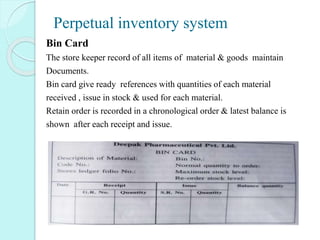
Bin Card
The store keeper record of all items of material & goods maintain
Documents.
Bin card give ready references with quantities of each material
received , issue in stock & used for each material.
Retain order is recorded in a chronological order & latest balance is
shown after each receipt and issue.
Perpetual inventory system
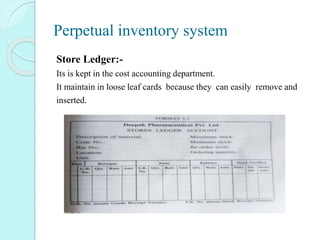
Store Ledger:-
Its is kept in the cost accounting department.
It maintain in loose leaf cards because they can easily remove and
inserted.
Perpetual inventory system
Continuous Stock-tacking
In this limited number of items are verified on a day.
Selected item material check at least a certain number in year and
checking particular items is evenly distributed during the period.
Selected items counted daily & compare with bin card & Store ledger
by store keeper.
The bin card & store ledger recorded the balance and their
correctness can be verified by physical verification.
In case of any difference between recorded and actual balance , it has
to be pointed out to the managements.
Perpetual inventory system
Advantages
Its help in detection of clerical error.
Timely action can be taken on serious shortage.
It serves on moral checking on staff, thus serving as a deterrent to
dishonestly ( checking to duplicate )
Overstocking & under stocking is avoided by verification of stock .
Its help in compilation of profit and loose account & balance sheet .
Review of slow and non-moving items
Proper system must be apply to detect and control slow moveing
Items, obsolete items, dormant stock.
Slow moving material are those items, which moving at a slow rate .
Dormant stock are those items which move temporarily because of
( seasonal product)
Obsolete items are those items which become useless due to change In
Design, method of manufacture , product or process.
Slow moving items are to be evaluated at cost replacement price or net
realisable value , whichever is less.
Review of slow and non-moving items
Steps of order to detect slow and non-moving items
1) Periodic report
2) Obsolete items
3) Moving ratios
1) 1) Periodic report :- Report is prepared monthly , quarterly on
stock of non-moving items which indicates its purchase, consumption
and balance in hand .
These report are given to the managements
Review of slow and non-moving items
2) Obsolete items:- slow and non-moving items become useless
with the passage of time .system is utilised for further purchase can be
stop .
3) Moving ratios :- In order separate slow moving items,
Dormant and dead stock , moving ration calculated periodically .
These ration show the turnover of these items for presentation to the
managements.

Input-output ration analysis
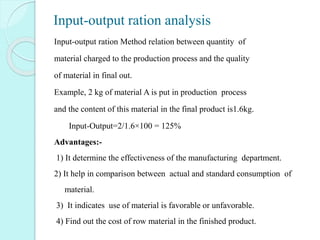
Input-output ration Method relation between quantity of
material charged to the production process and the quality
of material in final out.
Example, 2 kg of material A is put in production process
and the content of this material in the final product is1.6kg.
Input-Output=2/1.6×100 = 125%
Advantages:-
1) It determine the effectiveness of the manufacturing department.
2) It help in comparison between actual and standard consumption of
material.
3) It indicates use of material is favorable or unfavorable.
4) Find out the cost of row material in the finished product.
Input-output ration analysis
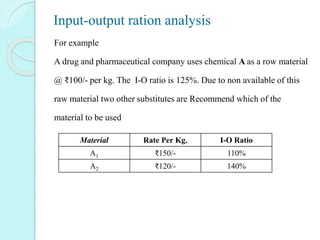
For example
A drug and pharmaceutical company uses chemical A as a row material
@ ₹100/- per kg. The I-O ratio is 125%. Due to non available of this
raw material two other substitutes are Recommend which of the
material to be used
Material Rate Per Kg. I-O Ratio
A1 ₹150/- 110%
A2 ₹120/- 140%
Input-output ration analysis
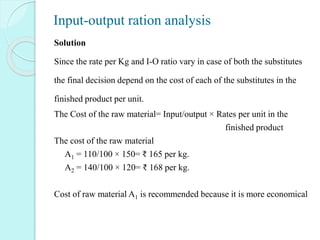
Solution
Since the rate per Kg and I-O ratio vary in case of both the substitutes
the final decision depend on the cost of each of the substitutes in the
finished product per unit.
The Cost of the raw material= Input/output × Rates per unit in the
finished product
The cost of the raw material
A1 = 110/100 × 150= ₹ 165 per kg.
A2 = 140/100 × 120= ₹ 168 per kg.
Cost of raw material A1 is recommended because it is more economical
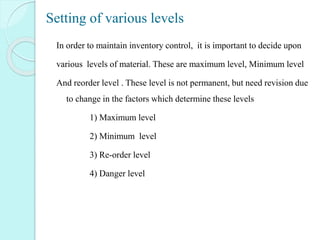
Setting of various levels
In order to maintain inventory control, it is important to decide upon
various levels of material. These are maximum level, Minimum level
And reorder level . These level is not permanent, but need revision due
to change in the factors which determine these levels
1) Maximum level
2) Minimum level
3) Re-order level
4) Danger level
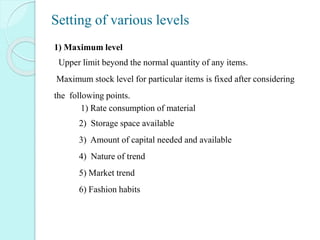
Setting of various levels
1) Maximum level
Upper limit beyond the normal quantity of any items.
Maximum stock level for particular items is fixed after considering
the following points.
1) Rate consumption of material
1) 2) Storage space available
2) 3) Amount of capital needed and available
3) 4) Nature of trend
4) 5) Market trend
5) 6) Fashion habits
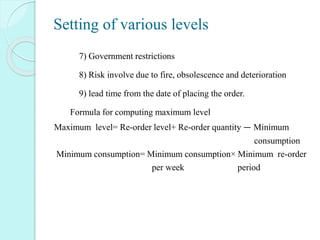
Setting of various levels
1) 7) Government restrictions
2) 8) Risk involve due to fire, obsolescence and deterioration
3) 9) lead time from the date of placing the order.
4) Formula for computing maximum level
Maximum level= Re-order level+ Re-order quantity — Minimum
consumption
Minimum consumption= Minimum consumption× Minimum re-order
per week period
Setting of various levels
Minimum Stock level or safety stock
This is the lower limit below which the stock of any item should not
normally be allowed to fall. This is also known as buffer stock.
Main purpose is protect against out of stock and there is future danger
of stoppage of its production and supplies.
This level factors
1) Average rate of consumption
2) lead time
Lead time is total items consumed between the recognition of the need
of an item, till the time it is received for use
The minimum stock level is expressed as follows
Minimum = Re-order – [ normal consumption × average delivery time ]
level level per week
Setting of various levels
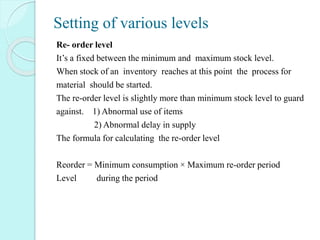
Re- order level
It’s a fixed between the minimum and maximum stock level.
When stock of an inventory reaches at this point the process for
material should be started.
The re-order level is slightly more than minimum stock level to guard
against. 1) Abnormal use of items
2) Abnormal delay in supply
The formula for calculating the re-order level
Reorder = Minimum consumption × Maximum re-order period
Level during the period
Setting of various levels
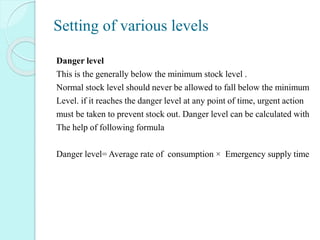
Danger level
This is the generally below the minimum stock level .
Normal stock level should never be allowed to fall below the minimum
Level. if it reaches the danger level at any point of time, urgent action
must be taken to prevent stock out. Danger level can be calculated with
The help of following formula
Danger level= Average rate of consumption × Emergency supply time

Inventrycontrol

  • 1.
    INVENTORY CONTROL Rajarshi ShahuCollege of Pharmacy Buldana MR. SADDAM SHAIKH CHAND M.PHARM ( Pharmaceutics) ASSISTANT PROFESSOR Diploma in Pharmacy
  • 2.
  • 3.
    CONTENTS  Introduction  Objectivesof inventory control  Functions of inventory control  Inventory control techniques procedure
  • 4.
    An inventory showsmajor current assets of a business enterprise to control is an effective way to keep control over losses from misappropriation, damage, deterioration, evaporation & carelessness. It can be defined as a scientific method of finding out how much stock should be maintained in order to meet the production demands & be able to provide right type of material at right time, in right quantities & at competitive prices. Inventory control pertains primarily to the administration of established , policies, systems & procedures in order to reduce the inventory cost. Inventory managements is essential to maintain a large size inventory for efficient and smooth production and also for sale operation . Inventories be maintain at a level lying between the excessive and the inadequate. This level give optimum level of inventory.
  • 5.
    Objective of Inventory control MaximumCustomer service Minimum Inventory investment Low Cost Plant Operation
  • 7.
    Techniques Inventory control ABC analysis.  Economic order quantity.  Perpetual inventory system.  Review of slow and non-moving items.  Input-output ration analysis.  Setting of various levels.  Use of material budgeting.  Establishing and effective purchase procedure
  • 8.
    ABC analysis In bigdrug stores, large inventory items are stocked. In order to maintain a proper control of inventories, the ABC ( always better control) this analysis is for better & economical control of items in inventory. Technique divided 3 group a) Group A items ( High Value Items ) b) Group B items ( Moderate Value Items) c) Group C items ( Low Value Items)
  • 9.
    Sr no AItems B Items C Items 1 2 3 4 5 6 It cover 10% of the total invention. It consumes about 70% of total budget. It requires very strict control. It needs maximum follow up. It must be handled by senior officers. It requires either It cover 20% of the total invention. It consumes about 20% of total budget. It requires moderate control. It need periodic follow up. It must be handled by middle management officers. It requires low safety stock. It cover 70% of the total invention. It consumes about 10% of total budget. It requires loose control. It need closed follow up. It must be handled by any official of the management. It requires high safety Stock.
  • 10.
    ALWAYS BETTER CONTROL (ABC)ANALYSIS PRINCIPLE • A small number of items represent a large % of the cost value. • Conversely, a large % of the items represent only a small portion of the cost value. • Procedure to determine varying levels of control is called the ABC analysis.
  • 11.
    ADVANTAGES  It ensuresbetter control over costly items  It helps in maintaining the stock in a better approach.  It helps in reducing the storage costs.  It helps in developing scientific method of controlling  inventories.  Investments in inventory can be regulated and funds can be  utilised in the best possible manner DIS ADVANTAGES  B & C categories can often get neglected &pile in huge stocks or susceptible to loss and slackness in record control
  • 12.
     This systemis best on the utility of the material.  In drug store it’s used in controlling & maintaining various types formulation of a particular group of drugs.  In VED analysis brand of drug formulation is classify according to following categories.   VED stands for vital, essential and desirable  V= Vital items without which an institution cannot function.  E = Essential items with out which an institute can function, but may  affect the quality of service of some extent.  D = Desirable items with out which an institution functioning will not  suffer & its management. VED ANALYSIS
  • 13.
    Economic Order Quantity( EOQ) These technique is used to find out how much of inventory is to be order. The correct quantity to buy is the quantity at which the ordering cost & inventory carrying cost will be minimum. This technique is 2 types 1) Ordering cost ( paper-work cost involved in placing an order) 2) inventory caring cost ( rent of storage, cost of incurrence, taxes) Methods for Determination of inventory of EOQ 1) Tabular determination of EOQ 2) Graphic presentation of EOQ 3) Algebraic formula.
  • 14.
    Economic Order Quantity( EOQ) Tabular determination of EOQ Tabular arrangements of date relating of material helps in the determination of an approximate EOQ. By this method company find out the number of orders that need to be weekly, quarterly, monthly , yearly. For example order cost is ₹ 10 per order. Inventory carrying cost is 10% of the rupee value of annual usage. Rupee value of annual usage is ₹ 1000.
  • 15.
    Economic Order Quantity( EOQ) Number of Ordering Per Year 1 Annual Ordering Cost 2 Annual Inventory Carrying Cost Total Annual Cost 2+3 1 2 12 6 120 60 8.33 16.33 128.33 76.66 Total annual cost is calculated by adding the ordering cost in Inventory carrying cost. 120+8.33=128.33 Items Purchased in Month Ordering Cost Inventory carrying cost One two ₹ 120.00 ₹ 60.00 (10/100×1000/12= ₹ 8.33) (10/100×1000/12= ₹ 16.66)
  • 16.
    Economic Order Quantity( EOQ) Graphic presentation of EOQ Graphic is plotted between order quantity+ cost Cost per period 200 300 Order quantity 100 400 500 EOQ Procuring costs Min cost 10 30 20 50 40
  • 17.
    Economic Order Quantity( EOQ) Determination of EOQ by algebraic formula EOQ can be calculated by formula √2ab/cs Where a= Annual consumption b= Buying cost per year c= Cost per unit of Material s= Storage and other inventory carrying cost Example, annual usage material is 1200 unit and its cost ₹10 to handle an order for this material. The price is ₹1.00 per unit regarding of the quality purchased and carrying cost of inventory is 24% per yr EOQ =√2×1200×10/1.00×0.24 =316 unit
  • 18.
    Perpetual inventory system Thisis a method of recording the store balance after every receipt & Issue to facilitate regular checking and to prevent closing down for stock-taking. Then after receipt & issue recorded in bin card and balance is adjust. Bin card become perpetual inventory record and store balance is recorded continuously after every receipt & issue. All errors detected are adjusted both in bin card as well as in store ledger under proper authority. The Perpetual inventory system 1) Bin Card 2) Store Ledger 3) Continuous Stock-tacking
  • 19.
    Perpetual inventory system BinCard The store keeper record of all items of material & goods maintain Documents. Bin card give ready references with quantities of each material received , issue in stock & used for each material. Retain order is recorded in a chronological order & latest balance is shown after each receipt and issue.
  • 20.
    Perpetual inventory system StoreLedger:- Its is kept in the cost accounting department. It maintain in loose leaf cards because they can easily remove and inserted.
  • 21.
    Perpetual inventory system ContinuousStock-tacking In this limited number of items are verified on a day. Selected item material check at least a certain number in year and checking particular items is evenly distributed during the period. Selected items counted daily & compare with bin card & Store ledger by store keeper. The bin card & store ledger recorded the balance and their correctness can be verified by physical verification. In case of any difference between recorded and actual balance , it has to be pointed out to the managements.
  • 22.
    Perpetual inventory system Advantages Itshelp in detection of clerical error. Timely action can be taken on serious shortage. It serves on moral checking on staff, thus serving as a deterrent to dishonestly ( checking to duplicate ) Overstocking & under stocking is avoided by verification of stock . Its help in compilation of profit and loose account & balance sheet .
  • 23.
    Review of slowand non-moving items Proper system must be apply to detect and control slow moveing Items, obsolete items, dormant stock. Slow moving material are those items, which moving at a slow rate . Dormant stock are those items which move temporarily because of ( seasonal product) Obsolete items are those items which become useless due to change In Design, method of manufacture , product or process. Slow moving items are to be evaluated at cost replacement price or net realisable value , whichever is less.
  • 24.
    Review of slowand non-moving items Steps of order to detect slow and non-moving items 1) Periodic report 2) Obsolete items 3) Moving ratios 1) 1) Periodic report :- Report is prepared monthly , quarterly on stock of non-moving items which indicates its purchase, consumption and balance in hand . These report are given to the managements
  • 25.
    Review of slowand non-moving items 2) Obsolete items:- slow and non-moving items become useless with the passage of time .system is utilised for further purchase can be stop . 3) Moving ratios :- In order separate slow moving items, Dormant and dead stock , moving ration calculated periodically . These ration show the turnover of these items for presentation to the managements. 
  • 26.
    Input-output ration analysis Input-outputration Method relation between quantity of material charged to the production process and the quality of material in final out. Example, 2 kg of material A is put in production process and the content of this material in the final product is1.6kg. Input-Output=2/1.6×100 = 125% Advantages:- 1) It determine the effectiveness of the manufacturing department. 2) It help in comparison between actual and standard consumption of material. 3) It indicates use of material is favorable or unfavorable. 4) Find out the cost of row material in the finished product.
  • 27.
    Input-output ration analysis Forexample A drug and pharmaceutical company uses chemical A as a row material @ ₹100/- per kg. The I-O ratio is 125%. Due to non available of this raw material two other substitutes are Recommend which of the material to be used Material Rate Per Kg. I-O Ratio A1 ₹150/- 110% A2 ₹120/- 140%
  • 28.
    Input-output ration analysis Solution Sincethe rate per Kg and I-O ratio vary in case of both the substitutes the final decision depend on the cost of each of the substitutes in the finished product per unit. The Cost of the raw material= Input/output × Rates per unit in the finished product The cost of the raw material A1 = 110/100 × 150= ₹ 165 per kg. A2 = 140/100 × 120= ₹ 168 per kg. Cost of raw material A1 is recommended because it is more economical
  • 29.
    Setting of variouslevels In order to maintain inventory control, it is important to decide upon various levels of material. These are maximum level, Minimum level And reorder level . These level is not permanent, but need revision due to change in the factors which determine these levels 1) Maximum level 2) Minimum level 3) Re-order level 4) Danger level
  • 30.
    Setting of variouslevels 1) Maximum level Upper limit beyond the normal quantity of any items. Maximum stock level for particular items is fixed after considering the following points. 1) Rate consumption of material 1) 2) Storage space available 2) 3) Amount of capital needed and available 3) 4) Nature of trend 4) 5) Market trend 5) 6) Fashion habits
  • 31.
    Setting of variouslevels 1) 7) Government restrictions 2) 8) Risk involve due to fire, obsolescence and deterioration 3) 9) lead time from the date of placing the order. 4) Formula for computing maximum level Maximum level= Re-order level+ Re-order quantity — Minimum consumption Minimum consumption= Minimum consumption× Minimum re-order per week period
  • 32.
    Setting of variouslevels Minimum Stock level or safety stock This is the lower limit below which the stock of any item should not normally be allowed to fall. This is also known as buffer stock. Main purpose is protect against out of stock and there is future danger of stoppage of its production and supplies. This level factors 1) Average rate of consumption 2) lead time Lead time is total items consumed between the recognition of the need of an item, till the time it is received for use The minimum stock level is expressed as follows Minimum = Re-order – [ normal consumption × average delivery time ] level level per week
  • 33.
    Setting of variouslevels Re- order level It’s a fixed between the minimum and maximum stock level. When stock of an inventory reaches at this point the process for material should be started. The re-order level is slightly more than minimum stock level to guard against. 1) Abnormal use of items 2) Abnormal delay in supply The formula for calculating the re-order level Reorder = Minimum consumption × Maximum re-order period Level during the period
  • 34.
    Setting of variouslevels Danger level This is the generally below the minimum stock level . Normal stock level should never be allowed to fall below the minimum Level. if it reaches the danger level at any point of time, urgent action must be taken to prevent stock out. Danger level can be calculated with The help of following formula Danger level= Average rate of consumption × Emergency supply time