INVENTORY
MANAGEMENT
Dr. Mandar Chandrachood
Associate Professor
Community Medicine
DVVPF’s Medical College, Ahmednagar
1
INVENTORY CONTROL
INVENTORY CONTROL
WHAT IS IT???
WHAT IS IT???
Inventory is a essential part of every
organization/business/manufacturing unit.
WHAT IS IT???
WHAT IS IT???

 It is the method of maintenance of stock at a
It is the method of maintenance of stock at a
level at which purchasing and stocking costs
are the lowest possible without interference
with supply.
with supply.
2
INVENTORY CONTROL
INVENTORY CONTROL
WHAT IS IT???
WHAT IS IT???

 Inventory control means keeping track of your
Inventory control means keeping track of your
stock
stock
Knowing
Knowing how much was sold and how much is
how much was sold and how much is left
left

 Knowing
Knowing how much was sold and how much is
how much was sold and how much is left
left

 Let’s
Let’s you keep records of losses and
you keep records of losses and gains
gains

 Gives
Gives you consumption rates of high demand and
you consumption rates of high demand and
low demand
low demand
3
INVENTORY CONTROL
INVENTORY CONTROL
HOW DO I KEEP INVENTORY???
∂
∂ By using inventory data
By using inventory data sheets
sheets
Daily Readings
Daily Readings
∂
∂ Daily Readings
Daily Readings
∂
∂ Daily
Daily inventory balance
inventory balance record
record
∂
∂ Monthly Summary
Monthly Summary
4
OBJECTIVE
OBJECTIVE
To maintain
To maintain optimum stock
optimum stock–
– i.e. not excessive
i.e. not excessive
but not likely to be completely exhausted.
5
METHODS
Following are the methods which are in
common use in inventory control:
ABC analysis
HML analysis
HML analysis
VED analysis
FSN analysis
6
ABC ANALYSIS
ABC (Always Better Control)
 It is based on the concept, “Thick on the best and Thin
on the Rest.”
 The objective of ABC control is to vary the expenses
associated with maintaining appropriate control
according to the potential savings associated with a
proper level of such control.
 It is one of the widely used techniques of inventory
control.
7
ABC ANALYSIS
 A system of analysis of store items based on their
cost is useful in materials management in general.
 It is particularly useful for drug management.
 Different items can be categorized into three
groups based on the annual expenditure incurred.
 The drugs should be arranged in a descending
order according to the amount of expenditure
incurred.
8
ABC ANALYSIS…...
 The cumulative cost should be calculated
beginning from the first item at the top of list.
Drug
Drug Item
Item Budget consumed
Budget consumed
A 10% 70%
B 20% 20%
C 70% 10%
9
ABC ANALYSIS…...
 Drugs of category A should get high priority and
managerial attention because though
constituting only small fraction of the total list
these account for the bulk of expenditure.
 There stock, consumption, purchase etc., must
be critically watched.
10
HML ANALYSIS.
 The HML classification follows the same
procedure as is adopted in ABC classification.
 H = HIGH;
 M = MEDIUM;
M = MEDIUM;
 L = LOW.
 Only difference is that in HML, the classification
unit value is the criterion and not the annual
consumption value.
11
HML ANALYSIS.
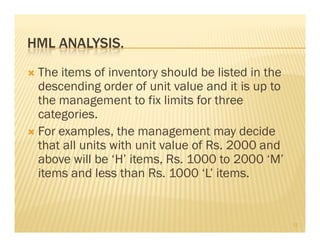
 The items of inventory should be listed in the
descending order of unit value and it is up to
the management to fix limits for three
categories.
For examples, the management may decide
 For examples, the management may decide
that all units with unit value of Rs. 2000 and
above will be ‘H’ items, Rs. 1000 to 2000 ‘M’
items and less than Rs. 1000 ‘L’ items.
12
VED CLASSIFICATION.
 VED Classification
 While in ABC, classification inventories are classified
on the basis of their consumption value and in HML
analysis the unit value is the basis, criticality of
inventories is the basis VED classification.
 The VED analysis is done to determine the criticality of
an item and its effect on production and other
services.
13
VED ANALYSIS
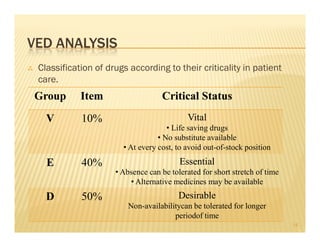
 Classification of drugs according to their criticality in patient
care.
Group
Group Item
Item Critical
Critical Status
Status
V
V 10% Vital
Vital
• Life saving drugs
V
V 10%
• Life saving drugs
• No substitute available
• At every cost, to avoid out-of-stock position
E
E 40% Essential
Essential
• Absence can be tolerated for short stretch of time
• Alternative medicines may be available
D
D 50% Desirable
Desirable
Non-availabilitycan be tolerated for longer
periodof time
14
FSN CLASSIFICATION
 FSN Analysis
 Here, classification is based on the pattern of
issues from stores and is useful in controlling
obsolescence.
obsolescence.
 F = Fast moving
 S = Slow Moving;
 N = Non Moving.
15
FSN CLASSIFICATION.
 To carry out an FSN analysis, the date of receipt
or the last date of issue, whichever is later, is
taken to determine the number of months, which
have lapsed since the last transaction.
 The items are usually grouped in periods of 12
months.
months.
 FSN analysis is helpful in identifying active items
which need to be reviewed regularly and surplus
items which have to be examined further.
 Non-moving items may be examined further and
their disposal can be considered.
16
DEMAND FORECASTING
 Demand forecasting is a process of
estimating future demand or value of future
events, based on the past.
Database Required for Demand forecasting
1. Inventory levels and shelf life for various items
2. Investment on inventory
3. Record of transactions
4. Maintenance
17
FACTORS INFLUENCING DEMAND
 Average demand
 Seasonal variations
 Cyclical variations
Random variations
 Random variations
 Auto correlation
18
PROCUREMENT OF MATERIALS
 Centralized Procurement
 Decetralised Procurement
 Rate contract system
Sources for procurement in the Health sector
1. Directorate General of Suppliers & Disposals ( DGS&D)
2. Medical Stores Depots
3. Public Sector Units, Small Scale Industries, And
Cooperatives.
4. Local Purchase Committee
5. Import
19
IN CONCLUSION
 Keeping good records will help you manage your
inventory.
 Don’t be intimidated by the numbers
 Look for the pattern.
20
THANK YOU
THANK YOU
21

Inventory Management or Inventory Control

  • 1.
    INVENTORY MANAGEMENT Dr. Mandar Chandrachood AssociateProfessor Community Medicine DVVPF’s Medical College, Ahmednagar 1
  • 2.
    INVENTORY CONTROL INVENTORY CONTROL WHATIS IT??? WHAT IS IT??? Inventory is a essential part of every Inventory is a essential part of every organization/business/manufacturing unit. organization/business/manufacturing unit. WHAT IS IT??? WHAT IS IT???   It is the method of maintenance of stock at a It is the method of maintenance of stock at a level at which purchasing and stocking costs level at which purchasing and stocking costs are the lowest possible without interference are the lowest possible without interference with supply. with supply. 2
  • 3.
    INVENTORY CONTROL INVENTORY CONTROL WHATIS IT??? WHAT IS IT???   Inventory control means keeping track of your Inventory control means keeping track of your stock stock Knowing Knowing how much was sold and how much is how much was sold and how much is left left   Knowing Knowing how much was sold and how much is how much was sold and how much is left left   Let’s Let’s you keep records of losses and you keep records of losses and gains gains   Gives Gives you consumption rates of high demand and you consumption rates of high demand and low demand low demand 3
  • 4.
    INVENTORY CONTROL INVENTORY CONTROL HOWDO I KEEP INVENTORY??? HOW DO I KEEP INVENTORY??? ∂ ∂ By using inventory data By using inventory data sheets sheets Daily Readings Daily Readings ∂ ∂ Daily Readings Daily Readings ∂ ∂ Daily Daily inventory balance inventory balance record record ∂ ∂ Monthly Summary Monthly Summary 4
  • 5.
    OBJECTIVE OBJECTIVE To maintain To maintainoptimum stock optimum stock– – i.e. not excessive i.e. not excessive but not likely to be completely exhausted. but not likely to be completely exhausted. 5
  • 6.
    METHODS Following are themethods which are in common use in inventory control: ABC analysis HML analysis HML analysis VED analysis FSN analysis 6
  • 7.
    ABC ANALYSIS ABC (AlwaysBetter Control)  It is based on the concept, “Thick on the best and Thin on the Rest.”  The objective of ABC control is to vary the expenses associated with maintaining appropriate control associated with maintaining appropriate control according to the potential savings associated with a proper level of such control.  It is one of the widely used techniques of inventory control. 7
  • 8.
    ABC ANALYSIS  Asystem of analysis of store items based on their cost is useful in materials management in general.  It is particularly useful for drug management.  Different items can be categorized into three  Different items can be categorized into three groups based on the annual expenditure incurred.  The drugs should be arranged in a descending order according to the amount of expenditure incurred. 8
  • 9.
    ABC ANALYSIS…...  Thecumulative cost should be calculated beginning from the first item at the top of list. Drug Drug Item Item Budget consumed Budget consumed A 10% 70% B 20% 20% C 70% 10% 9
  • 10.
    ABC ANALYSIS…...  Drugsof category A should get high priority and managerial attention because though constituting only small fraction of the total list these account for the bulk of expenditure. these account for the bulk of expenditure.  There stock, consumption, purchase etc., must be critically watched. 10
  • 11.
    HML ANALYSIS.  TheHML classification follows the same procedure as is adopted in ABC classification.  H = HIGH;  M = MEDIUM; M = MEDIUM;  L = LOW.  Only difference is that in HML, the classification unit value is the criterion and not the annual consumption value. 11
  • 12.
    HML ANALYSIS.  Theitems of inventory should be listed in the descending order of unit value and it is up to the management to fix limits for three categories. For examples, the management may decide  For examples, the management may decide that all units with unit value of Rs. 2000 and above will be ‘H’ items, Rs. 1000 to 2000 ‘M’ items and less than Rs. 1000 ‘L’ items. 12
  • 13.
    VED CLASSIFICATION.  VEDClassification  While in ABC, classification inventories are classified on the basis of their consumption value and in HML analysis the unit value is the basis, criticality of inventories is the basis VED classification. inventories is the basis VED classification.  The VED analysis is done to determine the criticality of an item and its effect on production and other services. 13
  • 14.
    VED ANALYSIS  Classificationof drugs according to their criticality in patient care. Group Group Item Item Critical Critical Status Status V V 10% Vital Vital • Life saving drugs V V 10% • Life saving drugs • No substitute available • At every cost, to avoid out-of-stock position E E 40% Essential Essential • Absence can be tolerated for short stretch of time • Alternative medicines may be available D D 50% Desirable Desirable Non-availabilitycan be tolerated for longer periodof time 14
  • 15.
    FSN CLASSIFICATION  FSNAnalysis  Here, classification is based on the pattern of issues from stores and is useful in controlling obsolescence. obsolescence.  F = Fast moving  S = Slow Moving;  N = Non Moving. 15
  • 16.
    FSN CLASSIFICATION.  Tocarry out an FSN analysis, the date of receipt or the last date of issue, whichever is later, is taken to determine the number of months, which have lapsed since the last transaction.  The items are usually grouped in periods of 12 months. months.  FSN analysis is helpful in identifying active items which need to be reviewed regularly and surplus items which have to be examined further.  Non-moving items may be examined further and their disposal can be considered. 16
  • 17.
    DEMAND FORECASTING  Demandforecasting is a process of estimating future demand or value of future events, based on the past. Database Required for Demand forecasting Database Required for Demand forecasting 1. Inventory levels and shelf life for various items 2. Investment on inventory 3. Record of transactions 4. Maintenance 17
  • 18.
    FACTORS INFLUENCING DEMAND Average demand  Seasonal variations  Cyclical variations Random variations  Random variations  Auto correlation 18
  • 19.
    PROCUREMENT OF MATERIALS Centralized Procurement  Decetralised Procurement  Rate contract system Sources for procurement in the Health sector 1. Directorate General of Suppliers & Disposals ( DGS&D) 1. Directorate General of Suppliers & Disposals ( DGS&D) 2. Medical Stores Depots 3. Public Sector Units, Small Scale Industries, And Cooperatives. 4. Local Purchase Committee 5. Import 19
  • 20.
    IN CONCLUSION  Keepinggood records will help you manage your inventory.  Don’t be intimidated by the numbers  Look for the pattern.  Look for the pattern. 20
  • 21.