Inventory Control
from
Nursing Management
By;
Pradeep.M
M.Sc. Nursing 2nd year
Meaning of Inventory Control;
• The term ‘inventory’ originates from the French word
‘Inventaire’ and Latin word ‘Inventariom’, which
implies a list of things found. It is defined as the
blocked working capital of an organization in the form
of material.
• In health care system, material management is
concerned with providing the drugs, supplies and
equipment needed by health personnel to deliver
health services. “Inventory control is an important
aspect of material management”.
• An inventory is a detailed list of all articles on the
ward their specification and standard number or
quantity.
Definition;
• Inventory control is a scientific system which
indicates as to what to order, when to order, and how
much to order, and how much to stock so that
purchasing costs and storing costs are kept as low as
possible.
• Inventory control is the technique of maintaining the
size of the inventory at some desired level keeping in
view the best economic interest of an organization.
• It is the process by which inventory is measured and
regulate according to pre-determined norms such as
 Economy
 Safety stock
 Minimal Level
 Maximum level
 Order level
Types of Inventory;
1) Official Inventory;
• Materials lying in the main stores and being
accounted for but have not been issued to the user
units. e.g medical and surgical items, dressings,
linens, supplies, laboratory items etc.
2) Unofficial Inventory;
• The materials have been issued to the user units
like the dispensary, CSSD, Laundry, wards, OPD etc
. In case of forecasting or demand estimation
these items are, not taken into, consideration by the
hospital administration, so it is called as unofficial
inventory for hospitals.
Objectives of Inventory Control;
• To supply the materials in time
• To give maximum clients service
• To reduce or minimize investment in
inventories
• To avoid shortage of stock
• To minimize the losses
• To meet unforeseen future demand.
• To minimize idle time by avoiding stock
outs and shortages.
Inventory Control Involves;
• Maintenance of stores records
• Physical control of materials
• Preservation of materials
• Minimization of obsolescence
• Reconciliation of stocks with book
figures
Techniques of Inventory Control;
• 1. ABC Analysis (Always, Better, Control)
• 2. VED Analysis (Vital, Essential, Desirable)
• 3. FSN Analysis (Fast moving, Slow-moving,
No moving)
• 4. SDE Analysis (Scarce, Difficult, Easy)
• 5. HML Analysis (High, Medium, Low)
• 6. XYZ Analysis
• 7. GOLF Analysis (Govt., Ordinary, Local,
Foreign)
• 8. SOS Analysis Seasonal, off Seasonal)
ABC (Always, Better, Control) Analysis
• It is a basic supply chain technique in inventory
control.
• Classification is based on two factors according to
Pareto’s Principle .
• 1. Cost
• 2. Annual consumption
 According to this principle;
 {Annual consumption value= cost of item x Quantity
consumed}
 It is also known as Selective Inventory Control Method.
A-Item;
• Small in number
• Managed by top management
• Tight control and rigid estimate of requirement
• Strict and close watch
• Require low safety stock
• Consume measure portion of fund
• e.g. Ventilator, Dialysis machine, Defibrillator,
CT-Scan machine, MRI Machine, USG, Heart-
lung machine.
B-Item;
• Moderate control
• Purchased on rigid requirement
• Strict watch and control is needed
• Safety stock are maintained moderately
• Managed by middle level management
• e.g. Suction machine, Oxygen Cylinder,
Nebulizer, Humidifier, Cardiac monitor.
C-Item;
• Needed large in number
• Consumed lesser amount of cost
• Ordinary control
• Purchase on usage estimate
• Require high safety stock
• e.g. Syringes, Cannula, Gloves, Suction
Catheters etc.
Advantages of ABC analysis;
• Investment can be maintained.
• Easy to control wastage of costly item
• Help in maintaining safety to total cost
• Easy to maintain stock and turn-over rate
• Manager is able to control the investment
specially A-item.
Disadvantages of ABC analysis;
•Proper standardization is required.
•Considered the only money value
not importance of item.
•Periodic review become difficult.
VED (Vital, Essential, Desirable) Analysis
Classification is based on criticality than
on functional basis.
V-Vital items
• It includes items without which a hospital cannot
function
• These items should be adequately stocked for
smooth functioning of an organization
• Stocked in abundance
• Shortage can’t be tolerated
• E.g. Oxygen supply, ET tube, ventilator,
Defibrillator
Cont….
E-Essential items
• It includes items without which a hospital can function
for a short time but affect the quality of patient care to a
limited extent.
• Reasonable risk can be taken.
• Controlled by middle-level managers.
• E.g. Antibiotics, IVF, X-ray machine, electric cautery,
patient trolley etc.
D-Desirable Items
• The non-availability of which for a considerable period
may not affect the functioning the hospital.
• They can be purchased easily when required.
• Low in stock or not in stock
• E.g. Gloves, Goggles, Eye Shield, Eye drape, clip drape.
Combination of ABC & VED analysis;
Depending on consumption value and
criticality which will give fruitful result.
Category-1 Close monitoring and control
 Most important
 Controlled by administrator
Category-2 Moderate control
 Intermediate importance
 Under control of officer in-charge of stores
Category-3 No need of control
 Least importance
 Under control of store keeper
FSN (Fast Moving, Slow-Moving
Non-moving) Analysis;
• Analysis is based on consumption pattern of
item and issue pattern of item from stock.
• • For analysis, issuing of item in past 2-3
years is considered.
• • Period of consideration and limited number
of issue may vary from organization to
organization.
Cont….
Non-moving item;
• If no issuing of item during 2-3 year- not moving
item
S- Slow-moving Item;
• If issuing 10-15 times in a year included in S-item
F-Fast Moving Item;
• If issuing > 10-15 times included in F-Item
Demand high;
• Special care to be taken otherwise work may
suffer.
SDE (Scarce, Difficult, Easy to
Obtain) Analysis
Based on problem faced in procurement
and availability of item.
S-scarce item;
• Difficult to obtain
• Generally imported
• In-short supply
• Management by top managers
• A big safety stock is maintained for such item.
Cont….
D-Difficult Item;
• Difficult to procure
• Come from distant places
• Moderate safety stock is maintained
E-Easy Item;
• Easy to acquire
• Readily available in local market
• Supply exceeds demand
• Minimum safety demand
HML (High, Medium, Low) Analysis;
Based on criteria of unit value of
item.
• High Value material
• Medium value material
• Low level management
XYZ Analysis;
Based on value of inventory stored.
• X-Item: whose inventory values are
high
• Y-Item: Moderate in stock
• Z-Item: Low in Stock
GOLF (Govt. Ordinary, Local,
Foreign) Analysis;
Based on source of material
• Government: items are imported through
govt. agencies.
• E.g. Indian Drug and pharmaceutical
Cont….
Ordinary/Open Market: who form
bulk of supplier and procurement is
easy.
Local: sell on cash-purchase basis
Foreign: bigger items can be purchased
annually
SOS (Seasonal, Off Seasonal) Analysis;
Based on season/ according to
necessity in a specific time
• Seasonal; Available only for a limited
period
• Off seasonal; Available throughout
the year
Responsibility of Inventory Control
in Ward;
Responsible
• Ward in-charge
• Sub in-charge
• Ward sisters
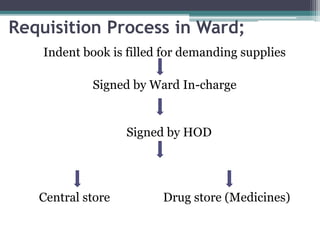
Requisition Process in Ward;
Indent book is filled for demanding supplies
Signed by Ward In-charge
Signed by HOD
Central store Drug store (Medicines)
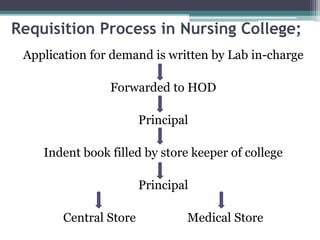
Requisition Process in Nursing College;
Application for demand is written by Lab in-charge
Forwarded to HOD
Principal
Indent book filled by store keeper of college
Principal
Central Store Medical Store
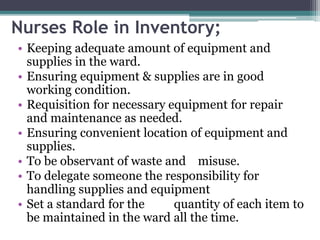
Nurses Role in Inventory;
• Keeping adequate amount of equipment and
supplies in the ward.
• Ensuring equipment & supplies are in good
working condition.
• Requisition for necessary equipment for repair
and maintenance as needed.
• Ensuring convenient location of equipment and
supplies.
• To be observant of waste and misuse.
• To delegate someone the responsibility for
handling supplies and equipment
• Set a standard for the quantity of each item to
be maintained in the ward all the time.
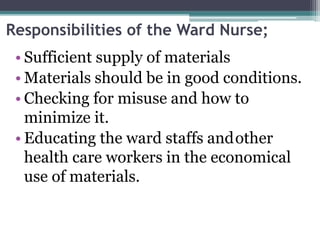
Responsibilities of the Ward Nurse;
• Sufficient supply of materials
• Materials should be in good conditions.
• Checking for misuse and how to
minimize it.
• Educating the ward staffs andother
health care workers in the economical
use of materials.
Conclusion;
Careful classification of the
inventory, and continuing analysis of
those classification, can play a vital
role in maintaining cost and
providing quality care. Inventory
control is a constant requirement of
any organization.
Research Article;
• Title- “ABC- VED analysis of expendable medical stores at
a tertiary care hospital”
• Journal- Medical journal armed forces India. Year of
publication- 2015, Author name- Sushil Kumar, A.
Chakrobarty
• Objectives- Use of ABC and VED analysis to identify the
categories of drugs needing focused managerial tool.
• Methods - Annual consumption and expenditure data of
expendable medical store for 1year was extracted from the
drug expenditure book, followed by classification on its
annual usage value.
• Results- Out of 1536 items, 6.77% (104), 19.27 % (296)
and 73.95% (1136) items were found to be A, B and C
category items respectively. VED analysis revealed that
only 322 (21% items out of an inventory of 1536 drugs
belonging to category I will require maximum attention.
Reference;
• Barrett Jean.ward management. konark
publisher. 2nd edition. New delhi. Pg.no .146-73
• Vati Jogindra.Principles and practice of nursing
management and administration 1st edition.
Newdelhi ; Jaypee Pg.No.;-554-60
• NAnoop, kumar Chetan, K Dipak. A textbook on
nursing management. 1st edition. Newdelhi.
Pg.No. 166-68
• Huber Daniel L. Leadership nursing care and
management. 3rd edition. New Delhi.
Summary
Inventory control Seminar Hospital Inventory

Inventory control Seminar Hospital Inventory

  • 1.
  • 2.
    Meaning of InventoryControl; • The term ‘inventory’ originates from the French word ‘Inventaire’ and Latin word ‘Inventariom’, which implies a list of things found. It is defined as the blocked working capital of an organization in the form of material. • In health care system, material management is concerned with providing the drugs, supplies and equipment needed by health personnel to deliver health services. “Inventory control is an important aspect of material management”. • An inventory is a detailed list of all articles on the ward their specification and standard number or quantity.
  • 3.
    Definition; • Inventory controlis a scientific system which indicates as to what to order, when to order, and how much to order, and how much to stock so that purchasing costs and storing costs are kept as low as possible. • Inventory control is the technique of maintaining the size of the inventory at some desired level keeping in view the best economic interest of an organization. • It is the process by which inventory is measured and regulate according to pre-determined norms such as  Economy  Safety stock  Minimal Level  Maximum level  Order level
  • 4.
    Types of Inventory; 1)Official Inventory; • Materials lying in the main stores and being accounted for but have not been issued to the user units. e.g medical and surgical items, dressings, linens, supplies, laboratory items etc. 2) Unofficial Inventory; • The materials have been issued to the user units like the dispensary, CSSD, Laundry, wards, OPD etc . In case of forecasting or demand estimation these items are, not taken into, consideration by the hospital administration, so it is called as unofficial inventory for hospitals.
  • 5.
    Objectives of InventoryControl; • To supply the materials in time • To give maximum clients service • To reduce or minimize investment in inventories • To avoid shortage of stock • To minimize the losses • To meet unforeseen future demand. • To minimize idle time by avoiding stock outs and shortages.
  • 6.
    Inventory Control Involves; •Maintenance of stores records • Physical control of materials • Preservation of materials • Minimization of obsolescence • Reconciliation of stocks with book figures
  • 7.
    Techniques of InventoryControl; • 1. ABC Analysis (Always, Better, Control) • 2. VED Analysis (Vital, Essential, Desirable) • 3. FSN Analysis (Fast moving, Slow-moving, No moving) • 4. SDE Analysis (Scarce, Difficult, Easy) • 5. HML Analysis (High, Medium, Low) • 6. XYZ Analysis • 7. GOLF Analysis (Govt., Ordinary, Local, Foreign) • 8. SOS Analysis Seasonal, off Seasonal)
  • 8.
    ABC (Always, Better,Control) Analysis • It is a basic supply chain technique in inventory control. • Classification is based on two factors according to Pareto’s Principle . • 1. Cost • 2. Annual consumption  According to this principle;  {Annual consumption value= cost of item x Quantity consumed}  It is also known as Selective Inventory Control Method.
  • 9.
    A-Item; • Small innumber • Managed by top management • Tight control and rigid estimate of requirement • Strict and close watch • Require low safety stock • Consume measure portion of fund • e.g. Ventilator, Dialysis machine, Defibrillator, CT-Scan machine, MRI Machine, USG, Heart- lung machine.
  • 10.
    B-Item; • Moderate control •Purchased on rigid requirement • Strict watch and control is needed • Safety stock are maintained moderately • Managed by middle level management • e.g. Suction machine, Oxygen Cylinder, Nebulizer, Humidifier, Cardiac monitor.
  • 11.
    C-Item; • Needed largein number • Consumed lesser amount of cost • Ordinary control • Purchase on usage estimate • Require high safety stock • e.g. Syringes, Cannula, Gloves, Suction Catheters etc.
  • 12.
    Advantages of ABCanalysis; • Investment can be maintained. • Easy to control wastage of costly item • Help in maintaining safety to total cost • Easy to maintain stock and turn-over rate • Manager is able to control the investment specially A-item.
  • 13.
    Disadvantages of ABCanalysis; •Proper standardization is required. •Considered the only money value not importance of item. •Periodic review become difficult.
  • 14.
    VED (Vital, Essential,Desirable) Analysis Classification is based on criticality than on functional basis. V-Vital items • It includes items without which a hospital cannot function • These items should be adequately stocked for smooth functioning of an organization • Stocked in abundance • Shortage can’t be tolerated • E.g. Oxygen supply, ET tube, ventilator, Defibrillator
  • 15.
    Cont…. E-Essential items • Itincludes items without which a hospital can function for a short time but affect the quality of patient care to a limited extent. • Reasonable risk can be taken. • Controlled by middle-level managers. • E.g. Antibiotics, IVF, X-ray machine, electric cautery, patient trolley etc. D-Desirable Items • The non-availability of which for a considerable period may not affect the functioning the hospital. • They can be purchased easily when required. • Low in stock or not in stock • E.g. Gloves, Goggles, Eye Shield, Eye drape, clip drape.
  • 16.
    Combination of ABC& VED analysis; Depending on consumption value and criticality which will give fruitful result. Category-1 Close monitoring and control  Most important  Controlled by administrator Category-2 Moderate control  Intermediate importance  Under control of officer in-charge of stores Category-3 No need of control  Least importance  Under control of store keeper
  • 17.
    FSN (Fast Moving,Slow-Moving Non-moving) Analysis; • Analysis is based on consumption pattern of item and issue pattern of item from stock. • • For analysis, issuing of item in past 2-3 years is considered. • • Period of consideration and limited number of issue may vary from organization to organization.
  • 18.
    Cont…. Non-moving item; • Ifno issuing of item during 2-3 year- not moving item S- Slow-moving Item; • If issuing 10-15 times in a year included in S-item F-Fast Moving Item; • If issuing > 10-15 times included in F-Item Demand high; • Special care to be taken otherwise work may suffer.
  • 19.
    SDE (Scarce, Difficult,Easy to Obtain) Analysis Based on problem faced in procurement and availability of item. S-scarce item; • Difficult to obtain • Generally imported • In-short supply • Management by top managers • A big safety stock is maintained for such item.
  • 20.
    Cont…. D-Difficult Item; • Difficultto procure • Come from distant places • Moderate safety stock is maintained E-Easy Item; • Easy to acquire • Readily available in local market • Supply exceeds demand • Minimum safety demand
  • 21.
    HML (High, Medium,Low) Analysis; Based on criteria of unit value of item. • High Value material • Medium value material • Low level management
  • 22.
    XYZ Analysis; Based onvalue of inventory stored. • X-Item: whose inventory values are high • Y-Item: Moderate in stock • Z-Item: Low in Stock
  • 23.
    GOLF (Govt. Ordinary,Local, Foreign) Analysis; Based on source of material • Government: items are imported through govt. agencies. • E.g. Indian Drug and pharmaceutical
  • 24.
    Cont…. Ordinary/Open Market: whoform bulk of supplier and procurement is easy. Local: sell on cash-purchase basis Foreign: bigger items can be purchased annually
  • 25.
    SOS (Seasonal, OffSeasonal) Analysis; Based on season/ according to necessity in a specific time • Seasonal; Available only for a limited period • Off seasonal; Available throughout the year
  • 26.
    Responsibility of InventoryControl in Ward; Responsible • Ward in-charge • Sub in-charge • Ward sisters
  • 27.
    Requisition Process inWard; Indent book is filled for demanding supplies Signed by Ward In-charge Signed by HOD Central store Drug store (Medicines)
  • 28.
    Requisition Process inNursing College; Application for demand is written by Lab in-charge Forwarded to HOD Principal Indent book filled by store keeper of college Principal Central Store Medical Store
  • 29.
    Nurses Role inInventory; • Keeping adequate amount of equipment and supplies in the ward. • Ensuring equipment & supplies are in good working condition. • Requisition for necessary equipment for repair and maintenance as needed. • Ensuring convenient location of equipment and supplies. • To be observant of waste and misuse. • To delegate someone the responsibility for handling supplies and equipment • Set a standard for the quantity of each item to be maintained in the ward all the time.
  • 30.
    Responsibilities of theWard Nurse; • Sufficient supply of materials • Materials should be in good conditions. • Checking for misuse and how to minimize it. • Educating the ward staffs andother health care workers in the economical use of materials.
  • 31.
    Conclusion; Careful classification ofthe inventory, and continuing analysis of those classification, can play a vital role in maintaining cost and providing quality care. Inventory control is a constant requirement of any organization.
  • 32.
    Research Article; • Title-“ABC- VED analysis of expendable medical stores at a tertiary care hospital” • Journal- Medical journal armed forces India. Year of publication- 2015, Author name- Sushil Kumar, A. Chakrobarty • Objectives- Use of ABC and VED analysis to identify the categories of drugs needing focused managerial tool. • Methods - Annual consumption and expenditure data of expendable medical store for 1year was extracted from the drug expenditure book, followed by classification on its annual usage value. • Results- Out of 1536 items, 6.77% (104), 19.27 % (296) and 73.95% (1136) items were found to be A, B and C category items respectively. VED analysis revealed that only 322 (21% items out of an inventory of 1536 drugs belonging to category I will require maximum attention.
  • 33.
    Reference; • Barrett Jean.wardmanagement. konark publisher. 2nd edition. New delhi. Pg.no .146-73 • Vati Jogindra.Principles and practice of nursing management and administration 1st edition. Newdelhi ; Jaypee Pg.No.;-554-60 • NAnoop, kumar Chetan, K Dipak. A textbook on nursing management. 1st edition. Newdelhi. Pg.No. 166-68 • Huber Daniel L. Leadership nursing care and management. 3rd edition. New Delhi.
  • 34.