Inventory Control
By
Mr. Ravi Rai Dangi
Assistant Professor
Fellowship in Neonatal Nursing
MSc. Child Health Nursing
Introduction
 Inventory control in hospitals is more than just
procurement and usage.
 The proper controls and processes can save
millions in healthcare costs by enabling a hospital
to efficiently order and store just the right amount
of supplies needed for patient cases while tracking
cost, tier pricing and patient charges associated
with supplies.
What is inventory:
 It is the stock to ensure uninterrupted supplies, the
idle resources which have future economic value
and cushion between estimated and actual demand
of materials.
Importance of maintaining
inventory
 It provides and maintains good customers service.
 Enables smooth flow of materials through
production process.
 Provides protection against the uncertainty of
demand and supply.
 Ensure a reasonable utilization of equipment
and effort.
 Possibility of discount, if purchase.
Inventory control
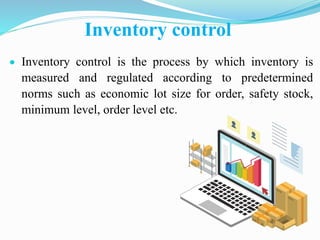
 Inventory control is the process by which inventory is
measured and regulated according to predetermined
norms such as economic lot size for order, safety stock,
minimum level, order level etc.
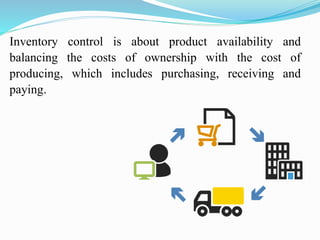
Inventory control is about product availability and
balancing the costs of ownership with the cost of
producing, which includes purchasing, receiving and
paying.
 Inventory control means keeping a track of
inventory, so that the materials are available when
needed.
 Inventory control measures and regulates to
predetermine the size for order, safety stock
minimum level of orders, and maximum level of
order.
Inventory management system
 It provides information to efficiently manage the
flow of material, effectively utilize people and
equipments, coordinate internal activities.
 Inventory management does not make decision or
manage operation; they provide the information to
managers who make more accurate and timely
decision to manage their decision.
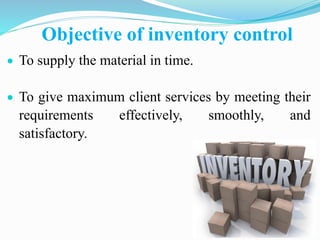
Objective of inventory control
 To supply the material in time.
 To give maximum client services by meeting their
requirements effectively, smoothly, and
satisfactory.
 To minimize investments in inventories.
 To minimize ideal time by avoiding stroke out
and shortage
 To avoid shortage of stoke.
 To minimize the loss due to deterioration,
obsolescence, damage of stoke.
 To meet unforce in future demand.
 To average out demand fluctuation.
 To balance various inventory cost such as carrying
and order cost.
Importance of inventory control
 To provide maximum supply service, consistence with
maximum efficiency and optimum investment.
 To provide cushion between for-casted and actual
demand for materials.
 To have optimum level of inventory; not too large not
small.
 To eliminate duplication in ordering.
 To take care of fluctuation in demand and lead
time.
 To take care of increasing prize tendency of
commodities or rebate in bulk buying.
 To increase transportation efficiently.
 To minimize the inventory cost.
 To minimize the waiting time.
 To provide the check against the loss of material.
 To better utilization of stokes available.
 To facilitate cost accounting activities.
 To locate and dispose inactive and obsolete store
items.
Technique of inventory control
ABC analysis (always better
control):
ABC analysis is a basic supply chain technique in
inventory control. It is very common tool for all
large inventory items.
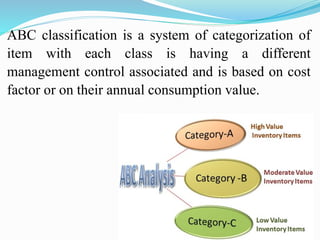
ABC classification is a system of categorization of
item with each class is having a different
management control associated and is based on cost
factor or on their annual consumption value.
Pareto’s theory-
According to his theory 10% items
consume about 70% of budget (Group-A). The next
20% consume 20% of financial resources (Group-B)
and remaining 70% items accounts for just 10% of
budget(Group-C).
Principles of ABC analysis
 The analysis is depending on its annual consumption
values rather than unit cost.
 The limit for ABC categorization are not uniformed but
depends on size of organization, its inventory as well as
number of item control.
 The analysis does not depend on the importance of
item rather based on material prize, credibility and
available status of material, material physical
characteristics, and frequency of material used.
 It also depends on degree and characteristics of
control to be exercised by the management: the
necessity of control, the necessity of which
material to be placed under control and particular
characteristics of material.
Comparison of ABC analysis
ITEM
Procedural steps
 Collect all the data of inventory and prepare a list of all
the items of stores indicating the unit price of each item
and annual consumption.
 Calculate their annual usage in
Rs.(annual consumption in units x unit costs in Rs. =
annual consumption values).
 For stores, it will be Quality issued x unit rate of each
item.
 Arrange all these items in the descending order of
total value of annual consumption of each item in
rupees.
 Mention the item numbers against their annual
consumption.
 Calculate cumulative annuals consumption value
percentage.
 Categorize items as per the consumption value
(cost) percentage.
Advantage of ABC analysis
 Investment in inventory can be maintained.
 Easy to control the wastage of costly items.
 Helps in maintain safety to the total cost.
 Easy to maintain stock and turnover rate.
 Helps to exercise selective control when
confronted with large number of items.
 Rationalize the number of orders, number of items
and reduce the inventory.
 Shows visible results in a short span of time.
 The manager is able to control the inventories
specially controlling ‘A’ items.
 Helps to pins point the obsolete stocks.
 Helps in reducing clerical cost.
Disadvantage of ABC analysis
 Proper standardization and codification of inventory
items is required.
 Considers only the money value not the importance of
items for functioning.
 Periodic reviews become difficult if only ABC analysis is
recalled.
Applicability
 It has universal application for fields returning
selective control.
 It extends almost all the aspects of material
management such as purchasing, receiving, and
inspection.
 It can be used in any setting to control the cost.
VED Analysis
 It means Vital, Essential and Desirable Analysis.
The materials are classified based on critically
that on functional basis.
 The degree of critically can be stated as whether
a material vital to the process, essential or
desirable for the process.
Advantages of VED analysis
 It is useful for monitoring and control of stores
and spare inventory by classifying them into 3
categories viz., Vital, Essential, Desirable.
 Determine the criticality of an item and its effect
on production and other services.
 It is specially used for classification of spare
parts/items. If a part is vital it is given ‘V’
classification. If it is essential than it is ‘E’
classification and if it non -essential the part is
given ‘D’ classification.
 It is useful in controlling and maintaining the
stock of various types.
Combination of ABC & VED
analysis
We can combine both and classify the materials
depending on both the consumption value and the
criticality; it will give us a fruitful result. This can
be done in nine ways
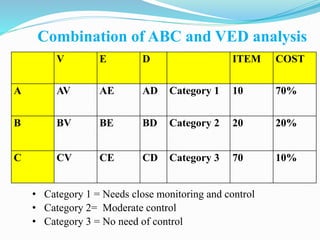
Combination of ABC and VED analysis
V E D ITEM COST
A AV AE AD Category 1 10 70%
B BV BE BD Category 2 20 20%
C CV CE CD Category 3 70 10%
• Category 1 = Needs close monitoring and control
• Category 2= Moderate control
• Category 3 = No need of control
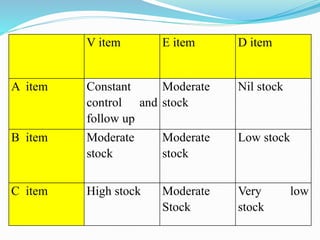
V item E item D item
A item Constant
control and
follow up
Moderate
stock
Nil stock
B item Moderate
stock
Moderate
stock
Low stock
C item High stock Moderate
Stock
Very low
stock
Advantage of ABC & VED analysis
 Helps to management to decide the material policy
and what the services level are expected to see that no
difficulty is faced.
 To control the stock levels by visualizing the
inventory carrying cost.
Nurses’ role in inventory control
 A ward is often referred to as Nursing unit. This implies
that a ward is actually under the control of the Nurse in-
charge for its maintenance and for running its day to-day
patient car activities.
The Nursing responsibilities in relation to
material management are :-
 Ensuring regular and adequate flow of necessary
equipment, supplies, drugs and solutions.
 Monitoring and sustaining the quality and safety of the
materials used including drugs and solution.
 Issuing of items on the basis of “First” in First out’’, and
regular checking of expiry dates of drugs contribute
towards safety.
 Indenting, receiving, storing, checking and timely
replenishing of all necessary equipment, supplies, drugs
and solutions
 Maintaining of emergency and buffer stocks.
 Arranging for preventive maintenance wherever
necessary.
 Maintaining inventory and stock of all items and supplies.
 Arranging for condemnation of articles in accordance
with the down policies of the organization and
maintaining a dead stock register.
 Arranging and assisting in audit of materials.
 Participation in policy making for material management
 Participation in tender / procurement sub-committals
 Orienting Nursing personnel on material management
policies from time to time.
 Evaluation the efficacy of the material management
system followed in particular Nursing unit.
Thank you

Inventry control

  • 1.
    Inventory Control By Mr. RaviRai Dangi Assistant Professor Fellowship in Neonatal Nursing MSc. Child Health Nursing
  • 2.
    Introduction  Inventory controlin hospitals is more than just procurement and usage.  The proper controls and processes can save millions in healthcare costs by enabling a hospital to efficiently order and store just the right amount of supplies needed for patient cases while tracking cost, tier pricing and patient charges associated with supplies.
  • 3.
    What is inventory: It is the stock to ensure uninterrupted supplies, the idle resources which have future economic value and cushion between estimated and actual demand of materials.
  • 4.
    Importance of maintaining inventory It provides and maintains good customers service.  Enables smooth flow of materials through production process.  Provides protection against the uncertainty of demand and supply.
  • 5.
     Ensure areasonable utilization of equipment and effort.  Possibility of discount, if purchase.
  • 6.
    Inventory control  Inventorycontrol is the process by which inventory is measured and regulated according to predetermined norms such as economic lot size for order, safety stock, minimum level, order level etc.
  • 7.
    Inventory control isabout product availability and balancing the costs of ownership with the cost of producing, which includes purchasing, receiving and paying.
  • 8.
     Inventory controlmeans keeping a track of inventory, so that the materials are available when needed.  Inventory control measures and regulates to predetermine the size for order, safety stock minimum level of orders, and maximum level of order.
  • 9.
    Inventory management system It provides information to efficiently manage the flow of material, effectively utilize people and equipments, coordinate internal activities.  Inventory management does not make decision or manage operation; they provide the information to managers who make more accurate and timely decision to manage their decision.
  • 10.
    Objective of inventorycontrol  To supply the material in time.  To give maximum client services by meeting their requirements effectively, smoothly, and satisfactory.
  • 11.
     To minimizeinvestments in inventories.  To minimize ideal time by avoiding stroke out and shortage  To avoid shortage of stoke.  To minimize the loss due to deterioration, obsolescence, damage of stoke.
  • 12.
     To meetunforce in future demand.  To average out demand fluctuation.  To balance various inventory cost such as carrying and order cost.
  • 13.
    Importance of inventorycontrol  To provide maximum supply service, consistence with maximum efficiency and optimum investment.  To provide cushion between for-casted and actual demand for materials.  To have optimum level of inventory; not too large not small.
  • 14.
     To eliminateduplication in ordering.  To take care of fluctuation in demand and lead time.  To take care of increasing prize tendency of commodities or rebate in bulk buying.
  • 15.
     To increasetransportation efficiently.  To minimize the inventory cost.  To minimize the waiting time.  To provide the check against the loss of material.
  • 16.
     To betterutilization of stokes available.  To facilitate cost accounting activities.  To locate and dispose inactive and obsolete store items.
  • 17.
  • 18.
    ABC analysis (alwaysbetter control): ABC analysis is a basic supply chain technique in inventory control. It is very common tool for all large inventory items.
  • 19.
    ABC classification isa system of categorization of item with each class is having a different management control associated and is based on cost factor or on their annual consumption value.
  • 20.
    Pareto’s theory- According tohis theory 10% items consume about 70% of budget (Group-A). The next 20% consume 20% of financial resources (Group-B) and remaining 70% items accounts for just 10% of budget(Group-C).
  • 21.
    Principles of ABCanalysis  The analysis is depending on its annual consumption values rather than unit cost.  The limit for ABC categorization are not uniformed but depends on size of organization, its inventory as well as number of item control.
  • 22.
     The analysisdoes not depend on the importance of item rather based on material prize, credibility and available status of material, material physical characteristics, and frequency of material used.  It also depends on degree and characteristics of control to be exercised by the management: the necessity of control, the necessity of which material to be placed under control and particular characteristics of material.
  • 23.
    Comparison of ABCanalysis ITEM
  • 24.
    Procedural steps  Collectall the data of inventory and prepare a list of all the items of stores indicating the unit price of each item and annual consumption.  Calculate their annual usage in Rs.(annual consumption in units x unit costs in Rs. = annual consumption values).  For stores, it will be Quality issued x unit rate of each item.
  • 25.
     Arrange allthese items in the descending order of total value of annual consumption of each item in rupees.  Mention the item numbers against their annual consumption.  Calculate cumulative annuals consumption value percentage.  Categorize items as per the consumption value (cost) percentage.
  • 26.
    Advantage of ABCanalysis  Investment in inventory can be maintained.  Easy to control the wastage of costly items.  Helps in maintain safety to the total cost.  Easy to maintain stock and turnover rate.
  • 27.
     Helps toexercise selective control when confronted with large number of items.  Rationalize the number of orders, number of items and reduce the inventory.  Shows visible results in a short span of time.
  • 28.
     The manageris able to control the inventories specially controlling ‘A’ items.  Helps to pins point the obsolete stocks.  Helps in reducing clerical cost.
  • 29.
    Disadvantage of ABCanalysis  Proper standardization and codification of inventory items is required.  Considers only the money value not the importance of items for functioning.  Periodic reviews become difficult if only ABC analysis is recalled.
  • 30.
    Applicability  It hasuniversal application for fields returning selective control.  It extends almost all the aspects of material management such as purchasing, receiving, and inspection.  It can be used in any setting to control the cost.
  • 31.
    VED Analysis  Itmeans Vital, Essential and Desirable Analysis. The materials are classified based on critically that on functional basis.  The degree of critically can be stated as whether a material vital to the process, essential or desirable for the process.
  • 32.
    Advantages of VEDanalysis  It is useful for monitoring and control of stores and spare inventory by classifying them into 3 categories viz., Vital, Essential, Desirable.  Determine the criticality of an item and its effect on production and other services.
  • 33.
     It isspecially used for classification of spare parts/items. If a part is vital it is given ‘V’ classification. If it is essential than it is ‘E’ classification and if it non -essential the part is given ‘D’ classification.  It is useful in controlling and maintaining the stock of various types.
  • 34.
    Combination of ABC& VED analysis We can combine both and classify the materials depending on both the consumption value and the criticality; it will give us a fruitful result. This can be done in nine ways
  • 35.
    Combination of ABCand VED analysis V E D ITEM COST A AV AE AD Category 1 10 70% B BV BE BD Category 2 20 20% C CV CE CD Category 3 70 10% • Category 1 = Needs close monitoring and control • Category 2= Moderate control • Category 3 = No need of control
  • 36.
    V item Eitem D item A item Constant control and follow up Moderate stock Nil stock B item Moderate stock Moderate stock Low stock C item High stock Moderate Stock Very low stock
  • 37.
    Advantage of ABC& VED analysis  Helps to management to decide the material policy and what the services level are expected to see that no difficulty is faced.  To control the stock levels by visualizing the inventory carrying cost.
  • 38.
    Nurses’ role ininventory control  A ward is often referred to as Nursing unit. This implies that a ward is actually under the control of the Nurse in- charge for its maintenance and for running its day to-day patient car activities.
  • 39.
    The Nursing responsibilitiesin relation to material management are :-  Ensuring regular and adequate flow of necessary equipment, supplies, drugs and solutions.  Monitoring and sustaining the quality and safety of the materials used including drugs and solution.
  • 40.
     Issuing ofitems on the basis of “First” in First out’’, and regular checking of expiry dates of drugs contribute towards safety.  Indenting, receiving, storing, checking and timely replenishing of all necessary equipment, supplies, drugs and solutions  Maintaining of emergency and buffer stocks.  Arranging for preventive maintenance wherever necessary.
  • 41.
     Maintaining inventoryand stock of all items and supplies.  Arranging for condemnation of articles in accordance with the down policies of the organization and maintaining a dead stock register.  Arranging and assisting in audit of materials.  Participation in policy making for material management  Participation in tender / procurement sub-committals
  • 42.
     Orienting Nursingpersonnel on material management policies from time to time.  Evaluation the efficacy of the material management system followed in particular Nursing unit.
  • 43.